Tag: Kenneth D. Bell

  • Nearly $2 Million Allegedly At Stake For 3 Arizona Zeek Affiliates Who Received Subpoenas, Filings Say

    “[Zeek operator Paul] Burks is solely responsible for determining the amount of ‘net profits’ to share in the Retail Profit Pool . . . Defendants represent that daily awards are calculated by dividing ‘up to 50%’ of daily net profits by the number of Profit Points outstanding among all Qualified Affiliates. This calculation results in a daily dividend paid to each Qualified Affiliate that consistently has averaged approximately 1.5% per day . . . In fact, the dividend bears no relation to the company’s net profits. Instead, Burks unilaterally and arbitrarily determines the daily dividend rate so that it averages approximately 1.5% per day, giving investors the false impression that the business is profitable.”From the SEC complaint in the Zeek Rewards Ponzi scheme case, Aug. 17, 2012

    “The most successful Affiliates worked the hardest, placed numerous ads, and explained the Zeekler.com penny auction to groups of people several times a month. Some of the Movants, for example, traveled extensively to maintain contact with their network of peers and to educate them, among other things, on how to be successful in the program. These Movants’ successes were a direct result of the amount of time and effort they poured into the effort to promote the penny auction.”Zeek Affiliates Dave Kettner, Mary Kettner and David Sorrells, Dec. 11, 2012

    Although the SEC accused Rex Venture Group LLC/Zeek Rewards operator Paul R. Burks in August of conducting a massive Ponzi scheme and duping members into believing he was presiding over a business that created enormous profits legitimately, three members of the MLM “program” with potentially millions of dollars in ill-gotten gains subject to clawback aren’t buying it.

    At stake for Dave Kettner, Mary Kettner and David Sorrells of Arizona is at least $1.94 million they allegedly earned in the “program” through hard work, according to court filings.

    Zeek was a legitimate venture, they argued in filings dated Dec. 11. And it was no Ponzi scheme, they advised Senior U.S. District Judge Graham C. Mullen of the Western District of North Carolina. Mullen is presiding over the Zeek Ponzi scheme case brought by the SEC Aug. 17.

    It was not immediately clear whether the Kettners and Sorrells were the recipients of payouts from Zeek’s Retail Profit Pool (RPP) or commissions for sponsoring new members — or some combination of both. The RPP also is known as the Retail Points Pool.

    What is clear, according to their filings, is that each received a letter and subpoena from Zeek Receiver Kenneth D. Bell that paint them as potential clawback targets. The information about the sums Bell is seeking is contained within exhibits filed by the Kettners and Sorrells.

    Zeek records, according to letters from Bell cited by the trio, suggest Sorrells received $945,539 from Zeek while paying in only $1,695. Dave Kettner received $537,577.95 while paying in only $1,378, and Mary Kettner received $465,866.67 while paying in only $1,495.

    Bell has said Zeek created approximately eight losers for each winner. The SEC described Zeek as a $600 million Ponzi and pyramid scheme that potentially defrauded more than 1 million people.

    The PP Blog is working on a related story about assertions by the Kettners and Sorrells that significant sums of money that belong to them effectively are trapped in NxPay, a payment processor used by Zeek. More later . . .



  • BULLETIN: Zeek Receiver To Hold Conference Call For Victims On Dec. 17

    BULLETIN: Kenneth D. Bell, the court-appointed receiver in the Zeek Rewards Ponzi scheme case, has announced he’ll hold a one-hour, web-based conference call Dec. 17 at 5 p.m. ET (U.S.A.). Bell is encouraging victims to email their questions to him prior to the call. The receiver’s full announcement is published below:

    December 11, 2012

    When I was appointed as receiver of Rex Venture Group LLC d/b/a Zeekrewards.com, one of my primary goals, in addition to locating and seizing assets from the site so they can be returned to the victims, has been to keep all interested parties informed as we move through this process. In an effort to continue to communicate with you and answer your questions about the receivership, I will be hosting a one-hour web based conference call for ZeekRewards victims on Monday, December 17, 2012 at 5:00pm EST. You may access the video call by clicking on the link and following the directions below:

    https://mcguirewoodsevents.webex.com/mcguirewoodsevents/onstage/g.php?d=669382018&t=a&EA=gcooper%40mcguirewoods.com&ET=be20abdd113582919838c5a9b73c73b6&ETR=5e4b1811fab80bf1575c1618f77b7fbc&RT=MiMxMQ==&p

    Event password: rewards

    If you are not near a computer and wish to join the call over the phone, please follow the directions below:
    US TOLL FREE: +1-855-749-4750
    US TOLL: +1-415-655-0001
    Toll-free dialing restrictions: http://www.webex.com/pdf/tollfree_restrictions.pdf
    Access code: 669 382 018
    (This is a call-in number only and those calling in will not have an opportunity to ask questions)

    You may join either the video or phone call 60 minutes prior to the start time.

    I will answer individual questions on the video conference call. However, because we may have more questions than I have time to answer on Monday, I would encourage you to email your questions to me prior to the call so I have the opportunity to address them in my remarks. You can email your question to me at zeekrewardcall@mcguirewoods.com.

    We will look at your questions and I will answer as many as I can during the presentation. Please note that I will not be able to address individual account questions, as there would be too many to get to during the time we have. However, if you have a question about the process, the progress we’ve made so far, next steps, estimated timelines, or even rumors you have heard regarding the receivership, please send those questions to me and I will address as many as I can during the call.

    In an effort to address as many people as possible, I have asked for the maximum number of available ports that our provider is able to handle. In the event that the call reaches capacity or if anyone cannot join the call on the 17th, it will be recorded and available on this site for anyone to view at a later time. Please continue to monitor this site for any updates.

    Thank you for your continuing support.

    Kenneth D. Bell
    Receiver

  • The Incredible Reach Of Zeek: Receiver Files In Guam

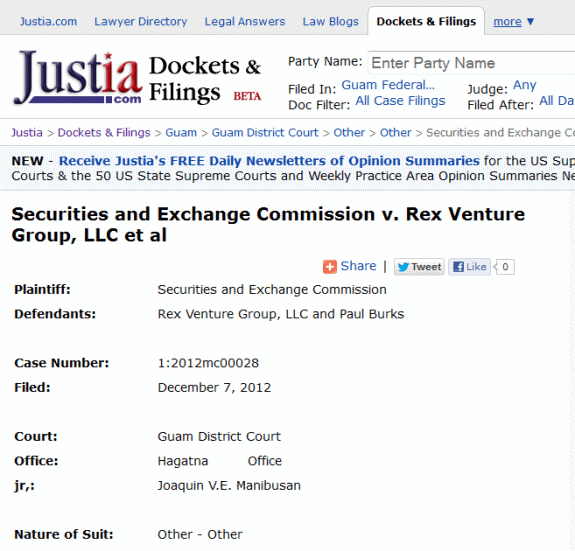
    This filing in Guam by the court-appointed receiver in the Zeek Rewards Ponzi scheme case may be the first in a U.S. territory.

    In yet another indicator of the incredible reach of the alleged Zeek Rewards Ponzi scheme, the court-appointed receiver has filed court paperwork in Guam.

    Guam is a U.S. island territory “approximately 3,300 miles West of Hawaii, and 1,500 miles east of the Philippines and south of Japan,” according to the website of Naval Base Guam.

    Whether U.S. military members in Guam bought into Zeek is unclear. Zeek was based in North Carolina, home state to four military installations.

    In August, the SEC said Zeek “raised money from more than one million Internet customers nationwide and overseas.” In July, the PP Blog reported that an article on Google News by an apparent Portuguese-speaking affiliate of Zeek claimed that the MLM “program” had more than 100,000 members in Brazil alone. Haaretz.com reported in August that Zeek may have had 20,000 members in Israel.

    In recent days, Zeek receiver Kenneth D. Bell has been posting notice of the August SEC complaint and his appointment as receiver in federal courts in multiple states.  The filing in Guam appears to be the first in a U.S. territory, as opposed to a state. The filings set the stage to consolidate Zeek-related court actions in the Western District of North Carolina before Senior U.S. District Judge Graham C. Mullen.

    Bell has said he’ll pursue clawback litigation against Zeek “winners.”

    Some military members were victims of the infamous “3 Hebrew Boys” Ponzi scheme in South Carolina, another state that includes multiple military installations.

    Some promoters of AdSurfDaily, a Zeek-like “program” that planted the seed it provided a return of 1 percent a day, deliberately targeted military members and their spouses.

    From a May 2008 pitch for ASD targeted at military families. ASD collapsed in August 2008.
  • UPDATE: Receiver Sets Stage For Clawbacks In Zeek Ponzi Scheme Case: Filings Provide Clues About U.S. States In Which Fraudulent Transfers Allegedly Occurred

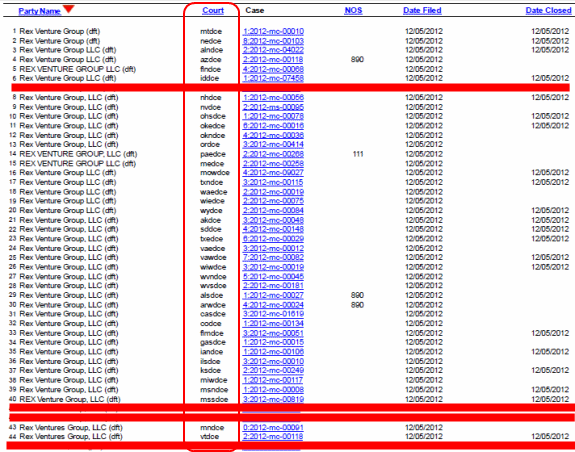
    These filings related to the alleged Zeek Rewards Ponzi scheme operated by Rex Venture Group LLC are appearing in federal court dockets in multiple states today. There are 94 federal judicial districts in the United States, and such a filing is possible in any district in which the court-appointed receiver believes Zeek Ponzi proceeds reside.

    UPDATED 11:02 P.M. ET (U.S.A.) PP Blog reader “Tony” posted comments this morning about cases involving Rex Venture Group LLC popping up in federal courts beyond the Western District of North Carolina, home base of the SEC’s Zeek Ponzi scheme case and the court-appointed receiver. Rex Venture is the parent company of North Carolina-based Zeek.

    Tony initially observed that he’d seen case numbers for Rex-related filings such as this one on Justia.com, a site that tracks court filings. Tony noticed Justia references to filings in the Western District of Arkansas and in Arizona.

    It turned out that these two filings were only the tip of the iceberg. As the day proceeded, more and more references to filings began to appear on PACER, the public-access system for the federal courts.

    The ASDUpdates Blog has been tracking the filings today. As of the time of this post, there appears to be more than 40 such filings in various federal districts in various states. That number could increase because there are 94 federal districts and the filings will occur in districts in which the Zeek receiver has traced assets linked to the scheme.

    Receiver Kenneth D. Bell has said he intends to pursue clawback litigation against Zeek net winners in order to make victims of the alleged Zeek fraud scheme as whole as possible. The early math of Zeek suggests there were about eight losers for every Zeek winner.

    The filings now appearing on the dockets today in various federal districts are yet another indicator of the massive scale of the alleged Zeek fraud, believed to be the largest Ponzi scheme in U.S. history based on the number of victims. That number is estimated in the neighborhood of 1 million.

    In August, the SEC described Zeek as a $600 million Ponzi- and pyramid fraud.

    Today’s filings are not lawsuits against individual Zeek promoters; those will come later, if the receiver and the promoters cannot negotiate a deal that will result in the return of sought-after funds. Today’s filings — in effect — are formal notifications to court officials in the various districts that the receiver may be operating in their districts under the authority of the federal court for the Western District of North Carolina.

    Senior U.S. District Judge Graham C. Mullen of the Western District of North Carolina is presiding over the SEC’s Zeek case and the receivership.

    Despite the SEC’s Zeek action, the HYIP universe continues to serve up wantonly destructive fraud schemes, thus potentially creating victims by the tens of thousands at a time. In many cases, the schemes are advanced by willfully blind hucksters, including hucksters who populate Ponzi scheme boards such as TalkGold and MoneyMakerGroup and race from scheme to scheme to scheme.

  • BULLETIN: Proposed Class-Action Against Zeek In Louisiana Transferred To North Carolina

    BULLETIN: A federal judge has transferred from the Eastern District of Louisiana to the Western District of North Carolina a proposed class-action lawsuit against Rex Venture Group LLC, Zeek Rewards and Paul R. Burks.

    The ruling by U.S. District Judge Carl J. Barbier  in New Orleans likely paves the way for Senior U.S. District Judge Graham C. Mullen of Charlotte to issue a specific order to stay the case. Both Burks and Kenneth D. Bell, the court-appointed receiver in the Zeek Ponzi scheme case brought by the SEC on Aug. 17 in Mullen’s courtroom, have sought the stay.

    In August, Mullen issued an order that “[a]ll Ancillary Proceedings are stayed in their entirety, and all Courts having any jurisdiction thereof are enjoined from taking or permitting any action under further Order of this Court. . . .”

    The prospective class action was filed in Louisiana on Aug. 24, a week after Mullen issued the stay in North Carolina.

    Burks has contended that the Louisiana plaintiffs tried to circumvent the Aug. 17 stay issued by Mullen by bringing an action in another federal district.

  • BULLETIN: Receiver Re-Serves Zeek Member Who Sought To Quash Subpoena

    BULLETIN: An apparent Florida member of the Zeek Rewards “program” who claimed last week that the court-appointed receiver situated in North Carolina had served a subpoena improperly from the Tar Heel state via U.S. Mail now has been served again — this time through a more expensive process that involved certified U.S. Mail, FedEx and a Florida federal district court.

    Receiver Kenneth D. Bell said in a court filing today in North Carolina that he had sent a revised subpoena to Nathaniel Woods of Ocala, Fla.

    This time, the subpoena was issued by U.S. District Court for the Middle District of Florida, as opposed to U.S. District Court for the Western District of North Carolina, Bell said.

    And it was sent by both certified mail and FedEx, Bell noted, adding that the subpoena “requires the requested documents to be produced at a location in Jacksonville, Florida, less than 100-miles from Mr. Woods’ residence in Ocala.”

    Jacksonville is approximately 85 miles from Ocala. The address at which the documents must be produced is the Jacksonville office of the McGuireWoods law firm. The firm is counsel for the receiver and also has an office in Charlotte, N.C.

    The implication is that Woods now will have to travel from Ocala to Jacksonville to comply with the second subpoena. In the initial process, he could have mailed the requested documents to North Carolina, the home base of the receivership.

    Senior U.S. District Judge Graham C. Mullen now should rule Woods’ objections to the manner in which he initially was served moot, Bell argued.

    Mullen is overseeing the Zeek case from the Western District of North Carolina.

    Bell’s earlier method of serving subpoenas was designed to save money, he advised the judge.

    From the receiver’s filing today (italics added):

    One of these subpoena recipients, Nathaniel Woods, admittedly received his subpoena, but has filed a motion to quash his subpoena on various procedural grounds. The Receiver’s initial investigation found that Mr. Woods may have received more than $500,000 in other people’s money in net winnings from this scheme. Thus, the documents sought by the Receiver from Mr. Woods are clearly relevant, and are at least likely to lead to relevant and admissible evidence. Indeed, Mr. Woods could simply have contacted the Receiver to discuss or object to the original subpoena or obtain more time to respond, as many other subpoena recipients have done. The Receiver has worked with everyone who has responded in good faith to obtain relevant documents on an agreed schedule. Many recipients are also pursuing the opportunity offered by the Receiver to reach a prompt settlement of the fraudulent transfer claims.

    Thus, Mr. Woods’ motion to quash only serves to delay – on the grounds of form, not substance – the production of documents to which the Receiver is undoubtedly entitled in his role as appointed by this Court.

    Bell also advised Mullen that the first batch of subpoenas that went out earlier this month were targeted at “approximately 1,200 of the largest net winners of the Zeek Rewards scheme.

    “On average,” Bell advised the judge, “these net winners made over $100,000 from the scheme’s victims.”

    From the initial mailing of “approximately 1,200 subpoenas,” the receiver said, “to date only 26 have been returned as undeliverable, confirming the Receiver’s belief that this initial method of delivery would accomplish the practical goal of actual notice.”

    And, he noted, “It would have cost more than five times as much to serve the subpoenas via certified mail or FedEx and taken far longer to issue them from numerous judicial districts and make arrangements for production of the documents within 100 miles of each address.”

    The goal of the initial mailing “was to implement a streamlined process that would most effectively begin the process of recovering Receivership Assets and initiating a dialogue with the net winners who are willing to cooperate with the Receiver in gathering information and discussing the return of fraudulently transferred funds,” Bell said.

    In August, the SEC described Zeek as a $600 million Ponzi scheme and pyramid fraud.


  • Firm Assisting In Zeek Receivership Probe Has Another High-Profile Case; New York Times Reports That Kroll Investigative Firm Discovered ‘Well-Concealed Ponzi Scheme’ At Kabul Bank And ‘114 Rubber Stamps For Fake Companies’

    A company retained by the court-appointed receiver in the Zeek Rewards Ponzi scheme case received a prominent mention in the New York Times yesterday.

    The company, the Kroll investigative firm, uncovered a massive Ponzi fraud at Kabul Bank in Afghanistan in which hundreds of millions of dollars were siphoned from depositors to benefit a “narrow clique” of people tied to the Afghan government, according to an audit report obtained the Times.

    Loan books were “almost entirely fraudulent,” the Times reported, citing the Kroll forensic audit.

    “At one point, Kroll’s investigators found 114 rubber stamps for fake companies used to give forged documents a more legitimate look,” the Times reported, citing the audit.

    From the Times (italics/bolding added):

    What Kroll’s audit found is that on Aug. 31, 2010, the day the Bank of Afghanistan seized Kabul Bank, more than 92 percent of the lender’s loan portfolio — $861 million, or roughly 5 percent of Afghanistan’s annual economic output at the time — had gone to 19 related people and companies, according to the audit.

    Kroll is one of the firms retained by Zeek receiver Kenneth D. Bell. Its name is referenced in the Preliminary Liquidation Plan Bell filed Oct. 8.

    In the filing, Bell informed Senior U.S. District Judge Graham C. Mullen of the Western District of North Carolina that Zeek had “at least one foreign account” that had not been seized in the aftermath of the SEC’s Ponzi scheme investigation.

    It was “not clear” whether the funds would be recoverable despite the fact the bank that holds the account has been served with a freeze order, Bell advised Mullen in the filing.

    Bell did not name the bank or its home country in the filings. Nor did he say how he discovered the account.

    On Aug. 17, the SEC described Zeek as a $600 million Ponzi- and pyramid fraud operating from Lexington, N.C.

    Some Zeek members have worked virtually nonstop since that time to demonize Bell, a former federal prosecutor who once successfully prosecuted a Hezbollah terrorist cell operating in the United States.

    Zeek had “internet customers and contacts throughout the United States and internationally,” Bell advised Mullen.

    Kroll Ontrack has assisted the receivership “with the collection of electronically stored information obtained from” Zeek, Bell advised Mullen.

    In the case in Afghanistan, Kroll prepared the audit for the country’s central bank, according to the Times. Twenty-two people have been charged in the Afghanistan case.


  • Nathaniel Woods Plants Seed That Zeek Receiver Issued ‘Bogus Subpoena’ And Committed Felony; Claims Reminiscent Of Assertions Made In AdSurfDaily Ponzi Case

    UPDATED 5 P.M. ET (U.S.A.) Various members of the Florida-based AdSurfDaily 1-percent-a-day Ponzi scheme advanced various theories that judges, prosecutors and investigators committed various felonies during the course of the probe and follow-up actions in court. The claims were absurd on their face and, when the arguments were rejected, they were replaced by conspiracy theories. Time after time the conspiracy theories expanded to accommodate unpleasant fact sets, with various “defenders” of ASD retreating into an infinite set of contingencies and conflating one artificial reality after another.

    Now, a Florida resident and apparent participant in Zeek Rewards has filed a document in federal court that accuses the court-appointed receiver in the Zeek Ponzi scheme case of committing a felony. The receiver, Kenneth D. Bell, is a former federal prosecutor who once successfully prosecuted a Hezbollah terrorist cell operating in the United States.

    The PP Blog contacted the Zeek receivership today to seek comment from Bell. The Blog’s message was not immediately returned.

    In separate filings that appear on the docket of Senior U.S. District Judge Graham C. Mullen of the Western District of North Carolina, Nathaniel Woods claimed Bell or Bell’s receivership team unlawfully mailed a “bogus subpoena” to him in Ocala, Fla., thus committing a felony under Florida law.

    Mullen is presiding over the Zeek Ponzi case. In August, the SEC accused Zeek of operating a $600 million Ponzi- and pyramid scheme. Zeek’s business model was very similar to the model of ASD. ASD’s business practices triggered both civil and criminal investigations by the U.S. Secret Service in 2008.

    The subpoena, Woods claims, was meant for the purposes of “intimidation and harassment” on the part of the receiver.

    And Woods further claims that sending a “bogus subpoena” from North Carolina to Florida through the U.S. Mail constitutes “simulated process” under Florida law, a “third degree felony.”

    An accompanying document filed by Woods as an exhibit claims that “preliminary Zeek Rewards records” reviewed by the the receivership show that Woods received more than $496,000 from Zeek but paid nothing (“$0.00”) into the purported program.

    Bell is seeking the return of the money, describing it as “money lost by victims,” according to the exhibit.

    Woods is seeking to quash the subpoena, which demands records of Woods’ interactions with Zeek dating back to January 2010. He also claims the subpoena was only an “alleged subpoena” and was improperly served.

    A domain styled “500FREEBIDS4U.COM” is registered in the name of Nathaniel Woods at the Ocala street address to which the subpoena was sent, according to records. Other domains listed with an email address that appears on the registration data attributed to Nathanial Woods include Mybidshack10k.com, Mybidshackhow.info, Mybidshack4u.com and Mybidshackearn.info.

    Daryle Douglas, a onetime purported Zeek executive, also has been associated with a MyBidShack entity, according to researcher “K. Chang.”

    Zeek was a purported “penny auction” company operated by Paul R. Burks through Rex Venture Group LLC in Lexington, N.C. The penny-auction site was known as Zeekler. Zeek’s MLM arm was known as Zeek Rewards. Burks has consented to a judgment in the case. He has neither admitted nor denied the SEC’s allegations, which include securities fraud and the sale of unregistered securities.

    On Aug. 17, the U.S. Secret Service said it also was investigating Zeek. The SEC has said Burks duped investors into believing the purported Zeek “program” was paying a legitimate return of about 1.5 percent a day.

    Bell has said that perhaps 1 million people sent money to Zeek. Viewed by the number of potential victims and the number of transactions, Zeek may be the largest Ponzi scheme in U.S. history.

    Earlier this month, Bell said the receivership had gathered evidence that nearly 1 billion transactions were conducted through Zeek in about 18 months.

    AdSurfDaily was a Ponzi scheme that promoted a payout of 1 percent a day. It has about 100,000 members and gathered about $119 million, also in about 18 months, according to records.

    Records suggest that Zeek, which launched after the Secret Service brought the ASD Ponzi case, did about five times the dollar volume of ASD and potentially had 20 times the user volume.

    The civil portion of the ASD case dragged out for all or parts of five years. ASD President Andy Bowdoin admitted in May 2012 that ASD was a Ponzi scheme. In August 2012, less than two weeks after the SEC brought the Zeek case, Bowdoin was sentenced to 78 months in federal prison.

    ASD and Zeek are known to have had members in common.

  • STUNNING: Nearly 1 BILLION Zeek Transactions Over 18 Months, Receiver Says; ‘Sheer Quantity Of Data’ And ‘Inadequate And Incomplete’ Records Necessitate Delay In Filing Of Liquidation Plan

    EDITOR’S NOTE: It’s this simple: Ponzi = Pain — and even “ordinary” Ponzi schemes often result in extraordinary paper chases. The Zeek case may be setting a new standard for the extraordinary.  

    The receiver in the Zeek Rewards Ponzi scheme case informed a federal judge today that “the Receivership Team is still in the process of reconstructing over 18 months of ZeekRewards financial information involving more than 931 million transactions.”

    It was not immediately clear if the jaw-dropping number set a record for a Ponzi case. About 2.2 million “unique users” of Zeek exist, and about 1 million affiliates “paid money into” Zeek, receiver Kenneth D. Bell said.

    Without objection from the SEC, Bell has asked Senior U.S. District Judge Graham C. Mullen for a delay until Dec. 17 in the filing of a liquidation plan.  On Aug. 17, the SEC accused Zeek — through its parent company Rex Venture Group LLC — of operating a $600 million Ponzi- and pyramid scheme. In terms of the number of participants, Zeek may be the largest Ponzi scheme in U.S. history.

    “In short, the magnitude of the transactions, the inadequate and incomplete nature of the Receivership Defendant’s financial records, and the sheer quantity of data and Affiliates all necessitate additional time for the Receiver to analyze, account, and liquidate the assets of the Receivership Defendant,” Bell wrote.

    Bell also filed reports today that showed the McGuireWoods law firm and FTI Consulting Inc., a forensic accounting firm, are providing significant billing discounts to the receivership estate. The law firm is providing a 15 percent discount, Bell said.

    Meanwhile, the accounting firm is providing a discount of more than 22 percent, Bell said.

    “As of September 30, 2012, the Receiver recovered $293.7 million for the Receivership Estate,” Bell said. “Combined, MW and FTI request $853,491.29 in fees and services. The fees requested are less than 0.3% of the recovery for the Estate.”

    Here is the breakdown, according to the receiver’s first application for fees and expenses:

    • Receiver and law firm (billing for services of $718,713.86 and expenses of $49,388.37).
    • FTI (billing for services of $82,430 and expenses of $2,959.06).

    From footnotes in the billing report (italics added):

    1 At the time of the Receiver’s appointment, the Receiver and MW agreed to a 15% reduction in the hourly rates for the Receiver and all of MW’s attorneys and paraprofessionals. In accordance with the SEC Guidelines, long-distance travel time was billed at a rate that was reduced 50% from the already-discounted rates, resulting in an effective discount of 64% or greater for travel time, and a total discount of $21,258.05 in fees related to travel time alone. The Receiver and MW also determined to write off the time for 11 timekeepers in a further effort to increase savings to the estate.

    2 In keeping with the rate discounts applied by MW, FTI reduced the hourly rates for its Senior Managing Directors to $495, Managing Directors to $410, Senior Directors to $395, Directors to $350, Senior Consultants to the range of $270-$320, and Consultants to the range of $210-$225. The average reduction in bill rates is 22.5% per hour.

    3 FTI has agreed to not charge for travel time. Additionally, FTI has waived its customary administrative expense that is usually 6% of fees charged.

    The judge must approve the billings.

    NOTE: Visit the Zeek files site maintained by the ASDUpdates Blog.

  • UPDATE: Judge Grants Zeek Receiver’s Request To Treat Preliminary Liquidation Plan As Ponzi Case’s First Status Report

    Senior U.S. District Judge Graham C. Mullen has granted the request of the receiver in the Zeek Rewards Ponzi scheme case to treat the preliminary liquidation plan filed Oct. 8 as the first status report in the case.

    Receiver Kenneth B. Bell said earlier this week in court filings that the request, if granted, would save money. Mullen approved the request in an order today.

    The development means that Bell, who is in the process of issuing subpoenas to a first round of about 1,200 Zeek members believed to have been the biggest winners, will not be required to file another status report until the end of January.

    Potentially “thousands” of subpoenas to other Zeek members who took out more than they put in will follow the first round of 1,200, Bell said in a statement Oct. 30. (See Oct. 31 PP Blog story.)

    The SEC has described Zeek as a $600 million Ponzi- and pyramid scheme. Among other things, status reports inform judges about efforts to recover fraud proceeds and return them to victims. In the Zeek case, status reports from the receiver are due within 30 days of the close of a calendar quarter.

    See Bell’s Oct. 8 preliminary liquidation plan. (Courtesy of ASDUpdates Blog.)

    In September, the SEC said its Zeek probe was ongoing.


  • BULLETIN: First Round Consisting Of 1,200 Subpoenas Will Go Out This Week To Zeek ‘Affiliates Who Profited Most,’ Receiver Says; More Subpoenas Will Follow; Winners Also Will Receive ‘Letter Offering To Negotiate Voluntary Surrender Of Profits’

    UPDATED: 7:08 P.M. EDT (U.S.A.) The court-appointed receiver in the Zeek Rewards Ponzi scheme case has announced that about 1,200 subpoenas will go out this week to “affiliates who profited most from ZeekRewards.”

    It’s “victims’ money, really,” receiver Kenneth D. Bell said in a letter posted on the receivership website.

    “The subpoenas ask for financial information, including dealings with Rex Venture,” Bell wrote. “Depositions and litigation will follow if necessary. With each subpoena will be a letter offering to negotiate voluntary surrender of profits (victims’ money, really) instead of going to Court.”

    On Aug. 17, the SEC described Zeek as a $600 million Ponzi- and pyramid scheme that potentially affected more than 1 million members.

    In the receiver’s letter dated Oct. 30, Bell said a preliminary analysis suggests that Zeek losers outnumber winners by a factor of about eight to one. Zeek was operated by North Carolina-based Rex Venture Group LLC and Paul R. Burks.

    “Our preliminary analysis has identified more than 800,000 affiliate User IDs who put more money into Rex Venture than they took out,” Bell wrote. “We estimate that losses will total between $500 million and $600 million. We have already recovered more than $300 million and continue to pursue millions more held in financial institutions. To fill the gap between what we have recovered and what victims lost, we will pursue recovery from those who took out of Rex Venture more than they put in. There are more than 100,000 User IDs in this category representing hundreds of millions of dollars.”

    More subpoenas will be issued in the coming weeks, Bell said.

    “Additional subpoenas and demands for return of profits will be served on thousands more in the weeks to come,” Bell wrote. “I can’t tell you we will recover enough to make all victims 100% whole, but if we don’t it won’t be for lack of trying.”

    A “preliminary, partial” distribution of money to help Zeek victims recover also is being planned, Bell said. No timetable was released, but the receiver noted that he would submit a claims form for the court’s approval. Once Senior U.S. District Judge Graham C. Mullen approves the form, the process of filing claims will begin.

    “Once approved the Form will be posted” on the receivership website, the receiver wrote.  “When that process has run we will ask the Court for permission to make a preliminary, partial distribution to qualified claimants from recovered funds. A final distribution will have to wait until we have finished collecting all recoverable assets. This will unfortunately take quite a while, and I appreciate your support and patience.”

    Bell said he’d received emails from Zeek members inquiring whether they should hire an attorney or “join a group” that has hired an attorney to assist in claims recovery.

    “I cannot and do not advise you one way or another about hiring an attorney,” Bell wrote. “I can tell you that my direction from the Court, and my duty to you, is to seize all recoverable assets and distribute them to victims as fully and fairly as possible.

    “That, I will do,” he concluded.

    UPDATE: 7:08 P.M. EDT (U.S.A.): The receiver has added a “Subpoena FAQ” here. At the time of this update, there are nine entries in the FAQs, including this question and answer (italics added):

    1. Why have I received a subpoena for documents?

    The ZeekRewards Receiver has been authorized by the Court to recover money and pursue claims for the company. You are receiving this subpoena because you have been identified as an “affiliate,” participant, agent or employee in the ZeekRewards operation who may have received significantly more money from ZeekRewards than you put into the operation. The so-called “profits,” “commissions,” or “winnings” that you received were really just money put in by the victims of the Ponzi and pyramid schemes described in the Securities and Exchange Commission Complaint. The subpoena you received is the legally authorized means for the Receiver to gather information from you in connection with the legal process to recover your “profits,” “commissions,” and “winnings” to compensate victims.