Tag: Kenneth D. Bell

  • Some Traffic Monsoon Promoters Are Zeek Clawback Defendants

    trafficmonsoonlogoUPDATED 11:51 A.M. EDT U.S.A. Zeek Rewards’ receiver Kenneth D. Bell had no comment this morning on reports that some Zeek clawback defendants also were participants in Traffic Monsoon, alleged last week by the SEC to have been a Ponzi scheme that had gathered at least $207 million.

    The reports appeared on RealScam.com.

    In March 2015, Bell sued Adrian Hibbert of the United Kingdom, alleging he had received more than $82,000 in Ponzi proceeds from Zeek. Zeek was charged with fraud by the SEC in August 2012.

    Another Zeek promoter listed by Bell as a winner in that scheme — Frank Calabro Jr. of the United States — also promoted Traffic Monsoon. Bell has expressed concern about online pitchmen moving from one fraud scheme to another.

    “Winnings” from MLM or direct-sales fraud schemes may be subject to return through clawback litigation.

    Both Zeek and Traffic Monsoon were purported “revenue sharing” programs. Paul Burks, the operator of Zeek Rewards, potentially faces a long prison term after his conviction earlier this month on multiple fraud counts.

    On July 26, the SEC civilly charged alleged Traffic Monsoon operator Charles Scoville of Utah with fraud. He has not been charged criminally and is believed to be residing overseas.

    Peggy Hunt of the Salt Lake City office of the Dorsey & Whitney law firm has been appointed receiver over Traffic Monsoon. Neither she nor the firm responded immediately this morning to a request for comment on the issue of common promoters between Traffic Monsoon and Zeek.

    The law firm confirmed to the PP Blog last week that there would be a receivership website for Traffic Monsoon, but the site was not yet live. The URL has not been released.

    Some Zeek clawback defendants also were participants in the AdSurfDaily Ponzi scheme. ASD was a “program” similar to Traffic Monsoon broken up by the U.S. Secret Service in 2008 in a highly publicized action.

    In U.S. domestic clawback litigation and in cases filed against non-U.S. residents, Bell has sued thousands of alleged Zeek winners for return of their gains and interest.

    Hunt’s plans with Traffic Monsoon are unclear.

    Hibbert appears also to have a page promoting the “My Advertising Pays” scheme.  MAPS, as it is known, has caught the attention of class-action attorneys involved in litigation against the TelexFree scheme broken up by the SEC and the U.S. Department of Homeland Security in 2014. The litigation also includes Zeek figures.

    TelexFree and Zeek may be the two largest combined Ponzi- and pyramid schemes in history, generating on the order of $4 billion in illicit, cross-border business and affecting hundreds and hundreds of thousands of people.

    The MAPS’ page attributed to Hibbert claims that MAPs operator Mike Deese “has been in the trenches with Zeek, ASD, Banners Broker, Ad Hit Profits, and many other advertising revenue sharing companies some of which continue to thrive and some that are not.”

    AdHitProfits also was a Scoville scheme. BannersBroker was a cross-border fraud that led to arrests in Canada.

    Separately, the Zeek page attributed to Hibbert claims, “If you want to make money and get paid everyday, you have to look at Zeek Rewards and understand how it works.”

    The SEC and federal prosecutors in the Western District of North Carolina said Zeek worked as a Ponzi scheme.

    Visit the TrafficMonsoon thread at RealScam.com.


  • URGENT >> BULLETIN >> MOVING: Zeek Receiver Moves For Summary Judgment Against Class-Action Clawback Defendants; Kenneth Bell Says Defense Expert Witness Has Found No Evidence That ‘Disproves That The Business As A Whole Operated As A Ponzi Scheme’

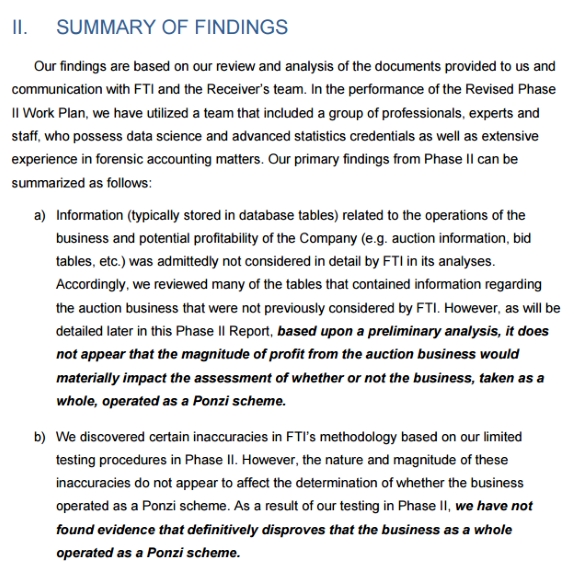
    Berkeley Research Group, an expert working for the defense in Zeek clawback litigation,has not been able to disprove the presence of a Ponzi scheme. Source: Screen shot of a Berkeley report to Senior U.S. District Judge Graham C. Mullen Jr. The report is dated May 26, 2016.
    Berkeley Research Group, an expert working for the defense in Zeek clawback litigation, has not been able to disprove the presence of a Ponzi scheme. Source: Screen shot of a Berkeley report to Senior U.S. District Judge Graham C. Mullen Jr. The report is dated May 26, 2016.

    URGENT >> BULLETIN >> MOVING: (3RD UPDATE 6:11 P.M. EDT U.S.A.) On virtually the eve of the criminal trial of Paul Burks, receiver Kenneth D. Bell has asked the court presiding over a huge class-action lawsuit against 9,400 alleged Zeek “winners” for a finding the MLM program was a Ponzi scheme.

    Such a finding would mandate winners to return nearly $300 million. Bell contended that “[o]f the over $900 million that was paid in to Zeek, only approximately $10 million (1.1%) came from actual retail purchases.”

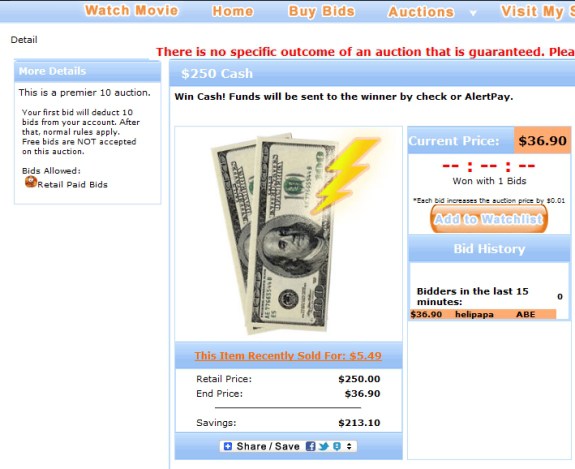
    Retail sales are crucial to the determination of whether an MLM program is legitimate. Bell contends Zeek, which offered a penny auction, was both a Ponzi scheme and a pyramid scheme. Zeek affiliates allegedly believed enormously profitable auctions made Zeek sustainable.

    “Two of the primary creators and operators of the ZeekRewards scheme have already admitted it was a Ponzi scheme and pleaded guilty to criminal conduct in connection with the scheme,” Bell argued to Senior U.S. District Judge Graham C. Mullen in a June 30 motion. “In sum, the evidence that ZeekRewards was a Ponzi scheme is overwhelming. Even the Defendant class’ expert has acknowledged finding no evidence that ‘disproves that the business as a whole operated as a Ponzi scheme.’

    “Because Zeek’s net winners ‘won’ (the victims’) money in an unlawful Ponzi scheme, under long settled law those winners are not permitted to keep their winnings and must return the fraudulently transferred funds back to the Receiver for distribution to Zeek’s victims,” Bell argued.

    At stake in the civil clawback case is more than $282 million allegedly paid to winners by Zeek. Berkeley Research Group is the expert for the defense. Bell used FTI Consulting Inc. as his expert.

    Burks’ criminal trial is scheduled to begin Tuesday (July 5).

    What kind of financial environment did Zeek create?

    According to FTI, only about 8 percent (75,000 usernames) were winners, while 90 percent (841,000 usernames) were losers. Meanwhile, only 0.3 percent (2,778 usernames) were net neutral, with only 1.6 percent (14,500 usernames) classified as auction bidders only.

    Bell sued 9,400 alleged winners who’d received more than $1,000 each. FTI asserted that the net losers lost more than $822 million and the net winners hauled away more than $282 million. The small number of auction bidders suggests that Zeekers by and large joined for the purported money-making venture.

    But Zeek, Bell alleged, was insolvent even while paying out large sums of money.

    Cocaine Allegation Made By Alleged Insider

    During a deposition conducted in April 2016 by an attorney for the receivership, alleged Zeek insider Darryle Douglas made a claim that former Zeek COO Dawn Wright-Olivares was a user of “crack cocaine” who was “asked to leave” Free Store Club, a Zeek predecessor, according to a partial transcript included in Bell’s June 30 motion.

    Wright-Olivares also is an alleged Zeek insider and one of two Zeek figures to plead guilty to Ponzi-related criminal charges. (The other is Daniel Olivares, her stepson.) Wright-Olivares and Olivares both are expected to testify against Burks at his criminal trial.

    Whether Burks intended to use the cocaine allegation against Wright-Olivares to impeach her credibility as a witness was not immediately clear. But Wright-Olivares and Olivares both lived with Douglas at one time in Lexington, N.C., according to the transcript.

    Zeek, as part of Rex Venture Group, was based in Lexington.

    While living in Lexington, a “separation” developed between Douglas and Wright-Olivares and a once-strong business relationship between Douglas and Burks became “fractured,” according to the transcript.

    “And that’s where our separation began,” Douglas said, according to the transcript. “Dawn was a crack cocaine user . . .  Dawn used cocaine and was asked to leave the company eventually . . . This was FreeStore Club. She left but came back with the idea for a penny auction, which no one had ever heard of. Because we had a fractured relationship, we created MyBidShack, they created Zeekler. Eventually Paul decided to get rid of MyBidShack and that the company would only go under Zeekler, which made our rift expand. It set up a war that we — that’s when I was no longer allowed to have access codes or key information from accessing the system . . .”

    The receiver’s motion, memo and exhibits are available at the receivership website.

    Also see “ANNOUNCEMENT FROM THE RECEIVER – July, 1, 2016” at the receivership site.


  • Alleged TelexFree Winner Tries To Sue Trustee For ‘Emotional Distress’; Separately, U.S. Judge Asks Dominican Court For Assistance

    breakingnews725It may be a first in MLM clawback cases.

    Dwayne Jones, an alleged winner of more than $561,000 in the judicially declared TelexFree Ponzi- and pyramid scheme, is trying to sue Trustee Stephen B. Darr for “Emotional Distress and Anticipated Attorney & Court Costs.”

    In a proposed defendant class-action, Darr sued Jones and dozens of other alleged winners earlier this year for return of their gains. Jones was sued at a New York address. Acting pro se, he appears to have responded to Darr’s adversary complaint filed in Massachusetts federal bankruptcy court with a kit pleading from Maryland federal bankruptcy court in which he denied he was a TelexFree winner, raised jurisdictional claims and asserted the emotional-distress counterclaim against Darr.

    Darr responded on June 6, saying he “denies in full the sole allegation in the defendant’s Counterclaim, that the defendant is entitled to unspecified damages for emotional distress and anticipated attorney and court costs arising out of this litigation.”

    The trustee also entered affirmative defenses.

    Class-action cases filed by Darr against alleged TelexFree winners potentially affect nearly 100,000 participants globally who gained more from TelexFree than they paid in. The scheme allegedly created hundreds and hundreds of thousands of losers.

    Chief U.S. Bankruptcy Judge Melvin S. Hoffman of Massachusetts is presiding over the cross-border TelexFree case and adversary proceedings.

    On May 24, Hoffman asked judicial authorities in the Dominican Republic for assistance in serving process on more than a dozen clawback defendants located there.

    Darr contends TelexFree generated more than $3 billion in illicit business worldwide and that winners must return their gains.

    Kenneth D. Bell, the receiver in the Zeek Rewards case, also has brought clawback claims against alleged domestic and international winners in that scheme. Zeek is alleged to have gathered on the order of $897 million.


  • PAYZA TO ZEEK RECEIVER: Don’t Blame Us

    ponzinews1Payza, an HYIP-friendly payment processor that recently bragged on Twitter about its attendance at an event for the teetering TrafficMonsoon scheme, has advised a federal judge that it is not responsible for millions of dollars that allegedly went missing in the Zeek Rewards’ scheme taken down by the SEC in 2012.

    Zeek receiver Kenneth D. Bell alleged in February that Payza and an outfit known as Payment World “facilitated” the epic cross-border Zeek Ponzi- and pyramid scheme. The PP Blog reported on Feb. 21 that the money at issue — about $13.1 million — may have ended up in one or more collapsed Russian banks after being transferred out of VictoriaBank in Moldova.

    Payza acknowledged it was a business partner with Payment World, but maintained the account in Moldova was Payment World’s alone and that it has sued Payment World for more than $20 million because it, too, had been ripped off.

    In response to Bell, who is seeking a contempt sanction and to hold Payza jointly liable with Payment World and VictoriaBank for return of the cash, Payza says it never had “dominion and control” over the money and thus should not be held liable.

    Payza, which operates out of Canada as part of a company known as MH Pillars of the United Kingdom, further contends with worked cooperatively and proactively with Bell and U.S. authorities tracking the money. The defense filing by Payza was docketed yesterday in the Western District of North Carolina and also claims Payza performed due diligence on Rex Venture Group, the operator of Zeek. The filing contained a declaration by MH Pillars Executive Vice President Firoz Patel.

    In a May 15 Twitter post, Payza said Patel was a speaker at a May 15 event in New York for the Traffic Monsoon program.

    The Tweet made no due-dilignce claims about Traffic Monsoon, which reportedly is under investigation by PayPal and has been blocked from a sum totaling on the order of $60 million.

    NOTE: Our thanks to the ASD Updates Blog.

    Also see TaraTalks site.


  • Alleged Zeek ‘Winner’ Repeatedly Invokes Fifth Amendment In Clawback Case

    UPDATED 3:07 P.M. EDT U.S.A. Darren Miller, an alleged winner of more than $1.635 million in Zeek Rewards and one of the lead defendants in a civil class-action clawback lawsuit filed by Zeek receiver Kenneth D. Bell, repeatedly has invoked his Fifth Amendment right not to incriminate himself, according to new court filings by Miller.

    In response to Bell’s 2014 clawback action in which the receiver seeks return of the winnings plus interest, Miller, of Coeur d’Alene, Idaho, also marked “sic” next to mentions of himself as a defendant. Bell is suing Miller and more than 9,000 alleged Zeek “winners.” The case is styled Bell v. Disner.

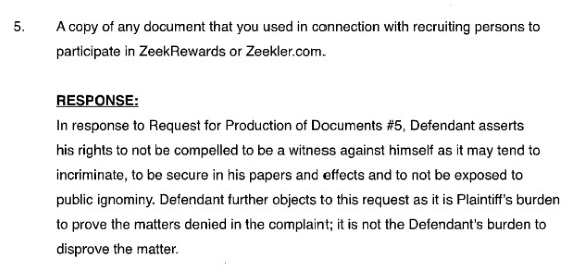
    Miller appears to have invoked the Fifth Amendment 41 times in response to 41 inquiries from Bell — 14 questions and 27 requests for documents.

    His response provides an overview of the sorts of questions Bell asked alleged “winners” through interrogatories. It also provides an overview of the type of documents sought from defendants by the receiver. Zeek was part of Rex Venture Group or RVG, alleged by the SEC and federal prosecutors to have been a North Carolina-based Ponzi- and pyramid scheme that gathered hundreds of millions of dollars before the SEC shut it down in August 2012.

    The Zeek clawback litigation itself shows the perils of pushing MLM schemes authorities deem to be fraudulent. Not only is money received from a “program” at great risk of clawback, expensive and emotionally draining legal proceedings on multiple fronts may ensue.  Some defendants even may fear criminal prosecution.

    At the same time, the Zeek clawback actions may provide something of a preview of what’s in store for tens of thousands of TelexFree “winners” pursued by the trustee in that Massachusetts case for return of their gains. TelexFree also was an MLM scheme.

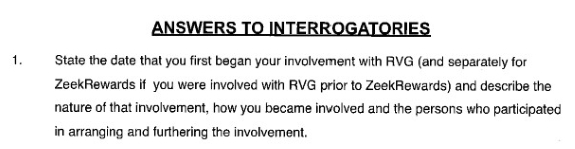
    Pictured below is the first of 14 interrogatories advanced by Bell, according to Miller’s response:

    Question 1 of the Zeek interrogatories.
    Question 1 of the Zeek interrogatories.

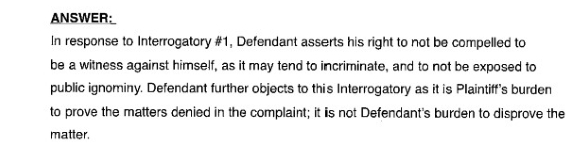
    As you can see above, Bell not only asked about Miller’s involvement, he also asked about the involvement of others, potentially including upline sponsors. Here’s how Miller answered Question 1 and 13 others. (Only minor variations such as the Interrogatory number were present.)

    Darren Miller's answer to the first Zeek interrogatory.
    Darren Miller’s answer to the first Zeek interrogatory.

    For years now, the SEC has expressed concern about scams spreading on social media. Bell also had a question about that — in this case, in Interrogatory 14 (as show below):

    The Zeek receiver asked about social-media accounts. There has been a longtime concern about scams spreading on Faceek, Twitter, YouTube and other sites.
    The Zeek receiver asked about social-media accounts. There has been a longtime concern about scams spreading on Facebook, Twitter, YouTube and other sites.

    In the interrogatories, Bell wanted to know when an individual’s participation began and when it ended. The receiver also was interested in dates and sums and outcomes — such as when money was paid to Zeek and when money was received from the “program” and how it was spent or kept.

    Individuals also were asked to name people who had information “related to your defenses or claims,” according to Miller’s response. Meanwhile, they were asked if they contended Zeek was not a Ponzi or pyramid scheme and to provide the names of individuals who could back up the claim.

    Bell previously expressed concern that some MLMers were moving from one fraud scheme to another in serial fashion.

    On the document front, Bell had 27 specific requests for production, according to Miller’s response. Here is how Miller answered a request to produce documents used “in connection with recruiting persons to participate” in Zeek.

    Miller's response to a request for document production by the receiver.
    Miller’s response to a request for document production by the receiver.

    Miller’s response to the 26 other requests for documents was substantially similar.

    Also see PP Blog editorial from July 1, 2014: On The War In Zeekland And HYIP Rabbit Holes.

    NOTE: Our thanks to the ASD Updates Blog.


  • URGENT >> BULLETIN >> MOVING: TelexFree Trustee Sues MLM Attorney Gerald Nehra

    newtelexfreelogoURGENT >> BULLETIN >> MOVING: (6th Update 8 p.m. EDT U.S.A.) TelexFree Trustee Stephen B. Darr has sued MLM attorney Gerald Nehra and the Nehra and Waak law firm, alleging they were “actively involved” in promoting TelexFree’s Ponzi scheme and “duping” participants.
    Nehra and the firm have asked for more time to respond to the April 1 complaint, saying through court filings that they “anticipated participation in criminal proceedings related to the case.”

    Chief Bankruptcy Judge Melvin S. Hoffman extended the response deadline until June 1. The original deadline was May 2.

    Whether Nehra or the firm considered themselves potential TelexFree criminal defendants was unclear in the response. TelexFree principals James Merrill and Carlos Wanzeler are the sole criminal defendants to date.

    Separately, prosecutors in the Zeek Rewards’ criminal case against Paul Burks said in court filings in the Western District of North Carolina Monday that Nehra and law partner Richard Waak may be called as witnesses in the case against Burks.

    Nehra and Waak have settled with Zeek receiver Kenneth D. Bell, who alleged they “encouraged investors to participate in the [Zeek] scheme by knowingly allowing their names to be used in providing a false façade of legality and legitimacy and gave improper legal advice that allowed the scheme to continue far longer than it would have without the Defendants’ support.”

    Darr wants Nehra and the firm to return all legal fees paid to them by TelexFree between May 2012 and April 2014 — about $24,000. Hoffman has ruled TelexFree a Ponzi- and pyramid scheme, and Darr contends neither Nehra nor the firm provided any “compensable advice” during the two years they represented TelexFree.

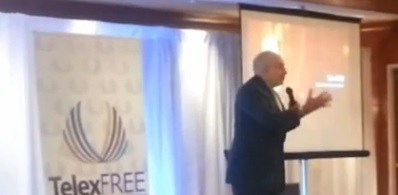
    The trustee further contends that Nehra appeared in a YouTube video promoting TelexFree.

    MLM attorney Gerald Nehra at a TelexFree rah-rah event in California in 2014. Source: YouTube.
    MLM attorney Gerald Nehra at a TelexFree rah-rah event in California in 2014. Source: YouTube.

    Representing Zeek and TelexFree created incredible problems for the two lawyers. At least three of their MLM clients have been charged criminally and a mountain of litigation has been filed against Nehra and the firm, including actions by Darr, Bell and class-action attorneys.

    In the settlement with Bell, Nehra and Waak agreed to a confession of judgment for $100 million. They contended “that they acted in good faith as legal counsel,” but now “acknowledge and agree that, based on their current knowledge, during the period they served as counsel RVG in fact operated an unlawful Ponzi an pyramid scheme involving an unregistered investment contract that caused hundreds of millions of dollars in losses to innocent victims of the scheme,” according to filings from Bell.

    Government attorneys handing the Burks’ criminal case quoted the settlement language in their May 2 filing. RVG, or Rex Venture Group, was the operator of Zeek.

    Zeek and TelexFree combined allegedly gathered on the order of $3.9 billion while creating hundreds and hundreds of thousands of victims globally.

    A TelexFree video featuring Nehra appeared on YouTube in August 2013, according to Darr’s complaint. That’s two months after authorities in Brazil called TelexFree a pyramid scheme.

    Also in August 2013, MLM attorney Jeffrey Babener advised TelexFree that it was operating a pyramid scheme, Darr alleged in September 2014.

    TelexFree nevertheless continued to gather money until it collapsed in bankruptcy in April 2014, Darr alleged. The last payment to Nehra and the Nehra and Waak firm was made on April 3, 2014, just 10 days before the implosion, according to Darr.

    Read Darr’s complaint against Nehra and the firm.

    NOTE: Our thanks to the ASD Updates Blog.


  • Certain International Zeek Members Due Distribution From Receiver Eligible To Receive Wire Transfer — But There Are Restrictions

    In a May 6 announcement, Zeek Rewards’ receiver Kenneth D. Bell shares important news with international Zeek members who have been unable to cash checks from the U.S.-based receivership estate.

    “Many foreign Affiliates have reported that they are unable to deposit or cash their distribution checks due to local banking fees and regulations. We filed a motion with the Court seeking a remedy for this problem so that all Affiliates, could receive their distributions,” Bell wrote.

    “On April 27, 2016, the Court entered an Order that permits the Receiver to pay certain foreign Affiliates by wire transfer in US Dollars. I sought this relief because various foreign Affiliates that were eligible to receive distributions contacted me to alert me to the fact that they were unable to cash the physical checks denominated in US Dollars that they had received. This relief will allow me to pay those foreign Affiliates who complied with the Court mandated process, but were otherwise unable to recover on account of their Allowed Claim because of their location.

    “If you are eligible to receive your distribution by wire transfer, my team will be sending you an email explaining how you may exercise the option to receive your distribution by wire transfer,” Bell continued. “However, if you are eligible to receive your distribution by wire transfer and you choose to do so, all of the fees and costs associated with the payment of the wire will be deducted from your Distribution (including without limitation the fees and costs associated with the sending of the wire by the estate, the receiving of the wire transfer by your bank, any currency conversion fee associated with converting the wire transfer from US Dollars to your local currency, any bank charges, and any canceled check fees incurred on account of any uncashed check which was previously issued to you. In addition, you agree to pay any costs associated with canceling uncashed checks previously issued to you). If you request a wire transfer and it is determined that the cost of the transfer will be greater than your Distribution, your Distribution will be sent by check.

    “In order to receive the wire transfer, you must submit all of the requested banking information via the Claim Portal. You must also give the estate a release in regard to any misdirected wire transfer caused by the entry of any incorrect banking information.

    “Wire payments will follow the same schedule as check Distributions and will not be made until the Release and OFAC have been submitted,” Bell wrote.

    Bell also announced that he will ask Senior U.S. District Judge Graham C. Mullen “this summer” for an order against more than 9,000 alleged Zeek winners sued in a class-action case for the return of their winnings.

    “We remain confident of success in that litigation, and that it will result in the collection of tens of millions of dollars for distribution to qualified claimants,” Bell wrote.

    The receiver also expressed hope that litigation against Payza, Payment World and Victoria Bank will conclude this summer and result in a recovery for the estate. (See Feb. 21, 2016, PP Blog Special Report that questions whether some of the Zeek money ended up in one or more collapsed Russian Banks after being transferred from Moldova.)

    “The bottom line is that we expect additional recovery of tens of millions of dollars for distribution in this year or next,” Bell wrote. “I’m sorry I can’t be more precise; litigation is slow and uncertain. You now know as much as I do.”

    Read Bell’s full statement, dated May 6, 2016, on the receivership website.


  • Faith Sloan’s Alleged TelexFree Haul: $710,319

    newtelexfreelogoUPDATED 3:32 P.M. EDT U.S.A. Faith Sloan received $710,319 from the TelexFree Ponzi- and pyramid scheme, according to filings by TelexFree bankruptcy Trustee Stephen B. Darr.

    Sloan, whose address was listed as Virginia Beach, Va., is a longtime Illinois HYIP huckster on Ponzi boards and social media. She and three other TelexFree promoters were charged in April 2014 with securities fraud by the SEC. The state of Illinois later barred her from the securities industry and warned her that violating the ban could result in a felony charge.

    Her alleged TelexFree haul was not known at the time.

    Darr, who has been investigating TelexFree for nearly two years, now wants to add Sloan and dozens of other alleged major winners as named defendants in a proposed class-action lawsuit filed in February that would return the winnings to the bankruptcy estate. Another proposed defendant is Randy Crosby, charged alongside Sloan by the SEC two years ago. His alleged haul, according to Darr, was $487,621.

    An individual identified as Sonya Crosby at the same address received $541,450, according to Darr. She, too, has been named a proposed defendant in the class action.

    As of April 4, no adequate class representative had been found, Darr advised Chief Bankruptcy Judge Melvin S. Hoffman of the District of Massachusetts.

    Sloan previously had complained that the SEC was picking on her, given that others in TelexFree had received more from the scheme and were not charged by the agency. As investigations evolve, however, the SEC sometimes files amended complaints or brings individual actions against defendants not charged out of the gate.

    Such as the case with HYIP huckster Matthew John Gagnon in 2010. He also was sued by a court-appointed receiver and charged criminally by the U.S. Secret Service.

    Alleged Zeek Rewards’ winner Trudy Gilmond wasn’t originally charged by the SEC. But as the probe continued, Gilmond was sued by both the agency and the receiver.

    Zeek receiver Kenneth D. Bell has expressed concerns about promoters moving from one fraud scheme to another. In March, SEC Enforcement Director Andrew Ceresney commented on the “whack-a-mole” nature of online pyramid schemes.

    Sloan has not been charged criminally. On the civil side, she is defending against the action filed by the SEC and also is named a defendant in multiple TelexFree fraud actions brought by private plaintiffs. If Hoffman approves Darr’s motion to file an amended complaint naming Sloan a “winner,” it would open a new litigation front against her.

    It is unclear if the SEC will name any additional TelexFree defendants.

    Darr’s motion to amend the complaint to include Sloan and additional defendants is available on the Trustee’s website. The proposed complaint is included as Exhibit A.


  • RECEIVER: (1) Zeek Defendant Class Action May Conclude This Year; (2) Some Claimants Still Haven’t Signed Required Release; (3) $10 Million Settlement With NewBridge Bank

    This promo for Zeek promised "passive" income. The SEC has warned about such schemes for years.
    This promo for Zeek promised “passive” income. The SEC has warned about such schemes for years.

    Three significant pieces of news from Kenneth D. Bell, the receiver in the Zeek Rewards’ Ponzi- and pyramid-scheme case:

    In a March 28 announcement on the receivership website, Bell wrote that a defendant class-action lawsuit against more than 9,000 alleged Zeek winners in the United States may conclude this year.

    “We hope to bring to a conclusion in 2016 our class action against more than 9,000 net winners, which will be a significant milestone,” Bell wrote.

    Senior U.S. District Judge Graham C. Mullen of the Western District of North Carolina certified the defendant class of alleged U.S. winners last year. The class includes “all persons and entities who participated in ZeekRewards and received at least $1000 more in money from ZeekRewards than they put into the program.”

    The winnings came from Ponzi proceeds and must be returned, Bell contended.

    A successful conclusion to the class action could mean more money for Zeek victims, Bell has said.

    TelexFree Bankruptcy Trustee Stephen B. Darr has filed similar litigation in that scheme. Darr’s action may affect nearly 100,000 alleged TelexFree winners.

    Bell has raised concerns about some MLMers moving from fraud scheme to fraud scheme. The SEC has raised concerns about the “whack-a-mole” nature of some fraudulent schemes.

    Meanwhile, Bell wrote yesterday that tens of thousands of people who are eligible for a distribution from the receivership estate have not received a check because they haven’t filled out the required forms. Such individuals should “log into the claims portal and electronically sign the Court required Release and OFAC Certification.”

    “At some point, I will be required to distribute the funds that have been reserved for these claimants to other Affiliates who have completed the process and, therefore, hold Allowed Claims,” Bell wrote.  “I don’t want any claimant with a recognized claim to lose out on receiving a distribution simply because they did not complete all of the steps required by the Court’s Orders.”

    Bell also highlighted a $10 million settlement with NewBridge Bank, a Zeek vendor. Zeek operated through Rex Venture Group.

    “The settlement arose out of claims the receivership had against NewBridge Bank for its continuing to provide banking services to Rex Venture Group after mid-April 2012, by which time the receivership alleged that the bank and its executives knew or should have known that Paul Burks and RVG were using their accounts to conduct an illegal Ponzi and pyramid scheme,” Bell wrote.

    Details of the receivership’s potential claims and the settlement with NewBridge are available through links in the receiver’s March 28 announcement.


  • URGENT >> BULLETIN >> MOVING: Zeek Vendor Pleads Guilty To Obstructing Probe

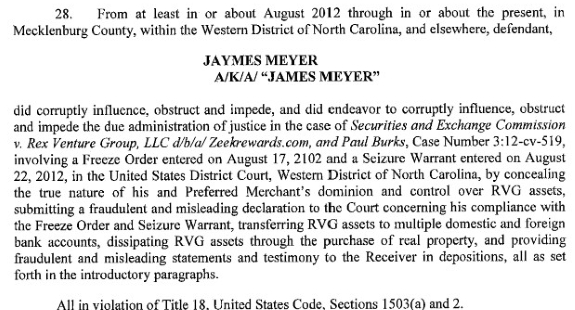
    From the criminal charges filed against Zeek payment vendor Jaymes Meyer in the Western District of North Carolina.
    From the criminal charges filed against Zeek payment vendor Jaymes Meyer in the Western District of North Carolina.

    URGENT >> BULLETIN >> MOVING: (12th Update 2:57 p.m. EDT U.S.A.) In what may be a warning shot fired across the bow of payment vendors who hope to profit from Ponzi schemes, Zeek Rewards’ vendor Jaymes Meyer of Preferred Merchants Solutions LLC has pleaded guilty to a criminal charge of obstructing investigators in the Zeek Ponzi- and pyramid-scheme case.

    Meyer, 47, of Napa, Calif., was charged criminally March 10 by federal prosecutors in the Western District of North Carolina. They alleged he hatched an “elaborate obstruction of justice scheme to conceal millions of dollars from the Government using a series of domestic and foreign nominees and related bank and brokerage accounts.”

    He was specifically accused of impeding the SEC’s Zeek probe beginning in 2012 and later lying to a federal judge and Zeek receiver Kenneth D. Bell.

    Senior U.S. District Judge Graham C. Mullen is presiding over the SEC’s Zeek case.

    As the PP Blog reported in October 2014, Bell accused Meyer of directing a $4.8 million transfer from a Rex Venture Group trust account to Preferred Merchants’ account “just 19 minutes after the SEC told them about the asset freeze and imminent shutdown of RVG” on Aug. 16, 2012.

    Rex, or RVG, was the operator of Zeek. It was under the control of accused Zeek Ponzi schemer Paul R. Burks. Burks is scheduled to go on trial in July.

    By March 2015, Bell and investigators had tracked Zeek money that flowed through Preferred to the Cook Islands and real estate in the Turks and Caicos. Prosecutors’ allegations against Meyer include a notice of forfeiture of $4.8 million.

    U.S. Magistrate Judge David S. Cayer accepted the guilty plea from Meyer on March 22. Certain documents in the case remain sealed. One document shows Meyer withdrew $195,000 in Zeek money in cash.

    At least two other payment vendors may be in Bell’s sights. On Feb. 21, 2016, the PP Blog reported that millions of dollars that originated through Zeek-related transactions involving Payza and Payment World may have ended up in a collapsed Russian bank.

    NOTE: Our thanks to the ASD Updates Blog.


  • SPECIAL REPORT: Zeek Money May Be In Collapsed Russian Bank

    From the PP Blog archives: April 2012.
    Funds from Zeek, which once auctioned sums of U.S. currency, may have ended up in a collapsed Russian bank. Graphic from the PP Blog archives: April 2012.

    EDITOR’S NOTE: For background, see Feb. 17 PP Blog story: RECEIVER: Payza And Payment World ‘Facilitated’ Zeek Ponzi Scheme; Whereabouts Of $13.1 Million An ‘Open Question’

    (Updated 11:14 a.m. ET U.S.A.) Money due victims of Zeek Rewards from transactions involving Payza and Payment World may have been transferred from VictoriaBank in Moldova to JSC TusarBank in Russia in violation of an asset freeze imposed in 2012 by a U.S. court, according to court filings by Zeek receiver Kenneth D. Bell.

    Meanwhile, OboPay’s name now has surfaced in filings by Bell. This is in the form of an October 2012 email from a Payment World official to a Payza official questioning Payza’s relationship with OboPay. The U.S. Justice Department last year announced a criminal investigation involving Payza and OboPay. The specific reason behind the probe and the targets are unknown.

    TusarBank collapsed in September 2015 and has been recommended for criminal investigation, according to the press office of Russia’s central bank. The bank’s website is beaming a “not available now” message.

    Senior U.S. District Judge Graham C. Mullen of the Western District of North Carolina last week lifted the seal on Bell’s 258-page filing in which Bell alleged Payza, Payment World and VictoriaBank enabled Zeek’s Ponzi scheme shut down by the SEC in 2012. The filing consisted of a 26-page motion and 232 pages of exhibits, including emails between Payza and Payment World. As noted above, one of the exhibits raises the name of OboPay.

    Mullen imposed the asset freeze in August 2012.

    Whether the possible transfer of Zeek-related funds from Moldova to Russia is part of the Russian probe is unclear.

    Adding to the international intrigue is that a second Russian bank that somehow might have been involved in the Payment World-related money flow reportedly collapsed in 2013. This institution is known as Master Bank and is described in Bell’s exhibits as a “sponsoring bank” of a Payment World entity in Hong Kong.

    A sponsoring bank provides processors access to Visa or MasterCard networks

    On Sept. 13, 2015, just prior to the collapse of TusarBank, the Moscow Times listed Master Bank as one of “Russia’s Biggest Banking Crashes of the Last 2 Years.” This crash occurred in 2013 and was notable for something beyond the 31.3-billion-ruble bailout.

    As the Moscow Times reported (italics added):

    Even having Igor Putin, a cousin of President Vladimir Putin, on the board of directors could not save Master Bank. The lender’s license was revoked in November 2013 with the Central Bank alleging the bank had violated money laundering legislation and processed large suspicious transactions.

    In 2012, just prior to the collapse of Zeek, Zeek figure Keith Laggos claimed he had helped Zeek move payment operations offshore, including to Hong Kong. Specific details of that asserted move are unknown. Zeek had about 15 financial vendors, according to court filings.

    Payza, under the leadership of Firoz Patel, has claimed it conducted due diligence on Zeek, according to Bell’s filings. Even if true, it somehow appears to have missed that Zeek was offering an outrageous and unusually consistent return averaging about 1.5 percent a day and also claimed “compounding” was possible.

    The SEC has described Zeek as a cross-border Ponzi scheme that gathered nearly $900 million while operating from North Carolina.

    From Bell’s filing (italics added):

    On August 29, 2010, Paul Burks [of Zeek] onboarded an account with Payza (then, known as AlertPay) in the name of Rex Venture Group LLC that was associated with two websites: www.zeekrewards.com and www.zeekler.com. Prior to the boarding of the account, Payza purportedly conducted due diligence, collecting and reviewing information about Paul Burks and the business. According to Payza, during the course of the relationship, it monitored and mitigated risk. Despite these procedures, Payza did not identify or address the red flags indicating that ZeekRewards was a Ponzi scheme and, instead, together with PaymentWorld and VictoriaBank [of Moldova], facilitated access and payment to and from ZeekRewards by numerous affiliates worldwide.

    Bell’s 258-page filing is available on the landing page of the receivership website. It is styled, “Memorandum in Support of the Receiver’s Motion for an Order Directing Payza, Payment World, and VictoriaBank to Turn Over Receivership Assets and/or Find Them in Contempt of the Court’s Order Freezing and Preserving Receivership Assets.”

    NOTE: Our thanks to the ASD Updates Blog.