Tag: Legisi

  • JSS TRIPLER 2 (T2) UPDATE: Serial Ponzi-Board Huckster ‘Strosdegoz’ Deletes MoneyMakerGroup Link That Showed T2 Presence In The United States, Italy

    Prior to its killing, this post yesterday by Ponzi-forum huckster "strosdegoz" showed a DNS propagation map for JSS Tripler 2 (T2) when a link in the post was clicked. The page that loaded showed that T2 was accessible via wire in the United States. The post vanished without explanation in less than an hour.

    “strosdegoz,” the serial Ponzi-board pitchman who claims to have a presence on at least 35 forums or websites that promote “programs” that advertise preposterous returns, has killed a MoneyMakerGroup post he created that showed JSS Tripler 2 (T2) is accessible via wire in the United States.

    The original post, which appears to have been created because some T2 members were complaining they could not access the T2 site, was replaced with a single word: “Edit.” A note below the substituted one-word post explained it had been “edited by strosdegoz.”

    Prior to its killing, the post had included a link to this DNS tracking service. When that link was clicked, it showed that the JSSTripler2 domain is accessible in the United States. It also showed T2 is accessible in Italy. (More on the potential importance of T2’s reach into Italy below.)

    “strosdegoz” did not explain his decision to kill his post and the link. Nor did he say whether he was properly registered to sell securities to U.S. or Italian citizens. Nor did he say whether T2 was properly registered to do so.

    T2 was known to be accessible in the United States even before “strosdegoz” killed the link that showed multiple points of contact on U.S. soil from the East Coast and the West Coast and places in between. Still, the DNS map provided a compelling visual of how scammers from all parts of the world can reach into the United States (and other countries) and recruit the unknowing into the murkiest of investment enterprises.

    T2, which preemptively denies it is a Ponzi scheme despite advertising returns that dwarf the return rates of Bernard Madoff,  purports to pay a return of 2 percent a day, a figure that computes to an annualized return of 730 percent. The “opportunity” claimed for weeks that it had suspended member cashouts, blaming the development on an AlertPay account freeze.

    AlertPay is a processor based in Canada.

    But T2 now says is has regained access to the frozen funds, a development that led to a flood of “I got paid” posts on MoneyMakerGroup, which is listed in U.S. federal court filings as a place from which Ponzi schemes are promoted.

    After having posted the DNS tracking link and later deleting it, “strosdegoz” — also known as “manolo” — virtually simultaneously posted an “I got paid” post for T2 at MoneyMakerGroup.

    “I got paid today already,” the post read. “Fast as usual.”

    Only days earlier, T2 purportedly was paying no one. Its explanation of an AlertPay freeze was a virtual concession that the enterprise was insolvent and could not pull from other resources to meet its obligations. “Opportunities” such as T2 pretend liabilities do not exist or conceal insolvency by treating liabilities as assets. Any significant interruption of cash flow can create a crisis that potentially affects thousands or even tens of thousands of participants.

    Both the edited DNS post and the “I got paid” post below it had a time stamp of 7:11 p.m. (The original DNS post had a time stamp of 6:21 p.m; the edit occurred at 7:11 p.m., according to the time stamp, and the follow-up “I got paid” post also was time-stamped at 7:11 p.m.)

    T2 Reaches Into Italy As Promoters Of Namesake ‘Opportunity’ JSS Tripler Are Under The Lens

    T2 purportedly created its name by appropriating the name of JSS Tripler, another “program” that advertises a return of 2 percent a day. JSS Tripler promoters have come under the lens of CONSOB, the Italian securities regulator.

    Like T2, JSS Tripler is accessible in the United States — with no corresponding evidence that the program itself as well as its promoters have any registrations as issuers of securities or broker-dealers.

    JSS Tripler promoters have pooh-poohed the CONSOB action, preferring instead to flood the Ponzi forums with “I got paid” posts.

    Compellingly, the DNS link “strosdegoz” posted at MoneyMakerGroup yesterday for T2 — JSS Tripler’s purported namesake — showed that T2 is accessible in Rome, the capital of Italy. CONSOB is headquartered in Rome.

    Club Asteria, another Ponzi-forum darling, came under the CONSOB lens last year — even as “strosdegoz” was leading Club Asteria cheers. The Club Asteria “program,” which traded on the name of the World Bank, first slashed weekly payouts and then eliminated them — amid reports of a PayPal freeze.

    Some Club Asteria cheerleaders claimed the “program” provided a “passive” return of up to 10 percent a week. “Ken Russo,” one of “strosdegoz’” fellow cheerleaders on the Ponzi forums, posted purported Club Asteria payment proofs totaling in the thousands of dollars.

    Even as accused AdSurfDaily Ponzi schemer Andy Bowdoin was pimping a murky “program” known as “OneX” while awaiting his September 2012 criminal trial that potentially could land him in prison for 125 years if found guilty on all counts, “strosdegoz” also emerged as a OneX pitchman.

    Among other things, Bowdoin is accused of selling unregistered securities to U.S. residents. He also is accused of using wires that run through the United States to sell prospects into the massive ASD scam, along with securities fraud.

    As “strosdegoz” was hawking T2 and OneX by wire, he turned his attention to a “program” called “HugeYield.”

    T2 purportedly is operated by “Dave,” now said to be venturing to Cambodia after previously venturing from England to Thailand during the purported AlertPay freeze. “Dave” posts on MoneyMakerGroup as Peakr8.

    JSS Tripler, meanwhile, is purported to be in the stable of “JustBeenPaid,” a “program” purportedly operated by onetime ASD promoter Frederick Mann.

    Like its Ponzi-forum cousin Legisi — which became the subject of an undercover operation by U.S. law enforcement that resulted in fraud charges — JSS Tripler makes members affirm they are not government spies or media lackeys.

     

  • UPDATE: JSS Tripler 2 (T2) Pulls An Andy Bowdoin; T2’s ‘Dave’ Comes Back For Second Bite Of Ponzi Apple To Chorus Of Forum Cheers

    Although accused Ponzi schemer and AdSurfDaily President Andy Bowdoin appears not to be among the promoters of JSS Tripler (T2), T2 appears to be relying on a Bowdoin-like playbook in announcing a restart after having earlier suspended payouts.

    The bizarre international spectacle created by JSS Tripler 2 (T2) is continuing — and gets stranger and more insidious by the day.  The purported “opportunity,” which is trading on the name of a murky entity known as JSS Tripler and apparently cloning its Ponzi business model, has announced a restart after weeks of existing in a state of suspended animation purportedly caused by the freezing of a one-time T2 business partner’s AlertPay account.

    T2 now claims it has regained access to the frozen AlertPay funds.

    A week or so prior to T2’s purported restart, promoters of JSS Tripler, the purported “opportunity” upon which T2 based its name,  became  the subject of a securities investigation in Europe. Ponzi-forum hucksters — some of whom are promoting both T2 and JSS Tripler — scoffed at the CONSOB probe and flooded the MoneyMakerGroup Ponzi forum with “I got paid” posts.

    It is axiomatic that all successful Ponzi schemes pay. That an “opportunity” pays is not evidence that no underlying criminality exists.  The timing of T2’s restart — indeed, the restart occurred after the Italian regulator CONSOB announced that JSS Tripler promoters were being scrutinized — demonstrates that the serial hucksters driving T2 are turning a blind eye to the serious issues being raised in Europe.

    The development is hardly unprecedented, given that core groups of scammers who populate the Ponzi boards and simultaneously maintain their own fraud sites thumbed their noses after law-enforcement moved against “opportunities” such as Pathway To Prosperity, Legisi, Gold Quest International, Imperia Invest IBC and others, including AdSurfDaily.

    Like its namesake JSS Tripler, T2 advertises a return rate of 2 percent a day, twice that of ASD. In 2008, the U.S. Secret Service called ASD an international Ponzi scheme. Tens of millions of dollars were seized from bank accounts, and ASD operator Andy Bowdoin later was arrested on charges of wire fraud, securities fraud and selling unregistered securities.

    At least $110 million found its way into ASD or related coffers, prosecutors said. Several million dollars were moved into Canada just prior to the seizure of ASD-related assets in August 2008, according to court filings.

    In early 2007, according to prosecutors, ASD suffered a Ponzi collapse that in part was blamed on “Russian” hackers. Bowdoin claimed the hackers stole $1 million, but he never filed a police report.

    Like T2 did between at least December 2011 and February of this year, ASD existed in a state of suspended animation for months in 2007. Bowdoin eventually restarted the “opportunity” under a different name and different website — ASDCashGenerator, as opposed to AdSurfDaily — and began the process of picking pockets anew, federal prosecutors said.

    Unlike ASD, T2 did not claim its payout problems were caused by Russian hackers. Instead, the “opportunity” claimed a onetime business partner known as “Chris,” purportedly living in England, was to blame.

    Like ASD, however, T2 claimed it was changing names, morphing from JSS Tripler 2 to T2MoneyKlub. The name change was explained to be part of an overall restart plan in which T2 would create revenue streams by building prefabricated websites and offering them for sale at a tremendous profit. The plan, which appeared to be exceptionally forward-looking while making preposterous assumptions, presented fallacies of logic such as these:

    • That T2, operating with an in-house skeleton crew and volunteer members, no declared base of operations and no compliance arm despite reaching into dozens of countries each with a unique set of laws, could at once be a web-service provider while managing a “program” that promised a return rate of 2 percent a day or 730 percent a year on top of recruitment-commission payments.
    • That web-service customers would pay a premium for sites built by a murky entity whose operators simultaneously were offering investors returns that would make Bernard Madoff blush.
    • That the fees generated by the sale of websites at a future point uncertain somehow could sustain a scheme that promised to pay out twice as much as ASD, whose operator already was under indictment on Ponzi-related charges and had advertised the same sort of payment schemes.
    • That there would be any reason at all for T2 to continue to offer an investment program that advertised a ludicrous return if its purported sale of websites could result in handsome, self-sustaining profits for the web-service venture. (Longtime PP Blog readers will recall that the AdViewGlobal (AVG) autosurf claimed at one time that it, too, was morphing into a company that would offer web services as a means of propping up an initial investment scheme. AVG, like ASD, promised to pay out half of what T2 claims. AVG disappeared in June 2009, only weeks after its morphing announcement.)

    Also like ASD, T2 preemptively denied it was a Ponzi scheme, despite an absurd confluence of payment schemes in which T2 claimed an ability to pay an annualized return of 730 percent on top of recruitment commissions.

    As previously noted, T2’s advertised return rate was double that of ASD, which prosecutors said had no meaningful revenue streams beyond payments by members. Those payments simply were recycled and returned to other ASD members in the form of classic Ponzi payouts.

    Even though T2 — like ASD — purported to be changing its name, the name change appears to have hit a snag. T2 initially announced it would emerge as T2MoneyKlub on Feb. 1. That didn’t happen, according to Ponzi-forum chatter, because T2 did not have an AlertPay account in its new name.

    T2, according to chatter, then defaulted back to its original name, a circumstance that apparently means the purported “opportunity” can both receive and send money, shelve its new name for the time being and reposition itself under its “old” name to reach into the pockets of new investors.

    “Dave,” the purported operator of T2, according to Ponzi-forum chatter, once was a member of JSS Tripler, one of the entities referenced in the CONSOB action. It appears as though “Dave” was unmoved by the CONSOB action, so much so that he restarted JSS Tripler 2 even though claims about namesake JSS Tripler are under scrutiny and the already-radioactive name easily could become even more radioactive in the weeks ahead.

    T2 payouts will come from “AlertPay, SolidTrustPay and LibertyReserve,” Dave announced on the MoneyMakerGroup Ponzi forum, posting as “Peakr8.” All three of the named processors have reputation for being friendly to fraud schemes. Both AlertPay and SolidTrustPay are referenced in court files in the ASD Ponzi case.

    MoneyMakerGroup member “jieroz” quickly fired up an “I got paid” post for T2 today, saying the $25 payment had come from AlertPay.

    Veteran huckster “strosdegoz” quickly congratulated “jieroz.”

    “Congrats, that was fast … As usual . . .” strosdegoz blathered.

    A poster purportedly from India and using the handle “hemsagar” also joined in the cheers.

    “WTG! WTG!” he exclaimed in approval.

    A link under the approving post of “hemsagar” led to a “benefactor” promotion in which he claims he’ll pay people to join T2 by sending them money through AlertPay.

    Amid the cheerleading in the MoneyMakerGroup T2 thread, “Dave,” posting as “Peakr8,” announced he was taking a trip to “Cambodia.” This trip apparently follows on the heels of a trip “Dave” purportedly had taken earlier from England to Thailand during a period in which T2 was not paying members.

    “Dave” conceded that T2’s restart had resulted in problems at T2’s in-house cheerleading forum.

    “I know there are bugs, but we will stamp on em one by one when I get back from Cambodia,” Dave posted on MoneyMakerGroup as “Peakr8.”

    Below that post, another post from “hemsagar” appears. Although his brief MoneyMakerGroup bio at the left of the post claims he is from India, his post about the bugs in the T2 forum makes this claim:

    “Its back up here in the Ukraine.”

    Whether “hemsagar” is a citizen of India now living in Ukraine is unclear.

    Serial huckster “strosdegoz” later proclaimed “we need to pump up” the T2 forum and “also . . . every place else.

    “I have to do my dozens of forums too,” strosdegoz acknowledged.

    Regulators have warned the public repeatedly that scams involving hundreds of millions of dollars are spreading virally on the Internet through forums and social-media sites. Pathway to Prosperity, which was pushed on the Ponzi forums, eventually made its way to 120 countries, according to court filings.

    The scheme had a take of more than $70 million and created at least 40,000 victims, according to court filings.

    ASD may have created a similar number of victims, according to court filings. Legisi and Imperia Invest IBC also created victims by the thousands, investigators said.

    Included in the Imperia victims’ count were thousands of people with hearing impairments, investigators said.

  • DISTURBING: JSS Tripler-Related Domain Listed In CONSOB Action Is Based In United States — But Suddenly Starts Redirecting To ‘JustBeenPaid’ Site In The Netherlands; Claim That ‘We’re Not Located In Any Unfriendly Political Jurisdictions’ Exposed As Rank Deception

    On Jan. 23, CONSOB, the Italian securities regulator, made public an action against promoters of JSS Tripler, a “program” that advertises an annualized return of 730 percent. The claim alone would be enough to make Bernard Madoff or Charles Ponzi himself blush.

    Or projectile-vomit.

    But if the CONSOB action were not trouble enough, one of the JSS Tripler-related domains listed in the agency’s action is hosted in Utah, according to domain records. The domain, which forms its root with a hyphen splitting the proper name of JSS Tripler — i.e., JSS-Tripler.com — continued to serve pages from Utah for several days after CONSOB’s Jan. 23 announcement. The domain, for instance, published daily updates on the number of days JSS Tripler itself purportedly had been in action.

    Among the graphics on the Utah-hosted landing page was an image of a JSS Tripler pitchwoman who appeared to be Asian in descent. Assuming the woman actually exists, her nationality remains a mystery. At a time uncertain between Feb. 2 and Feb. 3, however, the site stopped serving content and instead began to redirect to a JustBeenPaid subdomain styled “marketing” that is hosted in the Netherlands.

    Whether a U.S. resident or citizen of another country who reached across international borders applied the redirection is unclear. What is clear is that the United States could join Italy in exercising  jurisdiction over JSS Tripler and its promoters if it chose to do so. The site also is accessible through individual U.S. states, meaning regulators at the state level also could exercise jurisdiction.

    A state’s choice to exercise jurisdiction over the sale of unregistered securities is hardly unusual in the HYIP sphere. Florida, for example, exercised jurisdiction over AdSurfDaily and operator Andy Bowdoin. North Dakota exercised jurisdiction over Pathway to Prosperity and operator Nicholas Smirnow. Oregon exercised jurisdiction over an abomination known as “I Need Cash,” a cycler operated by Kristopher K. Keeney.

    JustBeenPaid and Frederick Mann, a murky figure who once claimed to be an ASD promoter, are the purported operators of JSS Tripler. The Netherlands subdomain shows an image of a man at the top of the page. That man is described on the site as “Louis Paquette, JBP Affiliate Sales & Marketing Director.”

    The redirection, which occurs in Utah, according to server data, is virtually immediate — meaning that the previous content and photo of the woman of Asian descent no longer load and that the traffic is switched to the Netherlands page that shows the purported image of Paquette.

    Among other things, this development raises questions about who caused the Utah server to redirect to the Netherlands domain and precisely why the change was made on the heels of the CONSOB action. Whether JustBeenPaid or JSS Tripler themselves had control over the Utah domain is unknown.

    At a minimum, though, the presence of the Utah domain may be evidence that JustBeenPaid/JSS Tripler not only sold unregistered securities to U.S. citizens, but did so from inside the United States with a U.S. promoter or a promoter from another country with access to the Utah server at the helm. And because the redirect to the JustBeenPaid subdomain in the Netherlands occurs from inside the United States, it exposes a JustBeenPaid/JSS Tripler lie that the “opportunity” protects itself and promoters from investigation and/or prosecution.

    Even if the redirection were not occurring in the United States, the CONSOB action destroys the myth that the “opportunity” is outside the reach of law enforcement.  So does the simple fact that any regulator in the world could take action against the “opportunity” and its promoters. Indeed,  the cross-border nature of the scheme puts investors in virtually all jurisdictions at risk. Individual promoters could be targeted for investigation/prosecution in multiple jurisdictions — and if actions such as those begin to occur, the access of Just BeenPaid/JSS Tripler to cash sources could dry up.

    A claim by a MoneyMakerGroup Ponzi-forum promoter that Just BeenPaid/JSS Tripler has paid out more than $10 million to investors may demonstrate the vast reach of the “opportunity” and its ability to tap funding sources while siphoning undisclosed sums for itself. Just BeenPaid/JSS Tripler may be no Madoff, but $10 million still is a massive sum, one that should raise eyebrows in the worldwide law-enforcement community.

    Content accessible from the Netherlands-based JustBeenPaid subdomain — marketing.justbeenpaid.com — raises other troubling concerns. This statement (next paragraph) appears at the bottom of a “login” page in the JustBeenPaid root domain. The statement is accessible through the “marketing” subdomain. (Indent/italics added):

    Secure Offshore Servers
    — Our servers are in a strategic location.
    We pay special attention to security.
    Our servers are organized so upgrading and expansion are very easy.

    Offshore Business
    — Our business operations are geographically decentralized.
    We don’t have any central office.
    We’re not located in any “unfriendly political jurisdictions.”

    As a practical matter, the mere fact the page is accessible through a redirect that occurs in the United States may destroy any claims that JustBeenPaid/JSS Tripler protects members against “unfriendly political jurisdictions.” Any transaction that occurred or occurs through the Utah domain necessarily involves wires in the United States.

    Regardless of the domain or email address through which business is conducted, any U.S.-based promoter of JustBeenPaid/JSS Tripler is using wires inside the United States, a situation that brings wire fraud into play — in addition to the securities issues.

    A more troubling question, perhaps, is why JustBeenPaid/JSS Tripler even would have the need to make such a claim if its international business is above-board. The same enterprise also claims to have a U.S. patent, a specious claim in the context of securities because the U.S. Patent and Trademark Office does not regulate the securities markets of the United States or any other country.

    Is JustBeenPaid/JSS Tripler The BCCI Of The HYIP World?

    In the early 1990s, a corrupt international banking enterprise known as Bank of Credit and Commerce International created a worldwide financial scandal. The bank perhaps was best known by its acronym — BCCI — and purportedly was designed to be “offshore everywhere.”

    JustBeenPaid/JSS Tripler is making the same sorts of claims associated with BCCI, a spectacularly bright red flag if ever there was one.

    But if that bright red flag were not enough, other content accessible through the “marketing” subdomain of JustBeenPaid sends signals that positively glow of danger. Indeed, a “Member Agreement” link accessible through the site includes this language. (Indent/italics added):

    6. I affirm that I am not an employee or official of any government agency, nor am I acting on behalf of or collecting information for or on behalf of any government agency.

    7. I affirm that I am not an employee, by contract or otherwise, of any media or research company, and I am not reading any of the JBP pages in order to collect information for someone else.

    Any political jurisdiction in any part of the world easily could construe those words as an invitation extended by JustBeenPaid/JSS Tripler to investors to join an international conspiracy engaging in organized crime and mass-marketing fraud.

    The same type of claim became an element of the Legisi HYIP prosecution in the United States. The Legisi prosecution, which ultimately involved the SEC, began as an undercover operation between the U.S. government and the state government of Michigan.

    Even more land mines emerge when one considers that JustBeenPaid/JSS Tripler  is being promoted on Ponzi boards such as MoneyMakerGroup and TalkGold, both of which are referenced in U.S. federal court files as places from which Ponzi schemes are promoted.

    Veteran forum and social-network hucksters are promoting JustBeenPaid/JSS Tripler, including promoters linked to the AdSurfDaily Ponzi scheme case in the United States and CONSOB’s earlier action involving Club Asteria, another Ponzi forum darling.

    Depending upon how the universe lines up, JustBeenPaid/JSS Tripler could find itself starving for cash in very short order. It is a program that is thumbing its nose at law enforcement across the globe — and its willfully blind promoters could find themselves named in individual actions just about anywhere.

    It is the very definition of an international financial conspiracy of the most dangerous sort, a sort of emerging BCCI of the HYIP world.

    BEFORE

    This is the top of the page at the JSS-Tripler.com domain as it existed on Jan. 30, 2012.

    AFTER

    This is the top of the "marketing" subdomain of JustBeenPaid.com as it exists today. Prospects who visit the Utah-based JSS-Tripler domain referenced in the "BEFORE" screen shot above now are redirected to the Netherlands-based "marketing" subdomain of JustBeenPaid. The switch occurs in Utah, according to server data.
  • URGENT >> BULLETIN >> MOVING: Legisi HYIP Pitchman Matthew John Gagnon Named In Criminal Complaint By U.S. Secret Service

    Matthew John Gagnon

    URGENT >> BULLETIN >> MOVING: Matthew J. Gagnon, an alleged online pitchman for the Legisi HYIP Ponzi scheme, has been named in a criminal complaint filed by the U.S. Secret Service.

    Gagnon, 42, of Portland Ore., and Weslaco, Texas, was accused civilly by the SEC in 2010 of being “a danger to the investing public,” amid allegations he promoted multiple fraud schemes — including Legisi — on his Mazu.com website.

    He is accused in a Secret Service affidavit filed Nov. 28 in the Eastern District of Michigan of not disclosing $1.7 million in payments from Legisi while he was touting it to “the investing public” between January 2006 and May 2007.

    Legisi, the Secret Service said in the affidavit, was a “massive Ponzi scheme” that gathered about $72 million from more than 3,000 investors before the fraud was exposed.

    Among the allegations against Gagnon is that he promoted Legisi’s unregistered offering as exempt from registration requirements and “literally the greatest” program he had “ever seen. ” (The complaint includes several specific allegations about how Gagnon promoted Legisi. One promo attributed to Gagnon by the Secret Service shows that Gagnon  used six exclamation points in a single paragraph consisting of about 66 words.)

    Gagnon already is facing Legisi-related civil judgments totaling more than $2.5 million.

    Like Florida-based AdSurfDaily, Legisi has been linked to E-Bullion, the shuttered California payment processor operated by James Fayed. Fayed, 48, was formally sentenced to the death penalty last month for arranging the brutal contract slaying of Pamela Fayed, his estranged wife and a potential witness against him before she was slashed 13 times in a greater Los Angeles parking garage in July 2008.

    Legisi also was promoted on Ponzi boards such as TalkGold and MoneyMakerGroup. The Legisi Terms of Service, according to federal court filings, included language that made members avow they were not an “informant, nor associated with any informant” of the IRS, FBI, CIA and the SEC, among others.

  • BULLETIN: E-Bullion Operator And Emerging AdSurfDaily Figure James Fayed Formally Sentenced To Death For Contract Slaying Of Estranged Wife; A ‘Cold, Calculating Human Being’

    BULLETIN: The Los Angeles Times is reporting (link below) that James Fayed has been formally sentenced to the death penalty for arranging the brutal slashing death of Pamela Fayed, his estranged wife and a potential witness against him.

    James Fayed, 48, is an emerging figure in the AdSurfDaily Ponzi case. Federal prosecutors in the District of Columbia said in December 2010 that E-Bullion was used to forward money to ASD, which the U.S. Secret Service described as a massive international Ponzi scheme that used multiple payment venues to amass at least $110 million.

    Erma Seabaugh, an ASD member who used E-Bullion, was an ASD trainer, according to the government. Records in Oregon show that Seabaugh, whose assets were seized in the ASD case, was operating a purported “religious” nonprofit firm from Missouri. The purported religious entity was known as Carpe Diem.

    Seabaugh’s assets were seized in February 2009, during a period of time in which the AdViewGlobal (AVG)  autosurf was launching and ASD President Andy Bowdoin was morphing into a pro-se litigant and trying to undo his January 2009 decision to submit to the forfeiture of $65.8 million seized by the Secret Service from 10 Bowdoin bank accounts in August 2008. AVG had close ASD ties, according to members.

    E-Bullion has been linked to multiple Ponzi schemes, including Legisi, Gold Quest International and FEDI. The FEDI scheme has been linked to Abdul Tawala Ibn Ali Alishtari, also known as Michael Mixon. Ali Alishtari pleaded guilty in 2009 to financing terrorism and fleecing investors in the FEDI scheme.

    FEDI participants could expect to receive payouts deemed “rebates,” according to documents obtained by the Ontario Securities Commission from a FEDI promoter who simultaneously was promoting a mysterious business known as the “Alpha Project.” ASD also used the word “rebates” to describe its payouts, according to court filings.

    Ali Alishtari, like ASD’s Bowdoin, contributed money to Republican causes and heralded a purported GOP award for his business acumen, according to documents.

    Seabaugh used ASD’s advertising “rotator” to promote an apparent “pyramid scheme” known as StreamlineGold.net, according to federal court filings. Like ASD, Legisi and GoldQuest International, StreamlineGold.net was promoted on Ponzi boards such as TalkGold and MoneyMakerGroup.

    Pamela Fayed was stabbed 13 times in a Greater Los Angeles parking garage on July 28, 2008. The Times reported today that James Fayed was seated on a nearby park bench “texting” on his cell phone while his alleged accomplices carried out the slaying.

    Los Angeles Superior Court Judge Kathleen Kennedy described James Fayed as “one cold, calculating human being,” according to the Times. Kennedy formally imposed the death sentence yesterday. The jury that convicted James Fayed in May recommended the sentence.

    From the Times (italics added):

    The only person within earshot who didn’t react was the victim’s estranged husband who was sitting on a nearby bench “texting on his cellphone, like he doesn’t have a care in the world,” Los Angeles County Superior Court Judge Kathleen Kennedy said Thursday, moments before sentencing James Fayed to death for the contract killing.

    Read the chilling story in the Times.

  • DURANGO HERALD: Attorney Says His Client Was Ponzi Player Who Tried To ‘Scam The Scammers’; E-Bullion’s Name Surfaces In Illustrative Case Of Frederick H.K. Baker, Who Is Sentenced To Federal Prison

    In July 2010, FINRA memorably described the HYIP sphere as a “bizarre substratum of the Internet.” The regulator warned about “online payment systems” that are used for criminal activity, noting that some fraud purveyors discuss subjects such as how to “build a winning HYIP portfolio” and how “to ‘ride the Ponzi’ and get in and out before a scheme collapses.”

    A case brought by federal prosecutors in Colorado against a Utah man could be an eye-opener for fraudsters and their apologists and shills who engage in bizarre and reckless behavior such as that outlined by FINRA and help fraud schemes proliferate to consume millions of dollars.

    Indeed, the Durango (Colorado) Herald is reporting that Frederick H.K. Baker will be going to federal prison for 41 months (see link at bottom of post). Although FINRA’s 2010 Public Awareness Campaign is not referenced in the story, Baker’s case speaks to a number of the issues FINRA raised more than a year ago.

    Compellingly, even Baker’s attorney conceded that his client thought he could “scam the scammers” by knowingly becoming a Ponzi player and adopting a strategy by which he’d get in early, collect his profits — and then get out, according to the Herald.

    “Baker thought he could make money if he got in early,” the Herald reported. “In effect, he was running a Ponzi scheme to invest in other Ponzi schemes . . .”

    The Herald’s story quotes a federal prosecutor who told a federal judge that Baker’s scheme destroyed families and caused financial and emotional heartache for the victims.

    And it also notes that E-Bullion, the shuttered California payment processor whose operator, James Fayed, was convicted in May of arranging the July 2008 gruesome murder of his wife, was used in the Baker scheme.

    E-Bullion also has been referenced in the AdSurfDaily Ponzi case, the Legisi Ponzi case, the Gold Quest International Ponzi case, the FEDI case and other cases. The most recent reference to E-Bullion in the Legisi case, according to research by the PP Blog, occurred on Sept. 22, 2011 — less than three weeks ago.

    An attorney for two individuals claimed in court filings that his clients had used E-Bullion when investing with Legisi and were out $92,094.11. The attorney noted that their claims to a share of proceeds from the receivership estate have been rejected. Other filings list the reason for the rejection as inadequate documentation of the investment. The operators of fraud schemes such as Legisi are infamous for keeping poor records and not entering information in books, a sad reality that can lead to a result of victims of fraud schemes not receiving compensation from restitution pools.

    Read the Baker story in the Durango Herald. The story is compelling because it points out that Ponzi players have more to lose than just money. Baker, according to the story, is now facing some harsh realities and coming to grips with what his descent into the Ponzi darkness truly has cost him and his family.


  • UPDATE: Club Asteria, Cherry Shares, ‘JustBeenPaid’ Promoter ’10BucksUp’ Falsely Claims PP Blog Posts As ‘ISPY’ On MoneyMakerGroup Ponzi Forum; HYIP Apologist Taunts U.S. Law Enforcement In Bizarre Post

    The bizarre descent into chaos of a failing “program” that claimed to be moving to “offshore” servers and once made its participants swear they were not government spies or media lackeys has gotten stranger yet.

    Poster “10BucksUp,” who’s now flogging the JustBeenPaid “program,” falsely claimed on the MoneyMakerGroup Ponzi forum today that the PP Blog posts on MoneyMakerGroup as “ISPY” and published a link to the Blog on the forum to discredit him.

    The PP Blog is not “ISPY” and does not post on MoneyMakerGroup under any identity. Nor does the Blog communicate with “ISPY” in any fashion, know his (or her) identity or encourage  “ISPY” directly or indirectly to post links to the Blog. The Blog has never encouraged any member of MoneyMakerGroup — or any other Ponzi scheme forum — to post links to the Blog.

    It is somewhat common for posters on Ponzi boards, including so-called “naysayers,” to post links to the Blog’s coverage of schemes-in-progress or schemes gone bust. It also is somewhat common for Ponzi board promoters to exhibit paranoia about the Blog’s reporting and even claim the Blog is part of a U.S. government operation.

    Prior to asserting that “ISPY” was the PP Blog, “10BucksUp” accused ISPY of threatening him. ISPY denied threatening “10BucksUp.”

    “10BucksUp” rose to Ponzi forum prominence as a pitchman and apologist for ClubAsteria, which became the subject of a probe by the Italian securities regulator CONSOB in May, had its PayPal account frozen, slashed weekly payouts to members and then eliminated the payouts.

    Meanwhile, “10BucksUp” also acknowledged today that he was a member of the collapsed Cherry Shares HYIP. In June, Cherry Shares was referenced in freeze and trade orders brought by The Autorité des marchés financiers (AMF), the securities regulator for the province of Quebec in Canada.

    The acknowledgement by “10BucksUp” of his Cherry Shares involvement means that he was participating in a second “program” that had come under government scrutiny — but nevertheless plowed headlong into JustBeenPaid.

    Earlier this month, “10BucksUp” advised members of JustBeenPaid that late-entry members were engaging in hurtful and “drastic measures” if they filed disputes with AlertPay. Among other things, JustBeenPaid has asserted it is a “private association.”

    The AdViewGlobal (AVG) autosurf made the same claim prior to its collapse in June 2009. AVG was one of the so-called AdSurfDaily clones — each of which launched (and collapsed) after the August 2008 seizure by the U.S. Secret Service of tens of millions of dollars in a Ponzi scheme investigation.

    Today’s false MoneyMakerGroup claims about the PP Blog also occurred against the backdrop of a securities fraud case brought by the SEC against Jody Dunn, an alleged pitchman for Imperia Invest IBC. Imperia Invest also was promoted on MoneyMakerGroup and TalkGold, and the SEC charged that Dunn had promoted it blindly and relied on claims made by the purported opportunity, rather than conducting any actual due diligence.

    Millions of dollars directed at Imperia Invest went missing, the SEC charged.

    “You want to arrest me? [G]o ahead,” 10BucksUp wrote on MoneyMakerGroup today. “Send a Secret Service/US Seal/intergalactic commando force in my little 3rd world village. Afterall, that is what some Americans think of us right? We all should live under your whims, at what you dictate as legal and not illegal. And then when somebody else invoke that ‘power’ against you, you cry ‘dont tread on me’ or ‘taxed enough already[.”]

    “Go ahead with your crusade, Mr ISPY/Patrick Pretty/Twerp,” 10BuckUp continued. “Clean up the world of garbages like us. There are millions of us. I hope you can finish up in your lifetime.”

    10BucksUp did not say whether he believed U.S. and other world citizens unwise to the ways of the Ponzi pitchman should simply remain silent after they recognize they’ve been scammed and permit fraudsters to steal their money. Nor did he say whether he believed the U.S. government was making a mistake in prosecuting fraudsters who have disappeared with tens of millions of dollars in recent cases such as Legisi and Pathway to Prosperity — in an era of terrorism and economic uncertainty.

    The combined haul of the Legisi, Pathway to Prosperity and ASD “opportunities” was about $250 million, according to court filings. Separately, the Financial Industry Regulatory Authority (FINRA) said last year that Genius Funds, a collapsed HYIP, had gathered $400 million.

    Like Club Asteria, JustBeenPaid and Cherry Shares, Legisi, Pathway To Prosperity, ASD, AVG and Genius Funds were promoted on the Ponzi boards.

    FINRA specifically warned last year that HYIP fraud schemes spread on the Internet through social media and forums.

    “10BucksUp” said today that he used a “a free, blogger blog” to promote Club Asteria. Blogger is part of Google’s Blogspot platform.

    “Now everybody knows ISPY = Patrick Pretty,” 10BucksUp falsely asserted today.

    MoneyMakerGroup and TalkGold are referenced in U.S. federal court filings as places from which Ponzi and fraud schemes are promoted.

  • Image Of Famed Actor And Grammy-Winner Will Smith Appears In Club Asteria House Organ Just Above ‘JOIN NOW’ Button; No Immediate Comment From His Publicist

    "ABOUT US" and "JOIN NOW" buttons — each punctuated with exclamation points — appear below this image of actor Will Smith in Club Asteria's September 2011 house organ. The PP Blog has cropped this screen shot not to show Smith's face, but his face appears in the Club Asteria promo.

    UPDATED 1:47 P.M. EDT (U.S.A. OCT. 29, 2011.)  An image of famed actor and rapper Will Smith appears in Club Asteria’s September house organ, an online glossy used by the firm to recruit affiliates across the world. It was unclear if Smith had knowledge of the promo or had authorized Club Asteria to use his likeness.

    A link to the publication featuring the image of Smith appeared on the TalkGold Ponzi forum yesterday. TalkGold is referenced in federal court filings as a place from which international fraud schemes are promoted.

    Smith’s publicists at the 42West agency in Los Angeles had no immediate comment on the promo when contacted today by the PP Blog, which provided a link to the Club Asteria publication. The entertainer’s image appears on Page 7 of the September gusher.

    Buttons using the words “LEARN MORE!”  “ABOUT US! and “JOIN NOW!” appear a short distance below the image of Smith. But readers who press the buttons do not receive information about Smith. Rather, the buttons forward to Club Asteria’s website. The “JOIN NOW” button, for instance, takes readers to Club Asteria’s registration page.

    The presence of the image of Smith, the wording and design of the page and the positioning of the buttons lead to questions about whether the “Independence Day” and “Men in Black” star had endorsed the purported Club Asteria opportunity or whether Club Asteria was trying to create the impression among readers that he was a spokesman for the company.

    In May, Club Asteria promotions were banned in Italy by the Italian securities regulator CONSOB. The agency has published its orders and findings on Club Asteria affiliate websites in Italy.

    It is common for shady promoters of multilevel-marketing (MLM) “opportunities” to plant the seed in promos that a particular product or service is endorsed by a celebrity when no actual endorsement exists.

    A headline of “Will Smith Inspires the World With Enthusiasm for Life, Work & People!” appears above the image of Smith in the Club Asteria promo.

    A deck below the headline uses these words, “An Interview With Will Smith,” suggesting that Club Asteria itself had a direct connection to him. In a short blurb below the deck, readers are told that the “interview” and “discussion” with Smith will inform them about the wisdom he gained “throughout his journey to success” and that Smith will explain “the importance of extraordinary dreams.”

    A button to a video —  apparently one that appeared on YouTube and is being reframed inside the house organ — appears below the image of Smith. When clicked, the video loads footage of an interview with Smith conducted by 60 Minutes reporter Steve Kroft (NOTE: This paragraph was edited on Oct. 29, 2011, to reflect that Kroft, not Scott Pelley, conducted the 60 Minutes’ interview.) As the video proceeds, it loads footage of Smith being interviewed by broadcaster Charlie Rose. It then works in footage of a Smith interview on NBC’s Today show and a Smith interview on the “Ellen” show. Footage from other shows also are spliced into the video.

    Club Asteria reportedly recruited more than 300,000 members in a worldwide promotional blitz that traded on the name of the World Bank. Hundreds — if not thousands — of promos for the firm claimed Club Asteria was a program that provided a weekly return on investment of between 3 percent and 10 percent. The offers were targeted at the world’s poor, with Club Asteria positioned as a company that could lift them out of poverty.

    Club Asteria was widely promoted on forums associated with Ponzi schemes and the sale of unregistered securities. Members said Club Asteria first slashed weekly payouts to members in the spring and then eliminated them. Club Asteria announced in May that its PayPal account had been frozen, a development it blamed on members.

    In various promos prior to the PayPal freeze, Club Asteria affiliates preemptively denied Club Asteria was operating a Ponzi scheme. Club Asteria managing member Andrea Lucas, whom the World Bank said in March once held a staff position at the bank, last worked for the bank in 1986 — 25 years ago.

    Lucas was described in promos for Club Asteria as a former “Director,” chairman and vice president of the World Bank. Images of Hank Needham, another Club Asteria principal, appeared in 2008 promos for AdSurfDaily.

    In August of that year, the U.S. Secret Service seized tens of millions of dollars from the personal bank accounts of ASD President Andy Bowdoin, alleging that he was presiding over an international Ponzi scheme.

    Bowdoin was arrested on criminal charges of wire fraud, securities fraud and selling unregistered securities in December 2010. His trial is pending. Like Club Asteria, ASD also was promoted on Ponzi boards such as TalkGold and MoneyMakerGroup, which is listed in federal court filings as a place from which the alleged Pathway To Prosperity and Legisi Ponzi schemes were promoted.

    ASD, Pathway To Prosperity and Legisi created tens of thousands of victims globally and fraudulently obtained a combined total of about $250 million, according to court filings.

  • UPDATE: Club Asteria Pitchman And TalkGold Promoter ’10BucksUp’ Declares That Filing An AlertPay Dispute To Recover Money From Yet-Another Tanking HYIP Scheme ‘Drastic’ Measure That Will Cause ‘All’ Members To ‘Suffer’

    You can’t make this stuff up . . .

    A Club Asteria pitchman flogging multiple HYIP schemes on the TalkGold Ponzi forum says that late-entry members of a teetering “program” known as “JustBeenPaid” are engaging in hurtful and “drastic measures” if they file disputes with AlertPay.

    Filing a dispute means that “all members will suffer,” according to serial HYIP pitchman “10BucksUp.”

    “10BucksUp” rose to Ponzi-board prominence earlier this year in his shilling for ClubAsteria, a U.S.-based company that traded on the name of the World Bank, had its PayPal account frozen, became a subject of an investigation by Italian regulators and suspended member cashouts.

    Screen shot: From a government evidence exhibit in the Legisi case. Legisi, an HYIP Ponzi scheme promoted on TalkGold and MoneyMakerGroup,made members certify they were not government spies. JustBeenPaid, a hybrid HYIP scheme now in an apparent state of collapse, sought to do the same thing, according to its member agreement.

    Undaunted, “10BucksUp” — like other Club Asteria pitchmen — turned his promotional attentions to JustBeenPaid, which appears to feed itself through something known as “JSSTripler.”

    JustBeenPaid claimed it was a “private association.” The “program’s” member agreement called for participants to “affirm that I am not an employee or official of any government agency.”

    Participants also had to certify that they were not “acting on behalf of or collecting information for or on behalf of any government agency.” Meanwhile, they had to certify that “I am not an employee, by contract or otherwise, of any media or research company, and I am not reading any of the JBP pages in order to collect information for someone else.”

    A Ponzi forum uproar began when JustBeenPaid’s website recently began to malfunction. A person who identified himself as a recent registrant threatened on TalkGold today file a dispute with AlertPay.

    “10BucksUp” counseled the JustBeenPaid member to “[p]lease just calm down.”

    “I am pretty sure they are doing their best to make the new system work,” 10BucksUp continued, without describing how he’d arrived at his notion of being “pretty sure” and whether being “pretty sure” constituted legitimate due diligence and proper consumer advice.

    “I just think that the priorities are screwed as the logging in right now even without the member id thing should work within this week,” 10BucksUp opined. “New members like you are becoming restless I know, but try to understand if you do such drastic measures then all members will suffer.”

    Whether the late-entrant enrollee, who also is pitching multiple schemes on Talk Gold, will file a dispute is unclear. What is clear is that AlertPay enabled both Club Asteria and JustBeenPaid and that both “programs” are in a state of decay.

    Among other things, JustBeenPaid announced last month that it was “moving to new offshore servers” and that the transition could take weeks.

    “10BucksUp” did not explain why a dispute to a payment processor by a late entrant in JustBeenPaid who is apt to have joined a global Ponzi scheme constituted a “drastic measure.” Nor did he explain his apparent belief that late-entry registrants had a duty to suffer their Ponzi losses gladly so the early entrants had a chance to continue getting paid.

    In 2010, the Financial Industry Regulatory Authority called the HYIP sphere a “bizarre substratum of the Internet.”

    Club Asteria was widely promoted on the Ponzi boards, which led to questions about whether the Virginia-based firm with a purported Hong Kong subsidiary was selling unregistered securities on a global scale and collecting tainted proceeds from other HYIP schemes. The firm’s offer was targeted at the world’s poor.

    A collapsed HYIP Ponzi scheme known as Legisi also was promoted on the Ponzi boards. Like JustBeenPaid, it sought to have registrants certify they were not government spies.

  • Tax Lien Was Filed Against Golden Panda’s Clarence Busby Prior To Lawsuit Autosurf Operator Filed Against Bank; Separately, Georgia Has Dissolved 2 Busby Firms And Says Biz Ad Splash ‘Surf Company In State Of Noncompliance

    EDITOR’S NOTE: Clarence Busby Jr., a figure associated with at least four autosurfs — AdSurfDaily, Golden Panda Ad Builder, LaFuenteDinero and BizAdSplash — has encountered a recent string of troubles, including a mortgage foreclosure and tax liens. Owing to his association with ASD President Andy Bowdoin, who operated ASD and LaFuenteDinero and once had a partnership with Busby in Golden Panda, Busby also was forced to spend an unknown sum on legal fees after the seizure of ASD- and Golden Panda-connected assets in 2008.

    Bowdoin said in September 2009 that he’d spent more than $1 million on legal fees in the first 13 months of ASD-related litigation. He was arrested on federal charges on Dec. 1, 2010, and had to arrange a bond of $350,000.  Sixteen days later — on December 17, 2010 — federal prosecutors filed yet another (the third) civil-forfeiture complaint against Bowdoin-connected assets. Bowdoin filed appeals in the first two forfeiture cases, losing both and driving up his legal costs.

    Despite the costly troubles encountered by both Bowdoin and Busby — and the remarkable staying power of those troubles, which next month will enter their fourth year — promoters on TalkGold, MoneyMakerGroup and other Ponzi forums still are pushing autosurfs and HYIPs.

    They’re pushing them even though Bowdoin and others potentially face long prison sentences and have lost significant dollar sums and property as a result of their infatuation with what prosecutors have described as serial lawlessness.

    On July 6, a federal judge ordered Gregory N. McKnight, the operator of the Legisi HYIP Ponzi scheme, to pay more than $6.81 million in disgorgement and penalties. Like ASD and countless schemes, Legisi was promoted on TalkGold and MoneyMakerGroup — and court filings in the Legisi case specifically reference MoneyMakerGroup.

    Still pushing ‘surfs and HYIPs?

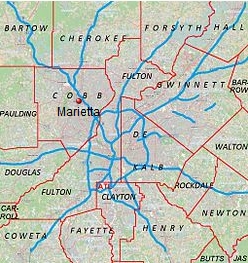
    Apparently using a fill-in-the-blank litigation template, Clarence Busby Jr. sought foreclosure relief on a central Cobb County property in Marietta, Ga. Busby's filing also placed the property in Gwinnett County, which does not border Cobb County. (Graphic from Wikipedia.)

    When former autosurf operator Clarence Busby Jr. filed a lawsuit last year last seeking relief from from a bank and other parties involved in a mortgage foreclosure against him, he’d already been put on notice by the Internal Revenue Service that the agency intended to collect thousands of dollars in back taxes from him, according to records in Cobb County, Ga.

    The taxes were from 2009, according to records. During the same year, Busby launched an autosurf known as Biz Ad Splash — but the tax bill was for a different Busby entity.

    On Aug. 11, 2010, the IRS prepared a federal tax lien against Busby and a company known as Freedom Achievement LLC for $15,481. The lien was formally recorded on Aug. 26, 2010. A note on the lien described Busby as “SOLE MBR” of Freedom Achievement, whose business purpose was not immediately clear.

    About four months later — in December 2010 — Busby filed a pro se lawsuit demanding relief from Quicken Loans, OneWest Bank, MERSCorp and 1,000 “Doe” defendants in Cobb County Superior Court.

    OneWest and MERS responded in January 2011 by moving to have Busby’s case transferred to federal court in the Northern District of Georgia because the lawsuit named defendants in multiple states and involved a controversy that exceeded the sum of $75,000.

    Busby’s case was assigned to Senior U.S. District Judge Robert L. Vining Jr., who dismissed it for failure to state a claim. Beyond dismissing the lawsuit for failure to state a claim, Vining agreed with the defendants that Busby’s arguments had no legal merit. Busby’s pro se pleadings appeared to have come from a fill-in-the-blank legal kit.

    These words appeared on the first page of Busby’s complaint: “COMES NOW, name here, as plaintiff” — and Busby did not insert his name in the “name here” space.

    By contrast, some filings in the ASD/Golden Panda forfeiture case begin with these words, “COMES NOW, plaintiff United States of America, by and through its attorney.”

    The Busby complaint also claims the Busby property in dispute is located in “Gwinnett County.” The document claimed elsewhere that the property was located in the city of Marietta in “Cobb County,” the venue in which Busby sued.

    Marietta is situated in central Cobb County. Cobb County and Gwinnett County do not border one another. and the property is listed in Cobb County courthouse records, meaning it is possible that Busby used an existing legal template and never swapped out an existing reference to Gwinnett County — in the same manner in which he did not insert his name in the “name here” space.

    Whether Busby’s apparent fill-in-the-blank oversights added to the defendants’ costs in successfully defending against the lawsuit is unclear. What is clear is that Busby came out on the losing end and that the defendants referenced the IRS tax lien against Busby in Cobb County in their response to his complaint.

    Separately, the state of Georgia dissolved a Busby company known as Homeshare Investment Club Corp. The dissolution occurred on Sept. 13, 2010, less than a month after the IRS tax lien was filed against Freedom Achievement LLC, according to records.

    Records pertaining to Homeshare Investment Club show that it used the same address used by Busby in the formation of Biz Ad Splash NA LLC.

    BizAdSplash, or BAS, was an autosurf that ceased operating in January 2010. BAS launched in the aftermath of the ASD- and Golden Panda-related asset seizures. A separate address associated with the BAS filing in Georgia is the address of a maildrop in Kennesaw.

    BAS purported to operate offshore. Its apparent U.S. domestic brand is listed in noncompliance by the office of Georgia Secretary of State Brian P. Kemp.

    Members of BAS have complained to the PP Blog about not getting refunds from the autosurf. How much money the surf collected is unclear.

    At the same time the state of Georgia was dissolving Homeshare Investment Club, it also was dissolving another Busby enterprise: Ocean View Enterprises Inc.  Meanwhile, yet another Busby firm — Legacy Premier Properties Inc. — is listed in a state of noncompliance.

  • KABOOM! Web-Based Ponzi Pitchman For Legisi Hit With Judgments Totaling More Than $2.5 Million; Receiver Hires Law Firm To Collect Against Matthew J. Gagnon; Scheme Was Promoted On TalkGold, MoneyMakerGroup, Among Others

    Matthew J. Gagnon, an alleged web-based pitchman of Ponzi schemes and Forex frauds, has been hit with judgments totaling more than $2.5 million by the receiver in the Legisi Ponzi and fraud case. Gagnon also was charged separately by the SEC.

    A web-based pitchman for the alleged Legisi Ponzi scheme has been hit with separate court judgments of $1.69 million and $810,000. Meanwhile, the court-appointed receiver in the Legisi case has hired local counsel in Oregon to pursue the judgments against Matthew J. Gagnon and Mazu Publishing Inc.

    Legisi was alleged by the SEC in 2008 to have operated an international Ponzi and fraud scheme that gathered about $72 million from more than 3,000 investors. The scam was promoted on TalkGold, MoneyMakerGroup and other websites, including Gagnon’s Mazu.com.

    MoneyMakerGroup’s name is referenced in federal court filings in the Legisi case — and records show that shills on TalkGold and MoneyMakerGroup sought to sanitize the scheme even as the U.S. Secret Service and the Michigan Office of Financial and Insurance Regulation were using undercover agents to gather evidence about the fraud.

    The judgments against Gagnon and Mazu illustrate the legal and financial nightmares to which forums such as TalkGold and MoneyMakerGroup contribute. Meanwhile, the fact that Legisi was promoted at the forums even as it was under investigation exposes a myth advanced on such forums that investors would know in advance that a government probe of an “opportunity” was under way.

    In this evidence exhibit given to a federal judge prior to the Legisi asset freeze, a Legisi prospect writes the name "Money Maker Group.com" in longhand. The prospect also wrote the name "Matt Gagnon" in longhand and a telephone number for Gagnon.

    At the same time, the judgments against Gagnon destroy the myths that online promoters of securities schemes have no legal exposure and that offers positioned as “private”  insulate promoters from prosecution.

    Indeed, the judgments against Gagnon resulted from litigation brought by Robert D. Gordon, the court-appointed receiver in the Legisi case, in October 2009. The SEC sued Gagnon in May 2010, seven months after Gordon brought his actions.

    Among the SEC’s allegations against Gagnon was that he continued to promote fraud schemes online — even after the Legisi scheme was exposed.

    “Gagnon has been unrelenting in his efforts to raise money from the public through fraudulent, unregistered offerings,” the SEC said in May 2010. “He remains a danger to the investing public.”

    Despite his sales pitches, “Gagnon has never been associated with a registered broker-dealer and has never been registered with the Commission as a broker or dealer or in any other capacity,” the SEC said.

    After the Legisi HYIP fraud, Gagnon transitioned to pushing Forex frauds, the SEC said.

    Gagnon was hit with an asset freeze after the SEC brought its action.

    Records show that Legisi was among a number of “opportunities” that used E-Bullion, which was operated by James Fayed.

    A jury in Los Angeles last week recommended the death penalty for Fayed for arranging the slaying of his estranged wife, Pamela Fayed.

    Federal prosecutors said in December that AdSurfDaily, yet another alleged Ponzi scheme, had an E-Bullion tie. Records show that Gold Quest International, still another Ponzi scheme, also used E-Bullion.