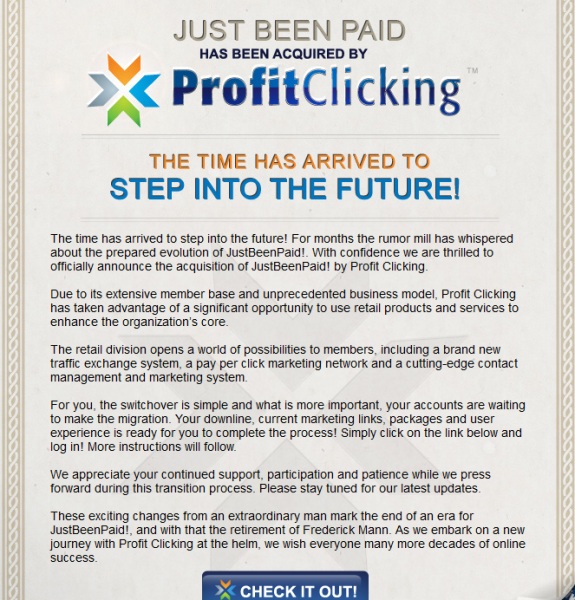
"ProfitClicking" claims it has acquired JSS/JBP and that Frederick Mann has retired.
Just days ago Frederick Mann — the purported operator of the JSS Tripler/JustBeenPaid “program” — was hinting that his fraud scheme that advertised a return of 60 percent a month needed a new name because critics were being entirely too negative. Like the now defunct Zeek Rewards “program,” which last week was described by the SEC as a $600 million Ponzi and pyramid scheme that was selling unregistered securities as investment contracts, JSS/JBP had served up one public-relations disaster after another.
There was the little matter of an ad for JSS/JBP that appeared on a website known as Vatican Assassins, for instance. And there was “Ping,” a woman who’d claimed she had heart problems, was managing multiple JSS/JBP accounts, that her sister’s home was in trouble — and that JSS/JBP ignored her support tickets for weeks.
Mann speculated that the company could come under attack by American cruise missiles.
JSS/JBP found itself wrestling another PR flap in the past 24 hours, amid Ponzi-forum reports that Mann suddenly had “retired” and that the JSS/JBP “program” had been acquired and wrapped into an upstart autosurf known as ProfitClicking.
A quick analysis of the shell of the ProfitClicking website suggests that the emerging “opportunity” plans to be every bit as disingenuous as the five-alarm fraud scheme it apparently has swallowed. Ponzi-forum pretentiousness on places such as MoneyMakerGroup can be paraphrased as such:
I didn’t sign up for no stinkin’ autosurf. Where the hell is the money I gave the JSS/JBP scammers to see if I could profit from the scam?
Give these honest scammers a chance to see if they can pull off their new scam.
Be patient with the new scammers and don’t make too much noise. Remember, we have to pretend they’re not scammers and we’re not scammers to maximize the effectiveness of the scam.
Perhaps to make its “sovereign citizen” clientele feel at home, ProfitClicking has adopted all or part of the former JSS/JBP terms, which makes members affirm they are not with the “government.”
Like the collapsed AdViewGlobal autosurf Ponzi scheme that now has been linked to the collapsed AdSurfDaily Ponzi scheme, ProfitClicking is calling itself a “private association.”
Similar to the collapsed Zeek scheme, ProfitClicking says it has a “Legal Compliance Department.”
Like many online fraud schemes these days, ProfitClicking appears to have a plan to scam the public through social-networking sites such as Google +, Twitter and Facebook. And Profit Clicking says it is using at least two of the same offshore payment processors Zeek chose: Payza and SolidTrustPay.
Mann was a former pitchman for the ASD Ponzi scheme. Zeek and JSS/JBP are known to have members in common.
One graphic on the current landing page for ProfitClicking features a cartoon image of a bird. The bizarre headline is “Polly Wants A Profit.”
Naturally, there’s also a picture of a waterfront mansion.
UPDATED 4:06 P.M. EDT (U.S.A.) It happened after the collapse of AdSurfDaily in 2008 — and it’s happening now in the aftermath of the collapse of Zeek Rewards amid spectacular allegations by the SEC Friday of Ponzi and pyramid fraud.
The office of North Carolina Attorney General Roy Cooper issued a warning minutes ago about “reload scams” aimed at taking advantage of Zeek victims.
Here is the warning in its entirety (italics added):
Reload scams hit consumers when they’re down, offering to help them make back money they lost to a previous scam or bad business decision. These scams have been popular for years with telemarketing fraud rings but can also follow other types of fraud.
We’re now seeing reload scams seeking to recruit consumers who were members of Zeekler, a penny auction website headquartered in North Carolina that shut its doors last week and entered into a settlement with the U.S. Securities and Exchange Commission. The SEC determined that Zeekler was a Ponzi scheme, using money from later investors to pay back earlier investors until the scheme started running out of money. The Attorney General’s Office is continuing to investigate Zeekler.
Blogs, news releases online, and individuals leaving comments in articles about the Zeekler shut down are already touting opportunities “for those that are looking for something that can help them replace the income they were receiving from Zeek Rewards.” If you’ve been a part of a scheme such as Zeekler that collapsed, or if you lost money to another recent scam, don’t fall for a reload scam. Better to cut your losses than lose even more.
The exact phrase quoted by Cooper’s office in the paragraph above appears in a news release for something called TheMayDayReport.
The SEC called Zeek a $600 million Ponzi- and pyramid scheme that had affected more than 1 million investors. Cooper’s office opened a probe into Zeek in July, and the U.S. Secret Service also is investigating Zeek.
Over the weekend, the PP Blog received multiple spams aimed at Zeek threads. Purportedly from “Briant,” those spams promoted a “program” called Ultimate Power Profits. Like Zeek, Ultimate Power Profits has a presence on well-known Ponzi scheme forums such as MoneyMakerGroup.
Zeek’s former head cheerleader at MoneyMakerGroup — “mmgcjm” — also is the head cheerleader for Ultimate Power Profits at the forum.
On Friday — the same day of the Zeek collapse — an MLM “program” known as Vi-Tel Wireless (Vi-Tel) issued a news release to announce it was sponsoring a “Zeek Rescue Program.” Affiliates busied themselves heralding the purported rescue program across the web.
Vi-Tel called itself a “safe refuge.” Vi-Tel affiliates aimed sales pitches at websites carrying information on Zeek, leading to questions about whether reps were circling like vultures. It was remarkably awful PR.
In other post-Zeek news, an auction “program” known as Bidify now is offine. The company says it is trying to retool itself in the aftermath of the Zeek collapse.
Like Zeek prior to the collapse, Bidify denies it is an investment program.
Zeek, Rex Venture Group LLC and operator Paul Burks were charged Friday with selling unregistered securities as investment contracts.
UPDATED 10:58 A.M. EDT (U.S.A.) Two new details have emerged in the mysterious shutdown yesterday of the office and websites of Zeekler/Zeek Rewards: The office of North Carolina Attorney General Roy Cooper told the PP Blog this morning that it has taken no action to shut down Zeek, the operator of an MLM and a penny-auction site.
“We have not taken action to shut the company down and are currently working to get more information so we can pass that along to consumers who may be impacted by this,” said Noelle Talley, a spokeswoman for Cooper.
But Cooper’s office did say that it had issued a Civil Investigative Demand (CID) to Zeek on July 6. That’s weeks earlier than initially believed and leads to questions about whether Zeek had known for five weeks that it had been under investigation and did not inform participants.
Without providing details, Zeek announced on its Blog yesterday that it had canceled its Aug. 22 “Red Carpet” event. By early evening, the Zeek Rewards and Zeekler sites began to publish this message: “Zeek Rewards is currently unavailable. More information will be available shortly on this website.”
Earlier in the week, Zeek announced that “there won’t be any training, recruitment or leadership calls for the next few days while planning is going on.”
With Zeek leaving affiliates in an information vacuum, many of them took to the Web. At least two petition drives appear to be under way demanding the government to reopen Zeek. As of the time of this post, the PP Blog has been unable to confirm that an action by any government agency — state or federal — was responsible for Zeek’s sudden absence.
The Blog still is in the process of trying to piece together events in what has emerged as a bizarre and fluid situation. Sensing Zeek affiliates were vulnerable, some MLM opportunists raced to various sites such as The Dispatch newspaper in North Carolina and YouTube with offers to join their “programs.”
Zeek fans on the MoneyMakerGroup Ponzi forum almost immediately blamed critics for Zeek’s problems, with one poster declaring he’d already mined his profits from Zeek and was confident they could not be attached by prosecutors in the United States.
The Better Business Bureau said this morning that it was aware of reports that the doors at Zeek’s office in Lexington, N.C., were closed. The BBB added that it would publish more information as it became available.
Zeek is a purported arm of Rex Venture Group LLC, led by Paul R. Burks.
BULLETIN: The Zeek Rewards MLM “program” that is married to a penny-auction site known as Zeekler and plants the seed that an annualized return in the hundreds of percent is possible has declared that “all” Zeek criticism has been “unprofessional” and based on “false information.”
Some Zeek affiliates have said that Zeek provides a payout that averages about 1.4 percent a day, a figure higher than the AdSurfDaily Ponzi scheme.
Zeek has preemptively denied it is an investment program or “pyramid scheme.” Regardless, Zeek has a presence on HYIP forums referenced in federal court filings as places from which Ponzi schemes are promoted. The company has used offshore payment processors linked to numerous fraud schemes and employs business model similar to the $110 million AdSurfDaily Ponzi scheme.
Zeek, which has members in common with ASD, gathers sums of up to $10,000 from members. Like ASD, it claims it is not offering an investment program. But Zeek now is blasting unspecified “North Carolina Credit Unions” for circulating a purported “internal memo” that allegedly was “at once unfavorable to Zeek Rewards and false.”
The Zeek Blog post was attributed to acting COO Gregory J. Caldwell, who replaced acting COO Dawn Wright-Olivares. While acting COO, Wright-Olivares once suggested that, if Zeek instructed members to change their preference in dispensing toilet paper in their private bathrooms (top-rolling vs. bottom rolling), they should do it.
Wright-Olivares now is Zeek’s “Chief Marketing Officer,” with Caldwell holding her former job, according to the company.
Caldwell, according to the Zeek Blog post, now is warning Zeek members to stick with the company line or face the consequences. The post did not spell out those consequences.
“It’s counter-productive for Affiliates to fan the flames of issues that are the proper responsibility of Zeek Corporate…and it’s a violation of the Zeek Policies and Procedures for which violators will be held responsible,” the post attributed to Caldwell and dated today read in part.
A North Carolina credit union had slandered Zeek, according to the post attributed to Caldwell on the Zeek Blog (italics/bolding added).
Zeek Rewards policy is to act quickly to support the Zeek reputation and the future of your business. Upon learning of the memo slandering Zeek, I called the head of Risk Management to track down the origin of the memo. Upon being discovered, the person responsible admitted he really didn’t know anything about the laws regarding direct selling or how to identify a legitimate network marketing company or opportunity. Like all our critics, he was behaving unprofessionally by acting on false information.
We intervened, shut down the misinformation at its source, and that would have been that…were it not for the inappropriate action of one of our own Affiliates who posted the memo online where it has been picked up and is now being used by our critics.
Prior to being arrested on Dec. 1, 2010, by the U.S. Secret Service amid allegations he was at the helm of an Internet Ponzi scheme that planted the seed affiliates received a return of 1 percent a day but were not making an investment, ASD President Andy Bowdoin also complained about slanderous critics. Bowdoin pleaded guilty in May 2012 to a Ponzi-related charge of wire fraud.
Although Bowdoin posted bond and remained free after the Secret Service brought its case, he is now jailed in the District of Columbia, amid allegations he continued to promote fraud schemes after the Secret Service seized more than $80 million in the ASD Ponzi case in August 2008 and after Bowdoin was arrested on Ponzi charges in December 2010. Federal prosecutors identified those schemes as AdViewGlobal and OneX.
Bowdoin, 77, is scheduled to be formally sentenced in the ASD case on Aug. 29.
Some Zeek members also have promoted OneX, which reportedly used at least one of the same offshore processors as Zeek (SolidTrustPay).
Zeek members also have been linked to a “program” known as JSS Tripler/JustBeenPaid and purportedly operated by Frederick Mann, a former ASD pitchman who may have ties to the so-called “sovereign citizens” movement. ASD also had ties to “sovereign citizens,” including the now-jailed Kenneth Wayne Leaming (false liens/harboring fugitives/possessing firearms illegally after prior felony conviction/false uttering) and Curtis Richmond, who once accused the federal judge overseeing the ASD case of “TREASON” and as many as 60 felonies.
JSS/JBP purports to provide a return of 730 percent a year. JSS/JBP uses at least two of the same offshore processors used by Zeek (SolidTrustPay and AlertPay, now Payza).
Meanwhile, Zeek promoters also have been linked to a “program” known as Regenesis 2×2, which came under Secret Service scrutiny in 2009 and also had a presence on the Ponzi boards.
Before the ASD Ponzi raid by the Secret Service in 2008, ASD had moved “several million” dollars into SolidTrustPay, according to court records. AlertPay also is referenced in filings in the ASD Ponzi case. Both firms are referenced in filings in the Pathway to Prosperity HYIP Ponzi case brought in 2010 by the U.S. Postal Inspection Service.
Filings in the Pathway to Prosperity case also reference the TalkGold and MoneyMakerGroup forums — forums on which Zeek, JSS/JBP, ASD and the Legisi HYIP Ponzi scheme had a common presence. SolidTrustPay, meanwhile, was mentioned in filings in the Eagle Trades LTD fraud case. Terrance Osberger of Eagle Trades was indicted last month by a federal grand jury in Ohio on one count of wire fraud and 48 counts of money-laundering.
Eagle Trades also had a presence on the Ponzi boards.
The Blog post attributed to Caldwell came on the heels of a report yesterday by BehindMLM.com that the North Carolina State Employee’s Credit Union (NCSECU) had concerns about Zeek. (Link to BehindMLM story below.)
In June, the office of North Carolina Attorney General Roy Cooper said it had concerns about Zeek. Cooper’s office expressed those concerns after a North Carolina television station suggested Cooper’s office had determined Zeek to be operating legally. Zeek’s Blog linked to the TV station’s report, but the TV station later removed the report. Cooper’s office said that no determination that Zeek was operating lawfully had been made.
EDITOR’S NOTE: In Ponzi Land, HYIPs that suggested returns of 1 percent (or more) per day “worked” to line up lambs for the slaughter. So did autosurfs that planted the 1 percent a day (or more) seed. Now, 1 percent a day (or more) “auction” sites are “working.” Will they mushroom globally like HYIPs and autosurfs, setting the stage to fleece participants in unprecedented numbers?
Apparently now fully recovered from his purported bout with Dengue fever, legendary HYIP huckster “Dave” is back — this time with something called “DailyCashMania” (DCM) that appears to be married to a nascent penny-auction site known as “HawkPay” that is luring affiliates amid DCM promises it will offer a “mega-prize” of a $10,000 cash voucher.
One MoneyMakerGroup Ponzi forum promoter of DCM declared it “The ONLY Matrix supported by a [sic] Auction site.”
HawkPay says it will offer “scratch” auctions. A graphic for a “test listing” (Canon camera) on the site reads “SCRATCH TO SEE YOUR PRICE.” When that graphic is clicked, this message loads: “Your scratch will cost 1 bid and the product price will be lowered with $.10.”
ASD’s chatter about the Presidency quickly brought out the U.S. Secret Service, which discovered ASD affiliates were being paid with money from other affiliates: a classic Ponzi scheme. The Secret Service also discovered that political donations made by ASD President Andy Bowdoin came from Ponzi money.
Other prelaunch hype for BidsThatGive claimed that affiliates of the “program” could get filthy rich, so rich the company would pay to name a hospital or orphanage after them.
Meanwhile, the Zeek Rewards MLM “program,” which is married to a penny-auction site known as Zeekler, has announced a new slate of officers at Rex Venture Group, the purported parent company of the Zeek businesses. Even as the company was making the announcement, posters on the MoneyMakerGroup Ponzi board were sharing “I Got Paid” posts. Another poster placed a link to something called ZeekCalc, a purported earnings calculator apparently created by a Zeek fan.
“This is a online FREE Zeekrewards Profit Calculator that allow [sic] you [to] predict your profit from the Zeekrewards Program,” the calculator site claimed. “With this tool it’s easy and fast [to] calculate your future income or future earnings of the new people who join the program.”
Among the apparent Zeek affiliates bragging about their Zeek payouts at MoneyMakerGroup in the run-up to Zeek’s announcement about its new officers yesterday was legendary Ponzi promoter “strosdegoz,” a former cheerleader for “Dave’s” scams, along with the OneX scam and the ClubAsteria scam — and many others. “strosdegoz” has claimed to be a member of 35 HYIP boards.
Among other things, Club Asteria traded on the names of the World Bank and the American Red Cross. Hank Needham, one of Club Asteria’s purported managers, was a former AdSurfDaily pitchman and cash-gifting enthusiast shown on videotape opening packages of cash from at least two countries.
“Just received two payments now,” “strosdegoz” posted of Zeek on MoneyMakerGroup on July 29. He simultaneously was promoting Bidify, yet another emerging penny-auction site. Others joined “strosdegoz” in the Zeek “I Got Paid” cheerleading chorus on MoneyMakerGroup, including a poster known as “jumpin.”
“You’ve got cash!” a post yesterday from “jumpin” began. “Rex Venture Group LLC . . . just sent you money through Payza.”
The post went on to claim a July 30 Zeek payment of $23.98 from Rex Venture, Zeek’s purported parent company.
“Ken Russo,” another Ponzi forum legend, also has made “I Got Paid” posts that cited payments from Rex Venture. In May, “Ken Russo” claimed on the TalkGold Ponzi forum that he’d received $34,735 from Zeek since Nov. 14, 2011. “Ken Russo” posts on Talk Gold as “DRdave.”
Just plain “Dave” of the emerging DCM scam perhaps is most infamous for a “program” known as JSS Tripler 2, which appears to have based its name on the JSS Tripler/JustBeenPaid “program” purportedly operated by Frederick Mann, a former ASD pitchman. JSS Tripler 2 soon morphed into something called T2MoneyKlub and launched a companion scam known as Compound150.
T2 Money Klub and Compound150 appear to have collapsed after “Dave” purportedly was battling back from a bout with Dengue fever.
But now “Dave” appears to be back with DCM and its work-in-progress “scratch” auction.
The new Rex Venture Group officers announced yesterday, according to Zeek’s news Blog, include Greg Caldwell as “acting COO”; Josh Calloway as CTO; Clifton Jolly “to head up PR”; Angie Fiebernitz as CFO; and Alex de Brantes as executive director of training and support services.
Meanwhile, according to the Zeek Blog, Peter Mingils “is rockin’” over the “Certified Trainers course curriculum as Zeek’s Training & Incentives Coordinator,” and “Robert Mecham and OH Brown are banging out video after video and Zeek’s “FANTASTIC NEW BUSINESS CARDS!”
Dawn Wright-Olivares is Zeek’s new “Chief Marketing Officer,” after previously serving as “acting COO,” according to the Zeek Blog.
UPDATED 6:36 P.M. EDT (U.S.A.) To hear some folks in HYIP Ponzi Land tell it, “opportunities” can avoid the long arm of the law by preemptively prohibiting affiliates from using certain words — “investment” and “security,” for two examples. Regardless, court records show that hucksters who played linguistic games to mask their fraud schemes confronted investigators who neatly exposed their wink-nod wordplay.
The following is from a transcript of a May 2007 U.S. Secret Service recording in which undercover agents posing as prospects were talking to Gregory McKnight of Legisi inside Legisi’s office in Michigan. McKnight and Legisi later were implicated in a $72 million Ponzi scheme that in part was promoted on the MoneyMakerGroup forum:
McKnight: ” . . . it is not an investment.”
Agent 1: “Okay.”
McKnight: “I hope you have any idea — if you have any inkling of an idea that it is an investment, then you should really . . .”
Agent 1: “I’m sorry.”
McKnight: “This is a loan to my corporation.”
Agent 1: “Okay.”
“Agent 2: “What’s the difference?”
McKnight: “The difference is — if I am selling investments and I am not registered with the SEC, I am going to prison.”
Agent 2: “Oh.”
Outcome: McKnight, adjudicated liable civilly in a case brought by the SEC and ordered to pay millions of dollars in restitution and penalties, is scheduled to be sentenced on a criminal charge of wire fraud on Sept. 11. The U.S. Secret Service brought the criminal case.
The following is from Paragraph 43 of the August 2008 complaint for forfeiture that targeted tens of millions of dollars in bank accounts tied to the AdSurfDaily Ponzi scheme, which gathered at least $110 million. ASD also was promoted on the Ponzi boards (italics added):
“The [undercover agent] asked her about investing with ASD. She immediately said, ‘Don’t call it investing, you know what I mean, we can get in trouble if we say that, we have to be careful.”
Outcome: A federal judge ordered the civil forfeiture of more than $80 million, including the forfeiture of more than $65.8 million in ASD President Andy Bowdoin’s personal bank accounts and more than $14 million in bank accounts linked to Golden Panda Ad Builder, another autosurf. The U.S. Secret Service brought the civil case.
The following is from the November 2010 criminal indictment against Bowdoin. The prosecution quoted from an email from Bowdoin in which the ASD patriarch himself laid out the wink-nod nature of the 1-percent-a-day ASD program and explained his bid to skirt securities laws by coming up with naming conventions to keep the government at bay (italics added):
“[L]et’s don’t (sic) use the words investment and returns. Instead, lets (sic) use ad sales and surfing commissions. The Attorney Generals in the U.S. don’t like for us to use these words in our program.”
Outcome: Bowdoin, currently jailed amid allegations he pushed other fraud schemes after the seizure and after his arrest and posting of bond, is scheduled to be sentenced on a criminal charge of wire fraud on Aug. 29. The criminal charge was brought after an investigation by the U.S. Secret Service.
And what about AdViewGlobal (AVG), the alleged 1-percent-a-day knockoff of ASD that prosecutors now say they’ve linked to Bowdoin? From the PP Blog’s April 27, 2009, report about the AVG forum warning members not to call AVG an investment program (italics added):
A Mod at an AdViewGlobal forum set up by Mods and members of AdSurfDaily has warned AVG members not to refer to their purchases as “investments.”
Rather, the Mod said, AVG members purchase “advertising” and are not “investing” or “investors.”
Posts that used the terminology of investments would be deleted, the Mod warned.
AVG members currently are stressing a so-called “80-20? strategy as a means of keeping the program viable for the long-term.
Analysts, however, point out that the “80-20? plans — taking out 20 percent in cash and letting 80 percent ride with the companies — are just another way to keep cash within ready reach of autosurf Ponzi schemes to sustain the deception.
There is not a single, documented case in the history of autosurf prosecutions in which the use of the word “advertising” to describe what the government views as an “investment” program involving the sale of unregistered securities has succeeded as a means of fending off a prosecution.
In other words, the government has made it plain that you can’t avoid prosecution by using other terminology to describe an investment program.
Regardless, many surf companies continue to insist that the use of the word “advertising” as a replacment for “investing” somehow insulates surfs from prosecution.
Outcome: Unknown. The AVG forum mysteriously disappeared, as did AVG itself. In April 2012, federal prosecutors announced in court filings that they’d linked Bowdoin to AVG.
Virtually all of the material quoted above has been a matter of record for at least three years. In the case of Legisi, it has been a matter of record for more than four years.
Wordplay, though, still is in play among “programs” that purport to pay members outsized percentages that correspond to annualized returns in the hundreds of percent per year. In the past 24 hours on the MoneyMakerGroup forum, for example, these posts (below) appeared in the context of the Zeek Rewards “program.” The first post used the word “investment.” Perhaps ignorant of history (or maybe not), the poster quickly followed up in the second post by saying the use of “investment” was a mistake and that what really was meant was that he or she had purchased “Bids.”
It was hard not to hear the echoes of ASD and AVG members doing largely the same thing summers ago, sometimes after being scolded by the purported forum masters.
BULLETIN: The operator of an alleged HYIP fraud known as Eagle Trades LTD has been indicted on 49 Ponzi-related charges of wire fraud and money-laundering after a probe by the IRS, federal prosecutors in the Northern District of Ohio said.
Terrance Osberger, 48, of Genoa, Ohio, has been charged with one count of wire fraud and 48 counts of money-laundering, the office of U.S. Attorney Steven M. Dettelbach said.
Records show that the “program,” which allegedly offered returns in the hundreds of percent over 190 days, was promoted in 2009 on the TalkGold and MoneyMakerGroup forums. Separately, records show that state securities regulators in Massachusetts filed civil charges against Eagle Trades in 2011, alleging that two investors in the state were instructed by Osberger to send “their joint $103,000 investment through SolidTrustPay.”
SolidTrustPay is a Canadian payment processor favored by HYIP scammers.
The money sent through SolidTrustPay appears to have made its way into an Eagle Trades’ bank account in Ohio “over the course of several successive days,” according to the Massachusetts filing. But due to the “high volume of transactions and the intermingling of funds” in the account, Massachusetts investigators said they were “unable to definitely determine the ultimate destination of the $103,000 investment.”
Another Massachusetts investor was instructed by Osberger to wire $50,500 to a Cyprus entity known as F.B.M.E. Bank Ltd. That transaction proved to be difficult to reverse-engineer because of international red tape, according to the Massachusetts complaint.
The Massachusetts filings speak to the recovery difficulties investors may encounter when doing business with murky enterprises that may have one or more offshore arms, the ability to send and receive money via offshore payment processors and a corresponding ability to dump the money into domestic or international bank accounts — before moving it again.
Eagle Trades, according to an evidence exhibit prepared by Massachusetts investigators, told investors that they “will quickly notice that we have reengineered the mold regarding High Yield Investment Programs [HYIPs], making it easier than ever for you to be more informed regarding your investment options and earn a realistic, yet sustainable investment return.”
Current HYIPs such as JSS Tripler/JustBeenPaid are making similar claims about purported sustainability and reengineered platforms while also luring prospects by advertising returns that correspond to annualized returns in the hundreds of percent — and all while using SolidTrustPay and other offshore processors.
JSS/JBP purportedly is operated by Frederick Mann, a former pitchman for the AdSurfDaily Ponzi scheme, which also had a presence on the Ponzi boards, also used SolidTrustPay and also planted the seed that annualized returns in the hundreds of percent were possible.
ASD President Andy Bowdoin, 77, is jailed in the District of Columbia. He pleaded guilty to wire fraud in May and acknowledged ASD was a Ponzi scheme that never operated legally from its 2006 inception.
Over time, Eagle Trades told Massachusetts investors waiting for their payouts that it had been targeted in a”massive, seven-figure fraud” and provided a series of excuses about why investors were not getting paid. But federal prosecutors in Ohio now say Osberger was using Eagles Trades to defraud customers.
He potentially faces decades in prison.
“Osberger misused investor funds for his own personal use,” federal prosecutors said. “In other cases, he misused investor proceeds to repay earlier investors in what is commonly known as a Ponzi scheme, according to the indictment.”
And, federal prosecutors said, “Osberger listed Eagle as a subsidiary of Falcon Financial Group Limited, with addresses in Belize and the Commonwealth of Dominica and utilitzed Aurum Capital Holdings, which maintained several offshore bank accounts during the scheme, according to the indictment.
From "Exhibit 1" in the state-level case against the Eagle Trades HYIP in Massachusetts.
Depending on how they navigate the site, PennyAuctionCustomers.com visitors may encounter a confusing series of screens and ultimately may be shown an ad for JSS Tripler/JustBeenPaid, which may have ties to the "sovereign citizens" movement. The PennyAuctionCustomers site purports to sell customers for the ZeekRewards MLM "program" that plants the seed it provides a daily return of between 1 percent and 2 percent while not being a "pyramid scheme" and while not constituting an investment program.
PennyAuctionCustomers.com advertises that it sells “customers” to members of the Zeek Rewards MLM, collects money through PayPal, serves confusing pop-up messages, uses the name of AdSurfDaily figure Todd Disner in its meta data — and sends traffic to the preposterous JSS Tripler/JustBeenPaid “program” that advertises a return of 60 percent a month.
Whether the site has any affiliation with Disner is unclear. What is clear is that Disner is a Zeek Rewards member who sued the U.S. government last year for alleged misdeeds in the AdSurfDaily Ponzi case, including a claim that federal prosecutors and the U.S. Secret Service had relied on a “tissue of lies” in bringing the ASD case.
This Zeek ad attributed to former AdSurfDaily member Dwight Owen Schweitzer paints Zeek as an investment program through which participants can "earn 1%+ a day compounded."
Disner’s co-plaintiff in the case was fellow ASD (and Zeek) member Dwight Owen Schweitzer, a former attorney whose license was suspended in Connecticut. The government asked a federal judge last month to dismiss the Disner/Schweitzer complaint, pointing out that ASD President Andy Bowdoin had pleaded guilty to wire fraud in the ASD case.
Bowdoin, 77, is now detained in Washington, D.C., awaiting formal sentencing by U.S. District Judge Rosemary Collyer in August. Court papers show that Bowdoin admitted ASD was a Ponzi scheme and that he had presided over an illegal money-making business since the inception of ASD in 2006.
Zeek’s business model closely resembles that of ASD. Like ASD, Zeek plants the seed that it provides a daily return that corresponds to an annual return in excess of 300 percent. Zeek participants must place an ad online daily to earn the purported daily payout. ASD members were required to view ads.
The U.S. Secret Service seized more than $80 million in the ASD Ponzi case, including more than $65.8 million from Bowdoin’s bank accounts in August 2008.
When the PP Blog visited PennyAuctionCustomers.com, accessed the “FAQ” page and sought to leave the page, the Blog’s browser encountered multiple pop-up screens that displayed confusing messages. Eventually the Blog was shown a page on the site with banner ads for the JSS/JBP “program” and a “program” known as Banners Broker.
The banner ad near the bottom of this page on the PennyAuctionCustomers.com website points visitors to the JSS Tripler/JustBeenPaid "program" after soliciting visitors to purchase "customers" for the Zeek Rewards MLM "program." A JSS/JBP site loads when the "Triple Your Money" banner is clicked.
“DO YOU LIKE ZEEK REWARDS?” the PennyAuctionCustomers site inquires.
“WELL YOU WILL LOVE THIS,” it asserts. “Two Other Highly Lucrative Programs That Do Not Require Any Sponsoring of Other Affiliates That You May Wish To Join If You Are Looking To Boost Your Income!”
It then points visitors toward JSS/JBP and Banners Broker.
Like Zeek (and ASD before it), the JSS/JBP and Banners Broker “programs” are being advertised on well-known Ponzi scheme forums such as TalkGold and MoneyMakerGroup. The various promotions lead to questions about whether fraudulent schemes are simply recycling money from scam to scam to scam, polluting the money stream at multiple points nationally and internationally.
These phrases are among the meta data on the PennyAuctionCustomers site:
zeekrewards 90 day strategy
zeekrewards calculator
is zeekrewards legit
is zeekrewards legal
todd disner zeek rewards
An Oregon entity known as Media Clinch LLC appears to be conducting the Zeek “customer” sales through PayPal while at once pointing traffic toward Banners Broker and JSS/JBP, which purportedly is operated by Frederick Mann. Mann and JSS/JBP may have ties to the so-called “sovereign citizens” movement in which adherents display an irrational belief that laws do not apply to them and courts have no jurisdiction over them.
Although JSS/JBP appears to rely on “offshore” payment processors linked to fraud scheme after fraud scheme, the PennyAuctionCustomers Zeek promos through the Media Clinch LLC PayPal account introduces the prospect that soiled proceeds from multiple fraud schemes also could be flowing into PayPal.
Media Clinch LLC, according to Oregon records, is managed by Sean Walters. Zeek has an affiliate by the same name.
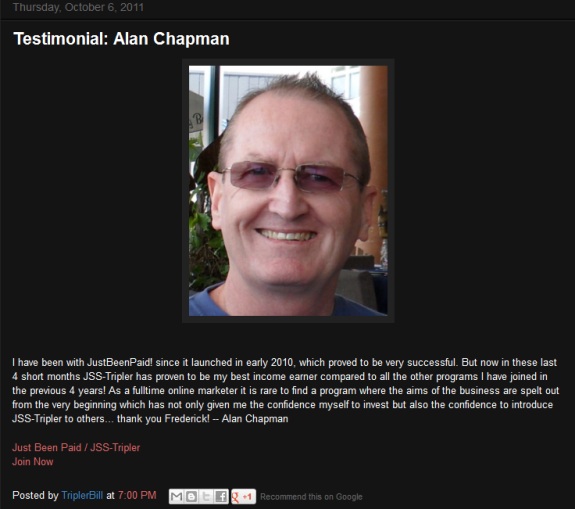
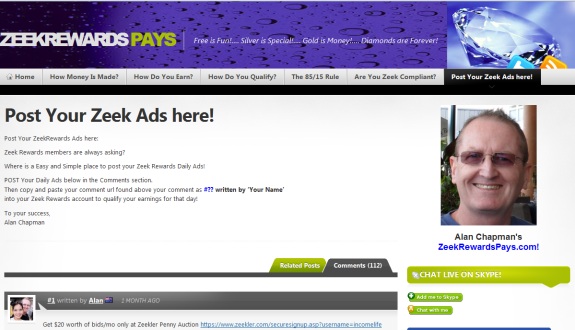
UPDATED 11:22 A.M. EDT (JUNE 13, U.S.A.) Images of a man described as “Alan Chapman” appear in online promos for both the JSS Tripler/JustBeenPaid and Zeek Rewards “programs” that plant the seed that enormous daily returns on the order of 1 percent to 2 percent are possible.
In one Blog pitch for JSS/JBP dated Oct. 6, 2011, “Chapman” is quoted as saying, “I have been with JustBeenPaid! since it launched in early 2010, which proved to be very successful. But now in these last 4 short months JSS-Tripler has proven to be my best income earner compared to all the other programs I have joined in the previous 4 years!”
The ad includes a photo of “Chapman.”
Meanwhile, in a Blog pitch for Zeek in a publication titled “ZeekRewardsPays,” “Chapman” is quoted as saying Zeek members can post their “ads” on the ZeekRewardsPays site “to qualify [for] your [Zeek] earnings for that day!”
The Zeek pitch also includes a photo of “Chapman.”
Zeek members who want to share in the firm’s purported revenue pool are required to post an ad online to qualify for a payout. The ad-posting requirement may be a bid to undermine the “Howey Test,” which determines what constitutes a security/investment contract.
One of the questions posed by the Howey Test is whether profits can be derived from an opportunity solely from the efforts of the purveyors. By insisting that Zeek members cannot get paid unless they post an ad, Zeek may be setting the stage to argue that Zeek’s ad-posting requirement constitutes “work” by affiliates and therefore the payouts do not derive solely from Zeek’s efforts.
Both Zeek and JSS/JBP use offshore payment processors such as AlertPay (now Payza) and SolidTrustPay that are friendly to fraud schemes promoted on known Ponzi-scheme forums such as TalkGold and MoneyMakerGroup. Both Zeek and JSS/JBP have promoters in common, and both “programs” are being promoted on the Ponzi boards.
Because Zeek and JSS/JBP have common promoters and a presence on Intenet cesspits, questions have been raised about whether the “programs” and their banks and payment-processing vendors have come into possession of funds tainted by fraud schemes.
On the ZeekRewardsPays site with the photo of “Chapman, the following claim is made today:
ZeekRewards Daily Profit Last 7 Days!
June 11 2012 1.89 %
JUNE 10 2012 0.88 %
JUNE 09 2012 0.96 %
JUNE 08 2012 0.92 %
JUNE 07 2012 1.91 %
JUNE 06 2012 2.00 %
JUNE 05 2012 1.93 %
In recent days, Frederick Mann, the purported operator of JSS/JBP, has raised the prospect that JSS/JBP members could be on their own if law-enforcement agencies take action against the “program.”
JSS/JBP also has banned discussion about customer-service issues on its weekly conference call. That announcement was made during the June 7 call, a week after a woman identified as “Ping” begged Mann for assistance, asserting her concerns had not been addressed in a month.
On May 31, “Ping” implied she was ill with a serious heart condition, was managing three JSS/JBP accounts that had been hacked a month ago and said her “sister borrowed on her house [to] put money in JBP.”
During the June 7 call, Mann also implied that JSS/JBP members were free to start their own business-with-a-business — for example, they could create pools from investor money at the local, regional, national or international level and a single JSS/JBP member could manage the pools and perhaps make a profit by playing the spread between what JSS/JBP pays and the fees a local pool manager would charge for managing the pool.
JSS/JBP has no known securities registrations, does not identify where it is operating from and may have ties to the “sovereign citizens” movement.
Mann now has taken to doling out medical advice during the JSS/JBP calls, insisting that JSS/JBP members should not trust their doctors.
Nor should they trust attorneys, Mann implied.
JSS/JBP members are required to affirm they do not work for the “government.”
Zeek recently has encountered problems at at least two U.S. banks. Zeek preemptively has denied it is a pyramid scheme. The firm also claims it is not offering an investment product.
EDITOR’S NOTE: Our theory about Zeek Rewards is that it’s a slow-motion, pyramid-style Ponzi scheme being driven by any number of clueless affiliates who do not understand they are being influenced by steroidal puppeteers and MLM’s Great Wing of Willfully Blind Hucksters, Religious Frauds and Disingenuous Opportunists, PR Amateurs, Government Agitators and Unindicted Felons and Misdemeanants. We had a similar theory about AdSurfDaily. Read this document (courtesy of the ASD Updates Blog) and see if you agree that Zeek affiliates need to be asking some very serious questions about their “program.”
** _____________________________________ **
UPDATED 1:39 P.M. EDT (U.S.A.) If you expected to be less confused about Zeek Rewards after listening to Jim Gillhouse and Troy Dooly chat up Zeek COO Dawn Wright-Olivares Friday night on ACES Radio Live, you’re apt to have come away disappointed — or perhaps even more confused. (Link to recording at bottom of editorial.)
The 86-minute show began with something that resembled a hopeful note: Gillhouse implied he’d hold Zeek’s feet to the fire and play “bad cop” to Dooly’s “good cop” because of various controversies swirling around Zeek. Co-host Dooly, though, seemed to bristle at the “bad cop” remark.
“Well, it ought to be interesting because I’m learning that bad cops don’t usually have all the facts,” Dooly said.
With that remark, the radio program more or less devolved into a session in which Wright-Olivares was permitted to ramble . . . and ramble . . . and ramble. The questions Dooly put to a top MLM executive who represents a company that plants the seed it offers a return of more than 1 percent a day without being the Bernard L. Madoff Investment Securities LLC of multilevel marketing were asked with sugary and/or leading preambles — with Dooly effectively stifling the worthy aims of his co-host and coming off as Zeek’s PR flack and spin doctor.
When Zeek’s story is compared to the tale of Madoff’s relatively modest (compared to Zeek) but unusually consistent returns of around 10 percent a year, Zeek is outperforming the notorious Ponzi swindler by a factor on the order of 30 to one. Zeek, though, insists it is not offering an investment. It also preemptively denies it is a “pyramid scheme” and plants the seed it will terminate any affiliate who suggests Zeek is offering an investment program.
Gillhouse tried. He deserves credit for that.
After not liking how Gillhouse framed a question to Wright-Olivares in the context of Zeek’s purported revenue-sharing program and recruitment efforts and how it purportedly spits 50 percent of its revenue with affiliates, Dooly behaved as though the question were asked of him and not the Zeek executive.
The information was “proprietary,” Dooly insisted.
He then bizarrely planted the seed that the ACES Radio Live show could get in trouble with a “regulator” for asking such a question and that Zeek itself could get in trouble for even responding to such a question. Dooly also implied that someone with dubious motives had set up Gillhouse by supplying him with bogus questions to make Zeek look bad. Such questions were offensive to American Capitalism, Dooly implied.
At one point in the “interview,” Wright-Olivares planted the seed that jealous competitors were after Zeek — in addition to the fraudsters and hackers who were making Zeek look bad in the eyes of its financial vendors, including offshore payment processors.
And there also was accidental comedy: Dooly called Zeek’s legal and compliance team the “crackpot team” when he meant the “crack team.”
We think he meant that, at least.
Gillhouse tried to make the show something other than a Zeek commercial and even caused Wright-Olivares to get snarky in one of her responses, but his own co-host made sure the Zeek executive had a cocoon into which she could retreat with no meaningful follow-up questions asked to tie up any of the incongruities about Zeek.
Although Dooly ventured that Zeek was “the most complex thing I’ve ever seen,” he did precious little to strip away any of the layers of complexity to show Zeek in the plain light of day.
“Proprietary” ain’t gonna cut it with Zeek — not with Zeek’s business model, not with criminals behind green curtains in the era of white-collar fraud relying on the word to coverup or sanitize massive fraud schemes, not after AdSurfDaily, not even if Zeek’s lawyers come on the show with the aim of turning on one of Dooly’s belt-high softball tosses in the middle of the plate and driving it into the upper deck of MLM La-La Land Stadium with the robotic Stepford fans rising to their feet in full Stepfordian awe. (Dooly’s suggestion that Gillhouse and/or the radio show itself could get in trouble for not being precise when asking questions is almost too strange to contemplate, so we are choosing not to contemplate it right now. Our plate is already filled with bizarre tales — JSS Tripler/JustBeenPaid, which has promoters in common with Zeek and plants the seed it can outperform Madoff on the order of 50 to one, for instance.)
It’s this simple if you are a Zeek affiliate and have questions about the company: Assume that Dooly is trying to wear two hats (at least) and therefore is not an independent voice. He is making personal appearances at Zeek Red Carpet events, posing for the camera with Wright-Olivares and even permitting his image to be shown in what effectively is a commercial for Zeek. Then, he’s “interviewing” Wright-Olivares on the subject of Zeek.
What you are observing, unfortunately, is Troy Dooly and a Zeek executive in MLM Radio La-La Land, a cheerleader quizzing a woman who apparently is committed to her own bizarre talking points and even running interference for her. Paul Burks is the purported boss of North Carolina-based Rex Venture Group LLC, Zeek’s purported parent company. Burks and Wright-Olivares go way back, Wright-Olivares says.
At the heart of the Zeek flap are questions such as these:
Does Zeek’s penny-auction arm (Zeekler) constitute a gambling operation and therefore put the entire Zeek enterprise at risk?
Does Zeek’s MLM arm (Zeek Rewards) make the company vulnerable to charges that it is selling unregistered securities as investment contracts because of the seed Zeek plants that a return of between 1 percent a 2 percent a day is possible — thus putting the entire enterprise at risk?
Are Zeek’s purported tens of thousands of affiliates exposing themselves to charges they are helping Zeek sell unregistered securities?
Given Zeek’s business mix, what agency is its principal regulator?
Because any number of Zeek affiliates also are promoting highly dubious opportunities or obvious scams on well-known Ponzi scheme forums such as MoneyMakerGroup and TalkGold, is Zeek coming into possession of funds tainted by fraud and depositing those funds in its own bank and payment-processing accounts?
Why is Zeek, a U.S. company, auctioning sums of U.S. cash and telling successful bidders it will pay them via offshore payment processors linked to fraud scheme after fraud scheme promoted on the Ponzi boards?
Why has Zeek had problems with at least two U.S. banks? (And why is Wright-Olivares now suggesting that the banks and affiliates are to blame?)
Why are Zeek customers openly complaining on a Zeek support forum that they have not received their auction winnings for weeks or even months?
Why is Zeek apparently closing itself to would-be prospects in Montana?
How is Zeek paying employees? How many employees — as opposed to independent contractors — does it have?
Why were/are some of the “employees” Zeek lists on its website participants in cash-gifting schemes, matrix-cycler schemes and autosurf Ponzi schemes such as AdSurfDaily?
Is Zeek relying on volunteers to catch up on a considerable backlog of customer-service issues — and calling the volunteers “employees?” Why would Zeek permit either volunteers or employees associated with various forms of online fraud effectively become spokespeople for Zeek? (Note: AdSurfDaily also relied on “volunteers.”)
Was Paul Burks or any Zeek executive, employee or volunteer involved in AdSurfDaily in any capacity? Did any Zeek executive, employee or volunteer receive any compensation from the remissions pool established by the government in the ASD Ponzi case? Did Zeek, whose business model is similar to ASD, come into possession of any money that flowed from the ASD remissions pool?
Is there a chance that Zeek’s growth was fueled in part by money originally seized in the ASD case and returned to participants last fall in the form of remissions payments?
Why is purported MLM expert Keith Laggos, who ventured an opinion that ASD was not a Ponzi scheme, a consultant to Zeek?
MLM attorney Gerald Nehra, an expert witness for AdSurfDaily, ventured an opinion that ASD was not a Ponzi scheme. Why is Nehra’s law firm purportedly doing work for Zeek?
While Wright-Olivares was rambling Friday night, she did say two attention-getting things. One was delivered almost as a throw-away line; the other was a butchered attempt to spin a major negative into a positive.
First, the butchered spin attempt: After Zeek implied on its Blog on May 28 that it voluntarily was closing two U.S. bank accounts, Wright-Olivares suggested Friday night that the closings were less than voluntary.
One of the banks simply was too small to handle Zeek’s rapidly expanding business, a circumstance that left the bank president “devastated,” Wright-Olivares said. But at the same time she was saying that, she also was implying that the bank booted Zeek because of all the problems associated with doing business with the firm. (Emphasis added.)
“Well, our bank of 15 years came to us and said, ‘You’re just way too big. We can’t handle this.’ This is like the small bank in Lexington, North Carolina, and the president of the bank was devastated . . .” Wright-Olivares said.
She went on to explain that Zeek had opened an account at a second bank, apparently after the multimillion-dollar MLM firm had approached a branch office to open the account instead of consulting with the main office. Although Zeek told the branch office what business it was in and apparently managed to get an account started, the matter got kicked upstairs and Zeek ultimately got booted, Wright-Olivares implied.
“They didn’t do their due diligence” at the branch office, she curiously explained.
Now, the throw-away line:
After Gillhouse asked her if Zeek’s profit pool is a “50/50 split” between Zeek and participating affiliates, Wright-Olivares said, “Yeah, the Retail Points Pool — the revenue shares . . . actually, [Zeek President and CEO] Paul [Burks] — Paul manages all that.”
Wright-Olivares went on to explain that Burks gives “us” up to 50 percent of Zeek’s daily net, an answer that strongly implied that she was both a Zeek executive and an affiliate sharing in the profit pool. Neither Gillhouse nor Dooly asked whether Burks made the revenue-sharing calculations in the plain light of day with other executives observing the process, whether Wright-Olivares also drew an executive’s salary from Zeek, whether her COO title was simply an in-house designation and whether she essentially was just an affiliate with a fancy title and more responsibilities.
The answer to those questions could be important because Zeek’s business model strongly resembles that of Florida-based AdSurfDaily, which the U.S. Secret Service said in August 2008 — nearly four years ago — was operating a massive online Ponzi scheme. Like Zeek, ASD positioned itself as a revenue-sharing program that split 50 percent of its daily receipts with affiliates, awarding them an unusually consistent gain of about 1 percent a day.
And like Zeek, some ASD executives held fancy titles. In the end, however, the titles that ASD handed out appeared to be simple naming conventions designed to create the appearance of legitimacy. No evidence has emerged that any purported executive with the possible exception of ASD President Andy Bowdoin was anything other than an affiliate who held a fancy title in ASD’s MLM la-la land. Bowdoin effectively was alleged to be a glorified affiliate of his own company, with federal prosecutors saying that he’d placed an ad for a failed, dissolved business in his own “advertising” rotator to qualify for a payout from ASD’s revenue pool.
Moreover, the Secret Service alleged that, contrary to assertions by Bowdoin that ASD was paying out to affiliates 50 percent of the daily revenue it generated from sales, ASD was not doing what it said it was doing.
“Rather, Bowdoin manufactured the revenue numbers to deceive members into believing that they could reasonably expect to receive an average daily return on their investment with ASD of at least 1%. This percentage in no way corresponded to the daily revenue that ASD was generating, but had been determined by ASD’s operators to be the amount needed to attract a steady stream of newcomers,” the Secret Service alleged in an affidavit originally filed under seal in February 2009, as the agency’s then-eight-month-old probe into ASD’s businesses practices continued.
In essence, the Secret Service alleged that Bowdoin was the man behind the colloquial green curtain and that he and unnamed others were fudging numbers and compartmentalizing information to keep the $110 million ASD scam afloat. Participants needed to hear a certain number or they weren’t apt to play, and Bowdoin and his coconspirators delivered that number — 1 percent a day — all while insisting ASD was not offering an investment product and giving themselves a further out by claiming revenue-sharing payouts were not guaranteed.
There have been no allegations of wrongdoing against Burks or Wright-Olivares or Zeek, but the remarks by Wright-Olivares are troubling.
“Paul manages all that?”
In closing, we present to you Paragraph 16 of a U.S. Secret Service affidavit filed on Feb. 26, 2009. This document was part of a seizure action that targeted the bank accounts of certain ASD members. We urge readers who may be members of Zeek not to listen to anyone who argues the document has no relevance in the context of the Zeek “program.” Indeed, you are about to read something that speaks compellingly about criminality — and steroidal puppeteers and Stepfordians — within the MLM universe:
16. Bowdoin and his [silent partner and 12DailyPro] sponsor knew that it was illegal to sell investment opportunities to thousands of individuals; thus, they were careful not to call participants “investors” but rather referred to them as “members.” Moreover, there were careful not to call payments to “members” “return on investments”; rather, they referred to the income program as a “rebate” program (A review of the ASD account database actually revealed ASD used the term “ROI” as a payment category for members). Although they were careful not to explicitly state that any income from ASD was guaranteed, both ASD founders intended that prospective members understood that they would receive better than market returns. Bowdoin and his sponsor were paying the stated 150% return and knew that ASD members expected that return. Bowdoin and the sponsor had discussed the need to pay at least one percent a day to members for members to promote the program to others.
After wrapping itself in the American flag on Memorial Day and authoring a vague announcement that it “will be closing our old accounts” at two named U.S. banks and transitioning to an unnamed bank “that can handle our growing needs,” the Zeek Rewards MLM “program” now says it experienced a problem with “mislabeled” credit-card purchases.
Zeek blamed a vendor for the problem, which resulted in Zeek purchases being mislabeled as purchases from a company named “Zonalibre1,” Zeek said.
“We have just been informed that our credit card processing mis labeled [sic] zeek purchases with the company name Zonalibre1 for the past 15 hours,” Zeek said on its news Blog last night. “This is currently being corrected on all billing statements. If you have purchased anything from zeek in the past 15 to 20 hours and have a ‘Zonalibre1’ charge for the same dollar amount as your zeek purchase, please do not dispute the charge.”
“Zona Libre” is a Spanish phrase that means “free zone.” Zeek did not say who informed it about the problem. Nor did it identify the vendor or say whether it was using a U.S. domestic or offshore processor to handle credit card transactions.
Zeek announced Monday that it was dumping two U.S. banks, adding a layer of mystery by saying it “is currently in the process of moving to a bank” — but not saying whether its new bank was U.S. domestic or offshore.
A Zeek-related business known as Zeekler is a penny-auction site. Among other things, Zeekler puts up for bid sums of U.S. currency, saying successful bidders can receive their winnings via the payment processors AlertPay (now Payza) and SolidTrustPay. Both firms are offshore from a U.S. perspective and have gained reputations as enablers of fraud schemes.
Among the many other Ponzi-forum promoted “programs” that use AlertPay and SolidTrustPay is JSS Tripler/JustBeenPaid, which purportedly is operated by Frederick Mann and may have ties to the so-called “sovereign citizens” movement. JSS/JBP purports to pay 2 percent a day. “Sovereign citizens” have an irrational belief that laws do not apply to them.
Promos in 2008 identified Mann as a pitchman for AdSurfDaily, which the U.S. Secret Service described as a “criminal enterprise” and Ponzi scheme that had gathered at least $110 million online. ASD is known to have had “sovereign citizens” in its ranks. ASD President Andy Bowdoin pleaded guilty to wire fraud last month, acknowledging that ASD was a Ponzi scheme that had defrauded participants from Day One of its operation, beginning in late 2006.
Some former ASD affiliates also are known to be promoting Zeek. Included among them are Todd Disner and Dwight Owen Schweitzer, who sued the United States last year for alleged misdeeds in bringing the ASD Ponzi case. One text ad for Zeek that includes a photo of Schweitzer includes this phrase (italics added):
“I earn 1%+ a day compounded & you can too!”
Schweitzer is a former attorney whose license was suspended in Connecticut. Disner is a co-founder of the Quiznos sandwich franchise.
Both Zeek Rewards and Zeekler say they are part of an entity known as Rex Venture Group. Rex operates in North Carolina, the same state in which the banks it announced it was dumping operate. On Monday, Zeek instructed customers to “Please be sure to deposit or cash any commission checks immediately so they clear before June 1st, 2012 or they will be returned to you with ‘account closed’ and will need to be reissued.”
Two days later — on Wednesday, during evening hours in the United States — Zeek issued a strange announcement that used the term “claw-back.” “Clawback” is a word often associated with Ponzi schemes. For instance, if investors in Ponzi schemes emerge as winners among a pool of losers, the government or court-appointed receivers may file clawback lawsuits that demand the return of funds from winners as a means of ensuring that all victims of a fraud scheme are treated equally.
Here, in one instance, is how Zeek used the term (italics added):
“As you know, we are currently in the process of transferring accounts to our new banks. While we will be able to resume check runs when the transfers are finalized, we do not want to cause any additional delay to our affiliates who are waiting for their May 21st or 28th commission checks. Therefore we are going to be issuing a claw-back of all requested checks into a special Zeek portal where any affiliate who is awaiting a physical check can instead choose their preferred eWallet for their commission payment. All three fully integrated eWallets (below) will be made available for this and future paydays.
SolidTrust Pay
AlertPay
Although Zeek initially said on Wednesday it had three eWallet providers, it now appears to be referencing only two — apparently editing its original news-Blog post. (In the original announcement Wednesday, Zeek also listed NXPay.)
Adding another layer of mystery to Wednesday’s announcement was Zeek’s use of the plural “banks” in the context of its transition to new service-providers. On Monday, Zeek used the singular “bank,” implying that it was selecting a single new bank to handle its needs.
Zeek affiliates have a presence on well-known Ponzi scheme forums such as TalkGold and MoneyMakerGroup, forums whose members promote “programs” that purportedly offer returns that are both unusually consistent and outsize — typically at preposterous ROIs that exceed 1 percent a day.
Affiliates of Zeek say the Zeek “program” pays out between 1 percent and 2 percent a day, although Zeek claims it is not an investment program and has preemptively denied it is a pyramid scheme.
Among Zeek’s claimed consultants are the MLM law firm of Gerald Nehra, and purported MLM expert Keith Laggos. Both Nehra and Laggos ventured opinions that ASD was not a Ponzi scheme. Disner and Schweitzer pointed to those opinions when suing the United States in November 2011.
The government has moved for dismissal of the lawsuit, pointing to Bowdoin’s guilty plea and acknowledgement that ASD was a Ponzi scheme. Among other things, Disner and Schweitzer argued that undercover agents who joined ASD prior to the seizure of $65.8 million in the personal bank accounts of Bowdoin violated ASDs Terms of Service and had a duty to report their alleged violations to ASD.
Disner and Schweitzer also sued Rust Consulting Inc., the government-approved claims administrator in the ASD case. A federal judge dismissed Rust as a defendant weeks ago.
 UPDATED 4:06 P.M. EDT (U.S.A.) It happened after the collapse of AdSurfDaily in 2008 — and it’s happening now in the aftermath of the collapse of Zeek Rewards amid spectacular allegations by the SEC Friday of Ponzi and pyramid fraud.