Tag: Pathway To Prosperity

  • ASA Monitor Ponzi And Criminals’ Forum Locks MPB Today Thread — Again; Naysayers Scolded By Mod For Challenging ‘Ken Russo’

    EDITOR’S NOTE: The ASA Monitor Ponzi forum now has reopened its thread on the MPB Today MLM program — with a warning in red to “Play nice . . .”

    UPDATED 9:54 A.M. EDT (U.S.A.) A forum infamous for promoting Ponzi schemes and other criminal pursuits has locked the thread from which the MPB Today 2×2 matrix cycler is being pitched.

    The official explanation for locking the thread was that naysayers challenging ASA Monitor member “Ken Russo” needed a “temporary cooling off period.” (See Editor’s Note above: The thread now has been unlocked.)

    “Ken Russo” is a reliable cheerleader for Ponzi schemes and highly questionable business pursuits on ASA Monitor and other forums. ASA Monitor’s name is referenced in a May criminal case filed against the alleged Pathway To Prosperity Ponzi scheme. Prosecutors said the scheme mushroomed globally, gathering about $70 million and defrauding more than 40,000 participants.

    A similar program known as Legisi gathered more than $70 million and also fleeced thousands of participants, according to the SEC. It, too, was promoted on the Ponzi forums. A court filing in the Legisi case specifically references the MoneyMakerGroup forum, another venue from which MPB Today is being promoted.

    This marks the second time the MPB Today thread has been locked at ASA Monitor. It was locked earlier this month and then reopened amid similar circumstances. ASA Monitor initially deleted several references to the PP Blog in the initial closure of the thread, but later restored them.

    One of the principal incongruities of the MPB Today program is that it is being targeted at people of faith from a known Ponzi forum. Because ASA Monitor members routinely promote Ponzi schemes, some of the funds being passed to MPB Today could be criminal proceeds from Ponzi and other fraud schemes.

    “Ken Russo,” for example, promoted the alleged Regenesis 2×2 Ponzi scheme. Like MPB Today, Regenesis used a 2×2 matrix cycler. The U.S. Secret Service executed search warrants in the Regenesis case in July 2009. The agency said in court filings that it had linked the scheme to a convicted felon.

    Spectacular international frauds have been promoted at ASA Monitor. Meanwhile, some of MPB Today’s own members have said there are liars and thieves in the organization, including liars and thieves who are using false information to recruit prospects. The claims have been made in public on YouTube. Incongruously, they have been positioned as reasons to join the program under specific uplines that purport to be honest.

    How MPB Today’s payments to members could be clean if it has come into possession of money tainted by the lies of its own pitchmen and money tainted by Ponzi schemes promoted on forums such as ASA Monitor is left to the imagination.

    Last week the PP Blog reported that a “news release’ that appeared online encouraged MPB Today prospects to sell $200 worth of Food Stamps to raise money to join the program. One of the URLs referenced in the release also was being promoted on ASA Monitor by “Ken Russo.” Other information suggests that promoters of the judicially declared CEP Ponzi scheme are promoting MPB Today.

    Some ASA Monitor members use a strategy of playing dumb to promote Ponzi schemes. One form of the strategy is to repeatedly accept at face value whatever a company says in sales literature — and then blame the company and dishonest affiliates if a scheme collapses or is taken down by law enforcement.

    Another form of the strategy is to include links to the sites of other promoters, apparently on the theory that favorable commentary about an “opportunity” demonstrates that no scam could be occurring. If the opportunity later proves to be a Ponzi or a fraud scheme, promoters who employ the play-dumb method point out that others got taken, perhaps through the actions of a fraudster who was particularly clever.

    Yet another form of the play-dumb method is to position an opportunity as a matter of free choice. Such wink-nod efforts are part of numerous Ponzi schemes.

    In February 2010, the Secret Service said in a search-warrant application in Minnesota that it believed a company known as INetGlobal was operating a Ponzi scheme. In court filings, the agency said an undercover agent was introduced to INetGlobal by a member of the alleged AdSurfDaily (ASD) Ponzi scheme, describing the introduction as a wink-nod deal.

    ASD, which was accused of operating a $100 million Ponzi scheme, also was promoted from websites and forums. Federal agents seized about $26 million in the INetGlobal case, which is still under investigation. Steve Renner, the operator of INetGlobal, is in federal prison for income tax-evasion in a case linked to his money-services business.

    Court records show Renner-related ties to at least four Ponzi schemes.

    Among the targets of promotions for MPB Today were victims of the alleged ASD Ponzi scheme, foreclosure subjects, the unemployed, Food Stamp recipients, senior citizens, college students and other vulnerable populations.

  • Pensacola Fraudsters Sentenced To Federal Prison; Pinnacle Quest International Vendors Sold ‘Tax And Credit Card Debt Elimination Scams,’ Federal Prosecutors, IRS Say

    “They helped form a series of sham business entities and then promoted fraudulent debt elimination tactics intended for the sole purpose of concealing income from the IRS.” — Victor S. O. Song, chief, IRS Criminal Investigation

    As the U.S. Department of Agriculture was conducting a “review” of claims made by affiliates of a purported “grocery” business in Pensacola, Fla., that dispenses “gift cards” to winners in a 2×2 matrix cycler, a federal judge in Pensacola was handing out prison sentences to defendants convicted in a tax-fraud and debt-elimination scheme.

    All in all, nine promoters were implicated in the Pinnacle Quest International (PQI) case. Four were sentenced to prison in July. Two others will be sentenced in October, and three were sentenced yesterday for their roles in an elaborate fraud in which PQI served as an “umbrella organization for numerous vendors of tax and credit card debt elimination scams,” federal prosecutors said.

    Eugene Casternovia received 7 years in prison. Arthur Merino, meanwhile, was sentenced to 40 months. Mark Lyon, the third defendant sentenced yesterday, cooperated with prosecutors and received a sentence of 18 months.

    Among the PQI vendors was the Southern Oregon Resource Center for Education (SORCE), which “sold bogus theories and strategies for tax evasion,” prosecutors said.

    “For fees starting at $10,000, SORCE assisted its customers in the creation of a series of sham business entities in the United States and Panama,” prosecutors said. “Other tax-related PQI vendors denied the legitimacy of the income tax system on various theories and provided customers with a ‘reliance defense’ that consisted of a paper trail of frivolous correspondence which a client could allegedly use as evidence of good faith if the client were prosecuted.”

    Financial Solutions, another PQI vendor, sold “fraudulent schemes for eliminating credit card debt,” prosecutors said.

    “Financial Solutions charged its customers thousands of dollars for a series of letters to send to credit card companies disputing the lawfulness of the underlying debt,” prosecutors said. “The product was wholly ineffective, and customers typically were sued by their creditors and often forced into bankruptcy.”

    At the same time, yet-another PQI vendor known as MYICIS “operated as a sophisticated, computerized ‘warehouse bank,’” prosecutors said.

    “MYICIS was a single bank account in which customers pooled their money,” prosecutors said. “MYICIS was promoted to PQI’s clients as a method to hide their assets from the IRS as a result of the pooled nature of the account. MYICIS had 3,000 clients and approximately $100 million in deposits over a three year period.”

    A veteran IRS agent declared the business entities tied to the PQI case a “sham.”

    “These defendants are now being held accountable for their criminal behavior,” said Victor S. O. Song, chief, IRS Criminal Investigation. “They helped form a series of sham business entities and then promoted fraudulent debt elimination tactics intended for the sole purpose of concealing income from the IRS. Their tactics were fraudulent. There is no secret formula that can eliminate an individual’s tax obligation.”

    In July, Arnold Ray Manansala was sentenced to 12 years in prison; Dover Eugene Perry, meanwhile, was sentenced to 10 years. Michael Guy Leonard was sentenced to nine years and one month, and Mark Daniel Leitner was sentenced to five years.

    The trial in Pensacola took up a full month. Wayne Hicks, the operator of My Icis Inc., already was serving a five-year prison sentence.

    FBI Director Robert Mueller has warned Congress at least twice this year about a “shadow” banking system that is a threat to U.S. national security.

    In November, President Obama formed the Financial Fraud Enforcement Task Force to attack the problem with white-collar and other forms of fraud. It is billed the “broadest coalition of law enforcement, investigatory and regulatory agencies ever assembled to combat fraud.”

    MYICIS was a topic of discussion on known Ponzi scheme and fraud forums such as TalkGold. In May, the U.S. Postal Inspection Service referenced the forums in filings in a criminal case against an alleged Ponzi scheme known as Pathway To Prosperity.

    In recent months, a Pensacola business known as MPB Today (My Premier Business Today) has been operating an MLM program that purports to sell “groceries.” The program has been advertised on TalkGold, and other known Ponzi forums.

    One MPB Today affiliate attempted to sell the program by creating a video animation and depicting President Obama and Secretary of State Hillary Clinton as Nazis. Clinton was called “Hitlary” in the promo.

    Others have attempted to sell the MPB Today business “opportunity” by linking it to the federal Food Stamp program administered by the Department of Agriculture. The USDA announced earlier this month that it was conducting a “review” of affiliate claims.

    This video promo for Pensacola-based MPB Today is targeted at Food Stamp recipients.

    Still other MPB Today affiliates have focused on recruiting prospects by telling them they’d receive “gift cards” from Walmart. At least one promo on YouTube shows an envelope inside an envelope that had been mailed through the U.S. Postal Service.

    Such an approach is consistent with the practices of “cash-gifters” — people who use the mails to promote chain-letter pyramid and tax schemes. The inside envelope in the YouTube video showed that at least one MPB Today affiliate had been paid with a prepaid Visa card purchased at Walmart. The envelope also contained a Walmart gift card.

    In the YouTube video, the MPB Today affiliate appeared to be surprised about what he’d just received in the mail.

    One promo after another for MPB Today has emphasized the gift cards. Still other affiliates have produced videos that show checks drawn on an FDIC-insured bank in Pensacola that has been operating since January under a consent agreement with the FDIC.

    Florida has been plagued by mortgage foreclosures. MPB Today is targeting foreclosure subjects in a video pitch, as are many affiliates. Affiliates also have targeted the unemployed, senior citizens, people of faith and members of the alleged AdSurfDaily (ASD) Ponzi scheme.

    ASD also was based in Florida. The company is known to have attracted affiliates who participated in tax, debt-elimination and cash-gifting schemes. At least one ASD affiliate has been linked to a group that sought to imprison federal judges and litigation opponents in debt cases. Another affiliate filed papers in federal court that purported to show that a bank could be defeated in a foreclosure case by filing a bond consisting of $21 in “silver coinage.”

    At least one MPB Today promoter positioned the grocery company as an opportunity for religious members of ASD to make up losses in the failed autosurf. The U.S. Secret Service has seized tens of millions of dollars from bank accounts linked to ASD.

    Florida records show that MPB and its associated grocery company — Southeastern Delivery — have operated by at least five names since 2006. MPB Today operator Gary Calhoun was ordered by the U.S. Food and Drug Administration to stop violating federal law in promotions for a product marketed as a treatment for Lou Gehrig’s disease, among others.

    ASD President Andy Bowdoin also operated numerous companies in Florida. according to records.

  • Like DNA, MPB Today Affiliate Targets Churches: ‘Get $200 Walmart Gift Cards And $300 Checks Over And Over Again’; Another Affiliate Advises Prospects To Focus On The Money, Not The Groceries

    UPDATED 7:06 P.M. EDT (U.S.A.) TO INCLUDE GRAPHIC OF SEARCH-WARRANT APPLICATION IN THE  U.S. SECRET SERVICE PROBE OF THE REGENESIS 2×2 MATRIX CYCLER PROMOTED AT THE ASAMONITOR FORUM.

    An MPB Today affiliate is targeting churches in a video animation. MPB Today is a Florida-based multilevel-marketing (MLM) program tied to a grocery business known as Southeastern Delivery of Pensacola.

    Like yet-another Florida-based MLM — Data Network Affiliates, which purports to collect license-plate data that can help law enforcement and the AMBER Alert program rescue abducted children — the MPB Today program is being targeted at people of faith. DNA advised churches that it was their “MORAL OBLIGATION” to help it sell a purported mortgage-reduction program aimed at foreclosure subjects and positioned the MLM program as a “Church Fundraisers (sic) DREAM Come True.”

    A video for MPB Today titled “MPB Today . . . the movie,” meanwhile, positioned a salesperson for the purported grocery program as on the cusp of enrolling “Jill, her parents and her church.

    “The church is enrolling as a fundraiser!” the video exclaims.

    MPB Today also is referenced on the ASAMonitor Ponzi forum as a good opportunity for churches. ASAMonitor is referenced in court filings in a criminal case against the alleged Pathway to Prosperity Ponzi scheme as an outlet from which Ponzi schemes are promoted. Also referenced in the Pathway To Prosperity filings are the TalkGold and MoneyMakerGroup Ponzi forums — two other places from which MPB Today is being promoted by affiliates.

    In an Aug. 28 post at ASAMonitor, an MPB Today affiliate claimed he had “just signed up a minister who is going to use this as a fund raising method to help his church… should be interesting. Sure beats selling cookies or flower bulbs!”

    The animated video for MPB Today, which is accessible through a website that features multiple video promotions for the firm, shows a male character apparently angry for not listening to a female promoter who earlier urged him to join.

    “Ben, no need to be angry,” the video soothed, “want to know more about MBP Today (sic) call me . . .”

    The video urges Ben to “call me tonight if you want to get $200 Walmart gift cards and $300 checks over and over again . . .”

    A separate video accessible at the same site shows a 46-inch Samsung TV and other electronics acquired at Walmart through MPB Today’s MLM program. Walmart has not responded to a request for comment from the PP Blog. The U.S. Department of Agriculture is conducting a “review” of claims about the MLM program, which also is targeting Food Stamp recipients, foreclosure subjects, victims of the alleged AdSurfDaily Ponzi scheme, senior citizens and opponents of President Obama and Secretary of State Hillary Clinton.

    Obama and Clinton were positioned as Nazis in a video promo for MPB Today that now has been removed from a video site. First Lady Michelle Obama, the mother of two daughters, was depicted as in need of the product “Beano” after experiencing an embarrassing  gas attack in the Oval Office after consuming “beans” at a Sam’s Club Store. In the video, the First Lady apparently was knocked out after getting conked in the head by Clinton, a former First Lady and the mother of one daughter.

    Clinton was called “Hitlary” in the video, and was depicted as being a whining drunk who barged into the Oval Office bawling.

    In the video pitch that showed the 46-inch TV, an MPB Today affiliate said he’d initially dreamed of purchasing a 60-inch TV — but fell 14 inches short of his goal. Still, the affiliate noted, a 46-inch model was easy enough to live with.

    MPB Today affiliates can get anything and everything, a promoter said — including this 46-inch TV for Monday Night Football.

    “Any[thing] and everything that is at Walmart or Sam’s Club — both on- and offline — you can get at no cost because our program will put mailbox money and Walmart gift cards in your hand daily, weekly, monthly, hourly,” the narrator claimed.

    “It’s really up to you how much you want to get out of this program by simply sharing the program with other people,” the narrator said.

    Although the video is 4:08 in length, the word “groceries” appears to be curiously absent, even though MPB Today purports to be a grocery program.

    The narrator said he’d use his new TV to watch Monday Night Football.

    Countless Ponzi schemes have been promoted from ASA Monitor. In July 2009, for instance, the U.S. Secret Service alleged that a cycler program known as Regenesis 2×2 was operating a Ponzi scheme.

    Among the Regenesis 2×2 promoters was ASAMonitor member “Ken Russo,” who also is promoting the MPB Today 2×2 cycler at the ASA Monitor forum.

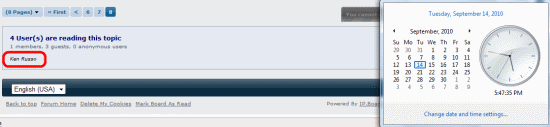
    “Ken Russo” was keeping up with MPB Today developments and commentary at ASA Monitor this afternoon, according to the forum log published at the bottom of the discussion thread on MPB Today.

    Separately, yet-another video promo for MPB Today is featuring a narrator who tells prospects not to bother buying their groceries from MPB Today — even though the firm purports to be in the grocery business.

    “If you’re joining this program to buy groceries, don’t bother . . .” the narrator said, lamenting MPB Today’s purportedly high shipping costs and explaining that the company sells a “grocery voucher” that is more cost-effective to use elsewhere.

    “I’m guessing you turned on this video because you heard you could make a lot of money and maybe not have to ever pay for groceries or gas again. So, you’re swimming around the ship — and not even seeing the boat — if you think this is about groceries and these other perks,” the narrator said.

    The narrator then recommended that prospects start recruiting other affiliates to make “serious money” in MPB Today.

    A snippet from the search-warrant application by the U.S. Secret Service in the investigation of the alleged Regenesis 2×2 matrix cycler Ponzi scheme, which was pitched from the ASAMonitor forum.

  • PHOTO EDITORIAL: The MPBToday Flap: Affiliates Target Food Stamp Recipients, Ponzi Scheme Victims, People Of Faith, Foreclosure Subjects — And Say Government Backs MLM Cycler Matrix Tied To Florida Grocery Business

    EDITOR’S NOTE: UPDATED 3:12 P.M. EDT (U.S.A.) Florida-based MPBToday is one of the programs pitched on Ponzi boards such as ASAMonitor, MoneyMakerGroup and TalkGold. It also is being pitched via email and on social-media sites such as YouTube. All three of the forums are referenced in court filings — including filings in criminal cases — as places from which Ponzi schemes are promoted. Pathway to Prosperity, just one of the schemes promoted on the forums, was alleged in May to have defrauded more than 40,000 people across the globe while gathering more than $70 million.

    MPBToday is a multilevel-marketing company tied to a Pensacola grocery company known as Southeastern Delivery LLC. The U.S. Department of Agriculture (USDA) said Friday that it was conducting a “review” of affiliate claims. Precisely what claims USDA will review is unclear.

    Some affiliates are encouraging recipients of Food Stamps to join the program, which claims a $200, one-time expense can led to free groceries for life. Other affiliates have targeted victims of the alleged AdSurfDaily Ponzi scheme in sales pitches. Still others are using religion to sell the program. The program uses the word “foreclosure” in its sales pitch. Florida has one of the highest foreclosure rates in the United States. More than 9,000 people showed up at the Palm Beach County Convention Center late last month to seek foreclosure relief.

    One potential area of inquiry is whether Food Stamp recipients somehow can use their allotment to qualify for MPB Today’s MLM program. Another potential area of inquiry is whether Food Stamp money somehow is being used to pay MLM commissions. Because MPB Today says Southeastern Delivery assesses a shipping charge of up to 50 percent for the home delivery of groceries — and because affiliates purport that food “vouchers” and food “credits” can be acquired, perhaps in the form of a Walmart gift card MPB Today sends in the mail — another potential area of inquiry is whether Food Stamp money somehow can be converted to pay for items such as electronics and prepaid Visa cards. One MPB Today affiliate said the firm’s high shipping costs were a reason for Southeastern Delivery’s Food Stamp customers to join the MLM program.

    Claims have been made that the MLM program is “certified” by the government, “acknowledged” by the government and that Walmart is affiliated with MPB Today. Walmart has not responded to a request for comment from the PP Blog.

    Here are some photos of promotions for MPB Today from around the web. (Red highlighting added by PP Blog):

    In this YouTube video and text pitch, a claim punctuated with exclamation marks is made that the program is "Govt. certified with Food Stamps!" and that there is a "contract with wal mart!" The word "scam" appears multiple times in the pitch — in an apparent bid to drive traffic to the site from prospects seeking to determine if there is any scam-related information on MPB Today.
    MPB Today positioned on YouTube as a good opportunity for people of faith. The words "Christian" and "scam" are used to drive traffic to the site.
    In a money-waving Blog post, an MPB Today affiliate with a California address shows a check for $300 and a Walmart card.
    In this video for MPB Today on DailyMotion, visitors are encouraged to visit a .org affiliate site for the company, even though MPB Today is not a charity. The video claims members can purchase "electronics," even though MPB Today says it is in the grocery business and affiliates are targeting Food Stamp recipients in sales pitches.
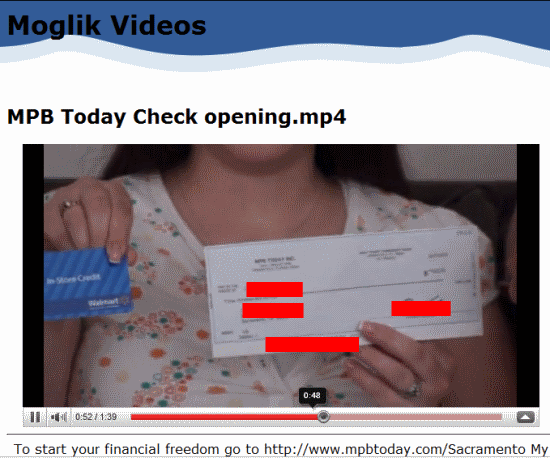
    MPB Today affiliates display check and Walmart card on YouTube after videotaping check-opening ceremony. The program is described as a "NO BRAINER."
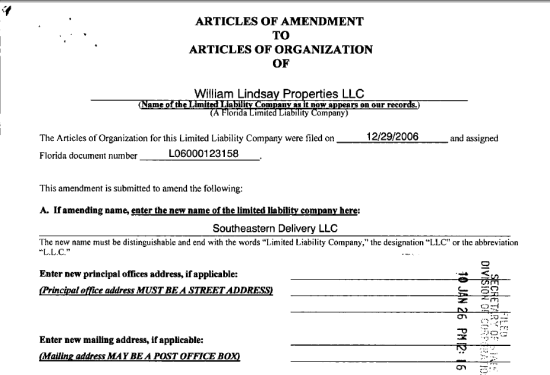
    This document on file in Florida shows that Southeastern Delivery LLC, the grocery arm of the MPB Today MLM program, once was known as William Lindsay Properties LLC. The name change occurred in January 2010. Gary Calhoun, the operator of MPB Today, is associated with both firms, according to records.
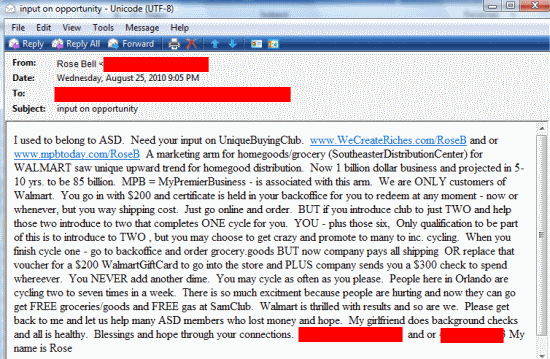
    On Aug. 25, the PP Blog received an unsolicited sales pitch for MPB Today via an email to the Blog's support address. Among the claims in the pitch, which did not include an unsubscribe link, was that "Walmart is thrilled" with the results of MPB Today. The pitch was targeted at members of AdSurfDaily, a company the PP Blog regularly covers because ASD is implicated by the U.S. Secret Service in an alleged Ponzi scheme involving tens of millions of dollars. A similar pitch was sent to another website that covers AdSurfDaily-related news.
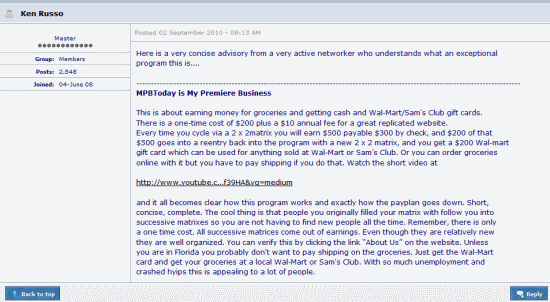
    The names of Walmart and Sam's Club referenced by "Ken Russo" at the ASAMonitor forum, which is notorious for promoting Ponzi schemes.
    In this video, a check and Walmart card are displayed. Unlike other checks written in Southeastern Delivery's name, this check was written in the name of MPB Today Inc. The video, which captured a check-opening ceremony, shows a Walmart "In Store Credit" card
    In this video, an MPB Today affiliate gives a sales pitch while driving an automobile. A check and Walmart card were presented when the vehicle stopped at a highway intersection.The pitch claims a "ONE-TIME" expenditure of $200 can "TOTALLY ELIMINATE" grocery bills.
  • KABOOM! Feds Release Info On ‘Alpha Trade Group’ Forex Scheme With Ties To Mexico, Panama; Records Suggest Scheme Was Collapsing Even Prior To Promos On TalkGold, MoneyMakerGroup Forums

    Yet another HYIP scheme pushed on the TalkGold and MoneyMakerGroup forums has been outlined by federal prosecutors — this time in Florida.

    The name of the scheme was Alpha Trade Group (ATG), and web records show that the scheme was pitched on TalkGold and MoneyMakerGroup beginning on Oct. 7, 2009. Court records, meanwhile, show that ATG already was under investigation by the U.S. Department of Homeland Security when the first posts to promote the scheme appeared on the forums.

    Just days earlier, on Sept. 25, 2009, a U.S. bank closed an account prosecutors later linked to the scheme, according to court records. Taken together, the court and web records strongly suggest that the ATG investment “opportunity” first was advertised on MoneyMakerGroup and TalkGold when the scheme already was in a state of collapse because one of its key money conduits had been blocked.

    This screen shot shows the first post about Alpha Trade Group appeared at the MoneyMakerGroup Ponzi forum on Oct. 7, 2009 — days after a U.S. bank already had closed an account linked to the scheme amid fears it was being used to launder money.
    This screen shot, taken from Paragraph 23 of a federal affidavit in the ATG Ponzi case, shows that a U.S. bank closed an account later linked to the scheme at least 12 days prior to the ATG promo on the MoneyMakerGroup forum. Court records show the scheme already was under investigation by federal authorities before the sales posts were made on the MoneyMakerGroup and TalkGold forums.

    It is possible that the scheme was in a state of collapse even earlier than September 2009. Court records show that at least one bank account tied to the business was closed on June 18, 2009 — nearly four months prior to the first posts promoting the scheme on MoneyMakerGroup and TalkGold.

    One MoneyMakerGroup poster — apparently angry that the program was being advertised in public — scolded the poster who started the thread.

    “Please take down your posts,” the scolder wrote. “ATG asked all of the members not to advertise. Otherwise your account with the company will be closed. Go to recent e-mails from the company. This is serious. Please comply.”

    The post scolding the advertiser appeared on Oct. 29, more than three weeks after the original sales pitch appeared on the forum and more than a month after federal agents began their probe into ATG.

    By Feb. 22, 2010, federal prosecutors and Immigration and Customs Enforcement (ICE), a division of the U.S. Department of Homeland Security, were in federal court in Orlando filing a forfeiture complaint.

    The Feds sought the seizure of $316,418.50 in a bank account linked to the scheme, according to court records. The forfeiture complaint alleged a Forex Ponzi scheme, and prosecutors linked the fraud to ATG, a Florida company known as Online Market Solutions and at least four individuals: Jose Cecilio Martinez Beltran, Francisco Amaury Suero Matos, Yehodiz Padua Valentin and Welinton Bautista Castillo.

    Unnamed “others” also were referenced in the complaint.

    “Investment opportunities offered by Alpha Trade Group promised participants unusually high monetary returns on investments and for referring other persons to the programs,” prosecutors said, in a statement to victims. “In reality, the investment opportunity was little more than ‘Ponzi’ or ‘Pyramid’ scheme, in which if participants actually received funds, those funds were generated by investments made by other Alpha Trade Group investors.”

    A federal judge ordered the money forfeited on July 26, according to court records.

    The case was brought by the office of U.S. Attorney A. Brian Albritton of the Middle District of Florida. Albritton’s office is handing a number of highly complex financial-fraud schemes.

    Websites such as TalkGold, MoneyMakerGroup, ASAMonitor and MyCashForums have promoted one fraud scheme after another. TalkGold, MoneyMakerGroup and ASAMonitor are specifically referenced in court documents filed in the Pathway To Prosperity (P2P) fraud scheme.

    P2P’s Nicholas Smirnow was charged in May by the U.S. Postal Inspection Service and federal prosecutors in Southern District of Illinois with operating a massive HYIP Ponzi scheme that affected investors across the world.

    MoneyMakerGroup also is referenced in court filings by the SEC in the alleged Legisi Ponzi scheme.

    Earlier this month, the U.S. Department of Justice announced that the U.S. Secret Service had helped bring about the arrest in France of an alleged international thief in part by monitoring criminal forums.

    Vladislav Anatolievich Horohorin, 27, was arrested by French authorities in Nice. Court filings show that the Secret Service used undercover agents and “undercover communications” to develop the case.

    Federal records show that ATG purported to be registered in Panama and was using “various corporations and fictitious names registered in Florida” to pull off the scheme.

    Among the names used was “Orsa Investment Group LLC,” according to an affidavit filed in the case. The scheme began in April 2009, according to court filings.

    An ICE agent said in an affidavit that the Internet and “business opportunity meetings” in Central Florida were used to promote the scheme.

    Read the ATG forfeiture complaint, which paints a picture of a commission-based, multilevel-marketing (MLM)  scheme within a Forex fraud scheme — and other schemes within schemes.

  • Judge Extends Asset Freeze In Matt Gagnon Fraud Case; Issues Order To Preserve Evidence And Require Weekly Financial Report To SEC

    Matt Gagnon of Mazu.com.

    A federal judge has extended the freeze on the assets of a website operator accused by the SEC of shilling for a Ponzi schemer and then trying to extort money from the schemer when the fraud was collapsing.

    Severe restrictions placed on Mazu.com operator Matt Gagnon by U.S. District Judge George Caram Steeh of the Eastern District of Michigan illustrate the financial and legal dangers of using the Internet to promote murky businesses. At the same time, orders issued by Steeh destroy myths advanced on Ponzi forums that website operators are insulated from prosecution and that their business contacts and customers cannot be sucked into a Ponzi probe.

    Demonstrating the life-altering nature of Ponzi schemes and the monumental legal entanglements and inconvenience that flow from such schemes, the judge also ordered Gagnon to submit a “sworn” statement “each Friday” to the SEC. The order requires Gagnon to account for “all funds received” during the week, including funds received “by others on his behalf.”

    Steeh also ordered Gagnon and his “officers, agents, servants, employees, attorneys, nominees, banks, brokers, dealers, financial institutions, and those persons in active concert or participation with any one or more of them” not to destroy evidence.

    Steeh’s order applies to “books, records, documents, correspondence, ledgers, accounts, statements, files, electronically stored information, and other property of or pertaining to the Defendant,” regardless of the location of the information.

    At the same time, the judge ordered expedited discovery in the case and freed up $2,000 for Gagnon “to pay living expenses.”

    Gagnon was accused in May of using his website to pitch the alleged Legisi HYIP Ponzi scheme, which the SEC described as a $72.6 million fraud. The judge’s orders followed on the heels of an awareness campaign by the Financial Industry Regulatory Authority (FINRA) to educate the public about HYIP schemes and the filing of criminal charges by the U.S. Postal Inspection Service against Nicholas Smirnow, accused of operating a $70 million Ponzi HYIP scheme known as Pathway to Prosperity (P2P).

    FINRA issued its HYIP warning on July 15, calling the HYIP universe a “bizarre substratum of the Internet” and saying “HYIPs are old-fashioned Ponzi schemes dressed up for a Web 2.0 world.”

    In May, federal prosecutors declared in court filings in the P2P case that “[a] large percentage, if not all, HYIPs, are Ponzi schemes.” In its HYIP alert, FINRA built on that theme, declaring that “[v]irtually every HYIP we have seen bears hallmarks of fraud” and noting that schemers were using websites, forums and social-media sites such as Twitter and Facebook to spread Ponzi misery globally.

    “From January 2006 through approximately August 2007, Gagnon helped orchestrate a massive Ponzi scheme conducted by Gregory N. McKnight . . . and his company, Legisi Holdings, LLC,” the SEC said.

    “Gagnon promoted Legisi but in doing so misled investors by claiming, among other things, that he had thoroughly researched McKnight and Legisi and had determined Legisi to be a legitimate and safe investment,” the SEC said.

    Among other things, the SEC alleged that Gagnon “had no basis for the claims he made about McKnight and Legisi.

    “Gagnon also failed to disclose to investors that he was to receive 50% of Legisi’s purported ‘profits’ under his agreement with McKnight,” the SEC said. “Gagnon received a net of approximately $3.8 million in Legisi investor funds from McKnight for his participation in the scheme.”

    In its complaint against Gagnon, the SEC alleged he moved from one fraud scheme to the next and even had promoted a scheme operated by the late Bryan K. Foster, a convicted felon. Some of the money from the alleged Legisi Ponzi scheme ended up in the control of Foster, who was running a purported investment program of his own.

    The allegation that proceeds from one fraud scheme ended up as proceeds of a second scheme demonstrates the interconnectivity of schemes in the age of the Internet.

    “Gagnon has been unrelenting in his efforts to raise money from the public through fraudulent, unregistered offerings,” the SEC said in May. “He remains a danger to the investing public.”

    See earlier story titled “Requiem For The Forum Pimps . . .”  The story discusses some of the history of the Legisi Ponzi case.

  • MYTH-SHATTERING CASE: Local Prosecutors Extradite Ronald Paul Shade From Thailand To Face Real-Estate Ponzi Charges; Shade Also Accused Of ‘Financial Elder Abuse’

    Ronald Paul Shade: Source: Interpol

    EDITOR’S NOTE: The PP Blog has covered a number of stories in which U.S. residents living overseas were extradited to the United States to face Ponzi charges. The case against Ronald Paul Shade is another one — and it’s one that demonstrates that an extradition can occur even if a defendant is not charged with a federal offense.

    Indeed, the warrant for Shade’s arrest was issued by a state-level Superior Court judge in California, according to Interpol. Shade’s case is instructive because it defeats some of the myths propagated on Ponzi boards such as MoneyMakerGroup, ASAMonitor, TalkGold and MyCashForums. Among the myths is that “offshore” equals “safe” for both investors and Ponzi perpetrators.

    Don’t tell that to Shade, now jailed in California after being extradited from Bangkok by local — as opposed to federal — prosecutors in California. His bail was set at $3.9 million.

    And don’t tell it to Jeffrey Lane Mowen, extradited from Panama to face federal Ponzi charges in Utah and later indicted in an alleged murder-for-hire plot. Here’s a quick side note on the Mowen case: If you like the recruitment fees paid by HYIP, autosurf and corrupt MLM or commission-based investment programs and make claims about the “due diligence” you’ve performed and try to impress prospects with your insider knowledge, your willful blindness may put you at great risk.

    Mowen had three prior convictions in Utah for securities fraud and two for theft, according to records. Despite Mowen’s criminal record and history as a fraudster, promoters still did business with him. Their faith drained millions of dollars from investors, the SEC said. Using language apt to cause unease in the Ponzi-promoting world, the SEC said at least one promoter “either knew or was reckless in not knowing that Mowen had multiple recent felony convictions involving crimes of dishonesty.”

    Indeed, the SEC said, the promoter learned in approximately late June 2007 that Mowen had been convicted of securities fraud . . . [but] “continued to solicit new investor funds for several months while failing to disclose Mowen’s criminal history to any of the Promoters or their investors.” Downstream promoters who entrusted the promoter “conducted virtually no due diligence in connection with [his] purported investment opportunities, but transferred investor money to [him] without any documentation or limitation on his use of the funds,” the SEC said.

    Perhaps the biggest myth exposed by the Ronald Paul Shade case is that going offshore takes state attorneys general and local prosecutors totally out of play. Longtime PP Blog readers will remember that the “offshore” pitch was pivotal in promotions for AdViewGlobal, AdGateWorld, MegaLido and other autosurfs that surfaced in the aftermath of the seizure of tens of millions of dollars by the U.S. Secret Service in the AdSurfDaily Ponzi scheme case. Some ads claimed that the “offshore” surfs neutralized state-level investigators.

    Shade, however, was brought back to the United States at the request of the San Bernardino County District Attorney’s Office in California to face state charges filed by local investigators.

    Still promoting investment-fraud schemes on the Ponzi boards and supplementing your pitches with myths about “safety” and how the overseas schemes are insulated from prosecution? Perhaps this story on the dramatic extradition of Colombian national David Murcia to the United States will help you snap out of your delusion that Ponzi and pyramid businesses cause no harm and represent “freedom” of choice. Perhaps this story on Robert Hodgins, who goes to bed at night knowing he’s wanted by Interpol, will help you shape your thinking.

    The cases of John and Marian Morgan, U.S. residents extradited from Sri Lanka, also are instructive.

    Finally, it’s worth noting that, after the United States charged Canadian national Nicholas Smirnow in May with operating an HYIP Ponzi scheme, a MyCashForums poster was quick to claim that “the USA has no extridition (sic) agreement ion (sic) place with the Phillipines (sic) . . . “

    The claim was false. Federal prosecutors said they are seeking Smirnow’s extradition. He was accused of operating a $70 million, international fraud known as Pathway to Prosperity (P2P).

    Here, now, the story of Ronald Paul Shade’s extradition . . .

    A California man living in Thailand was extradited to the United States to face charges he ripped off senior citizens in a real-estate Ponzi scheme, authorities said.

    Ronald Paul Shade, 39, formerly of Riverside, was arrested by local detectives Friday at Los Angeles International Airport. He was charged by investigators from the San Bernardino District Attorney’s Office with 29 felonies, including financial elder abuse, filing forged documents with the County Recorder’s Office and grand theft.

    San Bernardino County District Attorney Michael A. Ramos, who also is the president of the California District Attorneys’ Association, led the probe.

    Among the detectives involved in the Shade probe was Michael Leibrich, a senior investigator with the DA’s office.

    “From 2006 to 2008, Shade solicited money from numerous investors for his company, Orange Crest Realty,” investigators said. “Investors were promised a high rate of return for a short-term investment. Elderly victims later discovered that their life’s savings were being used to further a Ponzi scheme.”

    Shade had been living in Thailand for about two years, investigators said.

    In 2008, the California Department of Corporations issued a “desist and refrain” order against Shade and his company after alleging that they were selling unregistered securities and recruiting prospects  by urging them to “Get 18% APR Today” through the company’s “wonderful” investment.

    Shade and the company used a now-defunct website known as OCRFunding.com to pitch the purported program, authorities said.

    Among the misleading claims made to investors, according to authorities, were these:

    • That Orange Crest Realty was founded in 1993. (Authorities said Orange Crest Realty was not incorporated until June 2004.)
    • That Orange Crest Realty is a “registered investment advisor.” (Authorities said neither Shade nor the company and its associates were registered.)
    • That each investment was secured by actual title to specific existing real property. (Authorities said that “each investment was not secured by real property.”)
    • That a Deed of Trust And Assignment of Rents in the Property would be recorded with the Office of the County Assessor/Recorder and the investor would be provided with the recorded deed.  (Authorities said a deed promised an investor who sent in $50,000 was not recorded and the “investor never received a recorded deed.”)
    • That the investor would receive regular monthly interest payments. (Authorities said “payments ceased shortly after the investment was purchased.”)

    San Bernardino County investigators were assisted in the extradition by the Southwest Regional Fugitive Taskforce of the U.S. Marshals Service.

    The scheme, which allegedly gathered $14 million, also fleeced investors who responded to newspaper ads, investigators said.

  • SCAMMER’S GAMBLE BACKFIRES: Fraudster Who Chilled Customer With Lawsuit Threat Pleads Guilty To Mail Fraud; Philip Pestrichello Faces Up To 20 Years In Prison After Plea In ‘Work-At-Home’ Caper

    Source: FBI.Â

    UPDATED 4:51 P.M. EDT (U.S.A.) A convicted felon who emerged from prison and almost immediately launched a $1 million fraud scheme known as PPSN threatened to prosecute and sue a consumer who had filed an online complaint, federal prosecutors said.

    Although the threat caused the consumer to withdraw the complaint against Philip Pestrichello, Pestrichello’s bid to rattle the consumer’s nerves ultimately backfired because he included a “fake lawsuit number” in a letter to the consumer. Prosecutors used the letter and Pestrichello’s checkered past to persuade a federal judge to deny him bail. He has been jailed since his February arrest, and now faces up to 20 years behind bars after entering a guilty plea in the case.

    In the threatening letter, Pestrichello advised the complainant that “we will proceed by filing a lawsuit against you in The State of New York and you will be subject to prosecution, fines and penalties including monetary damages,” prosecutors said.

    Pestrichello also threatened “victim-consumers who lodged on-line complaints warning others that PPSN was a scam,” prosecutors said.

    The Federal Trade Commission and the U.S. Postal Inspection Service worked together in the Pestrichello case, which was brought in February as one of the undertakings of President Obama’s Financial Fraud Enforcement Task Force.

    Pestrichello was running a scam enterprise known variously as “Preferred Platinum Services Network LLC” ; “PPSN LLC”; “Home Based Associate Program”;  and the “Postcard Processing Program,” prosecutors said. They added that he had been running scams since the early 1990s and had been sentenced to three years in prison in 2003 after being convicted of mail fraud in a work-at-home scheme known as “IMXT & Co.”

    His most recent scam began in 2007 while Pestrichello was on federal probation after serving his time for the 2003 mail-fraud conviction, prosecutors said.

    “For nearly 20 years, Philip Pestrichello has preyed on the especially vulnerable — the economically disadvantaged, the unemployed, the disabled, or elderly individuals — who are trying to supplement their income by working from home,” said U.S. Attorney Preet Bharara. “Pestrichello even began committing his work-at-home scam within one year from his release from prison for a prior scam. If Pestrichello thought he was unstoppable, he was wrong.”

    Pestrichello, 38, of Bayville, N.J., now has pleaded guilty to mail fraud in the PPSN case. He faces up to 20 years in prison when sentenced by U.S. District Judge Kimba Wood on Oct. 26. A fraud case against Pestrichello’s wife, Rosalie Florie, is pending, prosecutors said.

    It is common for fraudsters to threaten to sue customers, critics and journalists. Such threats were present in the $1.2 billion Ponzi scheme case of disgraced Florida attorney Scott Rothstein, who eventually was disbarred. He repeatedly threatened to sue a reporter who questioned his business practices in the weeks leading up the the exposure of the scheme.

    Threats against customers and journalists also were part of the alleged AdSurfDaily Ponzi scheme case. ASD President Andy Bowdoin, according to August 2008 court filings, told customers that he had set aside $750,000 to sue critics.

    “These people that are making these slanderous remarks, they are going to continue these slanderous remarks in a court of law defending about a 30 to 40 million dollar slander lawsuit,” Bowdoin said, according to federal prosecutors. “Now, we’re ready to do battle with anybody. We have a legal fund set up. Right now we have about $750,000 in that legal fund. So we’re ready to get everything started and get the ball rolling.”

    Less than a month after Bowdoin allegedly issued the threat in July 2008, the U.S. Secret Service raided ASD’s Florida headquarters. Prosecutors said the company was operating a $100 million Ponzi scheme and engaging in wire fraud and money-laundering.

    Even after the raid, some ASD members continued to threaten Bowdoin’s detractors. One ASD member suggested Bowdoin’s critics would be dragged off in handcuffs for speaking out against the autosurf firm, publishing his version of lyrics from the television program “COPS” to put a chill on the purported slanderers.

    “Bad Boys, Bad Boys, Whatcha Gonna Do?” he chanted on the now-defunct AdSurfZone forum, a predecessor site to the Pro-ASD Surf’s Up forum. “Whatcha Gonna Do>WHEN<THEY COME FOR YOU ?!!!”

    In June 2009, while the AdViewGlobal (AVG) autosurf was failing, members were threatened with lawsuits for sharing information that purportedly was “copyrighted.” Members also were told that they risked losing their Internet service for questioning the firm in public. Journalists who published information about AVG were threatened with lawsuits.

    When the Pathway To Prosperity HYIP scheme was collapsing in 2008, members were threatened with “expulsion,” according to court filings.

    “When complaints were made externally to service providers or supposed payment agents,
    scathing rebukes were made to the ‘members,’” according to court filings.

    In February 2010, Hospitalera.com Blogger Sybille Yates announced she had been threatened with a lawsuit for calling the INetGlobal autosurf a “scam” in September 2009.

    On Feb. 23, the U.S. Secret Service raided INetGlobal’s Minneapolis offices. An affidavit by the U.S. Secret Service described the company as operating an international Ponzi scheme. A federal probe into INetGlobal’s business practices is ongoing.

  • GO FINRA! Regulator Tackles Online HYIPs; Issues Warning On ‘Social Media-Linked Ponzi Schemes’; References P2P, Genius Funds, ‘Con Artists’ And ‘Bizarre Substratum’ Of Internet

    EDITOR’S NOTE: It has become increasingly clear that regulators and the law-enforcement community are rallying around a common theme that web-based promoters are using discussion forums and social-networking sites in bids to sanitize HYIP Ponzi schemes by positioning them as attractive investment opportunities and even a thrilling form of gambling that pays commissions.

    Today the Financial Industry Regulatory Authority (FINRA) launched an awareness campaign aimed at taking the lipstick off financial pigs and exposing them for the economy-killing, filthy hogs they are. FINRA did not mince words, calling the HYIP universe a “bizarre substratum of the Internet.”

    Here, now, the story . . .

    The Financial Industry Regulatory Authority (FINRA) has launched a public-awareness campaign and issued an investor alert on HYIP schemes that use social-media sites such as YouTube, Twitter, Facebook and online forums and “rating” sites to spread Ponzi misery globally.

    “HYIPs are old-fashioned Ponzi schemes dressed up for a Web 2.0 world,” said John Gannon, FINRA’s senior vice president. “Some of these schemes encourage people to bring in new victims, while others entice investors to ‘ride the Ponzi’ by attempting to get in and get out before the scheme collapses.”

    FINRA is supplementing its educational campaign with an advertising campaign.

    “By using Google AdWords, we are hoping to reach anyone searching the Internet for HYIPs before they fall into the hands of con artists,” Gannon said.

    FINRA’s campaign occurs against the backdrop of remarkable law-enforcement actions against the alleged Legisi Ponzi scheme pushed by Matt Gagnon of Mazu.com, the alleged Pathway To Prosperity (P2P) Ponzi scheme pushed on forums such as ASA Monitor, MoneyMakerGroup, Talk Gold and MyCashForums, and the collapse of an HYIP known as Genius Funds.

    It also occurs against the backdrop of “prelaunch” buzz surrounding a mysterious program known as WebsiteTester.biz, which is spreading virally on the Internet through electronic news releases, references on promoters’ websites and daily updates on Twitter.

    Promoters’ advertising is heavy for WebsiteTesterBiz, despite the fact the company’s domain name is registered behind a proxy, its purported parent company’s domain name is registered behind a proxy and there is a paucity of any verifiable information about either firm.

    FINRA specifically referenced the alleged P2P Ponzi in its educational materials. It also provided a link to information published about the collapsed Genius Funds HYIP by the British Columbia Securities Commission. Alarmingly, FINRA said the Genius Funds’ fraud costs investors a staggering $400 million.

    Federal prosecutors who filed criminal charges against P2P operator Nicholas Smirnow declared in May that “[a] large percentage, if not all, HYIPs, are Ponzi schemes.”

    In its resource material, FINRA is building on that theme.

    “[V]irtually every HYIP we have seen bears hallmarks of fraud,” FINRA said. “We are issuing this alert to warn investors worldwide to stay away from HYIPs.”

    P2P gathered more than $70 million. Legisi also gathered more than $70 million, according to court records.

    Separately, the alleged AdSurfDaily autosurf Ponzi scheme gathered at least $80 million and perhaps $100 million or more, according to records. Autosurfing is a form of HYIP fraud. The U.S. Secret Service acted against ASD in August 2008.

    In February 2010, an autosurf known as INetGlobal also came under investigation by the Secret Service. The SEC has acted against autosurfs known as 12DailyPro, PhoenixSurf and CEP, which gathered tens of millions of dollars combined — fueled by online promotions.

    Citing FBI statistics, FINRA said “the number of new HYIP investigations during fiscal year 2009 increased more than 100 percent over fiscal year 2008.”

    The regulator specifically warned about websites that “Rank the latest programs and provide details of ‘payout options.’” At the same time, it warned about sites that “Allow web designers to buy ready-made HYIP templates and set up an ‘instant’ HYIP.” Meanwhile, it warned about sites that “Blog, chat and ‘teach’ about HYIPs.”

    “Some HYIP ‘investors’ proffer strategies for maximizing profits and avoiding losses — everything from videos showing how to ‘make massive profits’ in HYIPs and ‘build a winning HYIP portfolio’ to an eBook on how to ‘ride the Ponzi’ and get in and out before a scheme collapses,” FINRA said.

    “Other HYIP forums discuss how to enter ‘test spends,’ how to identify new HYIPs to maximize one’s chances of being an early stage payee and even how to check when a HYIP’s domain name expires so you can guess how long it might pay returns before shutting down,” FINRA noted.

    One of the tips offered by FINRA was to be on the look out for “typos and poor grammar” in sales pitches.

    “This is often a tip-off that scammers are at work,” FINRA said.

    FINRA said HYIP scammers often don’t share critical information with investors.

    “HYIP operators cloak themselves in secrecy regarding who manages investor money, where the company is located or where to go to get additional information,” FINRA said.

    Claims about being “offshore” also are made, FINRA said.

    “Be aware that generally persons or firms offering securities to U.S. residents must be licensed by FINRA and registered with the SEC,” FINRA said.

    The sky often is positioned as the limit in the HYIP universe, which often relies on “online payment systems” — some of which “have been tied in recent years to criminal activity, including money laundering, identity theft and other scams,” FINRA warned.

    “High-yield investment programs (HYIPs) are unregistered investments created and touted by unlicensed individuals,” FINRA said. “Typically offered through slick (and sometimes not-so-slick) websites, HYIPs dangle the contradictory promises of safety coupled with high, unsustainable rates of return — 20, 30, 100 or more percent per day—through vague or murky trading strategies.”

    Read FINRA’s warning on HYIPs. (Make sure you click on the links in the body of the warning.)

    Read a PP Blog story about an alleged penny-stock scheme that was operated on Facebook and Twitter. Read a PP Blog story on P2P, and also one on Genius Funds and others.

    Read more about P2P. Read more about Legisi.

  • WebsiteTester.Biz Pitched On Reborn GoldenPandaAdZone Forum, Plus MoneyMakerGroup, TalkGold And Other Ponzi Havens

    EDITOR’S NOTE: This story originally was published June 30. The PP Blog later encountered a database problem, which caused the site to go down and resulted in the temporary loss of some data. The data now has been retrieved.

    This story is about a new site known as “WebsiteTester.biz,” but some background is in order.

    It turns out that the April reports of the demise of the Golden Panda Ad Zone Forum, which changed its name to the Online Success Zone (OSZ), were premature.

    OSZ now is back online — and a poster is pitching  “WebsiteTester.biz,”  which appears to be promoting itself as an upstart advertising “testing” platform.

    Positioning surfing sites as testing platforms dates back at least to the CEP Ponzi scheme. Last summer, the failed AdViewGlobal (AVG) autosurf, which had close ties to the AdSurfDaily autosurf, was trying to reposition itself as an ad-testing site.

    Just prior to going offline in April, OSZ was pushing Narc That Car and Data Network Affiliates, two highly questionable companies  whose membership roster includes people linked to alleged Ponzi or pyramid schemes. OSZ got its start as the Golden Panda Ad Zone forum after the U.S. Secret Service seized more than $80 million from ASD and its purported “Chinese” autosurf companion, Golden Panda Ad Builder.

    During the summer of 2008, with ASD at its zenith and about to be accused of operating a Ponzi scheme, a predecessor to the INetGlobal autosurf also was coming online. INetGlobal eventually morphed into a surf site that largely targeted Chinese members, according to the Secret Service, which is investigating INetGlobal as its operator, Steve Renner, is in federal prison serving time for income-tax evasion.

    The ASD and Golden Panda money was seized amid allegations of wire fraud, money-laundering, selling unregistered securities and operating a Ponzi scheme. A forfeiture complaint in the case alleged a conspiracy with unnamed participants, and ASD was sued separately under the federal racketeering statute by members who also alleged a conspiracy was under way.

    Participants’ marketing of WebsiteTester.biz. occurs against the backdrop of a forceful statement by federal prosecutors in Illinois that virtually all HYIPs are Ponzi schemes. Autosurfs are a form of an HYIP program.  The business model of WebsiteTester.biz is unclear, and the company has not been accused of wrongdoing.

    In the Illinois case, Pathway To Prosperity (P2P) was alleged to have operated a global Ponzi scheme that gathered more than $70 million and fleeced more than 40,000 people. Nick Smirnow, P2P’s operator,  has a criminal past dating back to at least 1979, including convictions for breaking and entering, driving the getaway car in a robbery and cultivating and selling drugs. He also told a colleague he was involved in a double homicide in Canada and claimed to have ties to organized crime in Ontario, according to court filings.

    Posts on forums such as ASA Monitor, TalkGold and MoneyMakerGroup sought to sanitize the P2P scheme, authorities said. This important piece of information seems to have escaped the OSZ forum, which apparently continues to operate on the theory that HYIPs, autosurfs and cash-gifting programs somehow are a legitimate form of commerce.

    Incongruities abound in the autosurf and HYIP universes. “WebsiteTester.biz,” the apparent new darling of Ponzi boards such as OSZ, has a domain that is registered behind a proxy. It is unclear if any of its early boosters even know who owns the company or could name a single executive or a board member. Because the site’s business model is unclear, promoters are pitching a program they know virtually nothing about.

    The mere fact the “opportunity” is being pitched on the Ponzi boards shows, at a minimum, that promoters instinctively turned to the cesspools to drive business to the company.

    On its website, Website Tester, which purportedly is in prelaunch,  says this (italics added):

    “FINALLY . . . This is the business you have waited for so long:

    “It is completely free, you earn through EVERYBODY who registers after you, even if you do not sponsor people; you must not sell or buy anything. Guaranteed!

    “The faster you register, the more can be your potential income, even if you do nothing else than register for free . . .

    “How does it work? – It’s simple!

    “A market research company from the USA is searching for internet users all over the world, who get paid for testing websites and giving a short opinion. You also can earn up to 1,000 US$ per month working 1 to 10 hours weekly.

    “Even if the job as a website tester is not for you, you can earn two passive incomes month after month.”

    Excuse us while we vomit.

    Based on information on the landing page of WebsiteTester, the upstart company appears to have a tie to an upstart, Las Vegas-registered company known as Alpha Market Research Inc.  Alpha Market appears to have a Twitter site from which it relentlessly links to self-produced news releases that are posted on PRLog.org, a free press-release distribution service.

    Hey, did you see how the SEC described a scam yesterday that allegedly relied on Twitter and Facebook to help line up people to be fleeced in a securities swindle?

    Here is a paragraph from one of Alpha Market’s PR gems:

    “Global marketing is nothing but marketing done on national and international level and which involves understanding the similarities, dissimilarities and taking advantage of the opportunities to attain the goal.”

    Here is another gem:

    “When you buy something from eBay, Amazon.com or any online store, you’ve participated in e-commerce.”

    Meanwhile, here is yet another:

    “If you do not have a ghostwriter writing your blog content, then it means you will need to spend some time writing some blog posts.”

    Separate from its news releases, Alpha Market says this (italics added):

    “Potential clients who are disturbed by trifles during the ordering process are often unaware of exactly why. For you, the entrepreneur, the big questions remain: why did the potential client visit your website and why did they accept or not accept your offer?

    Alpha Market Research, Inc. starts exactly at this point: we make your website available for thousands of AMR website-testers, assigned in groups of age and interest – this way we get detailed feedback with an honest evaluation of your website.

    Like WebsiteTester.biz, AlphaMarketResearch.com is registered behind a proxy. The Alpha Market site was registered May 28, according to records. The Web Tester site was registered five days later, on June 2. Alpha Market’s Twitter site appears to date back to June 4.

    The buzz about Website Tester also is occurring against the backdrop of the launch of yet-another surfing company: AdPayDaily (APD).

    APD, which appears to have promotional ties to ASD and AVG, is running an AVG-like series of promotions that offer bonuses.

    Interestingly, APD, which appears to have only about 550 members despite virtually nonstop flogging for weeks, now says members can send in as much as $10,000.

    Website Tester, at the moment, appears just to be gathering names — and generating excitement by publishing the names of the latest registrants on the left side of its landing page. The names suggest the enterprise is attracting many people from outside the United States, but it is far from clear if anything about the company is real.

  • Affiliate Links Show That Surf’s Up Mod And ASD Members Hold High Positions In Upstart Surf: Things To Consider If You Are Tempted To Join AdPayDaily

    Alfred E. Neuman: From Wikipedia.

    Dear Readers,

    We have received a few inquiries about a new surfing program called AdPayDaily (APD). Our initial take is that the program is a dressed-up version of AdSurfDaily, AdViewGlobal, BizAdSplash and AdGateWorld and that the operators are persuaded they’ve found a word combination and legal structure that will neutralize critics and law enforcement should concerns about the sale of unregistered securities and a Ponzi and pyramid scheme be raised.

    AVG, BAS and AGW were positioned by former ASD members as offshore “clones” of ASD. APD, like ASD, appears to be operating in the domestic United States.

    In our view, APD’s presentation raises numerous red flags. At a minimum, it is starting out as an MLM absurdity, if not a potential monstrosity. To get a flavor of the absurdity, imagine that Walmart was clueless enough to start an autosurf and provide a corporate-approved greeter who says, “Welcome to Walmart Pay Daily. We count all the money out of sight in the back room at midnight to determine how much you get, and keep 50 percent of the cash for ourselves. Don’t worry. We have excellent lawyers, and we’ve instructed the money-counter not to rip you off.”

    That’s effectively what APD is saying.

    Another red flag is the fax number listed on a document APD refers to on its website as “Ad Pay Daily’s Conference Registration Form For July 30th and 31st 2010.” The fax number is listed online as a number used by a Kansas real-estate flipping company billed as National Flips. Like APD, the National Flips domain registration is hidden behind a proxy, although the website says this: “To learn how to become a Hard Money Lender and earn 30+% per annum, call [a telephone number] . . .”

    Meanwhile, the invitation for the APD conference that uses the National Flips fax number says this — not once, but twice: “Any person who does not provide photographic proof of identity will not be permitted to attend this event, so don’t forget your photo ID.”

    Why a photo ID would be required to attend a sales pitch for an advertising company is left to the imagination. Undercover Secret Service agents have been known to attend such functions, however.

    Virtually every autosurf that has come along has used strange approaches or applied language tweaks designed to skirt securities laws, disarm critics and sanitize the “opportunities” for prospects. Serial autosurf promoters are infamous for telling prospects that a particular surf has found the magic pill that makes everything legal. Historically they rely on the surf operators to provide a legal cover. When things go south, they claim no one can blame them for promoting the schemes. After all, they relied on the assertions of the operators that everything was above-board and legal. They have been disingenuous in the same way that Alfred E. Neuman, Mad magazine’s fictional mascot, was disingenuous.

    “What, me worry?”

    Worry, however, appears to be front-and-center at APD, which is preemptively denying in multiple places that it is a Ponzi scheme. This strikes us as a big red flag. There are others.

    ASD, Surf’s Up Members Become APD Players

    During its early research into APD, the PP Blog has determined that a number of members of the alleged AdSurfDaily autosurf Ponzi scheme have high positions in the APD venture. Some of the former ASD members hold more than one position in the top 80 positions in APD, including a former Surf’s Up Mod who appears to hold positions 76 and 77. It is possible that another Surf’s Up Mod also is high up in the pecking order of APD affiliates at No. 56.

    The Blog determined the names of APD promoters by researching the method by which APD creates affiliate links. At least one ASD member who made himself part of the ASD Ponzi litigation by submitting pro se pleadings holds positions 9 and 10 in APD, according to the affiliate links.

    Surf promoters are not fond of pointing out the pain of previous prosecutions of autosurfs and the time-consuming and expensive litigation involving both the government and court-appointed receivers that may occur when a surf collapses. It is not uncommon for millions of dollars to go missing in a surf.

    ASD’s Andy Bowdoin has told members that he has spent more than $1 million in his legal defense. Nothing (other than GIGO passed along by promoters) suggests Bowdoin was a man of means prior to the Secret Service raid on ASD’s headquarters in August 2008. His money for his defense appears to have come from ASD members. On a side note, Bowdoin tried to persuade members in September 2009 that the million dollars he dropped to keep himself out of prison was for their benefit. At the same time, he claimed his fight with the government was inspired by a former Miss America.

    ASD gathered at least $65.8 million. When the sum seized in the Golden Panda Ad Builder action, which is part of the ASD litigation, is factored in, the number surges to more than $80 million. That’s a big number, of course — one that shows why others want to start surfs and just tweak and tweak and tweak in search of the elusive magic pill.

    APD’s website was registered on Nov. 18, 2008. That’s just one day before U.S. District Judge Rosemary Collyer ruled that ASD had not demonstrated it was a lawful business and not a Ponzi scheme. APD’s domain-registration date also coincides with a string of registration dates by the so-called ASD clones:

    • Aug. 18, 2008: Domain name for AdGateWorld registered. (About two weeks after the ASD raid by the U.S. Secret Service, which is working in concert with the IRS and federal prosecutors.)
    • Sept. 22, 2008: Domain name for AdViewGlobal registered. (AVG had very close ties to ASD.)
    • Nov. 7, 2008: Domain name for BizAdSplash registered. (ASD and Golden Panda figure Clarence Busby purportedly was both the “chief consultant” and owner of BAS.)

    APD’s domain was registered just 11 days after the BAS domain was registered and only a couple of weeks before ASD declared that the now-defunct Surf’s Up forum was its official organ for ASD news. Surf’s Up became infamous for shilling for Bowdoin, fracturing the facts of the ASD wire-fraud and money-laundering case and misinforming members.

    Each of the surfs in the bullet points above failed spectacularly. Each of them blamed members for their problems. Each of them had promoters and members in common with ASD. Each of them also offered various “bonuses” to join — something APD is doing at the moment.