Tag: Paul R. Burks

  • Nathaniel Woods Plants Seed That Zeek Receiver Issued ‘Bogus Subpoena’ And Committed Felony; Claims Reminiscent Of Assertions Made In AdSurfDaily Ponzi Case

    UPDATED 5 P.M. ET (U.S.A.) Various members of the Florida-based AdSurfDaily 1-percent-a-day Ponzi scheme advanced various theories that judges, prosecutors and investigators committed various felonies during the course of the probe and follow-up actions in court. The claims were absurd on their face and, when the arguments were rejected, they were replaced by conspiracy theories. Time after time the conspiracy theories expanded to accommodate unpleasant fact sets, with various “defenders” of ASD retreating into an infinite set of contingencies and conflating one artificial reality after another.

    Now, a Florida resident and apparent participant in Zeek Rewards has filed a document in federal court that accuses the court-appointed receiver in the Zeek Ponzi scheme case of committing a felony. The receiver, Kenneth D. Bell, is a former federal prosecutor who once successfully prosecuted a Hezbollah terrorist cell operating in the United States.

    The PP Blog contacted the Zeek receivership today to seek comment from Bell. The Blog’s message was not immediately returned.

    In separate filings that appear on the docket of Senior U.S. District Judge Graham C. Mullen of the Western District of North Carolina, Nathaniel Woods claimed Bell or Bell’s receivership team unlawfully mailed a “bogus subpoena” to him in Ocala, Fla., thus committing a felony under Florida law.

    Mullen is presiding over the Zeek Ponzi case. In August, the SEC accused Zeek of operating a $600 million Ponzi- and pyramid scheme. Zeek’s business model was very similar to the model of ASD. ASD’s business practices triggered both civil and criminal investigations by the U.S. Secret Service in 2008.

    The subpoena, Woods claims, was meant for the purposes of “intimidation and harassment” on the part of the receiver.

    And Woods further claims that sending a “bogus subpoena” from North Carolina to Florida through the U.S. Mail constitutes “simulated process” under Florida law, a “third degree felony.”

    An accompanying document filed by Woods as an exhibit claims that “preliminary Zeek Rewards records” reviewed by the the receivership show that Woods received more than $496,000 from Zeek but paid nothing (“$0.00”) into the purported program.

    Bell is seeking the return of the money, describing it as “money lost by victims,” according to the exhibit.

    Woods is seeking to quash the subpoena, which demands records of Woods’ interactions with Zeek dating back to January 2010. He also claims the subpoena was only an “alleged subpoena” and was improperly served.

    A domain styled “500FREEBIDS4U.COM” is registered in the name of Nathaniel Woods at the Ocala street address to which the subpoena was sent, according to records. Other domains listed with an email address that appears on the registration data attributed to Nathanial Woods include Mybidshack10k.com, Mybidshackhow.info, Mybidshack4u.com and Mybidshackearn.info.

    Daryle Douglas, a onetime purported Zeek executive, also has been associated with a MyBidShack entity, according to researcher “K. Chang.”

    Zeek was a purported “penny auction” company operated by Paul R. Burks through Rex Venture Group LLC in Lexington, N.C. The penny-auction site was known as Zeekler. Zeek’s MLM arm was known as Zeek Rewards. Burks has consented to a judgment in the case. He has neither admitted nor denied the SEC’s allegations, which include securities fraud and the sale of unregistered securities.

    On Aug. 17, the U.S. Secret Service said it also was investigating Zeek. The SEC has said Burks duped investors into believing the purported Zeek “program” was paying a legitimate return of about 1.5 percent a day.

    Bell has said that perhaps 1 million people sent money to Zeek. Viewed by the number of potential victims and the number of transactions, Zeek may be the largest Ponzi scheme in U.S. history.

    Earlier this month, Bell said the receivership had gathered evidence that nearly 1 billion transactions were conducted through Zeek in about 18 months.

    AdSurfDaily was a Ponzi scheme that promoted a payout of 1 percent a day. It has about 100,000 members and gathered about $119 million, also in about 18 months, according to records.

    Records suggest that Zeek, which launched after the Secret Service brought the ASD Ponzi case, did about five times the dollar volume of ASD and potentially had 20 times the user volume.

    The civil portion of the ASD case dragged out for all or parts of five years. ASD President Andy Bowdoin admitted in May 2012 that ASD was a Ponzi scheme. In August 2012, less than two weeks after the SEC brought the Zeek case, Bowdoin was sentenced to 78 months in federal prison.

    ASD and Zeek are known to have had members in common.

  • DEVELOPING STORY: Zeek Winners Begin To Receive Subpoenas

    Alleged Ponzi scheme Zeek Rewards wrapped itself in the American flag and symbols such as the American penny coin to attract business. The purported “opportunity”  has created problems for hundreds of thousands of members in the United States and other countries.

    The PP Blog has received a report that some members of Zeek have received subpoenas issued by the court-appointed receiver in the Zeek Rewards Ponzi scheme case. The SEC alleged in August that Zeek was a $600 million Ponzi and pyramid scheme operated by Paul R. Burks and Rex Venture Group LLC.

    Receiver Kenneth B. Bell said earlier this week that a first round of about 1,200 subpoenas would be issued to “affiliates who profited most from ZeekRewards.”

    Early details are sketchy about precisely what information the subpoenas demand. Bell wrote on the receivership website that recipients “are required to fully respond to the subpoena.

    “If you do not have possession, custody or control of any of the documents requested simply say so in responding to the subpoena. However, you are required to make a full reasonable effort to locate all documents requested, including electronic documents and email,” Bell wrote.

    The issuance of the subpoenas demonstrates that online HYIPs dressed up as multilevel-marketing “programs” can — at a minimum — create civil exposure for participants. Profits received from such schemes are viewed as ill-gotten gains subject to clawback.

    In an Oct. 8 court filing, Bell advised Senior U.S. District Judge Graham C. Mullen that he planned to pursue Zeek winners and others through common-law and and clawback claims “under applicable fraudulent transfer statutes.”

    In addition to Zeek winners, potential clawback targets include Zeek officers, employees and professionals who benefited from the scheme, according to Bell’s Oct. 8 filing. As many as 100,000 people potentially received ill-gotten gains from Zeek, while about 800,000 Zeek members experienced losses.

    Zeek wrapped itself in the American flag while pitching its offer globally, claiming among other things that winners of its Zeekler auctions for sums of U.S. cash would be paid through offshore payment processors. North Carolina-based Zeek has never explained the striking incongruity of auctioning U.S. cash and offering to deliver it via payment processors linked to fraud scheme after fraud scheme promoted on Ponzi scheme forums such as TalkGold and MoneyMakerGroup.

    Auctions for cash mysteriously went missing from Zeek in June. On Aug. 4, 13 days before the SEC filed an emergency action to halt the alleged Zeek Ponzi scheme, the company publicly complained about “North Carolina Credit Unions” that were warning customers about Zeek.

    On June 5, the company bizarrely planted the seed that, if Zeek instructed members to change their preference in dispensing toilet paper, they should do it to demonstrate how coachable they are. Just days earlier — on May 28, Memorial Day — the company claimed it was closing two U.S. bank accounts and urged members to cash commission checks by June 1 or they would bounce.

    Zeek’s auction arm was known as Zeekler and was married to Zeek Rewards, the MLM side of the business. The SEC said in August that Zeek commingled funds and that Burks “unilaterally and arbitrarily” determined Zeek’s daily dividend rate so that it averaged “approximately 1.5% per day, giving investors the false impression that the business is profitable.”

    In 2008 and 2009, the U.S. Secret Service made similar allegations against AdSurfDaily and operator Andy Bowdoin. Bowdoin, 77, was charged criminally in December 2010. He pleaded guilty to a Ponzi-related charge of wire fraud in May 2012. Bowdoin was sentenced in August 2012 to 78 months in federal prison.

    ASD operated as an “autosurf” HYIP that planted the seed that members would receive a return of 1 percent a day.

    Precisely how many Zeek members live outside the United States and benefited from the scheme is unclear. In July, the PP Blog reported that a Zeek-related article carried on Google News claimed that Zeek had 100,000 members in Brazil alone.

    An issue that potentially could emerge in the coming weeks is whether the receiver will be successful in seeking clawbacks from non-U.S. members of Zeek who received more from the scheme than they put in. How many Zeek members fit the profile is not yet known.

    HYIPs that operate across borders on the Internet introduce the specter of international red tape and also potentially bring language barriers into play. In the days after the SEC brought the Zeek case, some purported international members of Zeek effectively thumbed their noses at the United States and Zeek victims, crowing on Ponzi-scheme forums that they’d keep their Zeek money no matter what.


  • BULLETIN: First Round Consisting Of 1,200 Subpoenas Will Go Out This Week To Zeek ‘Affiliates Who Profited Most,’ Receiver Says; More Subpoenas Will Follow; Winners Also Will Receive ‘Letter Offering To Negotiate Voluntary Surrender Of Profits’

    UPDATED: 7:08 P.M. EDT (U.S.A.) The court-appointed receiver in the Zeek Rewards Ponzi scheme case has announced that about 1,200 subpoenas will go out this week to “affiliates who profited most from ZeekRewards.”

    It’s “victims’ money, really,” receiver Kenneth D. Bell said in a letter posted on the receivership website.

    “The subpoenas ask for financial information, including dealings with Rex Venture,” Bell wrote. “Depositions and litigation will follow if necessary. With each subpoena will be a letter offering to negotiate voluntary surrender of profits (victims’ money, really) instead of going to Court.”

    On Aug. 17, the SEC described Zeek as a $600 million Ponzi- and pyramid scheme that potentially affected more than 1 million members.

    In the receiver’s letter dated Oct. 30, Bell said a preliminary analysis suggests that Zeek losers outnumber winners by a factor of about eight to one. Zeek was operated by North Carolina-based Rex Venture Group LLC and Paul R. Burks.

    “Our preliminary analysis has identified more than 800,000 affiliate User IDs who put more money into Rex Venture than they took out,” Bell wrote. “We estimate that losses will total between $500 million and $600 million. We have already recovered more than $300 million and continue to pursue millions more held in financial institutions. To fill the gap between what we have recovered and what victims lost, we will pursue recovery from those who took out of Rex Venture more than they put in. There are more than 100,000 User IDs in this category representing hundreds of millions of dollars.”

    More subpoenas will be issued in the coming weeks, Bell said.

    “Additional subpoenas and demands for return of profits will be served on thousands more in the weeks to come,” Bell wrote. “I can’t tell you we will recover enough to make all victims 100% whole, but if we don’t it won’t be for lack of trying.”

    A “preliminary, partial” distribution of money to help Zeek victims recover also is being planned, Bell said. No timetable was released, but the receiver noted that he would submit a claims form for the court’s approval. Once Senior U.S. District Judge Graham C. Mullen approves the form, the process of filing claims will begin.

    “Once approved the Form will be posted” on the receivership website, the receiver wrote.  “When that process has run we will ask the Court for permission to make a preliminary, partial distribution to qualified claimants from recovered funds. A final distribution will have to wait until we have finished collecting all recoverable assets. This will unfortunately take quite a while, and I appreciate your support and patience.”

    Bell said he’d received emails from Zeek members inquiring whether they should hire an attorney or “join a group” that has hired an attorney to assist in claims recovery.

    “I cannot and do not advise you one way or another about hiring an attorney,” Bell wrote. “I can tell you that my direction from the Court, and my duty to you, is to seize all recoverable assets and distribute them to victims as fully and fairly as possible.

    “That, I will do,” he concluded.

    UPDATE: 7:08 P.M. EDT (U.S.A.): The receiver has added a “Subpoena FAQ” here. At the time of this update, there are nine entries in the FAQs, including this question and answer (italics added):

    1. Why have I received a subpoena for documents?

    The ZeekRewards Receiver has been authorized by the Court to recover money and pursue claims for the company. You are receiving this subpoena because you have been identified as an “affiliate,” participant, agent or employee in the ZeekRewards operation who may have received significantly more money from ZeekRewards than you put into the operation. The so-called “profits,” “commissions,” or “winnings” that you received were really just money put in by the victims of the Ponzi and pyramid schemes described in the Securities and Exchange Commission Complaint. The subpoena you received is the legally authorized means for the Receiver to gather information from you in connection with the legal process to recover your “profits,” “commissions,” and “winnings” to compensate victims.


  • UPDATE: As Proposed Money-Saving Measure, Zeek Receiver Asks Judge To Treat Oct. 8 Preliminary Liquidation Plan As Status Report; Meanwhile, Yet Another Zeek Member Declares Herself A Fraud Victim

    A woman who described herself as a Zeek victim filed copies of postal receipts in federal court today. Source: Screen shot of federal court files. Redaction by PP Blog.

    UPDATED 8:26 A.M. EDT (OCT. 31, U.S.A.) Saying it would save money, the court-appointed receiver in the Zeek Rewards Ponzi scheme case has asked a federal judge to treat the receiver’s Oct. 8 preliminary liquidation plan as a status report. (See Oct. 9 PP Blog story.)

    Separately, yet another Zeek member has declared herself a victim of the alleged $600 million Zeek fraud scheme operated by Paul R. Burks and Rex Venture Group LLC. Two other Zeek members effectively did the same thing earlier this month. On Aug. 17, the SEC alleged that Zeek was a massive Ponzi- and pyramid scheme that potentially fleeced more than 1 million people.

    In August, Senior U.S. District Judge Graham C. Mullen of the Western District of North Carolina ordered receiver Kenneth D. Bell to file the first status report in the case by Oct. 30. Among other things, status reports inform judges about the efforts under way to recover proceeds linked to alleged fraud schemes and return them to victims.

    In the Zeek case, status reports are due within 30 days of the end of a quarter — for example, the third quarter of the calendar year ended Sept. 30, making the first Zeek status report due Oct. 30. The second is due Jan. 31, 2013, a month after the end of the fourth quarter of the calendar year on Dec. 31, 2012.

    Bell said in court filings today that the information in the Oct. 8 report included “the same information” due today.

    “Given that a separate Quarterly Status Report would be redundant, and in the interest of preserving Receivership assets, the Receiver respectfully requests that the Court order that the Preliminary Liquidation Plan be treated as the Receiver’s First Quarterly Status Report,” Bell petitioned Mullen.

    Mullen had not acted on the request by late this afternoon, according to the docket of the case.

    How Zeek enthusiasts on Ponzi-scheme boards such as TalkGold and MoneyMakerGroup will react to Bell’s request was not immediately clear. One-percent-a-day (or more) schemes such as Zeek gain a head of steam in part because willfully blind scammers who populate the Ponzi cesspits position the “programs” as legitimate.

    The demonization of Bell on the Ponzi boards and elsewhere began shortly after the SEC brought the Zeek case. As was the case in the AdSurfDaily prosecution brought by the U.S. Secret Service in 2008, some Zeek members have claimed that the government is manufacturing victims where none exist. The ASD and Zeek Ponzi schemes fetched a combined sum of at least $719 million, nearly three-quarters of a billion dollars, according to court filings.

    Both frauds operated as classic Ponzi schemes that recycled money from members to create the illusion of sustainability and profitability, according to investigators.

    Both Zeek and ASD were promoted on forums listed in federal court filings as places from which Ponzi schemes are promoted. Earlier schemes promoted on the forums include Legisi and Pathway To Prosperity, which gathered a combined sum of more than $140 million and affected tens of thousands of people, according to court filings.

    Legisi operator Gregory McKnight faces sentencing next month in his Ponzi scheme case. Alleged Pathway To Prosperity operator Nicholas Smirnow, meanwhile, is listed by INTERPOL as a wanted fugitive. As was the case with Zeek, the SEC and Secret Service led the Legisi probe. The U.S. Postal Inspection Service brought the Smirnow/Pathway to prosperity case, saying the scam affected individuals in 120 countries.

    ASD operator Thomas A. “Andy” Bowdoin is serving a 78-month prison sentence. He was sentenced in August 2012.

    Despite claims that Zeek created no victims, at least three individuals already have claimed in court filings to have been scammed by Zeek.

    In a filing docketed today, Maria Aide Gomez claimed she sent North Carolina-based Zeek parent Rex Venture Group five postal money orders for $1,000 each in May and paid an additional $300 to maintain her Zeek membership.

    Gomez described herself as a “Victim of fraud and deception” on the part of Zeek, Rex Venture Group and Paul R. Burks, the operator of Zeek and Rex Venture. The money orders Gomez sent to Zeek were purchased at a post office in Washington state, according to exhibits that accompanied the filing.

    Bell, the receiver, is experienced as both a defense attorney and a prosecutor. The U.S. Department of Justice lauded Bell a decade ago for his successful prosecution of a Hezbollah terrorist cell operating in the United States.

  • 2 California Members Tell Court Zeek Rewards Left Them ‘On The Verge Of Financial Devastation’

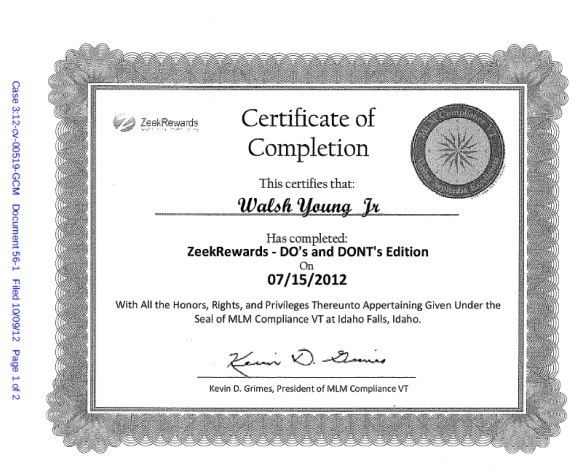
    The logo of Zeek Rewards appears on this “Certificate of Completion” issued to Zeek member Walsh Young Jr. (Source: screen shot of exhibit filed by Young Oct. 9.)

    For Californians Walsh J. Young Jr. and May Causing, the Zeek Rewards MLM scheme left them “on the verge of financial devastation,” according to a new filing in the Zeek Ponzi scheme case.

    The self-written, self-submitted filing by Young and Causing appeared yesterday on the docket of Senior U.S. District Judge Graham C. Mullen of the Western District of North Carolina. Mullen is presiding over the Zeek case brought by the SEC Aug. 17.

    Causing plowed $5,000 into the Zeek scheme in April 2012, funding her Zeek account with an “Official Check” from Citibank, according to the filing and an exhibit that accompanied it.

    Causing resides in Eagle Rock.

    On June 4, Young plowed $2,000 into Zeek, using a cashier’s check from Bank of America, according to the filings. Later — on June 26 — he plowed another $6,000 into Zeek, again using a Bank of America cashier’s check.

    Young resides in Bell.

    The filing alleges that Zeek business meetings were conducted by affiliates in Rancho Cucamonga, Harbor City, Cerritos and Carson.

    Prospects, according to Young and Causing, were told that they could purchase “name brand merchandise at 95% off of retail prices” and that the company had a “long standing track record with 15 years of rock solid business practices.”

    The pitch, according to Young and Causing, included references to the business bona fides of Zeek operator Paul Burks and Kevin Grimes, “known to be the best MLM attorney in the industry.”

    Prospects also were told that Zeek shared “50% of its daily profits with vested affiliates,” according to the filing.

    The filing claims that Zeek pitchman Tom More had acquired “over a million VIP points” and that Dolly Inocencio had acquired “over 250,000 VIP points.”

    All in all, the Zeek deal seemed to make sense, given the claims, according to Young and Causing.

    “This offer made it difficult to walk away with taking no action and in consideration of the money being received by Mr. Tom More and Ms. Dolly Inonencio, early Zeek members,” Young and Causing wrote.

    Then came news of the August SEC action, which alleged Zeek was a $600 million Ponzi- and pyramid scheme and Burks was a securities fraudster. The SEC said last month that its probe was ongoing.

    The filing by Young and Causing closed with an assertion that they “have suffered a tremendous financial hardship and are left on the verge of financial devastation” — and it asked the judge and court-appointed receiver Kenneth D. Bell for help in making them whole.

    Young and Causing also alluded to a “class” of Zeek members in their filing, but the meaning of that was not immediately clear. The caption of their filing complains of “false business practices, false hopes disguised as lucrative financial business opportunities and ill gotten gain.”

    Bell said in court filings Monday that he will “investigate potential claims against professionals and others” involved with Zeek to determine “who may be liable for the role they played in facilitating the operation.”

    Claims against the unidentified “professionals” and others will be pursued, if warranted, Bell advised the judge.

    Clawback actions against Zeek “net winners” also are contemplated, Bell said.


  • Month After Zeek Ponzi Complaint By SEC, ASD Figures (And Zeek Pitchmen) Todd Disner And Dwight Owen Schweitzer Accuse Judge Who Dismissed Their ASD-Related Lawsuit Of ‘Sophistry’; Duo Tries To Reopen Case And Have Judge Removed

    MLM pitchmen and AdSurfDaily figures Todd Disner and Dwight Owen Schweitzer — both of whom went on to become promoters of the alleged Zeek Rewards Ponzi scheme — have accused a federal judge of “sophistry.”

    Sophistry, according to Dictionary.com, means “a subtle, tricky, superficially plausible, but generally fallacious method of reasoning.”

    Disner turned to MLM after his days as a founder of the Quiznos sandwhich franchise. Schweitzer is a former attorney whose license was suspended in Connecticut. Both men live in southern Florida.

    The curious assertion by Disner and Schweitzer against U.S. District Judge Rosemary Collyer appeared on Collyer’s court docket in the District of Columbia on Sept. 17, one month to the day after the SEC alleged in the western District of North Carolina that the Zeek Rewards MLM “program” was a $600 million Ponzi scheme and pyramid fraud that potentially had affected more than 1 million people.

    Senior U.S. District Judge Graham C. Mullen of the western District of North Carolina is presiding over the Zeek case. Kenneth D. Bell is the court-appointed receiver.

    Zeek and ASD are known to have members in common.

    The ASD Ponzi scheme, which collapsed in 2008, affected at least 97,000 people and created at least 9,000 victims, federal prosecutors said.

    Disner and Schweitzer also were pitchmen for ASD, which federal prosecutors in the District of Columbia have described as a $119 million Ponzi scheme marketed MLM-style. The ASD duo sued the United States in November 2011, claiming their records in ASD’s database were private and thus unlawfully seized and accusing federal prosecutors and a U.S. Secret Service agent of presenting a “tissue of lies” when bringing the civil- forfeiture case against $65.8 million in the bank accounts of ASD President Andy Bowdoin in August 2008.

    On Aug. 29, Collyer sentenced Bowdoin to 78 months in federal prison. Bowdoin, 77, pleaded guilty to wire fraud in May 2012, admitting in a statement of offense that ASD was a Ponzi scheme and that his business never operated lawfully from its inception in 2006.

    Collyer dismissed the Disner/Schweitzer complaint on the same day she sentenced Bowdoin.

    But Disner and Schweitzer now claim Bowdoin’s admission “was a necessary part of his plea bargain” with the government. They further assert that Bowdoin’s admission was the “coerced confession of an 80 year old man.”

    In court filings in May, however, Bowdoin said this:

    “I have read this Plea Agreement and discussed it with my attorneys, Michael McDonnell, Esq. and Charles Murray, Esq. I fully understand this Plea Agreement and agree to it without reservation. I do this voluntarily and of my own free will, intending to be legally bound. No threats have been made against me nor am I under the influence of anything that could impede my ability to understand this Plea Agreement fully. I am pleading guilty because I am in fact guilty of the offense(s) identified in this Plea Agreement.” (Italics/bolding added by PP Blog.)

    In the filing docketed Sept. 17, Disner and Schweitzer claim the Secret Service “manufactured” events to ensure that the ASD case was heard by Collyer. Earlier, Disner and Schweitzer advanced a theory that undercover agents who joined ASD in 2008 had a duty to identify themselves to ASD management.

    Even after Bowdoin pleaded guilty in May, Disner and Schweitzer contended that the government’s case was a “house of cards,” according to court filings.

    Disner and Schweitzer now have asked for their lawsuit to be reopened and to have Collyer removed from the case. In ASD-related litigation, Collyer has ordered the forfeiture of more than $80 million.

    The bid by Disner and Schweitzer to have Collyer removed from ASD-related litigation is at least the third. In 2009, purported “sovereign” being Curtis Richmond unsuccessfully sought to have Collyer removed. So did Bowdoin.

    Disner is now involved with purported Zeek Rewards consultant Robert Craddock in an effort to raise money to challenge either the SEC or the court-appointed receiver in the Zeek case.

    Among the early theories advanced by Craddock was that Mullen — the judge in the Zeek case — was playing politics by appointing Bell’s firm as the receiver to enable the firm to gorge itself on fees.

    Both ASD and Zeek were accused of selling unregistered securities as investment contracts. The U.S. Secret Service brought the ASD case, with the SEC bringing the Zeek case.

    The Secret Service confirmed on Aug. 17 that it also was investigating Zeek. The SEC said that, since January 2011, Zeek had “raised more than $600 million from approximately 1 million investors nationwide and overseas by making unregistered offers and sales of
    securities through the ZeekRewards website in the form of Premium Subscriptions
    and VIP Bids.”

    Zeek was an arm of North Carolina-based Rex Venture Group LLC and was operated by Paul R. Burks, the SEC said.

    In their filing accusing Collyer of sophistry, Disner and Schweitzer appear to suggest that Collyer needs a lesson in MLM from purported MLM expert Keith Laggos and MLM attorney Gerald Nehra.

    Laggos, an  SEC defendant in a 2004 case that alleged he issued laudatory press releases without disclosing he was being compensated, is listed in court records as a Zeek consultant. Laggos settled the 2004 SEC case without admitting or denying liability but agreeing to pay more than $30,000, including a $19,500 civil penalty.

    Laggos once opined that ASD was not a Ponzi scheme. Nehra also opined that ASD was not a Ponzi scheme. Richard W. Waak, Nehra’s law partner, is listed in court filings by Zeek as an attorney for the firm.

    Read the Disner/Schweitzer motion to remove Collyer.

    Screen shot of section of motion by ASD figures Todd Disner and Dwight Owen Schweitzer to remove Judge Collyer for alleged "cause."
  • SEC Says Zeek Probe ‘Is Continuing’; Agency Updates Information Page

    UPDATED 10:05 P.M. EDT (U.S.A.) The SEC today updated its information site on the Zeek Rewards Ponzi scheme case, noting its investigation “is continuing” and pointedly adding language that “ZeekRewards and [Paul R.] Burks immediately consented to an asset freeze, the appointment of a receiver over their assets, and the payment of a $4 million penalty.”

    Although the agency gave no specific reason for the update, it occurred against the backdrop of an ongoing effort by Zeek figure Robert Craddock to intervene in the case after collecting donations from individual members of Zeek.

    1.

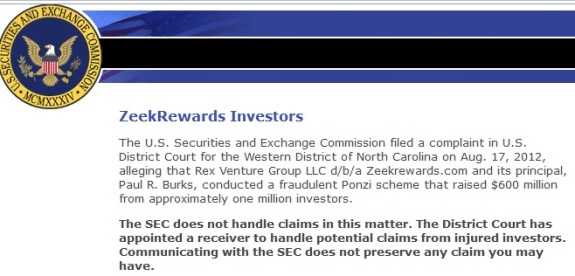
    Screen shot of section from Google cache. This is how this section of the SEC's Zeek information page looked prior to today's update.

    2.

    Screen shot: The red highlights were added by the PP Blog and show today's change to the SEC's Zeek info site.

    Blogger Jordan Maglich of PonziTracker.com noted yesterday that Craddock reportedly had been subpoenaed to appear before the SEC.

    From PonziTracker (italics added):

    While the SEC did not provide the reason for the subpoena, some have speculated that recent comments attributed by Craddock to the SEC concerning purported admissions of fault in the SEC’s case against Zeek which were later refuted may have piqued the SEC’s interest.

    On Sept. 23, the PP Blog reported that Craddock’s name did not appear on a Sept. 17 list of “EMPLOYEES, OTHER PERSONNEL, ATTORNEYS, ACCOUNTANTS & OTHER AGENTS/CONTRACTORS” submitted by Zeek to Senior U.S. District Judge Graham C. Mullen even though Craddock identified himself in July as a Zeek “consultant.”

    Craddock also was present on separate fundraising calls last month with Todd Disner, a Zeek pitchman and a member of the AdSurfDaily 1-percent-a-day Ponzi scheme, and with T. LeMont Silver. Silver was described on a Zeek website in June as a Zeek “employee.”

    Among other things, Silver was a pitchman for OneX, which federal prosecutors in the District of Columbia described in April as a “fraudulent scheme” and “pyramid” that was cycling money in ASD-like fashion. Jailed ASD Ponzi scheme operator Andy Bowdoin also was a OneX pitchman.

    ASD was a Ponzi scheme that gathered at least $119 million, according to federal prosecutors. Zeek’s business model was very similar to ASD’s business model.

    Zeek was a Ponzi scheme that gathered $600 million, according to the SEC.

    See Sept. 19 PP Blog story.

    Visit the SEC’s Zeek infomation page.

  • ZEEK: Part Of The Backstory — In Pictures

    UPDATED 4:20 P.M. EDT (U.S.A.) Unsolved mysteries remain in the Zeek Rewards Ponzi scheme case. Among the unanswered questions are these:

    • How many members did Zeek have in common with AdSurfDaily, a predecessor 1-percent-a-day scam to the Zeek scheme?
    • Why do some Zeek “defenders” appear to be engaged in bizarre bids to harass and menace Zeek critics?
    • Why did Zeek list certain ASD members or story figures as employees on its website — and why does some of the employee information published on Zeek’s website in June appear to be at odds with employee information contained in court filings by Zeek last week?
    • How much connectivity did Zeek have with scams such as NarcThatCar, AdViewGlobal, OneX and JSSTripler/JustBeenPaid, a “program” that may have ties to the “sovereign citizens” movement?

    On June 7, the PP Blog reported that a Zeek Rewards MLM “program” website was listing the names of 16 Zeek “employees,” including the name of Terralynn Hoy, a mainstay in the AdSurfDaily Ponzi scheme story. Also included was the name of OH Brown, an executive at a company (USHBB Inc.) that produced ads for the NarcThatCar pyramid scheme. This information is reflected in screen shots Nos. 1 and 2. Notes by the PP Blog also are included.

    Hoy participated in at least one conference call for Zeek, as did Brown. Zeek’s 1-percent-a-day-plus business model was very similar to the business model of ASD, which the U.S. Secret Service described in 2008 as a massive online Ponzi scheme that had gathered tens of millions of dollars. Zeek launched after the collapse of ASD and had members and/or figures in common with ASD and AdViewGlobal, a collapsed 1-percent-a-day “program” federal prosecutors linked in April 2012 to ASD.

    1.


    2.

    ADDITIONAL NOTES: T. LeMont Silver, identified by Zeek in June as an employee, also was a pitchman for “OneX.” In April, federal prosecutors in the District of Columbia described OneX as a “fraudulent scheme” and “pyramid” that was recycling money in AdSurfDaily-like fashion. ASD was a $119 million Ponzi scheme operated by the now-jailed Andy Bowdoin, who also was a OneX pitchman.

    Among Silver’s OneX claims was that OneX positions being given away were worth $5,000. Bowdoin declared OneX an excellent “program” for college students.

    Even though Zeek claimed Silver, Hoy, Catherine Parker, Brown, Trudy Gilmond and Marie Young Cain as “employees” in June, they are not referenced as “EMPLOYEES, OTHER PERSONNEL, ATTORNEYS, ACCOUNTANTS & OTHER AGENTS/CONTRACTORS” in a Sept. 17 court filing by Rex Venture Group LLC/Zeek operator Paul R. Burks.

    Also absent from Burks’ Sept. 17 list of Rex/Zeek employees/contractors is Robert Craddock, who identified himself in July as a Rex “consultant.” In July, prior to the SEC’s Ponzi allegations against Zeek, Craddock sought to disable the Hub of Zeek critic “K. Chang” by filing a complaint for purported copyright/trademark infringement and libel with HubPages.com. Craddock was successful briefly, but HubPages eventually restored the “K. Chang” Hub. Craddock later became involved in a purported effort to raise funds to “protect” Zeek affiliates from the SEC and/or the court-appointed receiver in the Zeek Ponzi case.

    Gilmond once pitched Regenesis2x2, a “program” that became the subject of a U.S. Secret Service investigation in 2009. The Secret Service also is investigating Zeek. The SEC described Zeek last month as a $600 million Ponzi- and pyramid scheme.

    Precisely how and when Rex/Zeek hired or replaced/dismissed employees is unclear. The names of a number of individuals listed by Zeek as employees in June do not appear on the list Burks filed in court last week.

    NarcThatCar effectively collapsed in 2010, after coming under scrutiny by the Better Business Bureau and investigative reporters. Narc operated from Texas — and yet did part of its banking in North Carolina at one of the banks used by Zeek. Both Narc and Zeek used USHBB Inc. to produce ads for their respective “programs.” Both Narc and Zeek scored “F” grades with the BBB — and when the BBB published negative information about the respective “programs,” some affiliates of the respective “programs” claimed the BBB was a fraud.

    Zeek ‘Defender’ Stalks PP Blog, Starts Disinformation Site After HubPages Restores ‘K. Chang’ Site Targeted By Craddock

    The PP Blog is reporting today that, after the SEC described Zeek as a $600 million fraud and after HubPages restored the “K. Chang” Hub critical of Zeek and targeted by Craddock, a purported Zeek “defender” used the Internet repeatedly to send harassing communications to the PP Blog. Dated Aug. 28, one such communication was an announcement that the PP Blog and “K. Chang” had been targeted in a retaliation campaign for their respective reporting on Zeek.

    3.

    4.

    The Blog’s stalker created more than a dozen bogus usernames and email addresses to send harassing (and bizarre) communications to the PP Blog.

    Here is one from Aug. 31 (italics added):

    Watch out for the Romney lover namely KSChang!!!! He was saw holding hands with Mitt, caressing the presidential candidate, while surfing PatrickP’s amazing, smart, funny, and romantic blog.

    Mitt Romney is the Republican nominee for President of the United States.

    For reasons that remain known only to the PP Blog’s cyberstalker, the individual also sent a one-word harassing communication — “Pussy” — to the thread below this Aug. 29 PP Blog guest column by Gregg Evans. Separately, the cyberstalker sent a communication that planted the seed Evans would get sued for his Aug. 29 PP Blog column.

    “Are you willing go toe to toe with a lawyer on your claims and back up this article?” the cyberstalker wrote.

    On Aug. 31, the cyberstalker — who’d been banned under multiple identities — sent this harassing communication to the PP Blog:

    “What happened to your face dude, looks like you got ran over by an ugly truck.”


  • ZEEK UPDATE: Thousands Of Records Filed Under Seal

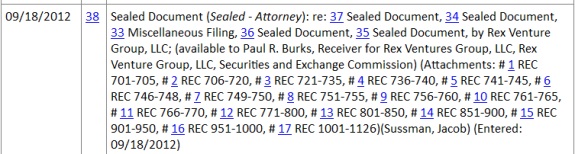
    An entry from the court docket in the Zeek Ponzi scheme case.

    UPDATED 4:20 P.M. EDT (U.S.A.) Attorneys for accused Ponzi schemer Paul R. Burks of the Zeek Rewards MLM “program” operated through North Carolina-based Rex Venture Group LLC have filed thousands of records under seal.

    On Sept. 17, Burks’ attorneys sought the approval of Senior U.S. District Judge Graham C. Mullen to file the documents under seal.

    The “anticipated filing contains account and financial information concerning not only Rex Ventures Group, LLC d/b/a ZeekRewards.com, but also thousands of individuals who either paid funds to and/or received funds from Receivership Defendant since January 1, 2010,” the attorneys said in advance of the massive filing.

    Mullen permitted the attorneys to submit the documents under seal. The filings now have been made and will remain under seal until further order of the court. The precise form of the filings is unclear because they are not available to the public.

    As things stand, the records will be available to Burks, the SEC and to Kenneth D. Bell, the court-appointed receiver in the Zeek case.

    Zeek was described Aug. 17 by the SEC as a Ponzi- and pyramid scheme that had gathered $600 million.

    The sheer complexity of Ponzi-scheme cases often leads to spectacular paper chases because of the enormous number of records that must be reviewed. But the Zeek case could set a new standard for volume because Zeek used as many as 15 financial vendors and perhaps ensnared between  1 million and 2 million victims while operating over the Internet between January 2011 and August 2012.

    Visit the ASD Updates files site to view Zeek-related court documents. Visit the ASD Updates Blog.


  • BULLETIN: Zeek Had $20.7 Million In AlertPay/Payza And $20 Million In SolidTrustPay

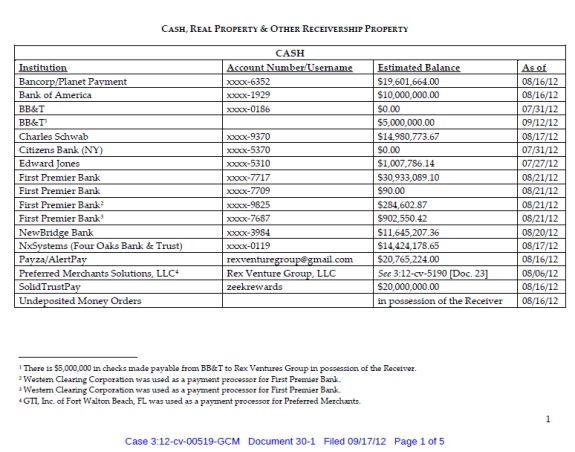
    Screen shot: Accused Ponzi schemer Paul R. Burks of Rex Venture Group LLC advised Senior U.S. District Judge Graham C. Mullen of the Western District of North Carolina today about Zeek's relationships with various financial vendors. The alleged Zeek Rewards Ponzi scheme operated through Rex Venture..

    BULLETIN: (UPDATED 9:18 P.M. EDT U.S.A.) New court filings by accused Ponzi schemer Paul R. Burks of Rex Venture Group LLC show that Zeek Rewards had more than $40 million in offshore payment processors.

    Included in that sum is $20.765 million in Canada’s AlertPay/Payza, and $20 million in Canada’s SolidTrustPay.

    Today’s filing also shows $10 million on deposit at Bank of America. Court filings in the AdSurfDaily Ponzi scheme case brought by the U.S. Secret Service in 2008 show that ASD also banked at Bank of America.

    On Aug. 17, the SEC alleged that North Carolina-based Zeek was a massive online Ponzi- and pyramid scheme that had gathered $600 million since January 2011. Filings by Burks today suggest Zeek did it all with fewer than 40 employees, including part-time contractors such as attorneys and consultants in areas such as payroll, accounting, compliance and marketing.

    Included among the consultants listed by Burks was Keith Laggos, a purported MLM expert. Laggos once opined that AdSurfDaily was not a Ponzi scheme. ASD President Andy Bowdoin later admitted that it was. Bowdoin was sentenced last month to 78 months in federal prison.

    Visit the ASD Update Blog’s files site to read Zeek-related court filings.

    Visit the website of Kenneth D. Bell, the court-appointed receiver in the Zeek case. Read the FAQs on the receiver’s website.

  • William J. Wise, International ‘Mastermind’ Of $129.5 Million Ponzi Fraud Involving CDs, Pleads Guilty To 18 Felonies; Top U.S. Attorney Says Federal Prosecutors ‘Around The Country’ Have Identified ‘Unprecedented Rise’ In Investment Fraud Schemes With ‘Staggering Losses’

    “The fraudsters prey upon vulnerable victims, do not respect local or even state boundaries, and often loot the victims’ life savings.”Melinda Haag, U.S. Attorney for the Northern District of California, Sept. 13, 2012

    It featured confidence-boosting names: Millennium Bank, United Trust of Switzerland and Sterling Bank and Trust.

    But it was a cross-border Ponzi scheme that operated for 10 years. Its international “mastermind” controlled each of the entities and duped investors into purchasing at least $129.5 million in “bogus CDs,” federal prosecutors in two U.S. districts said this week.

    William J. Wise, the mastermind, was a resident of Canada. But he also operated in the region of Raleigh, N.C., luring investors with tales of outsize returns made possible by profitable overseas investments, prosecutors said. In 2009, the SEC said Wise was assisted by Kristi M. Hoegel of Napa, Calif.

    Hoegel, the SEC said at the time, used as many as five aliases. One proved to be the name under which she was charged criminally in February 2012: Jacquline Hoegel.

    On Wednesday, Wise pleaded guilty to 18 felonies, prosecutors said. He potentially faces decades in prison.

    Here is a breakdown of the Wise guilty pleas: one count of conspiracy to commit mail and wire fraud; twelve counts of mail fraud; three counts of wire fraud; one count of money laundering; and one count of tax evasion.

    “The United States Attorneys around the country have identified an unprecedented rise in investment fraud schemes, involving thousands of victims and staggering losses,” said U.S. Attorney Melinda Haag of the Northern District of California. “The fraudsters prey upon vulnerable victims, do not respect local or even state boundaries, and often loot the victims’ life savings. This case is an example of U.S. Attorneys working together – from the Northern District of California to the Eastern District of North Carolina – to identify the schemes, find the perpetrators and bring them to justice.”

    Haag was backed by Thomas G. Walker, the U.S. Attorney for the Eastern District of North Carolina.

    “The individuals who commit these crimes have no regard for the well-being of their victims – only the desire to make a quick buck,” Walker said. “United States Attorney’s offices, along with federal, state and local law enforcement officials, work diligently each and every day to see that those who commit these crimes are the ones who pay.”

    Prosecutors stressed that “[t]he Sterling Bank and Trust referred to in the indictment and plea agreement is not affiliated with the Sterling Bank & Trust headquartered in Southfield, Michigan, with thirteen branches in the San Francisco Bay Area.”

    It is not unusual for scammers to trade on the name of a well-known entity or to cherry-pick parts of a well-known name to sanitize a fraud scheme and create comfort in the minds of investors. The Trevor Cook Ponzi scheme in Minnesota, for example, cherry-picked the name of UBS and also used names that sounded regal.

    Ponzi-forum hucksters often do the same thing, dazzling investors with tales of fantastic “offshore” profits and using names that instill comfort and confidence.

    Prosecutors noted pointedly this week that Wise “agreed to work with the government and the Receiver appointed by the Texas District Court to obtain control over any remaining investor funds in bank accounts in the United States or in foreign countries. ”

    North Carolina was rocked Aug. 17 with SEC allegations that Zeek Rewards, an MLM “program” married to a penny-auction site known as Zeekler and operated by Paul R. Burks of Rex Venture Group LLC, was a $600 million Ponzi- and pyramid scheme that may affect more than 1 million people.

    Kenneth D. Bell, the court-appointed receiver in the Zeek case, now says there may be 2 million victims. Zeek used as many as 15 financial vendors, including offshore vendors, the SEC said.

    Court records strongly suggest Burks was cooperating with the SEC before the agency’s civil charges became public. The U.S. Secret Service said last month that it also was investigating Zeek.

    The SEC said last month that Burks had agreed to cooperate with the receiver.

    The Wise case resulted from “a lengthy investigation by the IRS-Criminal Investigations Division,” prosecutors said.