Tag: Rex Venture Group LLC

  • LETTER TO READERS: Our Choice For The Most Important PP Blog Post Of 2012

    Dear Readers,

    The PP Blog’s choice for the “Most Important” story to appear on the Blog in 2012 is this one, dated July 28: “Site Critical Of Zeek Goes Missing After HubPages Receives Trademark ‘Infringement’ Complaint Attributed To Rex Venture Group LLC — But North Carolina-Based Rex Not Listed As Trademark Owner; Florida Firm That IS Listed As Owner Says It Has ‘No Knowledge’ Of Complaint.”

    The story tells the bizarre tale of how purported Zeek “consultant” Robert Craddock, beginning on July 22, tried to gag K. Chang, a Zeek critic.

    Our reasoning for selecting the Craddock tale appears below . . .

    ** __________________________________ **

    recommendedreading1UPDATED 1:30 P.M. ET (U.S.A.) This Blog is well aware that some MLMers would have you believe that nothing that appears here is important. The “case” against the Blog normally involves ad hominem attacks, along with bids to change the subject or cloud issues. Some of the campaigns against the PP Blog have been almost comical, falling along lines such as these: ASD can’t be a Ponzi scheme because it rained on Tuesday. Your [sic] an idiot and looser [sic] !!!!!

    Other campaigns have been much more menacing.

    One of the least-appreciated aspects of the Zeek Rewards story is that Zeek launched after Bernard Madoff made the word “Ponzi” a part of the national (and international) consciousness. Setting aside Zeek’s epic legal problems, Zeek and its “defenders” have a PR problem from which they’ll never recover. In short, it is fatal. The reason that it’s fatal is that it creates a dynamic that is virtually unique to the MLM HYIP sphere: While the rest of the world rails against Ponzi schemes and Ponzi schemers, the MLM HYIP sphere defends them.

    But it gets stranger than that. Certain inhabitants of the HYIP sphere in effect are lobbying for the legalization of Ponzi schemes to make their lives more convenient. To this group, the answer to Ponzi schemes is even more Ponzi schemes. Their message is remarkably similar to the message of the gun lobby, which appears to be arguing that the answer to gun violence is even more guns — in strategic locations, of course, perhaps in educational institutions at the grade-school level through college. (And maybe at movie theaters and at the scene of rural house fires, in case first responders such as firefighters and EMTs encounter an ambush.)

    You’ve heard by now that the rural town of Webster, N.Y., turned into Israel last week, we’re sure.

    In fairness to the gun lobby, it must be pointed out that HYIP “defenders” who are lobbying for more Ponzi schemes even as the gun lobby lobbies for more guns have less legal standing than the gun lobby. Guns already are legal. Ponzi schemes are not.

    But, getting back to Zeek’s PR problem . . .

    Madoff was exposed in 2008 as a Ponzi schemer, a financial criminal of unprecedented hubris. Not only did Zeek debut after Madoff, it came after Scott Rothstein was exposed (in 2009) as a racketeer/Ponzi schemer — and after AdSurfDaily, a purported MLM “advertising” company, was exposed (in 2008 and 2009) as the largest online Ponzi scheme ever and was sued by its own members amid allegations of racketeering.

    For some Zeek promoters, this well-known fact set makes them vulnerable to charges they are nothing less than members of an organized mob of habitual criminals who thrive by choosing to be willfully blind.

    But, incredibly, it gets even stranger . . .

    Zeek had members in common with AdSurfDaily and, like AdSurfDaily, told members that a purported “advertising” function was central to its business model.  Meanwhile, Zeek became popular in North Carolina, after the infamous Black Diamond Ponzi caper was exposed in that very state. (Among other things, the Back Diamond fraud led to criminal charges being filed against a bank.)

    Along those lines, Zeek (in May) began to show signs that it was experiencing banking problems after it had become popular in a region known to have served up another colossal mess, this one in nearby South Carolina. (The South Carolina mess was known as the “3 Hebrew Boys” scheme. It resulted in the longest Ponzi scheme sentences in the history of the South Carolina federal courts and, like AdSurfDaily and Zeek, served up a heaping helping of the bizarre, including claims by “sovereign citizens” that prosecutors had no authority over them.)

    Moreover, the Zeek scheme for which some “defenders” continue to cheer featured recruitment commissions on two levels (like AdSurfDaily) and an “RPP” payout (like ASD’s 1-percent-a-day “rebates”). Finally, the Zeek scheme came to the fore after the U.S. Secret Service described ASD as a “criminal enterprise” and after the Attorney General of the United States made a special public appearance in Florida — fertile recruitment grounds for schemes such as Zeek and the stomping grounds of Madoff and Rothstein — to announce that the Justice Department was serious about putting people in jail for ravaging the U.S. economy with their Ponzi schemes.

    “Palm Beach is, in many respects, ground zero for the $65 billion Ponzi scheme perpetrated by Bernard Madoff — the largest investor fraud case in our nation’s history,” Eric Holder said on Jan. 8, 2010, in southern Florida. “Before the house of cards Madoff built collapsed in 2008, before he was sentenced to 150 years in prison last June, before he became a notorious criminal on the cover of newspapers around the world, he was one of your neighbors.

    “His former home sits just north of us,” Holder continued. “An 8,700-square-foot mansion that’s worth . . . well, we’ll know what its worth once the U.S. Marshals Service auctions it off and the proceeds are distributed to Madoff’s victims.”

    Holder’s words are best viewed as a warning against willful blindness: Neither victim nor perpetrator be. There is unqualified pain and misery for both.

    Despite Holder’s appearance in Florida — despite his reference to Madoff’s “house of cards” — AdSurfDaily promoters Todd Disner and Dwight Owen Schweitzer later sued the United States, claiming that its Ponzi case against ASD was a “house of cards.” Naturally they made this claim even as they were promoting Zeek.

    And from what region were they promoting Zeek? Why, Southern Florida, of course, the same region Holder visited in 2010 to throw down the gauntlet against Ponzi schemers and their enablers.

    Amid the historical circumstances cited above, Zeek Rewards began to encounter some heat from the media and from its own members. Some of the members did not understand why things at Zeek appeared to be so circuitous and why they were being asked to use payment processors such as AlertPay and SolidTrustPay that had been associated with fraud scheme after fraud scheme operating online, including ASD.

    What to do if you’re Zeek?

    Well, according to Florida resident Robert Craddock, a self-described Zeek consultant, you hire, well, Robert Craddock — and you use Robert Craddock to go after Zeek critics such as K. Chang.

    The Most Important Story Of 2012

    In the PP Blog’s view, the most important story to appear on the Blog in 2012 is this one, titled, “Site Critical Of Zeek Goes Missing After HubPages Receives Trademark ‘Infringement’ Complaint Attributed To Rex Venture Group LLC — But North Carolina-Based Rex Not Listed As Trademark Owner; Florida Firm That IS Listed As Owner Says It Has ‘No Knowledge’ Of Complaint.”

    The story details efforts in July by Craddock to have K. Chang’s Zeek “Hub” at HubPages removed from the Internet just weeks before the SEC accused Zeek of being a $600 million Ponzi- and pyramid fraud. By early estimates, the alleged Zeek fraud was about five times larger than ASD in pure dollar volume ($600 million compared to $120 million) and perhaps 20 times larger in terms of the membership base (2 million compared to 100,000).

    Incredibly, Craddock went after K. Chang after Deputy Attorney James Cole, speaking in Mexico, said that international fraud schemes have been known to “bring frivolous libel cases against individuals who expose their criminal activities.” And Cole also pointed out that fraudsters have a means of “exploit[ing] legitimate actors” and may rely on shell companies and offshore bank accounts to launder criminal proceeds.

    If ever a company exploited legitimate actors, it was Zeek. Kenneth D. Bell, the court-appointed receiver, says there were approximately 840,000 Zeek losers who funded the ill-gotten gains of 77,000 winners. And Bell also says he has “obtained information indicating that large sums of Receivership Assets may have been transferred by net winners to other entities in order to hide or shelter those assets.”

    There can be no doubt that some of those winners are longtime residents of the woeful valley of willful blindness. Not only do they “play” HYIP Ponzis for profit, they now publicly announce their intent to keep their winnings. Zeek has exposed the epicenter of willful blindness, the criminal underworld of the Internet. It is easy enough to view Craddock’s efforts as a means of institutionalizing willful blindness, first by seeking to chill speech and, second, by scrubbing the web of information that encourages readers to be discriminating so they won’t be duped by a Ponzi fraudster.

    Bizarrely, it appears as though someone inside of Zeek believed it prudent to hire Craddock to go after K. Chang. If that weren’t enough, only days later Zeek used its Blog to plant the seed that unnamed “North Carolina Credit Unions” were committing slander against Zeek.

    After the SEC brought the Zeek Ponzi complaint in August, Craddock quickly went in to fundraising mode. As incredible as it sounds, ASD’s Todd Disner — also of Zeek — was on the line with him.

    What Craddock did was deplorable. It was as though he slept through the past four years of Ponzi history, all the cases that showcase the markers of fraud schemes and all the government warnings to be cautious. (Nongovernment/quasigovernment entities such as FINRA also publish such warnings, like this one on HYIP fraud schemes outlined by the PP Blog.)

    The FINRA warning was published in 2010, prior to Zeek but after the Legisi, Pathway To Prosperity and ASD schemes were exposed. Legisi operator Gregory McKnight potentially faces 15 years in federal prison. He was charged both civilly (SEC) and criminally (U.S. Secret Service) — and Legisi pitchmen Matthew John Gagnon also was charged civilly and criminally by the same agencies. The SEC called Gagnon a “threat to the investing public.”

    Any number of Zeek promoters pose a similar threat. They are at least equally willfully blind.

    It is clear that some Zeek promoters also were promoting JSSTripler/JustBeenPaid, the debacle-in-waiting purportedly organized by Frederick Mann, a former ASD promoter. JSS/JBP has morphed into “ProfitClicking” amid reports of the “retirement” of Mann. Now, ProfitClicking “defenders” are threatening lawsuits against critics.

    Naturally the stories advanced by ProfitClicking “defenders” are being improved by “defenders” of other obvious fraud schemes such as BannersBroker. A BannersBroker “defender” is over at RealScam.com — an antiscam site — suggesting that RealScam is a terrorist organization.

    My God.

    These claims are being made just days after Zeek figure Robert Craddock suggested he had contacts in law enforcement who were going to charge Blogger Troy Dooly with cyber harassment.

    It wouldn’t sell as fiction.

    Craddock’s bid to gag K. Chang easily was the most important story on the PP Blog in 2012. It’s the one that signaled that things are destined only to get crazier in MLM La-La Land and that the threat to U.S. national security only will grow.




  • Conference Call By Zeek Receiver Under Way [Call Ended At 6:03 P.M.]

    EDITOR’S NOTE: This post was updated at 2:48 p.m. on Dec. 20 to include this link to a recording of the receiver’s Dec. 17 call. The information below reflects the PP Blog’s original notes from the call on Dec. 17 . . .

    UPDATED 7:27 A.M. (DEC 18, U.S.A.) A conference call by Kenneth D. Bell, the court-appointed receiver in the Zeek Rewards Ponzi scheme case, is under way. (Call ended at 6:03 p.m., as noted below.) The call began at 5 p.m. ET (U.S.A).

    UPDATE 5:15 p.m. Bell, formerly a federal prosecutor, has said he knows what a Ponzi scheme is — and “this was one.” Somewhere between $500 million and $600 million was lost. The receivership estate has recovered about half of that. “We’re roughly half-way home, but that’s a huge gap,” Bell said.

    UPDATE 5:18 p.m. A claims form for victims should be ready by the end of January, Bell said. It’s doubtful that victims can be made 100 percent whole.

    UPDATE 5:21 p.m. There are some sad, Zeek-related stories of loss out there. Bell said he had emails from people who’d lost anywhere from $49 to $10,000.

    Some folks are worried they can’t establish their loss because they sent money to their sponsor, not Zeek parent Rex Venture Group, Bell said. A means of addressing such claims is being established.

    UPDATE 5:25 p.m. Bell said some people have questioned whether he is dragging out the receivership to drive up legal fees. He asked listeners to trust him, and he denied foot-dragging. His “goal is to be the most cost-effective receivership in history,” Bell said.

    UPDATE 5:33 p.m. Bell said he did not know if other people will be charged by authorities in connection with Zeek. (Zeek/Rex operator Paul R. Burks is the only person charged to date — civilly by the SEC.)

    He added that he’ll be prepared to prove Zeek was a Ponzi scheme as he pursues winners in clawback litigation. A motion by Zeek winners to appoint attorney Michael Quilling  examiner was “absurd,” he said. He did not reference Quilling by name.

    UPDATED 5:38 p.m. Bell also will oppose a motion by attorney Ira Lee Sorkin to dissolve the receivership. He did not mention Sorkin’s name. (Sorkin was Bernard Madoff’s defense attorney.)

    UPDATED 5:41 pm. Bell is contemplating an interim distribution to victims. More study needs to be done, but “I don’t see any reason to sit on $300 million,” he said. No timetable has been established for an interim distribution.

    UPDATED 5:44 p.m. Zeek’s database “is a real mess,” Bell said. He is studying a means by which victims could gain access to their back offices to gain access to information, but such a capability could be cost-prohibitive.

    UPDATED 5:48 p.m. Some Zeek members have poor records, but others have good records that are helping fill in  gaps in Zeek’s database. “We will try to help you establish your claim,” Bell said. The more records members can submit, the better.

    UPDATED 5:50 p.m. The plan is to treat all Zeek members equally. Distributions likely will occur all at once. No one has received money from the receivership to date.

    UPDATED 5:52 p.m. In the early days of the receivership, Bell said he received “tens of thousands” of emails.

    UPDATED 5:54 p.m. Bell will sell real estate and furnishings owned by Zeek, he said.

    UPDATED 5:58 p.m. There are “eight to 10” core members of the Zeek receivership team. At the moment, some of the lawyers are arguing with lawyers on the other side of the issues, Bell said.

    UPDATED 6 p.m. Bell said if Paul Burks still has Zeek receivership property, he’ll be treated as a winner. The case was not over simply because Burks paid a $4 million fine to the SEC, he said. It was not up to the receivership to determine if Burks would be charged criminally, Bell said.

    UPDATED 6:03 p.m. Call ended. Bell thanked those supporting his efforts and said he understood why some people would not.

    MISC NOTES AT 6:05 p.m. What happens to possible Zeek “ringleaders” is the responsibility of law enforcement, Bell said during the call.

    The current math, he said, looks something like this: 840,000 losers and 77,000 winners. “A lot” of people had more than one Zeek username, Bell said. Every dollar the receivership estate spends on court battles is a dollar that won’t go to victims, Bell said. Prudent choices have to be made when deciding how to fund the receivership estate in a cost-effective manner to maximize the distributions to victims, Bell said. There were “boxes and boxes” of cashier’s checks at Rex headquarters, Bell said.

    Those cashier’s checks were receivership property under the law, Bell said.

  • BULLETIN: Zeek Receiver Says ‘Large Sums . . . May Have Been Transferred By Net Winners To Other Entities In Order To Hide Or Shelter Those Assets’

    breakingnews72BULLETIN: (UPDATED 2:34 P.M. ET U.S.A.) The court-appointed receiver in the Zeek Rewards Ponzi scheme case has advised a federal judge that he “has obtained information indicating that large sums of Receivership Assets may have been transferred by net winners to other entities in order to hide or shelter those assets.”

    The dramatic assertion by receiver Kenneth D. Bell that Zeek winners may have hidden cash appeared in a motion to Senior U.S. District Judge Graham C. Mullen to compel certain alleged Zeek “winners” to produce documents in advance of anticipated clawback actions.

    Bell’s move may send shudders across the HYIP sphere because it signals an effort to unmask bids by willfully blind hucksters and professional Ponzi players — known derisively as “pimps” — to benefit from serial scamming on a national and international scale. It is known, for instance, that some Zeek participants also pitched AdSurfDaily, which the U.S. Secret Service described in 2008 — at least two years before the launch of Zeek — as an international Ponzi scheme that had gathered tens of millions of dollars.

    ASD operator Andy Bowdoin pleaded guilty to wire fraud in May. In August, he was sentenced to 78 months in federal prison.

    HYIP schemes thrive in part because serial scammers race from scheme to scheme to scheme while turning blind eyes to obvious markers of fraud, including purported returns that dwarf the marketplace and are unusually consistent. Zeek planted the seed that it provided a daily return of between 1 percent and 2 percent. In August, the SEC said Zeek’s payout “consistently has averaged approximately 1.5% per day.”

    Zeek operator Paul R. Burks, the SEC charged, “unilaterally and arbitrarily” determined the daily dividend rate to give “investors the false impression that the business is profitable.”

    In 2009, the U.S. Secret Service effectively accused Bowdoin of doing the same thing. ASD purported to pay 1 percent a day. In August 2012, the Secret Service said it also was investigating Zeek. Court filings in the ASD case show that some members of ASD established entities through which to receive proceeds from ASD. One was described as a “ministry of giving,” for instance. Another was described as a nonprofit religious entity.

    The Secret Service described ASD as a “criminal enterprise” that directed tainted proceeds potentially to thousands and thousands of participants while scamming the very people it purported to be helping earn money through its 1-percent-a-day revenue-sharing “program.”

    Zeek also described itself as a revenue-sharing program and, like ASD, preemptively denied that anything untoward was occurring. Burks did not contest the SEC’s case against his firm, neither admitting nor denying wrongdoing. ASD’s Bowdoin eventually acknowledged that he was at the helm of a massive Ponzi scheme and that ASD had never operated lawfully from its inception in 2006 through it collapse in 2008.

    Bell also revealed in the filing that he had filed paperwork in “all” 94 U.S. federal court districts to inform judges and court officials that he was presiding over the receivership ordered by Mullen in August after the SEC described Zeek as a $600 million Ponzi- and pyramid scheme operated through Rex Venture Group LLC (RVG) and Burks. The move was designed to consolidate jurisdiction over clawback actions in a single place: Mullen’s courtroom in the Western District of North Carolina, the home base of Zeek.

    Among other things, Bell is seeking “All documents constituting or relating to any communication involving or related to RVG.”

    “The Receiver has asked for these documents to learn more about how the recipient was involved in Zeek, portrayed the scheme to others, solicited others, and otherwise conducted activities related to Zeek,” Bell said in court filings.

    Meanwhile, Bell is seeking “All documents constituting or related to any communication to any affiliate, vendor, customer or client of RVG related to RVG.” At the same time, he is seeking “Documents sufficient to show all user names, passwords, email addresses and accounts used . . . in connection with RVG.”

    That information is needed because many “individuals used multiple user names, and this information will clarify which user names a given net winner used,” Bell advised Mullen. “In addition, the account information will help to allow the Receiver to verify the financial figures calculated from RVG’s records.”

    Bell’s motion to compel specifically references Zeek affiliates Robert Craddock, David Sorrells, David Kettner and Mary Kettner as the recipients of subpoenas from the receivership. In October, Bell mailed a first wave of subpoenas to about 1,200 Zeek affiliates. He effectively is seeking the same information from them that he is seeking from Craddock, the Kettners and Sorrells.

    Craddock, the Kettners and Sorrells “have failed to produce any of the documents requested by the Receiver despite multiple requests,” Bell advised Mullen. “Therefore, the Receiver has filed a motion to compel production of a portion of the documents originally requested by the Receiver.”

    The Kettner and Sorrells potentially have nearly $2 million in combined clawback exposure, according to court filings. Craddock’s exposure is unclear. He has referred to himself as a Zeek “consultant.”

    One of the authorities Bell pointed to in advance of Zeek clawback actions and in his motion to compel the production of documents is a case involving Michael Quilling, an attorney for Craddock, the Kettners and Sorrells. Quilling himself has presided over SEC receiverships.

    Bell pointed out to Mullen that Quilling once sued the estate of a a deceased individual who’d received proceeds from the Frederick J. Gilliland Ponzi scheme in 2002. That lawsuit was filed on the same legal theory Bell is pursuing in the Zeek case: that recipients of fraudulent proceeds from a Ponzi scheme are not entitled to keep them.

    See post on ASDUpdates.

  • Nearly $2 Million Allegedly At Stake For 3 Arizona Zeek Affiliates Who Received Subpoenas, Filings Say

    “[Zeek operator Paul] Burks is solely responsible for determining the amount of ‘net profits’ to share in the Retail Profit Pool . . . Defendants represent that daily awards are calculated by dividing ‘up to 50%’ of daily net profits by the number of Profit Points outstanding among all Qualified Affiliates. This calculation results in a daily dividend paid to each Qualified Affiliate that consistently has averaged approximately 1.5% per day . . . In fact, the dividend bears no relation to the company’s net profits. Instead, Burks unilaterally and arbitrarily determines the daily dividend rate so that it averages approximately 1.5% per day, giving investors the false impression that the business is profitable.”From the SEC complaint in the Zeek Rewards Ponzi scheme case, Aug. 17, 2012

    “The most successful Affiliates worked the hardest, placed numerous ads, and explained the Zeekler.com penny auction to groups of people several times a month. Some of the Movants, for example, traveled extensively to maintain contact with their network of peers and to educate them, among other things, on how to be successful in the program. These Movants’ successes were a direct result of the amount of time and effort they poured into the effort to promote the penny auction.”Zeek Affiliates Dave Kettner, Mary Kettner and David Sorrells, Dec. 11, 2012

    Although the SEC accused Rex Venture Group LLC/Zeek Rewards operator Paul R. Burks in August of conducting a massive Ponzi scheme and duping members into believing he was presiding over a business that created enormous profits legitimately, three members of the MLM “program” with potentially millions of dollars in ill-gotten gains subject to clawback aren’t buying it.

    At stake for Dave Kettner, Mary Kettner and David Sorrells of Arizona is at least $1.94 million they allegedly earned in the “program” through hard work, according to court filings.

    Zeek was a legitimate venture, they argued in filings dated Dec. 11. And it was no Ponzi scheme, they advised Senior U.S. District Judge Graham C. Mullen of the Western District of North Carolina. Mullen is presiding over the Zeek Ponzi scheme case brought by the SEC Aug. 17.

    It was not immediately clear whether the Kettners and Sorrells were the recipients of payouts from Zeek’s Retail Profit Pool (RPP) or commissions for sponsoring new members — or some combination of both. The RPP also is known as the Retail Points Pool.

    What is clear, according to their filings, is that each received a letter and subpoena from Zeek Receiver Kenneth D. Bell that paint them as potential clawback targets. The information about the sums Bell is seeking is contained within exhibits filed by the Kettners and Sorrells.

    Zeek records, according to letters from Bell cited by the trio, suggest Sorrells received $945,539 from Zeek while paying in only $1,695. Dave Kettner received $537,577.95 while paying in only $1,378, and Mary Kettner received $465,866.67 while paying in only $1,495.

    Bell has said Zeek created approximately eight losers for each winner. The SEC described Zeek as a $600 million Ponzi and pyramid scheme that potentially defrauded more than 1 million people.

    The PP Blog is working on a related story about assertions by the Kettners and Sorrells that significant sums of money that belong to them effectively are trapped in NxPay, a payment processor used by Zeek. More later . . .


  • UPDATE: See Copy Of Letter From Zeek Receiver To Northern California Federal Court In Advance Of Possible Clawback Actions

    Below is a copy of a letter sent by counsel for the court-appointed receiver in the Zeek Ponzi scheme case to U.S. District Court for the Northern District of California. The PP Blog obtained a PDF of the letter from a publicly available source and took a screen shot of the PDF. The redactions were added by the PP Blog to obscure a specific phone number for an attorney and the name of a paralegal and a specific number for her. The Blog redlined the information in an abundance of caution because it could not immediately determine if was intended only for court personnel. The letter is otherwise unchanged.

    The letter and accompanying filings set the stage for the receiver to pursue clawback lawsuits against Zeek winners. You’ll note from the letter that the receiver paid a $46 filing fee. The same fee is referenced in filings in other federal districts. As of today, the receiver appears to have filed in 68 districts. That number is an estimate by the PP Blog and is unofficial.

    Receiverships act to gather money for distribution to victims of fraud schemes. They come with costs, such as professional fees, filing fees and delivery fees (such as mail fees and courier fees). Such fees are not unusual.

  • The Incredible Reach Of Zeek: Receiver Files In Guam

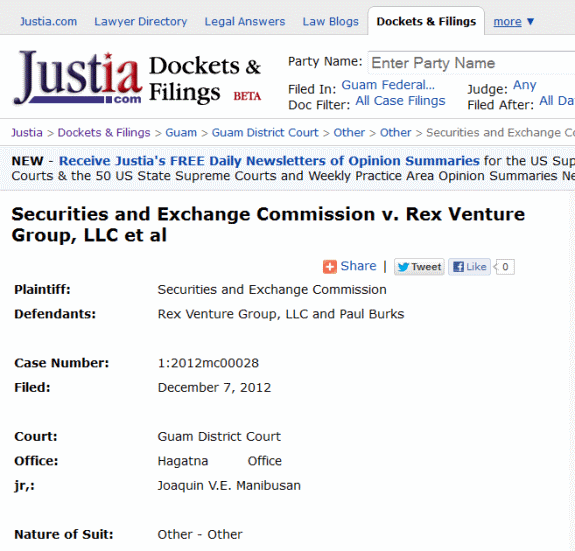
    This filing in Guam by the court-appointed receiver in the Zeek Rewards Ponzi scheme case may be the first in a U.S. territory.

    In yet another indicator of the incredible reach of the alleged Zeek Rewards Ponzi scheme, the court-appointed receiver has filed court paperwork in Guam.

    Guam is a U.S. island territory “approximately 3,300 miles West of Hawaii, and 1,500 miles east of the Philippines and south of Japan,” according to the website of Naval Base Guam.

    Whether U.S. military members in Guam bought into Zeek is unclear. Zeek was based in North Carolina, home state to four military installations.

    In August, the SEC said Zeek “raised money from more than one million Internet customers nationwide and overseas.” In July, the PP Blog reported that an article on Google News by an apparent Portuguese-speaking affiliate of Zeek claimed that the MLM “program” had more than 100,000 members in Brazil alone. Haaretz.com reported in August that Zeek may have had 20,000 members in Israel.

    In recent days, Zeek receiver Kenneth D. Bell has been posting notice of the August SEC complaint and his appointment as receiver in federal courts in multiple states.  The filing in Guam appears to be the first in a U.S. territory, as opposed to a state. The filings set the stage to consolidate Zeek-related court actions in the Western District of North Carolina before Senior U.S. District Judge Graham C. Mullen.

    Bell has said he’ll pursue clawback litigation against Zeek “winners.”

    Some military members were victims of the infamous “3 Hebrew Boys” Ponzi scheme in South Carolina, another state that includes multiple military installations.

    Some promoters of AdSurfDaily, a Zeek-like “program” that planted the seed it provided a return of 1 percent a day, deliberately targeted military members and their spouses.

    From a May 2008 pitch for ASD targeted at military families. ASD collapsed in August 2008.
  • UPDATE: Receiver Sets Stage For Clawbacks In Zeek Ponzi Scheme Case: Filings Provide Clues About U.S. States In Which Fraudulent Transfers Allegedly Occurred

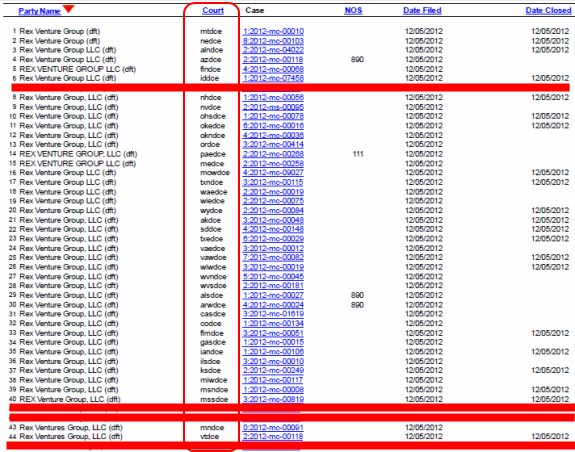
    These filings related to the alleged Zeek Rewards Ponzi scheme operated by Rex Venture Group LLC are appearing in federal court dockets in multiple states today. There are 94 federal judicial districts in the United States, and such a filing is possible in any district in which the court-appointed receiver believes Zeek Ponzi proceeds reside.

    UPDATED 11:02 P.M. ET (U.S.A.) PP Blog reader “Tony” posted comments this morning about cases involving Rex Venture Group LLC popping up in federal courts beyond the Western District of North Carolina, home base of the SEC’s Zeek Ponzi scheme case and the court-appointed receiver. Rex Venture is the parent company of North Carolina-based Zeek.

    Tony initially observed that he’d seen case numbers for Rex-related filings such as this one on Justia.com, a site that tracks court filings. Tony noticed Justia references to filings in the Western District of Arkansas and in Arizona.

    It turned out that these two filings were only the tip of the iceberg. As the day proceeded, more and more references to filings began to appear on PACER, the public-access system for the federal courts.

    The ASDUpdates Blog has been tracking the filings today. As of the time of this post, there appears to be more than 40 such filings in various federal districts in various states. That number could increase because there are 94 federal districts and the filings will occur in districts in which the Zeek receiver has traced assets linked to the scheme.

    Receiver Kenneth D. Bell has said he intends to pursue clawback litigation against Zeek net winners in order to make victims of the alleged Zeek fraud scheme as whole as possible. The early math of Zeek suggests there were about eight losers for every Zeek winner.

    The filings now appearing on the dockets today in various federal districts are yet another indicator of the massive scale of the alleged Zeek fraud, believed to be the largest Ponzi scheme in U.S. history based on the number of victims. That number is estimated in the neighborhood of 1 million.

    In August, the SEC described Zeek as a $600 million Ponzi- and pyramid fraud.

    Today’s filings are not lawsuits against individual Zeek promoters; those will come later, if the receiver and the promoters cannot negotiate a deal that will result in the return of sought-after funds. Today’s filings — in effect — are formal notifications to court officials in the various districts that the receiver may be operating in their districts under the authority of the federal court for the Western District of North Carolina.

    Senior U.S. District Judge Graham C. Mullen of the Western District of North Carolina is presiding over the SEC’s Zeek case and the receivership.

    Despite the SEC’s Zeek action, the HYIP universe continues to serve up wantonly destructive fraud schemes, thus potentially creating victims by the tens of thousands at a time. In many cases, the schemes are advanced by willfully blind hucksters, including hucksters who populate Ponzi scheme boards such as TalkGold and MoneyMakerGroup and race from scheme to scheme to scheme.

  • BULLETIN: Proposed Class-Action Against Zeek In Louisiana Transferred To North Carolina

    BULLETIN: A federal judge has transferred from the Eastern District of Louisiana to the Western District of North Carolina a proposed class-action lawsuit against Rex Venture Group LLC, Zeek Rewards and Paul R. Burks.

    The ruling by U.S. District Judge Carl J. Barbier  in New Orleans likely paves the way for Senior U.S. District Judge Graham C. Mullen of Charlotte to issue a specific order to stay the case. Both Burks and Kenneth D. Bell, the court-appointed receiver in the Zeek Ponzi scheme case brought by the SEC on Aug. 17 in Mullen’s courtroom, have sought the stay.

    In August, Mullen issued an order that “[a]ll Ancillary Proceedings are stayed in their entirety, and all Courts having any jurisdiction thereof are enjoined from taking or permitting any action under further Order of this Court. . . .”

    The prospective class action was filed in Louisiana on Aug. 24, a week after Mullen issued the stay in North Carolina.

    Burks has contended that the Louisiana plaintiffs tried to circumvent the Aug. 17 stay issued by Mullen by bringing an action in another federal district.

  • Nathaniel Woods Plants Seed That Zeek Receiver Issued ‘Bogus Subpoena’ And Committed Felony; Claims Reminiscent Of Assertions Made In AdSurfDaily Ponzi Case

    UPDATED 5 P.M. ET (U.S.A.) Various members of the Florida-based AdSurfDaily 1-percent-a-day Ponzi scheme advanced various theories that judges, prosecutors and investigators committed various felonies during the course of the probe and follow-up actions in court. The claims were absurd on their face and, when the arguments were rejected, they were replaced by conspiracy theories. Time after time the conspiracy theories expanded to accommodate unpleasant fact sets, with various “defenders” of ASD retreating into an infinite set of contingencies and conflating one artificial reality after another.

    Now, a Florida resident and apparent participant in Zeek Rewards has filed a document in federal court that accuses the court-appointed receiver in the Zeek Ponzi scheme case of committing a felony. The receiver, Kenneth D. Bell, is a former federal prosecutor who once successfully prosecuted a Hezbollah terrorist cell operating in the United States.

    The PP Blog contacted the Zeek receivership today to seek comment from Bell. The Blog’s message was not immediately returned.

    In separate filings that appear on the docket of Senior U.S. District Judge Graham C. Mullen of the Western District of North Carolina, Nathaniel Woods claimed Bell or Bell’s receivership team unlawfully mailed a “bogus subpoena” to him in Ocala, Fla., thus committing a felony under Florida law.

    Mullen is presiding over the Zeek Ponzi case. In August, the SEC accused Zeek of operating a $600 million Ponzi- and pyramid scheme. Zeek’s business model was very similar to the model of ASD. ASD’s business practices triggered both civil and criminal investigations by the U.S. Secret Service in 2008.

    The subpoena, Woods claims, was meant for the purposes of “intimidation and harassment” on the part of the receiver.

    And Woods further claims that sending a “bogus subpoena” from North Carolina to Florida through the U.S. Mail constitutes “simulated process” under Florida law, a “third degree felony.”

    An accompanying document filed by Woods as an exhibit claims that “preliminary Zeek Rewards records” reviewed by the the receivership show that Woods received more than $496,000 from Zeek but paid nothing (“$0.00”) into the purported program.

    Bell is seeking the return of the money, describing it as “money lost by victims,” according to the exhibit.

    Woods is seeking to quash the subpoena, which demands records of Woods’ interactions with Zeek dating back to January 2010. He also claims the subpoena was only an “alleged subpoena” and was improperly served.

    A domain styled “500FREEBIDS4U.COM” is registered in the name of Nathaniel Woods at the Ocala street address to which the subpoena was sent, according to records. Other domains listed with an email address that appears on the registration data attributed to Nathanial Woods include Mybidshack10k.com, Mybidshackhow.info, Mybidshack4u.com and Mybidshackearn.info.

    Daryle Douglas, a onetime purported Zeek executive, also has been associated with a MyBidShack entity, according to researcher “K. Chang.”

    Zeek was a purported “penny auction” company operated by Paul R. Burks through Rex Venture Group LLC in Lexington, N.C. The penny-auction site was known as Zeekler. Zeek’s MLM arm was known as Zeek Rewards. Burks has consented to a judgment in the case. He has neither admitted nor denied the SEC’s allegations, which include securities fraud and the sale of unregistered securities.

    On Aug. 17, the U.S. Secret Service said it also was investigating Zeek. The SEC has said Burks duped investors into believing the purported Zeek “program” was paying a legitimate return of about 1.5 percent a day.

    Bell has said that perhaps 1 million people sent money to Zeek. Viewed by the number of potential victims and the number of transactions, Zeek may be the largest Ponzi scheme in U.S. history.

    Earlier this month, Bell said the receivership had gathered evidence that nearly 1 billion transactions were conducted through Zeek in about 18 months.

    AdSurfDaily was a Ponzi scheme that promoted a payout of 1 percent a day. It has about 100,000 members and gathered about $119 million, also in about 18 months, according to records.

    Records suggest that Zeek, which launched after the Secret Service brought the ASD Ponzi case, did about five times the dollar volume of ASD and potentially had 20 times the user volume.

    The civil portion of the ASD case dragged out for all or parts of five years. ASD President Andy Bowdoin admitted in May 2012 that ASD was a Ponzi scheme. In August 2012, less than two weeks after the SEC brought the Zeek case, Bowdoin was sentenced to 78 months in federal prison.

    ASD and Zeek are known to have had members in common.

  • STUNNING: Nearly 1 BILLION Zeek Transactions Over 18 Months, Receiver Says; ‘Sheer Quantity Of Data’ And ‘Inadequate And Incomplete’ Records Necessitate Delay In Filing Of Liquidation Plan

    EDITOR’S NOTE: It’s this simple: Ponzi = Pain — and even “ordinary” Ponzi schemes often result in extraordinary paper chases. The Zeek case may be setting a new standard for the extraordinary.  

    The receiver in the Zeek Rewards Ponzi scheme case informed a federal judge today that “the Receivership Team is still in the process of reconstructing over 18 months of ZeekRewards financial information involving more than 931 million transactions.”

    It was not immediately clear if the jaw-dropping number set a record for a Ponzi case. About 2.2 million “unique users” of Zeek exist, and about 1 million affiliates “paid money into” Zeek, receiver Kenneth D. Bell said.

    Without objection from the SEC, Bell has asked Senior U.S. District Judge Graham C. Mullen for a delay until Dec. 17 in the filing of a liquidation plan.  On Aug. 17, the SEC accused Zeek — through its parent company Rex Venture Group LLC — of operating a $600 million Ponzi- and pyramid scheme. In terms of the number of participants, Zeek may be the largest Ponzi scheme in U.S. history.

    “In short, the magnitude of the transactions, the inadequate and incomplete nature of the Receivership Defendant’s financial records, and the sheer quantity of data and Affiliates all necessitate additional time for the Receiver to analyze, account, and liquidate the assets of the Receivership Defendant,” Bell wrote.

    Bell also filed reports today that showed the McGuireWoods law firm and FTI Consulting Inc., a forensic accounting firm, are providing significant billing discounts to the receivership estate. The law firm is providing a 15 percent discount, Bell said.

    Meanwhile, the accounting firm is providing a discount of more than 22 percent, Bell said.

    “As of September 30, 2012, the Receiver recovered $293.7 million for the Receivership Estate,” Bell said. “Combined, MW and FTI request $853,491.29 in fees and services. The fees requested are less than 0.3% of the recovery for the Estate.”

    Here is the breakdown, according to the receiver’s first application for fees and expenses:

    • Receiver and law firm (billing for services of $718,713.86 and expenses of $49,388.37).
    • FTI (billing for services of $82,430 and expenses of $2,959.06).

    From footnotes in the billing report (italics added):

    1 At the time of the Receiver’s appointment, the Receiver and MW agreed to a 15% reduction in the hourly rates for the Receiver and all of MW’s attorneys and paraprofessionals. In accordance with the SEC Guidelines, long-distance travel time was billed at a rate that was reduced 50% from the already-discounted rates, resulting in an effective discount of 64% or greater for travel time, and a total discount of $21,258.05 in fees related to travel time alone. The Receiver and MW also determined to write off the time for 11 timekeepers in a further effort to increase savings to the estate.

    2 In keeping with the rate discounts applied by MW, FTI reduced the hourly rates for its Senior Managing Directors to $495, Managing Directors to $410, Senior Directors to $395, Directors to $350, Senior Consultants to the range of $270-$320, and Consultants to the range of $210-$225. The average reduction in bill rates is 22.5% per hour.

    3 FTI has agreed to not charge for travel time. Additionally, FTI has waived its customary administrative expense that is usually 6% of fees charged.

    The judge must approve the billings.

    NOTE: Visit the Zeek files site maintained by the ASDUpdates Blog.

  • BULLETIN: First Round Consisting Of 1,200 Subpoenas Will Go Out This Week To Zeek ‘Affiliates Who Profited Most,’ Receiver Says; More Subpoenas Will Follow; Winners Also Will Receive ‘Letter Offering To Negotiate Voluntary Surrender Of Profits’

    UPDATED: 7:08 P.M. EDT (U.S.A.) The court-appointed receiver in the Zeek Rewards Ponzi scheme case has announced that about 1,200 subpoenas will go out this week to “affiliates who profited most from ZeekRewards.”

    It’s “victims’ money, really,” receiver Kenneth D. Bell said in a letter posted on the receivership website.

    “The subpoenas ask for financial information, including dealings with Rex Venture,” Bell wrote. “Depositions and litigation will follow if necessary. With each subpoena will be a letter offering to negotiate voluntary surrender of profits (victims’ money, really) instead of going to Court.”

    On Aug. 17, the SEC described Zeek as a $600 million Ponzi- and pyramid scheme that potentially affected more than 1 million members.

    In the receiver’s letter dated Oct. 30, Bell said a preliminary analysis suggests that Zeek losers outnumber winners by a factor of about eight to one. Zeek was operated by North Carolina-based Rex Venture Group LLC and Paul R. Burks.

    “Our preliminary analysis has identified more than 800,000 affiliate User IDs who put more money into Rex Venture than they took out,” Bell wrote. “We estimate that losses will total between $500 million and $600 million. We have already recovered more than $300 million and continue to pursue millions more held in financial institutions. To fill the gap between what we have recovered and what victims lost, we will pursue recovery from those who took out of Rex Venture more than they put in. There are more than 100,000 User IDs in this category representing hundreds of millions of dollars.”

    More subpoenas will be issued in the coming weeks, Bell said.

    “Additional subpoenas and demands for return of profits will be served on thousands more in the weeks to come,” Bell wrote. “I can’t tell you we will recover enough to make all victims 100% whole, but if we don’t it won’t be for lack of trying.”

    A “preliminary, partial” distribution of money to help Zeek victims recover also is being planned, Bell said. No timetable was released, but the receiver noted that he would submit a claims form for the court’s approval. Once Senior U.S. District Judge Graham C. Mullen approves the form, the process of filing claims will begin.

    “Once approved the Form will be posted” on the receivership website, the receiver wrote.  “When that process has run we will ask the Court for permission to make a preliminary, partial distribution to qualified claimants from recovered funds. A final distribution will have to wait until we have finished collecting all recoverable assets. This will unfortunately take quite a while, and I appreciate your support and patience.”

    Bell said he’d received emails from Zeek members inquiring whether they should hire an attorney or “join a group” that has hired an attorney to assist in claims recovery.

    “I cannot and do not advise you one way or another about hiring an attorney,” Bell wrote. “I can tell you that my direction from the Court, and my duty to you, is to seize all recoverable assets and distribute them to victims as fully and fairly as possible.

    “That, I will do,” he concluded.

    UPDATE: 7:08 P.M. EDT (U.S.A.): The receiver has added a “Subpoena FAQ” here. At the time of this update, there are nine entries in the FAQs, including this question and answer (italics added):

    1. Why have I received a subpoena for documents?

    The ZeekRewards Receiver has been authorized by the Court to recover money and pursue claims for the company. You are receiving this subpoena because you have been identified as an “affiliate,” participant, agent or employee in the ZeekRewards operation who may have received significantly more money from ZeekRewards than you put into the operation. The so-called “profits,” “commissions,” or “winnings” that you received were really just money put in by the victims of the Ponzi and pyramid schemes described in the Securities and Exchange Commission Complaint. The subpoena you received is the legally authorized means for the Receiver to gather information from you in connection with the legal process to recover your “profits,” “commissions,” and “winnings” to compensate victims.