Oregon-based NX Systems Inc. has advised a federal judge that Rex Venture Group LLC, the North Carolina-based parent company of Zeek Rewards, had more than $14.4 million in an account frozen on Aug. 17. On that date, the SEC accused Zeek of being a $600 million Ponzi- and pyramid scheme that had affected more than 1 million people.
Visit ASDUpdates to read filings related to the Zeek case.
The SEC has established an information page for victims of the alleged Zeek Rewards Ponzi- and pyramid scheme. The Zeek case, which may affect up to 2 million individuals, is spotlighted today on the SEC's main webpage.
Information for victims of the alleged Zeek Rewards Ponzi scheme is getting top billing on the SEC’s website today, and the agency has established a webpage for Zeek victims.
Here is that page, which includes a link to the website of the court-appointed receiver. Kenneth D. Bell is filling that role. Visit the receiver’s website.
Zeek was operated by Paul R. Burks and Rex Venture Group LLC of Lexington, N.C. The SEC described Zeek as a $600 million Ponzi- and pyramid that operated online.
UPDATED 12:18 P.M. EDT (U.S.A.) There is a report on the MoneyMakerGroup Ponzi forum today of at least one member of the Zeek Rewards’ “program” getting charged $99 for a monthly renewal:
Here’s how the post read (italics added):
“Your Diamond renewal has been processed Order Total: 99.00 Order Date: 8/5/2012 6:06:51 PM Subscription Renewal Date: 7/29/2012 Order Number: [deleted by PP Blog] This will appear on your statement as ZeekRewards.com. Thanks! ZeekSupport
The poster went on to point out that the “[d]ates are off though.”
And the poster also asked, “Anyone else get this? Probably old renewal only processed now, knowing how slow they’ve been.”
Last week, the state of Maine cautioned Zeek members to contact their service-providers to cancel Zeek billings. Here is the statement from Maine’s Office of Securities and Bureau of Financial Institutions in its entirety (italics added):
Maine’s Office of Securities and Bureau of Financial Institutions today alerted consumers that federal regulators recently took action to stop an alleged massive online “profit sharing” Ponzi scheme that appears to have attracted Maine investors. The site, ZeekRewards.com, was placed into receivership and had its assets frozen by a North Carolina District Court on August 17 following an action by the U.S. Securities and Exchange Commission (SEC) for securities fraud against the site, as well as a related entity, Rex Venture Group, LLC, and internet marketer Paul R. Burks of Lexington, N.C.
According to the SEC’s complaint, ZeekRewards and defendants raised $600 million dollars from more than one million internet customers and investors nationwide and overseas through the website, ZeekRewards.com, which began operating in January, 2011. Customers were offered several ways to earn money through the ZeekRewards profit-sharing program, which the SEC alleges was marketed in violation of federal law. ZeekRewards operated a classic Ponzi scheme by paying the first wave of investors with new funds solicited from subsequent investors using false and misleading statements.
“Some Maine financial institutions reported receiving requests for assistance from customers who invested in ZeekRewards.com, so, unfortunately, we have good reason to believe there may be a number of Maine victims of this scheme,” said Bureau Superintendent Lloyd LaFountain III. LaFountain encouraged anyone who purchased an interest or otherwise invested in ZeekRewards through a monthly subscription or other recurring payment plan administered by their financial institution to contact the institution immediately to make sure future payments are not deducted from the customer’s account.
The receiver in this case has identified $225 million in investor funds in 15 foreign and domestic financial institutions, but is still currently identifying assets and victims of the scheme. Securities Administrator Judith M. Shaw urged investors to stay abreast of developments by monitoring the receiver’s website: www.zeekrewardsreceivership.com. Shaw pointed to another resource for investors, an SEC site to keep investors apprised of updates, www.sec.gov/divisions/enforce/claims/zekerewards.htm.
“Scam artists rely on the internet as a reliable forum for perpetuating fraud,” noted Shaw. “The fact that this scheme reportedly pulled in over one million investors worldwide underscores the importance of thoroughly investigating any kind of profit-making venture before investing, regardless of how the venture is styled or presented The Office of Securities stands ready to assist all Maine citizens with objective information so that investors can make informed investment decisions.”
Last Updated: August 31, 2012 12:33 AM
Visit the webpage of the Maine Office of Securities and Bureau of Financial Institutions.
URGENT >> BULLETIN >> MOVING: (UPDATED 8:59 P.M. EDT U.S.A.) The U.S. Secret Service has seized more than $11.5 million allegedly traceable to the Zeek Rewards MLM “program,” according Preferred Merchants Solutions LLC (PM), which cited an “asset seizure warrant” in a new court filing.
PM is a Zeek vendor. The company also says it is in possession of between $10 million and $15 million of “unprocessed checks” linked to Zeek. Moreover, the company has advised a federal judge that there may be an additional $3 million in checks that were not processed due to “processing errors.”
The Secret Service confirmed on Aug. 17 that it was investigating Zeek. The filing by PM is believed to be the first public document that shows the agency is seizing Zeek-related money. The SEC has described Zeek as a $600 million Ponzi- and pyramid scheme.
PM, according to Florida records, is a Miami-based company. The company, whose registration in Florida was marked reinstated on July 2, also lists an address in Napa, Calif., in Florida records.
Separately, North-Carolina-based Four Oaks Bank & Trust Co., which earlier said it needed more time to establish how much it was holding in Zeek-related funds through Rex Venture Group LLC, has advised the judge it does not have an account in the Rex name “or any other direct relationship” with Rex.
However, the bank went on to say that it “does have a commercial account in the name of “Nx Systems Inc.” and that the bank “froze the entire NX Systems’ Commercial Account” on Aug. 17.
Rex Venture is Zeek’s purported parent company.
Nx Systems was a Zeek vendor. What the freeze of its “entire” commercial account means to other NX Systems’ customers was not immediately clear. Four Oaks advised the judge that it could not “independently certify” the amount of funds Nx Systems holds in the name of Rex and that Nx Systems told the bank it was working on a reconciliation for presentation to the court.
Earlier this year, Zeek identified NX Systems as a service-provider. Zeek also scolded members for making phone calls to NX Systems, which operates an entity known as NxPay.
Paul R. Burks, the operator of Zeek Rewards, was cooperating with the SEC prior to the filing of the Aug. 17 complaint that alleged Zeek was a $600 million Ponzi scheme and pyramid fraud, a new court filing suggests.
That “period of cooperation” resulted in the production of “hundreds of thousands of documents, including financial records, e-mails, and all manner of electronic files,” according to the filing by Noell P. Tin, an attorney for Burks.
The filing does not specify when the cooperation began or say whether others inside of Zeek knew that the SEC had access to Zeek records prior to the filing of the complaint and a freeze on the assets of Zeek’s parent company, Rex Venture Group LLC. But it may explain at least in part why Burks agreed to settle the case without admitting or denying the allegations and to cooperate with Kenneth D. Bell, the court appointed receiver: The SEC effectively already had been inside the company.
Separately, First Premier Bank of Sioux Falls, S.D., has advised Senior U.S. District Judge Graham C. Mullen of the Western District of North Carolina that it is holding more than $31.2 million in three separate Rex Venture accounts frozen under court order. The largest Rex account at the bank holds more than $30.9 million. A smaller account holds more than $284,000, and the smallest account holds only $90, according to a filing by the bank.
To date, court filings suggest that Rex Venture has an account at Charles Schwab that holds $10.3 million in cash and more than $4.94 million in securities. The company also has an account at North Carolina-based NewBridge Bank that holds more than $11.64 million.
Rex Venture also holds an account at Four Oaks Bank & Trust Co. Inc., another bank in North Carolina. The bank has asked the judge to give it until Sept. 3 to say how much it is holding because of the “complexity of the financial information that must be analyzed and the need to obtain relevant information from a third party.”
All in all, the SEC said on Aug. 17 that the Burks-controlled entities used 15 foreign and domestic financial institutions.
Burks’ personal assets were not frozen in the Aug. 17 SEC action, and the accused Ponzi schemer wants to keep it that way, according to court filings.
“There is no basis and no need to freeze Mr. Burks’ personal funds,” his attorney wrote in response to a motion by Bell that raised the possibility that “Recoverable Assets” were controlled by Burks and his family. “Mr. Burks has never expatriated the assets of Rex Ventures Group, LLC or his personal money. He has fully cooperated in the SEC investigation, which included examination of relevant financial records. He is 65 years old, married, a two time cancer survivor, and has lived in Lexington, North Carolina for 23 years. He has never been a defendant in any action, civil or criminal, until this matter. Mr. Burks is aware of the importance of this proceeding and will abide by any orders this Court imposes.”
One of the remaining mysteries of Zeek is how and when key executives found out about the SEC probe and whether they or other insiders feathered their own nests prior to the collapse.
DISCLOSURE: Gregg Evans, a longtime member of the antiscam community, is a longtime PP Blog contributor. He was not compensated for this column, and his views are not necessarily the views of the PP Blog.
Whose Lawyer Is This Anyway?
By Gregg Evans
A group of Zeek Rewards’ affiliates claim they have retained SNR Denton to do, well, something about the SEC taking over Rex Venture Group, Zeek’s corporate parent. What they intend to do is a mystery at this time. You see, Rex Venture Group, and with it Zeek, is dead. Nothing left but the shell that is in possession of a court-appointed receiver.
There can be no resurrection here: Paul Burks, the previous owner has turned the company over voluntarily to the receiver and, under the terms of the consent judgment, he cannot change his mind, he cannot appeal, he cannot argue that he didn’t violate securities laws and he can’t reboot the company under a different entity.
Zeek is no more: All that’s left is to gather up all the money and distribute what’s left back to those that it was stolen from.
The first problem with this is that not all that was stolen can be recovered, a part of it is going to be spent in the effort to return it and not everyone lost, which means some people won. Fairness, and by the way the law, says that those winners should have to return not only their ill-gotten gains, but in fact they should also return part of their original investment so that they proportionately bear the same loss rate as everyone involved.
In short, if the average “investor” is only going to recover $30 of the $100 they sent in, why should someone who sent $10,000, and profited in the end, only have to return their net winnings? It’s only fair that they should in fact have to return all their profits, but also 70% of their contributions, so that they bear the same loss as everyone else. If you sent in $10,000 and didn’t take out a dime, I think you’ll see the logic there. If, on the other hand, you were among the early investors who made a sizable profit, you may think differently.
Zeek presented in online pitch as “Passive Income!” opportunity.
It was once claimed that some affiliates were “earning” over $1 million a month from Zeek. If you’re a big winner, you might be quietly hoping that the receiver isn’t going to try to get anything back from you and you might be thinking that if he does, you might be wise to get an attorney to do everything legally possible to prevent any of your “profits” being taken from you to be added to the pool of funds eventually refunded to the people who weren’t as lucky as you. Well and good. I don’t agree with you, but then again, I wasn’t getting a million dollars a month in Zeek “profit sharing.” You’re certainly entitled to the best legal talent you can pay for.
Ah, but you’re too greedy to even accept that. No, you’re not going to use your own money to get that very pricey legal team working to keep you from losing money in the Ponzi scheme like almost all the others, you want the losers to contribute to a fund to pay your lawyers.
That’s chutzpa, Sparky.
The names so far mentioned as being behind this legal effort are hardly innocents. Among them are some names very familiar to those of us who follow online investment frauds, Ponzi schemes and MLM hucksters. These are the big recruiters. They pimped this scam, flaunted the money they were raking in, money that was ultimately stolen from their own downlines. Now they’ve cranked up their downlines, incited the victims and are shouting from the Internet hills about the injustice of the evil government shutting down their favorite scam, because, after all, it was still paying.
Never mind the $3 billion deferred liability that Zeek Rewards had only $225 million to pay. Never mind that only 2% of Zeek’s revenue came from an actual business and that 98% of the money paid out in the end was coming from new money paid into the affiliates programs. (The very definition of a Ponzi scheme.)
I’d venture you’d be a little less admiring of Paul Burks if the SEC, Secret Service and North Carolina Attorney General had not investigated this scam and it had collapsed of its own weight a few weeks or days later than the SEC action. There were signs that Zeek was in fact about to implode in the very near future anyway. Had that happened I’d expect a few of you would be raising complaints as to why the authorities had let the scam continue when they knew about it and had been investigating it. (Search “CMKX Scam” for an example of that.)
But with apologies to Arlo Guthrie, that’s not what I’m here to talk about.
I’m here to talk about your lawyers, and how you’re trying to get the people whose stolen money you have, to pay lawyers so you don’t have to give any of that stolen money back. First, you’re asking people to send the money to you, not to the lawyers. Second, you’re telling them to please not call the lawyers.
This raises a few issues. To begin with, if the people involved lost money they can of course take advantage of the tax code to at least save on their taxes. They could also, if they retained counsel in relation to their business deduct that money, too. They cannot deduct any contribution they make to someone else’s legal bills.
In order for them to be able to say they paid a lawyer in relation to a business expense, the IRS is pretty insistent that they paid lawyers, not paid someone else who paid a lawyer, especially when the lawyer in question won’t even take your calls. I’m not an attorney myself but I’m pretty certain that some ethical rule somewhere says you have to take calls from your client. Which brings us to another thing:
Who is the client, and what is the client’s interest?
In a solicitation letter published on the Internet, the people soliciting donations say that the law firm will only communicate with 12 people. Forgive me if I take that to mean that only those 12 people are formally the clients represented, and that means that the attorney’s in question MUST represent those 12 people and ONLY those 12 people, and any interest any other people may have that is against the clients are by default adversarial.
So if, for instance, those 12 people were all net winners wishing to avoid a clawback action, hundreds of thousands of investors who lost would be the enemy, and by the tenets of the legal profession, said lawyers would be opposed to their interests in any conflict. There were early reports of over a million investors in Zeek Rewards. At a later news conference, the receiver said that number may well be over 2 million.
Mathematically speaking a Ponzi scheme results in at least 88% of participants who are net losers, a percentage that rises the longer a scheme continues, so of the 2 million, 1,760,000 people are likely net losers here. But these lawyers are only looking out for the 12, who I’ll bet are all net winners.
I’ll go out on a limb and say that all of them are big-time winners; at least one had a video posted showing off a new luxury home he implied was paid for with Zeek Reward profits. And they want the losers to pay for their lawyers, because after all, Zeek was still paying. There was over $225 million left in the till and if the evil government had just minded their business they could have gotten a pretty good chunk of that, too.
So, am I wrong? I’m talking now to the 12 people who are allowed to call the lawyer, and to the lawyer, too for that matter. I think this is rotten to the core, but prove me wrong. Make public the retainer agreement between whoever the clients are and SNR Denton.
If you’re good enough and shameless enough to get your victims to pay for your lawyers, good on you, but I think you owe it to the people you’re asking to pay for it to show them just exactly what they’re paying for, and whose interest is being represented here.
Oh, and since you’re telling people to pay you, and not the lawyers, and since that means they can’t deduct it on their taxes, I ‘d like to offer my own opinion that any money you get is regular income as far as the IRS is concerned, and you’d better report every penny of it as such.
“On August 17, 2012, Judge Graham C. Mullen of the U.S. District Court for the Western District of North Carolina, Charlotte Division, entered an order appointing Kenneth D. Bell of McGuireWoods LLP as temporary receiver of ZeekRewards for the purposes of marshaling and preserving all assets of ZeekRewards and those assets (a) held or possessed by ZeekRewards; (b) held in constructive trust for ZeekRewards; and (c) fraudulently transferred by ZeekRewards.” — From a statement by the receiver
The website URL for the receiver appointed to handle the SEC’s Ponzi- and pyramid-scheme case against Zeek Rewards, Rex Venture Group LLC and Paul R. Burks is ZeekRewardsReceivership.com.
Kenneth D. Bell, a highly experienced attorney who has served both as a federal prosecutor and as defense counsel, is the receiver.
Bell rose to national prominence as a recipient of the U.S. Attorney General John Marshall Award for Trial of Litigation. He received that award from the U.S. Department of Justice after successfully prosecuting a Hezbollah terrorist cell operating in North Carolina.
The receivership website is not yet fully operational. Visit the site.
UPDATED 4:06 P.M. EDT (U.S.A.) It happened after the collapse of AdSurfDaily in 2008 — and it’s happening now in the aftermath of the collapse of Zeek Rewards amid spectacular allegations by the SEC Friday of Ponzi and pyramid fraud.
The office of North Carolina Attorney General Roy Cooper issued a warning minutes ago about “reload scams” aimed at taking advantage of Zeek victims.
Here is the warning in its entirety (italics added):
Reload scams hit consumers when they’re down, offering to help them make back money they lost to a previous scam or bad business decision. These scams have been popular for years with telemarketing fraud rings but can also follow other types of fraud.
We’re now seeing reload scams seeking to recruit consumers who were members of Zeekler, a penny auction website headquartered in North Carolina that shut its doors last week and entered into a settlement with the U.S. Securities and Exchange Commission. The SEC determined that Zeekler was a Ponzi scheme, using money from later investors to pay back earlier investors until the scheme started running out of money. The Attorney General’s Office is continuing to investigate Zeekler.
Blogs, news releases online, and individuals leaving comments in articles about the Zeekler shut down are already touting opportunities “for those that are looking for something that can help them replace the income they were receiving from Zeek Rewards.” If you’ve been a part of a scheme such as Zeekler that collapsed, or if you lost money to another recent scam, don’t fall for a reload scam. Better to cut your losses than lose even more.
The exact phrase quoted by Cooper’s office in the paragraph above appears in a news release for something called TheMayDayReport.
The SEC called Zeek a $600 million Ponzi- and pyramid scheme that had affected more than 1 million investors. Cooper’s office opened a probe into Zeek in July, and the U.S. Secret Service also is investigating Zeek.
Over the weekend, the PP Blog received multiple spams aimed at Zeek threads. Purportedly from “Briant,” those spams promoted a “program” called Ultimate Power Profits. Like Zeek, Ultimate Power Profits has a presence on well-known Ponzi scheme forums such as MoneyMakerGroup.
Zeek’s former head cheerleader at MoneyMakerGroup — “mmgcjm” — also is the head cheerleader for Ultimate Power Profits at the forum.
On Friday — the same day of the Zeek collapse — an MLM “program” known as Vi-Tel Wireless (Vi-Tel) issued a news release to announce it was sponsoring a “Zeek Rescue Program.” Affiliates busied themselves heralding the purported rescue program across the web.
Vi-Tel called itself a “safe refuge.” Vi-Tel affiliates aimed sales pitches at websites carrying information on Zeek, leading to questions about whether reps were circling like vultures. It was remarkably awful PR.
In other post-Zeek news, an auction “program” known as Bidify now is offine. The company says it is trying to retool itself in the aftermath of the Zeek collapse.
Like Zeek prior to the collapse, Bidify denies it is an investment program.
Zeek, Rex Venture Group LLC and operator Paul Burks were charged Friday with selling unregistered securities as investment contracts.
DISCLOSURE: Gregg Evans, a longtime member of the antiscam community, is a longtime PP Blog contributor. He was not compensated for this column, and his views are not necessarily the views of the PP Blog.
Who are these “Experts” anyway?
By Gregg Evans
Troy Dooly is the latest “expert” to look like an utter fool in the wake of the Zeek Rewards collapse. For months the apparently respected MLM guru has been defending Zeek against all logic, common sense or demonstrated knowledge of mathematics.
It turns out that — even though in Troy’s “expert opinion” and based upon his “inside knowledge” that he couldn’t share because he wanted to respect a “non disclosure agreement” — Zeek, Zeekler and Rex Venture Group was just another garden-variety Ponzi scheme.
This one added up to $600 million if you’re keeping score. And you should be. That’s more than half a billion dollars.
A few years ago, I decided to not actively hide my identity, but not advertise it either when 12DailyPro collapsed in a heap of scandal based solely on the figures being tossed around about how much money Charis Johnson had drawn in. It occurred to me at the time that there are people out there who will in fact kill you for that kind of coin, and more than a few of them I knew were involved in the scam. I had never received a death threat before, or at least not one I took seriously.
Here we have again a figure that frankly boggles the mind being funneled into a rather transparent Ponzi scheme by a collection of ref whores, financial illiterates and flat-out criminals posting with glee “I got paid” at all the familiar places these kind of folks hang out. As the late Everett Dirksen once said, “A billion here, a billion there, and soon you’re talking real money.”
And here again we have a list of supposed “experts” whose opinion proved that “this time, it’s legit.” I just have to ask, by what standard are these people experts at anything, beyond herding the suckers to the spend button?
I, modestly, consider myself an expert in matters of investing, accounting and how money and banking work. Not just because I think so, mind you, I have an earned PhD in International Business, a MSci in Economics, an MBA and a BBA in Finance (with a shared major in Mathematics, btw).
But honestly, if you’re taking my word for it advice-wise, you’re still a sucker, because anyone can try to impress you with what they say, you have to at least look at the motivation. My motivation is to perhaps save a few people who don’t have my background from falling for the siren song of the pimps like Ken Russo, Troy Dooly and others.
Longtime HYIP huckster "Ken Russo," also known as "DRdave," helped lead the "I Got Paid" cheers for Zeek on the TalkGold Ponzi forum.
You see, I’m not asking you to spend your hard-earned money on anything. I’m not encouraging you to inform your friends, relatives and co-workers about the latest sure-fire-get-rich-with-passive-income scheme. I’m just asking you to think a bit, and trying to explain how real money and business works. I happen to some pretty spiffy credentials, but it’s more important that I’m just making common sense.
You see, some people with credentials as good as or better than mine are blinded by the easy pickings to be had if they sell out their fancy titles and initials after the name. Gerald Nehra is licensed attorney and all indications I have seen are he’s not a bad lawyer, as lawyers go. Gerry’s problem, and potentially yours, is that he’ll suspend his common sense, legal knowledge and objectivity if the check clears
Hey, I hate to judge the man, and everyone deserves good legal representation, but Mr. Nehra has not impressed me so far. I am only familiar with two companies with which he has been publicly associated with in the last few years: ASD Cash Generator and Zeek. The operator of one is in jail waiting to find out he’s going to serve what is likely going to be a life sentence based upon his age, the other one just got their offices locked up by some combination of the Secret Service, the Securities and Exchange Commission and the North Carolina Attorney General.
Our “expert” lawyer, one of the best reputations in MLM law around, testified that ASD wasn’t a Ponzi, and from the looks of it told Zeek that if you tell the suckers not to call it an investment, it’s Okie Dokie legally speaking. Good advice there.
Do I think Gerald Nehra believes this? Well, as much as any lawyer believes the legal theory he’s pursuing he may, but I doubt he had a lot invested in Zeek, if you get my drift. He had, over the years built a reputation, and whether he deserved it or not (and I think not) when ASD needed to show a Federal Judge that paying old investors with new investors money wasn’t a Ponzi scheme, Nehra was right there, willing to lend his expert opinion in a Federal Court that black was white, up was down and Andy Bowdoin of ASD was a business visionary who could somehow pay 1% a day legally.
If he’s trying to represent a defendant in a court of law, that’s his job and I have no problem with that, but if he believes it, well, a friend I once had used to say it was never a good idea to believe your own bar stories or “smoke your own dope” as he put it.
ASD was a cheap Ponzi scheme and anyone not blinded by greed with had enough sense to tie his own laces could see that. A few “MLM Experts” and the “All Star Team of Stupid” ASD cheerleaders, sovereign citizen nutcases and Arby’s Indians couldn’t, but that’s just the kind of people loose on the streets since they changed the laws about involuntary mental patient commitment. The Indians, Sovereigns and pimps I won’t comment on here, but the lawyers did it mostly because it paid pretty well. And Ken Russo isn’t doing it because he likes people either, for what it’s worth, he just lacks the credentials to sound like much more than a crooked used car salesman. People like Troy Dooly should know better, and I suspect they do, but they have no trouble overlooking their own knowledge as long as the check clears.
URGENT >> BULLETIN >> MOVING: (UPDATED 6:25 P.M. EDT (U.S.A.) The SEC has filed an emergency action in federal court in Charlotte, N.C., that alleges Zeek Rewards is a $600 million Ponzi and pyramid scheme.
“The obligations to investors drastically exceed the company’s cash on hand, which is why we need to step in quickly, salvage whatever funds remain and ensure an orderly and fair payout to investors,” said Stephen Cohen, an associate director in the SEC’s Division of Enforcement. “ZeekRewards misused the power of the Internet and lured investors by making them believe they were getting an opportunity to cash in on the next big thing. In reality, their cash was just going to the earlier investor.”
In its emergency filing, the SEC described Zeek as a classic Ponzi scheme. The agency charged that “approximately 98% of ZeekRewards’ total revenues, and correspondingly the purported share of ‘net profits’ paid to current investors, are comprised of funds received from new investors.”
Records show that the AdSurfDaily Ponzi scheme which, like Zeek, suggested that investors would receive a return on the order of 1 percent a day, also received only about 2 percent of its revenue from sources other than members. Zeek had members in common with ASD.
Zeek, the SEC alleged, “is teetering on collapse.”
Zeek CEO Paul R. Burks has been charged with selling unregistered securities as investment contracts, the SEC said. Burks presided over Rex Venture Group LLC, Zeek’s purported parent company. Rex Venture also has been charged. The SEC said it was aided in the probe by the Quebec Autorite des Marches Financiers and the Ontario Securities Commission.
Burks’ program holds “approximately $225 million in investor funds in approximately 15 foreign and domestic financial institutions, and those funds are at risk of imminent dissipation and depletion,” the SEC charged, noting that the Ponzi potentially could affect more than 1 million people globally.
A federal judge has ordered an emergency asset freeze and a receiver will the appointed, the SEC said.
“Through the ZeekRewards program, Defendants offer affiliates several ways to earn money, two of which involve the offer and sale of securities in the form of investment contracts: the ““Retail Profit Pool” and the “Matrix,” the SEC charged.
And, the agency said, the “compounding” effect has created a condition under which 3 billion Zeek “Profit Points” are outstanding.
“Based on the ZeekRewards current outstanding Profit Point balance, the company would be obligated to pay out approximately $45 million per day if all Qualified Affiliates elected to receive their daily award in cash,” the agency charged.
Amid Zeek claims that it paid out 50 percent of its daily net and that its business model was “proprietary,” investigators discovered that Zeek delivered an unusually consistent return of about 1.5 percent a day.
“In fact, the dividend bears no relation to the company’s net profits,” the SEC charged. “Instead, Burks unilaterally and arbitrarily determines the daily dividend rate so that it averages approximately 1.5% per day, giving investors the false impression that the business is profitable.
Similar allegations were made in 2008 against ASD operator Andy Bowdoin.
Zeek’s fabled Zeekler “bids” were described by the SEC as smoke-and-mirrors. From the complaint (italics added):
Despite encouraging affiliates to purchase and give away VIP Bids to promote and drive traffic to the Zeekler penny auction website, Defendants fail to disclose that almost none of the VIP Bids given away by Qualified investors are actually used on the Zeekler penny auction website. Of approximately 10 billion VIP Bids purchased by or awarded to investors, less than one-quarter of one percent have been actually used in auctions on the Zeekler penny auction website. Thus, the VIP Bids do little or nothing to actually promote the retail business.
Zeek operator Burks, meanwhile, “has withdrawn approximately $11 million while operating Rex Venture and ZeekRewards, of which approximately $4 million remains in his possession, custody or control.
Burks “distributed approximately $1 million of the funds garnered from ZeekRewards to family members,” the SEC said.
Amid high drama and confusing website reports from Zeek yesterday, including the virtual abandonment of its office in Lexington, N.C., and petition drives by Zeek affiliates to demand the return of Zeek, it turns out that “Burks has agreed to settle the SEC’s charges against him without admitting or denying the allegations, and agreed to cooperate with a court-appointed receiver,” the SEC said.
The U.S. Secret Service also is investigating Zeek, as is the office of North Carolina Attorney General Roy Cooper.
URGENT >> BULLETIN >> MOVING: Zeek Rewards, the multilevel marketing program married to the penny-auction site Zeekler, is under investigation by the U.S. Secret Service and the Securities and Exchange Commission, the Secret Service confirmed at 4:14 p.m. EDT today.
“There will be no further comment,” said Max Milien, a spokesman for the U.S. Secret Service in Washington.
The Secret Service leads a multiagency electronic crimes Task Force in Charlotte, N.C. The Charlotte Task Force is known by the acronym CMECTF.
Zeek, part of Rex Venture Group LLC, is based in Lexington, N.C. Paul R. Burks is Zeek’s chief executive officer.
The Zeek probe is not the first investigation of its sort in which the Secret Service and the SEC looked into the business practices of online schemes that suggest or promise outsize investment returns. A probe of the Legisi HYIP began in 2007 with an undercover investigation by the Secret Service and state securities regulators in Michigan.
That probe later led to civil charges brought by the SEC and criminal charges brought by the Secret Service.
Legisi operator Gregory McKnight pleaded guilty to wire fraud earlier this year. He is scheduled to be sentenced next month. Legisi gathered more than $72 million.
The Secret Service also led the AdSurfDaily Ponzi probe. ASD President Andy Bowdoin is scheduled to be sentenced Aug. 29.
ASD was a 1-percent-a-day Ponzi scheme that gathered at least $110 million. Zeek Rewards has a similar business model.
 Oregon-based NX Systems Inc. has advised a federal judge that Rex Venture Group LLC, the North Carolina-based parent company of Zeek Rewards, had more than $14.4 million in an account frozen on Aug. 17. On that date, the SEC accused Zeek of being a $600 million Ponzi- and pyramid scheme that had affected more than 1 million people.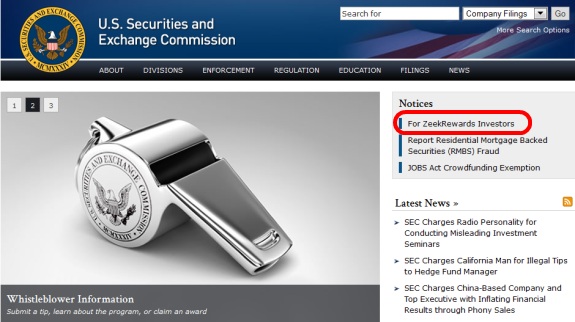


 Zeek presented in online pitch as “Passive Income!” opportunity.
 UPDATED 4:06 P.M. EDT (U.S.A.) It happened after the collapse of AdSurfDaily in 2008 — and it’s happening now in the aftermath of the collapse of Zeek Rewards amid spectacular allegations by the SEC Friday of Ponzi and pyramid fraud.
 Troy Dooly is the latest “expert” to look like an utter fool in the wake of the Zeek Rewards collapse. For months the apparently respected MLM guru has been defending Zeek against all logic, common sense or demonstrated knowledge of mathematics.
 URGENT >> BULLETIN >> MOVING: (UPDATED 6:25 P.M. EDT (U.S.A.) The SEC has filed an emergency action in federal court in Charlotte, N.C., that alleges Zeek Rewards is a $600 million Ponzi and pyramid scheme.