DEVELOPING STORY: (Updated 8:43 p.m. ET U.S.A.) The Press Democrat of Santa Rosa, Calif., is reporting that detectives in Napa County have linked the kidnapping and murder of 44-year-old Reynaldo Pacheco to the WCM777/Kingdom777 MLM scam and as many as four suspects.
From the Press Democrat in a story dated Jan. 15 about the arrest of Angela Martinez Arias, 41, of Petaluma (italics added):
According to investigators, Pacheco had been involved in a business scam known as WCM777, or Kingdom 777. Early last year, the U.S. Securities and Exchange Commission announced it to be an illegal pyramid scheme targeting Asian and Latino communities worldwide. Assets were frozen.
Pacheco apparently had gotten Arias to invest an undisclosed amount of money in Kingdom 777, according to detectives. Pacheco “owed her money from a failed business relationship,” [Napa County Sheriff’s Capt. Doug] Pike said.
The other suspects, according to the newspaper, are Mauricio Tovar-Telles, 24, and Norberto Guerrero Gonzalez, 29. Both are in custody.
A fourth suspect, Miguel Angel Garcia, reportedly shot and killed himself last year after a standoff with SWAT officers.
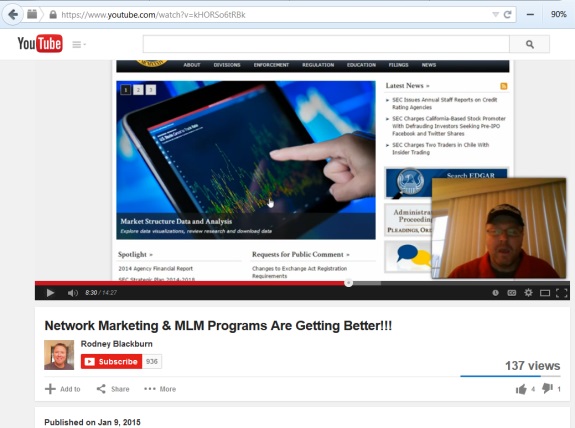
The U.S. Securities and Exchange Commission declined this morning to comment on a Jan. 9 YouTube pitch from an “Achieve Community” promoter who mixed nearly six minutes of footage from the SEC website into a pitch for Achieve and two other Ponzi-board “programs.”
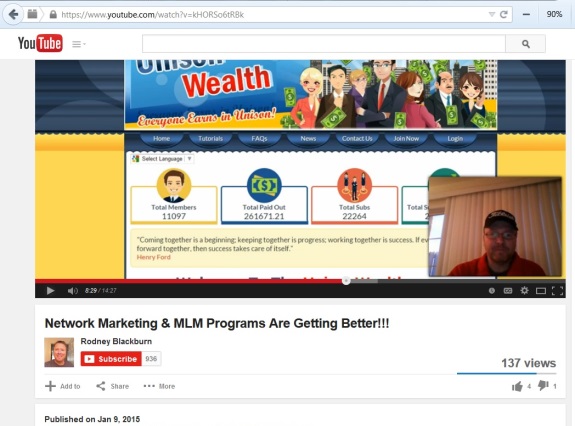
Rodney Blackburn implied in the 14:27 production that the SEC did not have jurisdiction over “programs” such as Achieve, Unison Wealth and Trinity Lines. Parts of the Blackburn promo were recorded inside his back office of Unison Wealth.
“[D]ecline comment,” the SEC succinctly said today.
Achieve purports that $50 sent to the “program” fetches back $400. Members reportedly were permitted to buy multiple $50 “positions” and to roll a percentage of “earnings” back into the “program,” a straight-line money-cycling scheme.
A similar rollback feature was an element in the Zeek Rewards scheme shut down by the SEC in 2012.
Blackburn says he prefers “passive” programs. The SEC and state-level regulators have a history of acting against such ventures. Zeek, for example, was promoted as a “passive” scheme.
At about the 0:51 mark of Blackburn’s Jan. 9 video, ads for “programs” called “Paradox Cash” and “GlobalAdShare” appear, meaning that people such as Blackburn who sign up for Unison Wealth are being shown promos for still-other Ponzi-board schemes.
“GET PAID DAILY FOR DOING NOTHING,” the ad for GlobalAdShare blares.
Blackburn’s Jan. 9 video is at least the second confirmation that Unison Wealth is beaming ads for other HYIPs.
On Dec. 12, the office of then-U.S. Attorney Timothy J. Heaphy of the Western District of Virginia had no immediate comment on an Achieve Community call in which Blackburn was a host. The call demonstrated that Achieve was driving business by reaching across state lines and that one or more senior citizens had signed up, including a woman who claimed her 86-year-old husband of 53 years had been “in the hospital for a full year and six months in the nursing home.”
Achieve reportedly suspended payouts to members more than two months ago after losing its ability to conduct business through Payoneer. Although it announced a purported deal with Global Cash Card on Dec. 18 to resume payouts, that deal appears to have fallen through.
The “program” said last week that it would resume payouts on an unspecified date through a “temporary” processor. The “temporary” processor was not named.
The SEC’s Office of Investor Education and Advocacy recently has dialed up its efforts to educate the public about scams that spread on social-media platforms such as YouTube, Facebook and Twitter. Achieve and its promoters have or had a presence on all three.
EDITOR’S NOTE: The screen shots below show that Rodney Blackburn ends his “Unison Wealth” promo at the 8:29 mark of a 14:27 video. At the 8:30 mark, the website of the SEC becomes the feature and remains so for nearly the next six minutes as Blackburn touts Achieve Community, Unison Wealth and Trinity Lines, Ponzi-board “programs” one and all. It is Saturday. The PP Blog did not immediately hear back from the SEC on a request for comment.
1. From ‘Unison Wealth’ . . .
2. . . . To The SEC
“We’re leaving the markets of these crazy MLM companies, and there are people like the Achieve Community, Trinity Lines, Unison Wealth, many of these other companies are coming out. And they are making programs that are very simplistic, they’re passive, they’re residual incomes. They’re just so simple you just kind of put your money down.” — Rodney Blackburn, Jan. 9, 2015.
A 14:27 YouTube video from an “Achieve Community” member now promoting at least two other Ponzi-board schemes includes nearly six minutes of continuous footage from the website of the U.S. Securities and Exchange Commission.
The latest promo by Rodney Blackburn focuses on “Unison Wealth” and has a publication date of Jan. 9, 2015. It is titled “Network Marketing & MLM Programs Are Getting Better!!!” The promo suggests that ordinary MLM creates an environment in which 97 percent of participants lose and that new, smarter, better schemes are emerging to replace them.
“You don’t have to do any marketing, for the most part,” he says of the purported new way of network marketing. “You don’t have to jump through any hoops and recruit people. You don’t have to go through any of these things.”
In short, Blackburn says, in the new way of network marketing, participants “just kind of put [their] money down” and payouts flow back to them. What’s more, he implies, the SEC doesn’t have jurisdiction, despite mountains of evidence to the contrary, including several concurrent active prosecutions involving network-marketing or MLM schemes with passive components.
Blackburn even dares individuals to complain to the SEC about the “programs” he’s promoting.
“There’s people on here who think that the SEC can shut companies down,” Blackburn says as part of his narration. “Guys, [the] SEC is designed for, again, Securities and Exchange Commission, what they do — it shows it right here in back and white.”
Blackburn proceeds to click on an “ABOUT” tab and a “What We Do” subtab at the SEC website. He then cherry-picks a quote from the agency’s site, wholly ignoring sections on SEC enforcement that detail various cases brought against network-marketing or MLM schemes.
“The mission of the U.S. Securities and Exchange Commission is to protect investors, maintain fair, orderly, and efficient markets,” Blackburn says, reading from the SEC site.
That’s true, of course — but the cherry-picking ignores the much larger whole.
Had Blackburn simply typed “MLM” into the search box in the upper-right corner of the SEC site, he’d have gained instant access to information that undermines his jurisdiction theory.
Without perusing the enforcement section that has information on recent schemes such as Zeek Rewards, TelexFree, WCM777, eAdGear, Zhunrize, CKB168 and others, Blackburn switches back to his personal narrative.
“Guys, it’s about investors,” Blackburn continues, apparently concluding that the SEC would have no interest in the schemes he’s promoting. “It’s about efficient markets. If others of you who want to complain to your governments about these companies that are out there — you know what, go right ahead. It’s not going to do any good, unless they’re doing illegal activity. Unless you have substantial, proven evidence that any of these companies — any of them, OK — are doing anything illegal, it’s futile. You’re just blowing fear out there to the rest of us, OK, because it’s not going to do any good. Come up with something better. Come up with a fact.”
It is a fact that the SEC, on Oct. 1, 2013, issued an “Investor Alert” titled “Beware of Pyramid Schemes Posing as Multi-Level Marketing Programs.” As part of its outreach, the SEC warned about schemes with “Promises of high returns in a short time period” and “Easy money or passive income.”
Meanwhile, it is a fact that Achieve Community has been positioned as a “passive” program with an 800 percent ROI in as few as 55 days. It’s also a fact that a Dec. 27, 2014, promo for Unison Wealth published on YouTube by Blackburn is titled, “Unison Wealth – Review 100% Passive Automated Play for just $40!”
Blackburn’s Jan. 9 video appears to be a compendium of two, with the first 8:29 focused on Unison Wealth. When Blackburn’s Unison pitch ends, the scene shifts abruptly to the SEC website. SEC visuals appear continuously for nearly the next six full minutes as Blackburn discuses his “programs.”
Even as Blackburn tries to make the case that the “programs” are outside the purview of the SEC, he tells his audience that he prefers “passive” programs.” Somehow lost by Blackburn in all of this is that the passivity of a scheme and how it behaves in practice are what confer jurisdiction on the SEC.
This has been the law in the United States since at least 1946.
Kenneth D. Bell, the receiver, is suing thousands of individuals for the return of hundreds of millions of dollars, saying their “winnings” came from hundreds of thousands of victims defrauded by Zeek.
“It is the biggest announcement I’ve ever made in my career.” — MLM attorney Kevin Thompson on the hiring of Kevin Grimes, Jan. 9, 2015.
2nd UPDATE 5:35 p.m. ET U.S.A. Zeek Rewards receiver Kenneth D. Bell accused Idaho MLM attorney Kevin Grimes last year of providing “substantial assistance” to Zeek’s Ponzi scheme and, in effect, attempting “to put lipstick on the ZeekRewards pig.”
Grimes, formerly of the now-defunct Grimes & Reese law firm, is battling Bell’s contentions that he engaged in legal malpractice, created a “bogus ‘compliance course’” and participated in “leadership calls” that helped sanitize Zeek.
It is against this backdrop that Grimes, whom Bell is suing for $100 million, has landed at suburban Nashville’s Thompson Burton as a new partner after being flown in to discuss joining the firm. The announcement was made by managing partner Kevin Thompson in both text and video forms. The news appears first to have been published elsewhere on the MLMHelpDesk Blog of Troy Dooly.
Thompson appears only to make an allusion to Zeek in the 4:28 YouTube video announcing the hire. But he mentions it directly in a Blog post at the Thompson Burton site.
Grimes, whose qualities include experience and depth, is a good person and good lawyer who fosters at-risk teens and is “very open about his faith” and “very passionate about serving people,” Thompson said.
A well-known MLM lawyer in a field often associated with PR blunders, Thompson appears not to be concerned that his 16-member firm whose practice isn’t limited to MLM could take a hit by bringing on Grimes with Zeek matters still unresolved. Three Zeek executives were charged with federal crimes in the aftermath of SEC civil actions in 2012 and 2013.
“I’m excited for what this means,” Thompson said of the hiring of Grimes. “I think in the industry, iron sharpens iron. He can make me better; I can make him better. There’s some things that he’s not doing very well, such as communicating. He’s hasn’t communicated at all. Most of you don’t even know who he is. We’ve got to fix that. So, you’re going to get to know him better. He’s going through some issues right now, and he’s dealing with them. And there going to be a day when he’s not dealing with them and he can focus on doing what he does best. He’s been practicing for close to 25 years without any single bar complaints. So, he knows what he’s doing.”
Grimes has not been named a defendant in the SEC’s civil actions and has not been charged with a crime. But Bell, the Zeek receiver, has alleged in court filings that Grimes missed important clues that something was seriously amiss at Zeek.
The SEC has described Zeek as a combined Ponzi- and pyramid scheme that gathered hundreds of millions of dollars. Zeek insiders Paul Burks, Dawn-Wright-Olivares and Daniel Olivares have been charged criminally, with Wright-Olivares and Olivares already entering guilty pleas.
BULLETIN: (Updated 10:18 a.m. ET Dec. 24 U.S.A.) Lucrazon Global, a purported revenue-sharing program pushed on Ponzi boards such as MoneyMakerGroup, has been sued in federal court by private plaintiffs who allege fraud.
Named defendants in the Dec. 9 complaint in Massachusetts federal court are Lucrazon LLC and Lucrazon Global LLC, both of Delaware and California. Plaintiffs are Scott Bonarrigo of Massachusetts and Todd Betlejewski of California.
Oscar Garcia and Alex Pitt are identified in the complaint as officers or employees of Lucrazon.
Former TelexFree huckster Faith Sloan at one time pushed Lucrazon. Sloan was accused by the SEC of securities fraud earlier this year in a case that alleged TelexFree was a massive, international fraud.
Some promoters of the WCM777 Ponzi scheme broken up by the SEC earlier this year also were targeting prospects for Lucrazon and seeking to get them to buy in at $8,000. The PP Blog noted in April that Lucrazon was promoting “Luxury Car Giveaways” and touting appearances by politicians/business figures such as Carlos Gutierrez, Mitt Romney and Vicente Fox at a Los Angeles confab.
Garcia and Pitt are accused in the complaint of making repeated false and misleading representations “that the [Lucrazon] daily bonuses ‘could go to $20 a day, $50 a day . . . who knows.’” However, this was never possible and based upon faulty (as well as meticulously and deliberately skewed) mathematical statistics promulgated to entice Plaintiffs and others into buying into Defendants’ scheme.”
Bonarrigo bought in for $46,000, with Betlejewski paying Lucrazon “approximately $110,000,” according to the complaint.
“Further, Defendants and Oscar Garcia and Alex Pitt (again, falsely and in an attempt to mislead Plaintiffs) represented that Defendants would assemble some 10,000 merchant accounts each making $10,000 into a $100 million bundle, akin to mortgage bundles, and then sell them to the banks at many times monthly recurring commissions,” the complaint alleges. “This never happened and Defendants never intended to do so.”
From the complaint (italics added):
Defendants also advised Plaintiffs that online accounts were worth 10 times the monthly commissions, retail accounts were worth 30 times commissions, and medical accounts were worth 60 times monthly earnings, and that Plaintiffs could sell those accounts every month, or keep them for an alleged large payoff when the bundles were sold. This was not true [sic?] never offered to Plaintiffs nor did Defendants make any attempts to secure such sales that would provide Plaintiffs the ability to elect to either sell or retain their merchant accounts . . .
. . . As further enticement, Defendants repeatedly advised Plaintiffs and others that when these “bundles” were sold, each Brand Partner position (to which both Plaintiffs purchased several) was entitled to a share of this pool of money, and that leaders of said accounts, like Plaintiffs, would be offered interest into another bundle. This was not true [sic?] never offered to Plaintiffs nor did Defendants make any attempts to secure such sales that would provide Plaintiffs the ability to elect to either sell or retain their merchant accounts or be offered the opportunity to re-invest their proceeds towards another endeavor . . .
Despite Defendants’ false and misleading representations, and due solely to Plaintiffs’ own work ethic and business acumen, Plaintiffs began to successfully develop business accounts and profit, which, per Defendants’ representations, was to be passed onto Plaintiffs as part of the aforementioned “daily bonuses.” In fact, said “bonuses” were to commence in January of 2014. Not surprisingly, Defendants never paid any amount of “bonuses” to either Plaintiff . . .
Despite this, and for vague and illusory reasons, these bonuses owed and due to Plaintiffs were then postponed to February of 2014, then yet again to March of 2014, then again in April of 2014 . . .
As such, Plaintiffs [believe] that there simply was no intent whatsoever to actually pay out these “bonuses” but instead Defendants’ representations to the contrary were simply part and parcel of an overall fraudulent scheme to secure as much monetary benefit as possible from Plaintiffs at Plaintiffs’ expense and detriment.
What is more, when daily bonuses did finally begin to commence, they were nothing like what was promised to issue, both in terms of amount and frequency of disbursement. Then mysteriously, all bonus payments simply stopped . . .
However, despite this demonstrable cessation of payments, Plaintiffs’ back office reporting evidences that Defendants falsely and deceptively reported these payments or “bonuses” has having been successfully transmitted, when no such payments were in fact issued to Plaintiffs in any fashion. Put bluntly, Defendants is intentionally and knowingly withholding money that rightfully belongs to Plaintiffs.
BULLETIN: (8th Update 10:09 p.m. ET Dec. 18 U.S.A.) Payment vendor for a Ponzi-board “program?”
More than two years after the shutdown of Zeek Rewards by the SEC, Plastic Cash International, a credit-card processor and would-be debit-card vendor for Zeek, said it has been “rendered insolvent as a result of the misconduct of [Rex Venture Group] and [Paul] Burks,” the operator of the Zeek scheme.
PCI also says its onetime attorney in California who advised the company on Zeek matters has been disbarred and that the attorney stole $800,000 in funds that originated in transactions it processed for Zeek.
Filings today by PCI identify the attorney as Scott Mehler. Details on the alleged Zeek-related theft were not immediately clear.
On Sept. 3, 2014, Judge Donald F. Miles of the California State Bar Court issued an order recommending Mehler’s disbarment to the California Supreme Court.
Filings in the case say Mehler misappropriated $1.4 million from two businessmen who sold their sheet-metal business to a company in Canada. In the papers, Mehler is accused of spending “all” the money entrusted to him, creating bogus screen shots to dupe the businessmen, ducking them for months and blaming his unresponsiveness to their demands for payment on mistakes with decimal points, miscalculations, a son who was ill, a wife who was out of town and an “injured dog.”
In November 2014, Zeek receiver Kenneth D. Bell asked for an order directing PCI to turn over more than $8.3 million that he believes are receivership assets. PCI now contends that it is insolvent, that it is a victim of Zeek and that its very business relationship with Zeek triggered a series of epic disasters that led to its demise.
Brian Newberry is the president, CEO and principal owner of PCI.
From a filing by PCI today (italics added):
Immediately upon discovering that RVG had been operating an alleged Ponzi Scheme, PCI directed PCI’s processing partner, without qualification, to honor all chargeback requests made by Customers, including those to whom monthly services had been rendered . . . To date, PCI has paid out at least $2,000,000 on Customer chargeback requests and related fees.
Severe fines and penalties have been imposed on PCI because PCI contracted with RVG, which has since been exposed for various fraudulent and unlawful practices. Such fines and penalties continue to accrue. To date, PCI has paid an aggregate of at least $1,100,000 in fines based directly on PCI having processed transactions related to RVG . . .
Furthermore, PCI has paid, to date, an aggregate of at least $600,000 in legal fees incurred by PCI, PCI’s processing partner and PCI’s merchant bank specifically related to handling the ZeekRewards fallout . . . Under the Agreement, these legal fees are RVG’s responsibility . . .
Based on the advice of PCI’s (now disbarred) attorney, Scott Mehler (“Mehler”), that the funds in dispute belonged to PCI and not RVG, PCI used the funds PCI received from processing monthly memberships that remained after payment of the aforementioned chargebacks, fees, fines and penalties in an attempt to mitigate the damages resulting from RVG’s conduct . . .
In addition to fines and legal fees, PCI and one of PCI’s principals, Brian Newberry, were themselves placed on the “MATCH List” based on the transactions processed for RVG . . . As a result, PCI’s processing partner, SecureNet, immediately ceased doing business with PCI altogether, thereby cutting PCI off from all sources of cash . . . Without any cash, PCI could not service the financial obligations imposed by contracts with other parties or otherwise meet operating expenses as they became due. PCI has asserted a Class 2 secured claim against the Estate, which claim is concurrently being pursued in accordance with the claims determination procedures established applicable to this SEC Enforcement Action, as ordered by this Court.
The buyer of the property, Xiaomei Deng, is the mother of Xu and Wang, Freitag said in court filings.
Wang is associated with an entity known as MaNa Fashion, Freitag alleged last month. She further alleged that Xu, who did not initially disclose that Wang was his sister, effectively had transferred $1 million to her in February through an entity known as ToPacific Inc. Wang likewise did not initially disclose that Xu was her brother.
Freitag now has discovered that Deng is the mother of Xu and Wang, Freitag alleged.
MaNa initially tried to wire the $730,000 on March 13 to purchase the property, but the wire was rejected, according to Frietag. One day later, on March 14, MaNa “initiated a wire in the same amount of $730,000 from MaNa Fashion’s account to Deng’s personal checking account at East West Bank . . . ” Freitag alleged.
“On the same day the $730,000 was wired to Deng, Deng transferred $700,000 of those funds” to an escrow company. She later transferred additional sums to complete the purchase of the property, Freitag alleged.
Tens and tens of thousands of MLMers appear to have joined the Ming Xu WCM777 scam, which the SEC described in March as a “worldwide” Ponzi- and pyramid scheme that had gathered tens of millions of dollars by posing as a “cloud” services business.
The WCM777 tale has been marked by a series of bizarre events, including a declaration of love to the people of Peru that was written on the letterhead of a suspended California company linked to Xu.
4TH UPDATE 3:44 P.M. ET U.S.A. Before the SEC announced its civil pyramid- and Ponzi-scheme case on Sept. 26 against eAdGear figures Charles Wang and Francis Yuen, the pair had been indicted on a criminal charge in U.S. District Court for the Northern District of California, the PP Blog has learned.
Docket records show the indictment was filed under seal Sept. 18. On Sept. 23, prosecutors in the office of U.S. Attorney Melinda Haag requested the seal be lifted. The SEC announced its civil case three days later.
The specific criminal charge is conspiracy to structure transactions to evade bank-reporting requirements. A grand jury alleged that the eAdGear duo directed two employees to open bank accounts in the employees’ names “for the purpose of using those accounts as nominee accounts in which to conduct structured cash transactions.”
The FBI is leading the criminal investigation, according to papers filed in the case.
News of an eAdGear criminal investigation first was reported yesterday by the Wall Street Journal under a headline of “SEC on Lookout for Web-Based Pyramid Schemes.” The PP Blog learned that an indictment had been returned by locating a criminal case number in a Nov. 12 order issued by U.S. District Judge Yvonne Gonzalez Rogers that also referenced the SEC’s civil case. The ASD Updates Blog then located the indictment, which lays out a structuring plot dating back to 2011 involving accounts at multiple banks.
Separately, the PP Blog learned that police in Taiwan carried out eAdGear-related raids in October. News of the raids first was reported in Taiwanese media, including reports in Chinese.
Accounts at JPMorgan Chase, Bank of America and Bank of the West allegedly were used in the Wang/Yuen structuring conspiracy, with Wang further accused of using accounts in his name and in the name of a relative to advance the plot.
Transaction sums were kept below $10,000 “such that they would not cause the relevant financial institutions to generate a currency transaction report,” according to the indictment.
“It was also a part of the conspiracy that, after these accounts were opened, [Wang], using funds for eAdGear memberships, made numerous structured cash deposits into these accounts and other accounts,” according to the indictment.
Yuen, according to the indictment, “caused to be transferred tens of thousands of dollars of the structured cash deposits into a separate consumer loan account at [Bank of the West],” according to the indictment.
Wang and Yuen both posted bond of $100,000, according to court records. Wang, 52, of Warren, N.J., may need a Mandarin interpreter, according to the docket of the case.
Yuen, 53, resides in Dublin, Calif., according to the SEC.
The Wall Street Journal article includes a statement from HYIP huckster T. LeMont Silver.
Don’t get fleeced by HYIP scammers and commission-based promoters who push such fraud schemes on the Internet, the North American Securities Administrators Association (NASAA) says in a new warning.
Have you ever seen an ad on the Internet or a posting on a social media site promising too-good-to-be-true rates of return in short periods of time? Then you may have encountered an advertisement for a high-yield investment program, sometimes referred to as an HYIP.
HYIPs are Ponzi schemes sold by unlicensed individuals. In the past, con artists relied on word of mouth to lure investors into these investments. Now they rely on the Internet and social media buzz to quickly popularize their schemes before the fraud is discovered.
NASAA’s membership consists of “67 state, provincial, and territorial securities administrators in the 50 states, the District of Columbia, Puerto Rico, the U.S. Virgin Islands, Canada, and Mexico,” the group says.
On Nov. 12, 2014, the SEC charged an HYIP known as “Profits Paradise” that allegedly was operating from India while duping people into believing it was operating from the United States.
The first Profits Paradise “plan purportedly yielded daily interest of 1.5 percent on investments of $10 to $749,” the SEC said. “The second plan purportedly yielded 1.75 percent on investments of $750 to $3,499. And the third plan purportedly yielded 2 percent on investments of $3,500 and above. Postings on Profit Paradise’s Facebook page promised investors they could ‘Enjoy Hassle Free Income’ and advertised a ‘5% Referral Commission.’”
NASAA’s HYIP warning notes that some HYIP scammers are switching to cryptocurrencies. With many HYIPs already operating in an environment of secrecy, ones that use payment vessels such as Bitcoin may intensify risk to investors.
Some common concerns and issues you should consider before investing in any product containing virtual currency include:
Virtual currency is subject to minimal regulation,susceptible to cyber-attacks and there may be no recourse should the virtual currency disappear.
Virtual currency accounts are not insured by the Federal Deposit Insurance Corporation (FDIC), which insures bank deposits up to $250,000.
Investments tied to virtual currency may be unsuitable for most investors due to their volatility.
Investors in virtual currency will be highly reliant upon unregulated companies that may lack appropriate internal controls and may be more susceptible to fraud and theft than regulated financial institutions.
Investors will have to rely upon the strength of their own computer security systems, as well as security systems provided by third parties, to protect their e-Wallets from theft.
EDITOR’S NOTE: Zeek Rewards receiver Kenneth D. Bell has issued the statement reproduced below. It is dated Nov. 25, 2014. Source: Zeek Rewards Receivership Website.
** ________________________________ **
ANNOUNCEMENT FROM THE RECEIVER – November 25, 2014
Today, new features were added to the claim status portal in response to issues that have arisen in the distribution process. The claim status portal can be accessed by following: https://cert.gardencitygroup.com/zrwdet/fs/home. These updates allow for a claimant who is eligible to receive a distribution to be able to check the status of that distribution by logging on to the claim status portal. In addition to claim status, that portal will now provide those affiliates who are eligible to receive a distribution with: the date on which his/her distribution check was issued; the amount of the distribution check; whether the distribution check has been cashed; and whether the distribution check was returned to us as undeliverable. Second, if your check was returned to us, lost, destroyed, or your check was issued in the wrong name (for example, if you inadvertently provided your Zeek username instead of your real name when you provided your payment information), you will now be able to request a new check be issued to you in the proper name. We hope that these updates will address many of the issues you have been asking us about.
With these improvements to the claims status portal we will no longer respond to emails and calls that request the status of a claim that can otherwise be answered by logging into the claim portal and checking on the status of your claim. We have been spending a considerable amount of receivership assets responding to affiliate claimants’ inquiries about the status of their claim, all of which can now be answered through self-help. The savings generated by this automated system will allow us to make larger distributions to all affiliate claimants holding allowed claims.
Among the inquiries to which we will no longer be responding are requests from affiliates who registered on the claims portal but did not complete and finally submit a claim. The claims system was continuously operational and was tested and verified as accurate during the claims period and afterward. If review of your claim status shows that you did not finally submit a claim through the claim portal by the Court ordered deadline of September 5, 2013, I have no authority to accept or permit you to file a claim thereafter, including now. I regret that anyone who could have validly submitted a claim failed to do so.
If you hold a claim eligible for a distribution, but were not mailed a check on September 30, 2014, I encourage you to login to the claims status portal and accept the letter of determination you were issued (or have any objection you raised to the claim determination resolved) and submit the required Release and OFAC certification so that we may distribute money to you. If you take these steps, you will be mailed a first interim partial distribution at the end of January 2015.
By the close of business on December 1, 2014, we will have issued Letters of Determination to all affiliate claimants who timely filed claims.
Finally, we continue to receive many inquiries about tax withholdings from distribution checks. We are trying very hard to get reliable guidance from the Internal Revenue Service. I do not want to withhold taxes from distribution checks, but unless and until I receive assurance that the IRS agrees with me, withholdings will be made. We cannot expose the receivership, and the assets which we have and from which we will make distributions to victims, to potential penalties and fines by the IRS.
From a letter by Sen. Al Franken to Uber. Franken, a Democrat, is a member of the powerful Senate Committee on the Judiciary. He also is chairman of the Subcommittee on Privacy, Technology and the Law.
We’ll begin by pointing out that Uber, the popular ride-sharing company and darling of venture capitalists, is not an MLM firm. But it sure is acting like one, even briefly vomiting one of MLM’s most familiar and reflexive responses to critics: HatersGonnaHate.
Can MLM enterprises and MLMers in general learn from Uber’s bizarre missteps?
You see, both Uber and MLM have a common problem: a certain internal recklessness coupled with a tin ear for PR, one that serves up one spectacular gaffe after another. Uber’s latest self-inflicted wound now has the attention of Sen. Al Franken, the Minnesota Democrat. Franken wants to know why “Uber’s Senior Vice-President of Business Emil Michael recently made statements suggesting that Uber might mine private information to target a journalist who had criticized the company.”
A senior executive at Uber suggested that the company should consider hiring a team of opposition researchers to dig up dirt on its critics in the media — and specifically to spread details of the personal life of a female journalist who has criticized the company.
Put another way: make the lady sweat that some skeleton might surface and lead to her demise should she dare continue to write pieces Uber found unflattering.
One Uber executive, BuzzFeed reported, planted the seed that Uber could prove “a particular and very specific claim about her personal life.”
The journalist is Sarah Lacy, the editor-in-chief at PandoDaily and a Mom. Here we’ll mention that, in addition to the Uber thuggishness, she’s also had to deal with the sidebar contention that Pando just might be funded by the CIA.
As a journalist who has been accused by MLMers of being on the CIA payroll and told by MLMers that my supposed secrets dealing with my supposed homosexuality and supposed porn addiction will be outed even as “sovereign citizens” threaten me with $500,000 fines for alleged trademark infringement, it will come as no surprise to PP Blog readers that I’m more than a little sympathetic to reporters who encounter thugs.
This sympathy extends whether the thugs are in the Ivory Tower or operating from the sewers.
The BuzzFeed Uber revelation set off a media firestorm now in its fourth day, putting Uber’s name in the papers for all the wrong reasons. Now, at least one reporter has come forward to claim that Uber tracked her without her permission as she rode in a Uber car. The device Uber uses to perform this tracking is known as “God View.”
In September, venture capitalist Peter Sims wrote that he’d been tracked by Uber without his permission. Sims says he was in a Uber car in New York City and that Uberites in Chicago were monitoring his movements. What this means, in essence, is that Uber was using him as a stage prop without his knowledge and consent from halfway across the country while also invading his privacy.
This reminds me of two crackpot MLM schemes making the rounds in 2010. These “programs” were known as NarcThatCar and Data Network Affiliates. Both schemes bizarrely reimagined mass invasions of privacy as exciting new products — and then wrapped pyramid schemes around their creations for good measure.
The schemes worked approximately like this: Armies of MLMers would hit neighborhoods across the land and write down the license-plate numbers of cars parked on streets and the addresses at which they were parked. They’d also hit the parking lots of grocery stores, big-box retailers, restaurant chains, pharmacies, doctors’ offices, bookstores, libraries, theaters, video-rental companies and universities.
All of this information would be entered in a database, purportedly to assist the AMBER Alert system of locating abducted children. AMBER Alert purportedly would get the data for free, but clientele purportedly including banks and companies in the business of repossessing cars during the height of the recession would pay for it.
MLM recruits were told to try not to attract too much attention while writing down all these plate numbers. They also were falsely told they were helping the U.S. Department of Homeland Security track terrorists.
Yes. MLM went in the spy business, using the pretext that it was one’s patriotic duty to monitor license plates and that enormous profits would flow from neighbors keeping track of automobiles in their neighborhoods. As the story was told, the database could tell the police what cars were parked at a fixed address at the time a child was snatched. This information then could be compared to the next sighting of the tag as entered in the database from a different fixed address, thus purportedly providing clues as to where the kidnapped child was being held.
If anyone had the temerity to raise a stink or even make a polite inquiry about why a stranger was recording their plate number in a parking lot, the recorders were trained to respond that no one had anything to fear if they hadn’t done anything wrong.
Both Narc and DNA were filled with such Orwellian outrageousness (and were such obvious pyramid schemes) that reporters began to hound both “programs.” The Better Business Bureau was subjected to bizarre attacks from the MLM sphere for raising questions about the “programs,” and some MLMers got the idea that the reporters, rather than the companies pulling off obvious scams, should be investigated.
Nazi propagandist Joseph Goebbels couldn’t have imagined greater allies than the MLM Stepfordians.
By 2012, MLMer and Zeek Rewards Ponzi-scheme figure Robert Craddock got the bright idea of putting himself in the opposition-research business — the opposition being reporters who wrote anything bad about Zeek. One of his targets was Zeek critic K. Chang, who briefly lost control over his HubPages site because Craddock had filed a complaint alleging copyright infringement, trademark infringement and libel.
K. Chang eventually prevailed, but not without experiencing downtime while the Zeek scheme was still gathering cash. The SEC eventually shut down Zeek, alleging that it was operating a fraud that had gathered $850 million.
Still sensing there was money to be made in the MLM cottage business of harassing reporters or soliciting dirt on them, Craddock eventually established a website known as “InternetClowns” that purportedly would serve all MLM firms. The supposed “clowns” included the PP Blog and BehindMLM.com, two sites that report on MLM frauds.
At the beginning of this column I noted that perhaps MLM could learn something from the experience of Uber in the subject area of tracking reporters and soliciting dirt on them. It strikes me now that maybe it should be the other way around: that Uber could learn from MLM.
One of the things Uber could learn is not to do anything MLMish if it wants to maintain its standing as a venture-capital darling.
By MLMish, we mean something crazy and outlandish such as tracking reporters, bringing in opposition-research teams to menace them and telling a group of people in the Second City that you’re using your “God Machine” to spy on a venture capitalist in the Big Apple.
And perhaps Uber also might want to avoid the most recent practice associated with “defenders” of outrageous MLM “programs” and HYIP schemes.
This would be the practice of trying to smear critics by using online forums to plant false stories about critics’ ties to Islamic terrorist groups and otherwise attacking human beings based on their Muslim faith.
Uber can read all about that one on RealScam.com, a site that concerns itself with international mass-marketing fraud. RealScam.com currently is being hectored by a person known as “Happy Customer” who is making outrageous claims against critics, filing bogus reports at RipoffReport and trying to keyword stuff the forum with words such as “Islamic Forum” and “haven for Islamic Terrorists !”
Happy Customer’s mind appears to be telling him (used presumptively) that, if only he can use the words “Islamic” and “Muslim” enough times — while mixing in words such as “terrorist” and “terrorism” — the eavesdropping and text-reading National Security Agency might just buzz by and turn off RealScam’s server.
Study the strange MLM circus, Uber. What you’ll learn should be more than enough to help make most unwanted headlines go away.
 DEVELOPING STORY: (Updated 8:43 p.m. ET U.S.A.) The Press Democrat of Santa Rosa, Calif., is reporting that detectives in Napa County have linked the kidnapping and murder of 44-year-old Reynaldo Pacheco to the WCM777/Kingdom777 MLM scam and as many as four suspects.