On the same day the SEC announced a civil and criminal prosecution of alleged Florida-based scammers using YouTube to fleece the masses in a Ponzi scheme, it announced it had charged a Honolulu woman who allegedly engineered two fraud schemes through promotions on her own website and Twitter, Facebook and Skype.
Keiko Kawamura’s scams featured the posting of third-party screen shots to create the impression “she was personally obtaining incredible investment returns,” the SEC charged yesterday.
But, the agency alleged, “the account statements were not hers.”
And Kawamura was not really a hedge-fund manager or investment banker, despite her claims, the SEC charged. Rather, “she had virtually no prior trading experience.”
The scam was not limited to social networks, the SEC charged. Kawamura built a myth on her own website and advanced it over Twitter and Facebook.
Subscribers willing to pay “between $94.95 and $174.95” a month received access to “a locked Twitter account that Kawamura used to provide recommendations on when to sell or purchase particular stocks and options,” the SEC said.
On the myth-making front, the SEC charged, Kawamura “claimed on the site that she had ‘been in the Investment banking industry for nearly a decade, specializing in Wealth Management for a major Financial Institution.’”
The reality “at the time she created her website,” however, was that Kawamura “knew this was false,” the SEC charged. “She has never worked in the investment banking industry and has never worked for any financial institutions.”
Her lack of qualifications notwithstanding, Kawamura “also provided all subscribers to her website with access to one-on-one advice over Skype’s instant message service in which she would provide specific recommendations regarding stocks and options to the subscriber,” the SEC charged.
Kawamura netted nearly $50,000 in fees that flowed from 70 subscribers. Beyond that, roughly $200,000 more came in from at least seven investors duped into believing Kawamura was a professional hedge-fund manager, the SEC said.
“Despite her promises to invest the funds she obtained, Kawamura misappropriated much of the money,” the SEC charged. “Of the funds she did invest, Kawamura lost everything in risky options trading.”
Part of the hedge-fund scheme featured the creation of “false tax documents,” the SEC charged.
The highly touted “experience” of the purported hedge-fund manager proved to be that she had placed “a small number of trades over the preceding few months in an account held in her boyfriend’s name and less than $10,000 traded in brokerage accounts held in her name,” the SEC charged.
Where did the money go?
“[L]uxury vacations to Miami and London,” the SEC said.
And after duping investors in that fashion, she launched the subscription service, the SEC charged.
“As alleged in our case, Kawamura used social media to ensnare investors and raise money to support her lifestyle,” said Michele Wein Layne, director of the SEC’s Los Angeles Regional Office. “Investors should beware of fraudsters who use social media to hide behind anonymity and reach many investors with little to no cost or effort.”
Screen shot from YouTube video playing today on the SEC’s website. Among other things, the video shows two men admiring a Cadillac, two women admiring a swimming pool situated at a tony home with a lake view, two other men admiring an exotic vehicle, testimonials from apparent investors — and a smiling pitchman throughout. The video helped drive business to a Florida-based Ponzi scheme that gathered tens of millions of dollars, the SEC and federal prosecutors said.
Updated 2:45 P.M. EDT (April 16, 2014) The SEC has sued the operators of an alleged Ponzi scheme in Florida — and federal prosecutors have filed criminal charges.
In its announcement of the prosecution against Joseph Signore of West Palm Beach and Paul L. Schumack II of Pompano Beach, the SEC provided a link to a YouTube video used by the alleged scammers. Separately, the office of U.S. Attorney Wifredo A. Ferrer of the Southern District of Florida said the scheme gathered about $70 million from investors nationwide.
Schumack, according to the SEC’s civil complaint, solicited investors by touting his military credentials and a passage from 1 Corinthians 10:31: “Whatever you do, do it all for the glory of God.”
Financial records, however, showed that Schumack’s business entity “transferred approximately $4 million from its investor account to an unrelated account from which Schumack and others executed more than 100 cash withdrawals totaling around $4.8 million, which was 91 percent of the account balance,” the SEC said.
Signore, Schumack’s colleague and sales agent, is a convicted thief, the SEC said.
Signore, 49, and Schumack, 56, were arrested for their alleged actions in the Florida Ponzi scheme. They are charged with “conspiracy to commit mail and wire fraud, five counts of mail fraud each, and six counts of wire fraud,” Ferrer’s office said.
The men were at the helm of companies known as JCS Enterprises Inc. (Signore) and T.B.T.I. Inc. (Schumack) that touted “virtual concierge machines” or VCMs, the SEC said. The agency long has warned that YouTube and other social-media sites have been used to push investment-fraud schemes.
Perhaps to further drive home its point, the SEC today posted the YouTube video to its own website. In one scene, a man is seen polishing a Cadillac. Another man says, “What an amazing car! How can you afford this?”
The first man replies, “My Virtual Concierge.”
A similar scene in the video played out at at home that featured a swimming pool.
“Your new pool is spectacular. How are you able to afford it?” a woman asks. Another woman replies, “My Virtual Concierge.”
A smiling narrator then intones, “Do you want to make more money? Then it’s time you learn about owning a Virtual Concierge.”
“Signore and Schumack touted VCMs as a revolutionary enterprise and fail-safe investment based on a stream of advertising revenue that would generate the guaranteed returns paid to investors,” said Eric I. Bustillo, director of the SEC’s Miami Regional Office. “However, the advertising revenue was virtually non-existent and investors aren’t enjoying the riches touted on YouTube.”
The SEC alleges that Joseph Signore of West Palm Beach, Paul L. Schumack II of Pompano Beach, and their respective companies JCS Enterprises Inc. and T.B.T.I. Inc. falsely promised hundreds of investors nationwide that their funds would be used to purchase ATM-like machines that businesses could use to advertise products and services via touch screen and printable tickets or coupons. Investors supposedly needed to do nothing to earn returns on their investment in a VCM, which would purportedly be placed at such locations as hotels, airports, and stadiums where they would derive revenue from the businesses paying to advertise through them. However, instead of advertising revenue serving as the driving force behind the returns paid to investors, the two men and their companies paid returns to earlier investors using money from newer investors. Signore and Schumack also diverted millions of dollars in investor funds for their personal use and other unrelated expenses.
The “majority” of investors stopped receiving payouts in January 2014, but “Signore and Schumack continued to solicit new investors while fabricating excuses to placate irate investors no longer receiving their returns,” the SEC said.
In the run-up to the collapse and feeling heat from investors, the SEC alleged, Signore’s JCS claimed it was “investigating” Schumack’s T.B.T.I.
“JCS issued a press release, which it posted on its website, indicating it was investigating the matter,” the SEC alleged. “In denying any wrongdoing, JCS placed the blame squarely on T.B.T.I., and claimed it had only an arms-length relationship with T.B.T.I. This was patently false.”
Records showed that “Signore personally used investor funds, including diverting approximately $2,000,000 to himself, his wife and son,” the SEC alleged. “Signore also diverted approximately $90,000 to a business jointly operated by himself and his wife, and approximately $44,000 to Schumack personally.”
A website known as ATMHospitality.com was among the sites used in the scheme, according to the SEC’s complaint. The site, which appears to be registered in the name of Schumack’s wife, now resolves to a page that displays a photo of a Bible, a cross and an infant.
In December 2013 2003 [edited April 16, 2014] Signore, the “chairman and president” of JCS, filed for bankruptcy, the SEC said.
Signore also has a criminal history, the SEC said.
“On February 10, 2006, Signore was adjudicated guilty per a plea agreement to theft charges emanating from two separate indictments brought by the State of New Jersey,” the agency said. “Signore first pled guilty to charges he failed to share the proceeds from the sale of an automobile with a charity to which he was legally obligated. Signore had to pay $11,475 in restitution to the National Multiple Sclerosis Society, as well as nominal amounts to other organizations, and fees. Signore also pled guilty to unlawfully obtaining vehicles owned by Sears Roebuck & Company, selling the vehicles, and retaining the proceeds for himself and his co-defendant. He was sentenced to four years’ probation, restitution of $47,850, and other nominal fines and fees.”
In 2011, the SEC said, JCS was registered as a Delaware corporation.
“JCS and its investment offerings are not registered with the Commission in any capacity,” the SEC said.
T.B.T.I. was incorporated in Florida in 2001, the SEC said.
Like JCS, “T.B.T.I. and its investment offerings are not registered with the Commission in any capacity,” the agency said.
Investors in the VCM program could “could choose between an aggressive or passive option,” the SEC alleged.
“The aggressive option burdened investors with responsibility, but allowed for greater returns,” the SEC continued. “The passive option left the investor with no responsibility, required no effort, and guaranteed them $300 monthly returns per VCM. The Defendants continuously and clearly stressed the passive option as the best choice for the investors.”
UPDATED 4:50 P.M. EDT (U.S.A.) The TelexFree LLC branch of the TelexFree enterprise posted more than $691 million in “total income” last year, according to a filing with the Alabama Public Service Commission. (The PP Blog retrieved the filing today and saved it as TelexFreeAlabamaApplication.pdf. See link below.)
TelexFree asked that the document be “FILED UNDER SEAL.” Regardless, the document was published on Alabama’s website. The date-stamp reads March 20, 2014. Among other things, the document asserts that TelexFree LLC, a Nevada entity, was formed with three “initial” managers.
These include Brazil-based manager Carlos Costa (30 percent), Massachusetts-based manager Carlos N. Wanzeler (50 percent) and Massachusetts-based manager James M. Merrill (20 percent), according to the document.
TelexFree, a two-year-old MLM company, says it offers a VOIP telephony service and is expanding into services such as cell phones, apps, credit repair and financial advice.
Other filings in Alabama show that TelexFree requested a hearing scheduled April 10 to consider its application for “Resale Interexchange Authority” to be postponed “for a month” owing to unspecified “scheduling conflicts.” Alabama has reset the hearing for May 13.
A week ago TelexFree promoters jammed themselves into a small office in Massachusetts that is the base of another TelexFree enterprise — TelexFree Inc. The promoters claimed that recent changes to the TelexFree compensation plan eliminated or negated payments to them. Police responded to the office in Marlborough.
In its Alabama filings, TelexFree LLC asserted it incurred expenses last year of “[$]572,240,960.21” in a category dubbed “Agent Commission – paid through system.” It also incurred expenses of “[$]50,424,998.61” in a category dubbed “Agent Commission – paid through bank.” Other line-item expenses are listed in the document, which says the firm’s “net income” last year was more than $36.4 million.
The Alabama filing did not cover TelexFree LLC revenue and expenses year-to-date in 2014. Nor did it cover revenue and expenses for 2012 or revenue and expenses for related TelexFree enterprises. Some affiliates have said they believe TelexFree has gathered $1 billion or more since its inception in early 2012.
How much revenue TelexFree Inc. of Massachusetts has posted is unclear. In early 2013, affiliates said recruits could deposit money into a TelexFree Inc. bank account in the state. Those instructions closely resembled instructions given to members of the $119 million AdSurfDaily Ponzi scheme in 2008.
So-called “AdCentral” packages purchased for sums ranging from $289 to $1,375 might be (or might have been) TelexFree’s key revenue-generator. Affiliates have claimed that $289 sent to TelexFree returned $1,040 in a year and that $1,375 returned $5,200. On an annualized basis, the asserted returns equate to roughly 365 percent, fueling claims that TelexFree is a pyramid scheme, a Ponzi scheme — or both.
Under a scenario based on the assertions of TelexFree affiliates, BehindMLM.com estimates that TelexFree may have AdCentral-related liabilities of more than $4 billion. On March 24, the PP Blog reported that an ad offering 550 AdCentrals for $16,760 appeared online, leading to questions about whether some affiliates had created a black market for the AdCentrals and were trying to sell them in advance of a TelexFree payout suspension.
TelexFree is under investigation by the Massachusetts Securities Division. It’s also under investigation in Brazil, amid pyramid-scheme allegations. Among the concerns is that TelexFree’s VOIP telecommunications product is a front to mask an investment scheme. Certain TelexFree assets are frozen in Brazil.
In 2012, the SEC charged a “program” known as Zeek Rewards with operating a massive, international Ponzi- and pyramid scheme that had gathered more than $600 million in less than two years. TelexFree’s filings in Alabama assert that it gathered more than $691 million last year alone.
Filings by the SEC now suggest Zeek may have gathered $850 million or more. If claims by TelexFree affiliates that their “program” gathered more than $1 billion are true — and if TelexFree later is deemed a fraud scheme — it could surpass Zeek as the largest MLM HYIP Ponzi/pyramid scheme based on U.S. soil and reaching into other countries.
TelexFree has purported to have more than 1 million members in Brazil alone. There may be 50,000 or more TelexFree members in the United States.
The Alabama filing asserts that TelexFree LLC has a “parent company” known as “TelexFree Group Inc.” Where it is based is unclear. A provision of the TelexFree LLC “Operating Agreement” included in the Alabama application purports to permit TelexFree LLC “[t]o lend money upon terms acceptable to the Managers to any person or entity, and to enter into contracts and agreements which are not arms-length if they are consistent with the best interests of the Company.”
Based on filings in both Alabama and Washington state, TelexFree appears to have made loans totaling more than $6.6 million to other TelexFree enterprises. (See March 9, 2014, PP Blog story.)
Read the Alabama filing, parts of which appear to confuse Alabama with the state of South Carolina. (For example, the Alabama Public Service Commission is based in Montgomery, the state capital. TelexFree LLC’s Alabama application, however, appears to direct Alabama residents to contact the “Office of Regulatory Staff” in South Carolina’s capital of Columbia if a billing dispute arises.)
If there is a dispute, TelexFree LLC says, “the Customer may appeal to the Alabama Public Service Commission for its investigation at the following address and/or phone number:
“Office of Regulatory Staff
“Consumer Services Division
“1401 Main Street, Suite 900
Columbia, SC 29201”
TelexFree’s name is referenced on Page 14 of Exhibit 3 in an SEC affidavit filed as part of the WCM777 pyramid- and Ponzi prosecution. Information in the exhibit was gleaned from the California Department of Business Oversight’s investigation into WCM777. Red highlights by PP Blog.
UPDATED 8:51 P.M. EDT (U.S.A.) Already under investigation in Massachusetts, is TelexFree destined to encounter trouble from state regulators in California and perhaps the U.S. Securities and Exchange Commission (SEC)?
At least by Nov. 14, 2013, the California Department of Business Oversight (DBO) was asking questions about the TelexFree MLM scheme, according to filings in federal court. The filings, which appeared in affidavit form and included exhibits, were docketed March 27 after being submitted by the lead investigator in the SEC’s case against WCM777, an alleged $65 million Ponzi- and pyramid fraud.
Some pitchmen in HYIP schemes promote multiple purported opportunities simultaneously and use money from one scheme to join another, a situation that may put banks and payment processors in possession of tainted proceeds from interconnected and ongoing frauds. A federal judge has frozen at least 54 bank or vendor accounts linked to WCM777 or accused operator Phil Ming Xu.
California investigators asked Stanley Stephan Huntsman, who identified himself as a “spokesman-ambassador” for WCM777 with Xu as his “employer,” whether he had any “relationship” with “TelexFree,” according to the SEC filings.
It may be the first reference to TelexFree in a federal court filing, albeit one that is not a charging document. At a minimum, however, it demonstrates that both the California DBO and the SEC are aware of TelexFree and believe that the Massachusetts-based “program” has promoters in common with WCM777.
“I have no relationship with TelexFree,” Huntsman responded.
The SEC announced the WCM777 prosecution on March 28, one day after its lead WCM777 investigator submitted the documents and exhibits from California’s WCM777 probe. Huntsman was not named a defendant in the SEC’s WCM777 action.
WCM777 was targeted at Asians and Latinos, the SEC alleged.
In addition to identifying himself as a “spokesman-ambassador” for WCM777, Huntsman told California investigators that he “was required to read power points prepared by WCM, which was also displayed on the WCM website,” according to an SEC affidavit.
Worried members wedge themselves into TelexFree’s broom closet in Marlborough, Mass, Tuesday. Source: YouTube.
UPDATED 12:15 P.M. EDT (U.S.A.) The Boston Red Sox were at the White House Tuesday to receive recognition for winning the 2013 World Series. There were plenty of smiling faces, perhaps particularly when slugger David Ortiz, the MVP of the series, posed for a selfie with President Obama.
But back home in Massachusetts, particularly in Marlborough, specifically in the stylized broom closet the MLM delusion merchants call TelexFree “corporate” as part of a long-running linguistic conspiracy to sanitize HYIP Ponzi cesspits, smiles were absent. In fact, the police were dispatched to prevent things from getting out of hand.
That’s because too many unhappy and confused TelexFree members who appear to believe they’ve been duped by the firm and its stable of serial delusion merchants wedged themselves into the broom closet to demand answers about why TelexFree either wasn’t paying them or why only certain members were getting paid.
But TelexFree — whom some affiliates say is a $1 billion company with a VOIP product — has only seven employees at its Marlborough office, according to regulatory filings in Tennessee. These employees work in “administration, sales and marketing, accounting, and operations positions.”
Our guess is that they work in staggered shifts, given the size of the office. All seven showing up at one time would appear to create sardine conditions.
According to the Tennessee filings, TelexFree’s two corporate officers are James Merrill and Carlos Wanzeler, who also own something called “Clarity Communications.” It’s unclear whether TelexFree’s seven employees also work for Clarity and several other firms associated with TelexFree.
Merrill is in charge of the money at TelexFree and has the ability to “motivate and instill trust in a company,” according to the Tennessee filings.
So, a company affiliates say has global reach, has gathered $1 billion and has the responsibility to pay hundreds of thousands of affiliates, does it all with just seven workers and owns another company called Clarity and several other firms. And when unhappy affiliates show up in the broom closet to demand answers . . . well, there isn’t a whole lot of wiggle room to begin with.
Filings in Tennessee confirm that TelexFree lacks its own underlying telephony infrastructure. Indeed, according to the filings, TelexFree “will resell or utilize the services of existing facilities-based national interexchange carriers in Tennessee, including the services offered by incumbent local exchange carriers.”
The issue here is almost certainly about margins — not only in Tennessee, but in other states — and whether TelexFree can squeeze any profits after it pays for everything else. This question leads to questions about why so many TelexFree affiliates seem to believe they’ll prosper through TelexFree. To put this in context, imagine that any presumptive TelexFree telephony competitor in a low-margin business had put additional pressures on itself by suggesting that $289 sent to the firm would return $1,040 in a year and that $15,125 would return $57,200.
Next imagine that these payouts were “guaranteed.”
This is an epic problem for TelexFree. For starters, the returns are absurd on their face and bring issues such as Ponzi scheme, pyramid scheme, the sale of unregistered securities and securities fraud into play. Moreover, TelexFree relies on banks to conduct business. And yet no legitimate bank ever would assert that a deposit account would provide such a whopping return. Even so, TelexFree affiliates effectively say the company outperforms its own banking vendors by orders of magnitude.
The same company now mysteriously says it is branching out into credit repair, something that potentially makes it a nemesis of the same banks its uses as vendors — while affiliates claim banks are laggards when it comes to producing income, a proposition that leads to questions about why banks haven’t followed TelexFree’s lead in recruiting affiliates and guaranteeing returns that would make Bernard Madoff blush.
At the same time, filings in Washington state show that TelexFree LLC, a Nevada entity, had made intracompany loans to other TelexFree businesses — and had more than $18 million parked at Fidelity Investment. Why does TelexFree have any money parked at Fidelity when, according to affiliates, it can earn 347 percent in a year “guaranteed” by investing in itself?
Where did affiliates get these ideas? Well, from TelexFree itself. In a “Be our promoter” pitch that once appeared on its own website, TelexFree told the troops to send in $299 (the sum also has been reported as $289) and start receiving $20 a week for a year. Meanwhile, TelexFree had an in-house scheme in which it entitled itself to 20 percent of affiliates’ earnings at the end of a year, something that became the subject of affiliate complaints.
As the PP Blog reported on Nov. 17, 2013, at least some TelexFree affiliates were told at a company event in Orlando that the 20 percent payback requirement had been waived. But the requirement appears not to have been lifted. The logistics of collecting 20 percent from each affiliate on a worldwide basis raises questions about whether some TelexFree rainmakers received secret deals that included no payback requirement (or payback discounts) and whether the company structured transactions or relied on a hidden money-moving system to evade bank-reporting requirements when policing up cash from affiliates, whether they received a waiver/discount or not.
Here we’ll point out that the Zeek Rewards MLM Ponzi scheme ($850 million) and the AdSurfDaily MLM Ponzi scheme ($119 million) both made sweetheart deals with insiders. Like Zeek, TelexFree has a purported “advertising” component in which members purportedly get paid for posting ads online. At 1.5 percent a day, Zeek promised to pay the most. On an annualized basis, TelexFree and ASD are in the same ballpark.
Zeek and TelexFree members purportedly get (or got) paid for posting ads. ASD members purportedly got paid for clicking on ads. The concern with TelexFree — as was the concern with Zeek and ASD before it — is that its “product” is just a front to mask an investment scheme.
Maximum Incongruity
As this Blog has pointed out many times, HYIPs are all about incongruity. Tuesday, however, set a new standard for irreconcilable images: cops and citizens potentially in harm’s way in an MLM HYIP broom closet.
Officers appear not to have known that TelexFree is under investigation by the Massachusetts Securities Division. Nor do they appear to have known that TelexFree is under investigation in Brazil and that a judge and a prosecutor reportedly have been threatened with death. Nor do they appear to have known that TelexFree affiliates in Brazil have staged protests in support of the company, something that was the exact opposite of what occurred in Massachusetts on Tuesday.
Our conclusion from observing videos of the broom-closet debacle is that TelexFree, now fueling tensions in the United States and creating worries about economic security after gorging itself nonstop at the 24/7/365 Portuguese and Spanish buffet it created and potentially hoping to establish an Asian smorgasbord, poses a risk to public safety.
Today we call for the Massachusetts Securities Division to brief police. And we call on TelexFree affiliates in Greater Boston and the whole of the state to remain calm and to steer clear of the broom closet occupied by a company that might have put $1 billion on the table. As righteous as your anger is, your answers are not there.
Rather, they are within the part of you that knows an annual return that beats Madoff on the order of 30 to one is too good to be true, that knows the videos and artwork online that suggest TelexFree is much bigger than a broom closet were deliberately designed to deceive, that the “private jet” and monster SUV and other shiny props were cynically calculated to reinforce your dream before cruelly destroying it.
Police did a good job of easing Tuesday’s tensions. And videos made by TelexFree affiliates suggest that reason was the order, not the exception. So, hats off to both the police and duped affiliates for exercising restraint.
We urge affiliates to see TelexFree “corporate” for what it is: the stylized broom closet used by a company that is not paying you after renting ornate hotel accommodations in Madrid, staging the entrance of limousines, posing with giant SUVs, shuttling top recruiters around on a “private jet,” dangerously pandering to the masses in Brazil and Portugal and even sponsoring a professional soccer team in South America.
Steve Labriola, another TelexFree executive, now pathetically calls the HYIP firm alleged in Brazil to be using a VOIP product as a front, a “customer-acquisition company.”
Say no. Avoid TelexFree “corporate” and any fellow member who calls it that. If you are concerned, call the FBI. Call the SEC. Call the Massachusetts Securities Division. Republican or Democrat, right, left or in between, write to President Obama and tell him his 2009 message about domestic and offshore frauds and corporate broom closets was slow to sink in — but that now you understand it because you’ve encountered one up close and personally. In fact, some of you were in the TelexFree broom closet — with police.
In closing, find joy in your Red Sox! May you and they always be “Boston strong.”
BULLETIN: What happens if it is alleged by law enforcement that you’re a Ponzi schemer/affinity fraudster, a business associate of a Ponzi schemer/affinity fraudster or a vendor of a Ponzi schemer/affinity fraudster?
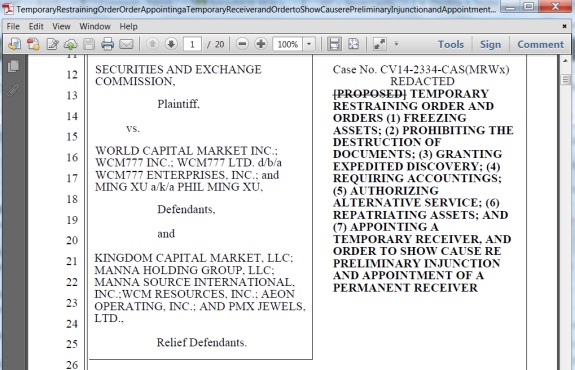
A federal judge has frozen at least 54 bank or financial accounts the SEC has linked to WCM777, an alleged $65 million Ponzi- and pyramid scheme with domestic and offshore conduits.
Accused operator Ming Xu had “authority” over at least 16 of the accounts, according to court filings. Who controlled the others was not immediately clear.
WCM777 was accused of targeting the Asian and Latino communities in a ribald HYIP scam that in part traded on the names of famous businesses, perhaps particularly companies in the hospitality industry. Many immigrants work in the hospitality trades.
The order has a provision that covers “all accounts at any bank, financial institution or brokerage firm, or third-payment payment processor, all certificates of deposit, and other funds or assets.”
Banks/vendors expressly covered by the order include Bank of America, Wells Fargo, Merrill Lynch, Comerica, HSBC, E*Trade, JPMorgan Chase, Citibank, East West Bank and American Continental.
It also became known today that Krista L. Freitag of E3 Realty Advisors of Los Angeles has been appointed receiver. The receiver already has taken control of at least two websites linked to WCM777, including WCM777.com.
U.S. District Judge Christina A. Snyder of the Central District of California has approved the asset freeze and the appointment of Freitag, a forensic accountant.
Snyder has authorized the SEC to conduct depositions “on two days’ notice” and cleared the agency to perform depositions even on Saturdays.
“Depositions may be taken Monday through Saturday,” according to the order.
And Snyder also authorized the SEC to bypass subpoenas and serve “a deposition notice by facsimile, hand or overnight courier” upon “agents, servants, promoters, employees, brokers, associates, and any person who transferred money to or received money from the bank accounts . . .”
Meanwhile, Snyder ordered Freitag “to conduct such investigation and discovery as may be necessary to locate and account for all of the assets of or managed by Defendants World Capital Market Inc., WCM777 Inc., WCM777 Ltd. d/b/a WCM777 Enterprises, Inc., and Relief Defendants Kingdom Capital Market, LLC; Manna Holding Group, LLC; Manna Source International, Inc.; WCM Resources, Inc., and their subsidiaries and affiliates, and to engage and employ attorneys, accountants and other persons to assist in such investigation and discovery.”
The judge also ordered the defendants and relief defendants not to destroy records and to repatriate assets.
URGENT >> BULLETIN >> MOVING: (16th update 5:42 p.m. EDT U.S.A.) The SEC has gone to federal court in Los Angeles, alleging that the WCM777 “program” is a “worldwide” pyramid scheme, a Ponzi scheme and an offering fraud that targeted Asian and Latino communities and gathered more than $65 million.
A federal judge has granted an asset freeze, the SEC said. The agency brought the case in an emergency complaint.
“[Phil Ming] Xu and his entities claimed they were using investor funds to build a strong cloud services company that would then ignite other high-tech companies and ultimately make their investors very wealthy,” said Michele Wein Layne, director of the SEC’s Los Angeles Regional Office. “In reality, they were operating a pyramid scheme that preyed on investors in particular ethnic communities, leaving them with nothing left to show for their investment.”
Some MLM promoters have pitched WCM777 alongside the TelexFree “program.” TelexFree is not referenced in the SEC complaint. But the complaint does reference a Massachusetts probe into WCM777 last fall. TelexFree has been under investigation by the Massachusetts Securities Division since at least February 2014.
Charged in the SEC’s WCM777 case are WCM777 Inc. of Nevada, World Capital Market Inc. of Delaware, WCM777 Ltd.( dba as WCM777 Enterprises Inc.) of Hong Kong and Ming Xu, also known as Phil Ming Xu, of Temple City, Calif.
Several firms are listed as relief defendants, amid allegations they received ill-gotten gains. These include Kingdom Capital Market LLC of Delaware, Manna Holding Group LLC of California, Manna Source International Inc. of California, WCM Resources Inc. of Texas, Aeon Operating Inc. of Texas and PMX Jewels Ltd. of Hong Kong.
Even as WCM777 was under investigation by state regulators in the United States, the SEC said, the “program” raised “more than $37 million from investors which has been deposited into [the defendants’] Hong Kong bank account.”
During the state-level probes in Massachusetts and elsewhere, “Defendants stopped depositing investor funds into their United States bank accounts, although the WCM777 offering continued,” the SEC alleged.
Xu, the SEC charged, is “involved in all aspects of the fraud.”
From the SEC complaint (italics/bolding/carriage returns added):
The bulk of the investor funds have been used to pay cash for real property purchased in the United States, purchased in many cases with funds transferred through Defendant World Capital Market Inc. (“WCM”), and held in the names of Relief Defendants Manna Holding Group LLC and Kingdom Capital Market LLC, which are affiliated with Defendant Xu.
The properties include two golf courses, a warehouse, vacant land, and several single family homes. Defendants have also used investor funds to play the stock market and to make investments, through intermediary companies, in an oil and gas offering of Relief Defendant Aeon Operating, Inc.
Defendants have also sent investor funds to Relief Defendant PMX Jewels, Limited, which is a rough diamond jewel merchant in Hong Kong, and to Relief Defendant Manna Source International, Inc., which is affiliated with Defendant Xu.
The golf courses were identified as Glen Ivy Golf Club in Corona, Calif., and the Links at Summerly in Lake Elsinore, Calif. To acquire Glen Ivy, WCM777 plunked down $6.5 million in cash, with the money coming from “WCM777 accounts that held investor proceeds,” the SEC charged.
Meanwhile, the Links at Summerly was acquired for $1.65 million in cash. Again, the SEC charged, the money to acquire the course “originated from WCM777 accounts that held investor proceeds.”
Along the pyramid and Ponzi path, the SEC charged, WCM777 bought a single-family home in Walnut, Calif., for “$2.4 million in cash,” a single-family home in Monrovia, Calif. for “$980,000 in cash,” a single-family home in Lake Elsinore, Calif., for “$500,000 in cash,” vacant land in New Cuyama, Calif., for “$700,000 in cash,” a warehouse in El Monte, Calif, for “$1,051,750 in cash” and used “$1,456,041.56” to close on the purchase of a single-family home in Monrovia, Calif.
This Monrovia sale never closed, the SEC said.
And “Ming Xu opened an account at a major brokerage firm in June 2013 in the name of WCM,” the SEC charged. “Between June 2013 and January 2014, Defendants deposited a total of $2.155 million into this brokerage account. The cash originated from WCM777 accounts that held investor proceeds.”
Moreover, the SEC charged, WCM777 disbursed $200,000 in investors proceeds to ToPacific Inc., $210,000 to Agape Technology and $230,000 to Media for Christ.
All of these entities, the SEC charged, were “associated or otherwise affiliated” with Xu.
Media for Christ — apparently before Xu’s alleged involvement — found itself at the center of an international firestorm in 2012 over a film production known as “Innocence of Muslims.” (See PP Blog report dated Nov. 21, 2013.)
Among the alarming allegations is that WCM777 falsely planted the seed that it had partnerships “with more than 700 major companies such as Siemens, Denny’s, and Goldman Sachs,” the SEC said.
WCM777 also asserted a false association with Stouffer Hotels and Resorts, a company that “has not been in business since 1996 when it sold its real estate portfolio to another company, and that was then purchased by Marriott in 1997,” the SEC said. “Marriott does not have any relationship with Defendants.”
As the PP Blog reported in October 2013, affiliates of WCM777 helped spread the claims about ties with famous businesses across the web.
Commingling
The WCM777 enterprises “opened and used numerous accounts located at three different banks in the United States, to move and commingle most of the investor proceeds before they were disbursed to third parties,” the SEC said.
It is common for HYIP scams to use banks and payment processors to warehouse proceeds from fraud schemes, a practice that brings national-security concerns into play.
HYIP schemes often also purport to offer interest-earning “packages” while using a “points” system and touting future public offerings, things allegedly in play at WCM777.
From the SEC complaint (italics added):
Through publicly available websites and promotional materials, Defendants offer packages or membership units in “WCM777.” Defendants portray WCM777 as a profitable multi-level marketing venture that sells packages of “cloud media” or cloud services. In the WCM777 offering, Defendants promise investors that they will earn 100% or more returns in 100 days. Defendants represent that the “points” investors receive for their investments will be convertible into equity in initial public offerings (“IPOs”) of “high tech” companies Defendants are purportedly incubating. Defendants have facilitated a “secondary market” in the points they award to investors, and Defendants estimate that $890 million of the points have traded on this market.
But in reality, the SEC said, the WCM777 enterprises “do not realize any appreciable revenue other than from the sale of ‘packages’ of cloud services to investors. WCM777 is not profitable, and is a pyramid scheme. Defendants use some of the investor funds to make Ponzi payments of returns to investors.”
The SEC, which says WCM777 was selling unregistered securities as investment contracts, is seeking the appointment of a receiver, a request the judge has approved.
Like other HYIP schemes, WCM777 preemptively denied it was a “Ponzi scheme.”
“Is WCM777 a Ponzi Game?” WCM777 wrote on its website, before answering its own question, the SEC said. “In summary, we are not a Ponzi game company. We are creating a new business model.”
In reality, the SEC said, “The cash paid to investors were Ponzi payments made with funds received from other investors, and were not paid from net income or profits of the WCM777 enterprise.”
At a 2013 business event in California, Xu was photographed alongside luminaries such as former U.S. Vice President Al Gore and Apple co-founder Steve Wozniak. It is somewhat common for Ponzi schemers to trade on the names and reputations of prominent individuals.
Zhi Liu, another WCM777 executive identified in state-level filings, is not directly referenced in the SEC complaint. There may be an oblique reference, however.
“On January 27, 2014, WCM777 Ltd. filed a lawsuit against a former employee in the Superior Court for the State of California, County of Los Angeles,” the SEC said.
Liu is known as “Tiger.”
A Twitter site under the name of “Dr. Phil Ming Xu” has a March 14 entry that claims, “Tiger created the system and took $30M worth of unauthorized ecash from WCM777. WCM777 sued him.”
As noted above, however, the SEC has alleged that Xu was involved in all aspects of the fraud. And also as noted above, the SEC further alleged that “more than $37 million from investors” had been deposited in a Hong Kong bank account.
Whether Liu had a role in the Hong Kong deposits is unclear. Also unclear is whether Liu remains in the United States or has relocated elsewhere.
In its emergency filing, the SEC said the WCM777 enterprise constituted an “ongoing” fraud.
From a Blog leading dubious cheers for the TelexFree MLM “program.”
UPDATED 12:07 P.M. EDT (U.S.A.) You can’t blame legitimate MLMers if they’re feeling a little jittery. Herbalife, one of the industry’s stalwarts, is under investigation by the FTC, which has many duties, including enforcing laws against false advertising and pyramid schemes. Precisely why the FTC is investigating Herbalife is unknown. Hedge-fund manager Bill Ackman says Herbalife is a pyramid scheme that plumbs and churns vulnerable population groups. (See Nov. 13, 2013, PP Blog editorial: “Herbalife And Polarization In The Latino Community.”)
A public company, Herbalife itself announced the probe on March 12, saying it had received a “Civil Investigative Demand” (CID) and will “cooperate fully” with the agency.
But even as Herbalife wore a confident face and shared the FTC news, others within the MLM realm were making the trade look ridiculous on a global scale. MLM already is known for train wrecks (see example) and spectacular PR gaffes (see example). The sorry circus taking place outside of Herbalife’s immediate sphere of influence (see below) couldn’t come at a worse time for the firm.
To Herbalife’s credit, there was no attempt to demonize the FTC or pretend the CID was unimportant. So, score an early point for the supplement-maker in the category of PR awareness.
The unfortunate reality for Herbalife, however, is that it is ensconced in an industry that serves up one outrageous scam after another. And because some quirky or downright bizarre MLM “programs” have shown an almost unbelievable ability to raise tremendous sums of money quickly, the issue is not simply about a PR deficit. It’s also about national and cross-border security.
That’s why Herbalife’s conduct while it is under investigation by the FTC matters to the entire trade.
Attempts by Stepfordian MLMers to paint law enforcement as the enemy and dismiss the importance of a CID sent by North Carolina Attorney General Roy Cooper to the Zeek Rewards MLM “program” in July 2012 made MLM look silly. Claims from Zeek’s Stepfordian wing that the receipt of a CID was “exciting” news made it look beyond clueless.
Whether the trade likes it or not, all of this Stepfordian behavior gets pinned on “MLM.” And MLM therefore looked particularly ridiculous when the SEC, a month after the North Carolina CID, described Zeek as a Ponzi- and pyramid scheme that had gathered hundreds of millions of dollars in less than two years and had ripped off hundreds of thousands of people by planting the seed it paid an interest rate of 1.5 percent a day and that earnings could be “compounded.”
So, if you’re a legitimate MLMer and need a comforting thought, here’s one for you: Unlike Zeek, Herbalife isn’t trying to sell the “exciting” angle to its legions of members during a government probe. And here’s a tip for legitimate MLMers and individuals considering signing up for an MLM: When someone tells you a government investigation is exciting news, get the hell off the list or stop reading the Blog. Recognize that you’re being splashed with sugary vomit and programmed by an MLM Stepfordian.
The PP Blog’s analysis of Zeek is that it was a criminal enterprise from the start that was designed in part to reel in participants dissatisfied with traditional MLM companies such as Herbalife that sell the dream but have low distributor success rates and high burn rates. Refugees from Herbalife and other traditional MLMs were perfect marks for Zeek’s MLM, a collection of predatory vultures unlike the MLM world had ever seen.
We’re bringing this up because MLM so often ventures into Stepfordland. So, odd as it sounds, Herbalife did itself (and the industry) a favor by avoiding the word “exciting” when describing a CID. For perfectly understandable reasons, it allowed only that it “welcomes the inquiry given the tremendous amount of misinformation in the marketplace” and that it is “confident that Herbalife is in compliance with all applicable laws and regulations.”
Even though Herbalife did not fumble the ball when announcing the probe, the company still needs to work on its messaging. Last year, when the firm was confronting Ackman’s pyramid allegations and companion assertions that it was plumbing and churning Latinos/Hispanics to sustain growth, Herbalife described former U.S. Surgeon General Richard Carmona — a new appointee to its board — as “[b]orn to a poor Hispanic family in New York City.”
In highlighting Carmona’s circumstances as a newborn delivered into poverty in the Big Apple more than 60 years ago, Herbalife perhaps was projecting some stress. Whether it also was projecting an accidental hint of a Stepfordland within Herbalife remains on open question.
Given the disturbing plumbing-and-churning assertions against the firm, Herbalife would have done better by simply announcing Carmona’s appointment and including only his academic/business/public-service credentials in the announcement. It doesn’t matter that other enterprises with which he is involved have used the same line about hailing from a “poor Hispanic family” to describe him. They’re not being accused of pillaging vulnerable populations.
In short, Herbalife cannot afford to be seen as a Stepfordland company. Nothing can erode marketplace confidence faster.
Poor or even insidious messaging has harmed MLM for years. It is an industry that, unfortunately, is known for serial disingenuousness, absurd misrepresentations, gross distortions, impossible constructions and outright lies.
How Other Industry Messages Could Hurt Herbalife
On March 11, a day before Herbalife announced the FTC probe, members of the TelexFree MLM were taking to the web and planting the seed that President Obama had TelexFree’s back. The assertions are either a gross misunderstanding of the JOBS Act and the concept of raising startup capital through crowdfunding or a typical MLM lie to provide extra cover for the scheme. (See Google Translation from Portuguese to English here. See original here.)
For starters, TelexFree, which appears to have gathered $1 billion or more in less than two years, wants the public to believe it is not selling securities, despite affiliate claims the “program” delivers “passive” income. Moreover, it is not raising capital under the JOBS Act, which is a work-in-progress. In October 2013, the SEC formally proposed that a “company would be able to raise a maximum aggregate amount of $1 million through crowdfunding offerings in a 12-month period.”
The sum of $1 million is less than the sum TelexFree pitchman and former SEC defendant Sann Rodrigues says he’s earned from TelexFree since Feb. 18, 2012.
Rodrigues started pitching TelexFree before the JOBS Act even became law and before the SEC even promulgated rules. So, strike the JOBS Act claim.
Beyond that, TelexFree is under investigation by the Securities Division in its home state of Massachusetts. There’s also at least one probe in Africa, specifically in Rwanda, where a genocide occurred in the 1990s. Meanwhile, in South America, Brazilian prosecutors have called TelexFree a pyramid scheme. Police in Europe have issued warnings about TelexFree, amid concerns that the “opportunity” is targeting the Madeiran community.
At a minimum, TelexFree is at least as clueless as Zeek, home of the “exciting” CID. As noted above, TelexFree pitchman Sann Rodrigues is a former defendant in an SEC pyramid-scheme and affinity-fraud case. If that weren’t enough, TelexFree executives and reps apparently have access to a “private jet” that recently made a flight between the Dominican Republic and Haiti.
If there’s a surefire way to destroy the public’s confidence in the emerging JOBS Act, it’s for a bunch of MLMers to go around planting the seed that the President of the United States has authorized TelexFree as a crowdfunding company — and to water that seed by talking about “private jets” that can be flown by the TelexFree MLM into Haiti to line up struggling Haitians to sell credit repair and financial advice to struggling Americans.
Yes, we know: It’s altogether too much to believe. But the bitter reality for MLM — and therefore for Herbalife — is that it’s actually happening.
TelexFree says it’s in the communications business, and is expanding from VOIP into cell phones and, highly curiously, credit repair and financial advice. This is an MLM quagmire if ever there was one, especially since American MLMers say sums from $289 to $15,125 sent to TelexFree virtually triple or quadruple in a year.
If MLMers ever wonder why the trade has so many critics, they need look no further than TelexFree or Zeek before it.
With Zeek smoldering in the ashes of Ponzi/pyramid history and TelexFree serving up a current symphony of the bizarre, the MLM trade now also is confronting yet-another epic PR disaster — namely, a “program” known as WCM777 that, like TelexFree, is under investigation in multiple countries.
Like TelexFree and Zeek, WCM777 also promoted preposterous returns.
But that might be just the beginning of WCM777’s problems. Among other things, WCM777 has claimed it is “Launching The Way TV to transform nations & Joseph Global institute to train a group of Josephs to bless the world.”
But the “Joseph Global Institute” and a companion enterprise that trades on the name of Harvard appear to be shams. And The Way TV launched long ago through an entity known as Media for Christ, which became the center of an international firestorm over a production known as “Innocence of Muslims.”
Particularly disconcerting now are reports that tens of millions of dollars may have gone missing from the WCM777 coffers. In 2013, the SEC alleged that a “program” known as Profitable Sunrise may have gathered tens of millions of dollars before disappearing.
Don’t kid yourself: There is no doubt that the circumstances surrounding some MLM “programs” are affecting economic security and contributing to concerns about national security.
MLM Minefields
As noted above, precisely why the FTC is investigating Herbalife is unclear. The Zeek case initiated by the SEC, however, could supply a clue or even a specific reason for the U.S. government to be concerned about Herbalife. A look at the list of alleged “winners” by the court-appointed receiver in the Zeek case suggests that Zeek became popular in immigrant communities, which may signal MLM affinity fraud on top of Ponzi and pyramid fraud.
It also may signal immigrant-on-immigrant crime under the MLM umbrella.
This information is preliminary, meaning a more thorough analysis is needed. But it at least suggests that some MLMers are proceeding from fraud scheme to fraud scheme and either laying waste to immigrant communities in the United States or setting the stage for immigrant populations to become immersed in litigation and MLM scams.
The surname name of “Johnson,” for instance, is one of longstanding in America. So, it can be expected that a major fraud scheme with 1 million or so members such as Zeek would pull in a number of people with that last name. There are about 45 people with that name on the Zeek list.
At the same time, there are about 60 people on the list with the Asian name of “Li.” So, “Li” has significantly more appearances than “Johnson.”
And what about “Smith,” another traditional American name? Well, there are about 52 “Smiths” on the list. Contrast that with the names “Nguyen” (about 146) and “Chen” (about 137).
There also are many Latino/Hispanic names on the Zeek list. Mind you, this is the list of alleged Zeek winners, not losers. The list of losers — perhaps as many as 800,000 — is not publicly available. (Because it is believed that many Zeek members had multiple user IDs, the number of user IDs may exceed the actual number of losers. But even if the 800,000 figure only incorporates user IDs, it remains troubling. The early data on the winners’ names suggest that immigrants could have been targeted as marks by other immigrants and also by long-established American MLMers.)
Latino groups have voiced concerns about Herbalife targeting vulnerable populations. With Zeek data suggesting such targeting occurred within Zeek, the MLM trade have may to confront some tough questions: Is a mature American MLM market being shored up by a disproportionate share of recent or relatively recent immigrants? And are American MLM companies prospecting in new lands creating losing propositions for the native inhabitants of those lands?
TelexFree certainly has targeted Portuguese and Spanish speaking populations — in the United States, Brazil and elsewhere. So has WCM777, which also has targeted Asians and Asian-Americans.
People are free to criticize Bill Ackman’s assertions that Herbalife is a pyramid scheme that is targeting vulnerable populations. But if MLMers who criticize Ackman expect to be taken seriously, they’d better be able to explain what appears to have happened at Zeek and what appears to be occurring now with both TelexFree and WCM777.
U.S. MLMers of any stripe — from longstanding citizens and naturalized ones to individuals hoping one day to proudly call themselves Americans — need to say no loudly to “programs” such as Zeek, TelexFree and WCM777.
And at a minimum, Herbalife needs to stop selling a message of “get rich quick” or turning a blind eye to it and stop trying to explain away its burn rate as the byproduct of affiliates who didn’t work hard enough to realize the dream.
Herbalife cannot be blamed for Zeek, but the burn rate may explain how Zeek and similar schemes rise to cherry-pick traditional MLMers and their recruits who have made little or no money with companies such as Herbalife.
No matter what the FTC has on its mind, any assertion by Herbalife that its current program is exemplary will be the strongest evidence of all that it, too, resides in MLM La-La Land. That would be a tragedy, given that Herbalife is viewed in the MLM community as a beacon of freedom.
UPDATED 7:03 P.M. ET (U.S.A.) At a TelexFree pitchfest in a Massachusetts hotel this morning, a man promoting a credit-repair “program” linked to TelexFree claimed that TelexFree reps recently took a “private jet” from the Dominican Republic to Haiti.
“I felt like a rockstar,” the man said from the stage.
Once on the ground in Haiti, the man said, “we got in the Prime Minister of Haiti’s motorcade.”
This triggered “high-fiving,” the man said from the stage.
Things settled down when the TelexFree passengers observed throngs of poor people lining the road from the airport into the city, the man suggested.
Whether TelexFree executives were on the private jet and later purportedly traveled in a government motorcade is unclear. TelexFree executive Steve Labriola said last week that he and TelexFree “leaders” recently ventured to Haiti.
It also was not immediately clear whether the asserted TelexFree “high-fiving” and claims of a state motorcade providing shuttle service to TelexFree would prove embarrassing to Haiti’s government. Nor was it clear that the TelexFree reps were guests of the government. The Washington Embassy of the Republic of Haiti did not immediately respond to a request for comment from the PP Blog.
Laurent Lamothe is Haiti’s Prime Minister. He is a former telecom executive.
Similar seeds about government ties from promoters of other MLM schemes have proved embarrassing to other governments, including the government of the United States. In the 2008 AdSurfDaily MLM/HYIP Ponzi scheme, for example, some members of the scheme planted the false seed that ASD had been endorsed by George W. Bush, then the President of the United States.
The false seeds about Bush were one of the things that prompted the U.S. Secret Service to open the ASD probe. Agents went on to discover a massive Ponzi scheme hidden inside ASD. ASD used “ad packs” from which purported “rebates” flowed to disguise its $119 million investment-fraud scheme.
TelexFree offers something called “AdCentrals.” Some promoters have claimed that sums of money from $289 to $15,125 sent to TelexFree triple or quadruple in a year. The $850 million Zeek Rewards Ponzi scheme had a similar component. Like TelexFree members, Zeek members were told they got paid for posting ads about the company online.
“ZeekRewards told Affiliates that in order to supposedly ‘earn’ their points, they were required to place a short, free digital ad each day on one of the many free classified websites available on the internet,” the court-appointed receiver in the Zeek Ponzi- and pyramid-scheme case asserted in a lawsuit last month against alleged insiders.
“In reality,” Zeek receiver Kenneth D. Bell asserted, “the ads were just an attempt to manufacture a cover for what was nothing more than the investment of money by Affiliates with the expectation of receiving daily ‘profit’ distributions.”
One of Bell’s lawsuit targets is Scott Miller of Greenwood, Ind. Miller, an alleged winnner in Zeek’s massive Ponzi scheme, has spoken at at least one TelexFree event and may be one of TelexFree’s key pitchmen.
TelexFree Affiliates Claim Government Approval
It is somewhat common in the HYIP sphere for promoters to suggest a “program” has the backing of a politician, a government or a government agency.
At least one TelexFree-related Blog claimed in a post dated March 7 that the “program” has gained “SEC Approval from USA.”
The U.S. Securities and Exchange Commission (SEC) does not issue such approvals. In 2013, some TelexFree members worded promos to suggest that the U.S. government itself had authorized TelexFree to operate in the United States. During roughly the same time period in the spring of 2013, affiliates made this assertion (italics added):
Steve Labriola, Director of Marketing for Telex FREE, Boston, announced via email earlier today that they are ‘pulling out of Bank of America.’
Earlier, in roughly January of 2013, TelexFree affiliates were urging recruits to make walk-in deposits at a Bank of America branch in Massachusetts. The instructions strongly resembled instructions AdSurfDaily gave its recruits in 2008. TelexFree also used TD Bank, according to affiliates.
It is possible — though not confirmed — that U.S. investigators began looking into TelexFree around the same period in early 2013 in which affiliates were soliciting deposits through Bank of America and TD — while simultaneously claiming that certain TelexFree members could speed the flow of deposits if recruits emailed copies of their deposit slips to a Gmail address.
TelexFree says on its website that tickets to “new comp plan training & overview” event at the Massachusetts hotel today cost $164 and were “Sold Out.”
A website styled MutualWealth.com is fraudulent and is part of an international pyramid scheme, the SEC says.
BULLETIN: (7th Update 8:51 p.m. ET U.S.A.) Entities known as Fleet Mutual Wealth Limited, MWF Financial Limited and Mutual Wealth are frauds that filed invalid forms with the SEC to dupe the masses, the SEC said.
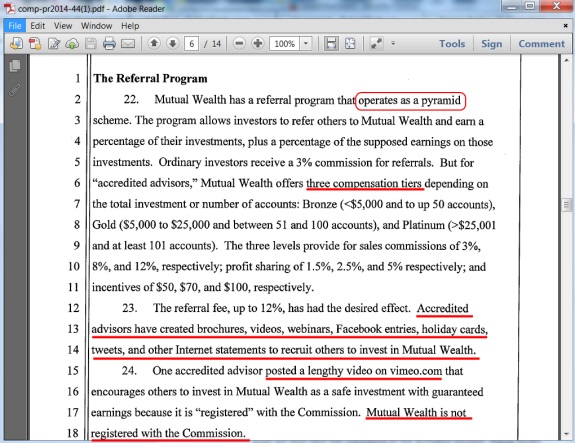
An associated web domain styled MutualWealth.com also is a fraud, the SEC said in a statement and emergency court filing that alleges a pyramid scheme in which promoters become referral agents or purported “accredited advisors” to earn recruitment commissions.
“Mutual Wealth used Facebook and Twitter as well as a team of recruiters to spread a steady stream of lies that tricked investors out of their money,” said Gerald W. Hodgkins, an associate director in the SEC’s Division of Enforcement.
Some recent scams have purported to operate out of Hong Kong, something that appears also to be the case with Mutual Wealth.
“[A]lmost nothing that Mutual Wealth represents to investors is true,” the SEC said. “The company does not purchase or sell securities on behalf of investors, and instead merely diverts investor money to offshore bank accounts held by shell companies. Mutual Wealth’s purported headquarters in Hong Kong does not exist, nor does its purported ‘data-centre’ in New York. Mutual Wealth also lists make-believe ‘executives’ on its website, and falsely claims in e-mails to investors that it is ‘registered’ or ‘duly registered’ with the SEC.
And, the SEC said, Mutual Wealth may operate through entities in Panama and the United Kingdom “and through Russian or Belarussian nationals.”
From the SEC complaint (italics added):
Investors who complete an account application are instructed to transfer money to Mutual Wealth either by wire transfer to banks located in Latvia and Cyprus or through third-party payment processors such as SolidTrust Pay, EgoPay, or Perfect Money.
Like other fraud schemes, Mutual Wealth has a presence on the MoneyMakerGroup and TalkGold Ponzi forums.
U.S. District Judge Dolly M. Gee of the Central District of California has ordered an asset freeze on all accounts “at any bank, financial institution, brokerage firm, or third-payment payment processor (including those commercially known as SolidTrust Pay, EgoPay, and Perfect Money) maintained for the benefit of Mutual Wealth,” the SEC said.
Assisting in the probe are the FBI, the Financial and Capital Market Commission of Latvia, the Ontario Securities Commission and the Cyprus Securities and Exchange Commission, the SEC said.
According to the SEC’s complaint, Mutual Wealth operates through entities in Panama and the United Kingdom and uses offshore bank accounts in Cyprus and Latvia and offshore “payment processors” to divert money from investors. Mutual Wealth’s sole director and shareholder presented forged and stolen passports and a bogus address to foreign government authorities and payment processors.
As in previous scams, the Mutual Wealth fraud spread on social media, the SEC said.
“Mutual Wealth maintains Facebook and Twitter accounts that link to its website and serve as platforms through which it lures new investors,” the SEC said. “Some of Mutual Wealth’s ‘accredited advisors’ then use social media channels ranging from Facebook and Twitter to YouTube and Skype to recruit additional investors and earn referral fees and commissions.
“Mutual Wealth’s Facebook page spreads such misrepresentations as ‘HFT portfolios with ROI of up to 250% per annum. Income yield up to 8% per week,’” the SEC said. “A Facebook post on Aug. 12, 2013, boasted ‘$1000 investment into the Growth and Income Portfolio made on April 8th, 2013 is now worth $2,112.77.’ Mutual Wealth regularly posts status updates for investors on its Facebook page, and the comment sections beneath the posts are often filled with solicitations by the accredited advisors. Mutual Wealth also tweets announcements posted on its Facebook page.”
Scammers recently have been purporting they are conducting IPOs or pre-IPOs or are registered with the SEC.
“Mutual Wealth has filed three Securities Act Forms D with the Commission,” the SEC said. “Each Form D purports to give notice of offerings of securities that are exempt from registration with the Commission under Regulation D of the Securities Act.
“But Mutual Wealth’s offers and sales of securities do not qualify for the exemptions cited in the Forms D or any exemption under from registration under Regulation D of the Securities Act. Consequently, the Forms D are invalid and of no legal effect,” the SEC said.
About 150 U.S. investors opened Mutual Wealth accounts, plowing “at least” $300,000 into the scheme, the SEC said.
URGENT >> BULLETIN >> MOVING: (8th Update 2:40 p.m. ET March 4, U.S.A.) The court-appointed receiver in the Zeek Rewards Ponzi- and pyramid-scheme case has sued alleged insiders and net winners, including members of the 2008 AdSurfDaily Ponzi scheme.
Parts of the complaint read like a re-living of the ASD scheme, with Zeek Receiver Kenneth D. Bell alleging Zeek’s penny-auction arm (Zeekler) was in trouble early on and that Zeek operator Paul Burks borrowed money from another insider to keep things going. The fraud later expanded massively, Bell alleged.
At one point, according to Bell, former Zeek COO Dawn Wright-Olivares “excitedly” told Burks, “I think we can blow this OUT together — we’ve already attracted a great many big fishes.”
But the insiders “were aware that the payouts to Affiliates would be funded by new participants rather than retail profits from the penny auctions,” Bell alleged.
Named defendant “insiders” were Burks of Lexington, N.C.; Wright-Olivares of Clarksville, Ark.; Daniel Olivares of Clarksville, Ark.; the estate of the late Roger Anthony Plyler of Charlotte; Alexandre “Alex” de Brantes, the husband of Wright-Olivares and a resident of Clarksville, Ark.; and Darryle Douglas of Orange, Calif.
Burks, the receiver alleged, received “in excess” of $10 million from Zeek; Wright-Olivares received more than $7.8 million; Daniel Olivares received more than $3.1 million; Plyler, who once lent money to Burks, received more than $2.3 million; Douglas received more than $1.975 million. An amount was not listed for de Brantes.
Named winners were former AdSurfDaily member Todd Disner of Miami (more than $1.875 million); former ASD member Jerry Napier of Owosso, Mich. (more than $1.745 million); Trudy Gilmond of St. Albans, Vt. (more than $1.75 million); Durant Brockett of Las Vegas (more than $1.72 million); Darren Miller of Coeur d’Alene, Idaho (more than $1.635 million); Rhonda Gates of Nashville (more than $1.425 million); Michael Van Leeuwen, also known as “Coach Van” of Fayetteville, N.C. (more than $1.4 million); David Sorrells of Scottsdale, Az. (more than $1 million); T. Le Mont Silver Sr. of Orlando, Fla. (more than $773,000 under at least two user names, and more than $943,000 through a Florida shell entity known as Global Internet Formula Inc. with one or more Zeek user names).
One of Silver’s usernames was “mentor,” Bell alleged.
Also named winners were Karen Silver, Silver’s wife (more than $600,000); veteran HYIP pitch team Aaron and Shara Andrews of Lake Worth, Fla. (more than $1 million through a Florida shell entity known as Innovation Marketing); David and Mary Kettner of Peoria, Az. (more than $930,000 via one or more user names and shell companies known as Desert Oasis International Marketing LLC and Kettner & Associates LLC); Lori Jean Weber of Land O’Lakes, Fla. (more than $1.94 million through a shell company known as P.A.W.S. Capital Management LLC).
Bell also sued a “Net Winner Class” of as many as 9,000 U.S. residents or entities who allegedly harvested illicit gains of $1,000 or more from Zeek. Lawsuits against international winners will come later, Bell said.
In December 2013, Wright-Olivares and Olivares were charged criminally. They pleaded guilty last month for their roles in the scheme and are liable for more than $11.4 million in restitution and penalties, the SEC said.
As the SEC previously alleged, Zeek relied on a so-called “80/20” program to sustain the Ponzi deception. Bell today built on that theme. From the complaint against insiders (italics added/spacing modified):
Dawn Wright-Olivares explained and promoted the plan in a Skype chat as follows:
Here’s a scenario here where you could be receiving $3,000 per month RESIDUALLY. Let’s use a 1% daily cash-back figure in this example (Please note: This is only an example and the actual amount will vary day to day).
When you reach 50,000 points in your account, then you could start doing an 80/20 cash-out plan. Pay close attention? When you hit 50,000 points in your account, if the daily cash-back percentage is 1%, ZeekRewards will be awarding you with $500.00 each day. First of all, did you catch that? … you’re making $500 per day … it’s your money! Ok, the 80/20 plan works like this, take 80% of that $500 (or $400) and purchase more VIP bids to give away to new customers as samples to continue growing your points balance.
Then, keep doing what you’ve been doing every day, which primarily consists of giving free bids away as samples and placing one free ad per day for Zeekler.com’s penny auctions and submitting into your ZeekRewards back office. Then, pull out 20% of the $500 (or $100) and request a check weekly. That’s $700 per week, or about $3,000 per month in residual income! And keep in mind, these amounts can continue to grow day after day and month after month.
HYIP schemes, including ASD and Zeek, often implement deceptions such as 80/20 programs as part of a bid to reduce cashout amounts to let the scheme continue to live. Insiders and veteran Ponzi pushers typically know they’re a crock.
Daniel Olivares, Bell said, has a Zeek user name of “dcolive.”
On June 14, 2012, about two months prior to the collapse of Zeek, RealScam.com moderator and PP Blog poster “Glim Dropper” posted a link on the PP Blog that established a tie between Zeek promoters and ASD promoters. ASD was a $119 million Ponzi scheme operated by now-jailed operator Andy Bowdoin.
RealScam.com is an antiscam forum.
The link “Glim Dropper” posted was at a URL styled “dcolive.com.”
From “Glim Dropper’s” observations at the time (italics added):
I’d draw your attention to about five minutes into the call when Dawn recalls a conversation with Jerry Napier. Jerry was quoted as loving ZR and never wanting to have to build another organization with another program and mentioned a previous program and the litigation it was still facing and he mentioned “similarities” between ZR and that previous program.
It is common in the HYIP sphere for promoters to move from one fraud scheme to another.
Napier’s exposure to ASD is unknown. But the Zeek receiver now says Napier received illicit gains of more than $1.745 million. The alleged illicit Zeek gains of former fellow ASD member Todd Disner are even higher: $1.875 million.
Precisely how many ASD members went on to join Zeek is unclear. What is clear is that both firms used similar business models and sweetened the deal for certain members.
Bell alleged today that Zeek had a “Sweet 16” deal in which participants paid $999 to mine even more “passive” gains.
“The Sweet 16 was another means by which [Rex Venture Group] made payments on a passive investment,” Bell alleged. “It did not involve the sale of a product, nor did it require a member to recruit other participants into the program.”
Disner once filed suit against the United States, alleging its ASD Ponzi case was a “tissue of lies” and a “house of cards.” A federal judge tossed the lawsuit, after Bowdoin pleaded guilty to wire fraud and admitted ASD was a Ponzi scheme.
 On the same day the SEC announced a civil and criminal prosecution of alleged Florida-based scammers using YouTube to fleece the masses in a Ponzi scheme, it announced it had charged a Honolulu woman who allegedly engineered two fraud schemes through promotions on her own website and Twitter, Facebook and Skype.