Touted on the MoneyMakerGroup Ponzi forum by former Zeek Rewards pitchman “mmgcjm,” a bizarre “program” known as CashCropCycler appears to have tanked. Joining CashCropCycler in the recent HYIP DOA lineup was NEOMutual, a purported “crowdfunding” opportunity that claimed it used bitcoin and a series of offshore payment processors to provide daily interest rates of 1.4 percent, 1.6 percent and 1.9 on sums between $20 and $250,000.
The websites of both NEOMutual and CashCropCycler are throwing error messages. Precisely when the sites went offline is unclear. In August 2012, the SEC described Zeek as a $600 million Ponzi and pyramid scheme.
Among other things, CashCropCycler was notable for its provocative name, which led to questions about whether the “program” was designed as a taunt and perhaps was using the HYIP world to crowd-source the cultivation of marijuana. The “program” also claimed enrollees received $10 just for signing up, a practice once used by the JSSTripler/JustBeenPaid scam.
An ad for NEOMutual once appeared on the landing page of the CashCropCycler website. NEO Mutual said it was located at Revolution Tower in Panama City, Panama. Like the “Profitable Sunrise” HYIP scheme, NEO Mutual purported to be in the bridge-loan business. In April 2013, the SEC called Profitable Sunrise a scam that may have gathered millions of dollars while using a “mail drop” in England and offshore bank accounts.
In July, the SEC issued an investor alert that warned about the dangers of potential investment scams involving virtual currencies promoted through the Internet.
“We are concerned that the rising use of virtual currencies in the global marketplace may entice fraudsters to lure investors into Ponzi and other schemes in which these currencies are used to facilitate fraudulent, or simply fabricated, investments or transactions. The fraud may also involve an unregistered offering or trading platform. These schemes often promise high returns for getting in on the ground floor of a growing Internet phenomenon,” the SEC said in the warning.
Among the strange claims on the CashCropCycler website was that the “program” was interested in building “a network that ticks.”
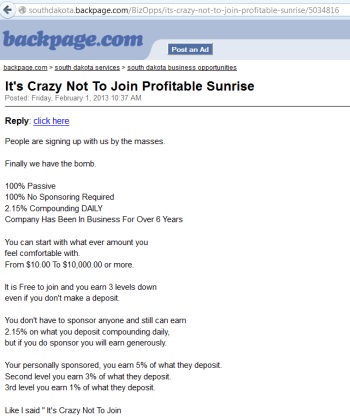
A February 2013 ad for Profitable Sunrise that appeared on a classified-ads site in Montana South Dakota (Sept. 5, 2013 edit) claimed that “Finally we have the bomb.” In an April 2013 Investor Alert on Profitable Sunrise, the state of Idaho warned that “Those investors who receive compensation for soliciting other investors may themselves be subject to the licensing and anti-fraud provisions of state and federal securities laws.”
In court filings on April 4, the SEC said Profitable Sunrise pitchmen may have pushed the “program” without even knowing for whom they were working.
In the latest affinity-fraud scheme detected in Utah, an Orem man conducted a $4 million offering fraud and Ponzi scheme aimed at church associates, family members and friends, including senior citizens and the “recent widow of a church associate” whom he volunteered to help with finances after she lost her husband, the SEC said.
Some of the money scammed by Steven B. Heinz was used “to pay his adult children to fund various business opportunities they are involved in, including multilevel marketing and web-based advertising business opportunities,” the agency said.
The SEC did not identify the “programs” in a complaint filed yesterday that led to an emergency asset freeze.
Heinz is 56. He is associated with a “financial planning and insurance” entity known as S.B. Heinz & Associates Inc. of Provo, the SEC said.
“Heinz promised some investors that they would earn tax-free income if they provided a ‘loan’ to Heinz to invest for them,” the SEC said.
And Heinz “has issued investment contracts to investors which guarantee returns ranging from 6% to 120% per year,” the SEC alleged.
Separately, the Deseret News is reporting allegations that he “paid returns in cash, often asking his clients to meet him in grocery store parking lots for the handoff.”
From a statement yesterday by the SEC (italics added):
The complaint alleges that since January 1, 2012, Heinz acted as an investment adviser and solicited nearly $4 million from more than fifteen former clients, family members, and friends to enable him, through his company S.B. Heinz, to execute rapid buy and sell orders of futures contracts. The complaint further alleges that investor funds are being used to falsely create the appearance of a successful investment business although S.B. Heinz has actually lost approximately $1.5 million executing Heinz’s high risk futures contract trading activities. In addition, the complaint alleges that Heinz pays “returns” to earlier investors using new investor funds, used investor funds for his own personal purposes and that S.B. Heinz used investor funds to pay business expenses, including the salary for its secretary and its office rent.
Named a relief defendant in the case as the alleged recipient of ill-gotten gains was Susan K. Heinz, Heinz’s wife. The SEC said Heinz “reportedly makes large monthly cash payments to his wife” and alleged that he’d drained $1 million to fund “personal expenses such as paying for family members to accompany him to Mexico on vacation.”
In addition to duping the widow, the SEC said, Heinz also duped an elderly couple.
Heinz, the SEC alleged, “convinced the elderly couple to liquidate their investments and invest those funds with him personally. Heinz did not disclose to the couple that they would incur $45,000 in penalties as a result of early liquidation of their investments.”
URGENT >> BULLETIN >> MOVING: Gregory N. McKnight, the operator of the $72 million Legisi HYIP Ponzi scheme popularized in part on the TalkGold and MoneyMakerGroup forums, has been sentenced to 188 months in federal prison for wire fraud and ordered to pay more than $48.9 million in restitution.
McKnight also was ordered to serve three years’ probation following his prison release. Legisi collapsed in 2008.
Legisi pitchman Matthew John Gagnon was sentenced last month to serve five years in federal prison and to pay $4.4 million in restitution.
The criminal cases against Gagnon and McKnight were prosecuted by the office of U.S. Attorney Barbara L. McQuade of the Eastern District of Michigan. The civil cases were prosecuted by the SEC.
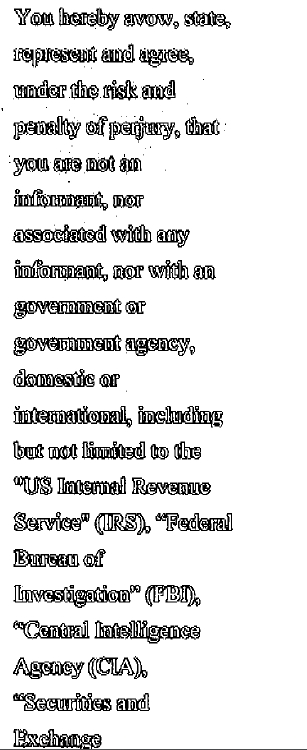
Legisi bizarrely made members affirm they were not associated with the SEC, the IRS, the FBI and the CIA — along with “Her Majesty’s Police,” the Intelligence Services of Great Britain and the Serious Fraud Office.
Among Legisi’s payment processors was e-Bullion. The Legisi receiver is pursuing claims tied up after the 2008 arrest of James Fayed, the operator of e-Bullion.
Fayed was convicted in 2011 of ordering the murder of his wife, a potential witness against him. Pamela Fayed was slashed to death in a Greater Los Angeles parking garage in July 2008. The SEC brought the Legisi fraud prosecution in May 2008, just two months before Pamela was killed.
E-bullion has been linked to several Ponzi schemes. In court filings on June 6, receiver Robert D. Gordon said more than 85 percent of the $72.6 million directed at Legisi had flowed through the defunct processor.
The Legisi investigations were led by the SEC, the U.S. Secret Service and state regulators in Michigan.
EDITOR’S NOTE: The PP Blog called the Federal Trade Commission to get its take on these news releases, which use the agency’s name and imply that the FTC recently has given several MLM “opportunities” a clean bill of health. The agency did not immediately respond.
What would you think if you read a headline on Google News yesterday such as this: “Herbalife Pyramid Scheme Rumors Untrue: FTC Speaks out on Pyramid Definition.”
Would you think, perhaps, that the FTC recently had conducted an investigation into Herbalife’s business practices and “spoke out” yesterday in defense of the firm after determining that it had been subjected unfairly to “rumors” that it was orchestrating a pyramid scheme — and that any questions about the the legality of Herbalife had been laid to rest by the government?
And what would you think if you read headlines such as these:
Each of the headlines listed above has appeared online in recent days — some of them carried by Google News, which published the feeds of SBWire, a news-release service. The release that uses both the FTC’s name and Herbalife, for example, carries an Aug. 5 dateline from Altamonte Springs, FL. The release that references the FTC and Javita carries an Aug. 2 dateline from Orlando, FL.
The release on Javita uses this deck: “Javita Pyramid Scheme question answered. FTC decides on Pyramid meaning.” Meanwhile, the release on Herbalife carries this deck: “Herbalife Pyramid Scheme Accusations Are Without Merit. Consumers Can Now Intelligently Determine Themselves Herbalife Pyramid Allegations Are Not True Based On FTC Pyramid Definition.”
The release that references Herbalife goes on to assert that Herbalife is “not a pyramid scheme at all by the FTC’s definition.”
Each of the news releases referenced above appears to be a bid to sell an MLM “leads” program by planting the seed that the FTC recently has given the green light to each of the companies. The basis of the claims curiously appears to be a 15-year-old speech (May 13, 1998) an FTC official gave on the subject of pyramid schemes that in part defined pyramid schemes as schemes that “promise consumers or investors large profits based primarily on recruiting others to join their program, not based on profits from any real investment or real sale of goods to the public.”
That the speech was given in 1998 and may have less relevance 15 years later was not made clear in any of the news releases. Beyond that, the thinking of agencies such as the FTC and SEC may evolve as the schemes themselves evolve.
In the 1998 speech, the FTC official went to to say (italics added):
“Some schemes may purport to sell a product, but they often simply use the product to hide their pyramid structure. There are two tell-tale signs that a product is simply being used to disguise a pyramid scheme: inventory loading and a lack of retail sales. Inventory loading occurs when a company’s incentive program forces recruits to buy more products than they could ever sell, often at inflated prices. If this occurs throughout the company’s distribution system, the people at the top of the pyramid reap substantial profits, even though little or no product moves to market. The people at the bottom make excessive payments for inventory that simply accumulates in their basements. A lack of retail sales is also a red flag that a pyramid exists. Many pyramid schemes will claim that their product is selling like hot cakes. However, on closer examination, the sales occur only between people inside the pyramid structure or to new recruits joining the structure, not to consumers out in the general public.”
We’ll leave it to you to decide if it is wise for MLmers to try to shoehorn a 15-year-old speech into news releases in 2013 that imply the FTC recently has scrubbed each of the “opportunities” referenced above and made a legal conclusion that no pyramid schemes exist.
The court-appointed receiver in the Zeek Rewards Ponzi-scheme case is reporting “significant progress” in securing assets for return to victims and says the estate has gathered approximately $325.1 million since the receivership began in August 2012.
As of 5 p.m. on July 29, Zeek victims had filed claims seeking about $287 million. The claims portal accessible though the receivership website will close Sept. 5, meaning the number could grow even higher — potentially by the tens of millions.
An estimated $290 million in fraudulent transfers occurred at Zeek, and receiver Kenneth D. Bell says he intends to file clawback litigation against both Zeek’s U.S. domestic and “foreign winners,” beginning as early as this quarter.
Bell advised the court that, on June 28, he deposited about $2.5 million seized by the U.S. Secret Service from Solid Trust Pay, one of Zeek’s ewallet providers. Another $3.6 million from NxPay is expected to be deposited soon — “and the Receiver is working with [the Secret Service] to investigate and secure additional Receivership assets that NxPay identified and are being held by its payment processor, LST Financial, Inc.”
Moreover, Bell said, the receivership — working with the Secret Service — recovered about $5 million from ePaymentAmerica and about $800,000 from PlasticCash.
Meanwhile, a “foreign account” that may contain $9.5 million still is under investigation by the receivership, and two other foreign accounts that may hold Zeek assets were discovered in the second quarter, Bell said. Those accounts also are under investigation.
Zeek operated as part of Rex Venture Group LLC of North Carolina. Court filings suggest that Zeek money flowed through at least 16 domestic and foreign accounts, not including the accounts of individual participants. Those accounts may number in the thousands.
Bell said he also may have claims against certain Zeek “third party-advisors, vendors and other service providers that knew or should have known” about Zeek’s inappropriate activities “and yet faciliated those activities for their own gain.”
Senior U.S. District Judge Graham C. Mullen of the Western District of North Carolina is presiding over the Zeek case, which was brought by the SEC last year.
BULLETIN: The SEC has gone to federal court in the Eastern District of Texas, charging Trendon T. Shavers of McKinney in an alleged Bitcoin Ponzi scheme that gathered more than $4.5 million before collapsing in August 2012.
Bitcoins are a digital currency that has “no single administrator, or central authority or repository,” the SEC said.
Investors with at least 50 bitcoins were told that they’d receive “up to 1% interest daily,” the SEC charged, alleging that Shavers used the moniker “pirateat40” at an online forum to pitch the scheme.
The “program” operated through an unincorporated entity known as BTCST, formerly known as First Pirate Savings & Trust, the SEC said.
“Ponzi scheme operators often claim to have a tie to a new and emerging technology as a lure to potential victims,” said Lori J. Schock, director of the SEC’s Office of Investor Education and Advocacy. “Investors should understand that regardless of the type of investment, a promise of high returns with little or no risk is a classic warning sign of fraud.”
Shavers is 30, the SEC said. The agency did not reveal when its investigation began or how it determined the online identities of Shavers.
The SEC alleges that Shavers promised investors up to 7 percent weekly interest based on BTCST’s Bitcoin market arbitrage activity, which supposedly included selling to individuals who wished to buy Bitcoin “off the radar” in quick fashion or large quantities. In reality, BTCST was a sham and a Ponzi scheme in which Shavers used Bitcoin from new investors to make purported interest payments and cover investor withdrawals on outstanding BTCST investments. Shavers also diverted investors’ Bitcoin for day trading in his account on a Bitcoin currency exchange, and exchanged investors’ Bitcoin for U.S. dollars to pay his personal expenses.
Virtual currencies, such as Bitcoin, have recently become popular and are intended to serve as a type of money. They may be traded on online exchanges for conventional currencies, including the U.S. dollar, or used to purchase goods or services, usually online.
We are concerned that the rising use of virtual currencies in the global marketplace may entice fraudsters to lure investors into Ponzi and other schemes in which these currencies are used to facilitate fraudulent, or simply fabricated, investments or transactions. The fraud may also involve an unregistered offering or trading platform.
These schemes often promise high returns for getting in on the ground floor of a growing Internet phenomenon. Fraudsters may also be attracted to using virtual currencies to perpetrate their frauds because transactions in virtual currencies supposedly have greater privacy benefits and less regulatory oversight than transactions in conventional currencies. Any investment in securities in the United States remains subject to the jurisdiction of the SEC regardless of whether the investment is made in U.S. dollars or a virtual currency. In particular, individuals selling investments are typically subject to federal or state licensing requirements.
Prior to the collapse of the scheme, Shavers denied to forum questioners he was operating a Ponzi. Along the way, however, he slashed the purported payout from 7 percent a week to 3.9 percent a week and changed the rules about who could invest, the SEC said.
As the scheme was collapsing, the SEC charged, “Shavers made preferential redemptions to friends and longtime BTCST investors.”
The scheme began “at least” by September 2011, the SEC said.
BULLETIN: Patrick Kiley, a radio host and conspiracy theorist who warned of “massive, massive chaos” and became a pitchman for the $194 million Trevor Cook Forex Ponzi scheme in Minnesota, has been sentenced to 20 years in federal prison.
Kiley, 75, now becomes the fifth person sentenced to a long prison term in the epic Cook caper, one of the largest financial frauds in Minnesota history. The others include Jason Bo-Alan Beckman, 43, (30 years); Gerald Joseph Durand, 62, (20 years); and Christopher Pettengill, 56, (90 months).
Cook was sentenced to 25 years. The defendants each face a restitution order of more than $155 million.
Like other scams, the Cook fraud traces part of its downfall to a decision to trade on a famous name — in this case, UBS. But the real UBS sued for trademark infringement, prompting Cook and his cronies to adopt other names and immerse themselves in a deeper and deeper sea of incongruity. Conservative Christians were the principal targets.
Kiley emerged a key Cook rainmaker, but ultimately tried to paint himself a Cook victim, describing Cook as “Pontius Pilate,” the Roman prefect many Christians believe authorized the crucifixion of Jesus.
At one point, Kiley tried to turn the tables on the CFTC — like the SEC, one of the agencies to sue Cook and Kiley — by asking the judge overseeing the case to sanction a CFTC attorney $1,000 and make the penalty payable to Kiley. Kiley asserted the CFTC lawyer filed an “offensive” pleading. He also contended that SEC recordings of his pitch were filled with “distortions” and that a website bearing his name had been put together by an individual with a high “sleaze factor.”
Kiley made these assertions, according to court documents, after he earlier had lied while asserting that Cook’s outsized returns were possible because the scheme was borrowing money at zero interest from a bank that complied with Shariah law, which forbids the payment of interest.
A judge ultimately ordered Kiley to undergo a psychiatric exam and a medical exam, delaying his sentencing until today.
From a statement today by federal prosecutors (italics added):
In 2007, when UBS, AG, filed a trademark infringement lawsuit against Cook, Durand, Kiley, and others, the defendants began operating their scheme under other names, including but not limited to those identified by the terms “Oxford” and “Universal Brokerage FX.” They then continued to solicit investors for the currency program, utilizing telemarketing, media spots, and seminars in which they repeated the false representations noted above. Kiley, a Christian radio host, solicited investors for the scam through his radio talk show, which was carried on more than 200 stations across the country. On those programs, he regularly warned listeners to avoid financial ruin by giving their life savings to his company for investment.
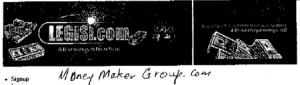
In this evidence exhibit given to a federal judge prior to the Legisi asset freeze in 2008, a Legisi prospect writes the name “Money Maker Group.com” in longhand. State and federal probes into Legisi were under way long before members knew — and undercover agents were part of the probe.
EDITOR’S NOTE: As the PP Blog reported Wednesday, HYIP Ponzi-scheme pitchman Matthew John Gagnon has been sentenced to five years in federal prison. On Thursday, the SEC released the statement reproduced below. Here’s hoping it will be the shot heard around the HYIP Ponzi World.
Still pushing HYIPs on your websites and social-media sites, in your emails and on the Ponzi boards? Still pushing them after the Legisi, AdSurfDaily, Zeek Rewards and Profitable Sunrise debacles? Is someone like “Ken Russo” or “10bucksup” or “strosdegos” enlisting you to enter Ponzi World?
Are you listening to Faith Sloan, when she shows you an investment-earnings calculator and plants the seed that the TelexFree action in Brazil is a yawner because it was brought in a “small” state that’s “literally in the middle of the jungle” — all while she further risks offending one-fifth of the world’s population by advising you not to engage in a “panic-like-Chinese-fire-drill” over your legitimate TelexFree concerns?
If you are turning a blind eye to all the incongruities of HYIP Ponzi Land, you may have the chance to be the next Matt Gagnon, meaning the next several years of your life will be consumed by court actions. First, you’ll watch your “program” get sued by the SEC. After that, you’ll get sued by the SEC and a court-appointed receiver. On top of those unpleasantries, you’ll be called a threat to the investing public in newspaper stories across the land, then charged criminally, and then sent to jail for years you’ll never get back while being ordered to pay back either the money you stole or the money you helped someone else steal.
A final note: More than FIVE years after the SEC filed the first of the Legisi-related fraud charges in May 2008, Legisi victims continue to visit the PP Blog for updates on the various Legisi-related actions, including the multiple actions against Gagnon. Scams may fall out of the headlines for a while — but the fleeced masses never forget them. For posterity, the PP Blog has inserted a section of a Legisi evidence exhibit into the SEC’s statement. It may be the strangest Terms of Service you’ve ever read.
** ______________________________________ **
U.S. SECURITIES AND EXCHANGE COMMISSION Litigation Release No. 22749 / July 11, 2013 Securities and Exchange Commission v. Matthew J. Gagnon, Civil Action No. 10-cv-11891 (E.D. Mich.)
Serial Fraudster Matthew J. Gagnon Sentenced to Five Years in Prison
The Securities and Exchange Commission announced that on July 9, 2013, the Honorable Mark A. Goldsmith of the United States District Court for the Eastern District of Michigan sentenced Matthew J. Gagnon to five years of incarceration followed by three years of supervised release and ordered Gagnon to pay over $4.4 million in restitution to his victims. Gagnon, 45, of Portland, Oregon, pleaded guilty to one count of criminal securities fraud for promoting a securities offering without fully disclosing the amount of his compensation in connection with his promotion of the $72 million Legisi Ponzi scheme in 2006 and 2007, in violation of Section 17(b) of the Securities Act of 1933.
The criminal charges arose out of the same facts that were the subject of a civil injunctive action that the Commission filed against Gagnon on May 11, 2010. The Commission’s complaint alleged that since 1997, Gagnon had billed himself as an Internet business opportunity expert and his website as “the world’s first and largest opportunity review website.” According to the SEC’s complaint, from January 2006 through approximately August 2007, Gagnon helped orchestrate a massive Ponzi scheme conducted by Gregory N. McKnight and his company, Legisi Holdings, LLC, which raised a total of approximately $72 million from over 3,000 investors by promising returns of upwards of 15% a month. The complaint also alleged that Gagnon promoted Legisi but in doing so misled investors by claiming, among other things, that he had thoroughly researched McKnight and Legisi and had determined Legisi to be a legitimate and safe investment. The complaint alleged that Gagnon had no basis for the claims he made about McKnight and Legisi. Gagnon also failed to disclose to investors that he was to receive 50% of Legisi’s purported “profits” under his agreement with McKnight. According to the complaint, Gagnon received a net of approximately $3.8 million in Legisi investor funds from McKnight for his participation in the scheme.
The SEC’s complaint further alleged that beginning in August 2007, Gagnon fraudulently offered and sold securities representing interests in a new company that purportedly was to develop resort properties. The complaint alleged that Gagnon, among other things, falsely claimed that the investment was risk-free and “SEC compliant,” and guaranteed a 200% return in 14 months. In reality, however, Gagnon sent the money to a twice-convicted felon, did not register the investment with the SEC, and knew such an outlandish return was impossible. Gagnon took in at least $361,865 from 21 investors.
The SEC’s complaint also alleged that in April 2009, Gagnon began promoting a fraudulent offering of interests in a purported Forex trading venture. Gagnon guaranteed that the venture would generate returns of 2% a month or 30% a year for his investors. Gagnon’s claims were false, and he had had no basis for making them because Gagnon never reviewed his friend’s trading records before promoting the offering, which would have shown over $150,000 in losses over the previous nine months.
The SEC’s complaint charged Gagnon with violating Sections 5(a), 5(c), 17(a) and 17(b) of the Securities Act of 1933 and Sections 10(b) and 15(a)(1) of the Securities Exchange Act of 1934 and Rule 10b-5 thereunder. The complaint sought preliminary and permanent injunctions, disgorgement, and civil penalties from Gagnon. On May 24, 2010, the SEC obtained an emergency order freezing Gagnon’s assets and other preliminary relief. Subsequently, on August 6, 2010, the Court granted an order of preliminary injunction against Gagnon pursuant to his consent. On March 22, 2012, the Court granted the SEC’s motion for summary judgment and entered a final judgment against Gagnon. The Court found that Gagnon violated the registration, anti-fraud, and anti-touting provisions of the federal securities laws. The Court’s final judgment against Gagnon permanently enjoined him from future violations of Sections 5(a), 5(c), 17(a) and 17(b) of the Securities Act of 1933 and Sections 10(b) and 15(a)(1) of the Securities Exchange Act of 1934 and Rule 10b-5 thereunder, and ordered Gagnon to pay $3,613,259 in disgorgement, $488,570.47 in prejudgment interest, and a $100,000 civil penalty.
On May 2, 2012, the SEC instituted related administrative proceedings against Gagnon to determine what, if any, remedial action was appropriate and in the public interest. On July 31, 2012, the SEC issued an Order Making Findings and Imposing Sanctions by Default barring Gagnon from association with any broker or dealer.
For further information regarding this case, see Litigation Releases No. 21532 (May 25, 2010), and 22310 (March 27, 2012).
URGENT >> BULLETIN >> MOVING: Legisi HYIP Ponzi-scheme pitchman Matthew John Gagnon has been sentenced to 60 months in federal prison, ordered to pay $4.4 million in restitution and further ordered to serve three years’ supervised probation after his prison release, the office of U.S. Attorney Barbara L. McQuade of the Eastern District of Michigan said.
Legisi, a $72 million Ponzi scheme pushed on fraud forums such as TalkGold and MoneyMakerGroup, was operated by Gregory N. McKnight, who faces sentencing in August. Gagnon’s five-year sentence was the maximum under a plea agreement with prosecutors, who’ve recommended McKnight serve 15 years.
Gagnon pushed Legisi and other fraud schemes through Mazu.com, the SEC said in 2010. The name of MoneyMakerGroup appears in evidence exhibits in the Legisi Ponzi case.
Gagnon will be permitted to self-report to prison, prosecutors said.
The Legisi case — perhaps particularly events involving Gagnon — has been closely watched because it shows that MLM-style HYIP pitchmen can be held accountable criminally for pushing scams. The SEC called Gagnon a threat to the investing public, describing him as a serial fraud pitchman who lacked licenses to sell securities and pushed the unregistered securities of multiple fraud schemes.
In civil charges announced yesterday in Ohio, prosecutors effectively made the same claims against promoters of the alleged Profitable Sunrise pyramid scheme. Included among them was Nanci Jo Frazer, who allegedly also promoted the $119 million AdSurfDaily Ponzi scheme and the $600 million Zeek Rewards Ponzi- and pyramid scheme.
The Legisi case began as an undercover probe by state securities regulators in Michigan and the U.S. Secret Service.
Legisi’s Terms of Service sought to make members affirm they were not an “informant, nor associated with any informant” of the IRS, FBI, CIA and the SEC, among other agencies, according to documents filed in federal court.
Current scams such as Profit Clicking have published similar terms, which read like an invitation to join an international financial conspiracy. Ohio prosecutors said they believed Frazer also pushed ProfitClicking, in addition to Zeek, ASD and Profitable Sunrise.
McKnight, prosecutors have said, tried to sanitize Legisi by calling it a “loan” program and engaging in semantic obfuscation. Any number of HYIP scams have employed similar linguistic sleight-of-hand, with ProfitClicking bizarrely arguing that neither itself nor affiliates can be held accountable.
Gagnon argued in court that he’d been duped by McKnight, but a federal judge didn’t buy it.
URGENT >> BULLETIN >> MOVING: (Fourth update 9:10 p.m. EDT U.S.A.) In court papers, the state of Ohio has called Nanci Jo Frazer’s Focus Up Ministries a “front” for the Profitable Sunrise HYIP scheme and alleges that Focus Up changed its name to Defining Vision Ministries Inc. in June 2013 — two months after the SEC brought the Profitable Sunrise fraud action in federal court in Atlanta.
Records suggest Nanci Jo Frazer also is known as Nancy Jo Frazer. The Ohio court documents list the “Nancy” spelling. Other documents list the “Nanci” spelling.
A judge in Williams County, Ohio, has ordered Frazer, Focus Up and other entities associated with Frazer to “[i]mmediately cease all activities on behalf of any charitable organization/trust in the state of Ohio,” to preserve assets and to return assets that already may have been dissipated.
The judge also ordered Frazer and others to cease selling unregistered securities. Meanwhile, the judge ordered three Ohio banks to take eight accounts linked to Frazer and others into “actual and/or constructive possession.” Frazer resides in Bryan, Ohio.
Ohio Attorney General Mike DeWine and the Ohio Department of Commerce said today that the state has brought civil fraud charges against Frazer, Focus Up, Defining Vision and others. Documents say the state believes Frazer was a pitchwoman for the AdSurfDaily Ponzi scheme and other “programs,” including Zeek Rewards and Profit Clicking.
“This case involves a worldwide pyramid scheme that defrauded Ohioans and others out of millions of dollars,” DeWine said. “These individuals brought the scheme to Ohio by promising outrageous returns and telling investors that their donations and investments would help charities. We will continue to work closely with the Department of Commerce to hold the defendants accountable for their actions.”
Also charged were David Frazer, Frazer’s husband, and Albert Rosebrock, a member of Frazer’s NJF Global Group. Rosebrock also was alleged by Ohio to be an AdSurfDaily and Zeek affiliate.
Purported Profitable Sunrise operator “Roman Novak” is called “John Doe” in Ohio’s complaint, leading to continuing questions about whether “Novak” actually exists. In April, the SEC said that Profitable Sunrise pitchmen may not even have known with whom they were doing business. Profitable Sunrise purported to pay up to 2.7 percent interest a day. The SEC said it was using a “mail drop” in England and offshore bank accounts potentially to scam tens of millions of dollars.
Frazer’s group may have driven $30 million to the scam, according to court files.
The Cleveland Plain Dealer is reporting that Rosebrock is blaming the SEC for the collapse of Profitable Sunrise.
Profitable Sunrise is an international pyramid scheme recently shut down by federal and international authorities. Profitable Sunrise claimed to be a Christian company that would use investment proceeds to help charities and provide investors with large returns. According to the state’s complaint, the Frazers, of Bryan, and Rosebrock, of Sherwood, used Focus Up Ministries’ status as a charity to solicit donations and investments into Profitable Sunrise. They also claimed that invested funds would compound at 1.6 to 2.7 percent daily, growing at annual rates of 5,000 to more than 75,000 percent. The complaint also alleges that the defendants used funds donated to Focus Up Ministries for personal expenses and other unlawful purposes. These included financing for personal business ventures, the purchase of a big screen television, no-interest personal loans, and compensation for agents who solicited on behalf of the Profitable Sunrise pyramid scheme. The complaint contains counts of misrepresentation, deceptive acts and practices, conversion, falsification, securities fraud, and unlicensed sale of securities, among other violations.
The SEC has described Zeek Rewards as a $600 million Ponzi- and pyramid fraud. AdSurfDaily was a $119 million Ponzi scheme, according to the U.S. Secret Service. Meanwhile, ProfitClicking is a “program” linked to Frederick Mann, the purported operator of JSSTripler/JustBeenPaid, which has come under regulatory scrutiny in Italy and the Philippines.
If Frazer was a pitchwoman for ASD, Zeek and ProfitClicking/JSS/JBP, it would mean she was pushing Profitable Sunrise after various well-publicized regulatory or law-enforcement actions against those “programs,” which purported to pay interest of between 1 percent and 2 percent a day. (ASD = 1 percent/day; Zeek = 1.5 percent/day; ProfitClicking/JSS/JBP = 2 percent/day.)
Beyond that, it would mean Frazer pushed the purported 2.7 percent a day Profitable Sunrise “Long Haul” plan, even though agencies filed various actions against the “lower-paying” programs with which she allegedly was involved previously.
Some HYIP promoters move from one fraud scheme to another, while engaging in willful blindness. ASD is known to have had ties to the “sovereign citizens” movement. Mann, of ProfitClicking/JSS/JBP, once used a website to drive traffic to videos featuring Francis Schaeffer Cox, a purported “sovereign citizen” and “militia” man implicated in a murder plot against public officials in Alaska.
Depictions of Jesus Christ were used in the Profitable Sunrise and the equally bizarre “Cash Tanker” HYIP schemes — and now are being used in promos for TelexFree, an MLM “opportunity” under investigation in Brazil amid pyramid-scheme and securities concerns.
It looks as though the statue of Christ the Redeemer in Rio de Janeiro has been used in promos for both TelexFree and Profitable Sunrise, which the U.S. Securities and Exchange Commission said in April 2013 was a fraud scheme operating in part through a “mail drop” in England.
1.
From a promo for TelexFree playing on YouTube. Another part of the video shows money being tossed by one TelexFree pitchman and raining down on another.
 Touted on the MoneyMakerGroup Ponzi forum by former Zeek Rewards pitchman “mmgcjm,” a bizarre “program” known as CashCropCycler appears to have tanked. Joining CashCropCycler in the recent HYIP DOA lineup was NEOMutual, a purported “crowdfunding” opportunity that claimed it used bitcoin and a series of offshore payment processors to provide daily interest rates of 1.4 percent, 1.6 percent and 1.9 on sums between $20 and $250,000.
 An ad for NEOMutual once appeared on the landing page of the CashCropCycler website. NEO Mutual said it was located at Revolution Tower in Panama City, Panama. Like the “Profitable Sunrise” HYIP scheme, NEO Mutual purported to be in the bridge-loan business. In April 2013, the SEC called Profitable Sunrise a scam that may have gathered millions of dollars while using a “mail drop” in England and offshore bank accounts.
 In July, the SEC issued an investor alert that warned about the dangers of potential investment scams involving virtual currencies promoted through the Internet.