Tag: Secret Service

  • BULLETIN: Autosurf Biz Takes Another Pounding; Federal Judge Adds Noobing As Receivership Defendant In Fraud Case Against Parent Company; 14 Other Subsidiaries Named

    UPDATED 6:05 P.M. EDT (U.S.A., Jan. 20, 2011.) In yet another case that portends disaster for the so-called “autosurf” industry, a federal judge has ordered the Noobing autosurf to be added as a receivership defendant in a fraud case brought against its parent company.

    The FTC and attorneys general from Minnesota, North Carolina and Kansas brought the case against Noobing’s parent — Affiliate Strategies Inc. (ASI) — in July 2009. Several other companies were named defendants in the case, which alleged the firms participated in a scheme that promised guaranteed government grants from economic-stimulus funds.

    Brett Blackman, ASI’s head, also was president of Noobing, members said. Noobing was not initially named a receivership defendant.

    U.S. District Judge Julie A. Robinson issued an asset freeze Sept. 1, along with stern orders to preserve evidence and repatriate to the United States all assets and documents held on foreign soil. She also broadened the powers of Larry Cook, the court-appointed receiver.

    Through his investigation, Cook determined that Noobing was operating under the umbrella of Apex Holdings International LLC, the same company under which ASI operated. Cook also determined that at least 14 other companies were operating under the Apex Holdings umbrella.

    Noobing, which was registered in the United States, also had an offshoot in Nevis, according to court filings. Noobing targeted people with hearing impairments.

    Cook asked Robinson last month to add Noobing and the other companies as receivership defendants after determining “each of the Subsidiaries used the same post office box as the [initial] Receivership Defendants.”

    Moroever, Cook advised Robinson that he had received “receive numerous inquiries from creditors, former independent contractors, and tax authorities for the Subsidiaries.” He further argued that “each of the Subsidiaries was entirely reliant upon the business operations of the [initial] Receivership Defendants.”

    Robinson, saying Cook had shown “good cause,” added Noobing and the others as defendants March 18.

    No party  — including the FTC, the state attorneys general, the initial set of defendants and the new defendants — objected, Robinson noted. In December, Illinois joined the FTC, Minnesota, North Carolina and Kansas in the action.

    On the previous day, March 17, FBI Director Robert Mueller III, without naming names, testified before Congress. Mueller said that “shell corporations” are emerging as a threat to the U.S. banking system because owners were using them “to facilitate the concealing of criminal proceeds” and engage in money-laundering.

    Neither Noobing not its corporate parent has been accused of a crime.

    In February, the U.S. Secret Service alleged in a civil forfeiture complaint that INetGlobal, a company that operates an autosurf, was engaged in money-laundering and wire fraud while operating a Ponzi scheme.

    INetGlobal is operated by Steve Renner, under his “umbrella corporation, InterMark,” the Secret Service alleged. The agency identified what it described as “subsidiaries,” specifically referencing “Virtual Payment Systems [LLC of Wisconsin/Brackets Denoting the LLC Designation added Jan. 20, 2011], V-Media, Cash Cards International, and V-Local,” as well as a company named “INet Global Productions.”

    NOTE IN BOLD ADDED JAN. 20, 2011: An Indianapolis-based company known as Virtual Payment Systems Inc. has contacted the PP Blog to let it know it is not affiliated with the Renner company Virtual Payment Systems LLC of Wisconsin, which is referenced in the paragraph above.

    “The commission by Renner of the federal crimes of wire fraud, in violation of Title 18, United States Code Section 1343, and money laundering, in violation of Title 18, United States Code Section 1957, is essential to the operation of this Ponzi scheme,” the Secret Service alleged.

    In August 2008, the Secret Service said AdSurfDaily, a Florida-based autosurf company, also was engaging in wire fraud and money-laundering while operating a Ponzi scheme.

    U.S. District Judge Rosemary Collyer — on Jan. 4, 2010 — ordered the forfeiture of more than $65.8 million in the personal bank accounts of ASD President Andy Bowdoin. A little more than a month later, on Feb. 23, the Secret Service moved against INetGlobal.

    Records show that ASD’s Bowdoin operated several corporations over the years. In September 2009, the state of Florida revoked the corporate registrations of AdSurfDaily and Bowdoin/Harris Enterprises Inc.

    The revocations occurred just four days after Bowdoin told members he had exciting plans for ASD’s future. Despite his claim, Bowdoin never bothered to submit the paperwork to keep the firm’s registration intact, despite having been given a five-month window to do so.

    In his remarks to members, Bowdoin said the government had seized the assets of ASD members. In his own sworn court filings, however, Bowdoin said the seized assets belonged to him and his company.

    The Secret Service transcribed Bowdoin’s remarks, and presented them to Collyer Sept. 28. Federal prosecutors said Bowdoin’s remarks were evidence that “this con man cannot manage to keep his stories straight.”

    Collyer ordered the ASD asset forfeiture a little more than three months later. In the INetGlobal case, the Secret Service said one of its undercover agents was on the receiving end of a sales pitch from an ASD member who was trying to recruit the agent into INetGlobal.

    Renner’s autosurf  “began operating just weeks after ASD was put out of business by the Secret Service, and this new entity uses the same terminology and business model as ASD,” the agency said in an affidavit for a search warrant.

    At least one of the undercover agents working the INetGlobal case also worked the ASD case, according to court filings. The Secret Service searched the Web for an INetGlobal affiliate site, and the INetGlobal affiliate who pitched the undercover agent also had been an ASD member, according to the affidavit.

    “The member asked if [the undercover agent] was a network marketer,” the Secret Service said. “The member said he had previously been a member of ASD . . . and said, ‘We know what happened there.’

    “The member said he was reluctant to join iNetGlobal due to it being similar to ASD,” the agency continued in the affidavit. “The member said, ‘we all know what this program is.’” The member said his daughter and wife surfed the websites and the member did not care about the services provided. The member said he just wanted to put his money in and get it out. The member said you convert your earnings to V-cash and then receive payouts by check or through an ATM card you can sign up for.”

    Less than a month later, FBI Director Mueller told Congress that “shell corporations” and “stored value” debit devices and “reloadable debit cards” increasingly were being used “to move criminal proceeds.”

    “This has created a ‘shadow’ banking system, allowing criminals to exploit existing vulnerabilities in the reporting requirements that are imposed on financial institutions and international travelers,” Mueller said.

    Mueller did not name any companies in his Congressional testimony.

  • INetGlobal, AdPacs Websites Offline; Acesse.com, Associated Search Site, Has Limited Functionality

    UPDATED 2:24 P.M. ET (U.S.A.) If you’re wanting to visit Steve Renner’s INetGlobal.com and AdPacs.com sites, at the moment you’ll land on pages that say “InetGlobal is currently down for maintenance. We’ll to (sic) be back by 12:00pm CST.”

    The message on InetGlobal.com and AdPacs.com has been in place for at least three hours and, despite the fact the INetGlobal and AdPacs sites suggested they would be back up by noon Central Standard Time, that time has passed by more than an hour — and the sites still are down.

    Why the Renner sites are down is unclear.

    UPDATE 2:24 P.M. The message on the site now has been changed to read, “InetGlobal is currently down for maintenance. We’ll to (sic) be back by 12:00am CST on Saturday, March 13th.”

    Another Renner site — Acesse.com, a search engine the U.S. Secret Service said last month was just a link to another search engine — appears to have limited functionality. It is possible to perform a search on the site and glean results, but several links on the site appear to have no functionality.

    The links are titled Images, Videos, Maps, News and Shopping, and appear in the upper-left corner of the Acesse.com site. The links appear to be dead. At the same time, other links that appear on the site — links that point to other Renner sites such as Adpacs.com and INetGlobal.com — are generating the “down for maintenance” message.

    Another link on Acesse.com titled “Top Searches” resolves to a page that says, “Top searches as of Tuesday December 2nd 2008 00:00:00 CST.”

    It was not immediately clear if the dead links at Acesse.com were caused by code that had been

    Part of the maintenance message at INetGlobal and AdPacs.

    removed to disable the links or code that had not been entered.

    The error message at INetGlobal and AdPacs appears under INetGlobal’s logo, and a headline that reads, “Preparing for bigger waves!” Two men are pictured riding a wave on surf boards, and a subhead reads, “Surf Alert.”

    Acesse.com purports to include a “Get Paid To Search The Web” element through the search engine.

    In a court affidavit last month, the U.S. Secret Service said Renner was at the head of an international Ponzi scheme.

  • Website Of Spokesman For Renner Entity Claims Government ‘Leaking’ Info To PP Blog About INetGlobal Ponzi Probe; ‘Didn’t Happen — Ever,’ Blog Says; Meanwhile, A Bogus ‘Apology’ Claim

    UPDATED 2:20 P.M. ET (U.S.A.) Did people associated with a company implicated by the U.S. Secret Service in a Ponzi scheme, wire-fraud and money-laundering case participate in a misinformation campaign?

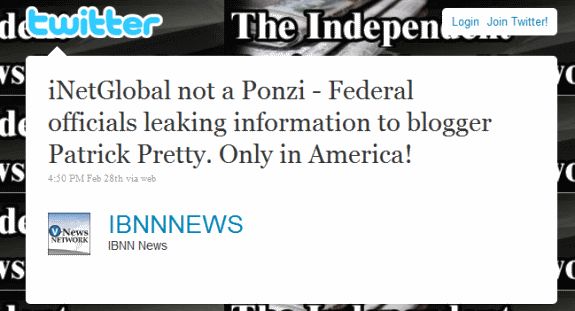
    A Twitter website with a tie to the Inter-Mark companies operated by Steve Renner claims that federal officials are “leaking” information to the PP Blog.

    “Didn’t happen — ever,” the PP Blog said today. “The information we published was not leaked to the Blog. The Blog obtained the information from a public source, through the normal course of its reporting, and the information was available to reporters and the public before the Blog even published its first story based on the information.”

    Meanwhile, another website with a tie to a Renner’s Inter-Mark Corp. is making the claim that a Blogger Inter-Mark is targeting in a lawsuit for calling INetGlobal a “scam” issued an “apology.”

    The apology claim appears on a domain titled CheapClix.net, whose domain registration lists V-WEBS.COM as its nameserver. A Renner company dubbed V-Webs LLC appears to be an inactive Minnesota corporation that used the same Minneapolis street address as InetGlobal and other Renner companies, according to public records.

    A CheapClix.net post headlined “HOSPITALERA.COM APOLOGIZES TO iNetGlobal” and dated Feb. 4 claims that the Hospitalera Blog issued an apology to INetGlobal on a date uncertain and implies that Hospitalera now even endorses INetGlobal.

    “We are deeply saddened by the actions taken by this blog to defame iNetGlobal,” the CheapClix.net site says, apparently quoting from the purported apology. “iNetGlobal is one of the top Internet Marketing firms in the United States. We reach out to them with a sincere apology in hopes that we too can use the iNetGlobal products and services.

    “After careful review of iNetGlobal’s services and products, we find the company is real and the services are true to what iNetGlobal represents. Again, we apologize.”

    The apology claim is dubious because Sybille Yates, who operates the Hospitalera Blog from the Czech Republic, told the PP Blog last week that she was not even aware that Renner’s company was suing her until Feb. 25 — three weeks after the date of her purported apology.

    Yates did not immediately return an email from the PP Blog today seeking comment on the apology claim and whether she had, in fact, apologized. A Feb. 16 post  from Yates on the Hospitalera Blog, however, describes the news release that announced the apology as “faked.”

    Whether the apology claim somehow sprouted from some fantastic reshaping of facts by an INetGlobal supporter or was just an outright lie that was part of a misinformation campaign was not immediately clear.

    It has been common in the so-called autosurf “industry” for lies, misstatements, misrepresentations, misinformation and claims not based on facts to spread virally on the Internet as though they were truth.

    In the AdSurfDaily case, for instance, claims were made that the prosecution admitted ASD was not a Ponzi scheme, that ASD President Andy Bowdoin had received an award from the President of the United States for business acumen, that Google and ASD were partners and that ASD had the backing of huge corporations with huge advertising budgets.

    All of the claims were untrue.

    The CheapClix.net claim about the purported apology adds another strange twist to the INetGlobal story. If Yates never issued such an apology — and Yates’ Blog says no such apology was issued — it leads to questions about why someone would claim such an apology had been issued and even go so far as to issue a news release to announce an apology that had not been made.

    The introduction to Hospitalera’s purported apology as reported by CheapClix net begins, “We appreciate this step taken by the people at the hospitalera web-site to make amends for their erroneous publications.”

    The CheapClix.net post from Feb. 4 includes a link to what appears to have been a news release issued by an unknown party to herald Hospitalera’s purported apology. The news release link to PRLog.org resolves to an error page. PRLog.org is a free news-release distribution service.

    Yates’ Blog says she contacted PRLog to have the fake news release removed, and that PRLog took down the bogus release “in a heart beat.”

    UPDATE 2:20 P.M. Yates has confirmed she never issued an apology.

    “I never issued said apology, nor did I ever authorize anybody to do so in my name,” Yates said.

    “I never issued or published a press release on prlog.org. As I came across the forged and false press release, I contacted prlog.org immediately and they took it down. I have no information who published/submitted said press release to prlog.org.”

    A second link in the CheapClix.net post that heralded the purported apology resolves to TweetMeme.com, a site that aggregates Twitter links. A small icon that reads “V News Network” appears below a headline of “iNetGlobal Scam: Hospitalera Blog apologizes to iNetGlobal.”

    Records suggest that “V News Network” may be yet another Renner entity.

    A headline heralding a purported apology from the Hospitalera Blog for calling INetGlobal a scam appears on a website known as CheapClix.net. The Hospitalera Blog says the apology was "faked."

    ‘Leaking’ Claim

    Why the Twitter site, which is tied to IBBN.org, made the claim of that the government was “leaking” to the PP Blog is unclear. The Twitter post is dated Feb. 28. IBNN, which stands for The Independent Business News Network, is registered in Renner’s name. The site is operated by Donald W.R. Allen II, IBNN’s editor-in-chief and the the vice president and director of public relations for V-Newswire — a company in Renner’s INetGlobal family.

    Renner is listed as the IBNN domain registrant.

    Allen did not comment Friday when the PP Blog advised him that the government leaked no information to the Blog. The Twitter site does not list a source for its claim that federal officials “leaked” information to the Blog, but asserts that such an event was possible “Only in America!” The Twitter site continues to make the claim.

    The site also claims “iNetGlobal not a Ponzi.” No source is listed for the denial. It is unclear if IBNN has access to audited and certified balance sheets and financial statements of the Renner enterprise that could destroy the government’s Ponzi assertions.

    IBNN previously skewered the Star-Tribune newspaper of Minneapolis/St. Paul, asserting that the paper, which covered the INetGlobal raid, was displaying  “defamatory contempt [for the Renner entities] prior to a full investigation and a Grand Jury inquiry.”

    Allen, who signed the IBNN opinion piece, did not disclose his tie to the Renner companies when the piece was published. The piece went missing after the PP Blog published a story in IBNN’s tie to Renner, but since has been restored — with a few lines added.

    The U.S. Secret Service, which raided Renner’s operations in Minneapolis last month, asserted that INetGlobal and other Renner companies were part of an international Ponzi scheme that was engaging in wire fraud and money-laundering.

    The PP Blog cited as its source a Secret Service affidavit for a search warrant. The affidavit was published openly on a government website.

    At various times in its history, the PP Blog has been accused by participants in alleged Ponzi schemes of being part of a government operation. The Blog has reported on paranoia that often accompanies Ponzi scheme participants, some of whom become preoccupied with thoughts about government “plants.”

    Such claims about the PP Blog have been made from one Ponzi scheme case to the next, but they simply are not true. Ponzi promoters have accused the Blog of idiocy, occasionally resorting to name-calling or posting under multiple identities in a bid to create the appearance that a particular company caught up in Ponzi allegations the Blog was covering had more supporters than it actually had.

    As was the case with AdSurfDaily, a Florida company implicated in an autosurf  Ponzi scheme by the Secret Service in 2008, the Secret Service used undercover agents as part of the investigation into INetGlobal, according to a court affidavit. At least one of the undercover agents also was involved in the ASD investigation, according to court filings.

    Other court filings reviewed by the PP Blog have described various investigative techniques the agency uses, including surveillance from automobiles of subjects under investigation at places such as residences, parking lots and post offices — and even trash Dumpsters.

    At least two Secret Service agents were in the room to observe an INetGlobal function in New York, according to court filings. Agents also observed an ASD function in Miami in 2008, according to court filings.

    An agent involved in the ASD case listened to an INetGlobal sales pitch by an ASD member, according to the affidavit in the case.  It is plain from multiple public filings that the Secret Service is well aware of the so-called autosurf “industry” — and also the so-called “matrix” industry.

    It was publicly known that Renner had been under federal indictment for income-tax evasion since September 2008, a month after the ASD raid. There also is a considerable, public paper trail consisting of court filings, news releases and other information that links Renner to a Ponzi scheme known as Learn Waterhouse, elements of which were prosecuted by both the SEC and the U.S. Department of Justice.

    The public paperwork in the Learn Waterhouse case dates back to 2004. A Renner entity known as CCI provided payment-processing services for the Learn Waterhouse Ponzi scheme.

    Visit the Hospitalera site.

    Read about the purported apology on CheapClix.net.

  • Spokesman For Renner-Related Company Did Not Disclose Tie In Opinion Piece That Attacked Star-Tribune Newspaper; Name Is Referenced In Secret Service Affidavit; Declines To Answer Questions From PP Blog

    UPDATED 2:25 P.M. ET (March 2, U.S.A.) The vice president and director of public relations for V-Newswire — a company in Steve Renner’s INetGlobal family — authored an opinion piece lambasting a Minnesota newspaper’s coverage of a Secret Service raid at INetGlobal’s Minneapolis offices last week on his personal Blog, but did not disclose his tie to the firm.

    Donald W.R. Allen II operates a Blog known as The Independent Business News Network (IBNN). Allen did not disclose his INetGlobal tie when authoring an editorial titled, “Minneapolis’ Star Tribune newspaper’s bias reporting causes defamatory speculation at Internet marketing firm.”

    The piece began, “If the Star Tribune newspaper can use its ‘power’ to taint a company’s image prior to investigation by authorities, whose (sic) to say the news you get is true and accurate?”

    The Star-Tribune was among the first media outlets to report that federal agents believed INetGlobal was operating a Ponzi scheme.

    Information gleaned during the federal probe led to allegations that INetGlobal also was engaging in wire fraud and money-laundering.

    Allen, whose name is referenced in a search-warrant application in the INetGlobal case, now says he should have disclosed the tie in the IBNN editorial.

    “I will give full disclosure on the iNetGlobal piece today because I have 3 more follow up stories,” he said this morning. He asserted that the IBNN domain, which is registered in Renner’s name under the organization of V-Webs LLC, “has nothing to do with iNetGlobal other than being registered by the company as part of my employment agreement.”

    Allen defined the IBNN Blog as a “Civil Rights, Politics and News Blog for mostly the Twin Cities area.” IBBN’s site content includes an endorsement of the Tea Party Movement in the United States and a “Declaration of Tea Party Independence.”

    Allen emailed the PP Blog Sunday after appearing at the Blog, posting comments and using the IBNN URL, not a URL associated with the Renner companies. He dismissed the Blog as “minor league,” writing it was engaging in a “witch hunt.” The Blog responded to Allen’s email by asking him to comment on a number of issues concerning INetGlobal and inquiring why he was using the IBNN URL if he was a spokesman for a Renner entity.

    Later in the day, Allen responded to the Blog’s questions by saying he would answer questions about his role at V-Newswire, but he did not address the questions the Blog asked previously.

    The Blog then resubmitted the questions, adding several more questions to a list of four it previously had asked. Allen responded to the email, but chose not to answer a number of questions.

    Among the questions Allen declined to answer was whether INetGlobal, in the aftermath of the Ponzi scheme allegations, believed it should inform members about Steve Renner’s December conviction on four felony counts of income-tax evasion. Allen also declined to answer a question on whether INetGlobal had a duty to inform members that Cash Cards International (CCI) — a payment processing firm once operated by Renner — could not return money to Ponzi scheme victims in a case brought by the SEC against a California company known as Learn Waterhouse because Renner had spent the customers’ money.

    Allen did say he saw “nothing illegal with V-Newswire or the V-News Network.”

    The Blog asked Allen whether he was the “Donny Allen” referred to in an INetGlobal news release and the “Donald Allen” referred to in a Secret Service affidavit that alleged “Donald Allen” provided confusing information to a person who attended an INetGlobal function in New York.

    Allen did not answer the question, which the Blog posed twice.

    Undercover Secret Service agents also attended the New York function, according to the affidavit.

    The PP Blog also asked Allen whether he believed he should disclose his tie to INetGlobal when responding to Blog and forum posts. He declined to answer the question, which was posed twice.

    He also declined to answer a question about how it served INetGlobal’s PR ends to dismiss as “minor league” Blogs that report the serious allegations against the company.

    AdSurfDaily, a Florida company implicated in a $100 million Ponzi scheme, employed a similar PR approach. The ASD case is referenced in the Secret Service affidavit, amid allegations that an ASD member described INetGlobal as a wink-nod enterprise and attempted to have an undercover Secret Service agent participate in a three-way call with the ASD members’ sponsor for the purpose of recruiting the agent into INetGlobal.

    Allen also declined to answer a question on whether he was the author of an INetGlobal news release after the raid that said federal agents had arrived at Renner’s offices “looking for something to substantiate their claim that illegal activity was occurring in the business.”

    The news release used Allen’s email address, which he described as temporary in an email to the PP Blog, but did not mention Renner’s income-tax conviction and the allegations that Renner had spent money belonging to CCI customers.

  • SECRET SERVICE: INetGlobal Forced Members To Keep Money In The Company With ‘Automatic Repurchasing’ Scheme; Undercover Agent Sent Email To Support, Which Verified Repurchase Was Mandatory

    UPDATED 11:07 A.M. ET (U.S.A.) One of the undercover Secret Service agents who joined INetGlobal discovered that the company had implemented an “automatic repurchasing” program by default and that the program could not be switched off, thus distancing participants — many of whom may not have understood English — from their money.

    Although it is unclear when the automatic-repurchasing program began, it was in operation in the weeks after INetGlobal owner Steve Renner was convicted on Dec. 8, 2009, of four felony counts of income-tax evasion, according to court filings.

    Other filings show that another Renner company — Cash Cards International (CCI), a money-transmission business  — was upside down by more than $2.5 million when a court-appointed receiver in a Ponzi scheme case sought to convert electronic credits to cash to compensate victims of the scheme.

    Beginning on Feb. 1, the Secret Service agent — a woman — repeatedly tried to turn off INetGlobal’s automatic-repurchasing feature, but it “came back on” each time. The agent, who speaks and writes in English, attempted to disable the feature “several times on different days,” failing each and every time, according to an affidavit for a search warrant filed in the case.

    INetGlobal had a high concentration of Chinese members who did not speak English, according to the affidavit. How they even could understand the automatic-repurchasing scheme or fully comprehend INetGlobal’s operations and English-language website is far from clear, and has led to questions about whether the company deliberately was targeting members who could not understand what they were purchasing and would have both a language and a geographic disadvantage when seeking explanations or filing complaints with authorities.

    The company generated “at least” 87 percent of its revenue from the sale of memberships to members “residing in China,” according to an analysis referenced in the affidavit. The analysis was performed by an unnamed INetGlobal employee.

    On Feb. 17, the undercover agent sent an email to INetGlobal customer service, asking if the feature could be turned off.

    “Customer service replied in the negative,” the agent said, suggesting that the automatic-repurchasing feature was forcing participants to keep at least 40 percent of their money in the company.

    In the affidavit, the Secret Service said a “high level iNetGlobal member” from Nevada was becoming increasingly frustrated by an inability to withdraw funds. The member complained to management that “for over one week [in January] they had been unable to get a money order payment from the company for value they are owed.”

    “The victim contacted iNetGlobal’s customer service on several occasions only to get excuses,” the Secret Service said.

    Eventually, the victim spoke with former InetGlobal CEO Steven Keough.

    Keough, according to the Secret Service, told the victim on Jan. 11 to “cash out” of the system.

    “We can’t cash out,” the victim said. “[I]t is not possible, due to mandatory repurchasing built into the system.”

    On the very next day — Jan. 12 — Keough, an attorney and former naval officer, met with the Secret Service. He had contacted federal prosecutors Jan. 8 to express concerns about the company’s business practices. His first contact occurred only two months after he was appointed CEO on Nov. 7, 2009, according to the affidavit.

    Steve Renner’s Tax Convictions, Link To Previous Ponzi Scheme

    Renner was found guilty Dec. 8 of four felony counts of federal income-tax evasion.

    Prosecutors said he “diverted substantial funds” from CCI between 2002 and 2005 to pay his personal living expenses as well as to make personal investments in coins, oil wells, art, stamps, and vintage musical instruments.

    CCI, which once served as a money-transmitter for a California Ponzi scheme known as “Learn Waterhouse,” used the same office facility in Minneapolis as INetGlobal, the Secret Service said.

    When a court-appointed receiver in the Learn Waterhouse case attempted to get Renner to return money due Ponzi scheme victims, he explained that he could not do so because it had been “invested,” according to the affidavit.

    Thomas Lennon, the receiver in the Learn Waterhouse case, met with Renner, who “provided . . . financial statements indicating that the assets of Cash Cards and Renner are insufficient to cover all outstanding vcredit balances and obligations to other creditors.

    “Specifically, the statements show that Cash Cards and Renner have assets with an estimated value of $2,946,000 and an outstanding v-credit liability of $5,450,000,” Lennon said in court filings in 2007. “Renner has also informed the Receiver that he is currently being audited by federal and state taxing authorities which may result in large additional liabilities and liens on his property.”

    Lennon’s name is well-known among victims of financial crimes. He also was the court-appointed receiver in the 12DailyPro autosurf Ponzi scheme.

    Repurchasing programs, which autosurf operators employ to minimize the outflow of cash, are one of the oldest tricks in the Ponzi book. “Trainers” for Florida-based AdSurfDaily, implicated in a $100 million Ponzi scheme, routinely pushed a so-called “80-20” program whereby members would remove no more than 20 percent of money they were due and plow 80 percent back into the surf.

    In June 2009, AdViewGlobal, an autosurf with close family, management and promotional ties to ASD, announced it was ceasing payouts and making an 80/20 program mandatory should payouts ever resume. AdViewGlobal promptly crashed and burned.

    In January, according to the affidavit, Keough told investigators that he could not make sense out of what was going on inside INetGlobal and had observed instances in which Renner appeared to be gaming the payout system.

    “Keough said he was concerned that large amounts of money were flowing through bank accounts related to iNetGlobal and that unusual system manipulation was being conducted by . . . Renner,” the Secret Service said. “Keough had recently been fired by Renner. Keough believed he had been fired because he continually questioned iNetGlobal’s business practices.”

    On Jan. 20, according to the Secret Service, the agency received information that TCF National Bank was closing the accounts of a Renner entity known as Inter-Mark Corp. after an investigation by the bank led to “suspicions that the activity in the accounts might be money laundering,” according to the affidavit.

    “TCF Bank had given notice to Renner that the accounts were going to be closed,” the Secret Service said. It is unclear if Renner ever advised INetGlobal members that the bank had closed the accounts, citing suspicions they were being used to commit crimes.

    TCF prepared a cashier’s check for “for a little over $5 million,” presenting it to a Renner employee.

    Later that day, the check was deposited into Bremer Bank, which also held Renner-connected accounts, according to the Secret Service.

    Balances in Renner-connected accounts began “moving up sharply in August 2008,” the Secret Service said.

    August 2008 was the month in which the Secret Service raided the headquarters of ASD — and the month in which Renner’s autosurf was coming onto the stage. Golden Panda Ad Builder, a surf that is part of the ASD litigation, positioned itself as a company that sought to cater to Chinese members.

    Golden Panda’s operator — Clarence Busby — was implicated by the SEC in a prime-bank investment scheme in the 1990s, the same sort of scheme that engulfed Learn Waterhouse and later resulted in the determination that Renner’s CCI money-services business was impossibly upside down because he had used customers’ money to make personal purchases.

    INetGlobal issued a statement yesterday that acknowledged the Secret Service probe, but did not mention Renner’s tax conviction in December or the trouble he encountered when he could not fund a payment to the Learn Waterhouse receivership estate in the Ponzi case.

    “iNetGlobal offices will remain open to provide support to our 1,000’s of customers from around the world,” the company said. “iNetGlobal will continue to provide the level of quality service our customers have come to expect now and into the future.

    “We would like to thank all of our Members and Customers for their support and well wishes in this trying time,” the company said.

  • BULLETIN: Receiver In Affiliate Strategies Inc. (ASI) Case Asks Federal Judge To Add Noobing Autosurf To Receivership Probe After Inquiries By ‘Tax Authorities’

    The court-appointed receiver in the fraud case against the parent company of the Noobing autosurf has asked a federal judge for the authority to add Noobing to the receivership probe.

    Larry Cook, the receiver, said that Noobing and 14 other companies under the Affiliate Strategies Inc. (ASI) umbrella have become the subjects of “numerous inquiries” from “tax authorities,”  creditors and “former independent contractors.”

    Cook did not identify specific parties that made inquiries, but noted that “each of the Subsidiaries used the same post office box as the Receivership Defendants.”

    Noobing targeted people with hearing impairments in its promotions. It is known that some Noobing members have contacted the Federal Trade Commission, which is spearheading the ASI probe, along with the attorneys general of Kansas, Minnesota, North Carolina and Illinois.

    At least one deaf member of Noobing says she has contacted a sheriff’s department in California about the company.

    News that Cook is seeking judicial approval to add Noobing to his receivership probe came on the same day that the U.S. Secret Service said it was conducting an intense probe of INetGlobal, which operated a Minneapolis-based autosurf.

    In an application for a search warrant in a Ponzi case against INetGlobal, the Secret Service referenced the AdSurfDaily Ponzi scheme case, saying a member of ASD had attempted to recruit an undercover Secret Service agent into the INetGlobal scheme.

    ASD members and members of a closely connected surf known as AdViewGlobal also promoted Noobing, as did INetGlobal members, according to web records.

    Steve Renner, the owner of INetGlobal, was convicted in December of four felony counts of income-tax evasion for his conduct with other companies earlier this decade.

    Autosurfs are notorious for keeping poor records or no records at all, and autosurf participants are notorious for engineering schemes to milk tax-free income.

    Cook said tax reporting is required, and is seeking an order that pertains to Noobing and 14 other ASI umbrella companies. Cook listed Noobing’s name at the top of the list.

    “In order to complete the tax reporting requirements and otherwise address the creditors’ and other claims, the Receiver seeks a clear order that he is the Receiver for the Subsidiaries,” Cook said.

    And, he added, “Counsel for the [FTC] has reviewed this Motion and concurs.”

    ASI and a number of companies were sued last year in a scheme involving government grants. Noobing went offline in the immediate aftermath of the FTC probe.

  • AdSurfDaily Cited In INetGlobal/Steve Renner Search Warrant Application; Former Company CEO Helped Agents Prior To Raid; Undercover Agent Joined Surf Program; Agents Witnessed Spectacle At New York Function

    The U.S. Secret Service observed Minnesota-based INetGlobal’s operations for weeks in January, dispatched undercover agents to join the autosurf, learned that a bank recently had closed accounts tied to the firm amid money-laundering suspicions — and already had received incriminating information from the firm’s former chief executive officer prior to executing multiple search warrants Tuesday, according to records.

    Agents even traveled to a company function in New York, mixed in with the audience and observed INetGlobal owner Steve Renner, according to records. The function was known as “Freedom Conference 2010.”

    Most of the attendees were Chinese, the Secret Service said.

    “[C]onference registration took a long time because nobody at the registration desk spoke Chinese, and many of the conference attendees could not make themselves understood in English,” the agency said.  “There was an interpreter in the main hall, but Renner often spoke over the interpreter.”

    At one point, Renner started a pandemonium by holding up $20 bills, which he began handing out to attendees in exchange for $10 bills, the agency said.

    “This caused a crush of people to approach the front of the hall, and Renner eventually needed assistance moving people back,” the Secret Service said. “Renner asked, through an interpreter, how many people in attendance had their own business, and only two raised their hands.”

    Steven Keough, a retired naval officer who was INetGlobal’s CEO for only weeks before being fired by Renner, contacted federal prosecutors Jan. 8 to report concerns about Renner and the company, according to court documents.

    Meanwhile, the search-warrant application cites the government’s prosecution of assets tied to Florida-based AdSurfDaily and a Jan. 4 order of forfeiture by U.S. District Judge Rosemary Collyer to bolster the case against INetGlobal and related companies. The application also cites the successful prosecution of the 12DailyPro and Phoenix Surf Ponzi schemes by the SEC.

    As was the case in the ASD prosecution, the Secret Service raised allegations of Ponzi fraud, wire fraud and money-laundering against INetGlobal, saying the company had grossly overstated its membership numbers, had co-mingled funds and operated the business in slipshod fashion.

    Agency Assigns Veteran From ASD Case To INetGlobal Case

    At least one of the Secret Service agents involved in the INetGlobal investigation also was involved in the ASD investigation, according to the search-warrant affidavit. Agents located an INetGlobal sales pitch online, and the agent involved in the ASD probe called the INetGlobal member.

    Out of the gate, INetGlobal was described by the member as a wink-nod proposition, the Secret Service said — and it turned out that the INetGlobal member also had been an ASD member.

    “The member said he had previously been a member of ASD . . . and said, ‘We know what happened there,’” the Secret Service said. “The member said he was reluctant to join iNetGlobal due to it being similar to ASD.

    “The member said, ‘we all know what this program is.’ The member said his daughter and wife surfed the websites and the member did not care about the services provided. The member said he just wanted to put his money in and get it out. The member said you convert your earnings to V-cash and then receive payouts by check or through an ATM card you can sign up for. The member said members earn a daily return on their investment but that he was not sure what he exactly earned. The member said he has not been able to figure out the percentage of return due to the convoluted information provided on the iNetGlobal website.”

    Regardless of the member’s own concerns about the program, the member nonetheless was eager to recruit the undercover Secret Service agent, according to the affidavit.

    “The member pushed [the undercover agent] to join and wanted to conduct a three way call with his sponsor,” the Secret Service said. “The member said bringing in new members under you was the best way to earn maximum returns.”

    CEO Met With Secret Service Prior To Raid

    Keough’s holds a Bachelor of Science in Chinese from the U.S. Naval Academy at Annapolis, Md.; a Master of Arts in Congressional Studies from the Catholic University of America, Washington, D.C.; and a law degree from Boston College Law School.

    After working for INetGlobal for only weeks, Keough said things going on inside the firm made no sense and he had come to believe Renner had hired him as a “good face” for the company, according to the search-warrant application.

    Keough told agents he believed Renner fired him for asking too many questions, according to the filings.

    “Keough described what he called his first ‘red flags,’ which were the reported size (50,000 members) and purported revenue ($100 million) of iNetGlobal; the complete disarray and disorganization of the businesses; and the seemingly small outside legitimate income,” the Secret Service said. “Keough further stated that the companies’ website never seemed to work properly, making him question what customers who purchased the advertising service alone, without the possibility of rebates, were getting for their money.

    “Keough said on occasion he witnessed Renner manually manipulating the iNetGlobal system to pay out percentages that were different, and smaller, from the percentage listed on the iNetGlobal website,” the Secret Service continued. “Keough also wondered how, with so little outside income, the company could pay these outlandish returns. Keough said Renner would explain away his concerns by telling him how beneficial the advertising was and about all the different levels a member could achieve. Keough said, ‘I never really understood how it could work.’

    “Renner told him iNetGlobal had 50,000 members, had been in business for 10 years, was debt free, and had made over $100 million in revenue. Keough said he later learned all these facts were ‘lies.’

    “Keough further stated that Renner used the misleading information in power point presentations and webinars to recruit others,” the agency said.

    Once becoming CEO, “Keough conducted his own internal audit and found, contrary to Renner’s statements, that iNetGlobal had only approximately 30,000 members, iNetGlobal had only been in business for 14 months, there were huge liabilities associated with the members’ ‘investments’ and the company’s estimated revenue was approximately $28 million, not the $100 million in revenue claimed by Renner.

    “Keough said he was particularly alarmed because he knew Renner and/or representatives of iNetGlobal were using these false statements to promote and market iNetGlobal to would-be members (investors),” the Secret Service said. “Keough believed these false statements caused individuals to invest with iNetGlobal.’

    “Keough said he had an iNetGlobal employee conduct an analysis to determine the member liability,” the Secret Service said. “The employee reported back to Keough that at least 87% of the company’s revenue was generated from sale of memberships to members residing in China.”

    The search-warrant application also claimed that a company Renner owned provided payment-processing services for a Ponzi scheme called “Learn Waterhouse,” which was smashed by the SEC in 2004.

    When a court-appointed receiver asked Renner to turn over funds to the receivership estate by converting electronic credits to cash, it was learned that Renner could not do it because he had “invested” more than $2.5 million in Learn Waterhouse V-Credits on “stamps, coins, Salvador Dali sculptures, autographed letters, guitars and amplifiers, fractional interests in motion picture companies, and fractional interests in oil wells, among other things.

    “Additional sums of customers’ money had been spent by Renner personally, including on daily living expenses,” the Secret Service said.

  • Secret Service, FBI, IRS Raid Steve Renner’s INetGlobal Operations In Minneapolis; Scene Resembled AdSurfDaily Raid In Florida

    UPDATED 10:40 A.M. ET (U.S.A.) Federal and state agents have raided the Minneapolis offices of Inter-Mark Corp., seeking evidence of a Ponzi scheme, the Star Tribune of Minneapolis/St. Paul is reporting.

    Inter-Mark Corp. is operated by Steve Renner, who also operates a purported “advertising” service known as INetGlobal. In a scene that resembled the August 2008 raid at the headquarters of Florida-based AdSurfDaily, agents in Minnesota were seen carting boxes of documents and computers.

    ASD was implicated in a $100 million Ponzi scheme.

    Renner has been under investigation for at least 17 months and likely longer. He was indicted on charges of tax evasion in September 2008, about a month after the ASD raid. He was convicted in December 2009 of evading more than $332,000 in taxes between 2002 and 2005.

    Renner, 54, “diverted substantial funds from his business, Cash Cards International (CCI), between 2002 and 2005 to pay his personal living expenses as well as to make personal investments in coins, oil wells, art, stamps, and vintage musical instruments,” prosecutors said in December.

    He also used CCI funds to promote his musical band, “Stevie Renner and the Renegades,” prosecutors said.

    “From 2001 to 2006, Renner owned CCI, an Internet-based stored-value card and money
    transmission business, with locations in Minnesota, South Dakota, and Hawaii,” prosecutors said. “Although he was legally obligated to file federal income tax returns and pay all federal taxes owed, he failed to file his income tax returns with the Internal Revenue Service for tax years 2002 through 2004 until March 5, 2006, the date on which he also filed his 2005 federal income tax return.”

    “Tax evasion is not a victimless crime,” said Julio La Rosa of the IRS, upon Renner’s conviction.

    “Honest, hardworking taxpayers pay the price when others choose to evade their tax obligations,” La Rosa said. “As this verdict shows, those that cheat will get caught.”

    Renner faces up to 20 years in federal prison in the tax case.

    Renner also is associated with a domain known as AdPacs.com, which is throwing a server error. It is believed that AdPacs promoters also promoted the AdViewGlobal (AVG) autosurf, which had close ties to ASD.

    Affiliates of Steve Renner's AdPacs.com pushed AdViewGlobal just prior to its February 2009 launch. This screen shot of search result that appeared online more than a year ago lists the name of Juan Fernandez, the CEO of AdSurfDaily. ASD is implicated in a $100 million Ponzi scheme. AVG launched AFTER the federal seizure of tens of millions of dollars in the ASD case. Like ASD President Andy Bowdoin, Fernandez took the 5th Amendment at an evidentiary hearing in September 2008. Now, Renner's company is the subject of a major federal probe. ASD sold "ad-packs." AVG referred to its version of "ad-packs" as "viewer impressions" after the phrase "ad-packs' became radioactive.

    As was the case with the ASD raid in Florida, local media caught the events at Renner’s office yesterday on video. Minnesota has been plagued by Ponzi schemes. Some ASD members from Minnesota have been among the loudest advocates for ASD President Andy Bowdoin.

    The Minnesota Financial Crimes Task Force assisted in the raid.

    Earlier this month, the Secret Service announced the formation of an Electronic Crimes Task Force (ECTF) based in Memphis. The agency also has ECTFs in St. Louis, Kansas City, New Orleans and Europe.

    “One of the top priorities for the Secret Service continues to be combating the computer
    related crimes perpetrated by domestic and international criminals that target the U.S.
    financial infrastructure,” said Secret Service Director Mark Sullivan.

    “The Secret Service, in conjunction with its many law enforcement partners across the United States and around the world, continues to successfully combat these crimes by working closely with experts from all affected sectors to constantly refresh and adapt our investigative methodologies.”

    Read the Star-Tribune’s coverage of the Steve Renner raid.

  • Split In Bowdoin/Harris Family? Members Described As ‘Very Much’ Divided; At Least One Family Member Said To Have Contacted Federal Prosecutors

    Andy Bowdoin

    UPDATED 12:01 P.M. ET (U.S.A.) Has the pressure of being challenged on multiple legal fronts led to a split in the extended family of AdSurfDaily President Andy Bowdoin?

    The depths of any split are unclear, and it is believed that Bowdoin has the continued support of some members of the Bowdoin/Harris family.

    But interviews conducted by the PP Blog and information obtained through sources suggest Bowdoin is unable to travel internationally, no longer is living in Quincy, Fla., does not enjoy the uniform support of the extended Bowdoin/Harris family and has been blamed by some for engulfing them in the flames of a legal nightmare.

    At least one family member has contacted federal prosecutors, according to a source. How prosecutors responded to the overture, which was said to have been made in the summer of 2009, is unclear.

    On Saturday, numerous vehicles were parked at a Florida property associated with Bowdoin’s wife, Edna Faye Bowdoin, according to a source. Edna Faye Bowdoin is the mother of George Harris, the reputed co-owner of Bowdoin/Harris Enterprises and the AdViewGlobal autosurf, as well as the head of ASD’s purported “real-estate” division.

    Several women were present, but Bowdoin was not seen, the source said.

    A second source knowledgeable about the Bowdoin/Harris family described the family as a “family divided.” The PP Blog interviewed the second source in August 2009, and has not published comments from the interview until today.

    The source spoke with the PP Blog on the condition of anonymity, and demonstrated knowledge of the family by voluntarily answering questions posed by the Blog prior to the interview and during the interview. The Blog was satisfied that the source could offer insight into the thinking of certain family members.

    “There is already an unbelievable amount of friction in the family right now because of everything that Andy has done,” the source said. “This is very much a family divided.”

    Less than a month after the Blog conducted the interview, the state of Florida revoked the corporate registrations of ASD and Bowdoin/Harris Enterprises Inc. because neither company filed annual reports despite the continuing presence of active litigation involving both firms and despite being given a five-month window to file required documents.

    Neither Bowdoin nor family members explained why the corporate registrations were permitted to lapse. Only four days prior to the revocation, which could have been prevented by the simple filing of papers, Bowdoin told ASD members in a conference call that he had big plans for ASD.

    On the same date Florida revoked the corporate registrations — Sept. 25, 2009 — federal prosecutors turned up the heat on Bowdoin by accusing him in court filings of trying to lie his way back into the federal forfeiture case against ASD’s assets.

    Prosecutors made a veiled reference to AdViewGlobal in their filings, saying Bowdoin perhaps “was just buying time while searching for a different exit strategy that failed to materialize. Maybe Bowdoin thought that before the government brought its charges he (like some of his family members) could move to another country and profit from a knock-off autosurf program that Bowdoin funded and helped to start.”

    Three days later, on Sept. 28, prosecutors turned up the heat again, filing a Secret Service transcript of an ASD conference call and advising a federal judge that Bowdoin was telling her one story and members another.

    In the weeks that followed, U.S. District Judge Rosemary Collyer ruled that Bowdoin no longer had standing in the case. Bowdoin then attempted unsuccessfully to have Collyer removed as the judge.

    Collyer has granted the government’s forfeiture petition in a case filed in August 2008 involving tens of millions of dollars. Bowdoin now is seeking a reversal of that order, claiming it came as a result of judicial error. Prosecutors, however, said the judge did not err and that Bowdoin’s arguments are “impenetrably illogical.”

    Purportedly headquartered in Uruguay, AdViewGlobal, which crashed and burned in June 2009, had close family, membership and promotional ties to ASD.

    In the August 2009 interview, the source described George Harris and his wife, Judy Harris, as “very worried.”

    “Judy heard that the Secret Service was staring to investigate [AdViewGlobal,]” the source said.

    Certain family relationships are fractured beyond repair, the source said.

    “These relationships are done,” the source said. The source said that paranoia was gripping certain family members and that there were efforts to compartmentalize knowledge and limit use of the telephone.

    “They became very shady,” the source said.

    Andy Bowdoin led family members and members of ASD and AdViewGlobal down the primrose path, the source said.

    AdViewGlobal was described by Bowdoin as a “wonderful idea,” the source said, noting that Bowdoin described the successor autosurf as ASD with tweaks.

    AdViewGlobal launched after ASD’s assets were seized amid Ponzi, wire-fraud, securities fraud and money-laundering allegations.

    Andy Bowdoin wanted to proceed with AVG, according to the source, “because, with a few little tweaks, this company can make it.”

    In June 2009, less than a year after ASD’s assets were seized, AdViewGlobal announced a suspension of cashouts, exercising its version of a “rebates aren’t guaranteed” clause.

    How much money the surf collected and how much it paid out are unclear.

  • TREVOR COOK AND KINGZ’ MURKY WORLD: Did Accused Ponzi Schemer Cook Send $75 Million To Mysterious ‘Investor’ Known Only As ‘Fased?’ Why AdSurfDaily/AdViewGlobal Cheerleaders Should Pay Attention

    David Krywenky of KINGZ Capital Management: Source: Marketwire

    UPDATED 5:25 P.M. ET (U.S.A.) KINGZ Capital Management Corp. (KCM) might have been used or contemplated for use as a tool in two far-reaching, incredibly elaborate Ponzi schemes, according to an analysis of public records and other information.

    One of the schemes ultimately appears to have consumed tens of millions of dollars in a squalid venture that used a royalty theme trading off the name “Crown.” It involved purported forex trading in Switzerland under the name “Crown Forex SA” and an American namesake called “Crown Forex LLC” allegedly set up to confuse investors and perhaps authorities.

    The other scheme, which appears to have been nipped before it could mushroom on a grand scale, sought to kickstart a rapidly collapsing autosurf believed to be an offshoot of an existing criminal enterprise desperately seeking to extend its reach from the United States into the Caribbean, Central America, South America and perhaps Europe to keep itself alive.

    The first scheme, which included other confusingly similar corporate names such as Oxford Global Partners LLC and Oxford Global Advisors LLC, became the subject of fraud charges filed by the SEC and the CFTC in November. Investors appear to be out tens of millions of dollars.

    Charged in the $190 million November case were Trevor Cook, former Christian radio host Pat Kiley and several other companies. The allegations paint the picture that Crown Forex LLC set up a U.S.-based bank account to siphon money investors believed was destined for the Swiss entity, which they knew as Crown Forex SA.

    “Cook and [Pat] Kiley, directly and acting through others, deposited checks from many investors, into a U.S. bank account in the name of a domestic shell company, with a name — Crown Forex, LLC –  that was misleadingly similar to the Swiss firm Crown Forex, S.A.,” the SEC said.

    Cook was jailed earlier this week for violating a court order that required him to turn over assets.

    Separately, the National Futures Association (NFA) charged KCM in September with permitting Cook — who was not accredited and previously was disciplined by NFA for highly questionable business practices — to manage a KCM fund that purportedly contained “somewhat above and below $300 million” between September 2008 and July 2009.

    KCM now has been permanently banned from NFA membership. David Krywenky, KCM’s vice president, has been banned for three years.

    It’s anybody’s guess how much money the fund actually contained and what happened to the money. The SEC, the CFTC and a court-appointed receiver are turning over numerous domestic and international rocks to find assets of Cook and Kiley’s alleged epic fraud.

    NFA’s allegations against KCM are disturbing. Not only was Cook managing a KCM pool known as KCI, according to the allegations, Cook’s Oxford Global Partners “appeared to be the only investor” in the KCI pool and all of the pool’s money was dumped into Crown Forex SA, a company in which Cook purportedly owned a majority stake and a company Swiss authorities declared bankrupt.

    Was Cook At The Intersection Of A Second Scheme?

    The second scheme to which KCN’s name has been linked was called AdViewGlobal (AVG), an autosurf purportedly headquartered in Uruguay but believed actually to have operated from inside the United States, most likely from Florida but perhaps also from Arizona. Autosurfs pose as “advertising” companies to skirt securities laws, authorities say.

    AVG had close family, membership and promoters’ ties to AdSurfDaily, a Florida company implicated by the U.S. Secret Service in a $100 million Ponzi scheme. Federal prosecutors are well aware of AVG. So are attorneys suing ASD President Andy Bowdoin and ASD attorney Robert Garner for racketeering.

    KCM’s tie to AVG  — according to AVG — was as the surf’s new facilitator of offshore wire transfers after AVG earlier had lost access to a bank whose name was not disclosed. AVG, among other things, claimed to own a payment processor known as eWalletPlus.

    Records suggest eWalletPlus was an extension of corporate shells in Nevada and Arizona. At least two other companies claimed to own eWalletPlus during the same time period in which AVG claimed ownership. In March 2009, AVG announced its back account had been suspended. Problems with eWalletPlus were reported at the same time.

    AVG identified KCM as its new wire facilitator on May 4, 2009, the same day the Obama administration announced a crackdown on international financial fraud. KCM denied AVG’s claim on May 7, saying it believed AVG had targeted it in a scam and perhaps was tying to use a third company based in Florida to route money to itself.

    KCM identified the third company as Living Legacy One LLC. Records in Florida identified Gerald Castor as Living Legacy One’s principal, and a communication from AVG identified Castor as an employee of the surf’s “Compliance” department.

    Michael P. Krywenky, David Krywenky’s father, denied any AVG ties in an interview with the PP Blog. The interview was conducted in May 2009, after Michael Krywenky contacted the Blog and asked it to remove a story citing AVG’s wire claim.

    The Blog declined to remove the story. Instead, it published a story about Michael Krywenky’s denial. The story was based on an interview the Blog conducted with Michael Krywenky and an email Michael Krywenky sent the Blog on May 7, 2009.

    “I think that we may be victims of a scam here and we are investigating this further at our end as well,” Michael Krywenky said in the email.  “Thank you for bringing this to our attention. In the meantime, we please (sic) remove this posting since it contains false information that is detrimental to our company.”

    A month later, in June 2009, the SEC began to investigate the Cook/Kiley entities. By September 2009, the NFA was accusing David Krywenky and KCM of permitting Cook to manage an investment fund and not making a claim for money lost when the Swiss entity went bankrupt.

    Whether NFA questioned David Krywenky and KCM about AVG is unclear.

    “KCM and D. Krywenky failed to act in the best interests of KCI’s participants, both known and unknown, in that when they knew or should have known that funds on deposit at Crown Forex, SA were frozen pursuant to that firm’s bankruptcy they took no action on behalf of the KCI pool to participate in the bankruptcy as a creditor or otherwise protect KCI’s equity,” NFA said.

    NFA further accused David Krywenky and KCM of turning a blind eye to Cook, now implicated with Kiley in a colossal fraud.

    AVG, which shielded members from knowing the identities of its owners by signing communications “The AVG Management Team,” never explained how it had identified KCM as a possible facilitator. The surf also ignored Michael Krywenky’s public denial that it had any business relationship with AVG, explaining that the wire deal it had announced as completed only days earlier — up to and including providing detailed wiring instructions — had fallen through as a result of failed negotiations.

    Meanwhile, the surf also did not address Michael Krywenky’s claim that AVG appeared to be trying to route money to itself through Living Legacy One, the entity associated with Castor.

    Michael Krywenky said KCM was consulting with attorneys to address AVG’s false claims and that the company had taken steps to ensure AVG could not receive money through KCM. AVG spent the balance of May promoting the launch of a new website and telling both prospects and recruiters that they could earn matching bonuses of 200 percent for sending money to the company or causing money to be sent to it.

    Like ASD, AVG used offshore payment processors such as Canada-based Solid Trust Pay.

    AVG collapsed in June, taking an unknown amount of money with it. Before the collapse, AVG identified George and Judy Harris of Tallahassee, Fla., as its owners. They previously had been identified as “Trustees” of AVG’s “private association,” which had cited U.S. Constitutional protections while purporting to he headquartered in Uruguay.

    AdSurfDaily members later said ASD President Andy Bowdoin was a silent partner in AVG, claiming that Bowdoin had dispatched George Harris to Switzerland to establish bank accounts.

    George Harris is Bowdoin’s stepson. The Harrises were named beneficiaries by the U.S. Secret Service of ASD’s illegal conduct in December 2008. AVG formally launched two months later, in February 2009, after the Harrises and Bowdoin’s wife, Edna Faye Bowdoin, had been named recipients of ill-gotten ASD gains — and after a major court ruling went against ASD, and after Bowdoin had been named a defendant in a racketeering lawsuit brought by members.

    In May 2009 — the month during which AVG purportedly had turned to KCM to establish a wire facility and during a period in which Trevor Cook allegedly was managing money for a KCM entity known as KCI — the alleged Cook/Kiley Ponzi scheme appears to have been collapsing.

    Cook has not been publicly linked to AVG. At a minimum, however, someone within AVG appears to have identified Barbados-based KCM as a solution to the company’s wire problem — and the NFA allegations establish a tie between KCM and Cook.

    At least for a few days in May 2009, AVG was sufficiently confident that its wire problem was solved, so much so that it provided members detailed wire instructions with KCM’s name and an account number.

    Given the nature of NFA’s allegations that Cook somehow had wormed his way into KCM’s purported forex operations with KCM turning a blind eye, it is reasonable to ask whether Cook also somehow had wormed his way into an intersection at which he could have cherrypicked funds from other KCM customers — and whether AVG and other autosurfs and HYIPs had turned to KCM to solve domestic banking and wire problems.

    Investigators might be interested in determining if Cook somehow positioned himself to cherrypick  fresh autosurf cash and apply it to his alleged existing Ponzi scheme, thus funding it with proceeds from other Ponzi schemes. Indeed, it is reasonable to ask if Cook’s influence with KCM extended from the forex fund to other areas of the business.

    Why?

    Because KCM, which became an NFA member in November 2007, issued two news releases less than a year later — in October 2008 — announcing it was managing more than $330 million. In a release dated Oct. 15, 2008, KCM said it had “received investment subscriptions of $334,263,000.” In a release eight days later — on Oct. 23, 2008, KCM said “clients who participated in their first raise of just over $330 Million US . . . have reported a very steady and consistent cash flow and rate of return.”

    The Star-Tribune of Minneapolis/St. Paul, quoting a lawyer for KCM,  reported in November 2009 that Cook offered to provide KCM start-up funding. KCM executives met Cook at a function in West Palm Beach, Fla., according to the attorney. Florida has become Ground Zero for Ponzi schemes.

    A Mysterious Investor

    NFA asserted in this filing that Cook perhaps peeled off $75 million from the purported Swiss fund and directed it to a mysterious investor. Cook also was alleged to have changed “passwords” on KCI “accounts” as part of the scheme.

    KCM, according to the NFA allegations, “permitted Cook to effectuate a purported $75 million withdrawal from KCI’s trading accounts for a purported [Oxford Global Partners] investor who was identified to them by Cook only as “Fased.”

    KCM is said to be cooperating with investigators from more than one state and federal agency.

    It is unclear if “Fased” is a person, a business, an acronym, a proper name, a misspelling of the word “phased” or a slang spelling of “phased,” an amalgamation of some sort or a complete fiction.

    What is clear is that Cook allegedly was managing money for KCM, a company to which AVG said it had turned last year to facilitate offshore wire transfers. AVG’s announcement — and the subsequent actions by the NFA, the SEC and the CFTC, may put KCM at the intersection of two murky worlds — the worlds of underground currency-trading schemes and offshore autosurf and HYIP schemes that promise enormous returns.

    It’s worth investigators’ time to check it out — if for no other reason than to rule out the possibility that Cook also was playing the autosurf and HYIP games either as an investor or by somehow positioning himself at an intersection in these noxious worlds to siphon funds and divert them to his alleged principal Ponzi scheme.

    What’s more, an HYIP known as Gold Nugget Invest (GNI) collapsed earlier this month, several weeks after NFA brought its action against KCM, and the SEC and CFTC brought their actions against Cook and Kiley.

    GNI reportedly was having trouble accessing needed funds in a European bank, but announced a “Re-organization” plan that would reduce payouts from 7.5 percent a week to a mere 20 percent a month.

    No, it’s not a misprint. GNI purportedly launched in October 2006, the same month AdSurfDaily was preparing for launch. ASD promoters advertised returns of 1 percent a day for viewing “advertisements.” Prosecutors said it operated as a virtually pure Ponzi scheme.

    Some GNI members have referred to money — or representations of money — in their “ewallets.” It is unclear if the “ewallets” to which they refer have any connection to eWalletPlus or if the term “ewallet” is being used as a generic.

    What is clear is that HYIP, autosurf and forex schemes have many players in common — and that tremendous sums of money go missing routinely.

  • EDITORIAL: God, Las Vegas, Satan, The 9/11 Terrorists, The Shills, Andy Bowdoin, And The U.S. Secret Service

    Andy Bowdoin
    Andy Bowdoin

    A claim was made yesterday in a now-deleted Surf’s Up post that AdSurfDaily President Andy Bowdoin “would not sell us out and he has stood his ground firm since August of 2008.”

    It was a lie by Bowdoin through a shill. The source to prove the lie is Bowdoin himself. Bowdoin has acknowledged in his own court filings that he previously was “cooperating” with prosecutors and investigators so he “could possibly avoid a prison sentence.”

    Bowdoin, in fact, advised a federal judge in his own sworn court filings that one of his meetings with the government “lasted three days.” Another meeting lasted at least one day. Bowdoin advised U.S. District Judge Rosemary Collyer that he had “revealed significant information against my interest.”

    The meetings were held in December 2008 and January 2009. Bowdoin’s affidavit implies that the December meeting was the one that lasted three days. So, Andy Bowdoin met with the government for a period of at least four days and revealed “significant information” against his interests and presumably the interests of others — and now Bowdoin, through his Surf’s Up shills, is trying to tell the membership that “he has stood his ground firm since August of 2008.”

    It was all there in black and white at Surf’s Up yesterday — until it was deleted, of course.

    There was no mention of the proof to the contrary: Bowdoin’s sworn affidavit.

    Two Whoppers Since September

    This was the second time since late September that Bowdoin has lied to the membership. During a Sept. 21 conference call, Bowdoin told listeners that the tens of millions of dollars seized in the wire-fraud, money-laundering, securities-fraud and Ponzi scheme case belonged to the members. The U.S. Secret Service listened to this call, transcribed it and presented it to the judge.

    The trouble with Bowdoin’s claim that the money belonged to members is that he told Collyer in three sworn documents he signed on Aug. 13, 2008, that the money belonged to him and his companies.

    Bowdoin now is trying to have Collyer disqualified from the case. It is not the first time an effort evolved to force Collyer to step down. Curtis Richmond, an ASD member who has declared himself a “sovereign” being in other cases and has attempted to have judges and litigation opponents jailed, also tried.

    A Devil In The Details

    Here is how Bowdoin, the purported “Christian,” sought to rally members in August 2008:

    “This is an attack of Satan because we were helping tens of thousands of people around the world,” members quoted Bowdoin as saying in describing the forfeiture case. “But we are more than over-comers, and we get our strength from God. And with God all things are possible. And we’re on our way to a miracle folks. I believe beyond a shadow of a doubt that we’ll be back in business, stronger than ever. It’ll take all the doubts away from all these people about being a Ponzi, because it’ll be proven that we are NOT a ponzi.”

    Of course, the same Andy Bowdoin solicited testimonials from the membership to assist in his battle to retain his money before all of the facts of the case were in. Thousands of trusting members — many of whom identify themselves as Christians and have described Bowdoin as a grandfatherly Christian — provided testimonials.

    Only later did they find out that Bowdoin was “advertising” a failed, dissolved business in his own rotator to qualify for “rebates” and that Bowdoin had told the Secret Service that ASD had $1 million in a bank on the Caribbean island nation of Antigua in an account under a different name.

    Let’s walk that one back: ASD, a purported “advertising” business, was so effective that even a company that no longer exists could make money. Prosecutors later said that Bowdoin paid an an employee to surf for Bowdoin’s son, so the son could make money.

    Bowdoin apparently forgot to tell his own attorneys about the Antigua money. Prosecutors reminded him of it, though, after Bowdoin filed for emergency release of $2 million in seized funds, saying ASD could not pay its rent or hosting bills.

    On or about June 10, 2008, less than two weeks after a May 31 ASD “rally” concluded in Las Vegas with Bowdoin talking about his relationship with God, Bowdoin’s wife and her son, George Harris, used money from two ASD Bank of America accounts and opened an account at a separate bank.

    More than $157,000 of the opening deposit was used to pay off the mortgage on the Harris home in Tallahassee. In the following days, ASD money was used to buy jet skis, a Cabana boat, marine equipment and two automobiles, according to prosecutors.

    Flash forward two months to August 2008 — and Bowdoin’s remarks that ASD had been on the receiving end of an attack from “Satan.”

    “[O]n Friday August 1st we had a 9/11 but it was about 30 times worse,” ASD members quoted Bowdoin as saying on Aug. 12, 2008.

    On the very next day, Aug. 13, Bowdoin signed the sworn affidavits saying the ASD money belonged to him and his companies.

    Bowdoin did not mention the cars, the jet skis, the boat, the marine equipment and the paid-off Harris mortgage at the time. He did not tell members that he was paying an employee to surf for his son. His core message was to inundate the offices of investigators and lawmakers with letters that told the recipients what a poor job they are doing, how unfair they are being, that people are hurting because of the actions prosecutors had taken the previous week in freezing certain ASD assets.

    Only 15 days prior to Bowdoin’s invocation of “Satan” on Aug. 12, 2008, ASD money was used to purchase a Lincoln luxury sedan for $48,244.03. About 16 days after Bowdoin invoked Satan and compared the Secret Service to the 9/11 terrorists, Bowdoin sent a check for $100 to his victims in an Alabama securities scheme a decade earlier.

    At the time, the victims were owed about $45,000, about $3,244 less than the purchase price of the Lincoln.

    God As A Stage Prop

    Yesterday will go down in history as one of the oddest days in ASD’s odd history. Bowdoin, through a shill, told the troops he was still fighting the good fight. The Surf’s Up missive implored members to “get a little excited folks!”

    “Andy explained a few things to me of which I cannot share them all, but I can say that the government attorney’s ‘have’ finally admitted to some things that are totally in our (ASD) favor,” the email from the shill claimed.

    Bowdoin, according to the email, just knew ASD would be back better than ever. The email did not reference a fresh ruling from Collyer that Bowdoin no longer even had standing in the forfeiture case.

    In fact, the email treated the membership as simpletons. It did not acknowledge the proffer letter Bowdoin had signed in the case, his meetings with prosecutors in which he provided information against his interests, his acknowledgments that ASD was operating illegally, his cooperation with the government, his decision to submit to the forfeiture in January 2009 to maximize his chances of avoiding prison time.

    What the email did was insist that Bowdoin had stood “firm” since August 2008, despite the overwhelming proof to the contrary. Indeed, the same man who invoked “Satan” and the 9/11 terrorists to destroy the reputation of the agency that guards the Treasury and the life of the President of the United States — the same man who tried to destroy the reputation of his defense counsel — is the same man who now is trying to have a federal judge removed from the case.

    Collyer can’t be fair, Bowdoin says — and he apparently says it with a straight face, just as he did when he said this on May 31, 2008, in Las Vegas:

    “We need to have an attitude of gratitude with God.

    “And I always say, ‘Thank you, God, for developing me into a money magnet.’ And I see myself as a money magnet in attracting money and, I say, attracting large sums of money.”

    Only 11 days later, the money was deposited to pay off the Harris mortgage.

    harrismortgage