Tag: TalkGold

  • North Carolina Secretary Of State: Profitable Sunrise ‘A Real Danger To The Investing Public’

    recommendedreading1EDITOR’S NOTE: Reproduced below is the full news release by the office of North Carolina Secretary of State Elaine F. Marshall on the cease-and-desist order issued last week to “Profitable Sunrise.”

    Even as the state has raised serious concerns about the “program,” Profitable Sunrise “defenders” have been seeking to minimize the issues. Some people even are hurling insults at North Carolina regulators while blanketing Ponzi-scheme forums such as TalkGold and MoneyMakerGroup with “I got paid” posts.

    That a program “pays” is not evidence that no fraud scheme is occurring. (Bernard Madoff “paid” — right up until the day he didn’t.)  Along those lines, collapsed “programs” such as Zeek Rewards, AdSurfDaily, Legisi, Pathway To Prosperity and Imperia Invest IBC — all of which advertised outsize returns  — all had a presence on the Ponzi boards.

    Some “defenders” of Profitable Sunrise appear to be scurrying to describe the alleged investment “program” as the recipient of “loans” from customers. The “loan” claims may raise altogether different issues — such as whether Profitable Sunrise is engaging in unlawful banking while commingling assets and operating as an unlawful investment pool. And despite “defenders’” claims that Profitable Sunrise is  not the issuer of “securities” as investment contracts, Profitable Sunrise has advertised five investment schemes on its own website, including a bizarrely named plan known as the “Long Haul” that purported to pay 2.7 percent a day. The Legisi HYIP scheme  sought to escape scrutiny in the United States by calling itself a “loan” program. Federal prosecutors described Legisi operator Gregory McKnight’s  wordplay as “semantic obfuscation.” The SEC earlier described U.S.-based Legisi pitchman Matthew John Gagnon as a threat to the investing public.

    Here, below, the statement by Marshall’s office . . .

    ** ______________________________________________ **

    Raleigh – North Carolina Secretary of State Securities officials have issued a Temporary Order to Cease and Desist to Roman Novak, Radoslav Novak and Inter Reef LTD d/b/a Profitable Sunrise to bar them from offering and selling or attempting to sell securities in the form of investment contracts to North Carolina’s investing public.

    Secretary of State investigators say the respondents promoted five different “investment plans” through a website that offered rates of return ranging from 1.6-percent per business day to 2.7-percent per business day. Investors were told their money would be used to fund short-term loans to businesses. Investors were also told their investments were “risk-free,” “with a certain rate of return and no chance of default,” and that “all funds deposited with us are insured against loss.”

    Secretary of State investigators have also discovered that victims were making wire transfers of money to financial institutions in Eastern European countries.

    However, the respondents were never registered with the North Carolina Secretary of State’s Securities Division to sell securities and the investment itself was not registered as a security in accordance with the North Carolina Securities Act.

    “We have issued this Cease and Desist Order because we believe this solicitation poses a real danger to the investing public,” Secretary of State Elaine F. Marshall said Friday. “Proper registration of securities and the individuals selling securities is fundamental to protecting the public from con artists and investment fraud. That is why it is so important to call our Securities Division before investing your hard-earned money to make sure that the investment you are considering is registered. This case also demonstrates the perils of web-based investment marketing.”

    Marshall urged anyone in North Carolina who has invested with Profitable Sunrise to contact the Secretary of State’s Securities Division at 1-800-688-4507.

  • ‘NewGNI,’ Apparent Knockoff HYIP Scam Promoted By Zeek And ‘Profitable Sunrise’ Cheerleader ‘Ken Russo,’ Appears To Have Collapsed

    kenrussozeekgni2The website of “NewGNI” has not resolved to a server for days. The “program” is believed to have been a knockoff of a predecessor scam known as “GNI” or GoldNuggetInvest, which collapsed in early 2010 after being promoted by members of the AdSurfDaily Ponzi scheme.

    The collapse of the original GNI was about as bizarre as they come in HYIP land. Critics were told to concentrate on earthquake relief in Haiti, rather than questioning the HYIP scheme. GNI’s collapse purportedly occurred after its operators sought “a crystal clear vision of our financial vortex.

    Among the pitchmen for both GNI and NewGNI was Ponzi-board legend “Ken Russo,” also known as “DRdave.” Earlier, “Ken Russo” had promoted the $119 million ASD scheme. He later turned to ClubAsteria, which was trading on the name of the World Bank to reel in suckers. ClubAsteria promos came under the lens of CONSOB, the Italian securities regulator. “Ken Russo” also emerged as a pitchman for Zeek Rewards, which the SEC described in August 2012 as a $600 million Ponzi- and pyramid scheme operating from North Carolina.

    Among “Ken Russo’s” latest ventures is “Profitable Sunrise,” now the subject of a cease-and-desist order from North Carolina regulators.

    Profitable Sunrise purportedly is operated by Roman Novak. The “program” is being targeted at people of faith, some of whom appear to be defending it by weaving impossible tales. Any number of Ponzi-board taunts have been aimed at the Securities Division of North Carolina Secretary of State Elaine Marshall, even as ProfitableSunrise advertises a risk-free, preposterous return of 2.7 percent a day in its bizarrely named “Long Haul” program with a purported Easter holiday payoff.

    “lol @ NC officials,” says one post at MoneyMakerGroup. Another compares Marshall’s office to “Deputy Barney Fife,” an iconic TV character played by Don Knotts in the Andy Griffith Show.

    Even after the government of Belize issued a warning against GNI in 2009, scammers continued to promote it — virtually to the very day it collapsed and took an unspecified sum with it. The collapse triggered a bizarre series of conspiracy theories.

    GNI was operating concurrently with a now-collapsed scam bizarrely known as “Cash Tanker,” an “opportunity” aimed at Christians. Cash Tanker used an image of Jesus Christ in its promos and purported to pay 2 percent a day.

  • INCREDIBLE: JSSTripler/JustBeenPaid Operator Frederick Mann Now Billed As Pitchman For Upstart Scheme Known As ‘ClickPaid’

    Frederick Mann is back, according to "ClickPaid."
    Frederick Mann is back, according to “ClickPaid.”

    UPDATED 8:51 A.M. ET (FEB. 20, U.S.A.) Frederick Mann, a former pitchman for the AdSurfDaily Ponzi scheme and the operator of the bizarre JSSTripler/JustBeenPaid “program” that advertised a return of 2 percent a day and morphed into a “program” known as “ProfitClicking” in the days after the SEC called rival HYIP Zeek Rewards a $600 million Ponzi- and pyramid scheme in August 2012, is back, according to promos for a new “opportunity” known as “ClickPaid.”

    The news comes as ProfitClicking appears to be in a state of collapse. Like ASD, Zeek, JSS/JBP and ProfitClicking before it, ClickPaid has a presence on the MoneyMakerGroup and TalkGold Ponzi forums. Mann purportedly “retired” from JSS/JBP last year, but not before claiming that government workers  were part of  “a criminal gang of robbers, thieves, murderers, liars, imposters.”

    Frederick Mann
    Frederick Mann

    He also speculated that the U.S. government could target JSS/JBP’s servers in a “cruise missile” attack.

    Mann is believed to be in his eighties and, at a minimum, to be sympathetic to the “sovereign citizens” movement. At the time of this post, ClickPaid is showcasing a ProfitClicking-like launch-countdown timer on its website. Visitors are invited to listen to a “World Wide Pre Launch Live Broadcast Call with Frederick Mann” tomorrow. A tab/subtab on the website styled “MEDIA/Upcoming Events” claims Mann will “personally” introduce “Click Paidto [sic] the world” tomorrow and will be featured on “the live launch call” Feb. 27.

    The ClickPaid Terms — like the Terms of JSS/JBP and ProfitClicking — makes members affirm they are not with the “government.”

    If the nongovernment affirmation were not enough, Click Paid also says it reserves the right to enroll Click Paid members in other programs. (Verbatim/italics added):

    19. From time to time, the Click Paid managers may import the entire Click Paid membership into another program, maintaining the Click Paid genealogy. This will also be done on the basis that people imported into the other program will have to activate their accounts by a certain deadline in order to become members of the other program. If they don’t activate their accounts by the deadline, they will be dropped from the other program. One benefit of this procedure is that Click Paid members receive their Click Paid downline in the other program (to the extent that accounts are activated). Another benefit is that those who don’t want to be in the new program will be dropped automatically if they do nothing. Prior to such an import,Click Paid managers will inform all Click Paid members via email and in the Member Area of the expected import and the reasons for it. Subsequent to the import, managers of the other program will email those imported from Click Paid to explain the benefits of the other program, and to provide them with the procedure to activate their accounts, should they wish to become members of the other program. More than one email may be sent by the managers of the other program. (Click Paid members who don’t activate their accounts in the other program by the deadline will be dropped from that program.) Click Paid members agree to receive the emails referred to in this rule 19. (Privacy: Any import per this rule 19 will be on the basis that the managers of the other program will not abuse the Click Paid email addresses in any way. Once the deadline has been reached, all unactivated accounts in the other program will be deleted and the email addresses for these deleted accounts will not be retained by managers of the other program.)

  • Legisi HYIP Pitchman Matthew John Gagnon Pleads Guilty, Admits He Didn’t Disclose ‘Touting’ Compensation Of More Than $1 Million And Caused More Than $7 Million In Losses

    Matthew John Gagnon
    Matthew John Gagnon

    Legisi HYIP Ponzi-scheme pitchman Matthew John Gagnon has pleaded guilty in the Eastern District of Michigan to a criminal charge of not disclosing he’d been paid more than $1 million by Legisi and its operator Gregory N. McKnight to tout the “program” online.

    In a plea agreement now public after being fashioned in October and November, Gagnon admitted he’d caused more than $7 million in losses to more than 50 Legisi investors. Legisi gathered about $72 million and collapsed in 2008, according to court filings.

    Legisi was promoted on Ponzi-scheme forums such as TalkGold and MoneyMakerGroup. Gagnon, who was accused of willful blindness and potentially faces up to five years in federal prison when sentenced in May, pitched the “program” through Mazu.com. The MoneyMakerGroup forum is specifically referenced in an evidence exhibit in the Legisi case.

    In the agreement, Gagnon admitted he touted Legisi as a “winner” and “not a scam.” On any given day, any number of hucksters make the same claims about any number of “programs” on the Ponzi boards. Willful blindness — in no small measure — drives the scams.

    Legisi’s Terms of Service sought to make members affirm they were not an “informant, nor associated with any informant” of the IRS, FBI, CIA and the SEC, among other agencies, according to documents filed in federal court. McKnight, like Gagnon, faces sentencing in May. Prosecutors have sought a 15-year term for McKnight.

    Both McKnight and Gagnon also face millions of dollars in civil judgments that flowed from a case brought by the SEC in 2008. The U.S. Secret Service and state authorities in Michigan also investigated Legisi.

    Prosecutors recommended a three-level sentencing reduction for Gagnon, noting he has accepted responsibility for his role in the scam and has assisted authorities.

    U.S. District District Judge Mark A. Goldsmith is scheduled to sentence Gagnon on May 7.

    Zeek Rewards, an alleged $600 million Ponzi- and pyramid fraud, also was touted on the MoneyMakerGroup and TalkGold forums. The SEC brought the Zeek case in August 2012.

  • UPDATE: Sentencing For Legisi HYIP Operator Gregory McKnight Postponed Again Pending Depositions; Now Set For May 7

    Gregory McKnight. From PDF of federal court file.
    Gregory McKnight. From PDF of federal court file.

    Sentencing for Gregory N. McKnight, the operator of the Legisi HYIP Ponzi scheme, has been postponed until May 7. McKnight had been scheduled to be sentenced today. The postponement marks at least the fourth in the case.

    McKnight pleaded guilty to wire fraud a year ago this month. The docket of the case in federal court in the Eastern District of Michigan notes that today’s sentencing was postponed because McKnight is participating in depositions. Although federal prosecutors have asked for a 15-year sentence for McKnight, filings suggest that McKnight hopes to earn a sentencing reduction for assisting the court-appointed receiver in the case recover money for victims of the $72 million fraud.

    On Jan. 31, U.S. District Judge Mark A. Goldsmith denied a motion by McKnight to be removed from a tether. Although details were not immediately clear, tethering is a form of electronic monitoring.

    Legisi was promoted on Ponzi scheme forums such as TalkGold and MoneyMakerGroup. The SEC charged McKnight and Legisi in May 2008. A criminal charge followed.

    The U.S. Secret Service and state authorities in Michigan also were involved in the Legisi probe.

    See Nov. 28, 2012, PP Blog story.

  • URGENT >> BULLETIN >> MOVING: Gary Calhoun, MPB Today Operator, Pleads Guilty To Racketeering Charge In Florida

    Gary Allen Calhoun
    Gary Allen Calhoun

    URGENT >> BULLETIN >> MOVING: (UPDATED 1:06 P.M. ET U.S.A.) Gary Calhoun, the operator of the the MPB Today MLM “program” and a companion grocery-delivery business known as Southeastern Delivery, has pleaded guilty to a state-level racketeering charge in Florida. He was charged in December.

    Calhoun, 56, of Pensacola, was not immediately sentenced. But he is expected to turn in his passport to the Florida Department of Law Enforcement “within 48 hours,” according to the docket of the case in Escambia County. The docket also notes correspondence from the U.S. Attorney’s Office for the Northern District of Florida and references a “voluntary forfeiture agreement.”

    In July, federal prosecutors filed a forfeiture complaint for a property at 8812 Grow Drive, also known as Grow Road, in Pensacola. The property is the business address of Southeastern Delivery and also the address of a Calhoun-controlled entity known as WL Property Holdings LLC. The property also is the address of MPB Today.

    MPB Today was among a number of “programs” pitched on Ponzi-scheme forums such as TalkGold and MoneyMakerGroup.

    The Calhoun guilty plea represents the second time in 24 hours that the name of a “program” operator whose “opportunity” was pitched on the Ponzi boards has surfaced in the news, either as a current prison inmate or potential one.

    David Merrick, the operator of the Trader’s International Return Network (TIRN) fraud scheme that was promoted from the Ponzi boards in 2008 and 2009, was sentenced in 2012 to 97 months in federal prison and was handed additional civil sanctions and a restitution order yesterday totaling more than $22.8 million.

    MPB Today was promoted on the Ponzi boards in 2010.

    Some individual MPB Today promotions were bizarre, including one that cast President Obama and former U.S. Secretary of State Hillary Rodham Clinton as Nazis. Another MPB Today promoter videotaped himself making a deposit of his MPB Today commissions at an FDIC-insured bank. At least one of MPB Today’s banks was operating under an FDIC consent agreement.

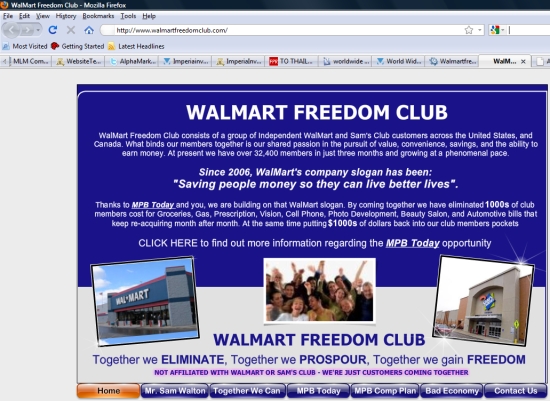
    Still other MPB Today affiliates taped commercials for the enterprise inside Walmart stores. Some promoters asserted Walmart was affiliated with MPB Today and approved by the government. One MPB Today affiliate videotaped a UPS driver making a delivery of a television set.

    The video’s narrator said the TV has been purchased “kind of, indirectly” with a Walmart gift card from MPB Today. Other MPB Today affiliates claimed a one-time purchase of $200 in groceries from Southeastern Delivery set the stage for MPB Today affiliates to receive free groceries and gasoline for life.

    Clinton once sat on Walmart’s board of directors. Why some MPB Today affiliates apparently believed it prudent to attack Democratic politicians in a bid to sign up MPB Today affiliates remains unclear.

    Promos for MPB Today were targeted at foreclosure subjects, Food Stamp recipients and the poor — and victims of the Florida-based AdSurfDaily Ponzi scheme. In 2010, Walmart declined to comment on MPB Today-related claims.

    Some MLM “opportunities” are infamous for implying in promos that they’re endorsed by famous business people or famous companies. MPB Today used images of Donald Trump and Warren Buffett in promos, and affiliates regularly implied that Walmart had endorsed MPB Today.

    From our files:

    1.

    mpbtodayobamalarge11

    2.

    mpbtodayupsdrivesmall

    3.

    mpbtodayfreedomsmall2

  • DEVELOPING STORY: Zeek Winners Begin To Receive Subpoenas

    Alleged Ponzi scheme Zeek Rewards wrapped itself in the American flag and symbols such as the American penny coin to attract business. The purported “opportunity”  has created problems for hundreds of thousands of members in the United States and other countries.

    The PP Blog has received a report that some members of Zeek have received subpoenas issued by the court-appointed receiver in the Zeek Rewards Ponzi scheme case. The SEC alleged in August that Zeek was a $600 million Ponzi and pyramid scheme operated by Paul R. Burks and Rex Venture Group LLC.

    Receiver Kenneth B. Bell said earlier this week that a first round of about 1,200 subpoenas would be issued to “affiliates who profited most from ZeekRewards.”

    Early details are sketchy about precisely what information the subpoenas demand. Bell wrote on the receivership website that recipients “are required to fully respond to the subpoena.

    “If you do not have possession, custody or control of any of the documents requested simply say so in responding to the subpoena. However, you are required to make a full reasonable effort to locate all documents requested, including electronic documents and email,” Bell wrote.

    The issuance of the subpoenas demonstrates that online HYIPs dressed up as multilevel-marketing “programs” can — at a minimum — create civil exposure for participants. Profits received from such schemes are viewed as ill-gotten gains subject to clawback.

    In an Oct. 8 court filing, Bell advised Senior U.S. District Judge Graham C. Mullen that he planned to pursue Zeek winners and others through common-law and and clawback claims “under applicable fraudulent transfer statutes.”

    In addition to Zeek winners, potential clawback targets include Zeek officers, employees and professionals who benefited from the scheme, according to Bell’s Oct. 8 filing. As many as 100,000 people potentially received ill-gotten gains from Zeek, while about 800,000 Zeek members experienced losses.

    Zeek wrapped itself in the American flag while pitching its offer globally, claiming among other things that winners of its Zeekler auctions for sums of U.S. cash would be paid through offshore payment processors. North Carolina-based Zeek has never explained the striking incongruity of auctioning U.S. cash and offering to deliver it via payment processors linked to fraud scheme after fraud scheme promoted on Ponzi scheme forums such as TalkGold and MoneyMakerGroup.

    Auctions for cash mysteriously went missing from Zeek in June. On Aug. 4, 13 days before the SEC filed an emergency action to halt the alleged Zeek Ponzi scheme, the company publicly complained about “North Carolina Credit Unions” that were warning customers about Zeek.

    On June 5, the company bizarrely planted the seed that, if Zeek instructed members to change their preference in dispensing toilet paper, they should do it to demonstrate how coachable they are. Just days earlier — on May 28, Memorial Day — the company claimed it was closing two U.S. bank accounts and urged members to cash commission checks by June 1 or they would bounce.

    Zeek’s auction arm was known as Zeekler and was married to Zeek Rewards, the MLM side of the business. The SEC said in August that Zeek commingled funds and that Burks “unilaterally and arbitrarily” determined Zeek’s daily dividend rate so that it averaged “approximately 1.5% per day, giving investors the false impression that the business is profitable.”

    In 2008 and 2009, the U.S. Secret Service made similar allegations against AdSurfDaily and operator Andy Bowdoin. Bowdoin, 77, was charged criminally in December 2010. He pleaded guilty to a Ponzi-related charge of wire fraud in May 2012. Bowdoin was sentenced in August 2012 to 78 months in federal prison.

    ASD operated as an “autosurf” HYIP that planted the seed that members would receive a return of 1 percent a day.

    Precisely how many Zeek members live outside the United States and benefited from the scheme is unclear. In July, the PP Blog reported that a Zeek-related article carried on Google News claimed that Zeek had 100,000 members in Brazil alone.

    An issue that potentially could emerge in the coming weeks is whether the receiver will be successful in seeking clawbacks from non-U.S. members of Zeek who received more from the scheme than they put in. How many Zeek members fit the profile is not yet known.

    HYIPs that operate across borders on the Internet introduce the specter of international red tape and also potentially bring language barriers into play. In the days after the SEC brought the Zeek case, some purported international members of Zeek effectively thumbed their noses at the United States and Zeek victims, crowing on Ponzi-scheme forums that they’d keep their Zeek money no matter what.


  • UPDATE: As Proposed Money-Saving Measure, Zeek Receiver Asks Judge To Treat Oct. 8 Preliminary Liquidation Plan As Status Report; Meanwhile, Yet Another Zeek Member Declares Herself A Fraud Victim

    A woman who described herself as a Zeek victim filed copies of postal receipts in federal court today. Source: Screen shot of federal court files. Redaction by PP Blog.

    UPDATED 8:26 A.M. EDT (OCT. 31, U.S.A.) Saying it would save money, the court-appointed receiver in the Zeek Rewards Ponzi scheme case has asked a federal judge to treat the receiver’s Oct. 8 preliminary liquidation plan as a status report. (See Oct. 9 PP Blog story.)

    Separately, yet another Zeek member has declared herself a victim of the alleged $600 million Zeek fraud scheme operated by Paul R. Burks and Rex Venture Group LLC. Two other Zeek members effectively did the same thing earlier this month. On Aug. 17, the SEC alleged that Zeek was a massive Ponzi- and pyramid scheme that potentially fleeced more than 1 million people.

    In August, Senior U.S. District Judge Graham C. Mullen of the Western District of North Carolina ordered receiver Kenneth D. Bell to file the first status report in the case by Oct. 30. Among other things, status reports inform judges about the efforts under way to recover proceeds linked to alleged fraud schemes and return them to victims.

    In the Zeek case, status reports are due within 30 days of the end of a quarter — for example, the third quarter of the calendar year ended Sept. 30, making the first Zeek status report due Oct. 30. The second is due Jan. 31, 2013, a month after the end of the fourth quarter of the calendar year on Dec. 31, 2012.

    Bell said in court filings today that the information in the Oct. 8 report included “the same information” due today.

    “Given that a separate Quarterly Status Report would be redundant, and in the interest of preserving Receivership assets, the Receiver respectfully requests that the Court order that the Preliminary Liquidation Plan be treated as the Receiver’s First Quarterly Status Report,” Bell petitioned Mullen.

    Mullen had not acted on the request by late this afternoon, according to the docket of the case.

    How Zeek enthusiasts on Ponzi-scheme boards such as TalkGold and MoneyMakerGroup will react to Bell’s request was not immediately clear. One-percent-a-day (or more) schemes such as Zeek gain a head of steam in part because willfully blind scammers who populate the Ponzi cesspits position the “programs” as legitimate.

    The demonization of Bell on the Ponzi boards and elsewhere began shortly after the SEC brought the Zeek case. As was the case in the AdSurfDaily prosecution brought by the U.S. Secret Service in 2008, some Zeek members have claimed that the government is manufacturing victims where none exist. The ASD and Zeek Ponzi schemes fetched a combined sum of at least $719 million, nearly three-quarters of a billion dollars, according to court filings.

    Both frauds operated as classic Ponzi schemes that recycled money from members to create the illusion of sustainability and profitability, according to investigators.

    Both Zeek and ASD were promoted on forums listed in federal court filings as places from which Ponzi schemes are promoted. Earlier schemes promoted on the forums include Legisi and Pathway To Prosperity, which gathered a combined sum of more than $140 million and affected tens of thousands of people, according to court filings.

    Legisi operator Gregory McKnight faces sentencing next month in his Ponzi scheme case. Alleged Pathway To Prosperity operator Nicholas Smirnow, meanwhile, is listed by INTERPOL as a wanted fugitive. As was the case with Zeek, the SEC and Secret Service led the Legisi probe. The U.S. Postal Inspection Service brought the Smirnow/Pathway to prosperity case, saying the scam affected individuals in 120 countries.

    ASD operator Thomas A. “Andy” Bowdoin is serving a 78-month prison sentence. He was sentenced in August 2012.

    Despite claims that Zeek created no victims, at least three individuals already have claimed in court filings to have been scammed by Zeek.

    In a filing docketed today, Maria Aide Gomez claimed she sent North Carolina-based Zeek parent Rex Venture Group five postal money orders for $1,000 each in May and paid an additional $300 to maintain her Zeek membership.

    Gomez described herself as a “Victim of fraud and deception” on the part of Zeek, Rex Venture Group and Paul R. Burks, the operator of Zeek and Rex Venture. The money orders Gomez sent to Zeek were purchased at a post office in Washington state, according to exhibits that accompanied the filing.

    Bell, the receiver, is experienced as both a defense attorney and a prosecutor. The U.S. Department of Justice lauded Bell a decade ago for his successful prosecution of a Hezbollah terrorist cell operating in the United States.

  • $250 Million-Plus Ponzi ‘Arbitrage’ Scheme In South Africa Allegedly Led To Murder/Suicide; A ‘Tangled Web Of Close Corporations, Trusts And Offshore Bank Accounts’

    MoneyWeb has the story of Relative Value Arbitrage Fund (RVAF), an alleged massive Ponzi scheme in South Africa in which Herman Pretorius shot and killed a business partner in July and then shot and killed himself.

    The scheme appears to have gathered R2.2bn, the equivalent of more than $250 million (U.S.).

    From Julius Cobbett at MoneyWeb (italics/bolding added):

    RVAF curators estimate that the scheme received R2.2bn from about 3000 investors. At the time of Pretorius’s death, the RVAF owed an estimated R3.1bn to investors.

    The difference between the amount received and owing is most likely explained by the fund’s performance, which is believed to be fictitious.

    Investigations following Pretorius’s death show that he alone was in control of a tangled web of companies, close corporations, trusts and offshore bank accounts.

    Read the MoneyWeb story.

    NOTE BY PP BLOG: Some scammers on Ponzi-scheme forums also purport to engage in “arbitrage.” The collapse of purported arbitrage “program” Gold Nugget Invest (GNI) in 2010 brought out the “conspiracy theorists,” the PP Blog reported at the time.

    Among the bizarre assertions was that the SEC was under investigation by INTERPOL.

    It is common for Ponzi-board scammers to use terms that sound impressive — arbitrage, for instance — in their scams.

    “Ken Russo,” a former Ponzi-board pitchman for the alleged Zeek Rewards Ponzi scheme, was promoting something called “NewGNI” even as he was promoting Zeek, according to his posts at the TalkGold Ponzi forum (as “DRdave”).

    NewGNI may be a follow-up scam to the GNI scam.

    Read a January 2010 PP Blog story on some of the bizarre claims surrounding the collapse of GNI, a scheme also pushed by some members of the AdSurfDaily Ponzi scheme.

  • UPDATE: Teetering ‘Wealth4AllTeam’ Scheme Reportedly Was Using I-Payout, Same Facilitator Cited By ‘OneX’ Scheme In July

    Screen shot: I-Payout website showing logos of "Global Strategic Partners." Ponzi-forum reports surfaced yesterday that the Wealth4AllTeam HYIP scheme was using I-Payout. In July, a scheme known as "OneX' that federal prosecutors previously described as a fraud and a "pyramid" announced that it was transitioning to I-Payout.

    UPDATE: Wealth4AllTeam, one of the many HYIP schemes pushed by Zeek Rewards “I Got Paid” cheerleader “Ken Russo,” reportedly was using I-Payout as a payment facilitator, according to new Ponzi-forum reports.

    Wealth4AllTeam appears to have suspended operations, leaving the Ponzi forums in an uproar amid claims that it is transitioning to a new business model that incorporates something called “Project Genesis.”

    Earlier this year, Wealth4AllTeam planted the seed that it would sue the RealScam.com antifraud forum  for publishing information unfriendly to Wealth4AllTeam.

    “I-payout quick links has been removed….all the attached bank account has been deactivated..there is no option left to deposit or withdraw…Looks like W4all have a hold on I-payout,” MoneyMakerGroup poster “jhakas22” claimed yesterday.

    If the report is true — and MoneyMakerGroup poster Tobwithu claimed that he (or she) “can confirm that all links at i-payout are gone!’ — then it means that Wealth4AllTeam was using the same facilitator to which the mysterious “OneX’ scheme claimed it was transitioning.

    In April, federal prosecutors described the purported OneX “program” as a “fraudulent scheme” and “pyramid” pushed by former AdSurfDaily President Andy Bowdoin. ASD was a $119 million Ponzi scheme. In August, Bowdoin was sentenced to 78 months in federal prison.

    On July 19, the PP Blog reported that OneX claimed it had dropped SolidTrustPay — a Canada-based processor linked to fraud scheme after fraud scheme — in favor of I-Payout. That announcement was made by “J.C.,” later identified by federal prosecutors as James C. Hill.

    I-Payout’s website publishes the logos of HSBC, Deutsche Bank, Barclays and other “Global Strategic Partners,” including Bank of America.

    “J.C.” made the OneX I-Payout announcement on July 17, the same day the U.S. Senate Permanent Subcommittee on Investigations was grilling HSBC executives on HSBC’s anti-money-laundering practices, including an executive who announced his resignation in front of the panel.

    (Also see June 20 PP Blog report about OneX claim that it was working with a processor with a tie to Bank of America. Given events that occurred after the dropping of Bank of America’s name and the appearance of the bank’s name on the I-Payout site, it appears “J.C.” was alluding to I-Payout in June.)

    Any number of ASD Ponzi-scheme pushers used Bank of America’s name to sanitize the ASD fraud. In raising Bank of America’s name in June and announcing the I-Payout transition in July, OneX appears to have been doing the same thing.

    Name-dropping to sanitize fraud schemes is common in the HYIP sphere. So are lawsuit threats and other bids to chill websites that publish information critical of HYIPs.

    In July, Robert Craddock, a purported “consultant” for Rex Venture Group LLC — the operator of the Zeek Rewards MLM scheme — sought to have a HubPages site operated by Zeek critic “K. Chang” removed from the web by filing a complaint with HubPages about purported copyright and trademark infringement and libel. Craddock’s efforts succeeded temporarily.

    In a bizarre Blog post on Aug. 4, Zeek claimed that “all” criticism of Zeek was unfair and planted the seed that unspecified “North Carolina Credit Unions” were circulating a purported “internal memo” that allegedly was “at once unfavorable to Zeek Rewards and false.”

    The Zeek post, attributed to then-acting COO Gregory J. Caldwell, complained the credit unions were slandering Zeek and warned Zeek members to toe the company line.

    Thirteen days later, the SEC filed an emergency court action that described Zeek as a $600 million Ponzi- and pyramid scheme.

    Craddock now is involved in a purported effort to defend Zeek affiliates from clawback actions by the court-appointed receiver in the SEC’s Zeek case. That effort began after the SEC’s actions against Zeek and also included name-dropping. During a pitch for Zeek members to send in money, Craddock dropped the name of former Florida Attorney General (and former U.S. Rep.) Bill McCollum.

    McCollum, now a partner at the SNR Denton law firm, no longer is in public office. Precisely why Craddock mentioned McCollum’s name is unclear, although Craddock initially said that the Zeek affiliates were hiring SNR Denton. That effort appears now to have fallen through.

    As Florida’s Attorney General, McCollum sued ASD for fraud in August 2008. Some ASD members countered that McCollum should be sued for Deceptive Trade Practices for holding the view that ASD was a fraud. Although McCollum’s office later dropped the ASD lawsuit, it said it had gathered names of ASD fraud victims and provided them to the U.S. Department of Justice, which had established a remissions process through which ASD victims could receive compensation from proceeds seized by the U.S. Secret Service in the ASD Ponzi case filed at the federal level in the District of Columbia.

    Zeek is known to have members in common with the ASD Ponzi scheme. Some Zeek members also promoted OneX, the scheme promoted by ASD’s Bowdoin after his December 2010 arrest by the U.S. Secret Service on Ponzi-related charges of wire fraud, securities fraud and selling unregistered securities.

    Bowdoin told prospects that OneX was good for “college students.”

    “Ken Russo” also is known as “DRdave.”

  • BULLETIN: Citing Gregory McKnight’s ‘Semantic Obfuscation,’ Prosecutors Ask Judge To Sentence Convicted Legisi HYIP Swindler To 15 Years — ‘The Top Of The Sentencing Guidelines’; Like Zeek, ‘Program’ Was Pushed On The Ponzi Boards And Instructed Members Not To Use The Word ‘Investment’

    This grainy likeness of Legisi HYIP operator Gregory N. McKnight appears in U.S. court files.

    BULLETIN: Yesterday’s scheduled sentencing of convicted Legisi HYIP swindler Gregory N. McKnight has been delayed until Nov. 19, but federal prosecutors in the Eastern District of Michigan have asked U.S. District Judge Mark A. Goldsmith to sentence McKnight to 15 years in prison.

    McKnight and Legisi relied on “semantic obfuscation” in which investors were told they were joining a “loan program,” not making an “investment,” prosecutors said.

    A 15-year sentence is at “the top of the sentencing guidelines of 151-188 months” and “may serve to discourage others who are inclined to involve themselves in similar criminal conduct,” prosecutors argued to the judge.

    In February, McKnight, 52, pleaded guilty to wire fraud in the Legisi Ponzi caper. The scam, which planted the seed a return of between .25 percent a day and 12 percent a month was possible, was popularized in part on Ponzi boards such as MoneyMakerGroup and Talk Gold.

    Court filings show that Legisi used some of the same payment processors used by the AdSurfDaily Ponzi scheme, including e-Gold and e-Bullion. ASD operator Andy Bowdoin was sentenced in August to 78 months in federal prison.

    “The principle mechanism by which investor funds would be funneled to defendant was through the utilization of the internet via digital currency, particularly e-gold and e-bullion,” prosecutors said in the McKnight sentencing memo. “The use of these non-traditional funding methods provided McKnight with the opportunity (at least for a while) to conduct the scheme below the radar of regulators.”

    And, prosecutors pointed out, “[i]n 2007, the United States government seized the property in approximately 58 e-gold accounts due to various criminal violations, including McKnight’s account . . . Moreover, in 2008, e-gold and its operators were convicted of money laundering and conspiracy to defraud the United States . . . And in 2006, the United States government commenced a forfeiture suit against e-bullion for operating an unlicensed money transmitting business, wire fraud, and money laundering . . . James Fayed, the owner and operator of e-bullion, was later convicted in the State of California of having his wife murdered and sentenced to death row.”

    Legisi gathered about $72 million. The SEC and the U.S. Secret Service led the probe, which resulted in civil charges against McKnight by the SEC and a criminal charge of wire fraud against him by the Secret Service.

    Legisi pitchman Matthew John Gagnon also was charged civilly and criminally in the Legisi case.

    From the prosecution’s sentencing memo on McKnight (italics added/bolding in original):

    As if the exorbitantly high interest rates were not enough to induce investors into defendant’s scam, Legisi also offered a referral program whereby investors could earn a 5% to 7% commission on the amount of new funds that a referred investor placed in the program. As McKnight explained, “[a]s an Active Member of Legisi.com, you are encouraged to refer friends, colleagues, and your own website visitors to us and benefit from an additional source of income — a 5% – 7% incentive bonus for each new account opened by your referrals and on any and all future deposits from them!”

    Legisi was an acronymn that stood for “Lucrative Electronic Gold Income Services International,” prosecutors said. HYIP schemes spread in part because unlicensed/unregistered brokers (such as Gagnon) push them online to earn “commissions.”

    The MoneyMakerGroup Ponzi forum — one of the outlets from which Legisi was pushed — is specifically referenced in court filings in the Legisi case.

    Zeek Rewards, which the SEC described last month as a $600 million Ponzi- and pyramid scheme selling unregistered securities, also was heavily pushed on the Ponzi forums. Zeek used both domestic and offshore financial vendors, including AlertPay and SolidTrustPay in Canada.

    Zeek planted the seed it could provide a return of between 1 percent and 2 percent a day, far higher than Legisi’s maximum suggested payout of 12 percent a month. Like Zeek, ASD suggested a payout on the order of 1 percent a day. The ASD scheme gathered at least $119 million, federal prosecutors in the District of Columbia said.

    ASD relied on wordplay to dupe investors. So did Legisi, prosecutors said in the McKnight sentencing memo (italics added):

    In addition to operating a Ponzi scheme, McKnight committed various securities violations. While McKnight himself referred to Legisi as a “loan” program, and demanded that “members” not refer to their “loan” and an “investment,” Legisi was, in reality, an investment contract, which is considered a security and therefore regulated by the Securities and Exchange Commission. This semantic obfuscation was quite obviously an attempt to sidestep the securities laws.

    From a footnote in the prosecution’s McKnight sentencing memo (italics added):

    [Legisi] Investors originated from all 50 states and approximately 33 foreign countries (Australia, Bahamas, Belgium, Canada, Cyprus, Demark, England, France, Finland, Germany, Greece, Iceland, India, Ireland, Israel, Italy, Japan, Netherlands, New Zealand, Norway, Malaysia, Mexico, Nigeria, Philippines, Saudi Arabia, Singapore, Slovenia,
    South Africa, South Korea, Sweden, Spain, Thailand, Trinidad West Indies).

    Read the prosecution’s sentencing memo on McKnight and recommendation of 15 years’ imprisonment.