We have received a few inquiries about a new surfing program called AdPayDaily (APD). Our initial take is that the program is a dressed-up version of AdSurfDaily, AdViewGlobal, BizAdSplash and AdGateWorld and that the operators are persuaded they’ve found a word combination and legal structure that will neutralize critics and law enforcement should concerns about the sale of unregistered securities and a Ponzi and pyramid scheme be raised.
AVG, BAS and AGW were positioned by former ASD members as offshore “clones” of ASD. APD, like ASD, appears to be operating in the domestic United States.
In our view, APD’s presentation raises numerous red flags. At a minimum, it is starting out as an MLM absurdity, if not a potential monstrosity. To get a flavor of the absurdity, imagine that Walmart was clueless enough to start an autosurf and provide a corporate-approved greeter who says, “Welcome to Walmart Pay Daily. We count all the money out of sight in the back room at midnight to determine how much you get, and keep 50 percent of the cash for ourselves. Don’t worry. We have excellent lawyers, and we’ve instructed the money-counter not to rip you off.”
That’s effectively what APD is saying.
Another red flag is the fax number listed on a document APD refers to on its website as “Ad Pay Daily’s Conference Registration Form For July 30th and 31st 2010.” The fax number is listed online as a number used by a Kansas real-estate flipping company billed as National Flips. Like APD, the National Flips domain registration is hidden behind a proxy, although the website says this: “To learn how to become a Hard Money Lender and earn 30+% per annum, call [a telephone number] . . .”
Meanwhile, the invitation for the APD conference that uses the National Flips fax number says this — not once, but twice: “Any person who does not provide photographic proof of identity will not be permitted to attend this event, so don’t forget your photo ID.”
Why a photo ID would be required to attend a sales pitch for an advertising company is left to the imagination. Undercover Secret Service agents have been known to attend such functions, however.
Virtually every autosurf that has come along has used strange approaches or applied language tweaks designed to skirt securities laws, disarm critics and sanitize the “opportunities” for prospects. Serial autosurf promoters are infamous for telling prospects that a particular surf has found the magic pill that makes everything legal. Historically they rely on the surf operators to provide a legal cover. When things go south, they claim no one can blame them for promoting the schemes. After all, they relied on the assertions of the operators that everything was above-board and legal. They have been disingenuous in the same way that Alfred E. Neuman, Mad magazine’s fictional mascot, was disingenuous.
“What, me worry?”
Worry, however, appears to be front-and-center at APD, which is preemptively denying in multiple places that it is a Ponzi scheme. This strikes us as a big red flag. There are others.
ASD, Surf’s Up Members Become APD Players
During its early research into APD, the PP Blog has determined that a number of members of the alleged AdSurfDaily autosurf Ponzi scheme have high positions in the APD venture. Some of the former ASD members hold more than one position in the top 80 positions in APD, including a former Surf’s Up Mod who appears to hold positions 76 and 77. It is possible that another Surf’s Up Mod also is high up in the pecking order of APD affiliates at No. 56.
The Blog determined the names of APD promoters by researching the method by which APD creates affiliate links. At least one ASD member who made himself part of the ASD Ponzi litigation by submitting pro se pleadings holds positions 9 and 10 in APD, according to the affiliate links.
Surf promoters are not fond of pointing out the pain of previous prosecutions of autosurfs and the time-consuming and expensive litigation involving both the government and court-appointed receivers that may occur when a surf collapses. It is not uncommon for millions of dollars to go missing in a surf.
ASD’s Andy Bowdoin has told members that he has spent more than $1 million in his legal defense. Nothing (other than GIGO passed along by promoters) suggests Bowdoin was a man of means prior to the Secret Service raid on ASD’s headquarters in August 2008. His money for his defense appears to have come from ASD members. On a side note, Bowdoin tried to persuade members in September 2009 that the million dollars he dropped to keep himself out of prison was for their benefit. At the same time, he claimed his fight with the government was inspired by a former Miss America.
ASD gathered at least $65.8 million. When the sum seized in the Golden Panda Ad Builder action, which is part of the ASD litigation, is factored in, the number surges to more than $80 million. That’s a big number, of course — one that shows why others want to start surfs and just tweak and tweak and tweak in search of the elusive magic pill.
APD’s website was registered on Nov. 18, 2008. That’s just one day before U.S. District Judge Rosemary Collyer ruled that ASD had not demonstrated it was a lawful business and not a Ponzi scheme. APD’s domain-registration date also coincides with a string of registration dates by the so-called ASD clones:
Aug. 18, 2008: Domain name for AdGateWorld registered. (About two weeks after the ASD raid by the U.S. Secret Service, which is working in concert with the IRS and federal prosecutors.)
Sept. 22, 2008: Domain name for AdViewGlobal registered. (AVG had very close ties to ASD.)
Nov. 7, 2008: Domain name for BizAdSplash registered. (ASD and Golden Panda figure Clarence Busby purportedly was both the “chief consultant” and owner of BAS.)
APD’s domain was registered just 11 days after the BAS domain was registered and only a couple of weeks before ASD declared that the now-defunct Surf’s Up forum was its official organ for ASD news. Surf’s Up became infamous for shilling for Bowdoin, fracturing the facts of the ASD wire-fraud and money-laundering case and misinforming members.
Each of the surfs in the bullet points above failed spectacularly. Each of them blamed members for their problems. Each of them had promoters and members in common with ASD. Each of them also offered various “bonuses” to join — something APD is doing at the moment.
BULLETIN: Ponzi suspect Alan Todd May of Dallas has been captured by the U.S. Marshals Service in San Francisco.
May, 45, was wanted by the U.S. Secret Service. In March, the SEC accused May of running an oil-and-gas Ponzi scheme through companies variously known as Prosper Oil & Gas Inc. and Prosper Energy Inc.
May, who has a long criminal record and was described by the SEC as a “felon,” assumed “multiple identities to evade apprehension,” according to U.S. Marshal Federico Rocha.
May pitched his scheme in ads in the Wall Street Journal, Barron’s, the Oklahoman, the Jewish Voice, the Abilene Reporter and on eBay, the SEC said in March.
Records show that May was arrested 13 times between 1983 to 2002 for crimes such as theft, theft by check and credit card abuse. He also had been apprehended for probation violations and failure to appear in court.
“These arrests resulted in at least 14 convictions, with dispositions ranging from probation to 20-years’ imprisonment,” the SEC said. “Most recently, he was released from prison in or about 2007.”
In his latest scheme, the SEC said, May sold royalty interests in wells in to at least 99 investors, advertising returns of up to 38 percent.
“May or other Prosper employees used investor funds for various lavish personal expenses, including approximately $611,000 for vehicle purchases and expenses (including purchases by May of a Ferrari, a BMW and a Mercedes), $400,000 in credit card payments, $430,000 for meals, entertainment and retail purchases, $324,000 in travel expenses, and $89,000 in cash withdrawals,” the SEC said in March.
“In addition, during the scheme, May and Prosper acquired multiple houses and condominiums, including homes in Dallas, each valued at approximately $1.5 million. May also caused $611,000 in investor funds to be transferred to his personal bank accounts,” the SEC said.
The Marshals Service said the scheme may involve $7 million.
Records suggest May was booked into the Glenn E. Dyer Detention Facility in Alameda County without bail.
“This arrest was a result of the combined efforts of the Dallas Fort Worth Fugitive Apprehension Strike Team, U.S. Secret Service and the Northern District of California Fugitive Task Force,” the Marshals Service said.
NOTE: This story has been republished at a URL that is different than its original URL. Although this post reflects a date of June 13, it is not the original publication date. Click here to read why.
EDITOR’S NOTE:UPDATED 9:22 P.M. EDT (June 7, 2010, U.S.A.) This post is presented in seven parts. With the exception of the lengthier introduction, each part includes six to eight paragraphs. You’ll see a “GO TO PAGE” prompt at the bottom of each section. Simply click on the next page number to continue reading.
The post takes a stark look at two recent court cases. WARNING: Some readers may find the content objectionable because it describes family-unfriendly events that occurred as a result of HYIP Ponzi schemes that operated in the Forex and futures spheres and promised huge returns. We are publishing the post because we believe it is in the public interest to do so. It reflects this Blog’s view that Ponzi apologists and pitchmen pushing unrealistic, unsustainable returns on forums and though other forms of mass communication are undermining family economies and regional economies, while threatening national economies and posing significant security risks to the nations of the world.
If you are still pushing HYIP and investment-fraud schemes on the Ponzi boards, lying to yourself by clinging to the notion that such schemes are “games” and you’re causing no real harm by promoting them or introducing people to the “opportunities,” be advised that these cases may interrupt your fantasy.
One of the cases is about how a woman who thought she had met a successful and generous man through an online dating service was ordered to surrender her property in Florida, despite the state’s famous Homeowner’s Exemption. The second case is about how a woman who became romantically involved with a Ponzi schemer lost just about everything. At the moment, there are hundreds of Ponzi and fraud cases with significant social and economic consequences either being investigated or working their way through the courts.
We’ll start the editorial with the case involving the Florida woman who lost her home because it was paid for with Ponzi proceeds, even though she was unaware she had been given money from a Ponzi.
After we outline the Florida case, we’ll turn your attention to a separate case in Tennessee in which a woman who received illegal proceeds from her Ponzi operator/paramour lost the value of a home paid for with Ponzi proceeds and lost the value of hundreds of thousands of dollars in cash and gifts that flowed from the Ponzi.
The paramour in the Tennessee case, Luis H. Rivas, initially fled after being exposed. He ultimately was captured, arrested, charged in both federal and state courts and convicted. In November, he was sentenced to nearly 25 years in prison. Meanwhile, federal records show that the woman, Pamela Morgan, now owes the Rivas bankruptcy estate $235,100 to cover fraudulent cash transfers, $225,000 to cover a fraudulent transfer that was plunked down on a new home, $82,266 to cover fraudulent transfers that led to the purchase of a Volkswagen Toureg, and $9,821 to cover fraudulent transfers that led to the purchase of furniture.
In the end, a federal judge also determined that Morgan owed the estate $11,000 to cover fraudulent transfers that led to the purchase of her engagement ring after she left her marriage for Rivas, who previously had spent years in prison for another fraud scheme.
When Rivas was sentenced by a federal judge in November, some of the victims asked the judge to go light on him or not even to order a jail sentence. After all, they reasoned, should Rivas be permitted to return to the Forex HYIP business, he just might be able to reverse his $35 million fraud and make everybody whole.
That he’d previously been sentenced to more than a decade in prison for running cons and, in fact, had fled when his latest con was exposed somehow did not fully compute. Some victims said they believed he should be set free to resume his purported trading program, thus viewing a $35 million fraud like a traffic-court case in which the defendant was charged with an innocuous offense such as overtime parking and viewing the fraudster himself as the remedy, not the problem.
This sort of thinking is so obviously flawed that it reads like fiction and challenges readers to suspend their disbelief — but it surfaces on a daily basis because both promoters and true victims in the schemes have a profound need to create psychological wiggle room.
In the case of true victims, the wiggle room is needed because acknowledging they have been conned in a fraud and have little hope of making a full recovery simply is too painful to contemplate. In the cases of the Ponzi players and pitchmen, the wiggle room is needed to let them off the hook and to rationalize continued participation in the frauds, which often pay commissions to recruiters for bringing in new marks whose money is used to reward earlier participants in the schemes.
The tortured result is to give aid and comfort to the thieves who caused spectacular losses while at once directing tiny daggers to the law-enforcement agencies, courts, receivers and trustees who suddenly have a glut of Ponzi cases that have consumed billions of dollars and altered the lives of tens of thousands of victims.
If you are collecting commissions and/or salary and payments from such schemes or recommending the schemes to prospects on the Internet, through the mails, through conference calls or other group functions or though other forms of mass communications, you are setting the stage for misery that could lead to the sort of court actions described in this post.
This misery includes protracted litigation, insoluble personal problems, romantic conflicts, conflicts with friends, family and acquaintances, attorneys’ bills, dispossessions and hourly, spirit-crushing stress.
Promoter? Awake yet?
What you are doing by involving yourself in HYIPs and investment frauds as a promoter or wink-nod cheerleader is deluding yourself by slipping into a convenient psychology that lets you off the hook for the pain you potentially are causing both people you know and strangers alike. While you are arguing that pushing such schemes is a sign that you embrace “freedom of choice” and that only psychologically unhealthy people would see things a different way, you are revealing yourself as a pusher of poison and hiding behind your bogus manta of self-actualization. Your delusion is on display for all the world to see, and your purported journey toward self-discovery is more accurately described as the relentless pursuit of criminal self-indulgence.
God pity the world if your delusions of self-actualization gain a viral following. Bottom line: You are participating in schemes that create endless nightmares, undermine families and family economies, undermine regional economies and threaten national economies and the security of nations worldwide — and you’re trying to sell yourself on the impossible notion that you’re somehow a modern-day freedom fighter and that the rest of society and the reporters and Bloggers who cover the schemes just don’t “get it.”
Take these three things to the bank:
Wherever there is an HYIP or autosurf Ponzi scheme, there is a player railing against the government. Wherever there is an HYIP or autosurf Ponzi scheme, there is a player railing against reporters and Bloggers and forum posters who are trying to educate the public about such schemes and the lengths to which players go to sanitize the schemes and rationalize their behavior, which is a cancer on the world.
And wherever there is an HYIP or autosurf Ponzi scheme, there is a player railing against the court-appointed receiver or trustee. The player paints the false picture that the receiver or trustee’s greed is the issue — all while the player conveniently ignores the fact that the schemers created the situation that made it necessary for the court to appoint professionals to unravel these hugely complex frauds through a supervised, costly, time-consuming process that is undertaken only because of the conduct of fraudsters and their shills and apologists.
With each passing day — as more and more schemes emerge — players are further marginalizing themselves, further identifying themselves not only as a criminals, but as a delusional ones. Society at large does, indeed, “get it.” What it “gets,” plainly, is the correct notion that HYIP and autosurf Ponzi pushers are capable of conflating one convenient reality after another and shaping those realities to fit any awkward or bizarre circumstance that arises.
Despite your claims, neither you nor your marks are being denied freedom of choice. What you’re being denied is the license you divine yourself to commit crimes on a local, regional, national or international scale. If your theories had any validity at all, you’d be permitted not to feed the parking meters in your neighborhood simply because you are you and thus insulated from getting a ticket by the mere circumstance of you being you.
On a grander scale, you’d be permitted to create a license to steal huge sums of money simply because you are, well, you — and thus insulated from prosecution by the mere circumstance of you being you.
But it’s not about you; it’s about the lives you are helping to ruin through your relentless pursuit of thrill profits and your relentless insistence that the cops, the courts, the journalists, the forum critics and the receivers and trustees are all wrong and have ganged up against you in a giant conspiracy to strangle the human spirit and undermine freedom of choice.
Far from being a modern-day freedom fighter, you actually are a modern-day, delusional criminal — one who is waging a war on behalf of fellow criminals. You are cementing the destruction of wealth and potentially ushering in an era of a global Third World economy.
You are dangerous — and the law can’t get to you soon enough. Period.
Here, now, briefs on two cases that interrupt your forum delusions . . .
EDITOR’S NOTE: Here’s one for your Bubba Blue notebook on the various ways to have a Ponzi scheme, as opposed to shrimp.
UPDATED 5:50 P.M. EDT (U.S.A.) A Miami man has been charged by the SEC with gathering $40 million in a Ponzi scheme, pocketing $6 million for himself and telling investors they were helping him finance his Florida jewelry businesses and pawn shops in New York.
Investors believed their money was safe because it was backed by the man’s jewelry operations, diamonds and life insurance, the SEC said.
The trouble with the claims of Luis Felipe Perez, according to the SEC, was that he “had no dealings with pawn shops and never provided financing to them.”
UPDATE 5:50 P.M:Perez also has been charged criminally by federal prosecutors with six counts of securities fraud, after a probe by the U.S. Secret Service and U.S. Immigration and Customs Enforcement, according to U.S. Attorney Wifredo A. Ferrer of the Southern District of Florida.
The criminal case is part of an ongoing series of actions by the interagency Financial Fraud Enforcement Task Force, which President Obama established in November 2009, according to Ferrer’s office.
At the same time, the SEC said, two “purported” jewelry businesses owned by Perez — Lucky Star Diamonds Inc. and Luis Felipe Jewelry Design Corp. — “did not generate sufficient revenue to pay investors’ principal and interest payments.”
Clients did not know that “his primary source of money to pay investor returns was from new investors,” the SEC said.
Although Perez said his offering was backed by “diamonds” in a bank safety-deposit box, the purported diamonds in the box “were fake,” the SEC said.
Meanwhile, investors’ funds were not protected by a life-insurance policy as Perez had claimed because he had “defaulted on the policy premium” and allowed it to lapse, the SEC said.
“Perez created an aura of success around him to lure old and new acquaintances into investing substantial sums of money,” said John C. Mattimore, associate regional director of the SEC’s Miami Regional Office. “Behind the luster of diamonds and jewelry, Perez told outright lies and made promises he couldn’t possibly keep.”
While investors were imagining “guaranteed annual returns of 18 percent to 120 percent through monthly interest payments,” the SEC said, Perez spent $3.2 million of their money on a home, $1 million on jewelry for himself and his wife, $400,000 to lease luxury cars, $300,000 on clothing for his wife, $300,000 for travel by private jet and $100,000 on artwork.
In addition, Perez paid himself a salary of $250,000, gave away more than $1 million to family members and made $100,000 in political contributions, the SEC said.
The scheme collapsed in June 2009, when Perez “was no longer able to recruit new investors,” the SEC said.
Because the scheme largely targeted Hispanics, it also had an element of affinity fraud, the SEC said. About 35 investors were affected.
The U.S. Secret Service, U.S. Immigration and Customs Enforcement and the Miami Police Department assisted in the probe, the SEC said.
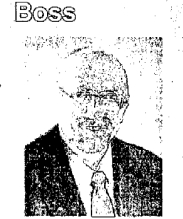
This grainy likeness of Legisi President Gregory McKnight is part of a PDF exhibit of evidence in the SEC's Ponzi case against the firm. This particular exhibit was gleaned on May 7, 2007, about 10 days prior to the entries in the case of undercover agents from the U.S. Secret Service and the Michigan Office of Financial and Insurance Regulation, according to court filings.
HYIP or autosurf Ponzi promoter? Player? Forum “expert?” Moderator? Cheerleader?
Get ready for a surprise: Your downline perhaps already has identified you as a pimp or even one of the masterminds.
If your plan is to continue to promote the programs on the Ponzi forums and though emails, you should know that things could be occurring behind the scenes that could put you four-square at the center of investigations. Not all HYIP and autosurf players are crooked. Not all of them understand the wink-nod nature of the HYIP and autosurf trades. In other words, they aren’t a crook or pimp like you and can’t be relied upon not to implicate you. They aren’t playing your game.
You, on the other hand, are a veteran pusher of Ponzi poison and perhaps a tax schemer who recommended yet another pig and painted it yet again with lipstick. Your victims very well may come to see themselves as your marks, as their knowledge of this shadowy and insidious business grows. Some of them will talk. Some of them have talked.
It’s now clear from court filings that some of them even are making handwritten notes and/or printing out emails and forum conversations — even if the forums purportedly are “private.”
And, speaking of “private,” how crazy are you going to look — and how vulnerable to prosecution are you going to be — if you happen to be pitching a purported “offshore” program that requires a loyalty oath and forces members to swear they aren’t government informants or agents?
Just agreeing to such bizarre terms potentially makes you a co-conspirator.
Here’s how silly you could end up looking later as you try to impress forum mates today with your “insider” knowledge and claims of due diligence. The reality you cannot deny is that an undercover investigation already could be under way into the program you’re pushing.
While you’re singing the praises of a company and talking about its purported expert management, you could be revealing yourself as just another willfully blind pimp while demonstrating your actual lack of knowledge about the programs you’re pushing.
Have you connected the dots yet? If not, here they are — in a nutshell: Your lack of knowledge can be construed as evidence of your guilt.You’re pushing programs you know virtually nothing about except what you’ve been told by people who rely on you to be the human equivalent of a trained seal who performs for a treat. You are not registered to sell securities, and you very likely are implicating yourself in a criminal wire-fraud, money-laundering and tax-evasion scheme.
There you are, pitching a program, professing your knowledge while perhaps even dissing the doubters, and you don’t even know the program you’re cheering already is the subject of an undercover investigation.
There’s a good chance the boss knows, though. He perhaps is in a secret panic. If word of the depths of the investigation leaks or the names of the agencies leak, well, the money stops streaming in. Maybe he didn’t tell you because he was too busy trying to figure out how to make it all go away when money was being seized in other investigations — and those seizures were leading to the choking of cash conduits for the programs you are pushing while purporting to be an expert.
Paperwork later could reveal you weren’t an insider at all (or at least not enough of one actually to have the ear of the boss), that you were just another commission-grubbing or “earnings”-hungry liar in a sea of commission-grubbing and earnings-hungry liars. You’d say anything for a commission, which is why you’re now the potential target of a criminal prosecution and an accompanying lawsuit filed by victims. You have criminal and civil exposure. At the very least, you could become an unindicted co-conspirator, which means the government holds the hammer and sees you as a potentially useful witness.
You never imagined yourself singing for your supper, of course. You were too busy picking the pockets of friends, neighbors and people you didn’t even know. If you get a break and become an unindicted co-conspirator, here’s what the jury will think as you’re singing for your supper: trained seal. Performed on cue for the schemers. Now batting the government’s ball to stay out of prison.
Jurors contemplating how you got yourself in this box actually will be willing to give an actual trained seal more credit. Seals perform for treats because they don’t know any better; you performed for money and did know better — and you likely knew the money was stolen to begin with.
Indeed, the marks who relied on your misrepresentations and claims of “due diligence” and other purported research could be maintaining a substantial paper trail. After all, it’s their money, and they want to make sure it’s safe. They’ve relied on your assertions. They’ll hold your feet to the fire when things start to go south, they’ll hold you to your claims and perhaps share your name, forum username and phone number with law enforcement.
What Willfully Blind Promoters Can Learn From The Legisi Case
Did you know that the U.S. Secret Service and the Michigan Office of Financial and Insurance Regulation (OFIR) sent undercover agents to interview Gregory McKnight, operator of the alleged Legisi Ponzi scheme, in May 2007, a full year before knowledge about the depths of an SEC investigation became public? Some Legisi members later learned the SEC was asking questions, but the inquiry was dismissed as routine. The SEC says Legisi continued to collect money up to November 2007, months after McKnight got the surprise of his life when he realized that two men with whom he had conversed actually were undercover agents.
It is likely that very few Legisi members knew that the Secret Service and OFIR had infiltrated Legisi in May 2007. Undercover agents walked right through the front door, according to court filings.
And did you know that the undercover agents were backed up by a Michigan state trooper who was only a short distance away — outside in the parking lot?
How silly do you think your forum posts, your cheerleading look now? You were championing a program that already was under investigation by at least three agencies that were in the process of sharing information and assembling a time-consuming case that crossed international borders. The public filings were 12 months away.
These are among many details about the probe, the paperwork for which originally was filed under seal by the SEC in May 2008. The Secret Service and OFIR agents posed as investors who wanted information on the Legisi program, which the SEC said was a massive Ponzi scheme. They recorded their discussion with McKnight, which took place in Legisi’s office in Flint, Mich. The Secret Service prepared a transcript of the conversation, which the SEC presented to a federal judge as part of 267 pages of exhibits used to gain an asset freeze.
After the undercover agents met with McKnight, they left the building and met with the trooper in the parking lot. A short time later, the agents — this time accompanied by the trooper — went back inside and presented their identification to McKnight, according to court documents.
Here’s what happened next, according to the SEC:
“Within hours of the interview, an announcement appeared on the Legisi website stating that the Legisi program was closed to new investors, effective immediately, and representing that Legisi had to close that afternoon because of a ‘massive influx’ of new investors.
“McKnight also cut off access to the Legisi website by the public by requiring a login and password to enter the site,” the SEC said.
After McKnight found out he had been talking to undercover agents, he told them that Legisi did not accept checks for the program. Even as the interview was taking place, an unnamed individual approached the office with a check made out to Legisi Marketing Inc., according to court filings.
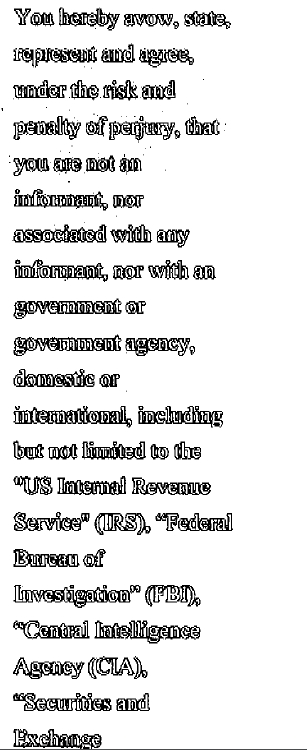
This section of the Legisi Terms of Service purports that members must avow they are not an "informant, nor associated with any informant" of the IRS, FBI, CIA and the SEC, among others. The others included "Her Majesty's Police," the Intelligence Services of Great Britain, the Serious Fraud Office, Interpol and others.
It has become clear that law enforcement is using multiple tools, including undercover operatives, infiltrations, Internet archives and notes kept by victims, to investigate and then prosecute HYIPs and autosurfs. Records viewed by the PP Blog show that the law-enforcement community is making one tie after another between and among various illegal investment businesses and their participants.
The common signatures of the promoters of these illegal enterprises are greed and wanton lawlessness — all so the scammers can enjoy the proceeds of theft. This work has not generated headlines; it mostly has gone about quietly, but there simply no longer is any doubt that multiple state and federal agencies have pooled resources and talents to destroy these insidious enterprises and a day of reckoning is at hand for the purveyors.
As the screen shot on the left shows, Legisi participants even were asked to certify that they weren’t “informants” or representatives of agencies such as the SEC, FBI, and IRS.
Last week the PP Blog wrote about the fraud case filed by the SEC against Mazu.com operator Matt Gagnon, Gagnon was accused of helping Legisi pull off a $72 million Ponzi scheme affecting more than 3,000 investors by using Mazu to shill for Legisi while not disclosing that “he was to receive 50% of Legisi’s purported ‘profits’ under his agreement” with McKnight.
Gagnon allegedly netted about $3.8 million in the scheme.
The filing of the complaint against Gagnon prompted the Blog to perform some more research into Legisi. Among the documents we obtained was the 267-page exhibit of evidence originally filed under seal by the SEC in the case against Legisi on May 5, 2008.
Prior to reading the document, we had wondered just how effective companies that purported to offer “private” HYIP and autosurf programs could be. For example, could these so-called “private” programs keep out what some investors describe as the prying eyes of government and the tax man?
If such purportedly programs offered a “private,” members’-only forum, could those forums have any expectation that the prying eyes of government and the tax man could be kept out?
“Private” is one of the big selling points of some HYIPs and autosurfs. We’ve always viewed the claims as dubious. After all, the schemes operate on the Internet. They involve people. People talk. It’s one thing to say you offer a “private” forum; it’s quite another to contain discussion to a single forum, perhaps especially when participants begin to smell a rat.
We learned this in a big way when we were covering events surrounding the collapse of the AdViewGlobal (AVG) autosurf last year. When some members finally removed their blinders, AVG had no way to contain discussion to its purportedly “private” forum — not that it should have had any expectation that it could contain discussion even if things were going swimmingly.
When AVG started to tank, some of its members couldn’t wait to share details about events that occurred in the “private” forum. Threats against them for purported copyright violations and to ban IPs and kick members out of the program for sharing information outside “association” walls did not work. In fact, they became the signatures of a scam in progress and the relentless efforts to hide it.
But getting back to Legisi and the issue of whether a “private” forum provided any protection for members and any insulation from the prosecution of Legisi . . .
It turns out that the government did not even have to “break in” to Legisi’s “private” forum, so to speak, to gain information on the program. Legisi members concerned about losing their money were keeping notes, including handwritten notes, and printing out page after page of posts from the “private” forum and Legisi’s own website.
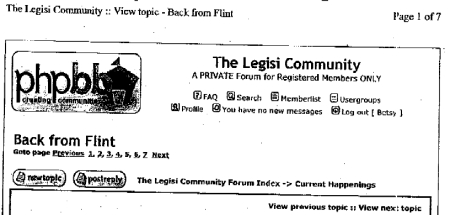
Included in evidence exhibits are page after page of posts from Legisi's "private" forum and other communications such as emails to customer service and printouts Legisi members made while visiting the company's website and keeping notes about the program.
Legisi members bothered by the company’s explanations and efforts to maintain secrecy when dealing with investors’ money turned over the information to the SEC.
Yep. Avatars, pictures, user names, real names and all.
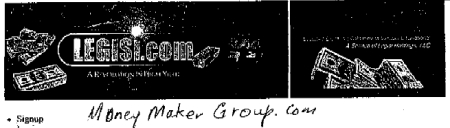
In this evidence exhibit given to a federal judge prior to the Legisi asset freeze, a Legisi prospect writes the name "Money Maker Group.com" in longhand. The prospect also wrote the name "Matt Gagnon" in longhand and a telephone number for Gagnon.
Prior to filing its case against Legisi, the SEC also had other hard-copy printouts from members, including emails and information from Legisi members’ back offices. At least one of the exhibits included the handwritten notes of a Legisi member.
The words “Money Maker Group.com” are spelled out in longhand on one of the exhibits, as are telephone numbers of individuals associated with the program. One of the numbers has the name “Matt Gagnon” spelled out in longhand above it.
Still promoting HYIPs and autosurfs? Still shilling in forums public and “private?”
Brian Alexik, 33, is wanted by Los Angeles police, and the police department and the U.S. Secret Service have opened a probe after an AK47 assault rifle, ammunition, a camera tripod, narcotics, counterfeit currency and other contraband was found inside Alexik’s apartment.
The apartment overlooks a branch of the U.S. Federal Reserve in Los Angeles, and Alexik fled the apartment carrying duffel bags, escaping through a rear window. Officers had come to the apartment to investigate a report of “noxious fumes,” police said.
Police did not say whether they believed Alexik was plotting a bigger crime involving the Federal Reserve, but have told local media they regard the location of the apartment as an element of their investigation.
Alexik is known to use at least two aliases: Briane Alexia and Ken Shurin. He is listed as “armed and dangerous.”
Police described him as a “white man of Russian descent, brown hair, hazel eyes, 5 feet 10 inches tall, and 180 lbs.”
Alexik is believed to be in the business of manufacturing both weapons parts and narcotics, police said. A known associate of Alexik has been arrested and booked on charges of possession of crystal methamphetamine.
The associate’s name is Gregory Charles Koller, 32. Police say he faces additional charges of weapons violations and possession of marijuana.
Police who executed a search warrant at Alexik’s apartment found “several loaded weapons, misc live ammunitions, US currency, fraudulent ID cards, counterfeit US currency, misc narcotics,” authorities said.
Alexik is a convicted felon.
“Based on the evidence recovered at the location it was apparent that . . . Alexik . . . was illegally manufacturing weapon parts for illegal weapons, and printing counterfeit currency,” police said. “He had escaped through a rear window of the apartment complex prior to officers’ arrival.
“Alexik is wanted on three felony counts stemming from this investigation; possession of assault weapons, possession of a short barrel shotgun, and convicted felon with a gun,” police said.
Anyone with information about Alexik is asked to contact LAPD Major Crimes Division, Det. Daniel Logan at 213-486-7386. During nonbusiness hours or on weekends, calls should be directed to 1-877-LAPD-24-7. Anyone wishing to remain anonymous should call Crimestoppers at 1-800-222-TIPS (800-222-8477).
The litigation against INetGlobal amid Ponzi scheme allegations is turning into a legal slugfest in multiple venues. On one side, federal prosecutors are seeking to disqualify INetGlobal attorney Mark Kallenbach, claiming that he is attempting to be both a lawyer and a witness in the same case.
Now, employees of INetGlobal are seeking a protective order that effectively would block the U.S. Secret Service and other law-enforcement agencies “from contacting these represented individuals and requesting interviews.”
Attorney Paul Engh filed the motion in federal court on behalf of INetGlobal’s 70 employees, arguing that he is the gatekeeper for the employees’ legal interests and that the government has approached an unspecified number of employees without going through him.
“These approaches have been made on a cold-call basis, at [employees’] homes, at night or in the early morning hours, and all without notice to counsel,” Engh said in a brief.
His request that the practice stop was “refused,” Engh argued, asserting that the government claims “that since the employees are on laid off status. . . they are no longer employees.”
“Having been an employee is a status that doesn’t disappear because the Government wants it to,” Engh asserted. “None were fired.”
At least one employee — Donald Allen, a former vice president of a company related to INetGlobal and its operator Steve Renner — said earlier this week that he had his own attorney and was cooperating with the Secret Service and federal prosecutors.
Allen said he was approached by the Secret Service, which appeared at his home unannounced a week ago today, and was asked by the agency if he wanted an attorney. Allen said that he answered yes, and described his first meeting with the agency as “excellent.”
Allen said he was advised he had “exposure” in the case. He denied he had done anything wrong, saying he was not privy to INetGlobal’s internal financial workings.
On Tuesday, Allen said he had a second meeting with the Secret Service April 26, adding that he is cooperating in the investigation “100 percent.”
Also on Tuesday, Steve Renner went to Hennepin County Court in Minneapolis and obtained a restraining order against Allen, claiming that Allen was harassing and threatening him and trying to extort $100,000 from the company.
Allen said that what Renner claimed to be extortion was actually an attempt to work out a severance package.
The extortion claim was the second against a former INetGlobal employee. Former CEO Steven Keough was accused in court filings by Renner last month of trying to extort $500,000 from the company. Keough may be the government’s star witness in the case. The Secret Service said Keough had come to believe that Renner had hired him to be a “good face” for the company and that Renner had fired him for asking too many questions.
Engh argued in his brief yesterday that the government appeared to be ignoring his duty as counsel to INetGlobal employees “on some federalist notion of superiority or entitled sense of un-accountability.”
Separately, some members of INetGlobal have asserted the government is not playing fair. Similar claims were made in the prosecution of the assets of the AdSurfDaily autosurf. The government ultimately won three separate orders of forfeiture totaling more than $80 million in the ASD case.
ASD President Andy Bowdoin, whose company has been linked to international fugitive Robert Hodgins, who allegedly laundered money for a Colombian drug cartel, has filed an appeal. The ASD case has been in litigation since the Secret Service raided the company’s Florida headquarters in August 2008. The ASD case is referenced in filings by the prosecution in the INetGlobal case that allege an undercover agent was introduced to INetGlobal by an ASD member who promoted the program despite describing it as a wink-nod enterprise.
Renner, who was convicted in December of four felony counts of income-tax evasion and is awaiting sentencing, has not been charged in the INetGlobal case. The government seized about $26 million in its investigation into Renner’s business practices, and prosecutors have argued that Renner is attempting to get the government to expose its case before a formal action is brought.
Renner has denied wrongdoing, and the companies have said they are legitimate enterprises.
BULLETIN: The vice president of marketing and public relations for V-Newswire — an entity in the Steve Renner family of companies — said he will cooperate “100 percent” with federal prosecutors in the INetGlobal Ponzi scheme investigation.
Donald W.R. Allen II said this morning that he has met with the U.S. Secret Service twice in recent days. Allen added that he believed INetGlobal had maligned former company CEO Steven Keough in the days following a Feb. 23 raid at the company’s offices in Minneapolis.
“I respect [Keough] highly,” Allen said. “Keough had the corporate skill . . . to make sure everything was in compliance,” but the company saw him as a “threat,” Allen said.
Allen said this morning that he had an “excellent” meeting Friday with the Secret Service after agents showed up unannounced at his home.
“I have nothing to hide,” Allen said. “I will cooperate 100 percent.”
A full story will appear in a separate post later this morning . . .
UPDATED 7:52 A.M. EDT (April 13, U.S.A.) On the very day Tom Petters was sentenced in Minnesota to 50 years in prison for operating a colossal Ponzi scheme, a federal judge froze the assets of Renee Marie Brown after the SEC accused her of ripping off clients by persuading them to invest in a mysterious vehicle known as “Fund X.”
U.S. District Judge Donovan W. Frank issued a temporary restraining order against Brown and her company, Investors Income Fund X LLC. The order was issued April 8.
Brown, 46, of Golden Valley, was accused of operating a “sham” fund into which investors plowed more than $1.1 million between July 2009 and March 2010.
“Brown told her investors that Fund X is a ‘bond fund’ with fixed annual returns of 8% or 9%,” the SEC said. “[S]he distributed fictitious ‘returns’ to investors, furthering the fiction that Fund X was a legitimate and successful investment opportunity.”
But Brown “misappropriated most of the $1.1 million she raised from investors to, among other things, purchase a condominium for herself and build . . . office space for her new business,” the SEC said.
Investors Income Fund X LLC was registered as a corporation in South Dakota, the SEC said.
“Unbeknownst to her victims, Fund X is a sham — Brown’s alter ego,” the SEC said.
The case features allegations of siphoning, forgery, cherry-picking clients of Brown’s former employer and issuing fraudulent “returns” in Bernard Madoff-like fashion. It also occurred against the backdrop of March 17 Congressional testimony by FBI Director Robert Mueller III that U.S. companies increasingly were relying on shell corporations to commit fraud.
Minnesota Fraud Cases
In recent months, investigators and prosecutors in Minnesota have opened up a number of major fraud probes. The combined cases are alleged to have drained hundreds of millions of dollars from investors. In some instances, prosecutors and regulators have asserted that companies used multiple names to commit fraud.
Petters was convicted last week of presiding over that was described as the largest financial-fraud case in Minnesota history: a $3.65 billion Ponzi scheme.
Petters displayed “stunning criminality,” prosecutors said. One of the victims wrote, “Our society, unfortunately, is becoming plagued with too many people like this, and like Bernard Madoff. Tom Petters needs to learn that there are severe consequences for his incomprehensible behavior.”
Meanwhile, the SEC, the CFTC, the FBI, prosecutors and a court-appointed receiver are poring over records to reverse-engineer the alleged Trevor Cook/Pat Kiley Ponzi scheme. Court records suggest multiple company names were involved and that the scheme involved at least $190 million and caused investor losses of at least $139 million.
Money was moved “all over the world,” according to court filings.
Cook and Kiley were sued by the SEC and the CFTC in November. Cook was charged criminally last month. Prosecutors said he was “aided and abetted by others.†In this document, the National Futures Association, which also filed an action that references Cook, asserted that $75 million from a purported Swiss fund may have been directed at a mysterious investor known only as “Fased.”
The purported payment occurred while Cook, a Minnesota resident, allegedly was managing money for a Canadian company known as KINGZ Capital Management Corp. KINGZ name also has been linked to an autosurf known as AdViewGlobal (AVG), which had close ties to an autosurf known as AdSurfDaily (ASD).
On May 4, 2009 — on the same day the Obama administration announced a crackdown on international financial fraud — AVG announced that KINGZ had become its facilitator for international wire transfers. KINGZ denied the assertion, saying it believed it had been targeted in a scam. The company painted the picture that AVG was attempting to route money to itself through a U.S. shell company.
AVG purportedly operated from Uruguay.
Florida-based ASD, which members said was popular in Minnesota, was implicated in August 2008 by the Secret Service in a Ponzi scheme. A federal judge has issued orders of forfeiture totaling more than $80 million in the ASD case. ASD used at least three names, according to records: AdSurfDaily, AdSalesDaily, and ASD Cash Generator.
Prosecutors also linked ASD to at least two other autosurfs: LaFuenteDinero (the “fountain of money”) and Golden Panda Ad Builder, the so-called “Chinese” option for ASD members.
In February, the U.S. Secret Service alleged that Minnesota resident Steve Renner was operating a Ponzi scheme through a company known as INetGlobal and companies related to the firm. The scheme, the Secret Service said, largely targeted Chinese members who may have little or no facility in English.
Renner denies the allegations. Prosecutors described the case as a “major fraud and money laundering investigation,” saying INetGlobal came to life during a period in which federal agents were seizing tens of millions of dollars in the ASD case amid Ponzi, wire-fraud and money-laundering assertions.
An ASD member introduced an undercover Secret Service agent to INetGlobal, the agency said in court filings.
Other recent fraud cases in Minnesota include the Gerard Cellette Jr. Ponzi case ($53 million); the Charles “Chuck†E. Hays case ($20 million); and the Kalin Thanh Dao case (up to $10 million).
Fresh from their third win in the AdSurfDaily civil-forfeiture litigation, federal prosecutors now say a restitution program for victims of the autosurf Ponzi scheme could be delayed “a year or longer” depending on appeals filed by ASD President Andy Bowdoin.
In an update to ASD members on the government’s website for victims, prosecutors did not address an appeal brief filed Monday by Bowdoin that cites a grand-jury investigation and suggests at least two attorneys involved in the defense of ASD-related property were ordered by a federal judge to testify in a case filed under seal.
The target or targets of the grand-jury probe were not revealed, and the names of the attorneys who provided counsel and were called to testify were not disclosed in Bowdoin’s filing.
Through a statement posted on the victims’ website, prosecutors said U.S. District Judge Rosemary Collyer had issued three orders of forfeiture that stemmed from the filing of two forfeiture complaints against ASD-connected assets.
In July 2009, prosecutors said, Collyer issued a forfeiture order of more than $14 million against assets tied to Golden Panda Ad Builder. Golden Panda’s assets were targeted in an August 2008 complaint that also targeted the lion’s share of ASD’s assets.
Collyer issued a second forfeiture order in January 2010. This one covered a lakefront home and more than $65 million seized from Bowdoin’s 10 bank accounts in the August 2008 complaint.
Last week, Collyer signed the third forfeiture order in the case. Last week’s order covered more than $634,000 surrendered by Golden Panda in a second case brought against ASD-connected assets in December 2008. The order also covered additional ASD-connected real estate (a building purchased with $800,000 cash and a home whose $157,000 mortgage was retired with ASD-connected cash) seized in the same complaint, along with a 2009 Lincoln automobile;Â a 2009 Acura automobile; a 2008 Honda automobile; a 2008 cabana boat (20-foot); a 2008 Mercury speed motor; a 2008 boat trailer; two 2007 Bombardier jet skis; and computers and related equipment.
Some ASD members derided the boat and jet skis as “water toys” after claims were made that the equipment was purchased to enable members who visited Bowdoin at the lakefront home in Quincy, Fla., to enjoy themselves.
One of the properties Collyer ordered forfeited last week belonged to George and Judy Harris. George Harris is Bowdoin’s stepson. Prosecutors said more than $157,000 in ASD-connected money was used to retire the mortgage on the Harris home.
The transaction that led to the retirement of the mortgage occurred within 11 days of the conclusion of a May 31, 2008, ASD “rally” in Las Vegas at which Bowdoin invoked God, saying he was pleased that God had made him a “money magnet.”
The U.S. Secret Service seized the bulk of Bowdoin’s immediately traceable assets two months after the Las Vegas rally concluded. The probe that led to the seizure began in the opening days of July 2008, a period during which Bowdoin was threatening to sue ASD critics while also collecting huge sums of money at “rallies” held in other cities, including Miami.
ASD members said some attendees showed up at the rallies with piles of cash and cashier’s checks.
Some ASD members joined Bowdoin in the threats to sue ASD’s detractors. One ASD member later said he imagined that the theme song from the television program “COPS” would be playing to herald Bowdoin’s court wins.
“WHATCHA GONNA DO WHEN ASD’S ATTORNEYS COME FOR YOU?” the ASD supporter chimed in all-caps on a Pro-ASD forum known as the Ad Surf Zone. “I think we should start collecting ALL the negative types in here so we can FORWARD their posts to the ASD Attorney’s Office after they WIN our case against the U.S. Att Gen!”
As a show of confidence in the strength of Bowdoin’s case and to rattle forum critics, the 76-word post included 14 exclamation points or question marks — an average of one every 5.4 words.
Three final orders of forfeiture now have been issued.
“An appeal from these rulings might affect how fast any of the forfeited funds can be released to fraud victims, which could take a year or longer,” prosecutors said in their update to ASD victims.
The president of a Florida-based autosurf company implicated in a Ponzi scheme by the U.S. Secret Service says he is appealing a forfeiture order that gave the government title to more than $65 million seized from his personal bank accounts in 2008.
Notice of the appeal by Andy Bowdoin of AdSurfDaily was filed by his attorneys March 1, about six days after federal agents — citing the Jan. 4 forfeiture order by U.S. District Judge Rosemary Collyer of the District of Columbia — raided the Minneapolis offices of INetGlobal.
In an affidavit for a search warrant last month, the Secret Service said INetGlobal, a company operated by Steve Renner, was operating a similar autosurf Ponzi scheme and also engaging in wire fraud and money laundering.
The INetGlobal affidavit asserts, among other things, that a member of ASD attempted to recruit an undercover Secret Service agent into INetGlobal despite the member’s own reservations about ASD.
INetGlobal was described by the ASD member as a wink-nod enterprise, according to the Secret Service affidavit. The company “uses the same terminology and business model as ASD,” the agency said.
In court filings prior to the INetGlobal raid, Bowdoin’s attorneys laid the groundwork for an appeal of Collyer’s Jan. 4 forfeiture order on the grounds of judicial error, arguing that Bowdoin had not received proper notice about orders Collyer issued last year and did not react to them because of computer glitches at the office of one of his attorneys, Charles A. Murray.
“I experienced as yet unidentified computer/server issues, wherein multiple email messages apparently never loaded to the firm’s Inbox,†Murray said in court filings on Feb. 17.
The glitches occurred between Nov. 10 and “early January†of this year, Murray said.
Paperwork for Bowdoin’s appeal shows a “minute order” issued by Collyer Feb. 21, denying earlier motions by Bowdoin.
A “minute order” is a document that encapsulates legal issues before a judge. Minute orders sometimes are used when paperwork among the parties in a case is flying and a judge memorializes rulings by addressing them in a short entry, as opposed to issuing lengthy orders for each issue.
“The Court’s Order of November 10, 2009 . . . was not a final, appealable order,” according to Collyer’s minute order. “Nor has Mr. Bowdoin shown that the Court erred in entering . . . the November 20, 2009, Order to Show Cause. The order granting default judgment and final order of forfeiture . . . is the final order in this case.”
On Nov. 10, Collyer ruled that Bowdoin no longer had standing in the case after he had battled for 10 months to reenter the case. Bowdoin submitted to the forfeiture in January 2009 — and then changed his mind, first acting as his own attorney and later acting with Murray’s help because Bowdoin had fired his previous paid counsel.
On Nov. 20, Collyer issued an order that gave potential claimants in the case 30 days to come forward. No claimant emerged. On Dec. 17, however, Bowdoin filed a motion to disqualify Collyer, saying she was biased. Collyer denied the motion Dec. 18. She issued the forfeiture order Jan. 4.
In February, Bowdoin, 75, flatly claimed in a sworn affidavit that he was told by a former defense attorney that, if he submitted to the forfeiture in January 2009 of tens of millions of dollars, he would face no jail time if criminal charges were filed in the ASD Ponzi scheme case.
He did not name the attorney in the February filing, referring to him obliquely as “prior counsel.†In an earlier filing, Bowdoin identified his counsel as Stephen Dobson.
“I was assured by my prior counsel that, if I released my claims in this [civil-forfeiture] action, I would not be facing any incarceration,†Bowdoin claimed last month. “My January 2009 motion to withdraw my claim . . . was solely based upon prior counsel’s unilateral mistaken belief that my release of claims would unequivocally assure that any subsequent criminal sentence entered would not include any prison time.â€
Last month’s filing was witnessed by Florida notary public Joe B. Cox of Lee County.
But in a sworn affidavit Bowdoin signed Sept. 15 before a different notary public — Patricia C. Sanson of Lee County — Bowdoin repeatedly said Dobson had said only that there was a possibility Bowdoin would not be sentenced to prison if criminal charges emerged.
In the Sept. 15 affidavit, Bowdoin repeatedly swore that Dobson had not promised him no jail time.
These are among the phrases Bowdoin swore to in the Sept. 15 affidavit (emphasis added):
Dobson represented to me that I could possibly avoid prison or get a reduced sentence if I agreed to disclose details concerning ASD and releasing the assets.
I also signed a document stating that I would release my claims in the abovecaptioned civil in rem forfeiture proceeding, again thinking that necessary for a possible avoidance of a prison term.
I did all of this on the understanding that by cooperating I could possibly avoid a prison sentence.
I agreed not to exercise my rights in the civil forfeiture proceeding, anticipating from representations made by Dobson that this could possibly keep me out of prison.
Dobson lead [sic] me to believe that if I cooperated there was a possibility that I would not be incarcerated or imprisoned.
I believed that my cooperation would still result in a criminal sentence that could possibly not include imprisonment or incarceration.
I slowly came to understand what I understood from Dobson not to be the case: that my agreement to cooperate provided me no benefit in the criminal matter except the possibility of a reduced sentence if the judge desired which would still be a life sentence.
Bowdoin’s filing last month led to questions about whether he deliberately chose to appear before a different notary to swear to the affidavit. At the same time, it led to questions about whether Bowdoin somehow was unaware that Collyer already had cited Bowdoin’s Sept. 15 sworn affidavit in a major ruling that Bowdoin no longer had standing in the case.
On Nov. 10, Collyer noted Bowdoin’s repeated use of the words “possibly,†“possible†and “possibility†in the Sept. 15 affidavit when referring to the advice Dobson had given him on the matter of jail and finding that Dobson had behaved responsibly while representing Bowdoin.
“Such an approach from counsel could be seen as the norm when the Government’s evidence is strong,†Collyer said. “What Mr. Bowdoin hoped to gain from his release of claims/early acceptance of responsibility and his debriefing with the Government was a promise of no jail time. When that was not forthcoming from the Assistant United States Attorney, Mr. Bowdoin balked and tried to back up, as if he had not already released his claims and talked to the Government.â€
There may be other news associated with Bowdoin’s appeal: The filings suggest that William Cowden, who spearheaded the forfeiture case for the Department of Justice as an assistant U.S. Attorney and then accepted a job in the private sector, may be returning as a special prosecutor while maintaining his job in the private sector.
Cowden was derided by Bowdoin supporters as “Gomer Pyle,” but piloted the case through an evidentiary hearing that resulted in a ruling from Collyer in November 2008 that ASD had not demonstrated it was a legal business and not a Ponzi scheme.
With the Secret Service leading the investigation, Cowden then filed a second forfeiture complaint against assets linked to ASD. The second complaint was filed in December 2008 and named members of Bowdoin’s family as beneficiaries of ASD’s illegal scheme.