Tag: U.S. Secret Service

  • Legisi HYIP Pitchman Matthew John Gagnon Pleads Guilty, Admits He Didn’t Disclose ‘Touting’ Compensation Of More Than $1 Million And Caused More Than $7 Million In Losses

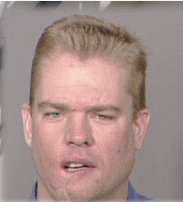
    Matthew John Gagnon
    Matthew John Gagnon

    Legisi HYIP Ponzi-scheme pitchman Matthew John Gagnon has pleaded guilty in the Eastern District of Michigan to a criminal charge of not disclosing he’d been paid more than $1 million by Legisi and its operator Gregory N. McKnight to tout the “program” online.

    In a plea agreement now public after being fashioned in October and November, Gagnon admitted he’d caused more than $7 million in losses to more than 50 Legisi investors. Legisi gathered about $72 million and collapsed in 2008, according to court filings.

    Legisi was promoted on Ponzi-scheme forums such as TalkGold and MoneyMakerGroup. Gagnon, who was accused of willful blindness and potentially faces up to five years in federal prison when sentenced in May, pitched the “program” through Mazu.com. The MoneyMakerGroup forum is specifically referenced in an evidence exhibit in the Legisi case.

    In the agreement, Gagnon admitted he touted Legisi as a “winner” and “not a scam.” On any given day, any number of hucksters make the same claims about any number of “programs” on the Ponzi boards. Willful blindness — in no small measure — drives the scams.

    Legisi’s Terms of Service sought to make members affirm they were not an “informant, nor associated with any informant” of the IRS, FBI, CIA and the SEC, among other agencies, according to documents filed in federal court. McKnight, like Gagnon, faces sentencing in May. Prosecutors have sought a 15-year term for McKnight.

    Both McKnight and Gagnon also face millions of dollars in civil judgments that flowed from a case brought by the SEC in 2008. The U.S. Secret Service and state authorities in Michigan also investigated Legisi.

    Prosecutors recommended a three-level sentencing reduction for Gagnon, noting he has accepted responsibility for his role in the scam and has assisted authorities.

    U.S. District District Judge Mark A. Goldsmith is scheduled to sentence Gagnon on May 7.

    Zeek Rewards, an alleged $600 million Ponzi- and pyramid fraud, also was touted on the MoneyMakerGroup and TalkGold forums. The SEC brought the Zeek case in August 2012.

  • Convicted Ponzi Schemer Andy Bowdoin Of AdSurfDaily Now Listed As Inmate In Florida Federal Prison [UPDATED FEB. 8]

    EDITOR’S NOTE: This post originally was published Jan. 24 at 7:33 p.m. It was updated Feb. 8 to include this editor’s note reflecting that Andy Bowdoin now is listed as an inmate at the federal prison camp in Pensacola, Fla. (Pensacola FPC.)  The original story published Jan. 24 appears below and includes some edits to reflect the latest information . . .

    ** ____________________________________ **

    UPDATED 9:08 A.M. ET (JAN. 27, U.S.A.) Thomas Anderson “Andy” Bowdoin, the 78-year-old AdSurfDaily Ponzi patriarch, is listed today as an inmate at the Federal Correctional Institution in Tallahassee. His estimated release date is Feb. 7, 2018. [New on Feb. 8: Bowoin has been transferred to Pensacola FPC.)

    In August 2008 — after federal prosecutors in the District of Columbia initially filed civil allegations of Ponzi fraud against Bowdoin and ASD after an investigation by the U.S. Secret Service — Bowdoin was defiant. The government was “Satan,” he claimed. And he compared the Secret Service to the 9/11 terrorists.

    Bowdoin was described as a head of a “flock,” a man who had “followers.” What transpired in the years that followed was the stuff of fiction — but it was very, very real. After initially demanding an evidentiary hearing and insisting ASD’s online “program” was not a Ponzi scheme, Bowdoin did not take the stand at the hearing he requested.

    He was “too honest” to testify, explained one of his followers.

    Prosecutors had a different take: Bowdoin, they said, was a recidivist securities swindler with a felony record in Alabama from a previous fraud scheme in the 1990s. One of his business partners also was a veteran swindler who once pushed “prime bank” frauds, according to court filings.

    Other Bowdoin followers planted stories that prosecutors secretly had admitted ASD was not a Ponzi scheme but were clinging to the case in a bid to save face. One follower ventured that a prosecutor should be placed in a medieval torture rack. Another ventured that a “militia” should storm Washington.

    In the bizarre world of ASD, there were efforts to enlist public support for Bowdoin by mailing packets of Kool-Aid to Fox News host Bill O’Reilly. There was a corresponding effort to enlist support for an investigation into a Florida TV station, apparently for having the temerity to cover negative news about ASD. Some of Bowdoin’s followers also wanted to investigate then-Florida Attorney General Bill McCollum, apparently for holding the view that ASD was a pyramid scheme.

    On Sept. 11, 2008, the seventh anniversary of the 9/11 attacks, some Bowdoin followers prayed for the prosecution to be struck dead.

    By July 2010, purported “sovereign citizen” Kenneth Wayne Leaming had entered the ASD fray. He is now jailed near Seattle on charges of filing false liens against at least five federal officials involved in the ASD case: a federal judge, three federal prosecutors and the Secret Service agent who did the early investigative legwork in the case. Leaming, according to court filings, was harboring two federal fugitives from Arkansas, had tried to pass a bogus “Bonded Promissory Note” for $1 million and assisted in the filing of false liens against other federal officials in cases presumably unrelated to ASD.

    Leaming, prosecutors said, was instrumental in the founding of the so-called “County Rangers,” an armed enforcement wing for a “sovereign” group in Washington state. The “Rangers” carried fake badges, according to court filings. And when Leaming, a convicted felon, was arrested in November 2011 by an FBI Terrorism Task Force on the false-liens charges, several firearms were found.

    One of them was an “AK-47 style assault rifle with a bayonet,” according to court filings.

    afavideosmall1Bowdoin was charged criminally in November 2010, when an indictment was unsealed. By October 2011, Bowdoin was trying to sell a “program” known as OneX to the members he was accused of defrauding in the ASD case. Conference-call listeners were told they could earn $99,000 very quickly through OneX, which federal prosecutors later described as yet another fraud scheme pushed by Bowdoin.

    In May 2012, Bowdoin pleaded guilty to wire fraud, acknowledging that ASD was a Ponzi scheme and that his Florida-based firm had never operated lawfully from its inception in 2006.

    Even after Bowdoin pleaded guilty, some of his followers continued to insist that ASD was a legitimate business. Bowdoin was jailed in June 2012, after prosecutors proffered evidence that he continued to promote fraud schemes even after the Secret Service seized $80 million in the ASD case and even after he was charged criminally.

    Bowdoin spent the early days of his sentence in a District of Columbia jail. Earlier this month, he was listed as a prisoner at a federal holding facility in Oklahoma City.

    And today he apparently has arrived in Tallahassee to serve out the remainder of his 78-month term. [New on Feb. 8: Bowdoin has been transferred to Pensacola FPC.) The prison is only a short [Feb. 8 edit: roughly two-and-a-half hour] drive from Quincy, the town from which Bowdoin pulled off a $119 million Internet fraud.

  • BULLETIN: Grand Jury Returns Superseding Indictment Against AdSurfDaily Figure And Purported ‘Sovereign Citizen’ Kenneth Wayne Leaming

    americaatrisk4BULLETIN: (UPDATED 4:38 P.M. EDT U.S.A.) A federal grand jury in the Western District of Washington has returned a superseding indictment against AdSurfDaily figure and purported “sovereign citizen” Kenneth Wayne Leaming.

    It is the second superseding indictment against Leaming. The first was filed in 2012.

    The new indictment was returned yesterday, a day after the White House and the Justice Department referenced “sovereign citizens” in a policy announcement that pointed to an FBI site that defined “sovereign citizens” as “anti-government extremists who believe that even though they physically reside in this country, they are separate or ‘sovereign’ from the United States. As a result, they believe they don’t have to answer to any government authority, including courts, taxing entities, motor vehicle departments, or law enforcement.”

    Leaming is 57. His alleged onetime business colleague David Carroll Stephenson, 57, also is named in the superseding indictment. The indictment formally accuses Leaming of filing false liens against a federal judge, two former federal prosecutors and a U.S. Secret Service agent who had roles in the ASD Ponzi case. The liens were filed in August 2010 and November 2010, according to the indictment.

    Meanwhile, the indictment accuses Leaming and Stephenson of filing false liens against two U.S. prison officials in July 2011.

    Leaming, meanwhile, was further accused of harboring two federal fugitives in 2010 and of being a felon in possession of six firearms.

    At the same time, the indictment accuses Leaming of passing a bogus “Bonded Promissory Note” for $1 million in March 2008, in a bid to defraud the United States.

    Leaming and Stephenson are being held at the SeaTac federal detention center near Seattle.

    ASD was a $119 million Ponzi scheme brought down by the Secret Service in August 2008. Leaming reportedly was performing legal work for some ASD members, even though he is not an attorney.

    Leaming was arrested in Spanaway, Wash., by an FBI terrorism Task Force in November 2011. He has been jailed since then. Stephenson already was serving a federal sentence for a tax crime when Leaming was arrested.

    Leaming has an existing federal felony conviction for piloting an aircraft without a license.

  • BULLETIN: Receiver Says $12 Million In Zeek Money Located ‘In An Eastern European Country’ — But Has Not Been Returned

    breakingnews72BULLETIN: (2ND UPDATE 8:47 P.M. ET U.S.A.) The court-appointed receiver in the Zeek Rewards Ponzi-scheme case says he has located $12 million in receivership assets held in an unspecified “eastern European country” — but the funds have not been returned.

    “This account is owned and was used by a payment processor outside the United States to provide funds to a foreign e-wallet that processed payments for ZeekRewards,” receiver Kenneth D. Bell said in court filings. “The Receiver previously caused the Freeze Order to be sent to the foreign financial institution which holds this account and demanded that the funds held in that account be turned over to the Receivership Estate. The foreign payment processor who owns this account was also sent the Freeze Order and a demand notice for the turnover of the funds in this account. However, neither the financial institution nor the foreign payment processor responded to the demands sent by the Receiver. Additionally, the Receiver has worked with the foreign e-wallet to seek to have these funds returned. While cooperative, the foreign e-wallet was unable to cause their customer to provide the funds held in this account to the Receiver.”

    Bell also confirmed today that the U.S. Secret Service “continues to pursue” money related to Zeek. Meanwhile, he announced a “Final Liquidation Plan” and proposed claims process will be filed tomorrow in U.S. District Court for the Western District of North Carolina. Zeek was based in Lexington, N.C. Senior U.S. District Judge Graham C. Mullen is presiding over the Zeek case.

    Massive Paper Chase Under Way

    In August 2012, the SEC described Zeek as a $600 million Ponzi- and pyramid scheme. What has transpired since then speaks to the enormous logistical challenges law enforcement and court-appointed receivers may confront when a fraud scheme goes viral on the Internet and spreads globally.

    Bell noted today that the receivership has communicated to “over 7,000 financial institutions” on the subject of cashier’s checks sent to Zeek by affiliates. Some affiliates also sought to fund their accounts with “certified checks, personal checks, bank money orders, and personal money orders.”

    One of the earliest problems with marshaling assets was the sheer volume of instruments sent to Zeek, according to Bell’s filing.

    “As of December 31, 2012, the Receiver presented over 140,000 financial instruments for deposit,” Bell said. “Many of these items were returned and not paid for various reasons. The Receiver Team is working with financial institutions to re-present instruments that were returned in error, and it is working to identify all instruments that were improperly returned.”

    One Zeek vendor alone was in possession of 85,000 cashier’s checks and other instruments, Bell said.

    “After reviewing these instruments, reviewing the records of the Receivership Defendant, communicating with [Zeek vendor Preferred Merchant Services] and working with a forensic accounting vendor, the Receiver Team was unable to definitively ascertain which instruments had already been processed and presented for payment by PM,” Bell said. “In order to maximize recovery to the Receivership Estate, the Receiver Team elected to present all of these instruments for payment. Approximately 34,000 of these instruments worth approximately $15 million were accepted and paid. Approximately 50,000 of these PM instruments were returned, which resulted in returned check fees of approximately $450,000.”

    Bell negotiated to reduce the return charges by 25 percent, he said.

    Beyond that, Bell said, “[t]he Receiver has been receiving numerous communications from financial institutions and Affiliate-Investors regarding cashier’s checks that have never been presented for payment,” adding that he is “unaware of any additional locations where cashier’s checks payable to the Receivership Defendant might be stored.”

    The receiver “determined that he does not have rights under the Uniform Commercial Code or the Receiver Orders to claim an interest in cashier’s checks that were never received by the Receiver or the Receivership Defendant,” Bell said. “Therefore, the Receiver has taken the position that although any cashier’s check that is subsequently received by the Receiver is a Receivership Asset and will be deposited, financial institutions should consider any cashier’s check that has not been presented by the Receiver or the Receivership Defendant as having been lost, and may refund the remitters of such cashier’s checks without fear of liability to the Receiver.”

    Crunching Numbers

    Zeek’s database included 1.6 billion records, which are now being analyzed, Bell said.

    “This analysis has taken longer than initially anticipated due to several issues: problematic transactions with questionable accuracy, the validity of database records, and the lack of available documentation (including look-up tables, database dictionaries, and source code documentation which are commonly used to understand the organization and function of a database’s components). In the absence of these tools, [receivership team member FTI Consulting Inc.] has been required to perform extensive testing of the data to validate the proposed calculations and to rely on disparate third-party sources, including Paul Burks, e-wallet vendors, financial institutions, and subpoena responses, for understanding the organization and function of the database components.”

    Compounding matters, according to today’s filing, was the sheer number of Zeek participants, including participants who had multiple usernames.

    “There are approximately 2.2 million unique users (“Affiliates” or “usernames”) in ZeekRewards,” Bell said. “The number of Affiliates does not reflect the number of unique individuals who participated in ZeekRewards, as it is likely that some individuals had more than one username. Approximately 1 million Affiliates paid money into the ZeekRewards Program . . .”

    And, Bell noted today, “[a]t this time, the Receiver has identified over 800,000 net-loser usernames in the Receiver Defendant’s records.”

    Taxing Matters

    The section below is verbatim from the receiver’s filing today (italics added):

    During the fourth quarter, the Receiver Team worked to determine which federal tax filings needed to be made with respect to income taxes, payments made to service providers, and payments made to Affiliate-Investors. The efforts were focused on the latter two issues because of the earlier filing deadline (January 31, 2013). The Receiver Team, including FTI, had discussions with RVG’s outside tax and accounting advisors to ascertain what had been filed for 2011 and earlier. After analyzing the issues, consulting with these various entities, and reviewing [Zeek operator Rex Venture Group LLC] ’s records, the Receiver Team determined that it would be necessary to file and issue 1099s to certain Affiliate-Investors and began the process of compiling the data necessary to issue the 1099s.

    Since the receivership began in August, Bell said, it has been determined that “some individuals who RVG classified as ‘independent contractors,’ to whom it had issued 1099s, were misclassified pursuant to IRS regulations.

    “Accordingly,” he continued, “the Receiver Team has reclassified them as employees and is issuing them W-2s. The Receiver Team will begin the process of identifying, misclassified employees, paying back taxes, and determining whether the Receivership Estate should pay any back wages owed to such employee as a result of RVG’s misclassification.”

    Pursuing International ‘Winners’

    Offshore members of Zeek expecting a free pass from the receivership may have to think again if they are classified as “winners.”

    “The group of net-winners identified to date includes numerous individuals residing outside of the United States, with the largest foreign winners living mainly in countries with established legal systems which are signatories to the Hague Convention for international service of process,” Bell said. “While the pursuit of ‘clawback’ claims against these foreign net winners raises various service issues and other challenges, the Receiver intends to include these winners as parties to domestic litigation based on their contacts with the ZeekRewards Program in the United States so long as doing so will not delay the litigation against domestic winners. The Receiver will also pursue cost-effective foreign litigation to establish the repayment obligation and/or to collect judgments where necessary and appropriate.”

    Claims Process

    Bell said he will file with the court tomorrow “the proposed claims process” as part of a “Final Liquidation Plan.”

    From Bell’s filing today (italics added):

    The Receiver anticipates filing a motion seeking approval of the Claims Submission Process by the conclusion of the first quarter of 2013. The Claims Motion will seek (i) approval of the claims submission process, (ii) to establish the date by which claims must be filed against the Receivership Defendant (the “Bar Date”), and (iii) approval of the noticing procedures to be used in providing notice of the Bar Date and the claims submission process.


  • ‘American Greed’ Producing Episode On Trevor Cook Ponzi Fraud; Seniors, People Of Faith Fleeced By Cook And His Pitchmen

    Trevor Cook
    Trevor Cook

    CNBC’s “American Greed” will be in Minneapolis today to begin filming an episode on the massive Trevor Cook Ponzi scheme that was targeted at senior citizens and conservative Christians and rendered some victims penniless, a source told the PP Blog.

    Cook’s scheme gathered about $194 million. It collapsed in 2009. Money that potentially could go to victims is still missing. The scheme was reminiscent of the AdSurfDaily Ponzi case in that it took various bizarre and disturbing turns.

    Earlier this month, Cook pitchman Jason Bo-Alan Beckman was sentenced to 30 years in federal prison. Gerald Durand received 20 years. Christopher Pettengill, who cooperated with prosecutors, received a 90-month sentence. Sentencing for Pat Kiley, a conspiracy theorist and former radio host in his seventies, was put on hold, pending the results of medical and psychological exams.

    Cook, the ringleader, received a 25-year sentence in 2010.

    For what the Cook fraud lacked in dollar volume — indeed, it was significantly smaller than Tom Petters’ epic Ponzi fraud in Minnesota — it more than made up for in pure brazenness. Beckman essentially was accused of taunting victims in his court filings after stealing millions from a senior-citizen couple in their late eighties. Durand told a tale about a submersible submarine Cook allegedly bought on eBay for the waters of Canada before moving it to Panama, where Cook purportedly found the conditions to be more sub-friendly.

    Kiley once tried to have a CFTC lawyer fined $1,000 for filing court papers Kiley deemed “offensive.”

    The Cook scheme also had something in common with AdViewGlobal, the collapsed 1-percent-a-day autosurf linked to the AdSurfDaily Ponzi scheme: a tie to offshore facilitator KINGZ Capital Management Corp.

    AdViewGlobal announced its purported tie to KINGZ on May 4, 2009, the same day the Obama administration announced a crackdown on offshore fraud. KINGZ denied any tie to AVG. But the National Futures Association (NFA) established a tie between KINGZ and Cook.

    AdViewGlobal collapsed during the summer of 2009, amid reports that millions of dollars had been stolen. The purported “opportunity” bizarrely declared itself a “private association” operating in Uruguay, apparently in a bid to evade U.S. regulatory scrutiny even though it was conducting business in the United States. Federal prosecutors tied ASD President Andy Bowdoin to AdViewGlobal in 2012. Bowdoin, now serving a 78-month prison sentence, once claimed that prosecutors were “Satan” and compared the U.S. Secret Service to the 9/11 terrorists. His scheme gathered at least $119 million.

    Prosecutors have evidence that suggests at least some of the AdViewGlobal money was deposited in Switzerland. The Cook Ponzi also did business in Switzerland.

    There also is a tie between Trevor Cook and Peregrine Financial Group Inc., the collapsed fraud scheme of Russell R. Wasendorf Sr., now facing up to 50 years in federal prison. Wasendorf once was a member of NFA’s Futures Commission Merchant Advisory Committee

    Peregrine consumed at least $215 million and conducted a scam for two decades, prosecutors said. “[I]n order for the fraud to be effective and sustainable for years, defendant routinely created and used false certifications and forged documents to deceive his customers, his accounting department, his fellow corporate officers, an outside auditor, and multiple regulatory agencies whose core function was to detect and prevent exactly the type of criminal activity defendant perpetrated,” prosecutors said of Wasendorf.

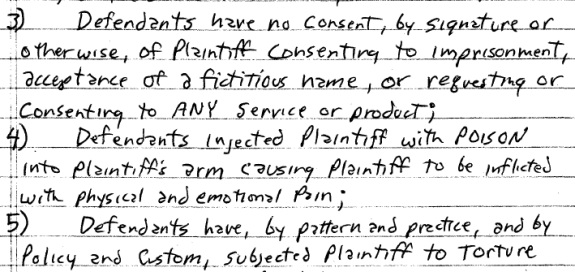
  • UPDATE: Leaming — Again: After Earlier Claiming He’d Been Targeted For ‘DEATH,’ AdSurfDaily Figure And Purported ‘Sovereign Citizen’ Now Claims’ He’s Been Subjected To ‘POISON’ And ‘TORTURE’

    AdSurfDaily figure Kenneth Wayne Leaming now claims he's been subjected to "POISON" and "TORTURE."
    AdSurfDaily figure Kenneth Wayne Leaming now claims he’s been subjected to “POISON” and “TORTURE.”

    In 2009, AdSurfDaily figure and purported “sovereign citizen” Kenneth Wayne Leaming claimed a city in Washington state targeted him for “DEATH” and threatened to kill him by “HUNTING” him down “in screaming packs and mobs” and using “several armed street gangs” that served as police, according to records.

    Leaming, now 57, further claimed the Pierce County city of Puyallup engaged in terrorism by controlling “multiple electronic broadcast media” and employing police who used “chemical and biological weapons,” “machine guns” and “explosives.”

    In November 2011, prosecutors said Leaming was found in Spanaway, Wash., with two federal fugitives from Arkansas. Those fugitives now have been convicted of mail fraud for a multimillion-dollar, home-based business caper. Court filings by Timothy Shawn Donavan, 64, and Sharon Jeannette Henningsen, 68, suggest they also were sovereign citizens.

    After Leaming’s arrest with Donavan and Henningsen, federal prosecutors in the Western District of Washington said an FBI terrorism Task Force found evidence that Leaming had filed false liens against at least five public officials involved in the AdSurfDaily Ponzi case filed by the U.S. Secret Service in 2008.

    Leaming allegedly also filed bogus liens or assisted in filing liens against a former cabinet official in the administration of President George W. Bush, the head of a credit union and at least two U.S. prison officials. In 2012, while detained, Leaming sued President Obama and Attorney General Eric Holder, advancing a Birther conspiracy theory.

    A federal judge tossed that lawsuit. Court filings by Leaming now suggest he intends to sue Holder anew, this time in the District of Columbia as opposed to the Western District of Washington.

    But Leaming also has another active lawsuit against Holder and others in the Western District of Washington. A complaint by Leaming dated yesterday asserts he has been subjected to “POISON” and “TORTURE” during his ongoing detention at the SeaTac federal detention center near Seattle.

    In October 2012, federal prosecutors alleged that Leaming “was instrumental in founding the ‘County Rangers,’ the sovereign group’s armed enforcement wing. Members of the County Rangers were issued realistic-looking badges and credentials were required to possess firearms as part of their duties, and held themselves out as law enforcement agents.”

    Leaming already is a convicted felon from a case that alleged he had no license and yet piloted an aircraft. When he was arrested in November 2011 in the company of Donavan and Henningsen, several firearms were found in Leaming’s residence, including an “AK-47 style assault rifle with a bayonet,” prosecutors said.

    He later was charged with unlawful possession of firearms as a convicted felon.

    When agents executed a search warrant, they found “numerous boxes of correspondence and legal paperwork documenting other apparent fraud schemes,” prosecutors said.

  • UPDATE: ASD’s Andy Bowdoin Incarcerated At Oklahoma City Federal Transfer Center

    Thomas Anderson "Andy" Bowdoin
    Thomas Anderson “Andy” Bowdoin

    Convicted 1-percent-a-day Ponzi schemer Andy Bowdoin is listed as an inmate at the Federal Transfer Center in Oklahoma City, a development that likely means the 78-year-old  AdSurfDaily patriarch is on his way to a federal prison. Bowdoin, a Floridian, last year requested to be incarcerated in Florida. The PP Blog was unable to determine immediately if that request was granted.

    Bowdoin pleaded guilty to wire fraud in the ASD Ponzi case in May 2012. He admitted ASD was a Ponzi scheme that had gathered about $119 million and had never operated lawfully from its inception in 2006 through its collapse in 2008. Bowdoin initially was imprisoned in June 2012, after federal prosecutors proffered evidence that he continued to promote scams even after the seizure of more than $80 million in the ASD Ponzi case and even after he was charged criminally in December 2010.

    In August, Bowdoin was sentenced to 78 months in federal prison for his role in the ASD Ponzi.

    Federal prosecutors identified AdViewGlobal and “OneX” as two other scams in which Bowdoin participated after the collapse of ASD amid Ponzi allegations by the U.S. Secret Service in 2008. Like ASD, AdViewGlobal was a purported “program” that planted the seed its paid a daily return of 1 percent. OneX was a “program” Bowdoin said could fetch participants a quick return of $99,000, apparently after an initial outlay of $5.

    Bowdoin targeted former ASD members and “college students” in his OneX promos.

    In August, the SEC accused Zeek Rewards of operating a massive online Ponzi scheme that had gathered about $600 million. Similar to ASD, Zeek Rewards was a “program” that planted the seed it paid a return of 1.5 percent a day.

    The SEC has described its Zeek probe as ongoing. The Secret Service said in August that it also was investigating Zeek.

    Despite the fact Bowdoin was sued civilly, accused of racketeering and charged criminally with wire fraud, securities fraud and selling unregistered securities for the ASD scam, any number of ASD members turned to promoting Zeek, which planted the seed it paid out even more than ASD.

    In August, the SEC accused Zeek of selling unregistered securities. Zeek operator Paul R. Burks, who is in his mid-60s, consented to a judgment in the civil case without admitting or denying the SEC allegations. Two prospective class-action lawsuits also were filed against Burks.

    Despite the legal entanglements of both Burks and Bowdoin and Bowdoin’s prison sentence, some MLMers immediately began promoting similar “programs.”

  • Former Zeek Pitchman Who Also Pushed JSS/JBP Scam Reportedly Doubts He’ll Be Paid By ProfitClicking, A Follow-Up ‘Program’

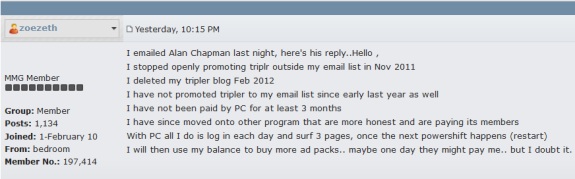
    alanchapmanpcmmgFormer Zeek Rewards and JSSTripler/JustBeenPaid pitchman “Alan Chapman” reportedly now claims he hasn’t been paid by “ProfitClicking” for “at least 3 months,” according to a post quoting “Chapman” on the MoneyMakerGroup Ponzi forum.

    ProfitClicking is the absurd follow-up “program” to the bizarre JSS/JBP scam, a 730-percent-a-year “opportunity” purportedly operated by Frederick Mann. JSS/JBP may have had ties to the “sovereign citizens” movement. Like ProfitClicking, the JSS/JBP “program” made members affirm they were not with the “government.”

    On Aug. 17,  the SEC described Zeek as a $600 million Ponzi and pyramid scheme that was selling unregistered securities to sustain a massive fraud that duped members into believing it provided a legitimate return averaging 1.5 percent a day. Just a day earlier, JSS/JBP took a page from the Zeek playbook, asserting that it was not selling securities and members were not making an investment.

    After the SEC’s Zeek action, JSS/JBP morphed into ProfitClicking, amid reports of the sudden retirement of Mann, a former pitchman for the AdSurfDaily Ponzi scheme. On Sept. 5, the PP Blog received a menacing communication threatening a lawsuit over its coverage of JSS/JBP/ProfitClicking. The lawsuit threat was made after the Blog reported that ProfitClicking was disclaiming any responsibility on the part of itself or its affiliates for offering the “program.”

    Like Zeek, JSS/JBP/ProfitClicking was promoted on forums listed in U.S. federal court files as places from which Ponzi schemes are promoted. In the hours after the SEC action, the PP Blog began to receive spam for a “program” known as “Ultimate Power Profits.” A check of the MoneyMakerGroup Ponzi forum showed that Zeek peddler “mmgcjm” was the key pitchmen for Ultimate Power Profits.

    The connectivity of the various scams shows how banks and financial vendors can come into possession of funds tainted by fraud schemes. Meanwhile, the court-appointed receiver in the Zeek case said last month that he had “obtained information indicating that large sums of Receivership Assets may have been transferred by net winners to other entities in order to hide or shelter those assets.”

    “Chapman” was an apparent Diamond affiliate of Zeek. In June 2012 — apparently even as the SEC’s Zeek probe already was under way — a “Chapman” Blog known as “ZeekRewardsPays” asserted this (italics added):

    ZeekRewards Daily Profit Last 7 Days!
    June 11 2012 1.89 %
    JUNE 10 2012 0.88 %
    JUNE 09 2012 0.96 %
    JUNE 08 2012 0.92 %
    JUNE 07 2012 1.91 %
    JUNE 06 2012 2.00 %
    JUNE 05 2012 1.93 %

    Court filings by the SEC last week suggest its Zeek probe began in April 2012 and perhaps earlier. What’s not known is when Zeek learned it was under investigation. It is not unusual for law enforcement to maintain secrecy when a “program” hits its radar screens. Court filings from 2008 show that the U.S. Secret Service had infiltrated AdSurfDaily with undercover agents who corresponded with ASD promoters prior to any public announcement of a probe.

    At least one ASD member instructed an undercover agent not to call the “program” an investment, apparently based on the errant belief that wordplay designed to disguise ASD as an “advertising” program and not a program offering unregistered securities and unusually consistent returns at a preposterous rate of 1 percent a day somehow could insulate ASD from prosecution.

    On Aug. 1, 2008, the Secret Service began the process of seizing more than $80 million from ASD-related bank accounts, alleging that the “opportunity” was a massive online Ponzi scheme. ASD, Zeek, JSS/JBP and Profit Clicking planted the seed they provided returns that made Bernard Madoff look like a piker. Viewed on an annualized basis, the “programs” effectively were asserting they could outperform Madoff by a factor on the order of between 30 and 70 to one.

    The assertion by “Chapman” (as noted above) computed to an average daily return of 1.498 percent. On Aug. 17, the SEC said that Zeek operator Paul R. Burks “unilaterally and arbitrarily determines the daily dividend rate so that it averages approximately 1.5% per day, giving investors the false impression that the business is profitable.”

    Burks consented to a judgment on the same day the SEC brought the Zeek Ponzi action. The U.S. Secret Service — also on Aug. 17 — announced it was investigating Zeek. In 2008, the Secret Service brought Ponzi allegations against ASD’s 1-percent-a-day “program.” ASD operator Andy Bowdoin later admitted he was running a Ponzi scheme. Bowdoin was sentenced to 78 months in federal prison. He is 78 years old.

    Mann’s age is unknown. There have been reports he is in his eighties.

  • LETTER TO READERS: Our Choice For The Most Important PP Blog Post Of 2012

    Dear Readers,

    The PP Blog’s choice for the “Most Important” story to appear on the Blog in 2012 is this one, dated July 28: “Site Critical Of Zeek Goes Missing After HubPages Receives Trademark ‘Infringement’ Complaint Attributed To Rex Venture Group LLC — But North Carolina-Based Rex Not Listed As Trademark Owner; Florida Firm That IS Listed As Owner Says It Has ‘No Knowledge’ Of Complaint.”

    The story tells the bizarre tale of how purported Zeek “consultant” Robert Craddock, beginning on July 22, tried to gag K. Chang, a Zeek critic.

    Our reasoning for selecting the Craddock tale appears below . . .

    ** __________________________________ **

    recommendedreading1UPDATED 1:30 P.M. ET (U.S.A.) This Blog is well aware that some MLMers would have you believe that nothing that appears here is important. The “case” against the Blog normally involves ad hominem attacks, along with bids to change the subject or cloud issues. Some of the campaigns against the PP Blog have been almost comical, falling along lines such as these: ASD can’t be a Ponzi scheme because it rained on Tuesday. Your [sic] an idiot and looser [sic] !!!!!

    Other campaigns have been much more menacing.

    One of the least-appreciated aspects of the Zeek Rewards story is that Zeek launched after Bernard Madoff made the word “Ponzi” a part of the national (and international) consciousness. Setting aside Zeek’s epic legal problems, Zeek and its “defenders” have a PR problem from which they’ll never recover. In short, it is fatal. The reason that it’s fatal is that it creates a dynamic that is virtually unique to the MLM HYIP sphere: While the rest of the world rails against Ponzi schemes and Ponzi schemers, the MLM HYIP sphere defends them.

    But it gets stranger than that. Certain inhabitants of the HYIP sphere in effect are lobbying for the legalization of Ponzi schemes to make their lives more convenient. To this group, the answer to Ponzi schemes is even more Ponzi schemes. Their message is remarkably similar to the message of the gun lobby, which appears to be arguing that the answer to gun violence is even more guns — in strategic locations, of course, perhaps in educational institutions at the grade-school level through college. (And maybe at movie theaters and at the scene of rural house fires, in case first responders such as firefighters and EMTs encounter an ambush.)

    You’ve heard by now that the rural town of Webster, N.Y., turned into Israel last week, we’re sure.

    In fairness to the gun lobby, it must be pointed out that HYIP “defenders” who are lobbying for more Ponzi schemes even as the gun lobby lobbies for more guns have less legal standing than the gun lobby. Guns already are legal. Ponzi schemes are not.

    But, getting back to Zeek’s PR problem . . .

    Madoff was exposed in 2008 as a Ponzi schemer, a financial criminal of unprecedented hubris. Not only did Zeek debut after Madoff, it came after Scott Rothstein was exposed (in 2009) as a racketeer/Ponzi schemer — and after AdSurfDaily, a purported MLM “advertising” company, was exposed (in 2008 and 2009) as the largest online Ponzi scheme ever and was sued by its own members amid allegations of racketeering.

    For some Zeek promoters, this well-known fact set makes them vulnerable to charges they are nothing less than members of an organized mob of habitual criminals who thrive by choosing to be willfully blind.

    But, incredibly, it gets even stranger . . .

    Zeek had members in common with AdSurfDaily and, like AdSurfDaily, told members that a purported “advertising” function was central to its business model.  Meanwhile, Zeek became popular in North Carolina, after the infamous Black Diamond Ponzi caper was exposed in that very state. (Among other things, the Back Diamond fraud led to criminal charges being filed against a bank.)

    Along those lines, Zeek (in May) began to show signs that it was experiencing banking problems after it had become popular in a region known to have served up another colossal mess, this one in nearby South Carolina. (The South Carolina mess was known as the “3 Hebrew Boys” scheme. It resulted in the longest Ponzi scheme sentences in the history of the South Carolina federal courts and, like AdSurfDaily and Zeek, served up a heaping helping of the bizarre, including claims by “sovereign citizens” that prosecutors had no authority over them.)

    Moreover, the Zeek scheme for which some “defenders” continue to cheer featured recruitment commissions on two levels (like AdSurfDaily) and an “RPP” payout (like ASD’s 1-percent-a-day “rebates”). Finally, the Zeek scheme came to the fore after the U.S. Secret Service described ASD as a “criminal enterprise” and after the Attorney General of the United States made a special public appearance in Florida — fertile recruitment grounds for schemes such as Zeek and the stomping grounds of Madoff and Rothstein — to announce that the Justice Department was serious about putting people in jail for ravaging the U.S. economy with their Ponzi schemes.

    “Palm Beach is, in many respects, ground zero for the $65 billion Ponzi scheme perpetrated by Bernard Madoff — the largest investor fraud case in our nation’s history,” Eric Holder said on Jan. 8, 2010, in southern Florida. “Before the house of cards Madoff built collapsed in 2008, before he was sentenced to 150 years in prison last June, before he became a notorious criminal on the cover of newspapers around the world, he was one of your neighbors.

    “His former home sits just north of us,” Holder continued. “An 8,700-square-foot mansion that’s worth . . . well, we’ll know what its worth once the U.S. Marshals Service auctions it off and the proceeds are distributed to Madoff’s victims.”

    Holder’s words are best viewed as a warning against willful blindness: Neither victim nor perpetrator be. There is unqualified pain and misery for both.

    Despite Holder’s appearance in Florida — despite his reference to Madoff’s “house of cards” — AdSurfDaily promoters Todd Disner and Dwight Owen Schweitzer later sued the United States, claiming that its Ponzi case against ASD was a “house of cards.” Naturally they made this claim even as they were promoting Zeek.

    And from what region were they promoting Zeek? Why, Southern Florida, of course, the same region Holder visited in 2010 to throw down the gauntlet against Ponzi schemers and their enablers.

    Amid the historical circumstances cited above, Zeek Rewards began to encounter some heat from the media and from its own members. Some of the members did not understand why things at Zeek appeared to be so circuitous and why they were being asked to use payment processors such as AlertPay and SolidTrustPay that had been associated with fraud scheme after fraud scheme operating online, including ASD.

    What to do if you’re Zeek?

    Well, according to Florida resident Robert Craddock, a self-described Zeek consultant, you hire, well, Robert Craddock — and you use Robert Craddock to go after Zeek critics such as K. Chang.

    The Most Important Story Of 2012

    In the PP Blog’s view, the most important story to appear on the Blog in 2012 is this one, titled, “Site Critical Of Zeek Goes Missing After HubPages Receives Trademark ‘Infringement’ Complaint Attributed To Rex Venture Group LLC — But North Carolina-Based Rex Not Listed As Trademark Owner; Florida Firm That IS Listed As Owner Says It Has ‘No Knowledge’ Of Complaint.”

    The story details efforts in July by Craddock to have K. Chang’s Zeek “Hub” at HubPages removed from the Internet just weeks before the SEC accused Zeek of being a $600 million Ponzi- and pyramid fraud. By early estimates, the alleged Zeek fraud was about five times larger than ASD in pure dollar volume ($600 million compared to $120 million) and perhaps 20 times larger in terms of the membership base (2 million compared to 100,000).

    Incredibly, Craddock went after K. Chang after Deputy Attorney James Cole, speaking in Mexico, said that international fraud schemes have been known to “bring frivolous libel cases against individuals who expose their criminal activities.” And Cole also pointed out that fraudsters have a means of “exploit[ing] legitimate actors” and may rely on shell companies and offshore bank accounts to launder criminal proceeds.

    If ever a company exploited legitimate actors, it was Zeek. Kenneth D. Bell, the court-appointed receiver, says there were approximately 840,000 Zeek losers who funded the ill-gotten gains of 77,000 winners. And Bell also says he has “obtained information indicating that large sums of Receivership Assets may have been transferred by net winners to other entities in order to hide or shelter those assets.”

    There can be no doubt that some of those winners are longtime residents of the woeful valley of willful blindness. Not only do they “play” HYIP Ponzis for profit, they now publicly announce their intent to keep their winnings. Zeek has exposed the epicenter of willful blindness, the criminal underworld of the Internet. It is easy enough to view Craddock’s efforts as a means of institutionalizing willful blindness, first by seeking to chill speech and, second, by scrubbing the web of information that encourages readers to be discriminating so they won’t be duped by a Ponzi fraudster.

    Bizarrely, it appears as though someone inside of Zeek believed it prudent to hire Craddock to go after K. Chang. If that weren’t enough, only days later Zeek used its Blog to plant the seed that unnamed “North Carolina Credit Unions” were committing slander against Zeek.

    After the SEC brought the Zeek Ponzi complaint in August, Craddock quickly went in to fundraising mode. As incredible as it sounds, ASD’s Todd Disner — also of Zeek — was on the line with him.

    What Craddock did was deplorable. It was as though he slept through the past four years of Ponzi history, all the cases that showcase the markers of fraud schemes and all the government warnings to be cautious. (Nongovernment/quasigovernment entities such as FINRA also publish such warnings, like this one on HYIP fraud schemes outlined by the PP Blog.)

    The FINRA warning was published in 2010, prior to Zeek but after the Legisi, Pathway To Prosperity and ASD schemes were exposed. Legisi operator Gregory McKnight potentially faces 15 years in federal prison. He was charged both civilly (SEC) and criminally (U.S. Secret Service) — and Legisi pitchmen Matthew John Gagnon also was charged civilly and criminally by the same agencies. The SEC called Gagnon a “threat to the investing public.”

    Any number of Zeek promoters pose a similar threat. They are at least equally willfully blind.

    It is clear that some Zeek promoters also were promoting JSSTripler/JustBeenPaid, the debacle-in-waiting purportedly organized by Frederick Mann, a former ASD promoter. JSS/JBP has morphed into “ProfitClicking” amid reports of the “retirement” of Mann. Now, ProfitClicking “defenders” are threatening lawsuits against critics.

    Naturally the stories advanced by ProfitClicking “defenders” are being improved by “defenders” of other obvious fraud schemes such as BannersBroker. A BannersBroker “defender” is over at RealScam.com — an antiscam site — suggesting that RealScam is a terrorist organization.

    My God.

    These claims are being made just days after Zeek figure Robert Craddock suggested he had contacts in law enforcement who were going to charge Blogger Troy Dooly with cyber harassment.

    It wouldn’t sell as fiction.

    Craddock’s bid to gag K. Chang easily was the most important story on the PP Blog in 2012. It’s the one that signaled that things are destined only to get crazier in MLM La-La Land and that the threat to U.S. national security only will grow.



  • Florida Man Who Hosts Zeek Calls Featuring Robert Craddock Was Winner In Botfly LLC Ponzi Scheme

    ponzinews1UPDATED 3:57 P.M. ET (U.S.A.) Gregory Baker, a Florida man who hosts calls featuring Robert Craddock in the aftermath of the SEC’s Ponzi-scheme case against Zeek Rewards, is listed as a winner in the Botfly LLC Ponzi scheme case, one of the Sunshine State’s ugliest fraud schemes.

    Prosecutors said that David Lewalski, Botfly’s now-imprisoned operator, tried to dupe investors into not cooperating with investigators and to coach investors on their testimony. The SEC last week accused Craddock of encouraging Zeek affiliates “not to cooperate” with Kenneth D. Bell, the court appointed receiver.

    No charges have been brought against Craddock.

    Court records show that Baker, who has used an address in the Tampa suburb of Valrico, was sued for his Botfly winnings by Michael E. Moecker, the court-appointed receiver in the Botfly case. Other records show that Baker presided over a now-defunct Florida entity known as Integrity Currency Traders LLC.

    Integrity was formed on March 15, 2010. Less than three weeks later — on April 1, 2010 — then-Florida Attorney General Bill McCollum alleged that Botfly was a massive Ponzi scheme that affected at least 550 investors, gathered tens of millions of dollars and got its name from “an insect whose larvae burrow under the skin of mammals and eat their flesh until they mature into an adult fly.”

    Bell asserted last week that he had “obtained information indicating that large sums of [Zeek] Receivership Assets may have been transferred by net winners to other entities in order to hide or shelter those assets.” The receiver did not identify winners who may be hiding assets.

    Moecker sued Baker in December 2011, alleging that Baker had received $8,580 in ill-gotten gains from Botfly, a purported Forex company prosecutors said promised a return on “promissory notes” of 10 percent a month. Under the terms of a settlement with the receiver, Baker agreed on Jan. 31, 2012 — only weeks after being sued — to pay the Botfly receivership estate $7,722, according to court filings. The sum represented a discount of $858 from Baker’s alleged winnings.

    Zeek planted the seed that it provided a return of 1.5 percent a day.

    Whether Baker was a member of Zeek when he paid back his Botfly winnings is unclear. In August 2012, the SEC described Zeek as a $600 million Ponzi- and pyramid scheme that potentially had defrauded more than 1 million people. Baker now is listed on a website styled gofunplaces.info as a member of the “Top Team” and a leader of Go Fun Places, a nascent MLM program.

    Lewalski operated Botfly in part from the Florida home of his 82-year-old mother, according to prosecutors.

    After McCollum sued Lewalski/Botfly, Lewalski chartered a private Gulfstream IV jet at a cost of $172,744 to fly from the United States to Belgium, prosecutors said. He eventually became the target of a federal criminal probe and, in November 2011, was sentenced to 20 years in federal prison. Moecker, the receiver, sued Baker a month later.

    Lewalski became infamous for wretched conduct before, during and after the Botfly probe. He directed conspiracy theories at investigators, complaining about “recent ‘Orwellian’ totalitarian tactics” allegedly employed by U.S. investigators in Ponzi scheme cases. He described a female attorney working for the receiver as a “c[$%!]” and a “Nazi,” and further described a female investigator for the Florida Department of Law Enforcement (FDLE) as “nuts” and a “bitch” — all while seeking to obstruct the Botfly probe, according to prosecutors.

    After the SEC brought the Zeek Ponzi prosecution, Craddock dropped the name of McCollum in a conference call, describing the former Attorney General now in private practice at the SNR Denton law firm as a good friend. Craddock’s efforts to secure counsel through SNR Denton for a purportedly “protected” group of Zeek affiliates upset by the actions of the SEC and the appointment of a receiver in the Zeek case ultimately failed.

    On the line with Craddock in one of his Zeek-related conference calls was Todd Disner, a Zeek pitchman and a figure in the AdSurfDaily Ponzi scheme story. McCollum sued ASD in 2008. His office later provided the names of ASD victims to the Feds as part of remissions program by which ASD members received compensation as crime victims from proceeds seized by the U.S. Secret Service in 2008. In November 2011, Disner sued Rust Consulting Inc., the remissions administrator. A federal judge eventually tossed Disner’s claim against Rust. That claim was brought in the same case in which Disner sued the United States, alleging that ASD was a legitimate enterprise and that the government had violated his Constitutional rights by seizing ASD’s database and business records.

    A judge tossed Disner’s claims against the government, too. He is now appealing. Disner’s co-plaintiff in the case was fellow ASD and Zeek pitchman Dwight Owen Schweitzer, a former attorney whose license was suspended in Connecticut.

    On the line with Craddock in another Zeek conference call was T. LeMont Silver. Like ASD’s Andy Bowdoin, Silver was a pitchman for a scheme known as OneX. In April, about four months before the SEC’s Zeek action, federal prosecutors described OneX as a “fraudulent scheme” and pyramid that was recycling money in ASD-like fashion. ASD was a Ponzi scheme that gathered at least $119 million, according to prosecutors.

    Zeek appears not to have been Silver’s first encounter with an alleged Ponzi scheme. During the call with Craddock, Silver identified himself as a victim of a separate Ponzi scheme he did not name. He complained bitterly during the call about the purported lack of action by an unnamed receiver in the second scheme.

    Craddock has been leading a chorus of boos against the SEC and the receiver in the Zeek case, planting seeds of doubt that Zeek was a Ponzi scheme. Court filings suggest that Zeek winners potentially have tens of millions of dollars in clawback exposure in the Zeek case.

    When Baker was sued by the receiver in the Botfly case, the lawsuit effectively was filed on the same theory the Zeek receiver is using: that proceeds from a Ponzi scheme are ill-gotten gains. Whether Baker has exposure as a Zeek winner is unclear.

    What is clear is that Craddock says reporters are spreading misinformation about Zeek. In a call last week, Craddock said he intended to file a police report against Blogger Troy Dooly after hearing from Zeek members who complained about how Dooly is covering the Zeek fallout on his MLMHelpDesk Blog.

    Dooly once was a fan of Zeek and has acknowledged he was reimbursed for certain expenses by Zeek while covering Zeek. His reports on the scheme apparently have become too negative for Craddock, who once spoke positively of Dooly.

    “I am always looking for a new Epic Adventure, so this should be fun to experience,” Dooly said on his Blog on Friday, in response to Craddock’s claims that he’ll use police contacts against Dooly.

    As was the case when he dropped McCollum’s name while collecting funds to challenge the actions of the SEC and the receiver in the Zeek case, Craddock last week dropped the name of the Florida Department of Law Enforcement in his remarks about the police action he has planned against Dooly.

    Dooly, Craddock ventured, needed to be charged with cyber harassment and gotten “rid of” by law enforcement.

    Whether FDLE would take kindly to Craddock’s dropping of its name was not immediately clear.

    In the 2010 Botfly case, McCollum’s office said this (italics added):

    The order to freeze assets and the injunction were obtained yesterday after an investigation by a dedicated team in the Attorney General’s Office that works under the Florida Securities and Investor Protection Act, a new law championed last year by the Attorney General and bill sponsors Representative Tom Grady and Senator Garrett Richter. The law provides the Attorney General’s Office with greater authority to pursue investment and securities fraud.

  • BULLETIN: Zeek Receiver Says ‘Large Sums . . . May Have Been Transferred By Net Winners To Other Entities In Order To Hide Or Shelter Those Assets’

    breakingnews72BULLETIN: (UPDATED 2:34 P.M. ET U.S.A.) The court-appointed receiver in the Zeek Rewards Ponzi scheme case has advised a federal judge that he “has obtained information indicating that large sums of Receivership Assets may have been transferred by net winners to other entities in order to hide or shelter those assets.”

    The dramatic assertion by receiver Kenneth D. Bell that Zeek winners may have hidden cash appeared in a motion to Senior U.S. District Judge Graham C. Mullen to compel certain alleged Zeek “winners” to produce documents in advance of anticipated clawback actions.

    Bell’s move may send shudders across the HYIP sphere because it signals an effort to unmask bids by willfully blind hucksters and professional Ponzi players — known derisively as “pimps” — to benefit from serial scamming on a national and international scale. It is known, for instance, that some Zeek participants also pitched AdSurfDaily, which the U.S. Secret Service described in 2008 — at least two years before the launch of Zeek — as an international Ponzi scheme that had gathered tens of millions of dollars.

    ASD operator Andy Bowdoin pleaded guilty to wire fraud in May. In August, he was sentenced to 78 months in federal prison.

    HYIP schemes thrive in part because serial scammers race from scheme to scheme to scheme while turning blind eyes to obvious markers of fraud, including purported returns that dwarf the marketplace and are unusually consistent. Zeek planted the seed that it provided a daily return of between 1 percent and 2 percent. In August, the SEC said Zeek’s payout “consistently has averaged approximately 1.5% per day.”

    Zeek operator Paul R. Burks, the SEC charged, “unilaterally and arbitrarily” determined the daily dividend rate to give “investors the false impression that the business is profitable.”

    In 2009, the U.S. Secret Service effectively accused Bowdoin of doing the same thing. ASD purported to pay 1 percent a day. In August 2012, the Secret Service said it also was investigating Zeek. Court filings in the ASD case show that some members of ASD established entities through which to receive proceeds from ASD. One was described as a “ministry of giving,” for instance. Another was described as a nonprofit religious entity.

    The Secret Service described ASD as a “criminal enterprise” that directed tainted proceeds potentially to thousands and thousands of participants while scamming the very people it purported to be helping earn money through its 1-percent-a-day revenue-sharing “program.”

    Zeek also described itself as a revenue-sharing program and, like ASD, preemptively denied that anything untoward was occurring. Burks did not contest the SEC’s case against his firm, neither admitting nor denying wrongdoing. ASD’s Bowdoin eventually acknowledged that he was at the helm of a massive Ponzi scheme and that ASD had never operated lawfully from its inception in 2006 through it collapse in 2008.

    Bell also revealed in the filing that he had filed paperwork in “all” 94 U.S. federal court districts to inform judges and court officials that he was presiding over the receivership ordered by Mullen in August after the SEC described Zeek as a $600 million Ponzi- and pyramid scheme operated through Rex Venture Group LLC (RVG) and Burks. The move was designed to consolidate jurisdiction over clawback actions in a single place: Mullen’s courtroom in the Western District of North Carolina, the home base of Zeek.

    Among other things, Bell is seeking “All documents constituting or relating to any communication involving or related to RVG.”

    “The Receiver has asked for these documents to learn more about how the recipient was involved in Zeek, portrayed the scheme to others, solicited others, and otherwise conducted activities related to Zeek,” Bell said in court filings.

    Meanwhile, Bell is seeking “All documents constituting or related to any communication to any affiliate, vendor, customer or client of RVG related to RVG.” At the same time, he is seeking “Documents sufficient to show all user names, passwords, email addresses and accounts used . . . in connection with RVG.”

    That information is needed because many “individuals used multiple user names, and this information will clarify which user names a given net winner used,” Bell advised Mullen. “In addition, the account information will help to allow the Receiver to verify the financial figures calculated from RVG’s records.”

    Bell’s motion to compel specifically references Zeek affiliates Robert Craddock, David Sorrells, David Kettner and Mary Kettner as the recipients of subpoenas from the receivership. In October, Bell mailed a first wave of subpoenas to about 1,200 Zeek affiliates. He effectively is seeking the same information from them that he is seeking from Craddock, the Kettners and Sorrells.

    Craddock, the Kettners and Sorrells “have failed to produce any of the documents requested by the Receiver despite multiple requests,” Bell advised Mullen. “Therefore, the Receiver has filed a motion to compel production of a portion of the documents originally requested by the Receiver.”

    The Kettner and Sorrells potentially have nearly $2 million in combined clawback exposure, according to court filings. Craddock’s exposure is unclear. He has referred to himself as a Zeek “consultant.”

    One of the authorities Bell pointed to in advance of Zeek clawback actions and in his motion to compel the production of documents is a case involving Michael Quilling, an attorney for Craddock, the Kettners and Sorrells. Quilling himself has presided over SEC receiverships.

    Bell pointed out to Mullen that Quilling once sued the estate of a a deceased individual who’d received proceeds from the Frederick J. Gilliland Ponzi scheme in 2002. That lawsuit was filed on the same legal theory Bell is pursuing in the Zeek case: that recipients of fraudulent proceeds from a Ponzi scheme are not entitled to keep them.

    See post on ASDUpdates.