WCM777 claims will be accepted in the not-too-distant future, under a proposal by Krista L. Freitag, the court-appointed receiver in the SEC’s pyramid- and Ponzi-scheme case.
The proposal, which includes time guidelines but no specific date upon which claims will be accepted, was submitted to U.S. District Judge John F. Walter of the Central District of California on June 3. Walter must approve the plan. The dates will become clear once the plan, which is subject to objections and amendments, is approved.
EDITORIAL NOTE: IMPORTANT:There is no way to file claims right now, but it perhaps is best to assemble your documentation now — before the filing date and deadlines are announced. As is typical in HYIP scams, WCM777’s books and records allegedly were a mess. In formulating the plan, Freitag says she also has taken the cross-border nature of the scheme into account, but budgeting also is a concern.
Says the receiver, “The notice, the physical claim form, the claim form website and call center will be presented in six languages – English, Spanish, Mandarin, Portuguese, Taiwanese and Japanese. While this does not cover all languages for known investors (because the cost of translation is significant), these six languages account for nearly 90% of investors who received and opened my October 2014 e-blast notification.”
Up to 96,000 claimants could come forward, according to an estimate by Freitag. She has nominated Epiq Systems — Class Action & Mass Tort Solutions. Inc., to be the claims administrator.
Snippet From The Proposal
We highly recommend you read the receiver’s plan to gain an understanding of the specifics before the claims process begins. The information below is from the plan and speaks to the difficulties scams such as WCM777 present (italics/bolding added):
3. In formulating procedures for the administration of claims, my goal is to find an efficient and cost effective means to verify and validate investor and creditor claims. In a best case scenario, a receiver transmits the receivership entity’s estimated claim amounts to claimants as part of the proof of claim form and simply seeks confirmation of the claim information. In other cases, a receiver requests claim information and matches the information received from claimants with information found in the records of the receivership entities or backup information provided by investors. Here, these approaches are simply not feasible because there are not reliable, detailed records reflecting who invested and how much was invested.
4. Three additional factors impact the claims review process in this case. First, a significant number of investors did not invest directly with the Receivership Entities, but rather invested through other individuals and entities. That is, many investors gave their money to another individual who pooled the money from multiple investors for a lump sum deposit with the Receivership Entities. This makes the process of matching claims to deposits far more complicated as the Receivership Entities’ records do not accurately reflect each individual investor’s payment.
5. Second, there are many thousands of investors from many countries around the world and the records indicate that the majority of these investors speak at a minimum six different languages. This makes the cost of all phases of the claims process, including manually reviewing claims, extremely expensive.
6. Third, there is the issue of “points.” As the Court will recall from the Commission’s filings, WCM, the third parties involved in pooling, and some insiders issued or sold points to investors. These points were not formally ascribed any particular value. However, the records show that an extensive marketplace for points developed that was independent of the WCM enterprise. While there was no value ascribed to such points by the Receivership Entities, investors and others purchased, sold, traded and valued the points as if they could be exchanged for cash or goods. As such, the expectation is that many investors will provide claim information based on misconceptions related to the value of their points as well as their cash investment in the Receivership Entities. This issue may also dramatically impact the estimated number of ‘known’ investors as those who traded or otherwise sold points may nothave ‘registered’ themselves in the company databases.
This screen shot from the “shop” section of website of UTokenUSA shows that orders were being solicited for UTokens at prices between $635 and $12,100. Not shown is a solicitation for orders at a level of $57,500. Whether orders successfully were placed is unclear. At some point, these words appeared on the site: “[01-31-2015] In order to work with the system planning, the Utrade trading system will pause for 7 days, from 00:00am, 1st February 2015 and re-open 00:01am 8th February 2015 for system upgrades and conversion of tradable UToken for investment liquidity planning. We will still be able to create membership accounts, but you will not be able to buy, sell, or trade Utokens until February 8, 2015.”In March 2015, as part of its coverage of the WCM777 cross-border scam operating out of the United States, the PP Blog reported that court-appointed receiver Krista L. Freitag said this in a Feb. 27 court filing (italics added):
“Many investors gave cash to the company and to their leaders (or upline sponsors) who then deposited the cash along with other investor funds.” (Click here to read “WCM777: More Theft And Money Laundering MLM-Style.”)
Back in 2010, something similar happened in the deeply disturbing Imperia Invest IBC scam that appears to have operated offshore and definitely targeted people with hearing impairments. The SEC first charged Imperia and, in 2011, charged alleged pitchman Jody Dunn. Millions of dollars went missing.
TelexFree may have gathered $1.8 BILLION — yes, billion with a “b.”
Welcome to the black markets of MLM/network marketing. The schemes may feature in-house transfer vessels in which participants can transfer money or cash-earning investment points to other members in underground fashion. Promoters also can do back-alley deals with recruits, opening up second and subsequent black-market tiers.
UFunClub/UToken may have plucked more than $1.17 BILLION.
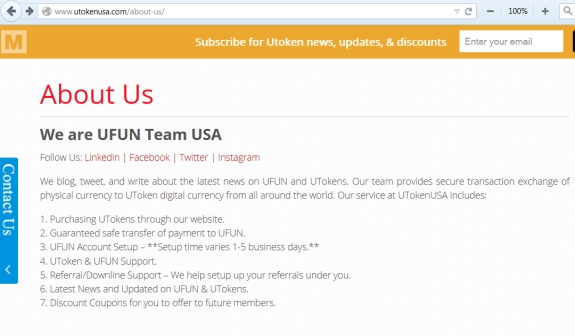
Separately, the PP Blog learned yesterday that a UFunClub/UToken promoters’ group known as UFUN Team USA had published a promo that claimed this (italics/bolding added):
We blog, tweet, and write about the latest news on UFUN and UTokens. Our team provides secure transaction exchange of physical currency to UToken digital currency from all around the world. Our service at UTokenUSA includes:
1. Purchasing UTokens through our website. 2. Guaranteed safe transfer of payment to UFUN. 3. UFUN Account Setup – **Setup time varies 1-5 business days.** 4. UToken & UFUN Support. 5. Referral/Downline Support – We help setup up your referrals under you. 6. Latest News and Updated on UFUN & UTokens. 7. Discount Coupons for you to offer to future members.
This UFunClub/UToken promoters’ group claimed recruits could purchase UTokens through its website and that the promoters “Guaranteed safe transfer of payment to UFUN.”
This leads to questions about whether an unlicensed Money Services Business was gathering funds for another unlicensed Money Services Business. UToken promoters claim the value of the purported digital currency only can rise and never can fall.
The UFUN Team USA site published a phone number with the 323 Area Code in Greater Los Angeles. That’s the same area from which WCM777 was operating.
Like any number of schemes, UFunClub/UToken has been positioned as a “passive” investment opportunity that already has created anywhere from 200 “millionaires” to 5,000, depending on the source of the claims.
This brings questions about an offering fraud and the sale of unregistered securities into play. The same sorts of questions existed with WCM777, Imperia, Zeek and TelexFree.
As the screen shot below taken from a YouTube promo shows, UFunClub/UToken did an in-house announcement about the “THE CONVERSION OF TRADABLE UTOKEN TO INVESTMENT POINTS” — apparently on Jan. 31.
Source: Screen shot from a YouTube video with a publication date of Feb. 10, 2015.
Some American MLMers/network marketers have claimed they traveled from the United States to Thailand to vet UFunClub/UToken and found the “program” to be legitimate.
The Thai police say the “program” is an international fraud scheme.
“The staff also has recently seen what appears to be an increase in pyramid schemes . . . under the guise of ‘multi-level marketing’ and ‘network marketing’ opportunities . . . These schemes often target the most vulnerable investors, and social media has expanded their reach. The Division is deploying resources to disrupt these schemes through a coordinated effort of timely, aggressive enforcement actions along with community outreach and investor education. We are also using new analytic techniques to identify patterns and common threads, thereby permitting earlier detection of potential fraudulent schemes.” — Andrew Ceresney, SEC Enforcement Division director, March 19, 2015
3RD UPDATE 6:09 P.M. EDT U.S.A. Bad news for “program” scammers and their willfully blind enablers: Andrew Ceresney, the director of the SEC’s Divison of Enforcement, told lawmakers on Capitol Hill today that scams using an MLM or network-marketing business model are on the radar.
In fact, according to written testimony Ceresney delivered to the House Capital Markets and Government Sponsored Enterprises subcommittee, they are enforcement “priorities” — right up there with insider trading, microcap fraud and other forms of securities fraud.
“The Division is deploying resources to disrupt these schemes through a coordinated effort of timely, aggressive enforcement actions along with community outreach and investor education,” Ceresney told the panel.
New Jersey Republican Rep. Scott Garrett chairs the panel. Rep. Carolyn B. Maloney, a New York Democrat, is ranking member.
Ceresney didn’t reference the task force in his prepared remarks today. However, the agency already has filed two actions against MLM or network-marketing schemes this year. In February, the agency sued the “Achieve Community,” alleging it was a Ponzi- and pyramid scheme that had gathered about $3.8 million and had spread on social media. One or more criminal probes related to the SEC’s Achieve investigation are believed to be under way, amid concerns Achieve was funneling scam proceeds offshore.
Also in February, the SEC sued a “program” known as Wings Network, alleging it was targeting Latino communities and that its promoters “used Facebook to publicize ‘business meetings’ that took place at hotels and other locations in Connecticut, California, Florida, Massachusetts, Pennsylvania, Texas, Georgia, and Utah.
“The promoters also set up storefronts or ‘training centers’ to lure investors into attending Wings Network presentations,” the agency charged. “For example, one promoter used a storefront in downtown Philadelphia to make presentations to prospective investors, and another promoter rented office space in Pompano Beach, Fla., and spread the word in the local Latino community to attract prospective investors to come in and hear presentations.”
Wings appears to have gathered at least $23.5 million.
In addition to targeting vulnerable population groups, Wings Network tried to sanitize itself by falsely trading on the name of the Direct Selling Association, the SEC said in court filings. Wings has been tied to two companies that used the name Tropikgadget.
Both ostensibly operated from Portugal through business entities set up in Madeira, a Portuguese island in the North Atlantic, and through Sharjah, a city in the United Arab Emirates, the SEC alleged.
Court records suggest Wings had a strong presence in Marlborough, Mass., the town from which the TelexFree MLM scheme was based. In April 2014, the SEC described TelexFree as a massive Ponzi- and pyramid scheme largely targeting immigrant populations. A court-appointed trustee says TelexFree may have gathered $1.8 billion through its pyramid scheme in about two years.
Participants hailed from dozen of countries. A partial list of U.S. participants shows many names that appear to be Latino. Trustee Stephen B. Darr said in court filings that the full list of worldwide participants “contains 1,894,940” names and spans “35,110 pages.”
A list of alleged “winners” in the 2012 Zeek Rewards scheme broken up the SEC and the U.S. Secret Service also appears to include a disproportionate share of Latino names or names from other vulnerable population groups. Zeek is estimated to have rounded up $897 million in less than two years and to have affected on the order of 800,000 victims.
Zeek’s name (through parent Rex Venture Group LLC) was referenced in a footnote and related link in today’s written testimony by Ceresney.
So was the name of CKB168, a “program” that allegedly targeted members of Asian-American communities in New York and California and was taken down by the SEC in 2013. The alleged haul was pegged at at least $20 million.
The footnote pointed to an SEC investor alert dated Oct. 1, 2013, and titled, “Beware of Pyramid Schemes Posing as Multi-Level Marketing Programs.” The alert, which has been translated into Chinese, Spanish, Portuguese, Vietnamese and Creole, has been updated to include information on “programs” such as TelexFree and Wings Network.
Though not referenced specifically in the October 2013 alert, “programs” such as eAdGear, Zhunrize and WCM777 also have encountered SEC actions. All three appear to have affected Asian population groups. WCM777 also clearly affected Latino groups and has emerged as one of the strangest MLM schemes of all time.
Some WCM777 promoters had claimed that $14,000 sent to the California-based “program” returned $500,000 in 52 weeks. WCM777 appears to have gathered more than $80 million in about a year, with the proceeds from the MLM “program” diverted to purchase golf courses, real estate and more. Tens of millions of dollars appear to have been diverted to Hong Kong.
Today’s Congressional testimony took place against the backdrop of continuing clashes between Herbalife and activist investor Bill Ackman, an Herbalife short-seller who has accused the MLM program of being a pyramid scheme that targets Latinos.
Herbalife, which was not referenced in today’s testimony, denies it is a pyramid scheme and says it is proud of its appeal to Latinos and serves the community honorably. (Ackman also isn’t mentioned in the testimony.)
Responding on web forums such as Seeking Alpha, fans of Herbalife have accused Ackman of pandering to enforcement agencies, members of Congress and Latino groups as part of a scheme to inspire investigations that would line his pockets by driving down Herbalife’s stock price.
In media accounts, Ackman has said he won’t keep personal profits if his Herbalife short pays off. At the same time, he asserts he is pursuing profit for his hedge-fund investors through a strategy that also delivers social justice.
Perhaps the only thing clear right now is that MLM, no stranger to controversy, never before has been under a light this intense.
The Capital Markets and Government Sponsored Enterprises subcommittee is under the House Financial Services Committee. The committee is chaired by Rep. Jeb Hensarling, a Texas Republican. Rep. Maxine Waters, a California Democrat, is ranking member.
UPDATED 9:44 P.M. EDT MARCH 14 U.S.A. How strange were things in the universe of WCM777, an MLM “program” accused by the SEC last year of pulling off an $80 million, cross-border Ponzi swindle?
Would you believe that a former CIA operative with two felony convictions ended up on the payroll?
Robert Sensi, the former operative, received $403,000 from companies linked to WCM777, according to an amended lawsuit filed against Sensi in U.S. District Court for the Central District of California.
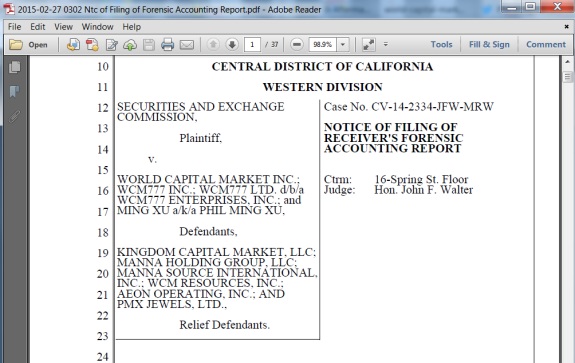
WCM777 was operated by Ming Xu of Temple City, Calif. A forensic accounting has determined that the WCM777 entities used 77 domestic bank accounts and 23 foreign ones, according to filings by court-appointed receiver Krista L. Freitag.
Sensi was paid six times through ToPacific Inc. and one time through World Capital Market Inc. between Jan 30 and March 25, 2014, according to court filings.
Alleged payments to Robert Sensi from WCM777-related firms. Source: Screen shot from federal court filing.
Freitag is suing Sensi for return of the money. She initially sued him for the return of $385,000 (excluding interest and costs) in November 2014, alleging that he claimed he “used to work” for the CIA and was hired by WCM777-related companies to address complaints about the program by authorities in Peru, Taiwan and Dubai. She further alleged that Sensi was “well aware” that various WCM777-related business were engaged in a Ponzi scheme.
Sensi responded to the November complaint on Feb. 9. He did not expressly deny Freitag’s claim that he had claimed to have worked for the CIA, but he did deny the allegations he’d been hired by the Xu entities to address the concerns about WCM777 in Peru, Taiwan and Dubai. He further denied he had knowledge of a Ponzi scheme.
In his answer, Sensi admitted “services were rendered pertaining to Peru, Taiwan, and Dubai.” But he did not describe the services. On March 12, Freitag filed an amended complaint, asserting in the filing that Sensi had received $403,000 from the WCM777 entities, not the $385,000 specified in the original complaint.
Court records or published reports from the past two decades show that Sensi has been sentenced to prison twice — once for stealing millions of dollars from Kuwait Airways, a second time for a “Nigerian letters” scam in which a German businessman was swindled.
Larry J. Kolb, an author and former CIA agent, has written extensively about Sensi, his ties to the CIA and further ties to Republican politicians and Republican political causes, including fundraising.
Chapter 1 of “America at Night,” a 2007 book by Kolb, is available for free on Kolb’s website. The chapter references a meeting Kolb had in California with attorney “Vince Messina” in May 2004.
A snippet (italics added):
Vince was late for lunch, and I wish he’d never shown up. But, then again, all indications are if Vince hadn’t sucked me back into the secret world, somebody else would’ve. So I don’t hold it against him. Vince Messina. Washington tax and immigration attorney, international dealmaker, bon vivant. Based on what I know of his background, he has to be as old as the hills. But somehow he doesn’t seem it. Bald on top, short dark hair on the sides, olive skin, smiles a lot, constantly on the move. Vince is on the up and up, but spends much of his time in strange lands working for mysterious clients.
During the lunch meeting, Messina asked Kolb if he knew Sensi, a somewhat startling question, Kolb wrote.
After Kolb answered yes, Messina called his nephew, Gary Messina, a U.S. Department of Homeland Security official, to enable Gary to listen in, Kolb wrote.
Ten years later, in May 2014, Vincent Messina would become a relief defendant in the WCM777 Ponzi case. The SEC alleged that Messina was WCM’s asserted “general counsel” and had come into possession of $5 million from the fraud scheme.
More than $941,000 of the $5 million went to International Market Ventures (IMV), a company operated by Gary Messina, according to court filings.
U.S. District Judge John F. Walter declared the $5 million that flowed to Vincent Messina “ill gotten” and ordered it disgorged. IMV was held jointly liable with Vincent Messina for disgorgement of $941,505 of the $5 million sum.
“Many investors gave cash to the company and to their leaders (or upline sponsors) who then deposited the cash along with other investor funds.” — Krista L. Freitag, court-appointed receiver in the WCM777 pyramid- and Ponzi case, Feb. 27, 2015
EDITOR’S NOTE: Tens of millions of dollars allegedly flowed through WCM777 and related entities. At the bottom of this column, you’re going to read that an apparent apologist for accused Ponzi schemer Ming Xu is claiming the U.S. Securities and Exchange Commission is violating his human rights. Fair warning: You might want to have your vomit bucket at the ready . . .
UPDATED 10:31 A.M. ET U.S.A. Here’s how you rob the Christians in an offering fraud that involves the sale of tens of millions of dollars in unregistered securities across state and national borders: You start an MLM “program,” get it in the churches and on YouTube, permit “leaders” to gather money from their enraptured audiences and put out the word that $1,999 returns $3,200 in 100 days.
It might help if you have a storefront in, say, Peru. It also might help if you have, say, promoters willing to tout the “program” in webinars and from a “function room in a hotel in Massachusetts.” At the same time, it might help if you have promoters willing to steal the intellectual property of the “Rocky” movie franchise to drive dollars into any of the “77 domestic and 23 foreign bank accounts” you’re using. (The bank-account information is sourced from a forensic accounting by Krista L. Freitag, the court-appointed receiver in the WCM777 case. It was filed Feb. 27 in U.S. District Court for the Central District of California and is the basis for part of this PP Blog column. Links to exhibits are provided near the bottom of the column.)
Along the way, it might help if you follow the standard blueprint from one MLM scam after another that calls for you to disarm skeptics by dropping the names of plenty of famous businesses, perhaps with the aim of hoping your “leaders” will follow your lead and do the same thing. Damn! Wouldn’t you know it! They did exactly that! (See link in first paragraph of this story.)
It might be particularly helpful if you make a calculation that a bank such as HSBC in Hong Kong might frown upon a subpoena issued in the United States and clam up when it comes to assisting the receiver appointed to your case after the SEC moves in.
“To date, HSBC-Hong Kong has not responded to the Receiver’s requests/subpoena,” Freitag advised U.S. District Judge John F. Walter in her forensic accounting.
Or maybe HSBC doesn’t want to open a new can of worms after it settled with the Justice Department in December 2012 by forfeiting $1.256 billion and entering into a deferred-prosecution agreement after it was accused of “willfully failing to maintain an effective anti-money laundering (AML) program, willfully failing to conduct due diligence on its foreign correspondent affiliates, violating [the International Emergency Economic Powers Act] and violating [the Trading with the Enemy Act].”
“Vincent,” the alleged Ming Xu email to Messina began. “We have lots of members for our social capital company, WCM777 in Brazil. They paid us in Brazil. How to move the money legally from Brazil to USA or Hong Kong?”
Whether Messina provided guidance on how to get money out of Brazil and move it to the United States and Hong Kong is unclear. Ming Xu’s email, however, suggests that WCM affiliates in Brazil, like their U.S. counterparts, also were collecting money directly from MLM recruits and that Ming Xu needed to find a way to get the cash under his control.
Freitag says she has traced $5 million in Ming Xu proceeds to Messina, and Walter ordered Messina to return it. Only $2.133 million has been returned, Freitag says.
Messina wasn’t just a lawyer; he was a WCM777 “insider,” the receiver alleges.
Because Freitag has access to certain WCM777 banking records, she has been able to determine that “$29,404,996” went to HSBC in Hong Kong “for 7 Receivership Entities and 1 individual.”
Ming Xu used numerous companies as part of his overall money-moving scheme, the receiver contends.
Here’s how she describes one transaction that occurred after WCM777 got in trouble with the Massachusetts Securities Division in late 2013 and agreed to return money to the fleeced investors in that state (italics added):
“ . . . rescission payments were made to WCM777 investors in accordance with the Consent Order issued by the Massachusetts Securities Division. Bank records show that funds from ToPacific bank accounts were used to make payments to the Massachusetts WCM777 investors.”
“ToPacific” was a company in the WCM777 fold.
How circuitous were things within WCM777 (italics added):
“the payment methods with which investors payments were made varied from third-party electronic disbursement (primarily Global Payout) to physical checks written directly on Receivership Entity bank accounts. There does not appear to be any consistency in the bank accounts from which investor checkswere written. Rather, bank records indicate payments were made to investors from whichever accounts happen[ed] to have funds available at the time the payments were made.”
The FBI has been warning about shell companies involved in crime and how banks and payment processors can get caught up in it since at least 2010. Even so, the WCM777 entities somehow managed to open at least 100 bank accounts while also gaining access to bank wires and at least one payment processor.
Here’s how Freitag describes the overall scheme (italics added/light editing performed):
“The Receivership Entities’ primary source of income was investor deposits, which was also the primary source of virtually all funds distributed to the investors; [t]he vast majority of the Receivership Entities’ business activities revolved around raising and distributing investor funds; [i]nvestor funds were so materially commingled between and among the Receivership Entities that the entities operated as a unitary enterprise, rather than as separate entities.”
And while WCM777 recruits thought they were joining an MLM “program,” their money financed the purchases of two golf courses in California, several pieces of real estate, including one with live koi, and a series of purported investments elsewhere. These allegedly included jewelry or gold, oil and gas — and even piles of “jeans, shorts, pants and leggings” stored by Ming Xu’s sister.
Ming Xu’s Mom allegedly got a new house, but not until after the cash to purchase the home had passed through bank accounts linked to Ming Xu and his sister.
The Ming Xu Twitter account, which once claimed all would become known when “blood moons” appeared in the sky and published a picture of Apple co-founder Steve Wozniak, whom Ming Xu had corralled at a networking event in California, now includes a link to a website that claims (italics added):
U.S. Securities and Exchange Commission was wrong to close down the company and confiscate about $43M cash asset and oil reserve asset of $50M. It has violated the company’s legal interests and human rights of Ming Xu.
Read the exhibits from Freitag’s forensic accounting. (Here’s one; here’s the other.)
As noted above, you might want to have a vomit bucket handy if you’re contemplating how certain MLM “programs” are operating these days in the era of epic white-collar fraud and while terrorism, beheadings and attacks on police are occurring.
EDITOR’S NOTE: The MLM “program” known as Wings Network is alleged to have operated through two business entities that used the name “Tropikgadget.” The SEC’s case, announced Friday, is filed in U.S. District Court for the District of Massachusetts. That’s the same venue in which the agency’s epic TelexFree case was filed last year.
There can be no doubt — zero, none — that vulnerable immigrant populations in Massachusetts are being targeted in one MLM scheme after another. Speakers of Spanish or Portuguese may be particularly at risk. It’s also apparent that Asian, Haitian and African population groups are being targeted and that the risk is not unique to Massachusetts residents. The WCM777 “program,” for example, brushed through Massachusetts, where it was aimed at speakers of Portuguese and was stopped by the Massachusetts Securities Division in late 2013.
MSD also has squared off against a “program” known as EmGoldEx. In this scam, investors were promised returns of up to 1,105% and photos of children “getting paid” were used as lures to drive dollars.
One of the Tropikgadget entities — Tropikgadget Unipessoal LDA — allegedly was set up in the Madeira Free Trade Zone in November 2013 and later abandoned. Madeira, whose largest city is Funchal, is a North Atlantic Portuguese archipelago slightly closer to continental Africa than continental Europe. It is worth pointing out that the SEC publicly thanked both Portugal’s securities regulator (Comissão do Mercado de Valores Mobiliários) and the office of Portugal’s Attorney General (Procuradoria-Geral da República of Portugal) for assistance in the American probe.
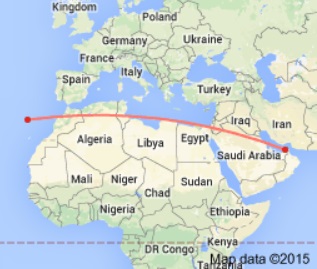
The other Tropikgadget entity — Tropikgadget FZE — appears to have been set up in Sharjah, United Arab Emirates, also in November 2013. Sharjah, on the Persian Gulf, is the UAE’s third most populous city, behind Dubai and Abu Dhabi, according to WikiPedia. The paper presence of these companies at geographic points on the North Atlantic and the Persian Gulf more than 4,300 miles away from each other and how they enlisted Massachusetts residents to do their bidding probably is a story unto itself, but it is a story for another day. What’s news today is that Wings Network was operating in Massachusetts at Ground Zero for TelexFree after the TelexFree action and, like TelexFree, is accused of fleecing vulnerable immigrant populations.
At least seven of the 12 charged Wings Network promoters had addresses in Marlborough, Mass. This is potentially important because TelexFree’s U.S. operations were based in Marlborough. TelexFree operated through various U.S. entities and a Brazilian entity known as Ympactus. Brazil-based TelexFree/Ympactus figure Carlos Costa has TelexFree business partners in Massachusetts, waved the flags of Madeira and Portugal in a 2013 TelexFree promo and invoked God in appeals to support TelexFree. Sann Rodrigues, a charged TelexFree promoter associated with an MLM entity known as iFreeX that also operated in Massachusetts and has come under scrutiny, has claimed “God” invented MLM and “binary.” Rodrigues, according to the SEC, is a recidivist pyramid-schemer.
There’s also evidence that the Zeek Rewards “program” taken down by the SEC in 2012 targeted vulnerable people.
**____________________**
Funchal, Madeira, to Sharjah, UAE. Source: Google Maps.
UPDATED 11:32 A.M. ET U.S.A. The SEC’s “Wings Network” case announced Friday is the latest example of the MLM world’s intolerable capacity to deceive. Though the facts alleged by the SEC are alarming, the action against two companies, three officers and 12 promoters is not an indictment of the trade. Indeed, the agency worked with the Direct Selling Association to expose one of the most mind-numbing lies.
But you still have to wonder if MLM and network marketing in general are on the road to perdition. This is because the horrifying abuses and thematic lies that propped up Wings Network are so common across the larger MLM trade that one can be forgiven for wondering if targeting vulnerable population groups and institutionalizing prevarication is Rule No. 1.
How DSA Got Involved In The Wings Network Case
Adolfo Franco, the trade association’s executive vice president and chief operating officer, sits at the intersection of commerce and government affairs. He’s an old political hand and has worked as a Republican strategist and assistant administrator for Latin America and the Caribbean for the U.S. Agency for International Development (USAID). Franco wants the MLM industry to prosper, and he wants to make sure he has a wholesome story to tell in government corridors.
Wings Network didn’t give him one, to be sure.
You see, Wings Network is accused by the SEC of using the DSA’s name to sugarcoat a creeping, cross-border fraud scheme that ultimately gathered at least $23.5 million. What actually happened, according to the SEC and an affidavit prepared by Franco, is that DSA received an “e-mailed request” for a DSA membership “application.” It then sent out the application, which was never returned. Not only was the application not returned, according to the affidavit, DSA never even heard back from Wings Network.
What allegedly happened next will surprise no one who follows the bizarre dramas MLM has been serving up for the past several years. This simple request for a membership application was conflated by Wings Network and affiliates as an endorsement by DSA of Wings Network.
By April 2014, according to the SEC, DSA became aware of this ribald deception. The association reacted by sending Wings Network a cease-and-desist letter, directing Wings Network and affiliates to stop claiming membership in DSA and stating point-blank that “any indication that Wings Network is a member of the DSA is fraudulent.”
Multiple Layers Of Deception
Could it get worse? Sure. Wings Network hucksters also are accused of duping participants into believing the “program,” which advertised guaranteed income, had the additional benefit of insuring them against loss.
Anyone who’s been following the unbelievably noxious example of TelexFree can tell you that the same thing allegedly happened there. The same thing currently is happening in a “program” known as “MooreFund,” and it previously happened in the AdSurfDaily Ponzi scheme in 2008 broken up by the U.S. Secret Service.
The MLM scammers look for a tiny kernel of truth and then wrap a lie around it: A “program” may have a bank account, for example. Money in the account may be insured by the FDIC in the event of a bank collapse.
From this, the “programs” themselves and affiliates conflate a fantastically malignant construction by which no one can lose money because of the “insurance.” It is just a contemptible lie. It’s also one that has been bettered by new versions of the lie. These versions — as is the case with Wings Network, TelexFree and MooreFund — hold that private insurers or even software companies such as Symantec have the companies’ backs and that these private insurers never would do business with a fraud scheme.
Supplementing this lie are companion lies — advanced by Wings Network, TelexFree and others — that a business registration with a Secretary of State or equivalent agency domestically or overseas is proof that there is no underlying scam. (One need only to look at Bernard L. Madoff Investment Securities LLC to understand just how preposterous this type of lie is.)
Here’s the thing: The type of lies advanced by Wings Network are not unusual for “opportunities” using an MLM or network-marketing business model. DSA happened to be the victim of brand-leeching and runaway disingenuousness in this case, but other cases show it’s hardly alone. Even the names of the U.S. government and various U.S. agencies have been dropped in this fashion.
Not even the “brands” of God and Jesus Christ are off-limits in the MLM sphere. Sometimes an asserted endorsement by a deity is supplemented by suggestions that living legends of entertainment and business have piled aboard a “program” train.
This is a short summary of these tactics as employed by recent MLM or network-marketing schemes that either cratered on their own or collapsed after regulatory intervention. (Note: Some background information also appears in the summary):
WCM777. Operated by Ming Xu. Targeted people who spoke Spanish, Portuguese, English and Asian languages. Dropped names of God, “Yahweh,” Jesus Christ, Al Gore, Steve Wozniak, Sylvester Stallone, “Rocky,” Eric Garcetti, Siemens, Goldman Sachs, the Denny’s restaurant chain and many, many more famous companies. (As many as 700.) Basic sales message: Send us money. Get rich. Estimated haul: $80 million in less than a year. Estimated number of victims: tens to hundreds of thousands.
TelexFree. Operated by James Merrill, Carlos Wanzeler and Carlos Costa. Largely targeted people in the United States and internationally who spoke Spanish, Portuguese and English. Global penetration at an almost unfathomable level. Appears to have created black market and back-alley economy in Massachusetts. Became subject of undercover investigation by the U.S. Department of Homeland Security. Dropped names of God, Jesus Christ, MLM Attorney Gerald Nehra, President Obama, Massachusetts Commonwealth Secretary William Galvin, the SEC, the U.S. Attorney General. Basic sales message: Send us money. Get rich. Estimated haul: $1.82 billion in about two years. Estimated number of victims: hundreds of thousands to more than 1.8 million.
Zeek Rewards. Operated by Paul R. Burks. Targeted people who spoke Spanish, Portuguese, English and Asian languages. Global penetration at an almost unfathomable level. Affiliates targeted Christians. Dropped names of the Association of Network Marketing Professionals, MLM attorneys Gerald Nehra and Kevin Grimes, plus MLM consultants Keith Laggos and Troy Dooly. Basic sales message: Send us money. Get rich. Estimated haul: $897 million in less than two years. Estimated number of victims: hundreds of thousands. “Clawback” cases to return alleged ill-gotten gains may affect 10,000 or more affiliates.
eAdGear. Operated by Charles Wang and Francis Yuen. “Primarily” targeted “investors in the U.S., China, and Taiwan,” according to the SEC. Dropped names of Google, Yahoo, Target Corp., Lbrands (Victoria’s Secret), Avon, Sears, Nordstrom, eBay, QVC, HSN, J.C. Penney, Banana Republic, Dillard’s, Kohl’s, Macy’s, Amazon.com, Men’s Wearhouse, Kmart, New York magazine and many, many more. (As many as 253 brands were abused.) Basic sales message: Send us money. Get rich. Estimated haul: $129 million. Estimated number of victims: tens of thousands.)
Wings Network now stands accused of targeting “many members of the Brazilian and Dominican immigrant communities in Massachusetts” in a combined pyramid- and Ponzi scheme that raised at least $23.5 million.
If that sounds familiar, perhaps it is because the TelexFree “program” was accused last year by the SEC of doing the same thing in the same place. Like Wings Network, TelexFree reached across national borders to plunder investors. Recent filings by the court-appointed trustee in the TelexFree bankruptcy case — and these filings are subject to amendment in part because there are more than 1 trillion disparate data points involved in the reverse-engineering of TelexFree — list the “nature” of the company’s business as “pyramid scheme.”
Other filings by Stephen B. Darr, the trustee, suggest that TelexFree gathered more than $1.8 billion in about two years of operation through a series of entities in the United States and an affiliate in Brazil known as Ympactus. The dollar volume alone is simply mind-boggling, more so when one considers the records so far denote “1,894,940 Participant names, spanning 35,110 pages.”
Some readers who sift through the TelexFree material will need a name-pronunciation guide and a world atlas. TelexFree didn’t just mow down Americans. The records suggest, for example, that the “Embassy Of Nigeria P O Box 1019 Addis Ababa Ethiopia” has contacted Darr. One document lists “Baker Island,” which WikiPedia says is an uninhabited Pacific atoll tended to by the U.S. Fish and Wildlife Service, as the “country” of an investor.
It is clear that TelexFree had investors (at least) in Argentina, Australia, Belarus, Belgium, Bolivia, Cambodia, Canada, Chile, China, Colombia, Croatia, Cyprus, Dominican Republic, Ecuador, Egypt, El Salvador, France, French Polynesia, Germany, Ghana, Guatemala, Honduras, Hong Kong, Hungary, India, Indonesia, Ireland, Italy, Japan, Jordan, Kenya, Lebanon, Luxembourg, Malaysia, Mexico, Moldova, Netherlands, New Zealand, Nigeria, Norway, Paraguay, Peru, Philippines, Poland, Portugal, Puerto Rico, Qatar, Romania, Russia, Rwanda, San Marino, Serbia, Singapore, South Africa, Spain, Sweden, Switzerland, Taiwan, Tanzania, Thailand, Togo, Turks and Caicos, U.S. Virgin Islands, Uganda, Ukraine, United Arab Emirates, United Kingdom, United States, “Unknown” country, Uruguay, Uzbekistan and Venezuela.
MLM in this form is “fraud creep” running wild. It is posing dangers to individual participants, including those who can ill afford to take a financial hit. Beyond that, it is posing a danger to the U.S. financial infrastructure.
Economic security is national security, friends. These MLM HYIP “programs” pose an untenable security threat. Many of them are shrouded in multiple layers of mystery.
DSA Needs To Do More
It is good to see that the DSA worked with the SEC on the Wings Network case. It would be better yet if the organization studied why so many MLM HYIPers appear to move from fraud scheme to fraud scheme to fraud scheme.
Where did these people start their “MLM journeys?” Did they start at, say, Herbalife or Amway after buying into the dream and the attendant hype? And did they get churned by those “traditional” MLMs, only to become shark bait for the HYIPs?
With so many of the scams selling the message that it’s nearly impossible to make money in “traditional” MLMs and that 97 percent of people who latch onto the MLM dream of riches emerge as losers or highly vulnerable treaders of water in rough seas, isn’t it time for those traditional MLMs to question whether they are creating the refugees and providing the training for the targeting?
Herbalife is not an HYIP. But it sells a dream and has a high burn rate. The most recent scheme to sell against traditional MLM is “Achieve Community,” taken down by the SEC last month.
Whether or not “the 97 percent” claim is precisely true is immaterial. What’s material is the ready availability of vulnerable population groups and refugees from “traditional” MLMs.
TelexFree even may have channeled Herbalife, calling its cheerleading sessions “extravaganzas” and latching onto the sport of soccer.
Stemming this hurtful tide should be a top priority at DSA. The wave of scams is not docile. It very well might be eroding protective shores in violent fashion and creeping up on the road to perdition.
DEVELOPING STORY: (Updated 8:43 p.m. ET U.S.A.) The Press Democrat of Santa Rosa, Calif., is reporting that detectives in Napa County have linked the kidnapping and murder of 44-year-old Reynaldo Pacheco to the WCM777/Kingdom777 MLM scam and as many as four suspects.
From the Press Democrat in a story dated Jan. 15 about the arrest of Angela Martinez Arias, 41, of Petaluma (italics added):
According to investigators, Pacheco had been involved in a business scam known as WCM777, or Kingdom 777. Early last year, the U.S. Securities and Exchange Commission announced it to be an illegal pyramid scheme targeting Asian and Latino communities worldwide. Assets were frozen.
Pacheco apparently had gotten Arias to invest an undisclosed amount of money in Kingdom 777, according to detectives. Pacheco “owed her money from a failed business relationship,” [Napa County Sheriff’s Capt. Doug] Pike said.
The other suspects, according to the newspaper, are Mauricio Tovar-Telles, 24, and Norberto Guerrero Gonzalez, 29. Both are in custody.
A fourth suspect, Miguel Angel Garcia, reportedly shot and killed himself last year after a standoff with SWAT officers.
EDITOR’S NOTE: The screen shots below show that Rodney Blackburn ends his “Unison Wealth” promo at the 8:29 mark of a 14:27 video. At the 8:30 mark, the website of the SEC becomes the feature and remains so for nearly the next six minutes as Blackburn touts Achieve Community, Unison Wealth and Trinity Lines, Ponzi-board “programs” one and all. It is Saturday. The PP Blog did not immediately hear back from the SEC on a request for comment.
1. From ‘Unison Wealth’ . . .
2. . . . To The SEC
“We’re leaving the markets of these crazy MLM companies, and there are people like the Achieve Community, Trinity Lines, Unison Wealth, many of these other companies are coming out. And they are making programs that are very simplistic, they’re passive, they’re residual incomes. They’re just so simple you just kind of put your money down.” — Rodney Blackburn, Jan. 9, 2015.
A 14:27 YouTube video from an “Achieve Community” member now promoting at least two other Ponzi-board schemes includes nearly six minutes of continuous footage from the website of the U.S. Securities and Exchange Commission.
The latest promo by Rodney Blackburn focuses on “Unison Wealth” and has a publication date of Jan. 9, 2015. It is titled “Network Marketing & MLM Programs Are Getting Better!!!” The promo suggests that ordinary MLM creates an environment in which 97 percent of participants lose and that new, smarter, better schemes are emerging to replace them.
“You don’t have to do any marketing, for the most part,” he says of the purported new way of network marketing. “You don’t have to jump through any hoops and recruit people. You don’t have to go through any of these things.”
In short, Blackburn says, in the new way of network marketing, participants “just kind of put [their] money down” and payouts flow back to them. What’s more, he implies, the SEC doesn’t have jurisdiction, despite mountains of evidence to the contrary, including several concurrent active prosecutions involving network-marketing or MLM schemes with passive components.
Blackburn even dares individuals to complain to the SEC about the “programs” he’s promoting.
“There’s people on here who think that the SEC can shut companies down,” Blackburn says as part of his narration. “Guys, [the] SEC is designed for, again, Securities and Exchange Commission, what they do — it shows it right here in back and white.”
Blackburn proceeds to click on an “ABOUT” tab and a “What We Do” subtab at the SEC website. He then cherry-picks a quote from the agency’s site, wholly ignoring sections on SEC enforcement that detail various cases brought against network-marketing or MLM schemes.
“The mission of the U.S. Securities and Exchange Commission is to protect investors, maintain fair, orderly, and efficient markets,” Blackburn says, reading from the SEC site.
That’s true, of course — but the cherry-picking ignores the much larger whole.
Had Blackburn simply typed “MLM” into the search box in the upper-right corner of the SEC site, he’d have gained instant access to information that undermines his jurisdiction theory.
Without perusing the enforcement section that has information on recent schemes such as Zeek Rewards, TelexFree, WCM777, eAdGear, Zhunrize, CKB168 and others, Blackburn switches back to his personal narrative.
“Guys, it’s about investors,” Blackburn continues, apparently concluding that the SEC would have no interest in the schemes he’s promoting. “It’s about efficient markets. If others of you who want to complain to your governments about these companies that are out there — you know what, go right ahead. It’s not going to do any good, unless they’re doing illegal activity. Unless you have substantial, proven evidence that any of these companies — any of them, OK — are doing anything illegal, it’s futile. You’re just blowing fear out there to the rest of us, OK, because it’s not going to do any good. Come up with something better. Come up with a fact.”
It is a fact that the SEC, on Oct. 1, 2013, issued an “Investor Alert” titled “Beware of Pyramid Schemes Posing as Multi-Level Marketing Programs.” As part of its outreach, the SEC warned about schemes with “Promises of high returns in a short time period” and “Easy money or passive income.”
Meanwhile, it is a fact that Achieve Community has been positioned as a “passive” program with an 800 percent ROI in as few as 55 days. It’s also a fact that a Dec. 27, 2014, promo for Unison Wealth published on YouTube by Blackburn is titled, “Unison Wealth – Review 100% Passive Automated Play for just $40!”
Blackburn’s Jan. 9 video appears to be a compendium of two, with the first 8:29 focused on Unison Wealth. When Blackburn’s Unison pitch ends, the scene shifts abruptly to the SEC website. SEC visuals appear continuously for nearly the next six full minutes as Blackburn discuses his “programs.”
Even as Blackburn tries to make the case that the “programs” are outside the purview of the SEC, he tells his audience that he prefers “passive” programs.” Somehow lost by Blackburn in all of this is that the passivity of a scheme and how it behaves in practice are what confer jurisdiction on the SEC.
This has been the law in the United States since at least 1946.
Kenneth D. Bell, the receiver, is suing thousands of individuals for the return of hundreds of millions of dollars, saying their “winnings” came from hundreds of thousands of victims defrauded by Zeek.
The buyer of the property, Xiaomei Deng, is the mother of Xu and Wang, Freitag said in court filings.
Wang is associated with an entity known as MaNa Fashion, Freitag alleged last month. She further alleged that Xu, who did not initially disclose that Wang was his sister, effectively had transferred $1 million to her in February through an entity known as ToPacific Inc. Wang likewise did not initially disclose that Xu was her brother.
Freitag now has discovered that Deng is the mother of Xu and Wang, Freitag alleged.
MaNa initially tried to wire the $730,000 on March 13 to purchase the property, but the wire was rejected, according to Frietag. One day later, on March 14, MaNa “initiated a wire in the same amount of $730,000 from MaNa Fashion’s account to Deng’s personal checking account at East West Bank . . . ” Freitag alleged.
“On the same day the $730,000 was wired to Deng, Deng transferred $700,000 of those funds” to an escrow company. She later transferred additional sums to complete the purchase of the property, Freitag alleged.
Tens and tens of thousands of MLMers appear to have joined the Ming Xu WCM777 scam, which the SEC described in March as a “worldwide” Ponzi- and pyramid scheme that had gathered tens of millions of dollars by posing as a “cloud” services business.
The WCM777 tale has been marked by a series of bizarre events, including a declaration of love to the people of Peru that was written on the letterhead of a suspended California company linked to Xu.
With a storyline that has included claims that $14,000 would turn into $500,000 in a year, a declaration of love to the Peruvians it had fleeced and additional claims that all would become clear when “4 blood moons” appeared in the sky in April, the WCM777 “cloud computing” MLM scam has served up a symphony of the bizarre. For now, at least, the storyline only is getting stranger.
Here’s the latest . . .
Very early on in her investigation of the WCM777 MLM “program” and the financial activities of accused Ponzi schemer Ming Xu, court-appointed receiver Krista. L. Freitag discovered that a Xu/WCM777-linked entity known as ToPacific had transferred $1 million to an entity known as MaNa Fashion.
This transfer, according to court filings, occurred “on or around” Feb. 28. On March 28, the SEC announced pyramid- and Ponzi charges against Xu. Freitag was appointed receiver.
Shortly thereafter, according to court filings, Freitag tried unsuccessfully to contact and to serve a subpoena on MaNa operator Sue Wang, according to court files.
Freitag, however, was able to identify Wang’s accountant, who provided an email address for Wang.
The receiver’s counsel then “e-mailed Ms. Wang a copy of the subpoena and a demand for information,” according to court filings. On May 23, nearly two months after the SEC action and Freitag’s appointment as receiver, “Ms. Wang finally acknowledged the Receiver’s attempts to contact her.”
Wang “thereafter engaged counsel to respond to the subpoenas,” according to the receiver. “After further delays and demands for additional time, Ms. Wang produced limited documents on July 18, 2014.”
In court filings, Freitag now says MaNa’s Wang is Ming Xu’s sister and that Ming Xu did not disclose this during an interview with the receivership. In fact, according to Freitag, the receivership did not learn this until September 2014.
That’s not the only surprise.
Freitag now finds herself seeking court approval to liquidate apparel in bulk as a means of recovering funds for WCM777 participants affected by the scheme. That’s because Freitag, on Oct. 13, met with Wang and her counsel and visited “two 10′ x 20′ storage sheds” that included an estimated 100,000 garments.
Wang has acknowledged the apparel belongs to the receivership, Freitag says.
These garments mostly were “stored in disorganized fashion, with much of the articles of apparel stuffed in large plastic bags and boxes with limited recognizable form of organization either by style, size or other methods generally acceptable in the [fashion] industry.”
The items, Freitag says, are “non-branded” and will not fetch the $1 million Xu supplied his sister to acquire them. The best that can be hoped for is between $100,000 and $250,000, but their value will decrease over time because the merchandise is aging. “Most” of it was acquired for “previous seasons.”
It might be helpful to sell them in bulk ASAP with the holiday season quickly approaching, Freitag says.
So, she has asked the judge for permission to do exactly that. And, Freitag notes that she “has direct experience running a design and wholesale footwear and accessories company, and will utilize that expertise and experience to market the Garments and negotiate with potential buyers for the highest per unit price.”
It also turns out that Wang was associated with two other entities that received another $1 million combined from Xu. These were identified as JJ Sparkles Inc. and Yuanhao Inc.
“These entities are interrelated as their public registrations with the California Secretary of State show that Ms. Wang (who is also named as a salesperson for MaNa Fashion) is the named agent for service of process for both MaNa Fashion and JJ Sparkles, and Yuanhao’s registered business address is that of JJ Sparkles.”
Because Ming Xu also bought golf courses, the receivership also has found itself in the golf business. And because Xu, the purported cloud-computing chieftain, used WCM777-linked funds to acquire real estate, the receivership also has found itself in the property-management business.
The receivership even became a part of the fish-management business when Freitag discovered “live Koi” at a WCM777-linked property in California.
As the PP Blog reported on May 15, Massachusetts Commonwealth Secretary William Galvin sued the Wings Network MLM “program” and some of its promoters, alleging securities violations and a “thinly veiled pyramid scheme” targeting minority communities.
Now, Nevada Secretary of State Ross Miller has published a warning on Wings Network, saying the online “program” even is being sold “door-to-door” and is targeting Spanish and Portuguese prospects.
Miller is encouraging residents of Nevada who have information on Wings Network to contact his Securities Division here or by calling 702-486-2440.
“It is vital that every investor conduct the most thorough due diligence possible when making an investment,” Miller said in a statement. “Investing is a complicated and risky process. Even the initial receipt of interest payments or distributions paid to some investors, or an investment sold by someone you know, doesn’t guarantee that an investment is legitimate. A Ponzi scheme may have similar attributes. Potential investors just can’t be careful enough. And always remember that if it sounds too good to be true, it probably is.”
Secretary of State Ross Miller warns Nevadans to beware of a possibly fraudulent investment scheme targeting minority communities, specifically Spanish and Portuguese. Wings Network is a multi-level marketing program that is advertising online, and being sold door-to-door or through friends and relatives.
Wings Network offers investors various packages ranging from $49 to $1,499. The “Elite” package purportedly requires an investor to purchase the package for $1,499, pay an activation fee of $49, and recruit two additional people to buy the package. The seller then allegedly promises that the investor is guaranteed to receive a minimum of $750 per month for one year afterward.
Investors may be told that Wings Network is associated with smartphone applications compatible with Google Play and Apple. Individuals who purchase the “Elite” package gain access to the Wings Network website, which provides them with information related to their purchase. Wings Network is allegedly associated with Tropikgadget FZE located in the United Arab Emirates.
The Secretary of State’s Securities Division believes Wings Network’s proposed business opportunity is an investment contract and a security that should be, but isn’t, registered with the State of Nevada. Some multi-level marketing programs may be structured in such a way that they constitute a security and should be registered as such. Miller cautions individuals not to buy or sell packages from Wings Network without conducting thorough research and seeking independent legal advice.
Although the dotcom landing page for WingsNetwork appears not to be loading properly at least in the United States, other pages on the site continue to be accessible from the United States. The PP Blog today observed the flags of the United States, Spain, Portugal, Italy, France, Germany and Russia on the site. WingsNetwork subdomains with Wings Network affiliate pitches that point prospects to YouTube promos and lead-capture pages also were observed.
In addition, the Blog observed a specific domain named a respondent in the Massachusetts action — WingsNetworkGlobal.com — that appears to have been repurposed by a onetime Wings Network affiliate to drive traffic to a video pitch for something called “The Millionaire’s Brain.”
“Listen,” a male narrator intones. “You’re skeptical. You’ve heard big claims before and they didn’t pan out. I get it.”
Opportunity-hopping is a frequent occurrence in MLM or direct-sales programs. Some affiliates of such programs proceed from fraud scheme to fraud scheme to fraud scheme.
Research suggests that the WingsNetworkGlobal domain previously was used to promote alleged scams such as TelexFree and WCM777, both of which were sued by the SEC and became the subjects of regulatory actions by the Massachusetts Securities Division.
 WCM777 claims will be accepted in the not-too-distant future, under a proposal by Krista L. Freitag, the court-appointed receiver in the SEC’s pyramid- and Ponzi-scheme case.