UPDATE: A federal judge has ordered the receiver in the WCM777 case to list for sale three properties linked to the alleged MLM pyramid scheme.
U.S. District Judge Christina A. Snyder is presiding over the SEC’s civil case filed in March. Receiver Krista L. Freitag asked for the authority to sell the properties last month. Snyder granted the authority June 9. The properties are single-family residential homes in Lake Elsinore, Monrovia and Walnut, Calif.
Snyder also authorized Freitag to “close frozen bank accounts of the Receivership Entities and have the balances wired to receivership bank accounts.”
Since the filing of the original SEC pyramid action, the agency has upped the dollar volume of the alleged scam from about $65 million to about $80 million. In April, Freitag said she’d put an end to a nascent MLM scheme with ties to WCM777.
WCM777 purportedly was part of an entity known as World Capital Market.
In an amended complaint last month, the agency accused Vincent Messina, an attorney linked to alleged WCM operator Phil Ming Xu, of self-dealing and distributing millions of dollars in funds linked to WCM777 to other entities.
Certain money disbursed by Messina ended up with “persons in Canada, Abu Dhabi, and to an entity in Hong Kong,” the SEC alleged.
Snyder imposed an asset freeze on Messina last month.
Some promoters of TelexFree, an MLM “program” and alleged Ponzi- and pyramid fraud that gathered more than $1.2 billion, also promoted WCM777.
Like TelexFree, WCM777 was the subject of a state-level securities investigation in Massachusetts. Regulators said both programs targeted individuals who speak Spanish or Portuguese. WCM777 also targeted the Asian community.
Like other HYIP scams, WCM777 traded on the names of famous companies.
The WCM777 and TelexFree “programs” have led to questions about whether MLMers were getting sucked into companies that have cult-like qualities.
La Republica, a newspaper in Peru, is citing information from police and reporting that a TelexFree promoter in the country was kidnapped Thursday afternoon and held in a van. The PP Blog cannot independently verify the report, which suggests the kidnapping was carried out by TelexFree members who ordered the man to withdraw money from a bank to make them whole.
In Peru and across the world, individual TelexFree members recruited others into MLM downlines. La Republica’s report suggests the kidnappers’ extortion plot failed, but one person reportedly was captured while others fled.
Court records in the United States allege that some TelexFree sponsors collected money from individual recruits, rather than directing the recruits pay TelexFree directly. Such a practice may establish a dangerous black-market economy while setting the stage for scams to occur inside of scams.
How the asserted Peruvian kidnapping victim handled TelexFree transactions is unclear. Even if recruits paid TelexFree directly, however, it’s no guarantee against an angry mob. In a 2009 Ponzi case in the United States, the FBI warned against Ponzi victims taking matters into their own hands. Four persons were charged criminally in an alleged shakedown bid associated with the 2009 case in California.
“In their guilty pleas the defendants admitted to creating an environment that was intimidating and causing the individuals to believe that they were not free to leave,” the FBI said in 2010.
On April 1, 12 days before TelexFree declared bankruptcy in the United States, unhappy affiliates jammed the “program’s” office in Massachusetts. Police were called to defuse the situation.
It’s often the case in the HYIP sphere that individual promoters push multiple scams simultaneously, potentially setting the stage for recruits to take multiple baths. It is known, for example, that some TelexFree promoters also were pushing WCM777 and Wings Network.
The SEC has called WCM777 an $80 million fraud scheme. Wings Network has been accused in Massachusetts of selling unregistered securities as investment contracts. Vulnerable populations often are targeted in HYIP scams.
There have been reports of at least two TelexFree-related suicide deaths. Some TelexFree affiliates spammed reports of the deaths with offers to join the “program,” which the Massachusetts Securities Division has described as a combined pyramid- and Ponzi scheme that gathered more than $1.2 billion.
In April, the U.S. Securities and Exchange Commission sued TelexFree and eight managers/executive or promoters, alleging a massive fraud scheme.
Some promoters continued to promote TelexFree after a Brazilian court froze TelexFree-related assets last year and suspended new registrations in that country. Promoters’ solicitations to prospects to join the “program” continued even after a judge and prosecutor in Brazil were threatened with death.
As the PP Blog reported on May 22, the FBI and the U.S. Department of Homeland Security have established a website for TelexFree victims. So has the Massachusetts Securities Division, as the PP Blog reported on April 25. As the PP Blog reported on May 15, the U.S. Securities and Exchange Commission has published TelexFree information in English, Spanish and Portuguese.
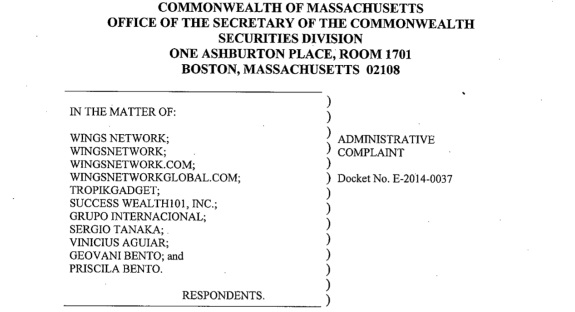
URGENT >> BULLETIN >> MOVING: (16th Update 12:27 p.m. EDT U.S.A.) “Wings Network,” an MLM “program” in part targeted at TelexFree participants, has been charged in Massachusetts with operating a pyramid scheme and selling unregistered securities as investment contracts as part of a securities-fraud scheme.
Several individual promoters or alleged recipients of fraud-scheme proceeds were named in the civil complaint.
The allegations were brought by the office of Massachusetts Commonwealth Secretary William Galvin, who oversees the Massachusetts Securities Division. Galvin’s office earlier brought fraud charges against TelexFree and banned a similar “program” known as WCM777 from the state. The SEC later sued both TelexFree and WCM777.
“This case is another example of unscrupulous operators preying on vulnerable immigrant communities with promises of great riches, in this instance a bogus means of downloading electronic content,” Galvin said. “In reality, these operators only sought to rope more participants into their scheme.”
In a statement moments ago, Galvin’s office said three individuals in Central Massachusetts had been charged as promoters.
“Within five months, Wings Network collected $12,546,226 from 8,914 Massachusetts investors,” Galvin’s office said, citing the complaint.
Named respondents include Priscila and Geovani Bento of Auburn, and Vinicius Aguiar of Marlborough.
Some of the money was “wire transferred” to Sergio Tanaka of Florida and Tropikgadget, Tanaka’s company based in the United Arab Emirates and Portugal,” Galvin’s office said.
“Tanaka and his company are respondents in the complaint,” Galvin’s office said.
Aguiar, Galvin’s office said, conducted transactions as BRAZUSA Communication Company, Eagle Team, Grupo Aguiar, and Grupo Internacional.
Carlos Barbosa of Madeira, Portugal, is a party referenced in the complaint. Barbosa purportedly is the CEO of Wings Network.
“Respondent Barbosa was videotaped in April, 2014 giving a Wings Network presentation to over 960 Massachusetts investors,” Galvin’s office said.
From a statement by Galvin’s office (italics/carriage returns added):
Wings Network purported to sell mobile marketing platforms that allow consumers to download electronic content for a fee, the complaint stated, but added, “The marketing materials, online selling presentations and assertions by the individual respondents make it clear that the primary purpose of Wings Network is to recruit additional members.”
Of the sales pitches for this “thinly veiled pyramid scheme,” the complaint says, “The use of trendy internet terms combined with meaningless high technology buzzwords and slick websites are all devices to dazzle prospective investors and induce them to purchase their way into the Wings Network scheme.”
“The product itself is redundant because it is not necessary to use any product including Respondents’ product, to download electronic content,” the complaint charges, “The true purpose of the program was to recruit additional participants into the Wings Network and investors were told that recruitment was how the investor was going to make any significantmoney.”
The complaint seeks a cease and desist order, and a requirement that the respondents offer to compensate investors who suffered losses through the alleged wrongdoing.
A message on the Wings Network website today claims “no wrong doing has been alleged.”
Based on today’s complaint by Galvin’s office, the message on the website appears not to reflect the current reality.
BULLETIN: (1st update 7:58 p.m. EDT U.S.A.) The SEC has filed an amended complaint in the alleged WCM777 pyramid- and Ponzi scheme. The complaint ups the WCM777 haul from roughly $65 million to more than $80 million and names an “inactive” Florida attorney a relief defendant as the alleged recipient and distributor of fraud proceeds.
Vincent Messina, the attorney, allegedly is associated with an entity known as International Market Ventures (IMV) “based in Washington, D.C.” with asserted offices in Los Angeles, Shanghai, Hong Kong, United Arab Emirates, Nigeria, Congo, Benin, and South Africa, the SEC says.
Messina also was the asserted “general counsel” of World Capital Market, a company associated with WCM777 and accused Ponzi schemer Ming Xu, the SEC said. An affidavit included with the SEC’s amended complaint includes a copy of an email allegedly sent by Ming Xu to Messina inquiring about how to get WCM777 money out of Brazil.
“Vincent,” the alleged Ming Xu email to Messina began. “We have lots of members for our social capital company, WCM777 in Brazil. They paid us in Brazil. How to move the money legally from Brazil to USA or Hong Kong?”
Whether Messina replied to the email was not immediately clear.
“In June 2013, Messina was named as in-house legal counsel of ‘World Capital Market,’” the SEC said in its complaint. “Messina is also the general counsel of Relief Defendant IMV. Messina holds himself out as duly licensed to practice law in the State of Florida; however, the Florida Bar Internet site lists Messina as ‘inactive’ and ‘Not eligible to practice in Florida.’ Messina has an office in Los Angeles, California.”
Messina appears also not to be licensed in California, the SEC said in the affidavit. WCM777 operated from California.
WCM777, the SEC said, “is the umbrella name that Defendants use for their multilevel marketing scheme.”
The SEC initially sued WCM777 in March 2014. The “program” is known to have promoters in common with TelexFree, which the SEC sued on April 15. Both complaints were filed on an emergency basis. Both “programs” allegedly targeted speakers of Portuguese and Spanish, with WCM777 also allegedly targeting speakers of Chinese.
Portuguese is the main language spoken in Brazil.
On April 10, the PP Blog reported that the court-appointed receiver in the WCM777 case advised a federal judge that she’d halted an apparent WCM777 reload scheme and that Ming Xu, also known as Phil Ming Xu, transferred $5 million to Messina as part of a “sham” designed to stash cash.
Messina, the SEC alleged in the May 7 amended complaint, “disbursed those funds to, among others, IMV and possibly entities affiliated with IMV.”
Certain money disbursed by Messina ended up with “persons in Canada, Abu Dhabi, and to an entity in Hong Kong,” the SEC alleged.
3rd Update 12:58 P.M. EDT U.S.A. The office of Massachusetts Commonwealth Secretary William Galvin has issued a subpoena to Wings Network, the Boston Globe is reporting.
From the Globe (italics added):
“We attended one of their events,’’ Galvin said. “We had heard from some investors who, in light of TelexFree, had become concerned — and we’re concerned.’’
Galvin’s office alleged that TelexFree was a combined Ponzi- and pyramid scheme that had gathered more than $1.2 billion.
Both TelexFree and WCM777 were targeted at the Brazilian community in Massachusetts, according to filings. In addition, the “programs” targeted speakers of Spanish and Chinese. The U.S. Securities and Exchange Commission (SEC) also filed charges against the “programs.”
No charges have been brought against Wings Network. The Massachusetts probe is ongoing, the Globe reports.
Like WCM777, Wings Network says it is in the cloud-computing business. Like TelexFree, Wings Network says it’s involved in “apps.” TelexFree also pushed a VOIP product.
Galvin’s office issued a warning on pyramid schemes last month, saying that investigators have encountered “recent schemes” involving “products related to internet services, mobile marketing platforms, app sales, cloud computing services, and voice-over-internet applications.”
The HYIP world is infamous for reload schemes in which victims of previous scams are targeted again by purveyors of purported emerging “opportunities.”
There is a Wings Network outlet in Framingham, Mass., according to a photo in the Globe.
The Framingham area appears to have been a TelexFree stronghold.
Like TelexFree, AdSurfDaily, Zeek Rewards, Profitable Sunrise and other schemes that have come under regulatory scrutinty, Wings Network has a presence on well-known Ponzi-scheme boards such as TalkGold and MoneyMakerGroup.
(UPDATED 8:21 P.M. EDT U.S.A.) The U.S. Securities and Exchange Commission says in new court filings that accused TelexFree promoter and securities fraudster Sann Rodrigues appeared in an April 16 YouTube video and asserted that “God” made MLM and “binary” and that Rodrigues claims he’s “never going to stop this.”
Rodrigues is now a two-time SEC defendant. He settled charges in 2007 that he was operating a pyramid scheme targeted at the Brazilian community through the purported sale of phone cards.
TelexFree is a combined Ponzi and pyramid scheme with a phone product that masked a massive, underlying fraud that gathered more than $1.2 billion, the Massachusetts Securities Division alleged on April 15. The SEC said the TelexFree scam mainly was targeted at Brazilian and Dominican immigrants.
Fellow TelexFree defendant Faith Sloan, meanwhile, appears to have removed certain videos but nevertheless has invoked “divine authority” elsewhere, according to SEC filings.
On March 15, the SEC alleged, Sloan claimed on her website that the TelexFree compensation plan was changing and was not in final form — “[b]ut is Getting BETTER as Jesus said.”
Sloan, a former promoter of the Profitable Sunrise and Zeek Rewards securities swindles, earlier claimed that the SEC was “picking on” her.
Separately, the agency alleged that TelexFree may be violating a temporary restraining order by putting its website back online.
“It appears that TelexFree and/or one or more of the individual defendants may be improperly using investor funds for that purpose,” the SEC alleged.
Moreover, the SEC said, none of the defendants has submitted the written accounting required under the order.
Sloan and Rodrigues are among four promoters charged by the SEC. TelexFree executives or co-owners James Merrill, Carlos Wanzeler, Joe Craft and Steve Labriola also were charged. The firm and related entities filed for bankruptcy protection in Nevada April 13.
Claims of divine authority or inspiration are not unusual in MLM HYIP frauds. In the 2008 AdSurfDaily case, for instance, accused operator Andy Bowdoin claimed God was on his side and compared the U.S. Secret Service to “Satan” and the 9/11 terrorists.
Bowdoin, who also fraudulently traded on the name of then-President George W. Bush to sanitize the ASD scam, had experience as a securities swindler prior to ASD, according to court records. He is now serving a 78-month term in federal prison for his role in the $119 million ASD swindle. One of his business partners, according to federal records, was implicated by the SEC in the 1990s in three prime-bank swindles, including one that touted a return of 10,000 percent.
Brazil-based TelexFree figure Carlos Costa also routinely invokes God over TelexFree-related issues.
On Dec. 19, 2013, the PP Blog reported that TelexFree puff pieces were appearing in a publication that featured a columnist who asserted Jesus Christ was the person who inspired modern network marketers through his recruitment of 12 disciples.
Ads for an apparent cash-gifting scheme appeared in the same publication.
Images of Jesus Christ also were used in the alleged Profitable Sunrise and WCM777 HYIP swindles.
William Galvin. Source: State brochure on avoiding pyramid schemes.
BULLETIN: (UPDATED 5:56 P.M. EDT U.S.A.) The Massachusetts Securities Division (MSD) has published a complaint form for TelexFree investors. Massachusetts Commonwealth Secretary William Galvin, who oversees MSD, also has published a brochure titled, “Illegal Pyramid Schemes Disguised as Multi-level Marketing Businesses (MLMs).”
Galvin’s investigators alleged on April 15 that TelexFree was a combined Ponzi- and pyramid scheme that had gathered more than $1.2 billion and sold unregistered securities. In November 2013, MSD alleged that WCM777, another “program” promoted in the state, also had sold unregistered securities. The U.S. Securities and Exchange Commission (SEC) later sued WCM777, alleging it was a “worldwide” pyramid scheme that had gathered at least $65 million. Likewise, the SEC has brought fraud allegations against TelexFree.
Both WCM777 and TelexFree were targeted at specific population groups, according to the allegations. Online promos show that the schemes had promoters in common and that prospects were encouraged to buy in at higher levels to receive higher payouts. Both “programs” were positioned as technology suppliers — TelexFree in VOIP and WCM777 in “cloud” computing.
As Galvin’s brochure notes (italics added):
In many illegal schemes the promoter spends little time explaining the product because the product is ancillary to the overall scheme. Recent schemes have involved products related to internet services, mobile marketing platforms, app sales, cloud computing services, and voice-over-internet applications.
These are just three of the bullet points in a warning by Galvin’s office today:
Don’t invest because your friends tell you it’s a good investment — use your own judgment and make your own decision.
Be wary of promoters who urge the purchase of higher positions in the distribution network to immediately increase payouts.
Be wary of promoters who urge quick establishment of distribution networks by adding family members, children, pets, etc.
There are plenty more. Read the online warning here. Download the PDF of the brochure. Access the TelexFree complaint form here.
Screen shot of federal court file. Red redaction by PP Blog.
EDITOR’S NOTE: See related story from earlier today that outlines where about $2.133 million of the $5 million cited in the story below is being held for safe-keeping. The whereabouts of the balance is creating a mystery, according to court files.
U.S. District Judge Christina A. Snyder has scheduled a hearing April 24 in Los Angeles to address a court-appointed receiver’s claim that a $5 million transfer by accused WCM777 Ponzi scheme operator Phil Ming Xu to a lawyer a month before an asset freeze was a “sham” designed to stash cash.
The lawyer, Vincent Messina, now has retained a lawyer and is refusing to return most of the cash and explain what happened to more than $2.66 million that hasn’t been accounted for, insisting that the transaction was a “loan” for investment purposes and that he also was helping Xu set up a “political action committee,” according to receiver Krista L. Freitag.
Messina has retained Maranda Fritz, an attorney in New York, according to court filings.
Freitag, who wants the money returned and an accounting of how it was used, has asked Snyder to freeze Messina’s bank accounts.
“There is not only a strong likelihood that monies transferred to Mr. Messina will be dissipated, but evidence they already have been,” Freitag argued.
And, she continued, “[t]his poses a serious risk of irreparable injury to the receivership estate and investors. Once monies are disbursed by Mr. Messina, it will be difficult, if not impossible, to recover them for the benefit of investors.”
The SEC has described WCM777 as a $65 million Ponzi- and pyramid scheme. Freitag says her early analysis suggests that WCM777 may have more than 479,000 “member accounts.”
Moreover, Freitag argued, Messina refused to return the money even when asked by Xu in a March 20 letter.
Xu, according to the letter, described Messina as his attorney, not as a business partner, and wrote he wanted the $5 million returned so he could use it “to settle any outstanding SEC issues that I may have.” (See screen shot above.)
Other records show that the SEC had been investigating Xu since October 2013. Snyder granted an asset freeze on March 27, after the SEC appeared in federal court and alleged that WCM777 and related entities were conducting an ongoing fraud.
Xu allegedly transferred the $5 million to Messina a month prior to the March 27 freeze.
From the receiver’s motion to freeze Messina’s bank accounts (italics/carriage returns added):
Considering the large sum of money at issue, the compelling evidence of fraud and that Defendant Xu uses nominees to hold the proceeds of fraud, as well as the proximity of the transfer to the filing of the case, and the fact that Mr. Messina refuses to provide any information about the whereabouts of the remaining $2.668 million, it is critical that Mr. Messina’s bank accounts be immediately frozen to protect the Receivership Entities’ investors from further dissipation of the funds.
The temporary freeze should remain in place pending further investigation and a determination by the Court of the true nature of the $5 million transfer. To aid in this investigation and determination, Mr. Messina should be directed to provide an accounting of the funds, a relatively simple task considering he received them only about 40 days ago.
The accounting will also assist in determining the appropriate scope of the freeze, which should cover accounts containing funds received from Mr. Xu or the Receivership Entities.
BULLETIN: (UPDATED 11:38 P.M. EDT U.S.A.) The court-appointed receiver in the WCM777 Ponzi- and pyramid case says in court filings that she has stopped a “new multi-level marketing scheme” that had been under development by WCM777 in a warehouse in El Monte, Calif.
WCM777, alleged by the SEC to have gathered about $65 million, purportedly was in the “cloud” computing business and may have more than 479,000 “member accounts.”
Receiver Krista L. Freitag says in a report that she has identified more than “100 domain names” associated with the alleged WCM777 fraudsters.
Meanwhile, Freitag says she is seeking an order to freeze the bank accounts of an attorney linked to accused WCM777 Ponzi schemer Phil Ming Xu.
The lawyer, according to the receiver, purportedly is “the beneficiary of a $5 million non-recourse loan, to be repaid in 2019 in a single balloon payment” and allegedly claimed he’d lost a cashier’s check for $200,000. The purported loan allegedly came from a Xu-owned entity.
At the same time, Freitag says her preliminary analysis suggests that Xu, who allegedly squired the purchase of two golf courses and at least six other properties for millions of dollars in cash, may have an association with at least 28 business entities. One is known as “12 Zodiacs Inc.” Another uses the words “Medical Group” when forming its name. Yet-another is described as “US Immigration Investment Assoc.” Still-another is called “WCM Art Inc.”
Perhaps like the Zeek Rewards MLM HYIP scheme before it, WCM777 could lead to an incredible paper chase that serves up intriguing but worrisome sidebars of black comedy. Another of the entities listed in the WCM777 receiver’s report, for example, potentially has an all-subsuming name: “Frequency Holdings Inc.”
The El Monte MLM scheme was being developed by “numerous of the same defendants and personnel” involved in WCM777, Freitag advised a federal judge.
U.S. District Judge Christina A. Snyder is presiding over the case. It was not immediately clear whether the alleged emerging scheme was “Global-Unity,” which once used a photograph of a golden pyramid on its website.
What is clear is that Freitag has been plenty busy since the SEC fraud case was filed March 27. In one instance, she advised the judge, the receivership observed a “third party” removing “furniture and art work” from a property linked to WCM777.
“The Receiver promptly contacted the Monrovia [Calif.] police department and made a report,” Freitag advised the judge. “The Receiver has investigated the removal of art and furniture and has identified the people who removed the personal property. The Receiver has demanded the return of the art and furniture.”
In another instance, Freitag said in the report to the judge, the receivership observed “live Koi” at a WCM777-linked property, this one in Walnut, Calif.
“Koi” are color-splotched, trainable, domesticated carp originally bred in Japan and reportedly known to recognize the persons feeding them and to eat out of the hands of their owners, according to the Wikipedia entry for the species.
Some websites sell Koi for thousands of dollars apiece.
“The Receiver has taken steps to maintain these fish in the event they have value to the receivership estate,” Freitag advised the judge.
On the money front, the receiver advised the judge that the receivership now has in its possession “$11.28 million” of WCM777-connected money that once had been in the trust account of a law firm, $1.5 million that had been in a bank account and designated to be part of a WCM777-connected real-estate acquisition and an “aggregate of approximately $2.54 million held in other accounts of the Receivership Entities or recovered from other entities.”
Freitag also has met with Xu and his lawyers, according to the receiver’s report to the judge.
“This interview lasted several hours, during which the Receiver primarily focused on identifying assets of the Receivership Entities that needed to be secured, as well as gaining understanding of any past or present operations that were being conducted by Receivership Entities,” Freitag advised the judge.”Among other things, these interviews yielded significant information concerning funds transferred to Vincent Messina as well as a myriad of investments, loans, and transfers that need to be addressed by the Receiver.”
Messina is a lawyer WCM777 billed as its “In-house Legal Counsel,” according to affiliate promos.
From the receiver’s report (italics/carriage returns added):
During her initial investigation, the Receiver learned that, approximately one month before this case was filed, $5 million was transferred from ToPacific, Inc., an entity owned by Defendant Phil Ming Xu and whose accounts are now frozen, to the IOLTA trust account of attorney Vincent Messina.
Mr. Messina has refused to turn over the funds and his counsel has stated that some of funds have already been disbursed, but the details of those disbursements have not been provided. The Receiver initially sought to recover the funds from Mr. Messina, which Mr. Messina refused. The Receiver then asked Mr. Messina to agree to escrow the undisbursed funds pending further order of the Court and provide an accounting of the funds he received. On April 4, 2014, Mr. Messina, the Receiver, and the Commission agreed that $2.332 million wired by Mr. Messina from various accounts he controls to the client trust account of Thompson Hine LLP, Mr. Messina’s attorneys, would be held in escrow by Thompson Hine pending further order of the Court. Mr. Messina still refuses, however, to provide any information about the remaining $2.668 million, stating only that it was disbursed for “business purposes.”
On April 8, 2014, Maranda Fritz of Thompson Hine confirmed that $2,133,214.62 has been received by Thompson Hine and is being held pursuant to the escrow agreement. The remaining $200,000 to be held pursuant to the escrow agreement has not yet been received.
The Receiver also learned Mr. Messina obtained a $200,000 cashier’s check from Bank of America, which he claims he lost. Mr. Messina is apparently putting in a claim with Bank of America that the funds be credited back to his account. Bank of America advises it may take as long as 91 days for such claim to be approved and the funds credited back to Mr. Messina’s account.
Mr. Messina’s position is that the $5 million transfer is a loan pursuant to a two-line loan agreement dated February 27, 2014, in which Mr. Messina is the beneficiary of a $5 million non-recourse loan, to be repaid in 2019 in a single balloon payment. The funds were wired to Mr. Messina’s IOLTA trust account . The purported loan agreement is virtually identical to purported non-recourse, unsecured loan agreements signed by Receivership Entity Manna Holding Group, Inc., an entity owned by Mr. Xu’s wife, in connection with large transfers fromWorld Capital Market, Inc. and Kingdom Capital Market, LLC for the purchase of real property. Declaration of [lead SEC investigator] Peter Del Greco, Dkt. No. 6, Exhibits 32 and 33. No payments are due under the purported loan agreement until January 2019.
Moreover, Defendant Ming Xu subsequently asked for return of the “retainer” from Mr. Messina, which undermines a claim that this was a bona fide loan transaction for some legitimate purpose.
The Receiver is filing an ex parte application concurrently with this report requesting that Mr. Messina’s bank accounts be frozen and he be directed to provide an accounting of all funds received from the Receivership Entities, including ToPacific, Inc. Such immediate relief is necessary to protect investors from further dissipation of the funds pending further investigation and a determination by the Court of the true nature of the $5 million transfer.
In its role as a watchdog for consumers, the FTC has sued third-party companies and individuals who have published the logos of prominent news agencies and falsely traded on their trusted identities to sanitize a purported product or opportunity. (See screen shot of Evidence Exhibit from one FTC case below.)
In a new video promo announcing it somehow has gained 550,000 new American customers in less than a month during a probe into its business practices, TelexFree is publishing the logos of 18 prominent media firms, including logos of local-market affiliates of major American TV networks. In certain instances, the logos of the so-called “mother ships” — media parent firms or brand/content licensors of the local affiliates — appear in the TelexFree promo. This could prove to be an epic blunder.
The move by TelexFree occurs on heels of SEC allegations that a Ponzi/pyramid scam known as WCM777 traded on the names of famous brands outside of media.
On Feb. 28, the Massachusetts Securities Division confirmed it was investigating TelexFree. The agency earlier gave WCM777 the boot.
Hong Kong may be emerging as a hotbed of MLM fraud.
TelexFree goes to Hong Kong.
Does anyone in TelexFree’s MLM leadership have a clue — we mean, Freaking Clue One?
More . . .
__________________________________
UPDATED 10:51 A.M. EDT (U.S.A.) Be skeptical of “programs” that imply media ties or suggest media vetting or an endorsement by the media or a famous company in another discipline, including high finance. Brand-leeching “works,” which is why so many fraudulent companies adopt it as a strategy.
On the “we’ve-been-endorsed-by-the-media” fraud front, several instances of this have occurred. In both 2011 and 2012, the blood-sucking, $850 million Zeek Rewards Ponzi scheme pretended that puff pieces about it that appeared in Network Marketing Business Journal constituted real news. Zeek’s court-appointed receiver later auctioned off the puff pieces and the impressive-looking plaques to which they’d been attached.
Zeek and many of its affiliates preferred fantasy constructions. Put another way, they weren’t all that keen on paying attention to actual news occurring in the direct-sales sphere. In April 2011, for example, the Federal Trade Commission brought actions against several alleged scammers pushing acai weight-loss products and making deceptive claims. Among other things, the FTC alleged that the Internet-based hucksters created fake news sites and often used “the names and logos of major media outlets” such as “ABC, Fox News, CBS, CNN, USA Today, and Consumer Reports” to plant the seed the products had the backing of the brands and had been vetted approvingly by reporters.
As the PP Blog wrote in an Editor’s Note at the time (italics added): If this federal and state action doesn’t get the attention of the out-of-control, direct-sales crowd that divines itself the right to plant the seed that an “offer” is endorsed by famous companies and people, well, perhaps nothing will. Even as this story is being written, affiliates of Club Asteria, a purported “passive” investment company, are planting the seed that the firm is endorsed by Google, Yahoo, MSN and America Online. Club Asteria promoters also routinely trade on the name of the World Bank. Club Asteria is being pitched on forums populated by serial Ponzi scheme promoters.
Club Asteria, which had a presence on the Ponzi boards and purportedly had a satellite operation in Hong Kong, had roots in the cash-gifting fraud sphere and planted the seed it provided a return of at least 3 percent a week. It stopped making weekly interest payments to affiliate-investors before 2011 had come to a close.
Flash forward to April 2014, three years to the month after the FTC brought the acai fraud cases against direct-selling companies and individuals using the names and logos of famous media brands. Indeed, on April 5, a new pitch by the TelexFree MLM “program” began appearing in video form online.
And indeed it uses the logos of a whopping 18 media companies famous in local markets. And because some of those locally famous brands also incorporate the logos of their even more famous parent brands or licensors, TelexFree potentially could be risking the wrath of the upstream mother ships, too.
Like Club Asteria, TelexFree has an affiliate presence on the Ponzi boards. Also like Club Asteria, TelexFree has wildly enthusiastic pitchmen who claim the “program” provides preposterous, “passive” returns. (The TelexFree promo referenced in this report by the PP Blog first was noted by a TelexFree skeptic and reader of BehindMLM.com, a site that covers emerging MLM schemes.)
From YouTube. As TelexFree executive Steve Labriola narrates a video, the logos of prominent media companies roll in the background. Red highlight by PP Blog.
At approximately the 4:55 mark in the April 5 TelexFree video, the logos of local television stations — including affiliates of Fox, NBC, ABC and CBS — begin rolling on the screen. (The logo of the Las Vegas Review-Journal, the biggest newspaper in Nevada, also rolls on the screen.)
Says TelexFree executive Steve Labriola, while continuing to narrate the video after complaining about Bloggers who are negative on the company:
“But let me tell you what is out there that you haven’t quite seen yet: media that’s talking positive about us. There are articles. There are things out there that you’re gonna have in your back office that you can print, you can read, you can use as a tool within the next few days. These are all media articles that are talking great things about your company. So, we’re excited about that. We’re excited that you can be excited about that. It’s all good news. It’s all reprinted. And it’s all available for you.”
From an FTC evidence exhibit in a 2011 case that alleged pitchmen used the logos of media companies to sanitize an online fraud scheme. Red highlights by PP Blog.
What are these “media articles” to which Labriola refers while logos of local affiliates of the major broadcast networks and the logo of a major American newspaper roll in the background?
Well, unless the media firms published any other “great things” about TelexFree, they’re puff pieces TelexFree itself submitted via one or more PR wires. In instances we observed, several local broadcast affiliates of the major networks republished TelexFree-authored content — but not before slapping on a disclaimer. To see an example of the disclaimer we observed, visit the website of News9.com (KWTV-DT as a broadcast channel), a CBS affiliate in Oklahoma City. From the station’s website (italics added):
Information contained on this page is provided by an independent third-party content provider. WorldNow and this Station make no warranties or representations in connection therewith. If you have any questions or comments about this page please contact [deleted by PP Blog]
SOURCE TelexFREE
You’ll see the same disclaimer at KTEN.com, the website of an NBC affiliate in Denison, Texas, that covers parts of Oklahoma. (KTEN’s logo, which incorporates NBC’s famous “peacock,” is the first to roll in the TelexFree promo.)
In yet another example, a disclaimer appears at the website of KTRE, an ABC affiliate in Pollok, Texas. Other channels or newspapers that might have published TelexFree’s PR talking points also likely added disclaimers or attributions to TelexFree, so readers would make a distinction between actual news content and verbatim PR puff.
Labriola doesn’t mention the disclaimers as famous logos roll in the background. The audience easily could conclude that each of the news outlets whose logos are reproduced had published objective reports about TelexFree and championed the company.
With all things possible in the HYIP sphere, we’re wondering if TelexFree affiliates soon will start whipping those republished PR releases into endorsements of TelexFree by major media firms locally and nationally. After all, some TelexFree affiliates have planted the seed the “program” is endorsed by the SEC and is backed by President Obama.
Earlier in the video, Labriola claimed, “Since March 9, since our compensation plan has changed, we have 550,000 new customers in [the] U.S.A. alone. And remember, we’re a global business.”
Whether those talking points later will end up in videos or print material that displays the logos of well-known media companies is, for now, unknown. The stage nevertheless has been set for disingenuous MLM constructions of all sorts, including hypothetical (as of now) constructions such as this one: “according to [Famous Media Company A], TelexFree is in a stunning growth phase that has seen more than 550,000 new American small-business customers enlist since March 9 alone. Because TelexFree is a worldwide phenomenon, tens of millions of customers are destined soon to be in the fold.”
And what about proof? Well, just wrap the logo of a famous media brand around the claim.
This won’t go well if this is TelexFree’s new media strategy.
Branding concerns aside, the practical reality remains that how TelexFree is defining “customers,” like Zeek before it, is far from clear. Beyond that, current TelexFree affiliates are complaining publicly about not getting paid after the company changed its compensation system.
Hong Kong
In the video promo with the media logos, Labriola goes on to note that “I just came back from a Hong Kong trip.” Whether that trip had anything to do with an asserted March 26 TelexFree “conference” in Hong Kong wasn’t explained.
Hong Kong may be emerging as a hotbed of MLM HYIP fraud. For instance, it is a venue in which Club Asteria claimed a presence and also a venue in which a “program” known as “Better-Living Global Marketing” purportedly conducts business. (See reference and related links here.)
In addition, Hong Kong is referenced in the SEC’s Ponzi- and pyramid case last month against WCM777, an alleged $65 million fraud scheme. Hong Kong also is referenced in the SEC’s fraud complaint last month against an entity known as “Mutual Wealth.”
In October 2013, the SEC alleged that enterprises known as CKB and CKB168 were “at the center” of a worldwide pyramid scheme that allegedly featured a purported office in Hong Kong and operations in Canada, the British Virgin Islands and the United States.
TelexFree, alleged in Brazil to be a pyramid scheme, is under investigation by the Massachusetts Securities Division. Some affiliates are deeply concerned about changes in the TelexFree compensation scheme that appear to have dried up or negated payments to them. These affiliates packed themselves like sardines into the “program’s” office in Greater Boston last week. Police were called to the scene.
Just four days after TelexFree affiliates jammed the TelexFree office, the Labriola video with rolling media logos, claims of hundreds of thousands of new customers and the reference to Hong Kong appeared on YouTube. Whether TelexFree has opened new can of worms remains to be seen.
What’s been clear for months is that TelexFree has no cohesive message and throws just about anything against the wall, including rants at prosecutors by a Brazil-based executive while investigations in that country are under way.
A maxim sometimes attributed to Mark Twain and often cited by PR companies and politicians goes like this: “Don’t pick fights with people who buy ink by the barrel.”
To that, we’ll add that it’s also not prudent to tempt fate with media companies that buy bandwidth by the terabyte and employ note-taking reporters and editors and videographers who take spectacularly detailed footage.
This Blog has grave doubts that any of the media firms whose logos appear in the TelexFree promo will be pleased. Their own names could be sullied. If those logos start appearing on marketing materials and plaques, well, hang on to them. They could become the same type of souvenirs the Zeek receiver sold to raise money for victims.
One of the issues in the SEC’s case against WCM777, of course, was the alleged republication of famous logos (nonmedia) and the namedropping of famous companies (nonmedia) to sanitize the alleged WCM777 fraud scheme.
Is any famous company, be it nonmedia or media, safe from MLM hucksters on the Internet? The answer is probably no, given that the vultures apparently think nothing of swiping the brands of government agencies and even of the President of the United States to advance their schemes.
Why TelexFree has ventured down the minefield-laden path of publishing logos of locally or nationally famous brands is truly baffling, especially given the nature of the allegations in the WCM777 case and the fact TelexFree itself already is under investigation.
This circumstance reminded us not only of the Zeek debacle and the SEC’s WCM777 case and the FTC’s acai-berry cases, but also of efforts by the AdViewGlobal Ponzi schemers in 2009 to use an in-house puff piece distributed on PR wires to plant the seed the 1-percent-a-day “program” was endorsed by Forbes magazine, the Washington Business Journal and The Business Review.
Prior to the filing of the SEC’s fraud complaint against WCM777, some apparent cheerleaders for the firm tried to plant the seed that the “program” had been vetted favorably by Yahoo Finance and the Wall Street Journal. One individual tried to drop both famous names at BehindMLM.com, a site that covers emerging MLM schemes.
BehindMLM’s negative coverage of WCM777 was “real non-sense,” the critic asserted on Oct. 11, 2013, pointing to a purported favorable story on WCM777 in the Wall Street Journal. That “story” proved to be a PR puff piece republished with a disclaimer at WSJ.com.
“The Wall Street Journal news department was not involved in the creation of this content,” the disclaimer read.
But with the purported Wall Street Journal “story” in his hip pocket, the WCM777 “supporter” and BehindMLM critic asserted, “I will make the most of it to my enemies’ disgust!” (See this story and Comments thread at BehindMLM.com.)
The SEC was in federal court about five months later, alleging that WCM777 had targeted a massive fraud scheme at Asians and Latinos and had caused the logos of famous brands to be republished as part of a bid to sanitize the $65 million scam.
Honestly, does anyone in TelexFree’s MLM leadership these days have a clue — we mean, Freaking Clue One?
TelexFree’s name is referenced on Page 14 of Exhibit 3 in an SEC affidavit filed as part of the WCM777 pyramid- and Ponzi prosecution. Information in the exhibit was gleaned from the California Department of Business Oversight’s investigation into WCM777. Red highlights by PP Blog.
UPDATED 8:51 P.M. EDT (U.S.A.) Already under investigation in Massachusetts, is TelexFree destined to encounter trouble from state regulators in California and perhaps the U.S. Securities and Exchange Commission (SEC)?
At least by Nov. 14, 2013, the California Department of Business Oversight (DBO) was asking questions about the TelexFree MLM scheme, according to filings in federal court. The filings, which appeared in affidavit form and included exhibits, were docketed March 27 after being submitted by the lead investigator in the SEC’s case against WCM777, an alleged $65 million Ponzi- and pyramid fraud.
Some pitchmen in HYIP schemes promote multiple purported opportunities simultaneously and use money from one scheme to join another, a situation that may put banks and payment processors in possession of tainted proceeds from interconnected and ongoing frauds. A federal judge has frozen at least 54 bank or vendor accounts linked to WCM777 or accused operator Phil Ming Xu.
California investigators asked Stanley Stephan Huntsman, who identified himself as a “spokesman-ambassador” for WCM777 with Xu as his “employer,” whether he had any “relationship” with “TelexFree,” according to the SEC filings.
It may be the first reference to TelexFree in a federal court filing, albeit one that is not a charging document. At a minimum, however, it demonstrates that both the California DBO and the SEC are aware of TelexFree and believe that the Massachusetts-based “program” has promoters in common with WCM777.
“I have no relationship with TelexFree,” Huntsman responded.
The SEC announced the WCM777 prosecution on March 28, one day after its lead WCM777 investigator submitted the documents and exhibits from California’s WCM777 probe. Huntsman was not named a defendant in the SEC’s WCM777 action.
WCM777 was targeted at Asians and Latinos, the SEC alleged.
In addition to identifying himself as a “spokesman-ambassador” for WCM777, Huntsman told California investigators that he “was required to read power points prepared by WCM, which was also displayed on the WCM website,” according to an SEC affidavit.
 UPDATE: A federal judge has ordered the receiver in the WCM777 case to list for sale three properties linked to the alleged MLM pyramid scheme.