Tag: Zeek

  • ‘NewGNI,’ Apparent Knockoff HYIP Scam Promoted By Zeek And ‘Profitable Sunrise’ Cheerleader ‘Ken Russo,’ Appears To Have Collapsed

    kenrussozeekgni2The website of “NewGNI” has not resolved to a server for days. The “program” is believed to have been a knockoff of a predecessor scam known as “GNI” or GoldNuggetInvest, which collapsed in early 2010 after being promoted by members of the AdSurfDaily Ponzi scheme.

    The collapse of the original GNI was about as bizarre as they come in HYIP land. Critics were told to concentrate on earthquake relief in Haiti, rather than questioning the HYIP scheme. GNI’s collapse purportedly occurred after its operators sought “a crystal clear vision of our financial vortex.

    Among the pitchmen for both GNI and NewGNI was Ponzi-board legend “Ken Russo,” also known as “DRdave.” Earlier, “Ken Russo” had promoted the $119 million ASD scheme. He later turned to ClubAsteria, which was trading on the name of the World Bank to reel in suckers. ClubAsteria promos came under the lens of CONSOB, the Italian securities regulator. “Ken Russo” also emerged as a pitchman for Zeek Rewards, which the SEC described in August 2012 as a $600 million Ponzi- and pyramid scheme operating from North Carolina.

    Among “Ken Russo’s” latest ventures is “Profitable Sunrise,” now the subject of a cease-and-desist order from North Carolina regulators.

    Profitable Sunrise purportedly is operated by Roman Novak. The “program” is being targeted at people of faith, some of whom appear to be defending it by weaving impossible tales. Any number of Ponzi-board taunts have been aimed at the Securities Division of North Carolina Secretary of State Elaine Marshall, even as ProfitableSunrise advertises a risk-free, preposterous return of 2.7 percent a day in its bizarrely named “Long Haul” program with a purported Easter holiday payoff.

    “lol @ NC officials,” says one post at MoneyMakerGroup. Another compares Marshall’s office to “Deputy Barney Fife,” an iconic TV character played by Don Knotts in the Andy Griffith Show.

    Even after the government of Belize issued a warning against GNI in 2009, scammers continued to promote it — virtually to the very day it collapsed and took an unspecified sum with it. The collapse triggered a bizarre series of conspiracy theories.

    GNI was operating concurrently with a now-collapsed scam bizarrely known as “Cash Tanker,” an “opportunity” aimed at Christians. Cash Tanker used an image of Jesus Christ in its promos and purported to pay 2 percent a day.

  • URGENT >> BULLETIN >> MOVING: North Carolina Orders ‘Profitable Sunrise’ To Cease And Desist; State Calls It An ‘Immediate And Significant Danger’

    americaatrisk4URGENT >> BULLETIN >> MOVING: The state of North Carolina — home base to the alleged $600 million Zeek Rewards Ponzi scheme — has ordered a purported offshore “opportunity” known as “Profitable Sunrise” to cease and desist from doing business in the state.

    Profitable Sunrise purports to be a hard-money lender and investment opportunity. It appears to have attracted some Zeek members both before and after the August 2012 collapse of Zeek. Zeek was under investigation by North Carolina, the SEC and the U.S. Secret Service at the time of its collapse.

    In its cease-and-desist order, North Carolina described Profitable Sunrise as “an immediate and significant danger” that is using multiple investment schemes to attract money, including a purported “Long Haul” plan.

    The offer is being targeted at people of faith through web-based promoters, some of whom described themselves as Christians. Offering materials for the “Long Haul” plan have advertised an Easter holiday payout.

    The company itself has advertised “risk free” payouts with “no chance of default,” according to the North Carolina order. And Profitable Sunrise also claims “investments are insured by a leading investment bank.”

    As the PP Blog reported in December, Profitable Sunrise appeared to qualify investors based on their views on hot-button issues, including abortion.

    North Carolina’s order names Roman Novak, Radoslav Novak and Inter Reef LTD (doing business as Profitable Sunrise) as respondents, amid allegations by the Securities Division of the office of North Carolina Secretary of State Elaine Marshall that Profitable Sunrise is selling unregistered securities as investment contracts.

    Profitable Sunrise lists a business address in the United Kingdom. Regardless, the enterprise is soliciting funds to be sent to Raiffeisenbank AS in the Czech Republic, according to North Carolina investigators. An entity known as Melland Company SRO was listed in Profitable Sunrise wiring instructions as the beneficiary, according to the order.

    A credit union used by a North Carolina-based Profitable Sunrise investor blocked at least one transaction directed toward the Czech bank, citing suspicions of fraud, according to the order.

    Marshall’s investigators noted that the Profitable Sunrise investor believed that the”Long Haul” plan would pay “interest of 2.7% daily, compounded at 100%, for 240 days.”

    Other Profitable Sunrise plans also promised high interest rates in compressed time frames, reaching for sums of between $10 and $2,500 and advertising interest rates of between 1.6 percent and 2 percent a day, according to the order.

    Zeek planted the seed that it paid an average of 1.5 percent a day, the SEC said on Aug. 17. On Aug. 4, Zeek claimed on its news site that unspecified “North Carolina credit unions” were creating problems for it.

    Read the North Carolina order against Profitable Sunrise.

    Visit Profitable Sunrise thread on RealScam.com.

  • URGENT >> BULLETIN >> MOVING: AdSurfDaily Figures (And Zeek Pitchmen) Todd Disner And Dwight Owen Schweitzer Lose In Appeals Court

    breakingnews72The U.S. Court of Appeals for the District of Columbia Circuit has upheld the rulings of a federal judge and rejected an appeal by AdSurfDaily figures Todd Disner and Dwight Owen Schweitzer. The ASD duo had contended the seizure of records from ASD’s database in a Ponzi scheme case brought in 2008 by the U.S. Secret Service and federal prosecutors violated their right to privacy and that Judge Rosemary Collyer was biased.

    A three-judge panel rejected both contentions.

    “Appellants’ purported evidence of bias amounts to nothing more than their disagreement with the judge’s actions in presiding over a related matter, and ‘judicial rulings . . . virtually never provide a basis for recusal,’” the panel ruled

    Moreover, the panel ruled, “The dismissal of appellants’ Fourth Amendment claim is affirmed on the ground that appellants lacked a reasonable expectation of privacy in the records allegedly seized.”

    ASD was a $119 million Ponzi scheme operating from Quincy, Fla. Disner and Schweitzer later became pitchmen for Zeek Rewards, which the SEC described in August 2012 as a $600 million Ponzi- and pyramid fraud operating from Lexington, N.C.

  • EDITORIAL: What Zeekers (And Other MLMers) Can Learn From The Upcoming Trial Of AdSurfDaily Figure And Purported ‘Sovereign Citizen’ Kenneth Wayne Leaming

    Kenneth Wayne Leaming, aka "Kenneth Wayne," aka "Keny," now is calling himself a "live abortion" -- apparently if "defense" of home
    Kenneth Wayne Leaming, aka “Kenneth Wayne,” aka “Keny,” now is calling himself a “live abortion” — apparently in “defense” of home-based businesses.

    UPDATED 12:28 P.M. (FEB. 27, U.S.A.) Kenneth Wayne Leaming, a figure in the AdSurfDaily Ponzi-scheme story and a purported “sovereign citizen,” is scheduled to go on trial today in federal court the Western District of Washington with co-defendant David Carroll Stephenson. Leaming is charged with filing false liens against public officials involved in the ASD prosecution. Among his alleged targets were a federal judge, at least two federal prosecutors — and the U.S. Secret Service agent who cracked the ASD Ponzi case in 2008.

    Leaming, 57, also is charged with assisting Stephenson in the filing of false liens against two federal-prison officials. Stephenson was in federal prison for a tax scheme at the time the liens allegedly were filed. Records strongly suggest that Stephenson, also 57, would be a free man today were it not for his association with Leaming, given that Stephenson’s prison term in the tax case had been scheduled to end early this year. Instead, he’s facing new charges and potentially more jail time.

    But the false-liens charges are just the beginning for Leaming. He also is charged with harboring two federal fugitives wanted in a multimillion-dollar home-business fraud in Arkansas, being a felon in possession of firearms and passing a bogus “Bonded Promissory Note” for $1 million.

    If you’re new to the PP Blog and new to the ASD case, a brief review is in order: The Secret Service raided ASD in August 2008, alleging the Florida-based firm operated by Andy Bowdoin was a massive Ponzi scheme operating over the Internet. Bowdoin reacted to the raid and the seizure of tens of millions of dollars by comparing the U.S. government to “Satan” and the Secret Service to the 9/11 terrorists. Now 78 and in federal prison, Bowdoin came out of the gate after the seizure by assuring ASD investors that “God” was on the company’s side.

    Some MLMers were quick to accuse the government of targeting a fine Christian man who was helping the United States create jobs with a “program” that purported to pay participants back 100 percent of their investment and a profit of 25 percent in only months. (Ten-thousand dollars in ASD purportedly fetched $12,500 within 90 to 125 days, purportedly more if members “compounded” their “earnings,” kept 80 percent of their money in a continuous state of “roll over” and never fully cashed out.)

    Essentially there was only one chance that ASD was not a Ponzi scheme during its approximately 18-month run — and that single chance required nearly a complete suspension of logic to destroy the government’s Ponzi case and get ASD off the hook: Had a crazy billionaire or exceptionally well-heeled financier (who also was crazy) given convicted-felon Bowdoin more money than ASD’s rapidly accruing liabilities — basically an enormous line of credit that didn’t have to be paid back and could be tapped on demand for ASD to pay out $1.25 for every dollar it took in until the line was exhausted — ASD would not have been a Ponzi scheme. Absent a benevolent madman-billionaire and the kind of capital it would take to build a nuclear-power plant and operate it indefinitely with zero concern for profit, however, ASD could be one thing and one thing only: a Ponzi scheme using money from “new” members to fund the redemption requests of “old” members or a Ponzi scheme that sustained itself by simply recycling money among members of a closed group.

    No madmen-billionaires sufficiently liquid to bankrupt themselves by funding Bowdoin’s stated plan of creating 100,000 ASD millionaires in three years while at once financing the “profits” of tens of thousands of average people seeking to expand the ranks of ASD millionaires well beyond 100,000 appeared to testify on ASD’s behalf at an evidentiary hearing it requested in the fall of 2008.

    Here is just one of the reasons MLM has a miserable reputation: Notwithstanding the fact that Bowdoin already was a convicted felon for an Alabama securities swindle in the 1990s and that one of his business partners was a man implicated by the SEC in the 1990s in three prime-bank swindles, some MLMers decided to improve the already bizarre narrative that the government was picking on a grandfatherly Christian.

    Petitions were started to paint prosecutors as the bogeymen. (The shorthand for this in MLM’s HYIP Ponzi land is “evilGUBment.”) ASD critics were derided as “maggots.” A “prayer” went out calling for prosecutors to be struck dead from the heavens. A theory was advanced that a Florida TV station should be charged with Deceptive Trade Practices for carrying news unflattering to ASD. A companion theory held that the Attorney General of Florida should be charged with the same offense and that AARP, which lobbies for senior citizens, should lobby for ASD. Meanwhile, some MLMers tried to enlist the U.S. Senate to turn the focus of the investigation away from ASD and Bowdoin and put it on the prosecutors who brought the Ponzi case. One MLMer called for the government’s lead prosecutor to be placed in a medieval torture rack, with ASD members at large drawing straws to determine who got the honor of making the prosecutor’s time in the rack as painful as possible.

    Very few people in MLM had anything to say about the circus surrounding ASD. The few who did — perhaps most notably Rod Cook of MLM Watchdog — were excoriated for dismissing the narrative advanced by Bowdoin and other MLMers. All of this was occurring while ASD was provably insolvent. When Bowdoin failed to take the witness stand at the evidentiary hearing he requested, it was explained that he was “too honest” to testify. Both before and after the hearing, some of his most notable Stepfordian apologists advanced a theory that the government secretly had admitted ASD was not a Ponzi scheme and was clinging to the case in a bid to save face.

    One ASD member advanced a narrative that the government had taken about $80 million in seized proceeds and invested it in a secret fund to pay for black-ops. It was from this caldron of conspiracy theories and fantastic idiocy that Kenneth Wayne Leaming emerged.

    Like other “sovereigns,” Leaming to date hasn’t focused much of his attention on the actual charges against him, even though his conviction could result in considerable jail time. Rather, Leaming mostly has focused on creating a blitz of paperwork on the apparent theory his best “defense” is to keep the Feds and even local officials scurrying to guard all flanks. Since his November 2011 arrest by an FBI Terrorism Task Force, Leaming has sued the President of the United States, the Attorney General of the United States, various officials (including purported “Does”) and a county sheriff in Arkansas.

    Members of Zeek Rewards and other MLM schemes should pay attention to the Leaming trial. There can be no doubt that Leaming-like figures existed within the Zeek enterprise. Like ASD before it, Zeek was a magnet to willfully blind MLM hucksters and actual criminals. Both “businesses” best are viewed as racketeering enterprises that posed an untenable risk to the United States and the rest of the world.

    For the remainder of this column, the PP Blog will focus on just one crime alleged against Leaming: the filing of a false lien against the U.S. Secret Service agent — not that the other alleged bogus liens are any more palatable or acceptable. The word “disgraceful” hardly covers Leaming’s alleged actions, and yet some MLMers saw Leaming not only as an inspirational figure, but as the wisest man of all.

    The Secret Service guards the lives of the President of the United States and the Vice President of the United States and their families. It also guards the lives of former Presidents and international dignitaries and political figures visiting the United States. As the agency is doing this, it also protects the U.S. financial system.

    It is unthinkable — so far beyond the pale that it almost defies description — that Leaming, let alone any other American, ever would target a Secret Service agent in a harassment campaign. The Secret Service is a smallish agency by federal standards, yet it is arguably the most important: Markets become unglued when world figures are assassinated or targeted in assassination attempts. Beyond that, history now has shown that an event such as the 9/11 terrorist attacks actually can close markets and restrict freedom, the very things Leaming purports to be upholding.

    People of good will are appalled that Leaming apparently thought it somehow his duty to Democracy and Constitutional government to harass a Secret Service agent. Given the critical duties of the Secret Service and its role in both national security and economic security, no American of good will wants to see an agent’s attention divided by the Kenneth Wayne Leamings of the nation and world.

    If Leaming is convicted, he should be sentenced to the longest jail term permissible under the law. Never again should MLM or any MLMer stay silent when an obvious fraud scheme surfaces and is “defended” at the exclusion of all logic.

    In both form and substance, Zeek was virtually identical to ASD — and yet ASD members and other MLMers joined Zeek. That’s a problem for MLM. whether it admits it or not.

    Those ASD members who joined Zeek? They did so even as Kenneth Wayne Leaming allegedly was targeting public officials, including a U.S. Secret Service agent, in campaigns designed to destroy the thin blue line that protects citizens from anarchy. The most dangerous Zeek members are the ones who hoped he’d succeed.

  • UPDATE: Nicholas Cox, Figure In North Carolina Fraud Scheme Operating Near Ground Zero For Zeek Rewards, Sentenced To Federal Prison

    With the alleged $600 million Zeek Rewards Ponzi scheme dominating local headlines in North Carolina’s Piedmont Triad region, including the city of Lexington in Davidson County, an earlier, smaller fraud scheme operating in the region largely fell out of the news.

    ponziblotterBut the Integra Capital Management LLC Ponzi and fraud scheme operated by Nicholas Cox and Rodney Whitney is back in the headlines. Cox, 35, of Lexington, has been sentenced to three years in federal prison, followed by three years’ supervised release, for his role in Integra Capital’s $3.2 million commodities and Forex swindle.

    Whitney, 50, from the nearby community of Archdale, pleaded guilty in January. He was sentenced to five years in federal prison.

    The Integra Capital scam, which had a Ponzi component, operated between September 2006 and August 2009, the CFTC said in September 2010. Among other things, the fraud scheme was notable for destroying a myth: that “opportunities” that send out 1099 tax forms to investors could not possibly be operating a scam.

    Cox and Whitney were charged both civilly and criminally. The CFTC led the civil probe; the U.S. Postal Inspection Service led the criminal investigation. Cox was arrested in May 2011 in Denton, N.C. Like Zeek’s home base of Lexington, Denton is in Davidson County.

    During Zeek’s run, some promoters argued that the enterprise could not be a scam because it collected data to be used on tax forms. Promoters also argued that Zeek was above-board because it was registered as a corporation in North Carolina.

    Records show, however, that Integra Capital also was registered as a North Carolina corporation — with business addresses in the Triad cities of High Point, Denton and Archdale. Neither Integra’s registration nor the issuance of tax forms proved to be proper barometers for investors to follow.

    What matters in Ponzi and financial-fraud schemes is how the money moves within the sphere of the actual practices of a business, not whether a company is a registered entity that issues tax forms.

    Citing court documents, the U.S. Department of Justice said that “Cox and Whitney obtained and misappropriated more than $3.2 million in investor funds and fabricated account statements and tax forms to conceal their fraud.”

    In December 2012, Cox pleaded guilty to one count of conspiracy to commit mail fraud, five counts of mail fraud and one count of conspiracy to commit money laundering. Earlier, in March 2011, Whitney pleaded guilty to one count of conspiracy to commit mail and wire fraud and one count of conspiracy to commit money laundering.

    “Cox and Whitney used the money invested by later investors to pay the monthly investment returns they had promised to earlier investors,” prosecutors said today.

    And the Triad duo also bought real estate, funded other business ventures and purchased automobiles and other personal goods and services, prosecutors said.

    In September 2012, the SEC said Lexington-based Zeek was a “classic” Ponzi scheme in which “[m]ost of ZeekRewards’ total revenues and the ‘net profits’ paid to investors” were “comprised of funds received from new investors.”

  • INCREDIBLE: JSSTripler/JustBeenPaid Operator Frederick Mann Now Billed As Pitchman For Upstart Scheme Known As ‘ClickPaid’

    Frederick Mann is back, according to "ClickPaid."
    Frederick Mann is back, according to “ClickPaid.”

    UPDATED 8:51 A.M. ET (FEB. 20, U.S.A.) Frederick Mann, a former pitchman for the AdSurfDaily Ponzi scheme and the operator of the bizarre JSSTripler/JustBeenPaid “program” that advertised a return of 2 percent a day and morphed into a “program” known as “ProfitClicking” in the days after the SEC called rival HYIP Zeek Rewards a $600 million Ponzi- and pyramid scheme in August 2012, is back, according to promos for a new “opportunity” known as “ClickPaid.”

    The news comes as ProfitClicking appears to be in a state of collapse. Like ASD, Zeek, JSS/JBP and ProfitClicking before it, ClickPaid has a presence on the MoneyMakerGroup and TalkGold Ponzi forums. Mann purportedly “retired” from JSS/JBP last year, but not before claiming that government workers  were part of  “a criminal gang of robbers, thieves, murderers, liars, imposters.”

    Frederick Mann
    Frederick Mann

    He also speculated that the U.S. government could target JSS/JBP’s servers in a “cruise missile” attack.

    Mann is believed to be in his eighties and, at a minimum, to be sympathetic to the “sovereign citizens” movement. At the time of this post, ClickPaid is showcasing a ProfitClicking-like launch-countdown timer on its website. Visitors are invited to listen to a “World Wide Pre Launch Live Broadcast Call with Frederick Mann” tomorrow. A tab/subtab on the website styled “MEDIA/Upcoming Events” claims Mann will “personally” introduce “Click Paidto [sic] the world” tomorrow and will be featured on “the live launch call” Feb. 27.

    The ClickPaid Terms — like the Terms of JSS/JBP and ProfitClicking — makes members affirm they are not with the “government.”

    If the nongovernment affirmation were not enough, Click Paid also says it reserves the right to enroll Click Paid members in other programs. (Verbatim/italics added):

    19. From time to time, the Click Paid managers may import the entire Click Paid membership into another program, maintaining the Click Paid genealogy. This will also be done on the basis that people imported into the other program will have to activate their accounts by a certain deadline in order to become members of the other program. If they don’t activate their accounts by the deadline, they will be dropped from the other program. One benefit of this procedure is that Click Paid members receive their Click Paid downline in the other program (to the extent that accounts are activated). Another benefit is that those who don’t want to be in the new program will be dropped automatically if they do nothing. Prior to such an import,Click Paid managers will inform all Click Paid members via email and in the Member Area of the expected import and the reasons for it. Subsequent to the import, managers of the other program will email those imported from Click Paid to explain the benefits of the other program, and to provide them with the procedure to activate their accounts, should they wish to become members of the other program. More than one email may be sent by the managers of the other program. (Click Paid members who don’t activate their accounts in the other program by the deadline will be dropped from that program.) Click Paid members agree to receive the emails referred to in this rule 19. (Privacy: Any import per this rule 19 will be on the basis that the managers of the other program will not abuse the Click Paid email addresses in any way. Once the deadline has been reached, all unactivated accounts in the other program will be deleted and the email addresses for these deleted accounts will not be retained by managers of the other program.)

  • Legisi HYIP Pitchman Matthew John Gagnon Pleads Guilty, Admits He Didn’t Disclose ‘Touting’ Compensation Of More Than $1 Million And Caused More Than $7 Million In Losses

    Matthew John Gagnon
    Matthew John Gagnon

    Legisi HYIP Ponzi-scheme pitchman Matthew John Gagnon has pleaded guilty in the Eastern District of Michigan to a criminal charge of not disclosing he’d been paid more than $1 million by Legisi and its operator Gregory N. McKnight to tout the “program” online.

    In a plea agreement now public after being fashioned in October and November, Gagnon admitted he’d caused more than $7 million in losses to more than 50 Legisi investors. Legisi gathered about $72 million and collapsed in 2008, according to court filings.

    Legisi was promoted on Ponzi-scheme forums such as TalkGold and MoneyMakerGroup. Gagnon, who was accused of willful blindness and potentially faces up to five years in federal prison when sentenced in May, pitched the “program” through Mazu.com. The MoneyMakerGroup forum is specifically referenced in an evidence exhibit in the Legisi case.

    In the agreement, Gagnon admitted he touted Legisi as a “winner” and “not a scam.” On any given day, any number of hucksters make the same claims about any number of “programs” on the Ponzi boards. Willful blindness — in no small measure — drives the scams.

    Legisi’s Terms of Service sought to make members affirm they were not an “informant, nor associated with any informant” of the IRS, FBI, CIA and the SEC, among other agencies, according to documents filed in federal court. McKnight, like Gagnon, faces sentencing in May. Prosecutors have sought a 15-year term for McKnight.

    Both McKnight and Gagnon also face millions of dollars in civil judgments that flowed from a case brought by the SEC in 2008. The U.S. Secret Service and state authorities in Michigan also investigated Legisi.

    Prosecutors recommended a three-level sentencing reduction for Gagnon, noting he has accepted responsibility for his role in the scam and has assisted authorities.

    U.S. District District Judge Mark A. Goldsmith is scheduled to sentence Gagnon on May 7.

    Zeek Rewards, an alleged $600 million Ponzi- and pyramid fraud, also was touted on the MoneyMakerGroup and TalkGold forums. The SEC brought the Zeek case in August 2012.

  • URGENT >> BULLETIN >> MOVING: Federal Judge Denies Motion To Appoint ‘Examiner’ In Zeek Ponzi Case; Court Rejects Contention By Alleged Zeek ‘Winners’

    breakingnews72URGENT >> BULLETIN >> MOVING: Senior U.S. District Judge Graham C. Mullen has denied a motion by Zeek Rewards affiliates aligned with Robert Craddock to appoint an “examiner.”

    Craddock’s Fun Club USA and Zeek members and alleged “winners” David Sorrells, David Kettner and Mary Kettner asked for their attorney — Michael Quilling of Dallas — to be appointed examiner late last year. Mullen said no today.

    “First of all, it is readily apparent to the Court that such an examiner would be unable represent the interests of both the net winner and net loser affiliates, two groups with inherently adverse interests,” Mullen said in an order dated today. “Secondly, the Court is of the opinion that appointing an examiner would cause unnecessary and significant depletion of the assets of the receivership.”

    Although Craddock has sought to demonize Zeek receiver Kenneth D. Bell, Mullen today said the court had “utmost confidence” in Bell.

    “The receiver is working diligently to maximize and protect the assets and the Court has utmost confidence in the receiver’s efforts,” Mullen wrote.

    The Kettners and Sorrells potentially have about $1.94 million in combined clawback exposure, according to court filings.

    Both the SEC and Bell opposed the appointment of Quilling.

    In a blistering memo in December, the SEC accused Craddock of encouraging Zeek affiliates “not to cooperate” with Bell. Craddock has not been charged with wrongdoing.


  • Judge Orders More Than $22.8 Million In Penalties, Restitution For Trader’s International Return Network (TIRN); ‘Program’ Was Pitched On Ponzi Boards

    breakingnews72David Merrick, the operator of Trader’s International Return Network (TIRN) fraud scheme, already is serving a TIRN-related, 97-month prison sentence for conspiracy to commit wire fraud, money laundering, and securities fraud, plus one count of money laundering.

    And now a federal judge has imposed addition sanctions, ordering Merrick and TIRN — a presence on Ponzi boards such as MoneyMakerGroup — to pay more than $22.8 million in civil penalties and restitution.

    One September 2008 post on MoneyMakerGroup declares this: “If you send money to TIRN using SolidTrustPay you will recive [sic] money on your account in a couple of hours!”

    The CFTC charged Merrick and TIRN civilly in October 2009. Though a onetime resident of Apopka, Fla, Merrick, 65, is serving his prison sentence in Minnesota, according to federal records.

    TIRN purported to operate from Panama as a “private investment club,” according to the CFTC.

    “TIRN has been soliciting U.S. residents, and directing them to deposit their funds in U.S. bank accounts,” the CFTC said in 2009.

    SolidTrustPay was among the financial vendors for Zeek Rewards, which also was promoted on the Ponzi forums. In August 2012, the SEC called Zeek a $600 million Ponzi- and pyramid fraud.

  • FOR ZEEKERS: Receiver Shows Judge Preliminary Mock-Up Of Online Claims Form; Kenneth D. Bell Says He’ll Seek Court Approval For Claims Process By End Of First Quarter

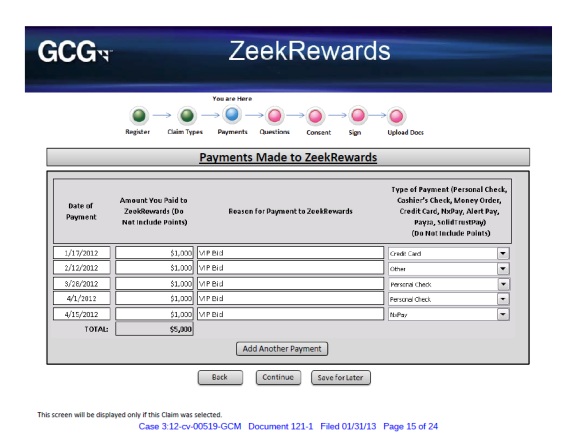
    The court-appointed receiver in the Zeek Rewards Ponzi scheme case has proposed an electronic-filing process for claims. Pictured above is one of the screens from a preliminary mock-up.
    The court-appointed receiver in the Zeek Rewards Ponzi scheme case has proposed an electronic-filing process for claims. Pictured above is one of the screens from a preliminary mock-up of the online claims submission process. The “GCG” reference above stands for The Garden City Group, the claims agent recently retained by the receiver.

    Kenneth D. Bell, the court-appointed receiver in the Zeek Rewards Ponzi-scheme case, has proposed a process by which claims would be filed online. Filers would proceed through a series of screens to enter information and would be permitted to upload information to substantiate their claims.

    The proposed filing process — still in preliminary form — would require affiliates to submit separate claims for each Zeek Rewards username. Bell has said that an untold number of Zeek affiliates had multiple usernames.

    Bell advised Senior U.S. District Judge Graham C. Mullen of the Western District of North Carolina that he “anticipates filing a motion seeking approval of the claims submission process . . . by the conclusion of the first quarter of 2013.”

    View preliminary mock-up.

    Read story by Jordan Maglich.

    Visit the ASDUpdates Blog.

    Visit the site of the Zeek receiver.

  • BULLETIN: Receiver Says $12 Million In Zeek Money Located ‘In An Eastern European Country’ — But Has Not Been Returned

    breakingnews72BULLETIN: (2ND UPDATE 8:47 P.M. ET U.S.A.) The court-appointed receiver in the Zeek Rewards Ponzi-scheme case says he has located $12 million in receivership assets held in an unspecified “eastern European country” — but the funds have not been returned.

    “This account is owned and was used by a payment processor outside the United States to provide funds to a foreign e-wallet that processed payments for ZeekRewards,” receiver Kenneth D. Bell said in court filings. “The Receiver previously caused the Freeze Order to be sent to the foreign financial institution which holds this account and demanded that the funds held in that account be turned over to the Receivership Estate. The foreign payment processor who owns this account was also sent the Freeze Order and a demand notice for the turnover of the funds in this account. However, neither the financial institution nor the foreign payment processor responded to the demands sent by the Receiver. Additionally, the Receiver has worked with the foreign e-wallet to seek to have these funds returned. While cooperative, the foreign e-wallet was unable to cause their customer to provide the funds held in this account to the Receiver.”

    Bell also confirmed today that the U.S. Secret Service “continues to pursue” money related to Zeek. Meanwhile, he announced a “Final Liquidation Plan” and proposed claims process will be filed tomorrow in U.S. District Court for the Western District of North Carolina. Zeek was based in Lexington, N.C. Senior U.S. District Judge Graham C. Mullen is presiding over the Zeek case.

    Massive Paper Chase Under Way

    In August 2012, the SEC described Zeek as a $600 million Ponzi- and pyramid scheme. What has transpired since then speaks to the enormous logistical challenges law enforcement and court-appointed receivers may confront when a fraud scheme goes viral on the Internet and spreads globally.

    Bell noted today that the receivership has communicated to “over 7,000 financial institutions” on the subject of cashier’s checks sent to Zeek by affiliates. Some affiliates also sought to fund their accounts with “certified checks, personal checks, bank money orders, and personal money orders.”

    One of the earliest problems with marshaling assets was the sheer volume of instruments sent to Zeek, according to Bell’s filing.

    “As of December 31, 2012, the Receiver presented over 140,000 financial instruments for deposit,” Bell said. “Many of these items were returned and not paid for various reasons. The Receiver Team is working with financial institutions to re-present instruments that were returned in error, and it is working to identify all instruments that were improperly returned.”

    One Zeek vendor alone was in possession of 85,000 cashier’s checks and other instruments, Bell said.

    “After reviewing these instruments, reviewing the records of the Receivership Defendant, communicating with [Zeek vendor Preferred Merchant Services] and working with a forensic accounting vendor, the Receiver Team was unable to definitively ascertain which instruments had already been processed and presented for payment by PM,” Bell said. “In order to maximize recovery to the Receivership Estate, the Receiver Team elected to present all of these instruments for payment. Approximately 34,000 of these instruments worth approximately $15 million were accepted and paid. Approximately 50,000 of these PM instruments were returned, which resulted in returned check fees of approximately $450,000.”

    Bell negotiated to reduce the return charges by 25 percent, he said.

    Beyond that, Bell said, “[t]he Receiver has been receiving numerous communications from financial institutions and Affiliate-Investors regarding cashier’s checks that have never been presented for payment,” adding that he is “unaware of any additional locations where cashier’s checks payable to the Receivership Defendant might be stored.”

    The receiver “determined that he does not have rights under the Uniform Commercial Code or the Receiver Orders to claim an interest in cashier’s checks that were never received by the Receiver or the Receivership Defendant,” Bell said. “Therefore, the Receiver has taken the position that although any cashier’s check that is subsequently received by the Receiver is a Receivership Asset and will be deposited, financial institutions should consider any cashier’s check that has not been presented by the Receiver or the Receivership Defendant as having been lost, and may refund the remitters of such cashier’s checks without fear of liability to the Receiver.”

    Crunching Numbers

    Zeek’s database included 1.6 billion records, which are now being analyzed, Bell said.

    “This analysis has taken longer than initially anticipated due to several issues: problematic transactions with questionable accuracy, the validity of database records, and the lack of available documentation (including look-up tables, database dictionaries, and source code documentation which are commonly used to understand the organization and function of a database’s components). In the absence of these tools, [receivership team member FTI Consulting Inc.] has been required to perform extensive testing of the data to validate the proposed calculations and to rely on disparate third-party sources, including Paul Burks, e-wallet vendors, financial institutions, and subpoena responses, for understanding the organization and function of the database components.”

    Compounding matters, according to today’s filing, was the sheer number of Zeek participants, including participants who had multiple usernames.

    “There are approximately 2.2 million unique users (“Affiliates” or “usernames”) in ZeekRewards,” Bell said. “The number of Affiliates does not reflect the number of unique individuals who participated in ZeekRewards, as it is likely that some individuals had more than one username. Approximately 1 million Affiliates paid money into the ZeekRewards Program . . .”

    And, Bell noted today, “[a]t this time, the Receiver has identified over 800,000 net-loser usernames in the Receiver Defendant’s records.”

    Taxing Matters

    The section below is verbatim from the receiver’s filing today (italics added):

    During the fourth quarter, the Receiver Team worked to determine which federal tax filings needed to be made with respect to income taxes, payments made to service providers, and payments made to Affiliate-Investors. The efforts were focused on the latter two issues because of the earlier filing deadline (January 31, 2013). The Receiver Team, including FTI, had discussions with RVG’s outside tax and accounting advisors to ascertain what had been filed for 2011 and earlier. After analyzing the issues, consulting with these various entities, and reviewing [Zeek operator Rex Venture Group LLC] ’s records, the Receiver Team determined that it would be necessary to file and issue 1099s to certain Affiliate-Investors and began the process of compiling the data necessary to issue the 1099s.

    Since the receivership began in August, Bell said, it has been determined that “some individuals who RVG classified as ‘independent contractors,’ to whom it had issued 1099s, were misclassified pursuant to IRS regulations.

    “Accordingly,” he continued, “the Receiver Team has reclassified them as employees and is issuing them W-2s. The Receiver Team will begin the process of identifying, misclassified employees, paying back taxes, and determining whether the Receivership Estate should pay any back wages owed to such employee as a result of RVG’s misclassification.”

    Pursuing International ‘Winners’

    Offshore members of Zeek expecting a free pass from the receivership may have to think again if they are classified as “winners.”

    “The group of net-winners identified to date includes numerous individuals residing outside of the United States, with the largest foreign winners living mainly in countries with established legal systems which are signatories to the Hague Convention for international service of process,” Bell said. “While the pursuit of ‘clawback’ claims against these foreign net winners raises various service issues and other challenges, the Receiver intends to include these winners as parties to domestic litigation based on their contacts with the ZeekRewards Program in the United States so long as doing so will not delay the litigation against domestic winners. The Receiver will also pursue cost-effective foreign litigation to establish the repayment obligation and/or to collect judgments where necessary and appropriate.”

    Claims Process

    Bell said he will file with the court tomorrow “the proposed claims process” as part of a “Final Liquidation Plan.”

    From Bell’s filing today (italics added):

    The Receiver anticipates filing a motion seeking approval of the Claims Submission Process by the conclusion of the first quarter of 2013. The Claims Motion will seek (i) approval of the claims submission process, (ii) to establish the date by which claims must be filed against the Receivership Defendant (the “Bar Date”), and (iii) approval of the noticing procedures to be used in providing notice of the Bar Date and the claims submission process.