Tag: Zeek

  • Conference Call By Zeek Receiver Under Way [Call Ended At 6:03 P.M.]

    EDITOR’S NOTE: This post was updated at 2:48 p.m. on Dec. 20 to include this link to a recording of the receiver’s Dec. 17 call. The information below reflects the PP Blog’s original notes from the call on Dec. 17 . . .

    UPDATED 7:27 A.M. (DEC 18, U.S.A.) A conference call by Kenneth D. Bell, the court-appointed receiver in the Zeek Rewards Ponzi scheme case, is under way. (Call ended at 6:03 p.m., as noted below.) The call began at 5 p.m. ET (U.S.A).

    UPDATE 5:15 p.m. Bell, formerly a federal prosecutor, has said he knows what a Ponzi scheme is — and “this was one.” Somewhere between $500 million and $600 million was lost. The receivership estate has recovered about half of that. “We’re roughly half-way home, but that’s a huge gap,” Bell said.

    UPDATE 5:18 p.m. A claims form for victims should be ready by the end of January, Bell said. It’s doubtful that victims can be made 100 percent whole.

    UPDATE 5:21 p.m. There are some sad, Zeek-related stories of loss out there. Bell said he had emails from people who’d lost anywhere from $49 to $10,000.

    Some folks are worried they can’t establish their loss because they sent money to their sponsor, not Zeek parent Rex Venture Group, Bell said. A means of addressing such claims is being established.

    UPDATE 5:25 p.m. Bell said some people have questioned whether he is dragging out the receivership to drive up legal fees. He asked listeners to trust him, and he denied foot-dragging. His “goal is to be the most cost-effective receivership in history,” Bell said.

    UPDATE 5:33 p.m. Bell said he did not know if other people will be charged by authorities in connection with Zeek. (Zeek/Rex operator Paul R. Burks is the only person charged to date — civilly by the SEC.)

    He added that he’ll be prepared to prove Zeek was a Ponzi scheme as he pursues winners in clawback litigation. A motion by Zeek winners to appoint attorney Michael Quilling  examiner was “absurd,” he said. He did not reference Quilling by name.

    UPDATED 5:38 p.m. Bell also will oppose a motion by attorney Ira Lee Sorkin to dissolve the receivership. He did not mention Sorkin’s name. (Sorkin was Bernard Madoff’s defense attorney.)

    UPDATED 5:41 pm. Bell is contemplating an interim distribution to victims. More study needs to be done, but “I don’t see any reason to sit on $300 million,” he said. No timetable has been established for an interim distribution.

    UPDATED 5:44 p.m. Zeek’s database “is a real mess,” Bell said. He is studying a means by which victims could gain access to their back offices to gain access to information, but such a capability could be cost-prohibitive.

    UPDATED 5:48 p.m. Some Zeek members have poor records, but others have good records that are helping fill in  gaps in Zeek’s database. “We will try to help you establish your claim,” Bell said. The more records members can submit, the better.

    UPDATED 5:50 p.m. The plan is to treat all Zeek members equally. Distributions likely will occur all at once. No one has received money from the receivership to date.

    UPDATED 5:52 p.m. In the early days of the receivership, Bell said he received “tens of thousands” of emails.

    UPDATED 5:54 p.m. Bell will sell real estate and furnishings owned by Zeek, he said.

    UPDATED 5:58 p.m. There are “eight to 10” core members of the Zeek receivership team. At the moment, some of the lawyers are arguing with lawyers on the other side of the issues, Bell said.

    UPDATED 6 p.m. Bell said if Paul Burks still has Zeek receivership property, he’ll be treated as a winner. The case was not over simply because Burks paid a $4 million fine to the SEC, he said. It was not up to the receivership to determine if Burks would be charged criminally, Bell said.

    UPDATED 6:03 p.m. Call ended. Bell thanked those supporting his efforts and said he understood why some people would not.

    MISC NOTES AT 6:05 p.m. What happens to possible Zeek “ringleaders” is the responsibility of law enforcement, Bell said during the call.

    The current math, he said, looks something like this: 840,000 losers and 77,000 winners. “A lot” of people had more than one Zeek username, Bell said. Every dollar the receivership estate spends on court battles is a dollar that won’t go to victims, Bell said. Prudent choices have to be made when deciding how to fund the receivership estate in a cost-effective manner to maximize the distributions to victims, Bell said. There were “boxes and boxes” of cashier’s checks at Rex headquarters, Bell said.

    Those cashier’s checks were receivership property under the law, Bell said.

  • URGENT >> BULLETIN >> MOVING: Montana Fines ‘Funky Shark,’ Purported Upstart ‘Penny Auction’ Program; Operator Agrees to Pay $834,000 After Issuance Of Order

    breakingnews72URGENT >> BULLETIN >> MOVING: (UPDATED AT 12:49 P.M. ET U.S.A. TO DELETE EARLIER REFERENCE TO ‘CEASE AND DESIST’ ORDER AND TO PROVIDE LINK TO CONSENT AGREEMENT AND FINAL ORDER.)

    An upstart “penny auction” company known as “Funky Shark” effectively has been shut down after the state of Montana named it in an order and its alleged operator agreed to pay a $40,000 fine and to repay $834,000 to investors, the office of the Montana Commissioner of Securities and Insurance Monica J. Lindeen said this morning.

    Montana authorities identified Scott Wacker of Bozeman as Funky Shark’s operator, alleging that he and Funky Shark sold investment opportunities illegally.

    In September — after the shutdown by the SEC of the purported Zeek “penny auction” program — “Wacker began recruiting investors for his penny-auction website, FunkyShark.com,” Lindeen’s office said. “By the end of October, Wacker had raised over $1 million from investors across the world.”

    In a claim apt to cause unease among HYIP operators, Lindeen’s office said Wacker’s bank filed a “suspicious activity report.” Such reports typically are filed when a bank begins to suspect something untoward is occurring in a customer’s account.

    “The flurry of transactions in Wacker’s personal and business accounts led his bank to file a suspicious activity report, which was referred to Lindeen’s office,” Montana authorities said. “After reviewing the report, investigators suspected Funky Shark was a pyramid scheme and requested a restraining order to prevent additional investors from getting involved.”

    Wacker cooperated with Montana authorities and “posted a notice on Funky Shark’s website explaining that its investment program ‘may violate certain securities laws in the United States,’” Lindeen’s office said.

    Authorities described Funky Shark as a program teetering on collapse shortly after its launch.

    “In the two months it operated, Funky Shark paid nearly $378,000 in commissions to participants who recruited new members,” Lindeen’s office said. “Those commission payments left Funky Shark unable to repay all of its participants in full, so Wacker agreed to pay $270,000 out-of-pocket to make investors whole.”

    Lindeen said Funky Shark investors were lucky.

    “Mr. Wacker stepped up to the plate and repaid his investors,” she said. “Often when we handle these types of cases, there’s simply no money left to repay participants. But for a number of reasons, this case is unique. Mr. Wacker didn’t understand what he was getting into, and he has expressed his commitment to setting things right.”

    Some HYIPs are selling “founder’s memberships” to fill the coffers with cash prior to the “launch” of a “program.” That was the case with Funky Shark, Lindeen’s office said.

    “According to the Funky Shark website, members who pay a $24.95 fee can join a ‘rewards program’ and earn ‘passive income’ from new members they recruit,” Lindeen’s office said on Nov. 2. “For a non-refundable, $1,000 investment, members become ‘founders’ and get a share of each day’s auction profits and a bonus for every new founder they recruit.”

    Authorities noted that “[n]either Wacker nor Funky Shark were licensed to offer securities in Montana.”

    Here is the consent order.

  • BULLETIN: Zeek Receiver Says ‘Large Sums . . . May Have Been Transferred By Net Winners To Other Entities In Order To Hide Or Shelter Those Assets’

    breakingnews72BULLETIN: (UPDATED 2:34 P.M. ET U.S.A.) The court-appointed receiver in the Zeek Rewards Ponzi scheme case has advised a federal judge that he “has obtained information indicating that large sums of Receivership Assets may have been transferred by net winners to other entities in order to hide or shelter those assets.”

    The dramatic assertion by receiver Kenneth D. Bell that Zeek winners may have hidden cash appeared in a motion to Senior U.S. District Judge Graham C. Mullen to compel certain alleged Zeek “winners” to produce documents in advance of anticipated clawback actions.

    Bell’s move may send shudders across the HYIP sphere because it signals an effort to unmask bids by willfully blind hucksters and professional Ponzi players — known derisively as “pimps” — to benefit from serial scamming on a national and international scale. It is known, for instance, that some Zeek participants also pitched AdSurfDaily, which the U.S. Secret Service described in 2008 — at least two years before the launch of Zeek — as an international Ponzi scheme that had gathered tens of millions of dollars.

    ASD operator Andy Bowdoin pleaded guilty to wire fraud in May. In August, he was sentenced to 78 months in federal prison.

    HYIP schemes thrive in part because serial scammers race from scheme to scheme to scheme while turning blind eyes to obvious markers of fraud, including purported returns that dwarf the marketplace and are unusually consistent. Zeek planted the seed that it provided a daily return of between 1 percent and 2 percent. In August, the SEC said Zeek’s payout “consistently has averaged approximately 1.5% per day.”

    Zeek operator Paul R. Burks, the SEC charged, “unilaterally and arbitrarily” determined the daily dividend rate to give “investors the false impression that the business is profitable.”

    In 2009, the U.S. Secret Service effectively accused Bowdoin of doing the same thing. ASD purported to pay 1 percent a day. In August 2012, the Secret Service said it also was investigating Zeek. Court filings in the ASD case show that some members of ASD established entities through which to receive proceeds from ASD. One was described as a “ministry of giving,” for instance. Another was described as a nonprofit religious entity.

    The Secret Service described ASD as a “criminal enterprise” that directed tainted proceeds potentially to thousands and thousands of participants while scamming the very people it purported to be helping earn money through its 1-percent-a-day revenue-sharing “program.”

    Zeek also described itself as a revenue-sharing program and, like ASD, preemptively denied that anything untoward was occurring. Burks did not contest the SEC’s case against his firm, neither admitting nor denying wrongdoing. ASD’s Bowdoin eventually acknowledged that he was at the helm of a massive Ponzi scheme and that ASD had never operated lawfully from its inception in 2006 through it collapse in 2008.

    Bell also revealed in the filing that he had filed paperwork in “all” 94 U.S. federal court districts to inform judges and court officials that he was presiding over the receivership ordered by Mullen in August after the SEC described Zeek as a $600 million Ponzi- and pyramid scheme operated through Rex Venture Group LLC (RVG) and Burks. The move was designed to consolidate jurisdiction over clawback actions in a single place: Mullen’s courtroom in the Western District of North Carolina, the home base of Zeek.

    Among other things, Bell is seeking “All documents constituting or relating to any communication involving or related to RVG.”

    “The Receiver has asked for these documents to learn more about how the recipient was involved in Zeek, portrayed the scheme to others, solicited others, and otherwise conducted activities related to Zeek,” Bell said in court filings.

    Meanwhile, Bell is seeking “All documents constituting or related to any communication to any affiliate, vendor, customer or client of RVG related to RVG.” At the same time, he is seeking “Documents sufficient to show all user names, passwords, email addresses and accounts used . . . in connection with RVG.”

    That information is needed because many “individuals used multiple user names, and this information will clarify which user names a given net winner used,” Bell advised Mullen. “In addition, the account information will help to allow the Receiver to verify the financial figures calculated from RVG’s records.”

    Bell’s motion to compel specifically references Zeek affiliates Robert Craddock, David Sorrells, David Kettner and Mary Kettner as the recipients of subpoenas from the receivership. In October, Bell mailed a first wave of subpoenas to about 1,200 Zeek affiliates. He effectively is seeking the same information from them that he is seeking from Craddock, the Kettners and Sorrells.

    Craddock, the Kettners and Sorrells “have failed to produce any of the documents requested by the Receiver despite multiple requests,” Bell advised Mullen. “Therefore, the Receiver has filed a motion to compel production of a portion of the documents originally requested by the Receiver.”

    The Kettner and Sorrells potentially have nearly $2 million in combined clawback exposure, according to court filings. Craddock’s exposure is unclear. He has referred to himself as a Zeek “consultant.”

    One of the authorities Bell pointed to in advance of Zeek clawback actions and in his motion to compel the production of documents is a case involving Michael Quilling, an attorney for Craddock, the Kettners and Sorrells. Quilling himself has presided over SEC receiverships.

    Bell pointed out to Mullen that Quilling once sued the estate of a a deceased individual who’d received proceeds from the Frederick J. Gilliland Ponzi scheme in 2002. That lawsuit was filed on the same legal theory Bell is pursuing in the Zeek case: that recipients of fraudulent proceeds from a Ponzi scheme are not entitled to keep them.

    See post on ASDUpdates.

  • URGENT >> BULLETIN >> MOVING: SEC Files Motion In Zeek Case To Oppose Appointment Of Examiner; In Blistering Memo, Agency Accuses Robert Craddock Of Encouraging Affiliates ‘Not To Cooperate With The Receiver’

    breakingnews72URGENT >> BULLETIN >> MOVING: (UPDATED 11:58 A.M. ET (U.S.A.) The SEC has gone to federal court in the Western District of North Carolina to oppose a motion by Zeek “winners” to appoint an “examiner” over all Zeek affiliates. In a blistering, 12-page memo, the agency accused Zeek figure Robert Craddock of encouraging Zeek affiliates “not to cooperate” with Kenneth D. Bell, the court appointed receiver.

    “Moreover,” the SEC claimed, “Craddock has asserted (incorrectly) that the SEC has acknowledged to his lawyers that the SEC has doubts or concerns about its case and is looking for ways to ‘back out’ in order to allow ZeekRewards to re-start its operations. Another Quilling client, David Kettner has repeated assertions similar to those made by Craddock in written communications to former ZeekRewards affiliates.”

    The agency also confirmed in its filing that its Zeek investigation was ongoing. The “confidential nature” of the probe, the agency said, potentially could make it difficult to respond to motions filed by opposition attorneys.

    There could come a time, the SEC said, that it would ask “to provide the Court with additional information under seal or in a closed hearing.”

    The SEC’s filing was dated yesterday — the same day Bell also asked Senior U.S. District Judge not to approve the sought-after appointment of Dallas attorney Michael J. Quilling as examiner. Quilling, Bell said, had an obvious conflict of interest. The SEC argued along the same lines.

    Quilling, the SEC said, is representing “certain significant net ‘winners’ in the ZeekRewards Ponzi scheme alleged in the Complaint” and seeks “to have himself appointed ‘Representative for Affiliates,’ provided with counsel, and compensated out of the Receivership Estate.”

    From the SEC’s motion (italics added):

    The Quilling Motion suffers from several obvious flaws:

    (1) The Motion offers no compelling factual or legal basis for the Court to consider appointing a “Representative for Affiliates” – the Commission continues to work closely with and monitor the Receiver to ensure that as much money as possible is returned to injured investors in the most efficient manner possible;

    (2) Appointment of a “Representative for Affiliates” would serve only to complicate this already complex matter, obstruct the Receiver’s ability to efficiently marshal Receivership Assets, and significantly and unnecessarily deplete the pool of assets available to be distributed to injured investors (given that Quilling and [Charlotte attorney Rodney E.] Alexander seek to be compensated from Receivership Assets); and

    (3) The interests of Quilling and Alexander’s current clients – significant net “winners” in the Ponzi scheme alleged in the Complaint – are diametrically opposed to the vast majority of ZeekRewards investors that were net “losers” in the Ponzi scheme.

    One of the potential issues is whether Craddock — through his Florida-based entity Fun Club USA — gathered money from Zeek losers and used it to bolster the aims of Zeek winners in the early days after the SEC’s Aug. 17 Ponzi complaint. Such an act potentially could have put losers in opposition to their own best interests, given that Bell intends to file clawback lawsuits against winners to help fund the receivership estate.

    In its motion, the SEC said that Fun Club USA appears to have been formed 11 days after the SEC’s actions and that it and other nonparties had “yet to explain why an entity formed after the Court froze ZeekRewards assets and appointed the Receiver should be heard on the subject matter” of the motion to appoint an examiner.

    Read the SEC motion.

  • BULLETIN: Zeek Receiver Opposes Appointment Of ‘Examiner’; Zeek Cheerleaders, ZTeamBiz Missives Get A Mention; Let Them ‘Employ Counsel At Their Own Expense,’ Bell Urges Judge

    “The ZeekRewards scheme has claimed hundreds of thousands of victims who lost hundreds of millions of dollars at the hands of the scheme’s winners who solicited their participation. Now, apparently not appreciating the irony, the lawyer for hundreds of the largest net winners asks the Court to pay him to be an ‘examiner’ or ‘representative for the affiliates,’ yet again at the expense of the scheme’s victims. The requested appointment is unnecessary and ill-advised because it would duplicate and complicate this Court’s, the Receiver’s, and the SEC’s efforts to compensate the victims, not to mention directly reduce the Receivership Assets available to pay them. Furthermore, the individual whom the net winners recommend for appointment (or more correctly who recommends his own appointment) ignores the inherent conflict of interest in seeking to somehow represent both the scheme’s ‘winners’ and ‘losers,’ two groups with irreconcilably adverse interests.”Zeek receiver Kenneth D. Bell, Dec. 17, 2012

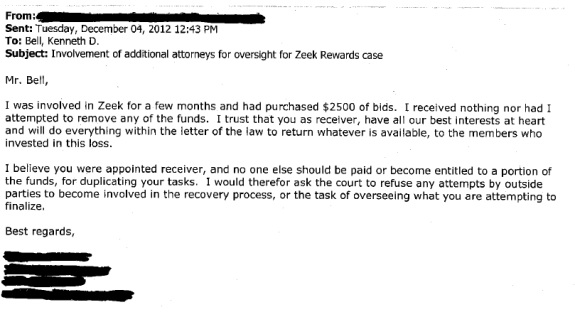
    Section from an email received by the court-appointed receiver in the Zeek Rewards Ponzi scheme case. Source: federal court files.
    Section from an email received by the court-appointed receiver in the Zeek Rewards Ponzi scheme case. The note asks the receiver to oppose efforts by Zeek winners to intervene in the case. Source: federal court files.

    Shortly after the SEC described Zeek Rewards on Aug. 17 as a $600 million Ponzi- and pyramid scheme, Zeek figure Robert Craddock solicited donations purportedly to hire an attorney and form a “protected” group of affiliates. Whether Zeek losers gave to the effort conducted at ZTeamBiz through Fun Club USA, Craddock’s Florida-based entity, remains unclear.

    On Aug. 29, PP Blog guest columnist Gregg Evans questioned how Zeek winners and losers ever could be on the same side.

    Today the court-appointed receiver effectively was asking the same question. His conclusion was that they could not — and he asked Senior U.S. District Judge Graham C. Mullen to reject a contention by certain Zeek “winners” that they could.

    “The net winners have already been put on notice that they will be asked to return their winnings to the Receiver for reimbursement to the net losers,” Bell said in court filings. “On the other hand, the net losers hope that they can recoup some of their losses from the gains of the scheme’s net winners . . . Thus, the winners and losers are plainly opposed in their respective interests regarding the winners’ efforts to keep their winnings.”

    Presumptive Zeek clawback targets Dave Kettner, Mary Kettner and David Sorrells asked Mullen last month to appoint Dallas attorney Michael Quilling as “examiner” over all Zeek affiliates. That should not be permitted to happen, Bell contended, because Quilling “has appeared in this case already as an attorney for Fun Club USA and represents the interests of those net winners.”

    In a bid to bolster his claim, Bell cited Craddock ties to Dave Kettner through ZTeamBiz and quoted from a letter attributed to Kettner.

    “In a similar vein, Mr. Kettner sent a letter seeking donations from affiliates that stated, “The SEC has tried to make us all believe that Zeek Rewards was an ‘investment’ and a Ponzi scheme. All the pages that were submitted by the SEC indictment [sic] has [sic] all been one sided and what we believe to be a misrepresentation of the truth and facts of what Zeek Rewards was as a viable and legal business,” Bell advised the judge in a footnote that included the URL to ZTeamBiz.

    Beyond that, Bell argued, the Craddock entity, the Kettners and Sorrells had no standing in the case brought by the SEC.

    And Bell said he has heard from Zeek members who want him to oppose the appointment of Quilling as examiner.

    Here, according to Bell, is a passage from one such Zeek member who contacted Bell after learning about the “examiner motion”:

    As one of the many losers in Zeek Rewards I wish to encourage you to do whatever is possible to block the motion filed on behalf of Fun Club USA (Robert Craddock) David & Mary Kettner and David Sorrells, asking that their personal attorney Michael J Quilling be appointed as the Examiner to oversee and represent the interest of ALL former Zeek Rewards affiliates.

    To many of us this is just another way for another attorney firm to slow up your process of recovery and to diminish the amount of funds to be returned to those of us who are in hopes of being able to recover some of our losses.

    Personally I feel that their agenda is also to help block your efforts to recover funds from the 1200 who received subpoenas.

    The Kettners and Sorrells potentially have exposure of nearly $2 million in receivership clawback litigation, Bell said.

    At least two apparent Zeek winners represented by attorney Ira Lee Sorkin also oppose the appointment of Quilling as examiner, according to filings last week.

    Todd Disner, a Zeek affiliate and figure in the AdSurfDaily Ponzi scheme story, once was on a conference call with Craddock.

    In recent remarks, Craddock said Disner was in Hong Kong with a “lost” passport.

    Reports now have surfaced that Craddock is pitching a “program” known as Offer Hubb that uses a Wyoming mail drop as its address. Disner’s name was listed on the Offer Hubb pitch, according to BehindMLM.com.

  • Potential Zeek Clawback Target Pitched Collapsed Regenesis 2X2 Cycler: ‘Giddy Up. Get Involved. [It’ll] Be The Best Decision You Ever Made’

    gilmondregenesis2x22UPDATED 7:55 A.M. ET (DEC. 23, U.S.A.) In May 2009, before the launch of the alleged Zeek Rewards Ponzi scheme, a Zeek promoter who has hired famed attorney Ira Lee Sorkin appeared in a check-waving video for an “opportunity” known as Regenesis 2X2.

    Check-waving is used as a form of “proof” that an “opportunity” that “pays” is not a scam.

    “Giddy up,” intoned Trudy Gilmond of Vermont. “Get involved. [It’ll] be the best decision you ever made.”

    Gilmond, according to the video she narrated while waving two checks from Regenesis 2X2 totaling $1,200, sent by Priority Mail and drawn on Bank of America, was “fired up.”

    She’d been in Regenesis 2X2 only since May 1, and already had received a nice payout, Gilmond explained.

    “Knew this company would work,” she said, before alluding to a Biblical tale of an apostle who insisted on proof of the resurrection of Jesus.

    “A lot of people are nonbelievers, doubting Thomases, didn’t believe it,” Gilmond said. She then presented checks as a form of proof that Regenesis 2X2 paid.

    About two months later — in July 2009 — the U.S. Secret Service applied for search warrants in federal court in Washington state, the purported home of Regenesis 2X2. From a PP Blog story on Aug. 3, 2009 (italics added):

    Agents, according to court filings, observed complaint letters directed at the firm being discarded into a Dumpster that was kept under constant surveillance. Also found in the Dumpster were copies of checks sent in by customers, other documents that included customers’ names and information to identify them personally, complaint faxes sent by customers and a letter from a law firm complaining about false, misleading and deceptive advertising.

    In one case in which agents were observing one of the adult principals in the case, they observed a youth described as a teenager exiting a vehicle and “struggling with a large arm full of opened business and UPS Priority Mail envelopes,” the Secret Service said in court filings.

    The juvenile entered a building and “then immediately came back outside and discarded the materials into an alley [D]umpster,” agents said.

    Agents identified the adult under surveillance as a person “arrested by the Internal Revenue Service out of Las Vegas, Nevada[,] for felony violations related to Illegal Money Laundering from Securities Fraud and Wire Fraud” in a previous case.

    How the Regenesis 2X2 probe proceeded is unclear.

    What is clear is that Zeek eventually came to the fore. In court filings, Sorkin has noted that Gilmond has potential clawback exposure of more than $1.364 million from the court-appointed receiver in the Zeek Rewards Ponzi scheme case.

    Gilmond once was listed on a Zeek website as both an “Employee” and “Official Rep.” So, too, was Zeek pitchman OH Brown of USHBB Inc., which produced ads for both Zeek and the collapsed Narc That Car pyramid scheme. For a while, at least, Zeek and Narc That Car appear to have used the same North Carolina-based bank: NewBridge.

    Checks displaying the name of NewBridge showed up in independent affiliate promotions on YouTube in 2010. After one Narc affiliate quit the program, he moved to another one. The check-waving for the new “program” began at the one-second mark. Literally.

    BehindMLM reported yesterday that Brown may have a tie to a burgeoning “opportunity” known as Offer Hubb.  AdSurfDaily and Zeek promoters Todd Disner and Jerry Napier also appear to be in the communication chain of Offer Hubb. The U.S. Secret Service has described ASD as a “criminal enterprise.” The U.S. Department of Justice has described ASD as “insidious.”

    A source told the PP Blog last week that Zeek figure Robert Craddock now was pitching Offer Hubb. Craddock is a purported Zeek “consultant” raising money to contest elements of the SEC’s Ponzi-scheme complaint and the court-appointed receivership. In July, Craddock sought to have the website of Zeek critic K. Chang removed from the Internet. Craddock was successful briefly, but the “K. Chang” Hub at HubPages returned.

    By Aug. 4 — just 13 days prior to the filing of a emergency action by the SEC alleging that Zeek was a $600 million Ponzi- and pyramid scheme — Zeek used its Blog to blast unspecified “North Carolina Credit Unions” for raising questions about the “program.”

    For years, questions have been raised about whether fraud schemes within the MLM sphere were recycling money between and among schemes and putting banks and other financial-service companies in possession of tainted funds. Purported “Wiring Instructions” of Offer Hubb imply that the Wyoming-based entity is soliciting sums of up to $10,099 from prospects and is using City National Bank.

    From a section of the BehindMLM report that describes an address used by Offer Hubb (italics added):

    As mentioned in the introduction of this review, “1712 Pioneer Avenue” is the headquarters of “Corporations Today”. The address is apparently so well-known in tax haven circles that Reuters used the 1712 Pioneer Avenue building itself for a 2011 article on corporate secrecy in the United States.


  • URGENT >> BULLETIN >> MOVING: Ira Lee Sorkin, Bernard Madoff’s Attorney, Files Motion For Clients Who Are Potential Clawback Targets For More Than $1.56 Million In Zeek Case

    URGENT >> BULLETIN >> MOVING: (3RD UPDATE 11:33 P.M. ET (U.S.A.) Famed defense attorney Ira Lee Sorkin is seeking pro hac vice admission to practice in U.S. District Court for the Western District of North Carolina on behalf of two prospective clawback targets in the Zeek Rewards Ponzi scheme case.

    Sorkin is with Lowenstein Sandler PC in New York. He perhaps is best known as Ponzi schemer Bernard Madoff’s defense counsel. Sorkin also is the former head of the SEC’s New York regional office.

    Sorkin’s clients are Zeek affiliates Trudy Gilmond and Kellie King, and Sorkin is arguing that Zeek did not sell securities and that the receivership should be dissolved.

    Gilmond is the prospective target of a clawback action for more than $1.364 million, with receiver Kenneth D. Bell asserting she put in only $3,105, according to Sorkin’s motion. King potentially faces a claim from Bell for more than $205,180 after paying in only $1,492, Sorkin said in the filing.

    Sorkin, according to a separate motion, also contests how the receiver issued subpoenas and is opposing a motion late last month by Dallas attorney Michael J. Quilling to be appointed “examiner.”

    Quilling sought “to represent the collective interests of the Affiliates and all creditors of the receivership estate” and desired to “be compensated out of the receivership estate,” Sorkin argued.

    But that should not be permitted to happen, Sorkin contended.

    From Sorkin’s motion (italics added):

    It is quite clear from the Receiver’s Preliminary Liquidation Plan and the defective subpoena issued to Ms. Gilmond that Qualified Affiliates have inherently conflicting positions as to one another, and thus cannot be jointly represented. To illustrate, it is in the interests of a Qualified Affiliate who is a “net-winner” to challenge the Receiver’s authority to clawback funds because the Receiver intends to use the “net-winner’s” money to pay net-losers. To the contrary, it is in the interests of a Qualified Affiliate who is a net-loser to support the Receiver’s efforts because the Receiver will take money from the “net-winner” and distribute it to the “net-loser” Qualified Affiliate. As such, an Examiner cannot be appointed to represent all of the Qualified Affiliates because the Examiner would have clients with inherently contradictory positions as to one another.

    The motion by Sorkin potentially puts Gilmond and King at odds with positions taken by Quilling clients and potential Zeek clawback targets Dave Kettner, Mary Kettner and David Sorrells. The Kettners and Sorrells, for example, moved to have Quilling appointed examiner.

    The Kettners and Sorrells potentially have a combined clawback exposure of nearly $2 million, according to court filings.

    Zeek records, according to letters from Bell cited by the trio, suggest Sorrells received $945,539 from Zeek while paying in only $1,695. Dave Kettner received $537,577.95 while paying in only $1,378, and Mary Kettner received $465,866.67 while paying in only $1,495.

  • BRIEF: Zeek Receiver Broadens Reach, Files In Southern District Of Florida — And In Northern Mariana Islands Nearly 15,000 Miles Away

    Bird Island, Saipan. Source: website of U.S. District Court for the Northern Mariana Islands.

    In yet another demonstration of the reach of the alleged Zeek Rewards Ponzi scheme, court-appointed receiver Kenneth D. Bell has filed paperwork in the Southern District of Florida — and in Northern Mariana Islands District Court.

    The Northern Mariana Islands are a U.S. Commonwealth. Saipan is perhaps the best-known island in the chain. The flight distance between Saipan and Miami — the city in which the receiver made the filing in the Southern District of Florida — is about 14,571 miles, according to Flightpedia.

    Saipan is more than 3,500 miles southwest of Hawaii, the U.S. island state in the Pacific.

    Bell previous filed in Guam, a U.S. territory in the western Pacific.

    In August, the SEC described Zeek as a $600 million Ponzi and pyramid scheme with international reach.

    Records suggest Bell has filed in more than 70 of the 94 U.S. districts in advance of anticipated clawback actions against Zeek winners.

  • Nearly $2 Million Allegedly At Stake For 3 Arizona Zeek Affiliates Who Received Subpoenas, Filings Say

    “[Zeek operator Paul] Burks is solely responsible for determining the amount of ‘net profits’ to share in the Retail Profit Pool . . . Defendants represent that daily awards are calculated by dividing ‘up to 50%’ of daily net profits by the number of Profit Points outstanding among all Qualified Affiliates. This calculation results in a daily dividend paid to each Qualified Affiliate that consistently has averaged approximately 1.5% per day . . . In fact, the dividend bears no relation to the company’s net profits. Instead, Burks unilaterally and arbitrarily determines the daily dividend rate so that it averages approximately 1.5% per day, giving investors the false impression that the business is profitable.”From the SEC complaint in the Zeek Rewards Ponzi scheme case, Aug. 17, 2012

    “The most successful Affiliates worked the hardest, placed numerous ads, and explained the Zeekler.com penny auction to groups of people several times a month. Some of the Movants, for example, traveled extensively to maintain contact with their network of peers and to educate them, among other things, on how to be successful in the program. These Movants’ successes were a direct result of the amount of time and effort they poured into the effort to promote the penny auction.”Zeek Affiliates Dave Kettner, Mary Kettner and David Sorrells, Dec. 11, 2012

    Although the SEC accused Rex Venture Group LLC/Zeek Rewards operator Paul R. Burks in August of conducting a massive Ponzi scheme and duping members into believing he was presiding over a business that created enormous profits legitimately, three members of the MLM “program” with potentially millions of dollars in ill-gotten gains subject to clawback aren’t buying it.

    At stake for Dave Kettner, Mary Kettner and David Sorrells of Arizona is at least $1.94 million they allegedly earned in the “program” through hard work, according to court filings.

    Zeek was a legitimate venture, they argued in filings dated Dec. 11. And it was no Ponzi scheme, they advised Senior U.S. District Judge Graham C. Mullen of the Western District of North Carolina. Mullen is presiding over the Zeek Ponzi scheme case brought by the SEC Aug. 17.

    It was not immediately clear whether the Kettners and Sorrells were the recipients of payouts from Zeek’s Retail Profit Pool (RPP) or commissions for sponsoring new members — or some combination of both. The RPP also is known as the Retail Points Pool.

    What is clear, according to their filings, is that each received a letter and subpoena from Zeek Receiver Kenneth D. Bell that paint them as potential clawback targets. The information about the sums Bell is seeking is contained within exhibits filed by the Kettners and Sorrells.

    Zeek records, according to letters from Bell cited by the trio, suggest Sorrells received $945,539 from Zeek while paying in only $1,695. Dave Kettner received $537,577.95 while paying in only $1,378, and Mary Kettner received $465,866.67 while paying in only $1,495.

    Bell has said Zeek created approximately eight losers for each winner. The SEC described Zeek as a $600 million Ponzi and pyramid scheme that potentially defrauded more than 1 million people.

    The PP Blog is working on a related story about assertions by the Kettners and Sorrells that significant sums of money that belong to them effectively are trapped in NxPay, a payment processor used by Zeek. More later . . .


  • BULLETIN: Zeek Receiver To Hold Conference Call For Victims On Dec. 17

    BULLETIN: Kenneth D. Bell, the court-appointed receiver in the Zeek Rewards Ponzi scheme case, has announced he’ll hold a one-hour, web-based conference call Dec. 17 at 5 p.m. ET (U.S.A.). Bell is encouraging victims to email their questions to him prior to the call. The receiver’s full announcement is published below:

    December 11, 2012

    When I was appointed as receiver of Rex Venture Group LLC d/b/a Zeekrewards.com, one of my primary goals, in addition to locating and seizing assets from the site so they can be returned to the victims, has been to keep all interested parties informed as we move through this process. In an effort to continue to communicate with you and answer your questions about the receivership, I will be hosting a one-hour web based conference call for ZeekRewards victims on Monday, December 17, 2012 at 5:00pm EST. You may access the video call by clicking on the link and following the directions below:

    https://mcguirewoodsevents.webex.com/mcguirewoodsevents/onstage/g.php?d=669382018&t=a&EA=gcooper%40mcguirewoods.com&ET=be20abdd113582919838c5a9b73c73b6&ETR=5e4b1811fab80bf1575c1618f77b7fbc&RT=MiMxMQ==&p

    Event password: rewards

    If you are not near a computer and wish to join the call over the phone, please follow the directions below:
    US TOLL FREE: +1-855-749-4750
    US TOLL: +1-415-655-0001
    Toll-free dialing restrictions: http://www.webex.com/pdf/tollfree_restrictions.pdf
    Access code: 669 382 018
    (This is a call-in number only and those calling in will not have an opportunity to ask questions)

    You may join either the video or phone call 60 minutes prior to the start time.

    I will answer individual questions on the video conference call. However, because we may have more questions than I have time to answer on Monday, I would encourage you to email your questions to me prior to the call so I have the opportunity to address them in my remarks. You can email your question to me at zeekrewardcall@mcguirewoods.com.

    We will look at your questions and I will answer as many as I can during the presentation. Please note that I will not be able to address individual account questions, as there would be too many to get to during the time we have. However, if you have a question about the process, the progress we’ve made so far, next steps, estimated timelines, or even rumors you have heard regarding the receivership, please send those questions to me and I will address as many as I can during the call.

    In an effort to address as many people as possible, I have asked for the maximum number of available ports that our provider is able to handle. In the event that the call reaches capacity or if anyone cannot join the call on the 17th, it will be recorded and available on this site for anyone to view at a later time. Please continue to monitor this site for any updates.

    Thank you for your continuing support.

    Kenneth D. Bell
    Receiver

  • CURIOUS: 3 Of 5 ‘Most Popular’ Stories On PP Blog Last Week Were ‘Old’ Articles On The AdSurfDaily And AdView Global Scams

    UPDATED 8:55 A.M. ET (U.S.A., DEC. 11) Are Zeekers doing research in advance of clawback actions in the Ponzi scheme case or otherwise trying to get a sense of history? Are they (or other readers) trying to gain a better understanding of ties that may exist among Zeek, AdSurfDaily and AdViewGlobal?

    Three of the PP Blog’s five “Most Popular” stories last week were “old” articles about ASD and AVG, according to a tracking service used by the Blog. AVG had not dominated reader interest on the PP Blog for nearly three years.

    Here are links to (and briefs about) those stories:

    From July 16, 2009: (No. 2 in ‘Most Popular’ rankings last week.) BREAKING NEWS: Federal Judge Says Curtis Richmond, Six Other Parties Who Used Pro Se Litigation Blueprint, Cannot Intervene In AdSurfDaily Forfeiture Case

    The July 16, 2009, story reported that seven would-be, pro se intervenors in the ASD Ponzi case were denied standing by a federal judge. In her ruling, the judge pointed out that the first filing occurred in February 2009. It is “representative and seems to be a ‘form’ complaint inasmuch as the others are duplicates,” the judge said.

    A key part of the ruling (italics added): “Fraud victims who voluntarily transfer their property to their wrongdoers do not retain a legal interest in their property; instead, such victims acquire a debt against their wrongdoers.”

    Waves of other pro se filiers later were denied standing in the case. (On at least two occasions, the judge denied the would-be intervenors en masse.)

    It perhaps is worth pointing out that standing also could become an issue in the Zeek case. Given ASD’s history, it also seems possible that “defenders” of the Zeek scheme will ponder the use of shared litigation templates. (The ASD templates, which advanced conspiracy theories and accused public officials of crimes,  didn’t “work.” To date, one Zeeker has accused the court-appointed Zeek receiver of a crime.)

    From Dec. 7, 2009: (No. 4 in “Most Popular” rankings last week.) AdViewGlobal Recording Suggests Member Cashed Out $10,000 Only Days After Formal Launch And That Insiders Were Awarded Bonuses; Less Than Two Weeks Later, Surf Switched To ‘Private Association’ Structure

    The Dec. 7, 2009, story reported that AVG, a  purported offshore entity, had conducted conference calls earlier in the year and lured prospects with “bonuses.” It also reported that some AdSurfDaily figures were among the first to receive the “bonuses.”

    It perhaps is worth pointing out that an effort by some Zeek insiders now appears to be under way to lure their downlines into nascent “programs,” at least one of which is being positioned as a way to maintain a Zeek downline in a new “program” and receive a bonus. The name of the new “program” that purportedly will provide bonuses to Zeek members and its base of operations are unclear.

    Zeek and ASD figure Todd Disner, however, recently was reported to be in Hong Kong with a “lost” passport.

    “Todd Disner,” said Zeek figure Robert Craddock on a call last week. “Bless his heart. I don’t know if he’s found his passport yet, but he’s . . .  in Hong Kong right now assisting us with this new program. And he’s lost his passport. So, I don’t know if he’s made it back to the states yet or not. And, so, we’re all working very, very hard to pull this together for you.”

    Some Zeekers have ported themselves to schemes such as “BannersBroker” and “GoFunPlaces.” It is possible that any number of Zeek members took soiled proceeds from previous scams to their new “opportunities.” What’s not known at this time is what will happen if Zeek “winners” who are the prospective targets of clawback litigation will do if they moved illicit Zeek proceeds into another scheme or dissipated the money in other ways.

    From the Dec. 7, 2009, story (italics added):

    The conference call, hosted by Terralynn Hoy, a Moderator at both the Pro-AdSurfDaily Surf’s Up forum and a ning.com forum set up to promote AVG, did not disclose how the member amassed a large sum in only days and qualified for a cashout. But another participant in the call announced that the man excitedly expected to receive a check for $10,000.

    Terralynn Hoy, a figure in both the ASD and AVG stories, hosted at least one call for Zeek in 2011. ASD was a $119 million Ponzi scheme that collapsed in August 2008. AVG collapsed in a sea of mystery in June 2009. Before it collapsed, it sought to make an 80/20 “program” mandatory and exercised its version of a “rebates aren’t guaranteed” clause.

    Lots of Zeek members tried to encourage fellow members and prospects to keep 80 percent in the “program” and remove only 20 percent. Like ASD and AVG, Zeek also had a version of a “rebates aren’t guaranteed” clause. Some Zeek “defenders” now claim that Zeek should be left alone because it never promised anybody anything. ASD and AVG members said the same thing about those “programs.”

    From July 24, 2009: (No. 5 in “Most Popular” rankings last week.) UNCONFIRMED: Harris Family In Uruguay, AVG Staff Fired

    This story reported that certain members of the Bowdoin-Harris family involved in both ASD and AdViewGlobal purportedly had moved to Uruguay. News about the purported move broke after AVG was mentioned in a racketeering lawsuit against ASD in June 2009.

    From the July 24, 2009, story (italics added):

    AVG has a history of blaming members for its problems and deflecting accountability from management to the rank-and-file. In the past, it has blamed members for the suspension of a bank account and threatened to sue members who shared information outside association walls — and even to contact their ISPs to suspend service of people who asked pointed questions about the company in forums.

    Yesterday’s announcement by AVG also blamed the delay in audit findings on unspecified “complications created by changes in payment processors.”

    Prior to its August 2012 collapse, Zeek appears to have experienced problems with banks and payment processors. Some Zeek promoters cautioned fellow members not to talk too much about Zeek in public. On Aug. 4, Zeek complained on its Blog about unspecified “North Carolina Credit Unions” saying unfair or untrue things about Zeek.

    Zeek members were warned there would be consequences to members who did not toe the company line.

    Just 13 days later, on Aug. 17, the SEC filed an emergency action in federal court that alleged Zeek was a $600 million Ponzi and pyramid scheme