EDITOR’S NOTE: It’s this simple: Ponzi = Pain — and even “ordinary” Ponzi schemes often result in extraordinary paper chases. The Zeek case may be setting a new standard for the extraordinary.
The receiver in the Zeek Rewards Ponzi scheme case informed a federal judge today that “the Receivership Team is still in the process of reconstructing over 18 months of ZeekRewards financial information involving more than 931 million transactions.”
It was not immediately clear if the jaw-dropping number set a record for a Ponzi case. About 2.2 million “unique users” of Zeek exist, and about 1 million affiliates “paid money into” Zeek, receiver Kenneth D. Bell said.
Without objection from the SEC, Bell has asked Senior U.S. District Judge Graham C. Mullen for a delay until Dec. 17 in the filing of a liquidation plan. On Aug. 17, the SEC accused Zeek — through its parent company Rex Venture Group LLC — of operating a $600 million Ponzi- and pyramid scheme. In terms of the number of participants, Zeek may be the largest Ponzi scheme in U.S. history.
“In short, the magnitude of the transactions, the inadequate and incomplete nature of the Receivership Defendant’s financial records, and the sheer quantity of data and Affiliates all necessitate additional time for the Receiver to analyze, account, and liquidate the assets of the Receivership Defendant,” Bell wrote.
Bell also filed reports today that showed the McGuireWoods law firm and FTI Consulting Inc., a forensic accounting firm, are providing significant billing discounts to the receivership estate. The law firm is providing a 15 percent discount, Bell said.
Meanwhile, the accounting firm is providing a discount of more than 22 percent, Bell said.
“As of September 30, 2012, the Receiver recovered $293.7 million for the Receivership Estate,” Bell said. “Combined, MW and FTI request $853,491.29 in fees and services. The fees requested are less than 0.3% of the recovery for the Estate.”
Here is the breakdown, according to the receiver’s first application for fees and expenses:
Receiver and law firm (billing for services of $718,713.86 and expenses of $49,388.37).
FTI (billing for services of $82,430 and expenses of $2,959.06).
From footnotes in the billing report (italics added):
1 At the time of the Receiver’s appointment, the Receiver and MW agreed to a 15% reduction in the hourly rates for the Receiver and all of MW’s attorneys and paraprofessionals. In accordance with the SEC Guidelines, long-distance travel time was billed at a rate that was reduced 50% from the already-discounted rates, resulting in an effective discount of 64% or greater for travel time, and a total discount of $21,258.05 in fees related to travel time alone. The Receiver and MW also determined to write off the time for 11 timekeepers in a further effort to increase savings to the estate.
2 In keeping with the rate discounts applied by MW, FTI reduced the hourly rates for its Senior Managing Directors to $495, Managing Directors to $410, Senior Directors to $395, Directors to $350, Senior Consultants to the range of $270-$320, and Consultants to the range of $210-$225. The average reduction in bill rates is 22.5% per hour.
3 FTI has agreed to not charge for travel time. Additionally, FTI has waived its customary administrative expense that is usually 6% of fees charged.
Alleged Ponzi scheme Zeek Rewards wrapped itself in the American flag and symbols such as the American penny coin to attract business. The purported “opportunity” has created problems for hundreds of thousands of members in the United States and other countries.
The PP Blog has received a report that some members of Zeek have received subpoenas issued by the court-appointed receiver in the Zeek Rewards Ponzi scheme case. The SEC alleged in August that Zeek was a $600 million Ponzi and pyramid scheme operated by Paul R. Burks and Rex Venture Group LLC.
Receiver Kenneth B. Bell said earlier this week that a first round of about 1,200 subpoenas would be issued to “affiliates who profited most from ZeekRewards.”
Early details are sketchy about precisely what information the subpoenas demand. Bell wrote on the receivership website that recipients “are required to fully respond to the subpoena.
“If you do not have possession, custody or control of any of the documents requested simply say so in responding to the subpoena. However, you are required to make a full reasonable effort to locate all documents requested, including electronic documents and email,” Bell wrote.
The issuance of the subpoenas demonstrates that online HYIPs dressed up as multilevel-marketing “programs” can — at a minimum — create civil exposure for participants. Profits received from such schemes are viewed as ill-gotten gains subject to clawback.
In an Oct. 8 court filing, Bell advised Senior U.S. District Judge Graham C. Mullen that he planned to pursue Zeek winners and others through common-law and and clawback claims “under applicable fraudulent transfer statutes.”
In addition to Zeek winners, potential clawback targets include Zeek officers, employees and professionals who benefited from the scheme, according to Bell’s Oct. 8 filing. As many as 100,000 people potentially received ill-gotten gains from Zeek, while about 800,000 Zeek members experienced losses.
Zeek wrapped itself in the American flag while pitching its offer globally, claiming among other things that winners of its Zeekler auctions for sums of U.S. cash would be paid through offshore payment processors. North Carolina-based Zeek has never explained the striking incongruity of auctioning U.S. cash and offering to deliver it via payment processors linked to fraud scheme after fraud scheme promoted on Ponzi scheme forums such as TalkGold and MoneyMakerGroup.
Auctions for cash mysteriously went missing from Zeek in June. On Aug. 4, 13 days before the SEC filed an emergency action to halt the alleged Zeek Ponzi scheme, the company publicly complained about “North Carolina Credit Unions” that were warning customers about Zeek.
Zeek’s auction arm was known as Zeekler and was married to Zeek Rewards, the MLM side of the business. The SEC said in August that Zeek commingled funds and that Burks “unilaterally and arbitrarily” determined Zeek’s daily dividend rate so that it averaged “approximately 1.5% per day, giving investors the false impression that the business is profitable.”
In 2008 and 2009, the U.S. Secret Service made similar allegations against AdSurfDaily and operator Andy Bowdoin. Bowdoin, 77, was charged criminally in December 2010. He pleaded guilty to a Ponzi-related charge of wire fraud in May 2012. Bowdoin was sentenced in August 2012 to 78 months in federal prison.
ASD operated as an “autosurf” HYIP that planted the seed that members would receive a return of 1 percent a day.
Precisely how many Zeek members live outside the United States and benefited from the scheme is unclear. In July, the PP Blog reported that a Zeek-related article carried on Google News claimed that Zeek had 100,000 members in Brazil alone.
An issue that potentially could emerge in the coming weeks is whether the receiver will be successful in seeking clawbacks from non-U.S. members of Zeek who received more from the scheme than they put in. How many Zeek members fit the profile is not yet known.
HYIPs that operate across borders on the Internet introduce the specter of international red tape and also potentially bring language barriers into play. In the days after the SEC brought the Zeek case, some purported international members of Zeek effectively thumbed their noses at the United States and Zeek victims, crowing on Ponzi-scheme forums that they’d keep their Zeek money no matter what.
Senior U.S. District Judge Graham C. Mullen has granted the request of the receiver in the Zeek Rewards Ponzi scheme case to treat the preliminary liquidation plan filed Oct. 8 as the first status report in the case.
Receiver Kenneth B. Bell said earlier this week in court filings that the request, if granted, would save money. Mullen approved the request in an order today.
The development means that Bell, who is in the process of issuing subpoenas to a first round of about 1,200 Zeek members believed to have been the biggest winners, will not be required to file another status report until the end of January.
Potentially “thousands” of subpoenas to other Zeek members who took out more than they put in will follow the first round of 1,200, Bell said in a statement Oct. 30. (See Oct. 31 PP Blog story.)
The SEC has described Zeek as a $600 million Ponzi- and pyramid scheme. Among other things, status reports inform judges about efforts to recover fraud proceeds and return them to victims. In the Zeek case, status reports from the receiver are due within 30 days of the close of a calendar quarter.
UPDATED: 7:08 P.M. EDT (U.S.A.) The court-appointed receiver in the Zeek Rewards Ponzi scheme case has announced that about 1,200 subpoenas will go out this week to “affiliates who profited most from ZeekRewards.”
It’s “victims’ money, really,” receiver Kenneth D. Bell said in a letter posted on the receivership website.
“The subpoenas ask for financial information, including dealings with Rex Venture,” Bell wrote. “Depositions and litigation will follow if necessary. With each subpoena will be a letter offering to negotiate voluntary surrender of profits (victims’ money, really) instead of going to Court.”
On Aug. 17, the SEC described Zeek as a $600 million Ponzi- and pyramid scheme that potentially affected more than 1 million members.
In the receiver’s letter dated Oct. 30, Bell said a preliminary analysis suggests that Zeek losers outnumber winners by a factor of about eight to one. Zeek was operated by North Carolina-based Rex Venture Group LLC and Paul R. Burks.
“Our preliminary analysis has identified more than 800,000 affiliate User IDs who put more money into Rex Venture than they took out,” Bell wrote. “We estimate that losses will total between $500 million and $600 million. We have already recovered more than $300 million and continue to pursue millions more held in financial institutions. To fill the gap between what we have recovered and what victims lost, we will pursue recovery from those who took out of Rex Venture more than they put in. There are more than 100,000 User IDs in this category representing hundreds of millions of dollars.”
More subpoenas will be issued in the coming weeks, Bell said.
“Additional subpoenas and demands for return of profits will be served on thousands more in the weeks to come,” Bell wrote. “I can’t tell you we will recover enough to make all victims 100% whole, but if we don’t it won’t be for lack of trying.”
A “preliminary, partial” distribution of money to help Zeek victims recover also is being planned, Bell said. No timetable was released, but the receiver noted that he would submit a claims form for the court’s approval. Once Senior U.S. District Judge Graham C. Mullen approves the form, the process of filing claims will begin.
“Once approved the Form will be posted” on the receivership website, the receiver wrote. “When that process has run we will ask the Court for permission to make a preliminary, partial distribution to qualified claimants from recovered funds. A final distribution will have to wait until we have finished collecting all recoverable assets. This will unfortunately take quite a while, and I appreciate your support and patience.”
Bell said he’d received emails from Zeek members inquiring whether they should hire an attorney or “join a group” that has hired an attorney to assist in claims recovery.
“I cannot and do not advise you one way or another about hiring an attorney,” Bell wrote. “I can tell you that my direction from the Court, and my duty to you, is to seize all recoverable assets and distribute them to victims as fully and fairly as possible.
“That, I will do,” he concluded.
UPDATE: 7:08 P.M. EDT (U.S.A.): The receiver has added a “Subpoena FAQ” here. At the time of this update, there are nine entries in the FAQs, including this question and answer (italics added):
1. Why have I received a subpoena for documents?
The ZeekRewards Receiver has been authorized by the Court to recover money and pursue claims for the company. You are receiving this subpoena because you have been identified as an “affiliate,” participant, agent or employee in the ZeekRewards operation who may have received significantly more money from ZeekRewards than you put into the operation. The so-called “profits,” “commissions,” or “winnings” that you received were really just money put in by the victims of the Ponzi and pyramid schemes described in the Securities and Exchange Commission Complaint. The subpoena you received is the legally authorized means for the Receiver to gather information from you in connection with the legal process to recover your “profits,” “commissions,” and “winnings” to compensate victims.
A woman who described herself as a Zeek victim filed copies of postal receipts in federal court today. Source: Screen shot of federal court files. Redaction by PP Blog.
UPDATED 8:26 A.M. EDT (OCT. 31, U.S.A.) Saying it would save money, the court-appointed receiver in the Zeek Rewards Ponzi scheme case has asked a federal judge to treat the receiver’s Oct. 8 preliminary liquidation plan as a status report. (See Oct. 9 PP Blog story.)
Separately, yet another Zeek member has declared herself a victim of the alleged $600 million Zeek fraud scheme operated by Paul R. Burks and Rex Venture Group LLC. Two other Zeek members effectively did the same thing earlier this month. On Aug. 17, the SEC alleged that Zeek was a massive Ponzi- and pyramid scheme that potentially fleeced more than 1 million people.
In August, Senior U.S. District Judge Graham C. Mullen of the Western District of North Carolina ordered receiver Kenneth D. Bell to file the first status report in the case by Oct. 30. Among other things, status reports inform judges about the efforts under way to recover proceeds linked to alleged fraud schemes and return them to victims.
In the Zeek case, status reports are due within 30 days of the end of a quarter — for example, the third quarter of the calendar year ended Sept. 30, making the first Zeek status report due Oct. 30. The second is due Jan. 31, 2013, a month after the end of the fourth quarter of the calendar year on Dec. 31, 2012.
Bell said in court filings today that the information in the Oct. 8 report included “the same information” due today.
“Given that a separate Quarterly Status Report would be redundant, and in the interest of preserving Receivership assets, the Receiver respectfully requests that the Court order that the Preliminary Liquidation Plan be treated as the Receiver’s First Quarterly Status Report,” Bell petitioned Mullen.
Mullen had not acted on the request by late this afternoon, according to the docket of the case.
How Zeek enthusiasts on Ponzi-scheme boards such as TalkGold and MoneyMakerGroup will react to Bell’s request was not immediately clear. One-percent-a-day (or more) schemes such as Zeek gain a head of steam in part because willfully blind scammers who populate the Ponzi cesspits position the “programs” as legitimate.
The demonization of Bell on the Ponzi boards and elsewhere began shortly after the SEC brought the Zeek case. As was the case in the AdSurfDaily prosecution brought by the U.S. Secret Service in 2008, some Zeek members have claimed that the government is manufacturing victims where none exist. The ASD and Zeek Ponzi schemes fetched a combined sum of at least $719 million, nearly three-quarters of a billion dollars, according to court filings.
Both frauds operated as classic Ponzi schemes that recycled money from members to create the illusion of sustainability and profitability, according to investigators.
Both Zeek and ASD were promoted on forums listed in federal court filings as places from which Ponzi schemes are promoted. Earlier schemes promoted on the forums include Legisi and Pathway To Prosperity, which gathered a combined sum of more than $140 million and affected tens of thousands of people, according to court filings.
Legisi operator Gregory McKnight faces sentencing next month in his Ponzi scheme case. Alleged Pathway To Prosperity operator Nicholas Smirnow, meanwhile, is listed by INTERPOL as a wanted fugitive. As was the case with Zeek, the SEC and Secret Service led the Legisi probe. The U.S. Postal Inspection Service brought the Smirnow/Pathway to prosperity case, saying the scam affected individuals in 120 countries.
ASD operator Thomas A. “Andy” Bowdoin is serving a 78-month prison sentence. He was sentenced in August 2012.
Despite claims that Zeek created no victims, at least three individuals already have claimed in court filings to have been scammed by Zeek.
In a filing docketed today, Maria Aide Gomez claimed she sent North Carolina-based Zeek parent Rex Venture Group five postal money orders for $1,000 each in May and paid an additional $300 to maintain her Zeek membership.
Gomez described herself as a “Victim of fraud and deception” on the part of Zeek, Rex Venture Group and Paul R. Burks, the operator of Zeek and Rex Venture. The money orders Gomez sent to Zeek were purchased at a post office in Washington state, according to exhibits that accompanied the filing.
Bell, the receiver, is experienced as both a defense attorney and a prosecutor. The U.S. Department of Justice lauded Bell a decade ago for his successful prosecution of a Hezbollah terrorist cell operating in the United States.
AdSurfDaily figures Todd Disner and Dwight Owen Schweitzer — later to become pitchmen for the alleged Zeek Rewards Ponzi scheme — have appealed the dismissal of their ASD-related lawsuit.
In August, U.S. District Judge Rosemary Collyer dismissed claims by the ASD duo that their 4th Amendment rights had been violated when ASD computer records were seized in 2008.
Disner and Schweitzer had no standing to make the claim and had no privacy interests in records they voluntarily conveyed to ASD, Collyer ruled.
In September, the duo sought to reopen the case and have Collyer removed from hearing it, but Collyer said no.
Disner and Schweitzer now have appealed to the U.S. Court of Appeals for the District of Columbia the Aug. 29 final judgment and their denied motions to reopen the case and have Collyer stand down.
The combined ASD and Zeek schemes fetched at least $719 million, according to federal records. On Aug. 17, the SEC described Zeek as a $600 million Ponzi- and pyramid fraud.
ASD was a $119 million Ponzi scheme, according to the U.S. Secret Service. The Secret Service said in August that it also was investigating Zeek.
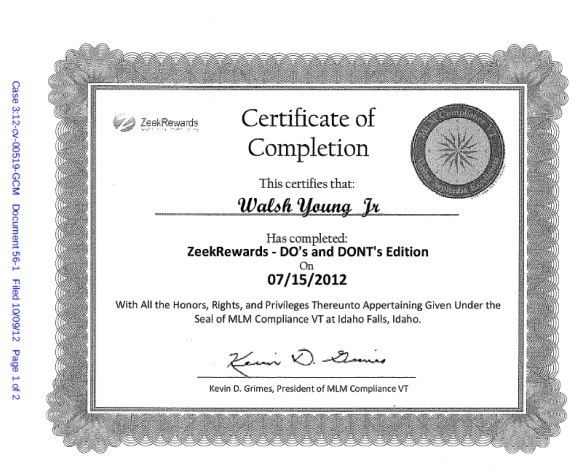
The logo of Zeek Rewards appears on this “Certificate of Completion” issued to Zeek member Walsh Young Jr. (Source: screen shot of exhibit filed by Young Oct. 9.)
For Californians Walsh J. Young Jr. and May Causing, the Zeek Rewards MLM scheme left them “on the verge of financial devastation,” according to a new filing in the Zeek Ponzi scheme case.
The self-written, self-submitted filing by Young and Causing appeared yesterday on the docket of Senior U.S. District Judge Graham C. Mullen of the Western District of North Carolina. Mullen is presiding over the Zeek case brought by the SEC Aug. 17.
Causing plowed $5,000 into the Zeek scheme in April 2012, funding her Zeek account with an “Official Check” from Citibank, according to the filing and an exhibit that accompanied it.
Causing resides in Eagle Rock.
On June 4, Young plowed $2,000 into Zeek, using a cashier’s check from Bank of America, according to the filings. Later — on June 26 — he plowed another $6,000 into Zeek, again using a Bank of America cashier’s check.
Young resides in Bell.
The filing alleges that Zeek business meetings were conducted by affiliates in Rancho Cucamonga, Harbor City, Cerritos and Carson.
Prospects, according to Young and Causing, were told that they could purchase “name brand merchandise at 95% off of retail prices” and that the company had a “long standing track record with 15 years of rock solid business practices.”
The pitch, according to Young and Causing, included references to the business bona fides of Zeek operator Paul Burks and Kevin Grimes, “known to be the best MLM attorney in the industry.”
Prospects also were told that Zeek shared “50% of its daily profits with vested affiliates,” according to the filing.
The filing claims that Zeek pitchman Tom More had acquired “over a million VIP points” and that Dolly Inocencio had acquired “over 250,000 VIP points.”
All in all, the Zeek deal seemed to make sense, given the claims, according to Young and Causing.
“This offer made it difficult to walk away with taking no action and in consideration of the money being received by Mr. Tom More and Ms. Dolly Inonencio, early Zeek members,” Young and Causing wrote.
Then came news of the August SEC action, which alleged Zeek was a $600 million Ponzi- and pyramid scheme and Burks was a securities fraudster. The SEC said last month that its probe was ongoing.
The filing by Young and Causing closed with an assertion that they “have suffered a tremendous financial hardship and are left on the verge of financial devastation” — and it asked the judge and court-appointed receiver Kenneth D. Bell for help in making them whole.
Young and Causing also alluded to a “class” of Zeek members in their filing, but the meaning of that was not immediately clear. The caption of their filing complains of “false business practices, false hopes disguised as lucrative financial business opportunities and ill gotten gain.”
Bell said in court filings Monday that he will “investigate potential claims against professionals and others” involved with Zeek to determine “who may be liable for the role they played in facilitating the operation.”
Claims against the unidentified “professionals” and others will be pursued, if warranted, Bell advised the judge.
Clawback actions against Zeek “net winners” also are contemplated, Bell said.
BULLETIN: (5TH UPDATE 6:13 P.M. EDT) The court-appointed receiver in the Zeek Rewards Ponzi scheme case says he discovered that Zeek has “at least one foreign account” that has not been seized.
It was “not clear” whether the funds would be recoverable despite the fact the bank that holds the account has been served with a freeze order, receiver Kenneth D. Bell said in court filings yesterday.
Bell did not name the bank or its home country in the filings. Nor did he say how he discovered the account.
But Bell advised Senior U.S. District Graham C. Mullen of the Western District of North Carolina that he was working with the SEC, the U.S. Secret Service and federal prosecutors to determine “the most efficient and cost effective manner to recover the funds from the entity that controls or the bank that holds this account so that the funds can be used in the distribution plan for this case.”
The amount allegedly held in the account was not disclosed. Zeek was operated by North Carolina-based Rex Venture Group LLC and Paul R. Burks, the SEC said in August. The agency described Zeek as a $600 million Ponzi- and pyramid fraud operating domestically and internationally.
Whether Zeek had silent partners or a special class of members is just one of the many mysteries still surrounding the purported “opportunity.”
Receiver May Have Cooperation Of Certain Insiders
Bell’s filings yesterday — on the Columbus Day holiday in the United States — made it plain that certain individuals associated with Zeek were cooperating in the receivership probe, sometimes through lawyers. The names of those individuals were not disclosed. Nor was the degree of their cooperation.
Filings, however, at least hinted that some people close to Zeek had stories to tell.
“Initial interviews of the Receivership Defendant’s employees and officers who were willing to be interviewed, as well as communications with various third parties, have revealed the identities of numerous other individuals and entities that might have relevant information regarding the Scheme, including potential business associates and investors of the Receivership Defendant and its principals,” Bell advised Mullen.
Moreover, the report revealed that the U.S. Secret Service largely was responsible for recovering the lion’s share of more than $293 million in Zeek-related financial accounts.
Forensic Accounting Firm Hired
Mullen ordered Bell in August to submit a preliminary liquidation plan by Oct. 8 that would update the court on the receivership’s efforts to date and lay out the early groundwork on how Zeek members could file claims.
Bell described his investigation as “still in its preliminary stages” and “ongoing.”
During the receivership’s first 52 days, Bell advised Mullen, it was learned that Zeek had about 2.2 million “affiliates,” but that some of those affiliates appeared to have “more than one user id.”
Approximately 1 million affiliates “paid money into the Zeek Rewards Program,” Bell advised Mullen.
Bell has hired FTI Consulting Inc., a forensic accounting firm, to assist in the receivership probe, according to yesterday’s receivership filing.
Meanwhile, the McGuireWoods law firm is counsel for the receiver. Kroll Ontrack is assisting with data recovery and storage, and Gilardi & Co. is hosting the receivership website and providing a means for Bell to communicate with potentially millions of individuals affected by the alleged epic fraud, Bell said in the filing.
Zeek’s Aug. 17 shutdown by consent after the SEC brought the Ponzi allegations did not stop bills from coming in, Bell said.
The estate, for example, already has disbursed more than $55,000 for payroll and benefits due employees, “taxes due the United States, North Carolina, and Arkansas” and for property rent and certain ongoing business expenses.
During the preliminary examination, Bell identified more than $922,000 in accounts payable, including “certain invoices for professional services,” according to the filing.
Bell advised Mullen that he still was “in the process of determining the validity and amounts of these accounts payable” and ascertaining the priority in which expenses will be paid.
Zeek Documentation ‘Inadequate Or Incomplete’
In a passage that may read like a familiar refrain to HYIP Ponzi analysts, Bell advised Mullen that certain Zeek-related financial documentation “has been found to be inadequate or incomplete.”
Examining paperwork and data will be time-consuming because of “the significant lack of documentation and the organization of this data,” Bell advised the judge.
Regardless, Bell said, the receivership team would follow the trail “to identify additional assets, trace the proceeds of any fraudulent conduct, evaluate claims of creditor and investors, and identify potential claims against former employees, third parties (including Affiliate-Investors), and others that may have received assets of the Receivership Estate.”
As the receiver’s probe moves forward and more evidence is gathered and analyzed, clawback claims will be contemplated under “applicable fraudulent transfer statutes against those who ran the operations and ‘net winner’ participants . . .” Bell said.
Bell envisions an approach that would “first offer those who are required to return money to the Receivership Estate the opportunity to do so cooperatively in an effort to avoid costly litigation for all concerned,” according to yesterday’s filing.
Below a subhead of “Miscellaneous Assets Recovered,” Bell advised Mullen that $5 million in cashier’s checks from BB&T Bank were located in [Rex Venture Group’s] main office.”
Zeek mysteriously announced on May 28 — Memorial Day — that it was closing its BB&T account, along with an account at NewBridge Bank. Why Zeek allegedly was in possession of $5 million in cashier’s checks that originated at BB&T was unclear in the receiver’s filing.
Despite Zeek’s claim online that it was closing the accounts and its prompt to affiliates to cash or deposit Zeek commission checks drawn on the banks before June 1 or they would bounce, court records show that NewBridge still had $11.64 million in Zeek-related funds on deposit.
Some observers have speculated that events that led to the August collapse of Zeek began in May, with the report from Zeek that it was closing the accounts voluntarily. If the account closures were less than voluntary, however, it may suggest that the banks had become suspicious of Zeek and that the Rex Venture-owned “opportunuity” was engaged in a scramble to find vendors to accept and maintain deposits.
Court records claim that Zeek used at least 15 domestic and offshore vendors, including Canada’s AlertPay and SolidTrustPay.
As of Oct. 8, the court-appointed receiver has identified these U.S. domestic companies as providers of services for Rex Venture Group LLC, the operator of the alleged Zeek Rewards Ponzi scheme. The receiver noted in court filings that “certain of the accounts listed above were closed, inactive or had a zero balance” before his August appointment.
‘Professionals’ To Receive Scrutiny
Bell advised Mullen in yesterday’s filing that he also planned to “investigate potential claims against professionals and others” involved with Zeek to determine “who may be liable for the role they played in facilitating the operation.”
Claims against the unidentified “professionals” and others will be pursued, if warranted, Bell advised the judge.
Bell further advised Mullen that the receivership would “streamline” operations as much as possible so that Zeek victims and other creditors could receive a disbursement as soon as possible. He did not rule out the possibility of a “preliminary distribution” from seized proceeds.
No specific timetable was laid out in the filings, but the task of formulating a claims process that potentially needs to accommodate 1 million or more people has begun, Bell said.
BULLETIN: AdSurfDaily figures Todd Disner and Dwight Owen Schweitzer will not be permitted to reopen their lawsuit against the government and get a different judge to hear it.
U.S. District Judge Rosemary Collyer of the District of Columbia this morning denied a motion by the ASD duo that she recuse herself from the case. At the same time, Collyer denied a motion by Disner and Schweitzer to reopen the case.
“A judge’s sworn duty is to judge with fairness and impartiality, and absent a showing otherwise, a judge is presumed to be impartial,” Collyer ruled.
Disner and Schweitzer made no such showing, Collyer ruled.
“Plaintiffs have presented no reasonable argument why this matter should be transferred to another judge,” Collyer ruled. “Further, Plaintiffs do not present sufficient facts that would lead an objective observer to believe that the Court has rendered a biased decision in this matter.”
With respect to the Disner/Schweitzer motion to reopen the case, Collyer said this (italics added):
Plaintiffs were victims of an internet Ponzi scheme called AdSurfDaily, Inc. (ASD). Federal agents investigated ASD for wire fraud and money laundering and, pursuant to warrants, federal agents seized approximately $80 million of ASD’s funds and related assets. The Government obtained in rem forfeiture judgments against the funds and other property purchased with ASD monies. Plaintiffs brought this suit, alleging that the warrants and the seizure of the funds were invalid and seeking a declaratory judgment that their Fourth Amendment rights were violated.
Because Plaintiffs lacked standing to raise a Fourth Amendment claim and because they had no privacy interest in financial records they voluntarily conveyed to ASD, the Court dismissed the Complaint on August 29, 2012 . . .
A motion for reconsideration need not be granted unless the court finds there is an intervening change of controlling law, the availability of new evidence, or the need to correct a clear error or prevent manifest injustice . . .
A motion to reconsider is not “simply an opportunity to reargue facts and theories upon which a court has already ruled” . . . Nor is it an avenue for a “losing party . . . to raise new issues that could have been raised previously” . . .
Plaintiffs’ motion falls woefully short of this demanding standard. Plaintiffs do not allege an intervening change of controlling law, the availability of new evidence, or the need to correct a clear error or prevent manifest injustice. They merely reargue the same points they previously raised . . .
On Sept. 17, Disner and Schweitzer accused Collyer of “sophistry” in her handling of their lawsuit. The ASD duo insisted that ASD was a legitimate enterprise even after ASD President Andy Bowdoin pleaded guilty to wire fraud in May and admitted ASD was a Ponzi scheme.
In separate court actions brought by the government on ASD-related matters, Collyer has ordered the forfeiture of more than $80 million. That money was set aside to compensate victims of Bowdoin’s crime.
About 9,000 ASD victims already have received a total of about $59 million in compensation, and the government says it plans to reopen claims to victims who missed the January 2011 filing deadline because the ASD database very likely did not include the names of all members.
In their motion to reopen the case, Disner and Schweitzer curiously argued that Collyer — despite Bowdoin’s guilty plea, acknowledgment that ASD was a Ponzi scheme and prison sentence of 78 months — should have assigned more weight to the opinions of purported multilevel-marketing experts that ASD was not a Ponzi scheme.
They further ventured that Bowdoin’s confession was “coerced,” even though Bowdoin himself said it was not.
After their ASD days, both Disner and Schweitzer became pitchmen for Zeek Rewards, which the SEC described in August as a $600 million Ponzi- and pyramid scheme.
ASD was a Ponzi scheme that gathered at least $119 million, federal prosecutors said.
A cyberstalker who has used more than a dozen usernames and bogus email addresses to send harassing communications to the PP Blog resurfaced today after an absence of days.
The stalker appears to be sending unwanted communications from a series of IPs in the region of Columbus, Ohio.
Here is what the would-be poster claimed (italics added):
Not even a road bump in the affiliates vs the SEC. The amount of support is snowballing. The defense fund is snowballing, and you guys will look so f’n stupid for your communist thought process. down with this stupid website and it’s little communist followers.
The communication was received at 11:37 a.m. EDT.
Earlier, at 10:19 a.m., the PP Blog received a strange Zeek-related email that appears to quote an individual dubbed “Steel.”
Among the claims attributed to “Steel” was this one (italics added):
In fact, your [sic] creating this un-substantiated linkage between ASD & Zeek, makes you look more like a mercenary/assassin for the SEC & [North Carolina Attorney General] than an impartial observer and reporter.
These words appeared below the section of the email attributed to “Steel” (italics added):
Individually We Are Weak – Together We Are Strong[.] We Can Win This Battle & We Will Win The Zeek War.
The PP Blog is reporting tonight that, on Aug. 6, it received a disturbing communication that “mercenaries” needed to be “[sent] out” to “take out those corrupt bankers, USG politicians, agents, judges and attorney’s that cause us all harm and demages [sic].”
That communication went on to identify three prominent U.S. politicians — all of whom no longer are in office — and questioned why “[Prominent Politician A’s Name Deleted by PP Blog] and both [Prominent Politician B and C’s Names deleted by PP Blog] [are] still alive and running around?”
The PP Blog reported the disturbing email to a U.S. law-enforcement agency. The Blog is declining to identify the office once held by the prominent politicians.
“JUST LOOK AT the insane NAZI driven USA,” the email read in part.
On Aug. 29, the PP Blog received a death threat targeted at another individual. The Blog reported that communication, as well.
On Aug. 30, the PP Blog itself received a death threat. Here is part of that message, which incongruously ended with a smilie (italics added):
. . . we don’t need to worry because we will pay Mr Patrick Pretty a visit. He is already under the sniper’s cross-hair and he will go down. :)
The Aug. 30 death threat appears to be related to the Blog’s coverage of “Profit Clicking,” the “program” that evolved from JSS Tripler/JustBeenPaid.
ProfitClicking/JSS/JBP, AdSurfDaily and Zeek are known to have had members in common.
AdSurfDaily figures Todd Disner and Dwight Owen Schweitzer should not be permitted to reopen their lawsuit against the government for alleged misdeeds in bringing the ASD Ponzi-scheme case in August 2008, government lawyers said in court filings today.
Disner and Schweitzer, who became pitchmen for the alleged Zeek Rewards Ponzi scheme after their ASD days ended, sued the United States in November 2011. Collyer dismissed their lawsuit in late August, ruling that Disner and Schweitzer lacked standing to bring their 4th Amendment claim.
Collyer dismissed the case on Aug. 29, the same date upon which she sentenced ASD operator Andy Bowdoin to 78 months in federal prison. Bowdoin, 77, admitted in May that ASD was a Ponzi scheme and that the firm never operated lawfully from its 2006 inception.
Summoning a fancy word in their bid to force Collyer to step down, Disner and Schweitzer accused the judge of “sophistry.”
The move by Disner and Schweitzer to prevent Collyer from hearing ASD-related matters was at least the third. Two others failed — one by purported “sovereign” being Curtis Richmond in 2009 and another by Bowdoin himself in 2009.
“Plaintiffs’ motion to reopen and set aside the Court’s Order of August 29, 2012, merely rehashes arguments previously raised and fails to demonstrate any error, let alone clear error, in the Court’s ruling granting Defendant’s motion to dismiss. Likewise, the record provides no support for Plaintiffs’ motion to recuse Judge Collyer and this motion, too, should be dismissed,” the government said.
ASD was a Ponzi scheme that raised at least $119 million, federal prosecutors said.
Zeek Rewards was a $600 million Ponzi- and pyramid scheme, the SEC said on Aug. 17.
Precisely when Disner and Schweitzer joined Zeek is unclear.
What is clear is that some very strange events have occurred since the U.S. Secret Service brought the civil portion of the ASD Ponzi case in 2008.
Purported “sovereign citizen” Kenneth Wayne Leaming is jailed near Seattle on charges he brought false liens against Collyer, three federal prosecutors and a U.S. Secret Service agent who had roles in the case.
Leaming was arrested by an FBI Terrorism Task Force in November 2011. He since has sued President Obama and Attorney General Eric Holder. Separately, Leaming sued a county sheriff in Arkansas.
Some ASD members claimed Leaming was doing legal work for them, even though he is not an attorney.
Disner, who solicited funds to sue the government for alleged misdeeds in the ASD case, also was involved in an effort by Zeek figure Robert Craddock to raise funds to intervene in the Zeek case.
Precisely how Craddock intends to do that is unclear.
 The receiver in the Zeek Rewards Ponzi scheme case informed a federal judge today that “the Receivership Team is still in the process of reconstructing over 18 months of ZeekRewards financial information involving more than 931 million transactions.”