Tag: Zeek

  • Another Scam In Zeekland Region

    breakingnews72A 48-year-old resident of Lexington, N.C., has been charged criminally in an alleged “precious metals investment scam,” the office of North Carolina Secretary of State Elaine F. Marshall said.

    Huge profits purportedly would flow within two weeks from gold transactions in the Middle East, according to related state filings.

    Rondell Scott Hedrick  was taken to the Davidson County Jail under $150,000 secured bond, Marshall’s office said.

    He was charged with 10 counts of securities fraud, five counts of obtaining property by false pretense, five counts of securities-dealer registration violation, five counts of security-registration violation and two counts of violation of a cease-and-desist order.

    Hedrick “was not registered to sell financial securities during the alleged incidents and his company was shown on the Secretary of State website to be not in good standing,” Marshall’s office said.

    “We always ask people to check before they invest,” Marshall said. “In this case, checking first would have shown a corporation that had been dissolved and that neither the suspect nor his investment offering were registered to be doing this business. Plus, he and the company had already been issued a cease and desist order for pursuing this type of activity.”

    The activity that led to Hedrick’s jailing involved trawling for investor cash on Craigslist, amid claims he was using the cash “to buy gold overseas and then re-sell[ing] for huge profits within a matter of days,” Marshall’s office said.

    In November 2012, Marshall’s Securities Division accused Hedrick in a cease-and-desist order of posting an ad a month earlier on Craigslist in Los Angeles that said, “$5,000 Investment pays $15,000 in about 10 days.” He also made at least one more Craigslist pitch during October 2012, according to the order.

    Hedrick “is or was” the president of “Hedrick Consulting, Incorporated” in Lexington, according to the November 2012 order.

    Upon seeing the ad, a California investor called Hedrick and was told Hedrick “was raising capital to buy gold bars in Dubai,” according to the order.

    Dubai is a city in the United Arab Emirates.

    The investor, according to the order, wired Hedrick $5,000 to a Hedrick account at a North Carolina credit union, after Hedrick had provided instructions and claimed he’d be leaving for Dubai soon and providing the investor a return of 200 percent.

    No evidence emerged that Hedrick made the promised trip to Dubai to purchase gold, and the investor received neither the promised return nor the return of the principal, according to North Carolina filings.

    “[H]e has refused to return Investor’s money,” the state said.

    Hedrick also operated a website styled “HedrickConsulting.com,” according to the order.

    HedrickConsulting.com is still viewable online. Alongside photos of glistening buildings in Dubai, these word appears (italics added):

    Gold Buyer
    International Consultant and Broker
    Introduction to MTN – BG – SBLC Sellers
    Coming Soon: Electronic Sales Division

    United States – West Africa – Dubai

    Contact information for for Hedrick Consulting in “Raleigh, North Carolina” and “Malibu, California” also appear at the site.

    Lexington is a small town known for delicious barbeque, rather than crime.

    But Lexington also was the home of Zeek Rewards, which the SEC described in August 2012 as a $600 million Ponzi- and pyramid fraud. Prior to the filing of the SEC complaint, Zeek complained publicly on its Blog about purported interference in its operations by unnamed “North Carolina Credit Unions.”

    “All” criticism of Zeek had been “unprofessional” and based on “false information,” the firm bizarrely contended on Aug. 4, 2012, 13 days prior to the SEC action.

    Among other things, Zeek planted the seed that it would provide a daily return in excess of 1 percent and an annualized return in the hundreds of percent. The SEC later said Zeek duped members into believing that such returns came through legitimate means, alleging that Zeek operator Paul R. Burks “unilaterally and arbitrarily” determined the daily dividend rate so that it would average “approximately 1.5% per day, giving investors the false impression that the business is profitable.”

    With the Zeek debacle still in the news 14 months after the SEC action, Lexington again unwillingly found itself back in the headlines, in a story on yet another fraud scheme aimed at its residents. Earlier this month, state investigators charged an out-of-town vendor at the Lexington wholesale market with two felony counts of trademark violations.

    In the trademark case, Hua Wu, 40, of Raleigh, was accused of possessing nearly $60,000 worth of “counterfeit designer handbags and designer labels.”

    “The sale of counterfeit trademarked goods harms people across the economic spectrum, from consumers to the legitimate manufacturers and retailers who build our economy,” Marshall said earlier this month.

    News about the arrest of Lexington resident Hedrick followed the news of Wu’s arrest by about three weeks.


  • URGENT >> BULLETIN >> MOVING: SEC Charges 3 Executives, 8 Promoters Of Alleged ‘Worldwide’ Pyramid Scheme Operating From Hong Kong, Canada And British Virgin Islands; ‘CKB’ And ‘CKB168’ Fraudsters Allegedly Targeted Asian-American Community, Agency Says

    breakingnews72URGENT >> BULLETIN >> MOVING: 3RD UPDATE 5:46 P.M. EDT (U.S.A.) The SEC says it has gained an asset freeze and charged three executives and eight promoters of a worldwide pyramid scheme operating through five entities from Hong Kong, Canada and the British Virgin Islands.

    Promoters of the scheme, which “purportedly” sells Internet-based children’s educational courses, gathered at least $20 million “from U.S. investors, and millions of dollars more from investors in Canada, Taiwan, Hong Kong, and other countries in Asia, the agency charged.

    Entities known as CKB and CKB168 are “at the center of the scheme,” the SEC said. The complaint, which was brought on an emergency basis and initially filed under seal, is filed in U.S. District Court for the Eastern District of New York. U.S. District Judge Roslynn Mauskopf has granted an asset freeze. The seal has been lifted in the case.

    “CKB has little or no real-world retail consumer sales to generate the extraordinary returns promised to investors,” the SEC said. “In fact, CKB has no apparent source of revenue other than money received from new investors. Bank records show that the bulk of the money raised has been paid out to accounts controlled by CKB executives and as commissions to promoters of the pyramid scheme.”

    Various investment schemes with apparent footprints in Hong Kong have been pushed by online hucksters since the SEC moved against U.S. based Zeek Rewards in 2012. On Oct. 14, BehindMLM.com reported that a scheme known as WCM777 operating from Hong Kong through an entity in the British Virgin Islands suddenly announced it was closing its U.S. operations.

    Whether WCM777 had promoters in common with the CKB entities was not immediately clear. What is clear is that the SEC has taken action against three MLM or MLM-like “programs” that promised outsize returns since August of last year, amid allegations that were selling unregistered securities as investment contracts. (These are Zeek Rewards in August 2012; Profitable Sunrise in April 2013; and the “CKB” entities through an emergency action filed Oct. 9 and announced today, after the seal was lifted yesterday.)

    Accompanying the CKB actions was the issuance today by the SEC of an Investor Alert “about the dangers of potential investment scams involving pyramid schemes posing as multi-level marketing programs,” the SEC said. The Zeek and CKB cases are referenced in the Alert.

    “CKB’s operators and promoters profited by abusing relationships of trust within the Asian-American community and promising investors they can earn more money by recruiting other investors instead of selling actual products,” said Antonia Chion, an associate director in the SEC’s Division of Enforcement.  “What CKB really sells is the false promise of easy wealth.”

    Here is how the SEC described the eight U.S. promoters charged:

    • Daliang (David) Guo is a China native and a resident of Coram, N.Y., who was among CKB’s first U.S. promoters. He currently sits atop an investment pyramid, and claims in a testimonial on the CKB website to have earned more than $1 million within eight months.
    • Yao Lin is a resident of Fresh Meadows, N.Y., who was among CKB’s first U.S. promoters. He currently sits atop an investment pyramid, and claims in a CKB website testimonial to have earned more than $300,000.  The SEC’s complaint alleges that bank and credit card accounts he controls have received approximately $450,000 from CKB investors.
    • Chih Hsuan (“Kiki”) Lin is a Taiwanese native and resident of Las Vegas who claims in a CKB website testimonial to have earned “one million USD” in her first two months of investing.  She operates a website through which “CKB members” can log in to a password-protected area. She is within David Guo’s pyramid. The SEC’s complaint alleges that bank accounts she controls have received approximately $1.8 million from CKB investors.
    • Wen Chen Hwang (“Wendy Lee”) is a Taiwanese native and resident of Rowland Heights, Calif., who claims in a CKB website testimonial to have made $53,000 within four months. She is within Yao Lin’s pyramid. The SEC’s complaint alleges that bank accounts she controls have received approximately $2.2 million from CKB investors.
    • Toni Tong Chen is a resident of Hacienda Heights, Calif., and a certified public accountant who was formerly associated with a registered broker-dealer and held securities licenses. She and her husband claim to have earned six-digit commissions and in excess of a 100 percent return on their investment. They are connected to Wendy Lee and have made presentations at her weekly seminars in Los Angeles.
    • Cheongwha (“Heywood”) Chang is a Chinese native and the husband of Toni Tong Chen. He was formerly associated with a registered broker-dealer and held securities licenses. The SEC’s complaint alleges that bank accounts that he and his wife control have received approximately $2.1 million from CKB investors.
    • Joan Congyi Ma is a resident of Arcadia, Calif., who was formerly associated with a broker-dealer and held securities licenses. She is connected to Wendy Lee and has helped her organize seminars and other events in Los Angeles. In her CKB website testimonial, she references the day she met Yao Lin as her “lucky day.” The SEC’s complaint alleges that bank accounts she controls have received approximately $200,000 from CKB investors.
    • Heidi Mao Liu is a resident of Diamond Bar, Calif., who was formerly associated with a broker-dealer and held securities licenses. She is connected to Wendy Lee and has provided testimonials at her seminars in Los Angeles. She also operates her own website that promotes the CKB scheme. The SEC’s complaint alleges that bank accounts she controls have received approximately $1.2 million from CKB investors.

    YouTube video pitches and a claim that at least one promoter had acquired five properties in Las Vegas through the scheme were used to dupe the masses, the SEC said.

    “Kiki Lin,” the SEC said, “exemplified the pitch in a videotaped recording posted to the Internet, telling potential investors that in the ‘pyramid triangle system, we spread it from one to ten, and ten to hundred, and hundred to thousand, thousand to ten thousand.’ Kiki Lin later added, ‘And for those who really want to make money, who are really hard working, in a short time you would all be like John,’ who she claimed ‘made money to buy five houses in Las Vegas.’”

    The charged executives include:

    • Rayla Melchor Santos, whom the SEC said is a Philippines national “who is featured on the CKB website as its founder. Santos is known as “Teacher Sam” and “has traveled to New York and other areas of the U.S. to participate in meetings and seminars to promote CKB.”
    • Hung Wai (“Howard”) Shern, whom the SEC said is a Canadian citizen and resident of Hong Kong “who is featured on the CKB website as the director of CKB168 International Marketing.” And Shern “is one of the signatories to bank accounts used to receive and transfer funds from CKB investors, and has traveled to New York and other areas of the U.S. to participate in meetings and seminars to promote CKB.”
    • Rui Ling (“Florence”) Leung, whom the SEC said is a Hong Kong national “who is described on the CKB website as its chief financial officer. And Leung “is one of the signatories to bank accounts used to receive and transfer funds from CKB investors, and approximately $4.6 million has been transferred from CKB bank accounts to bank accounts in her name and the names of entities she controls. Leung portrays herself as a professional investment adviser who will assist CKB in its supposed future public offering.”

    From the SEC complaint (italics added):

    2. Through publicly available websites, promotional materials, seminars, and videos posted to the internet, as well as through other efforts intended to create the appearance of a legitimate enterprise, Defendants have falsely portrayed CKB as a profitable multi-level marketing company that sells web-based children’s educational courses.

    3. What CKB really sells, however, is the false promise of easy wealth. Potential purchasers of CKB products must invest in CKB to get one of its courses. Defendants promise that those investors will earn exponential, risk-free returns. In addition to the course, each purchaser/investor receives “Profit Reward Points” (“Prpts”) with a purported value of $750.

    Investors are told that they will eam “passive” returns in the form of Prpt dividends and 2-for-1 splits, and that they will be able to buy and sell their Prpts in an online exchange accessible through the CKB website. Investors also are promised that they will earn massive retums by converting their Prpts into shares of CKB stock when the company conducts an initial public offering (“IPO”) on the Hong Kong Stock Exchange sometime during 2014. Some Defendants allege that these returns can be achieved without any risk of loss.

    4. Despite Defendants’ representations to the contrary, the Prpts are worthless and cannot be meaningfully traded, sold or exchanged. Nor has CKB taken required steps to prepare for the promised IPO and, in fact, does not meet the Hong Kong Exchange’s current listing requirements. Even if the IPO were to occur, CKB would have to go public as one of the world’s largest companies in order to honor conversions of the ever-expanding universe of Prpts.

    Still, while essential to the scheme, Prpts are not its only incentive. The scheme’s ultimate goal is to tum investors into recruiters. CKB lures investors with the promise of even greater “active” returns, in the form of commissions and bonuses, for recruiting new, “downline” participants into the program. In contrast to Prpts, active recruitment is the only way to make actual significant money.

    The CKB defendant entities include:

    • WIN168 Biz Solutions Limited (WIN168), which the SEC described as a “private Hong Kong company” that “maintained bank accounts at HSBC in Hong Kong that were used to receive and transfer funds from CKB investors located in the United States and elsewhere. Those accounts received wire transfers from banks located in New York.”
    • CKB168 Biz Solution Inc., which the SEC described as a Canadian company in Toronto that “has maintained bank accounts at TD Bank in Canada that have been used to receive and transfer funds from CKB investors.”
    • CKB 168 Limited, which the SEC said shares a business address with WIN168 and operated from Hong Kong. Its alleged “sole director is CKB168 Biz Solution Limited (“CKB168 Biz Ltd.”), a British Virgin Islands corporation with its office in Tortola,” the SEC said, further alleging that “CKB168 Ltd. maintained a bank account at HSBC in Hong Kong that was used to receive and transfer funds from CKB investors, including wires coming from New York.”
    • CKB 168 Holdings Limited, which the SEC described as sharing a business address with WIN168 and CKB168 Ltd. “Sample stock certificates shown to prospective investors indicate that CKB 168 Holdings is the entity whose shares have been offered to the public,” the SEC said.
    • Cyber Kids Best Education Limited, which the SEC described as the controller of “five bank accounts at Shanghai Commercial Bank Ltd. in Hong Kong, at least two of which were used to receive and transfer funds from CKB investors located in the United States.”

    “WIN168, CKB168 Biz, CKB168 Holdings, CKB168 Ltd., and CyberKids Best have never been registered with the Commission in any capacity and have never registered any offering of securities under the Securities Act or any class of securities under the Exchange Act,” the SEC charged.


  • EDITORIAL: Zeek: The ‘Reverse Rolaids’ Of MLM

    From an old Rolaids commercial. Source: YouTube
    From an old Rolaids commercial. Source: YouTube

    Rolaids products are back on store shelves after a recall that lasted nearly three years — and that may come as particularly good news for sufferers of the ongoing Zeek Rewards sickness.

    And with the TelexFree MLM story potentially churning hundreds of thousands of stomachs and getting stranger and stranger with each passing week, Rolaids may have a chance of regaining its past glory under the new leadership of Sanofi US and its consumer-health business Chattem Inc.

    One way to look at Zeek Rewards is as a sort of reverse Rolaids, a brand of antacids that provides heartburn relief and became legendary for its claim that it consumed “47 times its weight in excess stomach acid.”

    Another way Rolaids worked its way into the American consciousness was by asking a simple question that Sanofi says became “one of the most recognized advertising taglines of all-time”:

    “How Do You Spell Relief? R-O-L-A-I-D-S.”

    Zeek: The ‘Reverse Rolaids’

    While wanting you to believe that it cured financial pain for small businesses and upstart entrepreneurs, Zeek and its combined MLM and auction “programs” actually created it by consuming victims at 44 times its weight. We arrive at this rounded figure (and reverse-Rolaids observation) by dividing the estimated number of Zeek “losers” (840,000) by the population of the North Carolina city of Lexington (18,936).

    Indeed, Zeek was to causing financial pain what Rolaids was to relieving your sick stomach.

    In August 2012, the SEC described Zeek as a massive Ponzi- and pyramid scheme that duped people into believing it paid a legitimate return of about 1.5 percent a day.

    Zeek, through Rex Venture Group LLC, operated from Lexington, turning a Southern city famous for its hospitality and delectable barbecue into the MLM Heartburn Capital of the World.

    Rolaids products were pulled from store shelves in late 2010, because “wood and metal particles were potentially introduced into the products during the manufacturing process at an outside supplier” and because customers detected “a musty or moldy scent,” according to the AP and NBC News.

    Lexington, unfortunately, inherited the MLM Heartburn Capital title from Quincy, Fla., home base of the $119 million AdSurfDaily MLM scam in 2008. Zeek, the SEC said, gathered about $600 million.

    A court-appointed receiver has been gathering up money for Zeek victims for more than a year and prepping to sue Zeek profiteers and insiders. He’s also in the process of seeking court approval to dismantle Zeek’s Heartburn Factory in Lexington.

    Though coincidental to the dismantlement of Zeek in a tranquil American city that never wanted the MLM Heartburn Capital title from Quincy, the comeback of Rolaids amid continuing stomach-churning events in MLM La-La Land perhaps is occurring at the perfect time.

    Best of luck as you relaunch, Rolaids.

  • SPECIAL REPORT: Like AdSurfDaily And OneX Before It, Alleged TelexFree Pyramid Scheme May Be Engaging In Game Of Payment-Processor Roulette

    “While reviewing the ASD website in the District of Columbia, [an undercover agent] found a posting within ASD’s News section, apparently posted by ASD on July 2, 2008. The title of the posting was, “Alert Pay & Direct Deposit are being phased out July 31, 2008.” According to ASD’s posting, “We have notified BOA not to accept cash or personal checks for deposit account – English or Spanish.” ASD further stated, “Please remember that the preferred method of purchasing Ad Packages is by mailing a Check or by Solid Trust Pay . . . Solid Trust Pay is a Canada based money transmitting and payment company that, like the e-Gold system, operates over the Internet. It appears that beginning August 1, 2008, Solid Trust Pay will be ASD’s preferred method for receiving funds from members, and for paying rebates and commissions to members . . . Within the past two weeks, ASD has wired several million dollars to Solid Trust Pay from its BOA Accounts. A TFA also learned that earlier in July 2008, a bank other than BOA closed the last account that was controlled by Bowdoin or family members after that bank determined, and explained to them, that an investigation by the bank determined that Bowdoin appeared to be operating a Ponzi scheme.”AdSurfDaily Ponzi scheme forfeiture complaint, August 2008

    TelexFree affiliate promos encouraging participants to register for International Payout Systems (I-Payout) began to appear online in recent hours. Just last month, TelexFree affiliates were encouraged to register for Global Payout Gateway, another e-Wallet vendor that supposedly would solve TelexFree's payment problems. There now are reports online that GPG has dumped TelexFree, leading to questions about whether TelexFree is trying to port its alleged fraud scheme to yet another vendor -- I-Payout.
    TelexFree affiliate promos encouraging participants to register for International Payout Systems (I-Payout) began to appear online in recent hours. Just last month, TelexFree affiliates were encouraged to register for Global Payroll Gateway, another e-Wallet vendor that supposedly would solve TelexFree’s payment problems as a pyramid-scheme probe moved forward in Brazil. There now are reports online that GPG has dumped TelexFree, leading to questions about whether TelexFree is trying to port its alleged fraud scheme to yet another vendor — I-Payout. Source: Google search results.

    In 2008, the U.S. Secret Service effectively accused the AdSurfDaily MLM “program” of playing a game of payment-processor roulette as U.S. law enforcement put the squeeze on certain money-movers, the willfully blind enablers of online fraud schemes.

    ASD, a $119 million HYIP Ponzi scheme that led to a 78-month prison sentence for operator Andy Bowdoin, started out by accepting “e-Gold and Virtual Money,” according to a Ponzi-scheme forfeiture complaint filed in federal court in August 2008.

    But ASD, according to the complaint, realized e-Gold had come under investigation for enabling the laundering of money, something that could put the heat on ASD.

    “Shortly after publicity surrounding the government’s investigation into e-Gold appeared, ASD discontinued using the e-Gold system as a means for receiving member funds,” the complaint alleged.

    And even as these events were occurring, according to court filings in the ASD case and in other cases, Robert Hodgins, a supplier of debit cards and the operator of Virtual Money Inc. — now listed by INTERPOL as an international fugitive — came under investigation in Connecticut amid allegations he was assisting in the laundering of narcotics proceeds in Medellin, Colombia, and prepping himself to assist in the laundering of funds in the Dominican Republic.

    Virtual Money, whom some ASD members said was supplying debit cards to ASD, also was linked to the PhoenixSurf Ponzi scheme, according to court filings.

    In December 2010, federal prosecutors alleged that ASD also had accepted money from e-Bullion, a California firm that processed payments for Ponzi schemes, including the $72 million Legisi HYIP scheme in Michigan that led to prison sentences for operator Gregory McKnight and pitchman Matthew John Gagnon. E-Bullion operator James Fayed has been sentenced to death for ordering the brutal contract slaying of his wife, a potential witness against him. Pamela Fayed’s throat was slashed repeatedly in the shadows of a Greater Los Angeles parking garage, her husband seated on a nearby park bench “like he doesn’t have a care in the world.”

    ASD, according to court filings, also used AlertPay and SolidTrustPay, money-movers based in Canada that have been linked to multiple Ponzi schemes, including the alleged $600 million Zeek Rewards Ponzi scheme broken up by the SEC last year.

    Not even Bowdoin’s arrest in 2010 stopped him from pitching fraud schemes, according to court filings. Facing serious criminal charges for his actions in ASD, Bowdoin (in 2011) became a pitchmen for the OneX “program,” which federal prosecutors later alleged to be a pyramid scheme recycling money in ASD-like fashion. Among Bowdoin’s fellow OneX pitchmen was T. LeMont Silver, later of Zeek and later of  JubiMax and GoFunPlaces, two MLM “programs” that are suing each other amid allegations of financial fraud.

    At one time, OneX claimed to have a relationship with SolidTrustPay. It then claimed to have ended that relationship and to have started a relationship with I-Payout. Earlier, I-Payout had listed the uber-bizarre TextCashNetwork MLM “program” with ties to the Phil Piccolo organization as a “selected client.” TextCashNetwork now appears to have disappeared, but still is operating with the acronym “TCN” — this time as TrueCashNetwork. How the “new” TCN is processing payments is unknown. What is known is that someone associated with the “new” TCN has sent emails to “winners” in the Zeek scheme in an apparent bid to get them to flog for the new iteration, an apparent investment arm of which is being promoted as an opportunity to earn an interest rate of 50 percent.

    Now — as incredible as it seems — promoters of the alleged TelexFree pyramid scheme operating in Brazil and the United States now are claiming that TelexFree is using I-Payout, known formally as International Payout Systems Inc. Equally incredibly, this is happening less than a month after TelexFree promoters advised TelexFree participants to register with Global Payroll Gateway (GPG), another eWallet company and supplier of debit cards, as a means of getting paid after payouts to Brazilian members of TelexFree were blocked in Brazil.

    Just last month, TelexFree affiliates were encouraging prospects to register with Global Payroll Gateway (GPG). In recent hours --0 and amid reports GPG has given TelexFree the boot -- TelexFree affiliates have been urged to register with I-Payout.
    Just last month, TelexFree affiliates were encouraging prospects to register with Global Payroll Gateway (GPG). In recent hours — and amid reports GPG has given TelexFree the boot — TelexFree affiliates have been urged to register with I-Payout. Source: Google search results.

    There are reports online, including on Facebook from self-identified members of TelexFree, that GPG gave TelexFree the boot in recent days. No sooner did those reports surface than videos went up on YouTube encouraging TelexFree members to register for I-Payout.

    One of the reports that TelexFree suddenly had shifted from GPG to I-Payout is published on the MoneyMakerGroup forum. MoneyMakerGroup’s name appears in U.S. court files as a place from which Ponzi and fraud schemes are promoted. Both FINRA and the SEC have warned that HYIP schemes spread in part through social-media sites such as forums, YouTube and Facebook.

    Because international MLM HYIP fraud schemes often have promoters in common — and because the schemes are promoted on Ponzi cesspits such as MoneyMakerGroup and TalkGold —  proceeds from the schemes can flow into banks at the local level, putting them in the position of becoming warehouses for the ill-gotten gains of participants, including winners and insiders. The use of stored-value debit cards such as those in play in HYIP schemes can lead to the quick dissipation of assets, meaning that victims of an HYIP scheme may have limited hope (or even no hope) that a recovery can be made for their benefit.

    The most recent incongruous events involving TelexFree are occurring even as at least one judge and one prosecutor involved in the TelexFree pyramid probe in Brazil reportedly have been threatened with death. And, as was the case with ASD, some promoters of TelexFree have claimed an ability to expedite the flow of money to the scheme — perhaps through back-office transactions within the TelexFree system.

    Also see report on BehindMLM.com.


  • TELEXFREE: Promoters Tell Brazilian Prospects To Create Registration Address In England — And To Appear At Door Of Brazilian Supreme Court Judge

    telexfreelogoEDITOR’S NOTE: At the time of the publication of this story, the PP Blog was experiencing trouble loading graphics. The probable cause of this is a conflict between certain plugins used by the Blog. We are working to correct this problem . . .


    ** _____________________________ **

    UPDATED 12:25 P.M. EDT (U.S.A.) TelexFree, an alleged pyramid scheme operating as an MLM that has U.S. arms in Massachusetts and Nevada and effectively was shut down in June in Brazil (by court order in Brazil) but continues to operate elsewhere, seems on the cusp of cementing itself as a marquee example of cross-border fraud.

    Several days ago, the company inexplicably began to publish the address of a purported office in the United Kingdom in Watford — near London. Today an apparent TelexFree promoter writing on a media site in Brazil appears to be instructing Brazilian affiliates to enroll with the firm by using any address in London, thousands of miles away. This coaching appears to originate from a hotmail address. (See story/comments thread in Portuguese; see translation of story/comments thread via Google Translate.)

    The center of London is approximately 5,700 miles away from the center of Rio de Janeiro, the Brazilian city that will play host to the 2016 Olympics. London hosted the 2012 Olympics. There are dozens of pyramid-scheme probes under way in Brazil, in the run-up to the 2016 Summer Games.

    Even more troubling than the suggestion that Brazilians should fabricate a London address to enroll in TelexFree is a suggestion from another apparent TelexFree affiliate on the same site in Brazil that affiliates should appear at the door of a judge of the Supreme Court of Brazil. It is unclear from the English translation of the post whether any protest aimed at the judge would occur at the Supreme Court or at his personal residence. Plenty of peaceful protests occur in Brazil. But a protest at the residence of a judge potentially would introduce the specter of menacing — something that was present in the AdSurfDaily Ponzi case in the United States.

    Purported American “sovereign citizen” Kenneth Wayne Leaming — a figure in the ASD story — was convicted earlier this year of multiple charges, including filing bogus liens against public officials involved in the ASD case. The evidence in the case strongly suggested that Leaming intended to stalk the children of the Chief Justice of the United States at the school they attended — as part of a plot to serve paperwork on the Chief Justice.

    TheTelexFree story is similar in certain key ways to the ASD story. For starters, some ASD members refused to believe that a crime had been committed against them and taunted prosecutors and the U.S. Secret Service with threats. There have been reports in Brazil of death threats against a judge and a prosecutor. Both the ASD and TelexFree schemes were targeted at Christians. Meanwhile, members of both “programs” were promised preposterous, unusually consistent returns. In the ASD case, the precoumpounding returns computed to an annual return in excess of 300 percent. Some TelexFree promoters have claimed that sending $15,125 to TelexFree results in a tripling or quadrupling of the money in a year.

    Beyond that, it almost certainly is the case that some TelexFree affiliates also were pitchmen for ASD and for Zeek Rewards, an MLM “program” described by the SEC last year as a $600 million Ponzi- and pyramid scheme. This leads to questions about whether criminal MLM combines are driving business to purported “opportunities” despite the legal, financial and social consequences. In April 2013, the SEC said a “program” known as Profitable Sunrise was using a mail drop in England as part of a massive scam that used a series of offshore bank accounts potentially to fleece people of faith of millions and millions of dollars.

    Now, TelexFree purports to be operating from England. The mere listing of a business address is not proof that no scam is occurring, despite repeated bids by HYIP schemes to create an air of legitimacy by publishing an address or registering it with a government. Profitable Sunrise, for instance, had a registered address. So did Zeek. So did AdSurfDaily. Both of the TelexFree addresses in the United States appear to be virtual offices or mail drops.

    And TelexFree affiliates have been sending confusing messages for months on how to send money to the firm. This sometimes signals that money-laundering, wire fraud or another crime is occurring. Some of the TelexFree affiliate bids strongly resemble events at ASD — events that led to the criminal indictment and subsequent sentencing of ASD President Andy Bowdoin to a 78-month prison term. (Also see Aug. 21 PP Blog story on a TelexFree shift to yet another payment processor.)

    BehindMLM.com is reporting that “rampant fraud” may be affecting TelexFree’s operations.


  • Zeek Claims Portal Is Closed; Filing Deadline Passes; [Updated To Include Sept. 6, 2013, Link To ‘Letter From The Receiver’]

    breakingnews72 UPDATED 3:37 P.M. EDT (SEPT. 6, 2013 U.S.A.) The portal for filing claims in the Zeek Rewards Ponzi-scheme case is closed. The deadline for filing claims passed at 11:59 p.m. EDT on Sept. 5.

    The website of the Zeek receivership remains online. On Sept. 6, receiver Kenneth D. Bell” posted a new “Letter from the Receiver.” (See comments thread below for some of the highlights.)


  • Zeek Claims-Filing Deadline Is Thursday, Sept. 5, 2013; Only 2 Days Left

    The deadline for filing claims in the Zeek Rewards Ponzi-scheme case is 11:59 p.m. prevailing Eastern time on Thursday, Sept. 5, 2013. That’s only two days from today.

    A “File a Claim” button is accessible on the website of the court-appointed receiver. The receiver is Kenneth D. Bell.

    The Garden City Group is the authorized claims administrator working for the Receiver Team, according to the receiver’s website.

    “This is the only legitimate, Court-approved claims form,” the receivership website notes.

    Visit the receiver’s Claims FAQs page.

    Senior U.S. District Judge Graham C. Mullen of the Western District of North Carolina is presiding over the Zeek case. North Carolina is in the U.S. Eastern Time Zone, the prevailing time zone for Zeek claims.

    On May 8, 2013, Mullen approved the claims process, set the bar date and approved the receiver’s method of administering the process. The claims portal opened on schedule on May 15. Claims submitted after the Sept. 5 deadline “are automatically disallowed pursuant to the Order approving the Claims Process,” according to the receiver.

  • Zeekers Targeted In New Scheme With Ties To Piccolo Organization

    truecashnetworkBULLETIN: Zeek Rewards members are being targeted in a new scheme with ties to the Phil Piccolo organization and are being solicited for sums ranging from $600 to $60,000 “in return for ” . . .  “guaranteed 50 percent interest” from a purported “unique and legal loan system” over an unspecified time period, the PP Blog has learned.

    The offering, which hints of some sort of falling out with Zeek’s management, has been styled on YouTube as “The Diamond Club by TRUE CASH.” The emerging “program” was the subject of an email pitch yesterday that appears to have been targeted by an unknown party at former Zeek “Diamond” affiliates, potentially including some of Zeek’s largest “winners” who have exposure to clawback lawsuits filed by the court-appointed receiver and who previously have been solicited to make contributions to a purported defense fund for Zeek affiliates. Zeek “losers” also could be targets.

    Previous schemes linked to Piccolo include the uber-bizarre Data Network Affiliates (DNA) “program” and One World One Website (OWOW), an equally bizarre money grab. (Use the PP Blog’s search function for information on those “programs.”)

    In August 2012, the SEC described Zeek as a $600 million Ponzi- and pyramid scheme. In April 2013, the SEC took down a purported “loan” program known as Profitable Sunrise that may have gathered tens of millions of dollars through an alleged offering fraud. How the “The Diamond Club by TRUE CASH” offering intends to collect money is unclear, although  a website to which pitchmen are directing traffic includes the logo of SolidTrustPay, one of the offshore processors used by Zeek.

    Certain members of a Zeek-related email chain received the purported “Diamond Club” pitch yesterday. Hinting of bad blood, the pitch appeared below this headline, “Zeek Management Belongs in Prison – On 8/27/2013 I earned over $500,000 – I will pay your way in from $600 to $3000.”

    How the $500,000 purportedly was earned was not explained. Also unclear was the identity of the sender. Among the claims in the pitch is this one (italics added):

    IF YOU LOST $10,000 IN ZEEK OR RECRUITED 10 PEOPLE IN ZEEK I WILL PUT UP $3,000.00 FOR YOU

    The principal part of the pitch claims this: “I just made $500,000.00[.] I will put up the $600 minimum for you – You pay me back ‘ONLY OUT OF COMMISSIONS’. If you are already in one of TCN 12 opportunities and want to be on my “DIAMOND CLUB” Team then you need to re-sign up. If you are resigning up you will need a new e-mail address. Get a free g-mail account from Google.”

    From the lowerright corner of the True Cash Network website. Source: Aug. 30 screen shot.
    From the lower-right corner of the True Cash Network website. Source: Aug. 30 screen shot.

    In the same email, the pitch points recipients to a YouTube video and a website URL of ThePowerTeam.TrueCashNetwork.Com. “TrueCashNetwork” is using the same acronym used by TextCashNetwork (TCN), an earlier scheme linked to Piccolo and Joe Reid, a longtime huckster associated with Piccolo. On the TrueCashNetwork website, an emblem labeled SiteLock SECURE appears, along with the word “Passed.” The emblem incongruously includes the name of “TEXTCASHNETWORK.COM,” even though it appears on the TrueCashNetwork domain. The TrueCashNetwork domain appears to have been registered behind a proxy on June 28, 2013.

    Reid, according to the TrueCashNetwork website, is the new TCN’s “Master Referral Agent” or “MRA.”

    Precisely what happened with the original TCN, a purported daily deals site that purportedly used text-messaging, never has been clear. The emerging TCN, however, appears to have access to the original’s database and appears already to have used it to create affiliate links for “old” TCN members — this despite the fact TextCashNetwork is listed in Wyoming as a “dissolved” entity and its members may not have given permission to be ported to the “new” TCN.

    These links shown in Google search results are show the name of "textcashnetwork" in the URL. But all of them rotate to True Cash Network.
    These links shown in Google search results are showing the name of “textcashnetwork” in the URL. But all of them rotate to True Cash Network.

    The “new” TCN purports to be operating as “True Cash Network, Inc.” Disputes, according to its website, will be handled under Wyoming law, but there appears to be no corresponding registration for True Cash Network in the state. Meanwhile, the “new” TCN is using the same Boca Raton (Fla.) business address as the “old” TCN. The old TCN once curiously purported that a member’s agreement with it “may not be transferred or assigned without prior written consent of REX Venture Group.”

    Rex was the operator of Zeek Rewards and one of the defendants in the SEC’s Ponzi case.

    True Cash Network — like TextCashNetwork before it — appears to be positioning itself as an MLM company that pushes affiliate products, including a “Medical Savings Plan,” X8 Energy Gum, Parcman Male Enhancer and more.

    While TCN was operating as TextCashNetwork, the Piccolo organization appears to have tried to dupe people into believing the company was owned by Johnson & Johnson, a component of both Dow Jones and the S&P 500 and an internationally famous maker of pharmaceuticals and consumer products that are household names.


  • Only 2 Weeks Left To File Zeek Claim; Deadline Is Sept. 5, 2013

    recommendedreading1As of today, there are only two weeks left to file a claim in the Zeek Rewards Ponzi scheme case. The deadline to file is 11:59 p.m. (prevailing Eastern time) on Sept. 5, 2013.

    Kenneth D. Bell is the court-appointed receiver in the Zeek case. The Zeek receivership website is here. The claims portal is accessible through the receiver’s website and also has a separate URL. The claims portal opened May 15, more than three months ago.

    Bell said this in an Aug. 2 letter from the receiver (italics added):

    To date, while more than 100,000 claims have been submitted or are in the process of being submitted through the Claims Process, hundreds of thousands of affiliates of ZeekRewards and other entities that hold potential claims against ZeekRewards have not filed claims.

    Perhaps you are one of these affiliates who has not submitted a claim because you believe that fully completing and submitting a claim will take too much time, the Claims Process is too complex, the amount of your claim is too small, or that your potential recovery will not be in a large enough amount to make the effort of pursuing your claim worthwhile.

    Regardless of these concerns, I would encourage you to submit your claim prior to the close of the Claims Process if you believe ZeekRewards owes you money for amounts that you invested in ZeekRewards. I anticipate that a substantial percentage of valid claims will be refunded. Moreover, I have made every effort to make the Claims Process as simple and user friendly as possible for all claimants and have only sought the information necessary to enable us to establish the amount each claimant is owed by ZeekRewards. Please also remember that even if you do not have all of the information requested, you may still complete and fully submit your claim. Any deficiencies with a particular claim will be addressed in the claim determination process.


  • REPORTS: Ice Cream Flavor Named After TelexFree, An Alleged Pyramid Scheme; Separately, TelexFree Affiliates May Be Crossing National Borders To Keep The Money Flowing — Even As Purported Opportunity Turns To New Payment Method

    telexfreegpgThe HYIP world is known for promoters’ bids to change the storyline, but this one may take the cake — or at least be a sweet complement.

    There are reports in Brazilian media that a promoter of the TelexFree MLM scheme — alleged to be a massive pyramid — has named an ice cream after TelexFree to show support for the embattled firm.

    “The ice cream is not a pyramid,” a person was quoted as saying in DiarioDigital, according to a translation — and neither is its namesake.

    Here is a link to the story in Portuguese; here is a link to the English translation by Google Translate.

    Recruitment by TelexFree is banned in Brazil while investigations by at least seven Brazilian states proceed. Payments to Brazilian participants by TelexFree likewise are blocked. The purported “opportunity,” however, still is operating in other countries and apparently gathering money and issuing payments.

    Separately, Veja.com is reporting that undercover investigators in Brazil have noticed that some Brazilian promoters of TelexFree have crossed national borders into Bolivia and Paraguay to keep TelexFree investment money flowing. Here is a link to the story in Portuguese; here is the link to the English translation by Google Translate.

    The United States long has warned about cross-border fraud such as was present in PathwayToProsperity, an alleged $70 million Ponzi scheme whose operator is listed by INTERPOL as an international fugitive. P2P, as the “program” was known, made its way across multiple continents and 120 countries, according to court filings.

    Meanwhile, U.S. promoters of TelexFree have been busy watching a promoter’s Aug. 16 YouTube video titled, “How to register your GPG account with TelexFree.”

    GPG, according to the video, stands for Global Payroll Gateway.

    The company, according to its website, provides services such as loading payrolls onto debit cards. TelexFree, according to the affiliate’s video, is now a GPG client and TelexFree affiliates must “connect” their account to GPG to get paid.

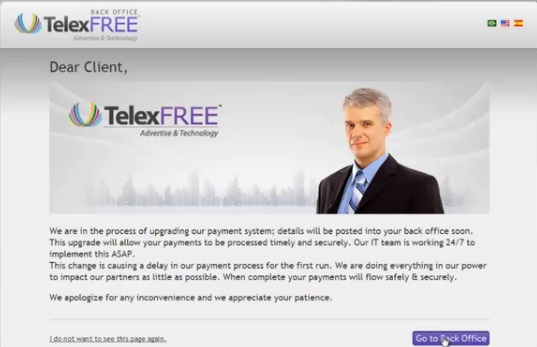
    A screen shown in the TelexFree affiliate’s video shows an apparent executive of TelexFree announcing that the changeover to GPG’s services “is causing a delay in our payment process for the first run.”

    The FBI long has warned that certain types of debit cards can be abused and that a “shadow banking system” is playing a role in fraud schemes that affect national security.

    If TelexFree is adjudicated a scam, it may be difficult for the governments of the world or the receivers/trustees they may appoint to gather proceeds for victims. HYIP money may dissipate quickly, perhaps particularly quickly if it is offloaded with debit cards. In a money-laundering case brought in 2008, federal prosecutors in Connecticut said that millions of dollars in narcotics proceeds were offloaded at ATMs in Colombia.

    Robert Hodgins, a Canadian currently listed by INTERPOL as an international fugitive in the Connecticut money-laundering case, reportedly supplied the debit cards through a firm known as Virtual Money Inc. and had ties to the HYIP world and schemes such as PhoenixSurf and AdSurfDaily.

    Another screen in the TelexFree affiliate’s video shows folders with titles such as “telexfree,” “Banner[s] Broker, “hyip monitors,” “forex”and “Passive peeps.”

    The context of the folders shown in the video is unclear. Banners Broker, however, is a bizarre HYIP scheme. HYIP monitors are websites that monitor whether a particular HYIP site is “paying.” Meanwhile, the word “passive” often is used in HYIP scams that promote tremendous returns for investors inclined to sit back and wait for the payments to flow in, instead of recruiting other investors to earn downline commissions from a “program.”

    TelexFree has been promoted on well-known Ponzi scheme forums such as TalkGold and MoneyMakerGroup. The names of both forums appear in U.S. court filings as places from which fraud schemes are advanced.

    From a promo for the alleged $600 million Zeek Rewards Ponzi- and pyramid scheme.
    From a promo for the alleged $600 million Zeek Rewards Ponzi- and pyramid scheme.

    Zeek Rewards, an alleged $600 million Ponzi- and pyramid scheme that had a Ponzi-forum presence and became the target of an SEC action last year, was promoted as a “passive” program. Like Zeek, TelexFree purportedly has a requirement that participants post ads for the “program” online.

    There have been reports in Brazil that a judge and prosecutor involved in the TelexFree case have been threatened with death.

    But not even those disturbing reports were enough to cause TelexFree to cancel a rah-rah event in California last month. The company says it also plans an “at sea” event in December. Earlier, some TelexFree pitchmen provided AdSurfDaily-like coaching tips to enrollees, especially on matters of how to speed the flow of money to the company.

    ASD was a $119 million MLM Ponzi scheme broken up by the U.S. Secret Service in 2008. Like Zeek and TelexFree, the ASD “program” also had a Ponzi-forum presence and was promoted as an opportunity for “passive” participants.

    Some TelexFree promoters in Brazil appear to believe that TelexFree has been deemed legal in the United States by the U.S. government. This errant belief may in part have been instilled by promoters of TelexFree who worded MLM HYIP pitches to suggest that the U.S. government had authorized the “program.”

    Some TelexFree promoters have claimed a payment of $15,125 to the firm will fetch a return of more than $42,000 in a year. Even the cautious “Aunt Ethels” of the world will grow to become keen on TelexFree, according to a promo.

  • **[UNCONFIRMED]** Report In Brazil Says Prosecutors Have Asked U.S. Court To Block TelexFree Accounts, New Signups **[UNCONFIRMED]**

    telexfreelogo**[UNCONFIRMED]** A report in Brazilian media translated by Google Translate from Portuguese to English says that prosecutors in Brazil have asked a U.S. court to prevent new members from joining TelexFree and to block the accounts of TelexFree figures Carlos Wanzeler, James Merrill, Carlos Costa and Lyvia Wanzeler.

    The PP Blog could not immediately confirm the report. If it is true, it could mean that law-enforcement agencies in Brazil have contacted their U.S. counterparts and asked them to begin the process of investigating a potential seizure of TelexFree-related funds that may be in the United States and perhaps to disable or otherwise block the functionality of the TelexFree web domains. The United States has said on various occasions that it is interested in fostering partnerships with law-enforcement agencies across the globe to combat commercial fraud online.

    As of 1:03 p.m. EDT today in the United States, the TelexFree websites remained online and appeared still to be capable of enrolling recruits.

    TelexFree has said it has U.S. arms in the states of Massachusetts and Nevada. Some U.S. afffiliates of TelexFree also appear to have formed business entities in California and Florida. Some TelexFree affiliates have claimed the “opportunity” did business through Bank of America, TD Bank and ProPay. (See July 8, 2013, PP Blog report on some of the claims.)

    Despite allegations in Brazil that TelexFree was conducting a massive pyramid scheme and that a Brazilian judge and prosecutor had been threatened with death, TelexFree nevertheless held a rah-rah session in California late last month in which an MLM pitchman appears to have tried to sustain the scheme by telling a joke about “Carlos Danger,” an online identity purportedly used by U.S. Democratic politician Anthony Weiner. A companion TelexFree promo playing in the United States on YouTube claims that people who send $15,125 to TelexFree can expect to profit to the tune of more than $42,000 in a year.

    TelexFree has a presence on well-known Ponzi-scheme forums such as TalkGold, MoneyMakerGroup and DreamTeamMoney. The forums previously were used as staging grounds for the Legisi Ponzi scheme, the AdSurfDaily Ponzi scheme, the PathwayToProsperity scheme, the Zeek Rewards scheme and the Profitable Sunrise scheme, among others. The SEC has described Zeek as a $600 million Ponzi- and pyramid fraud. The agency has described Profitable Sunrise as a fraud that may have gathered tens of millions of dollars through a series of accounts. Federal prosecutors in Illinois have described PathwayToProsperity as a fraud that made its way into at least 120 countries.

    In May, the United States indicted the Liberty Reserve payment processor and forced it offline, amid allegations that Liberty Reserve and some of its operators had engaged in a $6 billion money-laundering conspiracy. In June 2011, U.S. Attorney General Eric Holder described the amount of money being stolen online as “staggering.”

    “In recent years, we’ve seen clear, and alarming, advances in the sophistication and commercialization of crimes involving electronic networks,” Holder said.  “And the staggering volume of money being stolen online today has the potential to threaten not only the security of our nation — but the integrity of our government, the stability of our economy, and the safety of our people.”

    Nearly a year later — in May 2012 — INTERPOL said that “[Eighty] per cent of crime committed online is now connected to organized gangs operating across borders.”

    In October 2012, Lisa Monaco, then-Assistant Attorney General for National Security, said that cyber intrusions may have resulted in “the greatest transfer of wealth in history.”

    Monaco is now President Obama’s chief counterterrorism adviser.

    Some TelexFree members have claimed that the purported “opportunity” has gathered in excess of $300 million. Among other things, TelexFree has purported to be in the hotel-development business in the run-up to the 2014 World Cup and the 2016 Summer Olympics in Brazil. TelexFree, an MLM business, also purports to be in the VOIP telephone business.

    Many HYIP “opportunities” that use an MLM sales model have members and promoters in common and promise absurd rates of return. The practice has led to questions about whether groups of MLMers — however loosely associated — may be engaging in willful blindness and causing banks and payment processors to become warehouses for fraud proceeds.

    The ASD, Zeek, Legisi, PathwayToProsperity and Profitable Sunrise HYIP schemes may have gathered on the order of $1 billion, court filings suggest. Alleged PathwayToProsperity operator Nicholas Smirnow is listed as wanted by INTERPOL. So is Robert Hodgins, who reportedly once provided payment services to ASD and is listed as an INTERPOL fugitive in a money-laundering case allegedly involving the offloading of narcotics profits in Colombia.

    See Aug. 12 TelexFree report on BehindMLM.com.