BULLETIN: The court-appointed trustee in the TelexFree bankruptcy case is seeking authority to issue subpoenas and obtain information from eight financial institutions, including Puerto Rico-based Oriental Bank.
The other seven are Digital Federal Credit Union, based in TelexFree’s headquarters city of Marlborough, Mass., Bank of America, JPMorgan Chase, Citizens Bank, Santander, TD Bank and Wells Fargo.
All of the banks ended up in the TelexFree stream of commerce, but precise details of the relationships are not known publicly. What is known is that some TelexFree bank accounts were seized in criminal or civil forfeiture actions and that a cascading avalanche of litigation continues to roar down the mountain.
Why MLM firms continually tempt this ruinous fate is one of the great business mysteries of current times.
Court filings by Trustee Stephen B. Darr say he is trying to get to the heart of TelexFree-related money flow and communications involving the banks. Notably, one of the concerns is that all eight of the banks allegedly issued TelexFree-related cashier’s checks prior to the firm’s April 2014 bankruptcy filing, and later dishonored some of the checks.
Cashier’s checks also were an issue in the ASD case. At the time of the ASD related actions in 2008, the enterprise was the largest known MLM HYIP Ponzi scheme. It since has been surpassed by Zeek Rewards, TelexFree and others.
Dishonored cashier’s checks became one of the earliest issues in the $850 million Zeek Rewards MLM scheme in 2012. Citing the Uniform Commercial Code, Zeek’s receiver and lawyers have been been pursuing remedies from the banks for more than two years — at a cost of money and time.
Kenneth D. Bell, the Zeek receiver, has said that “[i]f a bank refuses to pay a cashier’s check or teller’s check presented by the Receiver, it may be required to pay for the Receiver’s expenses and loss of interest resulting from the nonpayment, as well as consequential damages.”
In the Zeek case, the Virginia Bankers Association provided guidance to member institutions that “the court’s order relied on the Uniform Commercial Code to establish that the uncashed cashier’s checks in the receiver’s possession were receivership assets, and that the receiver was required to present those cashier’s checks for payment and had no discretion not to.”
Now, the TelexFree trustee appears to be wading into the same or highly similar MLM waters. Among the information Darr is seeking is “information respecting the remitters of the cashiers’ checks and the reasons for the dishonor of such checks.”
Because MLM Ponzi- and pyramid schemes spread virally, have common promoters and often rely on cashier’s checks, it is conceivable that some promoters might have bought their way into both “programs” with cashier’s checks, possibly even with cashier’s checks recruits paid to their upline sponsors, rather than to the “programs” themselves.
In the case of Zeek, tens of millions of dollars in checks allegedly had backed up at Zeek’s office in North Carolina in the weeks prior to the SEC’s August 2012 Ponzi- and pyramid action.
The TelexFree case may add a new wrinkle. Indeed, nearly $38 million in cashier’s checks from Wells Fargo allegedly were found in TelexFree’s Marborough office in the possession of Joseph Craft two days after TelexFree’s April 13 bankruptcy filing. Craft, who has denied wrongdoing, was a TelexFree executive. He has been charged civilly with securities fraud.
In April, the SEC said that a check dated April 3 in Craft’s possession was “remitted to” TelexFree principal Carlos Wanzeler and made out to “TelexFree Dominicana SRL in the amount of $10,398,000.”
One check for more than $2 million in Craft’s possession was made out to Katia B. Wanzeler, Wanzeler’s wife. She later was arrested at JFK Airport in New York and detained for more than a week as a material witness.
The SEC alleged that Carlos Wanzeler was amassing a small-real estate empire in Massachusetts and Florida. He is alleged to have ducked out of the United States via Canada in April, ultimately flying to his native country of Brazil. The United States describes him as an international fugitive.
Darr now is seeking not only information about the cashier’s checks, but also information on communications between the banks and TelexFree or its principals James Merrill and Carlos Wanzeler, and information on any TelexFree-related investigations conducted by the banks, including “information related to ‘Know Your Customer’” rules and regulations.
In addtion, Darr is seeking bank statements, canceled checks, deposit slips, wire-transfer communications and remittances, documentation concerning fees and contracts, minutes from bank board meetings at which TelexFree matters were discussed, documentation on why the banks ended relationships with TelexFree, documentation on communications the banks had with the SEC and state regulatory bodies, documentation the banks may have on the Massachusetts Securities Division TelexFree investigation and documentation “concerning whether the remitters have been refunded any amounts advanced to purchase” the dishonored checks.
DEVELOPING STORY: (Updated 10:02 p.m. EDT U.S.A.) In an extraordinary development on this Halloween Friday, the federal judge presiding over the SEC’s Ponzi- and pyramid-scheme case against Zeek Rewards has issued a Temporary Restraining Order and directed a Zeek vendor to immediately turn over to the receivership more than $4.85 million.
The order was entered “without notice,” owing to concerns the money could go missing. It applies to Zeek financial vendor Preferred Merchants Solutions LLC and Jaymes Meyer, Preferred’s California-based sole member and manager.
Events that led to the order involve a bizarre circumstance that allegedly occurred in June 2012, when tens of millions of dollars in undeposited checks — enough to fill six to eight mail bins — had backed up at Zeek, starving the Rex Venture Group LLC enterprise for cash during a period in which Zeek was having banking problems in North Carolina and its alleged Ponzi was crumbling.
Zeek operator Paul Burks allegedly hired Preferred to solve the problem and also to provide trust services. According to a document filed by Preferred in August 2014, the first time the company visited Zeek headquarters, “ex- or off-duty police officers [were] providing security.”
Preferred contends it solved Zeek’s problem with the backed-up checks and legitimately is owed the $4.85 million at issue.
But receiver Kenneth D. Bell, who is seeking a contempt sanction against Preferred and alleges that Preferred effectively transferred Zeek Ponzi cash to itself after it learned from the SEC on Aug. 16, 2012, that an order freezing Zeek assets was imminent, asked Mullen for the TRO on Oct. 28.
Bell alleges that “the evidence establishes that Preferred Merchants and Meyer directed the $4.8 million transfer from the RVG trust account to Preferred Merchants’ account just 19 minutes after the SEC told them about the asset freeze and imminent shutdown of RVG” on Aug. 16, 2012.
He further alleges that “[n]ot only did Meyer fail to tell the SEC about his custody and control over RVG assets, Meyer also failed to disclose that he anticipated making any transfers, or, after the transfers were executed, that he had done so.”
From the order entered at 11 a.m. today by Senior U.S. District Judge Graham C. Mullen of the Western District of North Carolina (italics added):
The Receiver has satisfied the requirements of Federal Rule of Civil Procedure 65(b) and established that an order is appropriate in this case to avoid irreparable injury, loss, or damage to the Receivership Estate of Rex Venture Group, LLC, including the further waste and dissipation of Receivership Property. Notably, the Court finds that the large amount of money at stake, the liquidity of the funds which could be transferred overseas or hidden, and Preferred Merchants’ and Meyer’s apparent pattern of misconduct present a likelihood of irreparable harm and necessitate this order being entered without notice. Accordingly, and for the reasons stated in the motion and memorandum, the Court will GRANT the motion.
IT IS, THEREFORE, ORDERED, ADJUDGED, AND DECREED that: 1. This Order is entered at 11 a.m. on October 31, 2014. 2. The Receiver’s Motion for Temporary Restraining Order is GRANTED; 3. Preferred Merchants Solutions, LLC (“Preferred Merchants”) and Jaymes Meyer (“Meyer”) are directed to immediately deposit with the Receivership $4,854,010.40, which is the amount they transferred from RVG’s trust account after the SEC notified them of the asset freeze and requested that they freeze all RVG accounts and assets; 4. The Receiver is directed to deposit and maintain these funds in a segregated account; 5. This injunction shall expire no later than fourteen (14) days from the entry of this Order or sooner upon further order of the Court. 6. The Court will conduct a hearing on this matter on Wednesday, November 12, 2014 at 2 p.m. in Courtroom 3 at the Charles R. Jonas Federal Building, 401 W. Trade Street, Charlotte, NC 28202. The Receiver is directed to use all reasonable efforts to notify Meyer and Preferred Merchants of the date, time, and location of the hearing.
Burks, 67, of Lexington, N.C., was indicted a week ago today on criminal charges, including mail fraud, wire fraud and conspiracy. A separate lawsuit filed by Bell last month against alleged Zeek winners in Canada contends that Zeek “insiders often worried about being caught.”
Mountains of undeposited checks also were an issue in the AdSurfDaily Ponzi-scheme case in 2008. ASD purported to pay a dividend of 1 percent a day. Zeek’s average daily payout was about 1.5 percent, according to the SEC.
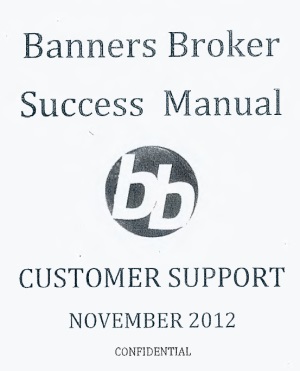
“Affiliates found to be contributing to the negativity on the Internet will have their accounts locked, they will be banned from participating in the Banners Broker system and they will forfeit all of their inventory and revenue.” — Banners Broker threat to members, February 2014
“It is the position of investigators that this business was a pyramid scheme that over time evolved into a straight Ponzi scheme in which new victims were recruited to stave off requests for withdrawals and complaints from older ones.” — Royal Canadian Mounted Police, July 17, 2014: Source: Affidavit that shows the RCMP, the Toronto Strategic Partnership and the Toronto Police Services Financial Crime Unit are involved in a criminal probe of Banners Broker.
EDITOR’S NOTE: The double-your-money Banners Broker “program” posed as an online “advertising” company. It appears to have gathered tens of millions of dollars using a series of conduits and employing entities or business identities in money-laundering havens. At least for now, the total sum stolen from participants is unclear. As alleged, funds were “diverted by the suspects and their associated corporations to various offshore and other bank accounts controlled by them.”
** _________________________**
How to begin the brainwashing process: Screen shot from page of court exhibit in Canada.
As an interview subject allegedly told the Competition Bureau of Canada on April 9, 2013, it was all so simple to Banners Broker operator Christopher George “Chris” Smith:
Indeed, Canadian authorities now have alleged, when the subject “met with Smith [in 2010,] he asked Smith why people lost money in these programs and Smith said it was what the programs were designed for, they bring people in, make some money and then they shut down and people move on to the next one.”
What was Smith allegedly discussing at the meeting in Toronto? His desire to come up with a “copycat” of Travel Ventures International, a purported “opportunity” also known as TVI Express and described as a scam on multiple continents. (See K. Chang’s MLM Skeptic Blog for a report on how TVI Express spread around the world.)
This, friends, is whack-a-mole — in the style of MLM huckster Chris Smith. It’s also racketeering MLM-style, whether formally prosecuted as such or not. And so it comes as no surprise that the term “criminal enterprise” to describe Banners Broker and its associated corporations now appears in court filings in Canada. (See links and credits at bottom of this story.)
Members of the TelexFree MLM “program” allege that racketeering occurred within that enterprise, described by U.S. regulators earlier this year as a billion-dollar, cross-border pyramid- and Ponzi scheme. The Zeek Rewards MLM “program,” alleged to have gathered on the order of $850 million before is August 2012 collapse, launched after the 2008 collapse of ASD. There can be no doubt that TelexFree, Zeek, ASD and Banners Broker had promoters in common.
There also can be no doubt that “see no evil” MLM cottage industries sprouted up around these foundationally corrupt “programs” and offered services such as “lead” provision and “ad” placement. Victims have piled up in such numbers that, in the TelexFree scam alone, 20,000 Greyhound buses with a 50-seat capacity each would be required to accommodate the fleeced masses.
But where would they all go to observe events and be acknowledged at once?
No courtroom can accommodate 1 million victims. Even if Mass-Participation Court existed and were gaveled into session on an unbooked Saturday in Pasadena’s famous Rose Bowl with onetime Tournament of Roses Parade Grand Marshal and U.S. Supreme Court Associate Justice Sandra Day O’Connor coming out of retirement to preside, the huge stadium’s seating capacity of 92,542 still would be far too small to accommodate the injured parties.
Despite the best efforts of the courts, victims are being lost as a result of these insidious MLM schemes. Some will be re-victimized in a whack-a-mole reload scam pitched by an MLM predator with a smile on his or her face and a Bible verse at the ready.
There also can be no doubt that certain members of the “programs” are members of a criminal combine that, whether loosely or closely associated, pushes one racketeering scam after another on the consuming public. It is willful blindness on a global scale. It is so dangerous, so calculating and methodical, so gruesomely injurious to persons and property, that it almost defies description.
Next time someone tries to recruit you into an HYIP “program” by telling you the “leaders” are already on board, here’s what to think: The racketeers are either running things or influencing events (again). They’re going to harm me (again). They’re going to harm my community, my country (again). They’re going to say they have been vetted by “attorneys” (again).
And then, as Chris Smith allegedly said, they’re going to shut down and “move on to the next one.”
Again.
Reclaim Your Brain — Right Now!
Like predecessor scams such as AdSurfDaily and AdViewGlobal and Zeek, the hypnotized and robotic Stepfordians in Banners Broker who’d been brainwashed by cult tactics rose up to “defend” the “program,” including some individuals who continued to champion the scam even after it effectively extorted them into paying more fees to keep their positions intact and to retain any chance of receiving a payout.
While trying to chill members who remained in control of their gray matter and hadn’t slipped into an MLM trance, Banners Broker naturally counted on the Stepfordians whose brains it had reduced to slush to wage efforts to chill Blogs and websites that report on scams.
“If you know of a site with content that is negative towards Banners Broker, we ask that you report it to the Community Watch,” the “program” instructed in February 2014.
On Jan. 17, 2013, the PP Blog reported it was receiving menacing communications about Banners Broker.
For additional background on bids to chill reporters or program members who publish information about scams and highly questionable “opportunities,” see this Dec. 27, 2012, PP Blog post: Our Choice For The Most Important PP Blog Post Of 2012. (It’s about an effort to chill K. Chang over his reporting on Zeek Rewards.)
UPDATED 8 A.M. EDT U.S.A. New England Public Radio has a minute-long audio report on TelexFree, iFreeX and Sann Rodrigues, including comments from Massachusetts Commonwealth Secretary William Galvin.
Rodrigues, accused in April 2014 by the U.S. Securities and Exchange Commission of fraud over his alleged role in TelexFree, earlier (in 2006) was accused of fraud by the SEC in a separate alleged pyramid scheme involving phone products. iFreeX may constitute at least his third dance in securities- and affinity-fraud schemes involving communications products.
Galvin reportedly told the station that the “current whereabouts” of Rodrigues is unknown. The charged pitchman hails from Brazil, once resided in Massachusetts and also has lived in Florida.
On Dec. 19, 2013, the PP Blog reported that TelexFree puff pieces were appearing in a publication that featured a columnist who asserted Jesus Christ was the person who inspired modern network marketers through his recruitment of 12 disciples.
Ads for an apparent cash-gifting scheme appeared in the same publication.
SEC case filings alleged that, on March 15, Rodrigues’ co-defendant Faith Sloan claimed on her website that the TelexFree compensation plan was changing and was not in final form — “[b]ut is Getting BETTER as Jesus said.”
Regulators have described TelexFree as a billion-dollar pyramid- and Ponzi scheme that operated across national borders.
Claims of divine authority or inspiration are not unusual in MLM HYIP frauds. In the 2008 AdSurfDaily case, for instance, accused operator Andy Bowdoin claimed God was on his side and compared the U.S. Secret Service to “Satan” and the 9/11 terrorists. Bowoin later was sentenced to federal prison for his $119 million Ponzi scheme.
Affinity fraud may occur in many contexts: appeals to religious faith, appeals to common interests, appeals to common heritage, appeals to common political interests and more.
From an SEC exhibit filed last week in the SEC’s case against eAdGear, an alleged international pyramid- and Ponzi scheme that gathered $129 million. Redactions by PP Blog.
EDITOR’S NOTE: eAdGear, which had entities in California and Hong Kong, “primarily” targeted “investors in the U.S., China, and Taiwan” and gathered $129 million in a combined pyramid- and Ponzi scheme that engaged in brand-leeching, the SEC alleged last week. An MLM scam known as WCM777, which allegedly gathered more than $80 million, also engaged in brand-leeching while targeting Asian communities, according to court filings. The SEC sued WCM777 in March 2014. Among the SEC’s alarming allegations against WCM777 was that it planted a false seed that it had partnerships “with more than 700 major companies such as Siemens, Denny’s, and Goldman Sachs.”
“This new approach to Internet advertising has businesses of all sizes, from small home based businesses to large corporations such as Google, Starbucks, Kodak, etc., joining ASD,” a 2008 promo for ASD read. “Not only are there over 75,000 small businesses advertising with ASD, but now major corporations are as well. Remember, a part of the daily rebate comes from the revenue corporations pay to advertise with ASD.”
It was all a crock. The U.S. Secret Service, which opened an undercover probe in July 2008, went on describe ASD as a “criminal enterprise.” ASD President Andy Bowdoin was convicted of wire fraud in the ASD Ponzi case. He is serving a lengthy term in federal prison.
Even while it was operating, ASD talked about a nascent “Chinese” arm known as Golden Panda Ad Builder. In retrospect, it now appears that plans to involve Asian populations in HYIP schemes were well under way at least by 2008 and since have evolved into frauds that were even larger than ASD. (ASD gathered $119 million and has been eclipsed in dollar volume by at least three Internet-based investment scams since then: TelexFree (possibly $1.2 billion); Zeek Rewards (c. $850 million); and eAdGear ($129 million). Falling just short of making this list were Zhunrize (allegedly $105 million) and WCM777 (allegedly $80 million). It is clear from court filings that Zeek also had a presence in Asian communities.)
There also was a tertiary scam inside the ASD scam. Indeed, promos for an entity known as ASD Offer Universe encouraged members to click on Google ads so ASD would earn fees of up to $5 a click. Here’s now that promo began (italics added):
“ASD ENTERS INTO AGREEMENT WITH GOOGLE FOR NEW CONSUMER SITE. Months ahead of schedule, Google and ASD Offer Universe are now teaming up to show Google ads on the site. Google, after seeing all of the major advertisers already being shown on ASD Offer Universe agreed to enter into a relationship with ASD.”
Did the eAdGear “program” channel long-ago events at ASD to help its massive pyramid scheme grow?
ASD was a purported “advertising” firm that operated a “rotator.”
Let’s compare what happened at ASD in 2008 to what the SEC now says happened at eAdGear, accused by the agency last week of operating a $129 million pyramid- and Ponzi scheme and positioning itself as an advertising company and an SEO firm.
By at least March 2014, the SEC says in court filings, investigators learned of a promo for eAdGear that read, “Google and Yahoo are partnering up with eAdGear for SEO services!!”
In the land of serial promoters of MLM or direct-sales HYIP scams, it’s as though the ASD case never happened.
The name-dropping and toxic disingenuousness associated with eAdGear hardly were limited to the abuse of the names of Google and Yahoo, according to SEC exhibits filed in the eAdGear case. It appears there were at least 253 incidents of brand-leeching associated with eAdGear. Indeed, eAdGear appears to have planned its ascent to the upper echelon of the fraud sphere by deliberately placing bogus ads for famous companies into its ad “rotator” to create a false sense that its “program” was legitimate.
Target Corp., the famous retailer, had its brand leeched, the SEC alleged. So did Lbrands, the Columbus, Ohio-based company that owns Victoria’s Secret
Now, let’s look at some of the behind-the-scenes investigative work performed by the SEC. Court filings by the agency show that, on July 1, 2014, the SEC issued a subpoena to Yahoo to check on the eAdGear-associated claims.
Yahoo responded on July 10 by advising the SEC that it had “identified no contracts or agreements with eAdGear[].”
Meanwhile, according to court filings, the SEC made an inquiry at Google on June 30. Google responded on July 22, advising the agency that it “is not aware of any commercial relationship between [eAdGear] and Google.”
Because ads for famous companies, including Target, Gap Inc. and Victoria’s Secret, had appeared in the eAdGear “rotator,” the SEC contacted those companies. (The response by L Brands Inc., owners of Victoria’s Secret, is shown above.)
Target responded by searching its database of vendors to which it had issued payments. No records surfaced for eAdGear, according to the SEC. Gap, similarly, informed the SEC that it had no record of doing business with eAdGear.
What else does the SEC have? Well, according to court records, it has internal eAdGear email correspondence that shows an employee was instructed to place 253 links to famous companies in its rotator.
These companies included Avon, Sears, Nordstrom, eBay, QVC, HSN, J.C. Penney, Banana Republic, Dillard’s, Kohl’s, Macy’s, Amazon.com, Men’s Wearhouse, Kmart, New York magazine and more.
These are among BCSC’s assertions — under a subheading titled “False impression of paid advertisements and advertising revenue”:
Bossteam described itself on its websites, in documents and in presentations as an online advertising business having huge growth potential and ready to become a leading global online advertising company. It referred to well-known online businesses such as Google, Amazon and eBay, and to the fast-growing advertising revenues of these businesses.
Although hundreds of “ads” appeared on the advertising platforms, the majority of the ads posted on Bossteam’s websites were associated with Bossteam’s own administrative accounts (accounts accessible by those controlling its systems) and not to accounts for advertisers or members who had paid to post links to their websites on Bossteam’s websites.
Ads associated with Bossteam’s administrative accounts included webpages for well-known local and international businesses.
Local businesses whose webpages appeared on Bossteam’s websites included a restaurant, a security systems company, a heating company and a private career college. Websites of well-known businesses and personalities included World Wrestling Entertainment, Miriam Webster and Britney Spears.
Posting the websites of local and international businesses on Bossteam’s websites without payment created a false impression that such businesses were advertising on Bossteam’s websites and paying Bossteam to do so.
Because Bossteam and eAdgear were similar businesses and appear largely to have targeted members of the Asian community, one has to wonder whether the schemes had promoters in common. For now, at least, the answer is unclear. What is clear is that some promoters simply move from one fraud scheme to an another when the “program” of the moment craters or encounters regulatory scrutiny.
Serial HYIP huckster and Zeek figure T. LeMont Silver currently is in name-dropping overdrive for BitClub Network, one of his latest “programs.” Silver’s name has surfaced in private lawsuits involving eAdGear and an interconnected enterprise known as Go Fun Places, which is referenced in the SEC’s eAdGear case. (For one instance, see the reference to Go Fun Places within the letter from L Brands to the SEC in the graphic above.)
The BitClub Network “program” — originally set to launch Sept 1, the 75th anniversary of the beginning of World War II — reportedly now will launch on Sept. 10.
That’s the eve of the 13th anniversary of the 9/11 terrorist attacks.
The Sept. 10 launch time is pegged for “2pm EST,” which possibly means the “program” is using Panama time. Panama, part of the Americas, does not use Eastern Daylight Time (EDT).
Some of the money from the Profitable Sunrise HYIP swindle last year went to an entity in Panama City, the SEC said last year. Other Profitable Sunrise money ended up in Australia and the Czech Republic, according to court filings.
Profitable Sunrise operated through a “mail drop” in England and had a “director” in Seychelles, according to court filings.
Zeek Rewards Ponzi- and pyramid-scheme figure T. LeMont Silver, an early adopter of BitClub Network who is promising a $600 sign-up bonus and “training” for the “program,” now is using a Seychelles address, according to an email pitch he sent last week.
Seychelles is a known money-laundering haven. Silver may be operating from the Dominican Republic after parachuting into the nation after the collapse of Zeek in 2012 and the later collapse of two other purported “revenue-sharing programs” he was pitching.
Those “programs,” which ended up suing each other amid allegations of fraud, were GoFunPlaces/GoFun Rewards and JubiMax/JubiRev. Silver described disaffected prospects as “low-hanging fruit.”
BitClub Network, which purportedly offers “shares” of “mining pools,” has a Bitcoin theme. The reported buy-in levels are $500, $1,000 and $2,000, with “Founders’” positions going for $3,599.
Whether Silver even knows precisely who is operating the BitClub Network “program” is unclear. Also unclear is why the “program” chose start dates that corresponded with the starting dates of World War II in Europe and the 9/11 terrorist attacks against the United States.
Are the dates merely coincidences?
Hitler’s Nazi Third Reich was hoped to last 1,000 years. BitClub Network, early bird MLM HYIPers say, will pay a daily dividend for 1,000 days.
HYIP schemes in general are exceptionally murky propositions, with narratives, descriptions and actions that may be designed as taunts against both prospects and regulators. Profitable Sunrise, for example, used images of Jesus Christ in promos and offered a purported “Long Haul” plan with a purported Easter gift to be paid out on April 1, 2013 — April Fool’s Day.
March 31 of that year was Easter Sunday.
WCM777 also used images of Jesus Christ. A follow-up scam used images of a golden pyramid.
John Neil Hirst was charged by the U.K. Serious Fraud Office in 2011 with running a Ponzi scheme that targeted British, French and Americans through a company registered in Panama and Seychelles.
A 2010 scam known as “Alpha Trade Group” that was promoted on well-known Ponzi-scheme forums purported to be registered in Panama and was using “various corporations and fictitious names registered in Florida” to pull off the scheme, according to court filings.
David F. Merrick of Traders International Return Network (TIRN) was charged in a 2009 Ponzi scheme that was operating in the United States while funneling money to Panama, Mexico, Malaysia, Switzerland and the Netherlands.
It was promoted alongside the bizarrely named “Cash Crop Cycler.” Among the provocative claims on the CashCropCycler website was that the “program” was interested in building “a network that ticks.”
A 2011 scam known as OneX used an image of a bomb in its logo.
Silver was a OneX pitchman, alongside Andy Bowdoin, the operator of the $119 million AdSurfDaily Ponzi scheme that he positioned as a “revenue-sharing” program.
At least one promo for Bitclub Network claims “All Countries” and prospects are accepted for “Legal Passive Income.”
BULLETIN: Federal prosecutors in the United States have informed a federal judge that “evidence underlying this case is closely tied to certain foreign countries, especially Brazil” and that “it is likely that the parties will need to review evidence in foreign countries and arrange for foreign witnesses and/or law enforcement officers to travel to the United States to testify at trial.”
The assertion by U.S. prosecutors is part of a motion to designate TelexFree as a “complex case” that calls for an exception to the Speedy Trial Act, a law that requires an indicted defendant to be tried within 70 days. Former TelexFree executives or managers James Merrill and Carlos Wanzeler were indicted on July 23.
It was unclear whether Merrill, who remains in the United States, would challenge prosecutors on the issue. Wanzeler ducked out of the United States through Canada on April 15, and flew to Brazil on April 17, according to prosecution filings.
From a prosecution filing today (italics added):
Relief from the requirements of the Speedy Trial Act is needed to allow the parties enough time to produce and examine discovery and evidence in this case and to prepare for trial. In the event of trial, substantial lead time will be required to secure the attendance of foreign witnesses, including the permission of host countries and travel. The ends of justice served by relief from Speedy Trial Act requirements in this case outweigh the best interests of the public and the defendant in a speedy trial; failure to grant relief may deny the parties the time needed for effective trial preparation, taking into account the exercise of due diligence, and may result in a miscarriage of justice.
U.S. prosecutors asserted today that they had seized 400 terabytes of data “spanning 46 servers.” Meanwhile, prosecutors said they’d “seized about 26 separate computers from TelexFree’s headquarters – all containing independent drives that are not networked to the servers described above – as well as about three other computers obtained via grand jury subpoena.”
At the same time, prosecutors said the U.S. government had “also issued approximately 185 grand jury subpoenas in the course of its investigation so far, nearly all for large productions of business records, including from multiple banks, brokerage houses, and payment processing services. The government is in the process of scanning the seized documents and, along with the subpoenaed materials, compiling a single database for production to the defense.”
BULLETIN: (2nd update 9:54 p.m. EDT U.S.A.) MLM attorney Kevin Grimes and a companion entity known as MLM Compliance VT LLC received $843,000 from the Zeek Rewards pyramid- and Ponzi scheme through the sale of a “bogus compliance course,” receiver Kenneth D. Bell has alleged in an amended complaint.
The amended complaint, filed yesterday, includes MLM Compliance as a defendant. The original complaint filed last month did not. Also new in the amended complaint is the figure of $843,000. The original complaint did not specify a specific sum.
Co-defendants also include Grimes and the Grimes & Reese law firm.
“In total, Grimes and MLM Compliance received approximately $843,000 from RVG for the bogus course,” Bell alleged. “The final payment from [Zeek operator Rex Venture Group] to Grimes and MLM Compliance was, upon information and belief, a check rushed to and indorsed by Kevin D. Grimes for $342,510, which posted on August 13, 2012, less than a week prior to ZeekRewards’ shutdown.”
The course, Bell alleged, served as “window dressing” for the Zeek fraud. The SEC shut down Zeek on Aug. 17, 2012.
Some MLMers immediately raced to other fraud schemes — after participating not only in Zeek, but in the AdSurfDaily MLM Ponzi scheme and other “programs.”
Zeek gathered on the order of $850 million in a combined pyramid- and Ponzi scheme that operated for about two years. It was “an internet based so-called ‘MLM’ (multi-level marketing) program,” Bell said.
Grimes and MLM Compliance engaged in “Unfair and Deceptive Trade Practices” by creating the course, which “served to bolster what they knew to be an unlawful scheme,” Bell alleged.
Bell is suing Grimes and the Grimes and Reese firm for a sum in excess of $100 million, alleging they were unjustly enriched and engaged in Legal Malpractice, Negligence, Breach of Fiduciary Duty and Aiding and Abetting Breach of Fiduciary Duty.
Florida “Expat” and Zeek Rewards Ponzi-scheme figure T. LeMont Silver yuks it up earlier this year in the Dominican Republic. Source: YouTube.
MLM, witness your latest PR train wreck — as voiced by alleged Zeek “winner” and purported “revenue sharing” consultant/trainer and Florida “Expat” T. LeMont Silver. (Video below.)
In a consolidated motion in response to motions by various alleged Zeek “winners” to dismiss the clawback lawsuits against them, the court-appointed receiver in the Zeek Rewards Ponzi- and pyramid case has asked the court to take “judicial notice” of two YouTube videos featuring Silver, a veteran HYIP huckster.
In typical HYIP fashion that marries the merely imponderable to the truly bizarre, one of them painfully is titled, “(T. Le Mont Silver, Sr.), (7 Figure Producer) shares about Plan B part #2.” (Bold emphasis added by PP Blog.)
The HYIP sphere, the staging waters for boat sharks who throw purported rescue jackets to victims bloodied in the water from earlier scams and desperately struggling to stay afloat, is infamous for Plans B.
Although the “program” isn’t identified in the video, Silver’s Plan B appears to be the ill-fated JubiRev/JubiMax. (See June 18, 2013, BehindMLM.com story.)
MLM may have a problem with “serial participants” in Zeek-like schemes to defraud, Zeek receiver Kenneth D. Bell suggests in the motion asking the court to take judicial notice of the Silver videos.
The language chosen by the receiver is similar to language the SEC used in 2013 to describe MLM HYIP huckster Matthew John Gagnon. Gagnon, the SEC said at the time, was a “serial fraudster.”
The context of the SEC’s Gagnon prosecution may be important. Indeed, one of the “programs” he was accused of promoting was the infamous Legisi scheme, a semi-offshore debacle the SEC took down in 2008. Like Zeek, the Legisi case started with asset freezes and the appointment of a receiver.
Time slowly marched on. But in 2009, the receiver sued Gagnon. In 2010, the SEC filed civil charges against him. He was charged criminally in 2011.
Legisi, the SEC said, operated a “classic pooled investment vehicle.” In one of the Silver videos cited by the receiver, Silver describes his “Plan B” program as the operator of a “pot.”
Women between the ages of 30 and 55 were the financial targets of the “opportunity,” according to one of the videos referenced by Bell.
The video tends to suggest that Silver understood how Zeek got caught by using highly questionable “bids” as its “product” and that the MLM’s trade’s serial fraud wing immediately sought more clever disguises — hiding an HYIP scam behind the purported sale of ostensibly legitimate products such as cosmetics and diet shakes, for instance.
Silver has appeared in “many” online videos and has promoted “several ‘revenue sharing’ schemes in addition to Zeek,” receiver Kenneth D. Bell advised Senior U.S. District Judge Graham C. Mullen.
Bell supplied the court links to the videos.
In the HYIP sphere, the term “revenue sharing” is used to make schemes appear to be innocuous.
As noted above, the HYIP sphere is infamous for purported Plans B, which typically are cosmetically tweaked reload schemes designed to fleece an initial group of marks for a second time.
Here, it’s appropriate to revisit HYIP history for a second time. If you believe AdSurfDaily Ponzi schemer Andy Bowdoin caused an almost inconceivable amount of PR damage to the MLM trade by comparing the U.S. Secret Service to “Satan” and the 9/11 terrorists, wait until you get a load of what T. LeMont Silver does in one of his videos cited by the receiver. (Video appears at bottom of this column.)
By way of background, the HYIP sphere is infamous for dropping the names of famous entities and people, even if they have no ties whatsoever to the “opportunity” being presented.
Although Silver apparently isn’t selling Avon or Amway or Mary Kay or Herbalife or ViSalus in the video, he drops the names of all of them (and more). Along the way he drops in a veiled reference to Zeek, describing it as a penny auction “program” in which affiliates would “make large purchases of . . . let’s say ‘bids’,” with Zeek’s product creating a “big issue” with regulators.
Silver notes that he’ll provide “training” for the upstart “program,” positioning it as a way for average MLMers to make money without having to recruit or to orchestrate “dog and pony” presentations. Regardless, Silver assures the audience that he’s a master of the MLM dog and pony. He further suggests that, because Zeek’s “bids” had caught the attention of regulators, the trade’s braintrust now is turning toward “more traditional MLM-type products and services.”
Putting lipstick on brand-new HYIP pigs or evolving ones is part and parcel to the HYIP sphere. Silver’s video suggests that the HYIP trade has learned that sketchy products such as Zeek’s bids might not fly and now was concentrating on attracting women between the ages of 30 and 55 by wrapping cosmetics, weight-loss shakes, home products and travel into a purported “revenue sharing” model in which participants who bought in would receive “pro rata” shares from a giant revenue pot.
After suggesting he has inside information about the new HYIP regime, Silver curiously observes that he is “very, very key on genealogical integrity.” We interpret this to mean that he’d be exceptionally pleased if people with existing MLM organizations within traditional companies would port them into his next scam.
Even though he’s apparently not selling Amway in the video, he bizarrely also prompts viewers not to dare “call Amway Scamway.” Equally bizarrely, Silver congratulates the company for “legitimizing this industry” back in the 1970s by purportedly “kick[ing] the backside” of the U.S. government and the government’s “[p]atootie.”
“My goodness,” he says. “Thank you, Amway.”
Yes. T. LeMont Silver has now publicly thanked Amway for kicking the government’s ass 35 years ago and, under his interpretation of In the Matter of Amway Corporation, Inc., et al., paving the way for people to send tremendous sums of money to companies with presumptively better disguises than Zeek.
Amway is a lot of things — good and bad — to a lot of people. Unlike Zeek, however, it is not an HYIP that offered “passive” investors who sent in $10,000 or smaller sums a laugh-out-loud, average daily return of 1.5 percent, basically in perpetuity.
Gawd!
Our take on Silver’s take of the 1979 non-HYIP Amway decision is that it somehow made preposterous “revenue sharing programs” as seen in the HYIP sphere lawful or that all HYIP schemes are lawful if they have product such as those offered by Avon, Amway, Herbalife and the others. But the pyramid analysis, of course, does not exclusively hinge on whether a company has a “product.” If it did, Zeek (“bids”) and BurnLounge (“music”) would still be in business. Moreover, there would be no Bill Ackman/Herbalife dichotomy, no question about whether Herbalife was Jurassic Park or Disneyland. In short, MLM heaven on earth would not be a rumor, it would be a reality.
“Plan B,” meanwhile, is a virtual calling card of HYIP swindles, with prospects typically given instructions to join at least two “programs” in case one of them fails or to quickly join another “program” when a favored one collapses or encounters regulatory scrutiny.
Silver is a longtime pusher of “Plan B” MLM HYIPs, which, as noted above, typically call themselves “revenue sharing programs.” He’s hardly alone. Zeek figure and purported MLM expert Keith Laggos pushed the Lyoness “program” to Zeekers as a “Plan B” just prior to the Aug. 17, 2012, collapse of Zeek. (See Aug. 12, 2012, PP Blog editorial: “Karl Wallenda Wouldn’t Do Zeek.”)
Lyoness, among other things, dropped the name of Nelson Mandela in sales promos.
Among the tips Laggos provided to listeners of a Lyoness conference call was this: “Don’t put no more than 70 percent back in [Zeek]. Take out 20 or 30 percent [on] a daily basis. [Unintelligible.] This would be a good place. But, by the same token, if you put $10,000 in Zeekler, if nothing happens over the next year, you’ll probably make $30,000 or $40,000, if that’s all you do without building the front end, the matrix . . . The same amount of money in Lyoness, you’re looking . . . and not doing anything else, without single sponsoring . . . you can probably make a quarter-million dollars.”
One of the problems with HYIP schemes is that they cause polluted money to flow between and among scams, in part because the scams have serial promoters in common. The inevitable result is that payment vendors become warehouses for fraud proceeds, prompting the government to apply for asset freezes and account seizures to stop the flow of tainted cash.
Receiver Cites Second Silver Video
The second video featuring Silver — an alleged winner of more than $1.71 million in Zeek — is titled “Internet Entreprenuer Family Chooses Cabrera [Dominican Republic] For Their New Expat Lifestyle.” It shows Silver and his wife — another alleged Zeek winner — lounging in the Dominican Republic after the collapse of the Zeek scheme.
Prior to relocating to the Dominican Republic, Silver told his downline in a failed MLM “program” known as GoFunPlaces to take advantage of “low-hanging fruit” (other disaffected GoFunPlaces members) and become recruiters for a “program” known as Jubimax. The “programs” ultimately accused each other of fraud.
Silver also promoted “OneX,” which federal prosecutors in the District of Columbia described as an AdSurfDaily-like, money-circulating scheme. ASD operator Andy Bowdoin, now jailed after the collapse of the ASD fraud in 2008, also promoted OneX, explaining to prospects that they’d earn $99,000 very quickly and that he’d use the money he’d earned to pay for his criminal defense in the ASD case.
Bowdoin asserted OneX was great for college students. Silver asserted that positions being given away were worth $5,000.
Prosecutors also linked Bowdoin to AdViewGlobal, an ASD reload scam that operated as a “Plan B.” AdViewGlobal, which purported to operate offshore but actually was operating from Florida and Arizona, mysteriously vanished in the summer of 2009.
Zeek receiver Bell, who connected alleged Zeek winner Todd Disner to the ASD Ponzi scheme in court filings this week, now says in court filings that certain Zeek clawback defendants “may well be serial participants in these types of schemes.”
One of the things that makes Zeek-related litigation unique in the history of actions flowing from HYIP schemes is that Bell is not limiting his lawsuits to a relatively small universe of alleged major winners such as Silver. In a proposed class action, he’s also pursuing more than 9,000 alleged winners of smaller sums (more than $1,000 but less than $900,000), something that could have a long-needed chilling effect on serial promoters who may enter an HYIP Ponzi knowingly but less publicly.
Some early HYIP Ponzi entrants may recruit heavily at first and be satisfied with smaller sums, because the larger plan is to get out quickly on the theory smaller winners won’t be pursued.
Regulators have warned for years about the online phenomenon of “riding the Ponzi.”
BULLETIN: (UPDATED 4:29 P.M. EDT U.S.A.) Zeek Rewards receiver Kenneth D. Bell — for the first time — has referenced the AdSurfDaily Ponzi case in a federal court filing. Zeek, believed to have gathered on the order of $850 million, is known to have had participants in common with ASD, a $119 million fraud.
Some MLM HYIP promoters proceed from fraud scheme to fraud scheme, racking up windfalls along the way.
Bell’s specific reference to ASD is in the context of alleged Zeek “winner” Todd Disner, already the subject of a clerk’s entry of default in a Zeek receivership lawsuit against Disner and other alleged winners.
Disner was defaulted for not entering a defense.
After not defending against the receiver’s claims, Disner then sought to file pro se to set aside the default. Bell is seeking more than $2 million from Disner, including more than $1.8 million in alleged Zeek winnings, plus interest.
Bell said today in court filings that the default entry should stand. Meanwhile, the receiver strongly suggested that Disner, after earlier having played games in ASD-related litigation, now was trying to do the same thing with Zeek.
“Mr. Disner is no stranger to litigation,” Bell said. “For instance, as a promoter of the Ad Surf Daily Ponzi Scheme, Disner earned significant funds and filed a twenty-nine page pro se Complaint for Declaratory Relief against the federal government in late 2011 claiming wrongful seizure of his Ad Surf Daily Ponzi scheme winnings . . . ”
Disner eventually lost the case he filed against the government in the Southern District of Florida — this after he earlier lost a pro se bid to intervene in the ASD case in the District of Columbia.
Disner’s co-plaintiff in the Southern Florida case was former AdSurfDaily pitchman Dwight Owen Schweitzer, potentially a Bell Zeek target along with Disner. Schweitzer, a former attorney whose license to practice law was suspended in Connecticut, is listed as a “winner” of more than $1,000 on the Zeek receivership website.
“Mr. Disner also has a history of dilatory action in litigation,” Bell said. “In the [ASD-related] case he filed against the United States, the government filed a motion to dismiss on May 18, 2012. However, Disner failed to provide any response to the motion to dismiss. As a result, the court was forced to order Disner to file a response . . .
“In light of his history, Mr. Disner was aware of the severe consequences of a failure to plead or defend [in the action against Zeek winners],” Bell said. “Despite this clear knowledge, he nonetheless failed to raise a hand until after default had been entered in this matter. For this reason as well, the motion should be denied.”
Bell also moved today to certify a class of more than 9,000 net-winner defendants from Zeek, all of whom allegedly won more than $1,000. Schweitzer potentially could be a member of this class, given the appearance of his name in a document on the receivership website maintained by Bell.
Summary of Todd Disner’s alleged Zeek winnings. Source: Exhibit by court-appointed receiver.
Zeek Rewards “winner” Todd Disner owes the receivership estate $2,079,757.88, according to a motion asking the court clerk to enter a default judgment.
Receiver Kenneth D. Bell filed for the judgment July 9 in federal court for the Western District of North Carolina, seeking not only Disner’s alleged Zeek haul of $1,800,037.06, but also interest of $279,720.82.
Zeek’s records show that Disner paid $11,810.49 into the “program,” beginning with an initial outlay of $480 on March 4, 2011, shortly after Zeek started business.
From that initial outlay and others, $1,811,847.55 flowed back to him, the receiver advised Senior U.S. District Judge Graham C. Mullen and the court clerk. The lion’s share of Disner’s outlay — $10,000 — was paid to Zeek on July 6, 2012. Zeek collapsed six weeks later, on Aug. 17, 2012.
Disner’s last Zeek withdrawal totaled $102,617.73 and occurred on July 30, 2012, less than three weeks prior to the SEC action that spelled doom for the “program.” His largest withdrawal, according to the receiver’s filing, was for $177,026.27 on July 9, 2012.
A former AdSurfDaily Ponzi pitchman who once sued the United States for alleged misdeeds in the ASD case, Disner regularly withdrew tens of thousands of dollars at a time from Zeek, according to the receiver’s filing.
Zeek operated as part of Rex Venture Group.
Bell also filed today for clerk’s default judgment against alleged winners David Sorrells and Michael Van Leeuwen. The receiver is seeking $1,197,241.12 from Sorrells, including $157,672.63 in interest. Meanwhile, he is seeking $1,617,444.99 from Van Leeuwen, including $213,012.07 in interest.
Disner’s unsuccessful lawsuit against the United States for allegedly violating his right to privacy in the ASD case was docketed on Nov. 7, 2011.
Bell’s filing shows that Zeek paid Disner $7,199.49 on the same day.
 BULLETIN: The court-appointed trustee in the TelexFree bankruptcy case is seeking authority to issue subpoenas and obtain information from eight financial institutions, including Puerto Rico-based Oriental Bank.