Category: Ad Surf Daily

  • BREAKING NEWS: Prosecution Says Bowdoin Trying To Recontest Forfeiture So He Can Use Case As ‘Get-Out-Of-Jail-Free’ Card; Calls Bowdoin’s Assertions Against His First Lawyer ‘Insidious’ Lies; Says New Lawyer Engaging In ‘Fantasy’

    UPDATED 12:38 P.M. EDT (U.S.A.) Andy Bowdoin is trying to lie his way back into the civil forfeiture case involving tens of millions of dollars seized from him last year and now has a lawyer engaging in “fantasy” to help his client pull it off, federal prosecutors said this morning.

    Meanwhile, prosecutors made a veiled reference to the AdViewGlobal autosurf, saying “it may be the case that Bowdoin never intended to plead guilty when he agreed to debrief, and was just buying time while searching for a different exit strategy that failed to materialize. Maybe Bowdoin thought that before the government brought its charges he (like some of his family members) could move to another country and profit from a knock-off autosurf program that Bowdoin funded and helped to start.”

    In a blistering memorandum to U.S. District Judge Rosemary Collyer, prosecutors said Bowdoin’s new attorney, Charles A. Murray, had filed motions at odds with themselves — and even at odds with various statements Bowdoin himself has made in affidavits.

    “This fantasy even Mr. Bowdoin fails to support,” prosecutors said of a recent filing by Murray.

    Prosecutors used italic type to stress their claim.

    “Mr. Murray’s apparent suggestion that Bowdoin made a mistake because he was ‘hoodwinked’ by his prior defense counsel is belied by Bowdoin’s own affidavits,” prosecutors said.

    “Bowdoin says (using more words) that he dismissed his claims in mid-January 2009 because he had decided to cooperate in either late December 2008 or early January 2009, after his attorney met with the government. Bowdoin explains that he understood that he was sitting down with agents in January 2009 in an effort to help himself, that he decided to withdraw his claims in this case as part of that effort, and that he eventually changed his mind,” prosecutors continued.

    “Mr. Murray’s manufactured effort to fault Bowdoin’s prior counsel for Bowdoin’s decision to cooperate and his revised decision to profess ‘my belief in my innocence’ is laughable,” prosecutors said. “Bowdoin knew he should expect no leniency unless he stopped pretending that he honestly earned the millions of dollars that the government recovered from his bank accounts in 2008.”

    Federal filings — and a lack of activity in the state case against Bowdoin in Florida — suggest Bowdoin had fired as many as six attorneys before Murray was retained. Bowdoin also embarked on a pro se litigation strategy in February after surrendering his claims to the seized money in January — and after meeting with what he described as a “group” of members.

    During the same time period, the AdViewGlobal autosurf, which has close ASD ties and now has suspended cashouts, introduced members to Pro Advocate Group. Pro Advocate Group is associated with a convicted felon and purports to offer services for pro se litigants. The company also advertises the formation of “associations” that purportedly help people practice law and medicine without being licensed.

    AdViewGlobal, which purported to be headquartered in Uruguay, then shifted to an “association” structure in which it incongruously claimed its authortity derived from the U.S. Constitution, despite the fact the company said it was based on foreign soil.

    Bowdoin and his attorney were making it up as they went along, prosecutors said.

    “In the release he filed, Bowdoin acknowledged he knew that by withdrawing the claims, he was consenting to a forfeiture judgment in the government’s favor,” prosecutors said. “In his affidavit, Bowdoin acknowledges that, as part of his cooperation, he agreed to withdraw the claims he filed in this case. Clearly, Bowdoin now has decided he no longer wants to cooperate to resolve this matter or his potential criminal liability. Bowdoin can certainly change his mind –but he cannot change facts.

    “Bowdoin’s new attorney spends almost seventeen pages asking the Court not to enforce a supposed settlement agreement that Bowdoin acknowledges did not exist and which, not surprisingly, the government does not seek to enforce. Bowdoin’s new attorney insinuates that Bowdoin was ‘hoodwinked’ or misinformed (presumably by either his prior counsel, or the government, or both). But Bowdoin’s own affidavit proves otherwise.

    “Moreover, most notable is the fact that, nowhere does Bowdoin’s new attorney demonstrate that Bowdoin has even a remote possibility of prevailing against the government in this civil forfeiture case were he permitted to reassert a challenge,” prosecutors said.

    Bowdoin says in his own motions that he alone owns the seized money, prosecutors said, pointing out that large sums of  money were used prior to seizure to support personal purchases for Bowdoin, his wife and others — and that the purchases were made from funds submitted by ASD members.

    Assertions Against Former Counsel ‘Insidious’; Differences Between What Bowdoin Claims And New Attorney Claims ‘Disturbing’  

    “What becomes clear, from Bowdoin’s current motion, is that Bowdoin believes that if he gets back into this case he can try to negotiate a better deal,” prosecutors said.

    “He wants to trade his right to challenge the forfeiture for the get-out-of-jail-free card that, Bowdoin himself acknowledges, the government has never been willing to offer.

    “To achieve that end,” prosecutors continued, “Bowdoin makes a series of remarkable misrepresentations and insidious accusations, primarily against [former defense counsel Stephen Dobson], in an apparent effort to have this Court reject a settlement agreement that everyone agrees never existed.

    “Mr. Murray’s new accusations are, in any event, utterly inconsistent with Bowdoin’s own affidavit testimony,” prosecutors said. 

    “Likewise, reports Mr. Murray[,”] prosecutors said, “Bowdoin understood from Dobson that he was obligated to dismiss claims in the civil in rem forfeiture action if he was to receive leniency from the government.’

    “The accusations are also irrelevant to the relief Bowdoin here requests: to reappear into a lawsuit against which he cannot mount a successful defense, solely to leverage a better deal in resolving criminal charges. But, this is not an exercise in horse-trading,” prosecutors said.

    “The difference between what Bowdoin says happened, and what Mr. Murray suggests happened, is disturbing,” prosecutors continued. “In the ‘Renewed Motion to Rescind Release of Claims,’ Mr. Murray sometimes reports, consistent with statements Bowdoin makes in his affidavits, that ‘Bowdoin understood from Dobson that to possibly avoid prison time he had to release claims in the civil forfeiture proceeding and disclose facts concerning the operation of ASD to Government counsel.”

    “In other words,” prosecutors continued, “Bowdoin understood from his attorney, before he started cooperating, that he could help himself if he did cooperate. Sounds like a smart lawyer’s good advice.

    “Bowdoin acknowledges that he started cooperating, voluntarily dismissed his claims in this case as part of his effort to demonstrate his sincerity, and (as he himself acknowledges to this Court) began to provide information about his operation to federal law enforcement authorities.

    “But, almost mysteriously, Mr. Murray’s motion transforms from statements like those quoted above into: ‘Dobson represented that Bowdoin’s cooperation would preclude the possibility of imprisonment following criminal charges.’  

    “Mr. Murray also writes: ‘Bowdoin agreed to release his claims in the civil forfeiture matter believing first that such action would avoid the possibility of imprisonment.’

    “Through these subtle but significant revisions, Mr. Murray suggests, and hopes to convince this Court, that even though Bowdoin was told by his several different prior attorneys that his conduct was criminal, and even though he retained criminal counsel to assist him, and even though Bowdoin says he was told that cooperation might lessen the prison exposure Bowdoin was facing for his criminal conduct, Bowdoin really thought he had resolved the criminal matter in a way that would guarantee him no jail time (as if this were merely a regulatory matter) when Bowdoin released his challenge to the seized money.”

    Read the prosecution’s memo.

  • BREAKING NEWS: AdGateWorld Announces ‘End Of Dream’; Surf Suspends Operations, Blames Members

    The AdGateWorld (AGW) autosurf has gone offline and has issued a statement that blames members for having unrealistic expectations.

    “The original developers of the AdGate network never created false expectations or gave rebates that were not completely justified by revenues,” AGW said. “This honest and legitimate approach using the advertising rebate model apparently did not meet the expectations of the herd mentality.”

    AGW did not explain why it felt the need to defend the purported previous ownership group, while blaming participants for the surf’s fate.

    AGW announced weeks ago that it was selling itself to an unnamed ownership group in the Middle East, although there was no way to confirm a sale had taken place. The announcement of AGW’s demise was equally vague, claiming that the surf had changed hands about 60 days ago, but not identifying either the new owners or the old ones.

    Jack Schrold, a Florida attorney and member of AdSurfDaily, was instrumental in the launch of AGW. Schrold once was suspended from the Florida bar for misconduct, has been prosecuted by the Federal Trade Commission for the actions of his credit-repair firm, and was convicted separately of knowledge of the commission of conspiracy and wire-fraud.

    The adgateworld domain name was registered Aug. 18, 2008, less than two weeks after the formal seizure of ASD’s assets. The adgateworld site at one time included ASD’s name in its Terms of Service. Schrold pitched ASD to members of the military.

    “Our ownership group purchased the AdGateWorld properties approximately 60 days ago,” AGW said in its shutdown announcement. “At that time we knew we were getting involved with a fluid situation and a very unique business model.  Unfortunately, we did not realize that other ‘similar’ sites continued to operate fly by night operations and dangle unreasonable bonuses and returns.”

    AGW appeared to make a veiled reference to AdVentures4U (ADV4U) or perhaps MegaLido — another failed autosurf – in its shutdown announcement.

    “No one cared because some other site was giving a ridiculous 14% a week until they collapsed after their supposedly record weeks!” AGW said.

    AGW did not explain how its model, which featured advertised payouts roughly in line with the 1 percent daily advertised by ASD, whose assets were seized last year by the U.S. government in a wire-fraud, money-laundering and Ponzi scheme probe, was any more legal. Nor did AGW explain how a relatively “low” payout percentage in comparison with other surfs was any more legal than a higher payout rate when the issues are the sale of unregistered securities in a Ponzi scheme environment, with wire fraud and money-laundering also potentially in play.

    Federal prosecutors view the lower payout percentage of some surfs as a bid to sustain the deception for a longer period of time so the “low” percentage surfs can rake in more money and fleece more people.

    AGW also did not explain how its purported offshore location made the surf any more legal when selling “advertisements” to U.S.-based customers when the government plainly views the product as securities sold as investment contracts.

    Two of the three so-called ASD “clones” — AGW and AdViewGlobal, which had close ties to ASD — now have failed.

    A third so-called clone, BizAdSplash, operated by ASD/Golden Panda Ad Builder figure Clarence Busby, has encountered severe difficulties and is conducting a relaunch, according to videos featuring Busby.

    Busby is a minister. One court document refers to him as “Rev.” at least 120 times.

    “Today may be the end of one dream but all of us will succeed in the exciting projects that will be introduced shortly,” AGW said in its shutdown announcement.

  • Did AdViewGlobal Insiders Know About Purported Bowdoin Indictment In May And Engage In Bizarre Summertime Cover-Up Bid?

    UPDATED 3:53 P.M. EDT (U.S.A.) The adviewglobal.com domain appears to be back online, with a renewed registration for one year. The domain name had expired Sept. 22, throwing the site offline and triggering questions and confusion from members.

    Here, below, our earlier story . . .

    AdSurfDaily President Andy Bowdoin now suggests he was indicted under seal in May. If true, does the Bowdoin indictment help explain the strange events at AdViewGlobal in May, June, July and August — events that culminated in September with AVG going offline?

    If you’re new to the PatrickPretty.com Blog, perhaps our archives can be of assistance in helping you understand more of the context of the ASD/AVG story.

    Here is a story from April that focuses on the prosecution’s bombshell announcement that Bowdoin had signed a proffer letter in the case.

    Prosecutors had responded to three of the four pro se pleadings by Bowdoin without divulging the existence of the letter. Only in their fourth and final response to the pleadings did they disclose that Bowdoin perhaps was assisting the government in unwinding the ASD mess, before Bowdoin suddenly changed his mind and morphed into a pro se litigant seeking to recast the civil-forfeiture case as a criminal matter and to undo his decision to cede tens of millions of dollars to the government.

    For additional background, see this story from March about apparent cash-flow problems that had developed at AVG, only weeks after its formal launch in February.

    Moving forward, perhaps this May story about AVG’s announcement it had secured a new wire facility to replace one that apparently had been suspended in March will add to your knowledge base.

    AVG made the announcement May 4, only hours after the President of the United States and the U.S. Treasury Department had announced a crackdown on international fraud.

    Three days later, a company AVG identified as a facilitator of the international wire transfers denied it had any business relationship with AVG. The firm suggested it had been targeted in a scam by which AVG would route money to itself by using a shell company.

    AVG ignored the denial, instead saying negotiations it already had announced as completed — up to and including precise wiring instructions for members to purchase “advertising” — had failed.

    An attempt by AVG to launch a new website about two weeks later failed. The website, which featured a Yellow Pages logo and suggested AVG perhaps was entering into even more businesses the government monitors closely, was withdrawn. AVG had announced an “unprecedented” 250 percent match to promote the website, a possible marker of severe cash-flow problems.

    Perhaps to send a signal all was well, the surf paid out higher-than-normal paper profits just prior to the introduction of the 250 percent bonus. An AVG forum run by some of the Mods and members of the Pro-ASD Surf’s Up forum went on a delete-fest when members began to ask uncomfortable questions.

    By June 1, AVG announced a new suite of products and services, apparently redefining itself only days after the purported indictment against Bowdoin.

    An email AVG sent to announce its new offerings hotlinked to the servers of three publishing companies, including Forbes. This led to questions about whether AVG was trying to create the appearance of legitimacy by piggybacking off the brands of legitimate companies — a practice associated with ASD.

    On June 3, a furious reaction ensued after we published a story on an AVG member’s plan to help prospects with “big bucks” qualify for matching bonuses before the June 5 deadline. The story questioned whether members who took the approach were committing wire fraud.

    Could AVG have been reacting to stress caused by the purported indictment against Bowdoin?

    One of our readers/posters, Entertained, the author of a “Black Box” mathematical method to prove/disprove Ponzi schemes, later composed some questions for AVG. (See story/comments thread.)

    AVG recast the questions. (See story/comments thread.)

    AVG suspended cashouts June 25. It explained that members had cheated the system by taking advantage of a cash button the surf itself had offered. AVG later changed its story, saying $2.7 million had been stolen from the firm.

    It has been very difficult to identify the actual owners of the eWalletPlus payment processor AVG said it owned. No fewer than three companies have claimed to own the payment processor, which now is offline.

    Now AVG itself is offline.

    UPDATE 3:53 P.M. Site appears to be back online, with the domain name renewed.

  • WHO’S IN CHARGE? AdViewGlobal Surf Domain Now Resolves To GoDaddy; Registration Appears To Have Expired

    UPDATED 6:45 P.M. EDT (U.S.A.) Has the autosurf world seen the last of AdViewGlobal? The surf’s main website at adviewglobal.com now resolves to a GoDaddy.com page filled with ads, and the domain registration appears to have expired Sept. 22.

    It was not immediately clear how the development would affect AVG members. The company suspended cashouts in June, and reported in August that it had filed reports with law-enforcement agencies about a purported theft of $2.7 million.

    AVG made the announcement about the purported theft one day after AdSurfDaily President Andy Bowdoin revealed in court filings that he was negotiating with federal prosecutors. ASD and AVG have close family, membership and promoter ties.

    AVG identified two suspects in its announcement about the purported theft. The PatrickPretty.com Blog is declining to publish the names because the information is sketchy and because AVG earlier had told a different story.

    Bowdoin, however, was not identified by the firm as a theft suspect. Members said he was a silent partner in AVG.

    An affidavit Bowdoin filed last week suggested a sealed grand-jury indictment had been returned against him in May, the same month AVG announced it had secured a new offshore wire facility customers could use to pay for “advertising” services.

    In an accompanying filing, Bowdoin’s attorney, Charles A. Murray, said prosecutors wanted his client to “travel to Washington, D.C. and enter a criminal plea.”

    Bowdoin chose not to go to Washington, Murray said.

    The nature of the charges in any sealed indictment against Bowdoin are unclear.

    AVG made the announcement about the wire facility on May 4, the same day President Obama announced a crackdown on offshore tax schemes. Three days later, a company that AVG had identified as a facilitator of the transfers denied it had any business relationship with AVG, suggesting AVG and a third company had engaged in a scam.

    On June 1, AVG issued a baffling news release that seemed to suggest that the company had become a full-service advertising firm that also offered products and services beyond advertising, which led to question about what AVG was before it issued the release.

  • Judge Denies Dismissal Motions By Bank, ASD Attorney Robert Garner, In Case That Alleged ‘Indictable’ Racketeering Offenses Had Occurred In Autosurfing Enterprise

    A federal judge has denied motions by Bank of America and AdSurfDaily attorney Robert Garner to dismiss a lawsuit in which ASD members alleged Garner and ASD President Andy Bowdoin had engaged in racketeering.

    Bank of America was not named a RICO defendant. Rather, the bank was accused of aiding and abetting ASD in a fraudulent scheme in which racketeers and unnamed co-conspirators committed indictable offenses and fleeced thousands of people out of tens of millions of dollars.

    Bank of America has denied wrongdoing. Garner has argued that U.S. District Judge Rosemary Collyer has no jurisdiction to hear the case. Bowdoin has not responded to the complaint, which was filed in January and amended in April.

    The RICO case was put on indefinite hold in July, because of ongoing litigation involving Bowdoin and the government. The motions to dismiss were filed prior to Collyer’s July 24 granting of a stay requested by Bank of America. Collyer denied the dismissal motions Sept. 18, although they could be refiled and argued later when the stay is lifted.

    RICO attorneys representing three ASD members in a prospective class-action lawsuit said ASD was a racketeering enterprise engaged in wire fraud and money-laundering. In June, the plaintiffs referenced AdViewGlobal (AVG) in court filings as an extension of ASD, although AVG has not been named a defendant.

    In other news, no recorded statement from Bowdoin was released to ASD members yesterday. Emails in recent days have suggested Bowdoin planned to address the membership. The first claim said Bowdoin would speak during a conference call.

    It later was said that Bowdoin had chosen instead to issue a recorded statement, rather than to address members in a conference call. Members expected to be directed to the recording yesterday, but no links were distributed.

  • Judge Orders Scam Artist To Turn Over Home Or Face Jail; Defendant Played ‘Trust’ Game To Thwart Receiver

    A federal judge found a man implicated in an elaborate fraud scheme in contempt of court and ordered him to turn over his Las Vegas home to a court-appointed receiver or go to jail.

    It was the second time Richard C. Neiswonger was found to have been in contempt of court, according to the Federal Trade Commission.

    “In April 2007, the same court held Neiswonger, his business partner William S. Reed, and their firm, Asset Protection Group, Inc., in civil contempt for violating the terms of a 1997 court order prohibiting them from deceptively promoting any ‘program,’ as that term is defined in the order, and from failing to disclose material facts to consumers,” the FTC said today.

    “The court’s 2007 order banned Neiswonger from telemarketing and from selling any business opportunity program to consumers,” the agency continued. “The court subsequently entered $3.2 million judgment against Neiswonger — the amount of his ill-gotten gains — and required him to transfer the title of his Las Vegas home to a court-appointed receiver within 20 days if he failed to pay the judgment in full.”

    Neiswonger engaged in gamesmanship and now faces jail, the FTC said.

    “Despite Neiswonger’s arguments that he had done everything he could to transfer the title, the court disagreed, leading to the contempt order announced today,” the agency said. “If Neiswonger fails to comply with the current contempt order, he could be imprisoned until he complies fully.”

    U.S. District Judge Stephen N. Limbaugh Jr. of Missouri minced no words in his order to Neiswonger.

    “It is clear that since the inception of the present lawsuit regarding defendant’s contempt of the 1997 Stipulated Final Judgment and Order for Permanent Injunction, the defendant has engaged in suspect activities regarding this property, including but not limited to, an attempt to sell the property in April 2007 (after the original Civil Contempt Order was entered invoking an asset freeze).

    “He now contends that the property is held in trust (the SRN Trust), he has resigned
    as a trustee under the trust, and that his wife Shannon is the only one as Trustor that can convey (or must also convey) title to the Verlaine Property,” Limbaugh said.

    Limbaugh also threatened to jail Neiswonger’s wife for taking part in a game to prevent the government from seizing the home.

    “Shannon Neiswonger, spouse of defendant Richard C. Neiswonger, shall immediately sign any and all documents tendered to her by the FTC and/or the Receiver to facilitate the transfer of marketable title to the residence located at 9509 Verlaine Court, Las Vegas, Nevada. Failure to comply with this Court’s order risks the finding of civil contempt and the imposition of sanctions, including but not limited to, incarceration until such time the contempt is purged,” Limbaugh ordered.

    Read the judge’s order.

    Read information from the FTC.

  • THEY’RE GUMBY, DAMMIT! Purported ASD ‘Flexible’ Plan Now So Flexible It Changes With Every Argument

    Gumby: From Wikipedia
    Gumby: From Wikipedia

    UPDATED 12:35 P.M. EDT (U.S.A.)

    They’re Gumby, dammit!

    Some AdSurfDaily supporters now claim that the company could not have been operating as a Ponzi scheme — and therefore cannot be guilty of wire fraud and other crimes — because it had a “flexible” business plan.

    Under this theory, “flexible,” in part, means ASD did not guarantee rebates. It also means that ASD planned to build a membership base, and then use that base to become attractive to Main Street, big-budget advertisers that would find people who were being paid to click on ads an attractive audience.

    Prosecutors anticipated this argument in August 2008, and refuted it in the original seizure complaint filed Aug. 5, 2008, more than a year ago.  ASD later asked for an evidentiary hearing to demonstrate it was not a Ponzi scheme.

    Prosecutors viewed the “flexible” business-plan argument as a bid for ASD to insulate itself from scrutiny by regulators and law-enforcement agencies — in short, a bid to legalize Ponzi schemes by calling them something else.

    The hearing was held Sept. 30-Oct. 1. ASD did not produce an audited balance sheet, thus failing to take advantage of an opportunity to blow the prosecution’s case out of the water. Nor did the surf produce a witness to support claims that it was operating with government approval.

    Nor did ASD produce a major corporate advertiser to explain how it possibly could derive any benefit from having its brand associated with a fraudster-led firm that was using a garden-variety autosurf script that had been used by other surf companies destroyed by the government.

    Imagine if such a major corporate witness existed — and if such a witness extolled the virtues of the autosurf universe on direct examination by the ASD side.

    Now, imagine the witness being cross-examined by the government. If the witness said pitching its product to ASD members was good enough and that the company did not intend to participate in ASD’s rebate plan that implied a return of 365 percent a year was possible, the government then could ask why the company was shirking its duty to stockholders to become more profitable.

    If ASD truly was a dynamic advertising service, there would be no reason not to participate in all three facets of the earning spectrum — profits derived from advertising, profits derived from recruiting and profits of 365 percent a year derived from surfing.

    Not to participate in all three would be the height of corporate irresponsibility to stockholders. In fact, the government could ask the major advertiser on the witness stand why it was not recruiting its own stockholders to join ASD, thus bolstering the advertiser’s bottom line and the bottom lines of individual stockholders.

    Any corporate stockholder who joined the corporate advertiser’s downline in ASD would have more money to invest in stock, more money to invest in other companies, more money to jumpstart the world economy, buy cars and real estate and gifts for family and friends — and more money to set aside for retirement.

    NBC, which was claimed in a promo for ASD to have been one of the major advertisers, could have been summoned to testify. Why didn’t NBC show up to defend the model? Why didn’t USA Today, another claimed advertiser, show up? Why didn’t Google or Starbucks or Kodak or Toshiba or Macy’s or Farmer’s Insurance show up? All of them (and more) were claimed to have been ASD advertisers.

    Any chance they weren’t really ASD advertisers and that the claims about them were made up?

    No matter. Some of ASD’s current Gumby apologists would have you believe the advertisers would have shown up one day — had the government not interfered with ASD’s “flexible” plan.

    What’s most flexible about the plan is the ASD advocates’ ability to spin it, even though ASD President Andy Bowdoin himself no longer is doing the same.

    A federal judge ruled Nov. 19 that ASD had not demonstrated it was a legal business and not a Ponzi scheme. The judge said evidence ASD presented conflicted with “come on” statements on its own website.

    Moreover, the judge said testimony by an ASD expert witness that ASD was not a Ponzi scheme was not credible because it conflicted with observable information, the testimony of other ASD witnesses and relied exclusively on information ASD provided, not an independent investigation.

    In January, ASD President Andy Bowdoin submitted to the forfeiture, thus taking a trial against the money and property off the table. Bowdoin has acknowledged multiple times that ASD was operating illegally.

    A scheduling conference that had been set for Jan. 30 was canceled because of Bowdoin’s request to a federal judge to release his individual and corporate claims to the seized money and property.

    Regardless, the “flexibility” arguments cited above continue to surface — even though Bowdoin no longer is protesting his innocence. Bowdoin, rather, has attacked prosecutors, his own attorneys and, now, a “group” of members from whom he accepted legal advice and embarked on a strategy of pro se legal filings.

    A federal judge has rejected three of Bowdoin’s four pro se arguments, which sought to cast him a criminal defendant in a civil case against money and property. Bowdoin was not arrested in August: The money and property were.

    A ruling is pending on Bowdoin’s fourth pro se argument — that he should be permitted to change his mind about submitting to the forfeiture, after previously asking the judge to release his claims “with prejudice,” meaning he would not assert them again.

    Bowdoin’s new counsel, retained only after Bowdoin had embarked on a pro se strategy that put him at odds with his previous claims,  has supplemented his client’s motion, and Bowdoin has filed two affidavits to support his bid to renew claims he once released.

    It’s a strange case, indeed. Bowdoin has been the equivalent of Gumby in his court filings — and ASD advocates have been even more flexible, bending their views to support fact sets that even Bowdoin himself no longer is challenging in the civil case.

  • AdSurfDaily: Could Things Really Be THIS Simple?

    EDITOR’S NOTE: News developed yesterday that ASD President Andy Bowdoin would make some sort of recorded statement to ASD members, with the recording perhaps becoming available on Tuesday. The news was announced in an email from Sara Mattoon. The email impressed us as typically vague and ambiguous — but also as cautious, preemptively suggesting there could be technical problems with the recording or delays that resulted from an “unforeseen circumstance.”

    The email also fretted about deliverability issues, which suggests that Bowdoin wants the maximum audience possible. Will he announce a continuation of his fight for tens of millions of dollars seized from his bank accounts?

    Or will Andy Bowdoin accept responsibility for conduct federal prosecutors said was criminal?

    The post below ponders a single question — “Could things really be this simple? — and outlines an argument that events surrounding ASD/AdViewGlobal perhaps are not as complex as they sound.

    Could Things Really Be This Simple?

    1.) ASD failed in at least one prior iteration.

    2.) Money vanished as a result of theft and a lack of management controls.

    3.) ASD was reborn under the name ASD Cash Generator because ASD/Bowdoin owed money to members, including members who were unfriendly.

    4.) ASD ramped up the criminality and eventually created a cash cow.

    5.) Owing to a lack of controls and seat-of-the-pants management by Bowdoin that created the precise conditions under which thefts could occur/reoccur and even be condoned, money that was destined for ASD was cherry-picked by corrupt members before it got there.

    6.) ASD actually never knew its real bottom line, because of side deals, secret deals and a culture that institutionalized theft.

    7.) The surf became attractive to professional money-launderers.

    8.) The surf became attractive to tax-deniers and people who associate themselves with fringe groups.

    9.) ASD knew the end was near in July 2008, when a bank closed an account, citing Ponzi fears.

    10.) Only then did Bowdoin concern himself in a very real way with the very real issue of securities fraud.

    11.) Attempts to muzzle critics by threatening them with lawsuits failed.

    12.) The U.S. Secret Service, alarmed by what agents saw early and aware of a general culture of corruption involving ASD, other surfs and other entities, seized the assets to prevent the scheme from mushrooming further.

    13.) Bowdoin sold himself on a belief that the enterprise was legal because certain lawyers — not lawyers on his defense team — told him the enterprise was legal.

    14.) Bowdoin and other ASD members rationalized the establishment of AdViewGlobal — even as the ASD case still was being litigated — by wrapping themselves in antigovernment fervor and selling themselves on the belief that, if certain lawyers said ASD was legal, then ASD was legal. If ASD proved not to be legal, they could blame the lawyers, while clinging to the antigovernment fervor.

    15.) As a fail-safe, Bowdoin and others took the new surf “offshore.”

    16.) Bowdoin and others, having demonstrated a remarkable lack of capacity to run a business on domestic soil, did not recognize the supremely difficult challenges of running a business offshore and actually were running much of the business from domestic soil.

    17.) AdViewGlobal became a sort of ASD3, with the very same lack of controls, theft and cherry-picking problems that surfaced in the first two ASD iterations.

    18.) Bowdoin subjected family members, key insiders and others to being charged with serious crimes — for a second time.

    19.) A scheme to obstruct justice was hatched, a key prong of which was to ramp up efforts to paint the government as a monster.

    20.) Bowdoin and co-conspirators put the whole of the enterprise in a box.

  • ‘Cops,’ Threats, Laundry Baskets, Militia, $30 Million, $120 Million, ‘Supreme Court,’ Mysteries, Claims, ‘Offshore,’ Conversion Rates — And Exclamation Points!!!

    EDITOR’S NOTE: The screen shots below are in no particular order. Each, however, helps tell a bit of the AdSurfDaily/AdViewGlobal story. Some of these screen shots are being published for the first time today.

    Do recent affidavits ASD President Andy Bowdoin filed clear up some of the mysteries surrounding AVG? Bowdoin has suggested an indictment was returned in May. On June 1, an AVG forum operated by some of the Mods and members from the Pro-ASD Surf’s Up forum announced that, “Effective today, AVGlobal Association is a full service Internet Marketing and Advertisement Company.” The announcement did not say what the company was prior to June 1.

    If there is a theme to this presentation of screen shots, it’s that information supplied by some of the operators and promoters of ASD often is in conflict with itself. At the same time, these screen shots demonstrate that some very strange things have happened and that some promoters have been in involved in very strange events.

    One promoter, for example, cited the theme song from the television program “Cops” in a bid to chill critics — and then proceeded to pitch MegaLido, the failed autosurf, in two forums — even after the U.S. Secret Service had seized tens of millions of dollars from ASD.

    Filing from 1996 showing address of Faye's Florist as 11 S. Calhoun.
    Filing from 1996 showing address of Faye's Florist as 11 S. Calhoun.
    Filing from 2008 showing address of Bowdoin/Harris Enterprises, which used the same building Faye's Florist listed in 1996 at 11 S. Calhoun, now using 13 S. Calhoun as its address.
    Filing from 2008 showing address of Bowdoin/Harris Enterprises, which used the same building Faye's Florist listed in 1996 at 11 S. Calhoun, now listing 13 S. Calhoun as its address.
    PatrickPretty.com Blog receives dual spams June 8, 2009, that promote AdViewGlobal. One of the spams claims Best Buy, Staples and GoDaddy are AVG advertisers. AVG suspended cashouts 17 days later, on June 25.
    PatrickPretty.com Blog receives dual spams June 8, 2009, that promote AdViewGlobal. One of the spams claims Best Buy, Staples and GoDaddy are AVG advertisers. AVG suspended cashouts 17 days later, on June 25.
    Unhappy ASD member posting at Pro-ASD Surf's Up forum suggests it's time to storm Washington, D.C., with guns. Post was signed "A Patriot."
    Unhappy ASD member posting at Pro-ASD Surf's Up forum suggests it's time to form a "militia" and storm Washington, D.C., with guns. Post was signed "A Patriot."
    Poster enamored with the exclamation point on AdSurfZone in August 2008 says ASD is going to sue critics in aftermath of seizure of tens of millions of dollars from surf company, amid wire-fraud, money-laundering and Ponzi scheme allegations.
    Poster enamored with the exclamation point on AdSurfZone in August 2008 says ASD is going to sue critics in aftermath of seizure of tens of millions of dollars from surf company, amid wire-fraud, money-laundering and Ponzi scheme allegations.
    Poster enamored with the exclamation point pitches the failed autosurf, MegaLido, on Surf's Up.
    Poster enamored with the exclamation point pitches the failed autosurf, MegaLido, on Surf's Up.
    Poster enamored with the exclamation point pitches MegaLido on the GoldenPandaAdZone forum.
    Poster enamored with the exclamation point pitches MegaLido on the GoldenPandaAdZone forum.
    AdViewGlobal forum operated by some Surf's Up Mods showcases Forbes' logo in AVG pitch.
    AdViewGlobal forum operated by some Surf's Up Mods showcases Forbes' logo in AVG pitch. AdSurfDaily President Andy Bowdoin now suggests a grand-jury indictment was filed under seal in May. This June 1, 2009, AVG screen shot begins with, "Effective today, AVGlobal Association is a full service Internet Marketing and Advertisement Company," which leads to the questions, "What was it before?" and "Did AVG know about the purported grand-jury indictment and decide suddenly to try to get legal?"
    July 2008 claim that major corporations, including Google, Kodak and NBC were ASD advertisers.
    July 2008 claim that major corporations, including Google, Kodak and NBC were ASD advertisers.
    AVG suggests in promotional material that Staples is one of its corporate advertisers.
    AVG suggests in promotional material that Staples is one of its corporate advertisers.
    AVG promotional materials claims a conversion rate of 37 percent, with the only qualifier being, "if the sales copy doesn't totally suck."
    AVG promotional material claims the surf produces a conversion rate of 37 percent, with the only qualifier being, if the "sales copy doesn't totally suck."
    On May 31, 2008, ASD workers place paperwork in plastic bins that resemble laundry baskets. On Aug. 5, 2008, the U.S. Secret Service claimed ASD had engaged in money-laundering. Within two weeks of the conclusion of the Las Vegas rally, Bowdoin/Harris family members and at least one ASD employee engaged in a spending spree that totaled more than $240,000, resulting in the purchase of automobiles, a Cabana boat and jet skis, and the retirement of the $157,000 mortgage on the Tallahassee home of George and Judy Harris.
    On May 31, 2008, ASD workers place paperwork in plastic bins that resemble laundry baskets. On Aug. 5, 2008, the U.S. Secret Service claimed ASD had engaged in money-laundering. Within two weeks of the conclusion of the Las Vegas rally, Bowdoin/Harris family members and at least one ASD employee engaged in a spending spree that totaled more than $240,000, resulting in the purchase of automobiles, a Cabana boat and jet skis, and the retirement of the $157,000 mortgage on the Tallahassee home of George and Judy Harris.
    On Oct. 29, 2008, as it awaited a ruling from a federal judge on Ponzi issues, ASD announced it expected a $200 million revenue infusion from Praebius Communications. ASD removed the announcement after members said they intended to verify the story as presented by ASD.
    On Oct. 29, 2008, as it awaited a ruling from a federal judge on Ponzi issues, ASD announced it expected a $200 million revenue infusion from Praebius Communications. ASD removed the announcement after members said they intended to verify the story as presented by ASD.
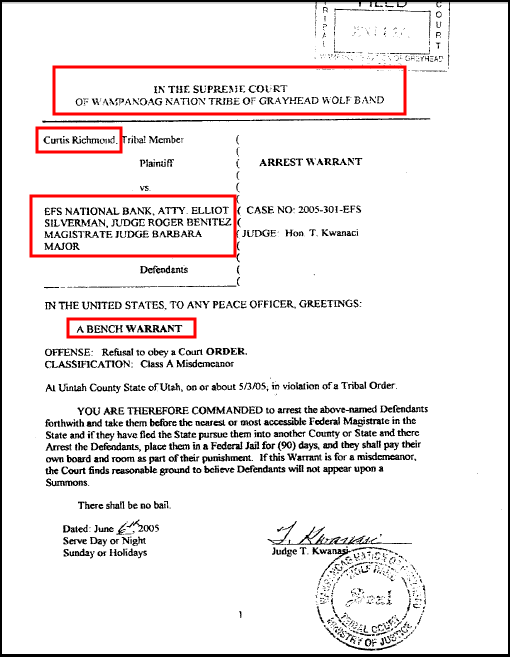
    ASD mainstay Curtis Richmond claims U.S. District Judge Stephen Friot owes him $30 million and must step down from a case.
    ASD mainstay Curtis Richmond claims U.S. District Judge Stephen Friot owes him $30 million and must step down from a case.
    Curtis Richmond filing in ASD case in which $30 million again is cited. Unlike the $30 claim against Friot in the seprate case (noted in screen shot directly above), the ASD claim appears to be targeted at four public servants, including Judge Rosemary Collyer, perhaps calling for a grand total of $120 million.
    Curtis Richmond filing in ASD case in which $30 million again is cited. Unlike the $30 million claim against Friot in the separate case (noted in screen shot directly above), the ASD claim appears to be targeted at four public servants, including Judge Rosemary Collyer, perhaps calling for a grand total of $120 million. One of the claims was that a court clerk was guilty of a "major Interference With Commerce and Interference With Interstate Commerce" and thus apparently owed ASD pro se litigants $30 million.
    Curtis Richmond turns to fraudulent 'Supreme Court' and seeks the arrest of federal judges, a banker and an attorney.
    Curtis Richmond turns to fraudulent 'Supreme Court' and seeks the arrest of federal judges, a banker and an attorney.
    On July 24, 2009, VanaBlue claimed on its webesite that it owned the company that owned the eWalletPlus payment processor. At least three companies, including AdViewGlobal, also have claimed to own eWalletPlus. What company or individual actually owns the processor continues to be a mystery involving AVG, VanaBlue, Karveck Corp., TMS Corp., TMS Association and TMS Corp. USA LLC, which used AdSurfDaily's street address in Quincy, Fla. Federal prosecutors said last year that the Quincy street address was bogus.
    On July 24, 2009, VanaBlue claimed on its website that it owned the company that owned the eWalletPlus payment processor. At least three companies, including AdViewGlobal, also have claimed to own eWalletPlus. What company or individual actually owns the processor continues to be a mystery involving AVG, VanaBlue, Karveck Corp., TMS Corp., TMS Association and TMS Corp. USA LLC, which used AdSurfDaily's street address in Quincy, Fla. Federal prosecutors said last year that the Quincy street address was bogus.
    In April, AFTER AVG had claimed to own eWalletPlus and AFTER Avg reported its bank account had been suspended, eWalletPlus reported on its website that new registrations were disabled.
    In April, AFTER AVG had claimed to own eWalletPlus and AFTER AVG reported its bank account had been suspended, eWalletPlus reported on its website that new registrations were disabled.

  • BULLETIN: Judge Denies 3 Bowdoin Motions; ASD Asks For A Second Evidentiary Hearing In Federal Forfeiture Case

    UPDATED 10:27 P.M. EDT (U.S.A.) A federal judge has denied two pro se motions by AdSurfDaily President Andy Bowdoin to undo the forfeiture of tens of millions of dollars seized last year by the U.S. Secret Service.

    Separately, U.S. District Judge Rosemary Collyer also denied a third motion by Bowdoin to exclude and suppress evidence obtained in an interview with Secret Service agents.

    Meanwhile, Bowdoin has asked for an evidentiary hearing in which ASD would call “approximately five” witnesses to help it demonstrate that Collyer should permit ASD to reopen its claims to the seized money.

    Bowdoin submitted to the forfeiture in mid-January, but changed his mind in late February. He submitted a pro se motion to reopen the claim, and his attorney, Charles A. Murray, filed a supplemental motion on Bowdoin’s behalf.

    Murray today filed a motion seeking the evidentiary hearing. The motion suggests prosecutors plan to oppose the motion.

    “Counsel has conferred with opposing counsel who has his opposition to this motion,” Murray said, in his request for the evidentiary hearing.

    If the motion is granted, it would lead to the second evidentiary hearing in the case. The first was held Sept. 30-Oct. 1, and Collyer ruled in November that ASD had not demonstrated it was a legal business and not a Ponzi scheme at the proceeding.

    Collyer rejected three pro se motions today that Bowdoin had filed earlier this year, including the motion to exclude and suppress evidence.

    “The agents who searched Mr. Bowdoin’s property and seized certain tangible evidence were operating on the basis of a warrant issued ‘upon probable cause, supported by an affidavit made under oath, which particularly described the place to be searched and the things to be seized,’” Collyer said.  “There is no basis upon which to suppress evidence so seized.

    “Nor is there any basis to suppress Mr. Bowdoin’s statements to the investigators,” Collyer wrote, pointing out that, “Though Mr. Bowdoin initially declined to speak to the agents without a lawyer present, he later agreed to be interviewed.”

    Collyer noted that the forfeiture case was brought as a civil proceeding, not a criminal proceeding.

    “As Mr. Bowdoin’s statements are not being used to subject him to criminal liability, there can be no violation of his privilege against self-incrimination here,” Collyer wrote.

    She also rejected a Bowdoin argument that the civil forfeiture case should be dismissed because Bowdoin did not receive a Miranda warning.

    “Mr. Bowdoin was never placed under arrest, never ordered to participate in the interrogation, and was in his own home,” Collyer said. “The agents had no duty to advise him of his Miranda rights, and their failure to do so cannot be a basis for suppressing his statements.”

    Collyer also rejected Bowdoin’s claims that she lacked jurisdiction to hear the matters, that Bowdoin had been denied “fair notice” that his conduct with ASD was illegal and that the civil-forfeiture case actually was a “quasi-criminal matter.”

    “Mr. Bowdoin further argues that because this action is ‘quasi-criminal’ the Government should be required to prove its case by ‘clear and convincing’ evidence rather than by a preponderance of the evidence,” Collyer said. “A look at the Civil Asset Forfeiture Reform Act of 2000 (‘CAFRA’), 18 U.S.C. § 981, et seq., demonstrates the fallacy of this argument.”

  • REALITY CHECK: Is Bowdoin Running Out Of Options?

    UPDATED 8:52 A.M. EDT (U.S.A.) Is AdSurfDaily President Andy Bowdoin quickly running out of options?

    A small spin campaign appears to be under way, and an email circulating among ASD members suggests the company will hold a conference call Monday. Like everything concerning ASD, the wording of the email is ambiguous. It is possible, however, that the email signals in ASDspeak that the end game is under way.

    There is trouble in all directions for ASD.

    Imagine ASD President Andy Bowdoin standing inside a see-through box facing you, with each wall of the box having a see-through grandstand. Every person in the grandstands poses risk to Bowdoin.

    The government is in the grandstands in the ceiling, which could collapse at any second; RICO attorneys are in the cellar grandstands, which could open up and swallow the floor. ASD’s rank-and-file membership is in the grandstands to Bowdoin’s left, which seat thousands of people who have been fleeced. They’ve been ignored for so long — and are so soured by Bowdoin’s various legal filings — that crashing the gate and bringing down the wall so Bowdoin cannot ignore their questions or mute them in a phone conference is a real possibility.

    Finally, seated in the grandstands on Bowdoin’s right, are potential co-defendants. They’re unhappy, too. Some of them want the legal game to continue because it provides a limited amount of cover for them. Others, however, have come to the realization they’ve been drafted into a conspiracy and hold Bowdoin accountable for making fools and potential co-defendants out of them. Some of them perhaps have received target letters from the prosecution. Others perhaps are unindicted co-conspirators. This wall, too, is in danger of collapse.

    If it all comes tumbling down, ASD’s few remaining janitors will sweep it up. ASD’s janitors always sweep it up. Some of them sing and think happy thoughts while they sweep. After all, there are no prizes for predicting rain, only for building arks.

    The Pickle

    In similar cases, courts have issued orders to repatriate assets, preserve evidence and prevent the destruction of documents. Judges also have jailed Ponzi scheme figures for intransigence or simply because they were arrested in advance of a bail hearing.

    It is possible that certain members of ASD and AdViewGlobal (AVG) have received target letters from the Department of Justice. Bowdoin himself hints of the existence of a sealed indictment handed down in May, the same month closely connected AVG was engaging in all sorts of bizarre behavior that got only more bizarre as spring transitioned into summer.

    Bowdoin’s two recent affidavits,  if anything, show insiders and serial promoters that significant jail time may be in the offing for criminal participants. Woe to them if they try to wipe evidence. They also are in a box: The government has the database and other records, and has interviewed garrulous Bowdoin over a period of at least four days.

    They weren’t discussing the weather or how Florida and Florida State will do this fall on the gridiron.

    Separately, the prosecution can argue, we believe, that Bowdoin and perhaps others are flight risks. The August complaint mentions an assertion by a banker that Bowdoin intended to buy a home in another country. (The snippet below is from paragraph 64 of the August forfeiture complaint.)

    “A [Secret Service/IRS Task Force Member] also learned that earlier in July 2008, a bank other than BOA closed the last account that was controlled by Bowdoin or family members after that bank determined, and explained to them, that an investigation by the bank determined that Bowdoin appeared to be operating a Ponzi scheme. Bowdoin indicated that he purchased, or was seeking to purchase, a home in another country.”

    ‘Offshore’ Shelter Is A Myth

    The very nature of ASD’s — and AVG’s — operations inure to the prosecution’s benefit. Both companies publicly advertised funding through offshore payment processors. Nothing in the public record so far in the forfeiture case against ASD suggests any of the offshore money has been repatriated — either by Bowdoin or alleged co-conspirators.

    So, the prosecution can point to the “home in another country” claim, Bowdoin’s intransigence and the existence of publicly advertised, offshore payment mechanisms in the names of thousands of people to demonstrate high potential for money to be hidden or dissipated, evidence to be destroyed and for people to flee to avoid prosecution. Bowdoin always has been at risk of confronting an order to repatriate the money and/or sit in jail.

    Participants also could find themselves confronting such an order — whether they have been indicted or not. A lack of an order, however, does not provide cover for individuals to destroy evidence. Prosecutors know that evidence exists.  If they go looking for it and discover it’s not there, it won’t be a happy day for co-conspirators who destroyed it. They are up against one of the top law-enforcement agencies in the world.

    Some readers will remember, of course, that the word went out with seven exclamation points on the Pro-ASD Surf’s Up forum in February to start closing down bank accounts because the Secret Service was coming.

    __________________________________________________________________________

    “If you took any money from ASD and it is in a bank account, get it out!!!!!!!

    Thanks,
    Erma

    __________________________________________________________________________

    Because the government has seized Bowdoin’s real estate, he may have serious trouble making bail if he finds himself sitting in jail. His bond could be set in excess of his paper net worth, owing to the serious nature of the crimes. Money hidden in shell companies  — Bowdoin/Harris Enterprises or any Bowdoin-connected business, for example — will be of no help, because that is the money the government would seek to collect to stop Bowdoin from committing more crimes.

    In the Regenesis 2×2 case, the Secret Service kept certain parties under surveillance for five weeks, prior even to applying for search warrants. Agents even monitored a Dumpster and observed as evidence was discarded. They then gathered the evidence from the Dumpster and brought in experts in computer forensics.

    Given the nature of AVG’s claims — Uruguay and all of that — there is a chance that certain people have been kept under surveillance. It is possible that the Justice Department has moved the State Department to seal the borders with respect to travel by certain individuals.

    It is possible that passports already have been collected. But because money either is missing or unaccounted for and may be stashed anywhere, the risk of flight is high.

    Andy Bowdoin and criminal co-conspirators, we believe, have created the perfect storm for ASD/AVG members. There might have been a concerted, coordinated effort in February to obstruct justice.

    A March 13 letter on Surf’s Up in which Bowdoin announced he had met with a “group” and filed pro se court pleadings, we believe, is extremely damaging.

    __________________________________________________________________________

    About a month ago, several members introduced me to a group that studied what my attorneys did. The group said that my attorneys had taken the wrong approach. The group was very confident that they could help because the government had broken so many laws and had violated our rights as citizens of the United States.

    I have rescinded my decision to release our ownership of all the assets. I filed various motions a few weeks ago, and several more last week, to dismiss our case and to return the assets because of the violations committed by our government.

    We are ready to pursue this all the way to the US Supreme Court.

    A great injustice has been done to 100,000 people, and we need to stand up and fight for our rights. Some agencies of the government have become so powerful that they believe they are above the Constitution. We, as members of ASD, need to help stop this misuse of power. I ask each one of you to write to the Justice Department, to your senators and representatives, to the President, and even to Glenn Beck of Fox News. Tell them all what the Justice Department has done to your business.

    We will be filing papers in the next couple of weeks that should really get their attention. Watch for the filings. I will be speaking out on a conference call as soon as the filings are completed. We will notify you of the call. I look forward to talking to you then.

    I appreciate your support in helping us get back what rightfully belongs to the members of ASD.

    Thanks,
    Andy Bowdoin

    __________________________________________________________________________

    Now, compare that letter to what Bowdoin said about his pro se status in paragraph 23 of his corrected affidavit filed two days ago:

    https://patrickpretty.com/wp-content/uploads/2009/09/bowdoincorrectedaffidavit.pdf

    In effect, Bowdoin was advising the court that he ultimately concluded that his pro se strategy did not meet his needs — and that he didn’t recognize this until after he had embarked on the campaign. He makes no mention of the fact a federal judge advised him in March that corporate litigants could not proceed pro se.

    “I determined that I could not adequately represent my legal interests pro se, and having lost confidence in my existing legal counsel, I retained separate criminal counsel to pursue reinstatement of my claims . . . ,” Bowdoin said, in paragraph 23 of the affidavit.

    But in March, as the letter above demonstrates, Bowdoin was expressing supreme confidence about the pro se strategy: (Emphasis added.)

    We are ready to pursue this all the way to the US Supreme Court,” he said. “We will be filing papers in the next couple of weeks that should really get their attention. Watch for the filings. I will be speaking out on a conference call as soon as the filings are completed. We will notify you of the call. I look forward to talking to you then.”

    So, Bowdoin had turned over ASD’s fate to a “group” that had analyzed the approach of Bowdoin’s paid counsel, found it lacking and prevailed upon him to change his mind about submitting to the forfeiture.

    “The group was very confident that they could help because the government had broken so many laws and had violated our rights as citizens of the United States,” Bowdoin said. “I have rescinded my decision to release our ownership of all the assets. I filed various motions a few weeks ago, and several more last week, to dismiss our case and to return the assets because of the violations committed by our government.”

    Key phrases:

    • “The group”
    • “very confident that they could help”
    • “I have rescinded my decision” (after meeting with the group)

    Bowdoin filed drivel with the coaching of the group. He signed the documents. His signature coincided with the “If you took any money from ASD and it is in a bank account, get it out!!!!!!!” report on Surf’s Up.

    And it coincided with AVG’s sudden shift to an “association” structure after members, too, were introduced to a “group” — Pro Advocate Group.

    The previous weeks and the following months were dominated by pro se filings, mostly not from Bowdoin. But Bowdoin now says, “I determined that I could not adequately represent my legal interests pro se.

    He arrived at this conclusion after he promised a pro se Supreme Court battle and after a federal judge advised him corporate entities could not proceed pro se. Bowdoin’s affidavit, however, suggests he came to his recognition that the pro se strategy didn’t work for him only after taking the time — apparently weeks later — to contemplate the serious legal implications.

    The trouble with that statement is that Bowdoin’s own affidavit shows the pro se strategy began after his four days of meetings with prosecutors and after his potential prison time was spelled out and after he submitted to the forfeiture — and yet Bowdoin would have a judge believe he did not understand the issues.

    If he did not understand the issues, he would have had no reason to consult with the “group” and embark on the pro se strategy to begin with.

    Not only is Bowdoin blaming government lawyers and his own paid lawyers, he also now is blaming the amateur lawyers — and perhaps a cloaked professional attorney whose name has not been introduced in the case but helped Bowdoin in his pro se efforts.

    Bowdoin is taking responsibility for none of it: bad prosecutors, bad lawyers, bad amateurs who happened to arrive on the scene around the same time he submitted to the forfeiture, the Secret Service reportedly was seizing bank accounts and AVG was going underground with the “association” nonsense.

    It looks like a bizarre bid to obstruct justice — and Bowdoin is trapped between people who prevailed upon him to proceed pro se, and the government, which holds Bowdoin’s proffer, his statements (probably recorded and perhaps even on videotape), the database, business records, banking records and evidence gleaned from others.

    The walls could come crashing down soon — unless negotiations Bowdoin entered into with the government weeks ago were productive, and a plan already is in place for Bowdoin to exit the stage after addressing members one last time.