Category: Ad Surf Daily

  • Zeek Receiver In Process Of Sending Large Batch Of Claim-Determination Notices; ‘Program’ Operated ‘Like World’s Biggest Chain Letter,’ Likely Created Losers On Unprecedented Scale And Resulted In Ill-Gotten Gains In All 94 Federal Districts, Receiver Says

    Zeek receiver Kenneth D. Bell at a Dec. 13, news conference in Lexington. N.C. Source: Screen shot from video at receivership website.
    Zeek receiver Kenneth D. Bell at a Dec. 13 news conference in Lexington, N.C. Source: Screen shot from video at receivership website.

    The court-appointed receiver in the Zeek Rewards Ponzi-scheme case has announced he is in the process of sending a batch of more than 80,000 Notices of Claims Determination. This is the first batch of such notices, which the receiver began to issue yesterday. The first batch is expected to take through Dec. 31 to be fully sent.

    Zeekers not included in the first group of 80,000 should remain calm.

    “Not receiving a Claim Determination notice at this time does not mean that your Claim is not valid,” receiver Kenneth D. Bell said in an update posted on the receivership website and dated Dec. 27. “Certain Claims will take additional time to evaluate and may require us to make further contact with you before we issue a Claim Determination. We are and will be working hard to reconcile all Claims and send all Claims Determination as soon as we are able to do so.”

    More than 175,000 claims were filed in the Zeek case, Bell said in Dec. 13 letter.

    The sending of the first batch of notices, though good news, does not mean that a distribution from the receivership estate is imminent. What it means is that individuals who receive a notice can log into the Claim Determination Portal to review the determination and follow the instructions provided to either accept or object to the determination. (Read the Dec. 27 update at the receivership website.)

    “We’ll be able to get, I think, more than 50 cents on the dollar back to people,” Bell said at Dec. 13 news conference.

    One or more distributions may come from the receivership. The first is contemplated for the first quarter of 2014, though more reconciliation work needs to be done before it is scheduled, Bell said.

    Top Ponzi Winners’ Alleged Hauls

    On the clawback front, Bell said on Dec. 13 that Zeek’s Top 10 net winners each received at least $900,000 from the Ponzi scheme.

    The biggest net winner received on the order of $1.8 million, Bell said.

    Clawback lawsuits are contemplated against roughly 9,000 net winners in the United States alone, Bell said.

    “They’re in all 94 U.S. District Courts, they’re in every state in the country,” Bell said. He noted that the U.S. winners have combined clawback exposure on the order of $200 million.

    Another 6,000 or so net winners are not U.S. residents and may have exposure of “several tens of millions of dollars,” Bell said.

    “We are trying to figure out who we can sue and where,” Bell said of Zeek’s international winners.

    Zeek operated through Rex Venture Group LLC of Lexington, N.C.

    ‘Like The World’s Biggest Chain Letter’

    “This Ponzi scheme is just fascinating to me in a lot of ways,” Bell said of Zeek. “It only lasted for about 20 months, from January 2011 [to] mid-August of 2012. During that time, it brought in something north of $800 million from about 900,000 people from 100 countries around the world. I mean, it’s like the world’s biggest chain letter, if you will.”

    The AdSurfDaily Ponzi scheme exposed by the U.S. Secret Service in 2008 brought in about $120 million and ensnared about 100,000 participants, also in less than two years of operation. Zeek, which launched after ASD was exposed and had promoters in common with ASD, appears to have brought in more than seven times the dollar volume of ASD while roping in about nine times the number of participants.

    More than $850 million was directed at Zeek, the SEC said last week.

    Zeek and ASD both operated MLM “programs” and had strikingly similar business models. Although ASD posed logistical challenges to the U.S. courts and victims seeking restitution, Zeek’s enterprise appears to have established an unprecedented challenge.

    Bell has called Zeek “one of the largest — if not the largest — Ponzi and pyramid schemes in history.”

    On Dec. 20, federal prosecutors charged former Zeek COO Dawn Wright-Olivares and former Zeek programmer Daniel Olivares criminally, marking the first criminal prosecutions in the case. The SEC sued Wright-Olivares and Olivares civilly on the same day. The former Zeek pair settled with the SEC, agreeing to pay more than $11.4 million.

    On the criminal side of things, Wright-Olivares agreed to plead guilty to investment-fraud conspiracy and tax-fraud conspiracy. Olivares agreed to plead guilty to investment-fraud conspiracy.

    The SEC sued Zeek operator Paul R. Burks in 2012.

    Various Zeek probes are ongoing, investigators said last week.

    Bell said that most individuals who filed Zeek claims “did an excellent job.” He added, however, that some individuals filed “fraudulent claims” and that some “net winners” appear to have filed claims that state losses.

    “We want to make sure we’re not paying claims to people who ought to be paying the money back to the receivership,” Bell said.

  • EDITORIAL: Zeek Jungleland Exposed: A Brilliant Disguise No More

    zeekmemday

    “So tell me what I see when I look in your eyes. Is that you baby or just a brilliant disguise?”Bruce Springsteen, Jersey Shore poet, lyricist, singer, musician, philanthropist and American icon. From “Brilliant Disguise” on the “Tunnel of Love” album, Columbia Records, 1987

    That something can become an embarrassment to an entire nation — while somehow not becoming one to an entire industry — is the most important takeaway from the monumentally bizarre tale of Zeek Rewards.

    Involuntarily forced by the SEC last year to abandon Zeek’s criminally gushing spigot, some of Zeek’s greatest purported “leaders” simply took their winnings and hitched their wagons to other MLM HYIP scams-in-progress. Those actions finally are catching up to them. The court-appointed receiver in the Zeek Ponzi- and pyramid case is expected to start suing them within hours for being the beneficiaries of tens of millions of dollars in fraudulent transfers.

    Some Zeek insiders and winners may have criminal exposure. Two were charged criminally last week, marking the first instance in the long-running Zeek probe in which the prospect of jail time has been used publicly as a deterrent.

    And this brings us to today, Christmas Day 2013.

    There is no holiday joy or bogus claims of patriotism today in the criminal and prefelony wings of Zeekland. A ticking clock now has fully replaced the outrageously tacky Zeek penny-auction flag, an insult to free-market commerce masked as a call to liberty. That Zeek wrapped itself in Old Glory while ripping off tens and tens of thousands of Americans and other peoples of the world made its $850 million fraud a crime for the ages. Active civil and criminal investigations continue on at least five fronts. Zeek’s jungleland has been exposed, its brilliant disguise is in tatters.

    Mysteries remain. When the SEC went to federal court last week to charge former Zeek COO Dawn Wright-Olivares with securities fraud and selling unregistered securities and her stepson (Daniel Olivares) with securities fraud, the agency left dangling the answer to a most-intriguing question: When did Dawn and Daniel find out Zeek’s dividend that averaged about 1.5 percent daily “bore no relation to the company’s net profits” and that Zeek operator Paul R. Burks allegedly had “unilaterally and arbitrarily” determined the payout?

    In its Wright-Olivares/Olivares civil complaint filed Dec. 20, five days before Christmas, the SEC says the pair found out while they were working for Zeek that Burks allegedly was concocting figures to scam the Zeek masses — but the agency doesn’t say precisely when the Olivareses learned.

    The SEC’s “unilaterally and arbitrarily” line about Burks strikes us as a polite way of saying he made up the numbers out of thin air. One would think that any COO worth the title would have questioned from Day One the numbers Burks supplied. Such unusually consistent and utterly preposterous daily gains were obvious markers of fraud, to say the least. And preposterous numbers manufactured from thin air to dupe the MLM masses were a major part of the AdSurfDaily Ponzi prosecution in 2008. If ever there was an MLM cautionary tale, it was the ASD story.

    If Wright-Olivares somehow didn’t know about the ASD case and the striking similarities between ASD and Zeek, she ranks among the most clueless American business executives of all time. If she did know about Zeek’s similarities to ASD and turned a blind eye, she is one of the MLM world’s most predatory hucksters.

    Although Daniel Olivares, a programmer, conceivably could have argued that his inherent geekiness kept him focused on code rather than the math behind the scheme, such a superficially plausible argument ultimately would have failed. As an MLM executive with a COO title, his stepmother had no argument, not even a superficially plausible one.

    The bitter reality for Dawn and Daniel is that there’s no good answer to the “what did they know and when did they know it” question, likely a contributing factor to their decisions to settle with the SEC and to plead guilty to criminal charges filed by federal prosecutors in the Western District of North Carolina. If they discovered early on that Burks was fabricating profitability numbers in the same fashion that jailed ASD Ponzi-schemer Andy Bowdoin had manufactured them in 2008 and earlier, it means that they sat back and watched as Zeek created victims by the tens and tens of thousands in a combined Ponzi- and pyramid scheme and tax fraud.

    If they found out later — say, within the final weeks of Zeek’s operation before its August 2012 collapse — it means that they still planned to benefit from the fraud despite the pain Zeek was about to inflict on a community of hundreds of thousands of people. In the settled SEC case filed against Dawn and Daniel last week, the agency alleged that they were “[a]ware that the ZeekRewards was under investigation by several law enforcement agencies and that the business was in serious trouble in 2012.”

    Indeed, the agency alleged that “Wright-Olivares, Olivares and others accepted, substantial sums of money from the scheme (or had prior loans forgiven) before it was shut down without advising investors.” The SEC further alleged that once the Olivareses learned Burks was pulling numbers out of a hat, they did the same thing in his absence.

    Had the SEC not acted on Aug. 17, 2012, to stop the Zeek Ponzi monster in its tracks, it likely would mean that Zeek would have hosted a wallet-pilfering “Red Carpet” event as planned on Aug. 22. Had Dawn, for example, been in that room on Aug. 22, it very much appears that she’d have been there with full knowledge that she intended to steal from attendees she greeted with a smile. She might have done the same thing at earlier Red Carpet events. The earliest was held on April 18, 2012. Others followed.

    Of course, the alleged fabrication of the daily dividend rate makes for interesting conversation, but it was hardly the only concern about Zeek. It is inconceivable that Dawn and Daniel did not understand even before they allegedly learned that Burks had fabricated numbers that Zeek was a Ponzi scheme. The SEC covers these elements thoroughly in its complaint last week. Outtakes (bolding added):

    • Both Defendants also learned, and Wright-Olivares and other RVG [personnel] failed to disclose, that without new investor deposits (in the form of VIP Bid purchases and subscription fees), revenues would dwindle substantially as only approximately 2% of daily revenues came from actual retail sales, and the scheme would likely collapse.
    • Wright-Olivares knew, and Olivares learned in the course of working for RVG, that daily award payments from the Retail Profit Pool – which were credited to investor accounts, supposedly making such sums available for cash withdrawal – were unsustainable absent a constant influx of new investor money.
    • Based on the average 1.5% daily dividend on 3 billion Profit Points outstanding by the time ZeekRewards was shut down in August 2012, ZeekRewards would owe nearly $45 million per day in profit share awards to investors (ZeekRewards Qualified Affiliates) if all investors requested cash rewards instead of points. Both Wright-Olivares and Olivares knew that the company’s actual daily revenues — which averaged approximately $5 million per day (based almost entirely on new affiliate subscriptions and VIP bid purchases) at the time ZeekRewards was shut down – could not support such daily cash payouts, but neither did anything to warn investors.
    • In order to discourage investors from withdrawing too much cash from the scheme, Wright-Olivares and other RVG personnel encouraged affiliates to reinvest at least 80% of their daily awards into a point compounder, and to withdraw no more than 20% in cash. By convincing affiliates that they could compound their earnings by reinvesting daily awards, RVG slowed the outflows of cash and sustained the ZeekRewards fraud for longer.
    • Wright-Olivares and other RVG personnel failed to disclose to investors that the company would quickly become insolvent if more Qualified Affiliates elected to take daily awards in cash from the Retail Profit Pool rather than converting their awards into ever-increasing accumulated Profit Points.
    • Wright-Olivares and other RVG personnel also failed to inform investors of the substantial risk that the Matrix was prone to collapse if the promoters were unable to recruit ever-increasing numbers of paid affiliates into the Matrix pyramid, because, as both Wright-Olivares and Olivares knew, without new investors there would be no source of revenue to pay existing investors.
    • In order to conceal from investors and regulators the true nature of the ZeekRewards scheme, Wright-Olivares and others directed several superficial or nominal changes to certain ZeekRewards features, which Olivares implemented. This included removing any references on the website to the terms “investment” and “ROI”; substituting a daily award percentage that in the aggregate approximated 125% every 90 days rather than “guaranteeing” a 125% return; and requiring investors to give away VIP bids to foster the illusion of contributing efforts to the enterprise.

    There’s plenty more . . .

    As the PP Blog reported in an editorial on June 10, 2012, two months before the collapse of Zeek, Wright-Olivares had been a guest on ACES Radio Live two days earlier, on Friday, June 8, 2012. During the broadcast, she contended to co-hosts Jim Gillhouse and Troy Dooly that “Paul manages all that,” meaning that Burks uniquely managed Zeek’s daily dividend rate and purported revenue-sharing calculations.

    If she was telling the truth, it means that she found out only after the broadcast that Burks allegedly had fabricated the numbers. But if she knew prior to uttering those words, it means that she lied to Gillhouse and Dooly and their entire audience of MLMers.

    Credit is due Gillhouse for not knuckling under to the Zeek PR machine. He used the radio show to try to get to the truth about Zeek’s murky math and revenue-sharing calculations. Dooly later settled SEC allegations that he failed to disclose that he was part of Zeek’s PR machine when he was delivering Zeek-related puffery on the radio and on his Blog.

    It seems clear that the SEC used the radio program to explore the issue of when Wright-Olivares found out that Burks allegedly was manufacturing numbers. At a minimum, the “Paul manages all that” answer gave the agency a starting point at which it could begin the process of pinning down the former Zeek COO. If she goes to prison, her various comments on ACES Radio Live could be part of the reason. There simply was no more wiggle room left for Zeek by that fateful Friday in June 2012, and court filings suggest the SEC probe had begun at least two months earlier, on April 17, 2012, one day prior to Zeek’s first Red Carpet Event.

    One or more Zeek insiders could have been spilling the beans to investigators even before the radio program aired.

    The danger Zeek posed to investors and the U.S. financial system was untenable, which likely is precisely why the U.S. Secret Service became involved in the Zeek probe after earlier spearheading the ASD probe. It is simply beyond the pale that former ASD investors also became involved in Zeek. Both “programs” polluted banks and financial vendors with tainted proceeds from scams whose rotten cores were fundamentally the same.

    The ASD enterprise raked in about $120 million, according to court filings. Zeek gathered at least $850 million, the SEC says. When the proceeds from the two scams are combined, the receipts allegedly total at least $970 million — nearly $1 billion. The combined victims’ count numbers in the hundreds of thousands. Wealth fundamentally was stolen from a vast number of people and placed in the hands of a virtually preordained few.

    Perhaps most remarkable of all is that some of the people who involuntarily left Zeek because of the SEC action didn’t miss a beat: They almost immediately starting pushing other “revenue sharing” MLM scams, likely using tainted money from Zeek to buy into those “programs.”

    For X number of people in Zeek’s inner circle or in the “net winner’s” club, the “what did they know and when did they know it” question was answered in 2008, when they were promoting AdSurfDaily.

    Dawn Wright-Olivares and Daniel Olivares should not take the Zeek criminal fall alone. They had plenty of helpers. ASD’s Andy Bowdoin is sitting in prison at the age of 79 with some of his helpers who went on to help Zeek still on the outside.

    If Wright-Olivares, Olivares and Burks go to jail, some of the ASDers who later promoted Zeek deserve to join them there. It was not stupidity; it was willful blindness and incredibly brazen and ongoing criminality ported from one fraud scheme to another. # # #

    NOTE TO ‘OZ’: You deserve high praise for your exceptional work on Zeek. Regardless, I have read many comments on your Blog from people who’d prefer that you shill, rather than educate and illuminate. For close to 40 years, I have found inspiration in the line from Bruce Springsteen highlighted below. Here’s hoping it will inspire you if you ever find yourself wondering if you’ve made a difference.

    On this Christmas Day, I wish you my best and congratulate you on your 1,000th post at BehindMLM.com. For good measure, I wish you the best piano sounds of Roy Bittan, the best violin sounds of Soozie Tyrell, the best guitar sounds of Nils Lofgren, Garry Tallent and Steven Van Zandt, the best drum beats of Max Weinberg, the best saxophone tones from the late and immortal Clarence Clemons,  the combined talents of the gifted but lesser-known players in the E Street Band — and the best Jersey Shore poetry of Bruce Springsteen.

    May you always be a giant Exxon sign that gives your fair city light. And may you always remain a writer who doesn’t just stand back and let it all be. Happy Holidays to you, Oz, and to all of my readers.

    “[A]nd the poets down here don’t write nothing at all, they just stand back and let it all be.”Bruce Springsteen. From “Jungleland” on the “Born to Run” album, Columbia Records, 1975

  • TOMORROW (DEC. 17) AT THE ZEEK AUCTION: Branded Ponzi History Up For Bid: Coffee Mugs, Water Bottles, Key Chains, Refrigerator Magnets — And Plaques Of Network Marketing Business Journal Puff Pieces

    zeeknmbjIt won’t be quite like buying Bonnie and Clyde’s fateful getaway car, but it still will represent a purchase of American crime or fraud history. In Lexington, N.C., tomorrow — on the second and final day of the court-approved Zeek Rewards auction — pieces of MLM Ponzi-scheme history will be put up for bid.

    And in Zeek’s case, it’s branded history: cases of water bottles with Zeekler.com branding, cases of coffee mugs with ZeekRewards branding, cases of key chains with Zeekler branding, cases of refrigerator magnets with Zeekler branding.

    The taglines on the Zeek coffee mugs read, “save money — make money.”

    Auctioneers also have put something called the “Zeek-Israel Jerusalem Trophy” up for bid.

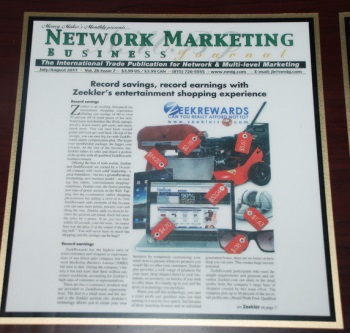
    Also on the auction list are plaques of Zeek puff pieces that appeared in the July-August 2011 edition of Network Marketing Business Journal. Here’s the headline: “Record savings, record earnings with Zeekler’s entertainment shopping experience.”

    NMBJ is published by Keith Laggos, a touting defendant in a 2004 SEC case who later became a figure in both the Zeek Ponzi-scheme story and the AdSurfDaily Ponzi story.

    About a year after the July-August 2011 NMBJ article appeared, the SEC alleged that Zeek was a $600 million Ponzi and pyramid fraud. ASD was a $119 million Ponzi scheme exposed by the U.S. Secret Service in 2008.

    Plenty of gift cards, furniture, computer equipment and other items linked to Zeek also are up for bid tomorrow.

    In terms of the number of victims — somewhere on the order of 800,000 — Zeek is believed to be the largest Ponzi scheme in U.S. history.  Kenneth D. Bell is the court-appointed receiver.

    See PP Blog story from earlier today on Day 1 of the Zeek auction.

    The Day 2 auction begins at 9 a.m. ET tomorrow, Dec. 17, 2013.


  • DEVELOPING STORY: Ghastly Campaign On Facebook To Intimidate TelexFree Prosecutor In Brazil May Be Under Way

    ponzinews1Facts are sketchy, but there are disturbing reports in Brazilian media today that someone with a Facebook account used it to claim falsely that a prosecutor involved in the TelexFree pyramid-scheme probe had been murdered. The bogus report was supplemented by photos of a mutilated body purported to be that of the prosecutor.

    Investigators in Brazil are treating the matter as an effort to intimidate the prosecutor, according to media accounts in Portuguese.

    TelexFree has been under investigation in Brazil since at least June. There have been reports of death threats directed at a prosecutor and a judge.

    But apparent efforts to menace officers of the court are only one symptom of the disconnect that accompanies TelexFree, an MLM “program” that some U.S. affiliates say triples or quadruples money in a year.

    The PP Blog has observed recent instances in which apparent TelexFree members hoping to gain recruits spammed Comments threads below stories in Brazilian media that reported on the suicide deaths of two TelexFree members in the country.

    New TelexFree registrations are blocked in Brazil. Certain TelexFree assets have been frozen. Pitchfests, though, continue in other countries. Some promos have encouraged Brazilians to pose as residents of the United Kingdom to evade the limitations imposed in Brazil and sign up for the “program.”

    TerraMagazine possibly was the first outlet to report the disturbing news about the false reports about the murder of a prosecutor. There’s also a report on cbnfoz.com.br. (See Google Translation from Portuguese to English.)

  • BULLETIN: No Immediate Comment From Federal Prosecutors On Payza/Obopay Announcement On U.S. Attorney’s Site In District of Columbia: [UPDATE: Prosecutors Confirm Probe Under Way, Decline To Provide Details Or Identify Subject Of Investigation]

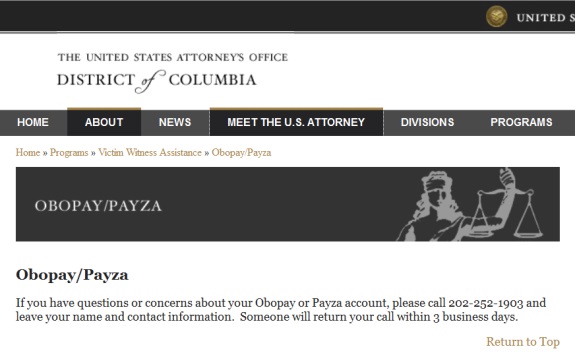
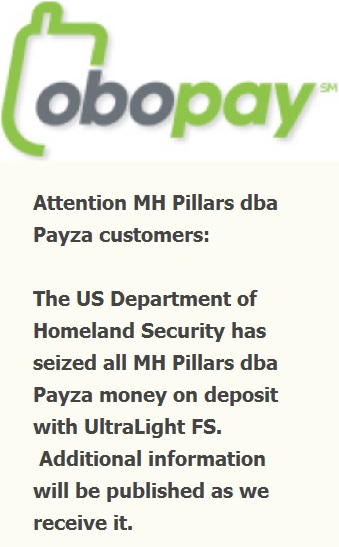
    This note concerning OboPay and Payza is appearing on the website of U.S. Attorney Ronald C. Machen Jr. of the District of Columbia this morning.
    This note concerning Obopay and Payza is appearing on the website of U.S. Attorney Ronald C. Machen Jr. of the District of Columbia this morning.

    EDITOR’S NOTE ADDED AT 10:09 A.M. Federal prosecutors in the District of Columbia now have confirmed that an investigation is under way, but declined to provide details. “The U.S. Attorney’s Office is involved in a pending investigation and we are unable to state the subject of the investigation or provide details,” the office of U.S. Attorney Ronald C. Machen Jr. said moments ago.

    Original story below . . .

    ________________________________

    The office of U.S. Attorney Ronald C. Machen Jr. of the District of Columbia (Washington, D.C.) did not immediately respond to a request for comment this morning on a note concerning Payza and Obopay that is appearing on its website.

    The two-sentence note, which appears under a headline of “Obopay/Payza,” reads as such: “If you have questions or concerns about your Obopay or Payza account, please call 202-252-1903 and leave your name and contact information.  Someone will return your call within 3 business days.”

    A PP Blog reader reported the existence of the note at 8:58 a.m. today. How long the note had been posted was not immediately clear. Nor was it immediately clear why Machen’s office was involved in an Obopay/Payza matter.

    Machen’s office, working with the U.S. Secret Service, successfully prosecuted the $119 million AdSurfDaily Ponzi scheme. ASD used AlertPay, Payza’s predecessor brand.

    And Machen’s office, again working with the Secret Service, also successfully prosecuted the eGold payment processor.

    Payza/AlertPay also were processors used by the alleged $600 million Zeek Rewards Ponzi- and pyramid scheme. The Secret Service also is investigating Zeek.

    See Nov. 28, 2013, PP Blog post on conflicting reports concerning the unavailability of Payza funds in the United States.

  • URGENT >> BULLETIN >> MOVING: Lawsuits Against Zeek Insiders, Winners Believed Imminent; Paul Burks, Dawn Wright-Olivares, Darryle Douglas Among Alleged Insiders; AdSurfDaily Figures Todd Disner And Jerry Napier Among Alleged Winners; Prospective Defendants’ List Also Includes Legendary HYIP Hucksters T. LeMont Silver And Aaron/Shara

    breakingnews72URGENT >> BULLETIN >> MOVING: (UPDATED 5:27 P.M. ET DEC. 16 U.S.A. ) The court-appointed receiver in the Zeek Rewards Ponzi scheme case has advised a federal judge that he intends to sue Zeek operator Paul R. Burks and five alleged insiders, amid allegations they developed and operated a colossal fraud, breached their fiduciary duties, converted and wasted corporate assets and enriched themselves unjustly.

    Included with Burks as alleged insiders are former Zeek COO Dawn Wright-Olivares, Daniel Olivares, Roger Plyler, Darryle Douglas and Alexandre “Alex” De Brantes. De Brantes and Wright-Olivares are husband and wife.

    Receiver Kenneth D. Bell suggested the lawsuit could be filed within days and has asked Senior U.S. District Judge Graham C. Mullen to approve the filing of the complaints.

    And in a move that could send shockwaves across the HYIP Ponzi landscape, Bell advised Mullen that he intends to sue alleged net winners Todd Disner and Jerry Napier, both of whom were AdSurfDaily Ponzi pitchmen. Disner, Bell advised the court, is associated with an entity known as Kestrel Spendthrift Trust and will be sued in his individual capacity and in his capacity as trustee for Kestrel.

    How a spendthrift trust somehow became involved in Zeek could not immediately be determined. Such trusts typically exist to protect the assets of individuals who may be irresponsible with money.

    Also on Bell’s defendants’ list are legendary hucksters T. LeMont Silver, Aaron Andrews and Shara Andrews. The Andrews are known as “Team Aaron Shara.”

    Other alleged Zeek winners Bell advised the court he intends to sue include Trudy Gilmond, Trudy Gilmond LLC, Darren Miller, Rhonda Gates, David Sorrells, Innovation Marketing LLC, Global Internet Formula Inc., Karen Silver, Michael Van Leeuwen, Durant Brockett, David Kettner and Mary Kettner.

    Lawsuits will not be limited to just these 17 alleged winners, Bell advised the court. The plan, he said, was to sue “those who received at least $1,000 more from ZeekRewards than they paid in.”

    Their profits “came from the scheme’s victims,” Bell said, proposing to the judge that they be treated as a “defendant class of the remaining ‘net winners.’”

    The final list of defendants is expected to include many names. Bell has asked the court to impose the rules of complex litigation and to order an initial conference to be held as early as Jan. 13.

    Gilmond’s clawback exposure may exceed $1.364 million, according to court filings in December 2012. Sorrells’ exposure may exceed $943,000. The Kettners may have exposure that exceeds $1 million.

    How much exposure the other prospective defendants have was not immediately clear.

    What is clear is that Zeek’s alleged $600 million Ponzi- and pyramid scheme that was popularized in part on infamous Ponzi forums could land promoters in court soon.

    After the U.S. Secret Service exposed the $119 million ASD Ponzi scheme in 2008, Disner sued the United States — and lost. Disner’s lawsuit was filed even as he was promoting Zeek, a “program” that planted the seed it paid out even more than ASD’s 1 percent a day. Alongside the SEC, the Secret Service also is investigating Zeek.

    Among Disner’s contentions when he sued the government over its ASD-related actions was that the Ponzi case was a “house of cards” and a “tissue of lies.”

    ASD operator Andy Bowdoin, however, later admitted ASD was a Ponzi scheme and that his company never operated lawfully from its inception in 2006 through its collapse in 2008.

    Bowdoin, now 79, was sentenced in August 2012 to 78 months in federal prison. He pleaded guilty to wire fraud in May 2012, after prosecutors produced evidence that Bowdoin had participated in at least two other MLM fraud schemes while out on signature bond and awaiting trial in the ASD Ponzi case.

    NOTE: Our thanks to the ASDUpdates Blog.


  • REVISITING ADVIEWGLOBAL AND ‘ONEX’: Why Promoters Of Better-Living Global Marketing, Zeek Rewards, TelexFree And Profitable Sunrise Should Care About Scam History

    EDITOR’S NOTE: The PP Blog is back — after its most recent brush with death led to a suspension of publishing that lasted through all or parts of six days. You’ll read more in the days ahead about certain changes the Blog plans to implement to safeguard its right to publish, to improve revenue, to make it less reliant on a small group of dedicated readers to put out fires and to keep its archives open to the people who can benefit most.

    As for the editorial below: Some of it is based on “Government Exhibit G” and other government exhibits in the criminal prosecution of AdSurfDaily Ponzi schemer Andy Bowdoin. Exhibit G was filed on Aug. 13, 2012, four days before the SEC went to federal court in Charlotte, N.C., and alleged that the Zeek Rewards MLM “program” was a $600 million Ponzi- and pyramid fraud that had victimized hundreds of thousands of participants. Among other things, Exhibit G addressed Bowdoin’s participation as a silent partner in the AdViewGlobal reload scam. Another court document filed by prosecutors on the same day addressed Bowdoin’s participation in OneX, which prosecutors described as yet-another MLM-style scam in which Bowdoin had participated after the U.S. Secret Service moved against ASD in August 2008 and eventually seized more than $80 million.

    _______________________________________

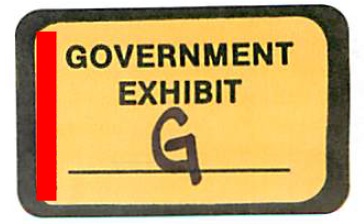
    The evidence sticker from "Government Exhibit G" in the criminal prosecution of AdSurfDaily Ponzi schemer Andy Bowdoin. (Red bar added by PP Blog.)
    The evidence sticker from “Government Exhibit G” in the criminal prosecution of AdSurfDaily Ponzi schemer Andy Bowdoin. (Red bar added by PP Blog.)

    Let’s talk about pollution and how it may be flowing to a bank near you:

    AdSurfDaily Ponzi schemer Andy Bowdoin used a secret hushmail address in 2009 to discuss a bank wire for $38,750 that was to be sent to an account at Regions Bank in Fort Lauderdale, Fla., to pay for servers and programming required by AdViewGlobal.

    AVG, as it was known, was an ASD reload scam that began to unfold in October 2008, just two months after the U.S. Secret Service began the process of seizing more than $65.8 million from at least 10 Bank of America accounts linked to ASD, according to government records.

    The Secret Service, according to court filings, also had its eyes on separate Bank of America accounts linked to an ASD-connected enterprise known as Golden Panda Ad Builder. Golden Panda was operated by Rev. Walter Clarence Busby Jr., a Bowdoin business partner and Georgia grifter implicated by the SEC 11 years earlier in three prime-bank swindles, including one that promised to pay interest of 10,000 percent. Some of the Golden Panda money also made its way into Bartow County Bank, a small Georgia bank that later failed, costing the Federal Deposit Insurance Corp. an estimated $70 million, according to government records.

    From this fact set, one can plainly see that ASD and related scams had caused polluted money to flow to Bank of America and Bartow — and that the noxious and ever-evolving ASD enterprise now had its sights on causing polluted money to flow to Regions. That’s three banks put in harm’s way by what effectively was an evolving ASD criminal enterprise.

    There were more.

    At least $413,018 in ASD-infected funds also had made their way into accounts at First National Bank in Ames, Iowa. Another $96,525 in polluted proceeds flowed to two accounts at Wachovia Bank. (The U.S. state in which Wachovia was used to stockpile $96,525 in fraudulent proceeds directed at an ASD member is unclear. What is clear, according to federal court filings, is that the ASD member allegedly was using ASD to promote a “multi-level marketing site that listed classified job postings” and that 17 checks from ASD were deposited into the Wachovia account on a single, fateful day.)

    That day was July 31, 2008.

    History shows that the Secret Service moved against ASD the very next day, Aug. 1, 2008, as a means of stopping the ASD Ponzi monster from sucking in any more cash and from polluting any more banks. The ASD member with the Wachovia accounts had “sponsored 6-8 people to get into the ASD system,” and somehow had managed to receive nearly $100,000 in tainted proceeds after paying ASD only $500 and working as a “consultant” to ASD “for a brief period,” according to court records.

    Because ASD used infected proceeds to pay members with accounts at banks across the U.S. spectrum of hundreds of institutions, each of those institutions became places at which wire-fraud proceeds were deposited. The total flow of fraudulent proceeds linked to Bowdoin and follow-up scams exceeded $120 million, according to federal court files.

    But it gets worse . . .

    At Least 2 Swiss Accounts Discussed In Exchanges Over Hushmail And Gmail

    Why not infect Europe with American Ponzi proceeds?

    This is the clincher, the one event that — in the context of other ASD-related events — shows the rampant criminality within the ASD enterprise and this particular wing of MLM. This criminality caused federal prosecutors to describe Bowdoin as a man who roped in at least 96,000 people in part by asserting that his “programs” reflected “God’s will.”

    Bowdoin, prosecutors said, indeed was the personification of a con man and affinity fraudster who “boldly continued or expanded his criminal conduct” even after the Secret Service raid in August 2008.

    Just two months later, in October 2008, Bowdoin and a former ASD insider held discussions aimed at launching AVG, the ASD reload scam that allegedly sucked in millions of dollars — in part by targeting ASD members all over again. The sources for this information are a government sentencing memo and  “Government Exhibit F,” filed on Aug. 13, 2012, four days before the SEC’s Zeek action and confirmation by the Secret Service that it also was investigating Zeek.

    Exhibit F is styled “Summary of AdView Global by T. Andy Bowdoin, Jr.” Precisely when and how the government obtained the document is unclear, but prosecutors say Bowdoin drafted it in “memo” form. Agents are known to have seized ASD-related computers. It also is believed that the government seized at least one AVG-related computer.

    The undated document features a narrative in which Bowdoin, despite the Secret Service raid of ASD and ongoing civil and criminal investigations, suggests he was still sticking to a cover story that ASD was an “advertising” company, not an investment company offering securities that paid a preposterous interest rate of 1 percent a day while magically constituting neither a Ponzi scheme nor an investment firm. In fact, according to the document, AVG hoped to ward off the U.S. government by establishing some sort of presence in Uruguay.

    Another part of the AVG launch plan was to attract “30 founders” in December 2008. In the Exhibit F document, Bowdoin also planted the seed that the nascent AVG MLM program had been vetted by “attorneys.”

    These unidentified “attorneys” purportedly had advised Bowdoin that prosecutors would not be interested in establishing whether the AVG upstart “was OK,” even if Bowdoin submitted an AVG business plan, according to Exhibit F. Bowdoin then moved forward with AVG, despite all that had happened at ASD. Both before and after the ASD debacle, according to assertions by prosecutors, Bowdoin claimed he had acted “on the advice of counsel” and therefore had done nothing wrong.

    “Bowdoin’s reliance on the ‘advice of counsel’ defense became a theme in both the civil and criminal litigation,” prosecutors advised a federal judge.

    It was a defense that failed miserably, as various entries on the public record show. And when Bowdoin got in trouble again — this time for promoting an alleged pyramid scheme known as “OneX” while out on signature bond in the ASD criminal case even as he asserted the OneX “program” had been vetted by attorneys and passed muster and that recruits could earn to the limits of their imaginations — Bowdoin again defaulted to an advice-of-counsel defense.

    This time, however, Bowdoin appears to have merely repeated false assertions that he’d heard from OneX or someone within OneX. The government responded by producing an affidavit from an attorney who’d performed work for OneX but never had drawn a conclusion the “program” was lawful and had never examined the actual business practices of OneX. The attorney swore in an affidavit filed under pain of perjury that the law firm through which he represented MLM clients “has never represented” Bowdoin. (The PP Blog is declining to identify the attorney, a partner in a Southern California law firm.)

    Back to AVG, the scheme Bowdoin helped launch before later trying to sanitize the alleged OneX pyramid scheme by claiming it had been scrubbed clean by attorneys: Bowdoin was to own two-thirds of AVG; the former ASD insider would own the remaining third, according to Exhibit F.

    Among other things, the document shows some of the fractured thinking and incongruities so often associated with HYIP scams. Despite the purported need for an offshore presence to ward off U.S. investigators, for instance, the document asserts that Gary D. Talbert, identified elsewhere as an ASD insider and one-time executive, had hired AVG “customer service people in the U.S.” (Bolding added by PP Blog.)

    Web records show that AVG had come out of the gate with two impossible (if not insane) propositions: The first was that AVG was just like the NBC television network, an absurdity on its face in that NBC doesn’t pay its advertisers to watch ads. Moreover, NBC, unlike the collapsed AVG, doesn’t operate a closed network in which only NBC’s advertisers and not the public at large can view ads. Nor does NBC try to recruit advertisers by telling them they’ll receive a dividend of 125 percent (or more) on their ad spend within a few months and that its advertisers can earn downline commissions two levels deep by recruiting competitors to advertise on NBC’s closed network.

    The second proposition was even more absurd: that AVG had nothing to do with ASD. The absurdity of this obvious lie was exposed before January 2009 even had ticked off the calendar. Indeed, after earlier asserting that AVG had no ties to ASD, the company — using a U.S.-based AVG customer-service rep who’d actually testified on ASD’s behalf in federal court —  announced that ASD’s Talbert was its CEO. If this weren’t absurd enough, AVG insisted through the former ASD member now working as a AVG spokesman that the appearance of AVG graphics in an ASD-controlled webroom was an “operational coincidence.”

    AVG went on to pile on the absurdities, according to court filings. In Exhibit F, the document prosecutors say was Bowdoin’s draft memo of his AVG reflections, members of Bowdoin’s family who allegedly benefited from ASD Ponzi proceeds are described as heroes who tried to save AVG from the thieves.

    With ASD’s Bowdoin’s knowledge, Talbert, according to Exhibit F, also purchased an Arizona “company named TMS” that owned a payment processor named “eWallet.” (Other records strongly suggest that the payment processor actually was named “eWalletPlus” and was operating from servers AVG was using in Panama.)

    “TMS used a bank in the Caribbean,” according to the document. The signatory on the Caribbean account somehow never was changed after the asserted change in ownership at TMS, and two former TMS associates allegedly stole nearly $2.7 million from AVG. The theft of nearly $3 million led to the collapse of AVG, according to the telling attributed to Bowdoin in the document.

    To date, the PP Blog has been unable to ascertain the truthfulness of the assertions about the thefts allegedly committed by the alleged former TMS insiders.

    What is clear, however, is that as much ASD money that could be found in August 2008 was seized. AVG then launched with cash that hadn’t been seized, and in part was targeted at ASD members.  AVG members then were left holding the bag, with the blame placed on former TMS associates.

    And something else is clear, which brings us to “Government Exhibit G”: AVG, the follow-up scam to ASD that involved Bowdoin and ASD insiders and alleged thefts of millions of dollars by outsiders, had at least two Swiss bank accounts.

    bowdoinhmail
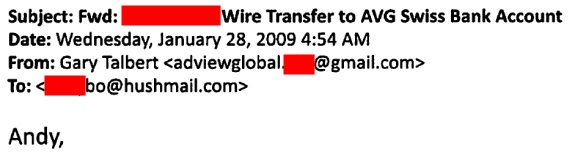
    One of AVG’s Swiss bank accounts allegedly was discussed in this email between Andy Bowdoin and Gary Talbert. Bowdoin was ASD’s operator; Talbert was an ASD insider who allegedly became Bowdoin’s business partner in the AVG Ponzi scheme that sucked away millions of dollars. (Red lines inserted by PP Blog.)

    On Jan. 28, 2009, just days before AVG’s scheduled launch date in early February and less than six months after the Secret Service raid on ASD’s headquarters and Bowdoin’s home in Quincy, Fla., Gary Talbert used a Gmail address to email Andy Bowdoin at a hushmail address, according to Exhibit G.

    Talbert advised Bowdoin that an individual — presumptively one of the 30 AVG founders — had conducted a “Wire Transfer to AVG Swiss Bank Account” and needed assurances that it had posted. The inquiry about the asserted wire transfer appears to have been initiated by another AVG insider who’d emailed Talbert from his Gmail address to Talbert’s Gmail address. Through Gmail, Talbert then checked with Bowdoin at Bowdoin’s hushmail address, instructing the ASD patriarch that someone wanted to “verify that a bank wire hit the Swiss bank account.”

    Upon verification, the customer would make “another large wire,” Exhibit G suggests.

    Another email within the January 2009 chain says that AVG had at least two Swiss accounts.

    What It Means

    Walking this back and assuming the Exhibit G communications were truthful, what it means is that the ASD enterprise — this time in the form of AVG — had set up a banking operation in Switzerland, a secrecy haven. At the same time, it means that the ASD enterprise did this after it earlier had polluted U.S. banks in multiple states with fraudulent proceeds and now was taking its act not only to Switzerland, but also to South America, Central America and the Caribbean.

    Less clear is whether ASD had a preexisting banking network in Switzerland before effectively morphing into AVG. Regardless of when the Swiss accounts were opened, however, the mere presence of them suggests that ASD and AVG insiders had the means to move fraudulent proceeds from U.S.-based crimes offshore and perhaps tap into them later.

    And this brings us to Zeek Rewards, which also used domestic and offshore facilitators and the same fundamental business model of ASD and AVG. It also brings us to Profitable Sunrise and other MLM “programs” such as Better-Living Global Marketing. The now-disappeared Profitable Sunrise scheme allegedly used U.S. bank wires and offshore facilitators to drive tens of millions of dollars to the scheme. BLGM, still active, clearly has U.S. promoters and facilitators while purportedly operating from Hong Kong.

    Meanwhile, BLGM, like ASD, AVG, Profitable Sunrise and Zeek Rewards, has Stepfordian “defenders” running interference online.

    One of those “defenders” is over at the BehindMLM.com antiscam Blog asserting that he “met a guy online. I know him well now. I deposited $6500 into his Bank Of America account at my local branch.”

    Another BLGM defender is at BehindMLM.com asserting that (italics added):

    Got my Hongkong wire/remittance of 6,000 USD at Bank of America, have all my questions and concerns answered by Luke Teng, the teleconference helped a lot, disregard all the unnecessary comments of non-members.

    Get all your transparent answers from Luke Teng, or else you will die of stress reading all the negative comments of people who are not engaging, and guys remember this is our freewill and our own money, our decision, our own risk.

    TelexFree, a scheme more or less operating globally that has U.S. footprints in Massachusetts and Nevada and is under investigation in Brazil, also used Bank of America, according to members. Some TelexFree promoters instructed recruits to walk deposits meant for TelexFree into a Bank of American branch in Massachusetts or TD Bank locations elsewhere. TD Bank, of course, was the bank of Florida Ponzi schemer and racketeer Scott Rothstein. Four years after Rothstein’s $1 billion-plus scam brought great shame to the banking community, it’s still causing ripples.

    The PP Blog previously reported that a former Zeeker who also was associated with Profitable Sunrise — an alleged international pyramid scheme that funneled tens of millions of dollars to Europe, China and Panama amid the murkiest of circumstances — also was pushing BLGM.

    All of these “programs” are operating or have operated within the MLM sphere, the same sphere that produced the incredibly toxic ASD/AVG Ponzi schemes. All of the “programs” either have or had access to the wire facilities of various nations around the globe while using Ponzi- and pyramid schemes as their business model.

    The Piggybackers

    Various destructive forces are piggybacking on the scams, including attack bots and spambots that are keying on the names of HYIP enterprises and HYIP story figures to promote other scams or to drive traffic to other highly questionable “opportunities.”

    Even after the PP Blog announced the temporary suspension of the publication of new stories last week, it continued to be targeted by resources-draining bots. One wave knocked the Blog offline for about an hour two days ago. During the involuntary outage, legitimate readers and researchers  could not access the Blog.

    One of the spammers left the signature of an IP associated with the country of Indonesia. A spam bid from the specific IP keyed on a PP Blog story about ASD figure and purported “sovereign citizen” Kenneth Wayne Leaming, now in federal prison for targeting U.S. federal officials and a Secret Service agent in an abuse campaign, harboring fugitives and possessing firearms as a convicted felon. Records in Washington state show that a Leaming-connected enterprise once traded on the name of JPMorgan, a famous banking concern. (“Sovereign citizens” are becoming increasingly infamous for harassing banks.)

    Another spammer — one that left an IP signature from Belarus — also targeted a Leaming story thread at the PP Blog.

    In recent weeks, the Blog has recorded data that plainly show that  botnets, spambots or human spammers are circling antiscam sites and attempting to execute command strings that — if enough volume is applied — can cause databases to malfunction or even cause the sites to go offline.

    This creates an atmosphere that affects the publishing of information not only on current scams, but also on emerging scams and scams of the past. The downstream effects are potentially ruinous — and yet it continues.

    ASD and AVG were discredited long ago. But scams that use their core business model not only are launching, but in some cases thriving. Serial promoters are racing from one fraud scheme to the next. This sets the stage for schemes to fill up the world’s largest sports stadiums eight or 10 times over with victims. In 2008, ASD could have filled the Rose Bowl to capacity with victims one time. By 2012, Zeek could have filled the Rose Bowl with victims 10 times.

    The “defenses” for these various schemes range from the bizarre to the utterly mindless — and they absolutely must be decimated with the full, combined weight of the various world governments.

    It is in the interest of the worldwide public to connect the dots of these schemes and to eradicate them through the maximum application of the force of law. Left unchecked, they will erode the very foundations of freedom and permit the criminal underworld of MLM to thrive.

    NOTE: Our thanks to the ASDUpdates Blog.


  • ESSAY: The Reality Of The PP Blog, Why I Do What I Do And Why I Refuse To Lose Hope

    EDITOR’S NOTE: Absent sufficient contributions from readers as outlined here, the PP Blog will suspend publication at 5 p.m. today, Dec. 5.  I will try to bring it back as soon as possible, but my hands are tied for now by a lack of money. This morning I restored full functionality, after causing the Blog to load only one story rather than the customary 11 on the front page about a day and a half ago. Full service also has been restored to the search, archives and tag functions.

    The idea of briefly limiting services was to bring attention to the donation post, the Blog’s first since January 2013. It didn’t work. The Blog receives a high percentage of traffic from online searches for specific topics. Much of that traffic never even sees the front page.

    As things stand right now, the Blog and its full archives, including thousands of internal and external links designed to help readers gain a fuller understanding of the menace posed by HYIP scams, securities fraud, Ponzi schemes, pyramid schemes and precious-metals and commodities scams, will be available for the balance of this month. I expect my ability to publish to end, however, at 5 p.m. or shortly thereafter today.

    Known as a destination site for Ponzi scheme victims, researchers, financial analysts, media companies, members of the antiscam community and government readers, the Blog has branched out over the past couple of years to cover the “sovereign citizens” movement. In some ways, that parallel coverage is even more important than our longstanding coverage of financial scams.

    “Sovereigns” are threatening judges, prosecutors, officers of the court, agencies, agents, support staff, litigation opponents and banks — and even members of the Cabinet and Presidential appointees. They’ve also threatened the PP Blog and other media outlets. When government officials, the critical service-providers in the financial sector and the media aren’t safe from outrageous attacks in the courts and through other venues, YOU aren’t safe.

    In any event, I’d like to share a few things that are on my mind — until we meet again . . .

    _____________________________________

    The Essay

    Because I do not know when I’ll regain my ability to publish, today seems an appropriate day to add some context to specific PP Blog posts or coverage related by theme. While I’m at it, I’ll share some of the details about the pressure I’ve been feeling over the past few years of publishing this Blog. I fear for the security of my country. I don’t feel entirely safe.

    My core belief is that unseen enemies of the United States and its way of life are trying to seize on a chance to affect domestic stability and disrupt the nation in unprecedented ways. Thousands of tiny attacks aimed at the U.S. financial system have occurred — everything from relatively low-grade attacks on payment processors to much more sinister, orchestrated attacks on major banks. At a minimum, these events drive up costs, but that may be just a precursor to the larger risk: repetitive injury in small waves that, over time, can create conditions under which vital infrastructure can be subjected to death by a thousands tiny cuts. These waves at first were interpreted as innocuous or perhaps even benign. The danger is that the small waves will have the same mathematical effect over time as a sudden tsunami that occurred in an instant.

    For the first time in my life, I find myself pondering what once was unimaginable: that criminal gangs or worse could affect systems to such a degree that the scale tips more toward anarchy than order, that greed-driven schemes could be designed and have the effect over time of turning Americans against each other. In short, every man for himself.

    And it’s not just financial schemes; it’s also political schemes.  State secrets have been stolen in volume and used in dangerous games of political brinkmanship. A man in his underwear sitting in Any Small Town U.S.A. instantly can become part of a destructive force if something simply rubs him the wrong way. Such a man may or may not understand the issues. He may be particularly susceptible to a narrative that incorporates his personal political beliefs, a narrative that instructs him he is acting in the interests of the public. In some U.S. states, “sovereign citizens” effectively are stealing homes. Some of the “sovereigns” effectively are teaching courses in anarchy: How to gum up the mix and frustrate the process as part of an effort to undermine judicial authority. The effective goal, as outrageous as it seems, is to create a condition under which crime becomes lawful and criminals become nonprosecutable.

    And then there are the tax frauds and other schemes so often associated with “sovereigns.” There can be no doubt “sovereigns” also are directly involved in HYIP frauds or serving as enforcers for them. A typical investor in such schemes may see them as a way out of their financial misery or even as a way to support their place of worship. The “sovereigns,” however, may see it as something quite different: a chance to infiltrate the U.S. banking system while inflicting pain on the “evilGUBment.”

    I think the Profitable Sunrise case that has been referenced many times on the PP Blog is an example of how international criminals joined with “sovereign citizens” and political extremists in the United States to steal millions and millions of dollars. And I think they used U.S. banking wires and international facilitators to do it, while leaving members of the Christian faith holding the bag. I think the targeting of Christians was deliberate because the masterminds knew the so-called Prosperity Gospel is playing well in faith communities across the country.

    My principal fear in this specific area is that the events create glee in the murkiest corners of the world, that Americans and in particular American Christians, are particularly vulnerable to handing over money to sinister forces and actually providing the means for their own demise.

    This is why I categorically reject some of the criticism directed at the Blog and me personally.

    A Madness Over The Land

    On Aug. 6, 2012, the PP Blog received a communication that suggested former U.S. Presidents George H.W. Bush, George W. Bush and Bill Clinton were viewed as assassination targets within the HYIP sphere. I immediately sent all of the information to the U.S. Secret Service, including the chosen identity and hushmail address of the sender, the IP address from which the threat originated, the full text of the threat and the specific PP Blog URL at which the threat was directed.

    Here is the story at which the threat was directed: Jailed AdSurfDaily Figure Kenneth Wayne Leaming Sues Obama, Holder; Purported ‘Sovereign Citizen’ Claims President Not A U.S. Citizen And Demands Compensation In ‘Silver’ And ‘Gold’ For Alleged Unlawful Imprisonment

    “People like Kenneth L. are true Patriots that know that without sending out mercenaries to take out those corrupt bankers, USG politicians, agents, judges and attorney’s [sic] that cause us all harm and d[a]mages,” the email read in part. (Bolding added.)

    It went on to specifically question why both President Bushes and President Clinton were “still alive and running around,” describing them as “real criminals.”

    Given the subject matter of the thread, for all I know maybe President Obama and Attorney General Holder are on the target list, too. I do not believe Kenneth Wayne Leaming was the sender; I believe it was one of his supporters, posting from overseas and/or perhaps trying to mask his IP. Leaming was in jail near Seattle at the time; he’s still in jail, having been convicted earlier this year on charges of filing false liens against public officials involved in the ASD Ponzi case and against other officials, harboring federal fugitives and being a convicted felon in possession of firearms.

    This is what was on my mind: How did Leaming, a Washington state resident, gain the support of an individual overseas? Could this person have been in the United States and then made his way to Europe? Could he perhaps have been in the United States at the time of the threat and relied on a proxy to make it appear he was overseas?

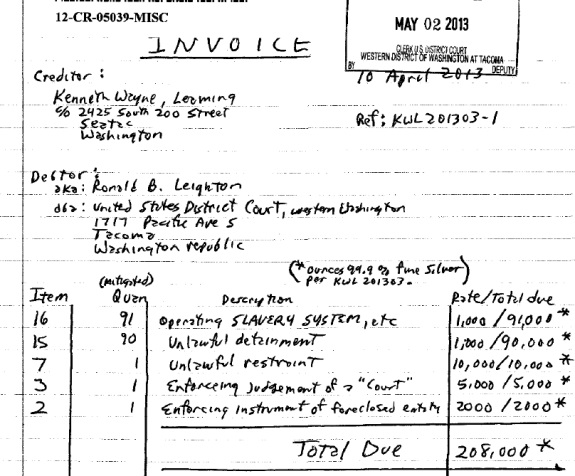
    In any event, Leaming later asserted that the federal judge who presided over his trial owed him 208,000 ounces of fine silver, another outrageous claim from the alleged member of the Washington state “County Rangers,” a group of “sovereign citizens” with an armed enforcement wing.
    leamingsilverslavery

    Pardon me for being offended at a would-be comment I received yesterday that called me a beggar and asserted that, if my readers kicked in to help me and this Blog, they’d be contributing to the starvation of children and perhaps denying them a visit from Santa Claus.

    If anyone thinks they’re going to manipulate me in this fashion and cause me to abandon the overall security story and turn my back on a journalism career that has spanned a quarter of a century, they don’t know me very well. Earlier in my career — while print publishing was still healthy and I had a continuous flow of work from multiple clients — I’d thought a medical scandal I covered at an institution for people with mental retardation likely would be the story of my life. There were at least four deaths, including the death of an individual with profound mental retardation. He was denied adequate medical treatment when his body temperature plunged to 86 degrees.

    The far-reaching story triggered menacing conduct against my family, which backed me fully. My coverage only intensified. Reporters worth their titles don’t back down.

    Within a few years, however, I began to believe that a mortgage-fraud and predatory-lending scandal I’d covered beginning in April 2001 in a 150-part series of installments would be the story of my life. Hundreds of inexplicable foreclosures had occurred in a county that traditionally had averaged only a couple of dozen per year. There was no corresponding triggering event such as a plant shutdown that would explain the incredibly rapid rise in local misery. A real-estate professional gave me the tip and told me where to look. From this base, I uncovered scores of of documents showing that deals in a region of counties were tainted from the start. There were corrupt appraisers, corrupt brokers, corrupt notaries public, corrupt home-improvement companies using multiple identities. Some of the deals later were packaged as securities and sold on Wall Street.

    State and federal investigations ensued. Scammers went to prison. Companies got shut down.

    I received two awards from the Associated Press for the series — Investigative Reporting and Public Service — and I didn’t think I’d ever encounter another story that would have such an impact on a community and region. Some of my reporting is referenced in one of the earliest books on the coming mortgage meltdown that caused so much chaos in 2008.

    But by 2005, even before the mortgage meltdown hit, the great free-fall in print publishing was under way. My reliable stable of clients began to contract. I responded by studying web-publishing as a means of stabilizing my income; I had a lot of skill sets to learn — and I learned them. Having the skill sets, however, did not translate into the money I needed to sustain the middle-class reality I had known. By 2007, I was down to only one regular client. A year earlier, in 2006, I almost certainly lost a chance to become the full-time editor of a print publication prominent in its field. In retrospect, the “mistake” I made was to answer a question truthfully during an interview with the publisher.

    I was asked how I saw the web emerging in the publishing industry in the near future; I answered by saying I believed the Internet was going to win and that print publishers would have to find a web model that paid the bills or the publications would vanish. They could rely on their cherished brands for only so long, and in the short term could use their familiarity with readers to drive traffic, I contended. But in the long term, I further ventured, readers accustomed to paying for a print subscription would be reluctant or unwilling to pay for an electronic subscription because of the easy accessibility of free content on the web, including an ever-expanding library of pirated content and content that was accessed by multiple readers sharing one paid subscription. Readers no longer had to wait for the newspaper or magazine to come out to see what was on sale. The major challenge, in my view, was that long-established advertising clients of well-recognized publishing firms and titles were becoming less and less reliant on publishers to carry their messages and inserts because the clients now could use the Internet to establish direct, personal relationships with customers. Print — and even electronic versions of print publications — were becoming less and less attractive as a middleman for major advertisers

    You could have heard a pin drop after I uttered those words; the publisher, it very much seemed, wanted to be told that print would win and that electronic versions of publications would be seen as an added value.

    Suffice to say, I did not get the job, so I dialed up my efforts to learn the ways of the web and become both a publisher and salesman.

    My Greatest Mistake

    The greatest mistake I made in the ensuing months was creating the Patrick Pretty brand and positioning it in the general space of “Internet Marketing” as a fun and entertaining way to do business online.

    The fictional backstory of the brand was that a child prodigy who had the permanent gift of brains but only the temporary gift of physical beauty had become an adult who believed that both his intellectual gifts and his childhood good looks had followed him into adulthood. Although people admired him in adulthood for his brain, they were put off by his looks. Patrick Pretty just didn’t make the connection and assumed he was “The Most Beautiful Man In The World” because he’d been awarded the title of “The Most Beautiful Little Boy In The World” in 1964.

    It was a hoot actually to create a brand, especially one with Gumpian qualities and a higher-functioning brain. I’d formerly only helped represent and extend existing brands or subbrands.

    I had hoped that the PP brand and the backstory would help me sell Amazon.com and other affiliate products via Blogs online by introducing readers to a fantasy cartoon character with an engaging way of doing business, sort of my version of the GEICO gecko. I further hoped that IM editorial prospects seeing my writing skills would hire me to prepare their news releases and marketing materials. The PP brand gained a lot of attention, particularly during a period in which I served as a volunteer moderator at the Warrior Forum. I hoped to supplement my income by selling short, self-created eBooks online through which customers also looking to make money online could learn skills such as how to prepare news releases, how to structure the flow of writing, how to create a brand identity.

    From the standpoint of building sustenance, all of my products were flops, despite the name recognition of the brand within the Internet Marketing space. The web can be a particularly wicked place: My products quickly were stolen and put behind paywalls, some in faraway lands. Virtual ghosts started to use me as a sort of free labor force; I’d create a product, they’d steal it and put it behind a paywall and charge subscription fees. In 2010, my PonziNews website was completely eviscerated by a thief who stole my articles verbatim and monetized them 100 percent for his benefit.

    I did not perform a careful study or analysis before joining what was being painted as the IM Revolution, the greatest way ever conceived to do business. In that sense, my story is far from unique. One of my assumptions was totally wrong: that professional Internet Marketers would be interested in hiring me to improve their presentations and eliminate or minimize mistakes on their websites. The reality proved to be that they were much more interested in writers who’d produce incredibly over-the-top hype-fests for a fee. Quality was an afterthought, if a thought at all.

    For the most part, they didn’t care about news releases, responsible sales copy and branding materials. Nor did they care to engage the mainstream media and Main Street consumers in the long-term at all. What they were mostly interested in was creating shiny dreck and selling it in limited quantities for exorbitant prices while creating what effectively was a free labor force duped into believing they’d become rich like the masters, virtually all of whom were selling against their own affiliates. In a nutshell, it was modern carnival barkers invading the Wild West of the Internet and mining it for everything it was worth — with virtually no attention paid to the social consequences of it all.

    In August 2008 — after my stint at the Warrior Forum had come to an end during a July weekend over which a thief at the forum was stealing electronic information products from other Internet Marketers and putting them behind paywalls and charging subscription fees — I changed the focus of PatrickPretty.com entirely. I did not fit in this space at all; I detested the gamesmanship, the general lack of professionalism and decorum within the IM space, the never-ending hype fests, the shiny dreck, the culture of instant riches.

    Beyond that, my experience battling scammers at the Warrior Forum taught me there effectively was no permanent way to contain them because of the ready availability of proxies to mask locations. There were instances in which a person used an IP to sell products under one identity, and then posed as a satisfied customer using the same IP but a different posting identity. Other forms of shilling often were suspected, but were very hard to prove.  Other people purchased products, immediately demanded refunds and then ran off with the products and sold them behind paywalls. For a nominal fee, corrupt shoppers could access corrupt websites and their troves of stolen products, denying the true authors the profits from the sale of their property while creating confusion over who was the real seller and party responsible for support.

    My core strength is news reporting, not Internet Marketing. During July of 2008, AdSurfDaily members were coming to the Warrior Forum to defend their “program” in droves. All of it had a cult-like feel that I found particularly disturbing; I decided to write about it.

    That single event — the emergence of the ASD Ponzi scheme and its endless series of Stepfordian shills — changed my life like no other event before it. PatrickPretty.com had a small, loyal following, so I decided to keep the name of the domain and transition it into producing hard-news reporting that would help legitimate Internet Marketers and online merchants keep track of events that could affect their futures.

    What I found out relatively quickly was that the antiscam community was on my side, but that the Internet Marketing community in general was not. By 2009, my last remaining regular print client — a client with which I had had a 21-year business relationship and had authored a monthly column or other works for 17 years — had filed for bankruptcy. This effectively canceled my contract, gutting my income and putting me in a tailspin.

    The PP Blog itself was producing De minimis revenue, but had developed a large audience compared to many Blogs. My efforts to improve the Blog’s performance were hampered by trolls and cyberstalkers who tried to create trouble at every turn. The only thing that saved the Blog (and me) were 14-hour days, an occasional check from Google, emergency saves by my family and the reemergence of a lost client that provided scattered, well-paying assignments.

    I had no disposable income to speak of, but continued to focus on building the Blog as a vital news source. My decision was simple: I was not going to be run out of this space, not by trolls and stalkers, not by noxious, unthinking critics, not by anyone. The stories that were emerging were impossible to ignore, and they weren’t being covered in any detail by much larger publications that were having their own struggles making ends meet. Some of them exited print altogether. Others tried to publish print versions two or three days a week. Still others folded or became a mishmash of print and electronic publishing.

    When Events Collide

    There has never been more upheaval or greater confusion in publishing — and it’s happening at the worst possible time: News that needs to be covered isn’t being covered. Fractiousness within media itself is creating even greater confusion. America’s politics has become utterly poisonous, putting cockroaches ahead of national politicians on the popularity meter.

    And all of this is happening while white-collar fraud thrives, government resources are strained and America is experiencing attacks both internally and externally. The banks are frequent targets, as are media sites, including large, general-interest publications such as the New York Times and the Washington Post, and much smaller, niche publications such as the PP Blog. DDoSers hit here in 2010, knocking the publication offline for days and increasing its costs. The site has experienced traffic floods and bot swarms virtually ever since, some broad enough to affect server performance or even to knock the blog offline for periods of time.

    This Blog is my house; people and things are attacking me in my house. They want to extort me emotionally to achieve their ends, an ends potentially dangerous for all Americans if the mob can gain the upper hand.

    Some people don’t understand this — something I see as frustrating but only natural. It is not happening directly to them; it is happening to me, and it is exceptionally difficult to explain, in part because so much of it happens via proxy. In the larger context, it also is happening to the United States, to financial institutions, to media sites, to key infrastructure guardians, and again much of it is happening via proxy. It often is hard to determine who the enemy is, a circumstance that likely is driving the national-security state.

    _____________________________________

    In 2009, after a series of vulgar stalking incidents at the Blog carried out by an apparent enforcer for HYIP scams and possibly aided by accomplices interested in destroying the Blog or otherwise extorting it, I was contacted by a party I will not disclose and asked if I would accept a subpoena aimed at identifying the stalker. I eventually provided the information voluntarily, based on my belief a crime was being carried out against the Blog. I later supplemented this information to include data on another stalker.

    Since that time and likely just coincidentally, an interesting IP has appeared occasionally at the Blog. It is an IP for the “Executive Office of the President of the United States.”

    I do not know who at the White House or companion offices is reading the Blog. Nor do I know why the White House comes here from time to time. There could be more visits than I know about because not all government workers use an IP that connects them to the government.

    Call me an optimist. The presence of the White House gave me both comfort and hope. I’ve also been comforted by visits to the Blog from the U.S. Senate and House and the U.S. State Department, despite the fractiousness in Washington. Law-enforcement agencies routinely visit the Blog. I believe people who can make a difference are trying to piece together clues about what it all means — everything from the effect on national security of serial Ponzi schemes, bizarre HYIP and “prime bank” swindles to the effect on national security of the outrageous scams and court swindles carried out by “sovereign citizens” operating within America’s borders, perhaps with cross-border assistance.

    A government IP associated with an agency I am declining to identify by name routinely appears at the Blog and accesses stories about “sovereign citizens” and “sovereign citizen” swindles. This, too, gives me comfort. I understand why some law-abiding and patriotic Americans might find that very proposition a source of discomfort, but these dots have to be connected.

    After Sept. 11, 2001, American agencies were faulted for lacking imaginations on how attacks could be carried out, for not connecting dots, for not sharing information vital to national security and for engaging in parochialism and turf wars. The 9/11 attacks and the need for fusing information resulted in the creation by President George W. Bush and the Congress of the Department of Homeland Security.

    I support DHS and have written about it or subagencies often. Many Americans, including law-abiding and patriotic ones, worry about DHS’s role in what they see as an expansion of the national-security state. What I’ve noticed about President Obama is that he, like his predecessor, is willing to take the incessant pounding and the Beltway blistering. In my view, both men know something highly concerning if not highly disconcerting is going on and that their first duty is to protect the safety of the American people.

    It’s easy for even responsible Americans to cast both Bush and Obama as politicians who made deals with the devil to infringe individual liberty. I do not see it that way — not at all. I think both men perceived a clear-and-present danger and were courageous enough confront it and wise enough to perceive that things could evolve in a way that triggered an internal crisis and caused panicked people to spill out onto the streets. In short, they had the imaginations to perceive that enemies would view the United States as a weakened country after 9/11 and seek new means of exploitation and penetration, including means that did not exist prior to the Internet and only now can be appreciated if not fully understood in a deeper context.

    It is my belief that the HYIP schemes initially were viewed by the government as ordinary crimes. That view has changed, I believe, because ordinary crimes would not fill the Rose Bowl to capacity ten times over and cause heartache and financial misery in tens of thousands of localities simultaneously.

    You may be paying higher interest rates and seeing the value of your property plunge because homes in your neighborhood are in foreclosure or otherwise attached to the limit. Lax lending standards and dubious deal-making with clients often are blamed for this circumstance, which nearly led to a financial collapse in America in 2008. That view may be reliable, but is not all-encompassing.

    The recovery from events in 2008 has been slow and painful for millions of people. The “rebound” that emerged, I believe, was far from inclusive because millions of people feeling financial pain got sucked into scams on the Internet, thus minimizing the effect of any post-2008 rising tide. I think the scams are only intensifying and that the efforts to combat them are intensifying in ways not currently known.

    That thought gives me comfort, and increased hope for the future.

    In some ways, the scammers are rationalizing these outrageous frauds as a response to bad politics and political infighting in Washington. There is an audience for that message. Within that audience are highly skilled financial criminals, political extremists and anarchists. They’re planning for what they see as a coming war and siphoning wealth from neighbors and strangers to fund it.  Their systems have been designed first to gain access to the U.S. financial infrastructure, then to identify a target audience of disaffected Americans and Americans desperate to make money, and finally to bleed those very Americans and American institutions of resources.

    The aim, in my view, is to injure America one tiny cut at a time and to put in place a constant series of follow-up scams.

    My coverage of these miserable Ponzi and pyramid schemes and the sinister forces driving the “sovereign citizens” movement is the story of my life; I have done my best to deliver it to you, to provide analysis, to connect dots. I am proud of this Blog. At the same time, I recognize that a Donation shingle provides fuel for my critics and helps them advance narratives that paint me in the worst possible light.

    But calling me a beggar and a demon won’t change my point of view: This Blog needs to be freely available to a wide audience, and establishing a paywall or mandatory subscription fee will vastly reduce the audience that can benefit from information and use it to recognize red flags and steer clear of scams. For now, at least, it’s contributions from readers who also are able to check a box to make their contributions recurring by the month — or nothing.

    It seems clear that relatively few people could fund the Blog and help keep it available to a wide audience. It is clear from logs that many of the Blog’s readers come here after searching online for information on specific scams and “programs.” That particular audience consists of thousands of readers, many of whom may be victims of scams or have come to the realization that a “program” that promised them riches just might be a scam

    It is my sincere hope that the suspension of publishing will last only a short time and that the Blog and I will emerge stronger. And it is my fondest hope that this essay marks not a long goodbye, but the opening work of a new hello.

    I miss you already, Dear Readers.
     

  • BULLETIN: AdSurfDaily Story Figure Kenneth Wayne Leaming Officially Loses Title To Seized Weapons, Badges, Police Gear, Computers And ‘Client’ Records

    Kenneth Wayne Leaming
    Kenneth Wayne Leaming

    BULLETIN: UPDATED 8:17 P.M. ET (DEC. 10 U.S.A.)  A federal judge in Washington state has issued a final order of forfeiture that awards title to items seized from AdSurfDaily story figure and purported “sovereign citizen” Kenneth Wayne Leaming to the U.S. government.

    Judge Ronald B. Leighton of the Western District of Washington signed the order on Nov. 22, the two-year anniversary date of Leaming’s arrest by an FBI terrorism task force. Federal prosecutors later said the Leaming probe was part of a larger investigation into “sovereign citizens” nationwide.

    Prosecutors asked for the order on Nov. 13, noting that Leaming had consented to the forfeiture.

    Included in the order are six firearms possessed by Leaming, a convicted felon, at the time of his arrest.  Also included is police equipment found with Leaming, including badges, credentials, law-enforcement identification documents, light bars, crime-scene tape, handcuffs, vests, nightsticks and similar items.

    Leaming, 57, was a member of the purported “County Rangers,” the alleged armed-enforcement wing of a group of “sovereign citizens.”

    The order also applies to computers, external hard drives, documents and “client” files linked to Leaming.

    Some ASD members said Leaming was performing legal work for them after the ASD Ponzi scheme was exposed by the U.S. Secret Service and federal prosecutors in the District of Columbia in 2008. Leaming later was convicted on charges of filing false liens against government officials involved in the ASD Ponzi investigation and prosecution. In the same case, he was convicted of assisting another “sovereign citizen” in the filing of false liens against other government officials. Leaming also was convicted of being a felon in possession of firearms and harboring two federal fugitives from Arkansas wanted in a fraud scheme separate from ASD.

    The government has not said what it intends to do with the seized “client” files and documents, some of which conceivably could be used to link Leaming to the ASD members who were using his services. Leaming’s history includes being accused in Washington state of engaging in the unauthorized practice of law.

    ASD was a $119 million Ponzi scheme. ASD operator Andy Bowdoin, 79, pleaded guilty to wire fraud in May 2012 and now is serving a 78-month sentence in federal prison.

    NOTE: Our thanks to the ASD Updates Blog.

  • Conflicting Reports Over Status Of U.S. Payza Funds: Frozen? Withheld By Vendor? Seized By Department Of Homeland Security?

    This claim appears today on a website styled obopayusa.com. Precisely when it began to appear is unclear.
    This claim appears today on a website styled obopayusa.com. Precisely when it began to appear is unclear.

    With Cyber Monday and the traditional online sales coming up a few days from now on Dec. 2, this is what we know: Payza, the successor brand to Montreal-based AlertPay, a Ponzi-forum darling and chronic HYIP- and fraud-enabler, suddenly says this in a headline on its Community forum: “US Funds Frozen | Obopay/Ultralight FS. issue.”

    The announcement is dated yesterday, Thanksgiving Eve in the United States.

    Today is Thanksgiving Day. U.S. government offices are closed. Black Friday, another day of brisk U.S. sales activity in which retailers cater to door-busting holiday shoppers, is tomorrow.

    We also know that the U.S. government has established a tradition of taking down counterfeiting and piracy scams and their enabling websites on Cyber Monday. Moreover, we know that U.S. Immigration and Customs Enforcement (ICE), a division of the U.S. Department of Homeland Security, issued an alert two days ago that it is working with partners and “will be conducting increased operations during the holiday season targeting the importation and distribution of counterfeit and pirated products.”

    Beyond that, we know that the United States — the U.S. Secret Service, ICE and other agencies — took down the Liberty Reserve payment processor over the 2013 Memorial Day holiday period and the U.S. Department of the Treasury identified Liberty Reserve as a “Financial Institution of Primary Money Laundering Concern.” The bust was announced on May 28, the day after Memorial Day.

    Backing up a year, we also know that the AlertPay-enabled Zeek Rewards venture that allegedly conducted a $600 million Ponzi- and pyramid fraud while auctioning sums of U.S. cash and telling successful bidders they could use AlertPay and another offshore processor (SolidTrustPay) to collect it, curiously announced on Memorial Day 2012 (May 28) that checks it issued from two U.S. banks had to be cashed by June 1 or they would bounce.

    Backing up a few years, we also know that AlertPay and SolidTrustPay enabled the $119 million AdSurfDaily Ponzi scheme and the $70 million Pathway To Prosperity fraud scheme — to name just two of many.

    Meanwhile, we know that the court-appointed receiver in the Zeek case is going after money allegedly tied to Payza and SolidTrustPay. The most recent affirmation of this occurred on Nov. 14, when the receiver advised a federal judge that his efforts to gather $10 million from Payza “persisted” and that “new information has come in” that affects his analysis of Zeek-related Payza funds. Whether the $10 million sum would go up or down based on the new information was not revealed in the filing.

    Analysis of “transactional data from Payza is not yet complete,” the receiver advised the judge. He also noted that the Payza funds were held in a “foreign bank account” in an undisclosed country.  Based on its research, the PP Blog believes the country is in Eastern Europe.

    We also know that AlertPay effectively became Payza in May 2012, even as Zeek was conducting auctions for U.S. currency and experiencing trouble with U.S. banks. Payza operates through a New York entity known as MH Pillars Inc., which in May 2012 announced the “recent acquisition of AlertPay’s existing online payment platform.” Payza also is associated with a U.K. entity known as MH Pillars Ltd. of London.

    Thanksgiving Confusion

    Although Payza’s headline uses the word “Frozen,” the text below it does not identify the party that purportedly froze the funds. At the same time, the text appears to be at least slightly at odds with the headline claim that the money was “Frozen.” Indeed, the text describes the funds as “withheld.”

    Although the word choices may or may not be important, one thing seems obvious: Either word is apt to be unsettling to Payza’s U.S. customers who want their money.

    “As you may or may not already know, we are unable to complete any requests to withdraw or transfer funds for a part of our U.S. members at this time, since they are being withheld [emphasis added by PP Blog] by Ultralight Financial Services (formerly known as Obopay Inc.) a licensed U.S. money transmitter of which Payza was an agent,” the announcement begins.

    “We have tried to resolve this problem by contacting their management, their legal team and State regulators,” the announcement continues. “Their management and legal team were unresponsive. However, State regulators are willing to help us, but they have told us that they will not intervene unless they hear from you, the owner of your funds.

    “In this case, Payza is asking all affected members to demand action from both Ultralight FS and your State regulator . . .”

    At the time of this PP Blog post, the full Nov. 27 announcement is available at the Payza Community Forum. [See Update at bottom of this PP Blog post.]

    These Thanksgiving Eve claims by Payza are at odds with other claims online.
    These Thanksgiving Eve claims by Payza are at odds with other claims online.

    In short, Payza seems to be saying that Ultralight/Obopay Inc. is responsible for its inability to serve U.S. customers because the entities either froze or withheld the money.

    But here is where the information diverges and becomes even more fractious: At least two websites that state they’re associated with Obopay claim that “[t]he US Department of Homeland Security has seized all MH Pillars dba Payza money on deposit with UltraLight FS.” Both of these sites are cheesy in appearance. Both also have have copyright notices: One, styled obopayusa.com, says “Content copyright 2013. Obopay, Inc. All rights reserved.” The other, styled ultralightfs.com, says “Copyright @ UltraLight Financial Services. All rights reserved.”

    Neither site says when the money purportedly was seized. Nor does either site say how much was seized.

    So, the apparent obopay and UltraLight entities are saying the money was seized by the U.S. Feds. Payza is saying it was “frozen” or “withheld” by obopay/ultralight.

    What’s the truth? Well, it’s unclear at this time.

    There’s also a website styled obopay.com that appears to have the same logo as obopayusa.com. The obopay.com site asserts an association with Obopay Mobile Technology India Pvt. Ltd. of Bangalore and says its partners include Societe Generale, Essar Telecom Kenya Limited and Union Bank of India.

    The obopay.com site appears to make no reference to Payza or MH Pillars, but does reference Obopay Inc. of Redwood City, Calif., as its parent company. When the PP Blog clicked on a “State License” tab at the bottom of the obopay.com site, however, it received this error message: “An error occurred during a connection to www.obopay.com. Peer’s Certificate has been revoked. (Error code: sec_error_revoked_certificate).”

    So, another layer of the curious.

    Searching the database of the Financial Crimes Enforcement Network (FinCEN), the PP Blog located a document that suggests Obopay Inc. of Redwood City, Calif., is a registered Money Services Business in all 50 U.S. states, plus the District of Columbia. FinCEN is an arm of the U.S. Treasury Department. Its stated mission is “to safeguard the financial system from illicit use and combat money laundering and promote national security through the collection, analysis, and dissemination of financial intelligence and strategic use of financial authorities.”

    Information on MH Pillars Inc. of New York also appears in the FinCEN database. The information suggests the firm is a registered Money Services Business in at least 48 of the the 50 U.S. states. (California and New Hampshire appear to be possible exceptions.) MH Pillars also appears to be registered in venues such as American Samoa, the Federated States Of Micronesia, the Marshall Islands, the Northern Mariana Islands, Palau and the U.S. Virgin Islands.

    It seems clear that both Obopay Inc. and MH Pillars Inc. are registered MSBs. Why, then, can’t U.S. Payza customers get their cash? Could it be because UltraLight isn’t registered? The FinCEN database appears to have no information on UltraLight.

    But a Florida Department of State database does, and that information suggests Obopay Inc. is changing its name to ULTRALIGHT FS Inc. The Florida document is date-stamped Oct. 15, 2013. A phone number listed in the document comports with a phone number in Louisiana and Mississippi records as the number for Obopay Inc. of Mountain View, Calif.  Like Redwood City, Mountain View is a Silicon Valley community.

    Why FinCEN records show Obopay in Redwood City while state records show the enterprise in Mountain View was not immediately clear.

    What does seem clear is that some or all of Payza’s U.S. customers can’t get their money and that whatever dispute exists between Payza and OboPay/Ultralight is about money that either was frozen/withheld by OboPay/Ultralight or seized by U.S. law enforcement.

    Payza claimed in July 2012 to be cleaning up its act. This claim was made about a month prior to the August 2012 Zeek action by the SEC and an accompanying confirmation from the U.S. Secret Service that it also was investigating Zeek. Whether the Payza claim was just lip service remains to be seen.

    When the United States took down Liberty Reserve, the Secret Service changed Liberty Reserve’s domain nameservers to a “sinkhole” URL at ShadowServer.org. This initially caused Liberty Reserve to go offline. When the domain returned, the logos/badges of the U.S. Department of Justice, the Global Illicit Financial Team,  the Secret Service, the Treasury Department and Homeland Security Investigations were published on the site to let the world know that crime doesn’t pay in the United States.

    Payza’s website loaded quickly this morning, with full Payza branding and services appearing. DNS settings appear not to have been altered, suggesting at least to this point that the domain has not been seized by the United States. Whether the United States intends to seize it now or ever is not known.

    But seizing money is an altogether different matter. One of the ways to choke off HYIP and counterfeit-goods/pirating scams is to stop the fuel supply and to starve them out. If the United States desired to cripple criminal HYIPs and counterfeiting enterprises, it theoretically could attack them by seizing money that had been routed through Payza and the AlertPay predecessor.

    Whether that’s what’s happening here remains unclear. At the same time, it would be catastrophically foolish for an enterprise such as Obopay or UltraLight (or some combination thereof) to attribute a seizure of Payza funds to the U.S. Department of Homeland Security if it were not true. It also would be catastrophically foolish for Payza to claim that Obopay/UltraLight froze or withheld the money from U.S. Payza customers if that were untrue or not the complete truth.

    Seizure of money by the U.S. government requires a court order. Obopay/UltraLight either has or has not received such a court order or notice that one was on the way.

    If the United States has court-worthy evidence that Payza was facilitating online criminal enterprises, then it should become apparent in the coming days. If Obopay/UltraLight played any role, it also should become apparent.

    It could be a very interesting Black Friday or Cyber Monday.

    Update 7:31 p.m. Nov. 28:  The original Payza announcement appears to have been removed this afternoon or this evening and replaced by this considerably shorter one. There’s also a post on the Payza Blog. It is dated today and titled, “Important Update: Limited Services for Certain U.S. States.” Those states are not identified in the Payza Blog post.

  • TelexFree Affiliate Pitches Appear To Have Been ‘Scraped’ To Drive Traffic To Purported Gold And Silver Venture In Panama; Spam Link Leads To Site That Showcases ‘First Zeek Red Carpet Event’ And ‘Banners Broker’ In Folder Labled ‘aaronsharazeek’

    UPDATED 7:36 P.M. ET (U.S.A.) Let’s say you’re out there feverishly flogging the TelexFree MLM even as the pyramid-scheme probe moves forward in Brazil, a judge and prosecutor have been threatened with death and TelexFree executive Carlos Costa is pulling an Andy Bowdoin and telling the world that God used him to bring the purported opportunity to the flock.

    There’s always risk associated with HYIP schemes. Now, however, it seems those risks are becoming even greater.

    With us so far? We’ll connect the dots below.

    At 5:56 p.m. on Friday, the PP Blog received a would-be “comment” that targeted this Nov. 17 story thread: NEW RECORDING: TelexFree Members Told To Pay The Piper 20 Percent Within 10 Days Or Lose Positions.”

    Here is a key fact: The sender used an IP based in France that has been associated by Project Honeypot with comment-spamming — pitches for porn sites and sites that purport to give you a good price on designer goods in advance of a predicted “downturn,” for example. (Basic message: You can look wealthy even if you’re not, even after the economy tanks. Buy your knockoffs now and look good when the sky is falling on your life.)

    The sender, now adding HYIP schemes to the porn and designer-good mix from that specific IP, used a handle that incorporated the word “Silver” within its overall handle and sought to plant a URL at the PP Blog to a Panamanian venture that advertises a custody service for precious metals. The PP Blog is declining to publish the URL and the name of the enterprise which, among other things, reproduces on its website the logos of an internationally famous insurer based in London and an internationally famous accounting firm based in Chicago. The site also publishes various contact phone numbers in the United States, Panama, New Zealand, Australia, Switzerland, the United Kingdom and Hong Kong. Although there is a chance that the service is legitimate, the PP Blog questions why someone or some thing is spamming links to the precious-metals site and loading them up further with links to “positive” coverage of seemingly unrelated HYIPs.

    For the purposes of this PP Blog post, the Panamanian venture is a sidebar tidbit. Far more interesting was the body content of the spam, which appears to be a compendium of gushing affiliate pitches for TelexFree that appear on the net. The spam appears to have been cobbled together by a human scraper or scraping device of some sort that had visited one or more TelexFree-related websites. Links embedded in the spam are the “real story” in the context of this PP Blog post.

    So, for starters, TelexFree’s name is being used as part of a bid to drive traffic to a precious-metals website on which visitors curiously are told they must provide 15 days’ notice if they wish to visit the office in Panama City. The PP Blog likely was targeted by the spammer simply because the word “TelexFree” appears here many times in reports about TelexFree-related events in Brazil and the United States.

    The spammer  — be it bot or human — appears to have made the calculation that TelexFree members might be the perfect customers for the precious-metals venture. Contained within the spam were three links: One to a site styled TelexFreeUnitedStates and two to a URL-shortening service that redirected visitors to Photobucket, the popular image-hosting and story-sharing website.

    Here’s where the story really begins . . .

    One of the picture stories told at at the Photobucket site was told inside a subfolder of a folder labeled “aaronsharazeek.” (Emphasis added.) The subfolder was slugged “First Zeek Red Carpet Event April 18th 2012.” Zeek conducted a Red Carpet event on that date.

    Exactly a month earlier — on March 18, 2012 — the popular BusinessForHome Blog listed “Aaron and Shara” as top Zeek earners. Whether the Photobucket site is operated by the same Aaron and Shara is unclear. Here’s a link to the BusinessForHome story. (If you’re not a Platinum member of Business For Home, you’ll need to purchase a subscription to read the entire story.) The PP Blog referenced the BusinessForHome story within a June 14, 2012, story titled, “Did Zeek Give Puff Piece To Rep Who Signed Petition For U.S. Senate To Investigate AdSurfDaily Prosecutors And U.S. Secret Service Agent?”

    The SEC moved against Zeek on Aug. 17, 2012. On the same date, the Secret Service said it also was investigating Zeek. Court records suggest the SEC began the Zeek probe at least by April 17, 2012, one day before the April 18 Zeek Red Carpet event highlighted within the “aaronsharazeek” folder on Photobucket.

    On April 17, 2012, according to court filings, the SEC tasked an IT specialist to “conduct Website/video capture” of ZeekRewards.com.

    Paul Burks appears to have been in deep thought on April 18, 2012, one day after the SEC tasked an IT specialist to capture content from Zeek Rewards.com. This is a slice of a photo from a larger photo that appears on Photobucket in a folder labeled "XXXX."
    Paul Burks appears to have been in deep thought on April 18, 2012, one day after the SEC tasked an IT specialist to capture content from Zeek Rewards.com. This is a slice of a photo from a larger photo that appears on Photobucket in a folder labeled “First Zeek Red Carpet Event April 18 2012.”

    Precisely when Zeek operator Paul R. Burks found out about the SEC probe remains unclear. But photos inside the “First Zeek Red Carpet Event April 18th 2012” subfolder at the Photobucket site show a Burks who appears to be in deep thought. One can only wonder what 66-year-old Burks was thinking about on that date. His health? His wife’s stress level, given the noise Zeek was creating in the small town of Lexington, N.C.? His ability to keep Zeek going? The prospect that investigators were closing in?

    There are 18 other photos in the Red Carpet event subfolder, some showing Zeek luminaries such as former SEC defendant Keith Laggos, former Zeek COO Dawn Wright-Olivares, former Zeek videographer OH Brown (looking happy), former Zeek trainer Peter Mingils (identified in one photo as the “V.P. of the Association of Network Marketing Professionals”). Other photos of Zeek personalities/staffers appear in the folder, as do photos showing attendees.

    Absent the “Silver”/TelexFree spammer, the PP Blog likely never would have seen these photos.

    Also within the “aaronsharazeek” folder at Photobucket is a subfolder slugged “Zeek Trip,” and subfolders slugged “Banners Broker” and “telexfree.” The “Zeek Trip” folder appears to contain four photos of Zeek-related real estate in Lexington, N.C. (In the ASD Ponzi case, affiliates suggested that ASD couldn’t possibly be illegitimate because ASD had an office. The same thing has been asserted by TelexFree promoters.)

    Meanwhile, the “Banners Brokers” folder contains a video of a sales pitch, and the “telexfree” folder contains images of government documents from the state of Massachusetts and the country of Brazil that appear to have been designed to plant the seed that TelexFree couldn’t possibly be a scam.

    Taken as a whole, the various folders and photos demonstrate the interconnectivity of MLM HYIP schemes, regardless of who actually controls the Photobucket site. It is known from other sources that some Zeekers also were in the JSSTripler/JustBeenPaid scam and the exceptionally murky Profitable Sunrise scam shut down by the SEC and various state regulators earlier this year.

    Banners Broker is an uber-bizarre Ponzi-board program. On July 2, 2013, the PP Blog reported that MLM attorney Kevin Thompson said that the name of his law firm had been used by scammers in a bid to dupe members of Banners Broker and Profit Clicking, the JSS/JBP-associated “program” linked to Frederick Mann that may have ties to the extremist “sovereign citizens” movement. The July 2 PP Blog post was titled, “Law Firm’s Name Used In Bid To Dupe Members Of Banners Broker, Profit Clicking, MLM Attorney Says.”

    Within the July 2 post, the PP Blog reported that it had received menacing messages in apparent “defense” of Banners Broker. As the Blog reported at the time (italics added):

    WARNING: The next paragraph  includes quoted material from one of the Jan. 18, 2013, spams, and the PP Blog is reproducing it to illustrate the bizarre and often menacing nature of the HYIP sphere. Indeed, the apparent Banner’s Broker supporter wrote (italics added):

    ” . . . I am Big Bob’s cock meat sandwich. Your mom ate me and made me do press ups until I threw up . . . I am gonna report you. When you make false accusations, you can get done. Maybe you will be seen in court soon . . .”

    It is as ugly today as it was on the January date the PP Blog received the communication.

    Why “programs” such as TelexFree, Zeek Rewards, BannersBroker and ProfitClicking become popular with people of faith is one of the head-scratching mysteries of current times. Gold fever, of course, is nothing new; it’s been around for centuries. What’s at least relatively new in the Internet Age is that the gold- and silver-sellers appear to be piggybacking off HYIP pitchmen, apparently hoping to rope in customers for shiny-object schemes.

    This "comment" sent to the PP Blog on Nov. 22 sought to drive traffic to a precious-metals site while using the TelexFree "program" as the engine.
    This “comment” sent to the PP Blog on Nov. 22 sought to drive traffic to a precious-metals site by planting a link to the site and also planting links related to TelexFree.

    On Oct. 25, the PP Blog reported that an alleged shiny-object scheme had taken root in Zeek’s back yard in North Carolina. On June 19, the PP Blog reported that the receiver in the Legisi HYIP Ponzi case was going after assets linked to E-Bullion, a collapsed payment processor with shiny-object woo. James Fayed, E-Bullion’s operator, is sitting on death row in California after a jury found him guilty of arranging the brutal contract slaying of his own wife.

    The Legisi scheme was targeted at Christians, and E-Bullion’s cheerleaders included the Canadian clergyman Brian David Anderson, who was sent to U.S. federal prison in 2010 for the Frontier Assets Ponzi scheme. Anderson also was linked to the Flat Electronic Data Interchange (FEDI) HYIP scheme that put Abdul Tawala Ibn Ali Alishtari, also known as “Michael Mixon,” in federal prison after his September 2009 convictions for financing terrorism and fleecing FEDI investors.

    Yes, financing terrorism.

    Alishtari traded on his purported ties to prominent politicians, just like ASD’s Andy Bowdoin. At least one of the schemes linked to Alishtari and Anderson used the term “rebates,” just like ASD. The narrative surrounding FEDI read like impossibly outrageous fiction, a mind-bending example of a shiny-object scheme. Ten members of purported “Royal families” in the Middle East were said to have set aside “50 Billion in Gold” ($5 billion each) to advance the scheme. Another entity in the Middle East was said to have supplied a “total of 100 Billion in Gold.” Still another entity was said to have put up “500 Million dollars in liquid gold assets.”

    FEDI marks were solicited to purchase what effectively were trading desks that somehow would enable them to profit on the coattails of Middle East royals interested in escrowing huge sums to fund worldwide construction projects, with money purportedly flowing to the “labor” force. If that weren’t enough, the scheme purportedly was married to a venture that purportedly would put vending machines in at least 50,000 locations. The vending machines purportedly would sell debit cards, and were purportedly backed by $150 billion in gold and an insurance policy in Canada.

    In March 2012, the PP Blog reported on FTC allegations that three Florida companies and a Florida man had roped customers into a shiny-object scam, a precious-metals boondoogle allegedly carried out by telemarketers.

    Imagine what would happen if a scamming telemarketing firm had the customer lists for TelexFree, Zeek, Banners Broker, Profit Clicking, AdSurfDaily, Legisi and others.

    If the MLM industry seeks to win favor on Main Street and stop being the brunt of jokes, it needs to act forcefully to eradicate these schemes. MLM attorneys need to stop permitting schemes to trade on their names, thus potentially setting the stage for prospects to believe that no scam could be occurring because no lawyer would permit his name to be used in this fashion.

    But even today, what does one get when one visits the website of TelexFree? A pitch in which the alleged TelexFree pyramid scheme announces its pride at having MLM lawyer Gerald Nehra on board.

    Zeek traded on the name of MLM attorney Kevin Grimes, who comes off in Red Carpet Day shots as a Zeek crowd prop, and also the name of Nehra. Bidify traded on Kevin Thompson’s name. The lawyers should not permit this to happen. And they should stop making personal appearances at “opportunity” events and start questioning why so many of these “programs” are targeted at people of faith and promise or suggest the likelihood of absurd returns.

    Profitable Sunrise — perhaps recognizing that an MLM scheme can be made to appear legitimate if affiliates simply are provided the name of a  purported lawyer  — appears to have conjured up an attorney’s name out of thin air. It then allegedly proceeded to run off with millions and millions of dollars. When ASD’s Bowdoin switched from the two scams that eventually put him in prison (ASD and AdViewGlobal) and began pitching the alleged OneX pyramid scheme, one of the first things he did was assure the former ASD members he was pitching in a webinar that OneX had an “attorney,” adding that the venture was a great fit for college students. Bowdoin,  mixing in God talk during the October 2011 webinar, never identified the purported lawyer by name. Neither did a former ASD pitchwoman pitching the OneX scheme alongside Bowdoin.

    One of Bowdoin’s fellow OneX pitchmen was Zeek Rewards figure T. LeMont Silver.

    In the absence of self-imposed, self-regulatory restraints in the MLM industry — lawyers restraining themselves from becoming accidental or purposeful stage props and sanitizers of “programs,” for example — MLM prospects may be well-advised to view any MLM “program” with the highest degree of skepticism, regardless of the programs’ wares.

    Every single one of the “programs” referenced in this story has ridden on the coattails of a deity and lawyers. It did not matter whether the lawyers were real or imagined.

    And it did not matter that the Gods of many faiths were observing it all, perhaps mournfully wondering how the precious Children of the Earth had come to view MLM money as the maximum deity.