Category: The Economy

  • ‘ACHIEVE COMMUNITY’: Stranger And Stranger, Murkier and Murkier

    An "Achieve Community" promoter recorded a commercial for the purported opportunity at an FDIC-insured bank last year. Photo source: YouTube screen shot.
    An “Achieve Community” promoter recorded a commercial for the purported opportunity at an FDIC-insured bank last year. Photo source: YouTube screen shot.

    UPDATED 11:41 A.M. ET U.S.A. On Nov. 12, 2013, an entity known as “The Universal Church of Charitable Life Inc.” filed articles of incorporation in Florida. It listed its base of operations at a street address in Saint Petersburg, a city in the Tampa region.

    Its nonprofit mission, according to the Florida filing, was to “act with charity providing relief to homeless and distressed people locally and internationally while providing spiritually educational resources.”

    How much relief the firm provided is unclear: Florida dissolved the purported church in September 2014 for failure to file an annual report.

    Certain managers or agents of the church also are listed in Florida filings by a company known as Binary Wallet LLC. Binary filed articles of organization on July 15, 2013, listing an address in Palmetto Bay, a Miami suburb.

    Binary appears also not to have filed an annual report, because the word “reinstatement” appears in 2014 Florida records for the firm. Binary subsequently filed a report for 2015, listing an address in St. Petersburg and the names of at least three people whose names also appear in the church filing.

    One person listed in the church’s articles of incorporation — but not in the articles of organization for Binary — is James T. Lovern. This perhaps is because Lovern had been implicated in a telemarketing/government-grants swindle. The case was prosecuted by multiple states, including Florida and North Carolina.

    Also involved in the prosecution of Lovern, according to a document on file at the Federal Communications Commission, was the state of North Dakota. Massachusetts also prosecuted Lovern.

    On Jan. 28, 2009, The Tampa Tribune reported that Lovern had pleaded guilty to tax evasion. The church, Florida records show, would come later.

    A website styled BinaryWallet.com appears online and features photos of credit cards, debit cards and gift cards emblazoned with or surrounded by “BW” branding. The site is listed in the name of Sagar Kotak at an address in Palmetto Bay. The name Sagar Kotak also appears in Florida filings for the defunct church. Those filings list an address in India for Kotak and include a curious geographic detail: “near Bytco Hosp.”

    Binary’s Florida filings list Sagar Kotak at an address in South Carolina.

    Multiple links at BinaryWallet.com generate “404 Not Found” errors.

    These things may take on increasing importance, because reports surfaced yesterday that suggest Binary Wallet somehow now is involved in payment processing for “Achieve Community,” a Ponzi-board “program” currently under investigation by the Colorado Division of Securities.

    It appears that these reports first surfaced on a Facebook site known as “the Sheepdog,” which produced a screen shot showing the BinaryWallet domain loading a page that included graphics from a payment processor known as AeraPay.

    Achieve Community has attracted many members of the faith community. Since at least early November — when reports first surfaced that Achieve had lost its ability to do business through Payoneer — the “program” appears to have been playing a game of payment-processor roulette. This has been a signature of other HYIP fraud schemes, including Zeek Rewards and TelexFree.

    Those two Ponzi-board “programs” alone appear to have gathered a combined sum on the order of $2.7 billion — yes, BILLION. Achieve purports to turn $50 into $400 repeatedly through a process of rollovers.

    People of faith also were targeted in the Zeek and TelexFree scams. Multiple payment vendors have been subpoenaed or sued.

    At least one Zeek vendor that is the target of litigation from the court-appointed receiver in the Zeek case has claimed it was rendered insolvent through its relationship with Zeek.

    The FBI has been warning since at least 2010 that certain types of debit cards can be used to launder money and to put undeserved wealth in the hands of criminals who may be using shell corporations.

    What’s going on at Achieve right now isn’t clear. What can be said, at a minimum, is that individuals associated with a defunct Florida church appear also to be involved in a payment-processing business.

    “GlimDropper,” a RealScam.com moderator posting at BehindMLM.com, observes that “Jim Lovern” has a LinkedIn page that asserts he is an “[Executive Vice President] in Binary Wallet.”

    The LinkedIn page shows someone posing with Mitt Romney, formerly a candidate for President of the United States.

    Lovern, according to the profile, also is associated with entities known as “Upside Client Solutions,” “World Charity Trust” and “Biznetonweb.”

    Achieve Community purportedly is operated by Kristi Johnson of Colorado and Troy Barnes of Michigan.

    DOCS:

    Florida articles of incorporation for “The Universal Church of Charitable Life Inc.”

    Florida reinstatement for Binary Wallet LLC.

  • BULLETIN: Judge In Zeek Clawback Cases Grants Receiver’s Motion To Certify Class Of 9,400 Alleged Winners; Todd Disner Faces Default; Phil Piccolo May Be Background Player

    breakingnews72BULLETIN: (Updated 11:11 p.m. ET U.S.A.) Senior U.S. District Judge Graham C. Mullen has certified a class of more than 9,000 alleged “winners” of more than $1,000 in the Zeek Rewards scheme.

    Receiver Kenneth D. Bell sued more than 10 named “winners” in February 2014 in a case styled “Kenneth D. Bell v. Todd Disner, et al.” The suit included class claims against about 9,400 winners of smaller sums.

    The ruling by Mullen effectively means the winners of the smaller sums are now defendants who will be represented by the same lawyers representing the larger winners. Bell “proposed that one or more of the following named Defendants serve as Class Representatives: Trudy Gilmond and Trudy Gilmond, LLC; Jerry Napier; Darren Miller; Rhonda Gates; Innovation Marketing, LLC; Aaron Andrews; Shara Andrews; Global Internet Formula, Inc.; T. LeMont Silver; Karen Silver; and Durant Brockett,” Mullen wrote.

    Disner is facing a default judgment of more than $2 million, but is trying to get it reversed.

    Bell asked for the class certification in July 2014, explaining that he “asked that the Court appoint one or more of the largest net winners sued by name as class representatives because they will, by virtue of their own defense to the same claims, be adequate and appropriate representatives for the rest of the Net Winner Class.”

    Mullen agreed today with that logic.

    “If the Receiver herein was forced to file separate actions against the 9,400 Defendants, he would certainly be risking inconsistent and varying adjudications,” Mullen wrote. “If one court found that a fraudulent transfer occurred, but another court did not, then those inconsistent decisions would place the Receiver in a stalemated or conflicted position. If the Receiver attempted to enforce a valid judgment against a particular Defendant, that Defendant might refuse to pay because other Defendants similarly situated were not held to be liable for the same underlying conduct related to ZeekRewards. An additional layer of inconsistency would arise if the Receiver attempts to settle a lawsuit, but the Net Winner Defendant is not willing to compromise since that Defendant is already aware of the inconsistent adjudication based on the same set of facts. These anomalous results would leave the Receiver in an untenable position and circumstances such as these are precisely why class actions exist.”

    Mullen specifically found that, with 9,400 defendants, Bell had satisfied the “numerosity requirement” to make a class-action reasonable and efficient. He also found that Bell had established a “commonality factor” in that the smaller winners had things in common with the larger ones.

    These included questions about “whether ZeeksRewards’ operation was a Ponzi and/or pyramid scheme,” Mullen wrote.

    And, he noted, “[a]ll class members had or controlled usernames and accounts with ZeekRewards through which they received funds from [Zeek operator Rex Venture Group]. Further, each class member received more money from RVG than they paid into RVG (their ‘net winnings’) during the course of their participation as affiliates in the ZeekRewards program. There is also a common question of law, that is: whether the payments from ZeekRewards to class members are fraudulent transfers that must be disgorged and repaid.”

    Bell also satisfied a “typicality” requirement that examines whether “the claims or defenses of the representative parties are typical of the claims or defenses of the class,” Mullen ruled.

    At the same time, the judge ruled, Bell had shown that the class of 9,400 would receive “fair and adequate representation.”

    “Here, the proposed Class Representatives’ interests are not antagonistic to, but rather aligned with, the interests of the unnamed class members because they share the common objective to defend against having to return funds received from ZeekRewards as demanded by the Receiver. Thus, there is no conflict which would defeat adequacy of representation.”

    Mullen rejected contentions that the defendants did not have enough in common for the matter to proceed as a class action.

    He also rejected contentions that the largest winners “simply cannot afford to represent the Net Winner Class, noting that “their protestations of poverty ring hollow in light of the fact that together they won over $11 million in profits from ZeekRewards.”

    Regardless, Mullen observed, the “Court has repeatedly made it clear that the Receiver will be required to help fund the defense of the class.”

    A footnote in the ruling reads (italics added):

    That Court is mindful that despite the large winnings of the Named Defendants, it is possible that much of the net winnings has been dissipated. As stated at the last status conference in this matter, the Court fully expects that the Named Defendants will provide the Receiver with any and all evidence of their financial status and the location of all net winnings received from ZeekRewards, including deposition testimony as to the same. Such financial transparency will not only aid the Court in its determination as to what extent the Receiver shall be required to fund the defense of the class, but will also undoubtedly aid in any settlement discussions.

    Disner, who pitched both the AdSurfDaily Ponzi scheme and Zeek, is now listed as a “Black Diamond” member on the website of an MLM program known as Lumaxa.

    Lumaxa sells Nyloxin, a pain-relief product made from cobra-venom. Longtime MLM huckster Phil Piccolo has been linked to the Nyloxin program once sold through MyNyloxin.com and may be a Zeek winner. Another business with a Piccolo tie was known as Text Cash Network or TCN. It operated from the area of Boca Raton, Fla.

    As the PP Blog reported in December 2011, the name of Rex Venture Group once appeared on TCN’s website.

    An entity known as “TCN CUSTOMER SERVICE INC” of Boca Raton is listed as a Zeek winner.

    Lumaxa, the company to which the MyNyloxin domain now rotates, may be facing some challenges, a source with knowledge of the “program” told the PP Blog.

    “The company is sounding desperate to have people keep their money invested, and in fact giving more, higher rates of interest to cancel their withdrawals and earn more,” the source said.

    Rod Cook, the “MLM Watchdog,” reported last year that Piccolo was scamming sellers of Nyloxin.

    Scott Miller, who pushed the TelexFree “program” now alleged to be a $1.8 billion pyramid scheme, also is listed as a Lumaxa “Black Diamond.”

    Also see August 2014 BehindMLM.com report.

    NOTE: Our thanks to the ASD Updates Blog.

  • ‘Achieve Community’ Huckster Rodney Blackburn In New Ponzi-Board HYIP Scam: Rockfeller Asset Management Limited

    "Achieve Community" figure Rodney Blackburn now is promoting Rockfeller.biz, a "program" that purports to pay up to 5 percent a day. The pitch implies a a tie to the Rockefeller family. The PP Blog this evening sought to contact former U.S. Sen. Jay Rockefeller through the Council on Foreign Relations. The Blog is waiting to hear back.
    “Achieve Community” figure Rodney Blackburn now is promoting Rockfeller.biz, a “program” that purports to pay up to 5 percent a day. The pitch implies a tie to the Rockefeller family. The PP Blog this evening sought comment from former U.S. Sen. Jay Rockefeller through the Council on Foreign Relations. The Blog is waiting to hear back.

    UPDATED 9:54 P.M. ET U.S.A. It’s called “Rockfeller.” Like the massive TelexFree scam in Massachusetts, it is using the address of a Regus office center — only this time the facility is in London.

    A Ponzi-board scheme similar to Rockfeller — Profitable Sunrise — may have swindled tens of millions of dollars before disappearing two years ago. While Profitable Sunrise claimed a daily payout of up to 2.7 percent. Rockfeller says it pays up to 5 percent daily.

    Note that the scheme’s name is very similar to the name of Rockefeller, the famous American family of financiers and politicians. Scams routinely trade on the names of famous entities or people, sometimes using slight variations of the names.

    Speaking in hushed tones in a 9:33 YouTube pitch for Rockfeller today, Rodney Blackburn suggests the “program” is operated by the Rockefeller family.

    “Guys, this is a very top-notch, high-quality company,” Blackburn says in a video titled “Rockfeller Asset Management Limited – Review Earn Daily!!!”

    “No, I have not talked to the owners of this company. I’m assuming that they’re not going to let me talk to the Rockefellers,” Blackburn says.

    The PP Blog this evening sought comment from Sen. Jay Rockefeller through the Council on Foreign Relations. Rockefeller, a West Virginia Democrat, is the former chairman of the U.S. Senate Select Committee on Intelligence. He retired last month from the Senate and joined the Council on Foreign Relations as a distinguished fellow.

    One of his interests is cybersecurity.

    The PP Blog is waiting to hear back on its request for comment on the Rockfeller “program.”

    Blackburn is promoting multiple schemes with a presence on well-known Ponzi-scheme forums such as MoneyMakerGroup. These include “Achieve Community,” currently the subject of an investigation by the Colorado Division of Securities.

    Other “programs” promoted by Blackburn include “BRING THE BACON HOME,” purportedly operating through “Sherilyn” of “Singapore,” and “Trinity Lines,” which is trading on the name of God.

    Blackburn also is promoting “Unison Wealth” and other schemes.

  • Purportedly Based In Hong Kong And Offering Equity Positions, ‘MyCoin’ Bitcoin Exchange Reportedly Goes Missing; Hundreds Of Millions Of Dollars May Be At Stake

    recommendedreading1“MyCoin’s” bitcoin exchange might have operated as a “pyramid-style Ponzi scheme packaged as bitcoin trading,” potential victims plan to tell Hong Kong authorities Wednesday, the South China Morning Post is reporting.

    The news comes as bitcoin-themed schemes or “programs” that claim to accept bitcoin appear on Ponzi boards such as MoneyMakerGroup, raising continuing questions about whether MLM HYIP scammers  worldwide will erode marketplace confidence in bitcoin itself.

    MyCoin appears to have planted the seed that investors could plow money into the MyCoin venture itself. The PP Blog was able to view the MyCoin website. Purported businesses such as a “Trading Center,” an “Electonic Mall,” a “Cloud Mining Machine,” a “Bitcoin Game Center and “Market Monitoring” are referenced on the still-active site.

    Various buzzwords appear on the English version of the site. Examples include “value-added services,” “strategic objective,” “mobile e-commerce” and “integrated multifunctional Bitcoin platform.”

    Fraud schemes often mix in well-known words and phrases from the worlds of investing and business to disarm members of the public. Other examples include “algorithm,” “trading floor,” “insured,” “green” (denoting “programs” said to be environmentally friendly”), “approved” and “contract.”

    Victims often are hoodwinked and dazzled into believing they’re exercising great personal and public responsibility while helping freedom and free markets expand.

    From the South China Morning post (link above/italics added):

    An 81-year-old woman surnamed Chan said she recovered only HK$1.2 million on her HK$3 million investment on seven bitcoin contracts. “I shouldn’t have been greedy. I was told by my real estate agent that the profit would be over HK$2 million after one year,” she said. The biggest loss by a single client was said to be HK$50 million, while some mortgaged their properties to invest.

  • Court Filings Show Self-Identified Church Sent $10,000 To Zeek Rewards 9 Days Before Collapse; 2 Other Checks From An Individual Were Marked ‘Blessing’

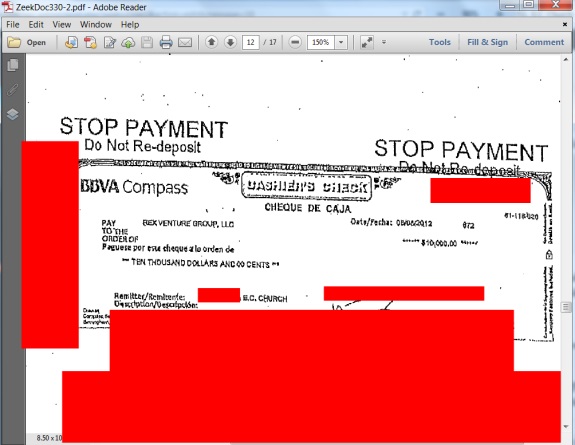
    This exhibit in the Zeek rewards Ponzi- and pyramid case shows that an an "E.C. Church" sent $10,000 to Zeek just days before in collapse in August 2012. (Masking by PP Blog.)
    This exhibit in the Zeek Rewards Ponzi- and pyramid case shows that an “E.C. Church” sent $10,000 to Zeek just days before the “program” collapsed in August 2012. (Masking by PP Blog.)

    UPDATED 8:42 P.M. ET U.S.A. Members of the faith community joining MLM HYIP schemes is a problem. It happened with the $119 million AdSurfDaily Ponzi scheme and the $72 million Legisi scam in 2008, for example.

    It’s happening currently with the “Achieve Community” scheme. Earlier, members of TelexFree  — an alleged $1.8 billion pyramid scheme — traded on the words and images of faith, including the Christ the Redeemer statue in Brazil.

    The WCM777 and Profitable Sunrise schemes also traded on images of the statue. Promoters of the schemes targeted people of faith. Those schemes likely generated more than $100 million.

    There’s also evidence that people of faith were targeted in the $897 million Zeek Rewards scheme brought down by the SEC in 2012.

    New filings by the court-appointed receiver in the Zeek case show that an entity that identified itself as an “E.C.” (Evangelical Congregational) church sent $10,000 to Zeek operator Rex Venture Group LLC on Aug. 8, 2012. The payment was in the form of a cashier’s check.

    The PP Blog is declining to identify the church because details of its precise geographic whereabouts could not be learned immediately. But the check was drawn on an Alabama bank that allegedly later stopped payment.

    Zeek receiver Kenneth D. Bell is seeking a court order for the bank — BBVA Compass Bank — to turn the $10,000 over to the receivership. BBVA Compass also allegedly unlawfully halted payment on 23 other cashier’s checks sent to Zeek. These totaled $73,800, meaning Bell is seeking $83,800 from the bank.

    Those checks were receivership assets, and the bank’s decision to stop-payment after the receiver presented them to be paid violated the asset freeze in the Zeek case, Bell alleged.

    From the receiver’s filings yesterday (italics added/light editing performed):

    At the commencement of the SEC Action on August 17, 2012, RVG possessed thousands of cashier’s checks and teller’s checks received from RVG Affiliates that had not been deposited or presented for payment. Upon entry of the Agreed Order, the Receiver collected cashier’s checks from RVG’s offices and deposited them in accounts opened for the Receivership Estate.

    Twenty-four (24) of the items collected from the RVG offices and deposited into the Receiver’s accounts were cashier’s checks payable to RVG issued by Compass. . . . On information and belief, between August 21 and August 29, 2012, Compass’s customers requested that Compass stop payment on the twenty-four Compass cashier’s checks previously delivered to RVG.”

    These halts by the bank were unlawful under the Uniform Commercial Code, Bell alleged.

    “Compass wrongfully accommodated its customers by stopping payment on all twenty-four cashier’s checks when it was not legally permitted to do so under the Uniform Commercial Code,” Bell contended.

    Although the filing is not on the subject of affinity fraud, documents within the filing suggest that the E.C. entity had company at Zeek among the faithful. Two checks among the 24 were drafted on behalf of an individual whose Zeek username included the word “blessing.” These checks totaled $2,300.

    Religious entities and people of faith getting recruited into HYIP schemes may not be the only problem. In the AdSurfDaily case, for instance, evidence surfaced that individuals had created purported nonprofits and religious entities into which to deposit their Ponzi winnings.

    Bell alleged in late 2012 that he “has obtained information indicating that large sums of Receivership Assets may have been transferred by net winners to other entities in order to hide or shelter those assets.”

    In 2014, Bell asked a court to take “judicial notice” of certain videos on YouTube.

    MLM may have a problem with “serial participants” in Zeek-like schemes to defraud, Bell suggested.

    NOTE: Our thanks to the ASD Updates Blog.

  • Feb. 5 TelexFree Bankruptcy Conference Is Canceled; Judge Orders Public Posting Of Trustee’s Report

    newtelexfreelogoUPDATED 5:42 A.M. ET FEB. 5 U.S.A. U.S. Bankruptcy Judge Melvin S. Hoffman has canceled a status hearing set for tomorrow in the TelexFree bankruptcy case.

    Hoffman further has ordered the report filed yesterday by TelexFree Trustee Stephen B. Darr to be posted publicly. Although the report already was posted, Hoffman’s order appears to underscore his desire to make sure it is widely read.

    Darr said yesterday that TelexFree, a purported VOIP company involved in multilevel marketing, may have involved more than 1 million participants globally and gathered as much as $1.8 billion in about two years. The trustee flatly called TelexFree a pyramid scheme.

    “In light of the detailed status report, the status conference scheduled for 2/5/2015 in these cases is canceled,” Hoffman wrote in an order today. “Kurtzman Carson Consultants LLC is odered to make a copy of this status report available for viewing by the public via the Kurtzman Carson website.”

    KCC now is providing links to Darr’s status report in two places — in a PDF on the lead page of filings, and on a TelexFree information page.

    Read Feb. 3 PP Blog report on Darr’s filing.

  • Zeek Figure Robert Craddock’s Fun Club USA Severely Sanctioned In Trademark-Infringement Case; Judge Orders Default For Failure To Follow Court Order

    OfferHubb.net Inc. sued Zeek Rewards figure Robert Craddock in February 2014, alleging Craddock “immediately” embarked on a web-based disparagement campaign after OfferHubb chose in July 2013 not to renew a contract with Craddock and Craddock’s Fun Club USA Inc.

    Co-defendants included Craddock’s wife, Sylvia Salgado Craddock, and Fun Club.

    Craddock was accused in the complaint of cybersquatting, trademark infringement, wrongful use of a computer, misappropriation of trade secrets, wrongful interference with economic relations, breach of contract, unjust enrichment, defamation and hiding behind a shell company.

    Now, a federal district judge in Nevada — following the October recommendation of a magistrate judge   — has ordered sanctions.  This includes the striking of the answer Fun Club filed in February. It also includes a default order against the enterprise.

    Why? Fun Club’s “failure to comply with this Court’s Order to obtain counsel,” Judge Richard F. Boulware II said in the order.

    Boulware also ordered the clerk to enter judgment and close the case. The financial fallout was not immediately clear.

    As the PP Blog reported in October (italics added):

    Fun Club and Craddock are referenced in a blistering memo filed in the Zeek Ponzi- and pyramid-scheme case by the SEC on Dec. 17, 2012. In the memo, the SEC accused Craddock of encouraging Zeek affiliates “not to cooperate” with Kenneth D. Bell, the court appointed receiver. The SEC further alleged that Craddock was spreading misinformation about how the agency viewed its own case against Zeek and that Fun Club appeared to have been formed 11 days after the SEC emergency action against Zeek on Aug. 17, 2012.

    Craddock has not been charged by the SEC with wrongdoing . . .

    The trademark-infringement claim may be particularly concerning to the MLM trade, given that Craddock has asserted he works as a copyright and trademark agent on behalf of MLM “programs.”

    On July 22, 2012, while purportedly working as a “consultant” for Zeek, Craddock filed a copyright- and trademark-infringement complaint against a HubPages website operated by Zeek critic K. Chang. K. Chang, who also posts on publications such as the PP Blog and BehindMLM.com, ultimately prevailed in the action brought by Craddock.

    Less than a month later, the SEC brought the Ponzi- and pyramid action against Zeek.

    Earlier this year, a website known as Changes Worldwide identified Craddock as its copyright agent. Filings by the SEC in June 2014 alleged that Faith Sloan, accused in April 2014 of securities fraud by the agency in its Ponzi- and pyramid complaint against the TelexFree “program,” sent more than $15,000 to an entity known as Changes Worldwide LLC after an asset freeze was imposed against Sloan in the TelexFree case.

    Sloan also was a Zeek affiliate. Whether proceeds that originated in Zeek and/or TelexFree made their way into Changes Worldwide is unclear.

    Craddock also was sued for trademark infringement and other alleged offenses by a firm known as BTG180, which accused Craddock of using the alleged Fun Club “shell corporation” to engage in a “shake-down” bid against affiliates of at least three MLM networks: Zeek, OfferHubb and BTG180.

    NOTE: Our thanks to the ASD Updates Blog.

  • ‘Achieve Community’ Websites Inaccessible

    From a promo for Achieve Community on YouTube.
    From a promo for Achieve Community on YouTube.

    UPDATED 12:20 P.M. ET U.S.A. Two websites associated with the “Achieve Community” — ReadyToAchieve.com and TheAchieveCommunity.com — are inaccessible this morning.

    Achieve Community is under investigation by the Colorado Division of Securities.

    The PP Blog asked the Division this morning if it was aware of the outage and whether the inaccessibility of the sites had anything to do with the investigation.

    “I cannot comment further at this time,” said Lillian Alves, Colorado’s Deputy Securities Commissioner.

    Reports surfaced yesterday on a Facebook site known as the “NonOfficialAchieveCommunity” that Achieve had shut down its own private forum and that a page linked to a purported new payment processor for Achieve was carrying a “server maintenance” message.

    The maintenance message continues to appear today.

    Some Achievers have condemned the NonOfficialAchieveCommunity Facebook site, which also is known as “the Sheepdog” and does not echo the company line. In recent days, one poster made the preposterous assertion that the Sheepdog was responsible for ruining 10,000 lives and could be held financially liable by Achievers.

    Achieve purportedly is operated by Kristi Johnson of Colorado and Troy Barnes of Michigan.  The “program,” backed by hucksters such as Rodney Blackburn, reportedly has not made payouts for nearly three months after encountering trouble with payment processors.

    Blackburn is pushing multiple “programs” with a presence on well-known Ponzi-scheme forums — and even camped out on the website of the U.S. Securities and Exchange Commission to record a promo.

    The SEC last month declined to comment on Blackburn’s commercial.


  • URGENT >> BULLETIN >> MOVING: Bankruptcy Trustee Says TelexFree Was ‘Pyramid Scheme’ That Gathered As Much As $1.8 Billion

    breakingnews72URGENT >> BULLETIN >> MOVING: (10th Update 8:53 p.m. ET U.S.A.) In his first formal report to the Massachusetts bankruptcy court, TelexFree Trustee Stephen B. Darr calls the company a “pyramid scheme” that may have involved 1 million or more participants globally and gathered as much as $1.8 billion through arms in the United States and Brazil.

    If the numbers hold up, it would mean that TelexFree has surpassed the Zeek Rewards scheme in both victims’ count and haul. Zeek is estimated to have created about 800,000 victims, while hauling about $897 million. Zeek was shut down by the SEC in August 2012.

    The SEC and the Massachusetts Securities Division brought actions against TelexFree in April 2014.

    Darr also revealed that 13 private lawsuits have been filed against TelexFree and/or related principals, including former executives James Merrill and Carlos Wanzeler.

    TelexFree’s Brazilian arm was known as Ympactus and “grew much more quickly than the Debtors and its shutdown by Brazilian authorities in the summer of 2013 was the first of many red flags that the Debtors were operating an unsustainable pyramid scheme,” Darr advised U.S. Bankruptcy Judge Melvin S. Hoffman.

    Darr also strongly implied that a black market existed both internally at TelexFree and externally to the cross-border enterprise. It is known that the U.S. Department of Homeland Security, through its Homeland Security Investigations arm, is deeply involved in the TelexFree probe.

    Today’s report by Darr may — at least in part — explain why. From the report (italics added/minor editing performed):

    The Debtors’ business plan was complicated in and of itself. The scheme’s complexity was expanded further, however, through a web of inter-Participant transactions that permeated the scheme.

    First, a new Participant could purchase a membership plan by making payment directly to the Debtors . . . or by redeeming accumulated credits.

    In lieu of paying funds directly to the Debtors, it appears that many Participants became involved in the scheme by paying their membership fee directly to a recruiting Participant who often did not remit the payment from the new Participant to the Debtors. Rather, the recruiting Participant frequently retained the payment from the new Participant in return for a reduction, or redemption, of their accumulated credits. The mechanics of this transaction were as follows:

    a) After an invoice was issued to the new Participant and marked as pending, the new Participant would forward the invoice through the system to the recruiting Participant for payment;

    b) The recruiting Participant would then pay the invoice using the recruiting Participant’s credits. The Debtors’ database would charge the recruiting Participant’s credits for the invoice and mark the invoice as paid.

    In this manner, new Participants often joined the Debtors’ scheme without any money actually being paid to the Debtors.

    In addition to the two scenarios outlined above, there appears to have been a third type of transaction that did not involve the Debtors at all. This type of transaction involved the transfer of credits by one Participant to another Participant in exchange for cash or other consideration. The motivation for the transfer of credits is not always clear, although in some instances recruiting Participants may have purchased credits so that such recruiting Participant had sufficient credits to be redeemed after receiving payment from a new Participant.

    Growth at the Ympactus arm in Brazil accelerated “in the fall of 2012 through the early summer of 2013,” Darr asserted.

    “The Debtors’ records indicate that by the spring of 2013, Ympactus had cash receipts of more than $100,000,000 per month,” he continued. “These receipts do not reflect inter-Participant transactions that did not involve direct payment to Ympactus.”

    After Brazilian authorities intervened in June 2013, freezing as much as $300 million in that country, the U.S. TelexFree arms — previously underperformers compared to Ympactus — began to surge, Darr alleged.

    “Following the shutdown of Ympactus, the Debtors’ revenues increased dramatically such that by the end of 2013 and early 2014, the Debtors were generating cash of as much as $50,000,000 per month, without regard to inter-Participant transactions for which consideration did not pass to the Debtors,” Darr said.

    TelexFree banking relationships crumbled, Darr said in the report.

    “Multiple banks closed the Debtors’ operating accounts apparently based upon suspicious activity in those accounts,” Darr said.

    A lawyer advised TelexFree in mid-2013 that its business plan constituted a pyramid scheme, Darr said.

    “Although the Debtors were apprised in mid-2013 by counsel that the business plan was a pyramid scheme, they continued to operate using that plan until March 2014. At that time, the Debtors introduced a new business plan, even though the Debtors were apparently advised that the new plan did not rectify the problem. The new plan was unanimously rejected by the Participants, which appears to have precipitated a ‘run on the bank’ inasmuch as $58,000,000 or more was paid out to certain Participants in the several weeks leading up to the filing of the petitions. An additional $100,000,000 was requested by Participants but was not paid.”

    In September 2014, Darr identified MLM lawyer Jeffrey Babener as an attorney who advised TelexFree it was operating a pyramid scheme.  Babener isn’t named in today’s filing, so it is not immediately clear if a second attorney also advised TelexFree that its platform was a pyramid.

    Darr also said in the report that TelexFree “wrote off” a receivable “in the approximate amount of $180,000,000” due from Ympactus. The write-off appears to have occurred in late 2013, after the action in Brazil.

    “Upon information and belief, the Debtors advanced the costs for the voice over internet protocol, or ‘VOIP’, service for both the Debtors and Ympactus,” Darr said. “Ympactus contracted to pay a portion of its revenues to the Debtors as a commission, but it is unclear the extent to which these payments were ever made. In December 2013, six months after the seizure of Ympactus’ assets by the Brazilian authorities, the Debtors established, and then subsequently wrote off, a receivable due from Ympactus in the approximate amount of $180,000,000, purportedly for unpaid commissions and related services.”

    Darr also identified a number of TelexFree subsidiaries or affiliates, noting there could be more. These are among the entities and ownership information listed in the report. (Please note that not all location information is listed):

    • TelexFree International LLC:: Ownership: Wanzeler, Carlos Costa, Merrill:: Location:: Nevis.
    • TelexFree Mobile Holdings Inc.:: Ownership:: Wanzeler and Merrill.
    • Graham Bell Telex LLC:: Ownership:: TelexFree Mobile Holdings LLC and Costa.
    • TelexFree Mobile LLC:: Ownership:: Graham Bell Telex LLC and Infinium Wireless.
    • TelexElectric LLLP: Ownership:: Wanzeler, Costa and Merrill.
    • Bright Lite Future LLC:: Ownership: Wanzeler, Costa and Merrill.
    • Brazilian Help Inc.:: Ownership: Wanzeler.
    • Sunwind Energy Group LLLP: Ownership: 1127 Enterprises LLC and Merchant Enterprises Inc.
    • Sunwind Energy Solutions:: Ownership:: 1127 Enterprises Inc., ACE.
    • LLLP: Ownership:: LLP, Executive Marketing Inc. and Sunwind Energy Group LLLP.
    • Sunwind Energy Doyle North LLC:: Ownership: Sunwind Energy Southern LLLP, ACE LLP, Adams Craft Ewing LLLP, Guasti LLC.
    • ACE LLP:: Ownership:: Undetermined.
    • Executive Marketing Inc.:: Ownership:: Undetermined.
    • 1127 Solutions LLC:: Ownership: Undetermined.
    • Merchant Enterprises Inc.:: Ownership: Undetermined.

    “There may have been other entities formed by the Debtors’ principals to conduct similar operations in other jurisdictions, including TelexFree Ecuador, TelexFree Columbia, TelexFree Dominican Republic, TelexFree Canada, and TelexFree International, Ltd. (Cayman Islands),” Darr alleged.

    And, he noted, “In addition, other entities appear to have been formed by the Debtors’ principals for related or unrelated purposes, including JC Real Estate Investments LLC; JC Real Estate Management Co., LLC; Above and Beyond the Limit LLC; CNW Real Estate LLC; CNW Realty State LLC; Acceris Realty Estate LLC; KC Realty State LLC; Makeover Investments LLC; Eagleview Realty Estate LLC; and Grandview Realty Estate LLC.

    With forensics well under way and with Darr in communication with investigators in the United States and Brazil, how big is the job ahead? (Bolding added):

    “The database identifies more than 2,100,000 electronic mail addresses for Participants in the operations of both the Debtors and Ympactus,” Darr said. “Of this amount, approximately 1,000,000 appear to be provided by Participants of the Debtors, with the balance related to the Ympactus Participants. The database identifies more than 17,000,000 different accounts, of which approximately 12,000,000 are those of Participants and 5,000,000 are those of Ympactus Participants. As referenced earlier, an individual Participant could maintain multiple accounts using a single electronic mail address, and an individual Participant could also maintain more than one electronic mail address. During the period February 2012 to April 2014, the total combined cash receipts for the Debtors and Ympactus were in excess of $1,800,000,000 and combined noncash revenue was approximately $4,200,000,000.

    Oddities abound, according to the report.

    ” . . . the Debtors’ computer system does not link all accounts for an individual Participant, and the Participant name field enabled Participants to use different variations of their name in the input process,” Darr said.

    “Certain accounts do not contain electronic mail address information. Of those accounts that do contain electronic mail address information, in some instances, the information is facially inaccurate, such as the Participant’s use of the Debtors’ electronic mail address as a placeholder such as [deleted by PP Blog]. In other instances, a Participant may have used the same electronic mail address as other Participants, including the sharing of electronic mail addresses with family members. Unlike the computer systems of similar type enterprises, the Debtors’ system did not require confirmation of an electronic mail address.

    “Similarly,” Darr said, “certain accounts do not contain physical address information. Some other accounts contain physical address information that is facially inaccurate, such as the use of a country code that is inconsistent with the address, e.g., ‘San Paulo, USA.’”

    From the report (italics/bolding added):

    Manual credits were credits assigned to a Participant’s account balance on account of money paid to the Debtors for one of several reasons, as distinguished from credits “earned” from the placement of advertisements or other components of the compensation scheme. The Debtors’ records reflect approximately $151,000,000 of manual credits issued to certain Participants. The issuance of manual credits appears to be a fraud within the larger fraud of the pyramid scheme with the Debtors’ insiders adding large amounts of credits to certain accounts whereby the credits could then be sold to other Participants. There appears to be no corresponding payment supporting many of these large manual credits.

  • Promos By ‘Achieve Community’ Huckster For ‘Military Medical Relief 21’ Go Missing From YouTube

    The MMR21 logo. Source: screen shot.
    The MMR21 logo. Source: screen shot.

    UPDATED 12:11 P.M. ET U.S.A. Two YouTube promos that asked U.S. military personnel and 20-year retirees to enroll in a purported study piggybacking off a purported “compound medication” to treat pain have been deleted.

    The promos were linked last month to “Achieve Community” huckster Rodney Blackburn, who also created a Facebook site to promote “Military Medical Relief 21” (MMR21), the “program” targeted at military members and retirees. The Facebook site now appears to be inaccessible.

    One individual Facebook text promo attributed to Blackburn that remains includes four exclamation marks and screams, “Help our soldiers today! Soldiers are being compensated! Soldiers are finding relief from addictive pain medication! Enroll today or spread the word to millions of soldiers!”

    A link to a YouTube video appears below the text promo. When clicked, this message appears, “This video has been removed by the user.” The promo appears to have been directed to the official Facebook site of “Army Wives,” a television program on the Lifetime cable and satellite network.

    On YouTube, Blackburn asserted that military personnel would be paid for their participation in MMR21, which purportedly is a nonopiate pain cream. MMR21 purportedly is linked to a Wyoming nonprofit registered Jan. 2 and called American Christian Warrior 13 Inc.

    Precisely who is running MMR21 and American Christian Warrior 13 is unclear. Also unclear is how the two are related and why the YouTube promos were deleted.

    At least one of the YouTube promos referenced the U.S. Food and Drug Administration and claimed ingredients contained within the compound had been “approved” without saying whether the medication itself had been approved. On Jan. 16, the FDA said it could not comment immediately. On Jan. 20, the agency declined to comment.

    Blackburn featured an individual described as “Dr. Tony” in one of the promos.

    At least one website Blackburn said was linked to MMR21 is soliciting information from military personnel. Despite the fact that the site is asking for intensely personal medical information, identification documents and even information on employment and medical insurance, it appears to be hosted at an insecure URL.

    Among the questions on the site:

    • Are you pregnant?
    • If pregnant, Due Date[.]
    • Last Menstrual Period[.]

    Prospects are solicited to provide information on whether they suffer from one or more of at least 56 medical ailments listed on the site. Examples include menopause, andropause, stretch marks, migraine, nervous disorder, depression, decreased sexual function, hypertension, hypotension and many more.

    A message on the site claims, “This form encrypts at the time of submission and will remain secured until it reaches your evaluating Doctor.”

    The names of the purported “evaluating” doctors are not disclosed. Also undisclosed is any information on their medical training, licenses held, board certifications and whether they are being compensated by MMR21 or American Christian Warrior. MMR21’s website appears to rotate to CMF10.com, the site that claims forms are encrypted during submission.

    How much military members purportedly could earn through MMR21 is unclear. Facebook sites with military themes appear to have been spammed by more than one individual with links to the “program.”

    Prior to the YouTube deletions of Blackburn’s MMR21 promos, they were mixed in with his promos for at least three money-cycler schemes with a presence on the Ponzi boards. “Achieve Community,” one of the Ponzi-board “programs” Blackburn is pitching, is under investigation by the Colorado Division of Securities.

    Claims about at least two other Ponzi-board “programs” Blackburn is pitching are more absurd than even Achieve claims. Achieve asserts $50 turns into $400.

    One of Blackburn’s MMR21 promos claimed, “The American Christian Warrior 13 Non Profit (ACW13) is actively looking for Soldiers to provide acceptance and need [sic] feedback after using our product. [A]nd for feedback there is compensation!!!

    “Yes[,] you and other military soldiers can be compensated for this!!!!”

    In order to be compensated, military personnel needed to participate in the study and “not be using or agree to stop using your current topical cream,” according to the video by Blackburn.

  • UPDATE: ‘Bacon’ Program Pushed By ‘Achieve Community’ Hucksters Reportedly Put On Hold By ‘Admin’; Second Program May Be DOA After Purported Payza Freeze

    If this graphic is to believed, "BRING THE BACON HOME" will produce a happy marriage and bring you children -- along with a palm-tree lined oceanfront mansion near a convenient airport, a big car and delicious, oversized fruit.
    “BRING THE BACON HOME” purportedly is operated by an “admin” who is a “young trustworthy girl from Singapore,” according to a Ponzi-board post. If this graphic is to believed, the “program” will produce a happy marriage and bring you children — along with a palm-tree-lined oceanfront mansion near a convenient airport, a big car, lots of U.S. cash and delicious, oversized fruit.

    UPDATED 6:20 A.M. ET U.S.A. “BRING THE BACON HOME,” a bizarre Ponzi-board “program” purportedly operated by “Sherilyn” from “Singapore” and pushed on YouTube by Achieve Community hucksters Rodney Blackburn and Mike Chitty, reportedly collapsed during a so-called Beta launch this week and has been put on hold.

    The “program” purportedly turns $40 into $1,800. Achieve Community purportedly turns $50 into $400, although it has been dogged by problems for more than two months and now is the subject of an investigation by the Colorado Division of Securities.

    “BRING THE BACON HOME” appears to have enabled subscription purchases, but the early haul before the failed Beta is unclear. “Sherilyn” is quoted on the MoneyMakerGroup Ponzi forum in a post dated Jan. 26 as saying, “Just buy the subs and let us do the ‘magic’ for now.”

    “My Beta Bacon got Burnt,” one Ponzi-board wag ventured.

    Separately, a “program” known as Cycles 24/7 that was advertised on the Achieve Community private forum last month may be dead. Cycles 24/7 initially collapsed at launch, but rebirthed itself — at least long enough to grab some cash.

    Cycles 24/7 purportedly is operated by “Rick Fleming.” Like Achieve, Cycles 24/7 purported to turn $50 into $400.

    On Jan. 24, a poster on MoneyMakerGroup claimed this about Cycles 24/7: “I have 45$ in payza balance, but admin say that his payza money Frozen, how i can withraw [sic] to egopay?”

    The MoneyMakerGroup claim about Payza freezing Cycles 24/7 funds followed by two days a claim on the Blog at EgoPay.com that EgoPay had been hacked and that a “gap” in cash reserves existed.

    Cycles 24/7 and “BRING THE BACON HOME” both listed EgoPay and Payza among their processors. Like Achieve Community, Cycles 24/7 is serving ads for other HYIPs.

    One ad for “BRING THE BACON HOME” observed today by the PP Blog on the Cycles 24/7 site referenced “Unison Wealth,” yet another Ponzi-board “program” pushed by Achieve Community members.

    The ad was titled “Bring Home The Bacon.” A text line read, “Did you miss Unison Wealth on the 1st day?” When clicked, the ad led to the “BRING THE BACON HOME” site.

    Unison Wealth also is beaming ads for other HYIP schemes.

    It is not unusual for one HYIP venture to try to prop up another through advertising or even to invest in other scams. Beginning in 2005, for instance, the CEP scam allegedly plowed money into at least 26 other schemes.

    In 2012, after the collapse of the $897 million Zeek Rewards “program,” a venture known as Wealth Creation Alliance published ads for one HYIP scheme after another. The schemes typically are Ponzi schemes or pyramid schemes — or sometimes both. They engage in securities fraud and the sale of unregistered securities across national borders.

    People who openly profess Christian beliefs or faith in God often are at once the marks and the purveyors of such schemes. AdSurfDaily Ponzi schemer Andy Bowdoin, an apparent advocate of The Prosperity Gospel who encouraged his MLM flock to envision money “flowing” to them, once declared himself a Christian “money magnet.”

    Federal prosecutors tied Bowdoin to at least four fraud schemes, including at least two that surfaced after the collapse of ASD in 2008. He is now in federal prison.

    One of Bowdoin’s schemes was called “One X.” “I believe that God has brought us OneX to provide the necessary funds to win this case,” Bowdoin claimed in 2011.

    The “this case” to which he referred was the ASD Ponzi prosecution. Bowdoin lost on all fronts, eventually pleading guilty to wire fraud.

    Bowdoin also was associated with a scam known as AdViewGlobal that once threatened to litigate against its own members for asking questions. AVG, as it was known, also created a private forum after its public scam outreach started to create problems.

    Achieve Community recently has added a private forum.

    Another current Ponzi-board HYIP scheme pushed by one or more Achieve Community promoters is called “Trinity Lines.” Among other things, Trinity Lines claims to be the purveyor of “high quality scriptural vignettes.” It also claims:

    • “Although this opportunity is geared for those who appreciate the Scriptures, we welcome anybody to join our community.”
    • “We at Trinity Lines do believe in God and believe in the power of ‘His Word’.

    Though not writing about any specific MLM HYIP schemes, the associate pastor of an evangelical church in Massachusetts this week called “The Prosperity Gospel” a “pyramid scheme” and “a form of oppression.”

    The column is titled, “Why the Prosperity Gospel Is the Worst Pyramid Scheme Ever.”

    From the column by Nicholas McDonald at The Gospel Coalition (italics added):

    Step One: A snazzy entrepreneur wants to make a lot of money. Said snazzy entrepreneur tells two little old ladies that if they sell his “Wow-What-A-Sham 3000,” they can make some dough to pay off their cat-sitting bills. That will cost them a startup investment of $401.76. And yes, Wow-What-A-Sham 3000 is a gimmick. But that’s okay, it’s not really about selling the product anyway; it’s about recruiting more salespeople.

    McDonald is associate pastor at Carlisle Congregational Church, according to his bio line in the column.