“He marketed his plan as ‘simply the best financial plan ever created.’” — Office of U.S. Attorney Benjamin B. Wagner of the Eastern District of California, Sept. 14, 2012
A California man and his 76-year-old father-in-law ran a $7 million Ponzi scheme called Naras Funds, federal prosecutors said yesterday.
The younger man — Lee Loomis, 54, of Granite Bay — joined with five others in two mortgage-fraud schemes that caused more than $10 million in losses, prosecutors said.
Now, all seven individuals have been charged in a 50-count indictment after a four-year investigation by the FBI and the IRS, prosecutors said.
Loomis, also known as Lawrence Leland Loomis, was arrested yesterday. His father-in-law, John Hagener of Granite Bay, is said to be cooperating with investigators.
From a statement by prosecutors yesterday (italics added):
The three frauds are connected to a wealth-building program offered to the public through Loomis Wealth Solutions (LWS) in California, Illinois, Washington, and elsewhere from 2006 through 2008. According to the indictment, Loomis encouraged members who joined LWS: (1) to purchase whole life insurance; (2) to “harvest” home equity and retirement accounts to buy shares in the Naras Funds; and (3) to serve as “nominees” in the purchase of residential real estate controlled by Loomis. Loomis promised members of Loomis Wealth Solutions that they could acquire real estate at no cost to themselves. Moreover, he said he would pay them more than $300 per month for each home they agreed to acquire and those payments could be applied to the life insurance premiums. He marketed his plan as “simply the best financial plan ever created.”
In the Naras Funds Ponzi scheme, Loomis and Hagener are charged with falsely promising 12 percent annual returns in two investment funds: (1) Naras Secured Fund #1 and (2) Naras Secured Fund #2. According to the indictment, to induce people to invest in the Naras Funds, Loomis and Hagener falsely promised that the Naras Funds were invested in junior mortgages paying 14 percent annual returns. The two men also claimed that the Naras Funds were guaranteed by secured deeds of trust in residential real estate and by backing from a third-party company. According to the indictment, those statements were false. In fact, Loomis and Hagener used the money to pay operating expenses of various Loomis-controlled companies, to pay themselves, and to pay earlier investors. Loomis and Hagener are charged with mailing false monthly investment reports to victims and arranging wire transfers of victims’ home equity and retirement accounts to the failing Naras Funds in 2008.
Meanwhile, the Sacramento Bee is reporting this (italics added):
The alleged fraud was so complex that federal agents and prosecutors took years before they were ready to seek an indictment, and the cast of characters that Loomis surrounded himself with were worthy of a screenplay.
One was a white supremacist, another a lifelong con man who fled the country and was eventually arrested coming in from Canada with $70,000 crammed in his cowboy boots.
“The fraudsters prey upon vulnerable victims, do not respect local or even state boundaries, and often loot the victims’ life savings.” — Melinda Haag, U.S. Attorney for the Northern District of California, Sept. 13, 2012
It featured confidence-boosting names: Millennium Bank, United Trust of Switzerland and Sterling Bank and Trust.
But it was a cross-border Ponzi scheme that operated for 10 years. Its international “mastermind” controlled each of the entities and duped investors into purchasing at least $129.5 million in “bogus CDs,” federal prosecutors in two U.S. districts said this week.
William J. Wise, the mastermind, was a resident of Canada. But he also operated in the region of Raleigh, N.C., luring investors with tales of outsize returns made possible by profitable overseas investments, prosecutors said. In 2009, the SEC said Wise was assisted by Kristi M. Hoegel of Napa, Calif.
Hoegel, the SEC said at the time, used as many as five aliases. One proved to be the name under which she was charged criminally in February 2012: Jacquline Hoegel.
On Wednesday, Wise pleaded guilty to 18 felonies, prosecutors said. He potentially faces decades in prison.
Here is a breakdown of the Wise guilty pleas: one count of conspiracy to commit mail and wire fraud; twelve counts of mail fraud; three counts of wire fraud; one count of money laundering; and one count of tax evasion.
“The United States Attorneys around the country have identified an unprecedented rise in investment fraud schemes, involving thousands of victims and staggering losses,” said U.S. Attorney Melinda Haag of the Northern District of California. “The fraudsters prey upon vulnerable victims, do not respect local or even state boundaries, and often loot the victims’ life savings. This case is an example of U.S. Attorneys working together – from the Northern District of California to the Eastern District of North Carolina – to identify the schemes, find the perpetrators and bring them to justice.”
Haag was backed by Thomas G. Walker, the U.S. Attorney for the Eastern District of North Carolina.
“The individuals who commit these crimes have no regard for the well-being of their victims – only the desire to make a quick buck,” Walker said. “United States Attorney’s offices, along with federal, state and local law enforcement officials, work diligently each and every day to see that those who commit these crimes are the ones who pay.”
Prosecutors stressed that “[t]he Sterling Bank and Trust referred to in the indictment and plea agreement is not affiliated with the Sterling Bank & Trust headquartered in Southfield, Michigan, with thirteen branches in the San Francisco Bay Area.”
It is not unusual for scammers to trade on the name of a well-known entity or to cherry-pick parts of a well-known name to sanitize a fraud scheme and create comfort in the minds of investors. The Trevor Cook Ponzi scheme in Minnesota, for example, cherry-picked the name of UBS and also used names that sounded regal.
Ponzi-forum hucksters often do the same thing, dazzling investors with tales of fantastic “offshore” profits and using names that instill comfort and confidence.
Prosecutors noted pointedly this week that Wise “agreed to work with the government and the Receiver appointed by the Texas District Court to obtain control over any remaining investor funds in bank accounts in the United States or in foreign countries. ”
North Carolina was rocked Aug. 17 with SEC allegations that Zeek Rewards, an MLM “program” married to a penny-auction site known as Zeekler and operated by Paul R. Burks of Rex Venture Group LLC, was a $600 million Ponzi- and pyramid scheme that may affect more than 1 million people.
Kenneth D. Bell, the court-appointed receiver in the Zeek case, now says there may be 2 million victims. Zeek used as many as 15 financial vendors, including offshore vendors, the SEC said.
Court records strongly suggest Burks was cooperating with the SEC before the agency’s civil charges became public. The U.S. Secret Service said last month that it also was investigating Zeek.
The SEC said last month that Burks had agreed to cooperate with the receiver.
The Wise case resulted from “a lengthy investigation by the IRS-Criminal Investigations Division,” prosecutors said.
Kenneth D. Bell, the court-appointed receiver in the Zeek Rewards Ponzi scheme case, said in a statement today that he had recovered nearly $300 million and that “[t]here may be tens of millions of dollars more of recoverable assets.”
On Aug. 17, the SEC described Zeek as a $600 million Ponzi- and pyramid scheme that had affected more than 1 million people.
Securing receivership assets has been his “first priority” since his Aug. 17 appointment by Senior U.S. District Judge Graham C. Mullen, Bell said.
Bell’s statement appeared today on the receiver’s website. He noted that clawback actions may be in the offing, although he didn’t specify when.
“Among those from whom we intend to recover assets are those affiliates who took more out of Rex Ventures than they put in,” Bell said.
Rex Venture Group LLC is North Carolina-based Zeek’s parent company.
“Many of you received little or nothing from this enterprise,” Bell said. “In order to make everyone as whole as possible, those who profited from participating should surrender their gains.”
And Bell said he was aware that bogus information about Zeek was spreading online.
“Finally,” Bell said, “I read in many emails and web postings that some affiliates claim to have spoken to me or the SEC. False information is being circulated by these claimants. I have not spoken to any of those claiming to have done so. I will communicate with you through this web site. If I could answer all of the hundreds of thousands of emails and calls from you I would, but obviously I can’t. I also recommend that you consider only what the SEC posts on its web site for its position on this matter.”
In an Aug. 27 statement, Bell said that his “early investigation shows that the number of victims could be double” the SEC’s Aug. 17 estimate of 1 million.
“By sheer number of victims, this is one of the largest, if not the largest, Ponzi scheme to go into receivership in U.S. history,” Bell said in the Aug. 27 statement.
Screen shot: I-Payout website showing logos of "Global Strategic Partners." Ponzi-forum reports surfaced yesterday that the Wealth4AllTeam HYIP scheme was using I-Payout. In July, a scheme known as "OneX' that federal prosecutors previously described as a fraud and a "pyramid" announced that it was transitioning to I-Payout.
UPDATE: Wealth4AllTeam, one of the many HYIP schemes pushed by Zeek Rewards “I Got Paid” cheerleader “Ken Russo,” reportedly was using I-Payout as a payment facilitator, according to new Ponzi-forum reports.
Wealth4AllTeam appears to have suspended operations, leaving the Ponzi forums in an uproar amid claims that it is transitioning to a new business model that incorporates something called “Project Genesis.”
“I-payout quick links has been removed….all the attached bank account has been deactivated..there is no option left to deposit or withdraw…Looks like W4all have a hold on I-payout,” MoneyMakerGroup poster “jhakas22” claimed yesterday.
If the report is true — and MoneyMakerGroup poster Tobwithu claimed that he (or she) “can confirm that all links at i-payout are gone!’ — then it means that Wealth4AllTeam was using the same facilitator to which the mysterious “OneX’ scheme claimed it was transitioning.
In April, federal prosecutors described the purported OneX “program” as a “fraudulent scheme” and “pyramid” pushed by former AdSurfDaily President Andy Bowdoin. ASD was a $119 million Ponzi scheme. In August, Bowdoin was sentenced to 78 months in federal prison.
On July 19, the PP Blog reported that OneX claimed it had dropped SolidTrustPay — a Canada-based processor linked to fraud scheme after fraud scheme — in favor of I-Payout. That announcement was made by “J.C.,” later identified by federal prosecutors as James C. Hill.
I-Payout’s website publishes the logos of HSBC, Deutsche Bank, Barclays and other “Global Strategic Partners,” including Bank of America.
(Also see June 20 PP Blog report about OneX claim that it was working with a processor with a tie to Bank of America. Given events that occurred after the dropping of Bank of America’s name and the appearance of the bank’s name on the I-Payout site, it appears “J.C.” was alluding to I-Payout in June.)
Any number of ASD Ponzi-scheme pushers used Bank of America’s name to sanitize the ASD fraud. In raising Bank of America’s name in June and announcing the I-Payout transition in July, OneX appears to have been doing the same thing.
Name-dropping to sanitize fraud schemes is common in the HYIP sphere. So are lawsuit threats and other bids to chill websites that publish information critical of HYIPs.
In July, Robert Craddock, a purported “consultant” for Rex Venture Group LLC — the operator of the Zeek Rewards MLM scheme — sought to have a HubPages site operated by Zeek critic “K. Chang” removed from the web by filing a complaint with HubPages about purported copyright and trademark infringement and libel. Craddock’s efforts succeeded temporarily.
In a bizarre Blog post on Aug. 4, Zeek claimed that “all” criticism of Zeek was unfair and planted the seed that unspecified “North Carolina Credit Unions” were circulating a purported “internal memo” that allegedly was “at once unfavorable to Zeek Rewards and false.”
The Zeek post, attributed to then-acting COO Gregory J. Caldwell, complained the credit unions were slandering Zeek and warned Zeek members to toe the company line.
Thirteen days later, the SEC filed an emergency court action that described Zeek as a $600 million Ponzi- and pyramid scheme.
Craddock now is involved in a purported effort to defend Zeek affiliates from clawback actions by the court-appointed receiver in the SEC’s Zeek case. That effort began after the SEC’s actions against Zeek and also included name-dropping. During a pitch for Zeek members to send in money, Craddock dropped the name of former Florida Attorney General (and former U.S. Rep.) Bill McCollum.
McCollum, now a partner at the SNR Denton law firm, no longer is in public office. Precisely why Craddock mentioned McCollum’s name is unclear, although Craddock initially said that the Zeek affiliates were hiring SNR Denton. That effort appears now to have fallen through.
As Florida’s Attorney General, McCollum sued ASD for fraud in August 2008. Some ASD members countered that McCollum should be sued for Deceptive Trade Practices for holding the view that ASD was a fraud. Although McCollum’s office later dropped the ASD lawsuit, it said it had gathered names of ASD fraud victims and provided them to the U.S. Department of Justice, which had established a remissions process through which ASD victims could receive compensation from proceeds seized by the U.S. Secret Service in the ASD Ponzi case filed at the federal level in the District of Columbia.
Zeek is known to have members in common with the ASD Ponzi scheme. Some Zeek members also promoted OneX, the scheme promoted by ASD’s Bowdoin after his December 2010 arrest by the U.S. Secret Service on Ponzi-related charges of wire fraud, securities fraud and selling unregistered securities.
Bowdoin told prospects that OneX was good for “college students.”
This grainy likeness of Legisi HYIP operator Gregory N. McKnight appears in U.S. court files.
BULLETIN: Yesterday’s scheduled sentencing of convicted Legisi HYIP swindler Gregory N. McKnight has been delayed until Nov. 19, but federal prosecutors in the Eastern District of Michigan have asked U.S. District Judge Mark A. Goldsmith to sentence McKnight to 15 years in prison.
McKnight and Legisi relied on “semantic obfuscation” in which investors were told they were joining a “loan program,” not making an “investment,” prosecutors said.
A 15-year sentence is at “the top of the sentencing guidelines of 151-188 months” and “may serve to discourage others who are inclined to involve themselves in similar criminal conduct,” prosecutors argued to the judge.
In February, McKnight, 52, pleaded guilty to wire fraud in the Legisi Ponzi caper. The scam, which planted the seed a return of between .25 percent a day and 12 percent a month was possible, was popularized in part on Ponzi boards such as MoneyMakerGroup and Talk Gold.
Court filings show that Legisi used some of the same payment processors used by the AdSurfDaily Ponzi scheme, including e-Gold and e-Bullion. ASD operator Andy Bowdoin was sentenced in August to 78 months in federal prison.
“The principle mechanism by which investor funds would be funneled to defendant was through the utilization of the internet via digital currency, particularly e-gold and e-bullion,” prosecutors said in the McKnight sentencing memo. “The use of these non-traditional funding methods provided McKnight with the opportunity (at least for a while) to conduct the scheme below the radar of regulators.”
And, prosecutors pointed out, “[i]n 2007, the United States government seized the property in approximately 58 e-gold accounts due to various criminal violations, including McKnight’s account . . . Moreover, in 2008, e-gold and its operators were convicted of money laundering and conspiracy to defraud the United States . . . And in 2006, the United States government commenced a forfeiture suit against e-bullion for operating an unlicensed money transmitting business, wire fraud, and money laundering . . . James Fayed, the owner and operator of e-bullion, was later convicted in the State of California of having his wife murdered and sentenced to death row.”
Legisi gathered about $72 million. The SEC and the U.S. Secret Service led the probe, which resulted in civil charges against McKnight by the SEC and a criminal charge of wire fraud against him by the Secret Service.
Legisi pitchman Matthew John Gagnon also was charged civilly and criminally in the Legisi case.
From the prosecution’s sentencing memo on McKnight (italics added/bolding in original):
As if the exorbitantly high interest rates were not enough to induce investors into defendant’s scam, Legisi also offered a referral program whereby investors could earn a 5% to 7% commission on the amount of new funds that a referred investor placed in the program. As McKnight explained, “[a]s an Active Member of Legisi.com, you are encouraged to refer friends, colleagues, and your own website visitors to us and benefit from an additional source of income — a 5% – 7% incentive bonus for each new account opened by your referrals and on any and all future deposits from them!”
Legisi was an acronymn that stood for “Lucrative Electronic Gold Income Services International,” prosecutors said. HYIP schemes spread in part because unlicensed/unregistered brokers (such as Gagnon) push them online to earn “commissions.”
The MoneyMakerGroup Ponzi forum — one of the outlets from which Legisi was pushed — is specifically referenced in court filings in the Legisi case.
Zeek Rewards, which the SEC described last month as a $600 million Ponzi- and pyramid scheme selling unregistered securities, also was heavily pushed on the Ponzi forums. Zeek used both domestic and offshore financial vendors, including AlertPay and SolidTrustPay in Canada.
Zeek planted the seed it could provide a return of between 1 percent and 2 percent a day, far higher than Legisi’s maximum suggested payout of 12 percent a month. Like Zeek, ASD suggested a payout on the order of 1 percent a day. The ASD scheme gathered at least $119 million, federal prosecutors in the District of Columbia said.
ASD relied on wordplay to dupe investors. So did Legisi, prosecutors said in the McKnight sentencing memo (italics added):
In addition to operating a Ponzi scheme, McKnight committed various securities violations. While McKnight himself referred to Legisi as a “loan” program, and demanded that “members” not refer to their “loan” and an “investment,” Legisi was, in reality, an investment contract, which is considered a security and therefore regulated by the Securities and Exchange Commission. This semantic obfuscation was quite obviously an attempt to sidestep the securities laws.
From a footnote in the prosecution’s McKnight sentencing memo (italics added):
[Legisi] Investors originated from all 50 states and approximately 33 foreign countries (Australia, Bahamas, Belgium, Canada, Cyprus, Demark, England, France, Finland, Germany, Greece, Iceland, India, Ireland, Israel, Italy, Japan, Netherlands, New Zealand, Norway, Malaysia, Mexico, Nigeria, Philippines, Saudi Arabia, Singapore, Slovenia, South Africa, South Korea, Sweden, Spain, Thailand, Trinidad West Indies).
There are Ponzi-forum reports today that “Wealth4AllTeam” has suspended operations. Wealth4AllTeam was a “program” pushed by legendary Ponzi-forum huckster “Ken Russo,” also known as “DRdave.”
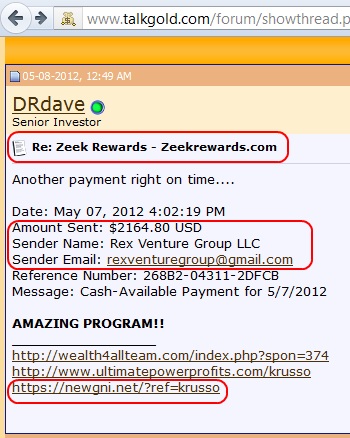
“Ken Russo” regularly made “I Got Paid” posts for Zeek Rewards on the TalkGold Ponzi forum. He also led cheers for Club Asteria, a “program” that encountered trouble from CONSOB, the Italian securities regulator. Meanwhile, Ken Russo led cheers for the bizarre JSS Tripler 2 “program,” which appears to have based its name on the JSS Tripler/JustBeenPaid scam-in-progress purportedly operated by Frederick Mann.
JSS/JBP appears now to be morphing into a scam known as “ProfitClicking.”
Among other things, the JSS Tripler 2 scam touted by “Ken Russo” hatched a companion fraud scheme known as “Compound150.”
A message today on the Wealth4All website accessible by clicking a link styled “Click Here for Other Forms of Payments” says “Temporally [sic] Down Please Check your e-mail.”
Separately, a message on the Ponzi boards attributed to “Wealth4allteam Management” in part says this (italics added):
As you are aware from previous communications, we have been working hard at getting our Project Genesis off the ground. The goal of Project Genesis is to create a business model that offers the right balance between a product and a rewarding financial opportunity. We’ve created an amazing model that will offer several income opportunities to a wide spectrum of people, from beginners to the more experienced network marketers.
In the past, we also informed you that we were consulting with both our legal team and with a compensation consulting firm to help us integrate our existing pay structure with the new model. During these consultations, it has become clear to us that the required changes to the current compensation plan are too drastic and complicated to be done effectively. Based on that, our counsel has advised us to create a completely new business model that will better serve everyone for our new business.
On Aug. 17, the SEC called Zeek a $600 million Ponzi- and pyramid scheme. Just weeks earlier, “Ken Russo” left a series of “I Got Paid” posts for Zeek on the TalkGold Ponzi forum.
Included in his signature line was a link for the Wealth4AllTeam “program.”
Precisely what Wealth4AllTeam’s “Project Genesis” entails is unclear. The name, however, is reminiscent of an earlier scam known as the “Alpha Project” that was linked to another scam known as FEDI.
Read more on the FEDI scheme. FEDI operator Abdul Tawala Ibn Ali Alishtari, also known as “Michael Mixon,” pleaded guilty in September 2009 to fleecing investors out of millions of dollars and to financing terrorism.
EDITOR’S NOTE: The PP Blog sought comment from Troy Dooly of MLMHelpDesk this morning (Sunday) on the disturbing Zeek- and Ponzi forum-related developments reported in our story below. (Story appears below screen shots.) Dooly has not responded as of the time of this post, but the PP Blog will publish his comment if and when received. (UPDATE 10:24 p.m. Dooly has responded to the request for comment. His comment has been added to the story below.)
Various efforts to mislead Zeek members and the public about the SEC’s Aug. 17 action against Zeek Rewards amid allegations that Zeek was a $600 million Ponzi- and pyramid fraud now are under way online. If you’ve received an email attributed to Zeek member Dave Kettner that claims “[t]he SEC acknowledged that there are a couple of problems with the case against Zeek Rewards and Rex Venture group,” it almost certainly is best to be extremely skeptical of the claims. Similar claims were made by apologists for the AdSurfDaily Ponzi scheme.
These are among the claims attributed to Zeek-member Kettner, who is using the pronoun “we” when referring to the SEC:
We (the SEC) are not able to find a victim in this case. We are not able to find anybody at this time that has been harmed by Zeek Rewards.
We (the SEC) are having a hard time finding a security. In the complaint, it said that Zeek was selling securities and was an investment scheme.
Beginning in August 2009, dozens of AdSurfDaily members flooded the docket of U.S. District Judge Rosemary Collyer with claims the government had produced no “VICTIMS” in the ASD Ponzi case. The pleadings appear to have been based on a template shared by one or more ASD downline groups. Included among the filers was Todd Disner, then an emerging figure in the ASD story and now an emerging figure in the Zeek story.
Collyer rejected each and every one of the claims. In September 2011, the U.S. government announced it had identified at least 8,400 ASD victims. Two months later — in November 2011 — Disner filed a lawsuit against the government that alleged it had produced a “tissue of lies” and that ASD was a legitimate enterprise. About seven months later — in May 2012 — ASD operator Andy Bowdoin pleaded guilty to wire fraud and admitted ASD was a Ponzi scheme and that the company never had operated lawfully. The government now says it has identified at least 9,000 ASD victims.
Justia.com has archived Collyer’s ASD docket and the related filings here. Disner’s unsuccessful filing is Docket No. 91. The ruling rejecting his claim (and others) is Docket No. 96. Despite the denials, other ASD members continued to use the same no “VICTIMS” argument, which incorporated a conspiracy theory that government evil was afoot. Collyer eventually issued en masse denials.
Disner, Kettner and Zeek figure Robert Craddock are known to be involved in an effort to raise funds purportedly to defend Zeek affiliates while taking the SEC to task. The effort has been marked by shifting stories, contributing to an atmosphere of confusion. PP Blog guest columnist Gregg Evans wrote about some of that confusion here. The SNR Denton law firm, once presented by Craddock as the attorneys for Zeek affiliates, now appears to have withdrawn its representation. Meanwhile, a website known as ZTeamBiz that was gathering funds for the purported Zeek defense has been blocked by PayPal, a development ZTeamBiz blamed on purported fear of competition by eBay. eBay owns PayPal.
RealScam.com (GlimDropper) now is reporting that ZTeamBiz is soliciting money via “electronic check drafts” and potentially putting contributors’ banking information at risk.
Meanwhile, it’s worth pointing out that the U.S. Secret Service confirmed on Aug. 17 that it was investigating Zeek. Beyond that, the office of North Carolina Attorney General Roy Cooper has confirmed it is investigating Zeek. At least two proposed class-action lawsuits also have been filed against Zeek. The SEC is hardly Zeek’s only worry.
Here, now, our story about how a Ponzi-board poster appears to be causing Dooly’s MLMHelpDesk.com to load beneath a different URL in an apparent bid to create confusion about the SEC’s Zeek action while also leeching off Dooly’s work product to gather “leads.”
1.
"freezeekler," a MoneyMakerGroup Ponzi forum poster in the "ProfitClicking" thread, is using his (or her) forum signature to help disinformation about Zeek spread online. ProfitClicking may have ties to the "sovereign citizens" movement.
2.
The redirect from the signature of "freezeekler" at the MoneyMakerGroup Ponzi forum causes Troy Dooly's MLMHelpDesk.com Blog to load under a URL styled "draftsforcash.com."
3.
On the MoneyMakerGroup Ponzi forum, "freezeekler" says his (or her) plan with the "ProfitClicking" program is to "withdraw at least until I have my investment back."
UPDATED 10:24 P.M. EDT (U.S.A.) TO ADD FIRST COMMENT FROM TROY DOOLY. UPDATED AT 11:25 P.M. TO REFLECT COMMENT FROM DOOLY THAT THE OFFENDING PAGE DESCRIBED BELOW HAS BEEN REMOVED. UPDATED 9:13 A.M. (SEPT. 10) TO FIX REDUNDANCY IN THIRD PARAGRAPH.
Efforts to spread disinformation about the SEC’s action in the Zeek Rewards Ponzi case intensified on the web yesterday. One such bid occurred within the thread on the “ProfitClicking” scam-in-progress at the MoneyMakerGroup Ponzi forum, where a poster known as “freezeekler” is using the following “signature” line (italics added):
Hot! ZEEK REWARDS Coming Back, NOT GUILTY? NEW updated information!
“freezeekler” apparently also is in “ProfitClicking,” given his (or her) MoneyMakerGroup comment about a plan to “withdraw at least until I have my [ProfitClicking] investment back.”
MoneyMakerGroup is listed in U.S. federal court filings as a place from which Ponzi schemes are promoted. Records show that five major scams promoted on the forum in recent years — Zeek, AdSurfDaily, Legisi, Pathway To Prosperity and Imperia Invest IBC — allegedly gathered a combined sum of at least $868 million. By contrast, the 2013 budget for the city of Las Vegas is $468.8 million, according to a May report in the Las Vegas Sun. The population of Las Vegas is approximately 590,000.
In terms of the number of victims — currently estimated at between 1 million and 2 million — Zeek may be the largest Ponzi scheme ever investigated by U.S. law enforcement. Its membership base may be at least 10 times larger than ASD, whose base was estimated by the U.S. Department of Justice at 97,000. Zeek’s estimated cash-drawing power of $600 million appears to have been approximately five times larger than ASD’s.
When “freezeekler’s” signature link is clicked, a redirect kicks in and visitors are taken to a URL styled “draftsforcash.com” and a page styled “zeekrewards.” (draftsforcash.com/zeekrewards.) When visitors move their mouse, a lead-capture ad then loads for a 60-minute “webinar” for an unspecified program that asks viewers to submit their name, email address and phone number.
Although visitors may believe they are at the “draftsforcash” site’s Zeek Rewards page, they’re actually at the site of Troy Dooly’s MLMHelpDesk. MoneyMakerGroup’s “freezeekler” appears to have caused the redirect to Dooly’s Blog to occur without causing the URL for MLMHelpDesk to appear in the location bar. Visitors unfamiliar with Dooly could come to believe he is the owner of “draftsforcash.”
That domain, however, is registered on the name of Bargain Crusader Inc., according to a whois search. When the “zeekrewards” page is stripped from the “draftsforcash.com/zeekrewards” URL, visitors see Blog whose sole story appears under a headline of “Daily, and Weekly fantasy sports leagues.”
The “skin” for the one-post Blog, according to a link at the site, is provided by “online casino uk site in cooperation with play roulette for fun weblog.”
Dooly tonight expressed concern about the Ponzi-forum development.
“This is nuts,” he said in an an initial email to the PP Blog. “Thank you for sharing this info with me. I will do a post tomorrow on this issue.”
In a second email to the Blog, Dooly said his company took quick action to ensure the offending page was taken down.
“My COO jumped on the issue as soon as I sent it to him,” Dooly said.
ProfitClicking is an ASD-like autosurf formed from the carcass of the JSS Tripler/JustBeenPaid “program” that suddenly went missing last month amid reports of the sudden “retirement” of Frederick Mann, the purported operator of JSS/JBP.
Mann is a former pitchman for the ASD Ponzi scheme. JSS/JBP claimed to have more than 1 million members. Its cash-sucking power remains unclear.
The launch of “ProfitClicking,” the follow-up scam to the JSSTripler/JustBeenPaid HYIP scheme (2 percent a day) purportedly operated by Frederick Mann, is under way.
Sort of.
Carl Pearson in his JSS/JBP days.
Just who’s running ProfitClicking is unclear, although the site has claimed that cash-gifting enthusiast J.J. Ulrich is the “PC Executive Director” and that Carl Pearson is on the “Management Team.” Pearson purportedly was the one-time COO of JSS/JBP, which experienced a promotional ban in Italy by the securities regulator CONSOB.
Mann hinted last month that he feared arrest in the United States. He previously speculated that the JSS/JBP site could be taken out by “cruise missiles.” Some JSS/JBP members complained that their support tickets hadn’t been addressed in weeks.
Rather than hold JSS/JBP responsibile, Mann suggested, it perhaps was best for members to read a self-improvement manual.
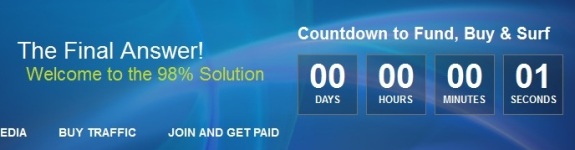
ProfitClicking’s site had featured a countdown clock for days, with the launch set to go live at 6 a.m. (EDT) today. Despite claims by ProfitClicking that new servers and a new engineering approach would make for a seamless experience, the site experienced an immediate meltdown — with the landing page defaulting to a “Block DOS” gateway.
The site did begin to load slowly within a few minutes, but members immediately complained on the MoneyMakerGroup Ponzi forum that they couldn’t log in. Members now are saying that they can log in but that the site is performing worse than dial-up.
Whether members’ data was transferred properly from the JSS/JBP site to the ProfitClicking site remains an open question. Like JSS/JBP, ProfitClicking makes members affirm they are not with the “government.” The site also seeks to disclaim any responsibility on the part of the “opportunity” or its affiliates for offering the “program.”
As JSS/JBP’s purported owner, Mann compared government workers to the Mafia. Regardless, he once permitted JSS/JBP’s conference-call host to hang up on a man who claimed to have been recruited by Mann and later to have suffered a stroke. Prior to being unceremoniously disconnected from the call, the man informed Mann that JSS/JBP support had ignored his pleas for help.
A woman who complained about support after claiming her sister’s home was at risk because of the JSS/JBP “program” was treated rudely during an earlier call — this after she pointed out she had a heart condition.
Among the apparent early aims of ProfitClicking is to permit members to fund accounts, but not withdraw. Such an approach is consistent with an effort to draft suckers into turning over money that may or may not be used at a later time to make Ponzi payments to people who bought into the JSS/JBP scam. AdSurfDaily, a ProfitClicking-like autosurf, scammed its members in this fashion in 2007, according to U.S. federal court files.
Mann was a former ASD pitchman, according to a 2008 promo.
ASD President Andy Bowdoin never told his new members that their money would be used to pay old members on board when the original iteration of ASD collapsed, federal prosecutors said. Bowdoin was sentenced last month to 78 months in federal prison.
All sorts of vacuous claims are made on the ProfitClicking site, including a claim that the purported opportunity is “Legally Compliant” and has a “Patented system.” Like JSS/JBP, ASD and the recently collapsed Zeek Rewards “program,” ProfitClicking has no known securities registrations and purports to do business with payment processors linked to fraud scheme after fraud scheme.
Because ProfitClicking has a virtually unquantifiable number of HYIP scammers within its ranks owing to the fact it was formed from the carcass of JSS/JBP and was promoted widely on the Ponzi-forum cesspits, new members may be at grave risk. ProfitClicking’s original group of scammers has a vested interest in continuing the deception because attracting “new money” may be the only means of getting paid in the future.
For posterity, the screen shots below provide a snapshot of the countdown of a new scam in progress:
1.
The ProfitClicking countdown timer at the 1:00 mark today.
2.
The ProfitClicking countdown timer at the 0:01 mark today, one second before launch.
Oregon-based NX Systems Inc. has advised a federal judge that Rex Venture Group LLC, the North Carolina-based parent company of Zeek Rewards, had more than $14.4 million in an account frozen on Aug. 17. On that date, the SEC accused Zeek of being a $600 million Ponzi- and pyramid scheme that had affected more than 1 million people.
Visit ASDUpdates to read filings related to the Zeek case.
EDITOR’S NOTE: Scams undermine faith in legitimate markets. This is a case in which a purportedly legitimate asset manager allegedly is using the sort of explanations/excuses commonly used by Ponzi-forum hucksters.
BULLETIN:The SEC has gone to federal court in the Northern District of Illinois, alleging that asset manager Nikolai Battoo duped investors by hiding losses in the Bernard Madoff Ponzi scheme, recruited new investors and boasted about “benchmark-beating returns.”
But Battoo, who claimed to have $1.5 billion under management, has not met redemption requests — and now claims his inability is due to the collapse of MF Global, the SEC said.
Also charged was Tracy Lee Sunderlage, “an unregistered broker-dealer who was banned from the industry in a previous SEC enforcement action,” the SEC said.
From the SEC complaint:
In 2008, Battoo and his company-defendants lost tens-of-millions of dollars investing in Madoff “feeder funds.” That same year they lost more than $100 million when an international bank terminated Battoo’s access to its credit and platform of funds. Yet Battoo-has not been forthcoming with his investors about the extent of — or in some cases even the fact of — these losses. His statements to clients omit his staggering losses. In the wake of such deception, existing clients have invested fresh investment proceeds. Battoo’sfalsified track record of benchmark-beating returns has also won him new investors.
The jig appears to be up. Clients are now clamoring for redemptions, so Battoo has doubled-down on his deception. He’s blamed theMF Global calamity for his inability to repay investors. But when the SEC sought support for such claims, he declined to provide further information. At other times Battoo has blamed unnamed counterparties for freezing his assets because of unspecified government investigations. He told one investor that his attorneys were negotiating a “release” with the SEC. These statements are lies.
A federal judge, the SEC said, has granted an emergency freeze of assets belonging to Battoo and two of his companies: BC Capital Group S.A. of Panama Panama and BC Capital Group Ltd. of Hong Kong.
The SEC action is designed to protect U.S. investors, the agency said.
Battoo claims to manage $100 million for U.S. investors, the agency said.
“Battoo attracted quite a following of investors by proclaiming his investments withstood the test of the financial crisis, but reality seems to have finally caught up with him,” said Robert Khuzami, director of the SEC’s Division of Enforcement. “Now, Battoo is offering investors one excuse after another for holding their money hostage.”
BULLETIN: (UPDATED 3 P.M. EDT U.S.A.) This bizarre announcement appears today on ZTeamBiz, the site that was using PayPal purportedly to raise funds to “defend” affiliates of the collapsed Zeek Rewards’ MLM scheme:
The payment solution has been removed and will be replaced on September 8, 2012. PayPal a company owned by eBay.com had decided it is not in their best interest to assist us in bringing back a Penny Auction that is directly competing with eBay.com.
We apologize for this inconvenient [sic] and will have a new solution soon. Thank you for your understanding
ZTeamBiz, which targeted Zeek affiliates in its fundraising pitch, has a tie to Todd Disner, a figure in the AdSurfDaily Ponzi scheme that advertised a Zeek-like payout of 1 percent a day. Affiliates who provided money to ZTeamBiz potentially put themselves at cross-purposes, given that a federal judge has appointed a receiver in the Zeek case and that the interests of all Zeek affiliates are not equivalent.
In 2011, ASD President Andy Bowdoin sought to use PayPal to raise funds to pay for his criminal defense. The site, known as Andy’s Fundraising Army, eventually was blocked by PayPal from using its services.
Robert Craddock is part of the purported braintrust behind the ZTeamBiz fundraising effort. Disner once was a guest on a Zeek-related conference call featuring Craddock. That call occurred after the SEC moved against Zeek last month.
In July, Craddock reportedly was behind an effort to silence the voice of Zeek critic “K. Chang” by bringing a purported copyright and trademark infringement complaint against K. Chang through HubPages, a site used by K. Chang to publish news and opinion about Zeek. The site was taken offline, but eventually returned.
In 2011, Disner sued the United States for alleged misdeeds in bringing the ASD Ponzi case, claiming ASD was a legitimate enterprise and that the U.S. government had presented a “tissue of lies” when bringing the case in August 2008. About seven months after Disner brought the action, Bowdoin pleaded guilty to wire fraud, admitting ASD was a Ponzi scheme.
A federal judge sentenced Bowdoin to 78 months in federal prison — and dismissed the lawsuit filed by Disner. Disner’s co-plaintiff in the case was Dwight Owen Schweitzer. At an unclear point in time after the August 2008 seizure of tens of millions of dollars in ASD-related bank accounts in the ASD Ponzi case by the U.S. Secret Service, both Disner and Schweitzer became Zeek promoters.
Zeek’s business model was similar to ASD’s. On Aug. 17, the SEC described Zeek as a $600 million Ponzi- and pyramid scheme that potentially affected more than 1 million people. The Secret Service also is investigating Zeek.
ASD’s Bowdoin was sentenced Aug. 29. Federal prosecutors described his “program” as a $119 million Ponzi scheme that had created at least 9,000 victims and had resulted in millions of dollars of losses.
ZTeamBiz did not explain on its website whether PayPal blocked the account through which it was soliciting funds from Zeek affiliates. Instead, it suggested that eBay, which owns PayPal, was an envious Zeek competitor.
 A California man and his 76-year-old father-in-law ran a $7 million Ponzi scheme called Naras Funds, federal prosecutors said yesterday.