Blog

  • Only Days After Negative CONSOB Finding On JSS Tripler, Affiliate Press Release Claims ‘Program’ Lets Members ‘Start With Just $10 And Turn It Into A Fortune’

    An affiliate's "press release" for JSS Tripler/JustBeenPaid is juxtaposed on Google News today against information about CONSOB's ban of promos for the "opportunity" in Italy. The affiliate's release ignores the CONSOB news, positions JSS/JBP as a way to make a "fortune" — and does not explain that JSS/JBP members must affirm they are not with the "government." The release also ignores conflicts between the "opportunity's" written words and the spoken words of purported operator Frederick Mann.

    At the moment, Google News is providing an interesting juxtaposition on the subject of JSS Tripler, the purported arm of the “JustBeenPaid” program that does not identify itself with a nation-state, makes members affirm they are not with the “government” and advertises an absurd monthly return of 60 percent.

    Frederick Mann, the “opportunity’s” purported operator, was identified in 2008 promos as a pitchman for AdSurfDaily. The U.S. Secret Service called ASD an online Ponzi scheme that had gathered at least $110 million and defrauded thousands of people. JSS Tripler/JustBeenPaid advertises a daily payout rate twice that of ASD.

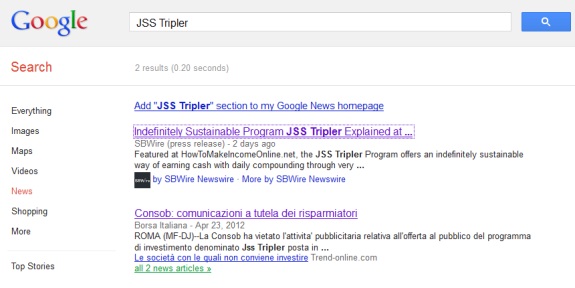
    As the screen shot above shows, Google News today is publishing information on JSS Tripler from three sources. Two of the sources report on the April 23 JSS Tripler promotional ban by CONSOB, the Italian securities regulator.

    A third source — dated May 2, nine days after CONSOB announced the JSS Tripler ban — does not reference the ban at all. Instead, it instructs readers via an affiliate’s press release that JSS Tripler is “an income-generating program that lets investors start with just $10 and turn it into a fortune. Essentially an HYIP, the program factors in the daily compounding system to increase earnings or make daily withdrawals as any investor would wish.”

    One of the issues in the ASD Ponzi case is lack of disclosure to investors.

    JSS Tripler/JustBeenPaid has no known securities registrations. Regardless, the affiliate’s release defines participants as “investors” and positions the program as one that is passive in nature. Claims in the release easily could lead to questions about whether the “opportunity” and its affiliates are benefiting in ASD-like fashion from the sale of unregistered securities by a global network of unregistered brokers.

    In March, Mann told members it was OK to describe the opportunity as an investment program. Regardless, this line appears in his own program’s member agreement. (Italics added):

    5. I have NOT been led to believe that this activity is an investment activity, franchise, or employment opportunity.

    Although the release prompts readers (in the first paragraph) to “look closely at what they are getting into and ensure that they are joining income opportunities through programs that are proven to truly deliver financial freedom and sustainability,” it does not explain why the Member Agreement says one thing and Mann another.

    Nor does it explain why any reasonable person would direct money to an entity whose Member Agreement also says this. (Italics added):

    6. I affirm that I am not an employee or official of any government agency, nor am I acting on behalf of or collecting information for or on behalf of any government agency.

    7. I affirm that I am not an employee, by contract or otherwise, of any media or research company, and I am not reading any of the JBP pages in order to collect information for someone else.

    Bizarre ambiguities, incongruities and internal inconsistencies are common in the HYIP fraud sphere.

    News about CONSOB’s JSS Tripler ban was published in English on CONSOB’s own website April 23. It also was published on the PP Blog and other sites, including the sites referenced by Google News.

    Even as the affiliate was prompting JSS Tripler/JustBeenPaid prospects to “look closely,” he apparently missed information that was available through simple web searches — and this apparently also occurred after he missed the conflict between Mann’s words and the “opportunity’s” published Member Agreement.

    The release concludes with these words:

    “People who want real money from a reliable online networking system without the fuss and tricks should visit [URL deleted by PP Blog] to learn more.”


  • DEVELOPING STORY: [BULLETIN]: Filings Suggest New Strain Of Autosurfing Cancer Discovered In Canada; British Columbia Securities Commission Investigating ‘Bossteam E-Commerce Inc.’ Amid Ponzi Allegations

    BULLETIN: A potential new form of online fraud that sells memberships for up to $5,000, purportedly pays participants for clicking on ads and also invites them to exchange “private” shares in the venture through a purported “internal trading platform” has been discovered in Canada, according to the British Columbia Securities Commission (BCSC).

    The scheme recorded more than $1.2 million in combined deposits in Canadian and U.S. dollars in less than four months and “has no real source of income other than funds received from investors,” according to a statement taken by BCSC investigators.

    In alarming preliminary findings announced yesterday as part of an Executive Director’s Bulletin designed to fast-track a developing Ponzi-scheme case, BCSC said the purported “opportunity” opened two bank accounts in Canada — one for Canadian dollars, and one for U.S. dollars.

    “From October 2011 to January 24, 2012, the accounts received numerous deposits in the form of cheques and inter-bank transfers in amounts ranging from $2000 to $5000,” BCSC alleged.

    By Jan. 24, the agency said, “$688,746.15 had been deposited into the Canadian dollar account” and “USD$590,527.26 had been deposited into the U.S. dollar account.”

    More than $405,000 was withdrawn from the Canadian-dollar account, with as much as $212,954 directed from the account to make Ponzi payments, according to the preliminary report.

    Although the report does not specifically reference affinity fraud, it alleges that “[a] website targeted at Hong Kong residents offers an investment in ‘YouAd Credits.’”

    The BCSC document references a site known as “youadworld.” When the PP Blog visited the site, a page loaded that read in part:

    “Our unique operating mechanism is attracting subscribers from all over the world. Your advertisements will have the most steady increasing, loyal audience.”

    Named in the BCSC action are Bossteam E-Commerce Inc. of Burnaby, B.C.; Yan Zhu, also known as Rachel Zhu; and Guan Qiang Zhang. Both Zhu and Zhang are listed as Burnaby residents.

    From BCSC (italics added):

    6. Bossteam offered two types of securities to residents of British Columbia through its Website (Bossteam Investments). To be eligible to purchase either of these securities, an investor first had to purchase a membership for $2000 or $5000.

    (a) The first security was a profit sharing agreement that provided a share of Bossteam’s profits to investors who clicked on a certain number of Internet advertisements.

    (b) The second security was a share of Bossteam offered by the Website through an “Initial Private Share Offering.” Bossteam offered 8 million shares, with dividends on these shares paid quarterly. The Website stated that Bossteam had issued 400,200 shares. The Website also provided an internal trading platform where investors could trade their shares.

    The BCSC probe began with anonymous tips, the agency said.

    As the investigation evolved, Zhu and Zhang denied offering Bossteam “shares.” Meanwhile, a story about a purported website hacking in December 2011 surfaced as an explanation for the offering of the “shares” and “Zhu lied about her involvement with the Hong Kong Website,” BCSC alleged.

    And Zhu, who is registered with the Mutual Fund Dealers Association of Canada as a dealing representative and with the Insurance Council of British Columbia as a life-insurance agent,  “falsely claimed she had told her mutual fund dealer employer about her outside business activities with Bossteam,” BCSC alleged.

    “She is the sole director of Bossteam,” BCSC said.

    When investigators interviewed Zhu’s husband, he told them that “Bossteam has no real source of income other than funds received from investors” and that “funds paid to investors came from the investment monies of other investors,” BCSC alleged.

    Read the preliminary order.

  • Alleged Missouri ‘Sovereign Citizen’ Indicted In $212,000 Social Security Rip-Off, Feds Say; Charles Daniel Koss Allegedly Sent Agency ‘False Negotiable Instrument’ To Pay Off Debt

    Charles Daniel Koss, 62, of Independence, Mo., allegedly owed the Social Security Administration $212,000 because he collected disability benefits to which he was not entitled between September 1994 and January 2010.

    Koss allegedly was working with his wife at Embassy Mortgage in Blue Springs, Mo.,  and “willfully failed” to let Social Security know about “the income derived from his work activity,” federal prosecutors in the Western District of Missouri said.

    A purported “sovereign citizen,” Koss now has been charged with two counts of theft of government money, one count of Social Security disability fraud, one count of passing a fictitious instrument with the intent to defraud and one count of mail fraud, federal prosecutors said.

    When Koss learned he had to repay the money, he allegedly mailed the Social Security Administration a false financial instrument dubbed a “Registered Private Money Order” in purported payment of the debt.

    The bogus instrument allegedly was part of a “redemption” theory favored by “sovereign citizens.” Under the theory, prosecutors said, the government is purported to have created “secret accounts” from which debtors can draw to satisfy their obligations.

    In a news release, the office of Acting U.S. Attorney David M. Ketchmark said:

    Koss subscribed to what is known as the redemption theory, the indictment says, which claims that a “Birthright Trust” is created with the U.S. Treasury when parents of a newborn child pledge the child’s birth certificate to the government. Redemption theory involves bogus claims that when the United States government abandoned the gold standard in 1933, it pledged its citizens as collateral so it could borrow money. The movement also asserts that common citizens can gain access to funds in secret accounts using obscure procedures and regulations.

    According to the indictment, adherents of the redemption theory sometimes call themselves “sovereign citizens.”  The sovereign citizen movement is a loosely organized collection of groups and individuals who have adopted anarchist ideology. Its adherents claim that virtually all existing government in the United States is illegitimate and they seek to “restore” an idealized, minimalist government that never actually existed. Redemption theory and sovereign citizen beliefs are totally without merit and they have no basis in law or fact.  Individuals often use these ideas to further various fraudulent schemes.

  • Andy Bowdoin A No-Show In Last Night’s Conference Call For ‘OneX’; Absence Blamed On ‘Personal Problems’ Days After Prosecutors Call ‘OneX’ A ‘Fraudulent Scheme’

    Andy Bowdoin

    UPDATED 12:06 P.M. EDT (MAY 5, USA): Andy Bowdoin’s bond-review hearing has been rescheduled from May 8 to May 18. Here, below, our earlier story . . .

    Only days ago, federal prosecutors described the OneX “program” pitched online by accused Ponzi schemer Andy Bowdoin of AdSurfDaily as a “fraudulent scheme” and “pyramid” that “simply re-distributes funds among participants” in ASD-like fashion.

    The PP Blog learned yesterday through a source that Bowdoin was a no-show on last night’s scheduled “team” conference call for OneX. A call Monday apparently was canceled.

    According to information provided by the source, Bowdoin was unable to participate in last night’s call — after the cancellation of Monday’s call — because of “personal problems.” The specifics of the personal problems were not disclosed.

    Unless U.S. District Judge Rosemary Collyer postpones a May 8 bond-review hearing for Bowdoin, prosecutors are expected to argue on Tuesday that Bowdoin was pushing the OneX pyramid scheme while awaiting his September trial in the ASD Ponzi scheme case.

    Although a postponement of the bond-review hearing is possible because one of Bowdoin’s two lawyers is ill and the government has not objected to a delay, the judge has not entered an order delaying the proceeding, according to docket entries as of this morning. (May 5 update: The May 8 hearing has been rescheduled for May 18.)

    Last night’s OneX call, according to information provided by the source, was conducted by “Allen” (or Alan).

    “First and foremost, Andy has some personal problems that he has to deal with, so he will not be with us for a few days,” Allen said, according to information from the source.

    Whether Bowdoin’s OneX “team” is aware that federal prosecutors have described the “program” as a scam is unclear. What is clear, according to filings by the government, is that Bowdoin has a long history of recruiting people into financial debacles and withholding information that would enable them to make informed investment decisions.

    Prosecutors also say they’ve tied Bowdoin to the failed AdViewGlobal (AVG) autosurf, which came to life in the weeks and months after the U.S. Secret Service seized tens of millions of dollars from ASD-related bank accounts in August 2008 as part of a Ponzi probe. AVG vanished during the summer of 2009 — about a year after the ASD seizure — amid claims that someone had stolen money from the enterprise.

    Even as AVG was tanking, members and critics were threatened with lawsuits for sharing news about the purported Uruguay-based entity.

    While at ASD’s helm in 2007, Bowdoin explained that members were not getting paid because of script problems and because “Russian” hackers had stolen $1 million, according to records. Prosecutors said Bowdoin never filed a police report about the purported $1 million theft.

    Prosecutors have argued that ASD collapsed before Bowdoin resurrected it and started operating it under a new name (ASDCashGenerator). Incoming members were not told they were funding payouts to members affected by the collapse. Over time, Bowdoin dialed up the criminality to keep ASD afloat in what was at least its second iteration, according to court filings.

    In the 1990s — in at least three Alabama counties — Bowdoin was charged with securities-related crimes similar to his later illegal behavior at ASD, prosecutors now say. ASD members, however, were led to believe that the ASD patriarch’s only encounter with law enforcement had been a speeding ticket.

    Bowdoin has been participating in OneX conference calls since at least October 2011, explaining in the earliest calls that we was seeking to fund his criminal defense to the ASD-related Ponzi charges through OneX and that OneX was brought to members and prospects by “God.”

    The indictment against Bowdoin was made public in December 2010. It charges him with wire fraud, securities fraud and selling unregistered securities.

    Details about OneX, including the identities of its operators, are exceptionally murky.

  • URGENT >> BULLETIN >> MOVING: Feds Arrest 3 ‘Leaders’ Of Alleged Cash-Gifting Scheme; Conspiracy, Wire Fraud And Tax Fraud Charged; ‘Defendants Attempted To Intimidate A Participant Who Had Questioned The Legality Of The Gifting Table Scheme,’ Prosecutors Say

    So, you think your cash-gifting “sponsor” has your best interest at heart?

    Three women who were “leaders” of a cash-gifting scheme in Connecticut were arrested earlier today on charges of conducting a pyramid scheme and engaging in a conspiracy, wire fraud and tax fraud, federal prosecutors said.

    The scam operated between 2008 and 2011, reached beyond Connecticut’s borders and allegedly featured an element of “intimidation” aimed at a prospect who questioned the purported opportunity.

    Prosecutors today published snippets of emails sent over multiple months and linked to the alleged scheme, which gathered purported “gifts” $5,000 at a time using a food theme.

    “[K]eep bringing in new blood,” one of the emails allegedly read in part. “It is a fact when women get excited about making money, they tend to over extend . . .”

    Another email allegedly advised in part that potential recruits needed “to Shit or get off the pot . . .”

    It has been known for months that a grand-jury probe into so-called “gifting tables” has been under way in Connecticut. That probe now has resulted in the arrests of Donna Bello, 55, of Guilford;  Jill Platt, 64, of Guilford; and Bettejane Hopkins, 66, of Essex.

    An indictment filed yesterday that names Bello, Platt and Hopkins also includes the word “co-conspirators,” suggesting others may be charged.

    “The indictment alleges that the three defendants ran a pyramid scheme designed to enrich themselves at the expense of other participants,” said U.S. Attorney David B. Fein.  “In addition, the indictment alleges that the defendants tried to use the pretext of ‘gifting tables’ as a way to avoid paying taxes on the substantial illegal proceeds of their scheme.”

    Fein noted that the probe, which is being led by the IRS, is ongoing.

    Bello, Platt and Hopkins “conspired to defraud the IRS by misrepresenting to recruits and participants that monies given and received during the scheme were legally considered tax-free ‘gifts’ under the IRS code and that lawyers and accountants had approved gifting tables as legal ventures that generated tax-free proceeds,” prosecutors said.  “The indictment further alleges that Bello, Platt and Hopkins filed false tax returns that failed to report income generated from the scheme.”

    Prosecutors today also released snippets of emails linked to the alleged cash-gifting scammers.

    “[W]e need to keep silent and under the radar,” one of the emails read in part, prosecutors said.

    Another allegedly read in part, “[A]s women we like our own stash. Keep it in a safe.  Keep it quiet because rather not have red flags raised.  Hiring accountants and atterneys [sic] is costly.”

    A third allegedly read in part, “I am not a . . . saint . . . . I’m teaching you all how to make an extra 80 grand a year . . . . Isn’t that enough?”

    Meanwhile, a fourth allegedly read, “It’s sort of a joke that I refer to our freezer as the ATM.” A fifth allegedly read, “They have had enough parties. Its [sic] costing us a small fortune in their food and wine delights. No more parties until they commit with the cash.”

    From prosecutors (italics added):

    . . . a gifting table is configured as a four-level pyramid, with eight participants assigned to the bottom row, four participants assigned to the third row, two participants assigned to the second row, and one participant assigned to the top row.  The top row participant is referred to as the “dessert,” the two participants on the second row as “entrees,” the four participants on the third row as “soup and salads,” and the eight participants on the bottom row as “appetizers.”  To join a gifting table, new participants were required to pay $5,000, typically in cash, to the dessert, that is, the participant occupying the top position on the pyramid.  The $5,000 payment, which was fraudulently characterized as a gift, secured the new participant a position as an appetizer on the bottom row.  Participants moved from the bottom row of the pyramid and progressed through a gifting table by recruiting additional people to join.  When eight new participants joined a gifting table, each having made a $5,000 “gift” to the person occupying the dessert position at the top of the pyramid, the dessert left the gifting table and kept the $40,000 paid by the eight new participants.  That particular gifting table was then split, with the two participants occupying the Entree position on the second row moving to the top position (dessert) of two new pyramids.  The other incumbent members of the gifting table moved up a row on one of the two newly-formed pyramids, and the search for 16 new participants began.  The success of the gifting tables depended on new participants joining and making the $5,000 “gift.”

    The indictment alleges that from approximately 2008 to 2011, Bello, Platt and Hopkins oversaw and profited from this gifting tables pyramid scheme.  The defendants recruited individuals to join the scheme, prepared and distributed materials to recruits that contained false representations, and misrepresented to recruits and participants that gifting tables was not a pyramid scheme.  The indictment further alleges that in May 2010, the defendants attempted to intimidate a participant who had questioned the legality of the gifting table scheme.

    Read the indictment, which includes information investigators allegedly gleaned from emails.


  • BULLETIN: FLORIDA — AGAIN: SEC Says Penny-Stock Scammer With Complicit Attorneys Hatched Scheme To Take Advantage Of Devastating January 2010 Earthquake In Haiti

    BULLETIN: Miami penny-stock scammer Kevin Sepe — along with two attorneys in Florida and one in Utah — engaged in illegal stock-selling schemes, the SEC said.

    One of the schemes “sought to capitalize on circumstances in Haiti following the earthquake that destroyed much of the country’s infrastructure in January 2010,” the SEC said.

    Sepe, 51, and 10 “cohorts,” including the attorneys, have been charged in the schemes, which allegedly featured pump-and-dump components. The attorneys include Ronny Halperin, 63, of Aventura, Fla.; Melissa Rice, 51, of Miami; and David Rees, 44, of Salt Lake City.

    As part of its probe, the SEC has suspended trading in the securities of entities known as Recycle Tech and HydroGenetics.

    “The Recycle Tech scheme involved a promotional campaign to pump the price and volume of the purported home container building company’s stock in the wake of the Haiti earthquake,” the SEC said. “The HydroGenetics scheme took millions of unregistered shares of the company — purportedly in the business of acquiring emerging alternative energy companies — and improperly converted its debt into free-trading shares that were dumped on the investing public.”

    Halperin did legal work for both firms, and Rice did legal work for HydroGenetics. Rees did legal work for Recycle Tech, the SEC said.

    All three attorneys and Sepe have agreed to settle the charges without admitting or denying the allegations, the agency said.

    From the SEC:

    • Sepe agreed to disgorgement of $1,416,466.16, prejudgment interest of $126,761.86, and penalties of $185,000 as well as a permanent bar from participating in an offer or sale of penny stocks.
    • Halperin agreed to disgorgement of $427,609.95, prejudgment interest of $33,595.33, and a penalty of $100,000 as well as a permanent penny stock bar and a five-year officer and director bar. He also agreed to surrender 1.97 million shares of HydroGenetics stock.
    • Rees agreed to disgorgement of $5,982, prejudgment interest of $406.25, and a penalty of $7,500 as well as a one-year prohibition from providing professional legal services connected to the offer or sale of securities.
    • Rice agreed to disgorgement of $422,445, prejudgment interest of $39,239.18, and a penalty of $60,000 as well as a five-year penny stock bar and three-year prohibition from providing professional legal services connected to the offer or sale of securities.

    The schemes netted more than $3.5 million in illegal profits, the SEC said.

    From one of the Sepe (et al.) complaints (emphasis added by PP Blog):

    HydroGenetics is a Florida corporation with its principal place of business in Fort Lauderdale, Florida. Hydro Genetics, company name was originally Pop Starz, an entity that operated dance studios. On April 23, 2008, after Sepe and others had contracted to purchase Pop Starz, the company changed its name to Global Entertainment Acquisition, Inc. and was purportedly in the film-making business. On August 1, 2008 the company changed its name to HydroGenetics and stated it was in the business of acquiring emerging alternative energy companies.

    From the other Sepe (et al.) complaint:

    Recycle Tech is a Colorado company. From February 16, 2010 through June 2010 its principal place of business was Miami, Florida. Its common stock is quoted on the OTC Link (formerly, “Pink Sheets”) operated by OTC Markets Group Inc. under the symbol “RCYT.” From no later than February 2010 to June 2010, Recycle Tech purported to be a development and engineering firm specializing in “green building.”

    Read the SEC news release for the full list of the alleged cohorts and links to the complaints.

  • BULLETIN: Feds Now Say Andy Bowdoin Was Charged In Securities Swindle In Third Alabama County; Records Show Arrest Warrants Were Issued And Suggest AdSurfDaily Patriarch Spent Time In Jail Prior To ASD Launch And Subsequent Ponzi Probe

    These court records from Jefferson County, Ala., suggest that Andy Bowdoin was jailed at least briefly in the 1990s in an alleged securities swindle involving mobile phones. (Redactions by PP Blog.)

    In April 24 court filings, federal prosecutors in the District of Columbia described four instances in which accused Ponzi schemer Andy Bowdoin was charged during the 1990s with state-level, securities-related crimes in Alabama. Those crimes occurred in Montgomery and Wilcox counties, prosecutors said.

    But yesterday prosecutors informed Bowdoin’s lawyers and U.S. District Judge Rosemary Collyer that Bowdoin also had been indicted in 1996 in Jefferson County on 12 state-level counts related to securities fraud. The government said it intended to use evidence of Bowdoin’s criminal history in all three Alabama counties in the AdSurfDaily patriarch’s September 2012 trial on ASD-related charges of wire fraud, securities fraud and selling unregistered securities.

    Warrants were issued in Jefferson County for Bowdoin’s arrest, according to exhibits federal prosecutors produced yesterday in advance of a May 8 bond-review hearing for Bowdoin in Washington. At least one of the records suggests Bowdoin was “Committed To Jail” after his arrest on the Jefferson County charges.

    How long Bowdoin actually spent in jail was not immediately clear. But records in Alabama show that he entered into plea agreements that required him to testify against at least five alleged securities fraudsters. Federal prosecutors now are suggesting that at least some of the Alabama litigation against Bowdoin was unresolved when he launched ASD in 2006 and that Bowdoin made restitution payments in the state with proceeds from the ASD Ponzi scheme.

    Bowdoin claims through ASD employees that his only encounter with law enforcement had been a speeding ticket were “false and misleading,” federal prosecutors said yesterday.

    ASD’s existing members and prospects were not told information that could have helped them in making an informed decision when joining ASD, prosecutors said.

    In August 2008, the U.S. Secret Service seized tens of millions of dollars from Bowdoin’s bank accounts, amid allegations he was presiding over a massive online Ponzi scheme through ASD. Bowdoin was arrested by the Secret Service in December 2010.

    Separately, new court filings suggest that Bowdoin’s May 8 bond-review hearing could be delayed, owing to the illness of one of Bowdoin’s lawyers.

    Prosecutors have said Bowdoin disguised ASD — an illegal securities business — as an “advertising” company. He also is accused of using ASD Ponzi proceeds to make campaign contributions to the National Republican Congressional Committee.

  • UPDATE: Call In Which Frederick Mann Told JSS/JBP Members That ‘Opportunity’ Was Paying Them With Funds From ‘New Members’ Goes Missing From Website

    Frederick Mann, onetime ASD pitchman and the purported operator of JSS Tripler/JustBeenPaid

    UPDATED 7:44 A.M. EDT (U.S.A.). A potentially damning audio recording of a March 15 conference call in which Frederick Mann told JSS Tripler/JustBeenPaid members that the “opportunity” was paying them with money from “new members” has gone missing from the JSS/JBP website.

    The precise date on which the recording was removed was not immediately clear. But the removal occurred after JSS/JBP also had removed recordings of conference calls featuring Carl Pearson, a pitchman for the “opportunity” and its purported COO.

    Mann, whose name appeared in 2008 promos as a pitchman for AdSurfDaily, is the purported operator of JSS/JBP. The U.S. Secret Service seized tens of millions of dollars tied to ASD in 2008, amid allegations it was conducting an international Ponzi scheme over the Internet.

    Andy Bowdoin now has been accused of serial scamming dating back at least two decades. He faces a May 8 bond-review hearing. Frederick Mann, the purported operator of JSS/JBP, was identified in 2008 promos as an ASD pitchman.

    ASD President Andy Bowdoin was charged criminally in 2010. He now faces a May 8 bond-review hearing amid allegations that he continued to scam the public even after the August 2008 seizure of $65.8 million from his 10 personal bank accounts and even after his December 2010 arrest in Florida on ASD-related Ponzi charges of wire fraud, securities fraud and selling unregistered securities.

    “I (Frederick Mann) have been with ASD since January 07,” remarks attributed to Mann on a site known as BigBooster read on May 14, 2008. “Past performance indicates a strong probablility (sic) that ASD will continue to perform as advertised. (By early May 2008, I had received 14 payments totalling over $6,000!”)

    The U.S. Secret Service conducted a Ponzi raid of ASD less than three months later. Despite the Ponzi allegations against Bowdoin and ASD, Mann purportedly went on to launch JSS/JBP, which purports to pay members a return of 2 percent a day — double the purported return of ASD.

    In January 2012, JSS/JBP-related claims came under the lens of CONSOB, the Italian securities regulator. The agency banned promos for the “opportunity” last month after earlier announcing a 90-day suspension.

    Just days before CONSOB’s April 23 announcement of the ban — on April 17 — U.S. federal prosecutors sent a letter to Bowdoin’s defense attorney in the ASD Ponzi case. The letter informed the attorney — Charles A. Murray — that the government intended to introduce evidence that Bowdoin continued to commit crimes after the August 2008 ASD seizure and after Bowdoin’s subsequent indictment on charges that could put him behind bars for 125 years if he is convicted on all counts.

    Prosecutors said they had tied Bowdoin to AdViewGlobal (AVG), an autosurf that collapsed in 2009. They also said Bowdoin had emerged as a pitchman for a “fraudulent scheme” known as OneX that — in ASD-like fashion — “simply re-distributes funds among participants.”

    Online Ponzi schemes are infamous for morphing into new forms. Serial scammers who populate Ponzi boards such as TalkGold and MoneyMakerGroup drive business to the purported “opportunities,” which often advertise MLM-style, tiered recruitment “commissions” on top of preposterous rates of return.

    ASD, AVG, OneX and JSS/JBP all have (or had) a presence on the Ponzi boards. Serial apologists for JSS/JBP have pooh-poohed the CONSOB developments.

    In the now-missing March 15 recording, a caller purportedly from “San Francisco” asked Mann where “JustBeenPaid get[s] the money to pay that kind of interest.”

    The reference was to the advertised return of 2 percent a day, which corresponds to a precompounding, annualized return of 730 percent — a figure that would make Bernard Madoff blush.

    “Well, first of all, JBP or JSS Tripler is a revenue-sharing program, so that means some of the money comes from new members buying positions,” Mann responded to the caller. “Then, we are in the process of developing additional income streams, so that’s relevant. And eventually the additional income streams may be sufficient to pay the 2 percent — maybe not.”

  • UPDATE: AdSurfDaily’s Andy Bowdoin Faces May 8 Bond-Review Hearing

    Andy Bowdoin

    With federal prosecutors in the District of Columbia now saying AdSurfDaily President Andy Bowdoin was involved in multiple fraud schemes after the U.S. Secret Service seized  $65.8 million from his personal bank accounts in August 2008 in a Ponzi probe, the ASD patriarch now faces a bond-review hearing in Washington.

    U.S. District Judge Rosemary Collyer has scheduled the hearing for May 8.

    Prosecutors pointedly asserted on April 17 that Bowdoin, 77, was promoting a “fraudulent scheme” known as “OneX,” informing Collyer that Bowdoin’s OneX pitches began in 2011 –after Bowdoin was indicted in 2010 on charges of wire fraud, securities fraud and selling unregistered securities in his operation of ASD.

    Collyer now has ordered prosecutors to present  “all evidence (written and testimonial) regarding Defendant’s alleged involvement in OneX or any other alleged Internet scheme since the Indictment in this case.”

    Bowdoin’s OneX pitches, which mixed in commentary about his criminal case, began in October 2011.  The ASD-related indictment against him was unsealed in November 2010 and announced publicly on Dec. 1, 2010.

    Prosecutors also say Bowdoin was involved in AdViewGlobal, an autosurf that came to life in late 2008 and early 2009 — after the August 2008 Secret Service seizure. At the same time, prosecutors say Bowdoin, Clarence Busby and “others” were involved in the operation of the Golden Panda Ad Builder autosurf, the so-called “Chinese” version of ASD.

    Money from at least five Golden Panda bank accounts was seized as part of the ASD probe in 2008. All in all, the combined sums seized from ASD and Golden Panda totaled about $80 million.

  • PP Blog Experiences Computer Meltdown

    Dear Readers,

    I drove to my sister’s house this morning to make this quick post. The past few days have brought about a crisis . . .

    On Friday, both of the computers used to publish the Blog developed problems with condensation. Precisely how and why this happened remain a mystery. Our desktop machine became wet on the inside. The screen on the laptop, meanwhile, literally was dripping with water.

    The bottom line is that both machines got fried. The situation also is affecting our ability to read and return correspondence and access email. Although the site remains online, we have no ability to access the Internet. This probably will be the case through Wednesday or Thursday.

    Friends, this is occurring while we’re facing our usual end-of-the-month obstacles. Although my family is going to help me get a replacement computer, the hosting bill is coming due and there are other expenses that must be addressed.

    Please help, if you are able.

    Thank you.

    Patrick

  • URGENT >> BULLETIN >> MOVING: [UPDATED]: Government Says It Has Tied Andy Bowdoin To Failed AdViewGlobal Autosurf; Prosecutors Also Cite AdSurfDaily Patriarch’s ‘OneX’ Sales Pitch, Calling Program A ‘Fraudulent Scheme’

    Andy Bowdoin

    UPDATED 11:40 P.M. EDT (U.S.A.)  Federal prosecutors say they’ve tied AdSurfDaily President Andy Bowdoin to the failed AdViewGlobal autosurf and intend to introduce evidence of “uncharged misconduct” at Bowdoin’s trial for the alleged ASD Ponzi scheme.

    Meanwhile, prosecutors say “OneX” — a “program” Bowdoin said he was pitching to help pay for his criminal defense in the ASD Ponzi case — is a “fraudulent scheme.”

    The OneX organization and its “matrix,” prosecutors said, are more accurately described as a “pyramid” and the purported opportunity “simply re-distributes funds among participants.”

    “In this latest venture, Bowdoin has again partnered with Tari Steward and Rayda Roundy, both of whom were involved in the operation of ASD,” prosecutors said.

    Prosecutors’ references to AdViewGlobal and OneX are believed to mark the first time the government has acknowledged publicly it was gathering information about the schemes. The government says its probe into Bowdoin continues and that it intends to introduce other evidence of criminal conduct at his September Ponzi trial.

    “The government is aware of additional criminal matters lodged against Bowdoin,” prosecutors said.

    Precisely what those alleged matters entailed was not immediately clear.

    Here (below) are some highlights from an April 17 letter and an April 24 list of exhibits prosecutors filed with the court and sent to Charles A. Murray, Bowdoin’s defense attorney. The letter and exhibits inform Murray about certain matters the government intends to introduce at trial. (Italics and/or bold emphasis added by PP Blog):

    • Bowdoin’s history involves at least four instances in which he was charged with securities-related crimes during the 1990s in Alabama. Three indictments were returned in Montgomery County, and one was returned in Wilcox County. There were multiple victims. Bowdoin accepted plea agreements, agreed to testify for the state against at least five defendants and agreed to make restitution to his fleeced investors. (Note: These assertions by the government may be aimed at short-circuiting any claim by Bowdoin that he was ignorant of securities laws when he started ASD. At the same time, the assertions are potentially useful in making a case that Bowdoin was committed to making a living from securities fraud even after agreeing to testify against alleged securities fraudsters.)
    • Bowdoin allegedly paid some of the Alabama restitution with proceeds from the ASD Ponzi scheme.
    • In one of the Alabama cases, a grand jury accused Bowdoin of not telling investors he was using their money to make “full and/or partial refunds to investors in earlier projects” involving a cell-phone business.
    • Bowdoin solicited $600,000 from an Alabama investor, but allegedly did not disclose that his company had been sued four times under a previous name. (Note: Lack of disclosure and a name change also are alleged parts of the ASD scheme.) Moreover, Bowdoin allegedly sold the $600,000 contract despite the fact that neither cell-phone entity had the required license to operate from the Federal Communications Commission.
    • Bowdoin was “permanently barred” from engaging in the securities industry in Alabama. (This point leads to questions about whether Bowdoin potentially could face state-level charges for selling ASD in Alabama after his ban in the 1990s.)
    • Included in Bowdoin’s history are a bankruptcy filing and string of lawsuits naming him a defendant. (Details of these are unclear, but the government says it expects to produce additional documents in the “near future.”
    • Although Bowdoin claimed to have run successful mobile-phone, GPS-tracking and dry-cleaning businesses, “those businesses were not successful and on several occasions were the subject of civil and criminal proceedings.”
    • “After the United States Secret Service seized ASD’s bank accounts in August 2008, Bowdoin, Gary Talbert . . . and others began operating another version of ASD over the Internet at adviewglobal.com (‘AVG’).” (Talbert was a former ASD executive, according to court filings.)
    • In 2009, AVG  “ceased operation when allegations arose that an individual associated with AVG purportedly stole money from AVG.” (Note: A purported theft of $1 million at the purported hands of “Russian” hackers is an alleged element of the ASD case.)
    • Bowdoin’s claims about OneX are “inherently deceptive.” Like ASD, OneX “does not generate income by selling a product to consumers outside the system. Instead, it simply re-distributes funds among participants.” (Note: The letter strongly suggests that the government is well-versed on the internal operations of OneX.)
    • Bowdoin is targeting former ASD members in his OneX promos and offered “leads” from the ASD database.

    One of the exhibits filed by the government is the AVG Terms of Service.