Tag: Achieve Community

  • ‘Achieve Community’ Now Serving Up Spectacle In Which Confusion Reigns; Video On Sign-Up Instructions For Purported New Processor Goes Missing From YouTube, As Report Of New Investigation Surfaces

    3RD UPDATE 4:02 P.M. ET U.S.A. The “Achieve Community,” an 800-percent ROI Ponzi-board “program” apparently hamstrung by problems with payment processors, now is serving up a spectacle in which confusion and delay are the only consistent themes.

    BehindMLM.com reported late last night (or early today, depending on your time zone) that the office of Michigan Attorney General Bill Schuette had confirmed an “open investigation” into Achieve involving the Attorney General’s Consumer Protection Division.

    The PP Blog this morning sought comment from Schuette’s office.

    “We don’t comment on investigations,” said Andrea Bitely, the Attorney General’s communications director and press secretary.

    The response appears to confirm the report on BehindMLM.com that Achieve is under investigation in Michigan.

    Because the Colorado Division of Securities has confirmed a probe into Achieve, the PP Blog sought comment yesterday from Michigan’s Corporations, Securities & Commercial Licensing bureau on whether Achieve was under investigation in that state. The bureau referred the Blog to the communications division of its parent agency, the Michigan Department of Licensing and Regulatory Affairs (LARA).

    A LARA spokeswoman said only that the bureau neither confirms nor denies investigations.

    But if the bureau is working with the Attorney General’s office, it would mean that Achieve might have two types of trouble in Michigan: consumer fraud and securities fraud — and at the same time it faces the Colorado investigation.

    Given information on two websites linked to Achieve, the “program” appears to operate through a Delaware corporation known as Work With Troy Barnes Inc. Barnes is a Michigan resident, and the two websites linked to Achieve list a Riverview, Mich., address for the “program.” Although Work With Troy Barnes Inc. appears in Delaware records as a company domiciled in that state, there appears to be no corresponding registration as a foreign corporation in Michigan.

    Precisely how Achieve is operating through Work With Troy Barnes is unclear. The two Achieve websites — ReadyToAchieve.com and The Achieve Community.com — have Korean lettering near the bottom. IP addresses for the web properties resolve to Iceland.

    Any number of Achieve members have shown blind faith in Achieve. Some “defenders” of the “program” have spoken of faith in God and Jesus Christ. Achieve, though, appears repeatedly to have encountered struggles with payment processors after reportedly losing its ability to do business through Payoneer in late October or early November.

    And this brings us to today . . .

    Instructional Video Goes Missing

    Barnes — along with Kristi Johnson of the Denver area — are the purported operators of Achieve.

    At some point yesterday (Feb. 12), a Barnes-narrated video appeared on YouTube. The 11:06 video was titled “Thursday Update 2 12.” The video provided Achieve members instructions on how to register for a purported new payment processor.

    This video now mysteriously has gone missing, amid concerns expressed by some Achievers that even registering for the processor might open the door to identity theft. What’s more, the identity of the processor itself, how it is operating and where it is operating from are murky.
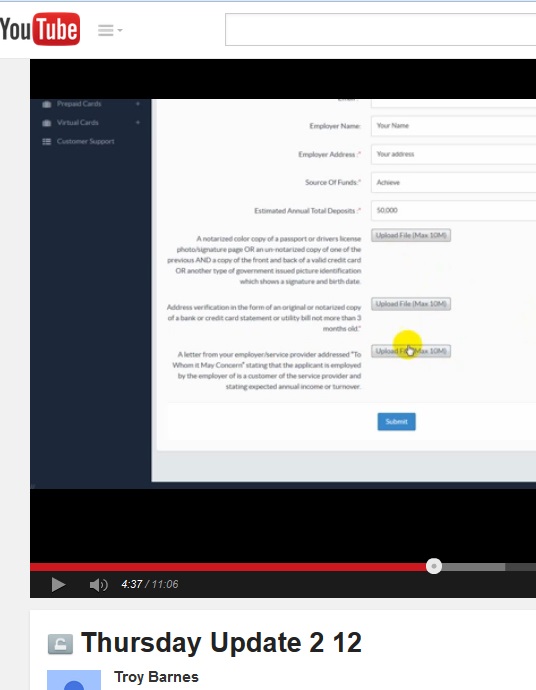
    The now-missing Troy Barnes' video for Achieve showed fields . . .
    The now-missing Troy Barnes’ video for Achieve showed fields soliciting notarized passport and driver’s license photo identification and other sensitive information, raising the specter of identity theft.

    The narration by Barnes was disjointed, at once advising members they had to submit all information requested in the information fields but backtracking to insist certain information was optional.

    In the video, fields requesting standard identification such as name and address were shown. But there also was a field that requested the submission of notarized color copies of a passport or driver’s license with a signature, “OR an un-notarized copy of one of the previous AND a copy front and back of a valid credit card OR another type of government issued picture identification which shows a signature and birth date.”

    There also were fields that solicited information on income and a letter from the employer of an Achieve member addressed “To Whom it May Concern” to verify employment.

    With respect to the field soliciting an employment-verification letter, Barnes said this: “Don’t even worry about this. You don’t need it, all right. This is going to disappear off of here. For now, it’s there. Don’t worry about it.”

    Despite those words, Barnes also said, “Remember: When you submit, everything’s gotta be filled out. Everything.”

    He also said, “If you have a PO Box and you’re in the United States, so, you’re [going to] need to go to the bank. Take your driver’s license. Any bank will do this. Tell them you [want to] get your driver’s license notarized. They’ll take it and make a copy of your driver’s license. I understand your mail may go to a PO Box, but your address should have your driver’s license on it [sic]. And that’s it. Just upload it here, and you’re all set.”

    About a field soliciting address verification, Barnes said this: Address verification is “very important. A utility bill. Anything that has your address on it that you’re billed for. You need to upload that here.”

    Barnes described a field soliciting information on estimated annual total deposits in this fashion: “You know: What do you think you’re gonna make [through Achieve?] Put whatever you want. It doesn’t matter. You know, for me, I put a hundred thousand. So, put whatever.”

    At a minimum, the video suggested Achievers who successfully submitted information would receive some sort of debit card to offload profits — perhaps in a couple of weeks.  Achieve appears not have have made a payout for more than three months while at once engaging in payment-processor roulette.

    The FBI has warned for years that certain types of debit cards and shell companies can be used for the purposes of money-laundering, handing economic strength to criminals or worse.

    Some Achievers have joined other Ponzi-board schemes and published YouTube promos for the schemes.

     

  • ‘ACHIEVE COMMUNITY’: Stranger And Stranger, Murkier and Murkier

    An "Achieve Community" promoter recorded a commercial for the purported opportunity at an FDIC-insured bank last year. Photo source: YouTube screen shot.
    An “Achieve Community” promoter recorded a commercial for the purported opportunity at an FDIC-insured bank last year. Photo source: YouTube screen shot.

    UPDATED 11:41 A.M. ET U.S.A. On Nov. 12, 2013, an entity known as “The Universal Church of Charitable Life Inc.” filed articles of incorporation in Florida. It listed its base of operations at a street address in Saint Petersburg, a city in the Tampa region.

    Its nonprofit mission, according to the Florida filing, was to “act with charity providing relief to homeless and distressed people locally and internationally while providing spiritually educational resources.”

    How much relief the firm provided is unclear: Florida dissolved the purported church in September 2014 for failure to file an annual report.

    Certain managers or agents of the church also are listed in Florida filings by a company known as Binary Wallet LLC. Binary filed articles of organization on July 15, 2013, listing an address in Palmetto Bay, a Miami suburb.

    Binary appears also not to have filed an annual report, because the word “reinstatement” appears in 2014 Florida records for the firm. Binary subsequently filed a report for 2015, listing an address in St. Petersburg and the names of at least three people whose names also appear in the church filing.

    One person listed in the church’s articles of incorporation — but not in the articles of organization for Binary — is James T. Lovern. This perhaps is because Lovern had been implicated in a telemarketing/government-grants swindle. The case was prosecuted by multiple states, including Florida and North Carolina.

    Also involved in the prosecution of Lovern, according to a document on file at the Federal Communications Commission, was the state of North Dakota. Massachusetts also prosecuted Lovern.

    On Jan. 28, 2009, The Tampa Tribune reported that Lovern had pleaded guilty to tax evasion. The church, Florida records show, would come later.

    A website styled BinaryWallet.com appears online and features photos of credit cards, debit cards and gift cards emblazoned with or surrounded by “BW” branding. The site is listed in the name of Sagar Kotak at an address in Palmetto Bay. The name Sagar Kotak also appears in Florida filings for the defunct church. Those filings list an address in India for Kotak and include a curious geographic detail: “near Bytco Hosp.”

    Binary’s Florida filings list Sagar Kotak at an address in South Carolina.

    Multiple links at BinaryWallet.com generate “404 Not Found” errors.

    These things may take on increasing importance, because reports surfaced yesterday that suggest Binary Wallet somehow now is involved in payment processing for “Achieve Community,” a Ponzi-board “program” currently under investigation by the Colorado Division of Securities.

    It appears that these reports first surfaced on a Facebook site known as “the Sheepdog,” which produced a screen shot showing the BinaryWallet domain loading a page that included graphics from a payment processor known as AeraPay.

    Achieve Community has attracted many members of the faith community. Since at least early November — when reports first surfaced that Achieve had lost its ability to do business through Payoneer — the “program” appears to have been playing a game of payment-processor roulette. This has been a signature of other HYIP fraud schemes, including Zeek Rewards and TelexFree.

    Those two Ponzi-board “programs” alone appear to have gathered a combined sum on the order of $2.7 billion — yes, BILLION. Achieve purports to turn $50 into $400 repeatedly through a process of rollovers.

    People of faith also were targeted in the Zeek and TelexFree scams. Multiple payment vendors have been subpoenaed or sued.

    At least one Zeek vendor that is the target of litigation from the court-appointed receiver in the Zeek case has claimed it was rendered insolvent through its relationship with Zeek.

    The FBI has been warning since at least 2010 that certain types of debit cards can be used to launder money and to put undeserved wealth in the hands of criminals who may be using shell corporations.

    What’s going on at Achieve right now isn’t clear. What can be said, at a minimum, is that individuals associated with a defunct Florida church appear also to be involved in a payment-processing business.

    “GlimDropper,” a RealScam.com moderator posting at BehindMLM.com, observes that “Jim Lovern” has a LinkedIn page that asserts he is an “[Executive Vice President] in Binary Wallet.”

    The LinkedIn page shows someone posing with Mitt Romney, formerly a candidate for President of the United States.

    Lovern, according to the profile, also is associated with entities known as “Upside Client Solutions,” “World Charity Trust” and “Biznetonweb.”

    Achieve Community purportedly is operated by Kristi Johnson of Colorado and Troy Barnes of Michigan.

    DOCS:

    Florida articles of incorporation for “The Universal Church of Charitable Life Inc.”

    Florida reinstatement for Binary Wallet LLC.

  • Court Filings Show Self-Identified Church Sent $10,000 To Zeek Rewards 9 Days Before Collapse; 2 Other Checks From An Individual Were Marked ‘Blessing’

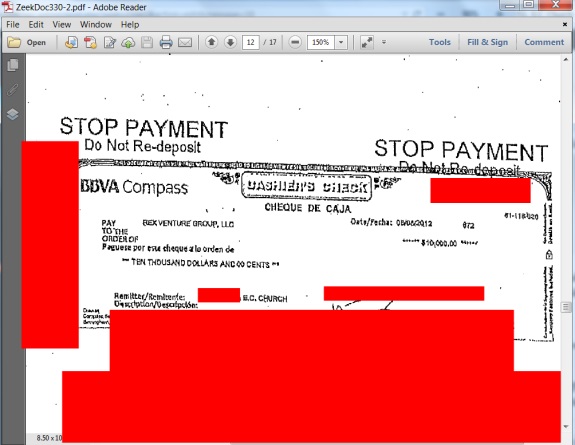
    This exhibit in the Zeek rewards Ponzi- and pyramid case shows that an an "E.C. Church" sent $10,000 to Zeek just days before in collapse in August 2012. (Masking by PP Blog.)
    This exhibit in the Zeek Rewards Ponzi- and pyramid case shows that an “E.C. Church” sent $10,000 to Zeek just days before the “program” collapsed in August 2012. (Masking by PP Blog.)

    UPDATED 8:42 P.M. ET U.S.A. Members of the faith community joining MLM HYIP schemes is a problem. It happened with the $119 million AdSurfDaily Ponzi scheme and the $72 million Legisi scam in 2008, for example.

    It’s happening currently with the “Achieve Community” scheme. Earlier, members of TelexFree  — an alleged $1.8 billion pyramid scheme — traded on the words and images of faith, including the Christ the Redeemer statue in Brazil.

    The WCM777 and Profitable Sunrise schemes also traded on images of the statue. Promoters of the schemes targeted people of faith. Those schemes likely generated more than $100 million.

    There’s also evidence that people of faith were targeted in the $897 million Zeek Rewards scheme brought down by the SEC in 2012.

    New filings by the court-appointed receiver in the Zeek case show that an entity that identified itself as an “E.C.” (Evangelical Congregational) church sent $10,000 to Zeek operator Rex Venture Group LLC on Aug. 8, 2012. The payment was in the form of a cashier’s check.

    The PP Blog is declining to identify the church because details of its precise geographic whereabouts could not be learned immediately. But the check was drawn on an Alabama bank that allegedly later stopped payment.

    Zeek receiver Kenneth D. Bell is seeking a court order for the bank — BBVA Compass Bank — to turn the $10,000 over to the receivership. BBVA Compass also allegedly unlawfully halted payment on 23 other cashier’s checks sent to Zeek. These totaled $73,800, meaning Bell is seeking $83,800 from the bank.

    Those checks were receivership assets, and the bank’s decision to stop-payment after the receiver presented them to be paid violated the asset freeze in the Zeek case, Bell alleged.

    From the receiver’s filings yesterday (italics added/light editing performed):

    At the commencement of the SEC Action on August 17, 2012, RVG possessed thousands of cashier’s checks and teller’s checks received from RVG Affiliates that had not been deposited or presented for payment. Upon entry of the Agreed Order, the Receiver collected cashier’s checks from RVG’s offices and deposited them in accounts opened for the Receivership Estate.

    Twenty-four (24) of the items collected from the RVG offices and deposited into the Receiver’s accounts were cashier’s checks payable to RVG issued by Compass. . . . On information and belief, between August 21 and August 29, 2012, Compass’s customers requested that Compass stop payment on the twenty-four Compass cashier’s checks previously delivered to RVG.”

    These halts by the bank were unlawful under the Uniform Commercial Code, Bell alleged.

    “Compass wrongfully accommodated its customers by stopping payment on all twenty-four cashier’s checks when it was not legally permitted to do so under the Uniform Commercial Code,” Bell contended.

    Although the filing is not on the subject of affinity fraud, documents within the filing suggest that the E.C. entity had company at Zeek among the faithful. Two checks among the 24 were drafted on behalf of an individual whose Zeek username included the word “blessing.” These checks totaled $2,300.

    Religious entities and people of faith getting recruited into HYIP schemes may not be the only problem. In the AdSurfDaily case, for instance, evidence surfaced that individuals had created purported nonprofits and religious entities into which to deposit their Ponzi winnings.

    Bell alleged in late 2012 that he “has obtained information indicating that large sums of Receivership Assets may have been transferred by net winners to other entities in order to hide or shelter those assets.”

    In 2014, Bell asked a court to take “judicial notice” of certain videos on YouTube.

    MLM may have a problem with “serial participants” in Zeek-like schemes to defraud, Bell suggested.

    NOTE: Our thanks to the ASD Updates Blog.

  • ‘Achieve Community’ Websites Inaccessible

    From a promo for Achieve Community on YouTube.
    From a promo for Achieve Community on YouTube.

    UPDATED 12:20 P.M. ET U.S.A. Two websites associated with the “Achieve Community” — ReadyToAchieve.com and TheAchieveCommunity.com — are inaccessible this morning.

    Achieve Community is under investigation by the Colorado Division of Securities.

    The PP Blog asked the Division this morning if it was aware of the outage and whether the inaccessibility of the sites had anything to do with the investigation.

    “I cannot comment further at this time,” said Lillian Alves, Colorado’s Deputy Securities Commissioner.

    Reports surfaced yesterday on a Facebook site known as the “NonOfficialAchieveCommunity” that Achieve had shut down its own private forum and that a page linked to a purported new payment processor for Achieve was carrying a “server maintenance” message.

    The maintenance message continues to appear today.

    Some Achievers have condemned the NonOfficialAchieveCommunity Facebook site, which also is known as “the Sheepdog” and does not echo the company line. In recent days, one poster made the preposterous assertion that the Sheepdog was responsible for ruining 10,000 lives and could be held financially liable by Achievers.

    Achieve purportedly is operated by Kristi Johnson of Colorado and Troy Barnes of Michigan.  The “program,” backed by hucksters such as Rodney Blackburn, reportedly has not made payouts for nearly three months after encountering trouble with payment processors.

    Blackburn is pushing multiple “programs” with a presence on well-known Ponzi-scheme forums — and even camped out on the website of the U.S. Securities and Exchange Commission to record a promo.

    The SEC last month declined to comment on Blackburn’s commercial.


  • Promos By ‘Achieve Community’ Huckster For ‘Military Medical Relief 21’ Go Missing From YouTube

    The MMR21 logo. Source: screen shot.
    The MMR21 logo. Source: screen shot.

    UPDATED 12:11 P.M. ET U.S.A. Two YouTube promos that asked U.S. military personnel and 20-year retirees to enroll in a purported study piggybacking off a purported “compound medication” to treat pain have been deleted.

    The promos were linked last month to “Achieve Community” huckster Rodney Blackburn, who also created a Facebook site to promote “Military Medical Relief 21” (MMR21), the “program” targeted at military members and retirees. The Facebook site now appears to be inaccessible.

    One individual Facebook text promo attributed to Blackburn that remains includes four exclamation marks and screams, “Help our soldiers today! Soldiers are being compensated! Soldiers are finding relief from addictive pain medication! Enroll today or spread the word to millions of soldiers!”

    A link to a YouTube video appears below the text promo. When clicked, this message appears, “This video has been removed by the user.” The promo appears to have been directed to the official Facebook site of “Army Wives,” a television program on the Lifetime cable and satellite network.

    On YouTube, Blackburn asserted that military personnel would be paid for their participation in MMR21, which purportedly is a nonopiate pain cream. MMR21 purportedly is linked to a Wyoming nonprofit registered Jan. 2 and called American Christian Warrior 13 Inc.

    Precisely who is running MMR21 and American Christian Warrior 13 is unclear. Also unclear is how the two are related and why the YouTube promos were deleted.

    At least one of the YouTube promos referenced the U.S. Food and Drug Administration and claimed ingredients contained within the compound had been “approved” without saying whether the medication itself had been approved. On Jan. 16, the FDA said it could not comment immediately. On Jan. 20, the agency declined to comment.

    Blackburn featured an individual described as “Dr. Tony” in one of the promos.

    At least one website Blackburn said was linked to MMR21 is soliciting information from military personnel. Despite the fact that the site is asking for intensely personal medical information, identification documents and even information on employment and medical insurance, it appears to be hosted at an insecure URL.

    Among the questions on the site:

    • Are you pregnant?
    • If pregnant, Due Date[.]
    • Last Menstrual Period[.]

    Prospects are solicited to provide information on whether they suffer from one or more of at least 56 medical ailments listed on the site. Examples include menopause, andropause, stretch marks, migraine, nervous disorder, depression, decreased sexual function, hypertension, hypotension and many more.

    A message on the site claims, “This form encrypts at the time of submission and will remain secured until it reaches your evaluating Doctor.”

    The names of the purported “evaluating” doctors are not disclosed. Also undisclosed is any information on their medical training, licenses held, board certifications and whether they are being compensated by MMR21 or American Christian Warrior. MMR21’s website appears to rotate to CMF10.com, the site that claims forms are encrypted during submission.

    How much military members purportedly could earn through MMR21 is unclear. Facebook sites with military themes appear to have been spammed by more than one individual with links to the “program.”

    Prior to the YouTube deletions of Blackburn’s MMR21 promos, they were mixed in with his promos for at least three money-cycler schemes with a presence on the Ponzi boards. “Achieve Community,” one of the Ponzi-board “programs” Blackburn is pitching, is under investigation by the Colorado Division of Securities.

    Claims about at least two other Ponzi-board “programs” Blackburn is pitching are more absurd than even Achieve claims. Achieve asserts $50 turns into $400.

    One of Blackburn’s MMR21 promos claimed, “The American Christian Warrior 13 Non Profit (ACW13) is actively looking for Soldiers to provide acceptance and need [sic] feedback after using our product. [A]nd for feedback there is compensation!!!

    “Yes[,] you and other military soldiers can be compensated for this!!!!”

    In order to be compensated, military personnel needed to participate in the study and “not be using or agree to stop using your current topical cream,” according to the video by Blackburn.

  • UPDATE: ‘Bacon’ Program Pushed By ‘Achieve Community’ Hucksters Reportedly Put On Hold By ‘Admin’; Second Program May Be DOA After Purported Payza Freeze

    If this graphic is to believed, "BRING THE BACON HOME" will produce a happy marriage and bring you children -- along with a palm-tree lined oceanfront mansion near a convenient airport, a big car and delicious, oversized fruit.
    “BRING THE BACON HOME” purportedly is operated by an “admin” who is a “young trustworthy girl from Singapore,” according to a Ponzi-board post. If this graphic is to believed, the “program” will produce a happy marriage and bring you children — along with a palm-tree-lined oceanfront mansion near a convenient airport, a big car, lots of U.S. cash and delicious, oversized fruit.

    UPDATED 6:20 A.M. ET U.S.A. “BRING THE BACON HOME,” a bizarre Ponzi-board “program” purportedly operated by “Sherilyn” from “Singapore” and pushed on YouTube by Achieve Community hucksters Rodney Blackburn and Mike Chitty, reportedly collapsed during a so-called Beta launch this week and has been put on hold.

    The “program” purportedly turns $40 into $1,800. Achieve Community purportedly turns $50 into $400, although it has been dogged by problems for more than two months and now is the subject of an investigation by the Colorado Division of Securities.

    “BRING THE BACON HOME” appears to have enabled subscription purchases, but the early haul before the failed Beta is unclear. “Sherilyn” is quoted on the MoneyMakerGroup Ponzi forum in a post dated Jan. 26 as saying, “Just buy the subs and let us do the ‘magic’ for now.”

    “My Beta Bacon got Burnt,” one Ponzi-board wag ventured.

    Separately, a “program” known as Cycles 24/7 that was advertised on the Achieve Community private forum last month may be dead. Cycles 24/7 initially collapsed at launch, but rebirthed itself — at least long enough to grab some cash.

    Cycles 24/7 purportedly is operated by “Rick Fleming.” Like Achieve, Cycles 24/7 purported to turn $50 into $400.

    On Jan. 24, a poster on MoneyMakerGroup claimed this about Cycles 24/7: “I have 45$ in payza balance, but admin say that his payza money Frozen, how i can withraw [sic] to egopay?”

    The MoneyMakerGroup claim about Payza freezing Cycles 24/7 funds followed by two days a claim on the Blog at EgoPay.com that EgoPay had been hacked and that a “gap” in cash reserves existed.

    Cycles 24/7 and “BRING THE BACON HOME” both listed EgoPay and Payza among their processors. Like Achieve Community, Cycles 24/7 is serving ads for other HYIPs.

    One ad for “BRING THE BACON HOME” observed today by the PP Blog on the Cycles 24/7 site referenced “Unison Wealth,” yet another Ponzi-board “program” pushed by Achieve Community members.

    The ad was titled “Bring Home The Bacon.” A text line read, “Did you miss Unison Wealth on the 1st day?” When clicked, the ad led to the “BRING THE BACON HOME” site.

    Unison Wealth also is beaming ads for other HYIP schemes.

    It is not unusual for one HYIP venture to try to prop up another through advertising or even to invest in other scams. Beginning in 2005, for instance, the CEP scam allegedly plowed money into at least 26 other schemes.

    In 2012, after the collapse of the $897 million Zeek Rewards “program,” a venture known as Wealth Creation Alliance published ads for one HYIP scheme after another. The schemes typically are Ponzi schemes or pyramid schemes — or sometimes both. They engage in securities fraud and the sale of unregistered securities across national borders.

    People who openly profess Christian beliefs or faith in God often are at once the marks and the purveyors of such schemes. AdSurfDaily Ponzi schemer Andy Bowdoin, an apparent advocate of The Prosperity Gospel who encouraged his MLM flock to envision money “flowing” to them, once declared himself a Christian “money magnet.”

    Federal prosecutors tied Bowdoin to at least four fraud schemes, including at least two that surfaced after the collapse of ASD in 2008. He is now in federal prison.

    One of Bowdoin’s schemes was called “One X.” “I believe that God has brought us OneX to provide the necessary funds to win this case,” Bowdoin claimed in 2011.

    The “this case” to which he referred was the ASD Ponzi prosecution. Bowdoin lost on all fronts, eventually pleading guilty to wire fraud.

    Bowdoin also was associated with a scam known as AdViewGlobal that once threatened to litigate against its own members for asking questions. AVG, as it was known, also created a private forum after its public scam outreach started to create problems.

    Achieve Community recently has added a private forum.

    Another current Ponzi-board HYIP scheme pushed by one or more Achieve Community promoters is called “Trinity Lines.” Among other things, Trinity Lines claims to be the purveyor of “high quality scriptural vignettes.” It also claims:

    • “Although this opportunity is geared for those who appreciate the Scriptures, we welcome anybody to join our community.”
    • “We at Trinity Lines do believe in God and believe in the power of ‘His Word’.

    Though not writing about any specific MLM HYIP schemes, the associate pastor of an evangelical church in Massachusetts this week called “The Prosperity Gospel” a “pyramid scheme” and “a form of oppression.”

    The column is titled, “Why the Prosperity Gospel Is the Worst Pyramid Scheme Ever.”

    From the column by Nicholas McDonald at The Gospel Coalition (italics added):

    Step One: A snazzy entrepreneur wants to make a lot of money. Said snazzy entrepreneur tells two little old ladies that if they sell his “Wow-What-A-Sham 3000,” they can make some dough to pay off their cat-sitting bills. That will cost them a startup investment of $401.76. And yes, Wow-What-A-Sham 3000 is a gimmick. But that’s okay, it’s not really about selling the product anyway; it’s about recruiting more salespeople.

    McDonald is associate pastor at Carlisle Congregational Church, according to his bio line in the column.

  • DEVELOPING STORY: Post On EgoPay Blog Claims Hack, ‘Gap In The Cash Reserves,’ Embezzlement And Staff Suspensions; Some ‘Achieve Community’ Promoters Are Pushing Other Ponzi-Board Schemes That Claim EgoPay Tie

    "BRING THE BACON HOME," a Ponzi-board "program" pushed by Achieve Community promoter Rodney Blackburn, says EgoPay is among its payment processors. An EgoPay Blog post claims it was hacked and subjected to embezzlement by itw owner -- and that the CEO has stepped down. The PP Blog cannot verify the claims.
    “BRING THE BACON HOME,” a Ponzi-board “program” pushed by Achieve Community promoter Rodney Blackburn, says EgoPay is among its payment processors. A Blog post on the EgoPay site claims EgoPay was hacked and subjected to embezzlement by its owner — and that the CEO has stepped down. The PP Blog cannot verify the claims.

    UPDATED 1:09 P.M. ET U.S.A. The Blog on the website of the EgoPay payment processor claims in a Jan. 22 post that the company was hacked on Dec. 28. The claims, which the PP Blog cannot confirm, read like a spy novel that marries insidious financial fraud and escalating computer fraud to uber-bizarre palace intrigue.

    After the hack, the post claims, EgoPay could trust no one. So it disabled its “transaction interface,” suspended staff, called in an unidentified “investigation team,”  let support tickets go unanswered and interacted with “Astropay and Payza as well a few key merchants to gauge interest in helping remedy this situation.”

    “Egopay was looking for help to discover the truth of the hack, for funding or liquidity, as well as to help consult on how to resolve this situation,” the Blog post claims.

    Whether any “interest” was forthcoming was unclear in the post.  Also unclear is how the asserted events would affect a range of schemes on the Ponzi boards.

    Given companion assertions on the Blog that EgoPay “owner” Amir Aziz effectively had hijacked EgoPay servers to delete evidence of a crime and that the hack “exposed a gap in the cash reserves of Egopay,” using EgoPay in any fashion would seem an exceptionally risky proposition.

    It was unclear in the Blog post whether EgoPay was blaming Aziz for the Dec. 28 hack. The post claimed that EgoPay determined on Jan. 5 that Aziz had been embezzling from the company, but it further claimed that (italics added):

    On January 18th, 2015 Amir Aziz social engineered his way with the hosting provider to reset his accesses and grant him access again to the servers which he used in turn to delete his Egopay account from the system (we would assume to cover his scheme) and removed all other Administrative accesses.

    The EgoPay Blog, which did not identify who wrote the post describing the hack and the post-hack actions and claims the company is back in full control of the servers, did not say whether it called police or regulatory authorities.

    The post further claims that Tadas Kasputis, the onetime CEO of EgoPay, has stepped down, “allowing for a new team to come onboard to make or break this situation.”

    The post did not say who was stepping in to fill the asserted leadership vacuum. Nor did it say who currently was running the company. The Blog post is attributed to the “Egopay Team.”

    On Friday, the PP Blog reported that the state of Colorado had opened an investigation into “Achieve Community,” a money-cycling scheme with a Ponzi-board presence. Although Achieve appears not to have advertised EgoPay, some Achieve promoters are pushing Ponzi-board schemes that claim to accept EgoPay.

    One such “program” is bizarrely called “BRING THE BACON HOME” and has a curious catch phrase of “We Do Bacon Right.” Achieve promoter Rodney Blackburn now is pushing “BRING THE BACON HOME.”

    “Are you ready to make some Yummy Money?!” Rodney asks in a text line below his Jan 14 YouTube promo titled “Bring The Bacon Home- Comp Plan and Review!!!” The video has a play time of 14:53.

    “Unison Wealth,” another Ponzi-board “program” pushed by Blackburn, also says it accepts EgoPay.

    Despite the Jan. 22 EgoPay Blog post asserting the company could trust no one — not even its own staff — the same page on which the post appears contends that “EgoPay.com is your safe way to Pay.”

    Here’s how the Blog post on the EgoPay site begins to explain the asserted hacking (italics added):

    On December 28th, during the holiday period, Egopay suffered a hack that greatly impacted key merchants and partners.  False values were made available in the merchants platform, when no actual value was transmitted in Egopay.  This hacker then proceeded to convert this fake value into irreversible currencies all within a one hour window.   These merchants believed that this value was in their Egopay account, but unfortunately it was not.  Upon discovery, at this point, Egopay immediately put restrictions in place and placed transactions from being automatically completed, to manual review to contain further damage and impact on our merchants.  The Shopping Cart Interface (SCI) was also restricted.  The impact amount was between 1M to 1.5M total for a handful of merchants.

    We concluded, that this hack must have been perpetrated by someone from within who knew the inner workings and had privileged access, so we took immediate actions and suspended everyone that we suspected while this investigation was underway.  Unfortunately, this resulted in our support services being delayed or non-existent.  Support tickets were not being answered and our transaction interface was taken down to stop any further exploit.  Considering the evidence on hand, Egopay was left with no choice but to take these drastic actions.

  • URGENT >> BULLETIN >> MOVING: Colorado Division of Securities Confirms ‘Achieve Community’ Investigation

    breakingnews72URGENT >> BULLETIN >> MOVING: (5th Update 5:35 p.m. ET U.S.A.) The “Achieve Community” money-cycling scheme is under investigation in Colorado.

    “We do have an open investigation,” said Lillian Alves, Colorado’s Deputy Securities Commissioner.

    It is the first official public confirmation that Achieve Community, a Ponzi-board program that claims to turn $50 into $400, is under investigation in the United States. In Colorado, the Division of Securities operates as part of the Department of Regulatory Agencies (DORA).

    In a story earlier today, BehindMLM.com reported that Colorado appeared to be setting the stage to open a probe. Alves confirmed the investigation to the PP Blog at 4:23 p.m. today.

    For the time being, she said, Colorado would not provide additional details. In January 2014, Colorado issued a cease-and-desist order against the WCM777 “program” operated by Ming Xu. The U.S. Securities and Exchange Commission later accused Xu of orchestrating a massive fraud scheme.

    Achieve Community purportedly is operated by Kristi Johnson of the Denver area and Troy Barnes of the Detroit area.

    At least one Achieve Community promoter recorded an ad for Achieve and two other Ponzi-board “programs.” The ad included footage from the SEC’s website. The SEC declined Jan. 12 to comment on the ad, which implied Achieve would have no trouble with securities issues.

    Colorado officially confirmed a securities investigation 10 days later.

    Visit the complaint area of the Colorado Division of Securities website.

  • Ontario Securities Commission Issues Warning On ‘Rockwell Partners,’ A Ponzi-Board ‘Program’

    rockwellpartnersRockwell Partners SA, an HYIP “program” that has a 218-page thread at the MoneyMakerGroup Ponzi forum, now is the subject of a warning from the Ontario Securities Commission.

    A Facebook site that claims an association with Rockwell Partners asserted in March 2014 that “[w]e would like to remind you that Rockwell Partners is not just another fly-by-night HYIP but a stable and safe place to invest your funds!”

    Rockwell Partners purportedly was based in Costa Rica.

    The first post in a MoneyMakerGroup thread in which Rockwell Partners was pushed in March 2014 claims a daily payout of between 1 percent and 3.5 percent. By June 2014, reports surfaced that the “program” was on the rocks. The website no longer resolves to a server.

    Current schemes being promoted at MoneyMakerGroup include Achieve Community, which claims $50 turns into $400.

    Any number of Achieve Community promoters now are pushing other Ponzi-board schemes.

  • UPDATE: SEC Declines To Comment On Pitchman’s Video Promo For ‘Achieve Community’ And 2 Other Ponzi-Board ‘Programs’ That Used Footage From Agency’s Website

    achievelogoThe U.S. Securities and Exchange Commission declined this morning to comment on a Jan. 9 YouTube pitch from an “Achieve Community” promoter who mixed nearly six minutes of footage from the SEC website into a pitch for Achieve and two other Ponzi-board “programs.”

    Rodney Blackburn implied in the 14:27 production that the SEC did not have jurisdiction over “programs” such as Achieve, Unison Wealth and Trinity Lines. Parts of the Blackburn promo were recorded inside his back office of Unison Wealth.

    “[D]ecline comment,” the SEC succinctly said today.

    Achieve purports that $50 sent to the “program” fetches back $400. Members reportedly were permitted to buy multiple $50 “positions” and to roll a percentage of “earnings” back into the “program,” a straight-line money-cycling scheme.

    A similar rollback feature was an element in the Zeek Rewards scheme shut down by the SEC in 2012.

    Blackburn says he prefers “passive” programs. The SEC and state-level regulators have a history of acting against such ventures. Zeek, for example, was promoted as a “passive” scheme.

    At about the 0:51 mark of Blackburn’s Jan. 9 video, ads for “programs” called “Paradox Cash” and “GlobalAdShare” appear, meaning that people such as Blackburn who sign up for Unison Wealth are being shown promos for still-other Ponzi-board schemes.

    “GET PAID DAILY FOR DOING NOTHING,” the ad for GlobalAdShare blares.

    Blackburn’s Jan. 9 video is at least the second confirmation that Unison Wealth is beaming ads for other HYIPs.

    On Dec. 12, the office of then-U.S. Attorney Timothy J. Heaphy of the Western District of Virginia had no immediate comment on an Achieve Community call in which Blackburn was a host. The call demonstrated that Achieve was driving business by reaching across state lines and that one or more senior citizens had signed up, including a woman who claimed her 86-year-old husband of 53 years had been “in the hospital for a full year and six months in the nursing home.”

    Achieve reportedly suspended payouts to members more than two months ago after losing its ability to conduct business through Payoneer. Although it announced a purported deal with Global Cash Card on Dec. 18 to resume payouts, that deal appears to have fallen through.

    The “program” said last week that it would resume payouts on an unspecified date through a “temporary” processor. The “temporary” processor was not named.

    The SEC’s Office of Investor Education and Advocacy recently has dialed up its efforts to educate the public about scams that spread on social-media platforms such as YouTube, Facebook and Twitter. Achieve and its promoters have or had a presence on all three.


  • Network-Marketing Pitchman Camps Out At SEC Website, Produces Commercial For Achieve Community, Unison Wealth And Trinity Lines; ‘They’re Passive . . . You Just Kind Of Put Your Money Down’ And Receive Payouts

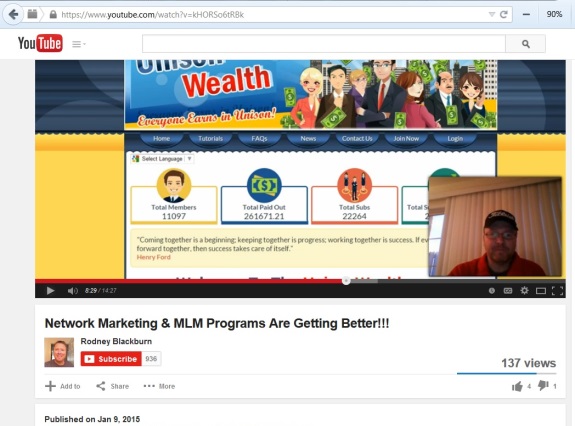
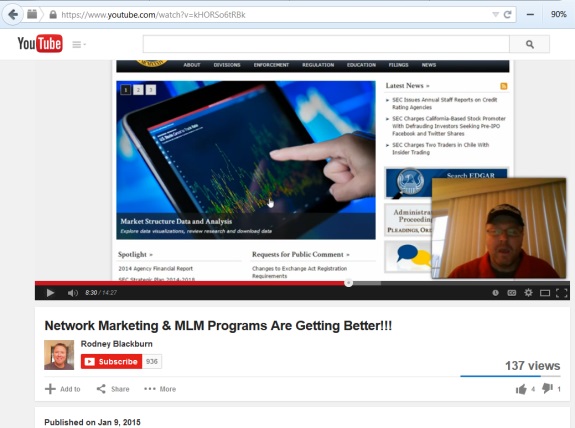
    EDITOR’S NOTE: The screen shots below show that Rodney Blackburn ends his “Unison Wealth” promo at the 8:29 mark of a 14:27 video. At the 8:30 mark, the website of the SEC becomes the feature and remains so for nearly the next six minutes as Blackburn touts Achieve Community, Unison Wealth and Trinity Lines, Ponzi-board “programs” one and all. It is Saturday. The PP Blog did not immediately hear back from the SEC on a request for comment.

    1. From ‘Unison Wealth’ . . .

    achievecommunityblackburnunisonwealth829sceensmall

    2. . . . To The SEC

    achievecommunityblackburnunisonwealth830sceensmall

    “We’re leaving the markets of these crazy MLM companies, and there are people like the Achieve Community, Trinity Lines, Unison Wealth, many of these other companies are coming out. And they are making programs that are very simplistic, they’re passive, they’re residual incomes. They’re just so simple you just kind of put your money down.”Rodney Blackburn, Jan. 9, 2015.

    A 14:27 YouTube video from an “Achieve Community” member now promoting at least two other Ponzi-board schemes includes nearly six minutes of continuous footage from the website of the U.S. Securities and Exchange Commission.

    The latest promo by Rodney Blackburn focuses on “Unison Wealth” and has a publication date of Jan. 9, 2015. It is titled “Network Marketing & MLM Programs Are Getting Better!!!” The promo suggests that ordinary MLM creates an environment in which 97 percent of participants lose and that new, smarter, better schemes are emerging to replace them.

    “You don’t have to do any marketing, for the most part,” he says of the purported new way of network marketing. “You don’t have to jump through any hoops and recruit people. You don’t have to go through any of these things.”

    In short, Blackburn says, in the new way of network marketing, participants “just kind of put [their] money down” and payouts flow back to them. What’s more, he implies, the SEC doesn’t have jurisdiction, despite mountains of evidence to the contrary, including several concurrent active prosecutions involving network-marketing or MLM schemes with passive components.

    Blackburn even dares individuals to complain to the SEC about the “programs” he’s promoting.

    “There’s people on here who think that the SEC can shut companies down,” Blackburn says as part of his narration. “Guys, [the] SEC is designed for, again, Securities and Exchange Commission, what they do — it shows it right here in back and white.”

    Blackburn proceeds to click on an “ABOUT” tab and a “What We Do” subtab at the SEC website. He then cherry-picks a quote from the agency’s site, wholly ignoring sections on SEC enforcement that detail various cases brought against network-marketing or MLM schemes.

    “The mission of the U.S. Securities and Exchange Commission is to protect investors, maintain fair, orderly, and efficient markets,” Blackburn says, reading from the SEC site.

    That’s true, of course — but the cherry-picking ignores the much larger whole.

    Had Blackburn simply typed “MLM” into the search box in the upper-right corner of the SEC site, he’d have gained instant access to information that undermines his jurisdiction theory.

    Without perusing the enforcement section that has information on recent schemes such as Zeek Rewards, TelexFree, WCM777, eAdGear, Zhunrize, CKB168 and others, Blackburn switches back to his personal narrative.

    “Guys, it’s about investors,” Blackburn continues, apparently concluding that the SEC would have no interest in the schemes he’s promoting. “It’s about efficient markets. If others of you who want to complain to your governments about these companies that are out there — you know what, go right ahead. It’s not going to do any good, unless they’re doing illegal activity. Unless you have substantial, proven evidence that any of these companies — any of them, OK — are doing anything illegal, it’s futile. You’re just blowing fear out there to the rest of us, OK, because it’s not going to do any good. Come up with something better. Come up with a fact.”

    It is a fact that the SEC, on Oct. 1, 2013, issued an “Investor Alert” titled “Beware of Pyramid Schemes Posing as Multi-Level Marketing Programs.” As part of its outreach, the SEC warned about schemes with “Promises of high returns in a short time period” and “Easy money or passive income.”

    Meanwhile, it is a fact that Achieve Community has been positioned as a “passive” program with an 800 percent ROI in as few as 55 days. It’s also a fact that a Dec. 27, 2014, promo for Unison Wealth published on YouTube by Blackburn is titled, “Unison Wealth – Review 100% Passive Automated Play for just $40!”

    Blackburn’s Jan. 9 video appears to be a compendium of two, with the first 8:29 focused on Unison Wealth. When Blackburn’s Unison pitch ends, the scene shifts abruptly to the SEC website. SEC visuals appear continuously for nearly the next six full minutes as Blackburn discuses his “programs.”

    Even as Blackburn tries to make the case that the “programs” are outside the purview of the SEC, he tells his audience that he prefers “passive” programs.” Somehow lost by Blackburn in all of this is that the passivity of a scheme and how it behaves in practice are what confer jurisdiction on the SEC.

    This has been the law in the United States since at least 1946.

    Less than a year ago — on Feb. 28, 2014 — the court appointed receiver in the Zeek Rewards Ponzi- and pyramid case as brought by the SEC in a highly publicized action in August 2012 — alleged that “ZeekRewards succeeded be cause it promoted a lucrative ‘compensation plan,’ offering large amounts of passive income to entice individuals to participate in the scheme.”

    Kenneth D. Bell, the receiver, is suing thousands of individuals for the return of hundreds of millions of dollars, saying their “winnings” came from hundreds of thousands of victims defrauded by Zeek.

    Resources

    Aug. 17, 2012, SEC News Release on Zeek action. (Headline: “SEC Shuts Down $600 Million Online Pyramid and Ponzi Scheme.”)

    Oct. 17, 2013, SEC News Release on CKB168 action. (Headline: “SEC Halts Pyramid Scheme Targeting Asian-American Community.”

    April 17, 2014, SEC News Release on TelexFree action. (Headline: “SEC Halts Pyramid Scheme Targeting Dominican and Brazilian Immigrants.”

    March 28, 2014, SEC News Release on WCM777 action. (Headline: “SEC Halts Pyramid Scheme Targeting Asian and Latino Communities.”

    Sept. 26, 2014, SEC News Release On eAdGear/Zhunrize actions. (Headline: “SEC Announces Cases Targeting International Pyramid Scheme Operators.”