Tag: ASD

  • CURIOUS: 3 Of 5 ‘Most Popular’ Stories On PP Blog Last Week Were ‘Old’ Articles On The AdSurfDaily And AdView Global Scams

    UPDATED 8:55 A.M. ET (U.S.A., DEC. 11) Are Zeekers doing research in advance of clawback actions in the Ponzi scheme case or otherwise trying to get a sense of history? Are they (or other readers) trying to gain a better understanding of ties that may exist among Zeek, AdSurfDaily and AdViewGlobal?

    Three of the PP Blog’s five “Most Popular” stories last week were “old” articles about ASD and AVG, according to a tracking service used by the Blog. AVG had not dominated reader interest on the PP Blog for nearly three years.

    Here are links to (and briefs about) those stories:

    From July 16, 2009: (No. 2 in ‘Most Popular’ rankings last week.) BREAKING NEWS: Federal Judge Says Curtis Richmond, Six Other Parties Who Used Pro Se Litigation Blueprint, Cannot Intervene In AdSurfDaily Forfeiture Case

    The July 16, 2009, story reported that seven would-be, pro se intervenors in the ASD Ponzi case were denied standing by a federal judge. In her ruling, the judge pointed out that the first filing occurred in February 2009. It is “representative and seems to be a ‘form’ complaint inasmuch as the others are duplicates,” the judge said.

    A key part of the ruling (italics added): “Fraud victims who voluntarily transfer their property to their wrongdoers do not retain a legal interest in their property; instead, such victims acquire a debt against their wrongdoers.”

    Waves of other pro se filiers later were denied standing in the case. (On at least two occasions, the judge denied the would-be intervenors en masse.)

    It perhaps is worth pointing out that standing also could become an issue in the Zeek case. Given ASD’s history, it also seems possible that “defenders” of the Zeek scheme will ponder the use of shared litigation templates. (The ASD templates, which advanced conspiracy theories and accused public officials of crimes,  didn’t “work.” To date, one Zeeker has accused the court-appointed Zeek receiver of a crime.)

    From Dec. 7, 2009: (No. 4 in “Most Popular” rankings last week.) AdViewGlobal Recording Suggests Member Cashed Out $10,000 Only Days After Formal Launch And That Insiders Were Awarded Bonuses; Less Than Two Weeks Later, Surf Switched To ‘Private Association’ Structure

    The Dec. 7, 2009, story reported that AVG, a  purported offshore entity, had conducted conference calls earlier in the year and lured prospects with “bonuses.” It also reported that some AdSurfDaily figures were among the first to receive the “bonuses.”

    It perhaps is worth pointing out that an effort by some Zeek insiders now appears to be under way to lure their downlines into nascent “programs,” at least one of which is being positioned as a way to maintain a Zeek downline in a new “program” and receive a bonus. The name of the new “program” that purportedly will provide bonuses to Zeek members and its base of operations are unclear.

    Zeek and ASD figure Todd Disner, however, recently was reported to be in Hong Kong with a “lost” passport.

    “Todd Disner,” said Zeek figure Robert Craddock on a call last week. “Bless his heart. I don’t know if he’s found his passport yet, but he’s . . .  in Hong Kong right now assisting us with this new program. And he’s lost his passport. So, I don’t know if he’s made it back to the states yet or not. And, so, we’re all working very, very hard to pull this together for you.”

    Some Zeekers have ported themselves to schemes such as “BannersBroker” and “GoFunPlaces.” It is possible that any number of Zeek members took soiled proceeds from previous scams to their new “opportunities.” What’s not known at this time is what will happen if Zeek “winners” who are the prospective targets of clawback litigation will do if they moved illicit Zeek proceeds into another scheme or dissipated the money in other ways.

    From the Dec. 7, 2009, story (italics added):

    The conference call, hosted by Terralynn Hoy, a Moderator at both the Pro-AdSurfDaily Surf’s Up forum and a ning.com forum set up to promote AVG, did not disclose how the member amassed a large sum in only days and qualified for a cashout. But another participant in the call announced that the man excitedly expected to receive a check for $10,000.

    Terralynn Hoy, a figure in both the ASD and AVG stories, hosted at least one call for Zeek in 2011. ASD was a $119 million Ponzi scheme that collapsed in August 2008. AVG collapsed in a sea of mystery in June 2009. Before it collapsed, it sought to make an 80/20 “program” mandatory and exercised its version of a “rebates aren’t guaranteed” clause.

    Lots of Zeek members tried to encourage fellow members and prospects to keep 80 percent in the “program” and remove only 20 percent. Like ASD and AVG, Zeek also had a version of a “rebates aren’t guaranteed” clause. Some Zeek “defenders” now claim that Zeek should be left alone because it never promised anybody anything. ASD and AVG members said the same thing about those “programs.”

    From July 24, 2009: (No. 5 in “Most Popular” rankings last week.) UNCONFIRMED: Harris Family In Uruguay, AVG Staff Fired

    This story reported that certain members of the Bowdoin-Harris family involved in both ASD and AdViewGlobal purportedly had moved to Uruguay. News about the purported move broke after AVG was mentioned in a racketeering lawsuit against ASD in June 2009.

    From the July 24, 2009, story (italics added):

    AVG has a history of blaming members for its problems and deflecting accountability from management to the rank-and-file. In the past, it has blamed members for the suspension of a bank account and threatened to sue members who shared information outside association walls — and even to contact their ISPs to suspend service of people who asked pointed questions about the company in forums.

    Yesterday’s announcement by AVG also blamed the delay in audit findings on unspecified “complications created by changes in payment processors.”

    Prior to its August 2012 collapse, Zeek appears to have experienced problems with banks and payment processors. Some Zeek promoters cautioned fellow members not to talk too much about Zeek in public. On Aug. 4, Zeek complained on its Blog about unspecified “North Carolina Credit Unions” saying unfair or untrue things about Zeek.

    Zeek members were warned there would be consequences to members who did not toe the company line.

    Just 13 days later, on Aug. 17, the SEC filed an emergency action in federal court that alleged Zeek was a $600 million Ponzi and pyramid scheme

     

  • The Incredible Reach Of Zeek: Receiver Files In Guam

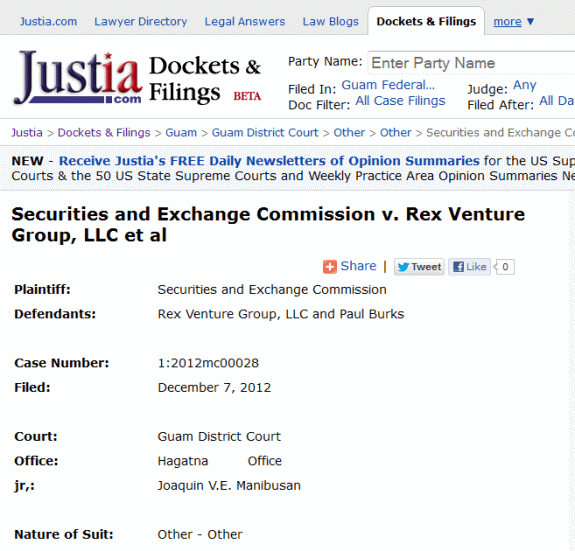
    This filing in Guam by the court-appointed receiver in the Zeek Rewards Ponzi scheme case may be the first in a U.S. territory.

    In yet another indicator of the incredible reach of the alleged Zeek Rewards Ponzi scheme, the court-appointed receiver has filed court paperwork in Guam.

    Guam is a U.S. island territory “approximately 3,300 miles West of Hawaii, and 1,500 miles east of the Philippines and south of Japan,” according to the website of Naval Base Guam.

    Whether U.S. military members in Guam bought into Zeek is unclear. Zeek was based in North Carolina, home state to four military installations.

    In August, the SEC said Zeek “raised money from more than one million Internet customers nationwide and overseas.” In July, the PP Blog reported that an article on Google News by an apparent Portuguese-speaking affiliate of Zeek claimed that the MLM “program” had more than 100,000 members in Brazil alone. Haaretz.com reported in August that Zeek may have had 20,000 members in Israel.

    In recent days, Zeek receiver Kenneth D. Bell has been posting notice of the August SEC complaint and his appointment as receiver in federal courts in multiple states.  The filing in Guam appears to be the first in a U.S. territory, as opposed to a state. The filings set the stage to consolidate Zeek-related court actions in the Western District of North Carolina before Senior U.S. District Judge Graham C. Mullen.

    Bell has said he’ll pursue clawback litigation against Zeek “winners.”

    Some military members were victims of the infamous “3 Hebrew Boys” Ponzi scheme in South Carolina, another state that includes multiple military installations.

    Some promoters of AdSurfDaily, a Zeek-like “program” that planted the seed it provided a return of 1 percent a day, deliberately targeted military members and their spouses.

    From a May 2008 pitch for ASD targeted at military families. ASD collapsed in August 2008.
  • Nathaniel Woods Plants Seed That Zeek Receiver Issued ‘Bogus Subpoena’ And Committed Felony; Claims Reminiscent Of Assertions Made In AdSurfDaily Ponzi Case

    UPDATED 5 P.M. ET (U.S.A.) Various members of the Florida-based AdSurfDaily 1-percent-a-day Ponzi scheme advanced various theories that judges, prosecutors and investigators committed various felonies during the course of the probe and follow-up actions in court. The claims were absurd on their face and, when the arguments were rejected, they were replaced by conspiracy theories. Time after time the conspiracy theories expanded to accommodate unpleasant fact sets, with various “defenders” of ASD retreating into an infinite set of contingencies and conflating one artificial reality after another.

    Now, a Florida resident and apparent participant in Zeek Rewards has filed a document in federal court that accuses the court-appointed receiver in the Zeek Ponzi scheme case of committing a felony. The receiver, Kenneth D. Bell, is a former federal prosecutor who once successfully prosecuted a Hezbollah terrorist cell operating in the United States.

    The PP Blog contacted the Zeek receivership today to seek comment from Bell. The Blog’s message was not immediately returned.

    In separate filings that appear on the docket of Senior U.S. District Judge Graham C. Mullen of the Western District of North Carolina, Nathaniel Woods claimed Bell or Bell’s receivership team unlawfully mailed a “bogus subpoena” to him in Ocala, Fla., thus committing a felony under Florida law.

    Mullen is presiding over the Zeek Ponzi case. In August, the SEC accused Zeek of operating a $600 million Ponzi- and pyramid scheme. Zeek’s business model was very similar to the model of ASD. ASD’s business practices triggered both civil and criminal investigations by the U.S. Secret Service in 2008.

    The subpoena, Woods claims, was meant for the purposes of “intimidation and harassment” on the part of the receiver.

    And Woods further claims that sending a “bogus subpoena” from North Carolina to Florida through the U.S. Mail constitutes “simulated process” under Florida law, a “third degree felony.”

    An accompanying document filed by Woods as an exhibit claims that “preliminary Zeek Rewards records” reviewed by the the receivership show that Woods received more than $496,000 from Zeek but paid nothing (“$0.00”) into the purported program.

    Bell is seeking the return of the money, describing it as “money lost by victims,” according to the exhibit.

    Woods is seeking to quash the subpoena, which demands records of Woods’ interactions with Zeek dating back to January 2010. He also claims the subpoena was only an “alleged subpoena” and was improperly served.

    A domain styled “500FREEBIDS4U.COM” is registered in the name of Nathaniel Woods at the Ocala street address to which the subpoena was sent, according to records. Other domains listed with an email address that appears on the registration data attributed to Nathanial Woods include Mybidshack10k.com, Mybidshackhow.info, Mybidshack4u.com and Mybidshackearn.info.

    Daryle Douglas, a onetime purported Zeek executive, also has been associated with a MyBidShack entity, according to researcher “K. Chang.”

    Zeek was a purported “penny auction” company operated by Paul R. Burks through Rex Venture Group LLC in Lexington, N.C. The penny-auction site was known as Zeekler. Zeek’s MLM arm was known as Zeek Rewards. Burks has consented to a judgment in the case. He has neither admitted nor denied the SEC’s allegations, which include securities fraud and the sale of unregistered securities.

    On Aug. 17, the U.S. Secret Service said it also was investigating Zeek. The SEC has said Burks duped investors into believing the purported Zeek “program” was paying a legitimate return of about 1.5 percent a day.

    Bell has said that perhaps 1 million people sent money to Zeek. Viewed by the number of potential victims and the number of transactions, Zeek may be the largest Ponzi scheme in U.S. history.

    Earlier this month, Bell said the receivership had gathered evidence that nearly 1 billion transactions were conducted through Zeek in about 18 months.

    AdSurfDaily was a Ponzi scheme that promoted a payout of 1 percent a day. It has about 100,000 members and gathered about $119 million, also in about 18 months, according to records.

    Records suggest that Zeek, which launched after the Secret Service brought the ASD Ponzi case, did about five times the dollar volume of ASD and potentially had 20 times the user volume.

    The civil portion of the ASD case dragged out for all or parts of five years. ASD President Andy Bowdoin admitted in May 2012 that ASD was a Ponzi scheme. In August 2012, less than two weeks after the SEC brought the Zeek case, Bowdoin was sentenced to 78 months in federal prison.

    ASD and Zeek are known to have had members in common.

  • SPECIAL REPORT: AdSurfDaily/Zeek Pitchman Todd Disner Gave Thousands To Gingrich, Romney After Soliciting Money To Sue The United States; Records Show Tax Liens Of More Than $405,000 Dating Back To 1999

    EDITOR’S NOTE: ASD was a multilevel-marketing scheme that planted the seed it paid a return of 1 percent a day on top of two-tiered affiliate commissions totaling 15 percent for recruiters. Federal prosecutors described the purported “opportunity” as a Ponzi scheme based in the the small town of Quincy, Fla., and operated by recidivist securities felon Andy Bowdoin.

    UPDATED 9:46 A.M. ET (NOV. 18, U.S.A.) A Florida man who claimed in a November 2011 lawsuit against the United States that AdSurfDaily was not a Ponzi scheme doled out thousands of dollars to Republican candidates and organizations in the following months, records show.

    The man, ASD promoter Todd Disner of Miami, joined with fellow Miami resident and suspended Connecticut attorney Dwight Owen Schweitzer in suing the United States as pro se plaintiffs after soliciting donations from fellow ASD members to fund the lawsuit earlier in 2011, according to records. As the lawsuit proceeded, Disner and fellow ASD promoter Schweitzer raised the prospect in court filings that the seizure of ASD’s database in a 2008 case brought by the U.S. Secret Service and federal prosecutors in the District of Columbia could lead to the ASD duo’s prosecution for tax evasion.

    A federal judge tossed the lawsuit in August 2012, but Disner and Schwetizer are appealing. They have accused the judge of “sophistry.”

    Both Disner and Schweitzer have been engaged in continuous litigation against the United States for more than a year. Neither has been charged with a crime. After their days promoting ASD, Disner and Schweitzer went on to promote Zeek Rewards, an ASD-like,  1.5-percent-a-day “program” with accompanying commissions that triggered probes by both the SEC and the U.S. Secret Service. On Aug. 17, the SEC accused North Carolina-based Zeek of operating a $600 million Ponzi-and pyramid scheme that potentially swindled more than 1 million investors.

    Zeek operator Paul R. Burks did not contest the SEC’s civil allegations and consented to a judgment in the case. Records show that Burks gave $2,500 to the campaign of GOP Presidential hopeful Ron Paul between 2011 and early 2012.

    On Dec. 26, 2011, only weeks after the Disner/Schweitzer lawsuit was filed against the government, Disner provided a donation of $1,000 to the GOP Presidential campaign of Newt Gingrich (Newt 2012), Federal Election Commission records show. The Gingrich donation by Disner appears to have been his first to a national candidate or organization. The FEC database, for example, shows no donations from Disner between Jan. 1, 1990, and Dec. 25, 2011.

    Disner matched the Dec. 26 donation with another $1,000 to Gingrich in January 2012, according to FEC records.

    Separately, records in Miami-Dade County show that the IRS filed a tax lien against Disner for $101,723 on Aug. 1, 2006. Included in that sum was $95,015.97 allegedly owed from 1999, and $6,707.77 allegedly owed from 2002.

    ASD, operated by the now-convicted and jailed Andy Bowdoin, launched just weeks after the IRS filed the lien against Disner. Two years to the day after the lien was recorded in Miami-Dade, the Secret Service seized $65.8 million from 10 Bowdoin bank accounts.  A raid of ASD’s headquarters followed four days later. Bowdoin later was charged criminally with operating a Ponzi scheme. Among the allegations against Bowdoin was that he had used money from the ASD Ponzi scheme to make a donation to the National Republican Congressional Committee.

    Bowdoin, 77, pleaded guilty to wire fraud in May 2012. In August, he was sentenced to 78 months in federal prison. Prosecutors said he was at the helm of a $119 million Ponzi scheme and promoted other MLM fraud schemes even after his December 2010 arrest.

    On Nov. 21, 2007, according to records, the IRS filed another lien against Disner in Miami-Dade totaling $294,940.89. This lien was for the 2003 and 2004 tax years. The IRS filed yet another lien against Disner on Oct. 22, 2008. This one sought $8,661.36 for the 2000 and 2001 tax years.

    All in all, records show three tax liens against Disner for the combined sum of $405,325.99.

    Whether Disner has cleared the IRS liens is unclear. What is clear is that, in June 2012, he raised the prospect in court filings that he could be prosecuted for tax evasion because of the seizure of ASD’s database in 2008. Records in the Zeek case, meanwhile, show that the Zeek database also has been seized.

    Records suggest that, with Gingrich out of the GOP Presidential race by May 2012, Disner switched his support to Mitt Romney, who went on to become the party’s nominee. Romney ultimately lost in the general election to President Obama, a Democrat seeking a second term.

    Gingrich, a former Georgia Congressman, is a former Speaker of the U.S. House of Representatives.

    On June 25, 2012, Disner gave $1,000 to Romney for President Inc., according to FEC records.

    Just days earlier — on June 18, 2012 — Disner and Schweizer claimed in federal court that the government’s Ponzi case against ASD was a “house of cards,” despite Bowdoin’s guilty plea and acknowledgment that he had operated a Ponzi scheme and that ASD never had operated lawfully after its 2006 inception.

    A month later — on July 17, 2012 — Disner gave $200 to the Republican National Committee, according to FEC records.

    Exactly a month after that — on Aug. 17, 2012 — the SEC filed an emergency action in federal court that accused Burks of presiding over a massive fraud scheme that effectively extended across the world.

    Within days of the SEC action, Disner — who previously solicited money to sue the United States for alleged misdeeds in the ASD Ponzi case — participated in a conference call with self-described Zeek “consultant” Robert Craddock, who himself was soliciting money for some sort of court action against the SEC or the court-appointed receiver in the Zeek case.

    Nothing has been filed by Craddock to date. During one call, Craddock dropped the name of former Florida Attorney General Bill McCollum, claiming McCollum as a “friend.” McCollum is a Republican. In 2008, while attorney general, McCollum accused ASD of operating a pyramid scheme.

    Some ASD members reacted by suggesting that McCollum and a Florida TV station that carried the news of the ASD lawsuit should be charged with Deceptive Trade Practices.

    Despite Craddock’s claim after the SEC action that McCollum’s law firm SNR Denton had become the attorneys for a Craddock and a group of Zeek members, SNR Denton appears to have decided not to represent Craddock or his group.

    FEC records show that Disner gave $1,500 to the Republican National Committee in September 2012.

  • DEVELOPING STORY: Zeek Winners Begin To Receive Subpoenas

    Alleged Ponzi scheme Zeek Rewards wrapped itself in the American flag and symbols such as the American penny coin to attract business. The purported “opportunity”  has created problems for hundreds of thousands of members in the United States and other countries.

    The PP Blog has received a report that some members of Zeek have received subpoenas issued by the court-appointed receiver in the Zeek Rewards Ponzi scheme case. The SEC alleged in August that Zeek was a $600 million Ponzi and pyramid scheme operated by Paul R. Burks and Rex Venture Group LLC.

    Receiver Kenneth B. Bell said earlier this week that a first round of about 1,200 subpoenas would be issued to “affiliates who profited most from ZeekRewards.”

    Early details are sketchy about precisely what information the subpoenas demand. Bell wrote on the receivership website that recipients “are required to fully respond to the subpoena.

    “If you do not have possession, custody or control of any of the documents requested simply say so in responding to the subpoena. However, you are required to make a full reasonable effort to locate all documents requested, including electronic documents and email,” Bell wrote.

    The issuance of the subpoenas demonstrates that online HYIPs dressed up as multilevel-marketing “programs” can — at a minimum — create civil exposure for participants. Profits received from such schemes are viewed as ill-gotten gains subject to clawback.

    In an Oct. 8 court filing, Bell advised Senior U.S. District Judge Graham C. Mullen that he planned to pursue Zeek winners and others through common-law and and clawback claims “under applicable fraudulent transfer statutes.”

    In addition to Zeek winners, potential clawback targets include Zeek officers, employees and professionals who benefited from the scheme, according to Bell’s Oct. 8 filing. As many as 100,000 people potentially received ill-gotten gains from Zeek, while about 800,000 Zeek members experienced losses.

    Zeek wrapped itself in the American flag while pitching its offer globally, claiming among other things that winners of its Zeekler auctions for sums of U.S. cash would be paid through offshore payment processors. North Carolina-based Zeek has never explained the striking incongruity of auctioning U.S. cash and offering to deliver it via payment processors linked to fraud scheme after fraud scheme promoted on Ponzi scheme forums such as TalkGold and MoneyMakerGroup.

    Auctions for cash mysteriously went missing from Zeek in June. On Aug. 4, 13 days before the SEC filed an emergency action to halt the alleged Zeek Ponzi scheme, the company publicly complained about “North Carolina Credit Unions” that were warning customers about Zeek.

    On June 5, the company bizarrely planted the seed that, if Zeek instructed members to change their preference in dispensing toilet paper, they should do it to demonstrate how coachable they are. Just days earlier — on May 28, Memorial Day — the company claimed it was closing two U.S. bank accounts and urged members to cash commission checks by June 1 or they would bounce.

    Zeek’s auction arm was known as Zeekler and was married to Zeek Rewards, the MLM side of the business. The SEC said in August that Zeek commingled funds and that Burks “unilaterally and arbitrarily” determined Zeek’s daily dividend rate so that it averaged “approximately 1.5% per day, giving investors the false impression that the business is profitable.”

    In 2008 and 2009, the U.S. Secret Service made similar allegations against AdSurfDaily and operator Andy Bowdoin. Bowdoin, 77, was charged criminally in December 2010. He pleaded guilty to a Ponzi-related charge of wire fraud in May 2012. Bowdoin was sentenced in August 2012 to 78 months in federal prison.

    ASD operated as an “autosurf” HYIP that planted the seed that members would receive a return of 1 percent a day.

    Precisely how many Zeek members live outside the United States and benefited from the scheme is unclear. In July, the PP Blog reported that a Zeek-related article carried on Google News claimed that Zeek had 100,000 members in Brazil alone.

    An issue that potentially could emerge in the coming weeks is whether the receiver will be successful in seeking clawbacks from non-U.S. members of Zeek who received more from the scheme than they put in. How many Zeek members fit the profile is not yet known.

    HYIPs that operate across borders on the Internet introduce the specter of international red tape and also potentially bring language barriers into play. In the days after the SEC brought the Zeek case, some purported international members of Zeek effectively thumbed their noses at the United States and Zeek victims, crowing on Ponzi-scheme forums that they’d keep their Zeek money no matter what.


  • UPDATE: As Proposed Money-Saving Measure, Zeek Receiver Asks Judge To Treat Oct. 8 Preliminary Liquidation Plan As Status Report; Meanwhile, Yet Another Zeek Member Declares Herself A Fraud Victim

    A woman who described herself as a Zeek victim filed copies of postal receipts in federal court today. Source: Screen shot of federal court files. Redaction by PP Blog.

    UPDATED 8:26 A.M. EDT (OCT. 31, U.S.A.) Saying it would save money, the court-appointed receiver in the Zeek Rewards Ponzi scheme case has asked a federal judge to treat the receiver’s Oct. 8 preliminary liquidation plan as a status report. (See Oct. 9 PP Blog story.)

    Separately, yet another Zeek member has declared herself a victim of the alleged $600 million Zeek fraud scheme operated by Paul R. Burks and Rex Venture Group LLC. Two other Zeek members effectively did the same thing earlier this month. On Aug. 17, the SEC alleged that Zeek was a massive Ponzi- and pyramid scheme that potentially fleeced more than 1 million people.

    In August, Senior U.S. District Judge Graham C. Mullen of the Western District of North Carolina ordered receiver Kenneth D. Bell to file the first status report in the case by Oct. 30. Among other things, status reports inform judges about the efforts under way to recover proceeds linked to alleged fraud schemes and return them to victims.

    In the Zeek case, status reports are due within 30 days of the end of a quarter — for example, the third quarter of the calendar year ended Sept. 30, making the first Zeek status report due Oct. 30. The second is due Jan. 31, 2013, a month after the end of the fourth quarter of the calendar year on Dec. 31, 2012.

    Bell said in court filings today that the information in the Oct. 8 report included “the same information” due today.

    “Given that a separate Quarterly Status Report would be redundant, and in the interest of preserving Receivership assets, the Receiver respectfully requests that the Court order that the Preliminary Liquidation Plan be treated as the Receiver’s First Quarterly Status Report,” Bell petitioned Mullen.

    Mullen had not acted on the request by late this afternoon, according to the docket of the case.

    How Zeek enthusiasts on Ponzi-scheme boards such as TalkGold and MoneyMakerGroup will react to Bell’s request was not immediately clear. One-percent-a-day (or more) schemes such as Zeek gain a head of steam in part because willfully blind scammers who populate the Ponzi cesspits position the “programs” as legitimate.

    The demonization of Bell on the Ponzi boards and elsewhere began shortly after the SEC brought the Zeek case. As was the case in the AdSurfDaily prosecution brought by the U.S. Secret Service in 2008, some Zeek members have claimed that the government is manufacturing victims where none exist. The ASD and Zeek Ponzi schemes fetched a combined sum of at least $719 million, nearly three-quarters of a billion dollars, according to court filings.

    Both frauds operated as classic Ponzi schemes that recycled money from members to create the illusion of sustainability and profitability, according to investigators.

    Both Zeek and ASD were promoted on forums listed in federal court filings as places from which Ponzi schemes are promoted. Earlier schemes promoted on the forums include Legisi and Pathway To Prosperity, which gathered a combined sum of more than $140 million and affected tens of thousands of people, according to court filings.

    Legisi operator Gregory McKnight faces sentencing next month in his Ponzi scheme case. Alleged Pathway To Prosperity operator Nicholas Smirnow, meanwhile, is listed by INTERPOL as a wanted fugitive. As was the case with Zeek, the SEC and Secret Service led the Legisi probe. The U.S. Postal Inspection Service brought the Smirnow/Pathway to prosperity case, saying the scam affected individuals in 120 countries.

    ASD operator Thomas A. “Andy” Bowdoin is serving a 78-month prison sentence. He was sentenced in August 2012.

    Despite claims that Zeek created no victims, at least three individuals already have claimed in court filings to have been scammed by Zeek.

    In a filing docketed today, Maria Aide Gomez claimed she sent North Carolina-based Zeek parent Rex Venture Group five postal money orders for $1,000 each in May and paid an additional $300 to maintain her Zeek membership.

    Gomez described herself as a “Victim of fraud and deception” on the part of Zeek, Rex Venture Group and Paul R. Burks, the operator of Zeek and Rex Venture. The money orders Gomez sent to Zeek were purchased at a post office in Washington state, according to exhibits that accompanied the filing.

    Bell, the receiver, is experienced as both a defense attorney and a prosecutor. The U.S. Department of Justice lauded Bell a decade ago for his successful prosecution of a Hezbollah terrorist cell operating in the United States.

  • AdSurfDaily Figures Todd Disner, Dwight Owen Schweitzer Appeal Lawsuit Dismissal

    AdSurfDaily figures Todd Disner and Dwight Owen Schweitzer — later to become pitchmen for the alleged Zeek Rewards Ponzi scheme — have appealed the dismissal of their ASD-related lawsuit.

    In August, U.S. District Judge Rosemary Collyer dismissed claims by the ASD duo that their 4th Amendment rights had been violated when ASD computer records were seized in 2008.

    Disner and Schweitzer had no standing to make the claim and had no privacy interests in records they voluntarily conveyed to ASD, Collyer ruled.

    In September, the duo sought to reopen the case and have Collyer removed from hearing it, but Collyer said no.

    Disner and Schweitzer now have appealed to the U.S. Court of Appeals for the District of Columbia the Aug. 29 final judgment and their denied motions to reopen the case and have Collyer stand down.

    The combined ASD and Zeek schemes fetched at least $719 million, according to federal records. On Aug. 17, the SEC described Zeek as a $600 million Ponzi- and pyramid fraud.

    ASD was a $119 million Ponzi scheme, according to the U.S. Secret Service. The Secret Service said in August that it also was investigating Zeek.

  • $250 Million-Plus Ponzi ‘Arbitrage’ Scheme In South Africa Allegedly Led To Murder/Suicide; A ‘Tangled Web Of Close Corporations, Trusts And Offshore Bank Accounts’

    MoneyWeb has the story of Relative Value Arbitrage Fund (RVAF), an alleged massive Ponzi scheme in South Africa in which Herman Pretorius shot and killed a business partner in July and then shot and killed himself.

    The scheme appears to have gathered R2.2bn, the equivalent of more than $250 million (U.S.).

    From Julius Cobbett at MoneyWeb (italics/bolding added):

    RVAF curators estimate that the scheme received R2.2bn from about 3000 investors. At the time of Pretorius’s death, the RVAF owed an estimated R3.1bn to investors.

    The difference between the amount received and owing is most likely explained by the fund’s performance, which is believed to be fictitious.

    Investigations following Pretorius’s death show that he alone was in control of a tangled web of companies, close corporations, trusts and offshore bank accounts.

    Read the MoneyWeb story.

    NOTE BY PP BLOG: Some scammers on Ponzi-scheme forums also purport to engage in “arbitrage.” The collapse of purported arbitrage “program” Gold Nugget Invest (GNI) in 2010 brought out the “conspiracy theorists,” the PP Blog reported at the time.

    Among the bizarre assertions was that the SEC was under investigation by INTERPOL.

    It is common for Ponzi-board scammers to use terms that sound impressive — arbitrage, for instance — in their scams.

    “Ken Russo,” a former Ponzi-board pitchman for the alleged Zeek Rewards Ponzi scheme, was promoting something called “NewGNI” even as he was promoting Zeek, according to his posts at the TalkGold Ponzi forum (as “DRdave”).

    NewGNI may be a follow-up scam to the GNI scam.

    Read a January 2010 PP Blog story on some of the bizarre claims surrounding the collapse of GNI, a scheme also pushed by some members of the AdSurfDaily Ponzi scheme.

  • ASD Figure Kenneth Wayne Leaming’s Birther Lawsuit Against Obama, Holder Gets Tossed

    Screen shot: Part of the Leaming/Stephenson complaint demanding gold and silver.

    After he was charged with filing false liens and other crimes and jailed near Seattle, AdSurfDaily story figure and purported “sovereign citizen” Kenneth Wayne Leaming apparently thought it prudent to sue President Obama and U.S. Attorney General Eric Holder.

    Leaming, 56, advanced a theory that Obama was not born in the United States, was not eligible to be President and had appointed Holder unlawfully.

    It therefore followed, according to Leaming and co-plaintiff and former business colleague David Carroll Stephenson, that Holder was “Personating [sic] the Attorney General of the United States” and could not lawfully appoint or delegate authority to “Any United States Attorney.”

    And because Holder had oversight responsibility over the U.S. Attorney’s Office in the Western District of Washington that had brought the criminal charges against Leaming and Stephenson after an FBI probe, the duo apparently surmised, it followed that the prosecution was unlawful and should be declared “VOID For FRAUD” because the U.S. Attorney also is “personating” [sic] a federal officer.

    In their June lawsuit, Leaming and Stephenson demanded compensation in “gold” and “silver” for each day they allegedly were held unlawfully. Over time, the docket of the case swelled to more than 30 entries.

    On Oct. 11, however, U.S. District Judge Robert S. Lasnik dismissed the Leaming/Stephenson lawsuit “for failure to identify any viable claim for relief.”

    The judge also ordered “all pending motions” stricken as moot.

    Leaming and Stephenson remain jailed near Seattle.

    In court filings earlier this month, federal prosecutors said Leaming was instrumental in founding the “County Rangers,” a “sovereign group’s armed enforcement wing.”

    He is charged with filing false liens against at least five federal officials involved in the prosecution of the AdSurfDaily Ponzi scheme, which the U.S. Secret Service described as a fraud operated by Andy Bowdoin that had gathered at least $119 million.

    Bowdoin, 77, was sentenced in August to 78 months in federal prison.

    Leaming initially was arrested by the FBI in November 2011. He was indicted in January 2012 on charges of filing false liens, harboring fugitives, possessing firearms as a convicted felon and uttering a bogus “Bonded Promissory Note” with a face value of $1 million and depositing it in U.S. Bank.

    Stephenson, a tax fraudster already jailed when Leaming was arrested and jailed, worked with Leaming to file false liens against U.S. prison officials, prosecutors said.

    See Nov. 27, 2011, PP Blog story that outlines FBI allegations that Leaming was discussing a way to serve Stepenson-related papers on U.S. Chief Justice John Roberts through the school attended by his children, who are minors.

    Roberts is the top judicial officer in the United States.

  • BULLETIN: AdSurfDaily Figure Kenneth Wayne Leaming Was Founder Of ‘Sovereign Group’s Armed Enforcement Wing’ And Had ‘Assault Rifle’ With Bayonet At Time Of Arrest, Prosecutors Say; Probe Was Part Of Deeper Investigation Into ‘Sovereign Citizens’ Operating Nationally Through Washington State

    Kenneth Wayne Leaming

    BULLETIN: The November 2011 arrest by the FBI of Kenneth Wayne Leaming was part of a deeper probe into the activities of a “national” group of “sovereign citizens”  operating in the Pacific Northwest, new court filings by federal prosecutors in the Western District of Washington reveal.

    “Local jurisdictions alerted federal law enforcement that they had received a significant number of threats from members of this group,” prosecutors said.

    Leaming, prosecutors said, was “a long-time constitutionalist/sovereign citizen, who had a
    documented history of holding himself out as a law enforcement officer and/or a lawyer . . . He also was instrumental in founding the ‘County Rangers,’ the sovereign group’s armed enforcement wing. Members of the County Rangers were issued realistic-looking badges and credentials were required to possess firearms as part of their duties, and held themselves out as law enforcement agents.”

    Leaming, 56, of Spanaway, Wash., is a figure in the AdSurfDaily Ponzi scheme story. Some ASD members have claimed Leaming was performing legal work for them, and his name appears on the ASD court docket as the filer of a purported “Notice of Final Determination and Judgment.”

    Such filings have been associated with the “sovereign citizens” movement.

    As first reported on the PP Blog last year, Leaming, 56 and a convicted felon for piloting an aircraft without a license, was found with two federal fugitives from Arkansas at the time of his arrest.

    Both of those fugitives — Timothy Shawn Donavan and Sharon Jeannette Henningsen — now have been convicted of multiple counts of mail fraud in a home-based business caper in Arkansas, according to court files.

    The new filings by prosecutors came in response to a bid by Leaming to challenge the search warrant in the case and to suppress evidence against him.

    Leaming was indicted on charges of filing false liens, harboring fugitives, possessing firearms as a convicted felon and uttering a bogus “Bonded Promissory Note” with a face value of $1 million and depositing it in U.S. Bank.

    The bank “briefly credited Leaming’s account in the amount of $31,350, before realizing the amount was wholly fictitious and reversing the credit,” prosecutors said.

    At least four of Leaming’s “sovereign” associates — David Russell Myrland, Timothy Garrison, Raymond Leo Jarlik-Bell and David Carroll Stephenson  — already have been charged or convicted in various schemes, prosecutors said.

    Bogus liens linked to Leaming were found during a search of Jarlik-Bell’s residence, prosecutors said, making a veiled reference to the ASD case as a “a large wire fraud case” in the District of Columbia.

    Whether Jarlik-Bell has any ASD ties is unclear.

    The liens had been filed with the Pierce County Auditor [in Washington state] against a “federal District Judge, an AUSA, and other federal agents and employees, ” prosecutors said.

    Other records show that each of the alleged lien targets had ties to the ASD case, including U.S. District Judge Rosemary Collyer of the District of Columbia. Collyer presided over the ASD case.

    Prosecutors now assert that agents conducted a search of Leaming’s Spanaway residence and found an “AK-47 style assault rifle with a bayonet; several handguns (one of which was in a drawer of the desk Leaming was sitting at as entry was made); two other rifles; and a shotgun.”

    From the prosecution filing (italics added):

    “Immediately after execution of the search warrant, but before Leaming was transported from the scene, agents asked Leaming questions about the presence of firearms for officer safety purposes. Leaming admitted that a number of firearms were present in the home.”

    Meanwhile, agents found a “box of ‘County Ranger’ badges and other false law enforcement credentials,” prosecutors said.

    At the same time, agents found “numerous boxes of correspondence and legal paperwork documenting other apparent fraud schemes,” prosecutors said.

    Leaming is contending that the alleged liens aren’t really liens and, even if they were, “he had some constitutional right to file them,” prosecutors said.

    He also contends that he has a Constitutional right to possess firearms as a convicted felon and that the government is not permitted to regulate firearms ownership, prosecutors said.

    As the investigation continued more bogus liens were discovered against other government officials, prosecutors said.

    Those liens have been linked to Leaming and Stephenson, a jailed former business colleague of Leaming’s. They were filed in Pierce County “against the Warden” of the Federal Correctional Institution in Phoenix and the “direct[or] of the Bureau of Prisons,” prosecutors said.

    From the prosecution’s filing (italics added):

    ” . . . during the investigation agents also discovered that Leaming was preparing and using false and fictitious financial instruments. These instruments were typically called “Bonded Promissory Notes,” and purported to be issued by the Federal Reserve or the United States Treasury.”

    As to the firearms allegations, Leaming “advanced some type of nonsensical, quasi-legalistic explanation as to why they were not, in fact, firearms,” prosecutors said.

    Leaming has been jailed since his November 2011 arrest. Since that time, he has sued President Obama, Attorney General Eric Holder and a county sheriff in Arkansas, according to court filings.

    ASD operator Andy Bowdoin was sentenced in August to 78 months in federal prison. He admitted in May that ASD was a Ponzi scheme. Prosecutors said the scheme gathered at least $119 million.

  • BULLETIN: Judge Declines To Recuse Herself — And Denies Motion By ASD Figures Todd Disner And Dwight Owen Schweitzer To Reopen Lawsuit

    BULLETIN: AdSurfDaily figures Todd Disner and Dwight Owen Schweitzer will not be permitted to reopen their lawsuit against the government and get a different judge to hear it.

    U.S. District Judge Rosemary Collyer of the District of Columbia this morning denied a motion by the ASD duo that she recuse herself from the case. At the same time, Collyer denied a motion by Disner and Schweitzer to reopen the case.

    “A judge’s sworn duty is to judge with fairness and impartiality, and absent a showing otherwise, a judge is presumed to be impartial,” Collyer ruled.

    Disner and Schweitzer made no such showing, Collyer ruled.

    “Plaintiffs have presented no reasonable argument why this matter should be transferred to another judge,” Collyer ruled. “Further, Plaintiffs do not present sufficient facts that would lead an objective observer to believe that the Court has rendered a biased decision in this matter.”

    With respect to the Disner/Schweitzer motion to reopen the case, Collyer said this (italics added):

    Plaintiffs were victims of an internet Ponzi scheme called AdSurfDaily, Inc. (ASD). Federal agents investigated ASD for wire fraud and money laundering and, pursuant to warrants, federal agents seized approximately $80 million of ASD’s funds and related assets. The Government obtained in rem forfeiture judgments against the funds and other property purchased with ASD monies. Plaintiffs brought this suit, alleging that the warrants and the seizure of the funds were invalid and seeking a declaratory judgment that their Fourth Amendment rights were violated.

    Because Plaintiffs lacked standing to raise a Fourth Amendment claim and because they had no privacy interest in financial records they voluntarily conveyed to ASD, the Court dismissed the Complaint on August 29, 2012 . . .

    A motion for reconsideration need not be granted unless the court finds there is an intervening change of controlling law, the availability of new evidence, or the need to correct a clear error or prevent manifest injustice . . .

    A motion to reconsider is not “simply an opportunity to reargue facts and theories upon which a court has already ruled” . . . Nor is it an avenue for a “losing party . . . to raise new issues that could have been raised previously” . . .

    Plaintiffs’ motion falls woefully short of this demanding standard. Plaintiffs do not allege an intervening change of controlling law, the availability of new evidence, or the need to correct a clear error or prevent manifest injustice. They merely reargue the same points they previously raised . . .

    On Sept. 17, Disner and Schweitzer accused Collyer of “sophistry” in her handling of their lawsuit. The ASD duo insisted that ASD was a legitimate enterprise even after ASD President Andy Bowdoin pleaded guilty to wire fraud in May and admitted ASD was a Ponzi scheme.

    In separate court actions brought by the government on ASD-related matters, Collyer has ordered the forfeiture of more than $80 million. That money was set aside to compensate victims of Bowdoin’s crime.

    About 9,000 ASD victims already have received a total of about $59 million in compensation, and the government says it plans to reopen claims to victims who missed the January 2011 filing deadline because the ASD database very likely did not include the names of all members.

    In their motion to reopen the case, Disner and Schweitzer curiously argued that Collyer — despite Bowdoin’s guilty plea, acknowledgment that ASD was a Ponzi scheme and prison sentence of 78 months — should have assigned more weight to the opinions of purported multilevel-marketing experts that ASD was not a Ponzi scheme.

    They further ventured that Bowdoin’s confession was “coerced,” even though Bowdoin himself said it was not.

    After their ASD days, both Disner and Schweitzer became pitchmen for Zeek Rewards, which the SEC described in August as a $600 million Ponzi- and pyramid scheme.

    ASD was a Ponzi scheme that gathered at least $119 million, federal prosecutors said.