Tag: ASD

  • SPECIAL REPORT: Alleged Colorado Ponzi Schemer Had Criminal Record For Securities Fraud, Previous Bankruptcy Record; Allegations Reminiscent Of ASD/Golden Panda Cases

    EDITOR’S NOTE: This story is about securities and fraud allegations leveled in Colorado against Philip R. Lochmiller and others. The case was brought amid assertions Lochmiller was operating a real-estate Ponzi, although the backdrop of the story is similar to the backdrop of the story on the “advertising” Ponzi allegations against Florida-based AdSurfDaily. Some of allegations against Lochmiller are strikingly similar to the allegations against ASD President Andy Bowdoin. Part of the story backdrop also shares a common venue: Vernal, Utah.

    Lochmiller had a real-estate development in Vernal, which also was home base to the so-called “Arby’s Indians,” a sham “tribe” of which ASD mainstay Curtis Richmond was a member. The “tribe” used the address of a Vernal doughnut shop as the address of its “Supreme Court,” and became known as the “Arby’s Indians” because it held a meeting at an Arby’s restaurant in Provo, Utah, in 2003.

    There are no assertions that the Lochmiller, ASD and “Indian” cases are in any way related or that Lochmiller had any ties to ASD or “tribal” figures. However, ASD members — as well as members of AdViewGlobal (AVG) and Golden Panda Ad Builder (GP) — may find the similarities in the Lochmiller and ASD cases instructive.

    Here, now, the story . . .

    This Rolex watch is an auction item in the Lochmiller case.A Colorado man sentenced to prison in California in the 1980s on state charges of securities fraud was indicted Dec. 15 in Denver on federal charges of securities fraud. Philip R. Lochmiller, 61, of Mack, settled in Colorado after his release from prison and started a new company, prosecutors said.

    That Grand Junction-based company, which first was called Valley Mortgage in the 1990s and is known today as Valley Investments, now is at the center of a new firestorm in a complex Ponzi scheme case that includes spectacular allegations of forgery and real-estate fraud in Colorado, Idaho and Utah.

    Investor losses could exceed $30 million. Also indicted and arrested for multiple felonies in the Colorado case were Philip R. Lochmiller II, 38, of of Olathe, Kansas, and Shawnee N. Carver, 33, of Grand Junction. If convicted, the defendants face dozens of years in federal prison. Each is free on bond, awaiting court appearances and trial.

    Lochmiller II is Lochmiller’s son.

    Certain assets, including a Rolex watch and a vintage 1955 GMC 450 American fire truck, already are being auctioned by a court-appointed receiver to raise money for an estimated 400 fraud victims.

    Family Fraud Affairs

    Records show that Philip R. Lochmiller was sentenced to three years in a California state prison in the 1980s after he was charged with 60 counts of securities fraud and pleaded guilty to about half of them.

    Also sentenced to prison in the California case were Lochmiller’s mother and brother. Jo Alice Lochmiller, Lochmiller’s mother, pitched the California scheme involving a Vista-based company known as Lochmiller Mortgage Co. on TV. She was sentenced to three years.

    Lochmiller’s brother, Stephen Lochmiller, was sentenced to four years, according to news accounts at the time.

    The 1980s scheme operated in the Greater San Diego area and resulted in 1,600 investors being bilked out of a total of $5 million. Jo Alice Lochmiller, who pleaded guilty to 10 counts and was sentenced to three years on the most serious one and given concurrent three-year sentences on the other nine, appealed her sentence.

    Jo Alice Lochmiller argued her intent was not to fleece customers but to raise money for Lochmiller Mortgage. She further argued that she should not be punished for each separate sale of unregistered securities and that her sentence was unfair because it subjected her to double punishment.

    A California appeals court consisting of a three-judge panel unanimously rejected her claim.

    “Because each unlawful sale [of unregistered securities] occurred at different times for different amounts of money to different victims, punishment for each separate sale is not prohibited by Penal Code section 654. A single object, to obtain money, does not bar multiple punishment for separate crimes,” the panel wrote.

    “The situation here is analogous to that of the robber who commits several robberies and claims he had one objective, to gain money,” the panel wrote.

    Citing case law, the panel wrote, “[W]here there are consecutive robberies in several communities . . .  over a period of several hours, a defendant may not bootstrap himself into avoidance of additional penalties by claiming that the series of divisible acts, each of which had been committed with a separate identifiable intent and objective, composed an indivisible transaction.”

    Under Jo Alice Lochmiller’s logic, the panel wrote, a defendant could fleece millions of people and expect to be punished as though she had fleeced only one person.

    “Lochmiller, through her part in the unlawful scheme, took the life savings of a group of elderly citizens,” the panel wrote. “She did so by making separate sales to 11 individuals on 10 occasions over a 3-month period. This was not one act or one indivisible course of conduct. To accept her argument, she could have continued to take the savings of every citizen in San Diego County and be punished no more than if she had done so to one individual.”

    Parallels To ASD

    The Colorado Ponzi case against Philip Lochmiller, his son and Carver is drawing comparisons to the fraud case against Florida-based AdSurfDaily and Georgia-based Golden Panda Ad Builder, the so-called “Chinese” option for ASD members.

    Federal prosecutors said Philip Lochmiller did not disclose his previous felony conviction in a securities case to investors; prosecutors made the same assertion against Bowdoin, adding that Golden Panda President Clarence Busby did not reveal his previous run-in with the SEC in a securities case alleging that Busby was involved in a prime-bank scheme.

    At the same time, prosecutors in the Lochmiller case said both Lochmiller and Lochmiller II had bankruptcy filings that were not disclosed to investors. Busby also had a bankruptcy that was not disclosed to Golden Panda members, prosecutors in the ASD case said.

    At the same time, the AVG autosurf  — purportedly based in Uruguay and now collapsed –  appears to have close Bowdoin family ties and appears to have risen from the ashes of the alleged ASD Ponzi scheme. Prosecutors alleged Philip Lochmiller’s family scheme in Colorado surfaced after his previous scheme in California collapsed and that the Colorado scheme also collapsed.

    Company name changes also are present in both the alleged Lochmiller and ASD schemes, according to court records.

    Feds Outline The Lochmiller Colorado Scheme

    “Between November of 1999 through April 2008, Valley Investments acquired five properties purportedly to develop affordable housing subdivisions,” prosecutors said.  “To finance the properties, Lochmiller and Lochmiller II advertised and solicited investments from individuals by promising a short duration high percent interest rate to be paid monthly. The advertisements characterized the investment as a ‘solid security’ secured and recorded by a Deed of Trust in the investor’s name.”

    The properties were in Colorado, Idaho and Vernal, Utah. With respect to the Vernal property, prosecutors said, Lochmiller, Lochmiller II and Carver “secured at least 12 separate investments, all with purported first Deeds of Trust, on Lot 34, Country Living Park, a lot with a rental trailer.”

    Indeed, prosecutors said, the trio sold 12 “first” positions on the same Utah property. Similar shenanigans were pulled in Idaho and Colorado, and prosecutors alleged that some people bought “first” positions in properties that already had been sold.

    Despite the fact Lochmiller was warned in 2001 by the Colorado State Securites Commission to cease and desist from selling unregistered securities, the scheme continued unabated, prosecutors said.

    In January 2004, “[Philip] Lockmiller and others traveled by air to Cancun, Mexico,” prosecutors said. In February 2004, Philip Lochmiller “caused two wire transfers for $25,000.00 each, one from his Mesa National Bank account and one from his Community First Bank account, to be sent to a recipient in Mexico as a down payment on the purchase of a furnished condominium located in Puerto Aventuras, near Cancun, Mexico.”

    In April and May 2004, Philip Lochmiller made various wire transfers to pay for the condominium in the famous resort area of Cancun, prosecutors said, adding that Lochmiller and his son traveled to Mexico by air at least 18 times.

    “The Lochmillers and Carver continued to misrepresent to investors that the business was thriving, and did not disclose to new investors how their money was being used,” prosecutors said. “Also, because there were not sufficient funds, the defendants did not file all of the Trust Deeds on behalf of investors, and most of the filed Trust Deeds were not the first encumbrance of the properties named and were thus worthless.”

    Carver was charged with notarizing forged signatures of investors for fraudulent releases of Deeds of Trust.

    “Investors should always remember the old saying that if it looks too good to be true, it probably is,” said U.S. Attorney David Gaouette of the District of Colorado. “Unfortunately, there are many people out there who are unscrupulous and tempting potential investors with false claims. Law enforcement will investigate these criminals and our office will prosecute them, but the public needs to be wary and only invest after thoroughly checking out these claims of large profits.”

    A veteran FBI agent said the agency was pursuing financial fraudsters aggressively.

    “These arrests demonstrate the FBI’s continuing commitment to aggressively investigate complex financial crimes, especially when the targeted victims are vulnerable and elderly,” said James Davis, special-agent-in charge of the Denver FBI office.

    Davis lauded victims for their willingness to cooperate in getting to the bottom of the mess.

    “We are especially appreciative of the tremendous cooperation from the victims in this case. The success of this investigation to date is tribute to the combined efforts of our federal law enforcement partners, including the IRS-CID, U.S. Postal Inspection Service, and the U.S. Attorney’s Office in Grand Junction.”

    An IRS agent who specializes in financial crime said the agency was leaving no stone unturned in the case.

    “Money laundering creates an untaxed economy that uses legitimate businesses to conceal criminal activity,” said Christopher M. Sigerson, special-agent-in-charge of IRS Criminal Investigation Unit in Denver. “IRS-CI has the financial investigators and expertise to follow the money and deprive criminals of their gains.”

    He was backed by a colleague in the U.S. Postal Inspection Service.

    “Postal Inspectors partnered with fellow law enforcement agencies in this investigation to assure the arrest of individuals utilizing the U.S. Mail for fraudulent means,” said U.S. Postal Inspector In Charge Shawn Tiller. “This is an offense the Postal Inspection Service takes very seriously.”

    Philip R. Lochmiller faces one count of conspiracy to commit mail fraud and securities fraud, one count of conspiracy to commit money laundering, 20 counts of money laundering and 10 counts of mail fraud.

    Lochmiller II faces one count of conspiracy to commit mail fraud and securities fraud, one count of conspiracy to commit money laundering, eight counts of money laundering and 10 counts of mail fraud.

    Carver faces one count of conspiracy to commit mail fraud and securities fraud, one count of conspiracy to commit money laundering, and 10 counts of mail fraud.

  • PP HOLIDAY READING: AdViewGlobal Stories Dominated Reader Interest In 2009; ASDMBA And ADV4U Coverage, Bowdoin Proffer, Guest Columnists Commanded Attention

    PPtop10UPDATED 1:25 P.M. ET (U.S.A.) AdViewGlobal-related stories comprised eight of the 10 “Most Popular” posts on the PatrickPretty.com Blog in 2009, as determined by a software scoring system that measures a range of data. The result suggests that readers were intensely interested in coverage of the controversial autosurf.

    The finding also suggests that AVG members were worried about the future of AVG and their participation in it. At the same time, the data suggest that AVG members were turning to the PP Blog to monitor AVG developments because they were not satisfied with the information provided by AVG and sought a “Big Picture” analysis, as opposed to relying exclusively on AVG to form their opinions.

    AVG-related stories and conversations dominated reader interest, largely beginning in the second quarter of the year. The most popular PP story of 2009 — weighing a range of factors beyond the single metric of post views — was an AVG story published June 3, under the headline, “AdViewGlobal Promoter Says Prospects Can Bypass Company And Purchase Ad-Packs Directly From Sponsors To Ensure They Get Credited With 200 Percent Match Before Deadline.”

    The June 3 story, however, was not the PP story that attracted the most readers, using “Single Post Views” as the only factor weighed by the software. That honor, if it can be called that, belonged to a March 24 post titled, “BREAKING NEWS: AVG Loses Banking Privileges.”

    The only two posts in the “overall” Top 10 — as weighed by several factors — that were not largely or exclusively about AVG were an April 18 column by guest writer Roxy Lewis and an Aug. 28 article about a claim by the AdVentures4U (ADV4U) autosurf that it was suspending cashouts amid reports that its purported owner, Steve Smith, had been threatened.

    Lewis’ column, titled “GUEST COLUMNIST: ‘Shocked’ And ‘Scared’ To See Her Name In Friedman Lawsuit Paperwork; Says She Was Told To ‘Examine Your Finances’; Sees Move By Dallas Lawyer As ‘Intimidation Tactic’ And Says She Won’t ‘Roll Over’ — was the 9th Most Popular post overall, as weighed by several factors.

    PatrickPretty.com has published 521 posts in the past year.

    In the Lewis guest column, the self-described member of the AARP generation told her story about various email interactions concerning her attempt to get a refund for her contribution to ASDMBA, an organization whose de facto head is ASD story mainstay Bob Guenther. Some ASDMBA members complained about obnoxious behavior by Guenther in their interactions with him, saying ASDMBA provided accounting that was less than transparent and bullied members who questioned its operation.

    ADV4U’s announcement, meanwhile, put the Ponzi forums in an uproar — and provided yet another compelling example of the “wink-nod” nature of autosurfs. On one hand, people throw money at the surfs to collect surfing “earnings” and sales commissions, and deny they are illegal. On the other hand, they become paranoid when a surf begins to show signs of trouble and then demand refunds or flock to Ponzi forums to complain, even though no autosurf has ever passed the test of time and demonstrated legality and mathematical sustainability.

    The story about the ADV4U announcement was the 2nd Most Popular Post, as weighed by several factors. Because ADV4U was known to be popular among members of AVG and AdSurfDaily — and because autosurfs in general are known to have common promoters — the data suggest that many people raced from one autosurf disaster to another in 2009.

    In the bizarre world of the autosurf, the people who entice others into joining one disaster after another — and pocket commissions for doing so — are known as the “leaders.”

    The Top 10 ‘Overall’ Posts As Measured By A Range Of Factors

    Here, in reverse order of popularity, is a list of the Top 10 Overall Posts on the PP Blog since December 2008, as measured by a range of factors, as opposed to the lone one of “Single Post Views.” To give you an idea of how the software works, consider that Tiger Woods may not lead the PGA Tour in all statistical categories, but may be the “overall” statistical leader when a range of variables are considered and averaged. Readers should view these results as a somewhat reliable estimate, as opposed to a scientifically pure one.

    No. 10: (July 1, 2009): AdViewGlobal Withdraws Announcement Of New Payment Plan; Initial Announcement Baffled Members

    No. 9: (April 18, 2009): GUEST COLUMNIST: ‘Shocked’ And ‘Scared’ To See Her Name In Friedman Lawsuit Paperwork; Says She Was Told To ‘Examine Your Finances’; Sees Move By Dallas Lawyer As ‘Intimidation Tactic’ And Says She Won’t ‘Roll Over’

    No. 8: (Aug. 5, 2009): DID SURF FIRM JUST MAKE HISTORY? AdViewGlobal Says It Filed State, Federal Complaints About $2.7 Million Theft; Surf Wants New CFO, Compliance Officer, Department Managers; Asks Members To Keep Surfing

    No: 7: (June 25, 2009): AdViewGlobal ‘Surf’ Firm Suspends Member Cash-Outs, Threatens Media With Copyright-Infringement Lawsuits

    No: 6: (July 10, 2009): AdViewGlobal’s June 1 News Release Had Typo That Directed Traffic Away From Website Firm Was Showcasing

    No. 5: (Aug. 7, 2009): And The Ponzis Will Die As One . . .

    No. 4: (June 30, 2009): BREAKING NEWS: AdViewGlobal Cited As Extension Of AdSurfDaily In RICO Complaint Against Andy Bowdoin

    No. 3: (June 23, 2009): Members Say AdViewGlobal Problems Are Mounting

    No. 2: (Aug. 28, 2009): BREAKING NEWS: AdVentures4U, New Darling Of Surf World, Says It Was Threatened; Note Says Cashouts Will Be Suspended Soon And Members Will Have To Make Do With Their ‘Advertising’ Purchases; Ponzi Forums In Uproar

    No. 1: (June 3, 2009): AdViewGlobal Promoter Says Prospects Can Bypass Company And Purchase Ad-Packs Directly From Sponsors To Ensure They Get Credited With 200 Percent Match Before Deadline

    ** Finishing just out of the Top 10 overall — in 11th Place — was this story about a dramatic announcement by the government in the AdSurfDaily Ponzi forfeiture case, published April 24, 2009: PROSECUTION BOMBSHELL: Bowdoin Signed Proffer Letter Prior To Submitting To Forfeiture And Told Investigators That Government’s Material Allegations Were ‘All True’

    *** No. 12 went to this post, published May 19, 2009: Patrick Pretty ‘Poof’ Penalty Plagues Portal Posters

    **** It is possible that the Bowdoin story now in 11th Place could eke its way into the Top 10 by the end of the year, as it currently is in a virtual tie for the No. 10 spot. Adjustments involving other stories also could occur.

    Sampling Of Top 10 Stories Scored By ‘Single Post Views’ Since December 2008

    No. 1: (March 24, 2009): BREAKING NEWS: AVG Loses Banking Privileges

    No. 2: (Sept. 23, 2009): WHO’S IN CHARGE? AdViewGlobal Surf Domain Now Resolves To GoDaddy; Registration Appears To Have Expired

    No. 6: (Dec. 13, 2008): Giant Wall Street ‘Ponzi Scheme’ Collapses; Potential Losses In Madoff Fraud Pegged at $50 Billion Amid ‘One Big Lie’

    No. 8: (Dec. 13, 2008): Two Friday Bank Failures Will Cost FDIC $212.5 Million

    No. 9: (Dec. 14, 2008): Judge Orders Freeze Of Madoff’s Assets; Investigators Will Try To Determine If Funds Were Co-Mingled In Ponzi Scheme

    No. 10: (Dec. 15, 2008): Madoff Victims Include Foundations, Business And Entertainment Icons, Mom And Pop

    ** Four of the other Top 10 stories measured by Post Views since December 2008 were updates instructing readers about our progress in switching to the WordPress publishing platform. It seems readers missed us when we were offline or down for maintenance. :-)

    *** The Most Popular Story in the past 90 days is this one, published on Sept. 30, 2009: ASD Mainstay Bob Guenther Lectures Federal Prosecutor, Says He’ll Call On ‘Political Connections’ To Embarrass Justice Department; Claims Maricopa County Sheriff Joe Arpaio Not Tough Enough On Crime

    **** The 2nd Most Popular Post in the past 90 days is this one, published on Oct. 1, 2009: Guenther Softens Comment That ‘Sheriff Joe’ Arpaio Was Soft On Crime; Says Recent Email Lecturing Veteran Federal Prosecutor Was Sent At Behest Of Crime Victims

    ***** The 3rd Most Popular Post in the past 90 days is this one, published on Oct. 12, 2009: Site That Used ASD’s Name And Made Odd Claims While Bowdoin Was Negotiating With Prosecutors Goes Offline

    ****** The 4th Most Popular Post in the past 90 days was this one, published on Oct. 14, 2009: EDITORIAL: Our Best Wishes To ‘Gomer Pyle,’ AUSA

    ******* The 5th Most Popular Post in the past 90 days was this one, published Sept. 29, 2009: OBSTRUCTION? ASD Spokeswoman Whose Name Appeared In Secret Service Filing Says She Instructed Members NOT To Fill Out Government Form; Now Appears To Be Advising Members To Clam Up If Contacted By Agents

    ******** This post, published on Sept. 28, 2009, is in a virtual tie for the 5th Most Popular Post in the past 90 days: BREAKING NEWS: Prosecutors Go Back To Court, Provide Judge Copy Of Transcript From Bowdoin’s Call Last Week

    ********* This Jan. 3, 2009, post by guest columnist “Entertained” scored very well overall for the year and finished in the Top 20 overall posts for the year: ‘Black Box’ Method Exposes ASD Sustainability Myth

    ********** This July 9, 2009, post by guest columnist Gregg Evans also scored very well overall for the year, finishing in the Top 30: GUEST COLUMN: Payment Processors That Give Refunds Unilaterally Help Surf ‘Industry’ Live To See Another Day

  • Bowdoin Purportedly Tells ASD Member That Prosecutors ‘Have’ Finally Admitted To Screwing Up; Email Asks Members To Look For ‘Rally’ Videos; New Flap Starts On Surf’s Up

    breakingnewsUPDATED 5:34 P.M. ET (U.S.A.) In a development reminiscent of a claim made more than a year ago on the Pro-AdSurfDaily Surf’s Up forum that prosecutors had acknowledged behind closed doors that ASD was not a Ponzi scheme and refused to admit it publicly because of embarrassment, a new email missive surfaced today that suggested Bowdoin was on the verge of winning the forfeiture case.

    The claim was made despite the fact that a federal judge has issued a fresh ruling that Bowdoin no longer even has standing in the case.

    Like previous unsubstantiated claims that the government was losing the case, today’s email was published on the Surf’s Up forum. Threadbare of supporting details, the email cited a third-party conversation with Bowdoin and implored ASD members to “get a little excited folks!”

    “Andy explained a few things to me of which I cannot share them all, but I can say that the government attorney’s ‘have’ finally admitted to some things that are totally in our (ASD) favor,” the email claimed.

    No mention was made as to what the government purportedly admitted that was helpful to ASD’s case. The email was posted a short time after news broke that U.S. District Judge Rosemary Collyer refused to step down from the ASD forfeiture case.

    Collyer’s refusal came in response to a Dec. 17 motion filed by Bowdoin to disqualify her, but Collyer said Bowdoin no longer had standing in the case to make any additional claims or to reassert old claims.

    Today’s Surf’s Up email did not address the judge’s fresh ruling, which was docketed only hours before the new round of unsubstantiated claims was made in the email published on Surf’s Up.

    “Andy said that in cases such as the ASD one the government usually pushes so hard until they get a plea deal. He said that this happens 98% of the time,” today’s email claimed. “But, Andy would not sell us out and he has stood his ground firm since August of 2008 and because of that things are starting to turn around for ASD. This is something the government did not expect.”

    Prosecutors called Bowdoin “delusional” in September 2009, asserting he was telling members one story and Collyer another. They asserted in earlier filings that he has “followers.”

    Despite repeated claims on Surf’s Up beginning in the fall of 2008 that prosecutors had admitted ASD was not a Ponzi scheme, no such proof ever has surfaced. In fact, in December 2008, prosecutors filed a second forfeiture complaint against assets tied to the firm, again alleging that ASD was a Ponzi scheme.

    Even though Surf’s Up claimed the government had admitted ASD was not a Ponzi scheme, no attorney for ASD ever argued a similar claim in court — in either the December 2008 or August 2008 forfeiture cases against the firm. There is not a single entry in the public record of the case that the government ever acknowledged ASD was not a Ponzi scheme.

    In April 2009, prosecutors said Bowdoin signed a proffer letter in the case and had acknowledged the material allegations against ASD were “all true.” Bowdoin had at least two meetings with prosecutors over a period of at least four days last winter, and admitted ASD was operating illegally, according to court filings.

    In September 2009, Bowdoin said in his own court filings that he had admitted “significant information against my interest.”

    Surf’s Up posters have led various campaigns to discredit the prosecution.

    Today’s email urged ASD members to search for videos that might have been taken at ASD  functions, suggesting the videos could be used to prove the prosecution is lying.

    “The reason Andy was calling was to get some help from the members. So, here it is…

    “Andy wants to know if any of you took Videos and/or Audios of ‘him’ speaking at any of the ASD Rallies,” the email said. “The government is stating that Andy said certain things during the rallies and Andy is confident that he did not, but he does not have the proof without being able to provide the video/audio footage.

    “Please share this message with your entire organization so that we can get it out to the
    masses yet today hopefully to see if someone has the supporting evidence for Andy,” the email urged. “If any of you DO have the video footage (or audio recording) then transfer it to DVD and and contact Catherine Parker at [email address deleted].”

    In August, some of Bowdoin’s supporters claimed that Collyer had ordered the prosecution to prove by Aug. 28 that ASD was a Ponzi scheme or dismiss the charges. A similar claim was made in April.

    Collyer has never issued such an order.

    Today’s email asked ASD members to send warm thoughts to Bowdoin and his wife, Edna Faye Bowdoin. Edna Faye Bowdoin and her son, George Harris, were named beneficiaries of ASD’s illegal conduct in the December 2008 prosecution filing.

    Prosecutors alleged that Edna Faye Bowdoin and Harris used money from two ASD Bank of America accounts in June 2008 to open an account at a third bank into which more than $177,000 in illegal proceeds was deposited. Of that sum, more than $157,000 was transferred by wire to yet another bank and used to pay off the mortgage on the Harris home in Tallahassee.

    Bowdoin described George Harris as head of ASD’s real-estate division, according to court filings. He also talked about establishing a business presence in South America. Only months later, the AdViewGlobal autosurf was born, purportedly operated from Uruguay and owned by George Harris and his wife, Judy Harris.

    ‘I asked Andy how Faye was doing and he was quiet for a moment and then said she is not doing so good,” today’s email said. “She is in a very severe depression and has been for quite some time ever since this whole debacle started.

    “So, I have a personal favor to ask of you all. Can you take a few minutes to send her a card or a nice note at the very least to let her know that the members are still thinking about her and Andy?” the email urged.

    Some ASD members immediately questioned why Bowdoin himself had not sent the email and instead relied on a third-party communication to ask for a favor. At the same time, members questioned what had become of Sara Mattoon, reportedly ASD’s official spokeswoman.

    In September 2009, the U.S. Secret Service filed a transcript of an ASD conference call in which Bowdoin and Mattoon were quoted. The filing led to questions about whether the government was contemplating a prosecution for obstruction of justice.

    Prosecutors also made a veiled reference to the AVG autosurf in a September filing. In June, RICO attorneys suing Bowdoin for racketeering made a direct reference to AVG.

    In the prosecution’s September 2009 filing, the government suggested an AVG prosecution could be in the offing.

    “ . . . it may be the case that Bowdoin never intended to plead guilty when he agreed to debrief, and was just buying time while searching for a different exit strategy that failed to materialize. Maybe Bowdoin thought that before the government brought its charges he (like some of his family members) could move to another country and profit from a knock-off autosurf program that Bowdoin funded and helped to start,” prosecutors said.

  • BREAKING NEWS: Bowdoin Tries To Have Judge Collyer Disqualified; Collyer Says She Will Not Step Down From Ponzi Forfeiture Case

    andybowdoinart12AdSurfDaily President Andy Bowdoin has filed a motion to disqualify U.S. District Judge Rosemary Collyer from hearing the civil-forfeiture case against tens of millions of dollars seized from ASD last year.

    Collyer reponded by issuing an order in which she refused to disqualify herself. Collyer said Bowdoin no longer had standing in the case.

    “If Mr. Bowdoin is displeased with a ruling of the Court, he has a right to appeal,” Collyer said. “If Mr. Bowdoin wishes to file a complaint against the Court for perceived judicial misconduct, he may address such complaint to Mark J. Langer, Clerk of Court, U.S. Court of Appeals for the District of Columbia Circuit.”

    Bowdoin’s motion was filed Dec. 17 — the same date ASD members said they received what purported to be an emailed Christmas greeting from ASD and Bowdoin. The email suggested Bowdoin planned to continue his legal fight and that 2010 would be the year ASD would prove it was not a Ponzi scheme after having failed to do so either in 2008 or 2009.

    In September, prosecutors said Bowdoin was “delusional.”

    In an affidavit in support of the disqualification motion, Bowdoin claimed Collyer had a “deep seated animosity” toward him and that the judge “has a personal bias and predudice” against him.

    Among Bowdoin’s assertions in the sworn affidavit was that an order Collyer issued last month proved she was biased against him.

    “The Honorable Judge Collyer evidenced personal bias and prejudgment, stating that if I were found eventually guilty of the criminal charges now being investigated by a grand jury, but upon which no indictment has yet been issued, Bowdoin ‘will face a term of incarceration for sure,” Bowdoin said.

    Charles A. Murray, a Bowdoin attorney, filed the disqualification motion.

    “Judge Collyer has, prior to trial on the merits on potential criminal charges, already foreclosed the possibility of parole, or probation, evidencing precisely . . .  ‘a deep-seated favoritism or antagonism’ which renders ‘fair judgment impossible,’” Murray argued.

    Collyer, though, said she was not stepping down.

    Noting that Bowdoin formally withdrew his claims to the seized funds in January 2009 and then attempted to reassert the claims a month later, Collyer said she ruled in November 2009 that she was not going to reverse herself and permit Bowdoin to reaasert his claims.

    “[O]n November 10, 2009, finding that he knowingly and voluntarily released his claims with respect to Defendant properties, the Court denied his motion to renew those claims,” Collyer said. “Thus, Mr. Bowdoin is no longer a party to this action. The Court therefore will deny Mr. Bowdoin’s motion for disqualification due to lack of standing.”

  • SHOCKING: A Ponzi Scheme Suicide In Canada; A Ponzi Scheme Death Sentence Reported In China

    EDITOR’S NOTE: Here is some recommended reading. Be prepared to be shocked. We will provide an introduction to the stories, but only a brief one.

    ponziblotterEdna Coulic killed herself, worn down by the pressures of trying to get her money back from a Ponzi scheme, her family told the Calgary Herald.

    The Royal Canadian Mounted Police and other authorities in America’s neighbor to the north are investigating the Ponzi case against Milowe Brost and Gary Sorenson.

    We recommend that you read the comprehensive report in the Calgary Herald and view the videos the newspaper has posted.

    Gold and silver production have played a prominent role in the case. Investors were shown bars being manufactured, but authorities said the scheme collapsed and investors were not paid.

    Some U.S-based Ponzi schemes, including autosurf Ponzi schemes, have members linked to movements involving the purported production of gold and silver or the desire to trade in gold in silver, as opposed to paper currency.

    Meanwhile, Shanghai Daily is reporting that a citizen of China has been sentenced to death for perpetrating a Ponzi scheme. The story, which appears to be based on on a report that originated with a government-run news service, could not immediately be confirmed independently.

    But the story suggests that China is prepared to put Ponzi promoters to death for grand-scale fleecings of the population. Fraud laws and punishments vary from country to country.

    In July 2008, a U.S.-based autosurf known as Golden Panda Ad Builder launched. It was described as the so-called “Chinese” option for members of AdSurfDaily. Federal prosecutors in the United States seized the assets of both Golden Panda and ASD in August 2008.

    ASD also had a “Spanish” option known as LaFuenteDinero, “the fountain of money.”

  • Purported Andy Bowdoin Christmas Email With Prayerful Message Causes A Stir Among Members; ASD President Has Not Refuted Authenticity Of Greeting

    Andy Bowdoin
    Andy Bowdoin

    Several PP readers reported Thursday and Friday that they’d received a prayerful email purportedly sent as a Christmas greeting by AdSurfDaily President Andy Bowdoin.

    We did not receive a single correspondence from a reader who was happy about receiving the email. In one way or another, the readers questioned the prudence of sending such an email.

    “Does this mean he is fighting the govt. and there will be more court dates over the next year?” one reader inquired.

    “I just received an email Christmas Card from Andy,” another reader wrote. “He wishes me a year of prosperity and believes that this year he will prove that ASD is NOT a ponzi and that they will be back in business during 2010. If you did not receive it, I will be happy to forward it to you.”

    We are skeptical that the email came from Bowdoin, despite the fact ASD’s address in Quincy, Fla., appears at the bottom. Regardless, Bowdoin, so far, has not publicly refuted the authenticity of the email. The more time that passes, the more it will look like Bowdoin sent the email, authorized it to be sent or could not prevent it from being sent.

    It’s bad news for him whether or not he is the author.

    If Bowdoin waits too long to issue a statement, then people will question why he did not refute the authenticity of the email earlier and why someone other than Bowdoin seems to have control over the ASD database. If he acknowledges the email came from him, then he’ll appear to be every bit as delusional as federal prosecutors said he was in a September court filing.

    Some ASD members say they are viewing the email as a sick joke by an unknown person. Others say they believe that Bowdoin actually sent it, speculating that he is so out of touch that he actually believes that ASD will return to business next year, as the email suggests. The email also implores members to rely on their religious faith.

    A few lines in the email don’t strike as Bowdoin-like, perhaps particularly an exultation that ASD will rise again and “will blow your socks off.”

    That sounds more like a prankster or amateur than it does Bowdoin. Even so, it would have to be a prankster or amateur who had access to names and email addresses in an ASD database.

    Or it might not be a prankster at all. ASD was fundamentally corrupt from top to bottom. The email could be from someone who has the database in whole or in part and is testing it to achieve an end that is unclear.

    There are lots of interesting possibilities — something always in play with ASD because of its history of sending impossibly mixed messages. Although it purports to be a professional communications firm, the company has displayed remarkable tone-deafness and a tin ear for anything even remotely resembling an understanding of real-world PR.

    If there is a lightning rod, ASD will touch it. If there is a speeding train bearing down on ASD,  the company will not step out of harm’s way. In September, for instance, Bowdoin informed members in a conference call that the money the government has seized in the Ponzi scheme forfeiture case was seized from participants, a story completely at odds with a story he told a federal judge in court filings.

    Indeed, Bowdoin had insisted in sworn court documents that the money belonged to him, not the members. The U.S. Secret Service transcribed the conference call and presented it to the judge in a filing.

    Bowdoin’s erratic behavior and history as a con man leads to all sorts of questions about the purported Christmas greeting. Could Bowdoin or someone else be using the ASD database to test support or weed out perceived spies and critics to eliminate them from the database?

    Could people who respond to the email with anything other than “You rock, Andy!” be deleted for posing a continuing danger to the next enterprise?

    Paranoia runs high in the ASD enterprise and among its promoters. The only truly safe members under this scenario are those who can be relied on not to rat. Some of ASD’s more ardent supporters have used thuggish language, calling critics and doubters “rats” and “maggots” and “cockroaches,” for instance.

    Such words generally are not used by legitimate enterprises or enterprises that have a core understanding of public relations. They are more consistent with enterprises that are trying to enforce cohesiveness through fear of reprisal.

    Could another form of deception be in play? Could it somehow serve a useful purpose for Bowdoin to have sent the email or silently approved its sending, only to refute it later and suggest others within the enterprise have hijacked the business?

    Bowdoin and a progeny autosurf known as AdViewGlobal (AVG) have a history of blaming members for unsettling developments in the companies. Prosecutors said Bowdoin had at least one “silent” partner in ASD, which leads to the possibility there was more than one. Meanwhile, ASD members now say Bowdoin was the silent head of AVG.

    In March 2009,  AVG blamed the reported suspension of its bank account on members. It later blamed members for its inability to pay members. At one point, AVG appeared to be using some of the same arguments ASD had used to explain troubling events, suggesting that members who questioned the company and insisted AVG operate in transparent fashion by identifying its owners and managers and providing proof of its geographic location were responsible for the company’s troubles.

    Is someone using the ASD database to try to build an All-Criminal Team or to determine the identities of members who’d be most inclined to do business with criminals?

    Could Andy Bowdoin be the victim of a practical joke or an effort to make him look as bad as possible in the eyes of the membership at large?

    We don’t know.

    What we do know is that the very nature of ASD has led to scores of questions, a laundry list of possibilities and one unqualified PR and legal disaster after another.

    For now, we’re going with the theory that a person or entity unknown to the email recipients is trying to determine the identities of ASD members most inclined to do future business with criminals.

    That would be very useful information — so useful, in fact, that it could aid an unknown person or entity to create a list consisting of the names of people who don’t mind doing business with criminals. That would not be a bad thing if prosecutors could obtain such a list and use it as a filter to segment the names of criminal perpetrators from the names of actual victims of ASD’s corruption.

  • FEDS: Man Bilked $10 Million In Ponzi Scheme That Traded On Name Of The Famous NASCAR Brand

    ponziblotterEven as stock-car fans were celebrating the news that Indy-car driving star Danica Patrick would hopscotch circuits and participate in a limited number of events in NASCAR’s Nationwide Series next year, federal prosecutors were putting together a Ponzi scheme case against a man alleged to have obtained $10 million by using NASCAR’s name.

    Eliott Jay Dresher, 63, of Chatsworth, Calif., was jailed yesterday in California after a federal judge ruled him a flight risk.

    In a case put together by the FBI and the U.S. Postal Inspection Service, prosecutors said Dresher “solicited money from investors with promises that their money would be used to finance a business in which [he] purchased NASCAR apparel and sold the merchandise to ‘big box’ stores such as Costco.”

    Dresher, however, “did not really operate such a business and all of the funds paid to investors were ‘Ponzi’ payments that came from the victims’ principal investments,” prosecutors said.

    NASCAR races are among the most popular spectator sports in the world. Fans are extremely loyal to the brand. It was not immediately clear if investigators were viewing the case against Dresher as a form of affinity fraud or perhaps brand leeching.

    Affinity fraud often is an element in Ponzi schemes, which frequently are targeted at specific groups of people, including members of a particular faith or ethnicity.

    Brand leeching also is associated with Ponzi models. Such approaches may include claims a company is the “next Google” or the “next Microsoft,” for instance. In the alleged $100 million AdSurfDaily Ponzi scheme, prosecutors said the company tried to leech credibility by falsely claiming that its president, Andy Bowdoin, had received a special award from the White House for business acumen.

    Investigators said the Dresher scheme using NASCAR’s name operated for about 10 years before collapsing in 2008.

    About 50 participants invested a total of $10 million over the years, lulled by Dresher’s guarantee that they would receive returns “typically between 20 percent and 25 percent every six months,” prosecutors said.

    The Dresher case has some of the hallmarks of Ponzi schemes under investigation in Minnesota and Illinois in which investors were told their money was being used to finance sales of goods that would be resold at a significant profit.

    Minnesota businessman Tom Petters, 52, was convicted in a $3.65 billion Ponzi scheme earlier this month. Meanwhile, Gerard Frank Cellette Jr., 44, is jailed in the state amid allegations he fleeced $53 million in a Ponzi scheme involving bogus printing contracts.

    In Illinois, Matthew Scott, 50, was accused of running a $28 million Ponzi scheme by assuring investors their funds would be used to purchase or finance the purchase of high-speed commercial printers that would be sold to third-party buyers at a profit.

    The machines were said to be valued in excess of $100,000, and Scott claimed his mark-up of 20 percent led to big profits, the FBI said.

    Scott, 50, of Elmhust, Ill., was charged with mail fraud. His Chicago-area company, Gelsco, neither purchased nor financed such printers, the FBI said.

  • BREAKING NEWS: FBI Tells Senate Judiciary Committee It Is Probing 314 HYIP Schemes Only Months After ASD Members Asked Panel To Probe Prosecutors

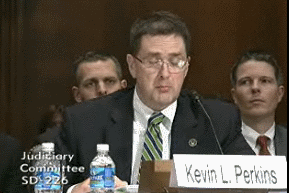
    Kevin L. Perkins of the FBI tells the Senate Judiciary Committee that the agency is investigating 1,500 cases of securities fraud and that 314 of them involve HYIP fraud in various forms.
    Kevin L. Perkins of the FBI tells the Senate Judiciary Committee that the agency is investigating 1,500 cases of securities fraud and that 314 of them involve HYIP fraud in various forms.

    And to think that only months ago — in February 2009 — various members of AdSurfDaily wrote to the Senate Judiciary Committee trying to elicit support for Ponzi schemes. The letter-writing campaign was spearheaded by “Professor” Patrick Moriarty and pushed by the Pro-AdSurfDaily Surf’s Up forum.

    But now the FBI has told the committee, led by Sen. Patrick Leahy, D.-Vermont, that it has registered a 105 percent increase in HYIP fraud and opened 314 investigations in 2009, up from 154 in 2008.

    “[M]any [had] losses exceeding $100 million,” said Kevin L. Perkins, assistant director of the FBI’s Criminal Investigations Division.

    Perkins said the probes cover the gamut — from the massive Ponzi scheme fraud of Bernard Madoff to smaller variations of the Ponzi scheme.

    “These schemes use money collected from new victims, rather than profits from an underlying business venture, to pay the high rates of return promised to earlier investors,” Perkins told the Committee.  “This arrangement gives investors the impression there is a legitimate, money-making enterprise behind the fraudster’s story; but in reality, unwitting investors are the only source of funding.”

    During his testimony, Perkins also referenced “prime-bank schemes” in which victims are told that “certain financial instruments such as notes, letters of credit, debentures, or guarantees have been issued by well-known institutions such as the World Bank, and offer a risk-free opportunity with high rates of return.”

    In August 2008, in a forfeiture complaint against the assets of AdSurfDaily and Golden Panda Ad Builder, federal prosecutors revealed that Golden Panda President Clarence Busby had been sued civilly by the SEC in the 1990s after he was implicated in three prime-bank schemes. At the same time, prosecutors revealed ASD President Andy Bowdoin had been arrested for felony securities fraud in Alabama during the same decade.

    Despite the Ponzi allegations against ASD and the histories of Bowdoin and Busby, Surf’s Up urged the Judiciary Committee to investigate the prosecutors who brought the forfeiture cases against ASD and Golden Panda in August 2008.

    “We each need to explain [to Leahy] how thousands of innocent Americans have suffered and continue to suffer because of these incredible and despicable acts” by prosecutors, Surf’s Up urged members.

    Law enforcement is investigating a stunning number of securities-fraud cases, the FBI revealed.

    “The FBI continues to aggressively investigate this criminal threat, and currently has more than 1,500 related securities fraud investigations,” Perkins said.

    Read about the Moriarty/Surf’s Up letter-writing campaign to the Senate Judiciary Committee.

  • Madoff Confessed Ponzi Scheme Year Ago Today; AdViewGlobal Prepared Ponzi Roll-Out Even As Stunned Public Watched Madoff Spectacle Unfold

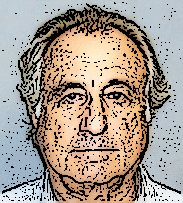
    Bernard Madoff
    Bernard Madoff

    One year ago today Bernard Madoff uttered a memorable phrase, describing his securities business economically as “one big lie” — and his Ponzi house of cards came tumbling down.

    Even as Madoff was uttering those three words to his sons and the FBI soon was to knock on his door, the insiders behind the AdViewGlobal (AVG) autosurf were busy putting together and getting ready to promote their own Ponzi scheme. For many, it would be their second — and they’d be greasing the wheels of their new Ponzi even as virtually the entire world was jeering Madoff and New Yorkers were demanding justice on the streets.

    Hundreds and hundreds of AVG promoters appear to have been slow on the Ponzi uptake, ignoring the lesson of instant villainy the Madoff case provided and seriously misreading their ability to repackage a Ponzi scheme and sell it all over again.

    Madoff was arrested Dec. 11, within 24 hours of confessing “one big lie.”  His arrest amid allegations of a $50 billion Ponzi fraud created a media spectacle. The crime was unimaginably huge. In the hours and days that followed, personal, corporate and charitable fortunes collapsed. The word “Ponzi”  instantly became associated with greed, criminality and reprehensible acts, and was burned into the public consciousness like never before.

    One place it was not used was the Unemployable Hobo Lifestyle Forum. There is a mention of the soon-to-launch AVG dated Dec. 13, 2008, two days after the arrest of Madoff, but no simultaneous reference to Madoff or the word “Ponzi.”

    “Call me if you [don’t] have [a] leader,” said Mark Simmons, the head of the forum and a witness in the Ponzi scheme case involving AdSurfDaily, a company with close ties to AVG. The headline of the thread was, “for those waiting on ADVIEWGLOBAL.”

    In the autosurf Ponzi business, the word “leader” is used to describe the people who make the most money by lining up sheep and leading them to the slaughter. In the months prior to the launch of AVG, the “leaders” had led sheep to the slaughter in ASD, Golden Panda Ad Builder, LaFuenteDinero (the “fountain of money”), MegaLido, Instant2U, Frogress, DailyProfitPond, AdGateWorld, BizAdSplash and Noobing, among others.

    The leaders still are leading the sheep to slaughter on various HYIP and autosurf Ponzi forums — even with Madoff serving a prison sentence of 150 years. They get paid a commission of 10 percent or more for leading people to the slaughter.

    Another reference to AVG appeared on Simmons’ forum Dec. 18, exactly a week after Madoff’s arrest. Some autosurf critics say the leaders are “out of touch.” Others use less-generous phrases to describe them, painting the “leaders” as the purveyors of “Kool-Aid” for consumption by the sheep.

    Some of the sheep sign up to be slaughtered over and over again. They’re sometimes also known as the “Stepfords.”

    “Our specific [AVG] group will have some additional perks that will not be tied to this and will allow you to grow exponentially and outpace everyone,” Simmons said Dec. 18 on his forum. The headline of the thread was, “STAY TUNED FOR ADVIEWGLOBAL.”

    Simmons was a former member of the AdSurfDaily autosurf, which was caught up in pre-Madoff allegations that it was a $100 million Ponzi scheme. The ASD allegations were made in August 2008, about four months before Madoff’s name and “Ponzi scheme” became household words. Simmons’ name was on ASD’s witness list for an evidentiary hearing held Sept. 30-Oct. 1, 2008.

    He never was called to the stand. U.S. District Judge Rosemary Collyer ruled Nov. 19, 2008, that ASD had not demonstrated it was a lawful business and not a Ponzi scheme. ASD had operated from the United States. Within days of the devastating ruling against ASD, word began to spread that AVG would launch and become a sort of ASD2 — only operating “offshore” from Uruguay and out the reach of U.S. authorities

    Collyer is apt to remember the ASD case for many reasons. The key ruling she made against ASD was issued on her 63rd birthday, for example.

    In the months that followed, Collyer would hear from dozens of pro se litigants who appeared to be arguing in favor of a presumptive right to operate or participate in a Ponzi scheme with no interference by the government.

    AVG’s formal launch occurred in February 2009, less than two months after the Dec. 13 reference on Simmons’ forum, less than two months after the spectacular Ponzi allegations against Madoff surfaced.

    But the autosurf’s days of having a tin ear for news and PR were far from over. Indeed, the surf that launched in the midst of the public hue and cry over Madoff’s Ponzi scheme and in the wake of Ponzi and racketeering allegations against ASD, went on to demonstrate for all time that it considered greed a virtue.

    On May 4, the same day the Obama administration announced a crackdown on offshore fraud carried out by Americans, AVG announced it had acquired a new offshore wire facility to replace one lost in March.

    “I’m asking Congress to pass some commonsense [antifraud] measures,” Obama told the American people at 11:37 a.m. on May 4.  At 5:44 p.m., a member of an AVG forum operated by some of the Mods and members of the Pro-AdSurfDaily Surf’s Up forum announced the new offshore wire facility.

    AVG collapsed less than two months later, on June 24. Five days later, on June 29, Madoff was sentenced to 150 years in prison. One day after that, on June 30, AVG’s name was mentioned in a racketeering lawsuit filed against ASD President Andy Bowdoin and ASD attorney Robert Garner.

    Some of the autosurf leaders are still leading on Internet forums, but Simmons’ Unemployable Hobo forum appears not to have had an update on any online program since September

  • AdViewGlobal Recording Suggests Member Cashed Out $10,000 Only Days After Formal Launch And That Insiders Were Awarded Bonuses; Less Than Two Weeks Later, Surf Switched To ‘Private Association’ Structure

    breakingnewsUPDATED 7:19 P.M. ET (U.S.A.) A recording posted on a public website of a Feb. 12 conference call by the AdViewGlobal (AVG) autosurf suggests an unnamed male member of the surf qualified for a $10,000 cashout within days of the company’s formal launch.

    The recording leads to questions about how a participant could qualify for a large payout so soon after launch and whether others also could have benefited from early cashouts funded by members in Ponzi scheme fashion. AVG appears to have had virtually no income streams beyond fees paid by members when it launched earlier in the month.

    AVG suspended cashouts in June, threatening media outlets and members who shared the news with lawsuits and blaming its problems on the greed of members. It later said it had been a victim of a $2.7 million theft and filed reports about the theft with law-enforcement agencies.

    The Feb. 12 call featured a giveaway of money-earning AVG page impressions to both members and their sponsors. One of the bonus-winning sponsors was identified as David Meade, whose bonus-winning enrollee came on the line and jokingly asked whether the bonus he received qualified for an additional matching bonus of 50 percent.

    AVG relentlessly pitched bonuses to enrollees and their sponsors before announcing in June that it was suspending cashouts, making an 80/20 program mandatory and exercising its version of a “rebates aren’t guaranteed” clause.

    Another sponsor who qualified for a bonus because he had enrolled a member whose name was called for a bonus was identified as Larry Alford, the husband of Barb Alford, a Moderator at the Pro-AdSurfDaily Surf’s Up forum. Yet another member whose name was called for a bonus was Joey Shiver, the brother of Judy Harris, identified during the summer as one of AVG’s owners.

    Meanwhile, the call highlighted AVG’s purported “offshore” location in Uruguay, stressing that the company planned to fly high-quality servers to Uruguay on a date uncertain after the call was held.

    Web records show AVG’s servers resolved to Panama, suggesting the company never completed installation of servers in Uruguay. AVG had been collecting money for weeks at the time of the Feb. 12 call, which leads to questions about whether the company was selling unregistered securities from inside the United States or selling unregistered securities illegally to U.S. residents from offshore servers, all while engaging in wire fraud and acts of money-laundering.

    The conference call, hosted by Terralynn Hoy, a Moderator at both the Pro-AdSurfDaily Surf’s Up forum and a ning.com forum set up to promote AVG, did not disclose how the member amassed a large sum in only days and qualified for a cashout. But another participant in the call announced that the man excitedly expected to receive a check for $10,000.

    Neither Hoy nor any other AVG official or representative who participated in the call referenced a racketeering lawsuit that had been filed less than a month earlier against ASD President Andy Bowdoin and ASD attorney Robert Garner. At the same time, no official or representative in the call referenced a second forfeiture complaint that had been filed against ASD-connected assets in December 2008, a month after Surf’s Up received ASD’s official endorsement.

    In August 2008, prosecutors accused both ASD and Golden Panda Ad Builder of not disclosing information members needed to make informed decisions about joining the companies. The allegations were spelled out in a forfeiture complaint formally filed Aug. 5, 2008.

    Among the assertions were that Bowdoin did not disclose his arrest in a felony securities case in the 1990s, and that Golden Panda did not immediately disclose an SEC action against its president, Clarence Busby, in the 1990s. ASD members later said Bowdoin was the silent head of AVG, which began to solicit money in December 2008, a month after a major court ruling went against ASD.

    News about the December forfeiture complaint, which painted a jaw-dropping picture of insider dealings, special favors, a “silent” ASD partner, people getting paid large sums for doing virtually nothing and a claim that Russian hackers stole more than $1 million, broke on Jan. 15.

    The AVG conference call, dubbed the “first” official call, was conducted Feb. 12, about 10 days after AVG’s formal launch and within 30 days of the revelation that the government had filed the December forfeiture complaint and identified members of Bowdoin’s family as beneficiaries of ASD’s illegal conduct.

    Judy Harris was among those the government identified in the filing, as were her husband, George Harris, and his mother, Edna Faye Bowdoin. Edna Faye Bowdoin is Andy Bowdoin’s wife.

    Two weeks after the Feb. 12 conference call, on Feb. 26, AVG announced it was shifting to a “private association” structure. One day prior, on Feb. 25, Bowdoin signed the first of several sworn court documents as a pro se litigant in the ASD case, attempting to set aside the forfeiture of tens of millions of dollars and reverse a decision he made in January to surrender his claims to the money, which had been seized by the government in August 2008 from his 10 bank accounts.

    Less than a month after Bowdoin signed the court document, AVG announced the resignation of Chief Executive Officer Gary Talbert, a former ASD executive. On March 23, AVG announced its bank account had been suspended, blaming the suspension on members who wired too many transactions in excess of $9,500.

    Talbert was a participant in the Feb. 12 conference call. He was introduced by Hoy. Talbert, in turn, passed the the call back to Hoy, who then introduced a person identified as marketing consultant Kathy Robertson. Robertson made the claim about the $10,000 check.

    “I just talked to a friend tonight,” Robertson said in the call. “He’s cashing out and he’s gonna get a $10,000 check into his bank account. He’s more excited than he’s ever been.”

    Robertson urged AVG members to take notes of her remarks, according to the recording.

    “Many of you have wondered, ‘Are we a United States’ business or are we another country[‘s] business?’” Robertson said in the recording. “I gotta tell you we’re based in Uruguay. We’re definitely an offshore business, and we’ll be moving very robust servers — we’ll actually be flying them on a plane to land in Uruguay. So, even the servers that host all of the websites are going to be offshore, so go ahead and write that down as a note. We are truly an offshore business.”

    Robertson said AVG members should “feel secure” in the knowledge the company was operating offshore. She did not explain how the purported offshore venue made AVG’s venture, which targeted U.S. residents and former ASD members, legal. Robertson acknowledged in the recording that AVG had gotten off to a rocky start and that some members who could not fund accounts had had a disappointing experience.

    But she urged members to look to the future and see a well-honed enterprise capable of producing a seamless experience for huge numbers of participants.

    Federal prosecutors said ASD was operating a $100 million Ponzi scheme from inside the United States, while engaging in the sale of unregistered securities to U.S. residents and committing acts of wire fraud and money-laundering.

    Later in the call, during the page-impression giveaway, Meade came on the line to accept his bonus for sponsoring a member whose name was called for a bonus.

    “Thanks a million. Appreciate it,” Meade said.

    Less than two weeks after the Feb. 12 conference call, reports circulated among ASD members that the U.S. Secret Service had seized the bank accounts of unidentified ASD members. AVG announced Feb. 26 that it was switching to a “private association” structure after consulting with a company known as Pro Advocate Group.

    Pro Advocate Group is associated with Karl Dahlstrom, a convicted felon who served time in federal prison in a case involving securities fraud.

    Listen to the recording.

  • ‘Egg’-Themed HYIP Domains Pitched By Surf’s Up Poster Registered In Last Name Of Man Dubbed A ‘Co-Conspirator’ In Scheme To Defraud Prepaid Wireless Company; Government Of Belize Issued Warning About HYIP Site

    UPDATED 2:22 P.M. ET (U.S.A.) A poster using the handle “joe” at the Pro-AdSurfDaily Surf’s Up forum advertised four egg-themed domain names that redirected to four high-yield investment programs yesterday, saying in all-caps, “ALL MY EGGS ARE NOT IN ONE BASKET.

    “I MAKE $2000.00 A WEEK.”

    It is unclear if the poster has a license to sell securities or act as an investment dealer or broker. The domains to which the .info domains redirected were for programs titled “Gold Nugget Invest” (7.5 percent a week); “Genius Funds” (6.5 percent a week); “Cash Tanker” (2 percent a day); and “Saza Investments” (9 percent a week).

    The domains — all of which used .info extensions, the word “egg” and a numeral in their URLs — are registered to a man with the last name of  “Stablein” in Erie, Pa. The spelling of the owner’s first name in domain-registration data was “Jeffrery.”

    An Erie man named “Jeffrey Stablein” — note the slightly different spelling of the first name from the domain-registration data — was sued in U.S. District Court for the Western District of Pennsylvania in June and identified by attorneys as a co-conspirator in a scheme to defraud TracFone Wireless Inc., a prepaid cell-phone provider.

    The Erie street address associated with Stablein in the TracFone lawsuit is the same address listed in registration data for the egg-themed .info domains. Stablein was enjoined by a federal judge from a practice TracFone attorneys described as “cell-phone trafficking.”

    Cell-phone trafficking involves the “unauthorized resale and hacking” of prepaid mobile phones, TracFone attorneys said. Future violations by Stablein could result in a $5 million judgment being enforced against Stablein, according to court filings.

    Attorneys described how the scheme works after a buyer acquires prepaid phones in volume.

    “The phones are then passed to middlemen who alter or remove the prepaid software and resell the altered phones as new, often in counterfeit packaging, at a significant profit to unsuspecting customers domestically and abroad in Latin America, Asia and the Middle East,” according to attorneys James B. Baldinger and Steven J. Brodie of the Carlton Fields law firm.

    In September, U.S. District Judge Sean J. McLaughlin handed down a stipulated judgment against Stablein and his Erie-based firm, 1st Premier Communications, banning them “from continuing to engage in the bulk purchase, sale, or unlocking/reflashing of TracFone’s wireless phones,” the attorneys said in a news release.

    TracFone aggressively litigates against cell-phone traffickers, according to the company.

    In 2008, Muhammad Mubashir, 28, of Sugar Land, Tex., was sentenced to 57 months in federal prison for trafficking in cell phones.

    “TracFone will continue to aggressively pursue those who participate in prepaid mobile phone trafficking because it undermines our ability to provide affordable wireless phone service to our customers,” said F.J. Pollak, president and CEO of TracFone Wireless, in a statement.

    The U.S. Customs Service seized a shipment of 1,300 TracFones that Mubashir was exporting to a known trafficker in Hong Kong, the company said. TracFone obtained documents proving Mubashir sold approximately 9,000 TracFones, representing more than $1 million in losses to the company.

    “Schemes like those organized by Mubashir exist across the country and involve groups of ‘runners’ who purchase prepaid mobile phones from major retail outlets,” TracFone said. “The phones are then passed to middlemen who alter or remove the prepaid software and resell the altered phones as ‘new,’ often in counterfeit packaging, at a significant profit to unsuspecting customers domestically and abroad in Latin America, Asia and the Middle East.”

    Some Surf’s Up posters criticized the post by “joe,” saying it was in poor taste given the serious allegations against AdSurfDaily. Tens of millions of dollars were seized from ASD President Andy Bowdoin in August 2008, amid allegations of selling unregistered securities and operating a $100 million Ponzi scheme.

    Despite the allegations, some Surf’s Up posters continued to pitch autosurfs and HYIP programs, often using phrases such as “offshore” or “I got paid” as evidence of legitimacy.

    One Surf’s Up poster agreed with “joe” that the programs he advertised by using the egg-themed URLs that redirected to HYIP sites were excellent.

    “Your intentions are good but you are dead wrong about those particular four programs!” a Surf’s Up member exclaimed in a post directed at a member who had been critical of “joe’s” post advertising the HYIP programs.

    “I also make a lot of money from those four and your remarks tell me you don’t know anything about them…..they are very reputable [companies] who have been around for years….and the money is NOT made from ‘new’ people’s money….google them and look at various forums and see what others have to say about them….I don’t even know Joe, but I can vouch for the programs!”

    The government of Belize issued a warning Nov. 12 about the Gold Nugget Invest HYIP advertised by “joe” on Surf’s Up.

    Surf’s Up eventually deleted “joe’s” egg-themed HYIP thread.

    It is not clear if “joe” is Jeffrey Stablein, but the stipulated judgment entry in the TracFone case includes Stablein’s signature and the same address used in the domain-registration data for the egg-themed HYIP domains.

    Read the lawsuit against Stablein.

    Read a document that shows that a Stablein street address in the lawsuit is the same Erie address used in the domain registration data for the egg-themed HYIP domains.