Tag: Bernard Madoff

  • BULLETIN: Ponzi Swindler And Racketeer Scott Rothstein Sentenced To 50 Years In Federal Prison For $1.2 Billion Scam; Schemer Forged Judges’ Signatures, Threatened Reporter

    BULLETIN: Scott Rothstein, the disbarred Florida lawyer who sold interests in nonexistent legal settlements, forged the signatures of federal judges on court documents to hoodwink investors and keep money flowing to his $1.2 billion Ponzi scheme and threatened to sue a reporter asking tough questions, has been sentenced to 50 years in federal prison.

    Rothstein, one day shy of his 48th birthday, was sentenced by U.S. District Judge James Cohn.

    His lawyer had sought a 30-year sentence. Prosecutors recommended 40 years, based on Rothstein’s post-arrest cooperation. Rothstein faced a maximum sentence of 100 years.

    By comparison, infamous Wall Street swindler Bernard Madoff was sentenced to 150 years for his $65 billion fraud. Tom Petters, who hatched a massive Ponzi scheme involving bogus sales of merchandise to prominent retailers, was sentenced to 50 years for his $3.65 billion fraud.

    Guessing the length of Rothstein’s sentence had become sport on the Internet, with people from all over the world advancing their notions.

    In the end, Cohn said Rothstein, who also threatened to sue at least one reporter who was in the process of exposing the fraud, deserved 50 years. The scheme destroyed the Rothstein Rosenfeldt Adler law firm in Fort Lauderdale and has subjected multiple people to investigation, indictments and lawsuits.

    Rothstein pleaded for mercy, saying he was a “changed man” who had contemplated suicide while operating the scheme but ultimately returned from Morocco to face the charges and assist prosecutors in their efforts to untangle the colossal mess.

    The elaborate Ponzi fraud included bogus legal settlements, forged court documents, fraudulent promissory notes, fraudulent campaign donations and gratuities paid to “high ranking members of police agencies,” prosecutors said.

    Rothstein forfeited $1.2 billion, 24 pieces of real estate, luxury cars such as Bugattis, Rolls-Royces and Cadillacs, yachts, shares in businesses and more.

    Here are snippets from Rothstein’s letter to Cohn that asked for fairness and mercy (italics added):

  • BULLETIN: Another Spectacular Florida Ponzi Case Emerging; Nevin K. Shapiro Charged Criminally, Civilly In Alleged $900 Million Fraud

    BULLETIN: Nevin K. Shapiro, the founder and president of Capitol Investments USA Inc., surrendered to authorities this morning after being charged both criminally and civilly in an alleged $900 million Ponzi and fraud scheme in south Florida and elsewhere, the SEC said.

    Shapiro, 41, is a prominent Miami Beach businessman and philanthropist in the wholesale grocery business. He is expected to make a court appearance in New Jersey today.

    Most of Shapiro’s investors live in Florida or Indiana, according to the SEC complaint. Some diverted funds from their IRA’s to earn profits by investing with the grocery company, but Shapiro conducted virtually no meaningful business after 2004 and simply propped up his grocery business with a shell game that raised $880 million from investors between 2005 and 2009 before the scheme collapsed, the SEC charged.

    “Capitol’s sales were less than $300,000 in 2005 and 2006, and it had no sales from 2007 through 2009,” the SEC charged.

    “Shapiro lured investors by falsely touting Capitol’s securities as a risk-free investment with extraordinarily high returns,” said Eric I. Bustillo, director of the SEC’s Miami Regional Office. “He used his prominence and prestige to gain investors’ trust in funding Capitol’s grocery diverting business, but behind their backs he diverted their money to enrich himself.”

    Grocery-diverters buy merchandise in one market and sell it in another at a higher price. Shapiro’s company, however, began operating a Ponzi scheme in 2005 after operating at a loss in 2004, the SEC charged.

    The SEC said Shapiro diverted $38 million “to enrich himself and finance outside business activities unrelated to the grocery business, including a sport representation business and real estate ventures.

    “His lavish lifestyle includes a $5 million home in Miami Beach, a $1 million boat, luxury cars, expensive clothes, high-stakes gambling, and season tickets to premium sporting events,” the SEC said. “Shapiro additionally tapped approximately $13 million of investor funds to pay large undisclosed commissions to individuals who attracted other investors.”

    A girlfriend received goods totaling $116,000 that were charged to Capitol’s American Express Black Card, and Shapiro himself made personal purchases of about $524,000 on the card, the SEC charged.

    All in all, the SEC said, the scheme was “a $900 million offering fraud and Ponzi scheme.” Investors were offered returns of 26 percent annually, backed by bogus claims that “Capitol’s purchase contracts and accounts receivable secured their investments.”

    Earlier this year, U.S. Attorney General Eric Holder said south Florida was “ground zero” for Ponzi schemes, noting that many of Bernard Madoff’s victims lived in the region. The government still is in the process of unwinding Madoff’s $65 billion fraud and Scott Rothstein’s $1.2 billion fraud.

    Smaller — though still massive Ponzi frauds — recently have occurred in the state, and Shapiro’s alleged $900 million fraud now is included among them.

    “To those who see the victimization of others as an avenue to wealth, take notice,” Holder warned in a January speech in Florida. “If you fabricate a financial statement, if you propagate an investment scheme, if you are complicit in an act of financial fraud, you are writing your ticket to jail.”

    The FBI and IRS also are involved in the Shapiro probe, the SEC said.

    “By late 2004, Capitol was operating at a loss,” the SEC charged. “From 2005 though late 2009, Capitol had almost no business operations. To hide this from investors, Shapiro merely repaid earlier investors with approximately $769 million collected from new investors in typical Ponzi scheme fashion.”

    The agency said “Capitol has never registered an offering or class of securities under the Securities Act or the Exchange Act,” and Shapiro was charged with securities fraud.

    In the past 48 hours, law enforcement and regulators have filed complaints in cases in Florida and New York that allege frauds totaling about $1 billion.

  • Ponzi Guilty Pleas In New York, Tennessee; New Ponzi Case Filed By CFTC In Florida; Relief Defendant Misspelled Its Own Company Name

    EDITOR’S NOTE: There was significant action in Ponzi cases today. Earlier we reported on the guilty plea of Trevor Cook in Minnesota and the issuance of a bench warrant in South Carolina for Michael Derrick Peninger. The brief below summarizes action in the Ponzi and affinity-fraud case case of Steven Byers in New York, the Ponzi case of Barron A. Mathis in Tennessee, and new allegations of a Forex Ponzi scheme against Claudio Aliaga in Florida.

    New York: Steven Byers, 47, of Oak Brook, Ill., pleaded guilty today to felony counts of conspiracy and wire fraud in a Ponzi case said to involve $255 million. U.S. District Judge Denny Chin, who sentenced Bernard Madoff to 150 years in prison, is the presiding judge in the case. Byers will be sentenced in September. He faces a maximum of 25 years in prison.

    Byers was the former president and chief executive officer WexTrust Capital LLC, a private-equity firm. Orthodox Jews were targeted in the scheme, which involved real estate and specialty finance.

    “From at least 2003, Byers and others raised money from investors pursuant to private placement offerings and then used material amounts of that money for other purposes, and did not disclose their diversion of funds to investors,” prosecutors said. “In one such private placement, Byers and others raised approximately $9.2 million in investor funds by representing that the funds would be used to purchase and operate seven commercial properties that were leased to the United States General Services Administration (GSA).

    “According to the GSA private placement memorandum issued to investors by WexTrust Capital,” prosecutors said, “the $9.2 million raised from investors, together with a mortgage of approximately $21 million, would be used to purchase the seven GSA properties and cover related acquisition expenses.

    “The seven GSA properties, however, were never purchased. Instead, virtually all of the funds raised from investors to purchase the properties were diverted by Byers and others to other purposes, but investors were never informed that the funds were used for any purpose other than to purchase and operate the seven GSA properties. Byers and others later agreed to make up a story that they would then tell the GSA investors regarding what happened to their investment,” prosecutors said.

    The guilty plea was entered as a result of a plea deal with prosecutors. Byers “agreed to forfeit $9.2 million and is subject to mandatory restitution and faces criminal fines up to twice the gross gain or loss derived from the offense,” prosecutors said.

    Tennessee: In Nashville, Barron A. Mathis, 29, pleaded guilty to wire fraud. He formerly was vice president and portfolio manager for J.C. Reed & Co., a failed financial services company headquartered in Franklin.

    Mathis sold his Ponzi and fraud scheme to friends, acquaintances and clients, collecting $11 million in the process, prosecutors said. Most of the investors were elderly, inexperienced traders.

    “Cases like these are egregious examples of predators who target vulnerable and innocent victims through false and fraudulent business practices,” said U. S. Attorney Edward M. Yarbrough. “By his own admission, Mathis encouraged people to invest by falsely promising security, growth and inflated returns on their money, but instead the investors lost their savings as part of an elaborate fraud scheme.”

    U.S. District Judge Robert L. Echols will sentence Mathis. A sentencing date has not been set.

    Florida: Claudio Aliaga, of Davie, has been charged civilly by the CFTC with operating a commodity-pool and Forex Ponzi scheme that gathered $4.5 million.

    Also charged was Aliaga’s company, CMA Capital Management LLC of Miami Lakes.

    Named relief defendants were Aliaga’s wife, Betty Aliaga, and a company known as CMA Global Investement (sic) Fund LLC. The CFTC noted that the company misspelled its own name and “received funds as a result of defendants’ fraudulent conduct.”

    U.S. District Judge Marcia G. Cooke ordered an asset freeze.

  • Another Fraud Case In Minnesota: Renee Marie Brown Accused By SEC Of Starting ‘Sham’ Investment Fund Known As ‘X’

    UPDATED 7:52 A.M. EDT (April 13, U.S.A.) On the very day Tom Petters was sentenced in Minnesota to 50 years in prison for operating a colossal Ponzi scheme, a federal judge froze the assets of Renee Marie Brown after the SEC accused her of ripping off clients by persuading them to invest in a mysterious vehicle known as “Fund X.”

    U.S. District Judge Donovan W. Frank issued a temporary restraining order against Brown and her company, Investors Income Fund X LLC. The order was issued April 8.

    Brown, 46, of Golden Valley, was accused of operating a “sham” fund into which investors plowed more than $1.1 million between July 2009 and March 2010.

    “Brown told her investors that Fund X is a ‘bond fund’ with fixed annual returns of 8% or 9%,” the SEC said. “[S]he distributed fictitious ‘returns’ to investors, furthering the fiction that Fund X was a legitimate and successful investment opportunity.”

    But Brown “misappropriated most of the $1.1 million she raised from investors to, among other things, purchase a condominium for herself and build . . . office space for her new business,” the SEC said.

    Investors Income Fund X LLC was registered as a corporation in South Dakota, the SEC said.

    “Unbeknownst to her victims, Fund X is a sham — Brown’s alter ego,” the SEC said.

    The case features allegations of siphoning, forgery, cherry-picking clients of Brown’s former employer and issuing fraudulent “returns” in Bernard Madoff-like fashion. It also occurred against the backdrop of March 17 Congressional testimony by FBI Director Robert Mueller III that U.S. companies increasingly were relying on shell corporations to commit fraud.

    Minnesota Fraud Cases

    In recent months, investigators and prosecutors in Minnesota have opened up a number of major fraud probes. The combined cases are alleged to have drained hundreds of millions of dollars from investors. In some instances, prosecutors and regulators have asserted that companies used multiple names to commit fraud.

    Petters was convicted last week of presiding over that was described as the largest financial-fraud case in Minnesota history: a $3.65 billion Ponzi scheme.

    Petters displayed “stunning criminality,” prosecutors said. One of the victims wrote, “Our society, unfortunately, is becoming plagued with too many people like this, and like Bernard Madoff. Tom Petters needs to learn that there are severe consequences for his incomprehensible behavior.”

    Meanwhile, the SEC, the CFTC, the FBI, prosecutors and a court-appointed receiver are poring over records to reverse-engineer the alleged Trevor Cook/Pat Kiley Ponzi scheme. Court records suggest multiple company names were involved and that the scheme involved at least $190 million and caused investor losses of at least $139 million.

    Money was moved “all over the world,” according to court filings.

    Cook and Kiley were sued by the SEC and the CFTC in November. Cook was charged criminally last month. Prosecutors said he was “aided and abetted by others.” In this document, the National Futures Association, which also filed an action that references Cook, asserted that $75 million from a purported Swiss fund may have been directed at a mysterious investor known only as “Fased.”

    The purported payment occurred while Cook, a Minnesota resident, allegedly was managing money for a Canadian company known as KINGZ Capital Management Corp. KINGZ name also has been linked to an autosurf known as AdViewGlobal (AVG), which had close ties to an autosurf known as AdSurfDaily (ASD).

    On May 4, 2009 — on the same day the Obama administration announced a crackdown on international financial fraud — AVG announced that KINGZ had become its facilitator for international wire transfers. KINGZ denied the assertion, saying it believed it had been targeted in a scam. The company painted the picture that AVG was attempting to route money to itself through a U.S. shell company.

    AVG purportedly operated from Uruguay.

    Florida-based ASD, which members said was popular in Minnesota, was implicated in August 2008 by the Secret Service in a Ponzi scheme. A federal judge has issued orders of forfeiture totaling more than $80 million in the ASD case. ASD used at least three names, according to records: AdSurfDaily, AdSalesDaily, and ASD Cash Generator.

    Prosecutors also linked ASD to at least two other autosurfs: LaFuenteDinero (the “fountain of money”) and Golden Panda Ad Builder, the so-called “Chinese” option for ASD members.

    In February, the U.S. Secret Service alleged that Minnesota resident Steve Renner was operating a Ponzi scheme through a company known as INetGlobal and companies related to the firm. The scheme, the Secret Service said, largely targeted Chinese members who may have little or no facility in English.

    Renner denies the allegations. Prosecutors described the case as a “major fraud and money laundering investigation,” saying INetGlobal came to life during a period in which federal agents were seizing tens of millions of dollars in the ASD case amid Ponzi, wire-fraud and money-laundering assertions.

    An ASD member introduced an undercover Secret Service agent to INetGlobal, the agency said in court filings.

    Other recent fraud cases in Minnesota include the Gerard Cellette Jr. Ponzi case ($53 million); the Charles “Chuck” E. Hays case ($20 million); and the Kalin Thanh Dao case (up to $10 million).

  • Sean Healy Sentenced To Nearly 16 Years, Ordered To Pay $16.7 Million In Ponzi Case; Meanwhile, Trevor Cook Reportedly Has Plea Deal

    A federal judge has ordered a Florida man to spend nearly 16 years in prison and pay $16.7 million in restitution for fleecing investors in a Ponzi scheme.

    Sean Healy, 39, of Weston, scammed dozens of investors in Pennsylvania. He went on to live in the lap of luxury in Florida, acquiring a $2.4 million waterfront home, a Bentley, several Ferraris, Lamborghinis and Porsches worth more than $2.3 million and jewelry worth $1.5 million.

    Meanwhile, Trevor Cook, charged criminally with mail fraud and tax evasion in a separate, $190 million Ponzi case in Minnesota, has struck a deal with prosecutors, the AP is reporting. Details about the deal are unclear, but the AP, citing comments by Bill Mauzy, Cook’s attorney, reported that Cook will plead guilty in the coming weeks.

    Healy became infamous in Florida, and was described as a smaller version of  former Wall Street titan Bernard Madoff and former Fort Lauderdale attorney Scott Rothstein. He was charged in a 55-count indictment unsealed in Pennsylvania last year with multiple counts of wire fraud, mail fraud, money laundering and obstruction of justice.

    Initially Healy tried to sandbag prosecutors by providing “phony bank statements and phony trading records” to thwart a grand-jury probe, but the government didn’t buy it.

    “When the authentic records were obtained, they revealed that Healy had simply spent the money on his extravagant lifestyle and used some of it to pay back earlier investors who he defrauded between 2003 and 2008,” prosecutors said.

    Healy was sued separately by the SEC and the CFTC, which said he used investor funds to purchase gold bullion and “to lease a luxury suite at Miami’s BankAtlantic Arena.”

    For its part, the SEC said the sky was the limit for Healy.

    “Rather than investing the money as he promised, Sean Healy used investor funds to finance an extravagant lifestyle for himself and his family,” the SEC said.

  • FBI CHIEF: ‘Major Threats’ Emerging From ‘Stored Value’ Debit Cards And ‘Shell Corporations’; ‘Shadow Banking System’ Has Exploited Vulnerabilities

    EDITOR’S NOTE: Autosurf or HYIP promoter? White-collar fraudster of another stripe? Fan of “stored value” debit devices used in the context of well-publicized,  fraudulent business models? Owner of a “shell” company used to disguise the ownership of funds? Figure you’re smarter than the cops and that you’ve perfected your form of deceit as you pocket commissions and other payments based on that deceit?

    The director of the Federal Bureau of Investigation was talking about you in his testimony Wednesday before the House Committee on Appropriations, Subcommittee on Commerce, Justice, Science, and Related Agencies. He said you were making it harder for the FBI to do its job and making it easier on people who might want to do harm to the country’s financial system and the country itself.

    He didn’t mention your name, of course. But Robert Mueller III did ask for an additional budget outlay of $306.6 million next year as a means of neutralizing you before you could cause any more damage to the financial system and the national security of the United States.

    And here, all along, you thought he didn’t know, that the agents who serve under him didn’t know.

    They know. Call it anything you like — an “advertising” business, a financial “game,” a nontraditional investment that yields a high return, a new form of “gambling” or “arbitrage,” a multifaceted, multilevel-marketing program that pays a return based on visiting websites and recruiting other participants, a program for “good Christians” — and they still know.

    Tell your prospects that the government doesn’t understand either the program or the technology in use — and they still know.

    The reason they know is because they’ve seen it all before, watched it evolve, watched the changing explanations and terminology, watched the testimonials, watched the attempts to purify the “opportunities.” What they didn’t know, perhaps, was how devoted you were to your own criminality, how willing you were to put lipstick on a pig, how willing you were to be willfully blind to the obvious financial and security dangers to your neighbors because the money was just too good.

    They know now, though — and they also know about your criminal cousins who conduct equally vile businesses and perhaps have ties to the Mob and other groups of organized criminals, perhaps even terrorist organizations.

    Quick! Name your autosurfing or HYIP neighbor! What does he do at 3 a.m., when you’re sleeping? Are your commissions worth the risk he potentially poses to the security of the banking system and to the United States itself? What if he’s a [fill in the blank]? What if he’s amassing money to buy [fill in the blank?] What if he’s using the ATM machine to [fill in the blank?]

    Is the Cadillac you bought with commissions from a [fill in the bank] worth it? Will it be worth it when it gets seized as the proceeds of a criminal enterprise — and your neighbors wonder aloud how you ever became involved in a criminal enterprise? Will it ring hollow when you try to explain that you didn’t know you were involved in a criminal enterprise — or will it look like an attempt to mask your criminality?

    Mueller proposed an additional $232.8 million for salaries and expenses and $73.9 million for construction. If approved, the outlay would create 812 new positions, including 276 special agents, 187 intelligence analysts and 349 professional staff.

    Why is the agency seeking a larger outlay? Because the “additional resources will allow the FBI to improve its capacities to address threats in the priority areas of terrorism, computer intrusions, weapons of mass destruction, foreign counterintelligence, white collar crime, violent crime and gangs, child exploitation, and organized crime. Also included in this request is funding for necessary organizational operational support and infrastructure requirements; without such funding, a threat or crime problem cannot be comprehensively addressed.”

    The FBI, Mueller said, “saw an unprecedented rise in the identification of Ponzi and other high yield investment fraud schemes, many of which each involve thousands of victims and staggering losses — some in the billions of dollars.”

    New threats such as “stock market manipulation via cyber intrusion” also are emerging, Mueller said.

    Here, below, is the verbatim statement of Mueller when he was talking about you and other fraudsters. Note that he described you as a criminal, not a vastly misunderstood business person in an exciting, new arena that only few people understand. We have added the emphasis . . .
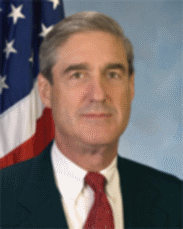
    Robert Mueller III“Money laundering allows criminals to infuse illegal money into the stream of commerce, thus manipulating financial institutions to facilitate the concealing of criminal proceeds; this provides the criminals with unwarranted economic power.

    “The FBI investigates money laundering cases by identifying the process by which criminals conceal or disguise the proceeds of their crimes or convert those proceeds into goods and services. The major threats in this area stem from emerging technologies, such as stored value devices, as well as from shell corporations, which are used to conceal the ownership of funds being moved through financial institutions and international commerce.

    “Recent money laundering investigations have revealed a trend on the part of criminals to use stored value devices, such as pre-paid gift cards and reloadable debit cards, in order to move criminal proceeds. This has created a “shadow” banking system, allowing criminals to exploit existing vulnerabilities in the reporting requirements that are imposed on financial institutions and international travelers.

    “This has impacted our ability to gather real time financial intelligence, which is ordinarily available through Bank Secrecy Act filings. Law enforcement relies on this intelligence to identify potential money launderers and terrorist financiers by spotting patterns in the transactions conducted by them.

    “The void caused by the largely unregulated stored value card industry deprives us of the means to collect this vital intelligence. Moreover, stored value cards are often used to facilitate identity theft. For example, a criminal who successfully infiltrates a bank account can easily purchase stored value cards and then spend or sell them. This readily available outlet makes it much more unlikely that the stolen funds will ever be recovered, thus costing financial institutions and their insurers billions of dollars each year.”

    Here is another snippet from Mueller talking about you . . .

    “The FBI focuses its efforts in the securities fraud arena on schemes involving high yield investment fraud (to include Ponzi schemes), market manipulation, and commodities fraud. Due to the recent financial crisis, the FBI saw an unprecedented rise in the identification of Ponzi and other high yield investment fraud schemes, many of which each involve thousands of victims and staggering losses — some in the billions of dollars.

    “With this trend and the development of new schemes, such as stock market manipulation via cyber intrusion, securities fraud is on the rise. Over the last five years, securities fraud investigations have increased by 33 percent.”

    We’ll close this column with a question or two for you: Did you really think that agencies such as the FBI and the U.S. Secret Service were going to sit back and watch you do this forever?

    Did you really think that you had no exposure as a promoter because you always could blame it on your upline and engage in willful blindness as you proceeded from program to program to program, dragging your downline with you from pig to pig to pig as you demonstrated your relentless willingness to paint with lipstick?

    Final note: They also know that some of you are penny-stock manipulators, tax-deniers, “sovereigns” and underground “credit-repair” specialists. Just a guess on our part, but we figure Andy Bowdoin’s lasting legacy to the “industry” will be as the man responsible for its long-overdue destruction.

    Records show that Bowdoin formed company after company, established corporate shells potentially with co-conspirators,  and that ASD and other knockoff autosurfs used “stored value” debit cards, unregulated or lightly regulated payment processors and money-services businesses, and other means to immerse themselves in the shadow banking system.

    The destruction of these miserable and dangerous “industries” is not going to happen overnight — but it is happening. The FBI, the U.S. Secret Service, the Justice Department, the SEC, the CFTC, the FTC, the U.S. Postal Inspection Service, the IRS and other agencies at the federal, state and local levels are going to make it happen.

    It’s going to happen because it has to happen. There never has been a worse time to be a white-collar criminal. The public at large wants to put you in jail and will not turn you into a folk hero as it did for Bonnie and Clyde and John Dillinger.

    You remind the public of Bernard Madoff, and it — the “it” being comprised of the vast majority of Americans and citizens of other countries who celebrate common decency and support the rule of law — simply is not willing to cut you any slack when you’re picking the pockets of your neighbors or the fellow congregants at your place of worship.

    Indeed, the public has seen all it is willing to take, and could not care less that you got your money without the benefit of a gun.  To the public, you’re worse than Bonnie and Clyde, worse than Dillinger himself, who robbed in the plain light of day.

    Robert Mueller wants to hire 276 more G-men and G-women  and 187 intelligence analysts — just to come after you and your criminal cousins.

  • ALERT: International Con Artists Target Madoff Victims; Regulatory Agencies, Receiver In Cook/Kiley Ponzi Case Go On Guard For Copycats

    An individual or group of individuals believed to be operating internationally created a website that mimicked the website of the U.S. Securities Investor Protection Corp. (SIPC) “in an apparent attempt to target [Bernard] Madoff victims” in a fraud scheme, SIPC said.

    SIPC and the SEC issued warnings immediately, as did the court-appointed receiver in the alleged Trevor Cook/Pat Kiley Ponzi scheme in Minnesota. There is no suggestion that a similar effort is under way by con artists to fleece Cook/Kiley investors, but R.J. Zayed, the receiver in the Cook/Kiley case brought by the SEC and the CFTC, urged Cook/Kiley investors to pay attention.

    “You should use caution when giving personal information to third parties,” Zayed said on the receivership website. “Before giving anyone your information you should verify that the agency you are communicating with exists and that the individual (or system) purporting to represent that agency actually does so.”

    SIPC maintains a special reserve fund mandated by Congress to protect the customers of insolvent brokerage firms such as Madoff’s. A scam site appeared online that used SIPC’s initials in its name, preceded by the letter “I” and a hypen, to form the domain name “I-SIPC.com.”

    The site purported to be the “International Securities Investor Protection Corporation.”

    Visitors to the bogus domain were told that the purported organization “collaborated with Interpol to recover $1.3 billion in Madoff money from a hideout in Malaysia,” SIPC said.

    Meanwhile, visitors were shown “a photo of a huge stack of U.S. currency,” SIPC said, noting a bogus “testimonial” from a purported Madoff victim who was happy with the fraudulent entity appeared on the site.

    The I-SIPC.com domain listed a registration address in Nigeria and was registered on Aug. 20, 2009, according to the registration data. It is unclear if the site was registered by a Nigerian or a person posing as a Nigerian. The site appears to be using shared hosting with 597 other domains on the same server, according to web records.

    Nigeria has an international reputation for online fraud, and some scammers — recognizing Nigeria’s reputation — have posed as Nigerians to perpetrate fraud and to cover their tracks. Such scammers could be located anywhere in the world.

    For its part, the SEC called the I-SIPC.com site a “fictitious entity.”

    “The ‘ISIPC’ Web site bears a certain likeness to the Securities Investor Protection Corporation’s (SIPC) Web site, mimicking its look, feel, and content in an attempt to achieve an aura of authenticity with Madoff victims,” the SEC said. “The ‘ISPIC’ Web site claims to partner with several governments including the United States, and links to actual government Web sites to signify an affiliation. ‘ISIPC’ also falsely claims to be sponsored by the United Nations, the International Monetary Fund, and the World Bank.”

    SIPC said it was investigating misuse of its trademark and “will seek to have the violator prosecuted to the extent the law allows.”

    “We know from information provided to us by individuals that this bogus group is already attempting to obtain funds and confidential financial information from investors in the U.S.,” said SIPC President Stephen Harbeck.

    “SIPC wants to be as clear as possible that Madoff victims and other investors should not share any personal financial information via this Web site or rely upon it as an information source. We intend to use every available means to shut down this illicit operation.”

    The bogus site now is loading a message that says, “THIS SITE IS TEMPORALLY CLOSED.”

    “Investors who lose money in widely publicized schemes are often targeted by con artists looking to cash in on the victim’s desire to recover losses,” said Lori Schock, director of the SEC’s Office of Investor Education and Advocacy. “Victims of fraudulent schemes should be aware that such refund schemes commonly exist, and can be perpetrated through copycat Web sites that appear similar to those of actual regulators or other organizations.”

  • POLL: Are The Robbers Smarter Than The Cops? (Sidenote: Are You Ready For A Ponzi Prime-Time Drama On Cable?)

    Our new poll asks a simple question: “Is The Average Autosurf/HYIP Promoter Smarter Than The Average FBI Agent, Secret Service Agent, Postal Inspector, IRS Investigator Or SEC/CFTC Investigator?”

    You may vote only once. There is an option of “Other” in this poll if you don’t want to limit yourself to a “Yes” or “No” answer.

    This poll was sparked by comments we’ve read on the Ponzi boards in recent days. It often seems as though the autosurf and HYIP promoters ignore the possibility that they could get dragged into a major investigation quickly, perhaps assuming that the mere fact they do not own or operate the “program” lets them off the hook from civil and/or criminal liability.

    Serial promoters race from program to program in the “industry,” pocketing commissions and other profits despite the fact one program after another crashes and burns, participants get hurt, families get torn apart, friends turn against friends — and the government has a history of destroying the programs and forcing particpants to pay back ill-gotten gains.

    The days of plausible deniability might be coming to an end for promoters of electronic Ponzis. If you’ve paid any attention at all to the AdSurfDaily case, it is obvious that the government has gleaned valuable intelligence. The men and women who guard the President of the United States and the Treasury started the prosecutorial ball rolling in the ASD case.

    In the ASD case, prosecutors have cited previous autosurf prosecutions by the SEC — namely 12DailyPro and PhoenixSurf. With the bad publicity Ponzi schemes are receiving these days — and with Ponzi headlines constantly in the news and the creation of the Interagency Financial Fraud Enforcement Task Force — the days of “wink-nod” in the autosurf and HYIP Ponzi universes may be coming to an end.

    Did you know that “Damages,” the popular TV drama starring Emmy-winning actress Glenn Close (as Patty Hewes), is wrapping its third season around a fictional Ponzi scheme? It’s a takeoff on the Madoff scheme, and here, in part, is what the New York Times says:

    The “Madoff scenario is a more plausible and inviting crime than the sinister energy-corporation conspiracy that Patty eventually took down last season,” the Times opines. “That story line presumed that corporate titans were not just greedy and murderous but also brainy, and that’s a bit much to swallow in the current economy.”

    Did the Times just call the fraudsters brainless? You decide.

    Here, now, our poll. It also will be in the sidebar to the right:

    Feel free to argue your points in the Comments section of this post. Meanwhile, go here to read what the Times says about “Damages.”

    Cable viewers are going to get plenty of Ponzi in the weeks ahead — not only on CNN, MSNBC and Fox News — but also on “Damages,” Monday night at 10 ET and PT, 9 CT, on FX.

  • Hedge-Fund Manager With ‘Great Tan’ And Porsche ‘Getaway Car’ Sentenced To Decade In Prison For Ponzi Scheme; Judge Scolds Bradley L. Ruderman At Sentencing

    After Bernard Madoff’s Ponzi scheme was exposed in December 2008, Beverly Hills hedge-fund manager Bradley L. Ruderman wrote a letter to clients assuring them them their money was safe and deploring Madoff’s “chicanery,” federal prosecutors in the Central District of California said.

    “[S]uch disgraceful practices will never happen under my watch,” Ruderman declared in the letter.

    Less than five months later — on April 28, 2009 — the SEC charged Ruderman, 46, with defrauding investors and lying about his Ruderman Capital Partners and Ruderman Capital Partners “A” hedge funds.

    Ruderman had  falsely told investors that Lowell Milken, chairman of the Milken Family Foundation and Michael Milken’s younger brother, and Larry Ellison, chief executive officer of Oracle Corp., invested with him, the SEC said.

    And “Ruderman falsely told investors that the hedge funds had earned positive returns from 15% to 60% per year and had over $800 million in assets,” the SEC said. “In reality, the hedge funds lost money and had less than $650,000 in assets.”

    Criminal charges followed in May 2009. In August 2009, Ruderman pleaded guilty to two counts of wire fraud, two counts of investment adviser fraud and one count of not filing a tax return for 2007, a year in which he earned $2 million.

    He was sentenced yesterday, and U.S. District Judge John F. Walter admonished Ruderman.

    “He stole from individuals he knew for many years, who cared about him, had invited him into their homes and shared meals with him, who had known him since he was a child,” Walter said.

    Ruderman family members and friends lost $25 million in the scheme, prosecutors said.

    When Ruderman wrote the letter assuring investors he was no Madoff and that their accounts were safe, the judge said, “he was stealing their money.”

    After hearing a statement from a victim that Ruderman was no different than a convenience-store thief or bank robber except he had “committed his crimes with manicured nails, a great tan, wearing an Armani suit and the getaway car was a Porsche that his victims all paid for,” Walter sentenced Ruderman to 121 months in federal prison.

    Given the recent “staggering increase” in investor-advisor frauds, Walter said, he wanted to “send a message that these crimes will result in significant prison sentences.”

    FBI agents who reverse-engineered the crime determined Ruderman had lost “$5.2 million of investor money in clandestine poker games held on a regular basis in a suite at a luxury Beverly Hills hotel.”

    Meanwhile, the investigation revealed that Ruderman, like Madoff, had sent investors bogus account statements. At the same time, it revealed he had spent had spent at least “$8.7 million of investor money on personal expenses, including $200,000 each summer for a rented beach house in Malibu, two Porsches, $53,930 on sporting events, $896,000 in credit card charges and $327,000 in cash expenditures.”

    Walter ordered Ruderman to pay nearly $26 million in restitution to victims. The FBI and IRS conducted the criminal probe.

  • KA-BOOM! SEC Files Emergency Action In Alleged Richard Elkinson ‘Uniform’ Ponzi Scheme; U.S. Attorney General Warns Fraudsters, ‘You Are Writing Your Ticket To Jail’

    Ka-boom! A federal judge has frozen the assets of alleged Ponzi schemer Richard Elkinson, accused of fleecing investors in Massachusetts by telling them he brokered deals for government uniforms and uniforms worn by Olympic athletes.

    Meanwhile, the attorney general of the United States ventured to Florida today and gave a dramatic speech at the Forum Club of the Palm Beaches. The speech was important symbolically — indeed, Florida is awash in a sea of Ponzi and mortgage-fraud schemes — and Holder wanted to reassure the noontime crowd of 700 that the government was doing everything it could to restore faith in the markets.

    But the speech also was important politically. The Obama administration wanted to showcase its new Interagency Financial Fraud Enforcement Task Force, which the President announced in November, and Holder chose Florida to drive home the message that Ponzi schemers, mortgage fraudsters and financial criminals are going to have many sleepless nights in the months ahead.

    “To those who see the victimization of others as an avenue to wealth, take notice,” Holder warned. “If you fabricate a financial statement, if you propagate an investment scheme, if you are complicit in an act of financial fraud, you are writing your ticket to jail.”

    Even as Holder was delivering his remarks, the SEC announced that it had sued Elkinson in an emergency action in Massachusetts that complemented the FBI’s criminal action in the case, dubbed a “Mini-Madoff” because it allegedly was both a Ponzi scheme and a case of affinity fraud that targeted Jewish investors.

    Court records show that the FBI was working the case on Christmas Eve, even as the government was shutting down for the holidays. Records also show that Massachusetts Secretary of State William Galvin sent a team of investigators to conduct interviews and to get to the heart of the matter while Massachusetts residents were doing their last-minute holiday shopping.

    State and federal agencies now have filed three separate actions in the Elkinson case. Elkinson, 76, was arrested at a casino in Biloxi, Miss., fresh off a trip to casinos in Las Vegas. The FBI said he had conducted at least $3.7 million in transactions at the Las Vegas casinos since 1998 and that investors in his Ponzi scheme were out $29 million.

    The SEC said today that Elkinson had “no relationship” with a uniform manufacturer based in Japan. Elkinson had told investors he had an exclusive arrangement and that only he was permitted to do business with the manufacturer.

    “Unfortunately, it was all make-believe,” the SEC said in its complaint. “Elkinson had no
    relationship with a Japanese uniform manufacturer, and there were no contracts to purchase uniforms. While some investors did receive payments of principal and interest, those payments were made using funds obtained from other investors, and Elkinson was able to keep the scheme going as long as most of the investors kept rolling over their investments.”

    Elkinson’s purported contracts to provide uniforms for government workers also were “fictitious,” the SEC said.

    The current attack on financial crime by law enforcement may be unprecedented. Holder said today that the FBI is investigating 2,800 cases of mortgage fraud, up a staggering 400 percent from 2005 case totals.

    In his Palm Beach remarks, Holder also dropped the names of Ponzi schemers.

    “Palm Beach is, in many respects, ground zero for the $65 billion Ponzi scheme perpetrated by Bernard Madoff — the largest investor fraud case in our nation’s history,” the attorney general said. “Before the house of cards Madoff built collapsed in 2008, before he was sentenced to 150 years in prison last June, before he became a notorious criminal on the cover of newspapers around the world, he was one of your neighbors.

    “His former home sits just north of us,” Holder continued. “An 8,700-square-foot mansion that’s worth . . . well, we’ll know what its worth once the U.S. Marshals Service auctions it off and the proceeds are distributed to Madoff’s victims.”

    Holder also mentioned the Ponzi cases of Tom Petters of Minnesota, Allen Stanford of the United States and Antigua and disbarred Florida attorney Scott Rothstein of Fort Lauderdale.

    “I’m proud that these men, along with more than 450 others convicted of corporate and securities fraud in 2009, have been taken out of the game,” Holder said.

    In Massachusetts, U.S. District Judge Joseph L. Tauro issued a temporary restraining that froze Elkinson’s assets. Tauro also entered an order freezing all proceeds of the misconduct held by others, and an order prohibiting the acceptance of additional investor funds.

    At the same time, Tauro ordered an accounting of assets and issued an order prohibiting the alteration or destruction of documents.

    The orders in the SEC case — as well as the legal action filed earlier this week by Galvin — bottle up any profits made by people who helped Elkinson promote the scheme.

    Holder said the law-enforcement community is fighting back against people who have licensed themselves to steal.

    “They’ve robbed people of their homes and their economic security,” Holder said.  “They’ve depleted bank accounts and pension funds.  In some places, they’ve dried up philanthropic giving and shuttered charities.  They’ve placed unfair challenges before cash-strapped governments, local police departments, small businesses, and American workers and consumers.”

  • PP HOLIDAY READING: AdViewGlobal Stories Dominated Reader Interest In 2009; ASDMBA And ADV4U Coverage, Bowdoin Proffer, Guest Columnists Commanded Attention

    PPtop10UPDATED 1:25 P.M. ET (U.S.A.) AdViewGlobal-related stories comprised eight of the 10 “Most Popular” posts on the PatrickPretty.com Blog in 2009, as determined by a software scoring system that measures a range of data. The result suggests that readers were intensely interested in coverage of the controversial autosurf.

    The finding also suggests that AVG members were worried about the future of AVG and their participation in it. At the same time, the data suggest that AVG members were turning to the PP Blog to monitor AVG developments because they were not satisfied with the information provided by AVG and sought a “Big Picture” analysis, as opposed to relying exclusively on AVG to form their opinions.

    AVG-related stories and conversations dominated reader interest, largely beginning in the second quarter of the year. The most popular PP story of 2009 — weighing a range of factors beyond the single metric of post views — was an AVG story published June 3, under the headline, “AdViewGlobal Promoter Says Prospects Can Bypass Company And Purchase Ad-Packs Directly From Sponsors To Ensure They Get Credited With 200 Percent Match Before Deadline.”

    The June 3 story, however, was not the PP story that attracted the most readers, using “Single Post Views” as the only factor weighed by the software. That honor, if it can be called that, belonged to a March 24 post titled, “BREAKING NEWS: AVG Loses Banking Privileges.”

    The only two posts in the “overall” Top 10 — as weighed by several factors — that were not largely or exclusively about AVG were an April 18 column by guest writer Roxy Lewis and an Aug. 28 article about a claim by the AdVentures4U (ADV4U) autosurf that it was suspending cashouts amid reports that its purported owner, Steve Smith, had been threatened.

    Lewis’ column, titled “GUEST COLUMNIST: ‘Shocked’ And ‘Scared’ To See Her Name In Friedman Lawsuit Paperwork; Says She Was Told To ‘Examine Your Finances’; Sees Move By Dallas Lawyer As ‘Intimidation Tactic’ And Says She Won’t ‘Roll Over’ — was the 9th Most Popular post overall, as weighed by several factors.

    PatrickPretty.com has published 521 posts in the past year.

    In the Lewis guest column, the self-described member of the AARP generation told her story about various email interactions concerning her attempt to get a refund for her contribution to ASDMBA, an organization whose de facto head is ASD story mainstay Bob Guenther. Some ASDMBA members complained about obnoxious behavior by Guenther in their interactions with him, saying ASDMBA provided accounting that was less than transparent and bullied members who questioned its operation.

    ADV4U’s announcement, meanwhile, put the Ponzi forums in an uproar — and provided yet another compelling example of the “wink-nod” nature of autosurfs. On one hand, people throw money at the surfs to collect surfing “earnings” and sales commissions, and deny they are illegal. On the other hand, they become paranoid when a surf begins to show signs of trouble and then demand refunds or flock to Ponzi forums to complain, even though no autosurf has ever passed the test of time and demonstrated legality and mathematical sustainability.

    The story about the ADV4U announcement was the 2nd Most Popular Post, as weighed by several factors. Because ADV4U was known to be popular among members of AVG and AdSurfDaily — and because autosurfs in general are known to have common promoters — the data suggest that many people raced from one autosurf disaster to another in 2009.

    In the bizarre world of the autosurf, the people who entice others into joining one disaster after another — and pocket commissions for doing so — are known as the “leaders.”

    The Top 10 ‘Overall’ Posts As Measured By A Range Of Factors

    Here, in reverse order of popularity, is a list of the Top 10 Overall Posts on the PP Blog since December 2008, as measured by a range of factors, as opposed to the lone one of “Single Post Views.” To give you an idea of how the software works, consider that Tiger Woods may not lead the PGA Tour in all statistical categories, but may be the “overall” statistical leader when a range of variables are considered and averaged. Readers should view these results as a somewhat reliable estimate, as opposed to a scientifically pure one.

    No. 10: (July 1, 2009): AdViewGlobal Withdraws Announcement Of New Payment Plan; Initial Announcement Baffled Members

    No. 9: (April 18, 2009): GUEST COLUMNIST: ‘Shocked’ And ‘Scared’ To See Her Name In Friedman Lawsuit Paperwork; Says She Was Told To ‘Examine Your Finances’; Sees Move By Dallas Lawyer As ‘Intimidation Tactic’ And Says She Won’t ‘Roll Over’

    No. 8: (Aug. 5, 2009): DID SURF FIRM JUST MAKE HISTORY? AdViewGlobal Says It Filed State, Federal Complaints About $2.7 Million Theft; Surf Wants New CFO, Compliance Officer, Department Managers; Asks Members To Keep Surfing

    No: 7: (June 25, 2009): AdViewGlobal ‘Surf’ Firm Suspends Member Cash-Outs, Threatens Media With Copyright-Infringement Lawsuits

    No: 6: (July 10, 2009): AdViewGlobal’s June 1 News Release Had Typo That Directed Traffic Away From Website Firm Was Showcasing

    No. 5: (Aug. 7, 2009): And The Ponzis Will Die As One . . .

    No. 4: (June 30, 2009): BREAKING NEWS: AdViewGlobal Cited As Extension Of AdSurfDaily In RICO Complaint Against Andy Bowdoin

    No. 3: (June 23, 2009): Members Say AdViewGlobal Problems Are Mounting

    No. 2: (Aug. 28, 2009): BREAKING NEWS: AdVentures4U, New Darling Of Surf World, Says It Was Threatened; Note Says Cashouts Will Be Suspended Soon And Members Will Have To Make Do With Their ‘Advertising’ Purchases; Ponzi Forums In Uproar

    No. 1: (June 3, 2009): AdViewGlobal Promoter Says Prospects Can Bypass Company And Purchase Ad-Packs Directly From Sponsors To Ensure They Get Credited With 200 Percent Match Before Deadline

    ** Finishing just out of the Top 10 overall — in 11th Place — was this story about a dramatic announcement by the government in the AdSurfDaily Ponzi forfeiture case, published April 24, 2009: PROSECUTION BOMBSHELL: Bowdoin Signed Proffer Letter Prior To Submitting To Forfeiture And Told Investigators That Government’s Material Allegations Were ‘All True’

    *** No. 12 went to this post, published May 19, 2009: Patrick Pretty ‘Poof’ Penalty Plagues Portal Posters

    **** It is possible that the Bowdoin story now in 11th Place could eke its way into the Top 10 by the end of the year, as it currently is in a virtual tie for the No. 10 spot. Adjustments involving other stories also could occur.

    Sampling Of Top 10 Stories Scored By ‘Single Post Views’ Since December 2008

    No. 1: (March 24, 2009): BREAKING NEWS: AVG Loses Banking Privileges

    No. 2: (Sept. 23, 2009): WHO’S IN CHARGE? AdViewGlobal Surf Domain Now Resolves To GoDaddy; Registration Appears To Have Expired

    No. 6: (Dec. 13, 2008): Giant Wall Street ‘Ponzi Scheme’ Collapses; Potential Losses In Madoff Fraud Pegged at $50 Billion Amid ‘One Big Lie’

    No. 8: (Dec. 13, 2008): Two Friday Bank Failures Will Cost FDIC $212.5 Million

    No. 9: (Dec. 14, 2008): Judge Orders Freeze Of Madoff’s Assets; Investigators Will Try To Determine If Funds Were Co-Mingled In Ponzi Scheme

    No. 10: (Dec. 15, 2008): Madoff Victims Include Foundations, Business And Entertainment Icons, Mom And Pop

    ** Four of the other Top 10 stories measured by Post Views since December 2008 were updates instructing readers about our progress in switching to the WordPress publishing platform. It seems readers missed us when we were offline or down for maintenance. :-)

    *** The Most Popular Story in the past 90 days is this one, published on Sept. 30, 2009: ASD Mainstay Bob Guenther Lectures Federal Prosecutor, Says He’ll Call On ‘Political Connections’ To Embarrass Justice Department; Claims Maricopa County Sheriff Joe Arpaio Not Tough Enough On Crime

    **** The 2nd Most Popular Post in the past 90 days is this one, published on Oct. 1, 2009: Guenther Softens Comment That ‘Sheriff Joe’ Arpaio Was Soft On Crime; Says Recent Email Lecturing Veteran Federal Prosecutor Was Sent At Behest Of Crime Victims

    ***** The 3rd Most Popular Post in the past 90 days is this one, published on Oct. 12, 2009: Site That Used ASD’s Name And Made Odd Claims While Bowdoin Was Negotiating With Prosecutors Goes Offline

    ****** The 4th Most Popular Post in the past 90 days was this one, published on Oct. 14, 2009: EDITORIAL: Our Best Wishes To ‘Gomer Pyle,’ AUSA

    ******* The 5th Most Popular Post in the past 90 days was this one, published Sept. 29, 2009: OBSTRUCTION? ASD Spokeswoman Whose Name Appeared In Secret Service Filing Says She Instructed Members NOT To Fill Out Government Form; Now Appears To Be Advising Members To Clam Up If Contacted By Agents

    ******** This post, published on Sept. 28, 2009, is in a virtual tie for the 5th Most Popular Post in the past 90 days: BREAKING NEWS: Prosecutors Go Back To Court, Provide Judge Copy Of Transcript From Bowdoin’s Call Last Week

    ********* This Jan. 3, 2009, post by guest columnist “Entertained” scored very well overall for the year and finished in the Top 20 overall posts for the year: ‘Black Box’ Method Exposes ASD Sustainability Myth

    ********** This July 9, 2009, post by guest columnist Gregg Evans also scored very well overall for the year, finishing in the Top 30: GUEST COLUMN: Payment Processors That Give Refunds Unilaterally Help Surf ‘Industry’ Live To See Another Day