Tag: MoneyMakerGroup

  • REPORTS: Ice Cream Flavor Named After TelexFree, An Alleged Pyramid Scheme; Separately, TelexFree Affiliates May Be Crossing National Borders To Keep The Money Flowing — Even As Purported Opportunity Turns To New Payment Method

    telexfreegpgThe HYIP world is known for promoters’ bids to change the storyline, but this one may take the cake — or at least be a sweet complement.

    There are reports in Brazilian media that a promoter of the TelexFree MLM scheme — alleged to be a massive pyramid — has named an ice cream after TelexFree to show support for the embattled firm.

    “The ice cream is not a pyramid,” a person was quoted as saying in DiarioDigital, according to a translation — and neither is its namesake.

    Here is a link to the story in Portuguese; here is a link to the English translation by Google Translate.

    Recruitment by TelexFree is banned in Brazil while investigations by at least seven Brazilian states proceed. Payments to Brazilian participants by TelexFree likewise are blocked. The purported “opportunity,” however, still is operating in other countries and apparently gathering money and issuing payments.

    Separately, Veja.com is reporting that undercover investigators in Brazil have noticed that some Brazilian promoters of TelexFree have crossed national borders into Bolivia and Paraguay to keep TelexFree investment money flowing. Here is a link to the story in Portuguese; here is the link to the English translation by Google Translate.

    The United States long has warned about cross-border fraud such as was present in PathwayToProsperity, an alleged $70 million Ponzi scheme whose operator is listed by INTERPOL as an international fugitive. P2P, as the “program” was known, made its way across multiple continents and 120 countries, according to court filings.

    Meanwhile, U.S. promoters of TelexFree have been busy watching a promoter’s Aug. 16 YouTube video titled, “How to register your GPG account with TelexFree.”

    GPG, according to the video, stands for Global Payroll Gateway.

    The company, according to its website, provides services such as loading payrolls onto debit cards. TelexFree, according to the affiliate’s video, is now a GPG client and TelexFree affiliates must “connect” their account to GPG to get paid.

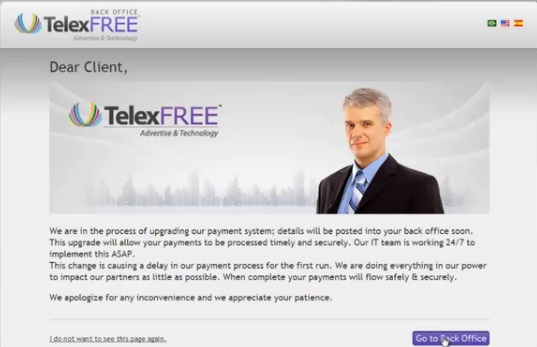
    A screen shown in the TelexFree affiliate’s video shows an apparent executive of TelexFree announcing that the changeover to GPG’s services “is causing a delay in our payment process for the first run.”

    The FBI long has warned that certain types of debit cards can be abused and that a “shadow banking system” is playing a role in fraud schemes that affect national security.

    If TelexFree is adjudicated a scam, it may be difficult for the governments of the world or the receivers/trustees they may appoint to gather proceeds for victims. HYIP money may dissipate quickly, perhaps particularly quickly if it is offloaded with debit cards. In a money-laundering case brought in 2008, federal prosecutors in Connecticut said that millions of dollars in narcotics proceeds were offloaded at ATMs in Colombia.

    Robert Hodgins, a Canadian currently listed by INTERPOL as an international fugitive in the Connecticut money-laundering case, reportedly supplied the debit cards through a firm known as Virtual Money Inc. and had ties to the HYIP world and schemes such as PhoenixSurf and AdSurfDaily.

    Another screen in the TelexFree affiliate’s video shows folders with titles such as “telexfree,” “Banner[s] Broker, “hyip monitors,” “forex”and “Passive peeps.”

    The context of the folders shown in the video is unclear. Banners Broker, however, is a bizarre HYIP scheme. HYIP monitors are websites that monitor whether a particular HYIP site is “paying.” Meanwhile, the word “passive” often is used in HYIP scams that promote tremendous returns for investors inclined to sit back and wait for the payments to flow in, instead of recruiting other investors to earn downline commissions from a “program.”

    TelexFree has been promoted on well-known Ponzi scheme forums such as TalkGold and MoneyMakerGroup. The names of both forums appear in U.S. court filings as places from which fraud schemes are advanced.

    From a promo for the alleged $600 million Zeek Rewards Ponzi- and pyramid scheme.
    From a promo for the alleged $600 million Zeek Rewards Ponzi- and pyramid scheme.

    Zeek Rewards, an alleged $600 million Ponzi- and pyramid scheme that had a Ponzi-forum presence and became the target of an SEC action last year, was promoted as a “passive” program. Like Zeek, TelexFree purportedly has a requirement that participants post ads for the “program” online.

    There have been reports in Brazil that a judge and prosecutor involved in the TelexFree case have been threatened with death.

    But not even those disturbing reports were enough to cause TelexFree to cancel a rah-rah event in California last month. The company says it also plans an “at sea” event in December. Earlier, some TelexFree pitchmen provided AdSurfDaily-like coaching tips to enrollees, especially on matters of how to speed the flow of money to the company.

    ASD was a $119 million MLM Ponzi scheme broken up by the U.S. Secret Service in 2008. Like Zeek and TelexFree, the ASD “program” also had a Ponzi-forum presence and was promoted as an opportunity for “passive” participants.

    Some TelexFree promoters in Brazil appear to believe that TelexFree has been deemed legal in the United States by the U.S. government. This errant belief may in part have been instilled by promoters of TelexFree who worded MLM HYIP pitches to suggest that the U.S. government had authorized the “program.”

    Some TelexFree promoters have claimed a payment of $15,125 to the firm will fetch a return of more than $42,000 in a year. Even the cautious “Aunt Ethels” of the world will grow to become keen on TelexFree, according to a promo.

  • **[UNCONFIRMED]** Report In Brazil Says Prosecutors Have Asked U.S. Court To Block TelexFree Accounts, New Signups **[UNCONFIRMED]**

    telexfreelogo**[UNCONFIRMED]** A report in Brazilian media translated by Google Translate from Portuguese to English says that prosecutors in Brazil have asked a U.S. court to prevent new members from joining TelexFree and to block the accounts of TelexFree figures Carlos Wanzeler, James Merrill, Carlos Costa and Lyvia Wanzeler.

    The PP Blog could not immediately confirm the report. If it is true, it could mean that law-enforcement agencies in Brazil have contacted their U.S. counterparts and asked them to begin the process of investigating a potential seizure of TelexFree-related funds that may be in the United States and perhaps to disable or otherwise block the functionality of the TelexFree web domains. The United States has said on various occasions that it is interested in fostering partnerships with law-enforcement agencies across the globe to combat commercial fraud online.

    As of 1:03 p.m. EDT today in the United States, the TelexFree websites remained online and appeared still to be capable of enrolling recruits.

    TelexFree has said it has U.S. arms in the states of Massachusetts and Nevada. Some U.S. afffiliates of TelexFree also appear to have formed business entities in California and Florida. Some TelexFree affiliates have claimed the “opportunity” did business through Bank of America, TD Bank and ProPay. (See July 8, 2013, PP Blog report on some of the claims.)

    Despite allegations in Brazil that TelexFree was conducting a massive pyramid scheme and that a Brazilian judge and prosecutor had been threatened with death, TelexFree nevertheless held a rah-rah session in California late last month in which an MLM pitchman appears to have tried to sustain the scheme by telling a joke about “Carlos Danger,” an online identity purportedly used by U.S. Democratic politician Anthony Weiner. A companion TelexFree promo playing in the United States on YouTube claims that people who send $15,125 to TelexFree can expect to profit to the tune of more than $42,000 in a year.

    TelexFree has a presence on well-known Ponzi-scheme forums such as TalkGold, MoneyMakerGroup and DreamTeamMoney. The forums previously were used as staging grounds for the Legisi Ponzi scheme, the AdSurfDaily Ponzi scheme, the PathwayToProsperity scheme, the Zeek Rewards scheme and the Profitable Sunrise scheme, among others. The SEC has described Zeek as a $600 million Ponzi- and pyramid fraud. The agency has described Profitable Sunrise as a fraud that may have gathered tens of millions of dollars through a series of accounts. Federal prosecutors in Illinois have described PathwayToProsperity as a fraud that made its way into at least 120 countries.

    In May, the United States indicted the Liberty Reserve payment processor and forced it offline, amid allegations that Liberty Reserve and some of its operators had engaged in a $6 billion money-laundering conspiracy. In June 2011, U.S. Attorney General Eric Holder described the amount of money being stolen online as “staggering.”

    “In recent years, we’ve seen clear, and alarming, advances in the sophistication and commercialization of crimes involving electronic networks,” Holder said.  “And the staggering volume of money being stolen online today has the potential to threaten not only the security of our nation — but the integrity of our government, the stability of our economy, and the safety of our people.”

    Nearly a year later — in May 2012 — INTERPOL said that “[Eighty] per cent of crime committed online is now connected to organized gangs operating across borders.”

    In October 2012, Lisa Monaco, then-Assistant Attorney General for National Security, said that cyber intrusions may have resulted in “the greatest transfer of wealth in history.”

    Monaco is now President Obama’s chief counterterrorism adviser.

    Some TelexFree members have claimed that the purported “opportunity” has gathered in excess of $300 million. Among other things, TelexFree has purported to be in the hotel-development business in the run-up to the 2014 World Cup and the 2016 Summer Olympics in Brazil. TelexFree, an MLM business, also purports to be in the VOIP telephone business.

    Many HYIP “opportunities” that use an MLM sales model have members and promoters in common and promise absurd rates of return. The practice has led to questions about whether groups of MLMers — however loosely associated — may be engaging in willful blindness and causing banks and payment processors to become warehouses for fraud proceeds.

    The ASD, Zeek, Legisi, PathwayToProsperity and Profitable Sunrise HYIP schemes may have gathered on the order of $1 billion, court filings suggest. Alleged PathwayToProsperity operator Nicholas Smirnow is listed as wanted by INTERPOL. So is Robert Hodgins, who reportedly once provided payment services to ASD and is listed as an INTERPOL fugitive in a money-laundering case allegedly involving the offloading of narcotics profits in Colombia.

    See Aug. 12 TelexFree report on BehindMLM.com.

  • URGENT >> BULLETIN >> MOVING: Legisi HYIP Operator Gregory McKnight Sentenced To More Than 15 Years In Federal Prison

    McKnight. From U.S. court files.
    McKnight. From U.S. court files.

    URGENT >> BULLETIN >> MOVING: Gregory N. McKnight, the operator of the $72 million Legisi HYIP Ponzi scheme popularized in part on the TalkGold and MoneyMakerGroup forums, has been sentenced to 188 months in federal prison for wire fraud and ordered to pay more than $48.9 million in restitution.

    McKnight also was ordered to serve three years’ probation following his prison release. Legisi collapsed in 2008.

    Legisi pitchman Matthew John Gagnon was sentenced last month to serve five years in federal prison and to pay $4.4 million in restitution.

    The criminal cases against Gagnon and McKnight were prosecuted by the office of U.S. Attorney Barbara L. McQuade of the Eastern District of Michigan. The civil cases were prosecuted by the SEC.

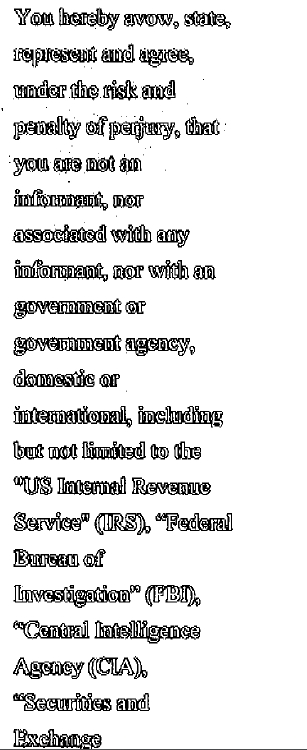
    Legisi bizarrely made members affirm they were not associated with the SEC, the IRS, the FBI and the CIA — along with “Her Majesty’s Police,” the Intelligence Services of Great Britain and the Serious Fraud Office.

    Prosecutors said McKnight engaged in “semantic obfuscation” in which investors were told they were joining a “loan program,” not making an “investment.”

    Among Legisi’s payment processors was e-Bullion. The Legisi receiver is pursuing claims tied up after the 2008 arrest of James Fayed, the operator of e-Bullion.

    Fayed was convicted in 2011 of ordering the murder of his wife, a potential witness against him. Pamela Fayed was slashed to death in a Greater Los Angeles parking garage in July 2008. The SEC brought the Legisi fraud prosecution in May 2008, just two months before Pamela was killed.

    E-bullion has been linked to several Ponzi schemes. In court filings on June 6, receiver Robert D. Gordon said more than 85 percent of the $72.6 million directed at Legisi had flowed through the defunct processor.

    The Legisi investigations were led by the SEC, the U.S. Secret Service and state regulators in Michigan.

  • HourlyRevShare, Another ‘Ken Russo’ Ponzi-Board ‘Program,’ Reportedly DOA

    krussohourlyrevshareHourlyRevShare, another in a long list of incongruous HYIP Ponzi-board “programs” pushed by serial huckster “Ken Russo” (also known as “DRdave”), reportedly has collapsed after taking a second bite of the Ponzi apple (purportedly as HRS II) after the original iteration collapsed. Other recent “programs” pushed by “Ken Russo” include Zeek Rewards and Profitable Sunrise, both of which cratered after regulatory actions in the United States.

    “Ken Russo” also pushed Felmina Alliance, which became the subject of an Investor Alert in Canada; AdSurfDaily, a $119 million Ponzi scheme that put operator Andy Bowdoin in federal prison in Florida; MPB Today, a scheme that led to racketeering charges being filed in Florida against operator Gary Calhoun; Club Asteria, a scheme that falsely planted the seeds it was endorsed by actor Will Smith and the American Red Cross while also trading on the name of slain human-rights champion Mahatma Gandhi; a scheme known as Gold Nugget Invest that cratered in at least two forms; JSS Tripler/JustBeenPaid, a multiple-name scheme purportedly operated by Frederick Mann that promised a return of 730 percent a year and has encountered regulatory actions in Italy and the Philippines;  knockoff scams known variously as JSSTripler 2 and Compound 150 purportedly operated by “Dave” between purported bouts with Dengue Fever; and Wealth4AllTeam, a “program” that experienced business halts and relaunches with new names, at one time claiming it was impervious to U.S. regulators at the state and federal level while incongruously claiming disputes would be settled under California law.

    Among other things, the lead pitchman for HourlyRevShare on the MoneyMakerGroup Ponzi forum claimed that the “program” offered “Daily guaranteed Payouts.” The promoter also claimed (italics added):

    “Earn 4.5% to 6.5% daily for 20 days.”

    “Earn 135% to 195% on your shares.”

    “Earn 0.18 to 0.29 every hour.”

    On April 9, 2013, less than a month after the Profitable Sunrise HYIP scheme collapsed amid SEC allegations a ghost might have been at the wheel, Ken Russo (as “DRdave”) claimed on TalkGold that he’d just received a payment of $4,850 from HourlyRevShare, which was using a Gmail email address. Critics of HourlyRevShare claim the “program” is linked to individuals known as Analie or Anelie Steinway and Dr. Leiven Van Neste.

    Whether these individuals actually exist remains an open question.

    “Ken Russo” also has been leading cheers for a “program” known as NEOMutual, yet-another Ponzi-board darling. NEOMutual is being pushed alongside a “program” bizarrely known as “CashCropCycler.”

    Also see Comments thread below this PP Blog story on the JSS/JBP-linked ProfitClicking scam.


  • BIZARRE: ‘Program’ Dubbed ‘CashCropCycler’ Has Ponzi-Board Presence And Zeek Pitchman While Touting Payouts Through PerfectMoney, SolidTrustPay And EgoPay — And Saying It Provides JSSTripler-Like Signup Bonus Of $10

    cashcropcyclerA “program” with the bizarre name of “CashCropCycler” (Triple C) is being pushed on the Ponzi forums, amid claims it issues cashouts through offshore payment processors linked to fraud scheme after fraud scheme and gives enrollees $10 just for signing up. An earlier HYIP scam known as JSSTripler/JustBeenPaid that appears to have morphed into at least two other scams also advertised recruits would be paid $10 for enrolling in its “program,” which purported to pay 730 percent a year (precompounding).

    Like a series of recent scams, CashCropCycler purports to be a “revenue sharing and advertising” program. It also claims it is using Skype and Gtalk for customer service. The lead pitchman for CashCropCycler on the MoneyMakeerGroup Ponzi forum appears to be “mmgcjm,” the lead pitchman for the alleged $600 million Zeek Rewards Ponzi scheme at the same forum.

    Whether CashCropCycler borrowed part of the JSS/JBP fraud pitch wasn’t immediately clear. Also unclear is whether CashCropCycler’s  unusual name was designed to be provocatively ambiguous or as a taunt of some sort. Could the unidentified Triple C operators be suggesting they are using the HYIP world to crowd-source the cultivation of marijuana, for instance? Other HYIP schemes — CashTanker, BotFly and Insectrio, for instance — may have been named to taunt regulators and demonstrate just how gullible investors can be.

    CashCropCycler curiously discusses the Triple C alliteration in another context, saying “The name ‘Triple C’ came about in year 2012 when we gave all our personal earnings to support the Clarion Children’s Choir, that was the best experience for us as a team.”

    The “program” purports to be operated by “three friends, Americans by naturalization and Swedish by birth; Benson, Dave and Anderson.”

    CashCropCycler’s website defines the trio as “ordinary people who find delight in been [sic] able to help our same human species. It doesn’t matter what country you’re from, what race you belong or how educated you are; we only care to help people by building a network that ticks, and this is what we enjoy doing.”

    Records suggest that one of the domain nameservers (ian.ns.cloudflare.com) linked to CashCropCycler has been used in spam campaigns for everything from malware to potentially fraudulent National Football League jerseys and potentially fraudulent designer purses purportedly from Louis Vuitton.

    Meanwhile, the CashCropCycler Terms of Service includes the strange phrase “Agreements shall be interpreted under the laws” — without identifying a jurisdiction or set of laws used if disputes occur. The Terms also confoundingly assert that “A member is neither an employee nor an independent contractor of CASHCROPCYCLER,” even as CashCropCycler asserts elsewhere on its site that promoters can earn MLM-style commissions totaling 15 percent over three tiers.

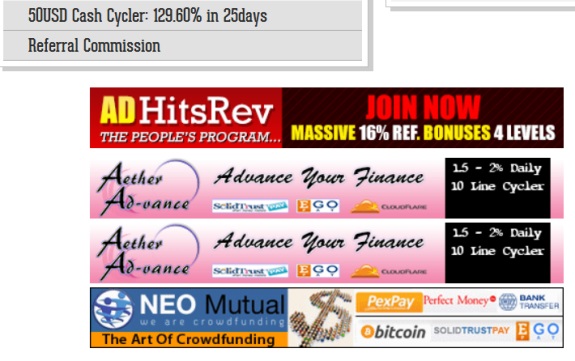
    By plowing $10 into the scheme, according to the CashCropCycler website, members will earn “186% in 60Days” [sic]. A sum of $50 purportedly fetches “129.60% in 25days” [sic]. Recruits should feel good about the “program” (apparently) because the “script was tested for 68days [sic] before this official launch.”

    And members also are permitted to engage in “Member to Member Transfer[s]” from inside the CashCropCycler system “for a 2.50% fee,” according to the website. Beyond that, according to the site, members can pay an exchange “fee of 8.70%” should they wish to have their earnings paid through a processor other than the one through which they joined the “program.”

    Some purported exchange services were among the casualties of the Liberty Reserve money-laundering action in the United States in May. Federal prosecutors in New York said that the now-shuttered Liberty Reserve payment processor was facilitating any number of fraud schemes while helping criminals launder billions of dollars.

    Even though CashCropCycler members purportedly are neither employees nor independent contractors of the “program,” they nevertheless are encouraged to (italics added/no edits made):

    “Promote via banner/text advertisements on other advertising websites that you are a member of.

    “Be active on the forums, including MoneyMakerGroup, TalkGold, DreamTeamMoney and Investment-Tracker .

    “Including a link to CashCropCycler in your signature in forums.

    “Traffic exchanges/Safe lists.

    “Social media.

    “Word of mouth.”

    At least four ads that appear to highlight other HYIP schemes appear near the bottom of the CashCropCycler landing page. One of the ads is for “NeoMutual,” which uses a tagline of “we are crowdfunding.”

    Some critics of crowd funding have voiced concerns that easing regulations on certain types of startup companies before appropriate safeguards are in place could lead to egregious marketplace abuses.

    Ads for what appear to be HYIP schemes are displayed on the website of CashCropCycler. A purported opportunity known as NEO Mutual purports to be a "crowd funding" company through which members can use bitcoins and payment processors linked to multiple fraud schemes.
    Ads for what appear to be HYIP schemes are displayed on the website of CashCropCycler. A purported opportunity known as NEO Mutual purports to be a “crowd funding” company through which members can use payment processors such as Perfect Money, SolidTrustPay and EgoPay that have been linked to multiple fraud schemes. NEOMutual also purportedly does business with bitcoins and PexPay — all while employing a “bank transfer” option. NEOMutual purports to have “Junior,” “Senior” and “Executive” plans that pay daily interest rates of 1.4 percent, 1.6 percent and 1.9 on sums  between $20 and $250,000. NEO Mutual says it is located at Revolution Tower in Panama City, Panama. Like the “Profitable Sunrise” scheme, NEO Mutual purports to be in the bridge-loan business. In April 2013, the SEC called Profitable Sunrise a scam that may have gathered millions of dollars while using a “mail drop” and offshore bank accounts.

    Also see CashCropCycler review on BehindMLM.com.

  • Full Statement Of SEC On Criminal Conviction, Restitution Order And Civil Liability Of ‘Serial’ HYIP Ponzi Pitchman Matthew J. Gagnon

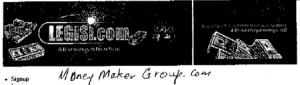
    In this evidence exhibit given to a federal judge prior to the Legisi asset freeze in 2008, a Legisi prospect writes the name "Money Maker Group.com" in longhand. State and federal probes into Legisi were under way long before members knew -- and undercover agents were part of the probe.
    In this evidence exhibit given to a federal judge prior to the Legisi asset freeze in 2008, a Legisi prospect writes the name “Money Maker Group.com” in longhand. State and federal probes into Legisi were under way long before members knew — and undercover agents were part of the probe.

    EDITOR’S NOTE: As the PP Blog reported Wednesday, HYIP Ponzi-scheme pitchman Matthew John Gagnon has been sentenced to five years in federal prison. On Thursday, the SEC released the statement reproduced below. Here’s hoping it will be the shot heard around the HYIP Ponzi World.

    Still pushing HYIPs on your websites and social-media sites, in your emails and on the Ponzi boards? Still pushing them after the Legisi, AdSurfDaily, Zeek Rewards and Profitable Sunrise debacles? Is someone like “Ken Russo” or “10bucksup” or “strosdegos” enlisting you to enter Ponzi World?

    Are you listening to Faith Sloan, when she shows you an investment-earnings calculator and plants the seed that the TelexFree action in Brazil is a yawner because it was brought in a “small” state that’s “literally in the middle of the jungle” — all while she further risks offending one-fifth of the world’s population by advising you not to engage in a “panic-like-Chinese-fire-drill” over your legitimate TelexFree concerns?

    If you are turning a blind eye to all the incongruities of HYIP Ponzi Land, you may have the chance to be the next Matt Gagnon, meaning the next several years of your life will be consumed by court actions. First, you’ll watch your “program” get sued by the SEC.  After that, you’ll get sued by the SEC and a court-appointed receiver.  On top of those unpleasantries, you’ll be called a threat to the investing public in newspaper stories across the land, then charged criminally, and then sent to jail for years you’ll never get back while being ordered to pay back either the money you stole or the money you helped someone else steal.

    A final note: More than FIVE years after the SEC filed the first of the Legisi-related fraud charges in May 2008, Legisi victims continue to visit the PP Blog for updates on the various Legisi-related actions, including the multiple actions against Gagnon. Scams may fall out of the headlines for a while — but the fleeced masses never forget them. For posterity, the PP Blog has inserted a section of a Legisi evidence exhibit into the SEC’s statement. It may be the strangest Terms of Service you’ve ever read.

    ** ______________________________________ **

    U.S. SECURITIES AND EXCHANGE COMMISSION
    Litigation Release No. 22749 / July 11, 2013
    Securities and Exchange Commission v. Matthew J. Gagnon, Civil Action No. 10-cv-11891 (E.D. Mich.)

    Serial Fraudster Matthew J. Gagnon Sentenced to Five Years in Prison

    The Securities and Exchange Commission announced that on July 9, 2013, the Honorable Mark A. Goldsmith of the United States District Court for the Eastern District of Michigan sentenced Matthew J. Gagnon to five years of incarceration followed by three years of supervised release and ordered Gagnon to pay over $4.4 million in restitution to his victims.  Gagnon, 45, of Portland, Oregon, pleaded guilty to one count of criminal securities fraud for promoting a securities offering without fully disclosing the amount of his compensation in connection with his promotion of the $72 million Legisi Ponzi scheme in 2006 and 2007, in violation of Section 17(b) of the Securities Act of 1933.

    The criminal charges arose out of the same facts that were the subject of a civil injunctive action that the Commission filed against Gagnon on May 11, 2010.  The Commission’s complaint alleged that since 1997, Gagnon had billed himself as an Internet business opportunity expert and his website as “the world’s first and largest opportunity review website.”  According to the SEC’s complaint, from January 2006 through approximately August 2007, Gagnon helped orchestrate a massive Ponzi scheme conducted by Gregory N. McKnight and his company, Legisi Holdings, LLC, which raised a total of approximately $72 million from over 3,000 investors by promising returns of upwards of 15% a month.  The complaint also alleged that Gagnon promoted Legisi but in doing so misled investors by claiming, among other things, that he had thoroughly researched McKnight and Legisi and had determined Legisi to be a legitimate and safe investment.  The complaint alleged that Gagnon had no basis for the claims he made about McKnight and Legisi.  Gagnon also failed to disclose to investors that he was to receive 50% of Legisi’s purported “profits” under his agreement with McKnight.  According to the complaint, Gagnon received a net of approximately $3.8 million in Legisi investor funds from McKnight for his participation in the scheme.

    legisiciadisclaimerThe SEC’s complaint further alleged that beginning in August 2007, Gagnon fraudulently offered and sold securities representing interests in a new company that purportedly was to develop resort properties.  The complaint alleged that Gagnon, among other things, falsely claimed that the investment was risk-free and “SEC compliant,” and guaranteed a 200% return in 14 months.  In reality, however, Gagnon sent the money to a twice-convicted felon, did not register the investment with the SEC, and knew such an outlandish return was impossible.  Gagnon took in at least $361,865 from 21 investors.

    The SEC’s complaint also alleged that in April 2009, Gagnon began promoting a fraudulent offering of interests in a purported Forex trading venture. Gagnon guaranteed that the venture would generate returns of 2% a month or 30% a year for his investors.  Gagnon’s claims were false, and he had had no basis for making them because Gagnon never reviewed his friend’s trading records before promoting the offering, which would have shown over $150,000 in losses over the previous nine months.

    The SEC’s complaint charged Gagnon with violating Sections 5(a), 5(c), 17(a) and 17(b) of the Securities Act of 1933 and Sections 10(b) and 15(a)(1) of the Securities Exchange Act of 1934 and Rule 10b-5 thereunder.  The complaint sought preliminary and permanent injunctions, disgorgement, and civil penalties from Gagnon.  On May 24, 2010, the SEC obtained an emergency order freezing Gagnon’s assets and other preliminary relief.  Subsequently, on August 6, 2010, the Court granted an order of preliminary injunction against Gagnon pursuant to his consent. On March 22, 2012, the Court granted the SEC’s motion for summary judgment and entered a final judgment against Gagnon.  The Court found that Gagnon violated the registration, anti-fraud, and anti-touting provisions of the federal securities laws.  The Court’s final judgment against Gagnon permanently enjoined him from future violations of Sections 5(a), 5(c), 17(a) and 17(b) of the Securities Act of 1933 and Sections 10(b) and 15(a)(1) of the Securities Exchange Act of 1934 and Rule 10b-5 thereunder, and ordered Gagnon to pay $3,613,259 in disgorgement, $488,570.47 in prejudgment interest, and a $100,000 civil penalty.

    On May 2, 2012, the SEC instituted related administrative proceedings against Gagnon to determine what, if any, remedial action was appropriate and in the public interest.  On July 31, 2012, the SEC issued an Order Making Findings and Imposing Sanctions by Default barring Gagnon from association with any broker or dealer.

    For further information regarding this case, see Litigation Releases No. 21532 (May 25, 2010), and 22310 (March 27, 2012).

    See also:  SEC Complaint

    http://www.sec.gov/litigation/litreleases/2013/lr22749.htm

  • URGENT >> BULLETIN >> MOVING: Legisi HYIP Ponzi Pitchman Sentenced To 60 Months In Federal Prison, Ordered To Pay $4.4 Million In Restitution

    Matthew John Gagnon
    Matthew John Gagnon

    URGENT >> BULLETIN >> MOVING: Legisi HYIP Ponzi-scheme pitchman Matthew John Gagnon has been sentenced to 60 months in federal prison, ordered to pay $4.4 million in restitution and further ordered to serve three years’ supervised probation after his prison release, the office of U.S. Attorney Barbara L. McQuade of the Eastern District of Michigan said.

    Legisi, a $72 million Ponzi scheme pushed on fraud forums such as TalkGold and MoneyMakerGroup, was operated by Gregory N. McKnight, who faces sentencing in August. Gagnon’s five-year sentence was the maximum under a plea agreement with prosecutors, who’ve recommended McKnight serve 15 years.

    Gagnon pushed Legisi and other fraud schemes through Mazu.com, the SEC said in 2010. The name of MoneyMakerGroup appears in evidence exhibits in the Legisi Ponzi case.

    Gagnon will be permitted to self-report to prison, prosecutors said.

    The Legisi case — perhaps particularly events involving Gagnon — has been closely watched because it shows that MLM-style HYIP pitchmen can be held accountable criminally for pushing scams. The SEC called Gagnon a threat to the investing public, describing him as a serial fraud pitchman who lacked licenses to sell securities and pushed the unregistered securities of multiple fraud schemes.

    In civil charges announced yesterday in Ohio, prosecutors effectively made the same claims against promoters of the alleged Profitable Sunrise pyramid scheme. Included among them was Nanci Jo Frazer, who allegedly also promoted the $119 million AdSurfDaily Ponzi scheme and the $600 million Zeek Rewards Ponzi- and pyramid scheme.

    The Legisi case began as an undercover probe by state securities regulators in Michigan and the U.S. Secret Service.

    Legisi’s Terms of Service sought to make members affirm they were not an “informant, nor associated with any informant” of the IRS, FBI, CIA and the SEC, among other agencies, according to documents filed in federal court.

    Current scams such as Profit Clicking have published similar terms, which read like an invitation to join an international financial conspiracy. Ohio prosecutors said they believed Frazer also pushed ProfitClicking, in addition to Zeek, ASD and Profitable Sunrise.

    McKnight, prosecutors have said, tried to sanitize Legisi by calling it a “loan” program and engaging in semantic obfuscation. Any number of HYIP scams have employed similar linguistic sleight-of-hand, with ProfitClicking bizarrely arguing that neither itself nor affiliates can be held accountable.

    Gagnon argued in court that he’d been duped by McKnight, but a federal judge didn’t buy it.

  • REPORT: TelexFree Diverted $88 Million After Brazilian Judge Blocked Payments

    cautionflagUPDATED 1:04 P.M. (JULY 5, U.S.A.) Quoting a prosecutor, the website of iG — a Brazilian communications provider — is reporting that the TelexFree MLM “program” allegedly diverted $88 million after a judge in the state of Acre blocked payments as a pyramid-scheme probe got under way last month.

    TelexFree also operates in the United States. The “program” has been pitched to victims of the murky Profitable Sunrise “opportunity,” which the U.S. Securities and Exchange Commission described in April as a pyramid scheme that may have collected tens of millions of dollars through offshore bank accounts.

    At least one U.S. video pitch for TelexFree described the purported opportunity as a “program” that provided a guaranteed payout of at least $1,100 per week for a year to individuals who sent in $15,125 for the purchase of a “contract.” TelexFree has been under investigation in Brazil for weeks. Behind MLM.com is reporting that seven Brazilian states have opened probes.

    Here is a link to a Google translation in English of today’s iG story.

    Whether U.S. investigators have opened probes into TelexFree is unknown. The opportunity, however, may have U.S. exposure to charges it is selling unregistered securities as investment contracts. MLM “programs” such as Zeek Rewards and Profitable Sunrise have been shut down under U.S. securities laws.

    Like Zeek Rewards and Profitable Sunrise, TelexFree has a presence on well-known Ponzi-scheme forums such as TalkGold and MoneyMakerGroup.

    Such MLM “programs” typically have promoters in common, a circumstance that raise questions about whether promoters are engaging in willful blindness and polluting banks both domestic and across national borders with unlawful proceeds from scams that may have ties to organized crime — or worse. TelexFree purports to be in the communications business.

    In August 2012, the SEC described Zeek Rewards as a $600 million Ponzi- and pyramid scheme operating from Lexington, N.C. The precise base of operations of Profitable Sunrise remains unclear. The SEC said it used a “mail drop” in England.

    HYIP schemes typically generate protests when governments move against them. Such appears to be the case with TelexFree, which appears to have affiliates willing to march in the streets in apparent “defense” of the “program.”

    As was the case among certain Zeek Rewards affiliates in the United States, certain affiliates of TelexFree in Brazil appear to be engaged in efforts to demonize law enforcement and to chill courts or enforcement agencies. After the AdSurfDaily Ponzi scheme was exposed in the United States in 2008, bogus liens seeking billions of dollars were filed against public officials.

    Because money directed at HYIP schemes typically involves transfers among any number of conduits to keep schemes afloat, law-enforcement agencies often seek asset freezes to prevent the movement of money. In the absence of such freezes or if freeze orders are ignored, less money may be available to compensate victims if an investigation ultimately reveals fraud has occurred.

    Large promoters typically gain the lion’s share of HYIP proceeds at the expense of their recruits. The operators of the schemes may siphon millions of dollars along the way even as they make classic Ponzi payouts to promoters to create an air of legitimacy.

  • Law Firm’s Name Used In Bid To Dupe Members Of Banners Broker, Profit Clicking, MLM Attorney Says

    Kevin Thompson of Thompson Burton PLLC.
    Kevin Thompson of Thompson Burton PLLC.

    UPDATED 11:28 P.M. EDT (U.S.A.) Scammers have used the names of government agencies and famous businesses in bids to dupe the public. Now, the name of a well-known MLM law firm appears to have been used for the same purpose.

    Attorney Kevin Thompson published a Blog post today that warns of a bogus Banners Broker/Profit Clicking “Claim Form” on the Web. Thompson is with Thompson Burton PLLC in Tennessee.

    “DO NOT FILL OUT THIS FORM,” Thompson warned in the post. “It’s fraudulent. We did not create this form, or anything like it. We are not representing Banners Brokers or Profit Clicking participants.”

    And, Thompson noted, “The form is requiring highly sensitive information, such as your usernames and passwords for Payza and Solid Trust Pay accounts. It’s also asking for credit card information. If you filled out the form, we strongly suggest you change your passwords and cancel your credit cards immediately.”

    Such events have been associated with phishing schemes and identity-theft schemes.

    Banners Broker is a bizarre “program” that, like many HYIPs, purports to be in the “advertising” business. Promoters have claimed that sending money to Banners Broker results in a doubling of the cash.

    ProfitClicking is a scam that rose up to replace the JSSTripler/JustBeenPaid scam purportedly operated by Frederick Mann. Mann, a former pitchman for the AdSurfDaily Ponzi scheme, may have links to the “sovereign citizens movement.” “Sovereign citizens” may express an irrational belief that laws do not apply to them.

    Among other things, ProfitClicking became known — like JSS/JBP before it — for publishing Terms that read like an invitation to join an international financial conspiracy. Here is Item 6 from the ProfitClicking Terms, as published on Sept. 3, 2012 (italics added):

    6. I affirm that I am not an employee or official of any government agency, nor am I acting on behalf of or collecting information for or on behalf of any government agency.

    Mann once called government employees “part of a criminal gang of robbers, thieves, murderers, liars, imposters.”

    Regulators in Italy and the Philippines have issued warnings about JSS/JBP or ProfitClicking, both of which featured Terms similar to those of Legisi, a $72 million HYIP fraud scheme broken up by the SEC and the U.S. Secret Service in May 2008, about three months before the AdSurfDaily Ponzi scheme ($119 million) was exposed.

    The PP Blog has been subjected to various bids to chill its reporting on the JSS/JPB/ProfitClicking scams, including one from an individual who claimed he’d defend Mann “so help me God.”

    Meanwhile, the PP Blog has received bizarre and menacing spam apparently in support of Banners Broker. (Like JSS/JBP/ProfitClicking, AdSurfDaily, Legisi and Zeek Rewards, Banners Broker has a presence on well-known Ponzi-scheme forums such as TalkGold and MoneyMakerGroup.)

    WARNING: The next paragraph  includes quoted material from one of the Jan. 18, 2013, spams, and the PP Blog is reproducing it to illustrate the bizarre and often menacing nature of the HYIP sphere. Indeed, the apparent Banner’s Broker supporter wrote (italics added):

    ” . . . I am Big Bob’s cock meat sandwich. Your mom ate me and made me do press ups until I threw up . . . I am gonna report you. When you make false accusations, you can get done. Maybe you will be seen in court soon . . .”

    In August 2012, the SEC described Zeek Rewards as a $600 million Ponzi- and pyramid scheme. A number of reload scams have surfaced in its wake. At least one appears to have been a bid to dupe people into sending money to an entity that was posing as a U.S. government agency while claiming to be a recovery vessel for Zeek members who lost money.

    Thompson is encouraging people who may have information about the purported Banners Broker/Profit Clicking “Claim Form” to contact him here.


  • URGENT >> BULLETIN >> MOVING: Threshold Dollar Number For Zeek Rewards’ Net Winners To Avoid Receivership Litigation Now Public; At Least 136 Settlement Agreements Ironed Out, Receiver Says

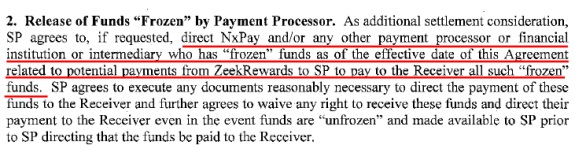
    From a June 28 filing by the court-appointed receiver in the Zeek Rewards Ponzi-scheme case. (Red highlights by PP Blog.)
    From a June 28 filing by the court-appointed receiver in the Zeek Rewards Ponzi-scheme case. “SP” stands for “Settling Party.” (Red highlights by PP Blog.)

    URGENT >> BULLETIN >> MOVING: (UPDATED 8:05 P.M. EDT U.S.A.) From the standpoint of avoiding financial accountability, it may have become more difficult for serial scammers who foist HYIP scams on the international public to thumb their noses at law enforcement and the courts. The court-appointed receiver in the Zeek Rewards Ponzi scheme case has revealed the threshold dollar number used to determine who received emails offering a settlement: That number, according to filings by receiver Kenneth D. Bell, was only $1,000.

    The lowness of the number could send shockwaves across the HYIP Ponzi universe. On well-known Ponzi-scheme forums such as TalkGold and MoneyMakerGroup, serial HYIP scammers routinely pooh-pooh court actions and claim that neither the government nor receivers will bother to seek recoveries from low-level players and “winners” in scams.

    Confident that they’ll never be held accountable, some purveyors move from one HYIP fraud scheme to another.

    In August 2012, the SEC described Zeek as a $600 million Ponzi- and pyramid scheme. Both the SEC and the receiver quickly were demonized on the Ponzi boards.

    Docketed in the Western District of North Carolina yesterday, Bell’s filing makes it plain that he expects any net winner who received $1,000 or more to pay up — and there is no guarantee that the number could not go lower in the future. Beyond that, a provision of the settlement agreement frees the receiver effectively to force net winners who may have money frozen in NxPay “and/or any other payment processor” or bank to make those funds payable to the receivership estate.

    Zeek used NxPay, AlertPay and SolidTrustPay. AlertPay (now Payza) and SolidTrustPay are longtime favorites of Ponzi purveyors and their shills on the fraud forums. Zeek was based in Lexington, N.C.

    If the Zeek settlement stipulations as outlined by the receiver are approved or accented by the court, it would mean that Zeek’s serial HYIP players and their recruits could not hope to stymie law-enforcement agencies and the receiver by waiting them out and removing “profits” from the payment processors or banks at a later date.

    At least 136 Zeek winners have agreed to settlements after being approached by the receiver, Bell said. Virtually all of the settlements have included a substantial discount on the order of 40 to 50 percent. The discount amounts, Bell has said, will enable the receivership to collect some money for Zeek victims without going to the additional expense of filing lawsuits.

    Winners who cooperated early with the receivership may stand to gain much better deals than stragglers who potentially could be held accountable for more lucrative dollar sums if successfully sued. Zeek had more than 2 million user IDs, Bell has said. About 1 million affiliates paid money to Zeek, which may have a universe of tens of thousands of “winners.”

    The $1,000 threshold in the early settlement emails was established after the receivership consulted with the SEC, according to a filing yesterday by Bell.

    Here are a several examples of the existing settlement agreements, according to the June 28 filing (bolding added):

    • A Zeek winner of $1,254 has agreed to a settlement of $600 “to be paid within 7 days of the effective date of this agreement.”
    • A Zeek winner of $9,249 has agreed to a settlement of $4,500 “to be paid as follows: $375 a month for 12 months beginning in April 2013 (to be paid by the 25th of each month).”
    • A Zeek winner of $28,909 has agreed to a settlement of $22,000 “to be paid as follows: $6,000 within 15 days of the effective date of the agreement and then eight payments of $2,000 due on the 15th day of each following month.”
    • A Zeek winner of $114,000 has agreed to a settlement of  “$47,500 to be payable on or before May 31, 2013.”
    • A Zeek winner of $170,440 has agreed to a settlement of “$84,981 to be payable in one payment of $23,165 on or before June 15, 2013 with the remainder ($61,770) to be paid by July 15, 2013 or in 10 equal consecutive monthly payments of $6,177.60 beginning on or before July 15, 2013 and to be paid by the fifteenth day of each following month.”
    • A Zeek winner of $176,000 has agreed to a settlement of “$88,000 to be paid within 7 days of the effective date of this agreement.”

    As things stand, Bell has settled with winners of more than $3.2 million for better than $1.81 million. The “Settlement as % of Winnings” is listed as 56.12 percent in the June 28 filing.

    NOTE: Our thanks to the ASD Updates Blog.


  • BULLETIN: SEC Backs Legisi Receiver’s Bid To Pursue E-Bullion Cash

    breakingnews72BULLETIN: The SEC has asked a federal judge to permit the receiver in the Legisi HYIP Ponzi-scheme case  to pursue funds tied up after the arrest of James Fayed, the operator of the e-Bullion payment processor. Fayed was convicted in 2011 of ordering the murder of his wife, a potential witness against him. Pamela Fayed was slashed to death in a Greater Los Angeles parking garage in July 2008. The SEC brought the Legisi fraud prosecution in May 2008, just two months before Pamela was killed.

    E-bullion has been linked to several Ponzi schemes. In court filings on June 6, receiver Robert D. Gordon said more than 85 percent of the $72.6 million directed at Legisi had flowed through the defunct processor. Gordon asked Judge George Caram Steeh of the Eastern District of Michigan for an order “to receive and collect any remission or restoration of funds recoverable or payable to Legisi investors pursuant to forfeiture actions brought by the United States” in federal court in Los Angeles.

    The SEC now says Steeh should issue the order because Gordon’s efforts could “lead to the recovery of millions of dollars for the Receivership Estate, funds which ultimately could be distributed to victims pursuant to a Court-approved formula.”

    Under Gordon’s plan, the SEC said, Legisi’s “winning investors” would be provided a process to dispute claims for the e-Bullion money.

    “As a result,” the SEC said, “any investors who assert that they are entitled to money claimed by the Receiver would have an opportunity to have their arguments heard and decided by the Court. No moneys would be disbursed until after the Court hears and decides such disputed claims.”

    The agency also said that Gordon earlier had successfully claimed $1.7 million from e-Gold, an e-Bullion rival charged in a 2007 money-laundering case. In May 2013, federal prosecutors in New York charged Liberty Reserve — yet another payment processor linked to online fraud schemes and other crime — in an alleged $6 billion money-laundering conspiracy.

    With a take of $72 million, Legisi was a “program” pitched on Ponzi-scheme forums such as TalkGold and MoneyMakerGroup — forums from which “programs” such as AdSurfDaily ($119 million), Zeek Rewards ($600 million), Pathway To Prosperity ($70 million) and Profitable Sunrise also were pitched. The combined scams gathered at least $861 million, according to federal court records. The number could be significantly higher because the final take of Profitable Sunrise — estimated in the tens of millions of dollars — is unknown. If Profitable Sunrise gathered $140 million, it would mean that the take of the five scams combined exceeded $1 billion.

    Similar scams continue to be promoted on the Ponzi boards by commission-based hucksters. The condition is comparable to “whack-a-mole” in the sense that one scam rises to replace another. The “offers” frequently are targeted at victims of previous schemes and positioned as a means investors can “earn” back funds lost in the earlier scams.

    Federal court records show that prosecutors asserted an AdSurfDaily pitchwoman funded her ASD account through e-Bullion, which also has been tied to mysterious scams such as Gold Quest International, the “Alpha Project” and Flat Electronic Data Interchange, known as FEDI. FEDI’s operator, Abdul Tawala Ibn Ali Alishtari, also known as “Michael Mixon,” was convicted in September 2009 of financing terror and fleecing investors in the FEDI scheme.

    Cash associated with the ASD Ponzi scheme was seized on Aug. 1, 2008, about four days after Pamela Fayed was murdered in Los Angeles. Erma Seabaugh, the ASD promoter who funded her account with e-Bullion, also pitched a scam known as StreamlineGold, according to federal records.

    In November 2007, a MoneyMakerGroup poster claimed this about StreamLineGold (italics added):

    StreamLine Gold is literally what it says. [I]t can provide you with an unlimited income through the combination of Precious Metals and Cash with a business model whose time has come PLUS the most advanced and lucrative pay plan ever devised.

    Seabaugh, according to records, was promoting ASD through an entity known as Carpe Diem, a purported “religious” nonprofit firm in Oregon.

    Separately, the receiver in the Zeek Rewards Ponzi case has said that he has “obtained information indicating that large sums of Receivership Assets may have been transferred by net winners to other entities in order to hide or shelter those assets.”

    An evidence exhibit in the Legisi case shows that investors had to affirm they were not an “informant” for government agencies such as the CIA, FBI, SEC, “Her Majesty’s Police,” the Intelligence Services of Great Britain and the Serious Fraud Office, among others.