More lawsuits against international “winners” in the Zeek Rewards cross-border Ponzi-and pyramid-scheme case are coming, receiver Kenneth D. Bell has advised a federal judge.
Bell also signaled to Senior U.S. District Judge Graham C. Mullen that lawsuits may be coming against alleged international Zeek vendors such as Payza and SolidTrustPay, both of which earlier were involved in the AdSurfDaily Ponzi scheme and are Ponzi-forum darlings.
On another front, Zeek’s former COO — Dawn Wright-Olivares — doesn’t get to keep her cars.
“In the first quarter, the Receiver also took possession of several motor vehicles as part of the settlement with Defendant Dawn Wright-Oliveras,” Bell informed Mullen. “The Receiver has retained an auctioneer and intends to liquidate these vehicles during the second quarter of 2015.”
Bell’s forensic team has tracked Zeek money all over the world. The receiver already has sued alleged “winners” with addresses in the United Kingdom, Canada, Australia, New Zealand, the British Virgin Islands and Norway.
It won’t end there, he advised Mullen in a quarterly update to the court filed yesterday.
“The Receiver expects to file lawsuits against foreign net winners in additional countries during the second quarter of 2015,” he wrote.
News that Bell intended to expand his efforts to gather money for an estimated 800,000 victims of Zeek’s cross-border scheme was received while the nation of Thailand was squaring off against UFunClub/UToken, yet another scheme pushed by MLMers/network-marketers.
So-called “sovereigns” were involved in the $119 million AdSurfDaily Ponzi scheme in 2008. ASD was pushed in part by Frederick Mann, the purported operator of multiple fraud schemes. Mann appears to have had sympathy for Francis Schaeffer Cox, an Alaskan “sovereign” and militia man implicated in a plot to murder public officials.
A scheme known as Profitable Sunrise also appears to have been pushed in part by “sovereign citizens.”
“Automatic Mobile Cash,” pushed on YouTube by “Achieve Community” hucksters Rodney Blackburn and Mike Chitty, has tanked, according to chatter on the MoneyMakerGroup Ponzi forum.
MMG poster “im the man,” citing information from SolidTrustPay, claimed yesterday that SolidTrustPay had blocked AMC’s ability “to accept deposits or make withdraws.” Other information in the 16-page, 226-post MMG thread suggests AMC was making selective payouts through SolidTrustPay and Payza at the beginning of March.
Blackburn and Chitty were representatives of something called the “Legendary Income Solutions Team” or LIST, often mixing promos for Achieve Community with appeals for viewers to get on board the LIST train and enroll in various HYIP schemes. YouTube appears to have banned Chitty. Blackburn deleted a number of his pitches for HYIP fraud schemes, and now is suggesting he’s returned to his roots in traditional MLM.
The PP Blog reported last week that Blackburn was touting a “tea” known as “laso,” amid claims it “mitigates” HIV, the virus that causes AIDS.
On Feb. 18, the SEC described Achieve Community as a pyramid- and Ponzi scheme that had gathered more than $3.8 million. A federal judge granted an asset freeze. Criminal investigations into Achieve Community reportedly also are under way.
Chitty claimed AMC paid a “dividend.” Blackburn claimed his good friend Chitty was making “3,000 a month” from AMC.
In January, Blackburn dared the SEC to investigate Achieve Community and other programs he was pushing. Whether he’ll dare the Federal Trade Commission or the Food and Drug Administration to investigate the laso health claims was not immediately clear.
The laso tea is one of the offerings of an MLM “program” known as “Total Life Changes.”
After Blackburn’s SEC dare, a “program” known as “TrinityLines” that traded on the name of God and allusions to Scripture went missing.
Blackburn also was promoting “MooreFund,” an obvious fraud purportedly operating from the United Kingdom. He also threw in with “Rockfeller,” an obvious fraud trading on the name of the famous Rockefeller family.
“BRING THE BACON HOME” and “Unison Wealth” also were in the stable. The “bacon” program now has carded at least its second failed launch, and reportedly has a plan to launch again tomorrow. Unison Wealth, meanwhile, appears to have developed problems.
“BRING THE BACON HOME,” a Ponzi-board “program” pushed by Achieve Community promoter Rodney Blackburn, says EgoPay is among its payment processors. A Blog post on the EgoPay site claims EgoPay was hacked and subjected to embezzlement by its owner — and that the CEO has stepped down. The PP Blog cannot verify the claims.
UPDATED 1:09 P.M. ET U.S.A. The Blog on the website of the EgoPay payment processor claims in a Jan. 22 post that the company was hacked on Dec. 28. The claims, which the PP Blog cannot confirm, read like a spy novel that marries insidious financial fraud and escalating computer fraud to uber-bizarre palace intrigue.
After the hack, the post claims, EgoPay could trust no one. So it disabled its “transaction interface,” suspended staff, called in an unidentified “investigation team,” let support tickets go unanswered and interacted with “Astropay and Payza as well a few key merchants to gauge interest in helping remedy this situation.”
“Egopay was looking for help to discover the truth of the hack, for funding or liquidity, as well as to help consult on how to resolve this situation,” the Blog post claims.
Whether any “interest” was forthcoming was unclear in the post. Also unclear is how the asserted events would affect a range of schemes on the Ponzi boards.
Given companion assertions on the Blog that EgoPay “owner” Amir Aziz effectively had hijacked EgoPay servers to delete evidence of a crime and that the hack “exposed a gap in the cash reserves of Egopay,” using EgoPay in any fashion would seem an exceptionally risky proposition.
It was unclear in the Blog post whether EgoPay was blaming Aziz for the Dec. 28 hack. The post claimed that EgoPay determined on Jan. 5 that Aziz had been embezzling from the company, but it further claimed that (italics added):
On January 18th, 2015 Amir Aziz social engineered his way with the hosting provider to reset his accesses and grant him access again to the servers which he used in turn to delete his Egopay account from the system (we would assume to cover his scheme) and removed all other Administrative accesses.
The EgoPay Blog, which did not identify who wrote the post describing the hack and the post-hack actions and claims the company is back in full control of the servers, did not say whether it called police or regulatory authorities.
The post further claims that Tadas Kasputis, the onetime CEO of EgoPay, has stepped down, “allowing for a new team to come onboard to make or break this situation.”
The post did not say who was stepping in to fill the asserted leadership vacuum. Nor did it say who currently was running the company. The Blog post is attributed to the “Egopay Team.”
On Friday, the PP Blog reported that the state of Colorado had opened an investigation into “Achieve Community,” a money-cycling scheme with a Ponzi-board presence. Although Achieve appears not to have advertised EgoPay, some Achieve promoters are pushing Ponzi-board schemes that claim to accept EgoPay.
One such “program” is bizarrely called “BRING THE BACON HOME” and has a curious catch phrase of “We Do Bacon Right.” Achieve promoter Rodney Blackburn now is pushing “BRING THE BACON HOME.”
“Are you ready to make some Yummy Money?!” Rodney asks in a text line below his Jan 14 YouTube promo titled “Bring The Bacon Home- Comp Plan and Review!!!” The video has a play time of 14:53.
“Unison Wealth,” another Ponzi-board “program” pushed by Blackburn, also says it accepts EgoPay.
Despite the Jan. 22 EgoPay Blog post asserting the company could trust no one — not even its own staff — the same page on which the post appears contends that “EgoPay.com is your safe way to Pay.”
Here’s how the Blog post on the EgoPay site begins to explain the asserted hacking (italics added):
On December 28th, during the holiday period, Egopay suffered a hack that greatly impacted key merchants and partners. False values were made available in the merchants platform, when no actual value was transmitted in Egopay. This hacker then proceeded to convert this fake value into irreversible currencies all within a one hour window. These merchants believed that this value was in their Egopay account, but unfortunately it was not. Upon discovery, at this point, Egopay immediately put restrictions in place and placed transactions from being automatically completed, to manual review to contain further damage and impact on our merchants. The Shopping Cart Interface (SCI) was also restricted. The impact amount was between 1M to 1.5M total for a handful of merchants.
We concluded, that this hack must have been perpetrated by someone from within who knew the inner workings and had privileged access, so we took immediate actions and suspended everyone that we suspected while this investigation was underway. Unfortunately, this resulted in our support services being delayed or non-existent. Support tickets were not being answered and our transaction interface was taken down to stop any further exploit. Considering the evidence on hand, Egopay was left with no choice but to take these drastic actions.
The court-appointed receiver in the Zeek Rewards Ponzi- and pyramid case says his “multitilayered investigation into [Zeek operator Rex Venture Group] and its insiders, advisors, and financial institutions” continues.
Receiver Kenneth D. Bell has been at the helm since the epic collapse of the Zeek MLM HYIP scheme in August 2012. The SEC initially filed civil charges to halt the $850 million fraud. A parallel criminal probe by federal prosecutors in North Carolina to date has resulted in the arrest and prosecution of two Zeek insiders, both of whom pleaded guilty.
Bell did not say in his May 7 report to Senior U.S. District Judge Graham C. Mullen precisely who the receivership was investigating. Zeek is known to have had members and vendors in common with the $119 million AdSurfDaily Ponzi scheme, which collapsed in 2008.
Bell so far has sued several members of ASD who became alleged winners in Zeek. (See March 3, 2014, PP Blog story and Comments thread.) Zeek also had members in common with TelexFree, an alleged Ponzi- and pyramid scheme that gathered more than $1.2 billion. Class-action attorneys have alleged RICO violations at TelexFree involving vendors and MLM attorney Gerald Nehra, who also performed work for Zeek, according to Zeek promos.
“The Receiver has begun to investigate possible claims against financial institutions that facilitated the [Zeek] scheme,” Bell advised Mullen. “If the Receiver becomes convinced that there are colorable causes of action against banks and other financial institutions, he will solicit other law firms to undertake this work.”
And, Bell noted, “The Receiver continues to evaluate potential claims against RVG’s third-party advisors, consultants, and others who received fraudulent transfers but who were not Affiliate Investors.
“These claims,” he continued, “are varied in light of the diverse range of involvement these parties had with RVG. The Receiver intends to file multiple third-party actions, likely grouping defendants in these actions based on the similarity of claims asserted against them.”
Moreover, Bell said, he “has been investigating allegations that certain insiders and net winners may be sheltering, hiding, or dissipating assets fraudulently transferred or held. The Receiver intends to fully pursue legal recourse in these situations so that funds are preserved and may be returned to victims of the ZeekRewards scheme.”
Bids to flummox the receivership were not limited to insiders and winners, Bell said.
“The Receiver Team also identified one creditor that appears to have taken numerous actions that were in direct violation of the Freeze Order and greatly damaged the estate,” Bell said. “The Receiver is in the process of determining what actions should be taken in regard to these violations.”
Bell did not identify the creditor.
An examination of of transactions that occurred at offshore processors such as Payza and SolidTrustPay continues, Bell said.
“The Receiver Team is continuing its investigation of and pursuit of any outstanding funds, including any potential transfers or withdrawals, from Payza and Solid Trust Pay,” Bell said.
Foreign transactions involving Payment World and CyberProfit also are under scrutiny, Bell said.
In addition, he asserted that his team “is investigating potential improper transfers totaling approximately $5.8 million from a Trust Account set up by Preferred Merchants’ CEO Jaymes Meyer for which Rex Venture Group was the beneficiary,” Bell said. “The Receiver Team has issued a subpoena to Preferred Merchants to obtain additional information and is engaged in conversations with Preferred Merchants’ counsel regarding these transfers and the production of this information.”
Transactions at Plastic Cash International also are under scrutiny, Bell said.
‘The Receiver Team is investigating potential improper transfers or withdrawals from Plastic Cash International,” Bell said. “This inquiry includes an analysis of the flow of funds through Network Merchants and SecureNet, which facilitated the flow of funds between Rex Venture Group and Plastic Cash International.”
Meanwhile, scrutiny of transactions involving NXPay, another Zeek Vendor, continues, Bell said.
“The Receiver Team completed its reconciliation of account information for NxPay, determining an outstanding amount of over $13 million, including improper post-freeze Order disbursements, and is analyzing potential options to recover this outstanding amount,” Bell said.
Negotiations with various parties over document production and information-sharing continue, Bell said.
“As part of this effort, the Receiver recently conducted an interview of a key fact witness with knowledge of the scheme,” Bell said.
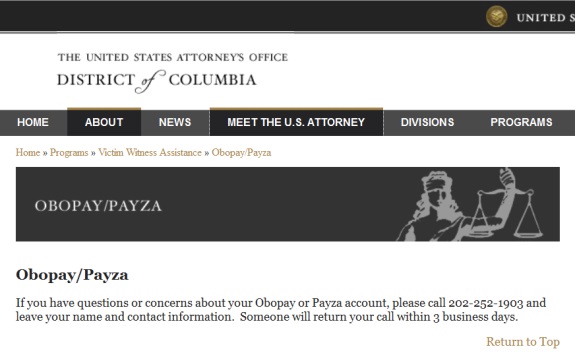
This note concerning Obopay and Payza is appearing on the website of U.S. Attorney Ronald C. Machen Jr. of the District of Columbia this morning.
EDITOR’S NOTE ADDED AT 10:09 A.M. Federal prosecutors in the District of Columbia now have confirmed that an investigation is under way, but declined to provide details. “The U.S. Attorney’s Office is involved in a pending investigation and we are unable to state the subject of the investigation or provide details,” the office of U.S. Attorney Ronald C. Machen Jr. said moments ago.
Original story below . . .
________________________________
The office of U.S. Attorney Ronald C. Machen Jr. of the District of Columbia (Washington, D.C.) did not immediately respond to a request for comment this morning on a note concerning Payza and Obopay that is appearing on its website.
The two-sentence note, which appears under a headline of “Obopay/Payza,” reads as such: “If you have questions or concerns about your Obopay or Payza account, please call 202-252-1903 and leave your name and contact information. Someone will return your call within 3 business days.”
A PP Blog reader reported the existence of the note at 8:58 a.m. today. How long the note had been posted was not immediately clear. Nor was it immediately clear why Machen’s office was involved in an Obopay/Payza matter.
Machen’s office, working with the U.S. Secret Service, successfully prosecuted the $119 million AdSurfDaily Ponzi scheme. ASD used AlertPay, Payza’s predecessor brand.
And Machen’s office, again working with the Secret Service, also successfully prosecuted the eGold payment processor.
Payza/AlertPay also were processors used by the alleged $600 million Zeek Rewards Ponzi- and pyramid scheme. The Secret Service also is investigating Zeek.
See Nov. 28, 2013, PP Blog post on conflicting reports concerning the unavailability of Payza funds in the United States.
This claim appears today on a website styled obopayusa.com. Precisely when it began to appear is unclear.
With Cyber Monday and the traditional online sales coming up a few days from now on Dec. 2, this is what we know: Payza, the successor brand to Montreal-based AlertPay, a Ponzi-forum darling and chronic HYIP- and fraud-enabler, suddenly says this in a headline on its Community forum: “US Funds Frozen | Obopay/Ultralight FS. issue.”
The announcement is dated yesterday, Thanksgiving Eve in the United States.
Today is Thanksgiving Day. U.S. government offices are closed. Black Friday, another day of brisk U.S. sales activity in which retailers cater to door-busting holiday shoppers, is tomorrow.
We also know that the U.S. government has established a tradition of taking down counterfeiting and piracy scams and their enabling websites on Cyber Monday. Moreover, we know that U.S. Immigration and Customs Enforcement (ICE), a division of the U.S. Department of Homeland Security, issued an alert two days ago that it is working with partners and “will be conducting increased operations during the holiday season targeting the importation and distribution of counterfeit and pirated products.”
Beyond that, we know that the United States — the U.S. Secret Service, ICE and other agencies — took down the Liberty Reserve payment processor over the 2013 Memorial Day holiday period and the U.S. Department of the Treasury identified Liberty Reserve as a “Financial Institution of Primary Money Laundering Concern.” The bust was announced on May 28, the day after Memorial Day.
Backing up a few years, we also know that AlertPay and SolidTrustPay enabled the $119 million AdSurfDaily Ponzi scheme and the $70 million Pathway To Prosperity fraud scheme — to name just two of many.
Meanwhile, we know that the court-appointed receiver in the Zeek case is going after money allegedly tied to Payza and SolidTrustPay. The most recent affirmation of this occurred on Nov. 14, when the receiver advised a federal judge that his efforts to gather $10 million from Payza “persisted” and that “new information has come in” that affects his analysis of Zeek-related Payza funds. Whether the $10 million sum would go up or down based on the new information was not revealed in the filing.
Analysis of “transactional data from Payza is not yet complete,” the receiver advised the judge. He also noted that the Payza funds were held in a “foreign bank account” in an undisclosed country. Based on its research, the PP Blog believes the country is in Eastern Europe.
We also know that AlertPay effectively became Payza in May 2012, even as Zeek was conducting auctions for U.S. currency and experiencing trouble with U.S. banks. Payza operates through a New York entity known as MH Pillars Inc., which in May 2012 announced the “recent acquisition of AlertPay’s existing online payment platform.” Payza also is associated with a U.K. entity known as MH Pillars Ltd. of London.
Thanksgiving Confusion
Although Payza’s headline uses the word “Frozen,” the text below it does not identify the party that purportedly froze the funds. At the same time, the text appears to be at least slightly at odds with the headline claim that the money was “Frozen.” Indeed, the text describes the funds as “withheld.”
Although the word choices may or may not be important, one thing seems obvious: Either word is apt to be unsettling to Payza’s U.S. customers who want their money.
“As you may or may not already know, we are unable to complete any requests to withdraw or transfer funds for a part of our U.S. members at this time, since they are being withheld [emphasis added by PP Blog] by Ultralight Financial Services (formerly known as Obopay Inc.) a licensed U.S. money transmitter of which Payza was an agent,” the announcement begins.
“We have tried to resolve this problem by contacting their management, their legal team and State regulators,” the announcement continues. “Their management and legal team were unresponsive. However, State regulators are willing to help us, but they have told us that they will not intervene unless they hear from you, the owner of your funds.
“In this case, Payza is asking all affected members to demand action from both Ultralight FS and your State regulator . . .”
At the time of this PP Blog post, the full Nov. 27 announcement is available at the Payza Community Forum. [See Update at bottom of this PP Blog post.]
These Thanksgiving Eve claims by Payza are at odds with other claims online.
In short, Payza seems to be saying that Ultralight/Obopay Inc. is responsible for its inability to serve U.S. customers because the entities either froze or withheld the money.
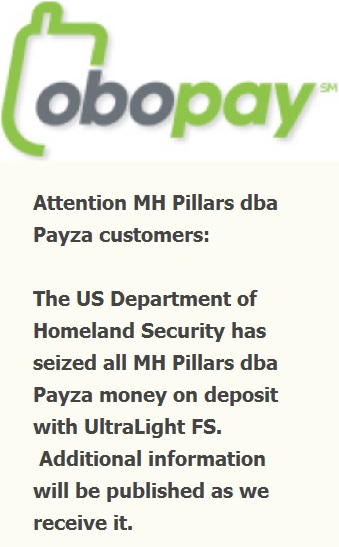
But here is where the information diverges and becomes even more fractious: At least two websites that state they’re associated with Obopay claim that “[t]he US Department of Homeland Security has seized all MH Pillars dba Payza money on deposit with UltraLight FS.” Both of these sites are cheesy in appearance. Both also have have copyright notices: One, styled obopayusa.com, says “Content copyright 2013. Obopay, Inc. All rights reserved.” The other, styled ultralightfs.com, says “Copyright @ UltraLight Financial Services. All rights reserved.”
Neither site says when the money purportedly was seized. Nor does either site say how much was seized.
So, the apparent obopay and UltraLight entities are saying the money was seized by the U.S. Feds. Payza is saying it was “frozen” or “withheld” by obopay/ultralight.
What’s the truth? Well, it’s unclear at this time.
There’s also a website styled obopay.com that appears to have the same logo as obopayusa.com. The obopay.com site asserts an association with Obopay Mobile Technology India Pvt. Ltd. of Bangalore and says its partners include Societe Generale, Essar Telecom Kenya Limited and Union Bank of India.
The obopay.com site appears to make no reference to Payza or MH Pillars, but does reference Obopay Inc. of Redwood City, Calif., as its parent company. When the PP Blog clicked on a “State License” tab at the bottom of the obopay.com site, however, it received this error message: “An error occurred during a connection to www.obopay.com. Peer’s Certificate has been revoked. (Error code: sec_error_revoked_certificate).”
So, another layer of the curious.
Searching the database of the Financial Crimes Enforcement Network (FinCEN), the PP Blog located a document that suggests Obopay Inc. of Redwood City, Calif., is a registered Money Services Business in all 50 U.S. states, plus the District of Columbia. FinCEN is an arm of the U.S. Treasury Department. Its stated mission is “to safeguard the financial system from illicit use and combat money laundering and promote national security through the collection, analysis, and dissemination of financial intelligence and strategic use of financial authorities.”
Information on MH Pillars Inc. of New York also appears in the FinCEN database. The information suggests the firm is a registered Money Services Business in at least 48 of the the 50 U.S. states. (California and New Hampshire appear to be possible exceptions.) MH Pillars also appears to be registered in venues such as American Samoa, the Federated States Of Micronesia, the Marshall Islands, the Northern Mariana Islands, Palau and the U.S. Virgin Islands.
It seems clear that both Obopay Inc. and MH Pillars Inc. are registered MSBs. Why, then, can’t U.S. Payza customers get their cash? Could it be because UltraLight isn’t registered? The FinCEN database appears to have no information on UltraLight.
But a Florida Department of State database does, and that information suggests Obopay Inc. is changing its name to ULTRALIGHT FS Inc. The Florida document is date-stamped Oct. 15, 2013. A phone number listed in the document comports with a phone number in Louisiana and Mississippi records as the number for Obopay Inc. of Mountain View, Calif. Like Redwood City, Mountain View is a Silicon Valley community.
Why FinCEN records show Obopay in Redwood City while state records show the enterprise in Mountain View was not immediately clear.
What does seem clear is that some or all of Payza’s U.S. customers can’t get their money and that whatever dispute exists between Payza and OboPay/Ultralight is about money that either was frozen/withheld by OboPay/Ultralight or seized by U.S. law enforcement.
Payza claimed in July 2012 to be cleaning up its act. This claim was made about a month prior to the August 2012 Zeek action by the SEC and an accompanying confirmation from the U.S. Secret Service that it also was investigating Zeek. Whether the Payza claim was just lip service remains to be seen.
When the United States took down Liberty Reserve, the Secret Service changed Liberty Reserve’s domain nameservers to a “sinkhole” URL at ShadowServer.org. This initially caused Liberty Reserve to go offline. When the domain returned, the logos/badges of the U.S. Department of Justice, the Global Illicit Financial Team, the Secret Service, the Treasury Department and Homeland Security Investigations were published on the site to let the world know that crime doesn’t pay in the United States.
Payza’s website loaded quickly this morning, with full Payza branding and services appearing. DNS settings appear not to have been altered, suggesting at least to this point that the domain has not been seized by the United States. Whether the United States intends to seize it now or ever is not known.
But seizing money is an altogether different matter. One of the ways to choke off HYIP and counterfeit-goods/pirating scams is to stop the fuel supply and to starve them out. If the United States desired to cripple criminal HYIPs and counterfeiting enterprises, it theoretically could attack them by seizing money that had been routed through Payza and the AlertPay predecessor.
Whether that’s what’s happening here remains unclear. At the same time, it would be catastrophically foolish for an enterprise such as Obopay or UltraLight (or some combination thereof) to attribute a seizure of Payza funds to the U.S. Department of Homeland Security if it were not true. It also would be catastrophically foolish for Payza to claim that Obopay/UltraLight froze or withheld the money from U.S. Payza customers if that were untrue or not the complete truth.
Seizure of money by the U.S. government requires a court order. Obopay/UltraLight either hasor has not received such a court order or notice that one was on the way.
If the United States has court-worthy evidence that Payza was facilitating online criminal enterprises, then it should become apparent in the coming days. If Obopay/UltraLight played any role, it also should become apparent.
It could be a very interesting Black Friday or Cyber Monday.
Update 7:31 p.m. Nov. 28: The original Payza announcement appears to have been removed this afternoon or this evening and replaced by this considerably shorter one. There’s also a post on the Payza Blog. It is dated today and titled, “Important Update: Limited Services for Certain U.S. States.” Those states are not identified in the Payza Blog post.
EDITOR’S NOTE: One way to read a report filed yesterday by the court-appointed receiver in the Zeek Rewards Ponzi-scheme case is as a warning manual that brings to life the kind of vexing problems HYIP schemes create for operators, vendors and participants — including “insiders.” Kenneth D. Bell’s report to Senior U.S. District Judge Graham C. Mullen of North Carolina strongly hints that the receivership has identified “key insiders.” Their names have not been published in court filings . . .
UPDATED 4 P.M. EDT (U.S.A.) Although early filings last year in the Zeek Rewards Ponzi scheme case suggested that offshore payment processors Alert Pay (Payza) and Solid Trust Pay held more than $40 million connected to Zeek, the court-appointed receiver has advised a federal judge that the two processors may hold even more than originally believed.
Both AlertPay and SolidTrustPay operate from Canada. Their names appear constantly in Ponzi-board promos for fraud schemes. The companies’ names also have appeared in court filings related to various HYIP schemes, including the alleged $72 million Pathway To Prosperity fraud in 2010 and the $119 million AdSurfDaily fraud in 2008.
In 2009, while the ASD case was still in the courts, some members of AdSurfDaily received mysterious “final refunds” from SolidTrustPay through an STP-connected email address of oceannamusic@xplornet.com. The purported pro rata refunds led to questions about whether some ASD members were benefiting at the expense of others while the case still was in the U.S. courts and whether ASD actually had money in SolidTrustPay under the name of a different company or a user other than President Andy Bowdoin. (See July 2009 post by PP Blog guest columnist Gregg Evans here.)
Later, an emerging scam known as JSSTripler/JustBeenPaid purportedly operated by former ASD pitchman Frederick Mann began to use the offshore processors — amid claims from JSS/JPB pitchmen that they not only were recruiting for JSS/JBP, but also managing both the JSS/JBP accounts of their sign-ups and the payment-processor accounts of the sign-ups.
Because HYIP schemes proliferate in part through the willful blindness of promoters and serial con artists, a situation has evolved over the years in which fraudulent proceeds circulate between and among scams and their individual promoters. “Alan Chapman,” a Zeek pitchman, also was promoting JSS/JPB and a follow-up scam known as “ProfitClicking,” for instance. Serial huckster “Ken Russo” also promoted Zeek and JSS/JBP — and many more schemes, including ASD and Profitable Sunrise, which the SEC described last month as a scam that may have gathered tens of millions of dollars.
But a new filing by Kenneth D. Bell, the Zeek receiver, suggests that the receivership may seek to foreclose any after-the-fact opportunities for offshore processors to duck their responsibilities to the receivership estate and for holders of the offshore accounts to benefit from Zeek after the SEC brought spectacular allegations of Ponzi- and pyramid fraud against Zeek in August 2012.
Zeek, the SEC said last year, was a $600 million fraud scheme that used at least 15 foreign and domestic financial institutions.
A forensic accounting has led Bell to believe that “both Payza and SolidTrustPay may have additional Receivership assets.”
In a report to Senior U.S. District Judge Graham C. Mullen, Bell said he is working “to investigate and seize these funds.”
And, Bell advised Mullen, “[t]o the extent these entities allowed affiliates to withdraw funds after receiving notice of the Receivership, the Receiver may seek reimbursement of indemnification for the funds from the payment service providers.”
If Bell somehow is able to foreclose chicanery involving serial Ponzi pitchmen and the scamming insiders with offshore accounts, it could go a long way toward minimizing the spread of fraud schemes over the Internet.
Bell’s April 30 filing also reveals that the receivership has recovered $291,000 from a “merchant services account reserve” that had been held by American Express for Rex Venture Group, Zeek’s parent company. At the same time, it reveals that Bell — to date — has recovered $36,000 from Zeek net winners in prelitigation settlements. That number may grow. The deadline to enter into negotiations for a prelitigation settlement is May 31.
More than anything, though, Bell’s report to the court showcases the enormous problems created by HYIP schemes. Among the problems outlined in the filing:
Potentially costly and time-consuming litigation disputes for all parties. Zeek operator Paul Burks is claiming privilege on certain matters. Some Zeek “winners” have filed motions that could slow down the refund process for Zeek victims at large.
Taxes: Zeek appears to have misclassified certain employees as independent contractors, which has tax ramifications.
Incomplete records. Because of poor records at Zeek, some members who received 1099 tax forms from the receivership received forms that showed earnings either higher or lower than actual earnings. The receivership has prepared amended 1099s for certain Zeek members.
Possible disputes with vendors. Bell’s report noted that USHBB Inc. asserted it was owed $878,856 by Zeek. USHBB produced video promos for Zeek. In September 2012, the PP Blog reported that Zeek once listed USHBB executive OH Brown as an employee. Meanwhile, USHBB once produced videos for a collapsed MLM scheme known as Narc That Car.)
Clawback litigation: In the absence of settlements, the receiver potentially could file actions that involve thousands of Zeek affiliates in possession of ill-gotten gains from the scheme.
From a post Friday at the Payza Blog at the close of U.S. business hours in the East. Companies sometimes make announcements late on Fridays to minimize PR fallout. Payza's announcement may put it at odds with customers who populate well-known forums whose members push HYIP and other scams that help fraud spread globally on the Internet
EDITOR’S NOTE: Payza seems to have taken an important step Friday in the battle against online fraud. The payment-processing company perhaps deserves an accolade for that. But it’s too soon to heap praise on Payza. We are particularly concerned about the phrasing of a specific line in Payza’s altered User Agreement. More on that below . . .
** ___________________________________ **
UPDATED 7:29 A.M. EDT (JULY 17, U.S.A.) Is Payza, the payment processor operating in Canada that recently changed its name from AlertPay, finally doing the right thing?
Or is it just lip service?
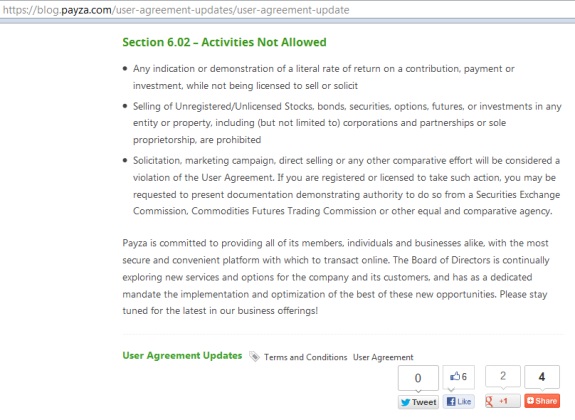
Payza has announced on its Blog that it is banning programs that show “[a]ny indication or demonstration of a literal rate of return on a contribution, payment or investment, while not being licensed to sell or solicit.”
Notice the phrasing (emphasis added): “any indication of a literal rate of return . . .”
What, precisely, does Payza mean? That expressing a literal return rate no longer is OK, but all can be cured if Payza’s current HYIP purveyors and Ponzi-board hucksters hide veiled or direct references to the return (perhaps in the back offices of HYIP affiliates or someplace else out of view of the public and search engines) or somehow find a word combination that avoids a literal expression of a return and instead relies on a deeply couched expression?
This is an important question because the HYIP “industry” cannot exist without the financial vendors that enable it, either by turning a blind eye or choosing not to peel back a single layer of the onion because choosing to see is bad for profits.
The last thing the “industry” needs is an invitation to become even more clandestine in its dealings, even more clever in its use of linguistic deception, information suppression or outright misinformation. The threat to individuals and the world’s financial infrastructure posed by con men and teams of accomplices in the thousands or hundreds of thousands already is untenable.
Payza needs to reassess its use of the phrase “literal rate of return.” Left untouched, that phrase easily could turn what’s already a dangerous, wink-nod “industry” into even more of one, thus providing scammers a new back door and actually making the problem of international financial chicanery on the Internet even worse.
Because AlertPay basically chose for years to gorge itself on HYIP fees and not to take the clues offered by the prosecution of e-Gold in the United States (by members of the same team that prosecuted the AdSurfDaily autosurf HYIP, BTW) and the disintegration of e-Bullion (while its operator stood accused of arranging the brutal contract slaying of his wife, a potential witness to e-Bullion’s Ponzi-sustaining fraud), we cannot yet offer Payza three cheers.
Owing to AlertPay’s history of choosing in e-Gold and e-Bullion-like fashion to see no evil, we question whether use of the word “literal” is just a means of signaling the scammers to do a better job of using language to disguise an investment program as something else or to hide and/or otherwise bury language that speaks to the investment elements. In the past few weeks, for example, the Payza-dependent JSS Tripler/JustBeenPaid “program” suddenly changed the language on its home page to say it offers a “LEGALLY COMPLIANT & PATENTED SYSTEM.”
Let’s pause for a moment to state the obvious, something that somehow often gets overlooked by HYIP apologists: Real people — living, breathing human beings — are being sucked into these utterly contemptible “programs” that are being enabled by processors such as Payza and SolidTrustPay.
And suddenly — out of the blue — JSS/JBP announced it was using a “WORLD RENOWNED LAW FIRM” to assure compliance. These things bizarrely clashed with recent claims by Frederick Mann, the purported operator of JSS/JBP, that attorneys could not be trusted, that government employees weren’t welcome in the “program,” that registering with securities regulators was a sign “you’ve signed up to be a slave, part of the slave system, and then they have jurisdiction over you and can shut you down” and that JSS/JBP members had nothing to fear because the “program” had no presence in the United States.
Now, all of a sudden, JSS/JBP has found the religion of compliance — or at least the language of the religion of compliance.
The New Religion Of Compliance
The Payza-dependent Zeek Rewards MLM “program” also is preaching the religion of compliance, even as it plants the seed that it can provide a JSS/JBP-like annual return of between 365 percent and 730 percent without being the Bernard L. Madoff Investment Securities LLC of multilevel marketing.
Part of what Zeek appears to be doing falls along the lines of not expressly stating a literal return. Welcome to the world of vomitous MLM in the year 2012. The players are eager to tell you what they’re not, less eager or completely unwilling to tell you what they are, and can bring a virtually unlimited supply of Stepfordians to the fore to help them cloud the issues.
Zeek has told the public it is not a “pyramid scheme.” It now says it will ban members who describe the “opportunity” as an investment program, despite the seed Zeek plants that participants can earn a return of between 1 percent and 2 percent a day. Some Zeek affiliates are practically tripping over themselves these days in what strikes us as a bizarre race to see how many times they can fit the words “attorneys” and “compliance” in their forum “defenses” for Zeek.
This Blog has not seen one instance in which a Zeek attorney has described the “program” as legal. Even so, we’ve seen plenty of examples in which Zeek affiliates implied that attorneys had given Zeek the all-clear and at least a few examples in which affiliates implied that agencies such as the SEC and FTC had scrubbed Zeek for compliance and found it in fine fettle. There have been hugely disingenuous claims from Zeek affiliates in this area — everything from describing the lack of any action against Zeek by the SEC or FTC as evidence that the agencies had examined Zeek and found nothing lacking to planting the seed that the lack of any action by the agencies is proof that Zeek is operating lawfully.
Zeek itself played this miserable game. In June, a North Carolina television station carried a report that suggested Zeek had been found to be operating lawfully by the office of North Carolina Attorney General Roy Cooper. Zeek linked to the TV station’s video report on its news Blog and certain Zeek promoters pointed to the report as proof of Zeek’s legitimacy.
But Cooper’s office said it never said Zeek was operating lawfully. After the TV station was contacted by Cooper’s office, which was concerned about the clarity and accuracy of the video report, the station removed the report. The incident produced one of those awkward moments that too often accompany the MLM trade: Zeek plainly liked the TV report because it construed Zeek as operating lawfully. The report then became a tool in Zeek’s PR arsenal — and Zeek wanted to make sure its affiliates had the same tool. It used its Blog to point affiliates to the video, and some of them predictably used it as evidence the Zeek critics were wrong and to plant the seed that Zeek had passed muster in North Carolina.
By linking to the report, Zeek tried to maximize its PR hand. When the report was removed, Zeek had nothing to say. The post on Zeek’s news Blog in which the company originally crowed that “Zeek Makes the Channel 2 News” now has been removed. Although the precise date and time in which Zeek removed the post are unclear, a Zeek affiliate with his own Blog sought to capitalize on the TV station’s report in a post that still remains.
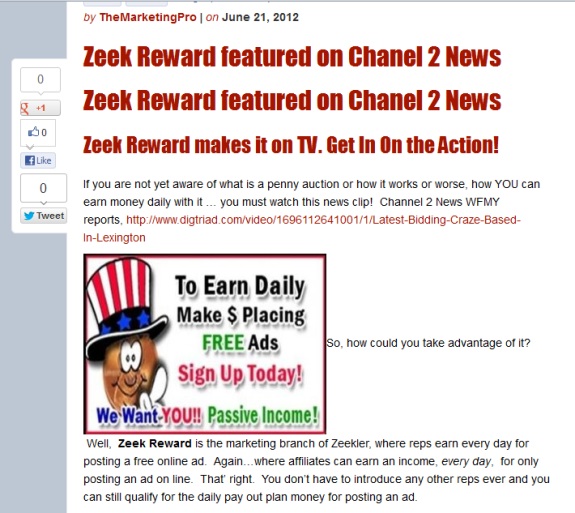
That post featured a three-tiered headline that screamed, “Zeek Reward [sic] featured on Chanel [sic] 2 News[.] Zeek Reward [sic] featured on Chanel [sic] 2 News[.] Zeek Reward [sic] makes it on TV. Get In On the Action!”
This post on the "Empower Network" Blog of a Zeek affiliate included a three-tiered headline and a link that pointed readers to a TV station's report about Zeek. Like Zeek itself, the "Empower Network" is an MLM "opportunity."
The affiliate’s post included a graphic that described Zeek as a “Passive Income!” opportunity. One link on the site pointed to the now-removed TV station video. Another link, however, pointed to post that included a YouTube version of the TV station’s report. That YouTube report included a headline and “crawler” in a language other than English.
Like the post that included the three-tiered headline about Zeek’s TV appearance, the second post included the graphic that described Zeek as a “Passive Income!” program. The claim about passive income speaks to the heart of the issue of whether Zeek is selling unregistered securities as investment contracts and trying to disclaim its way out of an encounter with regulators.
Although a TV station took down its link to a video report on Zeek, a YouTube version apparently existed.
The Culture Of Willful Blindness
Confusing messages appeared repeatedly when the AdSurfDaily Ponzi case was playing out. All of it was monumentally embarrassing to MLM. In one instance — while it was awaiting a key ruling from a federal judge in October 2008 on whether it had demonstrated it had sufficient income and was not a Ponzi scheme at a hearing it requested and the judge granted in the interests of justice — ASD insiders leaked a story that ASD expected a revenue infusion of $200 million from a penny-stock company.
The ASD Stepfordians immediately raced to forums to spread the good news. But skeptics immediately questioned the claim, pointing out that Praebius Communications — the penny-stock firm that supposedly was going to provide ASD a $200 million injection — did not even publish audited financials. SEC records later showed that, in October 2008, the same month ASD was awaiting the court decision and claiming a new $200 million was coming on board, Praebius stock was being pumped in a fraudulent-touting scheme.
Over time, serious questions were raised about whether certain MLMers within ASD were engaging in bids to obstruct justice. Rumors were planted that federal prosecutors had secretly admitted ASD was not a Ponzi scheme but were clinging to the case as part of a bid to save face. In 2008, ASD members who did not even question the bizarre claims coming from ASD or ASD insiders raced to forums and spread a false report that Ponzi charges had been dropped against ASD in Florida. That development prompted the attorney general of Florida to issue a statement that, not only had Ponzi charges not been dropped against ASD in the state, they’d never been brought to begin with. Indeed, Florida charged ASD with operating a pyramid scheme.
The names of both AlertPay and SolidTrustPay appear in court filings in the ASD Ponzi case. It is hardly coincidental that both Zeek and JSS Tripler/JustBeenPaid also have ties to the same processors, which are offshore from a U.S. perspective. These processors are the e-Golds and e-Bullions of Canada. They also are referenced in the Pathway to Prosperity Ponzi case, which the U.S. Postal Inspection Service called a global fraud affecting 40,000 people from 120 countries. In December 2010, the federal prosecutors handling the ASD case made the first public filing that referenced e-Bullion in the context of ASD.
In 2011, e-Bullion operator James Fayed was convicted of arranging the contact slaying of Pamela Fayed, his estranged wife who was found slashed to death in a Los Angeles-area parking garage. There is absolutely no doubt — zero — that e-Bullion was enabling Ponzi schemes. James Fayed has been sentenced to death for arranging the brutal killing of his wife, a potential witness against him.
It is beyond the pale — and almost beyond belief — that certain MLMers continue to insist there is something noble about these miserable money games, that they somehow represent the best of the free market and the entrepreneurial spirit, that they’ve somehow succeeded where other MLMs have failed.
What they are are recipes for financial and personal destruction that operate as slow-motion Ponzi schemes. They need to be destroyed, not duplicated. Far from being exciting, new niches — as some MLMers tell the story — they are form-shifting monsters that spread the greatest financial cancers devised in the history of mankind. They are so dangerous that external fraudsters target them as a means of unloosing secondary frauds — everything from the issuance and passing of bogus checks to organized credit-card fraud. Some of them have been linked to narcotics-trafficking or money-laundering operations. Some of the investigators who assisted in the ASD Ponzi case also developed this case.
From our May 16, 2010 report on the EMG/Finanzas Forex case (italics added):
Research by the PP Blog suggests the purported investment program was so sordid that promoters even claimed some of the funds were being used for the “humanitarian” purpose of assisting kidnapping victims in Colombia. In a sickening display of marketing theatrics, a claim was made that investors could “adopt” kidnapping victims for a payment of $1,000 and that the company would set aside $500 in corporate funds for each victim so that their families could have bright futures if the victims ultimately were released by their captors . . .
The HYIP scheme allegedly was associated with an entity known as Evolution Market Group (EMG), which purportedly had a Forex component known as FinanzasForex. Investigators alleged in January that there were schemes within schemes in a tangled web of domestic and international deception that featured dozens of bank accounts, shell companies and various fronts for money-laundering enterprises, including companies purportedly in businesses such as real estate and car washes.
The scheme was so corrupt, according to court filings, that some investors were told that, in order to leave the program whole, they had to recruit new investors, have the new investors pay them directly — and use the proceeds from the new investors to “recover” their initial outlays . . .
A Glimmer Of Hope
We do find a glimmer of hope in Payza’s announcement because Payza’s use of the phrase “any indication” implies it actually intends to exit the fraud-enabling business and intends to protect its reputation moving forward and make it harder for viral scammers who use its service to rob people without the aid of a gun.
A return — plainly stated or implied — would seem to fall under the “any indication” umbrella. Another indication is the presence of a “program” on the Ponzi boards. (Like ASD and EMG/Finanzas Forex, Zeek and JSS/JBP have a presence of the Ponzi boards.)
Yet another indicator of fraud is disclaimer language that seeks to cloud regulatory issues by planting the seeds that payouts are not guaranteed and that joining a “program” with a plainly stated or implied return does not constitute making an investment.
Much of the HYIP fraud “industry” exists because of the wink-nod deal and the willful blindness of the purveyors, including serial scammers with global reach and payment processors that gorge themselves on fees while serving what effectively are criminal combines consisting of like-minded individuals and “teams.”
Also banned, according to the Payza Blog post, is the the “[s]elling of Unregistered/Unlicensed Stocks, bonds, securities, options, futures, or investments in any entity or property, including (but not limited to) corporations and partnerships or sole proprietorship . . .”
Meanwhile, Payza says this (italics added):
“Solicitation, marketing campaign, direct selling or any other comparative effort will be considered a violation of the User Agreement. If you are registered or licensed to take such action, you may be requested to present documentation demonstrating authority to do so from a Securities Exchange Commission, Commodities Futures Trading Commission or other equal and comparative agency.”
Language in the full, six-paragraph announcement is exceptionally formal, bordering on the florid. But if the aim is for Payza to say no to fees and wrest itself from the wretched, pain-producing universes of HYIPs, autosurfs, cycler matrices and other “programs” that reach across national borders and fleece people on a global scale, the ornate language will become only a tiny footnote.
What’s far more important is that Payza will have said no to the scammers and a subculture of eager, greedy pitchmen who help financial crime spread globally and line their pockets on the current (or pending misery) of their marks.
It is possible these days for a scammer hiding in the darkest corners of the Internet to pick the pocket of a “customer” and contribute to a mortgage foreclosure or even the failure of a bank a continent away. Such “programs” often are pushed in the purported name of freedom itself, as a purported means of helping a neglected Everyman escape the shackles of poverty and become a free man who’s escaped his tyrannical captors.
But because the scammers’ schemes constantly evolve and because they often rely on overblown prose to disguise the fraudulent nature of their “programs,” it is going to take more than just words from Payza to incorporate any real change.
For example, could an “opportunity” that simply comes up with different naming conventions and avoids the traditional language of investments fool the checkers at Payza? Or could an “opportunity” that shields Payza from information perhaps by publishing it only in the back offices of the “opportunity’s” members escape scrutiny?
And because HYIPs and their willfully blind, serially disingenuous promoters already are infamous for wink-nod presentations, the use of disclaimers and even outright denials that an investment program of any sort is being offered, will the criminal minds who dominate this cancerous space go into overdrive to come up with new and more clever ways to disguise fraud schemes?
What To Watch For
Will panic engulf the HYIP sphere because of the Payza annoucement? Here are some things to look for:
Masked investment “programs” — perhaps aware they are under scrutiny — taking once-public forums offline and engaging in bids to further compartmentalize information and scrub negative information.
Management and affiliates of such “programs” making veiled or direct references to “attorneys” and “compliance” as a means of suggesting they are wholly lawful and embrace responsible corporate citizenship.
Increased lead times between “program” payment cycles, perhaps initially explained away as “growing pains.”
Payment bottlenecks to develop as “programs” horde cash or cash equivalents and become fearful that once-reliable enablers are hopping off the wink-nod fraud train because they realize the real world no longer is going to tolerate international lawlessness so a scammer on the TalkGold or MoneyMakerGroup forums can get rich by picking the pockets of senior citizens, deaf people, the unemployed and the struggling. (Also known as the AdSurfDaily problem.)
An uptick by scammers in the use of floridspeak as a means of talking around serious legal issues and masking the investment elements of a “program.”
The creation of bogus “regulatory agencies” and “trade groups” to create the appearance that a responsible party with legal authority is monitoring the store. (Note: A bogus regulator was an element of the George Theodule Ponzi scheme in Florida.)
The sale of purported memberships in these purported “regulatory agencies” and “trade groups.”
Read the Payza post, which was made Friday at the close of traditional business hours in the Eastern United States.
 More lawsuits against international “winners” in the Zeek Rewards cross-border Ponzi-and pyramid-scheme case are coming, receiver Kenneth D. Bell has advised a federal judge.