Tag: SEC

  • SPECIAL REPORT: How The SEC Silently Squared Off Against ‘Achieve Community’ In The Days Leading Up To The Asset Freeze

    EDITOR’S NOTE: The personnel information in the first section below is gleaned from public records in the SEC’s pyramid- and Ponzi case against the “Achieve Community” and alleged principals Kristi Johnson and Troy Barnes. Some of the numbered points include additional notes by the PP Blog. These notes are based on public records or information in the public domain, including a Feb. 18 statement by the SEC.

    **___________________**

    achieveexhibitdThe U.S. Securities and Exchange Commission announced on Feb. 18 it had filed a pyramid- and Ponzi complaint that alleged securities fraud against “Achieve Community” and that a federal judge had granted an emergency asset freeze.

    Supporting documents filed by the SEC paint a picture of significant legwork that took place at the agency as it studied how Achieve had evolved from its alleged start in April 2014 through the days immediately prior to the freeze. This column focuses on human assets, the public servants who played a role in stopping the harm caused by Achieve by applying their individual specialties.

    The SEC assigned (at least) the following individuals to the case prior to filing a complaint under seal against Achieve and requesting an emergency asset freeze on Feb. 12:

    1.) An IT specialist assigned to the Division of Enforcement in Washington, D.C. This person performed website/video-capture duties involving public sections of two Achieve sites (TheAchieveCommunity.com and ReadyToAchieve.com) and at least one YouTube video. (Longtime readers will recall the 2012 Zeek Rewards probe that led to spectacular allegations of pyramid-and Ponzi fraud also involved website capture.)

    2.) A senior paralegal employed by the Division of Enforcement and assigned to the SEC’s Denver Regional Office. This person reviewed and transcribed 11 Achieve-related public video files and one public audio file. Some of the video files were on the Achieve sites. Others were on YouTube. The audio file was on the Achieve site.  (A segment of a transcript shown a federal judge from the audio file shows “Rodney” serving up softball questions to Kristi Johnson and Troy Barnes, Achieve’s accused operators. The segment was on the topic of Achieve’s purported “triple algorithm.” It is referenced in “Exhibit D.” The screen shot that introduces this column is from a pdf of Exhibit D. More from Exhibit D appears in the form of a screen shot below.)

    3.) An attorney/investigator employed by the Division of Enforcement at the SEC’s Denver Regional Office. This attorney reviewed web sources of information on Achieve, bank statements and source material provided by Achieve vendors, including FirstBank and Payoneer. He filed a 28-page declaration in advance of the asset freeze. This document distilled key pieces of evidence from Achieve sales pitches and financial records, calculating that investors had directed at least $3.829 million to Achieve and that Johnson and Barnes had taken “a minimum” of $336,975 “of investor funds.” (That’s roughly 9 percent, a circumstance that suggests Achieve’s Ponzi was digging a deeper and deeper hole.)

    4. Two other SEC attorneys assigned to the Denver office. These attorneys brought the 17-page complaint against Achieve that alleged Achieve had “no legitimate business operations” and that “the sole source of repayments to earlier investors is funds contributed by newer investors.” (Though not referenced on the court docket of the Achieve case, the SEC, in a Feb. 18 public statement, confirmed a fourth agency attorney is involved in the probe.)

    5. An SEC staff accountant employed by the Division of Enforcement and assigned to the Denver office. This person has been with the SEC for 20 years and examined and summarized records from at least five Achieve-related bank accounts, including “underlying detail” such as account-opening forms, statements, checks, wire transfers and deposit slips. (No criminal wrongdoing has been alleged and it is unclear if a criminal investigation is under way, but this information shows that the SEC, in part, halted Achieve the same way Internal Revenue halted Al Capone: with an accountant’s skill and experience in understanding numbers and tracking money flow. The same SEC accountant was involved in the memorable prosecution of recidivist con man Larry Michael Parrish, accused in 2011 of going to a Colorado hospital room to swindle a man dying of cancer.)

    6. An SEC financial economist who holds a Ph.D in economics from the Massachusetts Institute of Technology. (This individual also studied in Chile and the Dominican Republic. She is a native speaker of Spanish, is fluent in English and also understands French. Based on her CV, I wouldn’t describe her as a secret weapon. But I do note that her international experience in areas that know poverty is a bonus, given that so many HYIP/Ponzi-board scams are targeted at people of limited means or people desperate for a positive economic result. Her MIT dissertation was titled, “Essays on Entrepreneurship” and was based in part on “survey data on the portfolios of U.S. families to study the tightness of borrowing constraints for entrepreneurs.” This may be important in context, because some Achievers already are making the absurd claim the SEC stands in opposition to entrepreneurship. One Achiever has claimed the agency’s Achieve action was a “systemic destroy tactic.” The same person has suggested the 9/11 terrorist attacks were a “false flag set up,” repeating a conspiracy theory that bizarrely accompanies just about any action that U.S. government takes against an HYIP scheme.)

    Friends, Ponzi schemes are fraud per se — that is, they exist for no other reason than to commit fraud by theft. In the Internet Age in the network-marketing sphere, they have become organized schemes to defraud that are capable of involving thousands, hundreds of thousands or even millions of people. There is no such thing as a benevolent Ponzi scheme or a Ponzi scheme with “good intentions.”

    Creating legions of victim-investors is only part of the problem.

    The SEC’s supporting documentation suggests Achieve itself polluted the commerce stream at at least nine points of contact: three banks, one credit union, four payment processors and one brokerage firm. This number does not take into account the fact that some Achieve participants were issued debit cards onto which their “earnings” were loaded, thus putting any number of financial institutions in the position of becoming either dispensaries or warehouses for fraud proceeds.

    At least one Achieve promoter recorded a video of himself offloading Achieve money at an ATM in Hawaii. The SEC says bank records indicate Johnson gave $10,000 to a church, a circumstance that suggests the church came into possession of tainted funds.

    Prior to filing the Achieve action, the SEC says in supporting filings, the agency did not contact “any” Achieve investors. Nor did it subpoena Achieve for information or personally view information in the private areas of Achieve’s websites.

    Why not?

    Because there was a “need to not alert Defendants of the investigation,” the SEC said in supporting materials. Beyond that, the agency said, “if investors were alerted to the SEC’s investigation, they would quickly disseminate that information to other TAC investors, as well as Defendants, which could risk additional dissipation or misappropriation of investor funds.”

    An Outtake From The Paralegal’s Transcription

    Image source: U.S. court filings.
    Image source: pdf from U.S. court filings by the SEC.

    The next section of the PP Blog’s Special Report seeks to anticipate and then answer questions Achieve members may have. The answers are gleaned from supporting documents the SEC provided a federal judge as part of the process of bringing the Achieve complaint and seeking an emergency asset freeze. This section includes some commentary/analysis by the PP Blog.

    Q: When did the SEC open its investigation into Achieve?

    A: At least by January 2015. The specific date is unclear.

    Q: Did the SEC receive tips about the operations of Achieve?

    A: Yes. The number of tips and the identities of persons who provided them are not disclosed.

    Q: Prior to the Feb. 12 asset freeze, did Achieve know it was under investigation by the SEC?

    A: The agency said it did not advise Achieve of the probe. However, Kristi Johnson knew at least by Jan. 13 that the Colorado Division of Securities, the state-level regulator, was asking questions about Achieve, according to the SEC. On that date, the Division learned in an “interview” with Johnson that Achieve did its banking at FirstBank. The Division shared this information with the SEC. By Feb. 2, the SEC had obtained Achieve’s banking records. The SEC accountant then began to examine the records, sharing information with the SEC attorney/investigator.

    Moreover, the SEC has alleged Johnson is a former “registered representative.” With experience in the securities industry and with Achieve already under investigation by a state regulator, Johnson must have contemplated that the SEC was hot on the Achieve trail. The SEC alleges she lives in Aurora, Colo. That’s only about 25 minutes away from the agency’s regional headquarters in Denver. It goes without saying that the SEC is particularly unfriendly to Ponzi schemes, perhaps particularly ones operating in its own back yard.

    Q: Why the asset freeze?

    A: Direct quote from SEC filings: “In light of the egregiousness of Defendants’ conduct, the ongoing and active Ponzi scheme, Defendants’ increasingly desperate attempts to make Ponzi payments and misappropriate investor funds, and the concern that Defendants will dissipate or misappropriate the remaining investor funds if they become aware of this action prior to the entry of the requested order, the Commission respectfully requests that the Court grant ex parte relief freezing the assets of Defendants and Relief Defendant, prohibiting them from soliciting additional investors or otherwise continuing their fraudulent scheme, and ordering other relief to ensure a prompt, fulsome, and fair hearing on Plaintiff’s motion for a preliminary injunction.

    “Absent an order granting such emergency ex parte relief, there is no reason to think Defendants’ fraudulent scheme, and their misappropriation and dissipation of the remaining investor funds, will cease, or that there will be any funds available to compensate investor victims at the conclusion of this litigation.”

    Q: What did the SEC accountant discover?

    A: Plenty, including banking records pertaining to this Achieve International LLC check for $90,000 made achievecjcheckpayable to “Cash” on Jan. 8, 2015. (Note: The check is dated Jan. 8, 2014, but that’s a new-year mistake. The banking records themselves note the correct date. The black redactions appear in a pdf of an SEC evidence exhibit. The PP Blog added the red redaction in this screen shot from the pdf. The $90,000 allegedly ended up in Kristi Johnson’s personal account at the Credit Union of Colorado.)

    An SEC attorney/investigator who reviewed the accountant’s work across multiple Achieve-related bank accounts alleged in a declaration to the court that the “bank records indicate that on at least thirteen occasions, Johnson went to a FirstBank branch and withdrew cash in the form of currency, or cash in the form of a check written to ‘cash.’  Virtually all of thee funds ended up in an account at the Credit Union of Colorado . . . that is Johnson’s personal account.” Such transactions involved $153,300.

    Q: Will I get my money back or a percentage of it from Achieve?

    A: Possibly. How that would occur is unclear. No receiver has been appointed. The SEC investigation is ongoing.

    Q: Will Achieve “winners” be treated like Zeek Rewards “winners” — i.e., sued for return of the funds?

    A: Too soon to tell. The SEC investigation is ongoing. An ongoing investigation sometimes means an amended complaint or additional complaints will be filed that names additional defendants or “relief defendants” — those in alleged possession of ill-gotten gains.

    Q: I’ve read online that the best practice with these programs is to throw in my stake with affiliates promoting them on YouTube and Facebook. These purported experts also say not to risk more than I can afford to lose and to quickly remove my “seed money” to create a situation that I’m only playing with “house money” — “profits” from the scheme. What am I to believe?

    A: Believe the SEC and FINRA. They have been warning about fraud schemes that use social media for years. The receiver in the Zeek Rewards case has raised concerns that “serial” promoters are moving from one fraud scheme to another. At least four promoters of the TelexFree scheme have been charged with securities fraud by the SEC.

    NOTE: Our thanks to “NikSam” at RealScam.com and to the ASD Updates Blog.



  • BULLETIN: Zeek Receiver Sues Alleged ‘Winners’ In Norway

    breakingnews72BULLETIN: (5th update 8:31 p.m.) Zeek Rewards receiver Kenneth D. Bell has sued more than a dozen alleged “winners” with residencies in Norway. These are believed to be the first cases against defendants in Europe. Bell previously has sued U.S. residents and residents of Australia, New Zealand, Canada and the British Virgin Islands.

    As is the case against other clawback targets, Bell contends Norwegian defendants must return their Zeek hauls because they “won” money from victims “in an unlawful combined Ponzi and pyramid scheme.”

    The alleged Norwegian defendants were identified as:

    • Geir Vidar Pleym, Oslo, $256,917.29.
    • Roger Guldahl, Halden, $200,271.51.
    • Anne Liv Dale, Kristiansand, $158,896.14.
    • Fredrik Skjoldt, Oslo, $97,694.27.
    • Robert Ulvberget, Elverum, $72,569.11.
    • Stian Alexander Karlsen, Oslo, $65,000.94.
    • Pia Cecilie Fore, Heggedal, $62,115.13.
    • Knut Fore, Asker, $60,436.49.
    • Fredrik Harald Skjoldt, Oslo, through CMS Huset AS, an alleged shell company, $57,586.54. (Note: “individually or collectively with Morten Skaar.”)
    • Morten Skaar, Oslo, through CMS Huset AS, $57,586.54.
    • Odd Steinar Nordlien, Faaberg, Lillehammer, $55,019.09.
    • Anne-Mette Helland, Mandal, through Vita-min AS, an alleged shell company, $53,428.51.

    Zeek is alleged to have gathered on the order of $897 million in less than two years of operation. It was shut down by the SEC in August 2012.

    The case against the Norwegian defendants is filed in U.S. District Court for the Western District of North Carolina.

    Just yesterday the SEC announced it had charged a “program” known as “Achieve Community” with operating a combined pyramid- and Ponzi fraud that had gathered more than $3.8 million in less than a year of operation. No receiver has been appointed in that case, which remains under investigation.

    NOTE: Our thanks to the ASD Updates Blog.

  • URGENT >> BULLETIN >> MOVING: SEC Charges ‘Achieve Community,’ Troy Barnes, Kristi Johnson; Federal Judge Approves Asset Freeze

    achievecomplaintURGENT >> BULLETIN >> MOVING: (17th update 3:07 p.m. ET U.S.A.) The U.S. Securities and Exchange Commission has charged “Achieve Community” (as Work With Troy Barnes Inc.) and alleged operators Troy A. Barnes and Kristine L. Johnson with operating a combined pyramid- and Ponzi scheme that raised more than $3.8 million. A federal judge in Colorado has ordered an asset freeze and granted a temporary restraining order.

    “Johnson and Barnes allegedly claim to be operating a successful investment program when in fact they are taking funds from new investors to pay phony profits to earlier investors,” said Julie Lutz, director of the SEC’s Denver Regional Office.

    Achieve’s internal structure is part of the probe.

    “Johnson is one of the two founders of TAC, and handles the majority of TAC’s finances,” the SEC charged. “Johnson is an authorized agent of WWTB and has acted as the sole signatory on at least three bank accounts that she opened in the name of WWTB.”

    Meanwhile, the Colorado Division of Securities confirmed minutes ago that it was working with the SEC on the Achieve probe.

    We continue to have our own open investigation regarding possible violations of the Colorado Securities Act,” said Lillian Alves, Colorado’s Deputy Securities Commissioner. “The factual basis of our investigation parallels that of the SEC case.”

    In a 17-page complaint that was filed under seal on Feb. 12, the SEC described the Achieve Community as a “pure Ponzi and pyramid scheme” whose revenue “has consisted entirely of investor-contributed funds.”

    “Johnson and Barnes have made no effort to generate profits from any legitimate business operations from which they could repay earlier investors,” the SEC charged. “Instead, the sole source of repayments to earlier investors is funds contributed by newer investors.”

    The Feb. 12 filing date likely means that Achieve still was trying to raise money even as the SEC was in court to request an emergency asset freeze. On Feb. 12, a Barnes-narrated video appeared on YouTube. The 11:06 video was titled “Thursday Update 2 12.” The video provided Achieve members instructions on how to register for a purported new payment processor.

    By Feb. 14, Achieve members were quoting a forum post attributed to Barnes that Achieve’s assets had been frozen. Whether a criminal probe is under way is unclear.

    Barnes is 52. He resides in Riverview, Mich., according to the complaint. Johnson, known as “Kristi,” is 60. She resides in Aurora, Colo.

    Johnson also is associated with an entity known as “Achieve International LLC,” which has been named a relief defendant as an alleged recipient of funds from the fraud.

    “Johnson formed Achieve International as a Colorado entity, is an authorized agent of Achieve International, and, on information and belief, is the sole member, and managing member, of Achieve International,” the SEC said. “Johnson has acted as the sole signatory on at least one bank account that she opened in the name of Achieve International. Johnson is a former registered representative, and was last associated with a registered entity in 1996.”

    Some Achieve members have described Johnson as a “former stockbroker.” The SEC’s allegation that she is a former registered representative may be particularly problematic for her, leading to troubling questions about whether she simply ignored the very real possibility that the SEC would do exactly what it did: charge her with securities fraud and allege she and Barnes made “material misrepresentations and omissions” about the nature of Achieve.

    The SEC accuses both Johnson and Barnes of misappropriating funds sent in by Achieve investors.

    From the complaint (italics added/light editing performed):

    In addition to making Ponzi payments to investors, Defendants have misappropriated investor funds for Johnson and Barnes’ own personal use.

    On more than a dozen occasions, Johnson made significant cash withdrawals or wrote checks to “Cash” from the WWTB and Achieve International accounts, and made corresponding cash payments to her personal accounts.

    Johnson used these investor funds to pay her personal expenses, including paying nearly $35,000 in cash for a new car, and making personal credit card payments.

    To date, Johnson has misappropriated at least $150,000 in investor funds.

    Similarly, Barnes has misappropriated investor funds. Using thirteen separate transfers reflected on WWTB bank statements as “Visa Paypal *Troy Barnes,” Johnson transferred approximately $40,000 to Barnes.

    The seal on the complaint was lifted yesterday afternoon in Colorado federal court. Achieve’s websites went offline yesterday. Whether the outage was related to the TRO was not immediately clear.

    What is clear is that the SEC wasn’t impressed by Achieve’s claims that a “triple algorithm” somehow made a 700-percent ROI possible. It’s also clear that the SEC spent plenty of time listening to and transcribing recordings used to sell the scheme.

    Johnson said this in a conference-call pitch, the SEC alleged: “I thought, what can I do, what can I make, what can I design, that has only what works and none of what doesn’t, and one day, honestly this is what happened, I just saw it. I just saw it in my head. This matrix is 3D, which is why we can’t put it on paper. It’s a triple algorithm. And I can’t for the life of me tell you why I could figure that out in my head. But I could.”

    Barnes claimed he hired a programmer “who spent three months perfecting the ‘triple algorithm’ investment formula,” the SEC said.

    The trouble, the agency said, was that Achieve had “no legitimate business operations; the only available funds to pay the promised investment returns come from new investors lured into the scheme.”

    With their “triple algorithm” cover story, Johnson and Barnes went on to fleece Achieve members, the SEC said.

    “In a short video on TAC’s website, again narrated by Johnson, Johnson encourages investors to repurchase new ‘positions’ with their investment returns rather than taking money out of TAC,” the SEC alleged. “Johnson explains that by purchasing one $50 ‘position,’ and then using the $400 investment return to repurchase 8 positions, the investor would earn $3,200. Johnson goes on to explain that, if the investor used the repurchase strategy again, she would then have 64 positions worth more than $25,000. Johnson states that this strategy will ‘give you the same income over and over again, forever.’”

    She was hardly alone, the SEC charged.

    “Barnes makes similar statements about TAC’s ‘Re-Purchase’ strategy,” the agency alleged. “For example, in a video posted online touting TAC, Barnes states that investors can repurchase more ‘positions’ to make more money. In another online video, Barnes claims that, with the ‘Re-Purchase’ strategy, it is ‘very easy to make six figures.’”

    The SEC said its investigation was ongoing. Johnson is the only person alleged in the Feb. 12 complaint to have hauled $100,000 or more out of Achieve.

    Johnson and Barnes are charged with securities fraud. And despite claims online that Achieve wasn’t selling an investment or a security and therefore the SEC would have little or nothing to say on the matter, the filing of the complaint shows those claims were a crock.

    Achieve’s “positions” are “securities under federal law,” the agency charged.

    U.S. District Judge Robert E. Blackburn granted the TRO and asset freeze.

    The SEC is seeking an order “that each of the Defendants and the Relief Defendant disgorge any and all ill-gotten gains, together with pre-judgment and post-judgment interest, derived from the activities set forth in this Complaint.”

    At the same time, the agency is seeking “civil money penalties.”

    Achieve had a presence on well-known Ponzi-scheme forums such as MoneyMakerGroup and TalkGold. Some Achieve promoters created YouTube videos and have moved to other Ponzi-board scams.

    Here is a link to the SEC’s statement on Achieve and complaint. The agency also posted a Twitter link (below).

  • In Wake Of Asset-Seizure Claim, Videos By ‘Achieve Community’ Huckster Rodney Blackburn Go Missing From You Tube

    With “Achieve Community” members posting on Facebook over the long President’s Day weekend claims attributed to co-founder Troy Barnes that he was under criminal investigation and assets had been seized, something seemed a bit odd on YouTube: Search results appeared to demote Rodney Blackburn in listings when the term “Achieve Community” was entered into the form.

    Mass deletions by Blackburn (see below) of Achieve-related content almost certainly explain the apparent SEO erosion. Blackburn, though, hasn’t completely run away from Achieve. A couple of the huckster’s productions remain, including one dated Saturday in which he throws Achieve’s Kristi Johnson under the bus.

    It is titled, “Achieve Is Done But We are Not!” The length is 6:24. In the video, Blackburn claims to be “really in shock right now on how everything has played out.”

    He further claims he had a falling out with Johnson in the recent past. “I didn’t want to bring that information out because I wanted Achieve to work just as much as each and every one of you,” he said.

    This falling out, Blackburn suggests, happened within four days of a Dec. 10 conference call Blackburn co-hosted with Mike Chitty. Johnson, the purported business partner of Barnes in Achieve, was a guest on the call. (Someone who goes by “washable jones” and appears not to be keen on HYIP hucksters posted a recording of the call on YouTube.)

    Blackburn and Chitty are Achieve members associated with a sponsor’s group known as the Legendary Income Solutions Team (LIST). On the Dec. 10 call, Blackburn claimed LIST had “over 2,000 people within our marketing team that is supporting Achieve. So, that’s just our little part of the 13,000 people who are in Achieve.”

    If “supporting” means “joining,” this means that LIST members alone had plowed at least $100,000 into Achieve and that they constituted 15 percent of Achieve’s membership, something that would have provided Blackburn and Chitty plenty of incentive to keep insisting prosperity for the masses was right around the corner if members would simply not abandon ship when payouts stopped in early November.

    It’s not that they stood to gain commissions through Achieve, which claims everybody was on the same team for the common good and promoted a common affiliate link. In Blackburn’s case, what he stood to gain was a payout on the claimed 221 Achieve positions he held. These positions weren’t going to pay if new people did not register and if both existing and new members didn’t keep reinvesting “earnings.”

    Blackburn’s expected payout, according to one of his videos, was ballparked at $90,000. And he’d already cashed out $16,000, he said. Registrations for LIST were a second benefit. From there, the LIST “leaders” could plow the marks into other Ponzi-board scams, some of which do pay commissions on top of preposterous interest payments.

    The minimum buy-in at Achieve was $50. Much higher buy-ins were possible, with some Achieve members likely spending hundreds or even thousands of dollars and expecting a minimum return of 800 percent, more through the Achieve-endorsed  process of plowing “earnings” back into the scheme.

    Johnson was a guest on the Dec. 10 call co-hosted by Achieve/LIST members Blackburn and Chitty.

    Johnson ostensibly went on the show to lead cheers for Achieve in the aftermath of the payout suspension in November. In that strange network-marketing way, Johnson’s guest spot also gave Blackburn a chance to shine. Rodney, unlike other Achievers, could summon the master and, in some ways, use her to dial down the pressure he might have felt if LIST was responsible for bringing 2,000 people into the “program.”

    Most disturbing about the call was the revelation that an elderly woman with an 86-year-old husband who was ill had joined Achieve. She was described by Chitty as “exactly the type of person that the Achieve Community is built around and for . . .”

    Blackburn also implied during the call that he was an Achieve insider, telling listeners that Johnson told him things they didn’t get to hear. He also suggested that LIST sponsorship group could do a better job performing customer service than Achieve itself.

    These things could not have been music to the ears of Johnson.

    It’s now clear that several Achieve promos by Blackburn have gone missing from YouTube, including one in which he recorded six minutes of footage from the website of the U.S. Securities and Exchange Commission while planting the seed the agency had no jurisdiction over “programs” such as Achieve

    On this President’s Day it is unclear if the SEC is investigating Achieve. The agency last month declined to comment on Blackburn’s video. Achieve is reported to be under investigation by state authorities in Colorado and Michigan.

    Blackburn’s now-missing SEC challenge was titled, “Network Marketing & MLM Programs Are Getting Better!!!” It returns the message shown below.

    blackburnachievecommunity

    Also missing is a video posted in mid-December in which Blackburn appeared to apologize to Achieve Community members for not being supportive enough of Johnson and Achieve “admins” on a Facebook site who were clashing with or deleting individuals who raised concerns about Achieve. It was titled, “Rodney Apology Achieve Community.”

    All of these Achieve-themed videos by Blackburn appear to have been removed.

    • Achieve Community Update 1 10 2015 By The LIST Marketing Team
    • Network Marketing & MLM Programs Are Getting Better!!!
    • Achieve Community Update 1/ 4 /2015
    • LIST – Achieve Community Update and More!!!
    • Rodney Apology Achieve Community
    • Achieve Community Update 12-5-14 2014
    • Achieve Community Update 12-2-14 Part 2
    • Achieve Community Update 12-2-2014 Relaunch is Here! No be patient…
    • Achieve Community Update 12 1 14 2014
    • Achieve Community Update 11 21 2014
    • Achieve Community Relaunch is Coming
    • Achieve Update 11-12-2014
    • Achieve Community – Believe…
    • Achieve Community Are You Ready?
    • Achieve Community Update 10 22 2014
    • Achieve Community What’s Possible? Paid out $138,000 this week!
    • Achieve Community Update- $102,000 Paid Out This Week!!!
    • Achieve Community~ Chuck made Money! $8,000!!!
    • Achieve Community Come Experience Achieve
    • Achieve Community- How to Repurchase Positions and Why…
    • The Achieve Community- How Does It Work?

    Meanwhile, there have been deletions of certain LIST content and content from other “programs” pushed by Blackburn, including Unison Wealth. Blackburn pitches for Ponzi-board programs such as “Rockfeller,” “Automatic Mobile Cash,” “Bring The Bacon Home” and “Trinity Lines” remain.

  • EDITORIAL: Case Against Alleged New York Scammer With Eye-Pleasing Website Could Help Educate ‘Achieve Community’ Members And Newcomers Who Encounter The Ponzi Boards — If They Choose To See

    From the "Wolf Hedge" website.
    From the “Wolf Hedge” website.

    EDITOR’S NOTE: This is one to think about if you’re an “Achieve Community” fan who’s moved over to the “Rockfeller” Ponzi-board scam while asserting its professional-looking website puts you at ease — even though you don’t know who’s running the purported company and apparently have formed the irrational belief that engaging a “chat” attendant through the website somehow means you’ve conducted due diligence.

    You’re about to read a tale about a man, his attractive websites and the artifices he allegedly employed to make sure he had a ready supply of cash at his disposal during his long con. The take home: Eye-pleasing websites and stories of fantastic success routinely are used to conduct and fuel securities fraud.

    **______________________**

    UPDATED 6:51 P.M. ET U.S.A. Moazzam Ifzal Malik, also known as Mark Malik, has been indicted, arrested and jailed in New York “on $1 million bond over $1 million cash bail,” state Attorney General Eric T. Schneiderman announced yesterday.

    Separately, the SEC announced civil charges against Malik, whom Schneiderman described as a Pakistani who’d defrauded investors in New York, Florida, Texas, Canada and Switzerland after setting up a constantly evolving flim-flam operation.

    Malik, the SEC charged, solicited investors with promises of consistently high returns. In the end, though, investors were left holding the bag.

    “By pretending to be a successful hedge fund manager, Malik conned investors into bankrolling his lavish lifestyle,” said Andrew M. Calamari, director of the SEC’s New York Regional Office.

    For a while, according to investigators, Malik was able to outsmart his investors, in part by creating “opportunity” after “opportunity” to keep the scam going. He even outsmarted financial journalists. But it eventually all came crashing down as redemptions stalled or disappeared and investors grew more skeptical.

    The five-year wave of fraud ended yesterday, authorities said, alleging that Malik still was trying to pick pockets as recently as January of this year.

    Precisely when Malik, 33, came to America and began his alleged long con is unclear. The SEC said he attended high school in Pakistan and later “became registered with FINRA as a stock broker trainee at a New York-based investment advisory firm from where he was terminated in November 2009.”

    Since 2009, the attorney general said, Malik was associated with entities identified as Wall Street Creative Partners L.P., Seven Sages Capital, L.P., American Bridge Investments L.P., and, most recently, Wolf Hedge LLC.

    His business? “Purported” hedge funds that “promised his victims a partnership interest,” Schneiderman said.

    It’s pretty clear that both the attorney general and the SEC want to use the cases against Malik to create a teachable moment. Schneiderman pointedly published a link to one of Malik’s webpages. The SEC published links to two Malik sites. (See one. See two.)

    It is from these attractive sites and corresponding links to social media such as Twitter that Malik created a myth around himself and engineered his alleged scheme to defraud.

    The SEC’s complaint is a real keeper for persons able to experience a teachable moment. It relates a tale of the impossible fictions Malik used to fleece his marks. If more money were involved — indeed, as this point we’re talking “only” about an $840,774 swindle — Hollywood perhaps would come calling.

    There are so many interesting allegations it’s hard to know where to begin. Let’s start with the allegation Malik used the web to deceive, something many scams (including the Ponzi-board program “Rockfeller” and “Achieve Community”) have in common.

    “In addition to communicating with investors using his own name, Malik created a fictitious identity named ‘Amanda Ebert’ to communicate with several investors. Malik sent emails from Amanda Ebert to several investors, with each email including a photograph of Ms. Ebert,” the SEC charged.

    “The emails identified Ms. Ebert as ‘Investor Relations, Wolf Hedge LLC’ and attached customer account statements, which contained inflated valuations,” the agency said. “However, there was never any such person named Amanda Ebert associated with [American Bridge Investment Group], Wolf Hedge, or Malik.”

    Malik simply plucked a photo of a woman off the web and worked it into his scam, the SEC alleged.

    And what of redemption delays? Although Malik was not running a Ponzi-board swindle, his purported hedge fund sure acted like one. The SEC identified one of his victims as “Investor A.” After this investor repeatedly asked Malik for a redemption, the delay in granting one initially was blamed on a busy travel and work schedule.

    “Okay working literally 24.7 just came back from Vermont (client meetings),” Malik allegedly advised the investor in an email. “I will call you on Monday and solve the issue. I promise.”

    That call allegedly never came. Another month passed. Here’s what happened next, according to the complaint (italics added):

    “Investor A did not hear from Malik again until September 2013 when a purported Malik employee named ‘Courtney,’ another fictitious identity used by Malik, emailed the investor as follows: ‘Mr. Malik has been [sic] passed away with the heart attack after accident. We will dissolve the fund shortly.’”

    How about name-dropping of the sort that regularly occurs among hucksters pushing HYIP “programs?”

    Well, Malik allegedly did that, too — perhaps with particularly notable success. You see, the SEC alleged that Malik duped Bloomberg and BarclayHedge into giving him positive press, and then used the inaccurate coverage he created to dupe his marks.

    “In 2012, Barclay Hedge awarded American Bridge Investments L.P. the ‘yearly performance award’ and ranked the fund as the year’s top performing equity long-short fund with over $100 million in assets,” Schneiderman’s office alleged.

    In its complaint, the SEC alleged that American Bridge’s trading account “never held more than $90,177 in assets.”

    It gets worse. During the same year American Bridge and its Seven Sages spinoff were winning awards as purported rising stars, “Seven Sages’ brokerage account held only $269.52,” the SEC said.

    How did Malik pull it off? By creating false financials and presenting them to reporters, the SEC charged.

    From the SEC complaint (italics added/light editing performed):

    Malik submitted to BarclayHedge a purported financial statement and auditor’s report of Seven Sages, dated December 31, 2012, which listed Berkowitz & Associates, a purported accounting firm with an Iselin, New Jersey address. The report claimed that Berkowitz & Associates had audited the Seven Sages’ financial statement.

    This information was false. There is no accounting firm named Berkowitz & Associates in Iselin, New Jersey, and no auditor ever served as ABIG’s or Seven Sages’ auditor.

    In the purported financial statement sent to Barclay Hedge, as of December 31, 2012, Seven Sages reported funds under management of$100.26 million. In fact, at that time Seven Sages’ brokerage account held only $269.52.

    Malik eventually used another trick from the scammer’s playbook: The SEC alleged he married his namedropping to a purported IPO. Among the names dropped in the never-to-materialize IPO were the New York Stock Exchange, KPMG, Credit Suisse, JP Morgan, Barclays, Guggenheim and Merrill Lynch.

    What to do when skeptical investors start turning up the heat? Here, Malik again engaged in the sort of conduct seen in HYIP scheme after HYIP scheme on the Ponzi boards.

    This, friends, is stuff made for Hollywood:

    “[O]n February 22, 2014, after Investor C had repeatedly asked Malik to redeem his investment (and Malik refused), Malik sent the investor a threatening email,” the SEC alleged. “The email contained a video of a werewolf movie with Malik’s comment ‘that’s what I think I am.’ Malik sent this email as a threat, indicating that Malik was as dangerous and threatening as a werewolf, and the email was intended to deter Investor C from efforts to redeem or to contact the authorities.”

    As is the case in many Ponzi-board scams, the threats allegedly didn’t end there.

    “Malik sent Investor D, who had repeatedly requested a redemption (which Malik refused), irate and profane emails apparently because Malik believed that the investor had contacted the [SEC] staff,” the agency alleged.

    As Malik allegedly dialed up his egregious conduct, he did something else commonly seen in the HYIP sphere: tried to rip off one or more of his victims for a second time.

    After his menacing conduct to Investor C, the SEC said, “Malik solicited Investor C to invest an additional $100,000.”

    This solicitation came in January 2015, about 11 months after Malik threatened Investor C with the werewolf imagery, according to the complaint.

    Along the way, the SEC charged, Malik sent emails that repeatedly used exclamation marks.

    It’s something that happens every hour in HYIP Ponzi Land.

    This, the SEC said, was one of the Malik emails: “Increase everyone! We are going to go in the biggest trade with full hedge and stop loss. You may redeem next month if you wish. INCREASE!!!”

    A false screen shot that showed a a fund value of $56 million was part of the scam, the SEC alleged.

    So was the use of  “uncompensated individuals to conduct marketing and perform other work for him,” the SEC said.

    And when things started caving in, Malik “sent emails to investors accusing them of trying to ruin him by communicating with the Commission staff, while simultaneously soliciting them to invest additional funds.”

    At one point, though, he finally remained silent, according to the complaint.

    “Malik asserted his Fifth Amendment privilege against self-incrimination in response to the Commission’s staffs subpoenas compelling him to testify and produce documents,” the SEC said.

    Read the SEC’s statement and access the complaint.


  • BULLETIN: Zeek Receiver Sues Alleged ‘Winners’ In New Zealand And British Virgin Islands

    breakingnews72BULLETIN: (9th update 9:57 p.m. ET U.S.A.) Zeek Rewards receiver Kenneth D. Bell has sued alleged “winners” with residencies in New Zealand and the British Virgin Islands.

    One BVI winner is alleged to have gained more than $2 million from Zeek’s combined Ponzi- and pyramid scheme. Bell identified her as Agnita Solomon of Road Town, Tortola.

    Susan Forbes, of Tortola, the largest island, is alleged by Bell to have won more than $603,000. No specific town is listed for her.

    Hamish Brownie appears to be Zeek’s largest alleged winner in New Zealand. Bell listed a sum of more than $507,000 for Brownie, who resides in Christchurch.

    Road Town, the capital of the BVI, possibly was a Zeek stronghold. Of the five BVI residents sued, three listed Road Town addresses, according to Bell’s lawsuit. Besides Solomon, the other two were identified by Bell as Marcus Drigo and Patrice Harewood.

    Drigo allegedly won more than $70,000; Harewood allegedly received nearly $60,000.

    Marguerite D. Hodge, another BVI resident, was alleged to have won more than $115,000. No specific city or island was listed for her.

    The other alleged New Zealand winners sued by Bell were identified as Praveen Kumar of Auckland and David Ian MacGregor Fraser, also of Auckland.  Kumar is alleged to have won more than $115,000; MacGregor Fraser received more than $89,000, Bell alleged.

    The lawsuits against the BVI and New Zealand defendants are filed in U.S. District Court for the Western District of North Carolina. The actions mark at least the third time Bell has sued international alleged winners.

    Bell previously sued winners with addresses in Canada and Australia. He has sued about 9,400 individuals or entities with U.S. addresses, most of them via a class action.

    The actions against U.S. domestic alleged winners and their international Zeek colleagues likely represent the largest undertaking by a receiver in an HYIP case in U.S. history.

    Cross-border MLM HYIP schemes operating over the Internet have emerged as a considerable problem. Zeek may have involved on the order of 800,000 participants, the vast majority of them alleged losers of a combined sum in the hundreds of millions of dollars.

    Court filings in the TelexFree bankruptcy case alleged that $1.8 billion was driven to that cross-border scheme, which potentially involved more than 1 million participants globally.

    The SEC shut down Zeek in August 2012, with three key figures later charged criminally. TelexFree declared bankruptcy on a Sunday night in April 2014, just as regulators were preparing to file actions.

    Two TelexFree figures later were charged criminally. There also are TelexFree-related civil and criminal investigations in Brazil, perhaps TelexFree’s main stronghold. The U.S. Department of Homeland Security and the FBI are involved in the TelexFree probe.

    In the actions against the BVI and New Zealand alleged Zeek winners, Bell said this: “Because Zeek’s net winners ‘won’ (the victims’) money in an unlawful combined Ponzi and pyramid scheme, the net winners are not permitted to keep their winnings and must return the fraudulently transferred winnings back to the Receiver for distribution to Zeek’s victims.”

    NOTE: Our thanks to the ASD Updates Blog.


  • Court Filings Show Self-Identified Church Sent $10,000 To Zeek Rewards 9 Days Before Collapse; 2 Other Checks From An Individual Were Marked ‘Blessing’

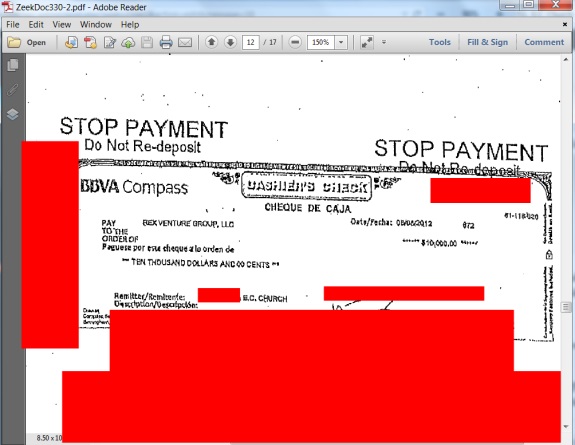
    This exhibit in the Zeek rewards Ponzi- and pyramid case shows that an an "E.C. Church" sent $10,000 to Zeek just days before in collapse in August 2012. (Masking by PP Blog.)
    This exhibit in the Zeek Rewards Ponzi- and pyramid case shows that an “E.C. Church” sent $10,000 to Zeek just days before the “program” collapsed in August 2012. (Masking by PP Blog.)

    UPDATED 8:42 P.M. ET U.S.A. Members of the faith community joining MLM HYIP schemes is a problem. It happened with the $119 million AdSurfDaily Ponzi scheme and the $72 million Legisi scam in 2008, for example.

    It’s happening currently with the “Achieve Community” scheme. Earlier, members of TelexFree  — an alleged $1.8 billion pyramid scheme — traded on the words and images of faith, including the Christ the Redeemer statue in Brazil.

    The WCM777 and Profitable Sunrise schemes also traded on images of the statue. Promoters of the schemes targeted people of faith. Those schemes likely generated more than $100 million.

    There’s also evidence that people of faith were targeted in the $897 million Zeek Rewards scheme brought down by the SEC in 2012.

    New filings by the court-appointed receiver in the Zeek case show that an entity that identified itself as an “E.C.” (Evangelical Congregational) church sent $10,000 to Zeek operator Rex Venture Group LLC on Aug. 8, 2012. The payment was in the form of a cashier’s check.

    The PP Blog is declining to identify the church because details of its precise geographic whereabouts could not be learned immediately. But the check was drawn on an Alabama bank that allegedly later stopped payment.

    Zeek receiver Kenneth D. Bell is seeking a court order for the bank — BBVA Compass Bank — to turn the $10,000 over to the receivership. BBVA Compass also allegedly unlawfully halted payment on 23 other cashier’s checks sent to Zeek. These totaled $73,800, meaning Bell is seeking $83,800 from the bank.

    Those checks were receivership assets, and the bank’s decision to stop-payment after the receiver presented them to be paid violated the asset freeze in the Zeek case, Bell alleged.

    From the receiver’s filings yesterday (italics added/light editing performed):

    At the commencement of the SEC Action on August 17, 2012, RVG possessed thousands of cashier’s checks and teller’s checks received from RVG Affiliates that had not been deposited or presented for payment. Upon entry of the Agreed Order, the Receiver collected cashier’s checks from RVG’s offices and deposited them in accounts opened for the Receivership Estate.

    Twenty-four (24) of the items collected from the RVG offices and deposited into the Receiver’s accounts were cashier’s checks payable to RVG issued by Compass. . . . On information and belief, between August 21 and August 29, 2012, Compass’s customers requested that Compass stop payment on the twenty-four Compass cashier’s checks previously delivered to RVG.”

    These halts by the bank were unlawful under the Uniform Commercial Code, Bell alleged.

    “Compass wrongfully accommodated its customers by stopping payment on all twenty-four cashier’s checks when it was not legally permitted to do so under the Uniform Commercial Code,” Bell contended.

    Although the filing is not on the subject of affinity fraud, documents within the filing suggest that the E.C. entity had company at Zeek among the faithful. Two checks among the 24 were drafted on behalf of an individual whose Zeek username included the word “blessing.” These checks totaled $2,300.

    Religious entities and people of faith getting recruited into HYIP schemes may not be the only problem. In the AdSurfDaily case, for instance, evidence surfaced that individuals had created purported nonprofits and religious entities into which to deposit their Ponzi winnings.

    Bell alleged in late 2012 that he “has obtained information indicating that large sums of Receivership Assets may have been transferred by net winners to other entities in order to hide or shelter those assets.”

    In 2014, Bell asked a court to take “judicial notice” of certain videos on YouTube.

    MLM may have a problem with “serial participants” in Zeek-like schemes to defraud, Bell suggested.

    NOTE: Our thanks to the ASD Updates Blog.

  • Zeek Figure Robert Craddock’s Fun Club USA Severely Sanctioned In Trademark-Infringement Case; Judge Orders Default For Failure To Follow Court Order

    OfferHubb.net Inc. sued Zeek Rewards figure Robert Craddock in February 2014, alleging Craddock “immediately” embarked on a web-based disparagement campaign after OfferHubb chose in July 2013 not to renew a contract with Craddock and Craddock’s Fun Club USA Inc.

    Co-defendants included Craddock’s wife, Sylvia Salgado Craddock, and Fun Club.

    Craddock was accused in the complaint of cybersquatting, trademark infringement, wrongful use of a computer, misappropriation of trade secrets, wrongful interference with economic relations, breach of contract, unjust enrichment, defamation and hiding behind a shell company.

    Now, a federal district judge in Nevada — following the October recommendation of a magistrate judge   — has ordered sanctions.  This includes the striking of the answer Fun Club filed in February. It also includes a default order against the enterprise.

    Why? Fun Club’s “failure to comply with this Court’s Order to obtain counsel,” Judge Richard F. Boulware II said in the order.

    Boulware also ordered the clerk to enter judgment and close the case. The financial fallout was not immediately clear.

    As the PP Blog reported in October (italics added):

    Fun Club and Craddock are referenced in a blistering memo filed in the Zeek Ponzi- and pyramid-scheme case by the SEC on Dec. 17, 2012. In the memo, the SEC accused Craddock of encouraging Zeek affiliates “not to cooperate” with Kenneth D. Bell, the court appointed receiver. The SEC further alleged that Craddock was spreading misinformation about how the agency viewed its own case against Zeek and that Fun Club appeared to have been formed 11 days after the SEC emergency action against Zeek on Aug. 17, 2012.

    Craddock has not been charged by the SEC with wrongdoing . . .

    The trademark-infringement claim may be particularly concerning to the MLM trade, given that Craddock has asserted he works as a copyright and trademark agent on behalf of MLM “programs.”

    On July 22, 2012, while purportedly working as a “consultant” for Zeek, Craddock filed a copyright- and trademark-infringement complaint against a HubPages website operated by Zeek critic K. Chang. K. Chang, who also posts on publications such as the PP Blog and BehindMLM.com, ultimately prevailed in the action brought by Craddock.

    Less than a month later, the SEC brought the Ponzi- and pyramid action against Zeek.

    Earlier this year, a website known as Changes Worldwide identified Craddock as its copyright agent. Filings by the SEC in June 2014 alleged that Faith Sloan, accused in April 2014 of securities fraud by the agency in its Ponzi- and pyramid complaint against the TelexFree “program,” sent more than $15,000 to an entity known as Changes Worldwide LLC after an asset freeze was imposed against Sloan in the TelexFree case.

    Sloan also was a Zeek affiliate. Whether proceeds that originated in Zeek and/or TelexFree made their way into Changes Worldwide is unclear.

    Craddock also was sued for trademark infringement and other alleged offenses by a firm known as BTG180, which accused Craddock of using the alleged Fun Club “shell corporation” to engage in a “shake-down” bid against affiliates of at least three MLM networks: Zeek, OfferHubb and BTG180.

    NOTE: Our thanks to the ASD Updates Blog.

  • ‘Achieve Community’ Websites Inaccessible

    From a promo for Achieve Community on YouTube.
    From a promo for Achieve Community on YouTube.

    UPDATED 12:20 P.M. ET U.S.A. Two websites associated with the “Achieve Community” — ReadyToAchieve.com and TheAchieveCommunity.com — are inaccessible this morning.

    Achieve Community is under investigation by the Colorado Division of Securities.

    The PP Blog asked the Division this morning if it was aware of the outage and whether the inaccessibility of the sites had anything to do with the investigation.

    “I cannot comment further at this time,” said Lillian Alves, Colorado’s Deputy Securities Commissioner.

    Reports surfaced yesterday on a Facebook site known as the “NonOfficialAchieveCommunity” that Achieve had shut down its own private forum and that a page linked to a purported new payment processor for Achieve was carrying a “server maintenance” message.

    The maintenance message continues to appear today.

    Some Achievers have condemned the NonOfficialAchieveCommunity Facebook site, which also is known as “the Sheepdog” and does not echo the company line. In recent days, one poster made the preposterous assertion that the Sheepdog was responsible for ruining 10,000 lives and could be held financially liable by Achievers.

    Achieve purportedly is operated by Kristi Johnson of Colorado and Troy Barnes of Michigan.  The “program,” backed by hucksters such as Rodney Blackburn, reportedly has not made payouts for nearly three months after encountering trouble with payment processors.

    Blackburn is pushing multiple “programs” with a presence on well-known Ponzi-scheme forums — and even camped out on the website of the U.S. Securities and Exchange Commission to record a promo.

    The SEC last month declined to comment on Blackburn’s commercial.


  • URGENT >> BULLETIN >> MOVING: Bankruptcy Trustee Says TelexFree Was ‘Pyramid Scheme’ That Gathered As Much As $1.8 Billion

    breakingnews72URGENT >> BULLETIN >> MOVING: (10th Update 8:53 p.m. ET U.S.A.) In his first formal report to the Massachusetts bankruptcy court, TelexFree Trustee Stephen B. Darr calls the company a “pyramid scheme” that may have involved 1 million or more participants globally and gathered as much as $1.8 billion through arms in the United States and Brazil.

    If the numbers hold up, it would mean that TelexFree has surpassed the Zeek Rewards scheme in both victims’ count and haul. Zeek is estimated to have created about 800,000 victims, while hauling about $897 million. Zeek was shut down by the SEC in August 2012.

    The SEC and the Massachusetts Securities Division brought actions against TelexFree in April 2014.

    Darr also revealed that 13 private lawsuits have been filed against TelexFree and/or related principals, including former executives James Merrill and Carlos Wanzeler.

    TelexFree’s Brazilian arm was known as Ympactus and “grew much more quickly than the Debtors and its shutdown by Brazilian authorities in the summer of 2013 was the first of many red flags that the Debtors were operating an unsustainable pyramid scheme,” Darr advised U.S. Bankruptcy Judge Melvin S. Hoffman.

    Darr also strongly implied that a black market existed both internally at TelexFree and externally to the cross-border enterprise. It is known that the U.S. Department of Homeland Security, through its Homeland Security Investigations arm, is deeply involved in the TelexFree probe.

    Today’s report by Darr may — at least in part — explain why. From the report (italics added/minor editing performed):

    The Debtors’ business plan was complicated in and of itself. The scheme’s complexity was expanded further, however, through a web of inter-Participant transactions that permeated the scheme.

    First, a new Participant could purchase a membership plan by making payment directly to the Debtors . . . or by redeeming accumulated credits.

    In lieu of paying funds directly to the Debtors, it appears that many Participants became involved in the scheme by paying their membership fee directly to a recruiting Participant who often did not remit the payment from the new Participant to the Debtors. Rather, the recruiting Participant frequently retained the payment from the new Participant in return for a reduction, or redemption, of their accumulated credits. The mechanics of this transaction were as follows:

    a) After an invoice was issued to the new Participant and marked as pending, the new Participant would forward the invoice through the system to the recruiting Participant for payment;

    b) The recruiting Participant would then pay the invoice using the recruiting Participant’s credits. The Debtors’ database would charge the recruiting Participant’s credits for the invoice and mark the invoice as paid.

    In this manner, new Participants often joined the Debtors’ scheme without any money actually being paid to the Debtors.

    In addition to the two scenarios outlined above, there appears to have been a third type of transaction that did not involve the Debtors at all. This type of transaction involved the transfer of credits by one Participant to another Participant in exchange for cash or other consideration. The motivation for the transfer of credits is not always clear, although in some instances recruiting Participants may have purchased credits so that such recruiting Participant had sufficient credits to be redeemed after receiving payment from a new Participant.

    Growth at the Ympactus arm in Brazil accelerated “in the fall of 2012 through the early summer of 2013,” Darr asserted.

    “The Debtors’ records indicate that by the spring of 2013, Ympactus had cash receipts of more than $100,000,000 per month,” he continued. “These receipts do not reflect inter-Participant transactions that did not involve direct payment to Ympactus.”

    After Brazilian authorities intervened in June 2013, freezing as much as $300 million in that country, the U.S. TelexFree arms — previously underperformers compared to Ympactus — began to surge, Darr alleged.

    “Following the shutdown of Ympactus, the Debtors’ revenues increased dramatically such that by the end of 2013 and early 2014, the Debtors were generating cash of as much as $50,000,000 per month, without regard to inter-Participant transactions for which consideration did not pass to the Debtors,” Darr said.

    TelexFree banking relationships crumbled, Darr said in the report.

    “Multiple banks closed the Debtors’ operating accounts apparently based upon suspicious activity in those accounts,” Darr said.

    A lawyer advised TelexFree in mid-2013 that its business plan constituted a pyramid scheme, Darr said.

    “Although the Debtors were apprised in mid-2013 by counsel that the business plan was a pyramid scheme, they continued to operate using that plan until March 2014. At that time, the Debtors introduced a new business plan, even though the Debtors were apparently advised that the new plan did not rectify the problem. The new plan was unanimously rejected by the Participants, which appears to have precipitated a ‘run on the bank’ inasmuch as $58,000,000 or more was paid out to certain Participants in the several weeks leading up to the filing of the petitions. An additional $100,000,000 was requested by Participants but was not paid.”

    In September 2014, Darr identified MLM lawyer Jeffrey Babener as an attorney who advised TelexFree it was operating a pyramid scheme.  Babener isn’t named in today’s filing, so it is not immediately clear if a second attorney also advised TelexFree that its platform was a pyramid.

    Darr also said in the report that TelexFree “wrote off” a receivable “in the approximate amount of $180,000,000” due from Ympactus. The write-off appears to have occurred in late 2013, after the action in Brazil.

    “Upon information and belief, the Debtors advanced the costs for the voice over internet protocol, or ‘VOIP’, service for both the Debtors and Ympactus,” Darr said. “Ympactus contracted to pay a portion of its revenues to the Debtors as a commission, but it is unclear the extent to which these payments were ever made. In December 2013, six months after the seizure of Ympactus’ assets by the Brazilian authorities, the Debtors established, and then subsequently wrote off, a receivable due from Ympactus in the approximate amount of $180,000,000, purportedly for unpaid commissions and related services.”

    Darr also identified a number of TelexFree subsidiaries or affiliates, noting there could be more. These are among the entities and ownership information listed in the report. (Please note that not all location information is listed):

    • TelexFree International LLC:: Ownership: Wanzeler, Carlos Costa, Merrill:: Location:: Nevis.
    • TelexFree Mobile Holdings Inc.:: Ownership:: Wanzeler and Merrill.
    • Graham Bell Telex LLC:: Ownership:: TelexFree Mobile Holdings LLC and Costa.
    • TelexFree Mobile LLC:: Ownership:: Graham Bell Telex LLC and Infinium Wireless.
    • TelexElectric LLLP: Ownership:: Wanzeler, Costa and Merrill.
    • Bright Lite Future LLC:: Ownership: Wanzeler, Costa and Merrill.
    • Brazilian Help Inc.:: Ownership: Wanzeler.
    • Sunwind Energy Group LLLP: Ownership: 1127 Enterprises LLC and Merchant Enterprises Inc.
    • Sunwind Energy Solutions:: Ownership:: 1127 Enterprises Inc., ACE.
    • LLLP: Ownership:: LLP, Executive Marketing Inc. and Sunwind Energy Group LLLP.
    • Sunwind Energy Doyle North LLC:: Ownership: Sunwind Energy Southern LLLP, ACE LLP, Adams Craft Ewing LLLP, Guasti LLC.
    • ACE LLP:: Ownership:: Undetermined.
    • Executive Marketing Inc.:: Ownership:: Undetermined.
    • 1127 Solutions LLC:: Ownership: Undetermined.
    • Merchant Enterprises Inc.:: Ownership: Undetermined.

    “There may have been other entities formed by the Debtors’ principals to conduct similar operations in other jurisdictions, including TelexFree Ecuador, TelexFree Columbia, TelexFree Dominican Republic, TelexFree Canada, and TelexFree International, Ltd. (Cayman Islands),” Darr alleged.

    And, he noted, “In addition, other entities appear to have been formed by the Debtors’ principals for related or unrelated purposes, including JC Real Estate Investments LLC; JC Real Estate Management Co., LLC; Above and Beyond the Limit LLC; CNW Real Estate LLC; CNW Realty State LLC; Acceris Realty Estate LLC; KC Realty State LLC; Makeover Investments LLC; Eagleview Realty Estate LLC; and Grandview Realty Estate LLC.

    With forensics well under way and with Darr in communication with investigators in the United States and Brazil, how big is the job ahead? (Bolding added):

    “The database identifies more than 2,100,000 electronic mail addresses for Participants in the operations of both the Debtors and Ympactus,” Darr said. “Of this amount, approximately 1,000,000 appear to be provided by Participants of the Debtors, with the balance related to the Ympactus Participants. The database identifies more than 17,000,000 different accounts, of which approximately 12,000,000 are those of Participants and 5,000,000 are those of Ympactus Participants. As referenced earlier, an individual Participant could maintain multiple accounts using a single electronic mail address, and an individual Participant could also maintain more than one electronic mail address. During the period February 2012 to April 2014, the total combined cash receipts for the Debtors and Ympactus were in excess of $1,800,000,000 and combined noncash revenue was approximately $4,200,000,000.

    Oddities abound, according to the report.

    ” . . . the Debtors’ computer system does not link all accounts for an individual Participant, and the Participant name field enabled Participants to use different variations of their name in the input process,” Darr said.

    “Certain accounts do not contain electronic mail address information. Of those accounts that do contain electronic mail address information, in some instances, the information is facially inaccurate, such as the Participant’s use of the Debtors’ electronic mail address as a placeholder such as [deleted by PP Blog]. In other instances, a Participant may have used the same electronic mail address as other Participants, including the sharing of electronic mail addresses with family members. Unlike the computer systems of similar type enterprises, the Debtors’ system did not require confirmation of an electronic mail address.

    “Similarly,” Darr said, “certain accounts do not contain physical address information. Some other accounts contain physical address information that is facially inaccurate, such as the use of a country code that is inconsistent with the address, e.g., ‘San Paulo, USA.’”

    From the report (italics/bolding added):

    Manual credits were credits assigned to a Participant’s account balance on account of money paid to the Debtors for one of several reasons, as distinguished from credits “earned” from the placement of advertisements or other components of the compensation scheme. The Debtors’ records reflect approximately $151,000,000 of manual credits issued to certain Participants. The issuance of manual credits appears to be a fraud within the larger fraud of the pyramid scheme with the Debtors’ insiders adding large amounts of credits to certain accounts whereby the credits could then be sold to other Participants. There appears to be no corresponding payment supporting many of these large manual credits.

  • TelexFree/iFreeX Figure Sann Rodrigues Appears In Car With Emerson Fittipaldi; Is Brazilian Racing Legend Being Duped By MLM Huckster?

    Racing legend Emerson Fittipaldi somehow ended up in a car with TelexFree figure Sann Rodrigues. Source: Video on DailyMotion.
    Racing legend Emerson Fittipaldi somehow ended up in a car with TelexFree figure Sann Rodrigues. Source: Video on DailyMotion.

    UPDATED 2:14 P.M. ET U.S.A. It is not unusual for financial fraudsters to seek to rub elbows with famous people or to imply ties to them as a means of sanitizing purported “opportunities” or accenting their own bona fides. Recent examples of this include Florida-based Ponzi-schemer/racketeer Scott Rothstein, who mixed with the elite as his epic fraud scheme spiraled out of control.

    Florida-based AdSurfDaily Ponzi schemer Andy Bowdoin (and any number of his promoters) falsely implied that then-President George W. Bush was on ASD’s train. The Mantria Corp. Ponzi scheme in Colorado traded on images of former President Bill Clinton and famous politicians or business executives.

    The WCM777 scam traded on purported ties to Siemens and scores of famous companies. Siemens publicy refuted the WCM777 claims.

    TelexFree, alleged to have gathered hundreds of millions of dollars in a combined Ponzi- and pyramid scheme targeted in no small measure at Brazilians and people who speak Portuguese or Spanish, aligned itself with the Botafogo soccer club in Brazil. The PR results were disastrous.

    Now comes word that Sann Rodrigues, a figure in both the TelexFree and iFreeX schemes, is seen in a video in which he is driving a car. That in itself wouldn’t be unusual, in that Rodrigues previously has recorded one or more videos that put him behind the wheel of a flashy ride.

    But in this case the passenger in the car is Emerson Fittipaldi, the Brazilian racing legend who won the Formula One World Championship twice and also is a two-time winner of the Indianapolis 500.

    The PP Blog has sought comment from Fittipaldi through multiple channels and hopes to hear back from the legend. If Fittipaldi or his organization responds, we’ll make sure you see that response.

    Rodrigues was charged by the SEC in April 2014 with securities fraud for his alleged role in the massive TelexFree swindle. This marked the second time the SEC had implicated him in a fraud scheme. The first was a 2006 scam known as Universo Foneclub Corporation. Like TelexFree, Universo Foneclub allegedly was targeted at the Brazilian community.

    TelexFree also is under investigation by the U.S. Department of Homeland Security and Federal Police in Brazil. At the same time, the Securities Division of Massachusetts Commonwealth Secretary William Galvin also is investigating TelexFree.

    In September 2014, Galvin issued a warning about iFreeX, another “program” associated with Rodrigues. T-Mobile, the famous phone company, later said it was checking to see if its branding material was being misused by iFreeX.

    Precisely how Fittipaldi ended up in a car with Rodrigues is unclear. Early research suggests Fittipaldi made an appearance at a hotel in the area of Orlando, Fla., on or around Jan. 6 of this year. Rodrigues may reside in the Orlando area.

    The Orlando event appears to have been arranged by a venture known as DFRF. The asserted operator of that venture is Daniel Fernandez Rojo Filho. (The Ferdandez name also has been spelled with a trailing “s,” as opposed to a “z.”) His name surfaced as part of the Evolution Market Group/Finanzas Forex case in 2010.

    (Also see PP Blog article. Also see Palm Beach Post article.)

    It is clear that some Brazilians interested in the TelexFree case are closely following the appearance of Fittipaldi alongside Rodrigues, wondering if the racing legend is being duped by an alleged recidivist swindler.