Tag: SEC

  • BULLETIN: NOT JUST EUROPE: Court Filings In Profitable Sunrise Fraud Case Say Some Of The Money Went To Entities In Australia And Panama

    profitablesunriseimageUPDATED 9:11 P.M. EDT (APRIL 17, U.S.A.) Some Profitable Sunrise investors wired money to entities in Australia and Panama, according to new filings in the SEC’s pyramid-scheme and fraud case.

    The new filings, dated today, identify those entities as Technocash Limited of Sydney and Trackford Business Corp. of Panama City. Earlier filings named four other entities that the SEC says received funds from Profitable Sunrise investors: Melland Company SRO of the Czech Republic; Color Shock SRO of the Czech Republic; Solutions Company SRO of the Czech Republic; and Fortuna-K SRO of the Czech Republic.

    Melland, Color Shock, Solutions and Fortuna-K all have been named relief defendants. How the SEC intends to proceed against Technocash and Trackford was not immediately clear today. Various state regulators in the United States have said that Profitable Sunrise traded on Bible verse.

    Profitable Sunrise operated as Inter Reef LTD through a “mail drop” in England, and its director, Agnes Jouaneau, “is a resident of the Seychelles. She is director of several dozen other UK companies,” according to court filings.

    “Having heard from witnesses, examined documents, considered the legal precedents and the arguments of counsel, the Court finds that the SEC has established a prima facie case that Inter Reef violated Sections 5(a), 5(c), and 17(a) of the Securities Act of 1933 (‘Securities Act’) [15 U.S.C. §§ 77e(a), 77e(c), and 77q(a)], Section 10(b) of the Securities Exchange Act of 1934 (‘Exchange Act’) [15 U.S.C. § 78j(b)], and Exchange Act Rule 10b-5 [17 C.F.R. § 240.10b-5],” wrote U.S. District Judge Thomas W. Thrash Jr.

    Thrash has approved a preliminary injunction and continued an asset freeze in the Profitable Sunrise case.

    A proceeding was held in open court today, according to the new filings. At that 20-minute proceeding, “no one” appeared for Profitable Sunrise or the relief defendants.

    Evidence entered by the SEC, according to Thrash, supports findings that Profitable Sunrise:

    • “offered a series of passive investments with low minimum investments claiming to pay interest rates varying between 1.6 percent and 2.7 percent per business day . . .”
    • Sold “securities” as defined under federal securities law . . .
    • “failed to register those securities with the SEC, and no exemption from registration has been proven . . .”
    • Sold “unregistered securities through misrepresentations and omissions of material fact” and that the sale of those securities “constitutes a device, scheme and artifice to defraud.”

    A minute entry from today’s proceeding before Thash suggests that the SEC has deposed Profitable Sunrise pitchman Anthony M. Infante of Florida and that at least a portion of his deposition was read into the record today.

    Read SEC statement issued April 16.

    The ASD Updates Blog is maintaining an archive of Profitable Sunrise-related court filings.

  • BULLETIN: ‘Bags Of Cash And A Rolex’: KPMG Auditor Charged In Alleged Insider-Trading Scheme Involving Herbalife, Others; SEC Says Tips Went To Auditor’s Golfing Buddy In The Jewelry Business

    The FBI has a photo of Scott London accepting cash in an insider-trading sting. Source: Exhibit A from FBI criminal complaint.
    The FBI has a photo of Scott London, left, accepting cash in an insider-trading sting. Source: “Exhibit A” from FBI criminal complaint filed today against London.

    BULLETIN: (UPDATED 4:44 P.M. EDT U.S.A.) The SEC has gone to federal court in the Central District of California, accusing a former KPMG “lead partner” and auditor of KPMG’s Herbalife account of insider trading by providing nonpublic information on Herbalife and other companies to a golfing buddy.

    Scott London, 50, of Agoura Hills, Calif., was fired last week by KPMG. He now stands formally accused of passing information unlawfully to Bryan Shaw, who also has been charged.  Shaw, 52, lives in Lake Sherwood, Calif., and operates a jewelry business in Encino, the SEC said.

    The men met at a country club and became close friends, the SEC charged.

    London has claimed he wanted to help Shaw because Shaw’s business was struggling, the SEC said.

    At a minimum, however, London’s alleged misdeeds have resulted in civil and criminal liability for himself, while creating a PR crisis for KPMG. At the same time, it put KPMG client Herbalife in the awkward position of having to explain why its stock stopped trading briefly Tuesday morning while its auditor was handling fallout from London’s actions and why it suddenly had no auditor.

    At 2:58 p.m. EDT today, Herbalife’s stock was showing a gain of 3.68 percent. The company said on Tuesday that KPMG had resigned its account  after “it had concluded it was not independent because of alleged insider trading in Herbalife’s securities by one of KPMG’s former partners.”

    Among the SEC’s alarming allegations is that Shaw paid London “at least $50,000 in cash that was usually delivered in bags outside of his Encino, Calif. jewelry store.”

    For good measure, the SEC alleged, Shaw also provided London “an expensive Rolex watch as well as other jewelry, meals, and tickets to entertainment events.”

    “London was honored with the highest trust of public companies, and he crassly betrayed that trust for bags of cash and a Rolex,” said George S. Canellos, acting director of the SEC’s Division of Enforcement.

    Using information provided by London, Shaw made more “more than $1.2 million in illicit profits trading ahead of earnings or merger announcements,” the SEC said.

    And, the SEC said, London has been charged criminally. (See photo above from FBI criminal complaint filed today against London, who is charged with criminal conspiracy to commit securities fraud through insider trading. Link to the complaint is in the Comments thread below.)

    On at least one occasion, “London disclosed nonpublic information in the presence of others during a golf outing,” the SEC charged.

    “Prior to public announcements, Shaw received material non-public information from London about numerous earnings announcements and releases of financial results for Herbalife, Skechers [USA Inc.] and Deckers [Outdoor Corp.],” the SEC charged.

    Shaw “grossed profits of more than $714,000 from trading based on confidential financial data about Herbalife, Skechers, and Deckers,” the SEC alleged.

    But the abuse didn’t stop there, the SEC alleged.

    London “also gained access to inside information about impending mergers involving two former KPMG clients – RSC Holdings [Inc.] and Pacific Capital [Bancorp],” the SEC alleged. “London tipped Shaw with the confidential details. Shaw made nearly $192,000 by purchasing RSC Holdings stock the day before its Dec. 15, 2011, merger announcement. He made more than $365,000 in illicit profits from his well-timed purchase of Pacific Capital securities prior to a merger announcement on March 9, 2012.”

    “As a leader at a major accounting firm, London’s conduct was an egregious violation of his ethical and professional duties,” said Michele Wein Layne, director of the SEC’s Los Angeles Regional Office.

    “KPMG advised the Company it resigned as Herbalife’s independent accountant solely due to the impairment of KPMG’s independence resulting from its now former partner’s alleged unlawful activities and not for any reason related to Herbalife’s financial statements, its accounting practices, the integrity of Herbalife’s management or for any other reason,” Herbalife said on Tuesday.

    Herbalife has been the subject of a battle between titans Carl Icahn, who is bullish on the company, and Bill Ackman, who claims Herbalife is a pyramid scheme. On its website, Herbalife denies it is either a pyramid scheme or a Ponzi scheme.


  • Joe Borg Of Alabama Securities Commission Tells WSFA That Profitable Sunrise Worked Because People ‘Kind Of Glossed Over The Mathematics’

    Joe Borg of the Alabama Securities Commission. From: WSFA news report.
    Joe Borg of the Alabama Securities Commission. From: WSFA news report.

    EDITOR’S NOTE: Alabama was one of the first U.S. states to take action against the Profitable Sunrise HYIP “program,” issuing both an Investor Alert and a cease-and-desist order last month. The C&D lists two alleged “agents” of Profitable Sunrise, demonstrating that a “program” can create problems for pitchmen, perhaps even as the “program” operators make a getaway or disappear into the darkest corners of the Internet.

    Profitable Sunrise had at least five purported investment plans, including one dubbed the “Long Haul” that promised a payout of 2.7 percent a day.

    Whether the bizarrely named “Long Haul” plan was a deliberate taunt at regulators and possibly even the pitchmen who helped the scheme gain a head of steam remains unclear.

    Listed as agents in the Alabama order were Melton McClanahan and Adam York. “An investigation of the company’s actions revealed that the men allegedly promoted at least five different ‘investment plans’ through a website used to promote Profitable Sunrise investment program and disseminate information to potential investors regarding the company’s various investment opportunities,” the Alabama Securities Commission said in the order.

    Also listed in the order were purported Profitable Sunrise operators Roman Novak and Radoslav Novak. In a complaint last week, the SEC said that “Profitable Sunrise operates for the benefit of unknown individuals and/or organizations doing businesses through companies formed in the Czech Republic and using bank accounts in the Czech Republic, Hungary, Latvia, and China, among other places.”

    ____________________________________

    Joe Borg of the Alabama Securities Commission (ASC) has dealt with massive fraud schemes that traded on faith, including the Greater Ministries International Church caper in the 1990s that led to criminal convictions against five individuals.

    Back in 1999, ASC and the Ohio Division of Securities filed a joint complaint in federal court in Florida to shut GMI down. The purported “opportunity” took in more than $550 million by touting “divinely-inspired investments in the foreign currency market and gold, silver and diamond mines in Africa and the Caribbean,” ASC said at the time.

    Now, Borg and other state and provincial regulators are tacking the Profitable Sunrise scheme, which traded on faith and promised absurd returns.

    “I think because they used a per-day percentage, people kind of glossed over the mathematics,” Borg told WSFA.

    WSFA.com: News Weather and Sports for Montgomery, AL.

  • ANNOUNCEMENT: PP Blog Receives Repeated Spams Labeled ‘telexfree’ That Point To YouTube Video For ‘Leads’ Program

    ponzinews1ANNOUNCEMENT: The PP Blog has banned a specific IP that appears to originate in the area of Fort Wayne, Ind.

    Between 1:33 p.m. and 1:36 p.m. today, the IP sought to pull six separate PP Blog stories with the aim of planting spam links. The first story was this one, dated Dec. 17, 2010: URGENT >> BULLETIN >> MOVING: Secret Service Has Seized More ASD Cash; Forfeiture Complaint Filed Today Against Bank Accounts Controlled By Erma ‘Web Room Lady’ Seabaugh And Robyn Lynn Stevenson

    It was not immediately clear whether the spammer was a bot. What is clear is that the would-be poster used the identity of “telexfree” and sought to plant links to a YouTube video that appears to be selling “leads” for TelexFree and other MLMs. The spams used a gmail address that (in part) included this phrase: “LoBuzcy.”

    On March 31 (Easter Sunday), the PP Blog reported that an apparent Telexfree boat-shark was seeking to recruit members of the collapsed Profitable Sunrise “program”:

    https://patrickpretty.com/2013/03/31/profitable-sunrise-members-targeted-in-easter-sunday-boat-sharking-for-telexfree-on-facebook-viewers-told-they-can-plunk-down-more-than-15000-for-a-contract-that-provides-earnings-of-at-lea/

    The SEC later said Profitable Sunrise was an international pyramid scheme.

    Now, someone appears to be trying to ride on the PP Blog’s bandwidth to drive traffic to a third-party leads provider for the TelexFree “program.”

    This is one of those days that MLM just makes people want to vomit. The would-be spammer sought to use both flattery and derision to drive traffic to the YouTube video for the purported TelexFree “leads”:

    Example of flattery: “Excellent write-up. I definitely love this website. Thanks!” the spammer wrote.

    Example of derision: “The next time I read a blog, Hopefully it doesn’t disappoint me as much as this one,” the spammer wrote.

    More background: On Feb. 15, BehindMLM.com reported that TelexFree was under criminal investigation in Brazil.

    http://behindmlm.com/companies/telexfree-under-criminal-investigation-in-brazil/

    So, what we have here is either a bot or a human being serial-spamming the PP Blog for a leads “program” that:

    Apparently doesn’t care if TelexFree is under criminal investigation if there is money to be made.

    Apparently doesn’t care that TelexFree is being pitched to Profitable Sunrise victims.

    Apparently doesn’t care that the first story targeted in the spam campaign was about the AdSurfDaily Ponzi scheme as investigated by the U.S. Secret Service.

    Apparently believes that it is entitled to ride on bandwidth provided by Google and the PP Blog because there is money to be made through a purported MLM “leads” program for a company under criminal investigation.

  • BULLETIN: Docket In Federal Court Shows That SEC Has Scheduled Deposition For At Least 1 Profitable Sunrise Pitchman

    breakingnews72BULLETIN: (UPDATED 1:56 P.M. EDT (APRIL 8, U.S.A.) In a move that may rattle promoters of HYIP fraud schemes, the SEC has scheduled a deposition for at least one individual known to have pitched the Profitable Sunrise “program.”

    Pitchman Anthony M. Infante will be deposed April 11 at a location in Florida, according to the docket of the case.

    Martin Sipe will be deposed April 9  [moved to April 19] at a location in Utah, according to the docket. Sipe’s tie to the ProfitableSunrise case was not immediately clear.

    Whether the SEC plans other depositions has not been disclosed in early filings.

    The filings disclosing the depositions of Infante and Sipe are expected to appear later today on the ASD Updates Blog.

    In filings in federal court in Atlanta this week, the SEC described Profitable Sunrise as an international pyramid scheme that had used a “mail drop” in England while conducting an “offering fraud” targeted at U.S. citizens.

    “Profitable Sunrise operates for the benefit of unknown individuals and/or organizations doing businesses through companies formed in the Czech Republic and using bank accounts in the Czech Republic, Hungary, Latvia, and China, among other places,” the SEC alleged.

    See April 5 PP Blog story.

  • URGENT >> BULLETIN >> MOVING: SEC Files Complaint Against Profitable Sunrise; Purported ‘Opportunity’ Called An International ‘Pyramid Scheme’

    breakingnews72URGENT >> BULLETIN >> MOVING: (17th update 4:02 p.m.) The SEC has filed a complaint against the ProfitableSunrise HYIP “program” in federal court in Atlanta. The story first was reported by CourthouseNewsService this morning.

    At the same time, the PP Blog has learned that the agency applied for an emergency asset freeze, explaining that Profitable Sunrise was using a “mail drop” in England and that “Hungarian law enforcement authorities” had had frozen an account holding $11.3 million connected to the scheme as part of an “investigation of suspected money laundering.” U.S. District Judge Thomas W. Thrash Jr. granted the freeze, which applies to multiple bank accounts.

    The Profitable Sunrise “referral program” operated as a “pyramid scheme,” the SEC said in its filings. Moreover, the SEC charged, Profitable Sunrise was conducting an “offering fraud” targeted at U.S. citizens and selling unregistered securities.

    And people pushing the “program” for commissions may not even know who they’re working for, the SEC said.

    “Profitable Sunrise operates for the benefit of unknown individuals and/or organizations doing businesses through companies formed in the Czech Republic and using bank accounts in the Czech Republic, Hungary, Latvia, and China, among other places,” the SEC alleged.

    The complaint names Inter Reef Ltd. (DBA Profitable Sunrise) as defendants. Four relief defendants also are named:

    Melland Company SRO, Color Shock SRO, Solutions Company SRO, and Fortuna-K SRO.

    Absent from the list of defendants are both “Roman Novak” and “Radoslav Novak.” Although many Profitable Sunrise pitchmen have claimed that “Roman Novak” operates the company and that “Roman’s” brother “Radoslav” is its attorney, that information has not been confirmed.

    “There is more than a slight possibility, as with many offering frauds, that the people described in the website, including the Novak brothers, do not exist,” the SEC said.

    InterReef’s registered agent is based in Seychelles, an island chain in the western Indian Ocean, the SEC said.

    “Tens of thousands of investors” may have invested “at least tens of millions of dollars in Profitable Sunrise,” the SEC said.

    At least 34 U.S. states and provinces in Canada have issued Investor Alerts or cease-and-desist orders against Profitable Sunrise.

    Assertions online that Profitable Sunrise “generates profits by making loans to businesses at higher rates” are “false,” the SEC charged.

    The scheme spread in part through “social media” and “numerous promoters in the United States,” the SEC said in its complaint.

    Incongruities dotted Profitable Sunrise, the SEC alleged.

    Although Profitable Sunrise claimed it had been operating for six years, “the United Kingdom Companies House reports that Inter Reef has been in existence for only 19 months,” the SEC alleged.

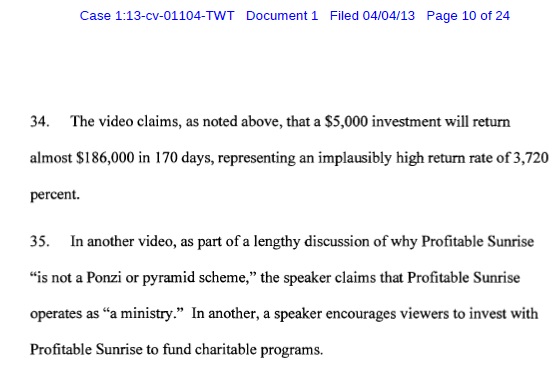
    Meanwhile, the SEC said, a YouTube promo for Profitable Sunrise positioned the “opportunity” as a “ministry” and included a discussion of why Profitable Sunrise “is not a Ponzi or pyramid scheme.”

    From the SEC complaint filed in federal court in Atlanta April 4.
    From the SEC complaint filed in federal court in Atlanta April 4.
    XX
    From the SEC complaint.

    See filings courtesy of the ASDUpdates Blog.

  • CNN’s Anderson Cooper 360 Expected To Air Segment On Zeek Rewards Tonight; [UPDATE: Report Apparently Delayed]

    acteaser040313UPDATE 8:07 A.M. EDT (APRIL 4, U.S.A.) The report did not air during the 8 p.m. or 11 p.m. broadcasts, possibly because developments in other stories took precedence. Our April 3 story is below . . .

    The Blog of CNN’s Anderson Cooper 360 is carrying this teaser today: “360 Wednesday[:] One of the biggest financial schemes in U.S. history went down in a small North Carolina town with many losing their life savings. Watch AC360 at 8 and 11 p.m. ET.”

    In August 2012, the SEC called Zeek Rewards a $600 million Ponzi- and pyramid scheme that had defrauded people by the hundreds of thousands. Zeek was operated by Paul R. Burks and Rex Venture Group LLC of Lexington, N.C.

    CNN’s apparent airing of a segment on Zeek will occur against the backdrop of mysterious disappearance of the Profitable Sunrise “program,” which purported to pay out more on a daily basis than even Zeek.  Zeek planted the seed that it paid out an average of 1.5 percent a day; the bizarrely named Profitable Sunrise “Long Haul” plan claimed it paid out 2.7 percent a day.

    Payouts from the Long Haul were dubbed an “Easter Gift” and were due April 1, April Fool’s Day. The Profitable Sunrise website, however, has been offline since at least March 14. At least 34 regulators in the United States and Canada have issued Investor Alerts or cease-and-desist orders against Profitable Sunrise.

    New Zealand and the United Kingdom also have issued warnings.

    CONSOB, the Italian securities regulator, yesterday issued a suspension order against an alleged Profitable Sunrise promoter.

    Some Zeek promoters also promoted ProfitableSunrise, which traded on Bible verse

    Zeek also has promoters’ ties to the $119 million, 1-percent-a-day AdSurfDaily Ponzi scheme, which operated from the small town of Quincy, Fla., and purported to be a Christian enterprise.  ASD collapsed after the U.S. Secret Service filed Ponzi allegations in 2008.


  • ZEEK RECEIVER TO NET WINNERS: ‘The Time For Court Action Is Drawing Closer’

    UPDATED 1:20 P.M. EDT (APRIL 4, U.S.A.) The court-appointed receiver in the Zeek Rewards Ponzi scheme case has warned net winners that “the time for court action is drawing closer” and that “there is an opportunity for settlement.”

    Receiver Kenneth D. Bell published a letter to winners today on the website of the receivership.

    A snippet from the letter (italics added):

    The time for court action is drawing closer. I am sending this message to make sure that net-winners understand that there is an opportunity for settlement, but that the window for the opportunity is closing. To allow a reasonable time for all those who would like to pursue a settlement to do so, I am going to continue to make my team available to negotiate settlements for at least 60 more days. Therefore, if net winners want to pursue a settlement they should contact us by no later than May 31, 2013. After that date, I will assume that all net-winners that want to avoid the legal process by discussing settlement have done so, and I will move forward with court action, likely in June 2013, against the remaining net-winners.

    breakingnews72In August 2012, the SEC descibed Zeek as a $600 million Ponzi- and pyramid scheme operated by Paul R. Burks through Rex Venture Group LLC. Based on the number of victims, Zeek may be the largest Ponzi scheme in U.S. history.

    Bell noted in the letter that he already has discussed settlements with a “number of net-winners” and that “we have successfully negotiated payments which will, subject to Court approval, result in the release of the Receiver’s claims against those winners.”

    Some winners have received significant discounts, Bell said. But he noted that settlements depend on circumstances and that not all winners will get the same deal.

    “The settlements take into account the amount of the affiliate’s winnings, the nature of their involvement and their involvement of others, their cooperation, their ability to repay the money (and the time period in which the repayment can reasonably be made) and other individual factors and circumstances,” Bell said in the letter.  “The amounts of the settlements have ranged from approximately 40% to 80% of the affiliate’s net winnings. However, not all net winners have been or will be offered discounted settlements and the amounts of future settlements may vary from this range. The amount of the settlement offered to each net-winner will be based on the affiliate’s particular circumstances and ultimately must – in both my and the Court’s opinion – be in the overall best interests of the victims, considering the costs associated with the legal process.”

    Senior U.S. District Judge Graham C. Mullen of the Western District of North Carolina is presiding over the Zeek case.

    Mullen’s name also was in the news last week as a result of a different government action that alleged fraud.

    On March 27, the CFTC sought an asset freeze against James Harvey Mason of Graham, N.C., The JHM Forex Only Pool (JHM) and Forex Trading at Home (FTAH).

    Mullen granted the freeze, amid CFTC allegations that Mason fraudulently solicited “at least $1.1 million from at least 60 individuals to participate in off-exchange foreign currency (forex) commodity pools and misappropriat[ed] at least $600,000 of participant funds.”


  • AP (VIA YAHOO NEWS): Zeek’s Paul Burks Says Participants At Fault For Losing Money In Alleged $600 Million Ponzi Scheme

    The Associated Press is reporting that Zeek Rewards operator Paul R. Burks claims that he is not at fault and that Zeek participants are to blame if they lost money.

    From the AP (via Yahoo News/italics added):

    “I never told anyone to invest more money than they could afford,” Burks snapped. “I didn’t tell them to do that. Never.”

    He said if they lost money, “it’s their fault. Not mine. Don’t blame me.”

    Read the full story.

    recommendedreading1Zeek rose in part through promotions on well-known Ponzi scheme forums such as TalkGold and MoneyMakerGroup. In August, the SEC alleged that Zeek was a $600 million Ponzi- and pyramid scheme operating from Lexington, N.C.  Court records suggest the SEC’s Zeek probe began at least in April 2012.

    Serial hucksters on the Ponzi boards often rationalize Ponzi train wrecks by claiming that no one advised participants to spend more than they could afford to lose.

    Convicted Ponzi schemer Dennis Bolze — one of the original so-called “mini-Madoffs” — tried a version of the “don’t invest more than you can afford to lose” rationalization in an unsuccessful bid to reduce his 27-year prison sentence for his brick-and-mortar scheme. A judge applied a sentencing enhancement in the Bolze case because senior citizens were among the victims.

    As the PP Blog reported on Jan. 12, 2012 (italics added):

    Bolze used a similar argument for a sentencing reduction, asserting that his victims invested only “discretionary money.”

    He further argued that age alone was  not sufficient to justify the enhancement “and that the present poor financial condition of his victims is not relevant to whether they were unusually vulnerable at the time they invested their money with him,” according to the 6th Circuit.

    Meanwhile, Bolze “denied that he forced anyone to invest” and claimed “that he did not know” certain investors “because his associate dealt with them.”

    The panel rejected each of those arguments.

    Burks, 66, has not been charged criminally. The SEC sued Burks and Zeek parent Rex Venture Group LLC last year.

    Ponzi-board hucksters have promoted numerous Internet-aided scams. AdSurfDaily, a $119 million Ponzi scheme opearting from Florida, had a presence on the boards. So did Legisi, a $72 million Ponzi scheme operating from Michigan. So did Pathway to Prosperity, a $70 million scam alleged to have penetrated 120 countries. So did Imperia Invest IBC, a shadowy entity that stole millions of dollars by targeting people with hearing impairments.

    The most recent Ponzi-board scam to make major news is Profitable Sunrise, another shadowy entity purportedly operated by “Roman Novak.” Profitable Sunrise purported to pay interest of 2.7 percent a day through its bizarrely named “Long Haul” plan targeted at Christians. Members were due a purported “Easter gift” on Monday, April Fool’s Day.

    The Profitable Sunrise website has been missing for more than two weeks. At least 34 U.S. states or provinces in Canada have issued Investor Alerts or cease-and-desist orders against Profitable Sunrise. The United Kingdom and New Zealand also have issued warnings.

    Research shows that Profitable Sunrise had members in common with ASD and Zeek.

  • FOR ZEEKERS: Court-Appointed Receiver Asks Federal Judge To Approve Claims Process, Bar Date — And More

    “In examining these facts, the Receiver has determined that because the VIP Points aspect of the multilevel marketing program did nothing more than redistribute funds among Affiliates in Ponzi-scheme fashion, points generated and/or accumulated by Affiliates will not be an includable part of an Affiliate’s claim for purposes of receiving a distribution from the Receivership Estate. Including any of these points as part of any claim of an Affiliate would merely effectuate a continued redistribution of funds from later-investing Affiliates to earlier-investing Affiliates. In other words, these Retail Profit Points were an instrument for the perpetration of the Scheme and will, therefore, not be honored as claims by the Receiver. Instead, the Receiver will solely recognize the actual cash paid to ZeekRewards by or for the benefit of an Affiliate, not Retail Profit Points accumulated by such Affiliates that were ‘earned’ through the perpetration of the Scheme.”Kenneth D. Bell, court-appointed receiver in the Zeek Rewards Ponzi scheme case, March 29, 2012

    recommendedreading1In a Good Friday filing, the court-appointed receiver in the Zeek Rewards Ponzi-scheme case has asked a federal judge to approve the claims process and a procedure by which claimants will be notified.

    Receiver Kenneth D. Bell also asked Senior U.S. District Judge Graham C. Mullen of the Western District of North Carolina to set a deadline for claims to be filed (the “bar date”).

    The claims process is largely designed to be handled over the Internet because there may be more than 800,000 claimants, nearly all of whom had an existing electronic relationship with Zeek, Bell advised Mullen.

    It is likely to be a bittersweet day for many Zeek affiliates. Some may be be happy because the approval motion means the receivership is advancing the ball down the field, meaning a key milestone has been met in the process of putting money back in victims’ hands. But it also may be a day that brings Zeek’s alleged fraud into fuller focus, causing winces among affiliates who trusted the “program” and their purported upline leaders.

    Here is the wince — and it’s one that occurs in Ponzi scheme after Ponzi scheme carried out on the Internet:

    Bell advised Mullen that claimants should not be compensated for Zeek’s so-called “Retail Profit Points” (RPP), saying the points “aspect of the multilevel marketing program did nothing more than redistribute funds among Affiliates in Ponzi-scheme fashion.”

    And, Bell advised Mullen, “these Retail Profit Points were an instrument for the perpetration of the Scheme and will, therefore, not be honored as claims by the Receiver. Instead, the Receiver will solely recognize the actual cash paid to ZeekRewards by or for the benefit of an Affiliate, not Retail Profit Points accumulated by such Affiliates that were ‘earned’ through the perpetration of the Scheme.”

    The process calls for affiliates to provide documentation of their claims. There will be a reconciliation process by which the cash outlay to Zeek will be balanced against the money affiliates may have received from Zeek, Bell advised Mullen.

    Visit the receiver’s “Case Documents” page to read the motion to approve the claims process and other filings. (The approval motion is titled, “Receiver’s Motion for Order Seeking Approval of (1) Claims Process, (2) Setting of Bar Date, and (3) Certain Notice Procedures.”

    Bell also published a “Letter from the Receiver” today. Read it here. (It is dated 3-29-13.)

    In August 2012, the SEC described Zeek as a $600 million Ponzi- and pyramid scheme that had duped people into believing they were earning an average of 1.5 percent a day on their money legitimately.

    It may be an especially introspective Easter weekend for some Zeek affiliates, given they also were involved with Profitable Sunrise, now the subject of Investor Alerts or cease-and-desist orders in at least 34 U.S. states or provinces in Canada. The United Kingdom and New Zealand also have issued warnings on Profitable Sunrise, whose website has gone missing.

  • BULLETIN: AdSurfDaily/OneX Pitchwoman Rayda Roundy Faces Proposed Fine Of $81,250 In Utah For Alleged Unlawful Sale Of ‘Safevest LLC’ Securities In Ponzi Scheme Targeted At Christians

    breakingnews72BULLETIN: (UPDATED 4:58 P.M. EDT (U.S.A.) The state of Utah has proposed that Rayda Roundy of Hurricane be fined $81,250 and ordered to cease and desist from selling securities unlawfully in the state for her alleged role in hawking Safevest LLC.

    In May 2008, the SEC described Safevest as a fraud- and Ponzi-like scheme that had gathered at least $25 million in part by targeting the Christian community.

    Roundy later became a figure in the AdSurfDaily Ponzi scheme story. In August 2008, the U.S. Secret Service described ASD as a massive Ponzi scheme operating online. By April 2012, Roundy was tied in court filings in the ASD case to the mysterious “OneX” scheme, which federal prosecutors described as a financial pyramid that was recycling money in ASD-like fashion.

    ASD’s Andy Bowdoin started pitching OneX while he was awaiting trial on Ponzi-related charges flowing from the ASD case. Federal prosecutors said ASD had gathered at least $119 million in its scam. Bowdoin was sentenced in August 2012 to 78 months in federal prison.

    In September 2008 — just a month after the Secret Service had  seized more than $80 million in the ASD Ponzi case — the Utah Division of Securities accused Roundy in a civil filing of hawking Safevest unlawfully. Roundy denied the assertions.

    The case dragged on from 2008 into 2013. Roundy missed a hearing scheduled for March 6 after being warned the presiding officer would hold her in default if she did not attend, the state said.

    Utah proposed that the fine could be used to provide restitution. Roundy’s alleged Safevest target was described only as “ME.”

    In August 2011, the court-appointed receiver in the Safevest case announced that he “does not anticipate any distributions to the investor/victims as no significant funds have been recovered or are anticipated.”

    News about the proposed sanctions against Roundy occur against the backdrop of Investor Alerts or cease-and-desist orders being issued in at least 33 states and provinces in the United States and Canada against the Profitable Sunrise “program.”

    Profitable Sunrise allegedly was targeted at Christians. Its website has been offline for two weeks.