Tag: TalkGold

  • URGENT >> BULLETIN >> MOVING: SEC Charges ‘Achieve Community,’ Troy Barnes, Kristi Johnson; Federal Judge Approves Asset Freeze

    achievecomplaintURGENT >> BULLETIN >> MOVING: (17th update 3:07 p.m. ET U.S.A.) The U.S. Securities and Exchange Commission has charged “Achieve Community” (as Work With Troy Barnes Inc.) and alleged operators Troy A. Barnes and Kristine L. Johnson with operating a combined pyramid- and Ponzi scheme that raised more than $3.8 million. A federal judge in Colorado has ordered an asset freeze and granted a temporary restraining order.

    “Johnson and Barnes allegedly claim to be operating a successful investment program when in fact they are taking funds from new investors to pay phony profits to earlier investors,” said Julie Lutz, director of the SEC’s Denver Regional Office.

    Achieve’s internal structure is part of the probe.

    “Johnson is one of the two founders of TAC, and handles the majority of TAC’s finances,” the SEC charged. “Johnson is an authorized agent of WWTB and has acted as the sole signatory on at least three bank accounts that she opened in the name of WWTB.”

    Meanwhile, the Colorado Division of Securities confirmed minutes ago that it was working with the SEC on the Achieve probe.

    We continue to have our own open investigation regarding possible violations of the Colorado Securities Act,” said Lillian Alves, Colorado’s Deputy Securities Commissioner. “The factual basis of our investigation parallels that of the SEC case.”

    In a 17-page complaint that was filed under seal on Feb. 12, the SEC described the Achieve Community as a “pure Ponzi and pyramid scheme” whose revenue “has consisted entirely of investor-contributed funds.”

    “Johnson and Barnes have made no effort to generate profits from any legitimate business operations from which they could repay earlier investors,” the SEC charged. “Instead, the sole source of repayments to earlier investors is funds contributed by newer investors.”

    The Feb. 12 filing date likely means that Achieve still was trying to raise money even as the SEC was in court to request an emergency asset freeze. On Feb. 12, a Barnes-narrated video appeared on YouTube. The 11:06 video was titled “Thursday Update 2 12.” The video provided Achieve members instructions on how to register for a purported new payment processor.

    By Feb. 14, Achieve members were quoting a forum post attributed to Barnes that Achieve’s assets had been frozen. Whether a criminal probe is under way is unclear.

    Barnes is 52. He resides in Riverview, Mich., according to the complaint. Johnson, known as “Kristi,” is 60. She resides in Aurora, Colo.

    Johnson also is associated with an entity known as “Achieve International LLC,” which has been named a relief defendant as an alleged recipient of funds from the fraud.

    “Johnson formed Achieve International as a Colorado entity, is an authorized agent of Achieve International, and, on information and belief, is the sole member, and managing member, of Achieve International,” the SEC said. “Johnson has acted as the sole signatory on at least one bank account that she opened in the name of Achieve International. Johnson is a former registered representative, and was last associated with a registered entity in 1996.”

    Some Achieve members have described Johnson as a “former stockbroker.” The SEC’s allegation that she is a former registered representative may be particularly problematic for her, leading to troubling questions about whether she simply ignored the very real possibility that the SEC would do exactly what it did: charge her with securities fraud and allege she and Barnes made “material misrepresentations and omissions” about the nature of Achieve.

    The SEC accuses both Johnson and Barnes of misappropriating funds sent in by Achieve investors.

    From the complaint (italics added/light editing performed):

    In addition to making Ponzi payments to investors, Defendants have misappropriated investor funds for Johnson and Barnes’ own personal use.

    On more than a dozen occasions, Johnson made significant cash withdrawals or wrote checks to “Cash” from the WWTB and Achieve International accounts, and made corresponding cash payments to her personal accounts.

    Johnson used these investor funds to pay her personal expenses, including paying nearly $35,000 in cash for a new car, and making personal credit card payments.

    To date, Johnson has misappropriated at least $150,000 in investor funds.

    Similarly, Barnes has misappropriated investor funds. Using thirteen separate transfers reflected on WWTB bank statements as “Visa Paypal *Troy Barnes,” Johnson transferred approximately $40,000 to Barnes.

    The seal on the complaint was lifted yesterday afternoon in Colorado federal court. Achieve’s websites went offline yesterday. Whether the outage was related to the TRO was not immediately clear.

    What is clear is that the SEC wasn’t impressed by Achieve’s claims that a “triple algorithm” somehow made a 700-percent ROI possible. It’s also clear that the SEC spent plenty of time listening to and transcribing recordings used to sell the scheme.

    Johnson said this in a conference-call pitch, the SEC alleged: “I thought, what can I do, what can I make, what can I design, that has only what works and none of what doesn’t, and one day, honestly this is what happened, I just saw it. I just saw it in my head. This matrix is 3D, which is why we can’t put it on paper. It’s a triple algorithm. And I can’t for the life of me tell you why I could figure that out in my head. But I could.”

    Barnes claimed he hired a programmer “who spent three months perfecting the ‘triple algorithm’ investment formula,” the SEC said.

    The trouble, the agency said, was that Achieve had “no legitimate business operations; the only available funds to pay the promised investment returns come from new investors lured into the scheme.”

    With their “triple algorithm” cover story, Johnson and Barnes went on to fleece Achieve members, the SEC said.

    “In a short video on TAC’s website, again narrated by Johnson, Johnson encourages investors to repurchase new ‘positions’ with their investment returns rather than taking money out of TAC,” the SEC alleged. “Johnson explains that by purchasing one $50 ‘position,’ and then using the $400 investment return to repurchase 8 positions, the investor would earn $3,200. Johnson goes on to explain that, if the investor used the repurchase strategy again, she would then have 64 positions worth more than $25,000. Johnson states that this strategy will ‘give you the same income over and over again, forever.’”

    She was hardly alone, the SEC charged.

    “Barnes makes similar statements about TAC’s ‘Re-Purchase’ strategy,” the agency alleged. “For example, in a video posted online touting TAC, Barnes states that investors can repurchase more ‘positions’ to make more money. In another online video, Barnes claims that, with the ‘Re-Purchase’ strategy, it is ‘very easy to make six figures.’”

    The SEC said its investigation was ongoing. Johnson is the only person alleged in the Feb. 12 complaint to have hauled $100,000 or more out of Achieve.

    Johnson and Barnes are charged with securities fraud. And despite claims online that Achieve wasn’t selling an investment or a security and therefore the SEC would have little or nothing to say on the matter, the filing of the complaint shows those claims were a crock.

    Achieve’s “positions” are “securities under federal law,” the agency charged.

    U.S. District Judge Robert E. Blackburn granted the TRO and asset freeze.

    The SEC is seeking an order “that each of the Defendants and the Relief Defendant disgorge any and all ill-gotten gains, together with pre-judgment and post-judgment interest, derived from the activities set forth in this Complaint.”

    At the same time, the agency is seeking “civil money penalties.”

    Achieve had a presence on well-known Ponzi-scheme forums such as MoneyMakerGroup and TalkGold. Some Achieve promoters created YouTube videos and have moved to other Ponzi-board scams.

    Here is a link to the SEC’s statement on Achieve and complaint. The agency also posted a Twitter link (below).

  • SPECIAL REPORT: ‘Achieve Community’ Promoter On YouTube Shows Her Back Office For ‘Unison Wealth,’ Revealing Ponzi-Board Bonanza

    As "Achieve Community" promoter Jristen Jennifer shows her back office in the "Unison Wealth" program, ads for other "programs" appear, including some "programs" on well-known Ponzi-scheme forums.
    As “Achieve Community” promoter Kristen Jennifer shows her back office in the “Unison Wealth” program, ads for other “programs” appear, including some “programs” on well-known Ponzi-scheme forums.

    EDITOR’S NOTE: In litigation related to Zeek Rewards, a Ponzi-board “program,” court-appointed receiver Kenneth D. Bell has raised a concern that network-marketers may be proceeding from one fraud scheme to another. Bell has asked a federal judge to take “judicial notice” of certain YouTube videos.

    ** ______________________**

    UPDATED 10:07 P.M. ET U.S.A. “Unison Wealth” is a “program” on MoneyMakerGroup from which a promoter claims “Turn $35 One-Time Into $1545.” It’s also on TalkGold. Both MoneyMakerGroup and TalkGold are forums listed in U.S. federal court files as places from which Ponzi schemes are promoted.

    One such reference to the forums is in the context of Nicholas Smirnow, the operator of the Pathway To Prosperity HYIP fraud who was arrested in Canada this month after being charged by the United States in 2010 and spending time in the Philippines.

    Pathway To Prosperity allegedly plucked people from 120 countries for $72 million. An affidavit by the U.S. Postal Inspection Service in the Smirnow case specifically references MoneyMakerGroup and TalkGold. The affidavit has been available online for more than four years and is published by the office of Stephen R. Wigginton, U.S. Attorney for the Southern District of Illinois.

    A “program’s” presence on the Ponzi boards is a crimson-red flag that a scam is occurring. Thousands of promoters of Zeek Rewards, a Ponzi-board “program” alleged to gave gathered on the order of $897 million, now face litigation aimed at clawing back their “winnings” from Zeek. At least one payment vendor for Zeek claims it was rendered insolvent through its business relationship with North Carolina-based Zeek.

    The individual litigation nightmares for Zeek fans and vendors may include crushing legal bills, the need to respond to subpoenas and sit for depositions or otherwise make an appearance in North Carolina federal court even if the litigation targets do not reside in North Carolina. The experience alone can be financially and emotionally draining, perhaps even more so if a person is deemed an “insider” or “winner” who received in excess of $1,000 from the Zeek enterprise.

    On another Ponzi-board front, promoters and vendors of TelexFree — an alleged $1.2 billion fraud — also are facing Zeek-like litigation nightmares.

    Like Pathway To Prosperity, Zeek and TelexFree, “Achieve Community” also has a Ponzi-board presence. This potentially sets the stage for new HYIP litigation nightmares from law-enforcement, receivers mandated by court order to round up fraud proceeds and class-action lawyers. And because some Achieve Community promoters are simultaneously promoting other Ponzi-board “programs,” any litigation that emerges could be amplified across multiple courts. Achieve, for example, appears to be operating in Michigan and Colorado.

    In theory, an Achieve promoter living in, say, Florida (or any other state) could be compelled by court order to appear in a federal court in another state to produce documents, sales materials, promos and business records.

    Back-Office Tour By Achieve Promoter Is Revealing

    Promoting Achieve is bad enough. But some Achieve promoters now are pitching other Ponzi-board “programs.” One YouTube promo dated Dec. 20 for Unison Wealth by an Achieve promoter takes prospects inside the Unison Wealth back office.

    Remarkably — and without comment from Achieve/Unison promoter Kristen Jennifer — the promo shows one ad after another for HYIP schemes loading in the Unison back office. (The ads load as Kristen pitches Unison.)

    The first of these is “MyTrafficValue.” As Kristen tries to sell viewers on Unison, a banner ad for MyTrafficValue claims “invest to earn 110% within 4 days or daily payments until 125%.”

    Who placed the ad is unknown, but the mere presence of the ad shows that Unison is driving traffic to a Ponzi-board “program” with a 141-page thread at MoneyMakerGroup.

    On Dec. 17, the PP Blog reported that an ad for a Ponzi-board “program” known as Cycles 24/7  was appearing inside a promo for Achieve by Mike Chitty. The Chitty ad showed the Achieve back office.

    Lo and behold, an ad for Cycles 24/7 also appears in the Unison back office of Achieve promoter Kristen. (BehindMLM.com has a report dated today on Cycles 24/7.)

    What obviously is occurring is that one scam is giving synergy to another. It hardly ends with Cycles 24/7.

    Indeed, even as Achieve promoter Kristen is narrating her ad for Unison, ads for other Ponzi-board “programs” load on the screen. Ads for each of these “programs” (and others) appear:

    • BitcoinCycler.
    • TrinityLines.
    • OneTenMethod. (URL appears to be OwnMatrix.com, with “OWN” an acronym for Online Wealth Network.)
    • HeavenPaid. (“THIS DONT [sic] SUCK” is among the claims.)
    • MyAdvertisingPays.
    • ClickAdPays.
    • Super 2×7 Matrix.
    • EveryoneCycles.

    During the same 13:18 YouTube promo by Achieve member Kristen for Unison, ads for other “programs” appear on the screen. (In some cases, these may include descriptors, rather than the actual “program” name.) This lineup includes Auto Mass Traffic, Dollar Funnel, $20 Quality AdPack, AdBoardMarketing, Private Cycler, Seven Save In Gold & Silver from $25 (edited Jan. 5, 2015), NetPennyStocks.com (” . . . Makes You Earn 101,970.75 And Get Paid Weekly”).

    A couple of ads for what appear to be “leads” program also appear. Some other names that appear in the ad are too fuzzy to be recognizable.

    Regulators have been warning for years about scams spreading on social media.

    In the Unison Wealth video, Kristen says, “I’m gonna keep you posted on this, but I have to be mindful of YouTube because YouTube doesn’t really like me posting result videos for some reason.”

    Perhaps Kristen hasn’t heard about the SEC’s warnings about scams spreading on YouTube.  (See April 8, 2014, PP Blog story: BULLETIN: In New ‘Advertising’ Ponzi-Scheme Takedown, SEC Points To YouTube Video Allegedly Used By Scammers To Drive Sales — And Feds File Criminal Charges

    Also see April 30, 2014, PP Blog story: SEC: TelexFree’s Sann Rodrigues On YouTube: God Started MLM And Made ‘Binary’; ‘I Am Never Going To Stop This’

    Also see June 5, 2013, PP Blog story: YouTube Video Pitchmen For Profitable Sunrise Hit By Subpoenas From SEC.

    There are other instances, including the eAdGear case in which the SEC contacted YouTube owner Google for information. The eAdGear case speaks to the issue of a scam trying to sanitize itself by touting supposed links to legitimate companies. Achieve promoters are doing the same thing when they assert Achieve couldn’t possibly be a scam because certain well-known financial vendors do business with it.

    Think of Enron, a colossal fraud. That famous financial firms did business with it was immaterial to the issue that Enron itself was a huge scam.

    Kristen also ventures there may be certain tax advantages when one joins Unison Wealth. Veteran MLM huckster Phil Piccolo of TextCashNetwork, DataNetworkAffiliates and OWOW — disasters one and all — is infamous for making such claims.

    Is there any doubt that network marketers are falling off one cliff after another and, in one “program” after another, putting on blindfolds? These scams are gathering billions of dollars.

    Friends, Kristen very well could be one of the nicest, most sincere people you’d ever want to meet. But she is grossly misinformed about Achieve and Unison Wealth.

    The Zeek and TelexFree litigation alone offers compelling examples of decidedly unpleasant things that can happen when HYIP “programs” crater or attract regulatory scrutiny. For promoters to ignore these cases is to ignore peril.

    Achieve promoters currently are explaining away criticism as the tool of “haters.” Zeek and TelexFree promoters did the same thing.


  • IRONY: Scheme Whose Actual Name Is ‘PlanB’ Tackled By European Authorities

    planb4youOne of the core signatures of an HYIP scam is highlighted when a “program” is presented as a “Plan B,” typically in the context of creating “multiple income streams” or “in case Plan A fails, you’d better have a “Plan B.”

    Zeek Rewards A-lister Keith Laggos gushed about Lyoness, his “Plan B” program. Zeek collapsed in a pile of Ponzi rubble and Lyoness later caught the attention of authorities in Australia.

    Fellow Zeek A-Lister T. LeMont Silver pushed an ill-fated series of Plans B such as JubiMax/JubiRev and GoFunRewards/GoFunPlaces.

    Zhunrize, remarkably, touted itself as both a “Plan A” and a “Plan B” scheme.

    Now it has come to pass that a “program” whose actual name is Plan B reportedly has encountered a police raid in Europe in which money and expensive cars were seized. Perhaps showcasing its Stepfordian mindlessness, the “program” added “4you” to its name, becoming “PlanB4You.”

    AdVentures4U, a similar MLM fraud, tried a similar tactic before crashing in 2009. That “program” was a “Plan B” for MLM scammers who earlier had joined the AdSurfDaily and AdViewGlobal MLM scams.

    This story about PlanB4You is in Dutch.  An English translation by Google Translate suggests there were police raids in the Netherlands and perhaps other countries, including Belgium.

    If the PlanB4You name wasn’t enough of a giveaway that the “program” was one to be avoided, PlanB4You’s presence on the MoneyMakerGroup Ponzi forum provided another one. (It’s on TalkGold, too.)

    Or you could have read the July 2014 BehindMLM.com review of PlanB4You as yet another scam in progress.


  • URGENT >> BULLETIN >> MOVING: Nicholas Smirnow, Pathway To Prosperity HYIP Ponzi Figure, Arrested At Airport In Canada

    Nicholas Smirnow. Source: INTERPOL Wanted notice.
    Nicholas Smirnow. Source: INTERPOL Wanted notice.

    URGENT >> BULLETIN >> MOVING:  (6th update 9:35 p.m. ET U.S.A.) Nicholas Smirnow, still listed by INTERPOL as a person wanted by the United States in the alleged Pathway To Prosperity (P2P) HYIP Ponzi scheme that affected people in 120 countries, has been arrested at Toronto’s Pearson International Airport, Canadian media outlets are reporting.

    U.S. federal prosecutors charged Smirnow, believed now to be 56 or 57, in 2010. He has been listed by INTERPOL since that time.

    CTV News, via the Canadian Press, is reporting that U.S. authorities are aware of the arrest. Smirnow also has been charged with crimes in Canada.

    P2P was an instance of international mass-marketing fraud, U.S. authorities said in 2010.  Though large for its time in the 2008 to 2010 time frame after allegedly gathering more than $70 million and affecting 40,000 investors, P2P since has been eclipsed in dollar volume and victims count by other mass-marketing fraud schemes such as Zeek Rewards and TelexFree.

    Professor James E. Byrne, an HYIP expert consulted by the U.S. government in the P2P case, said in 2010 that “the investment scheme described in the materials that I have reviewed are not legitimate but resemble and are classic instances of so-called high yield frauds and fraudulent pyramid schemes. The proposed returns are excessive for even the most risky legitimate investments and are simply preposterous for investments whose principal is supposedly guaranteed.”

    From Byrne’s P2P analyis (italics added):

    The funds are turned over to the investment and “earn” returns that range from 1.5% daily for a 7 day plan Plus the return of the initial investment to 2.67% daily for a 60 day plan or 160.2% plus the return of the initial investment. The weekly returns on the 7 day investment would amount to approximately 540% per year without taking into account the principal and the 60 day plan would return approximately 950% annualized.

    Like many HYIP schemes before and after, P2P had a presence on well-known Ponzi scheme forums such as TalkGold and MoneyMakerGroup. Both forums are referenced in P2P-related court filings. TalkGold got a mention last week in the Liberty Reserve money-laundering case.

    Like current schemes with a Ponzi-board presence such as “Achieve Community,” the P2P tentacles spread far and wide and sucked in vulnerable people such as senior citizens. From a PP Blog story on May 31, 2010 (italics/bolding added):

    The scheme was almost unimaginably widespread, the U.S. Postal Inspection Service said in an affidavit.

    “Financial records of payment processors utilized by P-2-P to collect investment funds from investors show that approximately 40,000 investors in 120 countries established accounts with P-2-P,” a postal inspector said. “Despite the fact that the investment was supposedly ‘guaranteed, investors lost approximately $70 million as a result of [Smirnow’s] actions.”

    The probe began when the U.S. government received a referral from the Illinois Securities Department “concerning an elderly Southern District of Illinois resident who had made a substantial investment in P-2-P,” the postal inspector said in the affidavit.

    “In addition to P-2-P’s own website, I discovered that P-2-P’s investment scheme was marketed on other websites, including High Yield Investment Program forums, which I was able to access directly through the internet,” the inspector said.

    Before long, the inspector determined that the scheme cost investors losses in 48 of the 50 U.S. states, and 18 of the 38 counties that comprise the Southern District of Illinois, prosecutors said.

    Such penetration in Illinois may suggest Smirnow had a promotional arm in the state. The complaint spells out a case against conspirators “known and unknown,” and the complaint notes that family members told other family members about the scheme.

    “When P-2-P’s funds were depleted and when investors did not receive a return of their funds as they had been promised, [Smirnow] caused a posting on P-2-P’s private forum warning investors not to complain to payment processors about P-2-P’s failure to return their money or they would find themselves ‘on the outside looking in,’” prosecutors charged.

    The postal inspector has spoken to “hundreds of P-2-P investors” during the course of the investigation, according to court filings.

    “Hundreds [of people] sent me copies of printouts they had made of P-2-P’s website, postings that had been made on the P-2-P’s members forum, and internet sites touting high yield investment programs which contained postings related to P-2-P,” the postal inspector said.

    With “Achieve Community,” promoters claim that $50 turns into $400 in three months or less. Participants are encouraged to roll over profits.

    Achieve Community promoters have published extrapolations that show “earnings” in the tens of thousands, hundreds of thousands and even the millions of dollars.

  • FEDS: Liberty Reserve Figure Mark Marmilev Shilled On TalkGold Ponzi Forum And Also Hired Shills To Do So; Memo Speaks To Vast Wasteland Of Online Criminality

    recommendedreading1Mark Marmilev, the technology specialist for the cross-border Liberty Reserve money-laundering operation favored by HYIP scammers and other criminals before its May 2013 collapse, shilled on the TalkGold Ponzi forum, U.S. federal prosecutors said in a sentencing memo.

    Marmilev, 35, of Brooklyn, N.Y., also hired forum shills and separately tried to hatch an SEO scheme to “clean up” accurate online references to his boss Arthur Budovsky, the office of U.S. Attorney Preet Bharara of the Southern District of New York said in the memo.

    U.S. District Judge Denise L. Cote yesterday sentenced Marmilev to five years in federal prison.

    In Marmilev’s mind, the SEO scheme was needed because a press release by the Manhattan District Attorney’s Office about Budovsky’s indictment in a 2006 case was causing problems.

    “Marmilev proposed that the SEO expert publish information on the Internet falsely suggesting that the ‘Arthur Budovsky’ behind Liberty Reserve was a different person from the ‘Arthur Budovsky’ who was convicted by the Manhattan District Attorney, but who simply happened to have the same name,” prosecutors advised Cote. “Marmilev’s evident purpose in doing so was to distance Liberty Reserve from Budovsky’s criminal conviction, in an effort to promote an appearance of legitimacy for Liberty Reserve.”

    Said Bharara, “Mark Marmilev spent years designing and maintaining the technological architecture that allowed Liberty Reserve to operate a global payment processor and money transfer system that catered to criminals. Now, he will pay for that crime with five years in federal prison.”

    There are all kinds of remarkable tidbits in the Dec. 9 sentencing memo, which was posted at the RealScam.com antiscam forum by “NikSam.”

    RealScam, which covers international mass-marketing fraud, recently was targeted in an SEO campaign designed to link it to Jihadists and Islamic terrorists. (See PP Blog reference here. See RealScam thread here.)

    Court references to the TalkGold and MoneyMakerGroup forums as places from which Ponzi schemes are promoted date back years.

    In a current case of trying to confuse the public, veteran HYIP scammer “Ken Russo,” also known as DRdave, is using MoneyMakerGroup in a bid to deflect criticism of the emerging “Achieve Community” scheme.

    In a Dec. 10 conference call, Achieve Community was positioned as a good outlet for female senior-citizens with ailing husbands to direct cash.

    As BehindMLM.com reported today (italics added):

    Liberty Reserve’s two founders have yet to be sentenced, but you can bet they’re going to be receiving similar if not harsher penalties than Marmilev’s 5 year sentence.

    The jailing of a Liberty Reserve executive comes on the eve one of the larger Ponzi schemes in operation today gears up to announce their new payment processor.

    After a short-lived run with Payoneer, they terminated their relationship with Achieve. The scheme has yet to hook up with a replacement payment processor.

    Last week news broke that incoming investment into the scheme was now being handled by iPayDNA, but nothing yet has materialized on the withdrawal front.

    iPayDNA appear to be accepting investments from Achieve affiliates using multiple unrelated business entities originating out of China.

    The PP Blog hopes readers will take the time to read the sentencing memo posted by NikSam. Here’s another tidbit (italics/bolding added):

    Aftermath of Liberty Reserve Shutdown. Following the shutdown of Liberty Reserve in May 2013, law enforcement agents monitoring various online criminal forums (such as “hacking” or “carding” forums) observed numerous postings by users of these forums bemoaning Liberty Reserve’s closure and the resulting loss of funds that they had on Liberty Reserve’s system. Many users complained of losing tens of thousands of dollars or more that they had in their Liberty Reserve accounts. By contrast, very few Liberty Reserve users have contacted the Southern District of New York seeking to recoup their Liberty Reserve funds on the basis that they were conducting legitimate business on the site. When the Liberty Reserve takedown was announced to the public in May 2013, users were instructed to contact the Southern District of New York if they wished to recoup their funds.

    Notwithstanding that Liberty Reserve had more than 5 million registered user accounts, only 32 persons have contacted the Southern District of New York from May 2013 to September 2014. Similarly, notwithstanding that numerous Liberty Reserve accounts were doing a high volume of business as Liberty Reserve “exchangers,” only one Liberty Reserve exchanger has contacted the Southern District of New York about a potential claim since May 2013, and that claim was ultimately not pursued

    NOTE: Our thanks to the ASD Updates Blog.

  • RECOMMENDED READING: Two Stories/Threads At BehindMLM.com On ‘The Achieve Community’

    recommendedreading1We recommend these two stories/Comments threads at BehindMLM.com on “The Achieve Community.” Access the first here. Access the second here.

    BehindMLM.com covers emerging MLM fraud schemes. Naturally the site separates some MLMers from their senses because it so neatly debunks cover stories and magical constructions that have helped MLM scams trading on the Internet thrive for years.

    We’d point out that, like other apparent “supporters” of other “programs,”  an apparent “supporter” of Achieve Community “defending” the “program” at BehindMLM.com is arguing that “The Achieve Community is not a scam [because] I GOT PAID . . .”

    Such arguments tend to reflect the coaching of willfully blind promoters and typically are seen on well-known Ponzi boards such as MoneyMakerGroup and TalkGold.

    All successful Ponzi/pyramid schemes “pay.” Those payments are used as “social proof” no scam exists and help to drive new dollars to scams. HYIP-flavored scams are among the most dangerous in the world. They pollute banks and payment processors with illicit proceeds, turning them into warehouses for fraud schemes. And because bad money follows bad money in the HYIP fraud sphere, the proceeds affect the commerce stream at multiple points of contact.

    Money purportedly “earned” in one “program” is used to join another. The banks and processors, in effect, end up warehousing radioactive financial waste. If that’s not bad enough, many of the schemes are exceptionally dark and murky. Money disappears down ratholes or ends up in the hands of ghosts. Such was the case at “Profitable Sunrise” and “Secure Investment” and many more.

    There are “I got paid” posts for both of those “programs” on the Ponzi boards.

    At Achieve Community, $50 somehow miraculously turns into $400, purportedly in 55 days or so. Our research shows that promos claim people can buy multiple “positions.” There also is a claim that, at some point in the future — a point at which Achieve Community lines up another payment processor — recruits will be able to buy 200 “positions” with two separate transactions of $5,000 each.

    This could be construed as an attempt to evade reporting requirements under the Bank Secrecy Act and to “structure” transactions to evade those reporting requirements. The Massachusetts Securities Division has raised the issue of structuring in its action against the TelexFree “program.”

    Structuring is dangerous because it accommodates both “micro” and “macro” scams. Some people may buy in at the “micro” level of $50, sometimes known in HYIP Ponzi Land as a “test spend.” Enough “I got paid” posts from cheerleaders at “micro” levels could cause others to buy in at “macro” levels of thousands of dollars.

    Some people in TelexFree appear to have made a series of purchases, effectively turning “micro” transactions into “macro” positions. The same thing likely also occurred with the Zeek Rewards and WCM777 MLM “programs.” Like TelexFree, Zeek and WCM777 cratered.

    MLMers should reject any contention that no scam exists because a program “pays” or that a member getting “paid” is proof that nothing untoward is occurring. HYIP schemes are infamous for fuzzy if not nonsensical math and for hiding scams behind green curtains.

    Beyond that, all successful Ponzi/pyramid schemes “pay.” Ever hear of Bernard Madoff? He “paid.”

    At the moment, 9,000 or so alleged winners are confronting clawback lawsuits to recover alleged fraudulent transfers from the c. $850 million Zeek Rewards scheme.

    Put another way, Zeek “paid.” After that, Zeek caused people it “paid” to have to hire lawyers and respond to subpoenas and prepare to sit for depositions — all at their own expense.

    Imagine Bernard Madoff, who “paid” far less than Zeek on an annualized percentage basis, strolling into court and addressing the judge at sentencing:

    “But . . . but, Your Honor,” he begins. “You don’t understand. I paid. This is so unfair! I’ll tell you what this is! It’s a [freaking] conspiracy by the government against people just trying to help their fellow man!”

    Next imagine the judge, after repairing from the bench to the restroom to projectile-vomit, returning to the courtroom and ordering the bailiff to escort Mr. Madoff through the side door to begin his 150-year tour of the prison system.

    Finally, imagine Madoff sitting in his cell and having the following conversation with himself.

    “If only the Achieve Community cycler had been around at the time. I could have rolled in all my clients’ money and, for each $50, I’d get paid $400 — in just two months or so, no less!”

    If you can imagine these things, you can imagine the insidious world of the HYIP universe. Madoff, no stranger to chicanery, might actually be mortified at the goings-on in certain MLM circles. Even so, he never would have insulted a judge by insisting no Ponzi scheme existed because he “paid.”

    Put another way, the greatest Ponzi schemer in U.S. history was more honest than the average HYIP purveyor and willfully blind promoter hoping to carve off profits from the mass production of scams on the Internet.

  • The Monumentally Alarming Tale Of ‘Secure Investment’

    “Secure Investment lured customers by creating its own good reputation and by publishing a seemingly successful trading record on its elaborate website. It was all a lie. The company’s claims to have offices and a large staff were also false. At least some of its so-called customer testimonials were actually delivered by actors.” Bloomberg News, Nov. 13, 2014

    From promo for 'Secure Investment' on YouTube.
    From promo for ‘Secure Investment’ on YouTube.

    Dear Readers,

    We’re about to provide you a link to a Bloomberg News story on a purported Forex-trading entity known as “Secure Investment.” Get ready: You’re about to read the maximum tale of how a nation’s security and faith in the legitimate marketplace can be undermined by criminals (or worse).

    We did a quick check. Sure enough, Secure Investment had a presence on Ponzi boards such as TalkGold and MoneyMakerGroup before it disappeared in May, possibly with $1 billion or more. At first glance, the Ponzi-board penetration appears not to have been particularly deep. Still there are “I got paid” posts, including one dated June 18, 2013. It says, “*** Great News ! *** You have successfully received money from a registered SolidTrust Pay member! Keep this email as your receipt.”

    The purported SolidTrustPay sender’s email address was from Yahoo, not from the SecureInvestment.com web domain.

    SolidTrustPay operates from Canada and has been associated with more scams than one has time to count.

    Congressional investigations over Secure Investment are a virtual certainty. The SEC, just yesterday, announced that yet-another scam trading on social media had plundered investors with a fantastical narrative about “1.5% daily returns for 100 days” and accompanying artifices to pull it off — things such as fake business addresses, fake names, fake domain registrations. That “program” was called “Profits Paradise” and allegedly was operating out of India.

    “Profits Paradise” also had a presence on the Ponzi boards.

    In terms of fantastical constructions, Secure Investment crushes Profits Paradise. As things stand, persons or persons unknown have consumed wealth on an epic scale.

    Read the Bloomberg News story, which is being widely quoted by the financial media today. A YouTube promo for Secure Investment appears below. Please note the link to the promo is featured in the very first MoneyMakerGroup post about Secure Investment. The MoneyMakerGroup category was “MoneyMaking: Markets, Real Estate, Banking, and Investments » Forex » Technical & Fundamental Analysis, Daytrading, & Other Strategies.”

  • URGENT >> BULLETIN >> MOVING: SEC Charges Alleged HYIP Operators Who Ran ‘Profits Paradise’ From India; Scammers Allegedly Used Fake Names And Engaged In Wanton Deception

    From an SEC exhibit in the Profits Paradise complaint.
    From an SEC exhibit in the Profits Paradise complaint.

    URGENT >> BULLETIN >> MOVING: (Updated 9:33 p.m. ET U.S.A.) The SEC has charged two Indian nationals with running an HYIP scheme known as “Profits Paradise” that reached into the United States and offered “extraordinary” returns of up to 480 percent in 240 days, plus “compounding.”

    As is typical in HYIP schemes, the “program” gained a head of steam on social media, the SEC charged. (A quick Google search shows that ProfitsParadise also had a presence on well-known Ponzi forums such as TalkGold and MoneyMakerGroup.)

    ProfitsParadise operated between April 2013 and early February of 2014 and offered “guaranteed” payouts, the SEC alleged.

    The scam “invited investors to deposit funds that supposedly would be pooled with money from other investors and traded on foreign exchanges as well as in stocks and commodities,” the SEC alleged.

    Pitches on Facebook, YouTube and Twitter were “pervasive” and resulted in investors being exploited, the SEC charged.

    The named respondents are Pankaj Srivastava of Mumbai and Nataraj Kavuri of Hyderabad. They also are accused of promoting the scam through Google Plus.

    Srivastava “used the pseudonym “Paul Allen,” the SEC charged. Kavuri called himself “Nathan Jones.”

    It was not immediately clear from the complaint whether the HYIP scammers intended to trade on the name of Microsoft co-founder Paul Allen. HYIP schemes, however, are infamous for trading on the names of prominent individuals.

    “Srivastava and Kavuri used excessive secrecy in their effort to swindle investors through social media outreach and a website that attracted as many as 4,000 visitors per day,” said Stephen Cohen, associate director of the SEC’s Division of Enforcement.  “Our investigation stopped the constant solicitations once the website disappeared, and successfully tracked down the identities of the perpetrators behind those fraudulent solicitations.”

    Bogus names also were used to register websites, the SEC charged.

    Srivastava caused the Profits Paradise website to be registered through GoDaddy in the name of “Jane Roe” of Seattle, the SEC charged.

    “Jane Roe is a fictitious name, and there is no connection between Profits Paradise and the dwelling at 300 Boylston Ave E., in Seattle, Washington, or its residents,” the SEC charged. “The telephone number provided to GoDaddy is a toll-free number for a conference call center that is unrelated to Profits Paradise,” the SEC charged.

    Meanwhile, a Gmail email address linked to the supposed Seattle street address was associated with IPs “located in India, not Seattle,” the SEC charged.

    At the same time, the agency charged, “Kavuri disguised Profits Paradise’s physical location by providing the false ‘whois’ data, indicating that Profit Paradise’s operations were within the United States when they were not.”

    From the SEC’s civil administrative complaint (italics added):

    “The phony name and address served a dual purpose. In addition to concealing the fact that Srivastava and Kavuri were behind the Website, the domain name registration to Jane Roe at a Seattle address was meant to attract American investors. Additionally, to create the illusion that mainly American investors were visiting the Profits Paradise Website, Srivastava instructed the web designer to ensure that the ‘Alexa detail’ showed the Website’s ‘rank in the United States’ rather than its ‘rank in India.’ “Alexa” refers to a website (www.alexa.com) that ranks other websites, by country, based on the amount of Internet traffic directed to the website.”

    Also typical of HYIP scams, payment processors such as Liberty Reserve, PerfectMoney and EgoPay were used. Dates cited in the SEC complaint suggest Profits Paradise opened its Liberty Reserve account just prior to federal prosecutors bringing criminal charges against Liberty Reserve in May 2013.

    Liberty Reserve has been described by prosecutors as a $6 billion money-laundering operation that propped up HYIPs and other frauds.

    Srivastava, in 2005, worked for Quixtar.com in Minneapolis, but returned to India in 2007, the SEC said.

    Read the SEC complaint,  which alleges the Profits Paradise scheme also was “structured so that under certain conditions investors could never recover their principal investments.”

    The SEC also has updated its Investor Alert on fraud schemes that trade on social media.

  • BOSTON GLOBE: Massachusetts Issues Subpoena To Wings Network ‘Program’

    cautionflag3rd Update 12:58 P.M. EDT U.S.A. The office of Massachusetts Commonwealth Secretary William Galvin has issued a subpoena to Wings Network, the Boston Globe is reporting.

    From the Globe (italics added):

    “We attended one of their events,’’ Galvin said. “We had heard from some investors who, in light of TelexFree, had become concerned — and we’re concerned.’’

    Galvin heads the Massachusetts Securities Division, which brought civil fraud charges against TelexFree last month after an investigation that lasted for weeks. Galvin’s investigators also brought fraud allegations against the WCM777 “program” in November.

    Galvin’s office alleged that TelexFree was a combined Ponzi- and pyramid scheme that had gathered more than $1.2 billion.

    Both TelexFree and WCM777 were targeted at the Brazilian community in Massachusetts, according to filings. In addition, the “programs” targeted speakers of Spanish and Chinese. The U.S. Securities and Exchange Commission (SEC) also filed charges against the “programs.”

    No charges have been brought against Wings Network. The Massachusetts probe is ongoing, the Globe reports.

    Like WCM777, Wings Network says it is in the cloud-computing business. Like TelexFree, Wings Network says it’s involved in “apps.” TelexFree also pushed a VOIP product.

    Galvin’s office issued a warning on pyramid schemes last month, saying that investigators have encountered “recent schemes” involving “products related to internet services, mobile marketing platforms, app sales, cloud computing services, and voice-over-internet applications.”

    The HYIP world is infamous for reload schemes in which victims of previous scams are targeted again by purveyors of purported emerging “opportunities.”

    There is a Wings Network outlet in Framingham, Mass., according to a photo in the Globe.

    The Framingham area appears to have been a TelexFree stronghold.

    Like TelexFree, AdSurfDaily, Zeek Rewards, Profitable Sunrise and other schemes that have come under regulatory scrutinty, Wings Network has a presence on well-known Ponzi-scheme boards such as TalkGold and MoneyMakerGroup.

    Also see March 22, 2014, PP Blog story on the interconnectivity of schemes .


  • URGENT >> BULLETIN >> MOVING: SEC Charges TelexFree, Executives And Key Promoters — Including Sann Rodrigues And Faith Sloan

    Faith Sloan as show in a YouTube video promoting TelexFree, an alleged pyramid scheme that "mainly targeted Dominican and Brazilian immigrants in the U.S," the SEC said.
    Faith Sloan as shown in a YouTube video promoting TelexFree, an alleged pyramid scheme that “mainly targeted Dominican and Brazilian immigrants in the U.S.,” the SEC said.

    URGENT >> BULLETIN >> MOVING: (19th Update 5:45 p.m. ET U.S.A.) The U.S. Securities and Exchange Commission (SEC) has filed charges against the alleged TelexFree pyramid scheme and a federal judge has granted an asset freeze.

    TelexFree was a sham to mask an investment scheme known as “AdCentral” in which affiliates were told they could earn money without selling anything as long as they placed “meaningless ads” for the the program’s VOIP product on the Internet “and recruit[ed] others to do the same,” the SEC charged.

    The TelexFree “program” was targeted mainly at “Dominican and Brazilian immigrants in the U.S.,” the SEC alleged.

    One of its key promoters, Sanderley Rodrigues de Vasconcelos, also known as Sann Rodrigues, has a history of both pyramid-scheming with telephone products and affinity fraud, the SEC said.

    On March 9, after TelexFree had received subpoenas on Jan.  22 and Feb. 5 from the Massachusetts Securities Division, according to assertions in TelexFree’s bankruptcy case filed earlier this week, TelexFree changed its compensation scheme. The Securities Division is the state-level regulator in Massachusetts and is overseen by Commonwealth Secretary William Galvin.

    Galvin filed a state-level civil action against TelexFree on Tuesday that alleged an epic Ponzi and pyramid scheme that had gathered more than $1.2 billion. Records now show the SEC was in court on the same day, filing a federal case under seal and seeking an asset freeze. A federal judge granted the freeze yesterday, and the seal was lifted today, the SEC said.

    “Prior to the rule change on March 9, 2014, there was no requirement that AdCentral promoters actually sell any VoiP packages in order to receive their weekly payments,” the SEC charged. “Indeed, TelexFree and its promoters repeatedly emphasized that AdCentral members did not have to sell anything — they simply had to post the internet ads. The slogan repeated over and over was “everybody gets paid weekly.”

    Named defendants in the SEC’s action are TelexFree Inc., TelexFree LLC, TelexFree co-owner James Merrill of Ashland, Mass., TelexFree co-owner and treasurer Carlos Wanzeler of Northborough, Mass., TelexFree CFO Joseph H. Craft of Boonville, Ind., and TelexFree’s international sales director, Steve Labriola of Northbridge, Mass.

    Also charged were four individual promoters:  Sanderley Rodrigues de Vasconcelos, formerly of Revere, Mass., now of Davenport, Fla., Santiago De La Rosa of Lynn, Mass., Randy N. Crosby of Alpharetta, Ga., and Faith R. Sloan of Chicago.

    How much they allegedly earned was not immediately clear.

    Sloan is a notorious pusher of HYIP fraud schemes, and de Vasconcelos, also known as Sann Rodrigues, is a former defendant in an SEC pyramid-scheme and affinity-fraud prosecution.

    The SEC is the top securities regulator in the United States.

    “This is one of several pyramid-scheme cases that the SEC has filed recently where parties claim that investors can earn profits by recruiting other members or investors instead of doing any real work,” said Paul G. Levenson, director of the SEC’s Boston Regional Office.  “Even after the SEC and other regulators have alleged that such programs are a fraud, the promoters of TelexFree continued selling the false promise of easy money.”

    Named a relief defendant as the alleged recipient of fraud proceeds from TelexFree was TelexFree Financial Inc. of Coconut Creek, Fla.

    “It was incorporated by Craft on December 26, 2013,” the SEC alleged. “Its officers and directors are Wanzeler and Merrill, and Wanzeler is its registered agent. On December 30 and December 31, 2013, it received wire transfers totaling $4,105,000 from TelexFree, Inc. and TelexFree, LLC.”

    Also named a relief defendant was TelexElectric LLLP of Las Vegas. “It was formed on December 2, 2013,” the SEC charged. “Its general partners are Wanzeler and Merrill. Financial statements prepared by Craft indicate that TelexFree made a $2,022,329 ‘loan’ to TelexElectric.”

    In addition, Telex Mobile Holdings Inc. of Las Vegas was named a relief defendant.

    “It was incorporated on November 26, 2013,” the SEC alleged. “Its officers are Wanzeler and Merrill. Financial statements prepared by Craft indicate that TelexFree made a $500,870 ‘loan’ to Telex Mobile.”

    The PP Blog reported the existence of asserted TelexFree intracompany loans on March 9.

    Craft, the SEC said, “has been the chief financial officer of other multi-level marketing companies.”

    The Boston Globe is reporting this afternoon that during a raid of the TelexFree Massachusetts office Tuesday by the FBI and the Department of Homeland Security, Craft “tried to leave the scene with a laptop and cashier’s checks totaling nearly $38 million.”

    In its complaint, the SEC said that “on April 11 (just before TelexFree filed for bankruptcy), Merrill and the wife of Wanzeler obtained cashier’s checks in the total amount of $25,552,402. The checks are payable to TelexFree, LLC.”

    Citing information it had received from a bank, “TelexFree, LLC sent $10,389,000 to an entity known as TelexFree Dominicana, SRL,” the SEC alleged. Records suggest this transaction occurred on April 3, 2013.

    And federal “wire transfer records show that Wanzeler wired $3.5 million to the Oversea-Chinese Banking Corporation in Singapore on January 2, 2014, the SEC alleged.

    “The Commission has not yet been able to obtain a complete set of statements from the defendants’ banks, brokerage firms, and credit card payment processing services,” the SEC said in its complaint. “However, the information available to date, from bank records and other financial records as well as from statements made by various defendants, indicates that Merrill and Wanzeler, who had sole authority to transfer TelexFree corporate funds until the bankruptcy filing, have caused more than $30 million to be transferred from TelexFree operating accounts to themselves and to affiliated companies in the past few months.”

    Merrill received $3,136,200 on Dec. 26 and Dec. 27, 2013, the SEC alleged, citing bank statements. On the same dates, Wanzeler “received $4,317,800,” the SEC alleged.

    Again citing bank statements, the SEC alleged that approximately $14.3 million “was transferred to newly-created brokerage accounts in the name ofTelexFree, LLC” in December 2013. The complaint outlines other money routes prior to the bankruptcy filing, which seeks the “authority to reject all existing AdCentral contracts” with TelexFree promoters.

    The PP Blog reported on Monday that TelexFree was seeking to reject the contracts.

    SEC investigators, according to the fraud complaint, plucked a number of online videos featuring TelexFree’s top promoters.

    “When telling his success story in an internet video on March 13, 2013, Rodrigues stated, ‘Just place your ads every day and everyone gets paid weekly,’” the SEC charged. “He also asked and answered the following question: ‘What company in the country, in the world, you can make money . . .  you don’t need to sell anything? Now it exists. TelexFree.’”

    In April 2013, Crosby was quoted in a video as saying, “What if you were with a company that would pay you just to advertise the service? . . .  They’re paying us to advertise the service. It’s just that simple.”

    He added that members do not have to “worry about selling to the public,” the SEC charged.

    During the same month — April 2013 — the SEC brought fraud charges against a “program” known as Profitable Sunrise, calling it an international pyramid scheme. Sloan also was a Profitable Sunrise promoter, according to her website.

    Just two months after the Profitable Sunrise action, Sloan allegedly was flogging TelexFree.

    “Sloan stated in an internet video on June 12, 2013, ‘Place your ads, and you go about your day,’” the SEC charged.

    “You do that for seven days a week, you get paid every single week,” the SEC continued, quoting Sloan.

    She added, “You don’t have to build,” the SEC charged.  “You don’t have to sell.”

    Like similar schemes before it that had collected hundreds of millions of dollars — AdSurfDaily, Zeek Rewards, Imperia Invest IBC, Pathway To Prosperity and Profitable Sunrise — TelexFree had a presence on well-known Ponzi scheme forums such as TalkGold and MoneyMakerGroup.

    And what about the photos showing Merrill posing in front of a large building In Massachusetts? The SEC said they were part of the scheme to defraud.

    From the SEC’s complaint (italics added):

    The “Founder” section of the TelexFree website includes a photo of Merrill standing in front of a large three-story building, with the caption “Mr. Merrill in front of the headquarters of Telexfree in the USA.” At least two versions of the marketing presentation on the company website contained a photo of Merrill and a photo of the same building with the caption “The Company HS: United States.” The use of the building photo is misleading. TelexFree, Inc. does not own or occupy the entire building. In fact, it originally shared a single suite (consisting of a receptionist, conference rooms, and cubicles) with 28 other companies. Only in December 2013 did it move into its own suite, which occupies a portion of the first floor. TelexFree, LLC has no physical office at all, just a mailing address in Nevada.

    From the SEC’s statement on the TelexFree case (italics added):

    According to the SEC’s complaint, the defendants sold securities in the form of TelexFree “memberships” that promised annual returns of 200 percent or more for those who promoted TelexFree by recruiting new members and placing TelexFree advertisements on free Internet ad sites.  The SEC complaint alleges that TelexFree’s VoIP sales revenues of approximately $1.3 million from August 2012 through March 2014 are barely one percent of the more than $1.1 billion needed to cover its promised payments to its promoters.  As a result, in classic pyramid scheme fashion, TelexFree is paying earlier investors, not with revenue from selling its VoIP product but with money received from newer investors.

    Read the SEC complaint.

  • BULLETIN: Entities Operating As Fleet Mutual Wealth Limited And MWF Financial Are Online Frauds, SEC Says; ‘Program’ Has Presence On TalkGold And MoneyMakerGroup Ponzi Forums; Money Ordered Frozen In SolidTrustPay, EgoPay And Perfect Money Accounts

    mutualwealthsmall
    A website styled MutualWealth.com is fraudulent and is part of an international pyramid scheme, the SEC says.

    BULLETIN: (7th Update 8:51 p.m. ET U.S.A.) Entities known as Fleet Mutual Wealth Limited, MWF Financial Limited and Mutual Wealth are frauds that filed invalid forms with the SEC to dupe the masses, the SEC said.

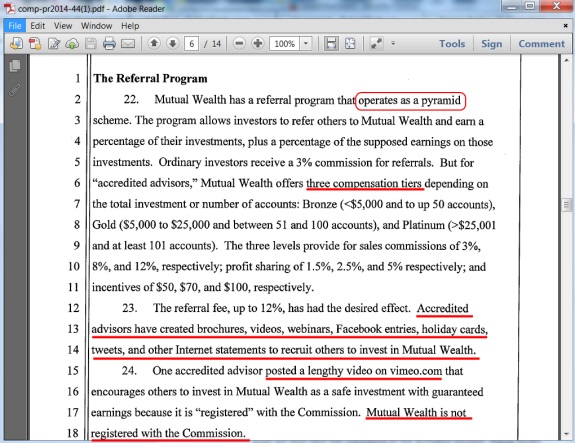
    An associated web domain styled MutualWealth.com also is a fraud, the SEC said in a statement and emergency court filing that alleges a pyramid scheme in which promoters become referral agents or purported “accredited advisors” to earn recruitment commissions.

    “Mutual Wealth used Facebook and Twitter as well as a team of recruiters to spread a steady stream of lies that tricked investors out of their money,” said Gerald W. Hodgkins, an associate director in the SEC’s Division of Enforcement.

    Some recent scams have purported to operate out of Hong Kong, something that appears also to be the case with Mutual Wealth.

    “[A]lmost nothing that Mutual Wealth represents to investors is true,” the SEC said.  “The company does not purchase or sell securities on behalf of investors, and instead merely diverts investor money to offshore bank accounts held by shell companies.  Mutual Wealth’s purported headquarters in Hong Kong does not exist, nor does its purported ‘data-centre’ in New York.  Mutual Wealth also lists make-believe ‘executives’ on its website, and falsely claims in e-mails to investors that it is ‘registered’ or ‘duly registered’ with the SEC.

    And, the SEC said, Mutual Wealth may operate through entities in Panama and the United Kingdom “and through Russian or Belarussian nationals.”

    From the SEC complaint (italics added):

    Investors who complete an account application are instructed to transfer money to Mutual Wealth either by wire transfer to banks located in Latvia and Cyprus or through third-party payment processors such as SolidTrust Pay, EgoPay, or Perfect Money.

    Like other fraud schemes, Mutual Wealth has a presence on the MoneyMakerGroup and TalkGold Ponzi forums.

    U.S. District Judge Dolly M. Gee of the Central District of California has ordered an asset freeze on all accounts “at any bank, financial institution, brokerage firm, or third-payment payment processor (including those commercially known as SolidTrust Pay, EgoPay, and Perfect Money) maintained for the benefit of Mutual Wealth,” the SEC said.

    Assisting in the probe are the FBI, the Financial and Capital Market Commission of Latvia, the Ontario Securities Commission and the Cyprus Securities and Exchange Commission, the SEC said.

    From the SEC’s statement (italics added):

    According to the SEC’s complaint, Mutual Wealth operates through entities in Panama and the United Kingdom and uses offshore bank accounts in Cyprus and Latvia and offshore “payment processors” to divert money from investors.  Mutual Wealth’s sole director and shareholder presented forged and stolen passports and a bogus address to foreign government authorities and payment processors.

    As in previous scams, the Mutual Wealth fraud spread on social media, the SEC said.

    “Mutual Wealth maintains Facebook and Twitter accounts that link to its website and serve as platforms through which it lures new investors,” the SEC said.  “Some of Mutual Wealth’s ‘accredited advisors’ then use social media channels ranging from Facebook and Twitter to YouTube and Skype to recruit additional investors and earn referral fees and commissions.

    “Mutual Wealth’s Facebook page spreads such misrepresentations as ‘HFT portfolios with ROI of up to 250% per annum.  Income yield up to 8% per week,’” the SEC said.  “A Facebook post on Aug. 12, 2013, boasted ‘$1000 investment into the Growth and Income Portfolio made on April 8th, 2013 is now worth $2,112.77.’  Mutual Wealth regularly posts status updates for investors on its Facebook page, and the comment sections beneath the posts are often filled with solicitations by the accredited advisors.  Mutual Wealth also tweets announcements posted on its Facebook page.”

    Regulators have been warning for years about scams spreading on social media.

    Scammers recently have been purporting they are conducting IPOs or pre-IPOs or are registered with the SEC.

    “Mutual Wealth has filed three Securities Act Forms D with the Commission,” the SEC said. “Each Form D purports to give notice of offerings of securities that are exempt from registration with the Commission under Regulation D of the Securities Act.

    “But Mutual Wealth’s offers and sales of securities do not qualify for the exemptions cited in the Forms D or any exemption under from registration under Regulation D of the Securities Act. Consequently, the Forms D are invalid and of no legal effect,” the SEC said.

    About 150 U.S. investors opened Mutual Wealth accounts, plowing “at least” $300,000 into the scheme, the SEC said.

    Note: Thanks to Jordan Maglich at PonziTracker.com.

    Screen stot of section of SEC complaint alleging that Mutual Wealth is a pyramid scheme. Red highlights by PP Blog.
    Screen shot of section of SEC complaint alleging that Mutual Wealth is a pyramid scheme. Red highlights by PP Blog.