On Memorial Day, U.S.-based Zeek Rewards announced it was closing its "old" bank accounts in the United States and opening a new account at a bank it did not name.
UPDATED 8:18 A.M. EDT (MAY 29, U.S.A.) In a curious Memorial Day announcement placed below a representation of the American flag, the Zeek Rewards MLM “program” told affiliates they must cash commission checks “immediately” because Zeek is switching banks.
“Zeek is currently in the process of moving to a bank that can handle our growing needs and while in transition will be closing our old accounts with both New Bridge Bank and BB & T,” Zeek said on its news Blog. “Please be sure to deposit or cash any commission checks immediately so they clear before June 1st, 2012 or they will be returned to you with ‘account closed’ and will need to be reissued.”
Zeek did not identify its new bank. Nor did the purported “opportunity” say why its old banks could not handle its needs and whether its new bank operated on U.S. soil.
Both New Bridge and BB&T are FDIC-member banks operating in North Carolina. Zeek is a purported arm of Rex Venture Group LLC, which conducts business in North Carolina.
Zeek says it conducts business with offshore payment processors such as AlertPay (now Payza) and SolidTrustPay. Both AlertPay and SolidTrustPay have been criticized for being friendly to dubious businesses if not outright scams such as investment programs operating in disguise, HYIPs, autosurfs and cycler matrices.
Zeek affiliates, meanwhile, have a presence on well-known Ponzi-scheme forums such as TalkGold and MoneyMakerGroup, which has led to questions about whether proceeds from any number of fraud schemes could be passing through Zeek. Today alone Italian authorities announced advertising bans against at least three “programs” that either have or had a presence on the Ponzi boards. The “programs” included JSS Tripler, which purports to pay a daily return of 2 percent; Ricochet Riches, which advertised a daily return of at least 2 percent; and Macro Trade, which advertised a daily payout rate of between 1.2 percent and 2.2 percent. A entity known as “System Explosion” also was referenced today in an investor warning by CONSOB, the Italian securities regulator.
Although Zeek insists it is not an investment program, its reported daily payout rate of between 1 percent and 2 percent is consistent with the returns advertised by numerous online scams.
Two days ago, British journalist Tony Hetherington of the Daily Mail wrote about a purported program known as Royalty 7 that was advertising a daily return of 7 percent. Royalty 7 also has a presence on the Ponzi boards, and a PP Blog reader — “Tony” — reported today that the U.K. Financial Services Authority warned on May 22 that Royalty 7 was an unauthorized firm.
“Finance Your Dream Ltd trading as Royalty7.com is not authorised under the Financial Services and Markets Act 2000 (FSMA) to carry on a regulated activity in the UK,” FSA warned. “Regulated activities include, among other things, accepting deposits by way of business.”
Royalty7 — like Zeek, JSS Tripler and scores of other programs that either plant the seed that outsize returns are possible or outright advertise returns that correspond to annualized returns in the hundreds of percent — advertises that it uses AlertPay and SolidTrustPay as payment processors.
The Zeek Rewards MLM program is married to a penny-auction site known as Zeekler.
“Win Cash!” Zeekler roars to bidders. “Funds will be sent to the winner by SolidTrust Pay or AlertPay.”
Zeek’s apparent reliance on processors that are the darlings of global fraudsters has resulted in a bizarre condition under which Zeekler effectively is using U.S. currency as an auction “product” no different than a TV set while advertising that successful bidders for sums of cash can receive their winnings through offshore processors linked to fraud scheme after fraud scheme.
Successful Zeekler bidders are told to “please send a note to [Zeekler] customer support requesting SolidTrust Pay or AlertPay” to receive their cash winnings.
Despite Zeek’s claim it is not an investment program, it has been presented as such online by its own affiliates. Affiliates claim they’ve earned gains that correspond to an annualized return of more than 500 percent and that Zeek has a feature that makes “compounding” possible.
Under the terms of his plea agreement, AdSurfDaily President Andy Bowdoin effectively has been banned from multilevel marketing, Internet opportunities and businesses that employ mass marketing.
The agreement contains this provision, and Bowdoin consented to it in writing as a condition of release before he is formally sentenced: “Your client shall not participate in any business venture using the internet, multi-level marketing, or mass marketing.” (Italics added.)
Language in the agreement suggests the bans could last until Bowdoin is well into his eighties — until Bowdoin, now 77, serves any prison or probationary term imposed. No sentencing date has been scheduled. Bowdoin’s next court date is set for June 12 “to determine if he should be incarcerated pending his sentencing,” federal prosecutors said.
Bowdoin pleaded guilty yesterday to wire fraud for the web-based ASD scam. The information in the numbered entries (below) was confirmed by Bowdoin himself in a “Statement of Offense” that bears his signature. It is in stark contrast to earlier online claims by the ASD patriarch that he had been railroaded and that ASD members should send him money to pay for his criminal defense.
Second Key Win For Government
Bowdoin’s guilty plea marked the second recent win by the government in a major online HYIP case. Gregory N. McKnight, the operator of the Legisi HYIP and Ponzi scheme, pleaded guilty to wire fraud in February. The Legisi and ASD schemes fetched a combined haul of more than $180 million, according to court filings. Bowdoin’s scheme was a form of HYIP fraud known as “autosurfing” in which participants were promised enormous returns for viewing advertisements. The schemes spread in part through social networking and shilling sites such as the TalkGold and MoneyMakerGroup forums.
The U.S. Secret Service was involved in both the ASD and Legisi probes.
ASD Discussed In HYIP’s Conference Call Day Before Bowdoin Guilty Plea
A current HYIP scheme known as JSS Tripler/JustBeenPaid continues to make inroads online. Frederick Mann, the purported operator of JSS/JBP, was identified in 2008 promos as an ASD pitchman. Bowdoin’s legal problems were among the subjects of a JSS/JBP conference call Thursday that appeared to be heavily populated by U.S. residents, including some who expressed worry about the “program.” JSS/JBP purports to provide a daily return of 2 percent, twice that of ASD.
Less than 24 hours after Thurday’s JSS/JBP call ended, Bowdoin pleaded guilty in open court and subjected himself to a possible prison term of 78 months, along with three years’ supervised release. Under the terms of his plea agreement, Bowdoin potentially faces court supervision for the next 9 and a half years.
During Thursday’s call, Mann — an older man, like Bowdoin — did not rule out the possibility that his program could encounter an ASD-like intervention by the government.
“The slavemasters don’t want their slaves to escape,” Mann said, casting the U.S. government as wicked.
“What you need to realize is that the de facto U.S. Constitution is ‘anything goes’ that we can get away with. So, that’s how Obama operates. That’s how Romney would operate if he were elected President. That’s how George Bush operates.”
Like ASD, JSS/JBP may have ties or be sympathetic to the so-called “sovereign citizen” movement. “Sovereign citizens” have an irrational belief that laws do not apply to them. JSS/JBP is so secretive that the “opportunity” does not identify where it is operating from and makes members affirm they are not with the “government.”
After a caller asked Mann Thursday about ASD, Mann said this:
“If they want to arrest people and take their money, they will find some pretext.”
HYIPs operate as virtually pure Ponzi schemes. Victims can pile up by the tens of thousands in a single scheme. The schemes redistribute wealth from the masses and put it in the hands of a select few.
Bowdoin’s Statement
ASD's Andy Bowdoin
Before getting into some of the specifics of Bowdoin’s signed statement — a statement also signed by Bowdoin’s attorney Charles A. Murray and a federal prosecutor — it perhaps is worth noting that Bowdoin’s plea agreement contains this provision to which Bowdoin agreed in writing: “Your client represents to the Court that his attorney has rendered effective assistance.” (Italics added.)
Though boilerplate language, it is important in the context of Bowdoin’s history. Indeed, he has a history of publicly blaming lawyers for his problems. In 2011, for example, he appeared in a video solicitation in which he asked the people he now admits he defrauded to pay for his criminal defense. Bowdoin blamed his prior counsel, a federal judge, two federal prosecutors and three agents of the U.S. Secret Service for his predicament. The final page of the plea agreement contains this language to which Bowdoin agreed in writing:
“I have read this Plea Agreement and discussed it with my attorneys, Michael McDonnell, Esq. and Charles Murray, Esq. I fully understand this Plea Agreement and agree to it without reservation. I do this voluntarily and of my own free will, intending to be legally bound. No threats have been made against me nor am I under the influence of anything that could impede my ability to understand this Plea Agreement fully. I am pleading guilty because I am in fact guilty of the offense(s) identified in this Plea Agreement.” (Italics/bolding added)
Because of the plea agreement and the MLM/Internet/mass-marketing bans, Bowdoin’s role as an an online pitchman for a program known as “OneX” has ended.
In essence, because of what Bowdoin did in ASD — and allegedly what he continued to do even after being arrested for running a Ponzi scheme — Bowdoin has been banned from MLM, kicked out of the business side of the Web and barred from making mass solicitations in any form.
Prosecutors said last month that OneX was a “fraudulent scheme” and “pyramid” that was recycling money to members in ASD-like fashion. Bowdoin was arrested on ASD-related charges in December 2010. In October 2011 — 10 months after his arrest — he told OneX prospects that God had provided the OneX program and that he intended to use money from the scheme to pay for his criminal defense.
On Tuesday — just three days before Bowdoin pleaded guilty to a felony for his operation of ASD — a fellow OneX pitchman described Bowdoin as “our Mentor.”
Here, now, some highlights from Bowdoin’s signed “Statement of Offense” — along with editorial notes. Bolding added by the PP Blog . . .
1.) “Bowdoin called ASD’s operation a revenue-sharing advertising program . . .” (NOTE: All kinds of HYIP schemes use the phrase “revenue sharing” as a means of masking the Ponzi elements. The phrase, for example, appears on the website of JSS/JBP. It “works” because it sounds plausible. After all, many businesses share revenue legally. The connection many new HYIP enlistees do not make is that scammers have co-opted the term to sanitize their fraud schemes.)
2.) “But, contrary to its representations, the advertising packages sold by ASD generated insufficient revenue to fund the returns it promised to the members. Instead, ASD operated as a ‘Ponzi’ scheme.” (NOTE: ASD members Dwight Owen Schweitzer and Todd Disner sued the government last year, alleging that ASD was a legitimate business. Bowdoin now publicly disagrees with them, based on his admission that ASD was a Ponzi scheme.)
3.) “Throughout ASD’s operation, Bowdoin was aware that ASD was an illegal money making business, and that he was intentionally defrauding ASD members.”
4.) ASD, according to Bowdoin’s statement, actually gathered more than “$119 million” from members. (NOTE: This figure is about $9 million higher than the rough amount of $110 million cited by the government in previous filings. The PP Blog will check next week to see if it can confirm that the $119 million figure is the final sum identified after investigation. As things stand, both Bowdoin and the government agree on the $119 million figure.)
5.) ASD made more than $45 million in Ponzi payments and spent more than $10 million on operations. About $1.161 million was directed at Bowdoin or his family.
6.) During ASD’s initial iteration at AdSurfDaily.com, Bowdoin realized “[a]fter only a few months of operation” that ASD was in over its head “because he was not selling any independent products or services sufficient to generate an income stream needed to support the returns and commissions ASD was paying . . .” (NOTE: The JSS/JBP scheme has a commission-payout scheme (two tiers, one paying 10 percent the other 5 percent) that is virtually identical to ASD. Incredibly, JSS/JBP says it can pay double ASD’s daily return of 1 percent on top of the two-tiered commissions.)
7.) “In approximately March 2007, Bowdoin ceased ASD’s operations because it was paying out money to its employees and members faster than it was taking in new money.” (NOTE: Bowdoin’s concession proves the government’s longstanding theory that ASD collapsed in its original iteration because of the Ponzi pressure. At one point, according to court filings, Bowdoin blamed ASD’s inability to pay on script problems and a purported theft of $1 million by “Russian” hackers.)
8.) Bowdoin — instead of getting out of the Ponzi business — thereafter launched ASD under a new name at a new website: ASDCashGenerator.com. Bowdoin, according to his statement, admits he made some cosmetic tweaks — lowering the return from 150 percent to 125 percent, for example. “By not changing ASD’s business model in any meaningful way, Bowdoin continued to intentionally defraud members.” (NOTE: It is common in the HYIP fraud sphere for “admins” to claim they’ve employed tweaks to take Ponzi issues out of play. An obvious Ponzi scheme known as JSS Tripler 2 appears recently to have employed some Bowdoin-like tweaks, including a name change to T2MoneyKlub — while adding to its claims that the “opportunity” had income streams sufficient to pay an absurd return of 2 percent a day on top of referral commissions.)
9.) Bowdoin never told his second group of fraud victims that they were paying for the fraud Bowdoin committed against his first group of victims.
10.) “Bowdoin also intentionally failed to explain to old and new members that, in the 1990s, he was convicted in Alabama of three securities-related crimes, charged in Alabama in at least 13 additional indictments alleging securities fraud, and barred from ever selling securities in Alabama.”
11.) Bowdoin compounded lies told about his lack of a criminal record by permitting lies to be told about an award for business achievement purportedly given Bowdoin by President George W. Bush. The “award” actually was a memento from the National Republican Congressional Committee (NRCC) that was “entirely dependent” on a Bowdoin money contrbution to NRCC of $25,000 “and was not based on Bowdoin’s business acumen or any other evaluation of his prior business practices.”
Frederick Mann, onetime ASD pitchman and the purported operator of JSS Tripler/JustBeenPaid
UPDATED 7:44 A.M. EDT (U.S.A.). A potentially damning audio recording of a March 15 conference call in which Frederick Mann told JSS Tripler/JustBeenPaid members that the “opportunity” was paying them with money from “new members” has gone missing from the JSS/JBP website.
Mann, whose name appeared in 2008 promos as a pitchman for AdSurfDaily, is the purported operator of JSS/JBP. The U.S. Secret Service seized tens of millions of dollars tied to ASD in 2008, amid allegations it was conducting an international Ponzi scheme over the Internet.
Andy Bowdoin now has been accused of serial scamming dating back at least two decades. He faces a May 8 bond-review hearing. Frederick Mann, the purported operator of JSS/JBP, was identified in 2008 promos as an ASD pitchman.
ASD President Andy Bowdoin was charged criminally in 2010. He now faces a May 8 bond-review hearing amid allegations that he continued to scam the public even after the August 2008 seizure of $65.8 million from his 10 personal bank accounts and even after his December 2010 arrest in Florida on ASD-related Ponzi charges of wire fraud, securities fraud and selling unregistered securities.
“I (Frederick Mann) have been with ASD since January 07,” remarks attributed to Mann on a site known as BigBooster read on May 14, 2008. “Past performance indicates a strong probablility (sic) that ASD will continue to perform as advertised. (By early May 2008, I had received 14 payments totalling over $6,000!”)
The U.S. Secret Service conducted a Ponzi raid of ASD less than three months later. Despite the Ponzi allegations against Bowdoin and ASD, Mann purportedly went on to launch JSS/JBP, which purports to pay members a return of 2 percent a day — double the purported return of ASD.
In January 2012, JSS/JBP-related claims came under the lens of CONSOB, the Italian securities regulator. The agency banned promos for the “opportunity” last month after earlier announcing a 90-day suspension.
Just days before CONSOB’s April 23 announcement of the ban — on April 17 — U.S. federal prosecutors sent a letter to Bowdoin’s defense attorney in the ASD Ponzi case. The letter informed the attorney — Charles A. Murray — that the government intended to introduce evidence that Bowdoin continued to commit crimes after the August 2008 ASD seizure and after Bowdoin’s subsequent indictment on charges that could put him behind bars for 125 years if he is convicted on all counts.
Prosecutors said they had tied Bowdoin to AdViewGlobal (AVG), an autosurf that collapsed in 2009. They also said Bowdoin had emerged as a pitchman for a “fraudulent scheme” known as OneX that — in ASD-like fashion — “simply re-distributes funds among participants.”
Online Ponzi schemes are infamous for morphing into new forms. Serial scammers who populate Ponzi boards such as TalkGold and MoneyMakerGroup drive business to the purported “opportunities,” which often advertise MLM-style, tiered recruitment “commissions” on top of preposterous rates of return.
ASD, AVG, OneX and JSS/JBP all have (or had) a presence on the Ponzi boards. Serial apologists for JSS/JBP have pooh-poohed the CONSOB developments.
In the now-missing March 15 recording, a caller purportedly from “San Francisco” asked Mann where “JustBeenPaid get[s] the money to pay that kind of interest.”
The reference was to the advertised return of 2 percent a day, which corresponds to a precompounding, annualized return of 730 percent — a figure that would make Bernard Madoff blush.
“Well, first of all, JBP or JSS Tripler is a revenue-sharing program, so that means some of the money comes from new members buying positions,” Mann responded to the caller. “Then, we are in the process of developing additional income streams, so that’s relevant. And eventually the additional income streams may be sufficient to pay the 2 percent — maybe not.”
BULLETIN: The SEC has gone to federal court in New York, alleging that 20-year-old British twin brothers Thomas Edward Hunter and Alexander John Hunter started an elaborate online fraud scheme when they were 16 and netted millions of dollars.
At least three Hunter websites were involved in the fraud, according to the SEC: DoublingStocks.com, DayTradingRobot.com and EquityPromoter.com. The EquityPromoter site allegedly was a stock-touting site that fueled the fraud.
Part of the alleged pump-and-dump scam centered on a fake “stock-picking robot” dubbed “Marl,” which purportedly chose stocks that would double in price, featured “evolutionary framework” and was was capable of making “1,986,832 mathematical calculations per second.”
Despite the impressive-sounding claims, the SEC charged, no robot was making real picks. Instead, the software just regurgitated stock symbols that had been entered into a database in advance and were linked to penny stocks the brothers were being paid secretly to hype.
“Marl” formed its name from its purported inventors, Michael Cohen and Carl Williamson, the SEC charged. Cohen, the agency added, was positioned in the Hunter promos as the developer of the “famous ‘Global Alpha’ computer stock trading model” as a contractor for the Goldman Sachs Group Inc.”
Representations about Michael Cohen “were false,” the agency alleged.
“[N]o such employee or contractor worked in that capacity at Goldman Sachs,” the SEC charged.
“The Hunters used the anonymity of the Internet and the promise of easy riches to prey on investors,” said Thomas A. Sporkin, chief of the SEC’s Office of Market Intelligence. “While touting their supposed breakthrough investment technology on two websites, the Hunters were racking up fees as stock promoters through a third.”
A downloadable version of the purported “Marl” robot was offered online by the Hunters for $97, positioned alongside a $47 newsletter subscription, the SEC alleged.
“The defendants claimed that the home software performed the same sophisticated analyses that purportedly underlay the defendants’ newsletter [stock] selections, but with the added benefit that investors would not have to wait for the emailed newsletters to capitalize on Marl’s analytic capabilities,” the agency alleged.
In reality, the agency charged, “the home software was designed to retrieve predetermined stock ticker symbols from a database that the defendants populated to deliver those tickers to investors on dates set by the defendants.”
In 2007, the SEC said, Alexander John Hunter sought bids from programmers to build the software. Here, according to the agency, is how the programming solicitation read (italics added).
“Need a small software program which will appear to the user that once running it is analyzing thousands of penny stocks.
“Every so often, the software will find a stock, and a message will appear from the system tray, and on the program showing the ticker symbol.
“IMPORTANT: This software does not actually find stocks at all. It should connect to my database and simply request any new stocks I have put in.”
The solicitation, according to the SEC, went on to say this (italics added):
“Basically this is almost a ‘fake’ piece of software and needs to simply appear advanced to the user . . . “
Various references to the purported miracle robot appear online. One such reference viewed today by the PP Blog appeared on Squidoo, a social-networking site. When the Blog clicked on a “Marl” link at the Squidoo site, it was forwarded to a Clickbank hoplink that included this message (italics added):
“This site is no longer in service or has been disabled due to a terms of service violation.”
Clickbank is an online retail outlet for digital products and affiliate marketers. The company is not referenced in the SEC complaint, and has not been accused of wrongdoing.
“Marl” also was touted from MySpace, another social-networking portal. A “Marl” video with a URL containing a Clickbank hoplink appears on a MySpace page viewed today by the PP Blog, but generated a “This site is no longer in service or has been disabled due to a terms of service violation” error message when entered in a browser window.
Promos for “Marl” also appeared on the TalkGold and MoneyMakerGroup Ponzi forum, according to research.
It was not immediately clear if the Hunters were responsible for the Clickbank promos or whether other individuals also were selling “Marl” through Clickbank.
The Hunter brothers, the SEC charged, were running scams within scams.
“The SEC alleges that the brothers separately created the website Equitypromoter.com where they marketed their newsletter subscriber list to penny stock promoters and boasted, ‘One email to this list of people rockets a stock price,’” the agency said. “The Hunters were in turn paid to send selected penny stock ticker symbols to their subscribers, who were misled to believe that the stock ‘picks’ were the product of the robot. The Hunters sent out their newsletters near the beginning of the trading day, and the price and volume of the promoted stocks spiked dramatically as newsletter subscribers rushed to purchase shares. However, the stocks typically fell precipitously shortly thereafter, leaving investors with shares worth less than they had purchased them for earlier in the day.”
All in all, the newsletter component of the scam fetched “at least” $1.2 million at $47 a pop, the agency alleged.
Beyond that, the Hunters were “paid at least $1.865 million in fees from known or suspected stock promoters, and they did not disclose to their newsletter followers the conflicting relationship between their two businesses,” the agency alleged.
How much the “robot” component of the scam allegedly fetched was not immediately clear, but the product was offered at $97, according to the SEC.
Named a relief defendant in the SEC case against the Hunters was Regency Investment Group Corp. The agency described it as a “Panamanian company owned by defendant Alexander John Hunter and over which defendants Alexander John and Thomas Edward Hunter jointly have power of attorney.”
In general, a company is named a relief defendant when there is reason to believe it has received ill-gotten gains from a scheme.
Owing to time constraints, the PP Blog hasn’t written much about Zeek Rewards, an MLM “program” married to a penny-auction site known as “Zeekler.” For simplicity, we’ll refer to both arms as “Zeek.”
The structure of Zeek and precisely what it does are just plain baffling. Even so, it appears to have a legion of loyal followers, including followers on well-known Ponzi forums such as MoneyMakerGroup and TalkGold. The Ponzi-board presence of Zeek affiliates is potentially problematic in the sense that some of them also are pushing obvious fraud schemes such as JSS Tripler/JustBeenPaid, which advertises a return of 60 percent a month and does not disclose its base of operations.
Yesterday, for instance, a MoneyMakerGroup poster “defending” JSS/JBP while dissing naysayer “Lynndel” was showcasing his Zeek affiliate link below his JSS/JBP “defense.”
“I am sorry to bring it up to you, but every business is a ponzi online or not,” poster “masikk08” wrote in response to “Lynndel’s” pointed criticism of JSS/JBP.
Let’s stop for a moment to assess what we just read: A JSS/JBP “defender” who’s also a Zeek affiliate just told you that “every business” is a Ponzi scheme.
Those words from your potential Zeek sponsor are just plain absurd. They also are devoid of any real-world understanding of the Ponzi menace. Ponzis have put people out of their homes, ruined lives, caused divorces, caused bankruptcies, destroyed college plans and dreams of passing on money to children and caused or contributed to suicides. A number of Ponzi/pyramid-related, murder-for-hire plots have been investigated. A California man believed to have used his ecommerce platform to facilitate Ponzi schemes has been sentenced to death for arranging the contract slaying of his wife, a potential witness against him.
“Every business makes money off of new customers and nothing lasts forever either,” the MoneyMakerGroup poster and Zeek affiliate continued, mixing an irrelevant point with a bromide.
“But we have to make the best out of what opportunities we have,” he droned. “I get paid and everyone I know gets paid with JBP. So I can not agree with your statement. But if you do not like to make money with JBP, there are other opportunities you may be interested in. JBP is not for everyone you know.”
Let’s assess those words: That people are getting paid is not evidence that no underlying crime exists. Successful Ponzis always pay. Bernard Madoff “paid” — right up until the day he didn’t.
Below the post, “masikk08” used an all-caps headline to attract attention to Zeek: “I HAVE A GIFT FOR YOU,” the headline reads. When the link is clicked, it resolves to a Zeek page.
“Zeek Affiliates are giving away up to 500 FREE BIDS to each of their registered and new customers!” the promo begins. It goes on to explain that the the bid giveaway is “AMAZING” and that the giveaway began in August 2011 and will “continue throughout the year!”
Given that we’re approaching May 2012, it appears as though the giveaway has been extended well into 2012.
Some JSS/JBP affiliates came under fire in January by CONSOB, the Italian securities regulator. From a U.S. perspective, both JSS/JBP and Zeek are using offshore payment processors. This, coupled with the Ponzi-board presence and the processors’ histories of enabling investment scams, could mean that money “earned” in one or more scam “programs” is passing through Zeek.
Zeek Cash Auctions
From the tempting-fate department, Zeek and its affiliates, using photos of U.S. currency, also advertise what effectively are auctions for sums of U.S. cash — all while affiliates laud the “program” for providing a return. These things easily could catch the attention of the Treasury Department’s Office of the Comptroller of the Currency, not to mention the SEC and potentially even the CFTC and the FTC.
Bidders potentially could receive substantial sums of cash at a significant discount. There is a certain incongruity about this, perhaps particularly in the sense that the cash auctions create the appearance that U.S. currency is being used as bait and potentially as a loss leader. But the strangest thing of all is that successful bidders apparently have the option of receiving the full value of the U.S. currency via AlertPay or SolidTrustPay, both of which are based in Canada and both of which are friendly to fraud schemes.
This opens the door to questions such as these: What registrations, if any, with which regulators in which countries does Zeek require — and does it have them? Which agency is its principal regulator? If a successful bidder pays less than the face value of the U.S. currency, is Zeek eating the loss? Is Zeek buying currency in bulk — or is it simply divining a sum available for bid and debiting its own bank or processing account for that sum when it sends the electronic equivalent of that sum to the successful bidder via the offshore processors?
Is Zeek selling U.S. currency at a loss or at a profit? If at a loss, why? If at a profit, how? Is there a risk to the U.S. and the currency markets if other “opportunities” model Zeek?
Blogger “Oz” at BehindMLM.com has written a number of articles that raise legitimate questions about Zeek. (It’s worth taking the time to use the search form at BehindMLM to check out the articles/editorials about Zeek.)
As time allows, we’ll add to our coverage of Zeek. We’re reading a lot about it from a variety of sources. The source volume and competing claims about the “program” create an atmosphere of confusion, and the overall Zeek “story” is far from clear.
For the purposes of this column, we’ll raise one final point: AdSurfDaily, which prosecutors have described as an international Ponzi scheme that operated over the Internet and plucked at least $110 million, once spouted that it would try to incorporate an auction arm of some sort. That arm never materialized.
Zeek appears to have ASD-like elements, leading to questions about whether regulators could become concerned that Zeek was selling unregistered securities as investment contracts and using wordplay to mask an investment program as something else.
ASD’s auction dream was speculative at best. Our initial take on Zeek is that it shared ASD’s now-ancient dream — indeed, other MLM’s have had the same dream — but Zeek actually put the dream into action. The question is whether that dream is compliant with any number of regulations that could come into play — or whether Zeek jumped the gun and now is trying to become compliant after the fact and after gathering an unknown sum of money while operating unlawfully.
Lots of people — perhaps millions — support MLM in one form or another. It is virtually impossible to quantify all of the disingenuous presentations, which often are hyperbolic — if not completely over-the-top. A certain sphere within the MLM universe is dominated by hucksters. These hucksters often display a remarkable lack of awareness. Some of them are tone-deaf politically and have a tin ear for real-world PR.
So, for the purpose of this first column on Zeek, we leave you with two questions: If you place a successful bid for a sum of U.S. currency on Zeekler, do you have any legal or political concerns if your cash equivalent is delivered via an offshore processor that has processed payments for one scam or collapsed scheme after another?
In a 29-page court order announced yesterday by the SEC, U.S. District Judge George Caram Steeh of the Eastern District of Michigan laid out the case of willful blindness against serial HYIP pitchman Matthew John Gagnon.
That case now has resulted in court-ordered judgments of more than $4.2 million against Gagnon, who also was named in a criminal complaint by the U.S. Secret Service in November 2011.
But in the HYIP sphere, which FINRA described in 2010 as a “bizarre substratum of the Internet,” not even the huge judgment against Gagnon announced yesterday appeared to unnerve the serial scammers on the TalkGold and MoneyMakerGroup Ponzi forums.
Posting as “DRdave” on TalkGold, huckster “Ken Russo” announced he’d received a new payment of $482.08 from JSS Tripler/JustBeenPaid, a “program” whose purported daily payout rate of 2 percent dwarfs the purported payout rate of Legisi, one of the “programs” that led to Gagnon’s demise.
In a March 15 conference call, Frederick Mann, the purported operator of JSS/JBP, told members that the company was making the payouts from money sent in by “new members.” Paying “old” members with money from “new” members is the central element of a Ponzi scheme.
Even as “Ken Russo” was making the announcement, the online security company McAfee was publishing a “Warning: Dangerous Site” message about the JustBeenPaid website.
“We tested this site and found it’s risky to visit,” McAfee’s Site Advisor reported.
In 2010, the SEC declared Gagnon a “danger to the investing public” for his serial promotion of scams. (See paragraph 11 of May 2010 SEC complaint.)
Assessing Gagnon more than $4.2 million in disgorgement, prejudgment interest and penalties, Steeh found that:
Gagnon promoted the Legisi HYIP online, through emails and through a forum.
Even though Gagnon promoted the program, he was not associated with a registered broker-dealer and had never been registered with the SEC in any capacity.
Gagnon understood HYIP frauds and Ponzi schemes, and yet gleaned about $3.6 million from Legisi operator Gregory McKnight and did not disclose details of his agreement with McKnight to solicit investors for Legisi.
Gagnon helped orchestrate the “massive” Legisi Ponzi scheme and initially had come into contact with McKnight after Gagnon had recruited McKnight into an MLM business that sold dietary supplements.
Legisi was selling unregistered securities.
Gagnon was selling unregistered securities.
Gagnon did not qualify investors in any way. (In essence, the only necessary qualification was to have money to send to Legisi.)
Gagnon performed no “due diligence” on the profitability of the Legisi program. He did not retain or review trading records, bank or brokerage accounts statements or e-currency account records.
Gagnon knew or “recklessly disregarded” warnings that Legisi was a scam, did not know where McKnight was keeping the money or how McKnight was calculating profits and losses.
Eventually Gagnon distanced himself from McKnight (after learning about an SEC probe, according to the agency), but proceeded to pitch other scams touting the illegal sale of securities. A twice-convicted felon was Gagnon’s alleged partner in one of the scams, but Gagnon performed no legwork up front.
Gagnon eventually learned that a man with the same name as his partner had been convicted of fraud, but “accepted” his partner’s “representation that it was not him.” Gagnon did not investigate his partner’s denials, which were false.
Gagnon then proceeded to another opportunity touting unregistered securities, effectively using the same blueprint he’d used when touting Legisi and the other scam in which his partner was a convicted felon. As in the other scams, Gagnon did no legwork and “recklessly ignored several warning signs.”
Even as he touted the third program, Gagnon had received “several” bad checks from the purported “successful” trader. Gagnon continued to tout the program.
Gagnon then touted a fourth program, apparently one operated by a Ugandan national Gagnon had met on the Internet. (Gagnon stopped promoting this program, according to the SEC, only after the agency subpoenaed his bank records.)
Gagnon has shown “no remorse” for his conduct “and has tried to downplay his culpability.”
Whether “Ken Russo” has conducted any “due diligence” on JSS/JBP is unknown. Whether “Ken Russo” has any qualifications to sell securities is unknown. Whether “Ken Russo” qualified investors in any way is unknown. Whether “Ken Russo” retained or reviewed JSS/JBP records, bank or brokerage accounts statements or e-currency account records is unknown.
What is known is that “Ken Russo” proceeds from scheme to scheme to scheme.
“I would caution everyone not to listen to anyone who is posting negative comments about this program,” “Ken Russo,” posting as “DRdave” on TalkGold, urged today. “JBP/JSSTripler has changed many lives during the past 13 months and it is one of the best programs I have seen since I first entered the industry back in 1996!”
Here, according to the SEC, is how Gagnon, who’d been pitching programs online “since at least 1997,” described Legisi:
“IN ALL OUR EXPERIENCE IF (sic) HIGH YIELD PROGRAMS THIS IS THE ONLY GENUINE PROGRAM THAT WE HAVE EVER FOUND!”
McKnight, like Gagnon, is facing millions of dollars in civil judgments. And McKnight pleaded guilty last month to a criminal charge of wire fraud.
It turned out that Legisi was not “GENUINE” at all.
UPDATED 10:35 P.M. EDT (U.S.A.) Matthew John Gagnon, an HYIP huckster and promoter of the Legisi Ponzi scheme, has been hit with orders of disgorgement and penalties totaling more than $4.2 million, the SEC said.
Gagnon, of Portland, Ore., and Weslaco, Texas, was described by the SEC as a serial promoter of fraud schemes through his Mazu.com website.
“The Court found that Gagnon ‘purposefully built up an image of trustworthiness in the on-line investing community and exploited this trust,’” the SEC said. “The Court also found that Gagnon ‘repeatedly committed egregious violations of the federal securities laws’ and ‘has shown no remorse for his conduct.’”
U.S. District Judge George Caram Steeh of the Eastern District of Michigan presided over the Gagnon case, which the SEC brought in May 2010. The SEC case against Gagnon was not limited to his involvement in Legisi. It also addressed his involvement in a “resorts” securities-fraud scheme from which money was diverted to a recidivist felon, and his involvement in multiple Forex schemes.
Legisi, an HYIP fraud, had a considerable presence on the TalkGold and MoneyMakerGroup Ponzi forums. Legisi operator Gregory McKnight pleaded guilty to wire fraud last month.
Here is the breakdown of the financial penalties ordered by Steeh in the May 2010 case against Gagnon: $3,613,259 in disgorgement; $488,570.47 in prejudgment interest; and a $100,000 civil penalty.
Here is a snippet from Steeh’s order of permanent injunction against Gagnon (italics added):
“[Gagnon] explained that ‘I have a trader I represent in Europe that can trade your funds in amanaged account.’ Gagnon promised that investors in the European Trade Offer would experience ‘consistent monthly profits’ and ‘very few losing trades.’ Apparently, the European trader is ‘Juju,’ who is Jjunju Kateregga, a Ugandan national residing in Finland. Gagnon promoted Juju’s trading prowess after meeting him on the internet, exchanging emails and talking to him on the phone ‘a few times.’”
NOTE: The quoted passage above pertains to a purported “managed Forex trading” offer pitched by Gagnon after he moved on from Legisi. (Read the full order at Justia.com.)
In November 2011, the U.S. Secret Service filed a criminal complaint against Gagnon for his alleged wrongdoing in Legisi.
UPDATED 7:43 A.M. ET (MARCH 9, U.S.A.) If ever there has been a cautionary tale for HYIP pitchmen, it is Jeffrey Lane Mowen’s Utah Ponzi scheme.
Mowen and at least six promoters ended up inspiring litigation on multiple fronts, with Mowen charged criminally. At issue was Mowen’s Forex Ponzi scheme, which allegedly was funded in part through an alleged high-yield “promissory notes” offering fraud.
Tonight, Mowen, 49, is listed as “in transit” to an unspecified federal prison. He has been jailed in the United States since he was extradited from Panama in 2009. He pleaded guilty to U.S. charges of wire fraud last year and was sentenced to 10 years.
Mowen received a merciful plea agreement in which other serious criminal charges were dropped, including solicitation to commit a crime of violence, witness tampering and retaliating against a witness.
The sidebars in the Mowen story have been every bit as compelling as the story-in-chief. Indeed, Mowen sought to shield himself in Panama when his scheme collapsed.
It didn’t work. Panamanian authorities and the FBI got him quickly.
Jeffrey Lane Mowen
After his return to the United States, Mowen allegedly solicited the murder of four witnesses “with the intent of preventing their attendance and testimony at his federal fraud trial” in the Ponzi scheme case.
That didn’t work. The cellmate through whom he allegedly solicited the murders was a snitch.
But the cautionary tale doesn’t end there. Jeffrey Lane Mowen was a felon and a recidivist securities huckster. Thomas Fry, an unregistered promoter, used at least five other unregistered promoters to raise funds for “opportunities” that purported to pay a return of between 2 percent and 3 percent a month, according to the SEC.
Fry and the pitchmen were sued by the SEC in 2009. All six also now face administration sanctions from the SEC — this after the agency targeted their ill-gotten gains in the earlier lawsuit.
Failure to conduct due diligence and engaging in willful blindness were elements in the SEC’s lawsuit 2009 against the promoters, according to court filings.
“Because the Promoters not only conducted virtually no due diligence in connection with Fry’s purported investment opportunities, but transferred investor money to Fry without any documentation or limitation on his use of the funds, the Promoters were reckless in failing to discover Fry’s association with Mowen and that their funds were being placed into a Ponzi scheme or used for other undisclosed purposes,” the SEC charged at the time.
All of the pitchman now have been barred from the securities business under the terms of the administrative action. In a settlement, none of the pitchmen acknowledged wrongdoing. But the various Ponzi- and fraud-related actions were front-and-center in their lives for the better part of three years.
This common paragraph appears in each of the administrative actions against the five Fry pitchmen (italics added):
“The Commission’s complaint alleged that, from at least January 2007 through July 2008, [Pitchman’s Name] offered and sold purported high-yield promissory notes to investors that he claimed would pay 2% to 3% interest monthly. The funds raised by [Pitchman’s Name] were given to Thomas R. Fry who funneled those funds into a Ponzi scheme run by Jeffrey L. Mowen, a convicted felon and securities law recidivist. The Commission alleged that [Pitchman’s Name] distributed private placement memoranda to investors that falsely stated that all the investors’ funds were being used to make collateralized domestic real estate loans and domestic small business loans and that misrepresented the level of his due diligence as to the investment scheme. The Commission alleged that [Pitchman’s Name] conducted virtually no due diligence in connection with the purported investment opportunities and transferred investor money without any documentation or limitation on the use of the funds.”
Fry knew Mowen was a scammer, but still continued to solicit funds, the SEC said. All in all, he and the other five pitchmen raised more than $18 million for Mowen.
But the FBI said Mowen wasn’t operating a legitimate investment opportunity. What he was doing was buying exotic cars, taking personal vacations, supporting a luxurious lifestyle and making Ponzi payouts that ultimately defrauded more than 200 investors out of between $9 million and $10 million.
The purported monthly returns offered by JSS Tripler/JustBeenPaid — an “opportunity” now making its way around the web — are roughly TWENTY times higher than the scheme pitched by Fry and his promoters, according to records.
As noted above, the alleged offering fraud involving Fry and the other pitchmen was promoted on the purported basis of returns of 2 percent to 3 percent a month. JSS Tripler/JustBeenPaid advertises 60 percent a month.
Also on a monthly basis, the purported payout of JSS Tripler/JustBeenPaid is roughly between TWO and SEVEN times higher than the payout of the Ponzi scheme that put Mowen in prison for 10 years, according to records.
Mowen’s Forex Ponzi scheme scheme offered between 8 percent and 33 percent a month, federal prosecutors said last year.
It is somewhat common for HYIP purveyors who populate Ponzi boards such as TalkGold and MoneyMakerGroup to assert they have conducted “due diligence” on an “opportunity” or to assert that a “program’s” operator and/or management “team” have done so and that prospects don’t have to concern themselves with doing any legwork.
It often proves to be the case that the “due diligence” consists of GIGO — garbage in, garbage out. The promoters simply repeat the company line, rather than doing any sort of critical assessment such as questioning how an HYIP “program” operator could provide returns that may dwarf the returns of Bernard Madoff and other Ponzi schemers such as Mowen.
“There is a line between First Amendment Rights vs. Libel here. So, when does your right to form an opinion begins (sic) and when does it constitute a defamation of character? The answer is, law enforcement agencies don’t pay attention to what’s being said on forums and blogs, so get your head straight and feet firm on the ground.” — “MoneyMakingBrain,” in March 4, 2012, post on RealScam.com
As previously reported on the PP Blog, a JSS Tripler/JustBeenPaid “defender” known as “MoneyMakingBrain” (MMB) has emailed threats to the PP Blog, hatched bizarre conspiracy theories here and at RealScam.com and planted the seed that he was someone to fear.
The email threats were received after MMB claimed Feb. 18 on RealScam he had performed “due diligence” on JSS Tripler/JustBeenPaid. On a website known as “ReviewOPedia,” a poster with the same handle offered this on Feb. 14, in the context of JSS Tripler/JustBeenPaid:
“They are for real! ”
Within the same Feb. 14 ReviewOPedia post, MoneyMakingBrain ventured this (italics added):
“BTW, everybody should check out the JBP live support chatroom which has over 160 people at any given time and is live 24/7. You can ask all the questions you can come up with and there is always moderator. Who does that? I’m sold already. So, if someone here claims that they ‘didn’t get paid’, either they still don’t understand how the matrix works or they’re just internet trolls.”
Whether the “MoneyMakingBrain” on the PP Blog and the “MoneyMakingBrain” on ReviewOPedia are one and the same is unknown to the PP Blog.
Precisely why the MMB known to the PP Blog and RealScam.com has been trying to chill specific individuals and antiscam forums is unclear. What is known is that what he’s doing is hardly unique.
Lessons Of HYIP History Ignored
While asserting that he knows the PP Blog’s IP address and posting location, MMB now is making a claim on RealScam, a forum that concerns itself with international mass-marketing fraud, that “law enforcement agencies don’t pay attention to what’s being said on forums and blogs.”
That claim is contrary to the public record, which shows that any number of agencies, self-regulatory bodies and private attorneys have been noting for years that HYIP schemes are proliferating on the Internet and being spread by posters on forums and social-networking sites. It also ignores the reality — also a matter of public record — that law-enforcement has a history of filing court documents that reproduce HYIP forum posts and of infiltrating HYIP schemes.
Prominent FINRA Warning On HYIPs
In July 2010, the Financial Industry Regulatory Authority issued this highly public alert. FINRA noted that “HYIPs use an array of websites and social media — including YouTube, Twitter and Facebook — to lure investors.”
HYIPs fabricate a “buzz” and create “the illusion of social consensus,” FINRA said, describing the sinister approach as a “common persuasion tactic fraudsters use to suggest that “everyone is investing in HYIPs, so they must be legitimate.”
Forum Posts Become Evidence In HYIP Cases
In the SEC’s May 2008 prosecution of the Legisi HYIP scheme, the agency included page after page of forum posts as part of a 267-page evidence exhibit in support of an asset freeze. A federal judge approved the freeze. (The screenshot below is from one of the forum pages.)
Legisi operator Gregory McKnight pleaded guilty to criminal charges of wire fraud last month. He also faces millions of dollars in civil judgments. The SEC Legisi filings also include a reference to the MoneyMakerGroup forum, which is listed in other federal court filings as a place from which HYIP Ponzi schemes are promoted.
This section of the Legisi Terms of Service purports that members must avow they are not an "informant, nor associated with any informant" of the IRS, FBI, CIA and the SEC, among others. The others included "Her Majesty's Police," the Intelligence Services of Great Britain, the Serious Fraud Office, Interpol and others.
Included within the SEC filings is a reproduction of Legisi’s bizarre Terms. (See graphic at right. It is taken from court filings.) Among other things, the Terms made members avow they were not an “informant” for various government entities.
JSS Tripler/JustBeenPaid has similar Terms. The Terms read like an invitation to join an international financial conspiracy. (The next two paragraphs are verbatim from the JSS Tripler/Just BeenPaid member agreement. Italics added.)
6. I affirm that I am not an employee or official of any government agency, nor am I acting on behalf of or collecting information for or on behalf of any government agency.
7. I affirm that I am not an employee, by contract or otherwise, of any media or research company, and I am not reading any of the JBP pages in order to collect information for someone else.”
When the U.S. Postal Inspection Service filed criminal charges against Nicholas Smirnow in May 2010 for his alleged operation of the Pathway To Prosperity HYIP Ponzi scheme, MoneyMakerGroup, TalkGold and ASAMonitor were specifically referenced in the service’s case filings. Smirnow now has his face on an INTERPOL “Wanted” poster.
MMB took great exception to the PP Blog’s Smirnow post, apparently believing it had no relevance in the context of JSS Tripler/JustBeenPaid. MMB also apparently believes the PP Blog and RealScam are treating Frederick Mann, the purported operator of JSS Tripler/JustBeenPaid, unfairly.
Among other things, MMB asserted on the PP Blog that “no one is invisible to the MoneyMakingBrain and you need to stop doing what you’re doing against this man immediately. Because if you don’t, I am going to make a formal complain (sic) to the very authorities you purport are coming after scam sites and send all the evidence I’ve gathered so far from posting on your site and the realscam site. I don’t like witch hunts and I am sure Fred Mann can whip your ass in court for your highly suggestive, provocative, highly contentious and flat-out defamatory commentaries against his character on your sites.”
MMB further suggested that JSS Tripler/JustBeenPaid critics may be “needing to look for another ISP because you won’t have internet access at home or your office, wherever.”
About three months after the SEC brought the $72 million Legisi/McKnight HYIP Ponzi case, the U.S. Secret Service — in August 2008 — filed evidence exhibits in support of an order to freeze tens of millions of dollars in AdSurfDaily-related bank accounts. The complaint in support of the seizure specifically references an ASD-related “Breaking News” Blog, and an evidence exhibit labeled “Government Exhibit 5” consists entirely of an ASD-related post on a different Blog that took up 15 printed pages.
The 15-page post featured alleged comments from ASD President Andy Bowdoin in which he threatened to sue critics.
“These people that are making these slanderous remarks, they are going to continue these slanderous remarks in a court of law defending about a 30 to 40 million dollar slander lawsuit,” the post quoted Bowdoin as saying. (The screen shot below is from Government Exhibit 5. It has been a matter of public record approaching four years.)
Both the ASD and Legisi investigations used government agents in undercover capacities, according to court filings.
Meanwhile, in June 2009, attorneys suing Bowdoin on behalf of ASD members in a civil RICO (racketeering) case referred to the PP Blog’s reporting on the ASD Ponzi case, specifically its reporting on a spinoff surf known as AdViewGlobal (AVG). (See court document. See June 30, 2009, related story. See PP Blog story the attorneys referenced in their filings.)
During its short run, AVG bizarrely asserted that it operated as a “private association” that enjoyed U.S. Constitutional protections in Uruguay. AVG used U.S.-based Gmail addresses to conduct business, something JSS Tripler/JustBeenPaid is doing. The defunct surf further claimed that it had appointed a person who held the title of “Protector.”
Such claims have been linked to the so-called “sovereign citizen” movement. On Feb. 27, 2012, the PP Blog reported that a site linked to Mann published videos of Francis Schaeffer Cox, a purported “sovereign citizen” indicted in Alaska in an alleged murder plot against public officials. The site features a drop-in ad for JSS Tripler/JustBeenPaid that encourages prospects to register with a Gmail address.
Whether MMB is aware of all of these these historical incidents while issuing threats and planting the seed he has the power to divorce JSS Tripler/JustBeenPaid critics from their Internet connections is not known. MMB’s posting privileges were revoked by the PP Blog last week after he emailed threats and menacing communications. RealScam has continued to permit MMB to post on its forum.
The PP Blog believes it is unwise to click on any link MMB has posted on RealScam. He appears to be attempting to bait members of the antiscam community into clicking on links as part of a bid to gather IP addresses and other data from posters — all while asserting he has the power to use the information to harm individuals and entities such as Eagle Research Associates, a California based nonprofit that seeks to educate the public about scams.
Piling On The HYIP Absurdity
In what would become one of the most visited threads in the history of the PP Blog, a poster known as “CORRECTION” repeatedly demanded that the Blog retract this June 3, 2009, headline about the AdViewGlobal (AVG) autosurf and a strategy advanced by a promoter by which AVG upline sponsors could gather money from individual prospects and funnel it through the sponsors’ local banks before passing it to offshore payment processors — instead of letting AVG gather the money.
“Get it right before you lead with this inaccurate, bias (sic) and unfair reporting!!!!!!!!!!!” CORRECTION demanded.
The PP Blog did not submit to the demand to retract the headline.
It was revealed later in court filings that the grand jury that indicted Bowdoin on charges of wire fraud, securities fraud and selling unregistered securities began to meet in May 2009, about a month prior to ASD- and AVG-related threats and demands made against the PP Blog.
“The focus of this sweep was fraud committed against individual investors, including Ponzi schemes, high-yield investment fraud, and market manipulation cases,” said Shawn Henry, the FBI’s executive assistant director. “Operation Broken Trust highlights the pervasiveness of the threat we face, and its impact on individuals from all walks of life.
“The perpetrators of these crimes are those who YOU might trust . . . friends and colleagues — people from your workplace, your child’s soccer team, even your church,” Henry said.
Read this March 1, 2012, story that reports a top U.S. Justice Department official speaking in Mexico referenced bogus libel lawsuits filed to protect criminal enterprises. Read this Justice Department news release last week on a meeting in Ottawa between top U.S. officials and top Canadian officials to discuss cross-border fraud.
More HYIP Nonsense: No ‘Unfriendly Political Jurisdictions’
JSS Tripler/JustBeenPaid purports to pay a daily return of twice that offered by Bowdoin and ASD — and eight times that of Legisi. The JSS Tripler/JustBeenPaid returns are somewhat on par with the returns offered by Pathway To Prosperity.
At the same time, JSS Tripler/JustBeenPaid says this on its website (italics added):
“Our business operations are geographically decentralized. We don’t have any central office. We’re not located in any ‘unfriendly political jurisdictions.’”
It is difficult to conceive how JSS Tripler/JustBeenPaid could send any brighter signals of a scam in progress, given its absurd advertised rate of return and a public proclamation that it is not located in any “unfriendly political jurisdictions.”
In 2008, Frederick Mann, the purported operator of JSS Tripler/JustBeenPaid, identified himself as an ASD pitchman. On Jan. 23, 2012 — six weeks ago today — the Italian securities regulator CONSOB announced it had opened a JSS Tripler-related probe and issued a 90-day suspension order.
During a March 1 conference call for JSS Tripler/JustBeenPaid, a caller informed Mann that a member of his second-level downline had informed him that the member’s bid to advertise the “opportunity” had been blocked in Holland amid concerns of legality.
“Tell him not to advertise in any particular country,” Mann replied.
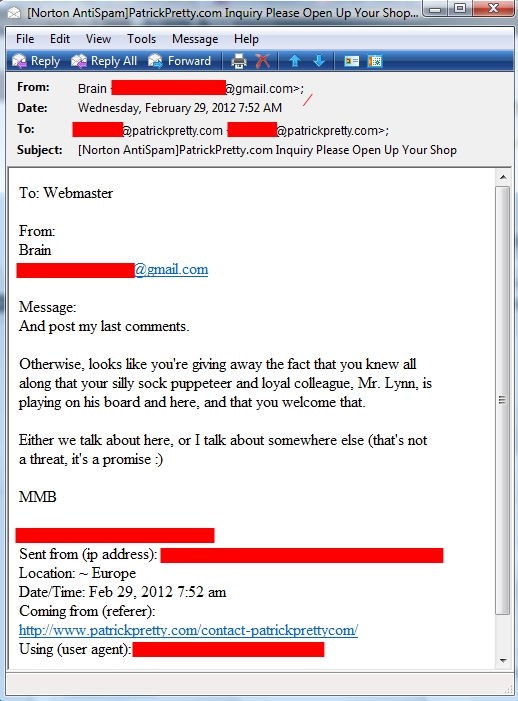
“Either we talk about here, or I talk about somewhere else (that’s not a threat, it’s a promise :)” — ‘MoneyMakingBrain (MMB), in email threat to PP Blog, Feb. 29, 2012, 7:52 a.m. ET
UPDATED 4:22 P.M. ET (U.S.A.) It has happened again: The PP Blog has received yet another threat via email for its reporting on the HYIP sphere, which FINRA described in a 2010 Alert as a “bizarre substratum of the Internet.”
Today’s threat came from “MoneyMakingBrain” (MMB) in apparent “defense” of JSS Tripler/JustBeenPaid, an HYIP “program” purportedly operated by self-described former AdSurfDaily and Ad-Ventures4U pitchman Frederick Mann. JSS Tripler/JustBeenPaid claims it pays a return of 2 percent per day.
ASD operator Andy Bowdoin, 77, is an accused Ponzi schemer under indictment for wire fraud, securities fraud and selling unregistered securities. The ASD scheme, which was based in Florida, gathered at least $110 million and created thousands of victims, federal prosecutors have said. Bowdoin’s Ponzi trial has been scheduled for September 2012. JSS Tripler/JustBeenPaid purports to pay a daily return twice that of ASD.
Among other things, Bowdoin has compared the August 2008 U.S. Secret Service raid on ASD’s headquarters to the 9/11 terrorist attacks and described it as the work of “Satan.”
MMB’s initial email threat was received at 7:52 a.m. ET. It was followed by another email threat at 11:14 a.m. in which MMB suggested he’d seek to cause banking troubles for a specific PP Blog poster and defend Mann “so help me God.”
“You could be the nicest guy in the world, doing a real public service, but on the matter of Frederick Mann, you’ve made a gross error, and you crossed the line, Mr.,” the second threat read in part. “I am not a passive by-stander Patrick, I am one of those who will come and help an old man from being beaten up by a bully, so help me God.”
The second email also claimed that, “If anything, you’ve brought all this upon yourself.”
On Feb. 27, the PP Blog reported that a site registered to Mann in South Africa at the same street address of JustBeenPaid had at least 11 links to videos featuring Francis Schaeffer Cox. Cox, 27, is a purported “sovereign citizen.” He is accused in Alaska of a “militia” murder plot against public officials.
Federal prosecutors known to be investigating the ASD scheme in the District of Columbia declined to comment on the Blog’s story, which was published Monday. Meanwhile, federal prosecutors known to be investigating the “sovereign citizen” movement in the Pacific Northwest did not respond to a request for comment on the report.
Today’s disturbing developments began with the Blog’s receipt of the initial threatening email at 7:52 a.m. The initial threat implied that, if the PP Blog did publish a comment submitted by MMB during the overnight hours and respond to the email, MMB would seek to cause harm to the Blog. The PP Blog did not reply to the initial email. Nor did it reply to the follow-up threat.
MMB’s comment already had been published by the PP Blog by the time the initial email threat was received. The comment was submitted at 1:12 a.m. today and approved by the PP Blog at approximately 7:30 a.m., after being temporarily sequestered in a holding queue because of the menacing nature of previous comments submitted by MMB.
An anonymous proxy in Europe was used to send the comment, and a Gmail address was entered on the PP Blog’s Comments form. For the past two days, MMB has been submitting comments that imply he has the power to harm the Blog if the Blog does not submit to his threats. His comments were sent from IPs in the United States and Europe. Today’s email communications from MMB were the first received from MMB.
Because the Blog believes it is important to publish comments that showcase the bizarre and sometimes menacing nature of the HYIP sphere, it has published several comments from MMB since Monday. But because today’s email threats introduced a new form of electronic menacing and implied a PP Blog reader would be subjected to a hectoring campaign, the Blog no longer will publish any additional comments from MMB.
The PP Blog engages in the marketplace of ideas, not the marketplace of threats.
These are among MMB’s menacing assertions yesterday:
“I know you’re reading everything I write and you are scared.”
” But, continue to annoy the MoneyMakingBrain and deviate him from his monitoring duties, and you’ll be the ones to be in the hot water. “
“no one is invisible to the MoneyMakingBrain and you need to stop doing what you’re doing against this man immediately. Because if you don’t, I am going to make a formal complain (sic) to the very authorities you purport are coming after scam sites and send all the evidence I’ve gathered so far from posting on your site and the realscam site. I don’t like witch hunts and I am sure Fred Mann can whip your ass in court for your highly suggestive, provocative, highly contentious and flat-out defamatory commentaries against his character on your sites.”
“You can delete my comments as much as you like, but take what I said to the bank. In the end, you are going to look like a fool.”
“Maybe it’s a good idea that you stop your charade once and for all and finally cease and desist attacking Mr. Fred Mann, who is innocent until proven guilty. Not going to be repeating myself again.”
“Needless to say that you’ll be needing to look for another ISP because you won’t have internet access at home or your office, wherever. Needless to say that your server host will also shut down your sites down for violation of terms and conditions.”
MMB also advanced a number of conspiracy theories, including one in which he asserts that two different people who post on RealScam.com and the PP Blog are one and the same. RealScam is a forum that concerns itself with mass-marketing fraud.
In November 2011, RealScam was subjected to a bid to chill from Bogdan Fiedur, the operator of AdLandPro, a website whose members routinely promote HYIP schemes and other highly dubious pursuits. JSS Tripler/JustBeenPaid is one of the “programs” promoted on AdLandPro, which also has a presence on Ponzi forums such as TalkGold and MoneyMakerGroup.
Conspiracy theories are part and parcel to the HYIP landscape, as are threats — direct and veiled. Today”s second MMB email threat also raised the specter of fear.
” . . . it’s clear that you are too scared of me by now,” the second email read in part.
In November 2011, an FBI Terrorism Task Force arrested ASD figure and purported “sovereign citizen” Kenneth Wayne Leaming on charges he filed false liens against at least five public officials involved in the ASD Ponzi case. Two months later, a superseding indictment was returned against Leaming that accused him of participating in a scheme to file false liens against two U.S. prison officials, uttering a false “Bonded Promissory Note” for $1 million and being a convicted felon in possession of firearms.
So-called “sovereign citizens” have been linked to various forms of securities fraud and tax fraud. Because they believe prosecutors and judges have no authority over them, “sovereigns” have been known to target state, local and national officials in plots to file bogus liens and destroy the credit of members of the law-enforcement community and litigation opponents.
Their harassment methods, which feature the use of both postal mail and email and often include direct or veiled threats, have become known as “paper terrorism.”
When arrested, Leaming, the ASD figure and purported “sovereign,” was found with two federal fugitives from Arkansas who’d been indicted on charges of duping participants in a home-business scheme of more than $2 million. Those fugitives also have been linked to the “sovereign citizen” movement and filed a series of bizarre pleadings in Arkansas after their arrests with Leaming, who is jailed near Seattle. Both fugitives now are detained at federal facilities in Texas, according to prison records.
After MMB sent today’s initial email threat, he sent another comment to the Blog that included a threat:
“Stop abusing your forum as Lynn does, or I am going to conclude that there is a business relationship between the two of you, and that would be bad a thing (I am afraid to say anything else as you may call it another ‘threat’).
“And yes, this is not a threat: you’re better off having me talking here than somewhere else. I know too much already about both you and Lynn, and I still want to believe that the two of you are men of good (although the tactics of one indicate the otherwise).”
“Lynn” is a reference to Lynn Edgington, the chairman of Eagle Research Associates Inc., a 501(c)3 Public Benefit Charitable Corporation based in Mission Viejo, Calif.
The second email implied that MMB would seek to interfere with an Eagle Research banking relationship.
Nicholas A. Smirnow. Source: Interpol "Wanted" notice.
After the news broke yesterday that Gregory N. McKnight, the accused operator of the Legisi HYIP Ponzi scheme, had pleaded guilty to wire fraud in a $72 million caper, things only got worse for the serial Ponzi-forum cheerleaders — not that they’re likely to abandon their practice of willful blindness while reaching across oceans to pick the pockets of any person with cash and a pulse.
Nicholas Smirnow, a convicted robber, burglar and drug dealer before he became an HYIP operator and darling of the TalkGold, MoneyMakerGroup and ASAMonitor Ponzi forums, is listed as wanted by INTERPOL.
How long Smirnow has been on INTERPOL’s wanted list and the circumstances under which he was placed on the list were not immediately clear. An email yesterday by the PP Blog seeking comment from federal prosecutors in the Southern District of Illinois on the status of Smirnow and the case against him was not immediately returned.
Smirnow, 54, also is known as Nicolay Smirnow, Alexander Judizcev, Nicholas Kachura and Jeff Prozorowiczm. He was charged in the Southern District of Illinois with fraud and money laundering-related crimes in May 2010 for his alleged operation of the Pathway To Prosperity (P2P) Ponzi scheme.
When the charges against Smirnow were announced approaching two years ago, U.S. federal prosecutors said they intended to ask the government of the Philippines to extradite Smirnow to the United States. Whether Smirnow had been jailed in the Philippines and somehow later was set free after the U.S. arrest warrant was issued could not immediately be determined.
What is clear is that INTERPOL is publishing a “Wanted” listing with the following physical details about Smirnow:
Height: 1.76 meter
Weight: 76 Kg
Colour of hair: Brown
Colour of eyes: Green
The INTERPOL poster for Smirnow was up even as the SEC was announcing the McKnight conviction. (See “Wanted” poster, which is active at the time of this post.)
The P2P scheme was almost unimaginably widespread, a postal inspector said in the 2010 affidavit.
“Financial records of payment processors utilized by P-2-P to collect investment funds from investors show that approximately 40,000 investors in 120 countries established accounts with P-2-P,” the postal inspector said. “Despite the fact that the investment was supposedly ‘guaranteed, investors lost approximately $70 million as a result of [Smirnow’s] actions.”
Ponzi-forum cheerleaders yesterday appeared either to be unaware of (or to have to ignored) the news about the guilty plea of Legisi’s McKnight and corresponding civil judgments against him totaling about $6.5 million.
Some of them continued to focus on their efforts to promote JSS Tripler/JustBeenPaid, a “program” purportedly operated by Frederick Mann that also uses AlertPay and SolidTrustPay.
AlertPay and SolidTrustPay also are referenced in court filings in the AdSurfDaily Ponzi case. A 2008 promo for ASD attributed to Mann asserted that Mann was an ASD promoter. ASD operator Andy Bowdoin faces a criminal trial in September 2012 on Ponzi-related charges of wire fraud, securities fraud and selling unregistered securities.
JSS Tripler/JustBeenPaid asserts it pays a daily return of twice what ASD offered. ASD figure Kenneth Wayne Leaming has been linked to the so-called “sovereign citizens” movement and is jailed near Seattle on federal charges of filing false liens against public officials involved in the ASD case.
McKnight’s base program in Legisi offered a return of .25 percent (one quarter of 1 percent) per day, according to a 2008 SEC filing.
Mann’s purported base program offers eight times that return on a daily basis, according to JSS Tripler/JustBeenPaid promos. On an annualized basis, the “program” offers a return that is between 48 and 73 times higher than the returns of imprisoned Ponzi schemer Bernard Madoff.
Madoff is serving a U.S. prison term of 150 years. McKnight faces up to 20 years, the SEC said yesterday.
A promo for JSS Tripler/JustBeenPaid that appeared yesterday on a forum known as CariGold made this claim. (Italics added):
JSS-Tripler now has 213,884 members — continuing to grow by over 3,000 new members a day. (If it hadn’t been for yesterday’s downtime, the number would have been “over 4,000.”) Thank you to our many promoters for doing such a great job!
Purchases of new JSS-Tripler positions are on track for a new all-time record, today.
More than a month ago — on Jan. 23 — the Italian securities regulator CONSOB announced that JSS Tripler promoters were under investigation. Ponzi-forum promoters pooh-poohed the news.