Tag: Traffic Monsoon

  • EDITORIAL: Traffic Monsoon Apologist Goes All-Trump, Calls Receiver ‘Piggy’ And ‘Lying Cow’

    trafficmonsoonlogoUPDATED 3:51 P.M. EDT U.S.A. Peggy Hunt, a partner at Dorsey & Whitney in Salt Lake City, is the court-appointed receiver in the SEC’s Ponzi- and securities-fraud case against Traffic Monsoon and Charles David Scoville. Her impressive Dorsey bio says she has worked in the areas of bankruptcy and receivership law for more than 25 years and has served as “lead counsel to trustees and equity receivers appointed in some of the largest Ponzi and securities fraud cases in Utah.”

    In a section on some of her professional and civil involvement, the firm notes “Peggy is passionate about advancing the status of women and girls in Utah. She co-founded and currently chairs the Utah Women’s Giving Circle of the Community Foundation of Utah, is President of the Utah Women’s Forum, and is a former President of Women Lawyers of Utah.”

    But to Traffic Monsoon apologist Jose Nunes, Hunt, an officer of the court for close to three decades, is “Piggy,” a “[b . . . h” and a “Lying cow.”

    These descriptors naturally reminded us of some of the things Donald Trump has said about women. Remarkably, Nunes took to Facebook to disparage Hunt just this past weekend, the same weekend Trump again was battling assertions that he is a misogynist.

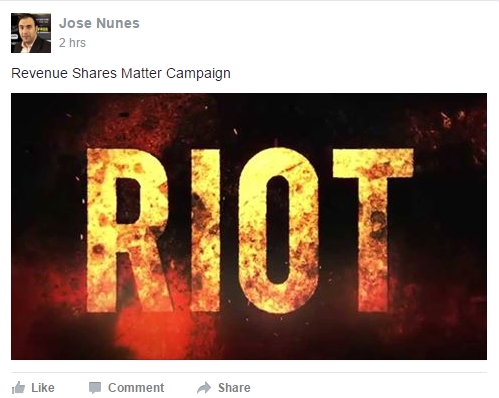
    Like Trump, Nunes may have a defective filter of some sort. The Traffic Monsoon huckster earlier came up with a “Revenue Shares Matter” campaign with a slogan of “RIOT.”

    Such cluelessness is hardly unprecedented in the so-called revshare sphere. AdSurfDaily was a purported “advertising” program similar to Traffic Monsoon.

    When the U.S. Secret Service raided ASD in 2008, operator Andy Bowdoin responded by comparing the agency to “Satan” and the 9/11 terrorists.

    Some ASDers circulated a “prayer” calling for prosecutors to be struck dead.

    When a receiver was appointed in the Zeek Ponzi case, Zeek apologists immediately launched verbal attacks against the receiver. One Zeeker suggested almost immediately that the receiver was guilty of a felony.

    It is all a steaming pile.


  • Traffic Monsoon Apologist Declares ‘Revenue Shares Matter’ Campaign With ‘RIOT’ As Slogan

    revsharesmattersmallA former pitchman for the Traffic Monsoon “program” declared a Ponzi scheme by the SEC is using Facebook to promote a “Revenue Shares Matter Campaign.”
    This is occurring against the backdrop of three nights of civil unrest in Charlotte, N.C., after a police shooting of an African American man.

    The purported Revenue Shares Matter campaign, which appears to be trading on a theme popularized by the Black Lives Matter movement after a series of police shootings of African Americans, apparently began today. The purported campaign was announced through a Facebook account in the name of Jose Nunes.

    Black Lives Matter did not respond immediately to a request for comment on whether it was concerned its message could be diluted by the Revenue Shares Matter campaign.

    As part of the Revenue Shares Matter campaign, a flame-filled graphic appears to urge members of similar revshare schemes to “RIOT.”

    It is not unusual for HYIP defenders to come up with harebrained PR campaigns or sales pitches. A particularly memorable one occurred in 2013, when recruiters associated with the alleged TelexFree Ponzi scheme spammed a funeral notice.

    At least one poster on Facebook already has raised concerns about the Revenue Shares Matter campaign.

    “Jose, I think you may well that some people will find this post and caption is in bad taste and may be deemed highly offensive to many people who support and believe in the BLM movement,” the poster wrote.


  • 2 New Lawsuits Filed Against Traffic Monsoon

    Charles Scoville
    Charles Scoville

    3RD UPDATE 4:21 P.M. EDT U.S.A. Two new lawsuits were filed yesterday in Utah federal court against Traffic Monsoon and Charles Scoville. The separate complaints allege breach of contract, with Rizwan Naseer Puri and Pokhunduth Vickash Thoree listed as the plaintiffs.

    The development appears to mark the first instances of private individuals suing Scoville and his company in a U.S. court.

    A listing for a U.K. solicitor named Pokhunduth Vickash Thoree exists at the Law Society, and the London address on the complaint against Traffic Monsoon and Scoville is the same as the address of the lawyer.

    Thoree contends in the complaint that he paid the defendants $138,350 for 2,777 “Ad Packs” between May 10 and July 25, 2016, expecting to be paid $1 a day per ad pack. The SEC sued Traffic Monsoon and Scoville on July 26, alleging securities fraud and a Ponzi scheme.

    In addition to seeking the return of his $138,350 outlay, Thoree wants $149,958 for lost ad-pack earnings and an additional $120,000 for “emotional distress, anxiety, depression, insomnia, Guilt and frustration caused to him by the Defendants,” according to the complaint.

    Meanwhile, the complaint seeks prejudgment interest of 8 percent a day on $408,808 allegedly owed to Thoree by Traffic Monsoon and Scoville. Contrary to Scoville’s view that Traffic Monsoon was not offering an investment, Thoree identifies himself as an individual who “invested into their business.”

    He further contends that Traffic Monsoon was openly promoted as an investment opportunity.

    Scoville may be facing court action on a third front. At least two class-action firms in the United States are investigating Traffic Monsoon. No complaints have been docketed to date.


  • Zeek Receiver Has $104K Judgment Against TrafficMonsoon Pitchman Now Pushing TrafficPowerline

    Screen shot from federal court files. Masking by PP Blog.
    Screen shot from federal court files. Masking by PP Blog.

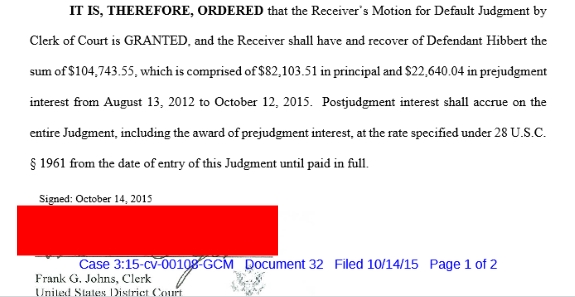
    On Oct. 14, 2015, the federal court clerk for the Western District of North Carolina signed a judgment of $104,743.55 against Adrian John Hibbert of Sully, United Kingdom. The judgment was in favor of Zeek Rewards’ receiver Kenneth D. Bell, records show.

    Bell had sued Hibbert and other U.K. residents in March 2015 for return of their alleged Ponzi scheme winnings, plus interest. The SEC shut down Zeek in August 2012, alleging a massive cross-border fraud that had gathered hundreds of millions of dollars.

    Hibbert appears not to have entered a defense to Bell’s claims that he had received more than $82,000 from Zeek and that those winnings constituted Ponzi proceeds that must be returned to victims.

    Instead, he pushed other cross-border, online schemes such as Traffic Monsoon, shut down by the SEC in July after allegedly gathering more than $207 million. With Traffic Monsoon facing a Sept. 23 hearing in Utah, Hibbert has turned his attention to Traffic Powerline, according to promos on YouTube.

    The development shows that money tainted by fraud may be flowing between and among schemes.

    Bell has raised the issue of MLMers moving from one fraud scheme to another.

    BehindMLM.com has reported TrafficPowerline is related to a recently collapsed Ponzi scheme known as MoBrabus.

    Pearse Donnelly of both TrafficPowerline and MoBrabus has been threatening BehindMLM.

    NOTE: Thanks to the ASD Updates Blog.


  • SINISTER: TrafficPowerline, A Ponzi-Board ‘Program,’ Threatens BehindMLM

    “The threat did not explain now a negative review on BehindMLM could be any worse than a fawning sales pitch on MoneyMakerGroup. ‘Programs’ that have appeared on that forum have caused billions of dollars in losses globally.”PP Blog, Sept. 5, 2016

    trafficpowerlinelogoTrafficPowerline, a “program” whose thread-starter at the MoneyMakerGroup Ponzi forum has more than 4,700 posts, reportedly is threatening BehindMLM.com because of a negative review. (More on the bizarre and sinister threat to artificially link BehindMLM to malware and porn below.)

    The mere presence of TrafficPowerline on MoneyMakerGroup suggests tainted proceeds from any number of scams could be flowing to the emerging program. “proReflex” is the starter in a thread dated July 23. The post begins with the classic line of “I am not the Admin.”

    MoneyMakerGroup is listed in U.S. federal court files as a place from which Ponzi schemes are promoted. Infamous schemes such as Zeek Rewards, AdSurfDaily, TelexFree and many others were listed there, contributing to a condition under which polluted money flows from scheme to scheme to scheme.

    A “program” similar to TrafficPowerline — Traffic Monsoon — was shut down by the SEC on July 26, just three days after TrafficPowerline made its MoneyMakerGroup debut. Like TrafficPowerline, TrafficMonsoon was a Ponzi-board scheme.

    In a post dated Sept. 5, BehindMLM reported that Pearse Donnelly of TrafficPowerline and an earlier scheme known as “MoBrabus” was the source of the threat. MoBrabus also was listed on the Ponzi boards. One of its payment processors was Payza, which the court-appointed receiver in the Zeek case has accused of facilitating that mammoth, cross-border scheme.

    Donnelly, according to BehindMLM, demanded the review be taken down within 72 hours or else a “negative SEO” campaign against BehindMLM would begin.

    Tools used against the well-known review site would include “SGA, Xrummer, Scrape BoX, SeNuke and other SEO tools at our disposal or from service providers to create thousands of low PR, PBN, PN, Porn, Link Farms and Malware site backlinks to your site along with teen-girl 10% free sex online 9% harmful for your computer 8% do not open this link 8% porn 8% adult content harmful 8% computer virus 8% dangerous 8%.”

    The apparent TrafficPowerline aim is to artificially damage BehindMLM’s worth with Google and other search engines through fraudulently placed links.

    Despite bizarrely claiming he was “nicely” requesting BehindMLM to kill the review and not issuing a threat. Donnelly reportedly went on to write that “I am fucking serious OZ do not fuck with me take down the fucking pages or I will make it my little project to fuck your site up.”

    The threat did not explain now a negative review on BehindMLM could be any worse than a fawning sales pitch on MoneyMakerGroup. “Programs” that have appeared on that forum have caused billions of dollars in losses globally.

    Sites sometimes have been known to overplay their hands when trying to bludgeon critics. KlearGear.com allegedly once threatened negative reviewers with a fine of $3,500. The site ended up getting sued by a public advocacy group.

    Because the PP Blog today was able to access the TrafficPowerline website, it means the site is accessible in the United States — after the TrafficMonsoon case and the allegations of securities fraud and after California passed a law that backs consumers if companies try to strongarm consumers by limiting speech through nondisparagement clauses.


  • DEVELOPING STORY: Possible Traffic Monsoon Data Breach

    trafficmonsoonlogoDEVELOPING STORY: During its routine reporting today, the PP Blog observed information that strongly suggests a data breach occurred at Traffic Monsoon or within a sponsor’s organization — possibly in the summer of 2015.


    The SEC, which charged Traffic Monsoon and alleged operator Charles David Scoville of Utah last month with running a massive, cross-border Ponzi scheme, did not immediately respond to a request for comment. Traffic Monsoon allegedly gathered at least $207 million.

    If a breach can be substantiated, it would mean that certain personally sensitive information of at least hundreds of Traffic Monsoon participants has been compromised. The information appears initially to have been published on a website with an Arabic audience. The site also includes certain information in English, including what we’d describe as purported PayPal payment “proofs” for various amounts.

    What’s clear at the moment is that the website uses the term Traffic Monsoon as two of the words that form its name. Information on the site suggests certain Traffic Monsoon participants in the United States, the Netherlands, Latvia, South Africa, India, Sweden, Malaysia, Germany, Canada, Serbia, Romania, Israel, Indonesia, the United Kingdom, Australia, the Philippines, Belgium, Argentina and other nations may have been affected.

    This would not be the first time a “program’s” database has leaked onto the web. It previously has happened with cash-gifting schemes, perhaps particularly if sponsors were maintaining their own databases of recruits and did not secure them properly.


  • SEC Declines Comment On Whether It Contacted Traffic Monsoon Pitchman Sunil Patel About Saturday Rally In England

    Sunil Patel: From Facebook video.
    Sunil Patel: From Facebook video.

    Traffic Monsoon pitchman Sunil Patel has promised “security” at a “Revolution Day” rally Saturday in the area of Brighton Beach/Brighton Pier in England to advocate for the alleged Ponzi scheme.

    In a video post today on Facebook, Patel claimed the SEC has contacted him about the event.

    The SEC this afternoon declined to comment on Patel’s claims and his public efforts to get Traffic Monsoon participants to sign a sworn “affidavit” that declares the agency a “third-party interloper.” The Sussex Police did not immediately respond to a PP Blog inquiry about the event. There may be scores of Traffic Monsoon victims in England, potentially setting the stage for trouble between supporters of the SEC’s action and supporters of the “program.”

    Last month the SEC alleged that “more than 99% of Traffic Monsoon’s revenue is derived from new investor funds, making claims that it is a successful advertising business merely an illusion.” A federal judge imposed an asset freeze.

    The SEC’s action against Traffic Monsoon and alleged operator Charles Scoville of Utah is the most recent of several major cases the agency has brought against “programs” that operate across borders. Others include TelexFree, Zeek Rewards and WCM777.

    Combined, the schemes are alleged to have resulted in billions of dollars of illicit business. Some of the funds were fraudulently moved to the far corners of the world.

    On Tuesday from Washington, the Justice Department announced that a money-mover in the Zeek case had been sentenced to 15 months in federal prison for obstruction of justice for fraudulently moving a pile of cash offshore. Jaymes Meyer, the operator of Preferred Merchant Solutions, was convicted on charges of trying to hide millions of Zeek dollars from the SEC, the court-appointed receiver and government investigators.

    The SEC charged Zeek in August 2012.

    Patel says that Traffic Monsoon participants from all over the world will attend Saturday’s Brighton event. How many of them will consult legal counsel before signing affidavits is unknown.

    Some Traffic Monsoon participants say they’ve already moved to a “program” known as Traffic Hurricane. The SEC previously has voiced concerns about “whack-a-mole.”

    NOTE: Our thanks to the ASD Updates Blog.


  • ‘TRAFFIC HURRICANE’: Reload Scheme Targets Traffic Monsoon Participants And Tries To Gag Reporters

    traffichurricanelogoIn the aftermath of the SEC’s Ponzi action against Traffic Monsoon last month, a website styled TrafficHurricane.plus has gone live and has a sign-up page. Ponzi-friendly Payza and SolidTrustPay are the listed money-movers.

    There are many items of interest on the Terms page, including exceptionally awkward English syntax and a preemptive bid to gag reporters.

    On the syntax front: “You are under the money laundering prevention law . . .”

    On the effort-to-gag front: “If you are not a member you are prohibited from modifying, copying, distributing, transmitting, publishing, selling, creating derivative works and / or using any information available on and / or through TrafficHurricane.”

    The PP Blog accessed the Traffic Hurricane page from the United States today. Given the Traffic Monsoon example and other examples in recent years, U.S. law enforcement may deem the offer as an offering of securities targeted at unaccredited investors in the United States and elsewhere.

    Traffic Hurricane has the hallmarks of a securities reload scheme and reportedly is hosted on the same server as TrafficMonsoon.plus, which appears to have been an earlier effort to launch a reload scheme. TrafficMonsoon originally operated at TrafficMonsoon.com, but that page now resolves to the website of the court-appointed receiver in the TrafficMonsoon case.

    In the HYIP sphere, reload schemes are somewhat common and provide a means by which victims get scammed a second time. Such schemes typically surface when a initial scheme displayed an incredible ability to gather money and line up suckers. Promos for Traffic Hurricane already are running on Twitter.

    The SEC said Traffic Monsoon rounded up more than $207 million. The agency’s complaint says the “program” had more than 162,000 investors.

    Apparently only in operation for a couple of days, Traffic Hurricane this morning said on its landing page that it already had 5,111 members. Like Traffic Monsoon, Traffic Hurricane says it is an “advertising” program.

    The situation is reminiscent of the 2008 AdSurfDaily “advertising” Ponzi scheme shut down by the U.S. Secret Service. ASD sparked at least three reload schemes, including one called AdViewGlobal. Investigators later linked ASD President Andy Bowdoin to AdViewGlobal. Because of AdViewGlobal, a federal judge revoked Bowdoin’s bond in the ASD Ponzi case.

    Charles Scoville, the alleged operator of Traffic Monsoon, has not been charged criminally. It is unclear whether a criminal investigation is proceeding on a parallel track with the SEC’s civil action against Scoville and Traffic Monsoon, but similar schemes have triggered criminal probes.

    BehindMLM.com, quoting TrafficMonsoon cheerleader Sharon James, is reporting Ernie Ganz is behind Traffic Hurricane.

    Other than the core business model and the reload schemes, TrafficMonsoon is like AdSurfDaily in other key ways.

    Traffic Monsoon supporters on social-media sites, for example, virtually are confessing their desire to engage in securities fraud on a global scale. Any number of them are using ASD-like arguments such as “we aren’t selling securities because we announced we weren’t selling securities” and payouts were never guaranteed.

    There also are ASD-like petition drives and various efforts to raise funds to fight the U.S. government. (See June 16, 2011, PP Blog editorial,  “The AdSurfDaily Solution.”)

    Like Traffic Hurricane, the AdViewGlobal knockoff scheme also tried to gag critics.


  • EDITORIAL: Arguments Of Zeek Winners Continue La-La Land Narrative, But Come As No Surprise In MLM’s HYIP Wing

    Zeek receiver Kenneth D. Bell.
    Zeek receiver Kenneth D. Bell.

    Many people in the antiscam community applauded Kenneth D. Bell, the receiver for Zeek Rewards, when he sued more than 9,000 individuals more than two years ago for return of their gains from the scheme. Those gains — more than $200 million — came from Ponzi proceeds, Bell alleged.

    And he pointed out that the money rightfully should go to the hundreds of thousands of Zeekers globally who were “affiliate victims.” Court filings later would show that Zeek gathered on the order of $940 million in less than two years. Only TelexFree, another MLM HYIP scheme that was disintegrating when Bell announced his lawsuit against the Zeek “winners” in March 2014, may be bigger.

    More than 90,000 (gulp!) alleged TelexFree winners now are being sued by Trustee Stephen B. Darr. TelexFree infamously caused angry affiliates to pour into the company’s billion-dollar broom closet in Massachusetts. It was a good thing police were there to keep order.

    Thanks to the willful blindness and serial disingenuousness brought to you by serial MLM HYIPers such as Todd Disner, T. LeMont Silver and “Ken Russo,” huge class-action cases in which “winning” promoters of MLM securities schemes are named defendants now are a reality.

    Bell, unfairly maligned among some MLM HYIPers and even some apparent “sovereign citizens,” deserves a lot of credit for trying to bring a measure of financial justice to the hundreds of thousands of individuals ripped off by Zeek and for establishing a sort of blueprint for how Darr could proceed.

    This blueprint also is there in case the Traffic Monsoon receiver needs it. Traffic Monsoon, an alleged $207 million scheme, was broken up by the SEC last month. There already is evidence that Traffic Monsoon had promoters in common with TelexFree.

    It is true that the number of potential defendants across the HYIP sphere is staggering. But it is equally true that the number of victims of these cross-border schemes is even more staggering. This number is in the millions. The global losses are in the billions. Absent actions such as those brought by Bell and Darr, however, there would be virtually no financial accountability. Society would be saying that it’s OK to profit through the promotion of online Ponzi schemes.

    For years, the PP Blog has raised questions about the national-security implications of cross-border HYIP schemes. The narratives surrounding such schemes typically are bizarre, with anonymous Ponzi-board pitchmen typically beginning with “I am not the admin” of the “program.” It all goes recklessly downhill from there.

    To those who feel a chill every time one of these schemes gains a head of steam, it came as no surprise that the alleged Zeek “winners” are arguing they should get to keep their hauls. It is simply the natural progression of the HYIP narrative.

    Bell, a former federal prosecutor, is having none of this. Indeed, his is the voice of common sense.

    From his argument (italics/bolding added):

    Defendants still act as if Zeek was a legitimate business and Defendants were “internet marketing specialists” entitled to be paid as employees rather than investors in the scheme, all of which is of course pure fiction.

    Specifically, Defendants ask the Court to absolve the scheme’s net winners from their obligation to repay the victims’ money because of an alleged “limitation” on the timing of future claims included in the scheme’s website’s “Terms of Service” (or “TOS”), which in any event do not limit the Receiver’s claims against Defendants. The Court should resist Defendants’ invitation to create the dangerous loophole of allowing a fraudster to use the terms implementing a Ponzi scheme to limit the right of a subsequently appointed Receiver to recover funds paid to the winners of the fraudulent scheme. While such a rule would be a great recruiting tool for future Ponzi scheme operators, it is surely an unacceptable legal rule and public policy.

    Also, Defendants urge the Court to rule that by purchasing bids, posting online advertisements (which Zeek boasted would take only three to five minutes a day), and recruiting thousands of victims to the scheme, they provided “reasonably equivalent value” to ZeekRewards such that they get to keep the victims’ money that they won in the scheme. In other words, Defendants claim that those Defendants who spent the most time successfully promoting the scheme and multiplying the number of its victims should be given the most credit against the Receiver’s claims to recover their fraudulently transferred winnings. In fact, in arguing that they were supposedly rightly paid for their “services,” Defendants stretch to compare themselves to the utility company, which among many other differences does not invest money in their customers’ businesses hoping to share in compounding profits of 125% every ninety days.

    NOTE: Our thanks to the ASD Updates Blog.


  • Private Attorneys Now Investigating Traffic Monsoon

    Charles Scoville: From YouTube.
    Charles Scoville: From YouTube.

    UPDATED 1:15 P.M. EDT U.S.A. It has happened in previous cases involving alleged violations of federal securities laws, and now it’s happening with Traffic Monsoon.

    “The Peiffer Rosca Wolf law firm is investigating Traffic Monsoon, LLC and Charles Scoville’s alleged Ponzi scheme on behalf of investors – whom Traffic Monsoon called ‘members,'” the firm said in a PR release today.

    How the firm would proceed is unclear. The announcement, however, potentially means Traffic Monsoon and Scoville will be facing litigation on a front separate from the Ponzi case filed by the SEC on July 26.

    After the 2008 AdSurfDaily Ponzi case was filed by the U.S. Secret Service, private attorneys filed a racketeering complaint against ASD operator Andy Bowdoin (and others) that helped out a second Ponzi scheme known as AdViewGlobal.

    Class-action attorneys also filed complaints in the TelexFree and Zeek Ponzi- and pyramid cases. Certain TelexFree-related actions alleged racketeering and referenced a “program” similar to Traffic Monsoon: My AdvertisingPays. There also were counts of fraud against TelexFree principals and some individual promoters.

    Even if they don’t result in a recovery, the actions filed by private individuals — as opposed to government plaintiffs — force defendants to confront litigation on multiple fronts. Defense costs may soar.

    “The Peiffer Rosca Wolf lawyers are preparing to take action and seek compensation on behalf of those who invested in the alleged Ponzi scheme orchestrated by Traffic Monsoon and Scoville,” the firm said.

    Traffic Monsoon gathered at least $207 million, according to the SEC.


  • Does Mysterious TrafficMonsoon.plus Domain Have A Bogus Comodo Security Logo?

    trafficmonsoonlogoThe last time the PP Blog covered something such as this was in February 2015. That’s when “Moore Fund,” a preposterous Ponzi-board “program” that later vanished with an unknown haul, was using a “Norton Secured” logo unauthorized by Symantec to fool the masses.

    Unfortunately, the masses included members of The Achieve Community, who’d already been ripped off in that preposterous Ponzi-board scam.

    On July 26, 2016, the SEC accused Traffic Monsoon and alleged operator Charles Scoville of Utah of operating a Ponzi scheme that had gathered at least $207 million.

    Like Moore Fund and Achieve Community, Traffic Monsoon was a Ponzi-board scheme. The scheme operated from TrafficMonsoon.com, which now rotates to the website of Peggy Hunt, the court-appointed receiver.

    With TrafficMonsoon.com now under the control of the receiver, a new domain has surfaced: TrafficMonsoon.plus.

    To hear some TrafficMonsoon promoters tell it on YouTube and other web venues,  Traffic Monsoon will start anew at the .plus domain and somehow will rally the membership to defeat the SEC. The .plus site appears to a virtual duplicate of the .com as allegedly operated by Scoville, except for a few edits that claim the “program” now is operating from Finland.

    There have been scattered reports that whoever is operating the .plus site has access to the TrafficMonsoon database, property that may be counted among the seized assets.

    The TrafficMonsoon.plus domain has a “COMODO SECURED” logo in the lower-right corner. When clicked, it resolves to a page on the Comodo site that in part reads, “IdAuthority Credentials not available for this site.”

    As was the case with Moore Fund, the Comodo logo may be a bid to trick visitors to TrafficMonsoon.plus that a well-known global Internet security company is aboard the Traffic Monsoon train — or the train of the purported Traffic Monsoon members trying to reboot an alleged $207 million Ponzi scheme during an asset freeze.

    Comodo did not respond immediately to a request for comment.