Author: PatrickPretty.com

  • ANALYSIS: Another Troubled Autosurf, Another Bizarre PR Approach; Some INetGlobal Supporters Attack The Messenger

    Steve Renner

    If you follow news about the so-called autosurf “industry,” the mind-boggling PR approach by some supporters of Steve Renner’s INetGlobal is apt to remind you of the bizarre approach employed by Florida-based AdSurfDaily and some members of the now-defunct Surf’s Up forum.

    If you’re new to the ongoing saga of AdSurfDaily (ASD), the developing story about INetGlobal and the autosurf “industry” in general, ASD’s case is instructive. Although ASD claimed to be a professional advertising and communications firm, one of its first efforts to counter the federal government’s allegations was to compare prosecutors and the U.S. Secret Service to “Satan” and the 9/11 terrorists who killed nearly 3,000 people in New York.

    ASD President Andy Bowdoin later asked for an evidentiary hearing in the civil-forfeiture case against the company’s assets  — the same sort of case INetGlobal is facing — but Bowdoin then took the 5th Amendment, as did his chief executive officer.

    In a comment that will live for the ages, one ASD supporter explained that Bowdoin, who was running the company with 10 bank accounts in his personal name and let it slip that ASD had $1 million in an account under a different name on the Caribbean island nation of Antigua, was “too honest” to testify.

    One of the issues in the ASD case was the Ponzi issue — specifically, whether ASD had sufficient revenue to pay members “rebates” without resorting to taking money from new members to pay old ones. ASD’s evidentiary hearing lasted two days. The company did not submit an audited and certified balance sheet to refute the government’s Ponzi claims.

    Instead, after the hearing — while ASD was awaiting a decision by U.S. District Judge Rosemary Collyer on whether it was operating lawfully and had demonstrated it was not a Ponzi scheme at the hearing  — the company issued a news release.

    The news release claimed ASD was expecting a revenue infusion of $200 million from a penny stock company. Performing no due diligence at all, some ASD members immediately raced to forums and websites to announce the company had a business deal worth one-fifth of a billion dollars.

    Other ASD members sought to substantiate the company’s announcement and insisted that ASD prove its $200 million claim. The company then deleted the news release.

    Meanwhile, ASD also claimed that Ponzi allegations brought against it by Florida Attorney General Bill McCollum had been dropped. Once again, ASD members who did no checking at all raced to forums and websites to announce the good news.

    In response, McCollum’s office issued a statement that, not only had Ponzi allegations not been dropped, they’d never been filed to begin with. ASD was accused by McCollum of operating a pyramid scheme.

    Earlier, some ASD supporters were part of a bizarre campaign to have McCollum charged with Deceptive Trade Practices for holding the view the company had broken the law. They also wanted to charge a Florida TV station with the same offense, apparently for broadcasting a story they deemed unflattering to ASD.

    Like ASD’s Andy Bowdoin, Steve Renner — now ordered by a federal judge to wear a GPS tracking device as he awaits sentencing on federal tax-evasion charges and plans his defense for the civil Ponzi allegations against INetGlobal — is being portrayed as a victim of a corrupt government bent on destroying small business.

    The approach is absurd. It did not work for Bowdoin, and it won’t work for Renner.

    Renner, of course, is entitled to have supporters. Regardless, his supporters will be hard-pressed to persuade — let alone convince — the Ponzi-hating public that government evil is driving events at INetGlobal when the Secret Service already has produced an affidavit that says a bank closed down Renner-connected accounts prior to the raid because it suspected money-laundering.

    Moreover, federal records show that one of Renner’s companies — a money-services business known as Cash Cards International (CCI) — previously had provided services for a Ponzi scheme that resulted in lengthy prison sentences for four people associated with the scheme.

    When the receiver in the Ponzi case asked Renner to convert electronic credits to cash to fund the estate for Ponzi victims, Renner could not do it because he had spent the money as though it were his own, according to court filings.

    As was the case with ASD, some INetGlobal members are attacking the media, amid claims there has been a rush to judgment.

    Blaming Renner’s predicament on the media or suggesting the media have rushed to judgment also won’t work. The media did not invent the allegations; it simply reported them, as it would do in any other case.

    Some INetGlobal members are pointing to an opinion piece on The Independent Business News Network (IBNN) website that the Star-Tribune newspaper of Minneapolis/St. Paul was guilty of “bias” in its coverage of the Secret Service raid on INetGlobal.

    The IBNN piece, however, did not disclose that Don Allen, the author of the IBNN editorial, also worked as a spokesman for a Renner company. In short, while Allen was opining the Star-Tribune was guilty of bias, he did not make it clear that his own impartiality could be questioned.

    IBNN’s Twitter site later reported that the Secret Service was “leaking” information to the PP Blog.  It simply did not happen. The Secret Service leaked no information to the Blog.

    While bashing the media in this context may provide some red meat for INetGlobal’s supporters, it does nothing to address the compelling reality that the allegations against Renner and his company are serious:

    Ponzi scheme. Wire fraud. Co-mingling. Suspicious withdrawals. Accounts closed by a bank that suspected criminal activity. Money-laundering.

    It’s the Minneapolis version of the ASD case. As was the case with ASD, INetGlobal is entitled to its day in court. It is entitled to argue passionately in its defense, and it is entitled to poke holes in the prosecution’s case. If the government does not have the goods, INetGlobal is entitled to win the forfeiture case and any future litigation that evolves.

    At the same time, INetGlobal members who support the company are entitled to argue their point of view passionately. They are not entitled, however, to be taken seriously if they spin events in ridiculous ways that cannot pass the giggle test.

    One difference between the INetGlobal forfeiture case and the ASD forfeiture case is that ASD did not appear to have gained traction in China. INetGlobal, though, does appear to have a substantial base of members in China. One of the issues in the INetGlobal case is language barriers: Can members who speak Chinese and have limited or no facility in English understand the business they joined and the complex litigation now engulfing the Renner companies?

    Neither bashing the government nor bashing the media does anything to address those concerns. Such an approach leads to questions about whether INetGlobal’s members who have limited facility in English are being ill-served by the efforts of English-speaking members to spin the story in ways that avoid the unpleasant realities and cloud the critical issues, which can be confusing even if a member has perfect understanding of English.

    On March 16, the PP Blog was provided a copy of an email some INetGlobal members received from their upline.

    “[T]he first court appearance which took place yesterday [March 15] went in favor of iNetGlobal,” the email claimed. It did not mention that a federal judge ordered Renner to wear the GPS tracking device as he awaits sentencing on four felony counts of income-tax evasion.

    Renner was convicted of the tax charges in December, more than two months prior to the Secret Service raid.

    Among the other claims in the email was that “[t]he judge in the case ordered the ‘Feds’ to release iNetGlobal payroll monies back to the company.”

    No such order appears to have been issued. Federal forfeiture law puts property that has been “arrested” — money in a bank account that has been seized, for example — in a state of limbo.

    Judges may entertain motions to have seized money released, but may be reluctant to release it out of concern the money will be “lost” prior to the conclusion of a forfeiture case.

    In general, the law seeks to avoid an inequitable result — for example, a decision to free money to pay employees could lead to a result in which less money would be available to compensate people who invested in a scheme and lost money.

    In the ASD case, the company asked for $2 million to be released. Collyer said no after hearing live testimony, weighing briefs submitted by attorneys from both sides and deliberating on the issues for several weeks.

    “The $2 million that ASD seeks to utilize are funds that were paid to ASD by advertisers and members,” Collyer ruled. “ASD has not demonstrated sufficiently that ASD is a legitimate business. Thus, the Court cannot release the funds to be used by the Company in its current form. And, if the plan to revamp ASD’s business proves unsuccessful, the citizens who paid that money will receive no advertising benefits and no return on their advertisement purchases. Quite simply, the money will be ‘lost’ forever.

    “Despite the obvious hardships endured by the employees of ASD and a great number of its members,” Collyer continued, “the Court cannot ignore its oath to uphold the law, nor can it rightly take the hardships of some and transfer them unto others.”

    Some of the same legal issues may come into play in the INetGlobal case, although the fact sets are not precisely the same. U.S. District Judge Donovan Frank is hearing the case, and the prosecution already has filed papers that reference ASD and a ruling by Collyer that ordered the forfeiture of more than $65 million to the government.

    Another section of the email was worded in a vague way that implied Donovan had arrived at the conclusion that INetGlobal might have the upper hand in the case.

    “Also indicated by the judge that inetGlobal should petition the court to have other funds released,” the email said.

    The mere act of petitioning a court for a result does not mean the court will rule favorably. That’s already been demonstrated in the INetGlobal case.

    Prosecutors sought to jail Renner, arguing he did not abide by the law while awaiting sentencing for his December tax conviction. Instead of jailing Renner, the judge ordered GPS tracking, enabling him to remain free.

    In the ASD case, members routinely spread misinformation after Collyer issued orders. When Collyer ordered ASD to file papers by a certain date, some ASD sponsors told downline members the prosecution had been ordered to prove ASD was a Ponzi scheme by the same date or lose the case.

    When Collyer ordered the government to file motions in response to Bowdoin’s pleadings by a certain date, ASD sponsors told downline members that the prosecution was in a panic because it could not prove ASD was a Ponzi scheme and was trying to find a way to save face.

    For at least a year,  the Pro-ASD Surf’s Up forum spread a rumor based on “inside information” that the prosecution had admitted behind closed doors that ASD was not a Ponzi scheme. The rumor persisted, despite the fact that the government filed a second forfeiture complaint against ASD-connected assets after the rumor started.

    Like the first complaint, the second complaint alleged the company was operating a Ponzi scheme. Not even the filing of the second complaint stopped the rumor, which was being repeated as though the court filings that disproved it simply did not exist.

  • FBI CHIEF: ‘Major Threats’ Emerging From ‘Stored Value’ Debit Cards And ‘Shell Corporations’; ‘Shadow Banking System’ Has Exploited Vulnerabilities

    EDITOR’S NOTE: Autosurf or HYIP promoter? White-collar fraudster of another stripe? Fan of “stored value” debit devices used in the context of well-publicized,  fraudulent business models? Owner of a “shell” company used to disguise the ownership of funds? Figure you’re smarter than the cops and that you’ve perfected your form of deceit as you pocket commissions and other payments based on that deceit?

    The director of the Federal Bureau of Investigation was talking about you in his testimony Wednesday before the House Committee on Appropriations, Subcommittee on Commerce, Justice, Science, and Related Agencies. He said you were making it harder for the FBI to do its job and making it easier on people who might want to do harm to the country’s financial system and the country itself.

    He didn’t mention your name, of course. But Robert Mueller III did ask for an additional budget outlay of $306.6 million next year as a means of neutralizing you before you could cause any more damage to the financial system and the national security of the United States.

    And here, all along, you thought he didn’t know, that the agents who serve under him didn’t know.

    They know. Call it anything you like — an “advertising” business, a financial “game,” a nontraditional investment that yields a high return, a new form of “gambling” or “arbitrage,” a multifaceted, multilevel-marketing program that pays a return based on visiting websites and recruiting other participants, a program for “good Christians” — and they still know.

    Tell your prospects that the government doesn’t understand either the program or the technology in use — and they still know.

    The reason they know is because they’ve seen it all before, watched it evolve, watched the changing explanations and terminology, watched the testimonials, watched the attempts to purify the “opportunities.” What they didn’t know, perhaps, was how devoted you were to your own criminality, how willing you were to put lipstick on a pig, how willing you were to be willfully blind to the obvious financial and security dangers to your neighbors because the money was just too good.

    They know now, though — and they also know about your criminal cousins who conduct equally vile businesses and perhaps have ties to the Mob and other groups of organized criminals, perhaps even terrorist organizations.

    Quick! Name your autosurfing or HYIP neighbor! What does he do at 3 a.m., when you’re sleeping? Are your commissions worth the risk he potentially poses to the security of the banking system and to the United States itself? What if he’s a [fill in the blank]? What if he’s amassing money to buy [fill in the blank?] What if he’s using the ATM machine to [fill in the blank?]

    Is the Cadillac you bought with commissions from a [fill in the bank] worth it? Will it be worth it when it gets seized as the proceeds of a criminal enterprise — and your neighbors wonder aloud how you ever became involved in a criminal enterprise? Will it ring hollow when you try to explain that you didn’t know you were involved in a criminal enterprise — or will it look like an attempt to mask your criminality?

    Mueller proposed an additional $232.8 million for salaries and expenses and $73.9 million for construction. If approved, the outlay would create 812 new positions, including 276 special agents, 187 intelligence analysts and 349 professional staff.

    Why is the agency seeking a larger outlay? Because the “additional resources will allow the FBI to improve its capacities to address threats in the priority areas of terrorism, computer intrusions, weapons of mass destruction, foreign counterintelligence, white collar crime, violent crime and gangs, child exploitation, and organized crime. Also included in this request is funding for necessary organizational operational support and infrastructure requirements; without such funding, a threat or crime problem cannot be comprehensively addressed.”

    The FBI, Mueller said, “saw an unprecedented rise in the identification of Ponzi and other high yield investment fraud schemes, many of which each involve thousands of victims and staggering losses — some in the billions of dollars.”

    New threats such as “stock market manipulation via cyber intrusion” also are emerging, Mueller said.

    Here, below, is the verbatim statement of Mueller when he was talking about you and other fraudsters. Note that he described you as a criminal, not a vastly misunderstood business person in an exciting, new arena that only few people understand. We have added the emphasis . . .

    Robert Mueller III“Money laundering allows criminals to infuse illegal money into the stream of commerce, thus manipulating financial institutions to facilitate the concealing of criminal proceeds; this provides the criminals with unwarranted economic power.

    “The FBI investigates money laundering cases by identifying the process by which criminals conceal or disguise the proceeds of their crimes or convert those proceeds into goods and services. The major threats in this area stem from emerging technologies, such as stored value devices, as well as from shell corporations, which are used to conceal the ownership of funds being moved through financial institutions and international commerce.

    “Recent money laundering investigations have revealed a trend on the part of criminals to use stored value devices, such as pre-paid gift cards and reloadable debit cards, in order to move criminal proceeds. This has created a “shadow” banking system, allowing criminals to exploit existing vulnerabilities in the reporting requirements that are imposed on financial institutions and international travelers.

    “This has impacted our ability to gather real time financial intelligence, which is ordinarily available through Bank Secrecy Act filings. Law enforcement relies on this intelligence to identify potential money launderers and terrorist financiers by spotting patterns in the transactions conducted by them.

    “The void caused by the largely unregulated stored value card industry deprives us of the means to collect this vital intelligence. Moreover, stored value cards are often used to facilitate identity theft. For example, a criminal who successfully infiltrates a bank account can easily purchase stored value cards and then spend or sell them. This readily available outlet makes it much more unlikely that the stolen funds will ever be recovered, thus costing financial institutions and their insurers billions of dollars each year.”

    Here is another snippet from Mueller talking about you . . .

    “The FBI focuses its efforts in the securities fraud arena on schemes involving high yield investment fraud (to include Ponzi schemes), market manipulation, and commodities fraud. Due to the recent financial crisis, the FBI saw an unprecedented rise in the identification of Ponzi and other high yield investment fraud schemes, many of which each involve thousands of victims and staggering losses — some in the billions of dollars.

    “With this trend and the development of new schemes, such as stock market manipulation via cyber intrusion, securities fraud is on the rise. Over the last five years, securities fraud investigations have increased by 33 percent.”

    We’ll close this column with a question or two for you: Did you really think that agencies such as the FBI and the U.S. Secret Service were going to sit back and watch you do this forever?

    Did you really think that you had no exposure as a promoter because you always could blame it on your upline and engage in willful blindness as you proceeded from program to program to program, dragging your downline with you from pig to pig to pig as you demonstrated your relentless willingness to paint with lipstick?

    Final note: They also know that some of you are penny-stock manipulators, tax-deniers, “sovereigns” and underground “credit-repair” specialists. Just a guess on our part, but we figure Andy Bowdoin’s lasting legacy to the “industry” will be as the man responsible for its long-overdue destruction.

    Records show that Bowdoin formed company after company, established corporate shells potentially with co-conspirators,  and that ASD and other knockoff autosurfs used “stored value” debit cards, unregulated or lightly regulated payment processors and money-services businesses, and other means to immerse themselves in the shadow banking system.

    The destruction of these miserable and dangerous “industries” is not going to happen overnight — but it is happening. The FBI, the U.S. Secret Service, the Justice Department, the SEC, the CFTC, the FTC, the U.S. Postal Inspection Service, the IRS and other agencies at the federal, state and local levels are going to make it happen.

    It’s going to happen because it has to happen. There never has been a worse time to be a white-collar criminal. The public at large wants to put you in jail and will not turn you into a folk hero as it did for Bonnie and Clyde and John Dillinger.

    You remind the public of Bernard Madoff, and it — the “it” being comprised of the vast majority of Americans and citizens of other countries who celebrate common decency and support the rule of law — simply is not willing to cut you any slack when you’re picking the pockets of your neighbors or the fellow congregants at your place of worship.

    Indeed, the public has seen all it is willing to take, and could not care less that you got your money without the benefit of a gun.  To the public, you’re worse than Bonnie and Clyde, worse than Dillinger himself, who robbed in the plain light of day.

    Robert Mueller wants to hire 276 more G-men and G-women  and 187 intelligence analysts — just to come after you and your criminal cousins.

  • Narc That Car’s ‘F’ Rating From Better Business Bureau Unchanged; BBB Says It Asked For ‘Comprehensive’ Client List To Determine If ‘Bona Fide Product With A True Market Value’ Exists

    Narc That Car (NTC) told the Better Business Bureau in Dallas that it would take a “few weeks” to respond to the BBB’s request to provide the organization a “comprehensive list of third-party clients,” the BBB said today on its website.

    The information was requested from NTC March 3 in an effort “to determine if the company is selling a bona fide product with a true market value,” the BBB reported.

    The BBB opened an inquiry into NTC Jan. 18 to determine whether NTC was “functioning as a pyramid promotional scheme.” BBB lowered NTC’s rating to “F” — the worst possible score on the BBB’s 14-step rating scale — earlier this month.

    Meanwhile, the BB said it also asked NTC Jan. 18 to “substantiate some claims made in its advertising.”

    Two months later, the advertising inquiry remains open, the BBB noted.

    Some NTC affiliates said last week that NTC was changing its name to Crowd Sourcing International — or CSI for short. The name-change announcement was made a week after the BBB issued the “F.”

    Read the updated BBB report on NTC.

  • EDITORIAL: Six Deaths Since 2006 In Car-Repo Incidents; Pistols, Knives, Autos Used As Weapons; Children Hauled Away In Repos

    UPDATED 4:48 P.M. EDT (U.S.A.) We’ve been writing about Narc That Car (NTC) and Data Network Affiliates (DNA), two multilevel-marketing (MLM) firms that recruit people to write down the license-plate numbers of cars for entry in a database. The information purportedly is or will be sold to companies in the business of repossessing automobiles.

    Neither NTC nor DNA affiliates appear to receive formal training on the propriety, safety and legality of recording plate numbers or any training on the repo business itself — even though they suddenly are part of the repo industry’s information supply chain.

    Affiliates for the companies are independent contractors. They use their own vehicles to arrive at places such as Walmart, doctors’ offices, universities, schools and other places cars are parked in a group, and have been instructed by promoters simply to start writing down plate numbers or recording them with video cameras and cell phones for later entry in a database.

    Some affiliates have instructed others to behave inconspicuously, which has fueled concerns that the firms are operating as a sort of private Big Brother and are not interested in operating in the plain light of day because the business of recording plate numbers would attract too much attention.

    Affiliates’ promotional efforts have focused almost exclusively on how much money can be made by recording plate numbers and recruiting others to record plate numbers. There has been little — if any — training on issues such as whether affiliates need the permission of store managers to record plate numbers on private property, how to behave if confronted by retailers, shoppers and police, whether solicitors’ licenses are required in individual jurisdictions, whether additional insurance protection is required or recommended, whether the videos recording plate numbers should be preserved, whether handwritten notes should be preserved and whether affiliates need to secure a bond, let the police know they are recording plate numbers and make themselves available as witnesses if the information they record later becomes part of an investigation or court case.

    Repo cases sometimes lead to spectacular, costly litigation, criminal and civil cases and monumental pain for plaintiffs and defendants. Some litigation has evolved as a result of deaths linked to incidents involving repossessions. Other litigation has evolved because repo agents were alleged to have broken laws.

    Unanswered Questions

    Paying people to write down license-plate numbers and providing an opportunity to earn additional income by recruiting others to do the same thing is a new business that has surfaced in the context of MLM. Many questions are unanswered:

    Who pays if an NTC or DNA affiliate suddenly needs an attorney? Who pays if an NTC or DNA affiliate wrecks his or her car while recording plate numbers and did not tell the insurance company the car was being used for a commercial purpose? Who pays if an NTC affiliate causes a wreck? Who pays if an NTC or DNA affiliate gets struck by a car that is passing through a parking lot or backing out of a space while the affiliate is preoccupied with recording plate data? Who pays if an NTC or DNA affiliate gets involved in a fight with a person who does not want his or her plate number recorded? Who pays if a repo case ends up in court and the repo target subpoenas NTC or DNA or forces discovery to learn how the companies came in possession of the information on where the car was parked? Who pays if a privacy lawsuit gets filed or a lawsuit emerges out of any other context of the NTC and DNA business models?

    Some companies that have the need to repossess cars also are in the business of title loans, meaning they finance cars for people with poor credit, arrange weekly or monthly payments and use the vehicle’s title as security to guarantee repayment. The repo man for title-loan companies comes if payments are not made. Banks and other traditional lenders also use repo men.

    Context Of Repo Business Vague Or Lacking In Presentations By NTC And DNA Promoters

    Three days ago we wrote about “Rena the Realtor,” the mythological borrower depicted and demonized in a video ad for NTC. “Rena,” a blond, blue-eyed, white woman with perfect teeth, presumably overspent to purchase a trophy car to impress her real-estate clients. When she missed her payments, a repo company was able to seize the car — thanks to a mythological NTC member named “John,” also white, who was depicted as having the bearing of a cop.

    Implicit in the video was the message that repping for Narc That Car was like being a cop and that NTC affiliates should not feel sorry for “Rena,” who had the money to work out at a gym but not to pay for her car, which she had hidden from the repo man.

    Real-life “Renas” do exist, of course — but “Rena’s” depiction as a young, white, single, ambitious Realtor presumably able to qualify for traditional financing who starts hiding her trophy car from the repo man (presumably not parking it at home or her workplace) when she’s not using it to shuttle herself to the gym — may not reflect the experience of a broad set of customers targeted in repo actions, which for the most part are not supervised by law enforcement and the courts.

    In real life, people of all races start missing car payments for all sorts of reasons: sudden and unexpected job losses, medical crises, illness, divorce. All of these things can cause a swift descent into poverty.

    Is it true that some people buy trophy cars to impress clients and almost immediately find themselves unable to make their payments? Yes. But it is equally true that legitimate misfortune typically plays a role in repo cases — and that people who have their cars repossessed are friends, neighbors, family members and acquaintances who have no ill intent.

    Repo Agents Are Not Cops

    There have been claims that repo agents have “pulled over” cars as though they were cops, treated subjects of repos as though they were prey and threatened repo subjects with “jail.” Some repo agents have been charged with crimes and put on trial amid allegations they broke the law while repossessing cars. Not all repo agents behave officiously or reprehensibly, but to pretend there is not a Wild West element in the repo business is to discard the truth.

    NTC’s mythological “John” recorded “Rena’s” plate number after exiting a hair salon. “Rena” worked out at a gym near the salon. The clear message of the video was that “John” was performing a civic duty that resulted in a happy ending for the company that retrieved its collateral as a result of NTC’s man in the field.

    Writing down license-plate numbers was portrayed in the video as fundamentally a carefree and easy business — just another way to make money while performing a critical service. Dollar signs were superimposed over cars in the video.

    Sometimes, though, the endings in real-life repo incidents aren’t happy. Heavy machinery is involved. Emotions are involved (on both sides of a repo transaction). Children sometimes are involved. Uncertainty is involved. Unlicensed people (sometimes people with criminal records) are involved. Safety often is ignored.

    Repo companies sometimes engage in activity that can be described as prowling late at night on private property or exercising police powers they do not lawfully possess. People sometimes get killed, injured and traumatized. African-Americans and other minority groups have been among the victims of repo cases run amok.

    National Consumer Law Center Describes Underbelly Of Repo Business

    Screen shot: A report by the National Consumer Law Center notes episodes of violence and instances in which children were towed away in repossessed automobiles in these Midwestern states and other states across the United States..

    Six people have been killed in the United States since 2006 in incidents involving the repossession of automobiles. Dozens more have been injured, traumatized or arrested. Children have been hauled away by repo men. Rifles, shotguns, pistols, fists and the cars themselves have been used as weapons — against both the target of the repo and the repo agent.

    So says a new report by the National Consumer Law Center (NCLC), a nonprofit advocacy group that concentrates on consumer justice and fair treatment for people “whose poverty renders them powerless to demand accountability from the economic marketplace.”

    Poverty and questionable or nonexistent due process often are factors in repo cases, NCLC says. Borrowers who lack access to traditional financing channels may turn to to “buy here, pay here” car dealers.

    “Not a single state guarantees automobile owners a day in court before a repossession,” said John Van Alst, a lawyer for NCLC and principal author of the report. “Only a handful of states have even minimal consumer protections such as requiring that repo agents have licenses, bonds or insurance.”

    NCLC’s footnoted report chronicles repo cases that have ended in misery for both the subjects of repos and the repo agents.

    “What we have now is vigilante repossession run amok,” said Rosemary Shahan, president of Consumers for Auto Reliability and Safety (CARS), a nonprofit organization that advocates for consumer safety and against auto fraud and abuse.

    NCLC is calling for states to enact “laws that would require secured lenders to obtain court
    orders or at least provide consumers minimal due process prior to seizing automobiles.”

    In addition, NCLC says, “states should require that such repossessions, when authorized by courts, be done by sheriffs, police or other law enforcement officials.”

    Here are a few of the NCLC’s observations in a March 2010 report titled “Repo Madness”:

    • Self-help repossession makes automobile loans dangerous — especially for low-income
      consumers and others who purchase cars from “buy here pay here” dealer-lenders who promise easy terms but frequently resort to tough tactics to extract payments from borrowers.
    • Self-help repossession stacks the deck in favor of lenders and dealers. They regularly seize cars without having to prove or even substantiate their claims.
    • Because self-help repossession does not require a lender to go to court to show it should be allowed to take a car, a car owner usually faces the daunting prospect of bringing a court action after repossession to show he or she is entitled to get their own car back. Without any procedure to ensure due process prior to repossession, a car owner has no opportunity to assert claims or defenses that might entitle him or her to keep possession of the car. Working families, typically without access to a lawyer, often are unable to initiate a court case on their own to get back a repossessed car. Too often, a family is left without a car and unable to afford a replacement.
    • The current system, unfair to families subject to repossession, also endangers repo agents, other car owners and bystanders. With most repossessions occurring without the involvement of law enforcement, parties often assert their rights in a sort of vigilante justice.

    The NCLC report spotlights a number of cases, including the case of a 17-year repo man who pulled over a car targeted for repo by flashing his high beams while driving an ordinary automobile occupied by four teen-aged boys and the youthful repo man’s 20-year-old brother. The target vehicle was a Ford Focus driven by a 25-year-old woman who had purchased the car three months earlier at a “buy here pay here” dealer.

    Inside the Focus were the driver, her boyfriend and their five-year-old daughter. The driver, confused and frightened, stopped her car. The youthful repo man approached the car on foot, reached through a window that was partially open to hand the woman paperwork and shift the car into park. The woman drove off, and stopped at a red light. The incident occurred in Massachusetts.

    At the red light, another person exited the car driven by the youthful repo man and stood in front of the woman’s Focus. The woman, Sara Bradley, drove off again, and the person standing in front of her “jumped on the hood” and remained there while Bradley drove to the police station.

    Bradley’s boyfriend gave this account:  A “boy” ran up to the car and barked, “We’re taking your car, and you’re going to jail.” Bradley, meanwhile, described her encounter with the repo man this way, “It was exactly like a car-jacking,” NCLC reports.

    No one was killed during the encounter. Two of the repo men — brothers Michael  and Robert Simeone — were charged criminally in 2007. They were acquitted last year after nearly two years of living under indictment.

    Although the repo men were acquitted, they spent months living under a cloud.

    Clouds are not uncommon in the repo business.

    “Self-help repossession poses a threat to consumers in every state,” NCLC says.

    A case of mistaken identity in Texas led to the repossession of the wrong car, which was towed away with two boys — six and 10 — inside, NCLC reports.

    “Only after noticing that the engine was running in the repossessed SUV did the repo man discover the children, and return them to their tearful mother,” NCLC says.

    Meanwhile, in a Maryland suburb of Washington, D.C., a 36-year-old man was shot to death after a police dispatcher did not send officers because the victim’s 911 call was treated as a report from a man whose car was being repossessed, NCLC reports.

    In 2006, the victim was awakened by the sound of his car alarm, NCLC says. He peered outside and observed his car being hooked up to a tow truck. The victim, Raymond Scott Brown, who was not behind on his car payments, called police to report a theft-in-progress.

    “[I]nstead of sending help, one of the [police] operators asked twice whether Brown was late on his payments and whether the car was being repossessed instead of stolen,” NCLC reports. “After barely a minute of conversation, the 911 operator told Brown to ‘call back within two hours’ to find out which tow company had taken his car and why.”

    Brown and his wife were reluctant to do nothing, and he and his wife hopped into her car and followed the tow truck. The tow truck was stopped at the side of the road, with the car attached, and Brown approached the truck to explain to the driver that a mistake had been made.

    “[A] pistol shot struck him in his chest and mortally wounded him,” NCLC says. “As his wife rushed to his side, the tow truck drove off — with Brown’s car still attached.”

    Elsewhere, Jimmy Tanks, 67, was shot and killed by a repo agent in the tiny, predominantly
    African-American town of Lisman, Ala.

    Kevin Alvin Smith was charged with murder. He is claiming the shooting was in self-defense.

    Tanks owed “$10,400 on a car with a ‘loan value’ of $7,400,” NCLC reports, citing an affidavit filed in the case.

    The shooting occurred in the middle of the night, NCLC says. Tanks was a retired railroad worker who got married only two weeks before his death.

    James Lovette, the sheriff of Choctaw County, said in an interview that Tanks, whom he knew, got “killed over a durn car,” NCLC reports.

    Read the NCLC report.

  • Astonishing Case Of Bank Fraud Alleged In New York; Charles J. Antonucci Sr. Charged With Bilking Pastors, TARP Program — And The Bank He Led

    Acting Assistant Director in Charge of the FBI’s New York Office George Venizelos announces the arrest.

    EDITOR’S NOTE: At the moment, I don’t have the time to do this story justice. The allegations, however, are astonishing. And law-enforcement officials at both the state and federal level  are calling it another case that has been solved by the Interagency Financial Fraud Enforcement Task Force.

    A New York man has been arrested on charges he tried to prop up a failing bank while fleecing two Florida church pastors and attempting to defraud the Troubled Asset Relief Program (TARP) operated by the government — all while stealing from the bank itself.

    The charges against Charles J. Antonucci Sr. read like a work of fiction, painting him as a man who engaged in one deception after another, received first-class transportation on a private plane by approving millions of dollars in overdrafts by a co-conspirator, pocketed money that did not belong to him  and hatched a complex scheme to fleece taxpayers.

    Investigators said all of these things occurred:

    • The Park Avenue Bank in New York was failing.
    • It was seized by the FDIC and New York banking regulators Friday.
    • Prior to the seizure, Antonucci, who served as the bank’s president and chief executive officer from June 2004 to October 2009 and also was a member of the board of directors, engaged in “self-dealing, bank bribery and embezzlement.”
    • Antonucci and a co-conspirator participated in an investment scheme that fleeced the pastors of  Calvary Springs Chapel in Coral Springs, Fla. out of $103,940 by making them believe they could earn back the principal and a profit of about $500,000 in weeks by investing in a bond. The pastors, who were investing the funds to build a new church, deposited the money into an account in the name of “Park Avenue Insurance.” The account proved to be owned by Antonucci, who split the proceeds with his co-conspirator and did not pay the interest promised the church.
    • Antonucci was at the center of a fraud in which he caused the bank to lend a company he owned $400,000 by installing a puppet president to hide his ownership of the firm, which was called “Easy Wealth Group Ltd.” The puppet president applied to the bank for a $300,000 line of credit, and Antonucci personally approved it, later increasing it to $400,000. The puppet president drew down the entire line, causing the bank a loss of the entire sum.
    • Antonucci approved overdrafts totaling more than $8 million tied to an entity of a co-conspirator. (The FBI cryptically referred to this co-conspirator as “CC-1,” an associate of Antonucci’s and part of the “Oxygen-related entities.”) In 2008 and 2009, Antonucci flew on the co-conspirator’s private plane more than 10 times, including trips to Florida, Panama, Arizona (to attend the Super Bowl), and Augusta, Ga. (to attend the Masters golf tournament). When a check from one of the “Oxygen” entities bounced in 2009 — apparently because Antonucci did not intervene — Antonucci was told he no longer could fly on the private plane.
    • Antonucci caused Park Avenue Bank to lease and pay expenses and upkeep on three properties he personally owned. Each of the properties was in Fishkill, N.Y. The bank had no legitimate need for two of the properties.
    • Antonucci tried to calm depositors’ concerns about the bank by saying he personally had pumped in $6.5 million. The money he invested, however, came from a series of loans the bank had made to businesses that had relationships with Antonucci. Those businesses then routed the money to Antonucci, who re-deposited the money back into the bank.
    • Antonucci lied to the FDIC about the source of the $6.5 million.
    • Antonucci tried to get $11 million in TARP funds, based on his purported, personal capital infusion of $6.5 million. He issued a false press release about the purported infusion, saying the bank was “well-positioned.”
    • The FDIC declined the bank’s TARP application. Antonucci then lied, saying he had withdrawn the application because of “issues” with TARP and because he did not want to create the “market impression” the bank was weak because it had accepted TARP funds.
    • To conceal the $6.5 million fraud, Antonucci created a bogus certificate of deposit in the amount of $2.3 million and engaged in an elaborate deception involving at least two companies to conceal the fraud.

    Read the FBI news release.

  • BULLETIN: CFTC Busts 2 Alleged Ponzi Schemes; Patrick H. Rakotonanahary Arrested By FBI In Florida After Financial Fraud Enforcement Task Force Probe

    A Florida man has been arrested by the FBI on 21 counts of wire fraud amid allegations he operated a forex Ponzi scheme, collecting more than $10.2 million and pocketing $1 million for himself.

    The announcement of the arrest of Patrick H. Rakotonanahary, 34, of  Punta Gorda, Fla., was made in Hawaii after a joint probe by the FBI, the Commodity Futures Trading Commission (CFTC), and the State of Hawaii Department of Commerce and Consumer Affairs (DCCA).

    His arrest was credited to a joint investigation by the agencies, which operated under the umbrella of the Interagency Financial Fraud Enforcement Task Force, the FBI said.

    President Obama formed the task force in November.

    “[I]nstead of using investor money to engage in Forex trading, Rakotonanahary primarily paid investment returns to earlier investors with investment funds from later investors as part of a ‘Ponzi scheme,’ using only about $1,864,000 for Forex trading, which generated losses of $814,806,” the FBI said. “Rakotonanahary used approximately $8,375,703 to pay investment returns and another $1 million personally.”

    Most of Rakotonanahary’s 100 investors hailed from Hawaii, the FBI said.

    Separately, CFTC announced yet another Ponzi case — this one in North Carolina.

    The agency charged Dennis Todd Hagemann and Yellowstone Partners Inc., both of Raleigh, with operating a forex Ponzi scheme involving the fraudulent solicitation of at least $700,000 from at least nine individuals.

    Hagemann was arrested and jailed by North Carolina state authorities.

    In yet another bizarre Ponzi twist, CFTC said Hagemann purported to have a tie to former Russian Federation President Boris Yeltsin.

    Hagemann failed to inform a potential investor “that Mr. Yeltsin is deceased, and was deceased at the time he made the representation,” CFTC said.

  • Video Promo For Narc That Car Demonizes Sweet-Faced ‘Rena The Realtor’; Some Reps Said To Make More Money Than President Of United States

    UPDATED 4:32 P.M. EDT (U.S.A.) A video Narc That Car promoters may rent for $12.95 a month and a onetime set-up fee of $15 through a third-party provider demonizes a fantasy deadbeat named “Rena the Realtor” for stiffing a bank on her car loan and says some members of the multilevel-marking company are making more money than the President of the United States.

    Narc That’s Car’s name is not mentioned in the video, which does not name the NTC reps out-earning the President.

    “Rena” is depicted as an attractive, sweet-faced young woman with blue eyes and perfect teeth. She buys a car to impress her real-estate clients, makes payments for a couple of months — and then misses three payments in a row and hides the car to save herself from the repo man.

    The video depicts a glum-faced collection agent who had no luck getting “Rena” to cough up her payments, and it becomes time for the bank to dispatch the repo man. But where to start searching?

    Thanks to a Narc That Car member named “John,” who is depicted as having the bearing of a plainclothes cop and happens to write down Rena’s license-plate number as he exits a hair salon a few doors away from the gym at which “Rena” works out, the information is entered in the NTC database.

    Through a process that the video does not make clear, it is established that “Rena” works out at the gym every day at 7 p.m.

    This sets the stage for the repo company  to snatch the car. The video shows a car (presumably Rena’s) being hauled off by a repo truck — a successful conclusion from the lender’s point of view, but a stinging defeat for “Rena the Realtor,” who didn’t make her car payments but still had the money to stay toned by working out at the gym.

    The video displays scores of cars backed up during Rush Hour — each one of them with a dollar sign superimposed. The video also implies that an NTC sponsor will give prospects their first 10 plate numbers to enter into the system — if the prospect does not have time to get 10 on his or her own.

    How the data can be validated if a sponsor provides the plate numbers is not made clear in the video. Such an approach would mean that the prospect would have to accept as truth the address at which the sponsor said the car was sighted, since the prospect neither saw the car nor recorded the plate number.

    Also unclear was whether the sponsor could share the same 10 plate numbers with other incoming prospects and perhaps simply instruct them to enter a fabricated address at which the plate was sighted.

    “Either contact your sponsor, who will provide you with your first 10 plates to enter into the system, or you can do it yourself,” the narrator says.

    And the narrator said a handsome wage is possible:

    “Several people saw this opportunity and dropped everything they were doing on the spot,” the narrator says. “Ninety days later, they’re making more money than the President — and without the stress.”

    The video displays a picture of the White House, the official residence of the President and the office from which he makes $400,000 a year, and has an expense account of about $169,000. The video does not say how much the President makes.

    The video’s ending was a little flat — a businessman was depicted walking on a tightrope, and another businessman (presumptively) with a briefcase was pictured falling into a safety net.

    It might have made for a better ending had “Rena the Realtor” redeemed herself by deciding to join NTC after her car was repossessed — as a means of making sure nothing like that ever could happen again.

    Then again, how could she? Deadbeat “Rena,” her blond hair, blue eyes and perfect smile notwithstanding, no longer had a car, no way to get to work, no way to get to the gym to record plate numbers.

    Too bad. The parking lot in front of the gym and the hair salon could have been a wonderful place to record numbers every night at 7  — and perhaps the next time around she could have returned the favor by getting “John’s” plate for NTC.

    Who knows if the repo man — or someone else — might one day have benefited from knowing where John got his hair cut?

    See the news release dated today with the video attached. The video appears to have been produced by this site, which says it has done promotional work for teams and companies such as Ad Surf Daily, AdGateWorld, BizAdSplash.Ad-ventures4U, TVI Express and Global Verge/Buzzirk Mobile, among others.

  • Death Cycle For BizAdSplash Complete; Site Resolves To Blank Page On U.S. Server; Members’ Losses Unclear

    It entered the autosurf world in January 2009 with the stern bang of a drum in a promotional video. The message was dire: “The World Is In Crisis,” it warned. “Turn On The News, And You’ll See. The Stock Market Is At A Record Low. Foreclosures Are At An All-Time High. Thousand’s (sic) Are Losing Their Jobs. Banks Are Closing. There Has To Be A Solution!”

    The dire bang of the drum faded, replaced by a riff from an organ. The riff grew frantic, building toward a crescendo. The video never said the tones were from a 1999 work by Fatboy Slim: “Right Here, Right Now.”

    Messages flashed in front of viewers’ eyes for more than a minute before the video announced the company’s name — BizAdSplash — and positioned the surf as the cure for all the economic misery in the world.

    “Biz Ad Splash Has The Answer,” it said. “The Plan Is Simple. Advertise Your Business, A Product Or Service, Introduce Others To The Value Of Advertising. View A Few Ads For A Few Minutes A Day. Earn Profits. It’s That Simple!”

    Except it wasn’t, of course.

    BizAdSplash, whose “chief consultant” Clarence Busby was implicated by the U.S. Secret Service in the AdSurfDaily Ponzi scheme probe as the operator of Golden Panda Ad Builder, was in the throes of death out of the gate. The company started out by promoting its offshore location; its servers resolved to Panama.

    Payments slowed, then vanished. The site appeared, then disappeared, then reappeared. Even as BizAdSpash was in the throes of death, Busby talked about how “excited” he was — and how “excited” members who were not getting paid should be.

    The site disappeared again over 2009’s Christmas holiday and into the new year. It then reappeared. In late January, members said they received a platitude-filled note from Busby that BizAdSplash had tanked.

    “Now what about the future?” the email said. “No matter what, there is a future. There are many things on the Internet that will help you in this future, so don’t give up. Make the effort and success is just right around the corner. May your life be full of faith, hope and love. This is where you will find your best rewards. May God bless you all!”

    Busby’s name appeared at the bottom of the email, which carried a business address of Acworth, Ga. The surf came to life in the wake of the seizure of tens of millions of dollars from AdSurfDaily Inc. and Golden Panda Ad Builder. Busby is the former president of Golden Panda, which ceded more than $14 million to the government in the ASD/Golden Panda case.

    Known for syrupy communications, Busby described the BAS staff as “sad,” according to the January email.

    “Our staff has been sad, not just because of losing a job, but because they have developed friendships with many of you and are very sad to ‘break up the party,’” the email said. “With anything that has had life, it is very sad to have that life taken away.”

    Busby was identified in the email as the owner of BAS. In earlier communications, he was identified as “chief consultant.” It was not immediately clear how he purportedly had ascended from consulting work to ownership.

    The site remained online. It now has vanished, however, and has been resolving to a blank page for at least three days. (It might have disappeared earlier.) The site’s server signature is in the United States.

    Now, it seems, the death dance is complete — offshore to onshore, and a fade to nothing but white.

    But the Biz Ad Splash video, the dire beat of the drum and Fatboy Slim’s pulsating tones remain on YouTube: It’s just that there no longer is anything to sell.

    Busby’s simple cure for the world’s economic ills — clicking on ads and introducing others to click on ads — did not work. The extent of Biz Ad Splash member losses is unclear.

    Busby, who used the title “Rev.” at least 120 times in a court filing involving Golden Panda last year, was implicated by the SEC in three prime-bank schemes in the 1990s, according to records.

  • SPECIAL REPORT: License-Plate Database Populated By Narc That Car Affiliates Will Be Used To Locate People; Firm Changing Name To ‘Crowd Sourcing International’; VP Rene Couch To Lay Out ‘Vision’

    UPDATED 5:14 P.M. EDT (U.S.A.) The database being built by affiliates of Narc That Car (NTC) will not be used solely for the purpose of locating cars for seizure by the repo man, according to a recording of a March 11 conference call by the company.

    The database, according to the recording, also is envisioned as a means of locating people, meaning it could be used to develop a data map that can plot the movement of citizens by tracking sightings of the license plates of their cars. The announcement of NTC’s plans may trigger even more concern about privacy and legal issues because citizens may not know their plate numbers are being recorded by a private business and entered in a database that tracks movement of cars.

    NTC does not publish a list of data clients. The company says it is expanding internationally, which raises the possibility that overseas data clients could track the movement of U.S. citizens, as well as citizens of other countries. Meanwhile, NTC provides only threadbare details about its management team while collecting millions of dollars from participants.

    Absent transparent controls, such a data tool conceivably could be used by spy agencies and secret clients, nationally and internationally, as a means of monitoring the behavioral patterns of individuals, including persons who hold sensitive jobs in government, science and industry, as well as the behavioral patterns of individuals such as politicians, candidates for offices, judges and their family members — and people of all stripes, regardless of occupation.

    NTC does not describe how it screens data clients, and also has announced a new name change — the third name the company will use this year alone.

    “What we want to become is the biggest company in the world for locating one individual item,” a speaker on the call said. It is believed the speaker was CEO William Forester.

    “That could be a car, boat, person, child — anything you could possibly imagine,” the speaker said. “That’s what we’re building this database for.”

    No Paid Clients From Law Enforcement

    The speaker confirmed that NTC has no paying clients from law enforcement, saying the company would provide data to police agencies “for free” as a “service to the community.”

    “We’re not charging local law enforcement; law enforcement — any law enforcement — is not a customer of ours,” the speaker said. The confirmation that NTC had no paid law-enforcement clients leads to questions about the company’s ability to attract clients outside of law enforcement in sufficient quantity to mute concerns about how it pays affiliates and whether the firm was using a pyramid or Ponzi model to pay participants who harvest license-plate data.

    The confirmation also destroyed claims from individual NTC affiliates that the company had an existing stable of law enforcement clients such as the FBI, the U.S. Department of Homeland Security and the military — and was part of the federally operated AMBER Alert program.

    Such claims appeared in promoters’ ads for weeks, leading to questions about whether NTC had come into possession of money based on false, misleading or confusing claims by its army of promoters — and whether NTC’s own vague claims led to the dubious claims of its affiliates.

    The speaker said NTC had “over 34,000” members, was expanding “very, very rapidly” and had paid out “over several million dollars” in bonuses and commissions. He added that the company was integrated with Code Amber.

    Code Amber is an entity that publishes AMBER Alerts and makes available a website ticker for others to publicize alerts, but is not the AMBER Alert program itself. The AMBER Alert program is administered by the U.S. Department of Justice and the National Center for Missing & Exploited Children, both of which said last month that they are not affiliated with NTC, despite the claims of promoters.

    Read a Feb. 3 story on the Justice Department’s denial that AMBER Alert was affiliated with the NTC multilevel-marketing program.

    Read a Feb. 4 story on the National Center for Missing & Exploited Children’s denial that the secondary AMBER Alert program was affiliated with Narc That Car.

    Read a Feb. 16 story about Narc That Car removing a reference to AMBER Alert in a video promotion after the denials by the Justice Department and the National Center for Missing & Exploited Children.

    Read a Feb. 9 opinion by the mathematician “Entertained,” who said the NTC system actually might be harmful if employed in the context of AMBER Alert.

    Name Change

    An Ohio man who promotes NTC on a Blog known as Cash For Car Plates announced the name change on his Blog last week.

    “Narc Technologies/Narc That Car is now Crowd Sourcing International,” wrote Ajamu Kafele.

    No announcement of a name change appears on NTC’s website.

    But an NTC audio (the source of the quotes above) is accessible from a website titled CrowdSourcingWealth.com operated by Kafele, who uses the nickname “Jah” to promote the company. The audio, which Kafele described as an excerpt of remarks by the “CEO,” suggests the name change is official and that NTC will begin to use the initials CSI.

    Indeed, a speaker says in the call, “We’re gonna change our name to Crowd Sourcing International — that’s right, for short, CSI.”

    The CrowdSourcingWealth.com domain was registered in Kafele’s name March 12, one day after the NTC conference call. A similar domain name that references NTC — CrowdSourcingPower.com — was registered in California Jan. 27. Like Kafele’s domain, the CrowdSourcingPower domain appears to be an NTC affiliate site that is a work-in-progress.

    NTC appears to have arrived at the conclusion that tying the company’s brand to the catch phrase crowdsourcing — which describes a method of accomplishing a task using large numbers of people and is controversial as an economic and scientific approach because it may drive down wages and lead to flawed and uneven results — would resonate with NTC members.

    “The main goal of NarcThatCar is to us (sic) the Power of CrowdSourcing to develop the largest database of it’s (sic) kind,” the CrowdSourcingPower.com site says. “Working together with Amber Alert and other organizations we can help to locate the known vehicles that may be involved in the abduction of children.”

    “CSI” is an acronym used by law enforcement that stands for “Crime Scene Investigation.” It  also is the title of a crime drama on the CBS television network. If the name change is official, Crowd Sourcing International will become the third name NTC and its corporate parent have operated under this year.

    The use of the CSI name as an acronym also could set the stage for NTC affiliates again to leech off the brands of famous entities by tying NTC to companies or entities that have no affiliation with the firm.

    NTC affiliates have demonstrated a desire to link the program to the names or the intellectual property of famous entities, including government entities. At least one NTC affiliate registered a domain titled AmberAlertHelp. org, using it as an affiliate site for NTC. Another affiliate used a takeoff of the ToysRUs brand to promote NTC.

    Kafele has recorded check-waving videos to promote NTC and has said repping for the firm was like working for the U.S. Census Bureau.

    The announcement about the name change, Kafele said, was based on a “company wide” announcement NTC made during a March 11 conference call. Why the announcement does not appear on the NTC website was not immediately clear.

    Company VP To Explain Vision

    Meanwhile, NTC has identified Rene Couch as its vice president of marketing. No biographical

    Narc That Car says VP Rene Couch will share his vision for the company.

    information on Couch was provided on NTC’s website, which said Couch will “share his vision” of the company at a meeting March 23 in Oklahoma City. The audio accessible from Kafele’s website includes comments from a male speaker who used the name Rene.

    A man by the same name with the middle initial of “L” was charged civilly by the Arizona Corporation Commission (ACC) with selling unregistered securities and misappropriating investors’ funds in a complex case involving real-estate promissory notes.

    It is unclear if NTC’s Rene Couch is the Rene L. Couch referenced in the ACC complaint.

    A call to NTC by the PP Blog was answered by an auto-attendant. A message said the office was closed. There was not an option for a caller to leave a message. The Blog verified there was no option to leave a message by placing a second call to the number. As was the case with the first call, the auto-attendant simply hung up.

    In 2005, after a finding that Rene L. Couch and entities he controlled had made “untrue statements or misleading omissions of material facts, and or . . . [engaged] in transactions, practices or courses of business which operate or would operate as a fraud or deceit upon investors,” ACC issued an order to cease and desist from unlawful conduct.

    Rene L. Couch and the entities further were ordered to disgorge “$549,085 plus interest at the rate of 10% per annum” to investors. In filings in the case, Rene L. Couch was described as the owner of a “personal nutritional supplement business known as Infinity 2.” Rene L. Couch consented to the order, according to case filings.

    Rene L. Couch was accused in the Arizona case of using investor funds in the real-estate venture for “various undisclosed purposes” and diverting investor funds to the Infinity 2 supplement business. Infinity 2 was described in documents external to the case as a multilevel-marketing company.

    The filings in the ACC case are public records.

    Other Arizona public records show that Rene L. Couch was a party in a Family Court dispute in Maricopa County over back child support and unreimbursed medical expenses between April 1, 2006 and May 31, 2009. Records published on an Arizona court site show that one of the parties was ordered to pay $65,895 in back support, plus an additional $8,472 in unreimbursed expenses.

    Repayment terms in the support case were set at $550 a month, according to records. The party ordered to pay the back support was not clear from court filings, and the case still appears to be in litigation. The PP Blog was unable to contact NTC to clarify whether the Rene Couch referenced as its vice president was the Rene L. Couch referenced in the Arizona documents.

    In February, NBC-5 of Dallas/Fort Worth reported it repeatedly was unable to reach NTC by telephone to answer questions for a story.

    “Repeatedly, NBCDFW worked through a phone tree, only to reach a recording that said, ‘Sorry, this mailbox is full and cannot accept any more recordings. Thank you for using the voice mail system. Goodbye,” the station reported of its efforts to navigate NTC’s phone tree.

    NBC-5 further reported that it sent a reporter to the company’s office, and was met by a man who identified himself as the operations manager.

    “He said company phones are busy because Narc Technologies has more than 20,000 participants,” the station reported.  “He declined to answer any other questions and said the company’s CEO would call us back, but we have received no return calls.”

    Timing Of Name-Change Announcement

    The timing of the name-change announcement coincides with a negative rating NTC received from the Better Business Bureau. The BBB branch in Dallas gave Narc That Car a rating of “F” on March 4. The “F” rating is the BBB’s lowest on a 14-point scale that begins with “A+” as the highest possible score. The announcement of the name change occurred March 11, a week after the BBB issued the company an “F.”

    Three versions of domains using the phrase CrowdSourcingInternational — a .com version, a .net version and a .org version — were registered behind a proxy Feb. 4. All three domains resolve to a parked page that shows advertisements.

    It was not immediately clear if the domains are connected to NarcThatCar. If they are, the domains were registered 17 days after the BBB opened an inquiry into Narc That Car amid pyramid concerns. On the previous day — Feb. 3 — the district attorney of Henderson County, Texas, also opened an inquiry. In a statement last month, the district attorney said he was consulting with Texas Attorney General Greg Abbott in the case.

    Less than a month earlier, on Jan. 12, a corporation named National Automotive Record Centre Inc. filed papers to incorporate in Nevada. Kafele produced a YouTube video March 1 that showed affiliate payments from National Automotive Record Centre Inc. for NTC earnings.

    An earlier video by Kafele showed a payment coming from Narc Technologies Inc., another company associated with the NTC brand. Both videos were made private on YouTube after the PP Blog reported that Kafele claimed in the video that working for NTC was like working for the U.S. Census Bureau, a division of the U.S. Department of Commerce.

    NTC is not a government entity. Its affiliates are deemed “independent consultants” by the company. Regardless, advertisements by NTC promoters have implied or stated directly that NTC was associated with the government, including the federally operated AMBER Alert program and even the U.S. Department of Homeland Security.

    Kafele was toiling with NTC critics on Scam.com a day after the name-change announcement. Among other things, he asserted that “Whip,” a poster on the PP Blog, and PP were one in the same.

    The claim is false, but follows a general pattern of claims about the PP Blog, which frequently becomes the target of fanciful theories and criticism from supporters of companies the Blog is writing about.

    The Ohio Supreme Court ruled in 2006 that Kafele had engaged in the unauthorized practice of law in a banking and mortgage-foreclosure case involving a third party, and assessed him a $1,000 civil penalty. Kafele and others have made sweeping statements that license-plate numbers are “public information” available for the taking to be entered by affiliates in the NTC database.

    Kafele produced a video of cars parked at a supermarket in Ohio, publishing the video on YouTube.

    “This is how simple this business is, folks,” he said in the video, as a camera panned around the Giant Eagle parking lot and captured one car after another in video frames.

    “I’m not even going to talk to anybody,” he said. He noted that “I’m just going to jot down some public information of the license plates. That’s the way this works.”

    At Scam.com, Kafele also suggested that the PP Blog “lied about our company not being affiliated with Code Amber, in an attempt to discredit us.”

    That claim, too, is untrue. The PP Blog never asserted NTC had no relationship with Code Amber. The Blog reported that the U.S. Department of Justice denied that the federally managed AMBER Alert program, which NTC referenced in a promotional video, had any affiliation with NTC.

    NTC removed the AMBER Alert reference from the video after the Justice Department’s denial.

    Kafele also has defended NTC by attacking the credibility of the BBB and dismissing critics as “naysayers” and “haters.”

    The PP Blog reads Scam.com, but does not post there — under any identity. The Blog even has been called a scam on Scam.com by a poster who was banned from the Blog for abusing its Comments function and, later, sending dozens of communications under multiple identities that were designed to harass the Blog and probe its software systems for vulnerabilities.

    The poster, who was banned from Scam.com for posting under multiple identities, later threatened to sue the PP Blog.

  • WELCOME TO PLANET CYBERFRAUD, U.S. REGION: IC3 Report Shows Tremendous Surge In Dollars Lost To Online Scams; Nevada, Utah, Florida, D.C. Among Cyberscam Capitals

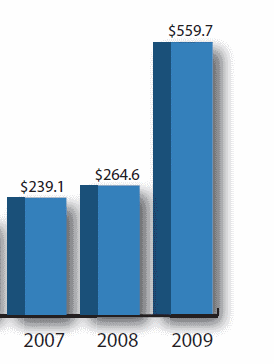
    Dollar value (in millions) of fraud referred for investigation by IC3 between 2007 and 2009. Source: IC3 2009 Internet Crime Report.

    Welcome to the rapidly evolving world of Planet Fraud, U.S. Region — or, more precisely, the U.S. Region of Planet Cyberfraud, the electronic web of deceit that often exists out of view and is sucking wealth at an alarming pace.

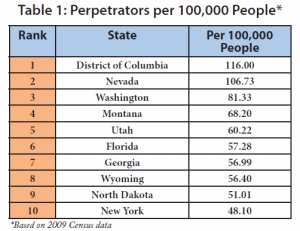
    Its capitals last year, according to a new report from The Internet Crime Complaint Center (IC3), included California, Florida, New York, Texas, Washington and the District of Columbia, with cyberfraud — viewed on a per-capita basis — particularly concentrated in D.C., Nevada, Washington, Montana, Utah and Florida.

    People who complained about fraud — and the fraudsters they complained about — most often did not live in the same state. Complainants often weren’t able to identify the state in which a fraudster resided, according to the report.

    Countries mentioned in the IC3 report include the United States, United Kingdom, Nigeria, Canada, Malaysia and Ghana. The report focuses on reports to IC3’s website, which operates in the United States.

    Highest, per-capita concentration of cyerfraud in the United States in 2009. Source: IC3 2009 Internet Crime Report.

    Not even law enforcement was immune from attacks by cybercriminals. The most common complaint that IC3 received last year was about an email scam in which the perpetrators used the name of the FBI — one of the world’s premier police agencies — “in an effort to gain information from the target,” IC3 said.

    IC3 is a partnership between the FBI and the National White Collar Crime Center (NW3C).

    “The figures contained in this report indicate that criminals are continuing to take full advantage of the anonymity afforded them by the Internet,” said NW3C Director Donald Brackman. “They are also developing increasingly sophisticated means of defrauding unsuspecting consumers. Internet crime is evolving in ways we couldn’t have imagined just five years ago.”

    IC3 placed the dollar losses in cases it referred for investigation last year at $559.7 million, up more than double from 2008’s figure of $264.6 million. The number of complaints in 2009 surged to 336,655, up 22.3 percent from 2008’s total of 275,284.

    Peter Trahon, section chief of the FBI’s Cyber Division, reissued the age-old warning:

    “[I]f something seems too good to be true, it likely is,” Trahon said. He added that computer users should ensure they have “up-to-date security protection on their devices and evaluate e-mail solicitations they receive with a healthy skepticism.”

    Why? Various appeals for money and various rogue attempts to corrupt computers by installing unwanted software and malicious code, including misery delivered by fake pop-up ads that “directed [victims] to purchase anti-virus software to repair their computers.”

    In some instances this resulted in viruses, Trojans, or key loggers being downloaded onto victims’ computers, IC3 said.

    Some highlights of the report:

    • In 2009, IC3 received several complaints presenting a new spin on the media coined “Hitman Scam,” a type of email extortion scheme. Victims are reportedly being threatened in an attempt to extort money. The victim receives an email from a member of an organization such as the “Ishmael Ghost Islamic Group.”
    • One of the components of crime committed via the Internet that makes investigation and prosecution difficult is that the offender and victim may be located anywhere in the world. This is a unique characteristic not found with “traditional” crime.
    • Another popular scam of 2009 involved unsolicited calls regarding fraudulent “government stimulus money.” IC3 received numerous complaints from victims receiving unsolicited telephone calls with a recorded message. The recorded voice message reportedly sounds very much like President Barrack Obama discussing alleged government funds available for those who apply.
    • IC3 received numerous complaints about work-at-home scams and survey scams related to online job sites.
    • Of the complaints involving financial harm that were referred to law enforcement, the highest median dollar losses were found among investment fraud ($3,200), overpayment fraud ($2,500), and advance fee fraud ($1,500).

    Read the IC3 Internet Crime Report for 2009.

  • INetGlobal, AdPacs Websites Offline; Acesse.com, Associated Search Site, Has Limited Functionality

    UPDATED 2:24 P.M. ET (U.S.A.) If you’re wanting to visit Steve Renner’s INetGlobal.com and AdPacs.com sites, at the moment you’ll land on pages that say “InetGlobal is currently down for maintenance. We’ll to (sic) be back by 12:00pm CST.”

    The message on InetGlobal.com and AdPacs.com has been in place for at least three hours and, despite the fact the INetGlobal and AdPacs sites suggested they would be back up by noon Central Standard Time, that time has passed by more than an hour — and the sites still are down.

    Why the Renner sites are down is unclear.

    UPDATE 2:24 P.M. The message on the site now has been changed to read, “InetGlobal is currently down for maintenance. We’ll to (sic) be back by 12:00am CST on Saturday, March 13th.”

    Another Renner site — Acesse.com, a search engine the U.S. Secret Service said last month was just a link to another search engine — appears to have limited functionality. It is possible to perform a search on the site and glean results, but several links on the site appear to have no functionality.

    The links are titled Images, Videos, Maps, News and Shopping, and appear in the upper-left corner of the Acesse.com site. The links appear to be dead. At the same time, other links that appear on the site — links that point to other Renner sites such as Adpacs.com and INetGlobal.com — are generating the “down for maintenance” message.

    Another link on Acesse.com titled “Top Searches” resolves to a page that says, “Top searches as of Tuesday December 2nd 2008 00:00:00 CST.”

    It was not immediately clear if the dead links at Acesse.com were caused by code that had been

    Part of the maintenance message at INetGlobal and AdPacs.

    removed to disable the links or code that had not been entered.

    The error message at INetGlobal and AdPacs appears under INetGlobal’s logo, and a headline that reads, “Preparing for bigger waves!” Two men are pictured riding a wave on surf boards, and a subhead reads, “Surf Alert.”

    Acesse.com purports to include a “Get Paid To Search The Web” element through the search engine.

    In a court affidavit last month, the U.S. Secret Service said Renner was at the head of an international Ponzi scheme.