
Category: Ad Surf Daily

  • REMEMBER PRAEBIUS? Penny-Stock Firm ASD Claimed Would Pump $200 Million Into Its Coffers Was Flogged By California Man In ‘Fraudulent Touting’ Scheme During Month ASD Announced ‘Joint Advertising Venture,’ Records Show

    On Oct. 29, 2008, Andy Bowdoin's AdSurfDaily Inc. announced a purported $200 million joint venture with Praebius Communications. During that same month, Praebius' penny stock was part of a "Fraudulent Touting" scheme operated by Songkram Roy Sahachaisere of Huntington Beach, Calif., the SEC says.

    A California man and his company have been accused by the SEC of running a “Fraudulent Touting” scheme that pumped the penny stock of Praebius Communications, a company the alleged AdSurfDaily Ponzi scheme once claimed would generate $200 million for its coffers through a joint “advertising” venture.

    Charged by the SEC with fraud were Songkram Roy Sahachaisere and InvestSource Inc. of Huntington Beach. The Praebius stock was pumped by Sahachaisere as part of what the SEC described as a “massive” email and newsletter scam.

    “Between January 1, 2008 and March 31, 2009, InvestSource sent nearly 450 email messages to over 24 million recipients,” the SEC charged.

    Praebius was one of seven InvestSource clients whose stock was pumped and dumped to generate illegal profits of more than $276,000, the SEC charged.

    The timing of the alleged touting scheme, according to records, coincided with dates in October 2008 in which ASD, an autosurf company, was announcing a purportedly lucrative  joint venture with Praebius. ASD announced the prospective deal on Oct. 29, 2008. During the same time period, ASD was awaiting a key court ruling on whether it had demonstrated at an evidentiary hearing earlier in October that it was operating lawfully. Using a headline of “ASD-Praebius Venture” on its now-defunct Breaking News website while awaiting the ruling, ASD said it expected to garner revenues of about $200 million “over the first several years” from Praebius.

    Announcement of prospective $200 million deal with Praebius Communications on ASD’s Breaking News website. The announcement was removed after some members questioned it.

    The SEC now says Sahachaisere and InvestSource were pitching Praebius stock during the same month, declaring their business practices to be “Fraudulent Touting” because they “failed to disclose that they were selling the very securities they were recommending investors buy.”

    Sahachaisere and InvestSource received 4.1 million shares of Praebius stock between Oct. 2, 2008, and Nov. 25, 2008, the SEC charged.

    The scheme involving Praebius netted $49,215 for Sahachaisere and InvestSource, the SEC said.

    Five of the seven stocks — including Praebius — experienced “significant increases in trading volume during InvestSource’s promotions,” the SEC said.

    ASD’s name is not referenced in the SEC complaint, and Praebius was not listed as a defendant in the case. Praebius is referenced in the case as a client that paid InvestSource and Sahachaisere in stock “to provide investor relations services.”

    One of the issues in the ASD Ponzi case was whether the company had revenue streams adequate enough to pay “rebates” to members of 1 percent a day or 365 percent a year for viewing “advertising.” During the evidentiary hearing, ASD never produced audited, certified financial statements to prove it could sustain the rebates. Prosecutors described the company as catastrophically insolvent and reliant on revenue from new members to pay “rebates” to older members in classic Ponzi scheme fashion.

    Less than a month after an evidentiary hearing concluded on Oct. 1, 2008, ASD announced the purported joint venture with Praebius. Critics immediately questioned both the $200 million figure quoted by ASD and the timing of the announcement because Praebius did not publish verifiable financial data and ASD was described by federal prosecutors in the Ponzi scheme case as hopelessly under water.

    Although ASD purported to be a professional communications firm, its announcement of the purported $200 million deal did not quote executives of either ASD or Praebius. The announcement led to questions about why Praebius would knowingly associate its name with a company suspected of operating a massive, international Ponzi scheme while it allegedly also engaged in wire fraud and money-laundering while selling unregistered securities.

    Some ASD critics saw the announcement as a cynical means of instilling hope in ASD members that all was not lost while signaling to a federal judge that ASD had a major, new client that single-handedly could wipe away the firm’s alleged insolvency. Even as critics were voicing concerns that ASD was advancing yet-another story that was too good to be true, members of the now-defunct Pro-ASD Surf’s Up forum were cheerleading ASD’s purported revenue infusion from Praebius.

    Some ASD members sprinted to forums to announce the news, but the information could not be verified. ASD later removed the announcement from its website.

    According to the SEC’s complaint against Sahachaisere and InvestSource, nearly 4.5 million shares of Praebius traded hands between Oct. 7, 2008, and Jan. 27, 2009, generating less than $50,000 in revenue.

    ASD never explained how Praebius, which did not publish verifiable financial data, could generate the $200 million ASD cited in the announcement.

    Less than a month after ASD issued the Praebius announcement, a federal judge ruled ASD had not demonstrated at the evidentiary hearing that it was operating lawfully and was not a Ponzi scheme. By Dec. 19, 2008, federal prosecutors had filed a second forfeiture case against ASD-connected assets, again citing Ponzi allegations.

    Even as prosecutors were filing the second Ponzi complaint, Surf’s Up members were claiming that the government secretly had admitted ASD was not a Ponzi scheme.
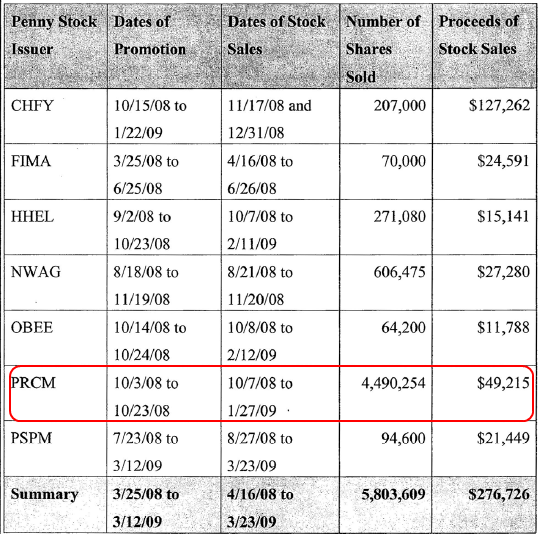

    From the SEC "Fraudulent Touting" court case against Songkram Roy Sahachaisere and InvestSource Inc. The highlight in red shows the alleged illegal touting of Praebius stock.

  • GO FINRA! Regulator Tackles Online HYIPs; Issues Warning On ‘Social Media-Linked Ponzi Schemes’; References P2P, Genius Funds, ‘Con Artists’ And ‘Bizarre Substratum’ Of Internet

    EDITOR’S NOTE: It has become increasingly clear that regulators and the law-enforcement community are rallying around a common theme that web-based promoters are using discussion forums and social-networking sites in bids to sanitize HYIP Ponzi schemes by positioning them as attractive investment opportunities and even a thrilling form of gambling that pays commissions.

    Today the Financial Industry Regulatory Authority (FINRA) launched an awareness campaign aimed at taking the lipstick off financial pigs and exposing them for the economy-killing, filthy hogs they are. FINRA did not mince words, calling the HYIP universe a “bizarre substratum of the Internet.”

    Here, now, the story . . .

    The Financial Industry Regulatory Authority (FINRA) has launched a public-awareness campaign and issued an investor alert on HYIP schemes that use social-media sites such as YouTube, Twitter, Facebook and online forums and “rating” sites to spread Ponzi misery globally.

    “HYIPs are old-fashioned Ponzi schemes dressed up for a Web 2.0 world,” said John Gannon, FINRA’s senior vice president. “Some of these schemes encourage people to bring in new victims, while others entice investors to ‘ride the Ponzi’ by attempting to get in and get out before the scheme collapses.”

    FINRA is supplementing its educational campaign with an advertising campaign.

    “By using Google AdWords, we are hoping to reach anyone searching the Internet for HYIPs before they fall into the hands of con artists,” Gannon said.

    FINRA’s campaign occurs against the backdrop of remarkable law-enforcement actions against the alleged Legisi Ponzi scheme pushed by Matt Gagnon of Mazu.com, the alleged Pathway To Prosperity (P2P) Ponzi scheme pushed on forums such as ASA Monitor, MoneyMakerGroup, Talk Gold and MyCashForums, and the collapse of an HYIP known as Genius Funds.

    It also occurs against the backdrop of “prelaunch” buzz surrounding a mysterious program known as WebsiteTester.biz, which is spreading virally on the Internet through electronic news releases, references on promoters’ websites and daily updates on Twitter.

    Promoters’ advertising is heavy for WebsiteTesterBiz, despite the fact the company’s domain name is registered behind a proxy, its purported parent company’s domain name is registered behind a proxy and there is a paucity of any verifiable information about either firm.

    FINRA specifically referenced the alleged P2P Ponzi in its educational materials. It also provided a link to information published about the collapsed Genius Funds HYIP by the British Columbia Securities Commission. Alarmingly, FINRA said the Genius Funds’ fraud costs investors a staggering $400 million.

    Federal prosecutors who filed criminal charges against P2P operator Nicholas Smirnow declared in May that “[a] large percentage, if not all, HYIPs, are Ponzi schemes.”

    In its resource material, FINRA is building on that theme.

    “[V]irtually every HYIP we have seen bears hallmarks of fraud,” FINRA said. “We are issuing this alert to warn investors worldwide to stay away from HYIPs.”

    P2P gathered more than $70 million. Legisi also gathered more than $70 million, according to court records.

    Separately, the alleged AdSurfDaily autosurf Ponzi scheme gathered at least $80 million and perhaps $100 million or more, according to records. Autosurfing is a form of HYIP fraud. The U.S. Secret Service acted against ASD in August 2008.

    In February 2010, an autosurf known as INetGlobal also came under investigation by the Secret Service. The SEC has acted against autosurfs known as 12DailyPro, PhoenixSurf and CEP, which gathered tens of millions of dollars combined — fueled by online promotions.

    Citing FBI statistics, FINRA said “the number of new HYIP investigations during fiscal year 2009 increased more than 100 percent over fiscal year 2008.”

    The regulator specifically warned about websites that “Rank the latest programs and provide details of ‘payout options.’” At the same time, it warned about sites that “Allow web designers to buy ready-made HYIP templates and set up an ‘instant’ HYIP.” Meanwhile, it warned about sites that “Blog, chat and ‘teach’ about HYIPs.”

    “Some HYIP ‘investors’ proffer strategies for maximizing profits and avoiding losses — everything from videos showing how to ‘make massive profits’ in HYIPs and ‘build a winning HYIP portfolio’ to an eBook on how to ‘ride the Ponzi’ and get in and out before a scheme collapses,” FINRA said.

    “Other HYIP forums discuss how to enter ‘test spends,’ how to identify new HYIPs to maximize one’s chances of being an early stage payee and even how to check when a HYIP’s domain name expires so you can guess how long it might pay returns before shutting down,” FINRA noted.

    One of the tips offered by FINRA was to be on the look out for “typos and poor grammar” in sales pitches.

    “This is often a tip-off that scammers are at work,” FINRA said.

    FINRA said HYIP scammers often don’t share critical information with investors.

    “HYIP operators cloak themselves in secrecy regarding who manages investor money, where the company is located or where to go to get additional information,” FINRA said.

    Claims about being “offshore” also are made, FINRA said.

    “Be aware that generally persons or firms offering securities to U.S. residents must be licensed by FINRA and registered with the SEC,” FINRA said.

    The sky often is positioned as the limit in the HYIP universe, which often relies on “online payment systems” — some of which “have been tied in recent years to criminal activity, including money laundering, identity theft and other scams,” FINRA warned.

    “High-yield investment programs (HYIPs) are unregistered investments created and touted by unlicensed individuals,” FINRA said. “Typically offered through slick (and sometimes not-so-slick) websites, HYIPs dangle the contradictory promises of safety coupled with high, unsustainable rates of return — 20, 30, 100 or more percent per day—through vague or murky trading strategies.”

    Read FINRA’s warning on HYIPs. (Make sure you click on the links in the body of the warning.)

    Read a PP Blog story about an alleged penny-stock scheme that was operated on Facebook and Twitter. Read a PP Blog story on P2P, and also one on Genius Funds and others.

    Read more about P2P. Read more about Legisi.

  • NEWS/NOTES: AdPayDaily Announces Tweak; Data Network Affiliates Asks Members To Participate In Imaginary Relaunch After Lecturing Churches On Their ‘MORAL OBLIGATION’ To Hawk MLM Program

    UPDATED 12:39 P.M. EDT (U.S.A.) An upstart autosurf pushed by members of the alleged AdSurfDaily Ponzi scheme has announced a confusing tweak in a confusing manner.

    In its announcement, AdPayDaily (APD) quoted 12 words from an attorney — and the quotation did not appear to be on the subject of legality. Rather, it appeared to be a general statement that all companies need sales to survive.

    Separately, a multilevel-marketing (MLM) company that claimed churches have a “MORAL OBLIGATION” to tell congregants about its $1,500 mortgage-reduction program that pays commissions 10 levels deep now is asking members to participate in an imaginary relaunch.

    Prospects willing to pay Data Network Affiliates (DNA) a fee to qualify for “Pro” status earn up to a “100% Matching Bonus” in the mortgage-reduction program, DNA said.

    In an email to members, DNA did not explain why it was lecturing churches on their purported moral duty to hawk an MLM program or instruct the churches on how to overcome sales objections if a minister, pastor or priest used a worship service or church facility to preach the gospel of DNA.

    DNA also did not explain if the clergy of non-Christian faiths had the same moral duty to flog a $1,500 MLM program targeted at people who could be on the verge of losing their homes.

    DNA supplemented the email with yet another email, asking members to imagine the company, which launched in March after missing at least two launch dates in February, was only now launching.

    “We are asking and calling on all DNA Leaders to FOCUS ON THE FUTURE… Make believe that July 26th, 2010 is the LAUNCH DATE for DNA…” the company said.

    In an apparent bid to drive home its point that an imaginary launch can be as effective as an actual launch, DNA again has added what it called a “NEW COUNTDOWN CLOCK” to its website.

    “OFFICIAL LAUNCH 7/26/2010,” DNA roared on its site. “Earn Up To $4500 Per Sale. LOCK IN YOUR POSITION NOW.”

    The message may be confusing to website visitors stopping at DNA’s site for the first time because it flatly states a launch is under way despite the fact DNA actually launched in March.

    A graphic that once advertised DNA Cellular, the company’s purported cell-phone arm, has been removed from the main page of the site. In April, DNA declared “GAME OVER — WE WIN” when it announced its purported cell-phone business that hawked a free phone with unlimited talk and text for $10 a month.

    The company later acknowledged that it studied cell-phone pricing only after announcing it had become the world’s pricing leader. It then withdrew the $10 offer, but members continue to promote it.

    In an email yesterday, DNA said it had learned “a lot of NOT TO DO kind of things” since it has been in business. It did not describe what it had learned not to do, choosing instead to inform members that “we have every guest you can have on tonight’s webinar” and urging members to focus on “the area of COMMISSIONS.”

    A previous guest on DNA’s conference calls has suggested that churches were wonderful places for members to record the license-plate numbers of congregants for entry into the company’s purported database. The same guest also recommended that DNA members record plate numbers at doctors’ offices.

    DNA has said its database could be used to locate abducted children.

    APD Tweaks Autosurf Pitch

    Saying it was relying on the advice of counsel, APD has tweaked its offer. In an announcement to members, the upstart surf provided a threadbare quote purportedly from its lawyer to explain the tweak.

    Here are the only words attributed to the attorney:

    “Every company needs new sales for survival and growth of the business.”

    And here is how APD explained the tweak after providing the 12-word quote:

    “To remain active and continue to earn commissions and viewing payments each month, all Reps are required to attract at least one new advertiser who makes a minimum purchase from outside funds of at least $100 or as an alternative an Advertiser/Rep can make a purchase of $100 from outside funds to qualify and remain active,” the company said.

    APD then pitched members on an 80/20 program.

    “[If] a Rep attracts a new advertiser who make (sic) a minimum purchase of $250 or more and the Rep rolls over at least 80% of the funds in their Cash account each month, they will earn a 20% commission for all additional sales in that month,” the company said. “10% of the commission will be paid with the sale and the remaining 10% will be paid on or before the 15th of the following month, assuming you qualify. Failure to qualify for two consecutive months will result in the deactivation of a Reps (sic) account.”

    In the past, private attorneys who have sued autosurfs have described so-called 80/20 or “rollover” programs as an effort to mask the true nature of the programs by minimizing the outflow of cash — in effect, trapping money in the system to achieve the mirage of sustainability.

    When the AdViewGlobal (AVG) autosurf announced a suspension of payouts in June 2009, it said that an 80/20 program would become mandatory if it ever dug itself out of the trench it created. Purported ASD “trainers” routinely promoted an 80/20 program.

    See earlier stories on APD here and here. See earlier story on DNA here.

  • MEMORY LANE: Before DailyProfitPond ‘Surf Tanked In 2008, Operators Warned That ‘Substainability’ Of 12 Percent Daily Payout Was ‘Questionable’

    EDITOR’S NOTE: We were researching an unrelated matter last night, and came across this gem (outlined below). In 2008, a number of autosurfs that became popular in the aftermath of the seizure of tens of millions of dollars from the personal bank accounts of AdSurfDaily President Andy Bowdoin tanked just prior to Christmas. One of them was Daily Profit Pond. The story below illustrates the fractured thinking that dominates the autosurf landscape — and the role promoters and autosurf “experts” play in spreading spectacular frauds virally on the Internet.

    As incredible as it sounds, an autosurf Ponzi known as Daily Profit Pond (DPP) said it was a legitimate business but warned prior to its collapse during the 2008 holiday season that its advertised payout rate of 12 percent a day might be unsustainable.

    Why promoters and members even had to ponder whether a Ponzi existed or the sustainability of an enterprise that advertised a 144 percent return in 12 days when there was no verifiable source of revenue beyond members’ funds was left to the imagination.

    But ponder it they did . . .

    In a missive to members, DPP described itself as thoughtful company that had listened to the input of unidentified “leaders” before making a decision to slash the advertised payout rate.

    “A few of our members got scarced (sic) and have contacted us that they want such a fine program like DPP to be here in the long run,” DPP said. “We have listen (sic) to these leaders and have decided to make some changes that will ensure the longterm success of DPP.”

    How did DPP address the sustainability issue?

    “[T]he management of DPP have decided to change the 12% daily plan which pays 144% in 12 days to a more realistic plan of 150% earnings in 30 days.”

    Yep. DPP suggested 144 percent in 12 days was too much, but added that 150 percent in 30 days was “more realistic.” DPP did not explain precisely how it had arrived at the conclusion that its new, 150 percent plan was a winner, but it noted (italics added):

    “The DPP administration are expects (sic) in the digital currency business and advertising business. This is where we intend to invest our members (sic) funds and the profit we generate will be used to substain (sic) our members payouts. This new strategy will enable DPP to be there in the long run when all other sites have closed and vanished into the (sic) thin air.”

    And like an overnight infomercial eager to add a free can of snake oil to the deal, DPP shrieked, “But Wait!” (Italics added):

    “How does this work, you may ask?

    “Henceforeth (sic), Our (sic) members will start earning 150% of their profit spots in 30 days. Ref. commission for upgraded members remains 12% down through 3rd levels (sic). 6% commission on level one, 3% ref commission on level two and three.”

    One promoter cheered DPP’s business acumen.

    “Well, I’m glad to see that someone at Daily Profit Pond is paying attention to the accounting,” he said. “They realize that their liability to their existing members is higher than the cash that is flowing in. You don’t have to be a math expert to realize that when you have more money going out than you have coming in, that you are going to run into cash problems pretty fast.

    “For the people who are upset by this change, I can understand where you are coming from but you have got to look at the alternative.

    “Would you rather keep earning 12% per day of virtual money that you will NEVER receive? Or would you rather earn 5% per day of money that you will actually be able to cash out? The choice is obvious.”

    Records suggest that DPP’s site vanished a week prior to Christmas in 2008. One ad viewed by the PP Blog prior to the collapse of DPP said it was possible to start with $12 and turn it into $12,000.

    Just days earlier DPP had lamented surf sites that vanish into “thin air.”

    Surfs such as DPP and MegaLido, which also went missing prior to the 2008 Holiday season, were particularly noxious. Members of AdSurfDaily and Golden Panda Ad Builder, whose assets were seized by the U.S. Secret Service in August 2008, cynically promoted DPP and MegaLido to other members of ASD, suggesting these miserable enterprises provided a way for people who lost money in ASD and Golden Panda to get it back quickly.

    Good grief: 144 percent in 12 days — later slashed to a “more realistic” 150 percent in 30 days.

    There was an earnings “calculator,” of course.

  • AP: Fraudster’s Self-Styled Litigation Strategy Led To Lengthier Prison Terms For Followers; Neville Solomon Cited UCC, Religious Passages Instead Of Listening To Lawyer

    A 67-year-old fraudster who did not listen to his attorney and embarked on a bizarre legal strategy was sentenced to a longer prison term as a result, the AP is reporting.

    Meanwhile, the AP is reporting that Neville Solomon met several other defendants in jail and shared his strategy, resulting in longer sentences for inmates who followed his advice, which cited the Uniform Commercial Code (UCC) and religious passages.

    One of the prongs of Solomon’s strategy was to repeatedly say, “I accept your offer and return it for value,” according to the AP.

    Read the AP story, which quotes a federal judge as saying a “whole bunch of people wound up in prison for a lot longer time than they should have” as a result of relying on improper defenses. At the same time, the story quotes a federal prosecutor who lamented the “crazy defense ideas out there.”

    Some of the legal notions advanced by Solomon are similar to the notions advanced by AdSurfDaily President Andy Bowdoin.

    Bowdoin, acting has his own attorney, advised a federal judge in 2009 that the mere filing of a pro se court document accomplished his objective of reversing a decision he made to surrender tens of millions of dollars in a Ponzi scheme forfeiture case “as a matter of law.”

    U.S. District Judge Rosemary Collyer disagreed, ordering the forfeiture of more than $65.8 million from Bowdoin’s bank accounts.

    The Solomon strategy also was reminiscent of a legal approach advocated by ASD member Curtis Richmond, a member of a Utah “Indian” tribe a federal judge ruled a complete “sham” in 2008. The “tribe” relied on fraudulent UCC claims in a bid to extort members of law enforcement, according to court filings.

    Elsewhere, a federal judge in Washington state ordered bogus UCC liens filed against government officials to be struck last month.

    Bogus liens filed by Ronald James Davenport of Deer Park sought the spectacular sum of nearly $5.2 billion from each of the officials, including U.S. Attorney James McDevitt of the Eastern District of Washington, an assistant U.S. attorney, a court clerk and an IRS agent, according to court records.

    Prosecutors described Davenport as a “tax defier.” Davenport has described himself in court filings as a “sovereign.”

    Davenport now has been charged criminally with filing false liens. If convicted, he faces up to 40 years in prison.

    In February, a federal jury found Solomon guilty of money laundering. Prosecutors said he and an associate, Frederick W. Keiser Jr. of Minot, N.D., “promoted a scheme to fraudulently obtain money from potential investors by inducing them to wire money to a company called MidChina Capital Management” in Las Vegas.

    “The phony investment promoted by Solomon and Keiser involved a fictitious bank trading or bank guarantee program in which bank instruments were to be obtained,” prosecutors said. “Solomon and Keiser convinced their victims that the bank instruments would generate exorbitant yields which would be used to fund other income-generating projects for MidChina, which in turn would result in investors gaining enormous returns.”

    Solomon now has been sentenced to 86 months in federal prison and ordered to forfeit $2,043,235 — the proceeds of the fraud scheme.

    “The sentence received by Mr. Solomon shows that investors who get defrauded like this will sit quietly waiting for their great returns for only so long,” said Assistant U.S. Attorney Brett Shasky. “If the promised return isn’t forthcoming and the investment isn’t returned, they will be heard. Persons choosing to promote such schemes should beware. The day will come when the price they pay for their greed will be great.”

    The pro se notions advanced by Solomon also are reminiscent of approaches used by defendants in the infamous 3 Hebrew Boys Ponzi scheme in South Carolina. They’re also similar to notions advanced in the Gold Quest International (GQI) Ponzi and securities-fraud case in Nevada.

  • Atlanta Journal Constitution: 3 Floridians Charged In Alleged $425 Million ‘Yellow Pages’ Directory Scam; Separate Research Shows Brother Of 1 Of The Defendants Is International Fugitive

    WANTED BY U.S. POSTAL INSPECTION SERVICE: Charles Robert Smith

    The Atlanta Journal Constitution and the Florida Times Union are reporting that three Jacksonville-area residents have been charged in an alleged $425 million fraud scheme involving mass solicitations for the renewal of dubious “Yellow Pages” listings.

    Separately, the brother of one of the defendants is listed as an international fugitive by the U.S. Postal Inspection Service in his own alleged Yellow Pages scheme.

    Charged in federal court in Atlanta were Mark Stuart Smith, Christopher Jon Gregory and Marian Phelan. The defendants were associated with a company known as United Directories, the newspapers reported.

    Smith’s brother, Charles Smith, was indicted last year in Atlanta on similar charges, the Times Union reported. The U.S. Postal Inspection Service (USPIS) has published a “Wanted” poster on Charles Smith, whose full name is Charles Robert Smith. Charles Smith also uses the alias of  Joseph Austin Smith, according to the USPIS.

    Charles Smith, according to the USPIS, is believed to have passports and Florida driver’s licenses in both names. He is described as an international fugitive possibly living in Tanzania, and is believed to travel extensively in Europe and Africa.

    Postal inspectors and state attorneys general have battled several variants of Yellow Pages scams over the years. Charles Smith, according to records, has been implicated in such scams for at least two decades.

    The Federal Trade Commission, among other agencies, has issued warnings about Yellow Pages scams. So has the state of North Dakota.

    Selling “Yellow Pages” listings on the Internet to create the impression that customers have purchased an ad in well-known, local print publications is one variant of the scam.

    Another variant is to send businesses a bogus bill for “Yellow Pages” listings. Because firms frequently purchase such listings and associate the “walking fingers” logo with legitimate print and online publishers, they often pay the bill without looking.

    Yet another variant of the scam is to send what appears to be a small “refund” check to businesses for overpayment of a “Yellow Pages” bill. When recipients endorse the checks, they actually are entering into a contract and agreeing to be automatically billed for advertising purchases.

    On May 26, 2009, the PP Blog reported that the AdViewGlobal (AVG) autosurf, which had close ties to the alleged AdSurfDaily Ponzi scheme operated from Florida, appeared to be in the process of launching a purported Yellow Pages directory service. Whether AVG planned to offer the purported service independently or through a partnership with a vendor was unclear.

    With great fanfare in May 2009, AVG announced that it was launching a new website and offering a new suite of purported services. The launch ultimately failed — but not before AVG had published a “walking fingers” logo to which the acronym “AVGA” had been added.

    Read the early story on the charges against Mark Stuart Smith, Christopher Jon Gregory and Marian Phelan in the Atlanta Journal Constitution.

    Read the story in the Florida Times Union.

    Visit the USPIS website to view the “Wanted” poster of Charles Robert Smith.

    Search for “Smith” in this USPIS document to get additional background.

    In the alleged Charles Smith scheme, “More than 10,000 victims lost an estimated $10 million,” USPIS said. Some of the money allegedly ended up in a Swiss bank account.

    During the course of the Charles Smith probe, “[i]nspectors and agents also found documents indicating that Charles Robert Smith was trying to liquidate funds in a brokerage account and several other bank accounts by purchasing one-ounce gold coins from dealers across the United States,” USPIS said.

    “Charles Smith had also recently placed a $42,000 deposit on a $1.2 million jet from Epic Air in Las Vegas, Nevada. Inspectors used information from the documents to obtain seizure warrants for the following items: – $323,793 from a brokerage account at Investscape. – 690 one-ounce American Eagle gold coins valued at $293,940. – 545 one-ounce Austrian Philharmonic gold coins valued at $228,900. – $42,000 down payment for the purchase of the jet, which had been converted into $30,000 worth of airplane parts and $12,000 in cash.”

  • MYSTERIOUS: WebsiteTester.Biz Getting Stranger By The Moment; Apparent Parent Company Of Website Now Advertising ‘Job’ Opportunities

    Alpha Market Research, the apparent, Nevada-based parent company of a website known as WebsiteTester.biz, now is advertising “job” openings  on its Twitter site.

    The domain ownership of both Alpha Market and Website Tester is hidden behind a proxy, and both sites appear to be hosted on the same server. Alpha Market has been issuing news releases on PRLog.org, a free PR site, for weeks.

    A Twitter site bearing Alpha Market’s name began to promote “Amazing new job opportunities” today.

    “We are looking for Country Managers and Affiliate Management Consultants,” the Twitter site claimed.

    A link from the Twitter site encourages visitors to “Apply now!” Some of the information presented includes fractured and overblown syntax that suggests the words were written by an individual or individuals who speak English as a second language or a native speaker of English who favors flowery, overbearing prose and does not have command of the language.

    Website Tester has been promoted on Ponzi boards such as Talk Gold, ASA Monitor, MoneyMakerGroup and the Online Success Zone. The search-engine penetration of the purported “opportunity” is nothing short of remarkable.

    Here is a snippet from the Alpha Market website (italics added):

    “Today, the clarity, the functionality and a fast and simple navigation decide if a company is successful on the internet. Providers without the right ‘internet tools’ have visibly less success even though their products/services might be identical to their successful competitior.

    “Therefore the internet user is placed at a crucial position; he alone decides if a website can succeed or fail on the market.

    “For that reason, Alpha Market Research (AMR) offers from September 2010 and on, a very special service: Thousands of neutral users are going to test (in a few days) the web site of a company and assure, through their feedback, that the internet presence can be optimized where necessary, before expensive publicity adjustments are made in vain.”

    Visitors are encouraged to “Apply now!

    “To be able to cope with all the orders from companies in timely manner AMR is looking for people, who want to work part time as website testers. There is no previous knowledge necessary; the workload is between 1 and 10 hours per week, depending on to how many fields of interest the applicant has inscribed,” the company says.

    Job openings are listed for “Website Tester,” along with “Country Manager / State Manager and “Affiliate Management Consultant.”

    For the position of Website tester, Alpha Market says this (italics added to snippet):

    “The position as a website tester is perfect for any person over the age of 16 who uses the internet from time to time.

    “Your job is to go to the websites of our clients and to fill out a short survey about that website. The compensation for this position is determined by the quality and quantity of your completed surveys. You are paid in money and/or vouchers that are in the range of $15 – $25 US/hr.”

    For the position of Country Manager / State Manager, Alpha Market says this (italics added to snippet):

    “As a Country or State Manager, your job would be to respond to all company inquiries in your country/state and to cultivate new business wherever possible in your territory.

    “In addition, it would be your responsibility to screen the actual website test very carefully, to insure that the use of words/phrases/text blocks/etc. ‘make sense’ in your native language so that all the chosen website testers can easily understand and read the instructions/the survey questions/etc., and complete their job quickly and easily.”

    Meanwhile, for the position of “Affiliate Management Consultant,” Alpha Market says this (italics added to snippet):

    “We are also creating an Affiliate Marketing Program for our company clients and as an Affiliate Management Consultant, your clients will be the companies that want to increase their business. You will show them how we can help them acquire more customers as we offer our website testers an additional source of income by promoting their products/services on a commission basis.

    “We will need a very select group (maybe 50 – 100 worldwide) of Affiliate Management Consultants.”

    See earlier story.

  • IT’S OFFICIAL: One Of Andy Bowdoin’s Lawyers Confirmed As U.S. Attorney; Another Tabbed As Federal Magistrate Judge; Firm Put In Charge Of Unraveling Wayne McLeod Ponzi Scheme

    Andy Bowdoin

    It’s enough to fuel the AdSurfDaily conspiracy theorists for years: Pamela Marsh, who represented ASD President Andy Bowdoin in a pyramid-scheme case in state court in Florida, has been confirmed by the U.S. Senate as the new U.S. Attorney for the Northern District of Florida.

    Meanwhile, Jonathan Goodman, one of the attorneys who represented Bowdoin in the Ponzi-scheme forfeiture case filed in U.S. District Court for the District of Columbia, has been appointed a federal Magistrate Judge in U.S. District Court for the Southern District of Florida.

    At the same time, an attorney for Akerman Senterfitt — the firm that employed both Marsh and Goodman — has been appointed to unravel the alleged K. Wayne McLeod Ponzi scheme that targeted members of law enforcement.

    Akerman Senterfitt’s Michael I. Goldberg already has begun his duties as receiver in the McLeod/Federal Employee Benefits Group case.

    President Obama appointed Marsh U.S. Attorney in April. She was confirmed by the Senate June 22.

    “Pam’s deep understanding of the law and commitment to excellence and ethics in her work made her a strong asset to the firm and she is the perfect choice to lead this important office,” said Andrew Smulian, chairman and chief executive officer of Akerman Senterfitt. “Pam has had great success in both the public and private sector and I am confident she will bring these impressive talents to her new role. We are particularly proud that Pam continues the tradition of Akerman attorneys who have made a special commitment to public service.”

    Marsh and Goodman have considerable experience as both prosecutors and defense attorneys.

    Bowdoin, 75, went on to fire an unclear number of attorneys representing him in state or federal court in ASD-related litigation, citing alleged incompetence and a conspiracy theory that his lawyers were only “looking out for the best interest of the government.”

    In 2008, federal prosecutors claimed Bowdoin had “followers.” In September 2009, they claimed he was “delusional.”

    Court records suggest Bowdoin withheld key information from both his attorneys and ASD members. While claiming in court that ASD was broke and could not pay its rent, Bowdoin did not disclose that ASD had $1 million in an offshore account under a different name, federal prosecutors said.

    He also claimed that “Ponzi” allegations against the company in Florida had been dropped, but the office of Florida Attorney General Bill McCollum pointed out that Bowdoin had never been accused by the state of operating a Ponzi scheme. The state brought pyramid allegations against the company.

    Despite federal allegations that Bowdoin was using an appeal to religion and operating a $100 million Ponzi scheme through 10 bank accounts in his personal name and that ASD was buying real estate, cars, jet skis, a boat and marine equipment with criminal proceeds, followers by the thousands initially lined up to support him.

    Some of his supporters said they associated themselves with a theory that the U.S. Congress met in secret session during the 1990s — a decade in which Bowdoin pleaded guilty to fleecing Alabama investors in a securities scheme — to pass secret legislation in anticipation of a visit by reptilian aliens.

    Some supporters also said they believed President Kennedy was assassinated in 1963 because he was about to expose a banking conspiracy.

    Eventually dozens of pro se litigants attempted to intervene in a forfeiture case brought by the U.S. Secret Service in August 2008. Some of them advanced a theory that prosecutors and judges were conspiring against Bowdoin.

    Others claimed the government had neither evidence nor witnesses, claims that were publicly refuted in court filings even before the claims were made. At least one ASD member sought unsuccessfully to force the ouster of U.S. District Judge Rosemary Collyer, claiming she was conspiring with another federal judge to deny justice to ASD members and operating a “kangaroo court.”

    The same member — Curtis Richmond — also sought unsuccessfully in 2008 to oust a federal judge in a separate case by claiming the judge owed him $30 million.

    Bowdoin himself also tried unsuccessfully to oust Collyer. One of his supporters falsely claimed the government had invested the seized funds and recorded a profit of more than $1 billion.

    In September 2009, Bowdoin claimed that his battle against the government was inspired by a former Miss America. He previously claimed the raid on ASD was the equivalent of the 9/11 terrorist attacks that killed nearly 3,000 people, and described the Secret Service and prosecutors as “Satan.”

  • WebsiteTester.Biz Pitched On Reborn GoldenPandaAdZone Forum, Plus MoneyMakerGroup, TalkGold And Other Ponzi Havens

    EDITOR’S NOTE: This story originally was published June 30. The PP Blog later encountered a database problem, which caused the site to go down and resulted in the temporary loss of some data. The data now has been retrieved.

    This story is about a new site known as “WebsiteTester.biz,” but some background is in order.

    It turns out that the April reports of the demise of the Golden Panda Ad Zone Forum, which changed its name to the Online Success Zone (OSZ), were premature.

    OSZ now is back online — and a poster is pitching  “WebsiteTester.biz,”  which appears to be promoting itself as an upstart advertising “testing” platform.

    Positioning surfing sites as testing platforms dates back at least to the CEP Ponzi scheme. Last summer, the failed AdViewGlobal (AVG) autosurf, which had close ties to the AdSurfDaily autosurf, was trying to reposition itself as an ad-testing site.

    Just prior to going offline in April, OSZ was pushing Narc That Car and Data Network Affiliates, two highly questionable companies  whose membership roster includes people linked to alleged Ponzi or pyramid schemes. OSZ got its start as the Golden Panda Ad Zone forum after the U.S. Secret Service seized more than $80 million from ASD and its purported “Chinese” autosurf companion, Golden Panda Ad Builder.

    During the summer of 2008, with ASD at its zenith and about to be accused of operating a Ponzi scheme, a predecessor to the INetGlobal autosurf also was coming online. INetGlobal eventually morphed into a surf site that largely targeted Chinese members, according to the Secret Service, which is investigating INetGlobal as its operator, Steve Renner, is in federal prison serving time for income-tax evasion.

    The ASD and Golden Panda money was seized amid allegations of wire fraud, money-laundering, selling unregistered securities and operating a Ponzi scheme. A forfeiture complaint in the case alleged a conspiracy with unnamed participants, and ASD was sued separately under the federal racketeering statute by members who also alleged a conspiracy was under way.

    Participants’ marketing of WebsiteTester.biz. occurs against the backdrop of a forceful statement by federal prosecutors in Illinois that virtually all HYIPs are Ponzi schemes. Autosurfs are a form of an HYIP program.  The business model of WebsiteTester.biz is unclear, and the company has not been accused of wrongdoing.

    In the Illinois case, Pathway To Prosperity (P2P) was alleged to have operated a global Ponzi scheme that gathered more than $70 million and fleeced more than 40,000 people. Nick Smirnow, P2P’s operator,  has a criminal past dating back to at least 1979, including convictions for breaking and entering, driving the getaway car in a robbery and cultivating and selling drugs. He also told a colleague he was involved in a double homicide in Canada and claimed to have ties to organized crime in Ontario, according to court filings.

    Posts on forums such as ASA Monitor, TalkGold and MoneyMakerGroup sought to sanitize the P2P scheme, authorities said. This important piece of information seems to have escaped the OSZ forum, which apparently continues to operate on the theory that HYIPs, autosurfs and cash-gifting programs somehow are a legitimate form of commerce.

    Incongruities abound in the autosurf and HYIP universes. “WebsiteTester.biz,” the apparent new darling of Ponzi boards such as OSZ, has a domain that is registered behind a proxy. It is unclear if any of its early boosters even know who owns the company or could name a single executive or a board member. Because the site’s business model is unclear, promoters are pitching a program they know virtually nothing about.

    The mere fact the “opportunity” is being pitched on the Ponzi boards shows, at a minimum, that promoters instinctively turned to the cesspools to drive business to the company.

    On its website, Website Tester, which purportedly is in prelaunch,  says this (italics added):

    “FINALLY . . . This is the business you have waited for so long:

    “It is completely free, you earn through EVERYBODY who registers after you, even if you do not sponsor people; you must not sell or buy anything. Guaranteed!

    “The faster you register, the more can be your potential income, even if you do nothing else than register for free . . .

    “How does it work? – It’s simple!

    “A market research company from the USA is searching for internet users all over the world, who get paid for testing websites and giving a short opinion. You also can earn up to 1,000 US$ per month working 1 to 10 hours weekly.

    “Even if the job as a website tester is not for you, you can earn two passive incomes month after month.”

    Excuse us while we vomit.

    Based on information on the landing page of WebsiteTester, the upstart company appears to have a tie to an upstart, Las Vegas-registered company known as Alpha Market Research Inc.  Alpha Market appears to have a Twitter site from which it relentlessly links to self-produced news releases that are posted on PRLog.org, a free press-release distribution service.

    Hey, did you see how the SEC described a scam yesterday that allegedly relied on Twitter and Facebook to help line up people to be fleeced in a securities swindle?

    Here is a paragraph from one of Alpha Market’s PR gems:

    “Global marketing is nothing but marketing done on national and international level and which involves understanding the similarities, dissimilarities and taking advantage of the opportunities to attain the goal.”

    Here is another gem:

    “When you buy something from eBay, Amazon.com or any online store, you’ve participated in e-commerce.”

    Meanwhile, here is yet another:

    “If you do not have a ghostwriter writing your blog content, then it means you will need to spend some time writing some blog posts.”

    Separate from its news releases, Alpha Market says this (italics added):

    “Potential clients who are disturbed by trifles during the ordering process are often unaware of exactly why. For you, the entrepreneur, the big questions remain: why did the potential client visit your website and why did they accept or not accept your offer?

    Alpha Market Research, Inc. starts exactly at this point: we make your website available for thousands of AMR website-testers, assigned in groups of age and interest – this way we get detailed feedback with an honest evaluation of your website.

    Like WebsiteTester.biz, AlphaMarketResearch.com is registered behind a proxy. The Alpha Market site was registered May 28, according to records. The Web Tester site was registered five days later, on June 2. Alpha Market’s Twitter site appears to date back to June 4.

    The buzz about Website Tester also is occurring against the backdrop of the launch of yet-another surfing company: AdPayDaily (APD).

    APD, which appears to have promotional ties to ASD and AVG, is running an AVG-like series of promotions that offer bonuses.

    Interestingly, APD, which appears to have only about 550 members despite virtually nonstop flogging for weeks, now says members can send in as much as $10,000.

    Website Tester, at the moment, appears just to be gathering names — and generating excitement by publishing the names of the latest registrants on the left side of its landing page. The names suggest the enterprise is attracting many people from outside the United States, but it is far from clear if anything about the company is real.

  • California Man, 72, Sentenced To 110 Months For HYIP Rip-Off; Richard M. Hersch Also Ordered To Pay ‘At Least’ $9.2 Million In Restitution

    First, Richard M. Hersch, 72, told investors they’d earn up to 6 percent a week by plowing money into his company, All States ATM Inc.

    He then explained the company had “contracts” with major horse-racing tracks in California and elsewhere to operate Automated Teller Machines (ATMs) on the “back side” of the tracks.

    Ordinary horse-racing fans could not use the ATMs, according to Hersch, because the “backside” was off-limits to the general public and situated for the convenience of racetrack employees, horse owners, horse trainers and others — his own, highly profitable niche.

    Hersch then made the investments appear to be even more lucrative by explaining “the racetracks allowed him to operate a check-cashing or loan service on the back side of the track for the exclusive use of those with access to that area,” prosecutors said.

    To further disarm skeptical prospects, “Hersch claimed that he had 160 employees and hundreds of ATMs and that his company was in its eighth year of business,” prosecutors said.

    But the tracks Hersch said used his ATM and check-cashing business “reported having no contracts with him or All States ATM to provide financial services of any sort,” prosecutors said.

    Hersch was charged with mail fraud and structuring, and was arrested last year by the FBI and IRS. Investigators determined he had coaxed more than 150 people to invest about $25 million in his company.

    He pleaded guilty in November and was sentenced yesterday, acknowledging he operated an HYIP fraud and conspired with others to structure 15 transactions totaling $141,500 to evade currency-reporting requirements. Prosecutors said he and co-conspirators withdrew cash from a bank account in amounts between $9,000 and $9,500 because they knew that withdrawals of cash over $10,000 triggered the reporting requirements.

    U.S. District Judge John A. Houston sentenced Hersch to 110 months in federal prison and to pay “at least” $9.2 million in restitution.

    “[Hersch’s] sentencing should remind the public of the financial perils associated with high yield investment fraud scams,” said Keith Slotter, FBI special agent in charge.

    HYIP schemers will get caught, a veteran IRS investigators warned.

    “Currency-report information filed by banks and financial institutions provides a paper trail, or roadmap, for investigations of financial crimes and illegal activities, including tax evasion, embezzlement, and money laundering,” said Leslie P. DeMarco, special agent in charge of the IRS Criminal Investigation unit in the agency’s Los Angeles Field Office.

    “Individuals who deliberately break down cash withdrawals into amounts less that $10,000, so as not to trigger a bank’s reporting requirement, are committing a financial crime,” said DeMarco. “In this investigation, IRS special agents used their financial expertise to uncover Mr. Hersch’s intentionally structured cash withdrawals, designed to hide his investment fraud scheme.”

    U.S. Attorney Laura E. Duffy of the Southern District of California said Hersch’s sentence sent a message to financial fraudsters who are duping investors.

    “[The] sentence demonstrates our commitment to investigating and prosecuting those individuals who prey upon innocent victims in our community through fraudulent investment schemes,” Duffy said.

    Hersch now joins the ranks of Bernard Madoff, 71, (New York/Florida); Richard Piccoli, 83, (New York); Andy Bowdoin, 75, (Florida); Julia Ann Schmidt, 68, (Texas); Judith Zabalaoui, 71, (Louisiana); Arthur Nadel, 77, (Florida/NewYork); Ronald Keith Owens, 73, (Texas); James Blackman Roberts, 71, (Arkansas); Larry Atkins, 65, (North Dakota), Richard Taft Johnson, 67, (Michigan), Maxwell B. Smith, 69, (New Jersey) and others as senior citizens implicated in large financial frauds.

  • Detectives Arrest Staten Island Man For Bilking Clients In Forex Scheme; Thomas Carson Ran .ORG Site; Allegedly Used Money For ‘Luxurious Lifestyle,’ Cigars, Treatment Of Varicose Veins

    Detectives from the office of Richmond County District Attorney Daniel M. Donovan Jr. have arrested a Staten Island man on charges of stealing $2.5 million from investment clients.

    Separately, a New York newspaper is reporting that Thomas Carson used some of the money to pay for 30 separate treatments for varicose veins on his legs. Carson is being called a “mini-Madoff.”

    Still smarting from the $65 billion Bernard Madoff Ponzi scheme, New Yorkers can be downright hostile to accused financial fraudsters. One reader of SILive.com, the website of the Staten Island Advance, left a comment that inmates at New York’s famous Rikers Island prison facility were apt to be impressed by Carson’s cosmetically altered legs.

    Donovan said Carson, 45, operated TDML Inc. and a .org website that bore the company’s name to defraud clients in a securities and forex scheme.

    “[Carson], while not quite rising to the level of a Bernard Madoff, is alleged to have stolen $2.5 million from his investors, who also happened to be friends and social acquaintances,” Donovan said.

    “Instead of making the agreed-to investments, the defendant is alleged to have used the funds to underwrite a luxurious lifestyle, including expensive cigars, cosmetic medical treatments, and trips to resorts in Las Vegas and the Caribbean islands,” he continued. “It is further alleged that he attempted to conceal this fraud and deceive his victims by manufacturing phony account statements with fictitious transactions and balances.”

    Donovan’s Detective Investigators Squad arrested Carson yesterday. He was charged with felony counts of Grand Larceny, Criminal Possession of Stolen Property and Criminal Possession of a Forged Instrument. Carson was listed this morning as an inmate at Otis Bantum Correctional Center, one of 10 jails on Rikers Island.

    Seven friends and social acquaintances gave Carson $4 million to invest, Donovan’s office said.

    “The funds were to be invested into an account at a New Jersey-based foreign currency exchange trading firm,” Donovan’s office said. “Instead, the defendant is alleged to have diverted $2.5 million for his personal use, while investing $1 million in his own accounts at TDML and later returning $500,000 to his investors.”

    The reaction of New Yorkers — and residents of many other cities — to financial fraudsters is in stark contrast to the reactions of members of a bizarre subculture that actually advocates for the legalization of Ponzi schemes.

    Instead of applauding the U.S. Secret Service in August 2008 for halting the alleged AdSurfDaily Ponzi scheme in Florida, some members of the ASD autosurfing enterprise directed forum catcalls at agents and prosecutors, calling them “Satan” and comparing them to the 9/11 terrorists who killed 3,000 people.

    When the SEC acted against a $28 million Ponzi scheme known as Gold Quest International in May 2008, participants in the scheme reacted by attempting to sue the agency for $1.7 trillion.

    If Richmond is convicted of the felony counts in New York, he potentially faces decades in prison.

    Read the story on SILive.com.