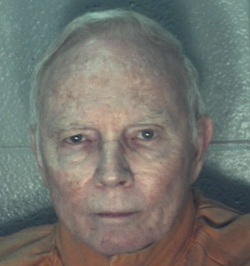
Was this Jack Phillips your Zeek Rewards sponsor or member of your upline/downline? (Contributed photo cropped by PP Blog.)
UPDATED 12:51 P.M. EDT (U.S.A.) This man (photo left) has been identified by a PP Blog reader as Jack Phillips, a suspect in an alleged swindle involving investments in purported emeralds.
Phillips, 77, is a resident of Oregon. He was charged criminally last week in Salt Lake County, Utah, in the alleged emeralds caper.
Zeek Rewards listed a member by the name of “Jack Junior Phillips,” according to materials viewed by the PP Blog. Zeek’s Jack Junior Phillips was a “Diamond” member and appears to be associated with a Oregon entity known as Yes You Can LLC.
The Blog is seeking to determine conclusively if the Jack Phillips pictured on the left and associated with the alleged emeralds fraud is the same Jack Phillips associated with Zeek Rewards as a “diamond” affiliate.
Two readers now have contacted the PP Blog, saying they were swindled by Jack Phillips in the alleged emeralds fraud.
“We were solicited by Jack Phillips to [triple] our money in a matter of 90 days,” one reader wrote.
The other reader asserted that the alleged emeralds caper involved a purported showing of the precious gems in Sarasota, Fla.
“There were more than 30 families involved in this scam,” the reader wrote.
MLM pitchmen and AdSurfDaily figures Todd Disner and Dwight Owen Schweitzer — both of whom went on to become promoters of the alleged Zeek Rewards Ponzi scheme — have accused a federal judge of “sophistry.”
Sophistry, according to Dictionary.com, means “a subtle, tricky, superficially plausible, but generally fallacious method of reasoning.”
Disner turned to MLM after his days as a founder of the Quiznos sandwhich franchise. Schweitzer is a former attorney whose license was suspended in Connecticut. Both men live in southern Florida.
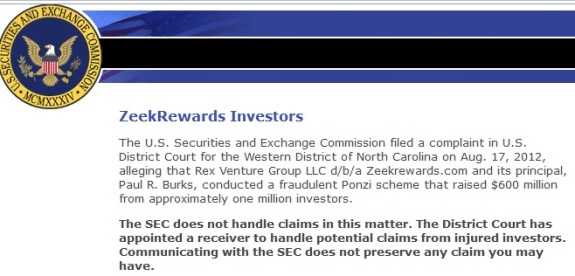
The curious assertion by Disner and Schweitzer against U.S. District Judge Rosemary Collyer appeared on Collyer’s court docket in the District of Columbia on Sept. 17, one month to the day after the SEC alleged in the western District of North Carolina that the Zeek Rewards MLM “program” was a $600 million Ponzi scheme and pyramid fraud that potentially had affected more than 1 million people.
Senior U.S. District Judge Graham C. Mullen of the western District of North Carolina is presiding over the Zeek case. Kenneth D. Bell is the court-appointed receiver.
Zeek and ASD are known to have members in common.
The ASD Ponzi scheme, which collapsed in 2008, affected at least 97,000 people and created at least 9,000 victims, federal prosecutors said.
Disner and Schweitzer also were pitchmen for ASD, which federal prosecutors in the District of Columbia have described as a $119 million Ponzi scheme marketed MLM-style. The ASD duo sued the United States in November 2011, claiming their records in ASD’s database were private and thus unlawfully seized and accusing federal prosecutors and a U.S. Secret Service agent of presenting a “tissue of lies” when bringing the civil- forfeiture case against $65.8 million in the bank accounts of ASD President Andy Bowdoin in August 2008.
On Aug. 29, Collyer sentenced Bowdoin to 78 months in federal prison. Bowdoin, 77, pleaded guilty to wire fraud in May 2012, admitting in a statement of offense that ASD was a Ponzi scheme and that his business never operated lawfully from its inception in 2006.
But Disner and Schweitzer now claim Bowdoin’s admission “was a necessary part of his plea bargain” with the government. They further assert that Bowdoin’s admission was the “coerced confession of an 80 year old man.”
In court filings in May, however, Bowdoin said this:
“I have read this Plea Agreement and discussed it with my attorneys, Michael McDonnell, Esq. and Charles Murray, Esq. I fully understand this Plea Agreement and agree to it without reservation. I do this voluntarily and of my own free will, intending to be legally bound. No threats have been made against me nor am I under the influence of anything that could impede my ability to understand this Plea Agreement fully. I am pleading guilty because I am in fact guilty of the offense(s) identified in this Plea Agreement.” (Italics/bolding added by PP Blog.)
In the filing docketed Sept. 17, Disner and Schweitzer claim the Secret Service “manufactured” events to ensure that the ASD case was heard by Collyer. Earlier, Disner and Schweitzer advanced a theory that undercover agents who joined ASD in 2008 had a duty to identify themselves to ASD management.
Even after Bowdoin pleaded guilty in May, Disner and Schweitzer contended that the government’s case was a “house of cards,” according to court filings.
Disner and Schweitzer now have asked for their lawsuit to be reopened and to have Collyer removed from the case. In ASD-related litigation, Collyer has ordered the forfeiture of more than $80 million.
The bid by Disner and Schweitzer to have Collyer removed from ASD-related litigation is at least the third. In 2009, purported “sovereign” being Curtis Richmond unsuccessfully sought to have Collyer removed. So did Bowdoin.
Disner is now involved with purported Zeek Rewards consultant Robert Craddock in an effort to raise money to challenge either the SEC or the court-appointed receiver in the Zeek case.
Among the early theories advanced by Craddock was that Mullen — the judge in the Zeek case — was playing politics by appointing Bell’s firm as the receiver to enable the firm to gorge itself on fees.
Both ASD and Zeek were accused of selling unregistered securities as investment contracts. The U.S. Secret Service brought the ASD case, with the SEC bringing the Zeek case.
The Secret Service confirmed on Aug. 17 that it also was investigating Zeek. The SEC said that, since January 2011, Zeek had “raised more than $600 million from approximately 1 million investors nationwide and overseas by making unregistered offers and sales of
securities through the ZeekRewards website in the form of Premium Subscriptions
and VIP Bids.”
Zeek was an arm of North Carolina-based Rex Venture Group LLC and was operated by Paul R. Burks, the SEC said.
In their filing accusing Collyer of sophistry, Disner and Schweitzer appear to suggest that Collyer needs a lesson in MLM from purported MLM expert Keith Laggos and MLM attorney Gerald Nehra.
Laggos, an SEC defendant in a 2004 case that alleged he issued laudatory press releases without disclosing he was being compensated, is listed in court records as a Zeek consultant. Laggos settled the 2004 SEC case without admitting or denying liability but agreeing to pay more than $30,000, including a $19,500 civil penalty.
Laggos once opined that ASD was not a Ponzi scheme. Nehra also opined that ASD was not a Ponzi scheme. Richard W. Waak, Nehra’s law partner, is listed in court filings by Zeek as an attorney for the firm.
UPDATED 10:05 P.M. EDT (U.S.A.) The SEC today updated its information site on the Zeek Rewards Ponzi scheme case, noting its investigation “is continuing” and pointedly adding language that “ZeekRewards and [Paul R.] Burks immediately consented to an asset freeze, the appointment of a receiver over their assets, and the payment of a $4 million penalty.”
Although the agency gave no specific reason for the update, it occurred against the backdrop of an ongoing effort by Zeek figure Robert Craddock to intervene in the case after collecting donations from individual members of Zeek.
1.
Screen shot of section from Google cache. This is how this section of the SEC's Zeek information page looked prior to today's update.
2.
Screen shot: The red highlights were added by the PP Blog and show today's change to the SEC's Zeek info site.
While the SEC did not provide the reason for the subpoena, some have speculated that recent comments attributed by Craddock to the SEC concerning purported admissions of fault in the SEC’s case against Zeek which were later refuted may have piqued the SEC’s interest.
On Sept. 23, the PP Blog reported that Craddock’s name did not appear on a Sept. 17 list of “EMPLOYEES, OTHER PERSONNEL, ATTORNEYS, ACCOUNTANTS & OTHER AGENTS/CONTRACTORS” submitted by Zeek to Senior U.S. District Judge Graham C. Mullen even though Craddock identified himself in July as a Zeek “consultant.”
Craddock also was present on separate fundraising calls last month with Todd Disner, a Zeek pitchman and a member of the AdSurfDaily 1-percent-a-day Ponzi scheme, and with T. LeMont Silver. Silver was described on a Zeek website in June as a Zeek “employee.”
Among other things, Silver was a pitchman for OneX, which federal prosecutors in the District of Columbia described in April as a “fraudulent scheme” and “pyramid” that was cycling money in ASD-like fashion. Jailed ASD Ponzi scheme operator Andy Bowdoin also was a OneX pitchman.
ASD was a Ponzi scheme that gathered at least $119 million, according to federal prosecutors. Zeek’s business model was very similar to ASD’s business model.
Zeek was a Ponzi scheme that gathered $600 million, according to the SEC.
Andy Bowdoin's booking photo in the District of Columbia.
Convicted AdSurfDaily Ponzi schemer Andy Bowdoin is in the custody of the U.S. Marshals Service and is listed “in transit” to a federal detention facility, according to court filings and the Federal Bureau of Prisons website.
Where Bowdoin, 77, will do his time has not yet been revealed. But a criminal judgment against Bowdoin signed Sept. 21 by U.S. District Judge Rosemary Collyer included a recommendation that Bowdoin be incarcerated “at a Low or Minimum Security facility near Tallahassee,” Fla.
Bowdoin’s ASD, which purported to pay members 1 percent a day, operated in Quincy, Fla., a short drive from Tallahassee.
On Aug. 29, Collyer sentenced Bowdoin to 78 months. He pleaded guilty to a Ponzi-related charge of wire fraud in May and admitted ASD was a Ponzi scheme.
Bowdoin had been held at a jail in the District of Columbia since June 12, the date his bond was revoked after federal prosecutors proffered evidence that he continued to commit crimes after the U.S. Secret Service raided ASD in 2008.
The Secret Service said last month that it also was investigating Zeek Rewards, another 1-percent-a-day-plus “program.” The SEC has described Zeek as a $600 million Ponzi- and pyramid scheme.
ASD gathered at least $119 million, according to court filings.
Zeek and ASD are known to have had members in common.
UPDATED 4:20 P.M. EDT (U.S.A.) Unsolved mysteries remain in the Zeek Rewards Ponzi scheme case. Among the unanswered questions are these:
How many members did Zeek have in common with AdSurfDaily, a predecessor 1-percent-a-day scam to the Zeek scheme?
Why do some Zeek “defenders” appear to be engaged in bizarre bids to harass and menace Zeek critics?
Why did Zeek list certain ASD members or story figures as employees on its website — and why does some of the employee information published on Zeek’s website in June appear to be at odds with employee information contained in court filings by Zeek last week?
How much connectivity did Zeek have with scams such as NarcThatCar, AdViewGlobal, OneX and JSSTripler/JustBeenPaid, a “program” that may have ties to the “sovereign citizens” movement?
On June 7, the PP Blog reported that a Zeek Rewards MLM “program” website was listing the names of 16 Zeek “employees,” including the name of Terralynn Hoy, a mainstay in the AdSurfDaily Ponzi scheme story. Also included was the name of OH Brown, an executive at a company (USHBB Inc.) that produced ads for the NarcThatCar pyramid scheme. This information is reflected in screen shots Nos. 1 and 2. Notes by the PP Blog also are included.
Hoy participated in at least one conference call for Zeek, as did Brown. Zeek’s 1-percent-a-day-plus business model was very similar to the business model of ASD, which the U.S. Secret Service described in 2008 as a massive online Ponzi scheme that had gathered tens of millions of dollars. Zeek launched after the collapse of ASD and had members and/or figures in common with ASD and AdViewGlobal, a collapsed 1-percent-a-day “program” federal prosecutors linked in April 2012 to ASD.
Among Silver’s OneX claims was that OneX positions being given away were worth $5,000. Bowdoin declared OneX an excellent “program” for college students.
Even though Zeek claimed Silver, Hoy, Catherine Parker, Brown, Trudy Gilmond and Marie Young Cain as “employees” in June, they are not referenced as “EMPLOYEES, OTHER PERSONNEL, ATTORNEYS, ACCOUNTANTS & OTHER AGENTS/CONTRACTORS” in a Sept. 17 court filing by Rex Venture Group LLC/Zeek operator Paul R. Burks.
Also absent from Burks’ Sept. 17 list of Rex/Zeek employees/contractors is Robert Craddock, who identified himself in July as a Rex “consultant.” In July, prior to the SEC’s Ponzi allegations against Zeek, Craddock sought to disable the Hub of Zeek critic “K. Chang” by filing a complaint for purported copyright/trademark infringement and libel with HubPages.com. Craddock was successful briefly, but HubPages eventually restored the “K. Chang” Hub. Craddock later became involved in a purported effort to raise funds to “protect” Zeek affiliates from the SEC and/or the court-appointed receiver in the Zeek Ponzi case.
Gilmond once pitched Regenesis2x2, a “program” that became the subject of a U.S. Secret Service investigation in 2009. The Secret Service also is investigating Zeek. The SEC described Zeek last month as a $600 million Ponzi- and pyramid scheme.
Precisely how and when Rex/Zeek hired or replaced/dismissed employees is unclear. The names of a number of individuals listed by Zeek as employees in June do not appear on the list Burks filed in court last week.
NarcThatCar effectively collapsed in 2010, after coming under scrutiny by the Better Business Bureau and investigative reporters. Narc operated from Texas — and yet did part of its banking in North Carolina at one of the banks used by Zeek. Both Narc and Zeek used USHBB Inc. to produce ads for their respective “programs.” Both Narc and Zeek scored “F” grades with the BBB — and when the BBB published negative information about the respective “programs,” some affiliates of the respective “programs” claimed the BBB was a fraud.
Zeek ‘Defender’ Stalks PP Blog, Starts Disinformation Site After HubPages Restores ‘K. Chang’ Site Targeted By Craddock
The PP Blog is reporting today that, after the SEC described Zeek as a $600 million fraud and after HubPages restored the “K. Chang” Hub critical of Zeek and targeted by Craddock, a purported Zeek “defender” used the Internet repeatedly to send harassing communications to the PP Blog. Dated Aug. 28, one such communication was an announcement that the PP Blog and “K. Chang” had been targeted in a retaliation campaign for their respective reporting on Zeek.
3.
4.
The Blog’s stalker created more than a dozen bogus usernames and email addresses to send harassing (and bizarre) communications to the PP Blog.
Here is one from Aug. 31 (italics added):
Watch out for the Romney lover namely KSChang!!!! He was saw holding hands with Mitt, caressing the presidential candidate, while surfing PatrickP’s amazing, smart, funny, and romantic blog.
Mitt Romney is the Republican nominee for President of the United States.
For reasons that remain known only to the PP Blog’s cyberstalker, the individual also sent a one-word harassing communication — “Pussy” — to the thread below this Aug. 29 PP Blog guest column by Gregg Evans. Separately, the cyberstalker sent a communication that planted the seed Evans would get sued for his Aug. 29 PP Blog column.
“Are you willing go toe to toe with a lawyer on your claims and back up this article?” the cyberstalker wrote.
On Aug. 31, the cyberstalker — who’d been banned under multiple identities — sent this harassing communication to the PP Blog:
“What happened to your face dude, looks like you got ran over by an ugly truck.”
UPDATED 7:58 P.M. EDT (U.S.A.) The mystery of precisely who would represent Zeek Rewards figure Robert Craddock in a bid to intervene in the Zeek Ponzi scheme case may be over.
Attorney Rodney E. Alexander of Charlotte has filed an appearance notice for Fun Club USA Inc., Craddock’s Florida business that raised funds for a court action challenging the Zeek case through ZTeamBiz.com.
Meanwhile, attorney Michael J. Quilling of Dallas has applied to the North Carolina federal court handing the Zeek Ponzi scheme case for permission to represent Fun Club.
Quilling’s application was sponsored by Alexander. Quilling is with Quilling, Selander, Lownds, Winslett & Moser, P.C.
In court filings today, Alexander said he “is appearing in this matter as local counsel for Fun Club USA, Inc and other entities whose assets were seized in connection with” the Zeek case.
Fun Club’s name does not appear as a defendant in the SEC’s civil case against Zeek, and it was not immediately clear whether a specific sum was seized from the company or whether Craddock and the unidentified “other entities” plan to argue that Zeek-related seizures in general by the government were unlawful.
The filing did not identify the other entities.
An email attributed to Craddock yesterday suggested that Senior U.S. District Judge Graham C. Mullen had permitted politics to enter the Zeek Ponzi fray. The email described the law firm of the court-appointed receiver in the Zeek case as “politically connected” and therefore potentially lacking “any incentive to protect anyone” and positioned to “run up a bill and submit invoices to the courts so they can pay themselves.”
Craddock did not explain why Mullen — a former Naval officer with 22 years on the bench — ever would play politics with Zeek. Zeek receiver Kenneth D. Bell, whom Craddock has painted as fee-hungry before Bell has submitted a single bill for the judge to review, is experienced as both a defense attorney and a prosecutor.
As a prosecutor, Bell was heralded by the U.S. Department of Justice for gaining convictions in a case against a Hezbollah terrorist cell operating in the United States. (See Bell in this YouTube video speaking about the cell.)
Craddock, though, appears to be dubious of Bell and his firm.
“So now we have an overzealous government agency, making unsubstantiated claims and convincing a judge to freeze the bank accounts and, dismantle the penny auction and for what, so the receiver can employ 100 people making in excess of 500 an hour for 210 weeks or 4.3 years and burn through the $500 million they have grabbed in 16 bank accounts,” the email attributed to Craddock read in part.
Scammers on well-known Ponzi-scheme forums such as MoneyMakerGroup also have planted seeds of doubt against the receiver. Zeek was promoted widely on forums listed in court filings as places from which Ponzi schemes are promoted.
Bell has said there potentially could be 2 million victims in the Zeek case. Yesterday alone attorneys for accused Zeek operator Paul R. Burks of Rex Venture Group filed thousands of Zeek-related records under seal. It is part of Bell’s job to examine those documents.
Craddock’s suggestion of political tomfoolery was curious, given that Craddock used the name of former Florida Attorney General Bill McCollum and the SNR Denton law firm in Craddock’s initial fundraising efforts to hire counsel. SNR Denton dropped out soon thereafter. McCollum is a partner at SNR Denton.
AdSurfDaily Ponzi scheme pitchman Todd Disner was present on a Craddock fundraising call last month. Among other things, Disner asserted in court filings earlier this year that ASD was not a Ponzi scheme even after ASD President Andy Bowdoin pleaded guilty to wire fraud and admitted ASD was a Ponzi scheme.
In a November 2011 lawsuit against the government for alleged misdeeds in the ASD Ponzi case, Disner also accused prosecutors of going shopping for a friendly judge when bringing the ASD Ponzi case in 2008. His claims were dismissed on Aug. 29, the same day Bowdoin was sentenced to 78 months in federal prison.
At an unclear point in time, Disner became a Zeek pitchman. Like ASD, Zeek featured a 1-percent-a-day (or more) payout plan on top of commissions for sales.
On Aug. 17, the SEC described Zeek as a Ponzi- and pyramid scheme that sold unregistered securities and raised $600 million.
Craddock has described himself as a consultant for Rex Venture Group LLC, Zeek’s parent company.
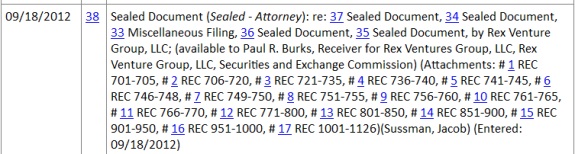
An entry from the court docket in the Zeek Ponzi scheme case.
UPDATED 4:20 P.M. EDT (U.S.A.) Attorneys for accused Ponzi schemer Paul R. Burks of the Zeek Rewards MLM “program” operated through North Carolina-based Rex Venture Group LLC have filed thousands of records under seal.
On Sept. 17, Burks’ attorneys sought the approval of Senior U.S. District Judge Graham C. Mullen to file the documents under seal.
The “anticipated filing contains account and financial information concerning not only Rex Ventures Group, LLC d/b/a ZeekRewards.com, but also thousands of individuals who either paid funds to and/or received funds from Receivership Defendant since January 1, 2010,” the attorneys said in advance of the massive filing.
Mullen permitted the attorneys to submit the documents under seal. The filings now have been made and will remain under seal until further order of the court. The precise form of the filings is unclear because they are not available to the public.
As things stand, the records will be available to Burks, the SEC and to Kenneth D. Bell, the court-appointed receiver in the Zeek case.
Zeek was described Aug. 17 by the SEC as a Ponzi- and pyramid scheme that had gathered $600 million.
The sheer complexity of Ponzi-scheme cases often leads to spectacular paper chases because of the enormous number of records that must be reviewed. But the Zeek case could set a new standard for volume because Zeek used as many as 15 financial vendors and perhaps ensnared between 1 million and 2 million victims while operating over the Internet between January 2011 and August 2012.
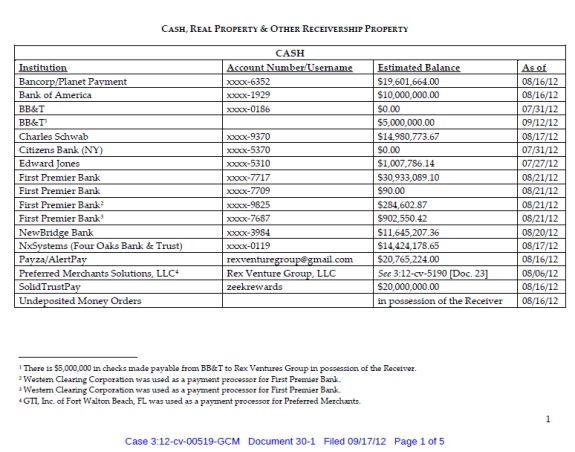
Screen shot: Accused Ponzi schemer Paul R. Burks of Rex Venture Group LLC advised Senior U.S. District Judge Graham C. Mullen of the Western District of North Carolina today about Zeek's relationships with various financial vendors. The alleged Zeek Rewards Ponzi scheme operated through Rex Venture..
BULLETIN: (UPDATED 9:18 P.M. EDT U.S.A.) New court filings by accused Ponzi schemer Paul R. Burks of Rex Venture Group LLC show that Zeek Rewards had more than $40 million in offshore payment processors.
Included in that sum is $20.765 million in Canada’s AlertPay/Payza, and $20 million in Canada’s SolidTrustPay.
Today’s filing also shows $10 million on deposit at Bank of America. Court filings in the AdSurfDaily Ponzi scheme case brought by the U.S. Secret Service in 2008 show that ASD also banked at Bank of America.
On Aug. 17, the SEC alleged that North Carolina-based Zeek was a massive online Ponzi- and pyramid scheme that had gathered $600 million since January 2011. Filings by Burks today suggest Zeek did it all with fewer than 40 employees, including part-time contractors such as attorneys and consultants in areas such as payroll, accounting, compliance and marketing.
Included among the consultants listed by Burks was Keith Laggos, a purported MLM expert. Laggos once opined that AdSurfDaily was not a Ponzi scheme. ASD President Andy Bowdoin later admitted that it was. Bowdoin was sentenced last month to 78 months in federal prison.
“The fraudsters prey upon vulnerable victims, do not respect local or even state boundaries, and often loot the victims’ life savings.” — Melinda Haag, U.S. Attorney for the Northern District of California, Sept. 13, 2012
It featured confidence-boosting names: Millennium Bank, United Trust of Switzerland and Sterling Bank and Trust.
But it was a cross-border Ponzi scheme that operated for 10 years. Its international “mastermind” controlled each of the entities and duped investors into purchasing at least $129.5 million in “bogus CDs,” federal prosecutors in two U.S. districts said this week.
William J. Wise, the mastermind, was a resident of Canada. But he also operated in the region of Raleigh, N.C., luring investors with tales of outsize returns made possible by profitable overseas investments, prosecutors said. In 2009, the SEC said Wise was assisted by Kristi M. Hoegel of Napa, Calif.
Hoegel, the SEC said at the time, used as many as five aliases. One proved to be the name under which she was charged criminally in February 2012: Jacquline Hoegel.
On Wednesday, Wise pleaded guilty to 18 felonies, prosecutors said. He potentially faces decades in prison.
Here is a breakdown of the Wise guilty pleas: one count of conspiracy to commit mail and wire fraud; twelve counts of mail fraud; three counts of wire fraud; one count of money laundering; and one count of tax evasion.
“The United States Attorneys around the country have identified an unprecedented rise in investment fraud schemes, involving thousands of victims and staggering losses,” said U.S. Attorney Melinda Haag of the Northern District of California. “The fraudsters prey upon vulnerable victims, do not respect local or even state boundaries, and often loot the victims’ life savings. This case is an example of U.S. Attorneys working together – from the Northern District of California to the Eastern District of North Carolina – to identify the schemes, find the perpetrators and bring them to justice.”
Haag was backed by Thomas G. Walker, the U.S. Attorney for the Eastern District of North Carolina.
“The individuals who commit these crimes have no regard for the well-being of their victims – only the desire to make a quick buck,” Walker said. “United States Attorney’s offices, along with federal, state and local law enforcement officials, work diligently each and every day to see that those who commit these crimes are the ones who pay.”
Prosecutors stressed that “[t]he Sterling Bank and Trust referred to in the indictment and plea agreement is not affiliated with the Sterling Bank & Trust headquartered in Southfield, Michigan, with thirteen branches in the San Francisco Bay Area.”
It is not unusual for scammers to trade on the name of a well-known entity or to cherry-pick parts of a well-known name to sanitize a fraud scheme and create comfort in the minds of investors. The Trevor Cook Ponzi scheme in Minnesota, for example, cherry-picked the name of UBS and also used names that sounded regal.
Ponzi-forum hucksters often do the same thing, dazzling investors with tales of fantastic “offshore” profits and using names that instill comfort and confidence.
Prosecutors noted pointedly this week that Wise “agreed to work with the government and the Receiver appointed by the Texas District Court to obtain control over any remaining investor funds in bank accounts in the United States or in foreign countries. ”
North Carolina was rocked Aug. 17 with SEC allegations that Zeek Rewards, an MLM “program” married to a penny-auction site known as Zeekler and operated by Paul R. Burks of Rex Venture Group LLC, was a $600 million Ponzi- and pyramid scheme that may affect more than 1 million people.
Kenneth D. Bell, the court-appointed receiver in the Zeek case, now says there may be 2 million victims. Zeek used as many as 15 financial vendors, including offshore vendors, the SEC said.
Court records strongly suggest Burks was cooperating with the SEC before the agency’s civil charges became public. The U.S. Secret Service said last month that it also was investigating Zeek.
The SEC said last month that Burks had agreed to cooperate with the receiver.
The Wise case resulted from “a lengthy investigation by the IRS-Criminal Investigations Division,” prosecutors said.
Kenneth D. Bell, the court-appointed receiver in the Zeek Rewards Ponzi scheme case, said in a statement today that he had recovered nearly $300 million and that “[t]here may be tens of millions of dollars more of recoverable assets.”
On Aug. 17, the SEC described Zeek as a $600 million Ponzi- and pyramid scheme that had affected more than 1 million people.
Securing receivership assets has been his “first priority” since his Aug. 17 appointment by Senior U.S. District Judge Graham C. Mullen, Bell said.
Bell’s statement appeared today on the receiver’s website. He noted that clawback actions may be in the offing, although he didn’t specify when.
“Among those from whom we intend to recover assets are those affiliates who took more out of Rex Ventures than they put in,” Bell said.
Rex Venture Group LLC is North Carolina-based Zeek’s parent company.
“Many of you received little or nothing from this enterprise,” Bell said. “In order to make everyone as whole as possible, those who profited from participating should surrender their gains.”
And Bell said he was aware that bogus information about Zeek was spreading online.
“Finally,” Bell said, “I read in many emails and web postings that some affiliates claim to have spoken to me or the SEC. False information is being circulated by these claimants. I have not spoken to any of those claiming to have done so. I will communicate with you through this web site. If I could answer all of the hundreds of thousands of emails and calls from you I would, but obviously I can’t. I also recommend that you consider only what the SEC posts on its web site for its position on this matter.”
In an Aug. 27 statement, Bell said that his “early investigation shows that the number of victims could be double” the SEC’s Aug. 17 estimate of 1 million.
“By sheer number of victims, this is one of the largest, if not the largest, Ponzi scheme to go into receivership in U.S. history,” Bell said in the Aug. 27 statement.
Screen shot: I-Payout website showing logos of "Global Strategic Partners." Ponzi-forum reports surfaced yesterday that the Wealth4AllTeam HYIP scheme was using I-Payout. In July, a scheme known as "OneX' that federal prosecutors previously described as a fraud and a "pyramid" announced that it was transitioning to I-Payout.
UPDATE: Wealth4AllTeam, one of the many HYIP schemes pushed by Zeek Rewards “I Got Paid” cheerleader “Ken Russo,” reportedly was using I-Payout as a payment facilitator, according to new Ponzi-forum reports.
Wealth4AllTeam appears to have suspended operations, leaving the Ponzi forums in an uproar amid claims that it is transitioning to a new business model that incorporates something called “Project Genesis.”
“I-payout quick links has been removed….all the attached bank account has been deactivated..there is no option left to deposit or withdraw…Looks like W4all have a hold on I-payout,” MoneyMakerGroup poster “jhakas22” claimed yesterday.
If the report is true — and MoneyMakerGroup poster Tobwithu claimed that he (or she) “can confirm that all links at i-payout are gone!’ — then it means that Wealth4AllTeam was using the same facilitator to which the mysterious “OneX’ scheme claimed it was transitioning.
In April, federal prosecutors described the purported OneX “program” as a “fraudulent scheme” and “pyramid” pushed by former AdSurfDaily President Andy Bowdoin. ASD was a $119 million Ponzi scheme. In August, Bowdoin was sentenced to 78 months in federal prison.
On July 19, the PP Blog reported that OneX claimed it had dropped SolidTrustPay — a Canada-based processor linked to fraud scheme after fraud scheme — in favor of I-Payout. That announcement was made by “J.C.,” later identified by federal prosecutors as James C. Hill.
I-Payout’s website publishes the logos of HSBC, Deutsche Bank, Barclays and other “Global Strategic Partners,” including Bank of America.
(Also see June 20 PP Blog report about OneX claim that it was working with a processor with a tie to Bank of America. Given events that occurred after the dropping of Bank of America’s name and the appearance of the bank’s name on the I-Payout site, it appears “J.C.” was alluding to I-Payout in June.)
Any number of ASD Ponzi-scheme pushers used Bank of America’s name to sanitize the ASD fraud. In raising Bank of America’s name in June and announcing the I-Payout transition in July, OneX appears to have been doing the same thing.
Name-dropping to sanitize fraud schemes is common in the HYIP sphere. So are lawsuit threats and other bids to chill websites that publish information critical of HYIPs.
In July, Robert Craddock, a purported “consultant” for Rex Venture Group LLC — the operator of the Zeek Rewards MLM scheme — sought to have a HubPages site operated by Zeek critic “K. Chang” removed from the web by filing a complaint with HubPages about purported copyright and trademark infringement and libel. Craddock’s efforts succeeded temporarily.
In a bizarre Blog post on Aug. 4, Zeek claimed that “all” criticism of Zeek was unfair and planted the seed that unspecified “North Carolina Credit Unions” were circulating a purported “internal memo” that allegedly was “at once unfavorable to Zeek Rewards and false.”
The Zeek post, attributed to then-acting COO Gregory J. Caldwell, complained the credit unions were slandering Zeek and warned Zeek members to toe the company line.
Thirteen days later, the SEC filed an emergency court action that described Zeek as a $600 million Ponzi- and pyramid scheme.
Craddock now is involved in a purported effort to defend Zeek affiliates from clawback actions by the court-appointed receiver in the SEC’s Zeek case. That effort began after the SEC’s actions against Zeek and also included name-dropping. During a pitch for Zeek members to send in money, Craddock dropped the name of former Florida Attorney General (and former U.S. Rep.) Bill McCollum.
McCollum, now a partner at the SNR Denton law firm, no longer is in public office. Precisely why Craddock mentioned McCollum’s name is unclear, although Craddock initially said that the Zeek affiliates were hiring SNR Denton. That effort appears now to have fallen through.
As Florida’s Attorney General, McCollum sued ASD for fraud in August 2008. Some ASD members countered that McCollum should be sued for Deceptive Trade Practices for holding the view that ASD was a fraud. Although McCollum’s office later dropped the ASD lawsuit, it said it had gathered names of ASD fraud victims and provided them to the U.S. Department of Justice, which had established a remissions process through which ASD victims could receive compensation from proceeds seized by the U.S. Secret Service in the ASD Ponzi case filed at the federal level in the District of Columbia.
Zeek is known to have members in common with the ASD Ponzi scheme. Some Zeek members also promoted OneX, the scheme promoted by ASD’s Bowdoin after his December 2010 arrest by the U.S. Secret Service on Ponzi-related charges of wire fraud, securities fraud and selling unregistered securities.
Bowdoin told prospects that OneX was good for “college students.”