Tag: Zeek

  • Law Firm’s Name Used In Bid To Dupe Members Of Banners Broker, Profit Clicking, MLM Attorney Says

    Kevin Thompson of Thompson Burton PLLC.
    Kevin Thompson of Thompson Burton PLLC.

    UPDATED 11:28 P.M. EDT (U.S.A.) Scammers have used the names of government agencies and famous businesses in bids to dupe the public. Now, the name of a well-known MLM law firm appears to have been used for the same purpose.

    Attorney Kevin Thompson published a Blog post today that warns of a bogus Banners Broker/Profit Clicking “Claim Form” on the Web. Thompson is with Thompson Burton PLLC in Tennessee.

    “DO NOT FILL OUT THIS FORM,” Thompson warned in the post. “It’s fraudulent. We did not create this form, or anything like it. We are not representing Banners Brokers or Profit Clicking participants.”

    And, Thompson noted, “The form is requiring highly sensitive information, such as your usernames and passwords for Payza and Solid Trust Pay accounts. It’s also asking for credit card information. If you filled out the form, we strongly suggest you change your passwords and cancel your credit cards immediately.”

    Such events have been associated with phishing schemes and identity-theft schemes.

    Banners Broker is a bizarre “program” that, like many HYIPs, purports to be in the “advertising” business. Promoters have claimed that sending money to Banners Broker results in a doubling of the cash.

    ProfitClicking is a scam that rose up to replace the JSSTripler/JustBeenPaid scam purportedly operated by Frederick Mann. Mann, a former pitchman for the AdSurfDaily Ponzi scheme, may have links to the “sovereign citizens movement.” “Sovereign citizens” may express an irrational belief that laws do not apply to them.

    Among other things, ProfitClicking became known — like JSS/JBP before it — for publishing Terms that read like an invitation to join an international financial conspiracy. Here is Item 6 from the ProfitClicking Terms, as published on Sept. 3, 2012 (italics added):

    6. I affirm that I am not an employee or official of any government agency, nor am I acting on behalf of or collecting information for or on behalf of any government agency.

    Mann once called government employees “part of a criminal gang of robbers, thieves, murderers, liars, imposters.”

    Regulators in Italy and the Philippines have issued warnings about JSS/JBP or ProfitClicking, both of which featured Terms similar to those of Legisi, a $72 million HYIP fraud scheme broken up by the SEC and the U.S. Secret Service in May 2008, about three months before the AdSurfDaily Ponzi scheme ($119 million) was exposed.

    The PP Blog has been subjected to various bids to chill its reporting on the JSS/JPB/ProfitClicking scams, including one from an individual who claimed he’d defend Mann “so help me God.”

    Meanwhile, the PP Blog has received bizarre and menacing spam apparently in support of Banners Broker. (Like JSS/JBP/ProfitClicking, AdSurfDaily, Legisi and Zeek Rewards, Banners Broker has a presence on well-known Ponzi-scheme forums such as TalkGold and MoneyMakerGroup.)

    WARNING: The next paragraph  includes quoted material from one of the Jan. 18, 2013, spams, and the PP Blog is reproducing it to illustrate the bizarre and often menacing nature of the HYIP sphere. Indeed, the apparent Banner’s Broker supporter wrote (italics added):

    ” . . . I am Big Bob’s cock meat sandwich. Your mom ate me and made me do press ups until I threw up . . . I am gonna report you. When you make false accusations, you can get done. Maybe you will be seen in court soon . . .”

    In August 2012, the SEC described Zeek Rewards as a $600 million Ponzi- and pyramid scheme. A number of reload scams have surfaced in its wake. At least one appears to have been a bid to dupe people into sending money to an entity that was posing as a U.S. government agency while claiming to be a recovery vessel for Zeek members who lost money.

    Thompson is encouraging people who may have information about the purported Banners Broker/Profit Clicking “Claim Form” to contact him here.
     

  • URGENT >> BULLETIN >> MOVING: Threshold Dollar Number For Zeek Rewards’ Net Winners To Avoid Receivership Litigation Now Public; At Least 136 Settlement Agreements Ironed Out, Receiver Says

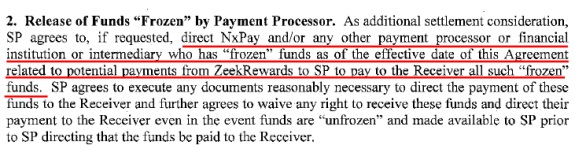
    From a June 28 filing by the court-appointed receiver in the Zeek Rewards Ponzi-scheme case. (Red highlights by PP Blog.)
    From a June 28 filing by the court-appointed receiver in the Zeek Rewards Ponzi-scheme case. “SP” stands for “Settling Party.” (Red highlights by PP Blog.)

    URGENT >> BULLETIN >> MOVING: (UPDATED 8:05 P.M. EDT U.S.A.) From the standpoint of avoiding financial accountability, it may have become more difficult for serial scammers who foist HYIP scams on the international public to thumb their noses at law enforcement and the courts. The court-appointed receiver in the Zeek Rewards Ponzi scheme case has revealed the threshold dollar number used to determine who received emails offering a settlement: That number, according to filings by receiver Kenneth D. Bell, was only $1,000.

    The lowness of the number could send shockwaves across the HYIP Ponzi universe. On well-known Ponzi-scheme forums such as TalkGold and MoneyMakerGroup, serial HYIP scammers routinely pooh-pooh court actions and claim that neither the government nor receivers will bother to seek recoveries from low-level players and “winners” in scams.

    Confident that they’ll never be held accountable, some purveyors move from one HYIP fraud scheme to another.

    In August 2012, the SEC described Zeek as a $600 million Ponzi- and pyramid scheme. Both the SEC and the receiver quickly were demonized on the Ponzi boards.

    Docketed in the Western District of North Carolina yesterday, Bell’s filing makes it plain that he expects any net winner who received $1,000 or more to pay up — and there is no guarantee that the number could not go lower in the future. Beyond that, a provision of the settlement agreement frees the receiver effectively to force net winners who may have money frozen in NxPay “and/or any other payment processor” or bank to make those funds payable to the receivership estate.

    Zeek used NxPay, AlertPay and SolidTrustPay. AlertPay (now Payza) and SolidTrustPay are longtime favorites of Ponzi purveyors and their shills on the fraud forums. Zeek was based in Lexington, N.C.

    If the Zeek settlement stipulations as outlined by the receiver are approved or accented by the court, it would mean that Zeek’s serial HYIP players and their recruits could not hope to stymie law-enforcement agencies and the receiver by waiting them out and removing “profits” from the payment processors or banks at a later date.

    At least 136 Zeek winners have agreed to settlements after being approached by the receiver, Bell said. Virtually all of the settlements have included a substantial discount on the order of 40 to 50 percent. The discount amounts, Bell has said, will enable the receivership to collect some money for Zeek victims without going to the additional expense of filing lawsuits.

    Winners who cooperated early with the receivership may stand to gain much better deals than stragglers who potentially could be held accountable for more lucrative dollar sums if successfully sued. Zeek had more than 2 million user IDs, Bell has said. About 1 million affiliates paid money to Zeek, which may have a universe of tens of thousands of “winners.”

    The $1,000 threshold in the early settlement emails was established after the receivership consulted with the SEC, according to a filing yesterday by Bell.

    Here are a several examples of the existing settlement agreements, according to the June 28 filing (bolding added):

    • A Zeek winner of $1,254 has agreed to a settlement of $600 “to be paid within 7 days of the effective date of this agreement.”
    • A Zeek winner of $9,249 has agreed to a settlement of $4,500 “to be paid as follows: $375 a month for 12 months beginning in April 2013 (to be paid by the 25th of each month).”
    • A Zeek winner of $28,909 has agreed to a settlement of $22,000 “to be paid as follows: $6,000 within 15 days of the effective date of the agreement and then eight payments of $2,000 due on the 15th day of each following month.”
    • A Zeek winner of $114,000 has agreed to a settlement of  “$47,500 to be payable on or before May 31, 2013.”
    • A Zeek winner of $170,440 has agreed to a settlement of “$84,981 to be payable in one payment of $23,165 on or before June 15, 2013 with the remainder ($61,770) to be paid by July 15, 2013 or in 10 equal consecutive monthly payments of $6,177.60 beginning on or before July 15, 2013 and to be paid by the fifteenth day of each following month.”
    • A Zeek winner of $176,000 has agreed to a settlement of “$88,000 to be paid within 7 days of the effective date of this agreement.”

    As things stand, Bell has settled with winners of more than $3.2 million for better than $1.81 million. The “Settlement as % of Winnings” is listed as 56.12 percent in the June 28 filing.

    NOTE: Our thanks to the ASD Updates Blog.


  • BULLETIN: SEC Backs Legisi Receiver’s Bid To Pursue E-Bullion Cash

    breakingnews72BULLETIN: The SEC has asked a federal judge to permit the receiver in the Legisi HYIP Ponzi-scheme case  to pursue funds tied up after the arrest of James Fayed, the operator of the e-Bullion payment processor. Fayed was convicted in 2011 of ordering the murder of his wife, a potential witness against him. Pamela Fayed was slashed to death in a Greater Los Angeles parking garage in July 2008. The SEC brought the Legisi fraud prosecution in May 2008, just two months before Pamela was killed.

    E-bullion has been linked to several Ponzi schemes. In court filings on June 6, receiver Robert D. Gordon said more than 85 percent of the $72.6 million directed at Legisi had flowed through the defunct processor. Gordon asked Judge George Caram Steeh of the Eastern District of Michigan for an order “to receive and collect any remission or restoration of funds recoverable or payable to Legisi investors pursuant to forfeiture actions brought by the United States” in federal court in Los Angeles.

    The SEC now says Steeh should issue the order because Gordon’s efforts could “lead to the recovery of millions of dollars for the Receivership Estate, funds which ultimately could be distributed to victims pursuant to a Court-approved formula.”

    Under Gordon’s plan, the SEC said, Legisi’s “winning investors” would be provided a process to dispute claims for the e-Bullion money.

    “As a result,” the SEC said, “any investors who assert that they are entitled to money claimed by the Receiver would have an opportunity to have their arguments heard and decided by the Court. No moneys would be disbursed until after the Court hears and decides such disputed claims.”

    The agency also said that Gordon earlier had successfully claimed $1.7 million from e-Gold, an e-Bullion rival charged in a 2007 money-laundering case. In May 2013, federal prosecutors in New York charged Liberty Reserve — yet another payment processor linked to online fraud schemes and other crime — in an alleged $6 billion money-laundering conspiracy.

    With a take of $72 million, Legisi was a “program” pitched on Ponzi-scheme forums such as TalkGold and MoneyMakerGroup — forums from which “programs” such as AdSurfDaily ($119 million), Zeek Rewards ($600 million), Pathway To Prosperity ($70 million) and Profitable Sunrise also were pitched. The combined scams gathered at least $861 million, according to federal court records. The number could be significantly higher because the final take of Profitable Sunrise — estimated in the tens of millions of dollars — is unknown. If Profitable Sunrise gathered $140 million, it would mean that the take of the five scams combined exceeded $1 billion.

    Similar scams continue to be promoted on the Ponzi boards by commission-based hucksters. The condition is comparable to “whack-a-mole” in the sense that one scam rises to replace another. The “offers” frequently are targeted at victims of previous schemes and positioned as a means investors can “earn” back funds lost in the earlier scams.

    Federal court records show that prosecutors asserted an AdSurfDaily pitchwoman funded her ASD account through e-Bullion, which also has been tied to mysterious scams such as Gold Quest International, the “Alpha Project” and Flat Electronic Data Interchange, known as FEDI. FEDI’s operator, Abdul Tawala Ibn Ali Alishtari, also known as “Michael Mixon,” was convicted in September 2009 of financing terror and fleecing investors in the FEDI scheme.

    Cash associated with the ASD Ponzi scheme was seized on Aug. 1, 2008, about four days after Pamela Fayed was murdered in Los Angeles. Erma Seabaugh, the ASD promoter who funded her account with e-Bullion, also pitched a scam known as StreamlineGold, according to federal records.

    In November 2007, a MoneyMakerGroup poster claimed this about StreamLineGold (italics added):

    StreamLine Gold is literally what it says. [I]t can provide you with an unlimited income through the combination of Precious Metals and Cash with a business model whose time has come PLUS the most advanced and lucrative pay plan ever devised.

    Seabaugh, according to records, was promoting ASD through an entity known as Carpe Diem, a purported “religious” nonprofit firm in Oregon.

    Separately, the receiver in the Zeek Rewards Ponzi case has said that he has “obtained information indicating that large sums of Receivership Assets may have been transferred by net winners to other entities in order to hide or shelter those assets.”

    An evidence exhibit in the Legisi case shows that investors had to affirm they were not an “informant” for government agencies such as the CIA, FBI, SEC, “Her Majesty’s Police,” the Intelligence Services of Great Britain and the Serious Fraud Office, among others.


  • Zeekers Share Their Conspiracy Theories At Newspaper Site

    zeekmemdayThe Dispatch of Lexington, N.C., published a story June 7 to update readers on Zeek Rewards-related litigation — specifically the date of a hearing on a motion by certain Zeek members (alleged net winners) to dissolve the receivership. (See link to story/Comments below.) As of this morning, about 27 comments appear below the story. The comments appear to be from Zeek supporters. Zeek was based in Lexington.

    Zeek, the SEC said in August 2012, was a $600 million Ponzi- and pyramid fraud that duped investors into believing they were receiving a legitimate return averaging about 1.5 percent a day. Zeek’s business model was similar to AdSurfDaily, a Florida-based Ponzi scheme that collapsed in 2008. Federal prosecutors said ASD had gathered about $119 million.

    ASD became infamous not only for its purported payout of 1 percent a day, but also for the extremely strange behavior of some of its supporters. Curtis Richmond, one of the scheme’s cheerleaders, was a purported “sovereign” being once sued successfully under the federal racketeering statute for his role in various bizarre plots advanced by a purported “Indian” tribe in Utah known derisively as the “Arby’s Indians.” (The “tribe” once held a meeting in an Arby’s restaurant.) Among other things, the “tribe” issued arrest warrants for public officials and litigation opponents and used the address of a Utah doughnut shop as the address of its purported “Supreme Court.”

    Richmond accused the judge presiding over the ASD case of dozens of felonies, saying she was guilty of “TREASON.” Moreover, Richmond claimed the judge’s supervising judge was conspiring with the judge to deny ASD members justice. For these claims (and more), Richmond was accorded the title of “hero” on the “Surf’s Up” forum, an ASD cheerleading site set up after the U.S. Secret Service raided ASD in August 2008. Among the Surf’s Up faithful was Terralynn Hoy, who later presided over at least one conference call for Zeek. (See this PP Blog Comments thread from June 2012. Props to GlimDropper of RealScam.com.)

    Many highly peculiar narratives were advanced by ASD supporters. One of them held that the U.S. government took about $80 million seized in the ASD case and plowed it into a secret fund through which it almost immediately generated $1 billion in interest that the United States used to pay for black ops. Another held that all commerce is lawful as long as the parties agree that it is lawful, a position that would legalize slavery. Yet another held that the ASD judge was on the take and “brain dead” if she ruled against ASD. Still another held that undercover agents who joined ASD to get the lay of the land had a duty to inform ASD management.

    On Surf’s Up, an ASD supporter claimed that a “militia” should storm Washington with guns. Another claimed a federal prosecutor should be placed in a medieval torture rack. Beyond that, a purported “prayer” was circulated that called for federal prosecutors to be struck dead.

    Given that ASD operator Andy Bowdoin once described himself (from a stage in Las Vegas) as a Christian “money magnet” and later claimed that the Secret Service was “Satan” and compared the agency to the 9/11 terrorists who killed nearly 3,000 people in New York, Pennsylvania and Washington, it’s no surprise that it became next-to-impossible to keep track of all of the ASD conspiracy theories.

    What is surprising is that any number of Zeekers seem willing to buy into the same sort of mind-numbing mind-set.

    At The Dispatch site, apparent Zeek supporters are claiming that:

    • the “SEC messed us all up.”
    • the court-appointed receiver “should be on trial.”
    • “someone paid these guys off with MINIMAL evidence!”
    • “Gestapo/KGB/SS tactics” are being used against Zeek by people in the “Executive Branch.”
    • the government is “not allowing anyone to [grow] economically.”

    Friends, a 1.5-percent-a-day “program” pushed on well-known fraud forums such as TalkGold and MoneyMakerGroup is a scam. Period. The SEC acted in the best interest of Zeek investors — and in the best interest of the people of the United States who are sick and tired of seeing their country used as a playground for HYIP scammers or worse. The security condition created by “programs” such as Zeek, Profitable Sunrise, JSSTripler/JustBeenPaid and others is untenable.

    Kenneth D. Bell, the court-appointed receiver for Zeek, has been doing a commendable job amid extremely trying circumstances. (In terms of the number of victims, Zeek may be the largest Ponzi scheme in U.S. history.) Bell is a former federal prosecutor known for having once successfully prosecuted a Hezbollah terrorist cell operating in the United States. He was appointed by a federal judge who is a former Naval officer. Claiming Bell should be put on trial is pure idiocy. So is clinging to a belief that the government somehow has outlawed the growth of business in the United States.

    No one got “paid off” to do anything against Zeek — and the evidence that Zeek had an insurmountable mountain of unfunded liabilities and was paying members with money from other members is overwhelming.

    Claims about Gestapo, KGB and SS tactics also were made by ASD members. Dwight Owen Schweitzer, later of Zeek, sued the United States (with fellow ASD and Zeek member Todd Disner). Among other things, Schweitzer and Disner claimed they were “unaware of any remission payments having been made” through the government-sponsored restitution program — this despite the fact the government had returned tens of millions of dollars to ASD investors and had issued news releases repeatedly about the program.

    For good measure, Schweitzer and Disner also claimed that undercover agents who joined ASD “should have reported their own violations of the ASD terms of service” to ASD management. The pair made this bizarre claim long after ASD lost in the District Court and in the U.S. Court of Appeals. Amazingly, the claim also was made after prosecutors pointed out that some ASD members were recruiting for ASD even though they knew it was a Ponzi scheme and that Andy Bowdoin’s silent partner in ASD was his sponsor in the 12DailyPro Ponzi scheme broken up by the SEC in February 2006 — months before ASD launched and years before Zeek launched.

    So, if you’re inclined to call accused Ponzi schemer and Zeek operator Paul R. Burks a genius while ranting against the government, you are according that title to a man who appears to have learned nothing from the ASD and 12DailyPro (and Legisi and PhoenixSurf and CEP and Imperia Invest IBC) prosecutions. If you are unhappy that the government’s Zeek action froze money you were counting on — well, that’s understandable. At the same time, however, there is a good chance you don’t understand the context of your own unhappiness. Zeek and Burks are to blame, not the SEC and the receiver.

    If you joined another Zeek-like “program” after the SEC action, the best that can be said is that you are slow to learn. The worst is that you are a budding “Ken Russo,” perhaps the most intransigent Ponzi-board scammer in the Western Hemisphere. Zeek member “Ken Russo” sells people into Ponzi misery for a fee.

    Repeatedly.

    What ASD and Zeek both appeared to be was a bid to dupe investors into believing that, if 12DailyPro’s return of 12 percent a day for 12 days for thousands of members was impossible, the “smaller” daily returns of ASD (1 percent) and Zeek (1.5 percent) for between 90 and 150 days for hundreds of thousands of members somehow were more plausible.

    Read story and Comments thread in The Dispatch. While you’re doing so, remember that Zeek once auctioned sums of U.S. currency (while wrapping itself in the American flag) and told successful bidders they could pick up their cash via offshore payment processors that enable fraud schemes like JSSTripler/JustBeenPaid and its 2-percent-a-day “program” globally.

  • ‘Earn Profit Click,’ Scheme Targeted At Profitable Sunrise Victims On Facebook, Says It Will Build Its Program With Targeted Spam On Facebook And Twitter

    An emerging scheme that butchers the English language and contends it opposes spam also bizarrely says it intends to build its business by requiring members to post ads on Facebook and Twitter.

    Equally bizarrely, the scheme says it accepts Liberty Reserve, the now-shuttered payment processor implicated by the United States last month in an alleged $6 billion money-laundering conspiracy.

    The scheme is known as Earn Profit Click — or EPC for short. The PP Blog observed ads for the “program” over the weekend on a Profitable Sunrise Facebook site. The ads now appear to have been removed. Profitable Sunrise was a murky international pyramid scheme that may have gathered tens of millions of dollars by using offshore bank accounts, the SEC said in April.

    Since that time, pitches for reload scam after reload scam have appeared on the still-active Profitable Sunrise Facebook site. Both the SEC and FINRA have warned that scams are spreading via social media such as Facebook, Twitter, YouTube and others. EPC’s full name is similar to “ProfitClicking,” a scam that rose from JSSTripler/JustBeenPaid, an earlier scam that also used social media to spread.

    EPC is similar to Zeek Rewards in the sense that “members” are required to place ads for the “program.” In August 2012, the SEC described Zeek as a $600 million Ponzi- and pyramid fraud. Unlike Zeek, EPC appears to be trying to force members to post ads on specific social-media sites that may have heavy viewership. (Many Zeek ads were placed on classified-ad sites with low traffic; such also appeared to be the case with Profitable Sunrise.)

    Here is a verbatim snippet from the purported Terms of EPC (italics added):

    19. You have to post face book ads in a group which have at least 500 members. If you want to post the ad on any of your friends’ wall, then the condition is that your particular friend must have at least 300 friends in his friends list.

    20. If you post the ad on LinkedIn or twitter in a group then there should be at least 200 members in this group. If you post the ad on a friend’s wall then there should be 100 friends in his friends list.

    21. In a group, you can post maximum 2 ads in 24 hours.

    22. On a friend’s wall, you can post only one ad during 24 hours.

    23. By accepting terms and conditions, you will be bound to keep the marketing material confidential provided on website.

    Part of the "Earn Profit Click" pitch.
    Part of the “Earn Profit Click” pitch.

    Elsewhere on its site, EPC claims to be a “Rapidly spread advertising company” through which members can “earn thousands of free entry [sic] that are changing lives [sic] of thousands people [sic] . . .”

    Meanwhile, EPC makes this text declaration: “We are a win-win game players [sic], as we provide our members a suitable era [sic] to win high financial benefits and helps [sic] to make their financial future [sic] splendid. We have the best minds from the field of IT to assist you and to handle the operations of EPC. Our mature, dedicated and wonderful team has twenty years [sic] experience in the field of online home-based business.”

    A graphic on the site declares, “We are growing fastly [sic].”

    The site reproduces famous logos and appears to trying to plant the seed that well-known companies such as GoDaddy, HostGator and the Ernst & Young accounting firm somehow have endorsed EPC’s operations. (The PP Blog’s research suggest GoDaddy is the EPC domain registrar and that HostGator servers are being used.) Promos for various HYIP scams appear on the same page as the logos of the famous companies. The HYIP scams include FastCashMega (“Turn $10 Into $20,010 Without Recruiting”); “NonStopPayments” (“6% Daily For 180 Business Days”); and “WorldConsumerAlliance,” a “program” once known as “WealthCreationAlliance” that launched as a Zeek Rewards reload scam in 2012 and published ad after ad for HYIP scams.

  • International Scammer Pleads Guilty In United States To Swindling Retirees In ‘Jamaican Lottery Scheme’; O’Brain J. Lynch Potentially Faces Decades In Federal Prison

    “Investigators from [the Social Security Administration] discovered that hundreds of victims throughout the United States were losing their social security benefits and their life savings either because they believed that they had won ‘The Jamaican Lottery’ or because, as part of another telemarketing scheme, they revealed enough information about themselves that allowed the thieves to fraudulently divert their money.”Office of U.S. Attorney James L. Santelle, Eastern District of Wisconsin, June 7, 2013

    recommendedreading1For O’Brain J. Lynch, senior citizens receiving retirement benefits from the Social Security Administration and other sources were the perfect targets of a criminal organization operating an international mass-marketing fraud scheme from Jamaica.

    The scheme duped people into believing they had won “The Jamaican Lottery.” In reality, authorities said, it was an advance-fee scam designed to drain retirement accounts and to recruit cashers in the United States.

    Lynch, 28, of of Montego Bay, Jamaica, now faces up to 20 years in federal prison after pleading guilty to wire fraud, the office of U.S. Attorney James L. Santelle of the Eastern District of Wisconsin said last week. The case was investigated by SSA, the U.S. Postal Inspection Service and Homeland Security Investigations (HSI).

    “Americans have lost millions of dollars to criminals from countries around the world in foreign lottery scams, said Pete Zegarac, inspector in charge of the Chicago Division of the U.S. Postal Inspection Service. “When one family member is harmed by a foreign lottery scam, the impact is felt by all. Losses can be monumental, sometimes entire life savings are wiped out. ”

    From a statement by prosecutors (italics added):

    A Jamaican Lottery Scheme is a form of mass-marketing fraud committed via the internet, telemarketing, or mass mailings. Jamaican criminal organizations contact victims and identify themselves as lawyers, government officials, law enforcement agents, or lottery company officials. The potential victims are led to believe they won an international multi-million dollar lottery. The fraudulent telemarketers then inform the victims that in order to receive their winnings the victim needs to pay an advance fee. This fee is usually described as a tax, insurance payment, or customs duty that must be paid to release the winnings. The victims are instructed to send the funds via mail or wire transfer.

    The scammers routinely involve victims to help facilitate the laundering of financial transactions by  receiving and withdrawing funds from prepaid cards and receiving and sending wire transfers. In an attempt to conceal and layer the proceeds from the lottery scams, the scammers direct victims to send funds, knowingly and unknowingly, to other victims and associates of the scammers within the United States. These victims and co-conspirators then transfer the proceeds of this fraud to the scammers in Jamaica by wire transfers. The Jamaican criminal organizations have modified the lottery scam into other variations of telemarketing schemes to include redirecting individuals Social Security Administration (SSA) benefits, direct deposit, automatic debit, re-routing schemes and other identity theft schemes.

    According to documents filed in court, in March 2012, the SSA learned that a social security recipient, from Glendale, Wisconsin, was receiving social security benefits in the name of other recipients and cashing in these benefits.  Special Agents from the SSA – Office of Inspector General (OIG) discovered the recipient was sending this money to Jamaica because he believed he had won “The Jamaican Lottery.”  He said he was contacted by an official from Global International who informed him that he won $2.5 million and two (2) Mercedes Benz vehicles in a sweepstakes.  He was then advised that in order for him to collect the money and the cars, he had to pay taxes, customs duty, and other fees. He initially sent his own money to Jamaica, and, once he had depleted his own assets, he was directed, by telephone, to accept checks, Direct Express cards, and other cash value cards in the names of other people (who were also victims), cash them out and then send the money to Jamaica.  As a result, numerous victims did not receive their social security benefits, and instead they were mailed to Jamaica. Investigators from SSA discovered that hundreds of victims throughout the United States were losing their social security benefits and their life savings either because they believed that they had won “The Jamaican Lottery” or because, as part of another telemarketing scheme, they revealed enough information about themselves that allowed the thieves to fraudulently divert their money.

    Prosecutors said they believed Lynch was the first Jamaican national charged in the United States with this type of fraud.

    “We will continue to work with our partners in Jamaica and other law enforcement agencies to put these criminal enterprises out of business,” said Gary Hartwig, special-agent-in charge of HSI’s Chicago Division.

    The Journal Sentinel newspaper (Milwaukee) reported last week that Lynch also is known as “Jake Dinero.”

    International mass-marketing fraud takes many forms. In 2010, the U.S. Postal Inspection Service alleged that the Pathway To Prosperity HYIP scheme gathered about $70 million and affected 40,000 investors in 120 countries. P2P was a Ponzi-board “program” that in part gained a head of steam on the TalkGold and MoneyMakerGroup fraud forums.

    The alleged $600 million Zeek Rewards Ponzi- and pyramid scheme followed P2P as a favored “program” on the Ponzi boards, as did the alleged Profitable Sunrise HYIP scheme. Profitable Sunrise may have collected tens of millions of dollars, the SEC said in April 2013, after bringing fraud charges against Zeek Rewards in August 2012.

    Reload scams have been targeted at both Zeek and Profitable Sunrise victims, authorities said.

    On May 9, the PP Blog reported that an emerging scam that is seeking to tie itself to the Catholic Church is engaging in a spam campaign and seeking to lure Profitable Sunrise victims into a new trap. The scam is using the name of “ALL SAINTS CATHOLIC CHURCH LOAN FIRM” and many other names, some of which are published in the Comments thread in the story linked in the first sentence of this paragraph.


  • BBC HOST: ‘We Have An Idiot On The Program Today’ — And It’s Alex Jones

    Andrew Neil yesterday made the universal "[batspit] crazy" gesture after trying to interview Alex Jones of InfoWars.
    Andrew Neil yesterday made the universal “[batspit] crazy” gesture after trying to interview Alex Jones of InfoWars.
    HYIP apologists dating back (at least) to the AdSurfDaily Ponzi scheme in 2008 ($119 million) have bizarrely sought to defend their favorite scams by steering discussions off the track. Why talk about the recidivist securities felon who presided over ASD (Andy Bowdoin), for instance, when the “real menace” is the Bilderberg Group?

    And, hey, since the United States is a participatory Democracy, why not further cloud the issues by launching petition drives designed to derail the prosecutions of major Ponzi schemes (such as AdSurfDaily and Zeek Rewards) and even filing bogus liens for billions of dollars against judges, prosecutors and investigators?

    If you encounter an HYIP Ponzi scheme these days that perhaps purports to pay interest of 2 percent a day or more, it’s a safe bet you’ll encounter one conspiracy theorist after another on well-known fraud-scheme forums such as TalkGold and MoneyMakerGroup — especially if the evilGUBment brings a criminal or civil action against the purported “opportunity.”

    It was against this delusional backdrop that conspiracy theorist Alex Jones appeared on the BBC’s “Sunday Politics” program hosted by Andrew Neil. The subject was the annual meeting of the Bilderberg Group, sometimes known  simply as the Bilderbergers.

    One of the best moments of the program occurred near the end of the Jones segment, when Neil made the universal “[batspit] crazy” gesture after Jones shared a FEMA concentration-camp conspiracy theory and screamed that “you will not stop freedom! You will not stop the republic! Humanity is awakening!”

    Neil declared, “We have an idiot on the program today.”

    Among the bizarre claims of the AdSurfDaily apologists was that all commerce is lawful as long as the parties to a “contract” agree that it is lawful, a position that would legalize Ponzi schemes — and slavery and human trafficking and narcotics trafficking, for that matter. The U.S. Secret Service took down ASD, and promptly was called “Satan” by ASD operator Andy Bowdoin, now serving a 78-month prison sentence for wire fraud for his 1-percent-a-day scheme.

    The SEC took down Zeek Rewards in August 2012, amid allegations it was conducting a $600 million, international Ponzi- and pyramid scheme by duping people into believing they were receiving a legitimate return that averaged about 1.5 percent a day. A federal judge appointed a receiver, who quickly was described as a felon by a Zeek litigant. (The Zeek receiver is a former federal prosecutor who once successfully prosecuted a Hezbollah terrorist cell operating in the United States.)

    Back in 2008 and 2009, some of the ASD apologists accused a federal judge appointed by President George W. Bush of committing dozens of felonies and conspiring with a chief judge to deny ASD members justice.

    Why HYIP scammers seem to embrace the conspiracy theories of Jones long has been left to the imagination. One thing that is clear is that ASD and Zeek combined allegedly gathered $719 million. Some recent HYIP scams such as Legisi ($72 million) and JSSTripler/JustBeenPaid (unknown take) have required participants to avow they were not with the “government.” Legisi specifically named the CIA, FBI, SEC, “Her Majesty’s Police,” the Intelligence Services of Great Britain and the Serious Fraud Office, among others.

    Late last month, the United States — working with other countries — took down a major payment processor for fraud schemes. Its name was “Liberty Reserve.”

  • YouTube Video Pitchmen For Profitable Sunrise Hit By Subpoenas From SEC

    John Schepcoff says he potentially lost more than $193,000 in Profitable Sunrise but that a new “program” is “1,000 percent” better.
    John Schepcoff says on YouTube that he potentially lost more than $193,000 in Profitable Sunrise but that a new “program” operating from Hong Kong is “1,000 percent” better.

    EDITOR’S NOTE: Much remains murky about Profitable Sunrise, the alleged purveyor of five HYIP “plans,” including one bizarrely dubbed the “Long Haul” that purported to pay a preposterous 2.7 percent a day. The “Long Haul” payoff was dubbed the “Easter Gift.” Investors were told it would arrive April 1 — but it never materialized.

    One thing that is abundantly clear is that Profitable Sunrise potentially has created legal exposure and inconvenience for individual pitchmen, even though purported operator “Roman Novak” appears to be gone like a thief in the night.

    Still pushing HYIP schemes?

    _____________________________

    At least three Profitable Sunrise pitchmen — including at least two who pushed the “program” on YouTube — have been subpoenaed by the SEC to appear at depositions this month. The agency’s move is occurring in the aftermath of the depositions of at least two other Profitable Sunrise figures in Florida and Utah in April.

    In July 2010, the PP Blog reported that the Financial Industry Regulatory Authority (FINRA) warned investors worldwide “to stay away from HYIPs,” saying that they use social-media sites such as YouTube, Twitter, Facebook and online forums and “rating” sites to spread Ponzi misery globally.

    At least two of the men named in the new round of subpoenas went on to push other purported “opportunities” after the SEC described Profitable Sunrise in April as a murky HYIP that had used a “mail drop” in England and a series of offshore bank accounts in multiple countries to scam investors potentially of tens of millions of dollars.

    A subpoena was docketed yesterday in federal court in Atlanta for John Schepcoff of Carmichael, Calif. Schepcoff also is known as James Schepcoff, according to the SEC. His deposition has been scheduled for June 12 at 10 a.m. in San Francisco.

    After pitching Profitable Sunrise on YouTube prior to its March collapse amid especially murky circumstances, Schepcoff returned to YouTube in late April and began pitching yet another murky “program” purportedly operating from Hong Kong. Although the identity of the Hong Kong “program” was unclear, records suggest it was a Zeek Rewards-like “opportunity” known as “Better-Living Global Marketing.”

    In August 2012, the SEC described Zeek as a $600 million Ponzi- and pyramid scheme that had pushed unregistered securities on hundreds of thousands of people and duped them into believing they were receiving a legitimate return of about 1.5 percent a day. The U.S. Secret Service also said it was investigating Zeek.

    A subpoena also was docketed in Atlanta yesterday for video pitchman Melton McClanahan of Fairfield, Calif. McClanahan was identified in a March order by the Alabama Securities Commission (ASC) as a Profitable Sunrise agent. McClanahan then posted a YouTube video denying he was an agent and yet claiming the information he passed along to lure prospects “was given to me.”

    McClanahan’s deposition is scheduled for June 11 at 10 a.m. in San Francisco.

    An SEC subpoena also was docketed yesterday in Atlanta for Don Gillette of Miami. Gillette reportedly told members of his Profitable Sunrise downline that he was turning to a new “program” that “must have a realistic earning potential of at least $500 a day or more,” according to a post at the RealScam.com antiscam forum.

    Details about the scheduling of Gillette’s deposition are unclear.

    As part of its ongoing Profitable Sunrise probe, the SEC also has subpoenaed records at PayPal and at Societe Generale in New York, according to the docket of U.S. District Judge Thomas W. Thrash Jr. in Atlanta. Whether Profitable Sunrise or its members were using the companies to move money is unclear.

    One of the problems with HYIP schemes is that they may cause laundered funds or proceeds of criminal enterprises to pass through or be placed on deposit at legitimate financial institutions.

    News of the new round of Profitable Sunrise subpoenas follows on the heels of the takedown last month of Liberty Reserve, amid allegations it had orchestrated a $6 billion money-laundering conspiracy. Liberty Reserve was popular with HYIP scammers and other criminals.

    NOTE: Thanks to the ASD Updates Blog.


  • ‘Felmina Alliance,’ Another Ponzi-Board ‘Program’ Pushed By ‘Ken Russo,’ Appears To Be DOA

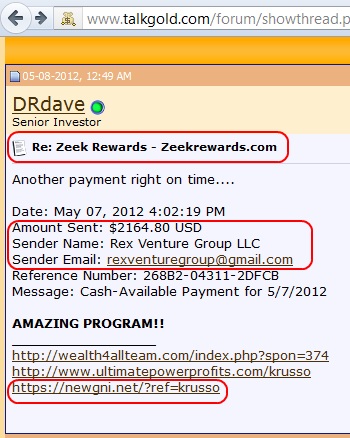
    kenrussozeekgni2Felmina Alliance, another in a long line of HYIP “programs” pushed on the Ponzi boards by serial huckster “Ken Russo,” appears to be DOA. “Ken Russo” also is known as “DRdave.” His record in promoting scams, pooh-poohing or ignoring regulatory actions and engaging in willful blindness may be unparalleled.

    Regulators in the United States and Canada issued an Investor Alert against Felmina Alliance earlier this year.

    The server for Felmina Alliance now has been throwing an error message for days. Other recent “Russo” disasters include NewGNI, an apparent knockoff scam of an earlier scam known simply as GNI (Gold Nugget Invest), Zeek Rewards and Profitable Sunrise. On the TalkGold Ponzi forum as “DRdave,” “Ken Russo” was promoting Zeek and NewGNI simultaneously.

    NewGNI appears to have collapsed in February.

    Previous “Ken Russo” scams include AdSurfDaily, a $119 million Ponzi scheme; Club Asteria, a venture that traded on the name of the World Bank and listed a serial-cash gifter and former ASD Ponzi promoter as one of its managers; and MPB Today, a “program” that claimed a one-time purchase of $200 in groceries could lead to free food and gasoline for life.

    MPB Today operator Gary Calhoun is awaiting sentencing in Florida on a racketeering charge. ASD operator Andy Bowdoin is serving a federal prison sentence for wire fraud after being sued for racketeering by some of his own members. Club Asteria, which falsely planted the seeds it was endorsed by actor Will Smith and the American Red Cross, suspended interest payments long ago. Club Asteria also traded on the name of slain human-rights champion Mahatma Gandhi.

    Club Asteria misspelled Gandhi’s name in promos.

    “Ken Russo” dubbed Zeek an “AMAZING PROGRAM” in May 2012. Three months later the SEC dubbed it a $600 million Ponzi- and pyramid fraud. The original GNI collapsed in 2010 into a sea of incongruity, amid reports the operators were seeking a “crystal clear vision of our financial vortex.”

    In April 2013, the SEC said ProfitableSunrise was conducting an international fraud scheme and may have gathered tens of millions of dollars through a mail drop and a series of offshore accounts.

    Records strongly suggest that Felmina Alliance was using an address of 50 Street, Global Plaza Tower, 19th Floor, Suite H, Panama City, Panama. That address also shows up in court filings by the SEC in the Profitable Sunrise action.

  • HYIP Spammer Hits Profitable Sunrise Facebook Site With Drive-By Offers For ‘AdHitProfits,’ A Ponzi-Board ‘Program’ Whose Thread-Opener Bragged, ‘Payza, STP & Liberty Reserve Accepted !!’

    ponziglareUPDATED 5:41 P.M. EDT (U.S.A.) A spammer hit a Profitable Sunrise Facebook site yesterday with five drive-by offers for “AdHitProfits.” All five of the machine-gunned theft bids claimed the same thing: “make money every half an hour…100% commission let your money grow for you at high speed.”

    The AHP “program” also is being pitched on the Ponzi boards, with the thread-starter at MoneyMakerGroup bragging that “Payza, []STP & Liberty Reserve Accepted !!”

    LibertyReserve was described last week by federal prosecutors in New York as a criminal enterprise that had laundered more than $6 billion for Ponzi schemers, credit-card fraudsters, identity thieves, investment fraudsters, computer hackers, child pornographers and narcotics traffickers.

    The names of Payza predecessor AlertPay and SolidTrustPay, meanwhile, appear in U.S. court files as payment processors for Ponzi schemes. In August 2012, the SEC accused Ponzi-board “program” Zeek Rewards of orchestrating a $600 million Ponzi- and pyramid fraud. Earier in 2012, Zeek Rewards was auctioning sums of U.S. cash and telling successful bidders they could receive their winnings through AlertPay and SolidTrustPay.

    Forums such as MoneyMakerGroup and TalkGold are referenced in U.S. court filings as places from which HYIP frauds/Ponzi schemes are promoted. AHP also has a presence on both forums. It also has a presence on DreamTeamMoney, yet another Ponzi forum.

    Like other recent Ponzi-board “programs,” AHP is triggering a security warning from McAfee Site Advisor. The warning declares the AHP site a “Dangerous Site.”

    “Whoa!” the warning begins. “Are you sure you want to go there?”

    In March, the SEC described Profitable Sunrise as a murky pyramid scheme that may have gathered tens of millions of dollars through offshore bank accounts. Court filings show that money tied to Profitable Sunrise and Liberty Reserve ended up in offshore bank accounts. Whether Profitable Sunrise had a Liberty Reserve account is unclear.

    Although HYIP schemes always are dangerous, they may be particularly dangerous now as operators scramble for new, Ponzi-sustaining cash after a series of seizures related to the Liberty Reserve investigation. The amount of HYIP-related cash seized in the Liberty Reserve probe is unknown. A well-known scam that has operated under at least three names — JSS Tripler, JustBeenPaid and ProfitClicking — claimed it accepted Liberty Reserve and now appears to have wiped out investors’ purported holdings and perhaps zeroed out the purported earnings of many of them.

    In an April 6 thread-starting post for AHP at MoneyMakerGroup, the claim is made that “You Purchase 1 Or More Revenue Share Ad Spot(s) For $45 !!” and that “You Earn $56.25.” The pitch also claims that a return of 125 percent is “More Stable For Long Term !!”

    Separately, the thread-starter’s forum signature tries to lure visitors to a “program” known as “AddWallet,” with a claim that it is “Better Than Zeek (( A Complete Passive Income With Best Advertising Revenue Income Ever )).”

    AHP shills have paraded to TalkGold to make “I Got Paid” posts for the purported “opportunity.” Shills did the same thing for Zeek and the other “programs.”

    An emerging Ponzi-forum darling like Zeek and Profitable Sunrise before it, AHP appears to have debuted in April, just weeks after the website of Profitable Sunrise went missing.

    A series of reload scams are been targeted at Profitable Sunrise victims via a Facebook site. Many of the “programs” claimed to accept LibertyReserve, PerfectMoney, Payza or SolidTrustPay.

    PerfectMoney, which purportedly operates from Panama, now claims it is banning new registrations from U.S. prospects.

  • BULLETIN: ‘PerfectMoney,’ Fraud-Scheme Processor Purportedly Based In Panama, Says It Is Banning U.S. Customers

    breakingnews72BULLETIN: On the heels of the apparent shutdown of Costa Rica-based Liberty Reserve as part of an international money-laundering investigation, “PerfectMoney” says it is banning users from the United States. Perfect Money purportedly operates from Panama. (More below.)

    In an announcement dated today on its website, Perfect Money says that “due to changes in our policy we forbid new registrations from individuals or companies based in the United States of America. This includes US citizens residing overseas. If you fall under the above mentioned category, please do not register an account with us.”

    How PerfectMoney intends to treat existing U.S. users was not immediately clear, and the firm did not explain why it suddenly had changed its policy. The company is favored by criminals and HYIP scammers and has a history of advertising on behalf of purported Forex “opportunities” that have been the subjects of sweeping court actions in the United States.

    In January 2013, the Superintendency of the Securities Market of the Republic of Panama (SMV) warned that Perfect Money “has not been granted any kind of license by the SMV, nor has been authorized to carry on activities of intermediation, administration, or advisory in securities, financial instruments or forex, in or from the Republic of Panama, within the scope of the Securities Law.

    “PERFECT MONEY FINANCE CORP. does not have [its] own offices in Panama, the office and its P.O. Box claim in its website [deleted by PP Blog], belong to the companies Azuero Business Center, Inc. and Panama Net Buy, which provides online shopping services,” SMV said.

    In 2011, the PP Blog reported that an individual referenced as a Perfect Money contact person is referenced in federal court filings that tie money from the alleged EMG/Finanzas Forex fraud scheme to an international narcotics probe that led to the seizure of at least 59 bank accounts in the United States and the companion seizure of 294 bars of gold and at least seven luxury vehicles.

    PerfectMoney’s name also is referenced in case filings from the SEC’s 2010 fraud complaint against Imperia Invest IBC, a scam purportedly operating offshore. Deaf people lost millions of dollars to Imperia, the SEC said.

    A quick check today by the PPBlog showed dozens of HYIP sites that claim to accept PerfectMoney. Many of the same sites also claimed to accept LibertyReserve. How the “programs” — all of which advertise preposterous returns — will contend with the absence of LibertyReserve and the new restrictions imposed by PerfectMoney was not immediately clear.

    Liberty Reserve operator Arthur Budovsky Belanchuk is reported to be under arrest in Spain as part of a probe by authorities in Costa Rica and the United States.

    Based on U.S. court files and certain extrapolations, murky HYIPs may be raking in billions of dollars. In August 2012, the SEC alleged that the Zeek Rewards “program” gathered at least $600 million. Legisi, another HYIP scam, gathered at least $72 million before its 2008 collapse. Pathway To Prosperity appears to have churned at least $70 million prior to its 2010 collapse. The 2008 AdSurfDaily scheme gathered at least $119 million, according to federal prosecutors.

    Zeek and ASD — at least — did business with AlertPay and SolidTrustPay, processors based in Canada.

    In April 2013, the SEC alleged that a murky “program” known as Profitable Sunrise may have gathered tens of millions of dollars. Profitable Sunrise is the subject of regulatory actions or Investor Alerts in at least five countries: the United States, Canada, the United Kingdom, Italy and New Zealand.

    Profitable Sunrise pitchmen may not even have known for whom they were working to glean commissions, the SEC alleged.

    There may be hundreds or perhaps thousands of HYIP scams operating online at any given point in time. Some of them — like Profitable Sunrise — even advertise they accept bank wires. HYIP scams often have promoters in common, a situation that sets the stage for banks to come into possession of funds tainted by a revolving door of fraud schemes.

    In recent weeks, the PP Blog has reported on a number of reload scams aimed at victims of the Profitable Sunrise scheme. Virtually all of the schemes accepted PerfectMoney, LibertyReserve or both. Some also advertised they accepted SolidTrustPay and EgoPay.

    These schemes included BiwakoBank Limited, SuperWithdraw, Whos12, Fairy Funds, Roxili, OptiEarn, AVVGlobal, ProForexUnion, MajestiCrown and TelexFree.