The purported operator of a “program” that claims to provide a return of 60 percent a month cannot meet with participants because of “security reasons,” according to a recording of the Aug. 9 conference call for JSS Tripler/JustBeenPaid.
JSS/JBP’s Frederick Mann hinted to conference-call listeners that he could be arrested if he appeared at a prospective cheerleading session for JSS/JBP at a California hotel.
“The [government] people in power — they regard citizens as livestock,” Mann said, in declining an invitation to speak to the JSS/JBP troops in person. “They farm the livestock. They want the eggs that the chicken[s] produce. And if they think somebody tries to interfere with their farming operation, they don’t like that.”
Mann is a former pitchman for the AdSurfDaily Ponzi scheme. A “Frederick Mann” also is listed as an affiliate of the Zeek Rewards’ 1-percent-a-day scheme, but it is unclear if it is the same Frederick Mann who pitched ASD’s 1-percent-a-day scheme before the U.S. Secret Service raided ASD in 2008.
What is clear is that some Zeek affiliates also are promoting JSS/JBP, which has acknowledged it has no registrations to sell securities and does not reveal it base of operations.
Like JSS/JBP and ASD, Zeek has a presence on known Ponzi scheme forums.
JSS/JBP may have ties to the so-called “sovereign citizens” movement.
BULLETIN: The Zeek Rewards MLM “program” that is married to a penny-auction site known as Zeekler and plants the seed that an annualized return in the hundreds of percent is possible has declared that “all” Zeek criticism has been “unprofessional” and based on “false information.”
Some Zeek affiliates have said that Zeek provides a payout that averages about 1.4 percent a day, a figure higher than the AdSurfDaily Ponzi scheme.
Zeek has preemptively denied it is an investment program or “pyramid scheme.” Regardless, Zeek has a presence on HYIP forums referenced in federal court filings as places from which Ponzi schemes are promoted. The company has used offshore payment processors linked to numerous fraud schemes and employs business model similar to the $110 million AdSurfDaily Ponzi scheme.
Zeek, which has members in common with ASD, gathers sums of up to $10,000 from members. Like ASD, it claims it is not offering an investment program. But Zeek now is blasting unspecified “North Carolina Credit Unions” for circulating a purported “internal memo” that allegedly was “at once unfavorable to Zeek Rewards and false.”
The Zeek Blog post was attributed to acting COO Gregory J. Caldwell, who replaced acting COO Dawn Wright-Olivares. While acting COO, Wright-Olivares once suggested that, if Zeek instructed members to change their preference in dispensing toilet paper in their private bathrooms (top-rolling vs. bottom rolling), they should do it.
Wright-Olivares now is Zeek’s “Chief Marketing Officer,” with Caldwell holding her former job, according to the company.
Caldwell, according to the Zeek Blog post, now is warning Zeek members to stick with the company line or face the consequences. The post did not spell out those consequences.
“It’s counter-productive for Affiliates to fan the flames of issues that are the proper responsibility of Zeek Corporate…and it’s a violation of the Zeek Policies and Procedures for which violators will be held responsible,” the post attributed to Caldwell and dated today read in part.
A North Carolina credit union had slandered Zeek, according to the post attributed to Caldwell on the Zeek Blog (italics/bolding added).
Zeek Rewards policy is to act quickly to support the Zeek reputation and the future of your business. Upon learning of the memo slandering Zeek, I called the head of Risk Management to track down the origin of the memo. Upon being discovered, the person responsible admitted he really didn’t know anything about the laws regarding direct selling or how to identify a legitimate network marketing company or opportunity. Like all our critics, he was behaving unprofessionally by acting on false information.
We intervened, shut down the misinformation at its source, and that would have been that…were it not for the inappropriate action of one of our own Affiliates who posted the memo online where it has been picked up and is now being used by our critics.
Prior to being arrested on Dec. 1, 2010, by the U.S. Secret Service amid allegations he was at the helm of an Internet Ponzi scheme that planted the seed affiliates received a return of 1 percent a day but were not making an investment, ASD President Andy Bowdoin also complained about slanderous critics. Bowdoin pleaded guilty in May 2012 to a Ponzi-related charge of wire fraud.
Although Bowdoin posted bond and remained free after the Secret Service brought its case, he is now jailed in the District of Columbia, amid allegations he continued to promote fraud schemes after the Secret Service seized more than $80 million in the ASD Ponzi case in August 2008 and after Bowdoin was arrested on Ponzi charges in December 2010. Federal prosecutors identified those schemes as AdViewGlobal and OneX.
Bowdoin, 77, is scheduled to be formally sentenced in the ASD case on Aug. 29.
Some Zeek members also have promoted OneX, which reportedly used at least one of the same offshore processors as Zeek (SolidTrustPay).
Zeek members also have been linked to a “program” known as JSS Tripler/JustBeenPaid and purportedly operated by Frederick Mann, a former ASD pitchman who may have ties to the so-called “sovereign citizens” movement. ASD also had ties to “sovereign citizens,” including the now-jailed Kenneth Wayne Leaming (false liens/harboring fugitives/possessing firearms illegally after prior felony conviction/false uttering) and Curtis Richmond, who once accused the federal judge overseeing the ASD case of “TREASON” and as many as 60 felonies.
JSS/JBP purports to provide a return of 730 percent a year. JSS/JBP uses at least two of the same offshore processors used by Zeek (SolidTrustPay and AlertPay, now Payza).
Meanwhile, Zeek promoters also have been linked to a “program” known as Regenesis 2×2, which came under Secret Service scrutiny in 2009 and also had a presence on the Ponzi boards.
Before the ASD Ponzi raid by the Secret Service in 2008, ASD had moved “several million” dollars into SolidTrustPay, according to court records. AlertPay also is referenced in filings in the ASD Ponzi case. Both firms are referenced in filings in the Pathway to Prosperity HYIP Ponzi case brought in 2010 by the U.S. Postal Inspection Service.
Filings in the Pathway to Prosperity case also reference the TalkGold and MoneyMakerGroup forums — forums on which Zeek, JSS/JBP, ASD and the Legisi HYIP Ponzi scheme had a common presence. SolidTrustPay, meanwhile, was mentioned in filings in the Eagle Trades LTD fraud case. Terrance Osberger of Eagle Trades was indicted last month by a federal grand jury in Ohio on one count of wire fraud and 48 counts of money-laundering.
Eagle Trades also had a presence on the Ponzi boards.
The Blog post attributed to Caldwell came on the heels of a report yesterday by BehindMLM.com that the North Carolina State Employee’s Credit Union (NCSECU) had concerns about Zeek. (Link to BehindMLM story below.)
In June, the office of North Carolina Attorney General Roy Cooper said it had concerns about Zeek. Cooper’s office expressed those concerns after a North Carolina television station suggested Cooper’s office had determined Zeek to be operating legally. Zeek’s Blog linked to the TV station’s report, but the TV station later removed the report. Cooper’s office said that no determination that Zeek was operating lawfully had been made.
EDITOR’S NOTE: In Ponzi Land, HYIPs that suggested returns of 1 percent (or more) per day “worked” to line up lambs for the slaughter. So did autosurfs that planted the 1 percent a day (or more) seed. Now, 1 percent a day (or more) “auction” sites are “working.” Will they mushroom globally like HYIPs and autosurfs, setting the stage to fleece participants in unprecedented numbers?
Apparently now fully recovered from his purported bout with Dengue fever, legendary HYIP huckster “Dave” is back — this time with something called “DailyCashMania” (DCM) that appears to be married to a nascent penny-auction site known as “HawkPay” that is luring affiliates amid DCM promises it will offer a “mega-prize” of a $10,000 cash voucher.
One MoneyMakerGroup Ponzi forum promoter of DCM declared it “The ONLY Matrix supported by a [sic] Auction site.”
HawkPay says it will offer “scratch” auctions. A graphic for a “test listing” (Canon camera) on the site reads “SCRATCH TO SEE YOUR PRICE.” When that graphic is clicked, this message loads: “Your scratch will cost 1 bid and the product price will be lowered with $.10.”
ASD’s chatter about the Presidency quickly brought out the U.S. Secret Service, which discovered ASD affiliates were being paid with money from other affiliates: a classic Ponzi scheme. The Secret Service also discovered that political donations made by ASD President Andy Bowdoin came from Ponzi money.
Other prelaunch hype for BidsThatGive claimed that affiliates of the “program” could get filthy rich, so rich the company would pay to name a hospital or orphanage after them.
Meanwhile, the Zeek Rewards MLM “program,” which is married to a penny-auction site known as Zeekler, has announced a new slate of officers at Rex Venture Group, the purported parent company of the Zeek businesses. Even as the company was making the announcement, posters on the MoneyMakerGroup Ponzi board were sharing “I Got Paid” posts. Another poster placed a link to something called ZeekCalc, a purported earnings calculator apparently created by a Zeek fan.
“This is a online FREE Zeekrewards Profit Calculator that allow [sic] you [to] predict your profit from the Zeekrewards Program,” the calculator site claimed. “With this tool it’s easy and fast [to] calculate your future income or future earnings of the new people who join the program.”
Among the apparent Zeek affiliates bragging about their Zeek payouts at MoneyMakerGroup in the run-up to Zeek’s announcement about its new officers yesterday was legendary Ponzi promoter “strosdegoz,” a former cheerleader for “Dave’s” scams, along with the OneX scam and the ClubAsteria scam — and many others. “strosdegoz” has claimed to be a member of 35 HYIP boards.
Among other things, Club Asteria traded on the names of the World Bank and the American Red Cross. Hank Needham, one of Club Asteria’s purported managers, was a former AdSurfDaily pitchman and cash-gifting enthusiast shown on videotape opening packages of cash from at least two countries.
“Just received two payments now,” “strosdegoz” posted of Zeek on MoneyMakerGroup on July 29. He simultaneously was promoting Bidify, yet another emerging penny-auction site. Others joined “strosdegoz” in the Zeek “I Got Paid” cheerleading chorus on MoneyMakerGroup, including a poster known as “jumpin.”
“You’ve got cash!” a post yesterday from “jumpin” began. “Rex Venture Group LLC . . . just sent you money through Payza.”
The post went on to claim a July 30 Zeek payment of $23.98 from Rex Venture, Zeek’s purported parent company.
“Ken Russo,” another Ponzi forum legend, also has made “I Got Paid” posts that cited payments from Rex Venture. In May, “Ken Russo” claimed on the TalkGold Ponzi forum that he’d received $34,735 from Zeek since Nov. 14, 2011. “Ken Russo” posts on Talk Gold as “DRdave.”
Just plain “Dave” of the emerging DCM scam perhaps is most infamous for a “program” known as JSS Tripler 2, which appears to have based its name on the JSS Tripler/JustBeenPaid “program” purportedly operated by Frederick Mann, a former ASD pitchman. JSS Tripler 2 soon morphed into something called T2MoneyKlub and launched a companion scam known as Compound150.
T2 Money Klub and Compound150 appear to have collapsed after “Dave” purportedly was battling back from a bout with Dengue fever.
But now “Dave” appears to be back with DCM and its work-in-progress “scratch” auction.
The new Rex Venture Group officers announced yesterday, according to Zeek’s news Blog, include Greg Caldwell as “acting COO”; Josh Calloway as CTO; Clifton Jolly “to head up PR”; Angie Fiebernitz as CFO; and Alex de Brantes as executive director of training and support services.
Meanwhile, according to the Zeek Blog, Peter Mingils “is rockin’” over the “Certified Trainers course curriculum as Zeek’s Training & Incentives Coordinator,” and “Robert Mecham and OH Brown are banging out video after video and Zeek’s “FANTASTIC NEW BUSINESS CARDS!”
Dawn Wright-Olivares is Zeek’s new “Chief Marketing Officer,” after previously serving as “acting COO,” according to the Zeek Blog.
From a post Friday at the Payza Blog at the close of U.S. business hours in the East. Companies sometimes make announcements late on Fridays to minimize PR fallout. Payza's announcement may put it at odds with customers who populate well-known forums whose members push HYIP and other scams that help fraud spread globally on the Internet
EDITOR’S NOTE: Payza seems to have taken an important step Friday in the battle against online fraud. The payment-processing company perhaps deserves an accolade for that. But it’s too soon to heap praise on Payza. We are particularly concerned about the phrasing of a specific line in Payza’s altered User Agreement. More on that below . . .
** ___________________________________ **
UPDATED 7:29 A.M. EDT (JULY 17, U.S.A.) Is Payza, the payment processor operating in Canada that recently changed its name from AlertPay, finally doing the right thing?
Or is it just lip service?
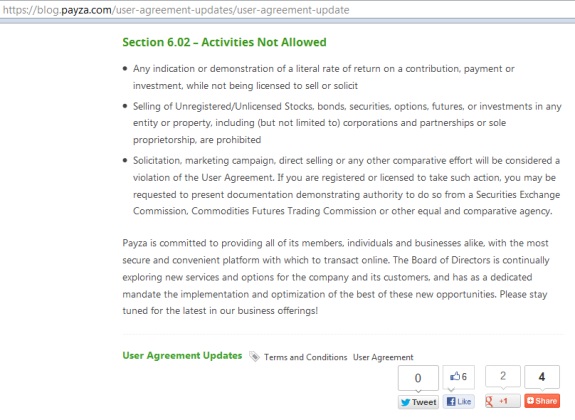
Payza has announced on its Blog that it is banning programs that show “[a]ny indication or demonstration of a literal rate of return on a contribution, payment or investment, while not being licensed to sell or solicit.”
Notice the phrasing (emphasis added): “any indication of a literal rate of return . . .”
What, precisely, does Payza mean? That expressing a literal return rate no longer is OK, but all can be cured if Payza’s current HYIP purveyors and Ponzi-board hucksters hide veiled or direct references to the return (perhaps in the back offices of HYIP affiliates or someplace else out of view of the public and search engines) or somehow find a word combination that avoids a literal expression of a return and instead relies on a deeply couched expression?
This is an important question because the HYIP “industry” cannot exist without the financial vendors that enable it, either by turning a blind eye or choosing not to peel back a single layer of the onion because choosing to see is bad for profits.
The last thing the “industry” needs is an invitation to become even more clandestine in its dealings, even more clever in its use of linguistic deception, information suppression or outright misinformation. The threat to individuals and the world’s financial infrastructure posed by con men and teams of accomplices in the thousands or hundreds of thousands already is untenable.
Payza needs to reassess its use of the phrase “literal rate of return.” Left untouched, that phrase easily could turn what’s already a dangerous, wink-nod “industry” into even more of one, thus providing scammers a new back door and actually making the problem of international financial chicanery on the Internet even worse.
Because AlertPay basically chose for years to gorge itself on HYIP fees and not to take the clues offered by the prosecution of e-Gold in the United States (by members of the same team that prosecuted the AdSurfDaily autosurf HYIP, BTW) and the disintegration of e-Bullion (while its operator stood accused of arranging the brutal contract slaying of his wife, a potential witness to e-Bullion’s Ponzi-sustaining fraud), we cannot yet offer Payza three cheers.
Owing to AlertPay’s history of choosing in e-Gold and e-Bullion-like fashion to see no evil, we question whether use of the word “literal” is just a means of signaling the scammers to do a better job of using language to disguise an investment program as something else or to hide and/or otherwise bury language that speaks to the investment elements. In the past few weeks, for example, the Payza-dependent JSS Tripler/JustBeenPaid “program” suddenly changed the language on its home page to say it offers a “LEGALLY COMPLIANT & PATENTED SYSTEM.”
Let’s pause for a moment to state the obvious, something that somehow often gets overlooked by HYIP apologists: Real people — living, breathing human beings — are being sucked into these utterly contemptible “programs” that are being enabled by processors such as Payza and SolidTrustPay.
And suddenly — out of the blue — JSS/JBP announced it was using a “WORLD RENOWNED LAW FIRM” to assure compliance. These things bizarrely clashed with recent claims by Frederick Mann, the purported operator of JSS/JBP, that attorneys could not be trusted, that government employees weren’t welcome in the “program,” that registering with securities regulators was a sign “you’ve signed up to be a slave, part of the slave system, and then they have jurisdiction over you and can shut you down” and that JSS/JBP members had nothing to fear because the “program” had no presence in the United States.
Now, all of a sudden, JSS/JBP has found the religion of compliance — or at least the language of the religion of compliance.
The New Religion Of Compliance
The Payza-dependent Zeek Rewards MLM “program” also is preaching the religion of compliance, even as it plants the seed that it can provide a JSS/JBP-like annual return of between 365 percent and 730 percent without being the Bernard L. Madoff Investment Securities LLC of multilevel marketing.
Part of what Zeek appears to be doing falls along the lines of not expressly stating a literal return. Welcome to the world of vomitous MLM in the year 2012. The players are eager to tell you what they’re not, less eager or completely unwilling to tell you what they are, and can bring a virtually unlimited supply of Stepfordians to the fore to help them cloud the issues.
Zeek has told the public it is not a “pyramid scheme.” It now says it will ban members who describe the “opportunity” as an investment program, despite the seed Zeek plants that participants can earn a return of between 1 percent and 2 percent a day. Some Zeek affiliates are practically tripping over themselves these days in what strikes us as a bizarre race to see how many times they can fit the words “attorneys” and “compliance” in their forum “defenses” for Zeek.
This Blog has not seen one instance in which a Zeek attorney has described the “program” as legal. Even so, we’ve seen plenty of examples in which Zeek affiliates implied that attorneys had given Zeek the all-clear and at least a few examples in which affiliates implied that agencies such as the SEC and FTC had scrubbed Zeek for compliance and found it in fine fettle. There have been hugely disingenuous claims from Zeek affiliates in this area — everything from describing the lack of any action against Zeek by the SEC or FTC as evidence that the agencies had examined Zeek and found nothing lacking to planting the seed that the lack of any action by the agencies is proof that Zeek is operating lawfully.
Zeek itself played this miserable game. In June, a North Carolina television station carried a report that suggested Zeek had been found to be operating lawfully by the office of North Carolina Attorney General Roy Cooper. Zeek linked to the TV station’s video report on its news Blog and certain Zeek promoters pointed to the report as proof of Zeek’s legitimacy.
But Cooper’s office said it never said Zeek was operating lawfully. After the TV station was contacted by Cooper’s office, which was concerned about the clarity and accuracy of the video report, the station removed the report. The incident produced one of those awkward moments that too often accompany the MLM trade: Zeek plainly liked the TV report because it construed Zeek as operating lawfully. The report then became a tool in Zeek’s PR arsenal — and Zeek wanted to make sure its affiliates had the same tool. It used its Blog to point affiliates to the video, and some of them predictably used it as evidence the Zeek critics were wrong and to plant the seed that Zeek had passed muster in North Carolina.
By linking to the report, Zeek tried to maximize its PR hand. When the report was removed, Zeek had nothing to say. The post on Zeek’s news Blog in which the company originally crowed that “Zeek Makes the Channel 2 News” now has been removed. Although the precise date and time in which Zeek removed the post are unclear, a Zeek affiliate with his own Blog sought to capitalize on the TV station’s report in a post that still remains.
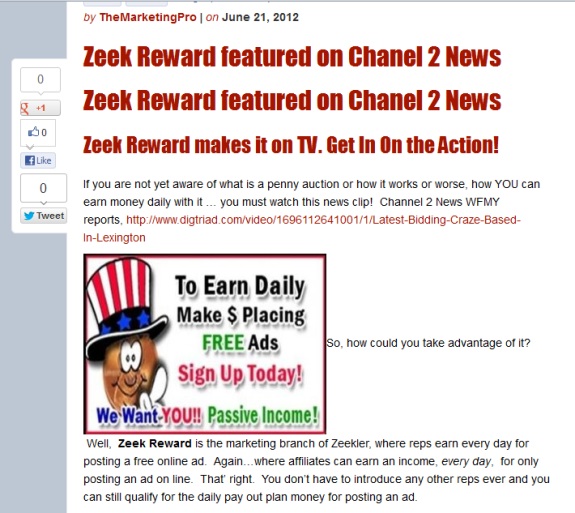
That post featured a three-tiered headline that screamed, “Zeek Reward [sic] featured on Chanel [sic] 2 News[.] Zeek Reward [sic] featured on Chanel [sic] 2 News[.] Zeek Reward [sic] makes it on TV. Get In On the Action!”
This post on the "Empower Network" Blog of a Zeek affiliate included a three-tiered headline and a link that pointed readers to a TV station's report about Zeek. Like Zeek itself, the "Empower Network" is an MLM "opportunity."
The affiliate’s post included a graphic that described Zeek as a “Passive Income!” opportunity. One link on the site pointed to the now-removed TV station video. Another link, however, pointed to post that included a YouTube version of the TV station’s report. That YouTube report included a headline and “crawler” in a language other than English.
Like the post that included the three-tiered headline about Zeek’s TV appearance, the second post included the graphic that described Zeek as a “Passive Income!” program. The claim about passive income speaks to the heart of the issue of whether Zeek is selling unregistered securities as investment contracts and trying to disclaim its way out of an encounter with regulators.
Although a TV station took down its link to a video report on Zeek, a YouTube version apparently existed.
The Culture Of Willful Blindness
Confusing messages appeared repeatedly when the AdSurfDaily Ponzi case was playing out. All of it was monumentally embarrassing to MLM. In one instance — while it was awaiting a key ruling from a federal judge in October 2008 on whether it had demonstrated it had sufficient income and was not a Ponzi scheme at a hearing it requested and the judge granted in the interests of justice — ASD insiders leaked a story that ASD expected a revenue infusion of $200 million from a penny-stock company.
The ASD Stepfordians immediately raced to forums to spread the good news. But skeptics immediately questioned the claim, pointing out that Praebius Communications — the penny-stock firm that supposedly was going to provide ASD a $200 million injection — did not even publish audited financials. SEC records later showed that, in October 2008, the same month ASD was awaiting the court decision and claiming a new $200 million was coming on board, Praebius stock was being pumped in a fraudulent-touting scheme.
Over time, serious questions were raised about whether certain MLMers within ASD were engaging in bids to obstruct justice. Rumors were planted that federal prosecutors had secretly admitted ASD was not a Ponzi scheme but were clinging to the case as part of a bid to save face. In 2008, ASD members who did not even question the bizarre claims coming from ASD or ASD insiders raced to forums and spread a false report that Ponzi charges had been dropped against ASD in Florida. That development prompted the attorney general of Florida to issue a statement that, not only had Ponzi charges not been dropped against ASD in the state, they’d never been brought to begin with. Indeed, Florida charged ASD with operating a pyramid scheme.
The names of both AlertPay and SolidTrustPay appear in court filings in the ASD Ponzi case. It is hardly coincidental that both Zeek and JSS Tripler/JustBeenPaid also have ties to the same processors, which are offshore from a U.S. perspective. These processors are the e-Golds and e-Bullions of Canada. They also are referenced in the Pathway to Prosperity Ponzi case, which the U.S. Postal Inspection Service called a global fraud affecting 40,000 people from 120 countries. In December 2010, the federal prosecutors handling the ASD case made the first public filing that referenced e-Bullion in the context of ASD.
In 2011, e-Bullion operator James Fayed was convicted of arranging the contact slaying of Pamela Fayed, his estranged wife who was found slashed to death in a Los Angeles-area parking garage. There is absolutely no doubt — zero — that e-Bullion was enabling Ponzi schemes. James Fayed has been sentenced to death for arranging the brutal killing of his wife, a potential witness against him.
It is beyond the pale — and almost beyond belief — that certain MLMers continue to insist there is something noble about these miserable money games, that they somehow represent the best of the free market and the entrepreneurial spirit, that they’ve somehow succeeded where other MLMs have failed.
What they are are recipes for financial and personal destruction that operate as slow-motion Ponzi schemes. They need to be destroyed, not duplicated. Far from being exciting, new niches — as some MLMers tell the story — they are form-shifting monsters that spread the greatest financial cancers devised in the history of mankind. They are so dangerous that external fraudsters target them as a means of unloosing secondary frauds — everything from the issuance and passing of bogus checks to organized credit-card fraud. Some of them have been linked to narcotics-trafficking or money-laundering operations. Some of the investigators who assisted in the ASD Ponzi case also developed this case.
From our May 16, 2010 report on the EMG/Finanzas Forex case (italics added):
Research by the PP Blog suggests the purported investment program was so sordid that promoters even claimed some of the funds were being used for the “humanitarian” purpose of assisting kidnapping victims in Colombia. In a sickening display of marketing theatrics, a claim was made that investors could “adopt” kidnapping victims for a payment of $1,000 and that the company would set aside $500 in corporate funds for each victim so that their families could have bright futures if the victims ultimately were released by their captors . . .
The HYIP scheme allegedly was associated with an entity known as Evolution Market Group (EMG), which purportedly had a Forex component known as FinanzasForex. Investigators alleged in January that there were schemes within schemes in a tangled web of domestic and international deception that featured dozens of bank accounts, shell companies and various fronts for money-laundering enterprises, including companies purportedly in businesses such as real estate and car washes.
The scheme was so corrupt, according to court filings, that some investors were told that, in order to leave the program whole, they had to recruit new investors, have the new investors pay them directly — and use the proceeds from the new investors to “recover” their initial outlays . . .
A Glimmer Of Hope
We do find a glimmer of hope in Payza’s announcement because Payza’s use of the phrase “any indication” implies it actually intends to exit the fraud-enabling business and intends to protect its reputation moving forward and make it harder for viral scammers who use its service to rob people without the aid of a gun.
A return — plainly stated or implied — would seem to fall under the “any indication” umbrella. Another indication is the presence of a “program” on the Ponzi boards. (Like ASD and EMG/Finanzas Forex, Zeek and JSS/JBP have a presence of the Ponzi boards.)
Yet another indicator of fraud is disclaimer language that seeks to cloud regulatory issues by planting the seeds that payouts are not guaranteed and that joining a “program” with a plainly stated or implied return does not constitute making an investment.
Much of the HYIP fraud “industry” exists because of the wink-nod deal and the willful blindness of the purveyors, including serial scammers with global reach and payment processors that gorge themselves on fees while serving what effectively are criminal combines consisting of like-minded individuals and “teams.”
Also banned, according to the Payza Blog post, is the the “[s]elling of Unregistered/Unlicensed Stocks, bonds, securities, options, futures, or investments in any entity or property, including (but not limited to) corporations and partnerships or sole proprietorship . . .”
Meanwhile, Payza says this (italics added):
“Solicitation, marketing campaign, direct selling or any other comparative effort will be considered a violation of the User Agreement. If you are registered or licensed to take such action, you may be requested to present documentation demonstrating authority to do so from a Securities Exchange Commission, Commodities Futures Trading Commission or other equal and comparative agency.”
Language in the full, six-paragraph announcement is exceptionally formal, bordering on the florid. But if the aim is for Payza to say no to fees and wrest itself from the wretched, pain-producing universes of HYIPs, autosurfs, cycler matrices and other “programs” that reach across national borders and fleece people on a global scale, the ornate language will become only a tiny footnote.
What’s far more important is that Payza will have said no to the scammers and a subculture of eager, greedy pitchmen who help financial crime spread globally and line their pockets on the current (or pending misery) of their marks.
It is possible these days for a scammer hiding in the darkest corners of the Internet to pick the pocket of a “customer” and contribute to a mortgage foreclosure or even the failure of a bank a continent away. Such “programs” often are pushed in the purported name of freedom itself, as a purported means of helping a neglected Everyman escape the shackles of poverty and become a free man who’s escaped his tyrannical captors.
But because the scammers’ schemes constantly evolve and because they often rely on overblown prose to disguise the fraudulent nature of their “programs,” it is going to take more than just words from Payza to incorporate any real change.
For example, could an “opportunity” that simply comes up with different naming conventions and avoids the traditional language of investments fool the checkers at Payza? Or could an “opportunity” that shields Payza from information perhaps by publishing it only in the back offices of the “opportunity’s” members escape scrutiny?
And because HYIPs and their willfully blind, serially disingenuous promoters already are infamous for wink-nod presentations, the use of disclaimers and even outright denials that an investment program of any sort is being offered, will the criminal minds who dominate this cancerous space go into overdrive to come up with new and more clever ways to disguise fraud schemes?
What To Watch For
Will panic engulf the HYIP sphere because of the Payza annoucement? Here are some things to look for:
Masked investment “programs” — perhaps aware they are under scrutiny — taking once-public forums offline and engaging in bids to further compartmentalize information and scrub negative information.
Management and affiliates of such “programs” making veiled or direct references to “attorneys” and “compliance” as a means of suggesting they are wholly lawful and embrace responsible corporate citizenship.
Increased lead times between “program” payment cycles, perhaps initially explained away as “growing pains.”
Payment bottlenecks to develop as “programs” horde cash or cash equivalents and become fearful that once-reliable enablers are hopping off the wink-nod fraud train because they realize the real world no longer is going to tolerate international lawlessness so a scammer on the TalkGold or MoneyMakerGroup forums can get rich by picking the pockets of senior citizens, deaf people, the unemployed and the struggling. (Also known as the AdSurfDaily problem.)
An uptick by scammers in the use of floridspeak as a means of talking around serious legal issues and masking the investment elements of a “program.”
The creation of bogus “regulatory agencies” and “trade groups” to create the appearance that a responsible party with legal authority is monitoring the store. (Note: A bogus regulator was an element of the George Theodule Ponzi scheme in Florida.)
The sale of purported memberships in these purported “regulatory agencies” and “trade groups.”
Read the Payza post, which was made Friday at the close of traditional business hours in the Eastern United States.
BULLETIN: The operator of an alleged HYIP fraud known as Eagle Trades LTD has been indicted on 49 Ponzi-related charges of wire fraud and money-laundering after a probe by the IRS, federal prosecutors in the Northern District of Ohio said.
Terrance Osberger, 48, of Genoa, Ohio, has been charged with one count of wire fraud and 48 counts of money-laundering, the office of U.S. Attorney Steven M. Dettelbach said.
Records show that the “program,” which allegedly offered returns in the hundreds of percent over 190 days, was promoted in 2009 on the TalkGold and MoneyMakerGroup forums. Separately, records show that state securities regulators in Massachusetts filed civil charges against Eagle Trades in 2011, alleging that two investors in the state were instructed by Osberger to send “their joint $103,000 investment through SolidTrustPay.”
SolidTrustPay is a Canadian payment processor favored by HYIP scammers.
The money sent through SolidTrustPay appears to have made its way into an Eagle Trades’ bank account in Ohio “over the course of several successive days,” according to the Massachusetts filing. But due to the “high volume of transactions and the intermingling of funds” in the account, Massachusetts investigators said they were “unable to definitely determine the ultimate destination of the $103,000 investment.”
Another Massachusetts investor was instructed by Osberger to wire $50,500 to a Cyprus entity known as F.B.M.E. Bank Ltd. That transaction proved to be difficult to reverse-engineer because of international red tape, according to the Massachusetts complaint.
The Massachusetts filings speak to the recovery difficulties investors may encounter when doing business with murky enterprises that may have one or more offshore arms, the ability to send and receive money via offshore payment processors and a corresponding ability to dump the money into domestic or international bank accounts — before moving it again.
Eagle Trades, according to an evidence exhibit prepared by Massachusetts investigators, told investors that they “will quickly notice that we have reengineered the mold regarding High Yield Investment Programs [HYIPs], making it easier than ever for you to be more informed regarding your investment options and earn a realistic, yet sustainable investment return.”
Current HYIPs such as JSS Tripler/JustBeenPaid are making similar claims about purported sustainability and reengineered platforms while also luring prospects by advertising returns that correspond to annualized returns in the hundreds of percent — and all while using SolidTrustPay and other offshore processors.
JSS/JBP purportedly is operated by Frederick Mann, a former pitchman for the AdSurfDaily Ponzi scheme, which also had a presence on the Ponzi boards, also used SolidTrustPay and also planted the seed that annualized returns in the hundreds of percent were possible.
ASD President Andy Bowdoin, 77, is jailed in the District of Columbia. He pleaded guilty to wire fraud in May and acknowledged ASD was a Ponzi scheme that never operated legally from its 2006 inception.
Over time, Eagle Trades told Massachusetts investors waiting for their payouts that it had been targeted in a”massive, seven-figure fraud” and provided a series of excuses about why investors were not getting paid. But federal prosecutors in Ohio now say Osberger was using Eagles Trades to defraud customers.
He potentially faces decades in prison.
“Osberger misused investor funds for his own personal use,” federal prosecutors said. “In other cases, he misused investor proceeds to repay earlier investors in what is commonly known as a Ponzi scheme, according to the indictment.”
And, federal prosecutors said, “Osberger listed Eagle as a subsidiary of Falcon Financial Group Limited, with addresses in Belize and the Commonwealth of Dominica and utilitzed Aurum Capital Holdings, which maintained several offshore bank accounts during the scheme, according to the indictment.
From "Exhibit 1" in the state-level case against the Eagle Trades HYIP in Massachusetts.
BULLETIN: Frederick Mann, the purported operator of the JSS Tripler/JustBeenPaid HYIP “program,” has acknowledged once again — this time by implication — that JSS/JBP pays members from funds received from new members. And Mann, who said the “program” had about a million members and acknowledged that nonmembers could not make purchases, has gone a step farther, saying that all payouts to members came from the funds of other members.
During the June 28 JSS/JBP call, however, Mann again returned to the claim that members were getting paid by other members.
“I was just curious about . . . those million members,” a caller on the June 28 JSS/JBP conference call asked Mann. “So, those payments coming in from the million members right now are just being redistributed to . . . the group of the million members. None of the money is coming into the program from other nonmembers and none of the money is going out of the program to other companies? It’s just circulating in the program. Is that right?”
Mann replied, “That’s essentially right, yes.”
Paying “old” members with funds from “new” members is the central element of a Ponzi scheme.
But Ponzi schemes often also exist within systems in which a “program” effectively pools the funds of all members and then makes disbursements from the common pool to members who qualify for disbursements. Prosecutors and regulators may describe such an “opportunity” as a money-cycling scheme. Such schemes typically feature either the “classic” Ponzi stucture (money flow from “new” to “old” members) or a structure that is less-than-classic but still is a Ponzi (money from “all” to “all” members) — with the money coming from common contributors of an enterprise that has no meaningful income streams (or, indeed, no income streams at all) beyond what members contribute.
AdSurfDaily, which became engulfed in Ponzi litigation in 2008 that led to a plea of guilty to wire fraud in May 2012 by ASD President Andy Bowdoin, had elements of both “new to old” and “all to all.” ASD had income streams external to the Ponzi, but they were insignificant. Court records show that ASD had no underlying, profitable business to sustain its advertised payout rate of 1 percent a day. Like JSS/JBP, ASD operated a closed system — and JSS/JBP purports to pay a daily return double that of ASD’s while also advertising an ASD-like commission structure.
JSS/JBP announced on its website last week that it had hired a law firm in Utah.
That announcement followed on the heels of a statement by Mann last month that JSS/JBP members perhaps should avoid words such as “compound” when presenting the “program.” Despite Mann’s suggestion, JSS/JBP features a video on its website that — within the first 11 seconds — advertises, “Daily Compounding to give yourself an Automatic Pay Raise!”
Internal inconsistencies are one of the hallmarks of HYIP fraud schemes.
“‘Compound’ . . . is really a word which [members] probably shouldn’t use.” — Frederick Mann, purported operator of JSS Tripler/JustBeenPaid, from conference call-recording dated June 14, 2012
“‘Repurchase’ is a great one.” — “Dale,” JSS Tripler/JustBeenPaid conference-call host, in response to Frederick Mann comment noted above, June 14, 2012
Frederick Mann
BULLETIN: (UPDATED 8:44 P.M. EDT U.S.A.) The JSS Tripler/JustBeenPaid HYIP Ponzi scheme that advertises a return of 60 percent a month and is soliciting $20,000 “purchases” announced during its June 14 conference call that it was adding an autosurf to its stable. The precise date upon which the autosurf would be introduced was not announced.
The announcement about JSS/JBP’s autosurf was made only two days after AdSurfDaily autosurf operator Andy Bowdoin was jailed in the District of Columbia. U.S. District Judge Rosemary Collyer revoked Bowdoin’s bail after federal prosecutors proffered evidence that Bowdoin had been involved in AdViewGlobal, an autosurf that launched after the seizure of more than $80 million in the ASD Ponzi case by the U.S. Secret Service in August 2008.
Meanwhile, purported JSS/JBP operator Frederick Mann appears to have backed away from his March 15 guidance to members that it was OK to use the language of investments when pitching the “program” to others.
Like Zeek Rewards, an MLM “program” that plants the seed it provides a return of between 1 percent and 2 percent a day without being an investment program, guides members not to use certain words and brags about its purported “compliance” arm, Mann now is suggesting JSS/JBP members should avoid the term “compound” when describing the JSS/JBP program.
Mann, according to 2008 promos, was a pitchman for ASD, the same autosurf that led to Ponzi charges against the now-jailed Bowdoin. In court filings, the U.S. Secret Service and federal prosecutors described ASD as an enterprise that engaged in linguistic sleight-of-hand in an ill-fated bid to skirt securities regulations.
ASD had links to the so-called “sovereign citizens” movement. JSS/JBP also may have such links.
Prior to the 2008 Secret Service seizure of tens of millions of dollars in the ASD Ponzi case, ASD advised members not to use the language of investments. AdViewGlobal launched after the Secret Service seizure and, like ASD, advised members not to use the language of investments.
AdViewGlobal disappeared mysteriously in the summer of 2009. During the spring of 2009, the ‘surf announced it was having banking troubles.
Zeek announced on Memorial Day that it, too, was having banking troubles.
ASD, AdViewGlobal, JSS/JBP and Zeek all use offshore payment processors. All four enterprises have (or had) promoters in common, and all four enterprises are (or were) being promoted on notorious Ponzi scheme forums such as TalkGold and MoneyMakerGroup.
On May 4, 2009 — the same date the President of the United States announced a crackdown on offshore scams — AdViewGlobal announced it had secured a new deal with an offshore wire facilitator. The ‘surf appears to have collapsed less than two months later.
EDITOR’S NOTE: The JSS Tripler/JustBeenPaid “program” may have links to the “sovereign citizens” movement. Potentially signaling a change in the “program’s” status quo, JSS/JBP has not posted a recording of its weekly conference call since June 7. As the screen shot below shows, JSS/JBP also now is soliciting “purchases” ranging from $1,000 to $20,000, suggesting the $20,000 purchase will produce a return of $400 a day.
The PP Blog accessed the JSS/JBP website (and the ad captured in the screen shot below) today through an ad on a site known as “ADsactly.com.” An ad for the purported Zeek Rewards MLM “program” also was featured on ADsactly.
Zeek and JSS/JBP are using at least two of the same offshore payment processors: SolidTrustPay and AlertPay (now Payza).
Francis Schaeffer Cox: Guilty in murder plot against public officials.
On Feb. 27, the PP Blog reported that a website registered in the name of purported JSS Tripler/JustBeenPaid operator Frederick Mann was publishing links to at least 11 videos featuring Francis Schaeffer Cox, an Alaska man implicated in an alleged “militia” murder plot against public officials.
These were among the remarks attributed to Mann at BuildFreedom.com — as a drop-down ad for JSS/JBB was displayed on the page.
“To what extent do the people and activities featured so far on this page provide real solutions? How far do they go toward neutralizing the real enemies? What activities need to be added to increase the prospects for freedom?”
The PP Blog almost immediately began to receive threats from “MoneyMakingBrain,” a Mann “defender.”
JSS/JBP purports to provide an investment return of 2 percent a day. It has no known securities registrations. In May, Mann said that government employees were “much worse than the Mafia.”
Government workers, Mann intoned in May, were “part of a criminal gang of robbers, thieves, murderers, liars, imposters.” He also speculated that the web servers of JSS/JBP could be targeted in a “cruise missile” attack.
Cox was convicted yesterday after a jury trial on a charge of conspiracy to commit murder. So, too, was Cox associate Lonnie Vernon.
EDITOR’S NOTE: The PP Blog first reported on the arrest in France of alleged international fraudster Vladislav Anatolievich Horohorin on Aug. 11, 2010. The arrest came as the result of an undercover operation the U.S. Secret Service conducted on online forums.
As the Blog reported at the time, “The arrest of Vladislav Horohorin is notable on a number of levels. First, the arrest in Europe was a result of an online fraud scheme that allegedly crossed international borders and made its way to the United States, where criminal charges were filed. At the same time, the crime allegedly involved the transfer of money though international payment processors. Perhaps more than anything, however, the case against Horohorin demonstrates that the U.S. Secret Service is “plugged into” forums that promote international lawlessness. His arrest is very bad news for credit-card crooks and HYIP and autosurf Ponzi schemers — and their corrupt colleagues.”
Today the PP Blog is reporting that the United States successfully arranged the extradition of Horohorin. His first court appearance was made in the District of Columbia, the venue from which the AdSurfDaily Ponzi case brought by the Secret Service is playing out. The office of U.S. Attorney Ronald C. Machen Jr., which was instrumental in guiding the ASD case, is in charge of certain elements of the Horohorin case.
The office of U.S. Attorney Sally Quillian Yates of the Northern District of Georgia also is handing elements of the Horohorin prosecution.
The allegations in the case are alarming: “According to the indictment filed in the Northern District of Georgia, Horohorin was one of the lead cashers in an elaborate scheme in which 44 counterfeit payroll debit cards were used to withdraw more than $9 million from over 2,100 ATMs in at least 280 cities worldwide in a span of less than 12 hours,” the Justice Department said in a statement. “Computer hackers broke into a credit card processor located in the Atlanta area, stole debit card account numbers, and raised the balances and withdrawal limits on those accounts while distributing the account numbers and PIN codes to lead cashers, like Hororhorin, around the world.”
** ______________________________________ **
UPDATE: Alleged international credit-card fraudster Vladislav Anatolievich Horohorin, also known as “BadB,” is in an American jail after an undercover probe on online forums by the U.S. Secret Service and a parallel investigation by the FBI.
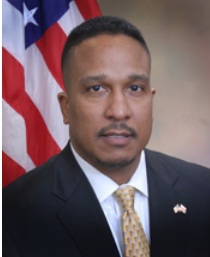
Ronald C. Machen Jr., U.S. Attorney for the District of Columbia
“We are pleased that he has been extradited to the United States to face these criminal charges in a District of Columbia courtroom,” said U.S. Attorney Ronald C. Machen Jr. of the District of Columbia. “This prosecution demonstrates that those who try to rip off Americans from behind a computer screen across an ocean will not escape American justice.”
Horohorin, whose age was listed as 27 after his August 2010 arrest in France on U.S. charges, also will be prosecuted in U.S. District Court for the Northern District of Georgia.
“International cyber criminals who target American citizens and businesses often believe they are untouchable because they are overseas,” said U.S. Attorney Sally Quillian Yates of the Northern District of Georgia. “But as this case demonstrates, we will work relentlessly with our law enforcement partners around the world to charge, find and bring those criminals to justice.”
News of Horohorin’s extradition by France to U.S. soil occurred against the backdrop of claims by an HYIP “program” known as JSS Tripler/JustBeenPaid that members must affirm they are not with the “government” and that the “program” is not located in any “unfriendly political jurisdictions.”
A JSS/JBP “defender” known as “MoneyMakingBrain” asserted in March that “law enforcement agencies don’t pay attention to what’s being said on forums and blogs.” The claim was at odds with various public records that show U.S. law enforcement pays close attention to forums and Blogs and even conducts undercover operations by infiltrating forums.
Among other things, “MoneyMakingBrain” asserted he’d defend JSS/JBP’s purported operator Frederick Mann “so help me God.” The PP Blog became the subject of threats from “MoneyMakingBrain.” JSS/JBP, which uses offshore payment processors, purports to provide a return of 60 percent a month, has no known securities registrations and may have ties to the “sovereign citizens” movement.
Underscoring the importance of the Horohorin arrest and extradition, Machen and Yates were joined in the announcement by the head of the U.S. Department of Justice’s Criminal Division and top officials from both the U.S. Secret Service and the FBI.
Horohorin, said Assistant Attorney General Lanny Breuer, was “one of the most notorious credit card traffickers in the world.”
“Due to our strong relationships with our international law enforcement partners, we secured his extradition to the United States, where he now faces multiple criminal counts in two separate indictments,” Breuer said. “We will continue to do everything we can to bring cybercriminals to justice, including those who operate beyond our borders.”
A top U.S. Secret Service official, meanwhile, said the agency viewed the alleged Horohorin caper as an “attack” on America’s financial system.
“The Secret Service is committed to identifying and apprehending those individuals that continue to attack American financial institutions and we will continue to work through our international and domestic law enforcement partners in order to accomplish this,” said David J. O’Connor, assistant director of investigations.
In addition to providing security for the President of the United States, the Secret Service is in charge of protecting America’s financial infrastructure. The agency has described AdSurfDaily as a “criminal enterprise,” with the Justice Department asserting that ASD was an example of an “insidious” business that permitted fraud to spread globally.
Just two days after Horohorin’s first appearance in a U.S. courtroom in the District of Columbia, AdSurfDaily members Todd Disner and Dwight Owen Schweitzer claimed that the federal prosecutors who brought the ASD Ponzi case in August 2008 had gone shopping for a “frendly [sic] forum” in which the government could enlist “some of their Washington D.C. operatives to become members of ASD, thereby making them potential witnesses.”
Disner and Schweitzer sued the United States in November 2011 for alleged misdeeds in the ASD case. Among other things, Disner and Schweitzer asserted that undercover agents who joined ASD had a duty to inform ASD management. The Secret Service described ASD as a massive online Ponzi scheme involving at least $110 million. ASD President Andy Bowdoin pleaded guilty to wire fraud last month, admitting ASD was a Ponzi scheme and that the company never operated legally from its inception in 2006.
Disner and Schweitzer now are affiliates for Zeek Rewards, a “program” that plants the seed it can provide an ASD-like return of 1 percent or more per day without being a pyramid scheme and without constituting an investment opportunity. The payout Zeek plants the seed it can provide is on par with the returns advertised by JSS Tripler/JustBeenPaid, which does not disclose its base of operations.
A top FBI official said the arrest of Horohorin showed that international agencies are working together to divorce criminals from their abilities to use computers to reach across borders to pull off egregious crimes.
“Horohorin’s extradition to the United States demonstrates the FBI’s expertise in conducting long-term investigations into complex criminal computer intrusions, resulting in bringing the most egregious cyber criminals to justice, even from foreign shores,” said Brian D. Lamkin , special agent in charge of the Atlanta division. “The combined efforts of law enforcement agencies to include our international partners around the world will ensure this trend continues.”
Court and other records show that Horohorin, like ASD, had a presence in both the District of Columbia and the Northern District of Georgia.
After the August 2008 seizure by the U.S. Secret Service of tens of millions of dollars in the AdSurfDaily Ponzi case, Dwight Owen Schweitzer became a pitchman for the Zeek Rewards "program," according to this ad. Schweitzer, a former attorney whose license was suspended in Connecticut, and fellow ASD figure Todd Disner sued the United States in November 2011 for alleged misdeeds in the ASD case, claiming the government had authored a "tissue of lies" in the ASD case and that ASD was a legitimate business. ASD President Andy Bowdoin admitted last month that ASD was a Ponzi scheme and that his business never operated legally from its 2006 inception, putting Bowdoin at odds with both Disner and Schweitzer and also purported MLM expert Keith Laggos, who curiously opined ASD was not a "Ponzie" scheme. Bowdoin is now jailed in the District of Columbia after a federal judge revoked his bond. The judge ordered Bowdoin jailed pending formal sentencing after the government proffered evidence that Bowdoin continued to promote fraud schemes after the seizure of $65.8 million from his personal bank accounts in 2008 and after Bowdoin was arrested in December 2010 on ASD-related charges of wire fraud, securities fraud and selling unregistered securities.
EDITOR’S NOTE: The filing by Todd Disner and Dwight Owen Schweitzer to which the PP Blog refers in this story was in response to a May 18 government motion to dismiss a lawsuit filed by Disner and Schweitzer against the United States in the Southern District of Florida or to transfer the case to U.S. District Court for the District of Columbia. The government filed its motions on the same date ASD President Andy Bowdoin pleaded guilty to wire fraud and admitted that ASD was a Ponzi scheme . . .
BULLETIN: In a curious, 23-page narrative, AdSurfDaily figures Todd Disner and Dwight Owen Schweitzer — who went on to become promoters of the Zeek Rewards MLM — have raised the prospect that they could be prosecuted for tax evasion because of the government seizure of ASD’s database in August 2008.
Neither Disner nor Schweitzer referenced Zeek in a filing stamped June 15 and entered today on the docket of U.S. District Judge Cecilia M. Altonaga of the Southern District of Florida. But the filing includes the name of Zeek consultant Keith Laggos, positioning Laggos as an expert on Ponzi schemes who ventured an opinion that ASD was not a Ponzi scheme.
The Disner/Schweitzer filing does not mention that Laggos repeatedly misspelled “Ponzi” as “Ponzie” in his purported expert opinion in the ASD case. Nor does it mention that Laggos was prosecuted by the SEC in a 2004 case that alleged he issued laudatory press releases and a laudatory article for a company that later become the subject of a securities investigation without disclosing he was being compensated for touting the purported opportunity.
Laggos neither admitted nor denied the SEC’s allegations, which involved a company known as Converge Global Inc. and a subsidiary known as TeleWrx Inc. The future Zeek consultant settled the 2004 SEC case by disgorging nearly $12,000, paying interest of nearly $2,000, paying a civil fine of $19,500 and agreeing to a five-year penny-stock ban.
Laggos was permanently enjoined in the case from violating Section 17(b) of the Securities Act, which makes it unlawful to tout a stock without disclosing the nature and substance of any consideration, whether present or future, direct or indirect, received from an issuer, underwriter or dealer.
An image of Laggos now appears in a commercial for Zeek, and a publication owned by Laggos has issued laudatory coverage of the purported MLM opportunity, which plants the seed it provides a return of between 1 percent and 2 percent a day without being a “pyramid scheme” and without constituting an investment opportunity.
It is known that Zeek and ASD had common promoters and that, beginning in about July 2011, some well-known figures in the ASD story began to emerge publicly as Zeek boosters. Among them are former “Surf’s Up” moderator Terralynn Hoy and former ASD pitchman Jerry Napier.
Hoy, who has been listed as a “Zeek” employee and has hosted at least once conference call for Zeek, was a moderator of a defunct ASD cheerleading forum known as “Surf’s Up.” While “Surf’s Up” still was operating, Hoy became a moderator of a forum that led cheers for an autosurf known as AdViewGlobal, which federal prosecutors now say was a fraudulent scheme backed by ASD President Andy Bowdoin. Both Surf’s Up and the AdViewGlobal forum, which also now is defunct, described ASD figure and purported “sovereign citizen” Curtis Richmond as a “hero.”
Richmond has a contempt of court conviction for threatening federal judges and once was sued successfully under the federal racketeering statute for participating in a scheme in which enormous purported judgments were filed against public officials and the officials were threatened with arrest. ASD is known to have had ties to tax deniers and “sovereign citizens.”
Some Zeek promoters also are pushing a purported “opportunity” known as JSS Tripler/JustBeenPaid that may have links to the “sovereign citizens” movement. Frederick Mann, the purported operator of JSS/JBP, does not identify where the purported opportunity operates from and has speculated that the servers of JSS/JBP could be targeted in a “cruise missile” attack by the government.
JSS/JBP advertises a return of 2 percent a day, a percentage that Zeek sometimes says it has matched or exceeded — though Zeek generally stays between 1 percent and 2 percent a day when the purported payout is averaged over a week, Zeek promoters claim.
As a Zeek promoter, Napier was given a puff piece last summer by the purported Zeek opportunity. An individual with the same name appears to have signed a petition in December 2008 calling for the U.S. Senate not to investigate ASD and Bowdoin, but to investigate various federal prosecutors and the U.S. Secret Service agent who brought the ASD Ponzi case in August 2008. The petition showing the name of “Jerry Napier” appears to have been signed by “Jerry Napier” after federal prosecutors brought a second forfeiture case against ASD-related assets on Dec. 19, 2008. As was the case with the August 2008 forfeiture filing by the government, the December 2008 case alleged a Ponzi scheme.
Today’s filing by Disner and Schweitzer advances a theory — even after Bowdoin’s guilty plea to wire fraud last month and public acknowledgment that he presided over a Ponzi scheme — that the government’s Ponzi claims constituted a “house of cards.”
It also plants the seed that prosecutors shopped the ASD case to a “frendly [sic] forum” in the District of Columbia to make it easier for the government to enlist “some of their Washington D.C. operatives to become members of ASD, thereby making them potential witnesses.”
Disner and Schweitzer claim that the seizure of ASD’s database in Florida was unconstitutional because it subjected them to an invasion of privacy and potentially a tax investigation.
“The plaintiffs have alleged that the information taken by the defendant places the plaintiffs in jeopardy of the defendant seeking to prosecute the plaintiffs for tax evasion as a result of the defendant having taken the plaintiffs records which are necessary to enable the plaintiffs to file accurate tax returns for the period covered by those records,” Disner and Schweitzer argued.
And Disner and Schweitzer further ventured (italics added):
As a result of the government’s action, the plaintiffs cannot file accurate tax returns, have lost both past and future business revenues, their reputations have been damaged to the extent that they recruited others to join in the program that the defendant alleged to be a Ponzi scheme, and by inference the plaintiffs have therefore enlisted others to participate in an illegal enterprise. The injuries suffered by the plaintiffs are not hypothetical or conjectural but are both finite and calculable. They have alleged that the actions taken against them were authorized without meeting the constitutionally guaranteed and statutorily increased requirements to establish probable cause and resulted in an illegal search and seizure of their property and effects.
Neither Zeek nor any of its executives or promoters have been accused of wrongdoing. Zeek, though, claimed last month that it was closing two U.S. bank accounts and looking to open an account with a bank it did not name.
Zeek is using offshore payment processors linked to numerous schemes that promote outsize returns. A Zeek auction arm known as Zeekler is auctioning sums of U.S. cash and telling winners it will pay them via offshore processors.
Components of the Zeek scheme are similar to components of the ASD Ponzi scheme.
In 2008, an HYIP scheme known as Legisi resulted in an an SEC civil prosecution. Court papers showed that the U.S. Secret Service and state regulators in Michigan were conducting an undercover probe of Legisi which, like JSS/JBP, sought to make participants affirm they were not government employees.
Like ASD’s Bowdoin, Legisi operator Gregory McKnight pleaded guilty to wire fraud. Records show that a tier of the purported Legisi program offered a daily return that was about one-fourth the daily return Zeek plants the seed can be realized through its purported opportunity.
Although Surf’s Up, which received ASD’s official endorsement as a news outlet with Hoy as a moderator, led cheers for ASD and Bowdoin until the forum mysteriously vanished in January 2010, Hoy appears to believe that Ponzi schemes actually can exist.
SSH2 Acquisitions, a Nevada company that listed Hoy as a director, claimed in 2010 that it had been defrauded in a Ponzi scheme.
 The purported operator of a “program” that claims to provide a return of 60 percent a month cannot meet with participants because of “security reasons,” according to a recording of the Aug. 9 conference call for JSS Tripler/JustBeenPaid.